This is the first in a series of articles that ask necessary but unpopular questions of the West’s defense-industrial complex.The best questions for this series are also the worst: they should be unpopular to ask and produce disquieting answers — when an answer is even possible.Got a provocative question?Send it to Content@cimsec.org.
Choose your own adventure: How is America’s next great power war most likely to end? (Pick one.)
A:The conflict is over rapidly, the U.S.is victorious, life goes on, and there’s nothing to analyze,
B: The conflict is over rapidly, the U.S.is defeated, and there’s nothing to analyze, or
C: The conflict is over quickly, everyone is dead, and there is nothing to analyze.
If you chose ‘none of the above,’ you probably don’t have a future as a late 80’s action screenwriter,1 but you might have one as a strategist.
Let’s pull the thread on the implicitly rejected option D: The conflict drags on.The defense establishment’s preoccupation with nuclear conflict throughout the Cold War has left a poisonous fallout of assumptions with an unexpectedly long half-life, chiefly the implicit expectation for a short, sharp conflict between great powers.While this expectation has many repercussions, from combat logistics to global economics to conflict termination, the attrition of combat aircraft is the topic today.
Each Services’ jet fighter community chase highly favorable attrition ratios; these cannot be assumed for a future conflict.Although current U.S. aircraft are exquisite feats of engineering that border on the miraculous, the trend creates an (un)virtuous cycle:Fewer aircraft need to be more exquisitely engineered, and more exquisite aircraft are fewer in number.This cycle is perhaps best described by Norman Augustine: “In the year 2054, the entire defense budget will purchase just one tactical aircraft. This aircraft will have to be shared by the Air Force and Navy 3½ days each per week except for leap year, when it will be made available to the Marines for the extra day.”
In contrast, a conventional conflict against a peer adversary could very easily result in the rapid attrition of top-line munitions and aircraft, both in the air and on the ground. From there, the war would become an entrenched stalemate – an admittedly unpopular yet plausible proposition.What actions should the United States and its allies take now as a hedging strategy?
The idea of a stalemated war in the skies over the sea against China or Russia echoes the First World War’s Western Front.Here, a stalemate is not defined by earthworks and wire across physical territory, but rather the inability to field a second wave of air power after the first is lost. American airpower would get very thin very fast after removing F-22s and F-35s from the flightline, and even more so when the runway itself becomes cratered rubble scattered with burning aircraft.
In the other corner, China’s significant production capabilities are neither unlimited nor invincible.The need for experienced replacement pilots to operate replacement aircraft may also be a critical factor in a future great power war, just as it was for Imperial Japan.In such a future, the ability to rapidly reconstitute a force of “acceptable” — vice “exquisite” — aircraft will be a vitally important factor for the United States to support war termination on favorable terms.
A threefold sequential hedging strategy can preserve and expand aerial combat power against rapid attrition. The first tenant is that an aircraft saved is an aircraft produced. Existing exquisite platforms need to be carefully employed and well-protected by legions of Unmanned Combat Aerial Vehicles (UCAVs). Secondly, the United States should seriously consider – and exercise – a true capacity to quickly return retired (“mothballed”) aircraft to active status. Third, and perhaps most importantly, the United States should invest in the design and prototype production of new, replacement combat aircraft, both manned and unmanned, that are designed to be built quickly and in large numbers.
No plan survives first contact with the adversary
General war is (generally) unpredictable. Clausewitz underscores the play of random chance and probability in war; Sun Tzu advises commanders to win without fighting. After all, when politics can deliver desired aims with certainty, why escalate to the chaotic friction of combat? The present authors have formal education in applied probability and endorse the wisdom of getting a sure thing over a wager with blurry odds. A great power war in the coming decades would likely result from strategic miscalculation by one or more belligerents – namely, the eventual loser(s) – which would create a heady and uncertain operational fog in the opening engagements. Many commanders would be tempted to extract a rapid, decisive victory from this melee. In an era of long-range, precision guided munitions fired across expansive distances, combat aircraft will be the closest thing to shock troops charging to the front line, the bloody fray of attrition warfare.
For the United States and its Allies, the risk to force for exquisite and hard-t0-replace platforms needs to be understood, acknowledged, and mitigated before they are exposed to risk in high-stakes battles. One way to mitigate the risk to force is to rely on unmanned systems; however, as these systems have similar – or in some cases, greater – complexity to manned systems, we expect that they will be subject to the same production shortages as manned systems.
Along this line of effort, an attractive and ongoing approach is to develop risk-worthy UCAVs, which would blunt enemy attacks while also distributing friendly sensors and weapons. These platforms are a low-hanging fruit, relatively inexpensive, and ready for accelerated operational development after decades of development. In addition to these operational considerations, producing these platforms in significant quantities in the near future would also help maintain the industrial base for accelerating production should the need arise.
The Replacements
Assume for a moment that the 80’s screenwriters are wrong, and a great power war drags on through months and years.What mitigations should the U.S. put in place now? An extended great power conflict would require a fallback capability of ‘second tier’ aircraft. Much of this fallback capacity already exists in the form of reserve and Air National Guard squadrons, many of which would likely see combat. Nevertheless, the logic of attrition also applies to these reserve aviation forces.Aviation-specific manpower policies, motivated in part by Imperial Japan’s pilot shortfall in WWII, grant a relative abundance of trained and experienced American combat aviators. Even so, they still need aircraft to fly.
Fortunately, the United States also has a large collection of retired but ‘preserved’ aircraft, most of which are at the ‘boneyard’, at Davis-Monthan Air Force Base in Arizona. While the modernization of current air wings are underway, budgeteers would do well to broadly consider service life extension programs (SLEP) for the ‘best’ past generation aircraft as a potential backfill for the attrition of manned aircraft and invest in greater capacity to accelerate the same.
While increasing funding for maintaining, preserving, and regenerating aircraft in the ‘boneyard’ is one course of action, it is admittedly not well-aligned with the broad incentives of either government or industry (with the possible exception of Arizona’s 2nd congressional district2).
A complementary approach is to prepare plans ‘at the ready’ for aircraft that can be rapidly built and fielded.For these aircraft specifically, the more parts they have in common with contemporary military (and civilian) aircraft, the better.
“Good Enough” means both things: good must be good and enough must be enough.
The first two hedges are admittedly expedient stopgaps, not optimal solutions. The most likely operational environment (the Indo-Pacific) and the most likely/dangerous belligerent (China) frames the required operational capabilities for replacement aircraft: They must have long range to be relevant across the vast distances of the Pacific and should be low-observable to evade detection and survive against capable air defenses.
Clear and well-justified system requirements should be based on a stable, reasonable, and coherent vision of the planned operational environment. The fiscal operational environment for this concept also means that it should be designed for rapid production and moderate cost, and by extension, low technological risk. Speed of production is a key performance parameter. Other performance parameters, like airspeed, should be strictly scoped against requirements creep.
Let good be good and enough be enough.
The Department of Defense should start with these modest and well-justified requirements to then develop progressive iterations of merely sufficient designs. Early and detailed systems engineering can help reduce risk, as can the conscious integration of mature technologies over the exotic temptation of leap-ahead capabilities. Government-ownership of these designs would allow widespread and more competitive aircraft production if the need ever arose, in keeping with the successful development and acquisition model of the Tomahawk cruise missile. A wide base of the American manufacturing and political establishment could be incentivized to invest in aerospace manufacturing capacity through the grant mechanism previously described in Distributed Manufacturing for Distributed Lethality.
Summation
The uncomfortable part of this question is not overcoming an engineering challenge or reinforcing the industrial base. It’s the recognition of just how destructive a future great power war would be, and that our best, most expensive ‘kit’ will likely be the first to be lost. It’s the acknowledgement of just how important a fieldable ‘second line’ of aircraft could be as a hedging strategy should most of each side’s exquisite first rate forces end up on each other’s spears.
Lieutenant Commander Collin Fox, U.S. Navy, is a foreign area officer serving as a military advisor with the Department of State. He is a graduate of the Naval Postgraduate School and the Chilean Naval War College.
Harrison Schramm is a retired Naval Aviator. He is President of the Analytics Society of INFORMS and a Principal Research Scientist at Group W.
The views presented are those of the authors and do not necessarily represent the views of any institution with which they are affiliated.
Endnotes
1. In turn: A. “Top Gun”, “The Final Countdown”, etc;, B. “Red Dawn”, C. “The Morning After.”
2. Where “the boneyard” is located.
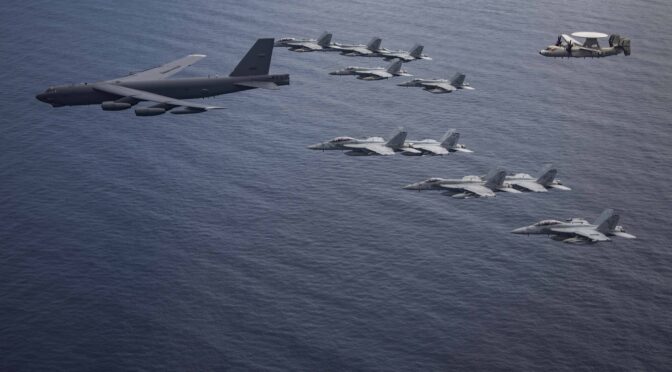
Featured Image: Navy aircraft from the Nimitz Carrier Strike Force and a B-52 bomber from Barksdale Air Force Base conduct integrated joint air operations over the South China Sea. (Lt. Cmdr. Joseph Stephens/Navy)
In Part 1, we summarized the principles and functions underpinning the 2018 National Defense Strategy’s (NDS) Global Operating Model (GOM). We outlined the factors that motivated GOM development, and showed how the GOM’s historical lineage informs its contemporary utility. In today’s second and final installment in this series, we will outline the strategic importance of forward “competition operations” to deterrence. We will then identify the necessary attributes for naval forces operating in the Contact and Blunt layers, as well as factors that strategists should consider when thinking about such operations. We will conclude with some thoughts regarding the GOM’s overarching implications for future naval strategy and force employment.
The Strategic Importance of “Competition Operations” to Deterrence
Contact layer support to deterrence goes beyond provision of support to the Blunt layer. To understand the connections between day-to-day competition operations in the Contact layer and deterrence against more acute aggression, one must first understand how the Chinese and Russians think about deterrence.
The (since superseded) 2013 edition of the People’s Liberation Army Academy of Military Science’s authoritative textbook Science of Military Strategy notes that deterrence strength derives in part from the “global strategic balance,” which itself is informed by assessments of “comprehensive national power” (CNP). CNP, which “takes economy and science and technology as the core” and includes political, military, and diplomatic power, significantly shapes Chinese perceptions of opportunities, threats, and risks. The Science of Military Strategy’s writers assert that all the elements of national power combine to “create optimum conditions for achieving the deterrence goal,” with the non-military elements serving as means that support the military element.1
Russian military theorists similarly define strategic deterrence as:
“…a package of coordinated political, diplomatic, economic, ideological, moral, spiritual, informational, scientific, technological, military, and other actions taken by a country to demonstrate the decisiveness of the political leadership to tap all instruments of state power consecutively or simultaneously—to stabilize the military, political, and strategic environment, to anticipate aggression, and to deescalate military conflict.”2
Russian strategic deterrence assessments are likely informed by estimates of the “military-political situation” at the global, regional, and local levels as well as estimates of how political, military, economic, and perhaps also technological power holistically blend into “state power.”3
We see, then, that both China and Russia link theater deterrence with strategic deterrence, and perceive strategic deterrence as encompassing more than solely military factors. It follows that Contact layer operations that affect Chinese and Russian perceptions of American political, diplomatic, informational, and economic influence within the Indo-Pacific and Europe therefore likely have deterrent effects beyond mere correlations of forces. The same is likely true for Contact layer operations that support the perceived bolstering of American economicstrength by supporting relations and favorable market access to trading partners, diplomatic and informational strength by reinforcing relations with longstanding allies and partners while cultivating new ones, and technological strength by demonstrating impressive new capabilities or fielding them quickly. And of course, Contact layer operations that shape perceptions of American political strength by demonstrating U.S. leaders’ resolve likely have a disproportionate effect on deterring Chinese and Russian leaders from engaging in aggression they deem to carry uncomfortable risk, and correspondingly for assuring allies and partners.
None of this is different from how U.S. forces, and especially naval forces, were employed forward in day-to-day operations during the Cold War in support of strategic competition—and in turn deterrence.4 Naval forces are unique within the Joint Force in that they are not garrison forces: they regularly deploy from homeports and bases into prioritized regions, and spend most of their deployed time in their intended operating environments at sea or ashore. Their operational tempo during day-to-day strategic competition must be carefully balanced against the time and resources needed to restore and preserve elements of their combat and material readiness. However, just as excessive operational tempos negatively affect naval force readiness, naval forces also lose elements of their competitiveness, deterrent, and combat effectiveness when they are reduced to a “fleet in being” kept pierside or in home waters.
Indeed, failures to confront adversary efforts to erode norms or employ calibrated sub-conventional aggression at forward friction points, especially within prioritized theaters, risks sending adversary leaders dangerous signals. As we have noted, authoritative Chinese and Russian literature strongly imply that military balances are just one of the metrics their leaders take into account within their decision calculus. U.S. efforts at maintaining deterrence stability benefit from convincing Chinese and Russian leaders that holistic strategic and theater trends remain unfavorable for them to chance major aggression.
This is not just an East Asia or Eastern Europe consideration given how Chinese and Russian estimates of U.S. strategic power are measured regionally as well as worldwide. The 2018 NDS prioritized the Indo-Pacific and Europe for day-to-day allocation of the most combat-capable and campaign-critical forces. That does not mean that U.S. forces should not be used economically to support strategic competition with China and Russia at carefully selected friction points elsewhere. Indeed, Contact layer operations at friction points in secondary theaters can sometimes offer low-cost opportunities for shaping Chinese and Russian global power estimates and complicating their abilities to score grand strategic gains they value highly, which in turn may indirectly reinforce deterrence against aggression in the priority theaters. Naval forces provide scalable, tailorable, and highly mobile options for performing these kinds of operations, including from within international waters with no dependence on a host nation. The 2018 NDS’ Dynamic Force Employment (DFE) concept, which emphasizes proactive and operationally unpredictable force movements and actions, provides an additional framework for tailoring Contact layer naval operations at select friction points in support of deterrence and strategic competition.
Deterrence stability also benefits from not pressing adversaries in places and ways that excessively exacerbate their fears based on their perceptions of extant circumstances, regardless of whether the U.S. instrument of competition is military, non-military, or both in tandem. Conventional deterrence works best if adversary leaders are primarily motivated by opportunism; it does not work as well if adversary leaders are primarily motivated by desperation and fear.5 An approach that carefully balances deterrence and competition with reassurance and restraint is necessary. It is essential that authoritative intelligence estimates of adversary mindsets, calculus, and objectives under extant circumstances dynamically inform Contact layer operations and Blunt layer configuration and posture.
Ultimately, decisions regarding which friction points U.S. naval forces should contest and in which theaters, and the timing and means for doing so, are reserved for U.S. political leadership. The naval services’ responsibility is to possess the requisite concepts, capabilities, and readiness to provide U.S. political leaders a range of flexible options for Contact layer actions, and a range of credible and effective options for Blunt layer design.
Attributes of and Considerations for Naval Forces in the Contact and Blunt Layers
A force’s required attributes—the functional characteristics it needs in order to support strategic objectives—can be derived from strategy to inform force design and development. The Contact and Blunt layers create demands for specific attributes from naval forces.
Responsive. Naval forces need to be positioned and postured such that they can respond on timelines necessary to generate circumstantial competitive or deterrent effects at forward friction points. This generally means Contact and Blunt layer naval forces must be forward deployed, whether permanently, rotationally, or situationally (e.g. DFE)—and whether at the front in a theater or further afield.
Credible. Adversary leaders must perceive forward naval forces’ capabilities, quantities, positioning, and posture as sufficient to make aggression unattractively costly and risky. It does not matter whether U.S. leaders perceive forward naval forces as sufficient or not; adversary perceptions are what matter for deterrent and competitive effect.
Persistent. Forward naval forces may need to remain in a given area during day-to-day or crisis operations for long periods. They require the ability to sustain themselves through economical consumption of fuel and materiel and by leveraging theater logistics networks.
Tailorable. Forward naval forces may be required to generate a wide variety of deterrent or competitive effects based on U.S. objectives and extant circumstances. This primarily translates into requirements for flexibility, selective visibility, and scalability:
Flexible. Forward naval forces possessing multi-mission capabilities and training, adjustable payloads (whether equipment, munitions, or personnel), and design features that enable operations in a wide variety of climates provide U.S. leaders with a range of tailorable options for deterrence and competition. By virtue of being forward, naval forces can also provide flexibility through their abilities to swing between Contact and Blunt layer tasks.
Selective Visibility. Clearly visible naval forces provide signaling options in support of deterrence and allied/partner assurance. Naval forces that are less visible if not virtually undetectable also support deterrence since they are difficult for an adversary to preemptively neutralize and can pose substantial latent threats to an adversary’s plans. Many naval forces can tailor their relative visibility by changing their operating postures. For example, normally highly visible surface combatants and Marine forces can reduce their emitted signatures to complicate adversaries’ abilities to detect, localize, and classify them. Conversely, normally undetectable submarines can conduct actions such as port calls to indicate their forward presence. A tailored balance across the spectrum of naval visibility, based on circumstances and adversary mindsets, can amplify deterrence credibility while generating competitive effects.
Scalable. Some deterrent or competitive effects benefit from the employment of a Carrier Strike Group or Marine Expeditionary Unit. Many others, however, only require a single ship (not even necessarily a major combatant) or a Marine rifle company. The ability to use aggregation or disaggregation to scale the naval forces allocated to a particular Contact or Blunt layer task based on mission needs and circumstances further expands U.S. leaders’ tailorable options. Furthermore, the ability to be highly economical in scaling naval force allocations for Contact layer tasks provides opportunities to generate competitive effects without detracting from the naval forces needed for Blunt layer credibility and responsiveness in priority theaters.
However, strategists must be aware of considerations that bound naval forces’ effective use in support of the Contact and Blunt layers.
Sustainability. As a Western Hemisphere nation with Eastern Hemisphere vital interests, U.S. naval force employment must balance between the forward presence required for Contact and Blunt layer tasks and the preservation of Surge layer material readiness. Continued elevated use of Carrier Strike Groups for Blunt layer tasks in the Middle East in recent years has complicated the fleet’s ability to maintain a stable balance between deployments and shipyard maintenance.6 This imbalance detracts from the time the fleet needs to restore readiness and availability for rotational deployments from the United States to the prioritized Indo-Pacific and European theaters—and for emergent Surge layer tasks. It also consumes ships’ operational service lives on a pace faster than was anticipated in their designs.7 In the absence of the larger fleet the nation needs, strategists are left with two options: marginal increases in the numbers of naval forces forward deployed in priority theaters (whether permanently at existing bases, or on extended deployments operating from transient “places” while using “multi-crewing” concepts), or marginal restraint regarding where, how often, and how many naval forces are rotationally deployed. The Department of the Navy can only provide recommendations regarding these options; decisions are reserved for the Secretary of Defense or the President, and successive Presidential administrations have been unwilling to substantially reduce naval presence in or refrain from responsively surging naval forces to the Middle East.8
Survivability. Blunt layer design in particular needs to balance naval forces’ visibility with preservation of their survivability. Adversaries need to perceive that a war-opening first salvo attack would fail to prevent forward U.S. naval forces from promptly reconstituting the critical mass needed to bog down the adversary’s thrusts against allied/partner forces or territories and bleed the adversary’s spearhead forces.9 A tailored mix of naval forces and postures, ranging from highly visible to nearly invisible, creates a mutually reinforcing maritime deterrent system. The integration of this maritime system within a broader Joint and Coalition theater deterrent further balances between the visibility and survivability attributes.
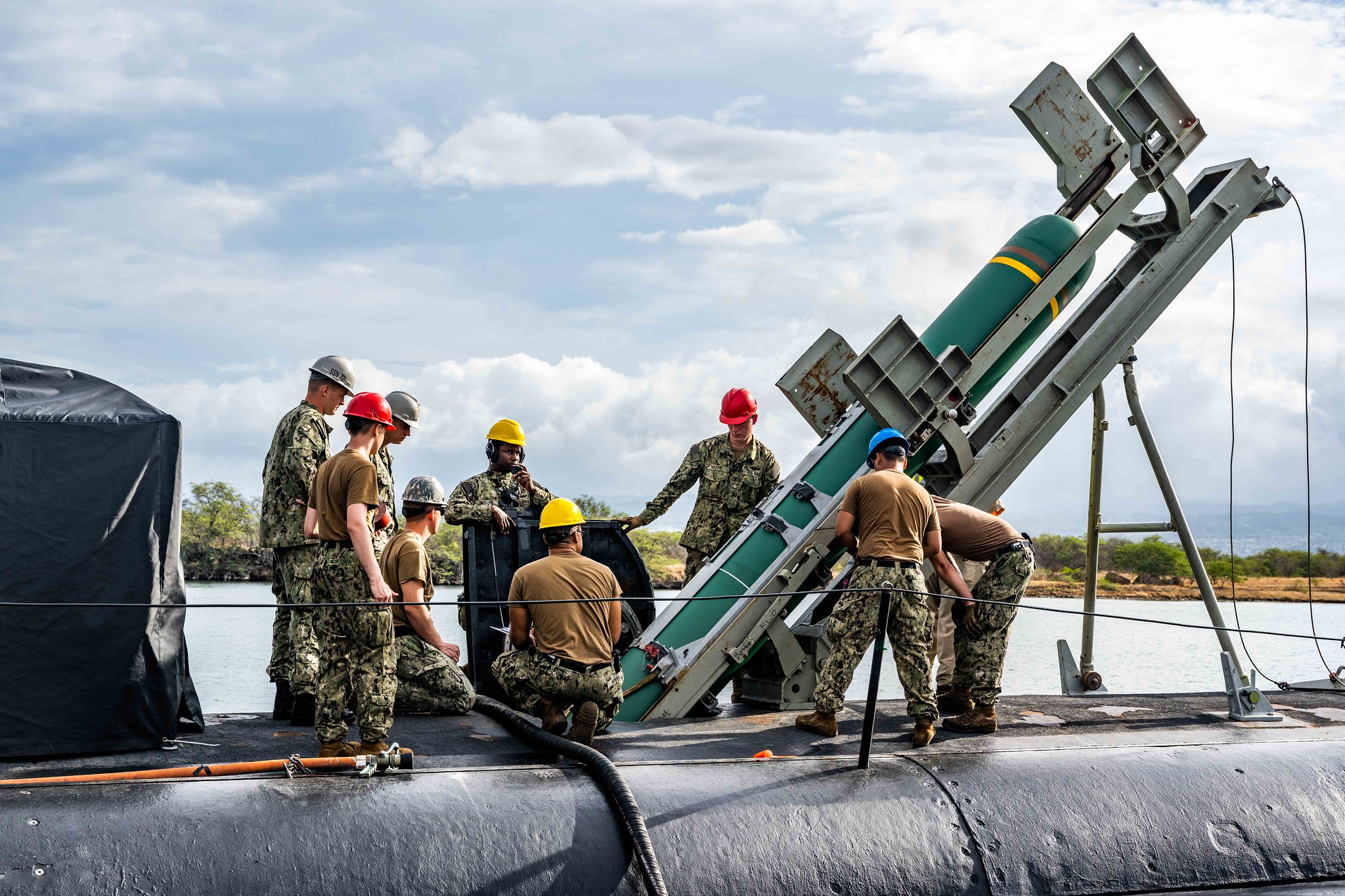
PEARL HARBOR (July 28, 2021) Sailors assigned to the Los Angeles-class fast-attack submarine USS Chicago (SSN 721), along with civilian contractors with BAE Systems, load a UGM-84 anti-ship harpoon missile onto the submarine in preparation of Large-Scale Exercise (LSE) 2021. (U.S. Navy photo by Mass Communication Specialist 1st Class Michael B. Zingaro)
Predictability. Some operational predictability can erode deterrence, as an adversary can note and potentially exploit the precise timing and timelines for when naval forces regularly rotate into and out of a theater. Likewise, if the flexible deterrent option selected to push back on an adversary’s provocations tends to be the same every time, that option’s effectiveness may decline. However, operational unpredictability can also erode deterrence, as an adversary can take note of and exploit transient naval presence near a friction point if it believes it can score a desired gain before the U.S. can dynamically reposition naval forces for Contact or Blunting purposes. Operational unpredictability can be especially destabilizing if adversary leaders misperceive U.S. intent behind a maritime DFE operation, resulting in inadvertent provocation. Authoritative, intelligence-informed operational planning is essential for mitigating risks stemming from a contemplated operation’s predictability or unpredictability.
Naval Forces and the New Era of Enduring Strategic Competition
The post-Cold War era was born with the Soviet collapse. It arguably ended with the rise of Chinese and Russian revisionist ambitions, and their development of significant military capabilities aimed at supporting those ambitions. We therefore find ourselves at the dawn of a new era—a “return to history.” The circumstances of the Cold War and the present are hardly identical, but they are similar enough to make it worthwhile for us to look back into our strategic past to understand what old concepts might offer value as adapted to present and future challenges.
The U.S. military’s ability to hold the line during what will likely be a multi-decade strategic competition with China and Russia, and especially the prevention of ruinous major war, requires the intelligent and balanced use of forces in prioritized regions and globally. The GOM represents a 21st century update of America’s Cold War-era strategic approach for doing so. Just as was the case during that twilight struggle, naval forces provide unique attributes for supporting deterrence and strategic competition at forward friction points. Disciplined implementation of the GOM enables use of naval forces for strategic competition without undermining deterrence, and vice versa.
There is no analytic evidence the United States needs a fundamentally different naval force architecture (which includes but is not necessarily limited to fleet composition, organization, command and control philosophy, and operating concepts) to support strategic competition from the one it needs to support deterrence. From the birth of our democratic republic onward, we designed the bulk of our naval forces for utility in armed conflict, which gave them the versatility they needed for steady state competition operations and the combat credibility they needed for deterrence. Rigorous quantitative analysis may find naval force architecture should change on the margins in order to provide better balances between the needs of deterrence and strategic competition, but as we have shown the two do not distinctly trade against each other when intelligently applied within a strategic design like the GOM.
The United States does need a larger Navy-Marine Corps team in order to increase its sustainable ability to support the deterrence and geopolitical competition requirements flowing from national strategy, or rather to reduce strain on and risks to naval force material readiness. To do this, the naval services will need to explain to the American people in more concrete terms how investments in larger naval forces will augment our nation’s ability to protect our security, prosperity, and influence. The GOM offers the foundation—and the American historical continuity—for explaining the naval services’ strategic contributions.
Even with larger naval forces, however, strategists will still need to prioritize where, when, and how naval forces are allocated to Contact and Blunt layer tasks. Chinese military capabilities and capacity are likely to grow on a scale that threatens U.S. vital interests in ways not seen since the Cold War, if ever. Russian military capabilities and capacity likely will not grow on anything close to a similar scale, but will retain the ability to pose threats to U.S. vital interests. The Navy-Marine Corps team will not be able to use force growth alone to solve their naval strategic challenges. Integrated solutions with the other services, the interagency, and allies and partners will be necessary for deterrence and strategic competitive effectiveness. The Contact and Blunt layers provide the functional logic along which all these players can combine their respective efforts with naval forces to greatest effect.
Specifically, the United States should look to allies and partners to shoulder significant roles within the Contact and Blunt layers. Allies and partners should specifically carry solitary responsibility for direct defense of their maritime territories and commercial interests from sub-conventional “salami slicing” aggression, if only because this often constitutes enforcement of their national laws and sovereignty. U.S. naval forces can and should operate in ways that counter Chinese and Russian threats of using conventional escalation to undermine allied and partner constabulary operations. U.S. naval forces can also provide allied and partner constabularies with intelligence, surveillance, and reconnaissance support. U.S. naval forces should not, however, actually perform domestic maritime policing actions for allies and partners. Nor should U.S. naval forces spend scarce resources developing duplicative Blunt layer capabilities in which allies or partners arguably possess competitive advantage, such as flotillas of fast coastal missile boats.
Absent the GOM, U.S. leaders would face reduced strategic influence in critical regions, with associated decrements to the American people’s security and prosperity, as the non-military forms of U.S. national power would lose the forward military power bulwark they rest upon. U.S. leaders would correspondingly also lose options for proactive, credible conventional deterrence by denial against aggression. The majority of options would likely become reactive, and in fact compel near-total reliance on conventional deterrence by punishment with all its shortcomings, if not nuclear deterrence and its credibility issues relative to deterrence of sub-conventional or limited conventional aggression.10The practical consequence would likely be the United States retreating to its pre-1945 de facto strategic emphasis on compellence by rollback, which lacks credibility against nuclear-armed great powers.
Current U.S. leaders show zero signs of wanting to live in such a world.11 And so the GOM will likely survive in the 2022 NDS to the benefit of U.S. naval forces, perhaps not in name, but almost certainly in functions.
Paul Lyons is a Principal Policy Analyst at Systems Planning and Analysis (SPA), Inc. and a former Surface Warfare Officer with four command-at-sea tours in the Pacific. He previously served as Branch Head for Global Policy and Posture within the Office of the Chief of Naval Operations and as the Navy’s lead maritime strategist within the Office of the Secretary of Defense’s 2018 NDS Core Team.
Jon Solomon is a Principal Policy Analyst at SPA, Inc. and a former Surface Warfare Officer.
The views expressed herein are solely those of the authors and are presented in a personal capacity. These views do not reflect the official positions of SPA, Inc., and do not necessarily reflect the policies or positions of the U.S. Department of Defense, any U.S. armed service, or any other U.S. Government agency.
References
1. “Science of Military Strategy (2013).” Translated by Air University China Aerospace Studies Institute, 2021; Pg.84, 86, 94, 102, 104, 130, 136, 139, 152, 168-169, 178, 188-189, 306.
2. “Russia Military Power.” U.S. Defense Intelligence Agency, 2017; Pg23.
3. “Russian Assessments and Applications of the Correlation of Forces and Means;” Pg22-25, 104, 112, 127-128.
4. The 1980s Navy’s Maritime Strategy described these functions in detail. See John D. Hattendorf and Peter Swartz, eds. “U.S. Naval Strategy in the 1980s: Selected Documents. Newport, RI: Naval War College Press, 2008; Pg48-52, 154-162, 213-214, 282-287, 306-308.
5. See Janice Gross Stein, “Deterrence and Reassurance,” in Behavior, Society, and Nuclear War, Vol. 2, eds. Philip E. Tetlock et al. (New York: Oxford University Press, 1991), Pg16; and Robert Jervis, The Meaning of the Nuclear Revolution (Ithaca: Cornell University Press, 1989), Pg137, 139–40.
8. Bryan McGrath. “The Problems of Politics and Posture are Baked into the System.” War on the Rocks, 05 January 2022, https://warontherocks.com/2022/01/the-problems-of-politics-and-posture-are-baked-into-the-system/
10. Jonathan F. Solomon. “Demystifying Conventional Deterrence.” Strategic Studies Quarterly, Vol. 07 No. 4 (Winter 2013), Pg120, 135.
11. The Biden Administration’s March 2021 Interim National Security Strategic Guidance states that “At its root, ensuring our national security requires us to… Promote a favorable distribution of power to deter and prevent adversaries from directly threatening the United States and our allies, inhibiting access to the global commons, or dominating key regions…” (Pg9). It also states that “Elsewhere, as we position ourselves to deter our adversaries and defend our interests, working alongside our partners, our presence will be most robust in the Indo-Pacific and Europe.” (Pg15). Had the Office of the Secretary of Defense’s 2021 Global Posture Review opted in favor of reduced force allocations to the Indo-Pacific and Europe, in favor of increased reliance on achieving deterrence through DFE or responsive force surges forward, it would have suggested a 2022 NDS shift away from deterrence by denial and towards deterrence—or compellence—by punishment, possibly paired with rollback campaigns.
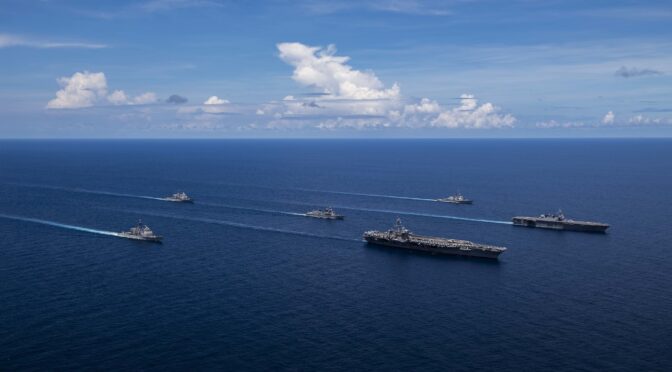
Featured Image: SOUTH CHINA SEA (Oct. 30, 2021) U.S. Navy Ticonderoga-class guided-missile cruiser USS Shiloh (CG 67), U.S. Navy Ticonderoga-class guided-missile cruiser USS Lake Champlain (CG 57), U.S. Navy Nimitz-class aircraft carrier USS Carl Vinson (CVN 70), U.S. Navy Arleigh Burke-class guided-missile destroyer USS Milius (DDG 69), Japan Maritime Self-Defense Force (JMSDF) Murasame-class destroyer JS Murasame (DD 101), and JMSDF Izumo-class helicopter destroyer JS Kaga (DDH 184) transit together in the South China Sea. (U.S. Navy photo by Mass Communication Specialist 2nd Class Haydn N. Smith)
The 2018 National Defense Strategy (NDS) heralded the end of the Department of Defense’s quarter century of emphasis on countering transnational violent extremist organizations and rogue regional powers. Although those threats hardly evaporated, they pale in comparison to the threats posed by China and Russia that have emerged over the past decade. As DoD’s NDS public summary observed, Chinese efforts to seek “Indo-Pacific regional hegemony in the near-term and displacement of the United States to achieve global preeminence in the future” combined with Russian efforts to “shatter the North Atlantic Treaty Organization and change European and Middle East security and economic structures to its favor” fundamentally endanger U.S. security, prosperity, and influence.1
The 2018 NDS explains how DoD and the Joint Force will reorient for the new era of strategic competition with adversarial great powers. It recognizes that China and Russia institutionally perceive themselves as being in conflict with the U.S. and its allies, albeit below the level of open and violent clashes of arms. It likewise prioritizes the use of U.S. military power to deter Chinese and Russian leaders from forcible aggression while also shaping the strategic environment in priority theaters such that if deterrence fails, the U.S. and its allies can defend from the strongest political-military situation attainable.
The 2018 NDS designates the Indo-Pacific theater as the highest priority for day-to-day allocation of Joint Forces, and Chinese military power as the pacing threat for much of the Joint Force’s capability development efforts. It also recognizes the need to support competition and deterrence of aggression in Europe and the Middle East while simultaneously defending the American homeland. The 2018 NDS calls its approach for doing so the Global Operating Model (GOM). In our opinion, the GOM is the most important yet perhaps one of the least widely understood elements of the strategy.
This two-part series will illuminate the importance of the GOM, especially its Contact and Blunt layers. It will outline the GOM’s continuity with the successful U.S. strategic approaches to competition and deterrence during the Cold War, explain how this lineage informs the functions performed by the Contact and Blunt layers, and illustrate how naval forces uniquely contribute to and bridge between those two layers’ functions. In particular, it will show how the Contact layer is designed to reinforce deterrence through day-to-day shaping of how China and Russia perceive regional as well as global trends and balances involving all forms of national power, as well as by complicating their abilities to achieve strategic objectives below the level of armed conflict. Lastly, it will outline the attributes required of naval forces to support the Contact and Blunt layers, as well as the GOM’s overarching implications for future naval strategy and force employment.
One of us (Lyons) had the honor of serving as the Navy’s lead strategist on the 2018 NDS Core Team and was a member of the small group that developed and defined the GOM concept. Even though the GOM is applicable to all the services, the Contact and Blunt layers have unique—and intentionally designed—implications for the Navy-Marine Corps team. And even though the Biden Administration’s Office of the Secretary of Defense will soon debut a new NDS, which could result in the GOM’s elimination as an official construct, the Contact and Blunt layers’ logic will live on as long as their NDS continues to embody a forward strategy for competition, deterrence, and defense. We will outline why we believe this is so and what it means for America’s naval services.
The GOM’s Principles
On first glance the GOM’s four layers—Contact, Blunt, Surge, and Homeland—may seem to be entirely geographical. In actuality, they are primarily functional—they describe the roles the Joint Force is to perform, whether shaping or contesting below the level of armed conflict in support of competition and deterrence, or during the initial stages of an armed conflict to seize the initiative and enable a broader defense against aggression. The roles of each GOM layer translate into a logic for how Joint Forces are to be positioned, postured, and employed across the conflict spectrum, and are a major source of demand signals for Joint Force capability development.
The layers’ official public descriptions are sparse:
Contact layer forces “work by, with, and through allies and partners to compete and defend U.S. interests below armed conflict.” Should an armed conflict erupt, Contact forces “enable Blunt and Surge forces.”
Blunt layer forces “comprise combat-credible forward deterrent forces capable of contesting aggression by delaying, degrading, or denying enemy forces from quickly seizing their objectives.”
Surge layer forces “provide agile, war-winning capabilities and capacity to reinforce the Contact and Blunt layers.”
Homeland layer forces “persistently defend the American people and its territory from foreign attack.”2
Further details emerged from the Senate testimony of former Deputy Assistant Secretary of Defense (Strategy and Force Development) and 2018 NDS Core Team leader Elbridge Colby:
Contact layer forces “orient activities in the ‘gray zone,’ especially in concert with allies, to prevent Russia or China from dominating the crucial perceptual landscape or surprising the United States and its allies by augmenting allied defenses, collecting intelligence, and challenging salami-slicing activities.”
Blunt layer forces “focus U.S. and allied force development, employment, and posture on the crucial role of ‘blunting’: delaying, degrading, and ideally denying the enemy’s attempt to lock in its gains before the United States can effectively respond. Crucially, blunting is a function – not an attribute – of the force. The central idea is to prevent China or Russia from achieving a fait accompli – it does not require a fixed force. Indeed, blunting is likely to be done best by a combination of munitions launched from afar as well as forces deployed and fighting forward.” (Emphasis from the original.)
Surge layer forces “provide the decisive force that can arrive later, exploiting the operational and political leverage created by the ‘Blunt’ Layer to defeat China or Russia’s invasion and induce them to end the conflict on terms we prefer.”
Homeland layer forces “deter and defeat attacks on the homeland in ways that are consistent with the Joint Force’s ability to win the forward fight and favorably manage escalation.”3
Hence, the layer a unit is operating in is defined by the functions it performs based on its assigned roles, and not necessarily by where it is located.
Genesis
During the 1990s and early 2000s, with the exception of forces employed in intervention operations or the Afghanistan and Iraq wars, forward deployed U.S. forces were primarily used day-to-day to tangibly demonstrate commitments to allies and partners worldwide, symbolically underscore regions’ importance to U.S. national interests, and underwrite peace and security within those regions. These forward forces did contribute to theater deterrence, but it was not their most highly prioritized function. The bulk of the post-Cold War U.S. deterrence approach rested on threatening regional “rogue” states with decisive defeats at the hands of forces surged into theater. If these countries embarked upon aggression, U.S. forward-deployed forces were not configured to deny them quick, cheap attainment of objectives since it was assumed that indications and warning would provide sufficient time for the Joint Force to amass an “iron mountain” in theater. Nor could these countries wield credible threats of escalation to outcompete U.S. power.4 U.S. forward-deployed forces’ task was to provide options for unleashing prompt and limited—albeit in some cases debilitating—conventional punishments in response to aggression.
The U.S. deterrence approach faced stresses during 2003-2011 due to the high demands of the Afghan and Iraq wars. The Navy’s ability to sustainably deploy combat-credible forces in theaters other than the Middle East was especially challenged by the steady decline in fleet size during this period.5 The approach was ultimately rendered ineffective, however, by the rapid growth in Chinese military power in eastern Asia and the parallel rise of aggressive Chinese regional revisionism following the 2008 global economic crisis, as exemplified by their 2012 seizure of Scarborough Shoal from the Philippines, their efforts to militarize contested islands and shoals in the South China Sea, and their probes against the Japanese Senkaku Islands. Russia’s military modernization following the 2008 Russo-Georgia War, its annexation of Ukrainian Crimea and proxy invasion of eastern Ukraine in 2014, and its subsequent stream of provocations along NATO’s territorial frontiers and maritime periphery further compounded the problem. U.S. forces in the Western Pacific and Europe were neither deployed in sufficient steady-state numbers, nor employed optimally in combination with the non-military elements of national power to dissuade China and Russia from limited acts of aggression below the level of armed conflict.
The 2018 NDS Core Team recognized the inadequacies of the post-Cold War force allocation models, especially in the face of enduring and perpetually evolving Chinese and Russian provocations or aggression below the level of armed conflict, reinforced by latent threats of conventional escalation (e.g. so-called “grey zone” or “sub-conventional” actions). The NDS Core Team also recognized that the solution required creation of a strategic construct that would require Joint Forces to be persistently present at or near points of friction in priority theaters to demonstrate American resolve and uphold international law, normative behavior, and diplomatic resolutions of bilateral and multilateral challenges while deterring escalation. And so the NDS Core Team tasked a small group of its members to develop the GOM.
The GOM development group recognized that the construct they devised levies a demand on the Joint Force and—to the seminal point of this article—especially on Navy forces to contribute to the Contact and Blunt layer functions through sustainable balancing of permanent forward basing, rotational deployments from U.S. homeports, and complementary unpredictable Dynamic Force Employment (DFE) actions. They also recognized that the construct they created was actually a 21st Century evolution of the successful model the U.S. used throughout the Cold War.
We’ve Done this Before
From the late 1940s through 1991, and excluding U.S. forces directly engaged in combat actions during the Vietnam War, the U.S. deployed Contact and Blunt layer-analogous forces in Western Europe and East Asia to deter and dissuade Soviet (and to a lesser extent, Chinese and North Korean) leaders from aggression, in part by shaping these leaders’ perceptions of costs and risks. U.S. forces did this by positioning and posturing combat-credible forces such that an adversary bent on territorial aggression against a U.S. ally would not be able to avoid clashing with U.S. forward forces—whether in central Europe, the Taiwan Strait, or South Korea—thereby creating a risk of potential nuclear escalation that adversary leaders deemed intolerable. In recognition of the fact that Soviet and North Korean conventional forces possessed quantitative advantages over combined U.S. and allied forces in central Europe and South Korea, the U.S. allocated additional Surge layer-analogous conventional forces for prompt movement forward in the event of crises or armed conflicts.
The combination of persistently forward U.S. forces and the demonstrated U.S. ability to surge massed conventional forces reinforced allied and partner military—and therefore political—confidence in America. This in turn supported U.S. employment of its diplomatic, economic, and informational elements of national power to contain and counter adversaries’ influence. All the while, the U.S. employed a subset of forces for the direct defense of the American homeland. U.S. defense strategy during the Cold War did not need to explicitly define the existence of Contact, Blunt, Surge, and Homeland layer functions—each was self-evident.
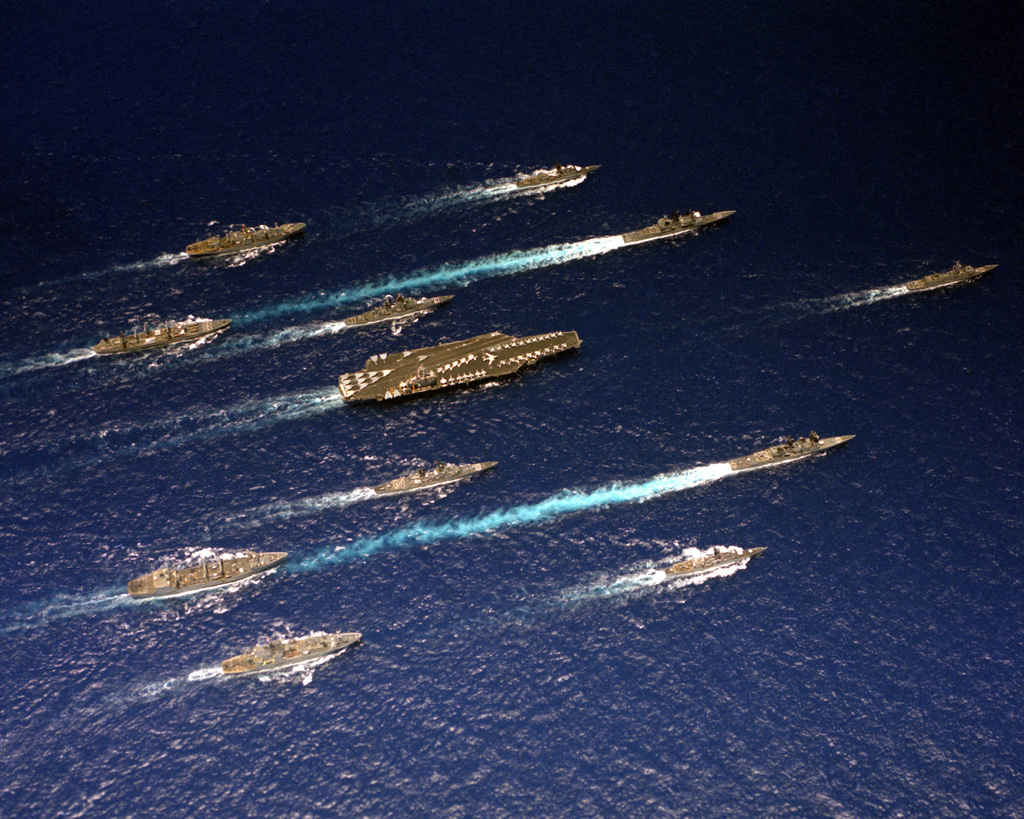
December 14, 1986 — An overhead view of Battle Group Charlie underway in formation, with nuclear-powered aircraft carrier USS CARL VINSON (CVN-70) in the center of the group. (Photo by PH2 Protz, via U.S. National Archives)
The Cold War analogy also shows how the Blunt, Surge, and Homeland functions are latent—they only become active in the event of adversary attack. The Blunt layer’s functions are most important for shaping competitor perceptions of the military balances in priority theaters, both day-to-day and as augmented by bomber strikes, airborne force insertions, and other Blunt-layer type capabilities that can be promptly brought to bear from afar. The Soviets used the term “correlation of forces” to define how they calculated theater as well as strategic military balances in reference to their wartime prospects; the contemporary Russian General Staff uses an expanded framework that includes estimates of the “military-political situation” and perhaps additional metrics for much the same purpose.6 It is unclear whether the Chinese People’s Liberation Army employs frameworks analogous to the correlation of forces or the military-political situation, but elements of both may be present within the Chinese concept of measuring “comprehensive national power” (CNP), and force balances likely factor significantly within PLA operations research activities.7
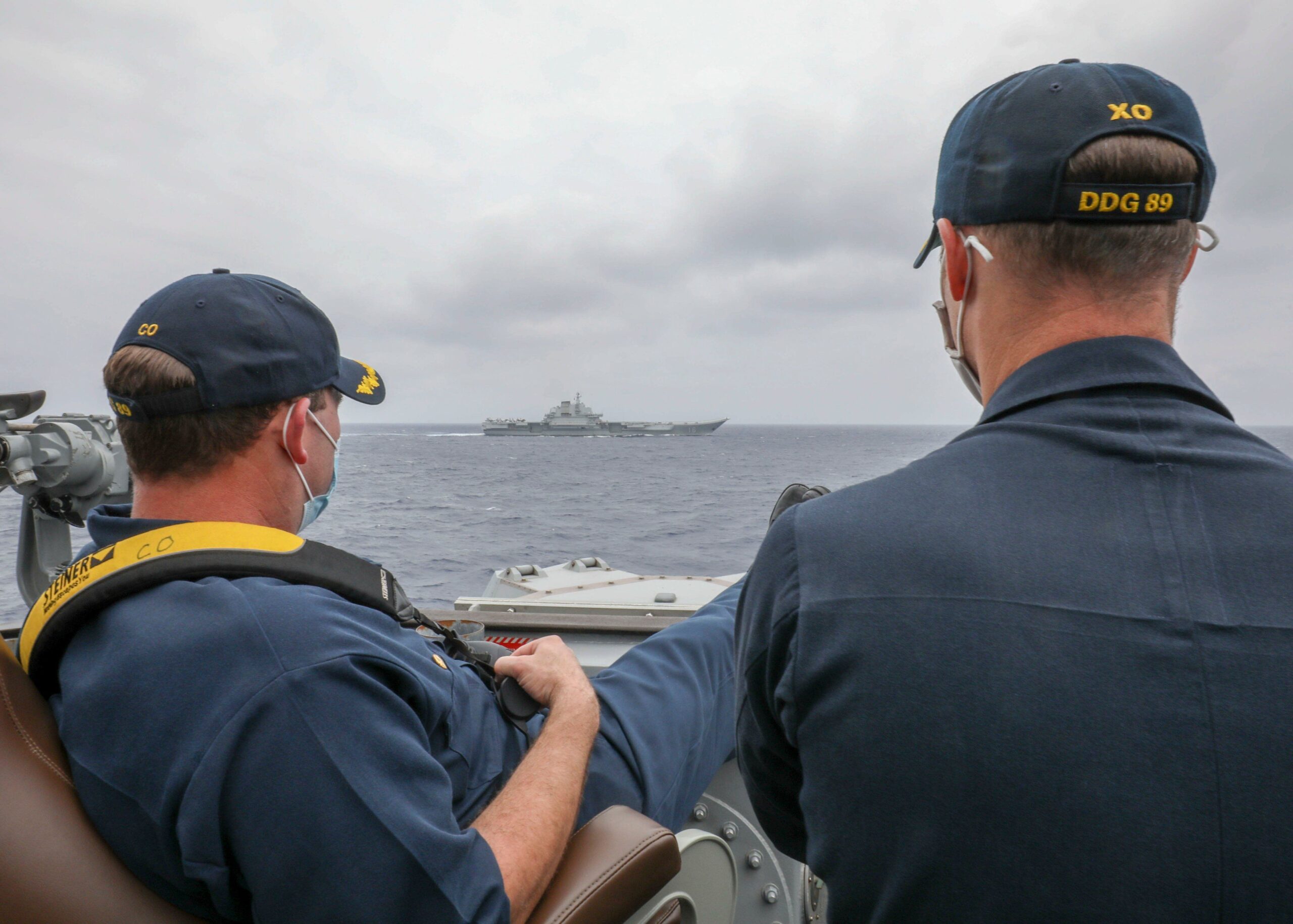
PHILIPPINE SEA (April 4, 2021) Cmdr. Robert J. Briggs and Cmdr. Richard D. Slye monitor surface contacts, including PLA Navy aircraft carrier Liaoning (pictured), from the pilothouse of the Arleigh Burke-class guided-missile destroyer USS Mustin. (U.S. Navy photo by Mass Communication Specialist 3rd Class Arthur Rosen)
In contrast, Contact layer functions are active every day. Much of the Contact function occurs at the “front” in priority theaters. For the Navy-Marine Corps team, this includes theater exercises that demonstrate blunting prowess, allied/partner solidarity, or force capabilities.18 It includes naval forces’ collection of information that can be publicly disseminated to shine a spotlight on adversaries’ malign activities and undermine their propaganda efforts.9 It includes routinized Navy freedom of navigation operations that challenge adversaries’ illegal claims over territories and water or airspace.10 It includes naval support to U.S. diplomatic operations, for example port calls in select, prioritized locations in theater that provide opportunities to demonstrate U.S. naval capabilities—and professionalism—to allied and partner leaders, both national and local, in government and in civil society.11 Contact functions include naval operations designed to frustrate adversaries’ efforts at sub-conventional employment of military or paramilitary forces to achieve objectives through ‘salami slicing.’12 Additionally, forward naval forces can seamlessly transition from active execution of Contact layer functions to latent execution of Blunt layer functions—or the inverse.
Further underscoring the point that the Contact function is not anchored to location, note the historical examples provided by the Navy’s attack submarines during the Cold War when they routinely trailed Soviet submarines in the open ocean.13 Soviet political and military leaders’ comprehension of their submarines’ acoustic inferiority likely contributed to diminished confidence in Soviet prospects in a war with the West. It also drove them to invest in significant undersea warfare capabilities the Soviet economy could not sustainably afford.14 Most significantly, if a war had erupted, U.S. attack submarines performing Contact layer functions in the open ocean could have promptly shifted to perform Blunt (or Homeland) layer functions by neutralizing the Soviet submarines they trailed or other targets, if so ordered.
A unit or force grouping’s ability to rapidly transition between functions illustrates how the GOM enables U.S. forces, and especially naval forces, to support deterrence and strategic competition simultaneously. This is especially the case for forward forces. A particular forward naval unit might take minutes, hours, or days to alter its posture or positioning such that it is optimized for performing Contact or Blunt layer functions. But even while it is emphasizing one layer’s functions over the other, it is still able to contribute to both. For instance, even a solitary small surface combatant conducting Contact layer functions in the South China Sea—such as placing itself in the vicinity of Chinese maritime forces harassing allied or partner maritime forces operating within international waters, filming and uploading video of the incident to the global internet, and perhaps even interposing itself—supports deterrence if it is supported by Blunt layer forces. This lone ship could be latently supported by other naval and Joint Forces, some deliberately detectable and others not readily detectable, so that Chinese leaders would know attacking the ship would ignite a process of escalation whose costs and risks would be assuredly higher for Beijing than any benefits an attack might provide. This is but one example of how conventional deterrence, intelligently applied and structured, can support efforts to counter sub-conventional coercion.
With intelligent allocation of U.S. forward forces in a theater between Contact and Blunt functions, using a diversity of unit stationing and postures informed by extant circumstances and assessments of adversary leaders’ mindsets, Geographic Combatant Commanders and their Joint component commanders can use Blunt layer forces to cover Contact layer forces and bolster deterrence. The inverse is also true: commanders can use Contact layer operations to incrementally set and shape the theater to increase prospects for wartime Blunt and Surge layer operational success if deterrence were ever to fail.
In Part 2, we will outline the strategic importance of forward “competition operations” to deterrence. We will also identify the necessary attributes for naval forces operating in the Contact and Blunt layers, as well as factors that strategists should consider when thinking about such operations. We will conclude with some thoughts regarding the GOM’s overarching implications for future naval strategy and force employment.
Paul Lyons is a Principal Policy Analyst at Systems Planning and Analysis (SPA), Inc. and a former Surface Warfare Officer with four command-at-sea tours in the Pacific. He previously served as Branch Head for Global Policy and Posture within the Office of the Chief of Naval Operations and as the Navy’s lead maritime strategist within the Office of the Secretary of Defense’s 2018 NDS Core Team.
Jon Solomon is a Principal Policy Analyst at SPA, Inc. and a former Surface Warfare Officer.
The views expressed herein are solely those of the authors and are presented in a personal capacity. These views do not reflect the official positions of SPA, Inc., and do not necessarily reflect the policies or positions of the U.S. Department of Defense, any U.S. armed service, or any other U.S. Government agency.
References
1. “Summary of the 2018 National Defense Strategy of the United States of America.” Office of the Secretary of Defense, January 2018; Pg1-2.
2. “Defense Budget Overview: United States Department of Defense FY2019 Budget Request.” Office of the Undersecretary of Defense (Comptroller) Chief Financial Officer, 13 February 2018; Ch2 Pg6. This source, on the same cited page, also refers to an additional “foundational layer” that provides the “nuclear; cyber; space; command, control, communications, computers, intelligence, surveillance and reconnaissance; and strategic mobility capabilities” that underwrite the other four layers. The “foundational layer” is clearly functional.
3. Elbridge Colby. “Testimony before the Senate Armed Services Committee Hearing on Implementation of the National Defense Strategy.” 29 January 2019; Pg6.
4. Jim Mitre. “A Eulogy for the Two War Construct.” The Washington Quarterly, Vol. 41 No. 4 (Winter 2019), Pg13-15.
5. The decline in fleet size is documented at “U.S. Ship Force Levels: 2000-Present.” Navy History and Heritage Command, https://www.history.navy.mil/research/histories/ship-histories/us-ship-force-levels.html#2000. For examples of how the decline in fleet size and unrelenting Geographic Combatant Commander demand for ships affected Navy operational tempo and readiness during this period, see 1. Andrew Scutro. “Staying At Sea: 2 Strike Groups Extended; More Long Deployments May Follow.” Navy Times, 28 September 2009; 2. Chris Cavas. “Frequent Deployments Take Toll: Quick-response policy fatiguing Navy’s fleet.” Navy Times, 04 October 2010; 3. Sam Fellman. “CNO: High Op Tempo Straining Fleet, Crises keep carriers, other ships at sea.” Navy Times, 08 October 2012.
6. See Clint Reach, Vikram Kilambi, and Mark Cozad. “Russian Assessments and Applications of the Correlation of Forces and Means.” Santa Monica, CA: RAND Corporation, 2020; Pg. 10-11, 24-25, 104.
7. See 1. Eric Heginbotham. “China Maritime Report No. 14: Chinese Views of the Military Balance in the Western Pacific.” U.S. Naval War College China Maritime Studies Institute, June 2021, https://digital-commons.usnwc.edu/cgi/viewcontent.cgi?article=1013&context=cmsi-maritime-reports, Pg3-5; 2. Timothy Thomas. “The Chinese Way of War: How Has it Changed?” Mitre Corporation, June 2020, Pg71-73.
8. For authoritative examinations of historical examples of contact layer functions in practice, see the U.S. Navy’s side in John Lehman. Oceans Ventured: Winning the Cold War at Sea. New York: W. W. Norton and Company, 2018; and the Soviet side in Maksim Tokarev. “Kamikazes: The Soviet Legacy.” U.S. Naval War College Review, Vol. 61 No. 1 (Winter 2014), https://digital-commons.usnwc.edu/nwc-review/vol67/iss1/7/.
9. For examples, see the articles and imbedded videos at 1. Brad Lendon, Ivan Watson, and Ben Westcott. “‘Leave immediately’: US Navy plane warned over South China Sea.” CNN, 23 August 2018, https://www.cnn.com/2018/08/10/politics/south-china-sea-flyover-intl/index.html; and 2. Luis Martinez. “Chinese warship came within 45 yards of USS Decatur in South China Sea: US.” ABC News, 01 October 2018, https://abcnews.go.com/Politics/chinese-warship-45-yards-uss-decatur-south-china/story?id=58210760.Selective embedding of independent media aboard U.S. ships and aircraft during such operations can dramatically illustrate Chinese and Russian malign maritime actions to American and international audiences, as well as highlight U.S. professionalism and resolve in protecting American vital interests—including allied and partner security. Moreover, they can demonstrate U.S. capability and resolve to compete in the “information environment.”
11. Authors’ personal experiences on many occasions while forward deployed during their active duty services.
12. For example, see Ben Werner. “Maritime Standoff Between China And Malaysia Winding Down.” U.S. Naval Institute News, 13 May 2020, https://news.usni.org/2020/05/13/maritime-standoff-between-china-and-malaysia-winding-down.The “salami-slicing” metaphor was popularized by Thomas Schelling in his book Arms and Influence. New Haven: Yale University Press, 1966, Pg66–69, 77–78.
14. This conclusion derives from evidence such as authoritative Soviet acknowledgements of U.S. undersea advantage and its strategic implications in “Soviet Perceptions of U.S. Naval Strategy.” Central Intelligence Agency Office of Soviet Analysis, July 1986, Pg8-13; and from a quote attributed to former Soviet General Vladimir Dvorkin that in 1986 Soviet Northern Fleet leadership informed CPSU General Secretary Mikhail Gorbachev that the Soviet Northwestern Theater of Operations could not be successfully defended against the U.S. Navy in the event of war. See Lehman, Pg200-201.
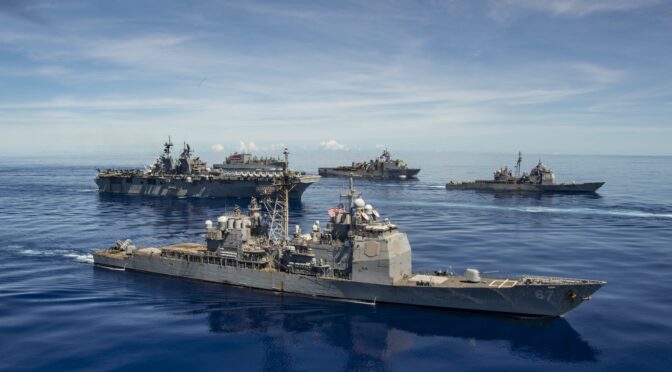
Featured Image: PHILIPPINE SEA Sept. 25, 2020) USS Shiloh (CG 67), front, USS America (LHA 6), USS Antietam (CG 54), USS Germantown (LSD 42) and USNS Sacagawea (T-AKE 2), steam in formation with the Navy’s only forward-deployed aircraft carrier USS Ronald Reagan (CVN 76), in support of Valiant Shield 2020. (U.S. Navy video by Mass Communication Specialist 2nd Class Erica Bechard)
The more deeply one thinks about strategy the harder it is to pin down exactly what it is. This problem is more than an academic musing when it comes to the Navy. The Navy routinely publishes documents that it calls strategy, but these vary widely in form and focus, and in any case are the result of different processes, so much so that it is hard to recognize some as actual strategy. In her recent CIMSEC article Congresswoman Elain Luria contends that the 1986 Goldwater-Nichols Act “effectively ended U.S. naval strategy.” What she means is that if one regards strategy as a plan for defeating an enemy, then the Navy no longer has a role in developing such plans, a marked difference from the early 1980s when the Navy developed its Maritime Strategy, a global plan for confronting the Soviet Union in a conventional war. Without such a plan, she contends, the Navy’s budgets are built on a foundation of sand. If so, the Navy’s current strategic document Advantage at Sea is an insufficient guide to force development. In parts oneand twoof this series of articles I discussed the factors that would influence the content of a new maritime strategy of the sort Congresswoman Luria calls for. In this article I will discuss the process of strategy, focused on the Navy’s case.
In 1981 Chief of Naval Operations Admiral Thomas Hayward established the Strategic Studies Group (SSG) and the Center for Naval Warfare Studies (CNWS) at the Naval War College to advance the quality of strategic thinking in the Navy. From its founding up until World War II the College had a major influence on Navy strategy and force development. In the case of the Maritime Strategy, reports from the SSG and the results of the Global Wargame series held at Newport provided significant inputs and support. The Maritime Strategy originated with Admiral Hayward’s Sea Strike strategy when he commanded Seventh Fleet. That nugget of an idea was then expanded, briefed, argued over, coordinated, modified and ultimately formalized over the course of six years. Importantly, it gained the support of both the Secretary of the Navy and President Reagan, leading to the creation of the “600 Ship Navy.”
In early July 2006 Vice Admiral John Morgan, then the Navy’s Deputy CNO for Operations and Strategy, visited the Naval War College to receive a brief on its proposed process for developing a new maritime strategy document as called for two weeks previously by then-CNO Admiral Mike Mullen. As the newly-designated Dean of the Center for Naval Warfare Studies I was tasked to design and lead that project. I briefed the Admiral as we slowly motored around Newport Harbor in the College’s “barge.” Morgan stressed to me before the brief that he wanted a broadly collaborative process, various stakeholders such as industry and fleet units being involved. The underlying purpose of the new strategy was to somehow elicit greater international cooperation on maritime security.
After I finished my brief, Morgan said “Okay, do it.” I then asked him if I could invite international officers to participate in the development process. He thought for a moment and then said yes. At that point I responded “Okay, Admiral, do you understand that you have just selected the strategy and everything from here on out is execution?” He smiled and said yes, he understood. From that point forward, process and product merged in the development of the 2007 A Cooperative Strategy for 21st Century Seapower (CS21). Achieving increased international naval cooperation required developing greater levels of trust, and giving other nations a voice in the Navy’s new strategy was a key part of the mechanism. A nine month program of workshops, games and international consultations followed. The formal document, announced at the 2007 International Seapower Symposium, although entitled a strategy, was actually a tool to advance the underlying strategy of courting international cooperation. In the years afterward international maritime security cooperation mushroomed. However, a new template for fleet architecture to execute the strategy, which originated with a strategy option submitted by Prof. Wayne Hughes of the Naval Postgraduate School, was ignored by the Navy’s resource directorate. It would have created a “bi-modal” fleet that contained a large number of smaller, single purpose ships in addition to the traditional large combatants.
Concurrently with the CS21 development process Vice Admiral Morgan worked on creating a formalized strategy development process for the Navy Staff. It reflected a desire to make strategy development a collaborative process both within and external to the Navy Staff. The result was codified into a draft instruction but opposition from the Resources Directorate (N8) killed it and it resides, unsigned and forgotten, in some file drawer in the Pentagon. I later asked the chief analyst in N8 how they incorporated Navy strategy documents into their budget preparations. He responded that they didn’t; they developed their own strategies. Thus from an organizational perspective, budget and strategy development were isolated from each other.
Fast forward to 2011 when Admiral Jonathan Greenert became Chief of Naval Operations. He, like many naval officers, were not satisfied with CS21 because they felt it had insufficient emphasis on warfighting. He wanted a “refresh” of the 2007 document; that is, a rewording to insert more traditional Navy emphasis on high end combat. The revised document was supposed to be issued within a month or so of him taking office. N51, the strategy shop, came to NWC and asked us to do a rewrite. I initially refused, saying that we were a research organization not a staff. However they reminded me that we were a Navy organization and bound to respond to OPNAV requests, so I set my faculty to work. We produced what I thought was a decent draft, the watchword being first do no harm to the international political capital CS21 had generated. This draft disappeared into the bowels of N3N5 never to be seen again.
The admiral in charge of N5 decided that his folks, i.e. the occasional available captain, would do the rewrite. The process of wordsmithing dragged on within the cubicles of the Navy Staff until March 2015. At one point I received a phone call from a commander on the Navy Staff who wanted the working papers from the 2006 project. It seemed that when they briefed version 12 (!) to the VCNO, Admiral Michelle Howard, she asked why the document said what it did and they did not have a good answer. Eventually, at a Naval Institute-sponsored conference in Washington, DC, Senator Ayotte of Maryland, responding to a question about who the audience for a new strategy should be, answered Congress. This broke the logjam and eventually the Navy issued the “refresh” to CS21 (CS21R), which turned out to be a pleading document to Congress for a larger fleet. Despite being a well-written justification for increasing the Navy’s size, it had no influence.
These case studies reveal several things that are key to a successful strategy development process. The first is that a document is not a strategy; rightly understood a strategy is an idea for solving a problem. The idea behind the Maritime Strategy was to intimidate the Soviets by aggressive forward presence operations. The idea behind CS21 was to court foreign cooperation by bringing them into the strategy development process. Both were solutions to global strategy problems that involved the unified world ocean. Congresswoman Luria defines it as the way military means are used to achieve political ends. The respective documents, the Maritime Strategy’s various classified briefs and ultimately the unclassified Proceedings Article, and the CS21 document itself, were tools to aid in the execution of the strategy or to garner support for it. In contrast, the CS21R document was meant to be the strategy; a document meant to gain Congressional support for a larger fleet, with no strategic problem solution underpinning it. Wordsmithing does not constitute strategy development. The upshot is that for practical purposes, strategy for the Navy should be an idea for solving a strategic problem that involves the world ocean. By strategic I mean what Congresswoman Luria means; using the Navy’s forces to achieve desired international political effects.
The second thing is how the Navy arrives at the central idea. A small group of officers brainstorming in a cypher-locked Pentagon office might produce a viable idea, and sometimes this approach is necessary, but it appears that wide collaboration has had more success. Moreover, strategic problems are generally multi-faceted and hard to grasp, so extensive research and gaming should be used to explore, refine, and finally articulate the problem. The Navy could certainly benefit from having a cadre of officers specially educated and experienced in strategy development, but that does not mean that the development process should take place exclusively within the Navy Staff. The connecting link between the two successful strategy cases just described is the Naval War College. The institutional context within which the research, gaming and thought that supports strategy development is important, and the College’s academic culture and ability to collaborate makes it the appropriate place for such activity to take place, even if the Navy Staff has ultimate responsibility for selecting the strategy and crafting any briefings and documents. Other venues such as think tanks or the Navy Staff itself lack complete objectivity for various reasons, and despite Congresswoman Luria’s advocating for the 2017 CSBA study, a blank slate is needed for the new maritime strategy project.
All of this begs the question of whether strategy development ought to somehow be formalized and institutionalized per Admiral Morgan’s ill-fated effort or whether it should be ad hoc, responding to the particular circumstances of the time. This writer favors the latter approach, although the history of War Plan Orange, the strategy for defeating Japan in the Pacific, suggests the former. As it stands, the Navy would be well-advised to initiate an ad hoc project at this point, even though it has, with the stand-up of the new N7 directorate, created an organizational home for strategy development whose authorities reach into the analysis and resource arenas. The smart move for N7 would be to act as a strategy development sponsor, absorbing and integrating the War College’s research and gaming efforts as well as think tanks such as the Center for Naval Analyses and perhaps those outside Navy lifelines like CSBA. As described by writers like Trent Hone and John Kuehn, the other empowering element of Navy strategy development during the years from the turn of the Twentieth Century up to World War II was the continuing relationship between the Naval War College, the Fleet, and the Navy Staff. As War Plan Orange demonstrated, iteration is a path toward better strategy, and N7 is well positioned to promote a coherent flow of thinking and rethinking of strategy among the relevant institutions and thereby informing Navy budgets, doctrine and shipbuilding plans.
I must agree with Congresswoman Luria’s complaints about the structure of the Unified Command Plan and its strategy development process. American military power, and especially its seapower, has become a scarce resource relative to the demands of the U.S. grand strategy of supporting and defending a rules-based, global liberal trading order. When resources become scarce, centralized planning is needed to ensure their efficient distribution. It is dangerous to simply mete out scarcity equally among the COCOMs, which is apparently all the current system is capable of. Moreover, as the current debacle in Afghanistan again demonstrates, throwing policy problems over the transom to the military that should rightly be handled by State, Commerce, and the other Cabinet departments, produces mindless overreach and ultimate tragedy. The Navy has, from time to time, had to step in and solve strategic problems that in theory should have been handled by either the Joint Staff or the Office of the Secretary of Defense, but neither was either capable or interested. The current problem that spawned Congresswoman Luria’s article – the looming loss of American command of the sea – is global, strategic and maritime, and apparently the Navy is the only organization capable of coming up with an idea – a strategy – for how to solve it. But to do so, the Navy must learn from both its past successes and failures and put into motion a rational process for developing a new maritime strategy.
Robert C. Rubel is a retired Navy captain and professor emeritus of the Naval War College. He served on active duty in the Navy as a light attack/strike fighter aviator. At the Naval War College he served in various positions, including planning and decision-making instructor, joint education adviser, chairman of the Wargaming Department, and dean of the Center for Naval Warfare Studies. He retired in 2014, but on occasion continues to serve as a special adviser to the Chief of Naval Operations. He has published over thirty journal articles and several book chapters.
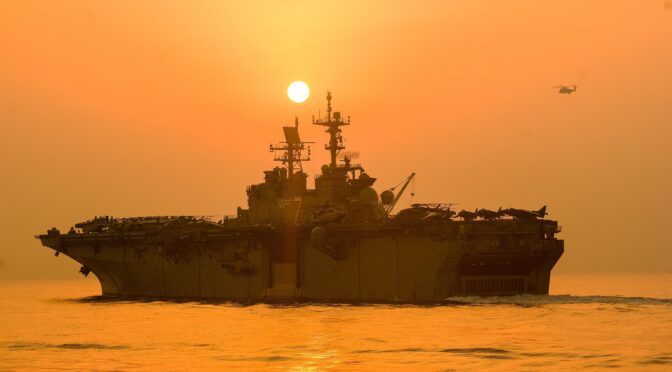
Featured Image: STRAIT OF HORMUZ (Aug. 4, 2021) The Wasp-class amphibious assault ship USS Iwo Jima (LHD 7) transits the Strait of Hormuz, Aug. 4, 2021. (U.S. Navy photo by Seaman Logan Kaczmarek)