Category Archives: Strategic Outlook

Predictions and forecasting.

No South EU Sea


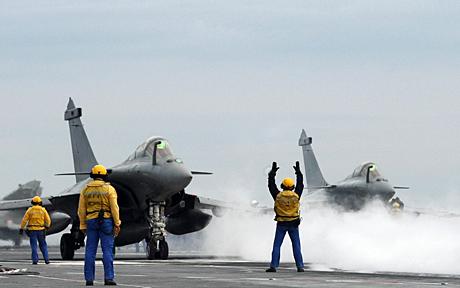
Rafale fighters launch from the deck of the French aircraft carrier Charles de Gaulle

By Peter Solomon

The South China Sea contains the second busiest trading route in the world: the Straight of Malacca. Vital to meeting the energy demand of China, Japan, Taiwan, and South Korea, the supply flow through this region is comprised mainly of crude oil, liquefied natural gas, coal, and iron ore. On account of the territorial claim disputes that afflict the South China Sea, several militaries have been busy modernizing, namely China, the Philippines, and Malaysia. Overall, six nations claim partial or entire territorial rights over the South China Sea: China, the Philippines, Malaysia, Vietnam, Taiwan, and Brunei. What’s at stake in the region is more than trade routes – a 2006 estimate by the United States Energy Information Administration revealed proven reserves of 26.7 billion barrels of oil in the South China Sea (about the same quantity as Oman, Qatar, Syria, and Yemen’s oil reserves combined), and proven reserves of natural gas amounting to 7.9 trillion cubic meters (about the same quantity as Saudi Arabia or the United States’ reserves). Due to the considerable value of the oil and natural gas, the potential for disagreement is exceptionally high and, therefore, the possibility of conflict over territory in the South China Sea cannot be understated.


Due to the magnitude of trade and investment conducts the European Union (EU) with Japan and South Korea, and the great prospects for enhancing economic relations, the EU has a great stake in the security of East Asia. About 18.1% (251.5 bn. Euros) of the EU’s exports are destined for East Asia, while a mere 3.3% go to other destinations in Asia. Additionally, the EU imports about 30.1% (452 bn. Euros) of its goods from East Asia compared to just 4.2% for the rest of Asia. It is easy to see that a good deal of the EU’s economic health depends upon trade with East Asia. Therefore, a key EU foreign policy security goal is to promote peace and stability in East Asia.


China is in the process of modernizing its People’s Liberation Army Navy (PLAN) to exert Chinese influence in the region. It is no secret that China is building up its power projection capabilities to counter-balance the presence of the United States defense forces in the Western Pacific. Due to Japan and South Korea’s geographic location and security ties, any conflict or disruption to stability in the South China Sea could have major impacts on East Asia. The EU’s concern, however, is in regards to Europe’s economic stake in the region and the EU’s identity as a normative power. Despite the EU’s promotion of peace and stability in East Asia, the institution’s lack of credible power projection capabilities in the region belie the EU’s ability to intervene in security issues in the region. 


Although an EU-led military operation would be unlikely in the Western Pacific, the importance of the region would compel individual nations to act to maintain law and order, or to preserve maritime safety, safeguarding their commercial interests in the region. In the event of a conflict it is entirely possible that EU member states would engage the region through the North Atlantic Treaty Alliance (NATO). Recent counter-piracy operations off the coast of Africa have set a precedent for maritime military action far from the traditional European area of operations. Additionally, Great Britain and France can still act on their own if it is in their best interests as both maintain competent navies with power projection capabilities, including the ability to deploy their own aircraft carriers.


In the case of a South China Sea conflict, Japan would be most certainly directly involved as its tankers transport 70% of Japan’s oil through this region. A confrontation would force Japan’s oil tankers to circumvent a conflict in the South China Sea by navigating around Indonesia into the Pacific Ocean. However, this option would be both expensive and laborious. Additionally, two-thirds of South Korean natural gas is shipped through the South China Sea on its way to the Korean peninsula. In regards to the European Union’s economic interests in East Asia, maritime security is crucial for Europe.


Currently, EU military capabilities consist of 13 battlegroups, which are “rapid response units” that consist of 1,500 troops each. EU member states rotate the responsibility of provisioning these units, two of which have always been on stand by since 2007. However, this force has never been deployed and it is difficult to say how the debt crisis will affect the EU’s research and development into new military capabilities. Given the budget cuts and focus on internal issues, the EU will likely continue to place the burden on the United States to maintain the status quo in the Western Pacific region. In the event of a crisis in the South China Sea, it would be the effects on the EU’s East Asian trading partners that would create the most potential to draw in the maritime forces of individual EU member states.


Whether or not the EU will cooperate in joint military expeditions with Japan or South Korea in the future is unknown. With regard to economics, EU-Japan and EU-South Korea economic ties are substantial, and significant cooperation in both relationships has led to the emergence of global economic partnerships via Free Trade Agreements with both nations. Through Japan and South Korea, the EU has established a gateway into East Asia’s vast markets and developed a role as a player in security issues, albeit a minimal role for the time being. Despite the EU’s current internal focus it cannot forget about its strategic partnership with Japan and South Korea.


This post is from our British partners at TheRiskyShift.com and can be found in its original form here.

Peter Solomon is a Master of Arts in International Political Economy candidate at King’s College London. Peter earned a bachelors degree from the University of Connecticut in English and Political Science. 
Securing the Swarm: New Dogs, Old Tricks

As the tide of automated warfare rises, optimists are already attempting to ride the wave.  I do so in Proceedings, suggesting possible paths of development for autonomous platforms, and at the Disruptive Thinkers blog Ben Kohlman and I imagine future scenarios in which automated platforms might be used. Admittedly, we often ignore the many ways our concepts can wipe out: particularly signals hijacking and spoofing of navigational systems. As illustrated by eavesdropping on Predator communications and the recent forced crash of a drone in Texas, determined enemies can steal information or cause mayhem if they break the code on combat robot (ComBot) operations. Ideas for securing these advanced automated armadas can be found in some of the oldest methods in the book.

Paleo-Wireless: Communicating in the Swarm
In 2002, LtGen Paul Van Riper became famous for sinking the American fleet in a day during the Millennium Challenge exercise; he did so by veiling his intentions in a variety of wireless communications. We assume wireless to mean the transfer of data through the air via radio signals, but lights, hand signals, motorcycle couriers, and the like are all equally wireless.  These paleo-wireless technologies are just what ComBots need for signal security.

ComBot vulnerabilities to wireless hacks are of particular concern for planners. Data connections to operators or potential connections between ComBots serve as a way for enemies to detect, destroy, or even hijack our assets.  While autonomy is the first step in solving the vulnerability of operator connections, ComBots in the future will work as communicating teams. Fewer opportunities will be provided for subversion by cutting the long link back to the operator  while maintaining the versatility of a small internally-communicating team. However, data communication between ComBots would still be vulnerable. Therefore, ComBots must learn from LtGen Van Riper and move to the wireless communications of the past. Just as ships at sea communicate by flags and lights when running silent or soldiers might whisper or motion to one another before breaching a doorway, ComBots can communicate via light, movement, or sound.

Unlike a tired Junior Officer of the Deck with a NATO code-book propped open, computers can almost instantly process simple data. If given the capability, a series of blinking lights, sounds, or even informative light data-transmissions  could allow ComBots of the future to coordinate their actions in the battlefield without significantly revealing their position. ComBots would be able to detect and recognize the originator of signals, duly ignoring signals not coming from the ComBot group. With the speed and variation of their communications, compressed as allowed by their processing power, ComBots can move through the streets and skies with little more disruption than a cricket, lightening bug, or light breeze. High- and low-pitch sounds and infrared light would allow for communications undetectable to the average soldier.

LtGen Van Riper melded a deadly combo of new weaponry with old communications to build a force capable of, with the greatest surprise, wiping out a force armed with the greatest technology in every category. Utility, not technology, is what gives us the edge in the battlefield. Sometimes it is a combination of the old and new that allows for the potency. Perhaps, one day, ComBots will be set loose into the battlefield where they will operate more as a pack driven by sight and sound than a military formation managed over a data link.

GPS: How About a Map?

The Texas incident has broken open the doors on a previously low-key vulnerability for ComBot systems, navigation. While speculation is rife as to how the CIA lost a drone in Iran, it is quite clear that the researchers in Texas were able to spoof a ComBot into destroying itself. Spoofing of externally-based navigational systems is a potential way to turn aerial ComBots in particular into weapons against us.  It is often forgotten that systems that are “autonomous” still rely on outside guidance references that can be manipulated. While civilian GPS is less secure than military-grade GPS, the potential for GPS spoofing to lay-low a combat force is a chilling one. However, the solution can be found by augmenting legacy techniques with modern processing.

Terrain Contour Matching (TERCOM) and Digital Scene Mapping Correlation (DSMAC) are non-GPS methods of navigation that specifically use internal recognition of local terrain and urban landmarks to maneuver Tomahawk missiles. This is another way of, “looking around and reading a map.” Processing power advances since the system was first introduced during the Cold War mean greater amounts of recognition data can be processed in shorter amounts of time by smaller platforms. ComBots deployed to specific areas can upload local data to allow localization based on terrain from high altitude or Google-maps-style scene matching from rooftops or even street-by-street. With adaptive software, ComBots could even “guess” their location if the battlefield changes due to combat destruction, noting changes in their environment as damage is done.  While GPS can be spoofed, unless the enemy has been watching too much Blazing Saddles, DSMAC and TERCOM will be nigh impregnable navigational systems.

This defense for ComBot operations can also act as a navigational redoubt for a fighting force. The downing of GPS satellites or the spoofing of signals effects everyone using electronic navigation systems. Aerial ComBots outfitted with TERCOM and DSMAC could act as a secondary GPS system in an area with a GPS outage. If signals are jammed or satellites taken out, warfighters or other navigationally lesser-developed ComBots could triangulate their positions based on the system of ComBots with locations determined by TERCOM and DSMAC. By adding these recognition systems to autonomous drones, commanders will defend ComBots from hijackers and combatants from the choking fog of war.

Riding the Wave

The key to the safe and effective use of ComBots is to avoid the extremes of optimists and luddites. Optimists will look far into the realm of capability before necessarily researching vulnerabilities, abandoning the old for every shiny new development. Luddites will make certification and security processes long and complicated, cowering from the strange light new technology brings; ComBots would run on Windows 95 and take 30 minutes to log on to themselves. It is best to advance fearlessly, but take our hard-learned lessons with us. Non-digital communications, aka speech and signals, and localized navigational systems, aka carrying maps, offer ComBot developers a shield against interlocutors.  Our new dogs will be best defended by some of the oldest tricks.

This article appeared in its original form at Small Wars Journal.

Matt Hipple is a surface warfare officer in the U.S. Navy. The opinions and views expressed in this post are his alone and are presented in his personal capacity. They do not necessarily represent the views of U.S. Department of Defense or the U.S. Navy. 

Behind the Bluster: The Reality of Russia’s Rhetoric for a Global Navy

By Ian Sundstrom

A slowly expanding shipbuilding program is no evidence of greater interest in the navy by the Russian government, and Russian interest in overseas bases does not mean significant changes in the international environment. If Russia does obtain more overseas bases, it will not result in a sustained global presence in the near future.

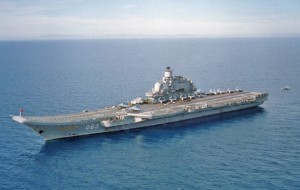
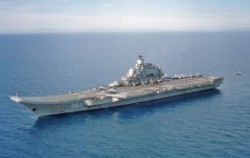
Russian aircraft carrier Admiral Kuznetsov

Throughout the ongoing Syrian crisis, Russia has stuck by the Assad regime and repeatedly stressed its desire to retain its access to the Syrian port of Tartus. Russia claims the base is needed for training and maintenance for routine counter-piracy patrols.[1] The base also gives Russia a bit claim to the position of global influence the Soviet Union once possessed.[2] Additionally, it may serve as a reminder of Russian influence in the Middle East or provide an added layer of defence for Russia’s Black Sea coast.[3] Just this week, the Russian government announced its renewed intentions to keep Tartus in conjunction with the desire to open new naval facilities in Cuba, Vietnam, and Seychelles.[4] It would appear to demonstrate a new desire by the Russians to project naval power around the world. But does this presage a global focus for the Russian Navy? The answer: not likely.


There are a number of reasons why the Russian Navy could not develop a global posture, even with access to new overseas facilities. The first is cost. Long-distance deployments are costly in fuel and maintenance expenditures. This is particularly problematic given instability in the Russian state budget. The budget is heavily dependent on high oil and gas prices – up to one third of government funds come from hydrocarbon revenues – meaning Russian military activity is beholden to global petroleum prices.[5] This has serious implications for Russia’s military modernisation, a key component of its current national security strategy.[6] In fact, an article in RIA Novosti stated that Economic Development Minister Andrei Belousov recently quashed rumours of a three-year delay in Russian rearmament plans.[7] The article noted that the Finance Ministry has been consistently opposed to high levels of defence expenditure because of the strain they put on state finances. Given intra-governmental disagreement over simply recapitalising and modernising the ailing military it is unlikely that funding will be available for foreign bases. After all, just in 2002 Russia closed its facility at Cam Ranh, Vietnam due to cost.[8] Expensive global cruises, sustained foreign deployments, and overseas bases are not sustainable for Russia.


The second reason is the Russian Navy’s aging equipment. Most of its ships are ex- Soviet vessels, many over thirty years old.[9] At this stage in their careers, these vessels require lengthy periods of maintenance to remain operational. Unfortunately for the navy, Russia lacks adequate maintenance facilities to keep them fully functional.[10] Just in 2008 the pride of the Russian fleet, the carrier Admiral Kuznetsov, suffered an electrical fire off Turkey and an oil spill off Ireland, all on the same deployment.[11] If Russia increases the pace and range of its naval deployments, similar incidents will likely occur. Furthermore, the Russian Navy suffers safety issues, demonstrated most spectacularly by the Kursk incident in 2000.[12] These would only be exacerbated by an increased deployment schedule, which would mean reduced training for short-service conscript crews and subsequent attendant issues.[13] With aging equipment, inadequate maintenance facilities and poor safety procedures, it would be difficult for Russia to maintain a global posture without seriously degrading its fleet. This brings us to the final point: the Russian Navy cannot handle increased attrition because it has already been severely reduced in size since 1990.


The Russian Navy is just not large enough as it stands to both maintain a global presence and meet its obligations nearer home. In 1990, the Soviet Navy stood at 2052 vessels. Today its Russian successor stands at 518, of which a maximum of 79 could be considered significant combat assets.[14] It is a shadow of its former Soviet self. On top of this reduction, Russian shipbuilding facilities are woefully inadequate. For example, from 1994 to 2008, only seven ships, all begun during the Soviet era, were completed.[15] RIA Novosti claims that 10 to 15 new ships will be launched this year, but it is likely that at least some of these will be delayed, and none are particularly large or capable ships.[16] Given its reduced size, the Russian Navy has had to focus on its core responsibilities. Russia’s core national interests include ‘ensuring the solidity of the constitutional system, territorial integrity, and sovereignty of the Russian Federation’, and the Navy helps achieve these by protecting the Russian coast and defeating terrorists and drug smugglers.[17] Russia has only a handful of major naval assets, barely enough to ensure its most basic national security objectives much less adopt a wider-ranging posture.


If Russia does obtain more overseas bases, and it appears Vietnam will at least allow Russian ships to visit Cam Ranh, the result will not be a sustained global presence in the near future.[18] In the longer term the Russian Navy may shift its focus, and a slowly expanding shipbuilding program does provide evidence of greater interest in the navy by the Putin government.[19] As it stands, Russian interest in overseas bases is a curiosity, but does not mean significant changes in the international environment.


Citations

[1] RIA Novosti,‘Russian Navy Holds on to Its Syria Base’, 25 July 2012

[2] BBC,‘How vital is Syria’s Tartus port to Russia?’, 27 June 2012

[3] I argue that Tartus provides Russia strategic depth on its Black Sea flank here. It would appear that Vice-Admiral Chirkov, head of the Russian Navy, supports this argument by referring to Tartus as in the ‘Black Sea Fleet’s strategic operational area’ in RTT News, ‘Russia to Retain Tartus Naval Base in Syria’, 26 July 2012,

[4] RIA Novosti,‘Russian Navy Holds on to Its Syria Base’, 25 July 2012; Reuters,‘Russia wants naval bases abroad-report’, 27 July 2012

[5] Andrei Shleiffer and Daniel Treisman (2011), ‘Why Moscow Says No: A Question of Russian Interests, Not Psychology’, Foreign Affairs, Vol. 90, No. 1, p. 125

[6] Russia’s National Security Strategy to 2020, paragraphs 28-32

[7] RIA Novosti,‘Russia’s Rearmament Remains on Schedule – Econ Minister’, 2 July 2012,

[8] International Business Times,‘Russian Navy Looks to Expand Bases Abroad, Goes Hunting in Southeast Asia, Indian Ocean, and Caribbean’, 27 July 2012

[9] Dmitry Gorenburg (2008), PONARS Eurasia Policy Memo No. 23: ‘Has the Russian Navy Turned a Corner? Recent Trends in Russian Shipbuilding and Naval Deployments’, pp. 22

[10] Ibid., pp. 2-4

[11] Dmitry Gorenburg (2009), PONARS Eurasia Policy Memo No. 57: ‘Russian Naval Deployments: A Return to Global Power Projection or a Temporary Blip?’, p. 3

[12] Ibid., p. 6

[13] Even a major vessel like Pyotr Veliky has conscript crewmembers. Russian conscripts serve for only one year. Ria Novosti, ‘The battle-cruiser Pyotr Veliky’, 22 April 2010. [14] IISS, The Military Balance 1990, pp. 36-38 ; IISS, The Military Balance 2012, pp. 194-196

[15] Dmitry Gorenburg (2008), PONARS Eurasia Policy Memo No. 23: ‘Has the Russian Navy Turned a Corner? Recent Trends in Russian Shipbuilding and Naval Deployments’, p. 2

[16] Bloomberg,‘Russian Navy May Add Up to 15 New Warships This Year, RIA Says’, 27 July 2012

[17] Russia’s National Security Strategy to 2020, paragraphs 21 and 41

[18] RIA Novosti, ’Vietnam Ready to Host Russian Maritime Base’, 27 July 2012

[19] IISS, The Military Balance 2012, p. 187; RIA Novosti,‘Russia to Build New Aircraft Carrier After 2020’, 26 July 2012,; RIA Novosti,‘Russian defense minister denies plans to build aircraft carriers’, 2 July 2012; Captain Thomas Fedyszyn, USN (Ret.), ‘Renaissance of the Russian Navy’, Proceedings, March 2012

This article was originally published at the website of our partners, theriskyshift.com and can be found in its original form here.

Winter is Coming

Heat waves, rising temperatures, and retreating ice grab headlines today. However, receding sea ice in the Arctic and a concurrent increase in shipping traffic will intensify attention on the globe’s (still) frigid northern reaches. Though the United States issued a forward-looking Arctic policy with National Security Presidential Directive 66 in 2009, it has not seriously faced the implications of matching these policy goals to strategic ends and backing its interests in the region with capital investments. Our Canadian allies have, and we should seek to learn from their experience.

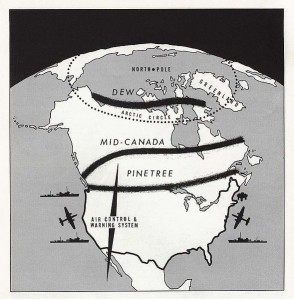
The Arctic was important to Canada and the United States well before the ice started melting.

Canada’s adaptation to the Arctic’s changing maritime geography is instructive. For starters, it serves as a reminder of Canada’s importance as an ally of the United States. Geography, heritage, and shared sacrifice have forged a special relationship between Canada and the United States and, like the Night’s Watch in the cold Northern reaches of the fictional world in Game of Thrones, I think we too infrequently give them proper credit for their support of our defense. This isn’t the first era requiring US-Canadian security cooperation in the Arctic – both countries jointly manned the “Distant Early Warning” Line of radar stations above the Arctic Circle during the Cold War.

The United States can look to Canada’s experience in matching ends, ways, and means in a new Arctic geography while under austere fiscal constraints to inform our own decisions as we contemplate our role in the region.

Canada is an Arctic nation, and this identity figures heavily in the Canada First Defence Strategy. Among the most important declarations in the strategy:

In Canada’s Arctic region, changing weather patterns are altering the environment, making it more accessible to sea traffic and economic activity. Retreating ice cover has opened the way for increased shipping, tourism and resource exploration, and new transportation routes are being considered, including through the Northwest Passage. While this promises substantial economic benefits for Canada, it has also brought new challenges from other shores. These changes in the Arctic could also spark an increase in illegal activity, with important implications for Canadian sovereignty and security and a potential requirement for additional military support.

and:

Canadian Forces must have the capacity to exercise control over and defend Canada’s sovereignty in the Arctic. New opportunities are emerging across the region, bringing with them new challenges. As activity in northern lands and waters accelerates, the military will play an increasingly vital role in demonstrating a visible Canadian presence in this potentially resource rich region.

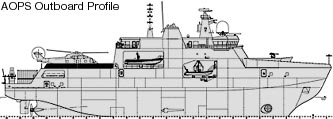
Canada First proposes Arctic Offshore Patrol Ships (AOPS) as the primary strategic means to accomplish the policy goal of demonstrating a visible Canadian presence in the Arctic. In early July of this year, the Canadian Government announced a preliminary contract to draft an execution strategy for the project and execute a design review of the proposed vessel, which will be based on the Norwegian Svalbard-class of ships. While representing a significant step towards realizing Canada’s goals in the Arctic, the proposed class has received a fair amount of domestic criticism. Some Canadians call the design too small, too light, and too slow. Others point to the vessel’s lack of armament, though some propose incorporating space for future weapons systems into the design. A final criticism of the class is that it is designed for light icebreaking duties, earning them the moniker “slushbreakers” in the Canadian American Strategic Review. Vessels designed for polar cruising typically conform to a “Polar Class” indicating a specific level of icebreaking capability. The proposed AOPS will be Polar Class 5, which means “Year round operation in medium first-year ice which may include old ice inclusions,” and represents the lowest year-round capability to negotiate polar waters.

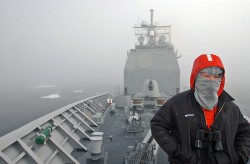
A portent of future Arctic FONOPS?

The AOPS represents, as some Arctic watchers have noted, a compromise between an offshore patrol vessel and a dedicated Arctic warship. This is the essential difficulty in planning an Arctic force structure: though the ice is retreating, there is still plenty of it and significant seasonal variations present new design challenges to Naval and/or Coast Guard vessels. True Arctic vessels require completely different hull, mechanical and engineering systems that significantly impact their tactical performance. No bow mounted sonar. Poor speed and maneuverability. Et cetera. Indeed, given the fact that American and Soviet/Russian submarines have a long, distinguished history of operating under the sea ice, I would question a surface vessel’s ability to operate in a submarine threat environment while noisily plowing through ice floes. This is just one challenge among many to tactical surface operations in the Arctic, and they are probably the reason why (as noted at Information Dissemination yesterday) the US Navy hasn’t seriously considered itself an Arctic player beyond ICEX and some limited research and development projects.

There are similarities between Canadian and US Arctic policy. While, geographically speaking, Canada seems to have a stronger need for an Arctic presence due to its more extensive maritime claims in the region, the Bering Strait – a critical choke point – is in Alaska’s back yard. US policy for the Arctic includes the following as summarized in a recent report:

The USA names several military challenges with implications for the Arctic, including missile defense and early warning; deployment of sea and air systems for strategic sealift, strategic deterrence, maritime presence, and maritime security operations; and ensuring freedom of navigation and overflight.

It’s possible to fulfill many of these goals with submarines, but once the discussion veers towards sealift, missile defense, and freedom of navigation, a polar surface combatant seems a necessary part of an Arctic force structure. The United States will have to answer many key questions raised by these stated goals:

  1. Should Navy, Coast Guard, or joint assets fulfill these roles?
  2. How important is it to the United States to lead the exploration and militarization of the Arctic?
  3. What metrics of civil use and sea ice change will determine the extent and timing of the United States’ Arctic presence?
  4. What functions can/should an Arctic ship fulfill?
  5. How does receding ice impact the existing Polar Classification system? What baseline of Polar Class is appropriate to Arctic warships/coast guard cutters?

Answering these questions is the work of strategy, and it’s telling that a recent letter signed by both of Alaska’s senators requested just such a strategy. If the United States does forge a detailed Arctic plan, it would do well to consider the experience of Canada’s government. Canada has pioneered the militarization of the Arctic region and revealed many of the challenges inherent in operating beyond “The Wall.”

LT Kurt Albaugh, USN is President of the Center for International Maritime Security, a Surface Warfare Officer and Instructor in the U.S. Naval Academy’s English Department. The opinions and views expressed in this post are his alone and are presented in his personal capacity. They do not necessarily represent the views of U.S. Department of Defense or the U.S. Navy.