Category Archives: Global Analysis

A Geographical Breakdown of What’s Going on in the World

Enter the SCAGTF: Combined Distributed Maritime Ops

By Nicolas di Leonardo

SURFACE * CYBER * AIR * GROUND * TASK FORCE

 “…The supreme art of war is to subdue the enemy without fighting.” –Sun Tzu, The Art of War 

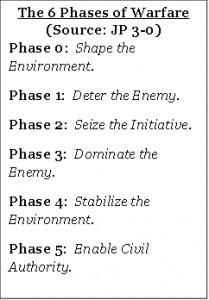
Six Phases of Warfare
Source: JP 3-0

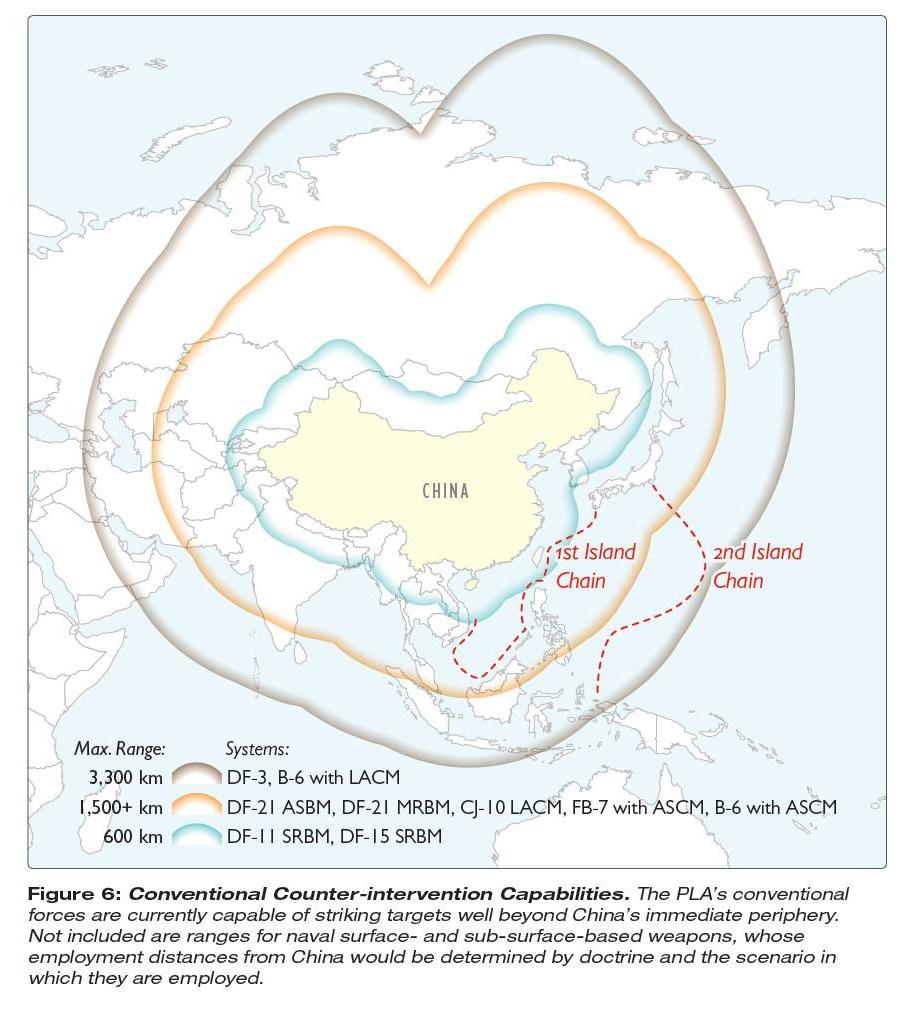
In modern parlance, winning without fighting is accomplished in Phases 0 and 1 of a campaign.  China is seeking to achieve a Phase 0-1 victory in the Pacific through its acquisition / deployment of Anti-Access Area Denial (A2AD) weaponry and economic / military coercion of its peripheral neighbors. When the two are coupled, US operational and diplomatic freedom of maneuver becomes severely constrained, and decisive counter-strategy is required.

Historically, the US has attempted to counter each of China’s weapon systems / diplomatic moves individually without attacking its overall strategy.  When new Chinese weapons systems are deployed, new American countermeasures are fielded.  When China builds new islands where disputed sandbars and reefs once existed, the US flies freedom of navigation sorties overhead.  When individual South East Asian countries are coerced by China to abandon multilateral UNCLOS negotiations and sign bilateral agreements, the US reaffirms support of multilateralism.  The American strategy demonstrates

Source: InformationDissemination.net

resolve and intent, but does little to shape the environment, and deter the near peer competitor.  It plays like a precipitated withdraw and ceding of the South China Sea to China—a stunning admission that there is seemingly little that the US can do when faced with the Chinese dominated political-economic landscape on one hand and a potential naval – air war of attrition on the other. 

The potential Chinese A2AD environment is particularly daunting for the US Pacific Fleet.  Chinese forces could elect to deploy their anti-surface / land attack ballistic and cruise missiles to keep American carriers outside of the 9-Dash Line; disable reconnaissance satellites; jam communications necessary for secure / centralized command & control; threaten to overwhelm remaining forces with vast numbers of aircraft while using the majority of their ships and submarines to counter the US asymmetric advantage in undersea warfare. By asymmetrically threatening American Navy “kill chains”, and especially by holding its naval center of gravity—the CVNs—at risk, the Chinese can effectively turn the American critical strength into a critical vulnerability.  The US cannot afford to lose even one CVN and thus when confronted with the threat of a paralyzing strike against its Pacific CVNs followed by an attrition war, it is prudent to assume that the US would not risk the losses and would exit the battlespace. A potential de-facto Chinese victory in Phases 0-2 could thus be achieved without a decisive Mahanian sea battle–just a credible threat.

Solution sets to countering Chinese A2AD Phase O-2 victory are under development from multiple sources—US  Naval Surface Forces (Distributed Lethality); Marine Corps Combat Development Command (Distributed STOVL [F-35B] Operations); US Marine Corps Advanced Studies Program (Engagement Pull).  All have one thing in common: strategic distribution of mobile offensive power to hold China’s freedom of maneuver in the South China Sea at risk, and inhibit their sea control over key sea lines of communication (SLOC). These solution sets represent a significant evolution in the strategic thought surrounding the US pivot to the Pacific:  attacking China’s strategy vs countering its individual asymmetric capabilities.

In Distributed Maritime Operations: Back to the Future, Dr. Benjamin Jensen states that

“…integrating land and naval forces as a ‘fleet in being’ denying adversary sea control is at the core of the emerging distributed maritime operations paradigm.” 

The defining of the pieces parts and the organizational construct of this paradigm is at the heart of the matter.  General Al Gray, USMC (ret) and Lt. General George Flynn, USMC (ret) recently presented at the Potomac Institute their thoughts on Sea Control and Power Projection within the context of The Single Naval Battle.  In their vision, the forces would include:

To this list I would add tactical level cyber capabilities.

Forces engaged in these missions will likely operate in near proximity to each other and in joint / combined operations, as the American, Australian, New Zealand and British sea, air and land forces of Guadalcanal did.  They will be required to pose sufficient threat to Chinese forces without significant reinforcement due to anticipated Chinese A2AD.  The inter-complexity of their likely combined Sea, Cyber, Air, Ground operations dictates that their task force command and control should not be ad-hoc, but must be defined well in advance to allow for the emergence, experimentation and exercising of command knowledge, skills, abilities and tactics / doctrine. US and allied lack of exercising joint/ combined, multi-domain operations prior to Guadalcanal led to tactics and command and control (C2) doctrine being written in blood.  This lack of foresight should not be repeated.

A SCAGTF construct allows for the US to shape the environment with its allies, deter the [Chinese], and if necessary to seize the initiative, buying time for the massing of forces to dominate the battlespace.  The SCAGTF is one way to integrate the great ideas of our best strategists on distributed maritime operations into a single, flexible organizational structure that is capable of mobile, simultaneous combined / joint multi-domain operations in all phases of warfare.  Such a force could aid the US in reversing its Pacific fortunes, in reinforcing multilateral peace and security for the region, and ultimately in realizing Sun Tzu’s bloodless victory.

Nicolas di Leonardo is a graduate student of the US Naval War College.  The views expressed here are his own and do not necessarily reflect those of the War College or the United States Navy.

Changing EEZs

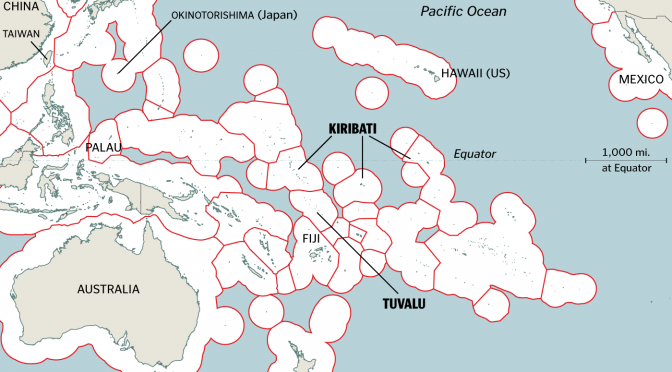
PacificEEZ
Pacific Exclusive Economic Zones. David Butler/Globe staff, click on the chart to enlarge

An interesting discussion took place in the Boston Globe about how to deal with potential changes in the world’s Exclusive Economic Zones (EEZs) as rising sea levels change the shape of land areas, perhaps resulting in the complete disappearance of some sovereign nations.

One of the possibilities is that the EEZs may be frozen in their current configuration and become an asset of the population, even after the land becomes uninhabitable or disappears completely, and that this asset may be sold, traded, or leased away. We know territorial sovereignty can be sold, after all, the United States benefited from the Louisiana Purchase and Seward’s Folly (Alaska).

A Chinese corporation has been attempting to build a new port complex on “reclaimed” land in Sri Lanka. “Located next to the Colombo Port, the US$1.4 billion project will add about 233 hectares of reclaimed land to the capital and house luxury office buildings, apartment blocks, a golf course, a water sport area, medical facilities, education institutions, hotels, a theme park and marinas.” The project is on hold right now, but if it goes forward, the Chinese firm would be granted  20 hectares (49.4 acres) on an outright basis and 88 hectares (244.6 acres) on a 99-year lease.

This is not a transfer of sovereignty, and  Sri Lanka is not in any danger of disappearing, but it does indicate the scope of China’s interest in the area and, located right off the Southern tip of India, it is sure to feed into India’s fears of being surrounded by a Chinese “string of pearls.”

Potentially more serious is the decision of the government of the Maldives, “The law passed by the Parliament will now allow absolute foreign ownership of land in Maldives if the investment is above USD 1 billion. The caveat to the law is that 70% of the land has to be reclaimed from the sea.” 

The Maldives, with an average elevation of 1.6 meters,  is one of those island nations in danger of being adversely effected by rising sea levels. If anyone takes the Maldives up on their offer, it will probably be the Chinese, who have already shown a lot of interest in the Indian Ocean island nation, despite Maldivan assurances to India that no Chinese military base will be allowed on its land. Again this is not a transfer of sovereignty, but it may be a harbinger of things to come

Besides I really wanted everyone to see the chart of Pacific EEZs. A lot of that is U.S. EEZ.

This article can be found in its original form on Chuck Hill’s CG blog. Chuck retired from the Coast Guard after 22 years service. Assignments included four ships, Rescue Coordination Center New Orleans, CG HQ, Fleet Training Group San Diego, Naval War College, and Maritime Defense Zone Pacific/Pacific Area Ops/Readiness/Plans. Along the way he became the first Coast Guard officer to complete the Tactical Action Officer (TAO) course and also completed the Naval Control of Shipping course. He has had a life-long interest in naval ships and history.

CIMSEC content is and always will be free; consider a voluntary monthly donation to offset our operational costs. As always, it is your support and patronage that have allowed us to build this community – and we are incredibly grateful.

Select a Donation Option (USD)

Enter Donation Amount (USD)

The Language of Terror

By Joshua Tallis

Terrorist. 

Few words evoke such an instant impression of pure evil. Somehow criminal, fanatic, extremist, none of these are adequate to describe the depravity of terror.

Terrorism.

Few words produce such a sense of dread in the pit of your stomach.

Yet, for a word with so much power, it is also incredibly contentious.

On September 11, 2012, armed men descended on the United States’ consulate in Benghazi, Libya. Ambassador Christopher Stevens and Foreign Service Officer Sean Smith were both killed in the attack. And for the last three years, the media and Washington have been in a never-ending debate over one question: was this, or was this not, an act of terror?

What was the source of this confusion? And moreover, why does it matter?

It matters because terrorism is a special word. Those emotions you feel when I write ‘terrorist,’ or when pundits speculate whether a shooting or a missing airliner was the product of terrorism, makes for a word with significant baggage.

This baggage is powerful in the political arena. It means that politicians can access deep emotions with relatively simple rhetoric.

But this baggage wreaks havoc in the academic sphere. Georgetown’s Bruce Hoffman writes that terrorism is a uniquely pejorative word, which means our use of it in scholarship is laced with normative assumptions. In other words, bias. Terrorism is universally recognized as a bad word; no one wants to be called a terrorist. Our use of the term means we are making a moral judgment about the people involved, about their cause.

We are accustomed to using terrorism predominantly as a political weapon. I call someone a terrorist because I disagree with them— vehemently. And because of the baggage this word carries, I gain the moral high ground if I can convince others to call them a terrorist as well.

And much of this isn’t wrong. Terrorism is undoubtedly a pejorative word, and using it does rightfully impart a sense of morality. But simply leaving terrorism defined as something so obscure is not too helpful, most of all because it leaves the idea of terror so nebulous that it appears up for debate.

We’ve all heard the phrase, ‘one man’s terrorist is another man’s freedom fighter.’

I may disagree with this sentiment, and indeed I do, but when we limit our understanding of terrorism to its barest, good guy versus bad guy narrative, we invite a relativistic debate where there shouldn’t be one.

And in our daily lives, this is the definition of terrorism we most commonly encounter and employ. As Hoffman writes:

“Pick up a newspaper or turn on the television and—even within the same broadcast or on the same page—one can find such disparate acts as the bombing of a building, the assassination of a head of state, the massacre of civilians by a military unit, the poisoning of produce on supermarket shelves, or the deliberate contamination of over-the-counter medication in a drugstore, all described as incidents of terrorism. Indeed, virtually any especially abhorrent act of violence perceived as directed against society—whether it involves the activities of antigovernment dissidents or governments themselves, organized-crime syndicates, common criminals, rioting mobs, people engaged in militant protest, individual psychotics, or lone extortionists—is often labeled ‘terrorism.’” (Inside Terrorism 2006)

Clearly, we need to get a little more specific. So, where does anyone start when they need to look up a definition? If I’m being honest the answer is Google, but for dramatic effect let’s say the dictionary.

The Oxford English Dictionary defines terrorism as follows:

“Terrorism: A system of terror. 1. Government by intimidation as directed and carried out by the party in power in France during the revolution of 1789–94; the system of “Terror.” 2. gen. A policy intended to strike with terror those against whom it is adopted; the employment of methods of intimidation; the fact of terrorizing or condition of being terrorized.” (Inside Terrorism 2006)

What would that mean in practice? Well, let’s see.

On June 28, 1914, Austria’s Archduke Franz Ferdinand and his wife were shot and killed while visiting Sarajevo. Gavrilo Princip, their assailant, has been widely regarded as a terrorist for his role in precipitating the start of the First World War. But was this really an act of terrorism? Well, it doesn’t have much to do with the French revolution, but I think it’s fair to say this murder produced widespread terror. So by the dictionary definition of terrorism, I’d have to say the death of the Archduke fits the bill.

But somehow this leaves me unfulfilled. “A system of terror—” that’s pretty vague. The reference to eighteenth century France is historically accurate, but also not very helpful. And “the fact of terrorizing or condition of being terrorized” is like defining hunger as the act of being hungry—it doesn’t give us much new information. We need more.

In a seminar on terrorism I attended in 2014 organized by the European International Studies Association and Yale University, Tamar Meisels from Tel-Aviv University advanced a definition of terrorism I found particularly compelling. To Tamar, Terrorism is “the intentional random murder of defenseless non-combatants, with the intent of instilling fear of mortal danger amidst a civilian population as a strategy designed to advance political ends.” (http://www.ucl.ac.uk/~uctytho/MeiselsTheTroubleWithTerror.html)

Tamar is guided by Michael Walzer, whose 1977 book, Just and Unjust Wars, helped disentangle terrorism from other forms of revolutionary violence. Revolutionary violence, by its very nature, implies that the actors undertaking it are not state-actors, and seek to radically alter the status quo. Walzer divides such violence into three categories.

The first is guerilla warfare. Guerillas typically launch attacks against an opposing military, limiting strikes against civilians. With victory, guerilla tactics are often easily justified, especially if the cause is deemed moral, like national self-determination or anti-colonialism.

Walzer’s second category is political assassination. Assassinations are targeted, demonstrating some distinction between valid and invalid targets, however unseemly. The violence is not random.

What is left is terrorism, which by process of elimination must target innocent individuals randomly in the pursuit of some political agenda.

To make things even clearer, we can disassemble the principles of this definition into five characteristics:

  • Violence—Terrorism necessarily includes the use or threat of violence directed against a population.
  • Motivation—Terrorism is used to achieve a political objective. By political, we mean that terrorism is intended to produce some sort of change in the political regime, however unlikely that may be.
  • Victim—There is a lot of debate over who constitutes a victim of a terrorist attack. Here, victims are randomly targeted civilians, not directly related to a cause and unable to defend themselves.
  • Audience—Terrorism, without an audience, is just a crime. Terrorism is propaganda by the deed, and thus it must be witnessed. This is because, while the victims of an attack may be terrorized, they are not the intended audience. To achieve a political objective, terrorism must induce a government or powerbrokers to choose a certain course of action in line with the terrorist’s objectives.
  • Actor—Groups without the right to legitimately use violence. In traditional political science, we define state sovereignty as the monopoly over the legitimate use of force, according to sociologist Max Weber. In other words, only states hold the right to exercise violence lawfully in conventional political philosophy. Under this rubric, terrorism cannot be practiced by states. Now, as I’ve noted, terrorism is a contentious topic in academia, and among the hundreds of definitions of terror, there are those that would include notions of state terror, which is itself a robust area of study. Entertaining both modes of violence in the same category, however, widens the use of the word terrorism so much as to almost become cumbersome. In the interest of balancing simplicity with clarity, I prefer to keep state terror and non-state terrorism in two separate bins.

So, what does this mean in the real world?

Let’s apply these five principles—violence, motivation, victim, audience, and actor—to some examples and see what happens.

And let’s start with the murder of Archduke Franz Ferdinand.

Number one, the use of violence, is clearly fulfilled.

Princip also fits the bill for number five, the actor. As an affiliate of the Black Hand, a militant nationalist organization, Princip was acting without legal authority to employ violence.

The incident also clearly fits number two, motivation. As a movement for self-determination, the Black Hand included many Yugoslav nationalists. And it was this broad aim that brought Princip to violence.

Number four, the audience, also seems to fit. Nineteenth and early-twentieth century terrorists, mostly anarchists, popularized ‘the propaganda of the deed,’ the idea that dramatic incidents were necessary for spreading revolution. In this regard, any public act of political violence speaks to an audience and fulfills that criterion. More specifically, the death of the heir apparent of the Austro-Hungarian Empire was clearly designed to send a message about the consequences of their continued presence in the Balkans.

Yet, the killing of Archduke Franz Ferdinand fails to meet the benchmark for the third characteristic, the victim. Applying Walzer’s categories of revolutionary violence, Gavrilo Princip was an assassin, not a terrorist. His victim was not random or unrelated to the success of Princip’s cause. None of this is to validate Princip’s actions, neither is it to say that his actions did not stir considerable terror. But according to this conception of terrorism, the assassination of the Archduke doesn’t pass muster.

How about another case, during the Lebanese Civil War?

On October 23, 1983, 299 American and French soldiers were tragically killed when two truck bombs detonated at the U.S. barracks in Beirut. The death toll marked one of the deadliest attacks on American soldiers since World War II. The Islamic Jihad Organization took credit for the devastation, which eventually precipitate an American withdrawal from Lebanon in 1984. It is frequently regarded as one of the most significant acts of terror in the last half-century.

Is it?

As with our first case, this clearly fits the criterion for violence

This attack also fits number two, motivation. Islamic Jihad was a Shiite militia whose aim was the withdrawal of Western forces from Lebanon, a political objective.

Number four, audience, is also apparent. The soldiers targeted may have been the victims, but the message was certainly intended for Washington.

Things get a little murky with respect to the perpetrator. Iran’s fingerprints were all over this attack, and they likely provided some intelligence, training and resources to make it happen. Still, Islamic Jihad, a non-state actor, was the group that eventually carried out the bombing, so it is fair to say the attack fits this category despite a relationship with state-sponsorship.

As with the assassination of the Archduke, however, this attack also fails to meet the characteristic for victims laid out above. As soldiers stationed in a conflict zone, Marines do not fit the status of randomly targeted civilians. Again, this is emphatically not an excuse for the attack, but it is illustrative of how important it is to find more enhanced words to frame such non-state violence.

This case is particularly demonstrative, as a renowned terrorism scholar relayed to me. The scholar noted that our field is riddled not only with conflicting definitions of terrorism, but also inconsistencies within individual works. An author may define terrorism on page 10 of a book as I did above, but by page 50 he or she is already referring to the Barracks Bombing as an act of terror, even though it fails to meet all markers. Scholars of terrorism are just as susceptible to the baggage associated with the word as anyone else, and often times we fail to remain consistent in our own applications of the terminology.

You’ll probably find that, at least in some instances, this academic understanding of terrorism may not align perfectly with events we instinctively regard as such. I would consider that a good thing, cause for coming up with better terms for acts of political violence. But some may find that overly restrictive, and you wouldn’t be alone. There are myriad definitions out there. Find one that makes sense to you. What matters most is that you are consistent in your application of the definition. Without a shared understanding of what terrorism means, we cannot ensure we are all speaking the same language.

So, was the attack on the U.S. Consulate in Benghazi an act of terror? You tell me.

Joshua Tallis is a PhD candidate at the University of St Andrews’ Centre for the Study of Terrorism and Political Violence. He is a Research Specialist at CNA Corporation, a nonprofit research and analysis organization located in Arlington, VA. The views and opinions in this article are his own and do not necessarily represent the position of the University or CNA.

CIMSEC content is and always will be free; consider a voluntary monthly donation to offset our operational costs. As always, it is your support and patronage that have allowed us to build this community – and we are incredibly grateful.

Select a Donation Option (USD)

Enter Donation Amount (USD)

Piracy 2.0 : The Net-Centric Evolution

By Brian Evans

Network-Centric Warfare derives its power from the strong networking of a well-informed but geographically dispersed force. – VADM Arthur Cebrowski, Proceedings 1998

Almost twenty years ago the pages of Proceedings carried an article by RDML Cebrowski that introduced the concept of network-centric, or net-centric, warfare.[1] The concept transformed the manner in which the United States (U.S.) Navy operates and fights. The principles that defined net-centric warfare remain relevant as they support Navy’s current pillars of Information Dominance: Battlespace Awareness, Assured Command and Control (C2), and Integrated Fires. The success of net-centric warfare has not gone unnoticed. Navies around the world are working to develop their own net-centric solutions. As a result, the U.S. Navy should not be surprised when enterprising individuals around the world similarly take note and make the evolutionary leap from traditional piracy to net-centric piracy.

While piracy has been a scourge for the duration of human history, the technological advances of the 21st century provide potential pirates transformational means, methods and opportunities. While the world has yet to witness a case of net-centric piracy, the two scenarios below present possible piracy events leveraging today’s technology.

Basic Net-centric Piracy

Sixty-two nautical miles south east of Singapore – 17JUL15 1154C: An Indonesian pirate opens his laptop and logs onto the internet via satellite phone. His homepage is a commercial Automated Identification System (AIS) website providing real-time track data from coastal and satellite receivers.[2] The laptop, satellite phone and website subscription were all funded by his investors.[3] As he scans his homepage, he looks for AIS contacts that meet his desired vessel profile for cargo type, transportation firm, flag, and speed of advance. Today there are two AIS tracks of interest matching his profile and likely to pass through his preferred zone of operation, MV OCEAN HORIZONS and MW ORIENTAL DAWN. He then checks weather conditions and determining that they are favorable, he sends individual texts messages containing coordinate and track data for the AIS tracks of interest. The text recipients are two fishing boat captains, one located in Belawan, Indonesia and the other in Dungun, Malaysia.

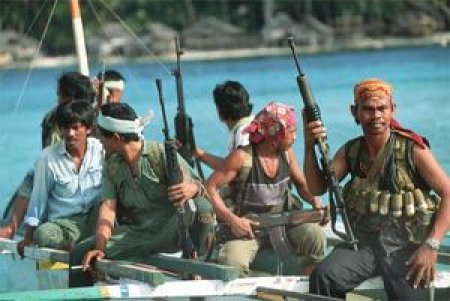
Indonesian Pirates
From: The Maritime Executive – Indonesian Pirates

Forty-six nautical miles east of Belwan, Indonesia – 17JUL15 1646C: MV ORIENTAL DAWN passes a non-descript fishing boat 46 nautical miles off the coast of Indonesia. Unbeknownst to the crew of the MV ORIENTAL DAWN, this fishing boat is captained by the pirate’s associate from Belawan. The fishing boat’s captain discretely observes the passing vessel through a pair of high-powered binoculars. Seeing barbed wire along the railings and an individual on the ship’s deck that does not appear to be a member of the crew, the fishing boat captain utilizes a satellite phone to call and report his observations to his Indonesian pirate contact. Based on this information the Indonesian pirate determines that MV ORIENTAL DAWN is not a suitable target.

One-hundred seventeen nautical miles east of Singapore – 17JUL15 1707C: The Indonesian pirate receives a call. This time it is the fishing boat captain from Dungun. The captain reports that the MV OCEAN HORIZONS is loaded down creating a smaller freeboard and there does not appear to be any additional security measures present. Given this assessment, the Indonesian pirate decides that MV OCEAN HORIZONS is a target of opportunity. He immediately has the crew of his ship alter course.

Thirty-seven nautical miles east of Pekan, Malaysia – 18JUL15 0412C: The Indonesian pirate launches two high-speed skiffs from his ship, both carrying multiple armed personnel. The Indonesian pirate mothership remains over the horizon, but in radio contact while the skiffs conduct the remainder of the intercept.

Sixty-two nautical miles east of Pekan, Malaysia – 18JUL15 0642C: The armed personnel from the skiffs board MV OCEAN HORIZONS and catch the crew off guard. Once in control of the ship, they contact the Indonesian pirate via radio and report their success. The Indonesian pirate immediately opens his laptop and reports his success to his investors. He also lists the ship’s cargo for auction on a dark website and sends a ransom demand to the employer of the MV OCEAN HORIZON crew.

Sophisticated Net-centric Piracy     

Moscow, Russia – 17JUL15 0126D: After a series of all-nighters over the last week, a Russian hacker has gained access to a crewmember’s computer onboard the MV PACIFIC TREADER.[4] Using this access he maps the shipboard network. Discovering a diagnostic and maintenance laptop used for the ship’s automation and control system on the network, he quickly exploits the laptop’s outdated and unpatched operating system to install a tool on the automation and control system.[5] The tool enables a remote user to either trigger or disable a continual reboot condition. Once installed, the hacker posts the access information for the tool’s front end user interface in a private dark web chatroom.

Prague, Czech Republic – 16JUL15 2348A: Sitting in his Prague apartment, a pirate receives a message on his cellphone via a private dark web chatroom. The message is from one of several hackers he contracted to gain access to control or navigation systems onboard vessels operated by the TRANS-PACIFIC SHIPPING LINE. With the posted access information, he logs onto his laptop and tests his access into the MV PACIFIC TREADER automation and control system. After successfully establishing a connection he closes out of the tool and electronically transfers half of a contracted payment due to his hired hacker. Next using a commercial AIS website providing real-time track data from coastal and satellite receivers, he determines that MV PACIFIC TREADER is likely headed into port in Hong Kong.[6] Posting a message in a different private dark web chatroom, the pirate provides the identifying information for MV PACIFIC TREADER.

Hong Kong, China – 19JUL15 0306H: On a rooftop in Hong Kong, a young college student pulls an aerial drone out of her backpack. She bought it online and it is reportedly one of the quietest drones on the market. She also pulls three box-shaped objects out of her backpack. Hooking one of the objects to the drone, she launches it and flies it across Hong Kong harbor in the direction of a ship she identified during the day as the MV PACIFIC TREADER. Using the cover of darkness she lands the drone on the top of the pilot house and releases the object. Repeating this process twice more, she places the box shaped objects on other inconspicuous locations on the ship. After bagging up her drone, she posts a message to a dark web chatroom simply stating that her task is complete. Almost immediately afterwards she receives a notification that a deposit was made into her online bank account.

Prague, Czech Republic – 25JUL15 1732A: After eating a home-cooked meal, the pirate sits down at his laptop and checks the position of MV PACIFIC TREADER via the commercial AIS website he subscribes to. Observing that the MV PACIFIC TREADER is relatively isolated in the middle of the Pacific Ocean, he opens the remote tool that provides him access to the ship’s automation and control system. He sends a text message and then clicks to activate the tool.

Two-thousand ninety-three nautical miles north east of Hong Kong – 26JUL15 0332K: Onboard MV PACIFIC TREADER an explosion engulfs the bow of the ships sending flames into the dark air. Immediately, the ship’s engines roll to a stop as the navigation and ship’s control system computers go into a reboot cycle. The lone watchstander on the bridge is paralyzed to inaction by the surprise and violence of the events unfolding around him. The Master immediately comes to the bridge, completely confused by the events occurring onboard his ship.

Prague, Czech Republic – 25JUL15 1736A: The pirate confirms via his remote tool that the ship’s automation and control system is in a continuous reboot cycle, then he re-checks the commercial AIS website and confirms that MV PACIFIC TREADER is dead in the water. He immediately sends an email to the TRANS-PACIFIC SHIPPING LINE demanding a ransom, stating MV PACIFIC TREADER will remain dead in the water and more explosive devices will be activated until he is paid.

New Means – Same Motive

These scenarios illustrate how the evolution of technology and the increased connectivity of systems and people potentially enable a fundamental shift in the nature of piracy. Despite the change in means and geographic distribution of actors, net-centric and traditional piracy both utilize physical force or violence, or the threat thereof, by a non-state actor to seize or detain a vessel operating on the high seas. The key enabler of net-centric piracy is the Internet.

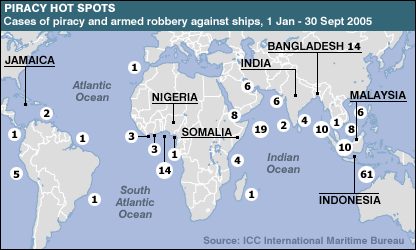
Piracy Hot Spots

The Internet is the net-centric pirate’s “high-performance information grid that provides a backplane for computing and communications.”[7] Admiral Cebrowski argued that this information grid was the entry fee for those seeking net-centric capabilities.[8] What Admiral Cebrowski did not know was how rapidly the Internet would evolve and enable near-instantaneous global communications at relatively low costs, allowing anyone who desires access to a high-performance information grid.

As the net-centric pirate’s high-performance information grid, the Internet serves as a command and control network as well as the means for disseminating intelligence information, such as vessel location or the presence of physical security measures. The intelligence that is disseminated may also have resulted from collections performed via the Internet. One collection means is to leverage the vast area of private and commercial data sources available for public consumption, again at little or no cost, such as shipping schedules and AIS data. A second means of collection uses the Internet to conduct intelligence, surveillance and reconnaissance (ISR) via cyber techniques; however, only the most sophisticated net-centric pirates will possess this capability. Similarly, highly sophisticated net-centric pirates may be able to achieve global weapons reach by producing physical effects via cyber means over the Internet, eliminating the need for the pirate to be physically present in order to seize or detain a vessel.

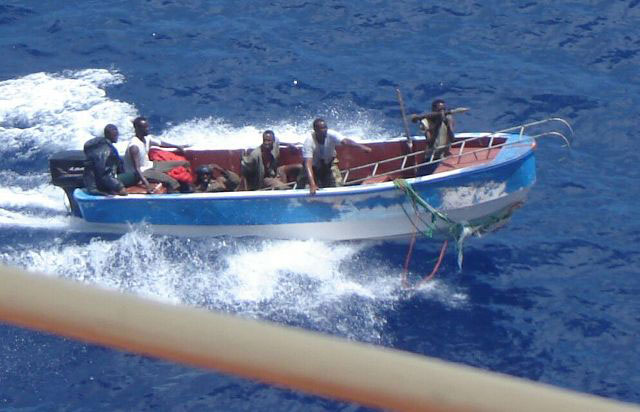
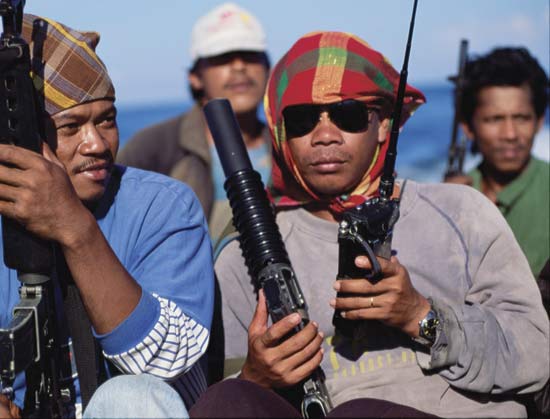
Somali Pirates
From: OCEANUSLive – Somali Pirates

The attractiveness of net-centric piracy is the low barrier to entry, both in risk and cost. Since the Internet is the key enabler of net-centric piracy, its low cost and ease of use vastly expand the potential pirate population. The anonymity of the Internet also allows potential net-centric pirates to meet, organize, coordinate and transfer monetary funds with a great degree of anonymity. As a result, the risks of arrest or capture are significantly reduced, especially since a net-centric pirate may not be able to identify any of their co-conspirators. Similarly, the ability of net-centric piracy to enable remote intelligence gathering or even produce physical effects via cyber techniques removes a significant element of physical risk associated with traditional piracy. The monetary gain from the successful capture of a vessel compared to the low cost and risk currently associated with net-centric piracy make it an attractive criminal enterprise.

Countering Net-centric Piracy

The United Nations Convention of the Law of the Sea (UNCLOS) Article 101 defines piracy as:

  1. any illegal acts of violence or detention, or any act of depredation, committed for private ends by the crew or the passengers of a private ship or a private aircraft, and directed:
    • on the high seas, against another ship or aircraft, or against persons or property on board such ship or aircraft;
    • against a ship, aircraft, persons or property in a place outside the jurisdiction of any State;
  2. any act of voluntary participation in the operation of a ship or of an aircraft with knowledge of facts making it a pirate ship or aircraft;
  3. any act of inciting or of intentionally facilitating an act described in subparagraph (1) or (2).[9]

Under this internationally recognized legal definition of piracy, net-centric piracy clearly results in violence against or detention of vessels on the high seas for private ends. It is also clear from this definition that any activities associated with facilitating a piracy event, such as intelligence collection or compromising a vessel’s computerized control systems, are also considered piracy under international law. International law also states that “All States shall cooperate to the fullest possible extent in the repression of piracy on the high seas or in any other place outside the jurisdiction of any State.”[10] As a result, the international community must resolve how it will counter net-centric piracy, where pirates need not operate on the high seas and may be located thousands of miles from the target vessel.

The challenge facing the international community from net-centric piracy is compounded by immaturity of international cyber law. Currently the authorities and responsibilities of international organizations, governments and law enforcement agencies with regards to the use of the Internet to commit piracy are undetermined. This challenge is further complicated by the fact that the Internet is a manmade domain where all potions are essentially within the territory of one state or another. As a result, disrupting net-centric piracy operations will require a significant degree of international coordination and information sharing. Extensive international cooperation will also be required to identify, locate, and apprehend individuals involved in net-centric piracy.

Pirates
From: Encyclopedia Britannica – Pirates utilize a range of weapons and technology

While an occurrence of net-centric piracy has yet to occur, the opportunity and capabilities required for such an event exist today. The U.S. Navy should not be caught off guard. Instead, the Navy should take the following actions:

  • Raise awareness within the international maritime community regarding the risks and realities of net-centric piracy
  • Provide best practice and limited cybersecurity threat information to transnational maritime shipping companies
  • Work with partner Navies to develop means and methods for disrupting net-centric piracy, including developing an appropriate framework for information sharing and coordination
  • Work with Coast Guard, law enforcement and international partners to develop a cooperative construct for identifying, locating and apprehending net-centric pirates
  • Engage with the State Department to advance international dialog on net-centric piracy, including the need for consensus on international law and processes for prosecution of net-centric pirates

An enduring lesson of human history is that opportunity for profit, regardless of difficulty or brevity, will be exploited by someone somewhere. Net-centric piracy represents an opportunity to generate revenue without requiring the physical risks of traditional piracy. The anonymity and distributed nature of the cyber domain also creates new counter-piracy challenges. Add to this the low cost and availability of unmanned system components coupled with the low barrier of entry for cyber, and the question becomes not whether net-centric piracy will occur but when. With a global interest in maintaining the international maritime order and ensuring the uninterrupted flow of commerce on the high seas, the U.S. Navy must be ready to meet the challenges of net-centric piracy.

LCDR Brian Evans is a U.S. Navy Information Dominance Warfare Officer, a member of the Information Professional community, and a former Submarine Officer. He is a graduate of the U.S. Naval Academy and holds advanced degrees from Johns Hopkins University, Carnegie Mellon University, and the Naval War College. 

The views expressed in this article are those of the author and do not reflect the official policy or position of the United States Navy, Department of Defense or Government.

[1] VADM Arthur K. Cebrowski and John H. Garstka, “Network-Centric Warfare – Its Origin and Future,” U.S. Naval Institute Proceedings, Volume 124/1/1,139 (January 1998).

[2]https://www.vesseltracker.com/en/ProductDetails.html

[3] “Somali Piracy: More sophisticated than you thought,” The Economist (November 2nd, 2013), http://www.economist.com/news/middle-east-and-africa/21588942-new-study-reveals-how-somali-piracy-financed-more-sophisticated-you

[4] Jeremy Wagstaff, “All at sea: global shipping fleet exposed to hacking threat,” Reuters (April 23rd, 2014), http://www.reuters.com/article/2014/04/24/us-cybersecurity-shipping-idUSBREA3M20820140424

[5] Mate J. Csorba, Nicolai Husteli and Stig O. Johnsen, “Securing Your Control Systems,” U.S. Coast Guard Journal of Safety & Security at Sea: Proceedings of the Marine Safety & Security Council, Volume 71 Number 4 (Winter 2014-2015).

[6]https://www.vesseltracker.com/en/ProductDetails.html

[7] VADM Arthur K. Cebrowski and John H. Garstka, “Network-Centric Warfare – Its Origin and Future,” U.S. Naval Institute Proceedings, Volume 124/1/1,139 (January 1998).

[8] Ibid.

[9] United Nations, United Nations Convention on the Law of the Sea (New York: United Nations, Article 101, 1994).

[10] United Nations, United Nations Convention on the Law of the Sea (New York: United Nations, Article 100, 1994).