Category Archives: Global Analysis

A Geographical Breakdown of What’s Going on in the World

The Russian Navy: Strategies and Missions of a Force in Transition

Russia Resurgent Topic Week

By Michael Kofman

On October 7th, Russia’s Caspian Flotilla launched land attack cruise missiles into Syria, bringing into relief the steady modernization of the Russian Navy (RFN), and its recently added strike capabilities. Dominating the Caspian is not a difficult challenge for the Russian flotilla of Gepard-class frigates and Buyan-M corvettes, but the ability to launch cruise missiles at targets in Europe or the Middle East potentially over two thousand kilometers away is emblematic of the future Russian Navy. Together with the Northern, Pacific, Baltic, and Black Sea Fleets, the RFN is a force in transition. Russia’s surface and submarine force today is quantitatively a fraction of the size of its Soviet ancestor, but it is undergoing revival, investment, and reconfiguration to become a qualitatively different force. Today’s Russian Navy is intended to pursue both traditional missions such as strategic deterrence and status projection, along with sea denial, sea control, and coastal defense.

[otw_shortcode_button href=”https://cimsec.org/buying-cimsec-war-bonds/18115″ size=”medium” icon_position=”right” shape=”round” color_class=”otw-blue”]Donate to CIMSEC![/otw_shortcode_button]

Russia’s latest maritime doctrine, released in July, is an incredibly ambitious document with visions of carriers, multirole landing ships, new destroyers, and a host of platforms indicating parity with the U.S. and power projection across blue waters in the maritime domain. However, these dreams, reaching out into 2050, are unlikely to be realized for a slew of reasons, including budget constraints, defense industry capacity, inefficiencies, and technological shortcomings. Russia’s defense budget this year, at 3.3 trillion roubles or 4.2% of GDP, is the largest it has ever been since the Soviet Union, but given prevailing economic conditions, it is unlikely to be seen at these levels for years to come. Financial constraints aside, Russia also lacks a vision for the missions these carriers or amphibious ships would perform. They are political aspirations on paper at best, while much of the actual maritime strategy and thinking on the future of Russian naval power is unlikely to reside in this document.

Instead of unattainable, and unrealistic, dreams of power projection with a large blue water navy, the RFN seems set to become primarily a green water force. Increasingly based around smaller and more advanced ship classes, with capable long range anti-ship and land attack missiles, this fleet will be designed to project conventional deterrence. In practice, Moscow is investing in the achievable, while paying lip service to the unnecessary. Hence, in the coming years, Russia will remain primarily a regional naval power. One area where the maritime doctrine rings true is the concentration of effort and assets facing NATO forces in Europe and along the Arctic, best embodied in modernization of the Northern and Black Sea Fleets.

The desire to establish “non-nuclear deterrence,” voiced in the Military Doctrine released in December 2014, is a more important driver behind Russian thinking. This strategy is based around long range precision weapons, multiple vectors of attack, and the ability to inflict high costs to NATO in select regions such as the Baltic, Black, and Barents Seas. In this respect, Russia’s naval developments should be viewed in conjunction with spending on additional maritime aviation and coastal defenses, such as the Su-30SM and the Bastion-P. However, Russia’s maritime aviation is a small force and organizationally in the hands of its air force. The more important trend in the Russian navy is that a small missile boat, or a frigate, armed with the new line of Kalibr missiles (SS-N-27A and SS-N-30A), can pose a similar threat to a Tu-22M3 bomber at a better stand-off range and have excellent land attack options.

In the Russian submarine force, strategic deterrence remains the paramount mission, particularly with the new Borey-class of SSBNs steadily replacing older Delta IVs and IIIs. Power projection seems mostly a mission for the submarine force, especially given the troubled shipbuilding program. In the coming years, older Soviet platforms will be steadily phased out. However, with delays in production of new multi-role ships, the Russian navy looks increasingly better underwater. The best example is a new squadron of six improved-Kilo diesel submarines being added to the Black Sea Fleet, armed with the same family of land attack and anti-ship missiles. The new Yasen-class multirole submarine, along with modernization projects for older SSNs and SSGNs, will restore some of the Russia’s sea power in the underwater domain.There is a marked increase in Russian submarine activity and patrols, up by fifty percent according to Russian Navy chief Admiral Viktor Chirkov, along with a newfound interest in underwater cable and oceanographic mapping.

Status projection via naval power remains an important national priority, as it arguably has been since the time of Peter the Great. While differences abound in Russian defense circles over the amount of spending on the navy, given the country is primarily a land power, Moscow remains committed to the notion that it cannot be considered a great power without visible hallmarks of naval power. Hence Russia is investing in the modernization and refit of the Kirov-class battlecruisers, at great expense to other priorities, with perhaps 1.7 billion roubles for Admiral Nakhimov and over 2 billion roubles for Peter the Great. The goal is to maintain a unique set of capital ships to conduct flag waving, strategic messaging, and a host of other status projection missions. While the Kirovs may be anachronistic, status projection is held at an even higher premium today because it is tied to the public perception of Vladimir Putin’s personal brand of leadership, which in Moscow is as important as the objective results of foreign policy.

The most prominent mission for the Russian Navy today is supporting the military intervention in Syria, including provision of air defense using the Slava-class missile cruiser Moskva and sustaining the force via sea lines of communication from the Black Sea, dubbed the “Syrian Express.” The Black Sea Fleet (BSF) is in charge of this operation in the Eastern Mediterranean, managing a rotating squadron of roughly ten ships, largely composed of Soviet era landing ships and the BSF anti-submarine warfare group. Originally stood up to support the Syrian regime in 2013, the Mediterranean squadron will become a more permanent fixture according to official statements, independent of the conflict’s trajectory.

The intervention in Syria is a useful study on the state of Russian sea lift and capacity for expeditionary warfare. Russia compensated for the lack of available sea lift, an expensive asset to have lying about for a country that has not done expeditionary warfare since the Afghanistan War, by simply re-designating commercial carriers (ironically purchased from Turkey). The RFN trains provision of mobility and sea lift for ground forces during annual strategic exercises, but even for a relatively close operation such as Syria, clearly lacks the requisite assets.  With limited platforms available for expeditionary warfare, the RFN is focused instead on being able to move forces around the country’s vast regions. This is an especially challenging mission in the Arctic and Pacific, largely uninhabited expanses of terrain where exerting sea control is taxing. Traditional expeditionary warfare is not something the Russian navy is geared for, plans for, or expects to be doing much of in the future.

The RFN will remain strongest facing NATO in the European theater, effecting sea denial and conventional deterrence, with smaller and more modern platforms. While Russian ships may venture out into the North Atlantic, most such forays will be limited to strategic communication, training, or flag waving missions. The submarine force will form an important element in a strategy of nuclear and conventional deterrence, maintaining the ability to strike the U.S. homeland. Around Russia’s periphery, a host of sea patrol ships and cutters for the FSB border guard will work to improve sea control along the coastline. The Arctic is an area of particular anxiety for Moscow, despite little traffic through the Northern Sea Route. Russian leaders envision long term economic competition over Arctic resources. They are seeking to invest in military and rescue infrastructure today in order to establish firm control over access to the region in the future. When it comes to sea control and sea lift the Russian strategy is mindful of cost constraints and structured around surging capacity when needed.

As envisioned today, the Russian Navy is not likely to become a global peer competitor to the U.S. but represent a more potent regional challenge, particularly to NATO allies. NATO will have to deal with a resurgent Russian presence in the Mediterranean and the ability of Russian ships to conduct long range strikes from within the comfort of established A2/AD zones close to their bases of operation. While the net sum of Russia’s naval strategy could be characterized as regional and largely defensive in nature, the practical results are not simply negative from a security standpoint for NATO, but present new challenges for a stretched U.S. Navy. Russia’s shipbuilding program will proceed fitfully at best, but the changes already in progress within the RFN are yielding results that will require adjustment and adaptation on the part of the U.S. and its allies.

Mr. Michael Kofman is a Research Scientist at CNA Corporation and a Fellow at the Kennan Institute, Woodrow Wilson International Center in Washington, D.C. Mr. Kofman holds a M.A. in International Security from the Edmund A. Walsh School of Foreign Service, Georgetown University and a B.A. in Political Science from Northeastern University.

Read other contributions to Russia Resurgent Topic Week.

Russia Resurgent Week Kicks Off on CIMSEC

By Matt McLaughlin

Welcome to Russia Resurgent Week at CIMSEC, where we attempt to shed some light on Russia’s objectives, capabilities and constraints. Russia has occupied the headlines for a variety of reasons in recent weeks, but this is not the place to visit for the latest updates. Rather, this week investigates the broad phenomenon of post-Soviet Russia’s rise. What are its tools? What will it do with them, and where? How do recent events fit into a broader strategic framework?

An impressive stable of international writers has contributed on a variety of Russia-related subjects. Interspersed are some pieces published earlier on CIMSEC that complement the latest work. We hope that by the end of the week Russia will be slightly less of a mystery, if still an enigma.

1 – The Russian Navy: Strategies and Missions of a Force in Transition By Michael Kofman
2 – The New Russian Naval Doctrine By Sean MacCormac
3 – The Development of Russian Naval Capabilities after the Cold War By Patrick Truffer
4 – Shipbuilding Constraints Drive Downsized but Potent Russian Navy By Dmitry Gorenburg
5 – Russian Navy Reads Sun Tzu’s Art of War By Vidya Sagar Reddy
6 – Cutting Through the Fog: Reflexive Control and Russian STRATCOM in Ukraine By Robert C. Rasmussen

7 – Is Russia’s Maritime Strategy Adrift? By Ben Hernandez
8 – Russia in the Arctic: Aggressive or Cooperative? By Laguerre Corentin
9 – Yours, Mine and Moscow’s: Breaking Down Russia’s Latest Arctic Claims By Sally DeBoer
10 – Russian & Soviet Fleets, 25 Years Apart  By Louis Martin-Vezian

Matt McLaughlin is a U.S. Navy Surface Warfare Officer. His opinions do not represent the Department of the Navy.

[otw_shortcode_button href=”https://cimsec.org/buying-cimsec-war-bonds/18115″ size=”medium” icon_position=”right” shape=”round” color_class=”otw-blue”]Donate to CIMSEC![/otw_shortcode_button]

An Embarrassing Fact: The Legal Basis of the PRC East China Sea ADIZ

By Chang Ching

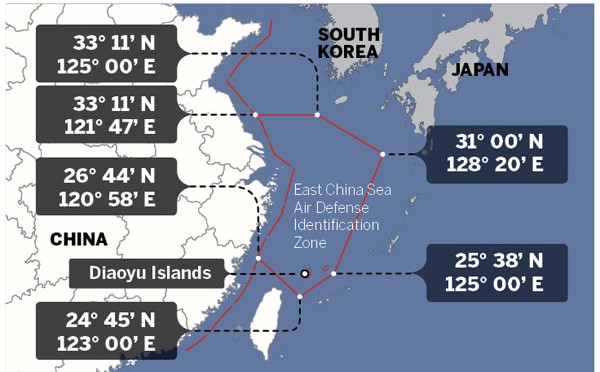
Two years ago on this day, the Ministry of National Defense of the People’s Republic of China issued a statement on establishing the East China Sea Air Defense Identification Zone. According to “the Statement by the Government of the People’s Republic of China on Establishing the East China Sea Air Defense Identification Zone,” three PRC domestic laws and administrative rules were addressed as the basis of the East China Sea ADIZ within the following text:

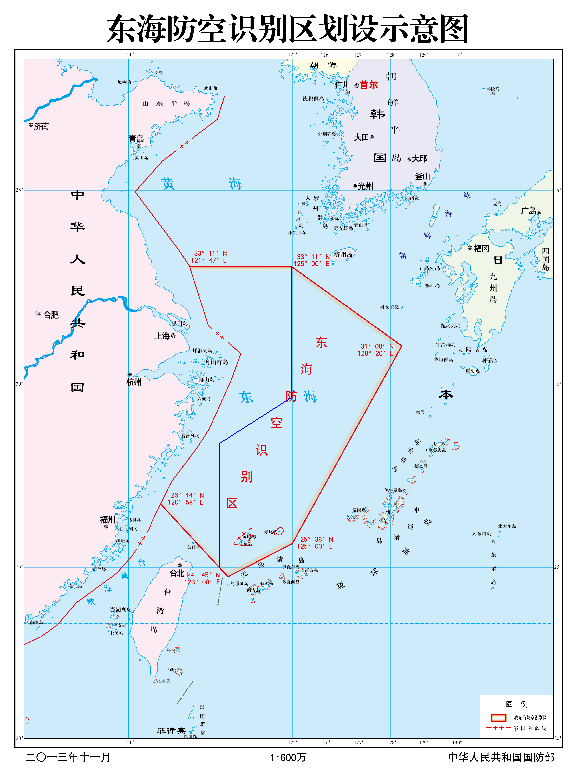
The government of the People’s Republic of China announces the establishment of the East China Sea Air Defense Identification Zone in accordance with the Law of the People’s Republic of China on National Defense (March 14, 1997), the Law of the People’s Republic of China on Civil Aviation (October 30, 1995) and the Basic Rules on Flight of the People’s Republic of China (July 27, 2001). The zone includes the airspace within the area enclosed by China’s outer limit of the territorial sea and the following six points: 33º11’N (North Latitude) and 121º47’E (East Longitude), 33º11’N and 125º00’E, 31º00’N and 128º20’E, 25º38’N and 125º00’E, 24º45’N and 123º00’E, 26º44’N and 120º58’E.

IMG_5846
It is highly unlikely that the East China Sea ADIZ may effectively terminate all the foreign air reconnaissance maneuvers.

Further, based on this government statement, China’s Ministry of National Defense issued an announcement of the aircraft identification rules for the East China Sea Air Defense Identification Zone of the People’s Republic of China as the following text:

The Ministry of National Defense of the People’s Republic of China, in accordance with the Statement by the Government of the People’s Republic of China on Establishing the East China Sea Air Defense Identification Zone, now announces the Aircraft Identification Rules for the East China Sea Air Defense Identification Zone as follows:

First, aircraft flying in the East China Sea Air Defense Identification Zone must abide by these rules.

Second, aircraft flying in the East China Sea Air Defense Identification Zone must provide the following means of identification:

  1. Flight plan identification. Aircraft flying in the East China Sea Air Defense Identification Zone should report the flight plans to the Ministry of Foreign Affairs of the People’s Republic of China or the Civil Aviation Administration of China.
  2. Radio identification. Aircraft flying in the East China Sea Air Defense Identification Zone must maintain the two-way radio communications, and respond in a timely and accurate manner to the identification inquiries from the administrative organ of the East China Sea Air Defense Identification Zone or the unit authorized by the organ.
  3. Transponder identification. Aircraft flying in the East China Sea Air Defense Identification Zone, if equipped with the secondary radar transponder, should keep the transponder working throughout the entire course.
  4. Logo identification. Aircraft flying in the East China Sea Air Defense Identification Zone must clearly mark their nationalities and the logo of their registration identification in accordance with related international treaties.

Third, aircraft flying in the East China Sea Air Defense Identification Zone should follow the instructions of the administrative organ of the East China Sea Air Defense Identification Zone or the unit authorized by the organ. China’s armed forces will adopt defensive emergency measures to respond to aircraft that do not cooperate in the identification or refuse to follow the instructions.

Fourth, the Ministry of National Defense of the People’s Republic of China is the administrative organ of the East China Sea Air Defense Identification Zone.

Fifth, the Ministry of National Defense of the People’s Republic of China is responsible for the explanation of these rules.

Sixth, these rules will come into force at 10 a.m. November 23, 2013.

For the most part, military observers and political commentators have analyzed the matter from the political dimension. What is lacking is an examination of the validity of these three PRC domestic laws and rules as well as their association with the PRC government statement and the subsequent aircraft identification rules. 

After reviewing the three laws and rules, i.e. the Law of the People’s Republic of China on National Defense, the Law of the People’s Republic of China on Civil Aviation and the Basic Rules on Flight of the People’s Republic of China, noted by the PRC East China Sea ADIZ statement (hereafter, the statement) and the associated aircraft identification rules, we may conclude the following flaws:

First, the effective dates of these three laws and rules noted by the statement are indeed questionable.

For the Law of the People’s Republic of China on National Defense, it was initially put into force on March 14, 1997, as noted by the statement. Likewise, the Law of the People’s Republic of China on Civil Aviation was originally put into effect on October 30, 1995, also noted by the statement. Nevertheless, according to the “Decision of the Standing Committee of the National People’s Congress on Amending Some Laws” issued by the Standing Committee of the National People’s Congress on August 27, 2009 and subsequently put into effect by the “Order No.18 of the President of the People’s Republic of China”, the Article 48 of the Law of the People’s Republic of China on National Defense was revised. Similarly, contents or wordings of the Article 191, 192, 193, 194, 195, 196, 197, 198, 199 and 200 of the Law of the People’s Republic of China on Civil Aviation were also revised by the same amending process and government document. Hence, the effective dates of these two laws noted by the statement were definitely incorrect after the law amendment process.

IMG_5850
The original map attached to the PRC East China Sea ADIZ government statement.

Moreover, the Basic Rules on Flight of the People’s Republic of China was not initially put into force as noted by the statement. It was first jointly issued by the PRC State Council and the PRC Central Military Commission on July 24, 2000, by the “Decree No. 288 of the State Council of the People’s Republic of China and the Central Military Commission of the People’s Republic of China” after a large scale revision from its progenitor with the identical title established by the same two institutions on April 21, 1977.

Based on two separate documents but with the same titles known as the “Decision of the State Council and the Central Military Commission on Amending the General Flight Rules of the People’s Republic of China”, it was subsequently twice amended on July 27, 2001 and October 18, 2007. Also, the revised rules were put into force by the “Decree No. 312 of the State Council of the People’s Republic of China and the Central Military Commission of the People’s Republic of China” and “Decree No. 509 of the State Council of the People’s Republic of China and the Central Military Commission of the People’s Republic of China” on August 1, 2001 and November 22, 2007, accordingly. We therefore may notice that the effective date of the Basic Rules on Flight of the People’s Republic of China noted by the statement was neither the initial effective date of the rule nor the latest effective date of the rule.

Based on the survey results already mentioned , we may conclude that the validity and legality of the judiciary documents cited by the statement is undeniably questionable. The quality of this government statement is poor.

Second, the jurisdiction associated with the contents noted by these three laws and rules as compared with the airspace defined by the PRC East China Sea ADIZ can also be problematic. The jurisdiction defined by the Law of the People’s Republic of China on National Defense is basically illusive. It does note with the territorial airspace in its text. Yet, the substantial content of this law has never specifically mentioned its jurisdiction may extend to any air defense identification zone. Likewise, the Article 2 of the Law of the People’s Republic of China on Civil Aviation does declare the PRC’s exclusive sovereign rights over its territorial airspace. Many other articles of this law also repeatedly address its jurisdiction over the PRC territorial airspace. By the principle of ratione loci, we may clearly identify the jurisdiction defined by this law never was intended to extend to the airspace over the East China Sea.

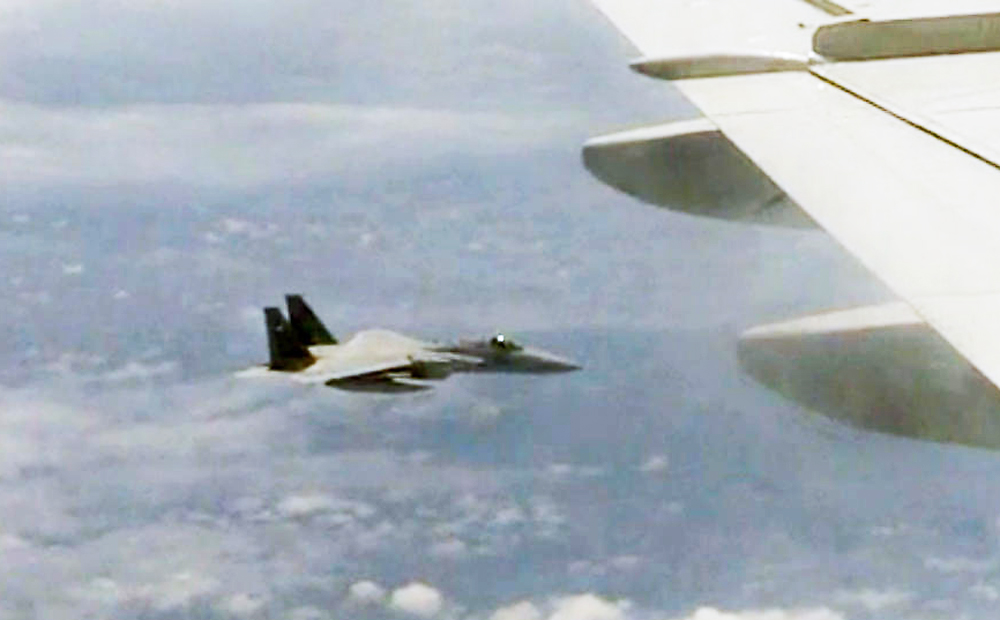
A screenshot from a video posted on the website of China's Ministry of National Defense shows a Japanese fighter jet following Chinese fighter jet. (Handout)
The PRC East China Sea ADIZ is not a hollow statement. The Substantial interception maneuvers toward the JMSDF MPA by the PLAAF fighters.

On the other hand, according to the Chapter 13 and the Article 173 of the People’s Republic of China on Civil Aviation, its jurisdiction does cover those foreign aircrafts or other flying objects within its territorial airspace. Also, by the terms noted in its Article 182, its jurisdiction may extend to certain search and rescue areas out of its territory. Nonetheless, such search and rescue areas are governed by the international treaties and totally irrelevant with any air defense identification zone.

Basically, the Basic Rules on Flight of the People’s Republic of China is the administrative rule originated from the People’s Republic of China on Civil Aviation. This is exactly the reason why the Article 1 of this rule specifically noted its jurisdiction only covering those aviation activities within the PRC’s territory. However, the Article 2 of the same rule also extends its jurisdiction over those units and persons with the ownership of the aircrafts as well as the personnel relevant to the aviation activities and the activities themselves. There are numerous articles of this rule repeatedly addressing its jurisdiction and objectives involved in the activities within this airspace as well as the aviation activities themselves.

The only exception regarding the jurisdiction out of its territorial airspace ever appeared in this rule is the Article 121 of Chapter XII titled with Supplementary Provisions: “In regard to the aircraft of the People’s Republic of China operating over the contiguous zones, exclusive economic zones or high seas beyond the territorial waters of the People’s Republic of China, where the provisions of an international treaty concluded or acceded to by the People’s Republic of China are different from the provisions of these Rules, the provisions of that international treaty shall apply, except the provisions for which reservation has been declared by the People’s Republic of China.” According to the content noted above, its jurisdiction may only cover the aircraft with the PRC nationality registration. It does not authorize any jurisdiction over foreign aircraft out of its territorial airspace.

After reviewing the content of these three laws and rules, we may very confidently believe that there is no basis of jurisdiction over the East China Sea ADIZ ever granted by them. This is another solid evidence of staff work negligence.

Third, terms or any substantial contents noted by these three laws and rules are never associated with the airspace defined by the statement or the aircraft identification rules requested by the PRC Defense Ministry announcement. The term of the ADIZ itself was never specifically defined by these three legal documents since it never ever appeared in any text of them. Further, for those means of identification demanded by the PRC Defense Ministry announcement, no corresponding regulation has ever been noted in these three laws and rules. Of course, Article 167 and 168 of the Law of the People’s Republic of China on Civil Aviation as well as Article 39 and 90 of the Basic Rules on Flight of the People’s Republic of China are noted with the term of flight plan, yet, the substantial content is totally irrelevant with the flight plan identification within the PRC East China Sea ADIZ.

As for the radio identification, the term does appear in the text of the Article 10, 88 and 90 of the Law of the People’s Republic of China on Civil Aviation for eight times and in the Article 48, 57, 60, 87, 95, 101 and 105 of the Basic Rules on Flight of the People’s Republic of China for a total of thirteen times. Again, the context of these applications is not relevant to the East China Sea ADIZ identification procedures. The term of secondary radar transponder noted by the transponder identification section of the PRC Defense Ministry announcement of identification rules is never noted in these three legal documents. Last but not least, for the logo identification, the term “logo” itself is mentioned by the Article 8, 58, 61 and 85 of the Law of the People’s Republic of China on Civil Aviation five times but the contexts are not substantially associated with the East China Sea ADIZ identification procedures.

Likewise, it was also noted by Article 24, 41 and 47 of the Basic Rules on Flight of the People’s Republic of China for six times. The content of the Article 24 and 47 is totally unrelated to the logo of any aircraft. Only the Article 41, “Aircraft operating within the territory of the People’s Republic of China shall bear distinct identification marks. Aircraft without identification marks are forbidden such flight. Aircraft without identification marks shall, when in need of such flight due to special circumstances, be subject to approval by the Air Force of the People’s Liberation Army. The identification marks of aircraft shall be subject to approval in accordance with the relevant provisions of the State,” the content is seemingly in accordance with the East China Sea ADIZ identification rule. Nonetheless, the jurisdiction of the Article 41 is only within the PRC territory, which is not the airspace defined by the East China Sea ADIZ.

It is noteworthy that there are various airspaces defined by these three laws and rules. Apart from the search and rescue areas mentioned above, the only other airspace that has the coverage out of the PRC territorial airspace is the “Flight Information Region” noted in the Article 30 and the Article 85 to Article 88 of the Basic Rules on Flight of the People’s Republic of China. The significance of the Flight Information Region is clearly defined by the International Civil Aviation Organization. It is totally different from ADIZ declared by any nation in the world. No confusion can happen between these two terms.

The PRC government statements on establishing the East China Sea Air Defense Identification Zone and the Defense Ministry announcement of the aircraft identification rules within this ADIZ are fundamentally reckless. The PRC East China Sea ADIZ has already existed for almost two years. Can we ask the following questions?

Does the PRC adopt this ADIZ to expand its sovereign claim as many political accusations ever predicted? Does this ADIZ successfully expand the PRC sphere of influence as many commentators ever actively speculated? Does this ADIZ pave the solid foundation for the PLA to exercise its airpower above the East China Sea as many military experts assessed? Do expanding PRC military air activities associate with the mechanism of this ADIZ? How much national pride is substantially acquired after establishing this ADIZ? Whether this ADIZ actually serves the functions as the PRC government originally claimed? And finally, do we fairly and comprehensively judge this issue by excluding our prejudice first?

All readers may have their own answer to these questions. We should never forget that the biased vision may only cause distortion of the fact and creating confusions that hindering us to see the reality. Whether we may fairly observe and assess the regime in Beijing does matter to our future strategic options and welfare.

Chang Ching is a Research Fellow with the Society for Strategic Studies, Republic of China. The views expressed in this article are his own.

From Russia With Love…To Ceuta

This post originally appeared on Common Sense. You may read it in its original form here. 
By Fernando Betancor
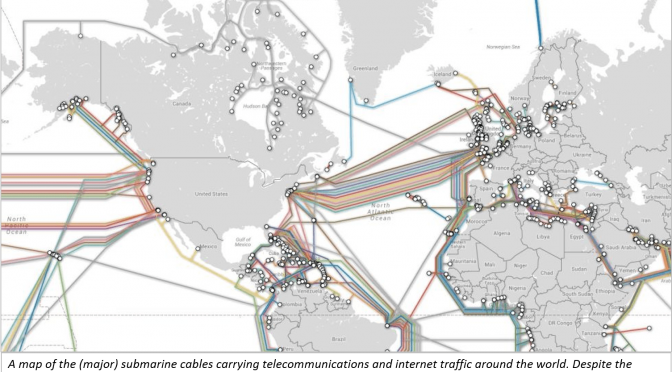
Defense experts on both sides of the Atlantic have expressed concern about the increase in Russian submarine activity in the Atlantic Ocean[1]. Russian patrols have risen by 50% to what one unnamed European diplomat described as “Cold War levels”. Not only the frequency of excursions has increased: the submarines are approaching the United States and Europe in areas with undersea cable routes. The cables are used for communications and internet data transmission; along with the fleet of satellites in low earth orbit, they are the spine of our digital world. The United States and NATO allies still rely on these cables for vital military traffic.
So far, the Russians have not been observed doing anything to the cables. But because of their importance, the presence of the submarines is alarming. The Russian Navy could be identifying the best places to cut the cables in the event of hostilities with the West; it could also be making efforts to tap them as a source of intelligence. Or they may have a different, unguessed purpose that is unrelated to the communications cables. What is certain is that the Russians are not simply passing the time of day; the Russian Navy is executing a mission and that mission somehow involves NATO.
ceuta 1
ntelligence gathering and signals interception remains the most probable activity. It has a long and distinguished history in warfare; the capture of a lost set of Confederate orders allowed General McClellan to bring General Lee’s Army of Northern Virginia to battle in unfavorable circumstances in Sharpsburg, Maryland, leading to an important Union victory in the Civil War. It has become critically important since the widespread adoption of wireless and radio communications during the First and Second World War. Everyone knows that the British built the world’s first computer at Bletchley Park in order to crack the German ENIGMA codes, though the incredible Polish contributions to that effort remain overlooked. The United States had successfully broken Imperial Japanese diplomatic codes prior to Pearl Harbor, and were used to prepare the US Navy for the critical Battle of Midway. The US Navy also pioneered the use of submarines and deep-sea submersibles for intelligence gathering, tapping the unencrypted military communications between the mainland and facilities along the Kurile Islands. We continue to deploy these assets, such as the USS Impeccable.
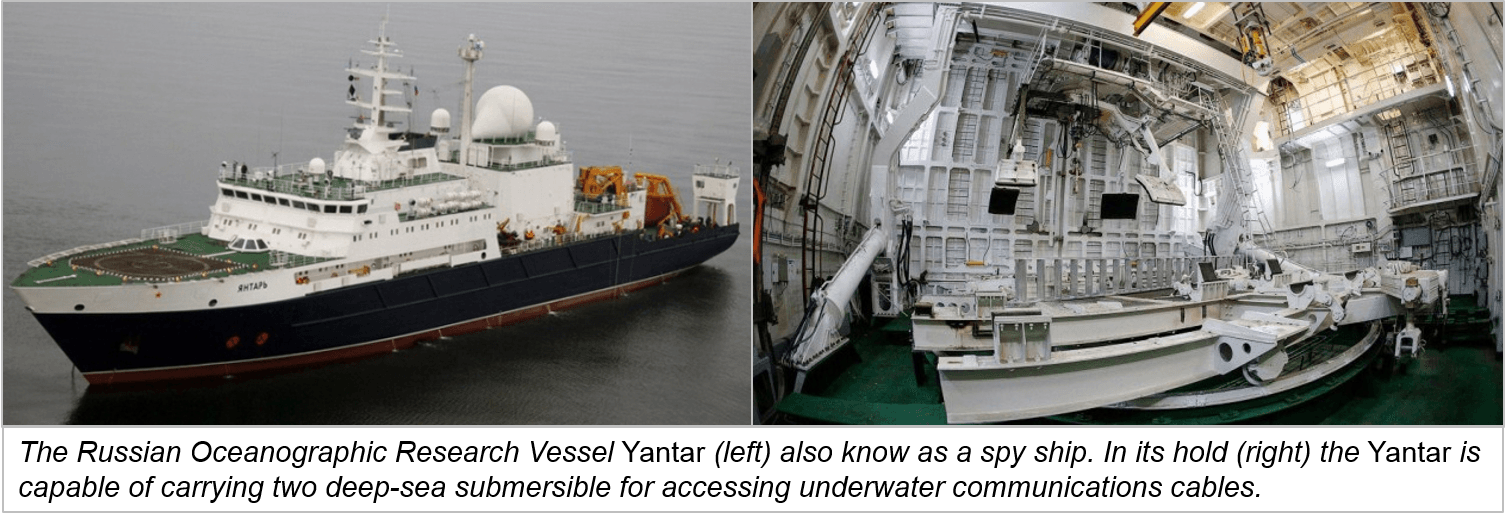
Assisting the submarines is the Russian Navy’s Oceanographic Research VesselYantar[2]. The Yantar is newly commissioned, having come off the Kaliningrad slips early this year, and has nothing in common with Jacques Cousteau and the Calypso despite its scientific-sounding designation. It is an intelligence platform, operated by the Russian Navy for the Glavnoje Razvedyvatel’noje Upravlenije, or Main Intelligence Directorate. Although less infamous than its sister organization, the KGB (now FSB), the GRU is the larger of the two organizations with six times more foreign agents deployed that the Foreign Directorate of the FSB[3]. The Yantar was tracked by the Department of Defense as it approached and followed the North American coast from Canada down to the Caribbean. The Yantar carries deep-sea submersibles of the same kind the US Navy uses for a similar purpose: finding, tapping and potentially cutting undersea communications cables.
ceuta 2
After its leisurely voyage, including passing the US nuclear submarine base in Kings Bay, Georgia, the Yantar made its way across the Atlantic back towards Europe. On the 19th of October, the spy ship arrived at its destination: the Spanish port of Ceuta[4]. There it received a warm welcome, with a protected berth and round-the-clock security provided by the port authorities. It took on fuel and consumables while its sailors stuffed their gobs with paella and vino tinto while also engaging in the other profligate activities typical of sailors ashore. As comradely a reception as Ivan could have received in Kaliningrad.
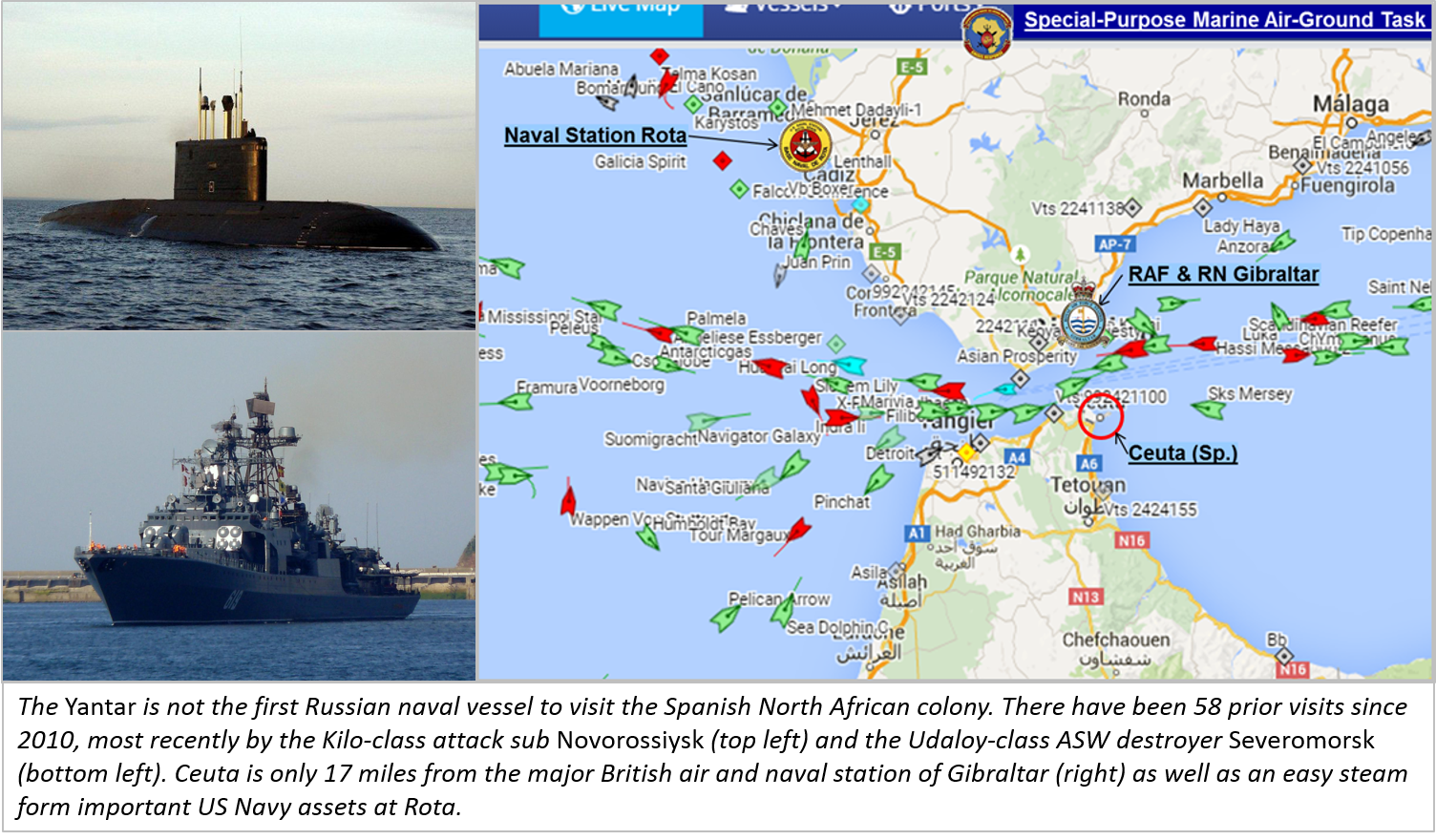
But Ceuta is not Kaliningrad. It is a port belonging to a NATO ally. It is strategically located on the North African coast next to the Straits of Gibraltar, one of the busiest maritime transit points in the world. And it is an easy day’s steaming from RN Gibraltar, a port that Royal Navy vessels often visit, as well as the naval station of Rota, a base leased by the US Navy from Spain. That is where the US is basing four Aegis-equipped destroyers as part of the European Phased Adaptive Approach to ballistic missile defense. What in God’s name is a Russian intelligence vessel doing there?
The Yantar visit is not an isolated incident: this year alone there have been 14 port calls by Russian naval vessels to Ceuta and 58 in total since 2010. In August, the diesel attack submarine, RFS Novorossiysk passed three days in the Spanish colony, with Gibraltar well within range of its SS-N-27 “Sizzler” anti-ship missiles. In April, it was the Udaloy-class ASW destroyerSeveromorsk; and in February another ASW frigate, the Yaroslav Mudry. The city fathers are happy to have 2,000 lonely sailors spending their rubles on “shore leave” and local businesses benefit too. Nothing to comment on in normal times; except that we’re not living in normal times. Russian troops are still in Ukraine; NATO aircraft are intercepting Russian bombers over allied airspace; Turkey is reporting violations of its airspace by Russian drones and jets; and we are not sending troops and equipment to Eastern Europe because relations are warm and fuzzy.
ceuta 3
It is long past time the United States took a firmer line with Spain. Spain may be an important ally for us and NATO, with a strategic location and shared interest in the stability of North Africa and the Sahel. It is not a question of gratuitously humiliating or infuriating them. But the US must make it crystal clear to Spain that they must choose their side and stick with their friends. They cannot play both sides: they cannot take American dollars for the use of Rota and Russian rubles for the use of Ceuta. Our concern and extreme displeasure at having half the Russian fleet pass the time of day within a hundred miles of our ballistic missile defense assets must be communicated to the Spanish in no uncertain terms. And the consequences of this perfidious attitude should also be made known – discretely.
Intelligence sharing between the two nations might begin to suffer. The notable successes of Spanish police in intercepting and arresting ETA operatives and potential jihadists in recent years is not due entirely to the keen sense of the beat cops, but to good intelligence and timely cooperation between the Spanish, French and American agencies. If Spain still refuses, the US should consider a relocation of US assets to the Port of Lisbon (USN) and to Beja for the Marine Crisis Response Force – Africa. Both are almost as well situated as the current locations and the Portuguese are not hosting Russian warships.
Unless the US and NATO take firm measure, Spanish will remain indifferent and their “business-as-usual” attitude will continue. It is not only avaricious and in bad faith, it is dangerous to Spain’s own interests. They may come to find, like the Crimeans, Moldovans and others, that once Ivan gets comfortable, he is not an easy houseguest to get rid of. And neither Ceuta nor Melilla are covered by NATO’s Article 5 provision for mutual defense.
Sources and Notes
[1] David E. Sanger and Eric Schmitt, “Russian Ships Near Data Cables Are Too Close for U.S. Comfort,” The New York Times, 25 October 2015
[3] The SVR, Sluzhba vneshney razvedki.