Category Archives: Middle East

Analysis related to USCENTCOM.

China’s Middle East Balancing Act

This article originally featured at the Conference of Defense Associations Institute, and is republished with permission. Read it in its original form here

CDA Institute Security & Defence Blogger Adam MacDonald, an independent scholar on Canadian foreign policy and Asia-​Pacific security, examines China’s role in the Middle East.

Turmoil in the Middle East has motivated most of the world’s major powers to become increasingly involved in stabilizing the region while progressing their own geopolitical agendas. Both the United States, trying to foster local solutions that would allow them to reduce their involvement and refocus energies elsewhere, and a Russia that senses an opportunity for increased influence in a theatre long outside its reach, have a number of strategic and security interests in the region. But it is China which has the most to lose (and gain) from a stable Middle East. Despite the strategic importance of the Middle East, Beijing has been cautious in engaging the region – an approach informed by higher level considerations underpinning their global engagement strategy as a whole.

China’s increasing reliance on Middle Eastern oil imports is becoming the Achilles Heel of Beijing’s energy security interests, owing to the disruption risks associated with ongoing regional volatility and the fact oil shipments travel on lengthy Sea Lanes of Communications (SLOCs). Despite diversification efforts (including closer energy partnerships with Russia and Central Asia), China receives 51 percent of its imported oil from the Middle East, with estimates projecting this value to increase to 60 percent by 2030. China is currently taking advantage of current low oil prices to build up its National Strategic Reserve, resulting in major shortages in storage capacity. Of course, Beijing also assesses supply disruptions as a realistic concern, and is cautiously beginning to become more diplomatically involved in strengthening relations with major oil suppliers as well as supporting conditions maintaining the general stability of the region writ large.

China’s Middle East engagements have stressed the importance of peaceful resolutions to conflicts and political tensions, fearing that a region-​wide conflict would paralyze desperately needed oil supplies and justify foreign interventions to remove regimes friendly to Beijing. China’s foreign policy privileges incumbent governments (regardless of the ways in which they access, wield, or maintain power) and pledges ‘non-​interference’ in their internal affairs, offering a counter-​balance (along with Russia) to regional players wary of Western calls for democratic development and political pluralism. Western powers have been frustrated by Russian and Chinese vetoing of numerous United Nations Security Council Resolutions (UNSCR) to end the Syrian civil war, but these obstructions largely stem from their experiences in supporting UNSCR 1973 in 2011 that imposed a No-​Fly Zone over Libya but quickly morphed into a military régime change campaign.

China and Russia, thus, only agreed to the latest UNSCR pertaining to Syria when explicit assurances were made that the Assad régime could remain in power until elections are scheduled. Within such negotiations China has played a supportive role, allowing Russia (which whom they share many broad strategic and regional interests), to be the face of opposition to the West. Beijing, however, has taken the initiative on some fronts, such as offering to host cease-​fire talks. As it pertains to the Iranian nuclear deal, Beijing has also played a low-​key diplomatic role but emphasized the need to reach a peaceful resolution to reduce the likelihood of conflict between Tehran, a major oil partner, and the West.

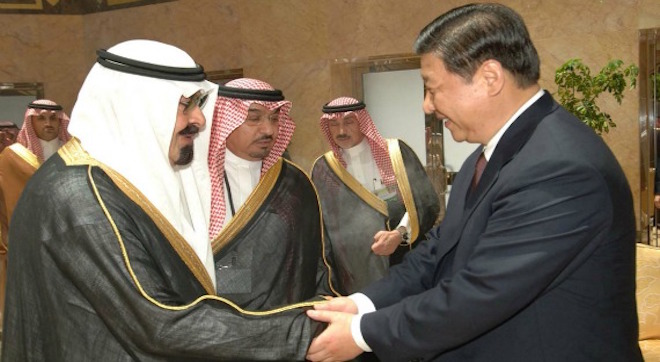
China is slowly beginning to augment bilateral diplomatic relations with regional partners, moving beyond collective action as part of their role as a permanent member on the UNSC. President Xi’s recent trip to the Middle East, the first by a Chinese president since 2009, included visits to its three largest trading partners in the region (Egypt, Saudi Arabia, Iran), signing dozens of new economic deals, particularly with Tehran. Sino-​Iranian relations in particular have been strengthened, with Tehran now named a ‘great neighbour’ in Chinese foreign policy – a term denoting a state which shares similar economic, political, and strategic interests with Beijing. China, however, must balance its interests in Iran with those in Saudi Arabia, their largest oil partner, particularly as tensions have been rising dramatically with both powers supporting opposing sides in various regional conflicts. One can also add the cessation of diplomatic relations between the two, when Saudi Arabia’s Iranian embassy was sacked following Riyadh’s execution of a prominent Shia Cleric.

Beijing remains reluctant to fully engage in the region, especially on the military front. Much of this apprehension stems from the United States’ expected reaction of more comprehensive Chinese involvement in an area historically defined by heavy American influence. Despite protests for Beijing to become more of a ‘responsible stakeholder’ in providing public security goods in support of the international system, China believes the deployment of military forces, regardless of their composition or purpose, would create anxiety in Washington, thereby drawing their strategic focus towards them vice their current fixation with Russia and its recent activities in Ukraine and Syria.

Chinese concerns regarding the lack of influence over their SLOCs including oil supply routes from the Middle East has motived the military, particularly the People’s Liberation Army Navy (PLAN), to focus towards expeditionary operations under the new mandate of ‘Open Seas Protection’ as opposed to their traditional role of coastal defence. The PLAN will continue to remain mostly active and focused in their immediate environment but have begun operating abroad in new theatres, most recently in the Bering Sea which drew much interest (and concern) in the US media. Beijing, wanting to avoid the strategic gaze of the West, has been surgical in employing them abroad, especially the Middle East. To date, Chinese military deployments have focused on protection of commercial traffic from piracy in the Gulf of Aden; assisting in the evacuation of citizens (and other foreign nationals) from conflict zones such as Yemen; and non-​combat units participating in UN peacekeeping missions. China, therefore, despite their fury following the execution of a Chinese journalist by ISIS, will most likely not deploy military assets in any large measure to the region anytime soon, especially in a combat role.

Beijing has pursued a low-​profile role in the region’s complicated political environment to avoid comprising other aspects of their foreign policy, not least relations with other major powers, most importantly the United States. Chinese leaders have and will avoid calls from some within the region, such as Egypt (which admires and wants to emulate Beijing’s successful development model of economic modernization without political pluralism), for a greater Chinese presence and leadership role to counterbalance the West. China does not necessarily lack the capacity to assume such a role (even if it lacks experience in global leadership) but will continue to play more a supporting role and rely on the other major powers to do the heavy lifting in maintaining regional stability.

Throughout this process, Beijing will continue to position itself in a supportive and non-​threatening role, allowing Russia to assume the mantle of the geopolitical ‘destabilizing other’ displacing American leadership and influence in the region. China will continue to expand its diplomatic engagements throughout the region, specifically on a bilateral level with Iran and Saudi Arabia, but these shall not result in any comprehensive change in Beijing’s current regional strategy. Assisting (but not leading) in regional stability efforts; building strong and reliable economic partnerships; and avoiding the entanglements of great power competition over influence and leadership between Russia and the United States will remain Beijing’s main objectives in the Middle East.

Adam P. MacDonald is an independent academic whose work focuses on Canadian foreign policy in Asia, Chinese naval developments, and the ongoing political transition in Myanmar. He can be reached at adampmacdonald@gmail.com. (Image courtesy of Reuters.)

Farsi Island and Matters of Honor

By LT Robert “Jake” Bebber USN

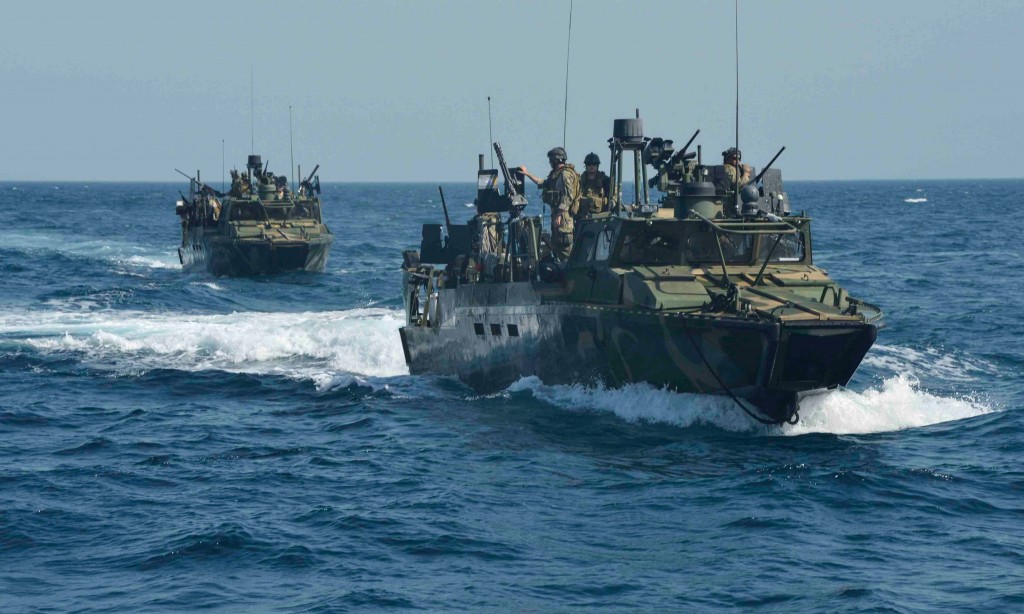
The recent incident of two U.S. Navy riverine boats crossing into Iranian territorial waters around Farsi Island and the subsequent arrest and detention of their crews has sparked a debate on a number of related issues, including the behavior of the officers and crew to the larger geopolitical issue of America’s relationship with Iran and the recently concluded nuclear “deal”. CAPT Steven Horrell has suggested that much of this debate is really “partisan vitriol” and “a litmus test of opposing camps of foreign policy.” He argues that the OIC submitting to a video recording of his “apology” was “quite possibly his best course of action.” He rightly counsels that we do not yet know all of the relevant facts regarding this incident, and one hopes the Department of Defense investigation is swiftly conducted and made public. While he acknowledges that the Iranian Revolutionary Guard Corps Navy (IRGCN) was wrong in its “initial treatment of the crew and propagandizing of the apology video,” he argues that the time for debate or calls to action are “not when the personnel are still on foreign soil …” He suggests that this may have been an attempt by the IRGC to “seize an opportunity” to use this incident to bolster their domestic political standing in Iran. At the end, however, CAPT Horrell seems more concerned about the “behaviors of our polarized body politic” than the long-term consequences to American power, prestige and yes, honor.

There is a persistent myth that Americans have historically avoided partisanship when it comes to national security or international crises. A cursory review of our past shows otherwise.  The War of 1812 was perhaps America’s most divisive conflict (even when compared to Vietnam), with vigorous opposition and “partisan vitriol” coming from within President Madison’s own party, led by John Randolph of Virginia. More recently, Americans were lectured that “we have a right to debate and disagree with any administration” on matters of national security. Indeed American political leaders of the opposing party have summarily declared wars “lost” in the middle of the fighting. On the recent Iran nuclear deal, the President himself declared that those opposed to him were “making common cause” with Iranian hardliners like the IRGC and that they were supporting war with Iran. The fact that candidates for the Presidency have “politicized” the incident, using it as a way to contrast their vision with that of their opponents during an election year should come as no surprise, and indeed seems to follow our traditional historical pattern.

Why might scenes of Navy Sailors on their knees, hands on their heads, surrendering to IRGCN forces and later apologizing on camera cause such a visceral reaction among Americans? The answer may be found in antiquity, and was best articulated by Thucydides. More than 2,500 years ago, he identified “three of the strongest motives” that explained relations between states were “fear, honor and self-interest.” While he is considered the “father” of the “realist” school of international relations, his point about notions of honor and prestige are often overlooked. The eminent Yale historian and classicist, Donald Kagan, carefully articulates why, despite being considered antiquated  by some academics and elites, “the notion that the only thing rational or real in the conduct of nations is the search for economic benefits or physical security is itself a prejudice of our time, a product of the attempt to treat the world of human events as though it were an inanimate, motiveless physical universe. Such an approach is no more adequate to explain behavior today than it ever was.” From this vantage point, Americans perceive that the systematic humiliation of American Sailors was a blow to our honor and prestige. Historically, Kagan notes, “when the prestige of a state wanes, so, too, does its power — even if materially … that power appears to remain unaffected.” Perhaps this is why, even coming on the heels of the Vietnam War, the Ford Administration reacted so assertively to the Cambodian seizure of the U.S.-flagged merchant vessel Mayaguez, as noted by retired Navy Captain and professor Jerry Hendrix. Even at a point in U.S. history where American power seemed at its weakest, the Khmer Rouge thought twice about taking on a superpower. The Farsi Island incident today seems to suggest that despite being a much stronger power than in 1975, the U.S. engenders much less fear, let alone respect, from its adversaries.

Patrol boats employed by Navy Expeditionary Combat Command.

CAPT Harrell and others consider the capture and release of American Sailors a “larger diplomatic success.” He specifically notes that the release was “due almost wholly to the existing relationships between Presidents Obama and Rouhani and Secretary Kerry and Foreign Minister Zarif. This, in turn, is due to having achieved their nuclear agreement.” He suggests that when an incident occurs between two potential adversaries, “the first phone conversation better not be after the crisis has started.” This implies that prior to the current administration, there were no mechanisms for direct or indirect communication. However, the previous administration held 28 separate meetings with Iranian officials of ambassadorial rank, including 15 direct U.S.-Iran meetings. Clearly, there was someone to have a conversation with prior to President Obama taking office, and the U.S. and Iran had open diplomatic channels, if a cool relationship. Whether the release was due to an “existing relationship” or simply because the Iranians got what they wanted (a taped apology, propaganda videos and pictures of American military personnel surrendering) is hard to say. The Middle East Media Research Institute suggests it is more likely that Tehran did not want to delay the lifting of economic sanctions and to ameliorate the negative impression left from the burning of the Saudi Arabian embassy and consulate. In any case, focusing on the release of the Sailors ignores the larger question – what emboldened the IRGCN to feel like they could capture two U.S. Navy vessels in the first place? There seemed to be no reticence on the part of the Iranians to risk a confrontation, and therefore they could act with impunity – at least that is how it appears.

While we can all be thankful for the Sailors safe release, many have a much less sanguine view. This incident seems to embody a recent, growing perception of American weakness and decline. That belief is held here in America and around the world – especially among our adversaries. The fact that American honor is so easily besmirched and violated without fear of retribution only exacerbates this view. This is more than just “partisan vitriol” in my opinion, but a real and growing problem that should concern us all, regardless of party, as Americans.

LT Robert “Jake” Bebber is an Information Warfare officer assigned to U.S. Cyber Command. The views expressed here are his own and do not represent those of the U.S. Department of Defense, U.S. Cyber Command or the Department of the Navy. He welcomes your comments at jbebber@gmail.com.

Saudi Navy Expansion Program

By Chuck Hill

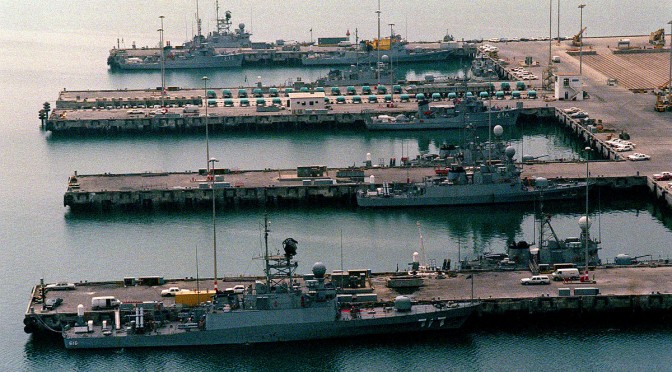
The Royal Saudi Navy is planning to replace virtually all of its Eastern Fleet. The expected price tag has been variously reported as between $11.25 and $20B. One of Saudi Arabia’s two fleets, the Eastern Fleet is based in the Persian Gulf and faces off squarely against Iran’s Navy and Revolutionary Guard Corp. The Western Fleet is based in the Red Sea and includes seven French built frigates.

[otw_shortcode_button href=”https://cimsec.org/buying-cimsec-war-bonds/18115″ size=”medium” icon_position=”right” shape=”round” color_class=”otw-blue”]Donate to CIMSEC![/otw_shortcode_button]

The existing Eastern fleet, all American built, includes four 75 meter (246 foot), 1,038 ton corvettes and nine 58 meter (190 feet), 495 ton guided missile boats. All are nearing the end of their useful lives, having entered service in the early ’80s.

It appears Saudi Arabia is again looking to the US to build this new fleet, reportedly buying  four up-rated Lockheed Martin Freedom Class Littoral Combat Ships.  While these ships have been much in the news, they are only part of a much larger program.

In February Defense News reported that Saudi Arabia had sent a letter of request to the US Navy that outlined the entire program.  It specified:

  • Four 3,500-ton “frigate-like warships” capable of anti-air warfare, armed with an eight-to-16-cell vertical launch system (VLS) capable of launching Standard SM-2 missiles; fitted with an “Aegis or like” combat system using “SPY-1F or similar” radars; able to operate Sikorsky MH-60R helicopters; with a speed of 35 knots.
  • Six 2,500-ton warships with combat systems compatible with the frigates, able to operate MH-60R helos.
  • 20 to 24 fast patrol vessels about 40 to 45 meters long, powered by twin diesels.
  • 10 “maritime helicopters” with characteristics identical to the MH-60R.
  • Three maritime patrol aircraft for coastal surveillance.
  • 30 to 50 UAVs, some for maritime use, some to be shore-based.

This shopping list sounds remarkably specific. This suggest that they already have a good idea what they expect to buy.

Four 3,500-ton “frigate-like warships”

Plans have firmed up for the four frigates. While they will not have the Aegis like radars they will have a, “…16-cell (Mk41) VLS installation able to launch Evolved Sea Sparrow missiles, and will carry Harpoon Block II surface-to-surface missiles in dedicated launchers, and anti-air Rolling Airframe Missiles in a SeaRAM close-in weapon system. The MMSC will also mount a 76mm gun… a Lockheed Martin COMBATSS-21 combat management system, which shares some commonality with the much larger Aegis combat system, and feature the Cassidian TRS-4D C-band radar.”

Six 2,500-ton warships with combat systems compatible with the frigates, able to operate MH-60R helos.

The design for the six smaller ships hasn’t been discussed openly, so this is a bit of speculation, but at least I think we can expect something like this. The video below, from Swiftship, recently appeared without much explanation.  The similarity in design to the Freedom class is striking and it claims to be a proven hull form. If Marinette Marine is too busy to build these smaller ships in addition to the LCS and the Saudi Frigates, having Swiftships build them might be a way have having them delivered relatively quickly and it looks like it might fit the description. Note there is no mention of an ASW capability for these ships (other than the ability to embark an MH-60R). This parallels the current fleet structure where only the four largest vessels have an ASW capability and the next largest class vessels do not.

Swiftships has a record of selling vessels through “Foreign Military Sales” and the vessel in the video shares a number of systems in common with the projected Saudi frigates including a 76mm gun, RAM missiles, MH-60s, and possibly Harpoon (they show only a generic representation of an ASCM).

20 to 24 fast patrol vessels about 40 to 45 meters long, powered by twin diesels.

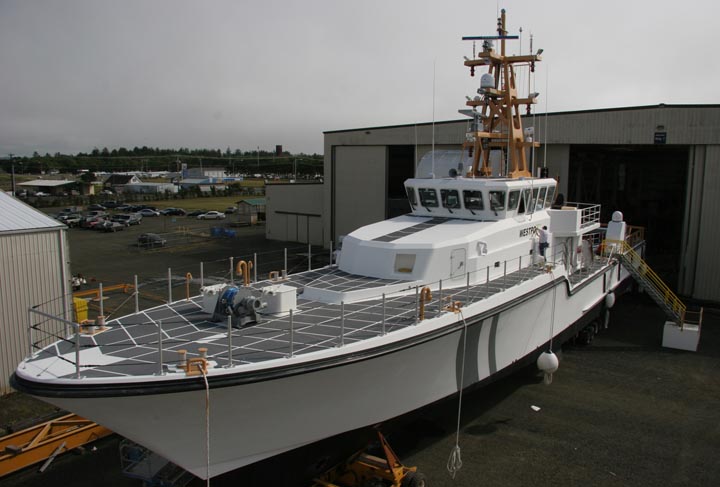
A likely choice for the patrol boat is this one, eight of which were sold to Pakistan. Reportedly these 43 meter, 143 foot vessels can make 34 knots and operate a ScanEagle UAS.

Westport143
Westport Yachts photo

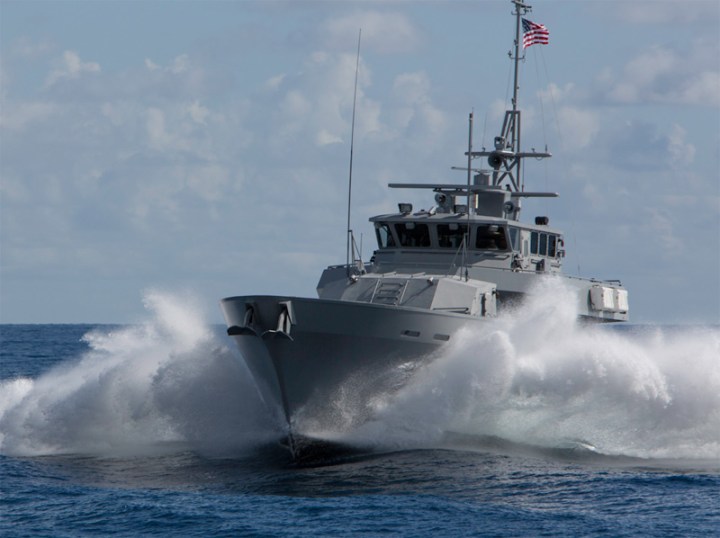
Another possibility is this 43.5 meter vessel that was provided to Lebanon under FMS.

RiverHawk-LCSC-42

Both of these PCs have the capability to stern launch an RHIB.

10 “maritime helicopters” with characteristics identical to the MH-60R.

A request for ten MH-60Rs was submitted earlier and has been approved by the State Department.

Included in the buy of the helicopters are, “one-thousand (1,000) AN/SSQ-36/53/62 Sonobuoys; thirty-eight (38) AGM-114R Hellfire II missiles; five (5) AGM-114 M36-E9 Captive Air Training missiles; four (4) AGM-114Q Hellfire Training Missiles; three-hundred eighty (380) Advanced Precision Kill Weapons System rockets; twelve (12) M-240D crew served weapons; and twelve (12) GAU-21 crew served weapons.”

I note that the 380 Advanced Precision Kill Weapons System (APKWS) semi-active laser homing 70mm rockets is exactly the number to fill twenty 19 round launchers. These weapons are probably an ideal counter to the much vaunted Iranian “swarm.”

Three maritime patrol aircraft for coastal surveillance:

These are almost certainly P-8s.

30 to 50 UAVs, some for maritime use, some to be shore-based:

While there is no indication which system is favored.  This sounds like too many systems for Firescout.

ScanEagle or one of Insitu’s slightly larger systems seems more likely, and if the Swiftships Offshore Patrol Vessel video is any indication, it includes a ScanEagle launch and recovery.

Conclusion:

This will be a major upgrade to the Saudi fleet that should allow them to maintain an advantage relative to the Iranian Fleet.

  • The ships and patrol boats will be three to five times larger than those they replace and far more survivable.
  • Fleet air defense systems which have been limited to 76mm guns and Phalanx CIWS will get a basic local area defense in the form of Evolved Sea Sparrow Missile, which will be backed up by rolling airframe missiles.
  • ASW  capability will take a quantum leap with the addition of the three Maritime Patrol Aircraft (MPA), the ten MH-60R.
  • The Eastern fleet was relatively well equipped to target larger surface targets with a total of 68 Harpoon launch tubes on the existing ships, but they were less well equipped to deal with numerous Iranian small craft.  MH-60Rs  armed with Advanced Precision Kill Weapon System guided rockets should provide an effective counter to Iran’s swarm strategy.
  • MPA and Unmanned systems will enhance ISR capability.
  • The larger patrol craft should significantly improve maritime security.
  • According to my “Combat Fleets of the World,” the Saudi Navy has a Marine Corp of 3,000, but their only Amphibious Warfare ships are four LCUs and two LCMs. The addition of at least 30 ships with RHIBs, assuming the patrol craft have this capability, should allow the Saudi Navy to consider at least small scale raids and other forms of maritime Special Ops. If the six 2500 ton ships are configured like the ship in Swiftships video, with four RHIBs, it would seem particularly appropriate for this role.  The addition of ten helicopter decks where there were none before also opens up options for these types of operations.

Chuck retired from the Coast Guard after 22 years service. Assignments included four ships, Rescue Coordination Center New Orleans, CG HQ, Fleet Training Group San Diego, Naval War College, and Maritime Defense Zone Pacific/Pacific Area Ops/Readiness/Plans. Along the way he became the first Coast Guard officer to complete the Tactical Action Officer (TAO) course and also completed the Naval Control of Shipping course. He has had a life-long interest in naval ships and history. Chuck normally writes for his blog, Chuck Hill’s CG blog.  

[otw_shortcode_button href=”https://cimsec.org/buying-cimsec-war-bonds/18115″ size=”medium” icon_position=”right” shape=”round” color_class=”otw-blue”]Donate to CIMSEC![/otw_shortcode_button]

Should the U.S. Navy Help with the Med. Refugee Crisis?

A Modest Proposal to Help this Generation’s “Boat People”  

By John T. Kuehn

First, this article may be too late.  What do I mean?  I mean that we—as in the global community and the United States in particular—may be too far behind the power curve to do something meaningful about helping the refugees fleeing across the sea from the Syrian Civil War-Islamic Thirty Year’s War raging in the Middle East.  This is my way of saying I wish I had written this about six months ago when the problem was manifest to all.  So why write at all?  Something might be STILL done with forward deployed naval forces of the United States today, perhaps with like-minded maritime allies to help the unfortunate masses of humanity fleeing their homelands from a particularly cruel conflict.    Even if it is too late for current policy, the trend of “boat people” fleeing war to a better life elsewhere has many precedents in history, especially the last one hundred years and it will most certainly occur again.   This means that ringing the clarion now might contribute to effective humanitarian policy action in the future.  So it is worth a try.

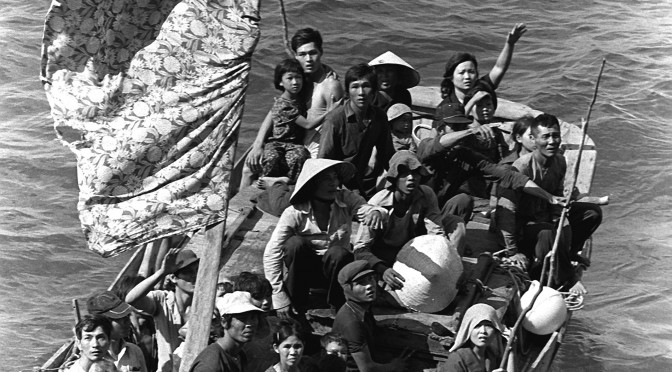
First, let us briefly review some relevant history on these sorts of refugee crises as they pertain to migration in unseaworthy craft in search of a better life on distant shores. Case one takes us back to 1975 and the late 1970s when the United States’ lost war in Vietnam resulted in the flight of the boat people of South Vietnam  (and Cambodia, too) from the proletarian utopias established by the new Vietnamese government in Hanoi and the Khmer Rouge. The United States was caught napping somewhat on this one, too, but before long had started making efforts with naval assets based in the Western Pacific to help with this crisis. However,   years later a particularly unfortunate incident occurred in the 1980s wherein the captain of a U.S. warship (the USS Dubuque) failed to render proper assistance to fleeing “boat people” who later survived to present evidence against him. We will return to this issue since it is a feature of the law of the sea that mariners must render aid to people in danger on the high seas.  More recently Americans saw the flight of people from both Cuba and Haiti to the United States in the 1990s, fleeing various natural and man-made disasters in the Caribbean.

Why should the United States use its assets, especially its Navy, to help these people? There are three principle reasons: moral obligation, humanitarian, and practical.    The practical value for the United States involves two factors, leadership and what, for lack of a better term, might be called “good press.” If the U.S. is to be a leader it must take the lead in areas where it claims an interest.  By getting more involved and working with other states of the region while at the same time committing actual naval forces to help, we build partnerships, lead, and help. It is a win-win-win result.

From a moral standpoint we owe it to these people.  Here is the causal logic—when the U.S.-led coalition invaded Iraq all those years ago we removed the government in power and destabilized the region.  From that context Al Qaeda in Iraq (AQI) developed.  During the final years in Iraq we estimated we had pretty much solved the problem of AQI, but instead it had simply transformed itself into the current Islamic State (ISIS).   At the same time Syria fell into civil war, a conflict not unrelated to our actions in Iraq and has been further de-stabilized, especially since 2013, by an increasingly powerful and dangerous ISIS.  The upshot is that some, not all, of these refugees can be traced to American policy choices, so there exists something of a moral obligation to help with the result of our, for lack of a better word, blundering in the Middle East.

Finally, we get back to the purely humanitarian reasons—the salvation of (mostly) innocent human life.   Obviously things are being done, but there is little reason to allow people to helplessly drown or die of exposure at sea on un-seaworthy craft.   They already think they can make it and so the arguments that they would not flee if they did not think someone would help are not only ill-informed, they are morally wrongheaded.   In fact, the United States by simply having ships in the Eastern Mediterranean is obligated to “render assistance” should it run across people in distress on the high seas. Simply stationing ships on patrol in that area will naturally result in a requirement to render assistance because we certainly do not want any more Dubuques like we had in the South China Sea after the Vietnam War had ended.

As with any use of American taxpayer-funded projects, use of U.S. Navy assets must be judicious.  Also, we must coordinate with partners and allies in the region, but rendering assistance on the high seas is part of international law and a moral imperative, more than one might think given our distance from the Eastern Mediterranean. However, if the United States is to use its Navy as the “sysadmin” of the global maritime regime, as Captain Peter Haynes discusses in his recent book on the “new maritime strategy,” then this sort of action and use of naval power is part of the responsibility that the mantle of maritime leadership confers.   Or perhaps we no longer aspire to lead in this domain?  I think not.

Dr. John T. Kuehn is the General William Stofft Chair for Historical Research at the U.S. Army Command and General Staff College CGSC).  He retired from the U.S. Navy 2004 at the rank of commander after 23 years of service as a naval flight officer flying both land-based and carrier-based aircraft.  He has taught a variety of subjects, including military history, at CGSC since 2000.  He authored Agents of Innovation (2008), A Military History of Japan:  From the Age of the Samurai to the 21st Century (2014), and co-authored Eyewitness Pacific Theater (2008) with D.M. Giangreco as well as numerous articles and editorials and was awarded a Moncado Prize from the Society for Military History in 2011.  His latest book, due out from Praeger just in time for the 200th Anniversary of the Battle of Waterloo is Napoleonic Warfare: The Operational Art of the Great Campaigns.

The views are those of the author and do not reflect the official policy or position of the Department of the Army, Department of Defense, or the U.S. Government.