The following article is the first in CIMSEC’s first regular column: The Red Queen’s Navy. Written by Vidya Sagar Reddy, The Red Queen’s Navy will discuss the influence of emerging naval platforms and technologies in the geostrategic contours of the Indo-Pacific region. The column will also identify relevant historical precedents, forming the basis for various maritime development and security related projects in the region.
“Now, here, you see, it takes all the running you can do, to keep in the same place.”- The Red Queen, Through the Looking Glass, Lexi’s Carroll.
By Vidya Sagar Reddy
During his recent visit to the Philippines, the United States Secretary of Defense promised delivery of a variety of sensors and communications equipment worth $42 million to the host nation. One of the critical sensors in this suite is an observation blimp that can peer across the South China Sea (SCS), providing maritime domain awareness to the Philippines.
The Philippines is one of several claimants to sovereign rights over few SCS islands; they are faced with a coercive China claiming such rights over 80 percent of the sea. China has forcefully seized control of maritime features in the SCS from both Vietnam and the Philippines. In addition, the PRC has started land reclamation projects and built artificial islands. Radars and missile batteries have been installed on some of the features, and military planes operate and land there routinely.
In 2012, China overwhelmed Philippine forces in a two month long conflict, resulting in China’s defacto control of Scarborough Shoal, located barely 140 miles off Manila. The Philippines filed a case against China before the UN’s Permanent Court of Arbitration, challenging 15 claims from China’s so-called nine-dash line to Scarborough Shoal. The tribunal is likely to find China’s activities around the Shoal illegal.
In spite of this, China has refuted the authority of the arbitration tribunal to rule on these claims. It is reported that China is now considering construction of outposts on Scarborough Shoal. Military installations on this Shoal would allow China to control the Luzon Strait, a gateway to the Pacific and tremendously busy trade artery, therefore further consolidating its control over the SCS. The proximity of the Shoal to Manila would also allow China to monitor military installations and maneuvers on the Philippine islands, of particular interest as the US visiting forces begin to deploy.
The primary concern is the expansion of China’s coast guard and maritime militias around the Shoal to erode the Philippine legal rights like fishing, maritime trade, and exploitation of natural resources in these waters. Establishing new facts on the ground will defeat Philippines’ legal standing. Continuous monitoring of China’s actions is required for validating these assumptions and in order to respond proactively to new security threats.
A network of sensors established in and over the SCS would enable monitoring of land reclamation activities, build up of military assets on the islands, transits of coast guard and maritime militia units, oil exploration rigs, and any other object that can potentially fly or sail as China has become innovative in asserting its claims. The communications equipment offered to the Philippines will enable secure transmission of data from these sensors for faster and more transparent decision-making.
One of the critical sensor nodes in this suite is an observation blimp that can peer across the SCS using onboard radar. Theblimp is a powered, gas filled lighter-that-the-air airship. It does not have a rigid structure like that of a balloon, but can instead be steered while floating in the air. Hindenburg is a famous example of these airships, which had a rigid structure.
Historically, airships have been used for both commercial and military activities, including ferrying passengers across the Atlantic, the American Civil War, bombing raids during World War I, polar exploration, advertisement campaigns, etc. The US Navy developed the airships USS Akron and USS Macon for ocean surveillance with the ability to launch and recover aircraft, dubbed flying aircraft carriers. Most of these airships crashed, but public interest truly faded with the Hindenburg disaster. The simultaneous advent of airplanes ferrying passengers far more efficiently across the oceans sealed their fate completely.
The potential of airships to provide constant mass area surveillance renewed military interest in them. Airships were useful to coalition forces in Afghanistan, forces along the US-Mexico border, and by Israel over Gaza, just to name a few.
The US Army initiated a $2.8 billion project called the Joint Land Attack Cruise Missile Defense Elevated Netted Sensor System (JLENS) that uses a blimp-duo hovering about 10,000 feet and covering an area the size of Texas. One blimp is capable of providing high resolution 360 degree radar coverage while the other is used for focusing on specific targets including fixed or rotary-wing aircraft, cruise missiles, unmanned air vehicles, tactical ballistic missiles etc. JLENS is designed to connect to the nation’s air defense networks for faster response to incoming threats.
Last October, one of the prototype JLENS blimps broke loose from the mooring station. Without the steering controls in place, the blimp dragged part of its tether across Pennsylvania causing power outages and damages to private property. Two F-16s were scrambled to monitor the movement of the blimp until it deflated and crashed into the trees.
Already looked upon unfavorably for cost overruns, the US Congress awarded a mere $2.5 million instead of the $45 million sought by the Pentagon, a measure supposedly aimed at killing the program.
Although details are yet to emerge regarding the size and observational scope of the blimp promised to the Philippines, this set of incidents and accidents points to knowledge gaps about the inherent risks of airships that contain highly inflammable gases and are prone to various atmospheric phenomena. Given this tenuous history of blimps, a loose one free floating over the SCS would invite further aggression from the PRC. It is in the interest of all parties to avoid such a situation. How can the US prove the blimp platform has been rigorously tested, despite Congress having killed the program? This is a critical question for the Philippines. It may be wiser to avoid creating, even accidentally, another tense situation in an already contested environment. Therefore the Philippines should explore additional options to improve its maritime domain awareness and security. Such options include acquiring patrol boats and light aircraft that can not only provide the Philippines maritime domain awareness, but also enhance the security of its territory and possessions.
Vidya Sagar Reddy is a researcher at the Observer Research Foundation, New Delhi.
Featured Image: U.S. Customs and Border Protection, Office of Air and Marine, Tethered Aerostat Radar System (TARS) Deming New Mexico. Photographer: Donna Burton
The following is a two-part series on how the U.S. might better utilize cyberspace and information operations as a Third Offset. Part I evaluated current offset proposals and explores the strategic context. Part II provides specific cyber/IO operations and lines of effort. Read Part One here.
By Jake Bebber
Targeting China’s ability to control information is an efficient means to offset Chinese power. To be effective, the United States should adopt a “whole of government” approach, leveraging cyberspace and other information related capabilities that can hold China’s domestic internet filtering, censorship, and information dissemination capabilities at risk. This campaign should operate across the entire spectrum of conflict and engagement, from public diplomacy and strategic communication, to battlespace preparation, limited conflict, and if de-escalation is unsuccessful, full-spectrum military operations. It will likely require coordination and administration at the highest civilian leadership level. This will be a long-term campaign aiming to counter China during the critical window in the next ten to twenty years when Chinese economic and military power will surge, and then subside as demographic factors limit its growth causing China to enter into a period of decline and inherently shifts its focus inward to to maintain stability.
The United States will have to address three broad issues: access, authorities, and capabilities. Internet access into China is restricted from the outside, and it is reasonable to assume that during a period of rising tensions or even conflict, traditional means of accessing China’s “red space” (civilian, military, and government networks) will not be available. The U.S. will need alternative avenues into Chinese networks, which may take the form of radio frequency injection into wireless networks (Bluetooth, WiFi and WiMAX)1 to other methods targeting the physical and logical network layers and cyber-persona layers2 of cyberspace for preplacement of access.
The Three Layers of Cyberspace [iii].
The authority of the U.S. government to operate in cyberspace crosses boundaries and jurisdictions, and largely depends on the function of the agency or entity. Traditional military activities conducted by the Department of Defense are covered under Title 10 of U.S. Code, with the principal being the Secretary of Defense. Other titles supporting cyberspace operations include foreign intelligence collection (Title 50), domestic security (Title 6), law enforcement (Title 18) and government information technology security and acquisition (Title 40).4 These authorities will have to be aligned and deconflicted.
The capabilities required run the spectrum. They can include fully attributable on-net operations, such as a Foreign Service Officer participating in an online forum or social network to communicate U.S. policy, to the development of tools and malware that can degrade and disrupt command and control networks. Other possibilities include the distribution of encrypted personal communication devices and unattributable social media and organizing applications that permit dissident groups within China to maintain situational awareness.
There have been attempts to respond to China’s growing Internet censorship capabilities by those in the telecommunications industry and by the U.S. government. The Global Network Initiative was started in 2008 by industry, civic organizations, and universities to “promote best practices related to the conduct of U.S. companies in countries with poor Internet freedom records.” In 2011, the President issued the “International Strategy for Cyberspace.” Its goals include “enabling continued innovation for increasing economic activity, increasing individuals’ ability to communicate with one another, safeguarding freedom of expression, association, and other freedoms, and enhancing both individual privacy and national and international security.” The U.S. Department of State includes Internet freedom as a part of its global human rights agenda. In 2006, State formed the Global Internet Freedom Taskforce which later became the NetFreedom Taskforce, to coordinate State Department efforts monitoring Internet freedom. Both the State Department and U.S Agency for International Development have received funding for the development of Internet censorship circumvention technologies, training of non-government organizations and activists, media assistance, and leading international policy formulation on Internet freedom.5
The Broadcasting Board of Governors, which oversees the Voice of America (VOA) and Radio Free Asia (RFA) programs, also supports counter-censorship and circumvention software development and distribution. The VOA sends daily emails to “8 million Chinese citizens … with international and domestic news stories as well as information about how to use proxy servers.” The RFA has implemented the Freedom2Connect program to “research, develop, and deliver online tools for Internet users in China to securely browse online and send secure e-mail.”6
While important, the current response by industry and government lacks both the senior policy coordination required of a grand strategy or adequate funding to keep up with China’s growing Internet monitoring and censorship capabilities. They do not fully leverage other assets and tools at America’s disposal. The U.S. can and should be doing much more to attack China’s critical vulnerabilities in information control.
Lines of Effort
Public Diplomacy – At the interagency level, the United States should continue pursuing bilateral, multilateral, and international agreements such as those mentioned above which promote freedom of information, expression and freedom from government oversight and censorship. The U.S. should also continue to strengthen international regimes against cybercrime and intellectual property theft. Internet norms and rules should be standardized across political boundaries where practical. This diplomatic effort ties into longstanding American policy of supporting freedom of speech and protection of universal human rights.
Economic Policy and Trade – Here again, longstanding American policy supporting property rights and free trade legitimize the continued advocacy of international agreements and accords promoting freedom in cyberspace. At the same time, the U.S. must tighten technology export controls to nations like China that continue to restrict access. In the event of industrial espionage or even cyber-attack, the U.S. can impose real economic costs and sanctions. The U.S. can also move on the Global Online Freedom Act, which would, among other things, prohibit U.S. companies from cooperating with foreign governments that engage in censorship or human rights abuses, require the U.S. Trade Representative to report on trade-related issues that arise out of a foreign government’s censorship policies, and impose export controls on telecommunications equipment that can be used to carry out censorship or surveillance.7 Some of these provisions can be waived when it suits American interests. In other areas, the U.S. can also promote public cybersecurity regimes, such as international risk insurance tools and accreditation that encourage network protection and hardening in the private sector.
Strategic Communication – In modern war, the actions of a single Soldier, Sailor, Airman or Marine can have a far-reaching impact on national strategy. While this is often used to highlight the potential implications of an untoward or controversial event, the reverse also holds true. The actions of every member of the U.S. government, from Foreign Service officer, embassy staff and humanitarian assistance officer to those of the military can have an equally positive impact if the appropriate messages are coordinated and timed to unfolding events. The United States should expand strategic communication tools such as Radio Free Asia and Voice of America. Using new capabilities in cyberspace and in personal communications, a comprehensive program of unbiased news delivery and strategic messaging to the Chinese public on a much larger scale can, over time, provide alternatives to Chinese government propaganda. Not to be forgotten, approximately two million Chinese visit the United States each year as tourists8, and around a quarter of a million Chinese students attend college in the U.S.9 Each visitor and student represents an opportunity for engagement.
Cyberspace Operations – Being able to deliver effects in and through cyberspace to China is a question of both access and capabilities. China has one of the most robust and sophisticated information control systems in the world, with multiple internal security and military organizations and tens of thousands of Chinese working daily to censor communications and filter access within China and between China and the world. Network penetrations and preplacement access generation needs to occur now, during peacetime, and continue throughout in order to assure capabilities can be delivered when needed. The fact is that when tensions escalate and China erects more firewalls, penetration becomes that much more difficult, if not impossible. This leaves military commanders and policy-makers little choice but to revert to traditional kinetic tools to dissuade Chinese aggression – exactly the scenario they hope to avoid – and plays to China’s strengths. Developing multiple access vectors now with the capability to hold at-risk, at a time and place of our choosing, information control systems in the long run represent an efficient means of directly attacking China’s most critical vulnerability and holding the Communist Party’s political control at risk. This represents an asymmetric counter to China’s growing A2/AD capabilities, and is a far more efficient and economical alternative.
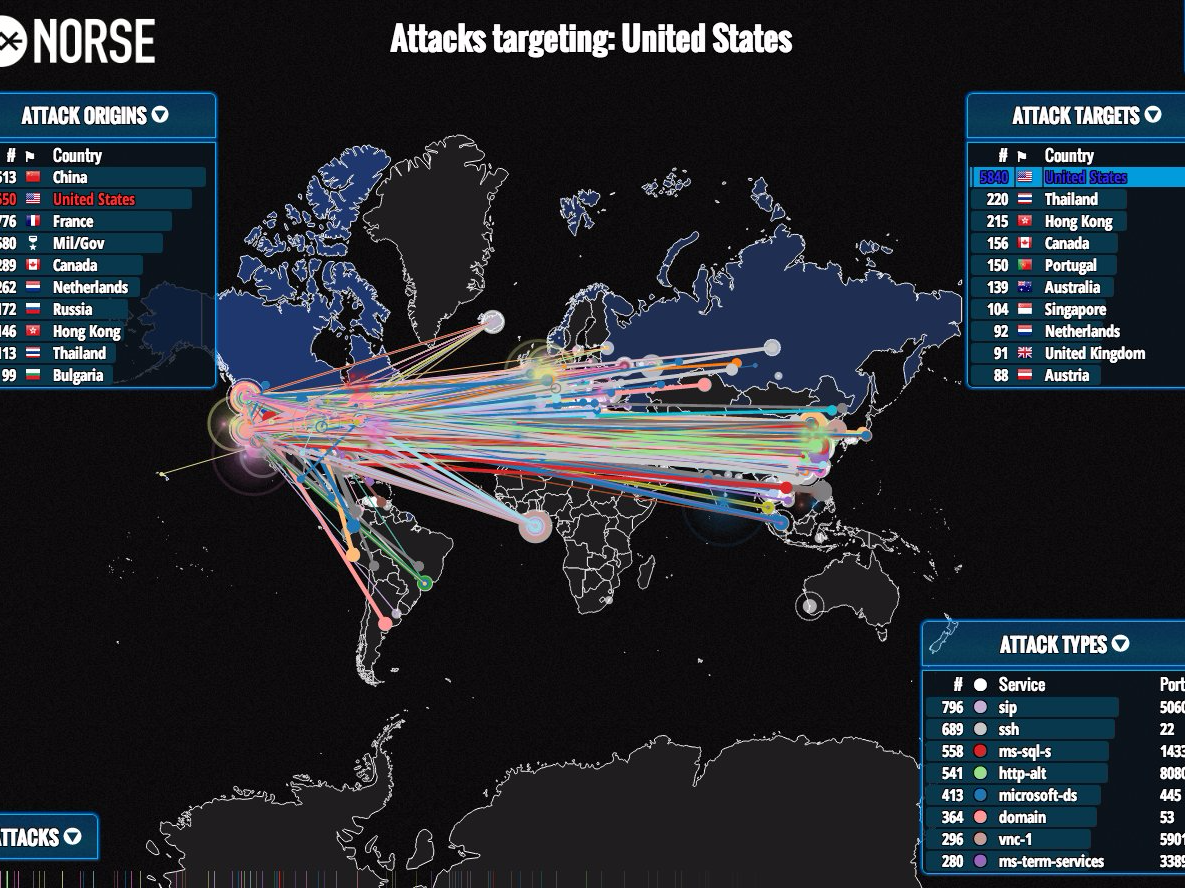
A snapshot image of cyber attacks. Source: Norse Corp.
Cyberspace operations reside on a continuum, sometimes offensive, sometimes defensive and sometimes both simultaneously. At the same time the U.S. is developing access vectors and tools to exploit China’s information control systems, it must also harden its own military, government, and civilian critical infrastructure networks. Research suggests that improving cyber defenses limit incentives to infiltrate networks for espionage, intellectual property theft, or cyber-attack. A resilience model should be adopted. Instead of building “cyber walls” using a traditional warfare model, cyber defense should model biological systems that can adapt and recover. Systems can be designed to turn the table on intrusions, misdirecting them down false alleys or “sinkholing” them in so-called “honeypots” for study. This can even be effective in passing back false information or simply causing the attacker to waste time and resources chasing phantoms.10 On the offensive side of the continuum, experts like retired Army Lieutenant Colonel Timothy Thomas see the development and fielding of 13 offensive cyber warfare teams as significant. According to him, the Chinese “now know we are ready to go on the offense. There’s something that’s been put in place that I think is going to change their view.”11
Clandestine Action – Due to the difficulties in acquiring and maintaining access in closed networks, the United States will have to undertake clandestine efforts, both in cyberspace and through traditional means. Policy makers should be careful, however, not to be lulled by the lure of technologically-based cyberspace operations as the preferable alternative to traditional human intelligence operations. While the U.S. is right to continue to pursue advances in unmanned vehicles, radio-frequency and electro-magnetic operations, and space-based computer and communication operations, obtaining and maintaining access in many cases will require mixed-mode penetration: human and cyber action. Cultivating human sources to gain insight into leadership intentions, network configurations, and potential areas of exploitation remain a critical part of a broad information operations campaign. As China continues to pursue clandestine operations against the U.S., both to gather traditional intelligence and to enable their own cyberspace operations, our own counter-intelligence and cyberspace defense capabilities will become that much more important.
These lines of effort will have to be synchronized in a mutually supporting effort. Public diplomacy and strategic communication can be enabled in and through cyberspace. Clandestine action may be required to obtain and maintain access to critical networks. Economic incentives, technology export controls and sanctions will play critical roles at times to advance America’s interests to degrade or disrupt China’s information control systems.
It will be necessary to develop options which degrade China’s information control capabilities incrementally while preserving significant reserves. Historically, this has been especially tricky. Past experience, such as the Vietnam War, suggests that the incremental application of force with too fine of control tends to condition the adversary rather than compel the adversary. The U.S. will need to be able to send “warning shots” that indicate to the CCP that we possess capabilities that will cause them to lose control entirely and threaten their hold on power, allowing the U.S. to prevail. Of course, given that many cyberspace and IO capabilities are perishable once used, the U.S. will need to maintain a host of capabilities able to be delivered across multiple vectors and times and places of our choosing.
One must be mindful that while China’s information controls systems are a critical vulnerability, they are not a gateway to the overthrow of the CCP and the establishment of a democratic government, at least not right away. Data suggests that the vast majority of the Chinese public who utilize the Internet and social media are quite happy with the amount and variety of content available. Only about 10 percent use the Internet for political purposes with the remainder, like their American counterparts, using it for entertainment and socializing.12 Therefore, strategic messaging will have to be much less overt and subtler.
We should utilize the natural advantages the U.S. has in the entertainment and public relations world to encourage the public to put pressure on the government gradually, perhaps not directly in the political sphere but rather on natural fissures and tensions already resident, such as corruption, mismanagement, ethnic strife, uneven development, environmental degradation, and the growing wealth gap in China. Consider the recent effort by the U.S. Department of State to publicly highlight air quality in Beijing, resulting in embarrassment as well as change in China’s environmental policies.13 Similar efforts, both public or through providing covert support to internal groups in China, would hopefully have similar impact. The goal will be to keep the CCP looking inward, concerned about social stability, rather than outward, projecting power.
To be successful, it will be necessary to understand at the highest level of detail possible not only the technical aspects of China’s information control apparatus but also its command, control and communication pathways, chain of command, and decision making calculus. Technical intelligence requirements would include network configuration pathways, router and server equipment models, operating and surveillance software versions, administrative controls, wireless hot points and air gaps and fiber network systems. The U.S. will need to know which agencies and bureaucracies are responsible for various kinds of surveillance and what their resident capabilities, gaps and scope of responsibility is. It would be helpful to identify key personalities and understand the resource competition between them in order to exploit them. We need to know how commands are passed down from leadership to operators, and if it is possible to deny, degrade, and in some way get in the middle of those communication pathways. We will also need to know the decision calculus of the Central Standing Committee. What will cause them to want to tighten control, or perhaps better yet, what might they simply ignore? This is certainly not an exhaustive list of intelligence requirements, but gives a sense of the kinds of information that a successful strategy will require.
China’s Response
In war, the enemy gets a vote, so policy makers and military commanders must carefully consider and “wargame” China’s response to a U.S. effort threatening its information control systems. By doing so, the U.S. can better prepare courses of action that counter potential Chinese responses. Traditionally, planners will break down adversary responses into two categories: most likely and most dangerous.
China’s responses are naturally shaped by their historic understanding of their place in the world, and especially the recent “Century of Humiliation” and the role that historical grievance plays in this understanding.14 Attempting to shape the CCP’s ability to control information within China has a direct impact on the regime’s need to mobilize popular support in times of crisis or even war. The CCP has come to realize that “it cannot simply demand compliance and access to materials, people or facilities” as it probably once could during the days of Mao Zedong. The CCP and the PLA have undertaken “a systematic attempt to plan for mobilization, integrating it into economic development.”15 This planning includes “information mobilization” due to the “central role of information and information technology, especially in the context of informationized warfare.”16 The various activities proposed here to attack critical vulnerabilities in China’s strategy should be viewed by policy-makers on a continuum of escalation. Public information campaigns highlighting air quality in Beijing will annoy the CCP in a much different way than denying China the ability to filter Internet content or threatening regime legitimacy.
March 22, 2013: Staff members of the newly-merged State General Administration of Press, Publication, Radio, Film and Television pose for group photos during a ceremony to hang a new nameplate in Beijing (Photo Credit: Xinhua/Wang Zhen).
China’s most likely course of action will be to continue to “plug the gaps” that any U.S. program creates in their information control system. This is a beneficial byproduct since the Chinese will continue to expend time and resources with an inward focus, possibly diverting some of its effort away from cyber espionage, or change its focus of cyber espionage from intellectual property theft to countering U.S. efforts. It will continue to partner with “like minded” regimes such as Russia, Iran, and Venezuela, perhaps targeting U.S. allies in Asia, Africa, and the Middle East, to advance an alternative international rule set and standard. China’s “Internet Agenda” will continue to focus on international recognition of state sovereignty over cyberspace, a global internet regulatory scheme that targets cybercrime and terrorism (with sufficiently vague definitions of “crime” and “terrorism” to allow for maximum latitude), and the legitimate role of the state to remain the “gatekeeper” to their country’s access to the internet.17
We can surmise what effect this strategy might have by examining world events and how the PRC responded when it felt threatened by internal pressures. For example, China has had a difficult relationship with some Muslim nations due to persecution of Uighurs in Xinjiang province. The recent decision by Thailand to repatriate nearly 100 Uighurs back to China was met with harsh criticism from the United Nations Refugee Agency and the international non-governmental organization Human Rights Watch. Reporting suggests that Beijing may have pressured Bangkok, and Chinese persecution has strained relations with Turkey, which has both ethnic and religious ties to the Uighurs in Xinjiang.18 In September of 2014, Ilham Tohti, an economics professor and member of the CCP, was sentenced to life in prison by a Xinjiang court for “inciting separatism” and inviting “international opprobrium,” according to Georgetown University professor James A. Millward.19
China’s continued crackdown on Internet access appears to be having a direct impact on business and foreign investment, according to surveys conducted by the European Union Chamber of Commerce in China and the American Chamber of Commerce. Respondents noted that foreign firms feel “less welcome,” poor air quality makes it harder for firms to recruit executives, and that recent regulatory enforcement campaigns “target and hinder foreign companies.”20
These two examples – internal repression, censorship and the impact on international relations and foreign investment – expose vulnerabilities in how China chooses to stem threats, which come at a cost to China. Therefore, we have insight into how proposed information activities which parallel previous events might look and the anticipated costs. A Cyberspace/IO Offset targeting China’s information control systems can be expected to result in more extreme or diverse efforts to clamp down on information and economic exchange, perhaps ratcheting up internal dissent or imposing economic costs as foreign investment slows.
Conclusion
By targeting China’s information control system, the United States can directly attack China’s most critical vulnerabilities and weaken its center of gravity, the Chinese Communist Party. By placing these controls at risk, PRC leadership will come to believe that their hold on power and ability to maintain domestic harmony is in jeopardy. This will permit the United States to effectively and efficiently counter Chinese power during a critical window of the next ten to twenty years, when demographic and economic headwinds will cause China to enter a period of decline.
A whole of government approach is often advocated but exceedingly difficult to execute in our federal system. The strategy will require careful coordination and long-term vision, two capabilities that Western democracies are notoriously deficient in. Due to the nature of the strategy, lines of effort and operations can become quickly compartmentalized in classified channels, which will make coordination that much more difficult. Importantly, much like the policy of containment against the Soviets, it will require buy in from across the political spectrum, also no easy task.
Ultimately, a Cyberspace-IO Offset permits the United States to leverage its unique advantages, both technological and historically ideological, to attack China’s critical vulnerabilities asymmetrically. Despite the challenge this strategy poses, the U.S. has shown historic resiliency and proven adaptability in the past, and the present is no different.
LT Robert “Jake” Bebber USN is a Cryptologic Warfare Officer assigned to United States Cyber Command. His previous assignments have included serving as an Information Operations officer in Afghanistan, Submarine Direct Support Officer and the Fleet Information Warfare Officer for the U.S. Seventh Fleet. He holds a Ph.D. in Public Policy from the University of Central Florida. His writing has appeared in Proceedings, Parameters, Orbis and elsewhere. He lives in Millersville, Maryland and is supported by his wife, Dana and their two sons, Vincent and Zachary. The views expressed here are his own and do not reflect those of the Department of Defense, Department of the Navy or U.S. Cyber Command. He welcomes your comments at jbebber@gmail.com.
1George K. Kostopoulos, Cyberspace and Cybersecurity. (Boca Raton, FL: CRC Press, 2013).
2 Joint Publication 3-12 Cyberspace Operations defines the Physical Network Layer as “comprised of the geographic component and the physical network components. It is the medium where the data travel;” the Logical Network Layer as consisting of “those elements of the network that are related to one another in a way that is abstracted from the physical network, i.e., the form or relationships are not tied to an individual, specific path, or node;” and the Cyber-Persona Layer as “the people actually on the network. Cyber-personas may relate fairly directly to an actual person or entity, incorporating some biographical or corporate data, e-mail and IP address(es), Web pages, phone numbers, etc. However, one individual may have multiple cyber-persona, which may vary in the degree to which they are factually accurate. A single cyber-persona can have multiple users.”
3 Joint Chiefs of Staff. Joint Publication 3-12 (R): Cyberspace Operations. (Washington, D.C.: Department of Defense, 2013).
4Joint Chiefs of Staff. Joint Publication 3-12(R): Cyberspace Operations.
5 Thomas Lum, Patricia Moloney Figliona, and Matthew C. Weed. China, Internet Freedom, and U.S. Policy.
9 Institute of International Education. “Top 25 Places of Origin of International Students, 2011/12-2012/13.” Open Doors Report on International Educational Exchange. 2013.
15 Dean Cheng, Converting the Potential to the Actual: Chinese Mobilization Policies and Planning, in The People’s Liberation Army and Contingency Planning in China, Ed by Andrew Scobell, Arthur S. Ding, Phillip C. Saunders and Scott W. Arnold (National Defense University Press: Washington DC, 2015). P. 130-131.
16 Dean Cheng, Converting the Potential to the Actual. p 111.
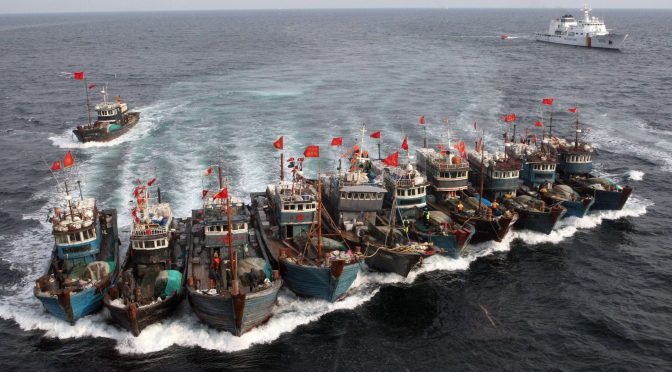
Any objective assessment of developments in the South China Sea over the last few years cannot but conclude that Beijing is successfully expanding and achieving its goals, the ultimate being complete mastery over this body of water. Please note that we can no longer talk about “dispute” since this word fails to capture the essence of the conflict. There is also no point in demanding a “clarification” of Beijing’s objectives in a wishful attempt at integrating China into the post-war liberal order. Third, and most crucially, given that China is deploying a combined force made up of the PLAN (People’s Liberation Army Navy), a number of Coastguard-like agencies, and a maritime militia, military to military contacts involving only the former are not only useless, they are counterproductive. By engaging the PLAN, in a bid to build trust and work toward agreements, such as the much touted Code of Conduct in the South China Sea, maritime democracies are dangerously ignoring China’s playbook. The PLAN does not operate in isolation. Instead, it follows a carefully orchestrated script featuring an internal division of labour, the coastguard agencies, and the maritime militia. Each has its role, and in some situations and missions they act separately, while in others they work as a team. Broadly speaking, most of the “dirty work” is carried out either by militia-crewed (or at least coordinated) “civilian ships” or by their coastguard counterparts, with the PLAN free to play the “good guy” role in a discreet second line.
This division of labour extends to diplomacy and military to military contacts: PLAN officers meet foreign counterparts, coast guard personnel keep a much lower international profile, and the maritime militias remain a domestic affair. This means that the objectives of these contacts are impossible from the start. What is the point of in engaging only the PLAN when it is just one part of the Chinese forces expanding in the South China Sea? How can we dream of integrating the PRC’s naval and maritime forces into some semblance of an international liberal order when the vast majority of their forces do not even take part in the exchanges and activities designed to bring this about?
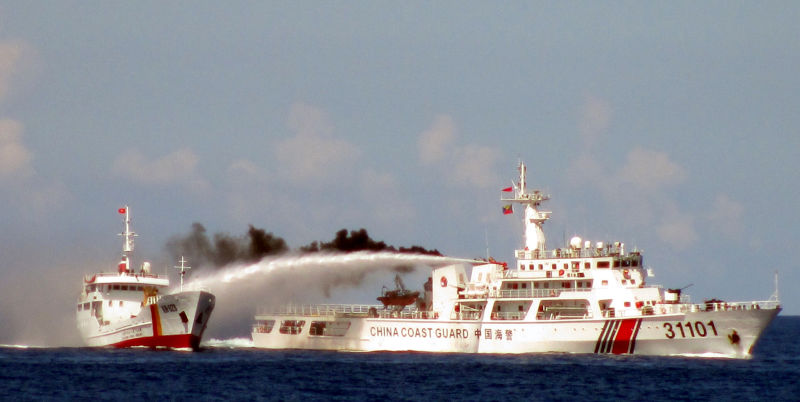
Heated altercation between a Chinese Coast Guard Cutter and a Vietnamese vessel in the South China Sea.
One of the eternal principles of war is the need to seize the initiative. For too long maritime nations in the South China Sea have simply been reacting to Chinese moves, playing into Beijing’s script. The solution is not to complain more loudly every time Beijing expands, or to rearm at the conventional level only, the solution involves seizing the initiative, playing by different rules (not China’s), and forcing the PRC to react for once. This has already happened in some instances, most notably the Philippines’ lawsuit under UNCLOS, but must now become the norm, not the exception.
In accordance with this need to seize the initiative, the following changes are necessary in military to military contacts and negotiations:
A) Maritime nations must refuse to take part in any negotiations where China’s Coastguard agencies and maritime militias are not represented. Dealings must take place only with delegations made up of the full range of institutions involved in territorial aggression in the South China Sea.
B) In order to make the above possible (and prevent Beijing from claiming that they are only sending PLAN personnel because they are just meeting naval officers), maritime nations must also include all equivalent agencies in their own delegations.
C) Third, when a maritime democracy does not have a maritime militia, it must be created. This can be accomplished, for example, by resorting to reserve personnel, maritime industries, and yacht owners associations.
Maritime democracies may also need to adopt measures to grow their fishing and merchant fleets in order to acquire the necessary dual-use assets to wage the non-lethal confrontation seen in the seas near China.
Adopting an integrated approach to military to military contacts with China may require some cultural and institutional changes. It may be understandable for a naval officer to prefer the company of a fellow officer from another country to that of a fisherman. Equally understandable may be an officer’s somewhat detached view of clashes among fishing boats, or landings by civilian “activists,” but the nature of the mixed warfare being waged by China means that superior conventional naval forces cannot simply wait for war to break out in order to defeat the enemy in a conventional battle. A war may be lost while waiting for it to break out. In theory, Chinese expansion could be checked by drawing a line in the sand and employing conventional force if necessary. However, this is politically unrealistic, given that not even economic sanctions have been discussed in Washington and pacific rim capitals. If the United States and her partners are not even ready to make China pay an economic price for aggression, can they be expected to go to war? The answer cannot be any other than a clear and loud no, and the Chinese are fully aware of it. Hence their “salami slicing” strategy.
US Navy Arleigh Burke-class Destroyer and US Coast Guard Hamilton-class High Endurance Cutter at sea.
If we rule out appeasement and surrender, then the only alternative left is to fight. Not to fight the war we would like, a war that is simply not on the menu, but the existing war being waged, and the one, we must regrettably say, which is being lost to date. In this war, the enemy is not simply using conventional forces, but a mixture of naval, non-naval state, and dual-use private assets. It is this complex reality that must be engaged with in attempts at confidence building and agreements negotiations. If it is not just PLAN officers working to conquer the South China Sea, what is the point in just talking to them? Shouldn’t we also be talking to their coast guard and militia counterparts?
This broad approach to military to military contacts is the only realistic approach to the current situation in the South China Sea (and the wider Indo Pacific). If actually resulting in agreements, they will be more likely to be respected, given that they will have been negotiated by the whole range of actors involved. If unsuccessful, then naval and maritime personnel from the nations of these contested waters will have gained a much better understanding of their foes. This will not only give them a clearer picture of the opposition, but will also help them make the necessary but often difficult and even painful cultural transition from leaders used to thinking in terms of conventional sea power to officers equally at ease when facing a trawler or a submarine, a missile fired in anger or a ramming fishing boat. Successful riverine operations in South Vietnamare a good example of a similar cultural and organizational change brought about by the need to fight a dual war, and the resulting transformation is a reminder that this is indeed possible.
Alex Calvo, a guest professor at Nagoya University (Japan), focuses on security and defence policy, international law, and military history, in the Indian-Pacific Ocean Region. He tweets at Alex__Calvo and his work, which includes “China’s Air Defense Identification Zone: Concept, Issues at Stake and Regional Impact”, Naval War College Press Working Papers, No 1, US Naval War College, 23 December 2013, available at http://www.usnwc.edu/Publications/Working-Papers/Documents/WP1-Calvo.aspx, can be found here.
We received a strong and quality response to our Call for Articles requesting publications on India’s Role in the Asia-Pacific. Our authors were diverse in background and experience. Their analysis highlighted competition between India and China in the maritime domain, various foreign policy initiatives of the Modi administration, and India’s aspiration to assume greater influence and responsibility on the international stage. We thank our authors for their excellent contributions.
Below is a list of the articles that featured during the topic week, with relevant excerpts outlining the main thrust of each publication’s analysis.
“As the United States increasingly faces challenges to its global power by Iran, Russia, and China, its relationship with India will grow in strategic importance.”
“Safe maritime connectivity, external trading, and overseas investments require India develop political confidence in its neighborhood and a dedicated navy to ensure secure seas.”
“Implicit competition in what has been dubbed “a new great game for influence in the Indo-Pacific” between these two rising powers is the order of the day in the Indian Ocean, the South China Sea, the West Pacific, and the South Pacific.”
“Whether the maritime competition between China and India is in the Indian Ocean or the South China Sea may prove to be only an elusive speculation though seemingly plausible.”
“Even though it is popular for its crystalline waters and sun bathed beaches, recently Maldives has been appearing on the minds and finds of security strategists. So why have strategists shifted their gaze to this tiny tourist destination all of a sudden? Two reasons: India and China.”
“Not only have the mountain passes and peaks of the Himalayas become zones for potential conflict, where in the past they served as natural buffers, but the shared space of the Indo-Pacific also links the interests and security concerns of present day India and China.”
“While India’s ascendance to great power status will take time, owing to domestic constraints, how India positions itself in the Indo-Pacific balance of power and rises as a ‘net security provider’ will contribute significantly to its security and status.”
“The Modi government’s strongly maritime oriented foreign policy launched in 2014 has proven somewhat rewarding, particularly in helping the Indian Navy transcend its image of a force that punches below its weight. The politico-strategic recalibration by India in its Asia-Pacific policy has sought to retool its mid-1990s Look East policy with more purpose.”
“The analysis will show that Sino-Indian relations reflect a peculiar kind of stability: although their relationship will continue to be marked by distrust and intermittent disputes, the risk of escalation to war remains unlikely. In general, Sino-Indian relations are influenced by four factors: (1) their history of enmity; (2) strategic competition; (3) nuclear relations; and (4) trade.”
“The Prime Minister’s firm declaration of national intent for India to be a net security-provider in the Indian Ocean and beyond, means the various connotations of maritime security (defined as freedom from threats emanating ‘in’, ‘from’, or ‘through’ the medium of the sea can no longer be denied centrality in any serious consideration of India’s national security.”
Dmitry Filipoff is CIMSEC’s Director of Online Content. Reach the CIMSEC editorial team at Nextwar@cimsec.org.


 influence of emerging naval platforms and technologies in the geostrategic contours of the Indo-Pacific region. The column will also identify relevant historical precedents, forming the basis for various maritime development and security related projects in the region.
![Figure 1. The Three Layers of Cyberspace[iii]](https://cimsec.org/wp-content/uploads/2016/05/bebber2.png)