Bangladesh’s acquisition of two submarines from China should not be narrowly viewed through the prism of India-China geopolitics. Rather, it should be understood in a wider context as a milestone by a modernizing naval power in the Bay of Bengal.
Commentary
The impending arrival of two Chinese-origin submarines to Bangladesh together with China’s planned construction of submarines for Pakistan, has contributed to the perception among some observers that China is attempting to encircle India and reinforced concerns about a Chinese “string of pearls.”
Yet Bangladesh’s acquisition of two Ming-class submarines should not be narrowly viewed through this geopolitical prism. Rather, it should be seen in the broader context of the country’s force modernisation, which has important implications for Bay of Bengal security. In fact, Bangladesh’s development of its naval capabilities may contribute as a force multiplier to Indian security initiatives in the Bay of Bengal rather than being a potential threat to regional stability.
Rising Navy
Bangladesh’s latest acquisition has its origins in Prime Minister Sheikh Hasina’s assumption of power in 2009 and Dhaka’s announced Forces Goal 2030. Under this project, Bangladesh has sought to augment its naval capabilities in “three dimensions,” going beyond solely surface platforms to include a naval aviation wing and undersea leg. Though an ambitious endeavor at the time, by 2011, Bangladesh had established a naval aviation wing by acquiring Italian helicopters and later German maritime patrol craft.
The navy has also expanded its surface fleet through Chinese and U.S. origin platforms. Refurbished submarines from China appear to have been the most competitively priced option to fulfill the third leg of Forces Goal 2030. The announcement about the transfer should be no surprise given that Bangladeshi media and military officers have openly discussed progress toward this goal over the past few years.
Furthermore, Bangladesh is one of a number of countries in the region that are expanding their fleets with sub-surface platforms. Through this force modernisation project, Bangladesh is seeking to be self-reliant and gain prestige for its military, as do many countries with growing economies.
Unsung Contributor to Maritime Security
At the same time that Bangladesh is augmenting its naval capabilities, it is increasing its contributions to maritime security in the Bay of Bengal and beyond. Since 2010, it has deployed two ships to the UN Maritime Task Force off Lebanon. Moreover, having long been a recipient of disaster relief, Bangladesh now seeks to become a provider of such aid. In the past three years, the Bangladesh Navy delivered relief to Sri Lanka after deadly landslides in May, to Maldives after a water crisis in 2014, and to the Philippines after Typhoon Haiyan in 2013.
Bangladesh also seeks a leadership role in advancing international maritime institutions and legal norms. The Bangladesh Navy is currently chairing the Indian Ocean Naval Symposium (IONS) until 2018. Previously led by the Royal Australian Navy, IONS convenes regional stakeholders to discuss opportunities for cooperation.
At their meeting in January, naval representatives from 30 countries gathered in Dhaka, including the first appearance by a four-star U.S. Navy admiral. Finally, after long-standing maritime disputes with Myanmar and India, Bangladesh opted to use the tools of international arbitration. As a result, the three countries helped affirm the importance of international law in the Indian Ocean.
India: Much to do with Bangladesh
The idea of Chinese sailors training the Bangladesh Navy on submarines in the Bay of Bengal is understandably disconcerting to Indian policymakers. India’s minister of defence recently paid a historic visit to Dhaka to upgrade defence ties, likely aiming to neutralise a long-term Chinese training presence in Bangladesh. Although India’s ability to provide Bangladesh with training on Chinese-origin submarines will be limited, it is an opportune moment for India and Bangladesh to deepen minimal naval cooperation.
Strikingly, neither neighbor engages in bilateral naval exercises or annual navy staff talks; this is a clear area for growth. Both sides make occasional port calls to the other country, the navy chiefs visit each other, and the Bangladesh Navy participates in the Indian Navy’s multinational MILAN maneuvers and in its training schools. The lack of deeper naval interactions may be due to the countries’ maritime boundary dispute, which was not resolved until 2014. A bilateral agreement in 2015 between Sheikh Hasina and Narendra Modi achieved cooperation between the two coast guards, yet not the navies.
As a result of the submarines’ impending arrival, India will be able to seize on this opening to advance naval cooperation, including on this platform. The two nations can develop mechanisms for water-space management and information-sharing in the Bay of Bengal. While Bangladesh will need to train on the submarines for years to develop requisite expertise, it can use this platform to monitor movements and communications as other navies have done.
This will augment maritime domain awareness and may deter criminal activity, including threats posed by Islamist militants. For its part, India houses two military commands in the Bay of Bengal and has a growing anti-submarine warfare capability. Bangladesh’s additional coverage of the maritime domain would supplement efforts to ensure regional stability.
India could also transfer or sell maritime platforms to Bangladesh as it has done for several Indian Ocean countries. As New Delhi tries to increase its indigenous defence industry under the “Made in India” initiative, Indian shipyards, including in nearby Kolkata, could similarly build ships and aircraft for the Bangladesh Navy and Coast Guard.
Way Forward
The delivery of two Chinese submarines to Bangladesh—likely in January or February, according to media reports—represents a milestone by a smaller South Asian country that is modernising its naval forces. Moreover, Bangladesh’s clear contributions to maritime security in the Bay of Bengal and beyond should be encouraged.
India is notably pursuing cooperation on submarines with the United States; it may also find a partner in the undersea domain closer to home. Relations between Dhaka and New Delhi have been growing, especially since Prime Minister Modi’s historic visit in 2015. Bangladesh leader Sheikh Hasina’s upcoming visit would be a good opportunity to lay the foundation for deeper, regular naval cooperation that reduces India’s threat perceptions and develops mechanisms for greater maritime domain awareness. Bangladesh’s evolving naval capabilities and role in advancing international naval operations, forums, and norms can bolster regional maritime security and stability.
Nilanthi Samaranayake is a strategic studies analyst at CNA, a non-profit research and analysis organisation in the Washington, D.C., area. The views expressed are solely those of the author and not of any organisation with which she is affiliated. She contributed this to RSIS Commentary.
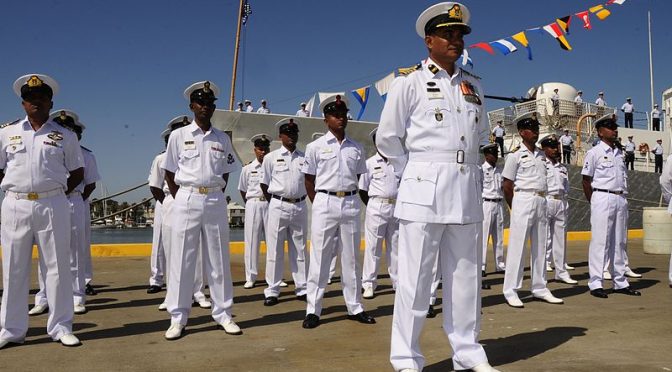
Featured Image: Capt. Mohammad Nazmul Karim Kislu leads a formation from the Bangladesh navy during the transfer and decommissioning ceremony of the Coast Guard Cutter Jarvis held on Coast Guard Island, Thursday May 23, 2013. (U.S. Coast Guard photo by Petty Officer 2nd Class Pamela J. Boehland)
CIMSEC convened a panel of Asia-Pacific experts to weigh in on recent security developments in the region, provide context on evolving international dynamics, and highlight potential issues to watch closely. Listen to the audio or read the transcript below.
Mina Pollmann: Hello everyone. Thanks for joining us on this call. My name is Mina, and as CIMSEC’s Director of External Relations, I have the honor of moderating today’s call on maritime security trends in the Asia-Pacific. For our CIMSEC listeners, I am pleased to say we have an exciting panel lined up, with four distinguished Asia-Pacific experts joining us to discuss security issues in the maritime domain from various different angles.
Before we begin, I would like to introduce our panelists.
We have joining us today, Captain Jim Fanell, a Government Fellow with the Geneva Centre for Security Policy. Jim retired from the U.S. Navy in January 2015, after spending 30 years as a naval intelligence officer specializing in Asia-Pacific security, with an emphasis on the Chinese Navy and its operations.
We have Greg Poling, director of the Asia Maritime Transparency Initiative and a fellow with the Southeast Asia Program at the Center for Strategic and International Studies. He oversees research on U.S. foreign policy in the Asia-Pacific, with a particular focus on the maritime domain and the countries of Southeast Asia.
We also have Elina Noor, director for foreign policy and security studies at the Institute of Strategic and International Studies Malaysia. Her policy interests include U.S.-Malaysia bilateral relations, cyber warfare and security, radicalization and terrorism, and major power relations.
And Scott Cheney-Peters also joins us, founder and chairman of CIMSEC, and a reservist in the U.S. Navy. His interests focus on maritime security in the Asia-Pacific and naval applications of emerging technologies. The views expressed are those of Scott’s alone and not necessarily representative of the U.S. government or U.S. Navy.
Without further ado, I would like to begin with Jim.
Jim, can you talk us through the most significant changes to the Chinese Navy over the course of 2016 – from a doctrinal and/or capabilities perspective? Also, how do you weigh the prospects for U.S.-China cooperation or conflict in 2017? Are incidents like the spat over the UUV that China picked up last month likely to increase?
Jim Fanell: First of all, thanks Mina for coordinating this and inviting me to participate. I’m very happy to be working again with CIMSEC and the great work you all do.
To answer your questions as concisely as possible, the biggest thing that happened in 2016, in my view, after spending the last couple days reviewing about 10,000 of my emails from the Red Star Rising, is the series of major changes President Xi instituted to the PLA – creating a separate PLA headquarters, elevating the status of the strategic rocket forces and the strategic support force, and reorganizing the seven military regions to five theater commands – all of which had an indirect impact on the navy, elevating their status.
The navy’s status had been rising since before 2016, but that trend continued throughout the past year, which is also evident when one considers the sheer number of events the Chinese Navy held – not only exercises inside the first island chain, but also the great number of operations that occurred outside the first island chain and globally in the Indian Ocean, the Mediterranean, up to the Baltic, down to the South Pacific, and into South America. What we saw was the solidification and culmination of Admiral Wu Shengli’s final year as chief of naval operations for the Chinese Navy.
I think you also saw President Xi recognize that the PLA is the principal tool for Chinese power and acquisition, to maintain China’s outward orientation, including as a part of the One Belt, One Road Initiative. You also saw China participate in RIMPAC 2016, which is a very big operation for them, and a solidification of what they did in 2014 and 2012 – establishing the pattern that they expect to continue in 2018. We’ll see how that goes.
In terms of shipbuilding, it looks like they built about 4.5 times as many ships as the U.S. did in the past year, so their shipbuilding program continued pretty strong. They were globally deployed in many ways, including submarines in the Indian Ocean while they were operating and doing fleet reviews in India – a kind of hard power-soft power approach by the Chinese.
In 2017, we can look for more of the same in terms of their presence. They’ve made it clear that they want to break outside the first island chain, and they demonstrated that very consistently in 2016 – culminating the year with their naval air forces flying outside the first island chain with bombers, fighters, and re-fuelers, circumnavigating Taiwan with their aircraft carrier. We can expect to see more of that in 2017.
I think we can also expect to see the rollout of the new carrier, an indigenous one. This will be their second carrier, but the first one they produced themselves. I think we’ll also get more information about their ballistic missile submarines officially being on SLBM patrol, helping shore up that portion of the nuclear deterrent capability they’ve been talking about.
With controversies, like with the UUV at the end of last year, it’s quite possible we’ll see more things of that nature. I think what you’ll see though, especially in the South China Sea dispute over the Spratly Islands and even over Scarborough, is that you’re going to see the Chinese incrementally continue to react to the United States’ presence.
Before October 2015, you could describe it as a “zone defense.” But by my read, from October 2015, through all of 2016, and even into 2017, the Chinese have taken a man-to-man approach in dealing with the presence of the United States in the South China Sea. I think, now, every time we’ve done one of our four freedom of navigation operations or when we have dual carrier operations or single carrier operations, the Chinese have gone out of their way to make clear and publicize that they are shadowing and following our naval vessels as soon as they come into the South China Sea. We can expect to see that increase, and the pressure from their vessels to become sharper in tone. I don’t expect to see shouldering or ramming, but it all depends on how they interpret the new administration. They will use statements and anything else that comes out of the new administration as justification for such challenging behavior – and we have to be prepared for that.
The littoral combat ship USS Fort Worth (LCS 3) conducts routine patrols in international waters of the South China Sea near the Spratly Islands as the People’s Liberation Army-Navy guided-missile frigate Yancheng (FFG 546) follows close behind. (U.S. Navy video by Mass Communication Specialist 2nd Class Conor Minto/Released) May 12, 2015
Mina: Thank you, Jim. Now, I’d like to turn to Greg. What are the most salient facts to know about China’s recent construction activities in the South China Sea? To make sense of their construction activities, what are the key indicators you are looking for in 2017 as signals or markers for Chinese intentions? Will the PCA ruling or a potential ASEAN code of conduct modify Chinese behavior?
Greg Poling: Thanks, Mina. I think what we saw, certainly over the last year, is continued consolidation by China of the installations made in the Spratlys and the expansion of its capabilities in the Paracels, all the while, at least in the second half of the year, pretty successfully diverting international criticism, at least diplomatically so.
If you only read the press on the South China Sea in 2016, it looked like two different years. In the first half of the year was high level bullying, especially of the Philippines but also everybody else, in an effort to prevent nations from publicly supporting the PCA ruling, along with this “will they-won’t they” debate about construction at Scarborough, which the U.S. seems to have successfully deterred in the short-term.
But after the July ruling, all of a sudden, we heard a tonal change from the Chinese. The election of President Rodrigo Duterte in the Philippines opened that door, but Beijing gladly walked through it. They continued to lash out at the U.S., Australia, Japan, and Singapore for perceived support of the Philippines, but towards the rest of ASEAN and especially the Philippines, they took a more polite approach. That pretty successfully helped them avoid the widespread censure that would have at least brought some pressure to change Chinese actions. Since that didn’t happen, I think they’ll see that they have largely a green light to return to a more coercive stance in 2017.
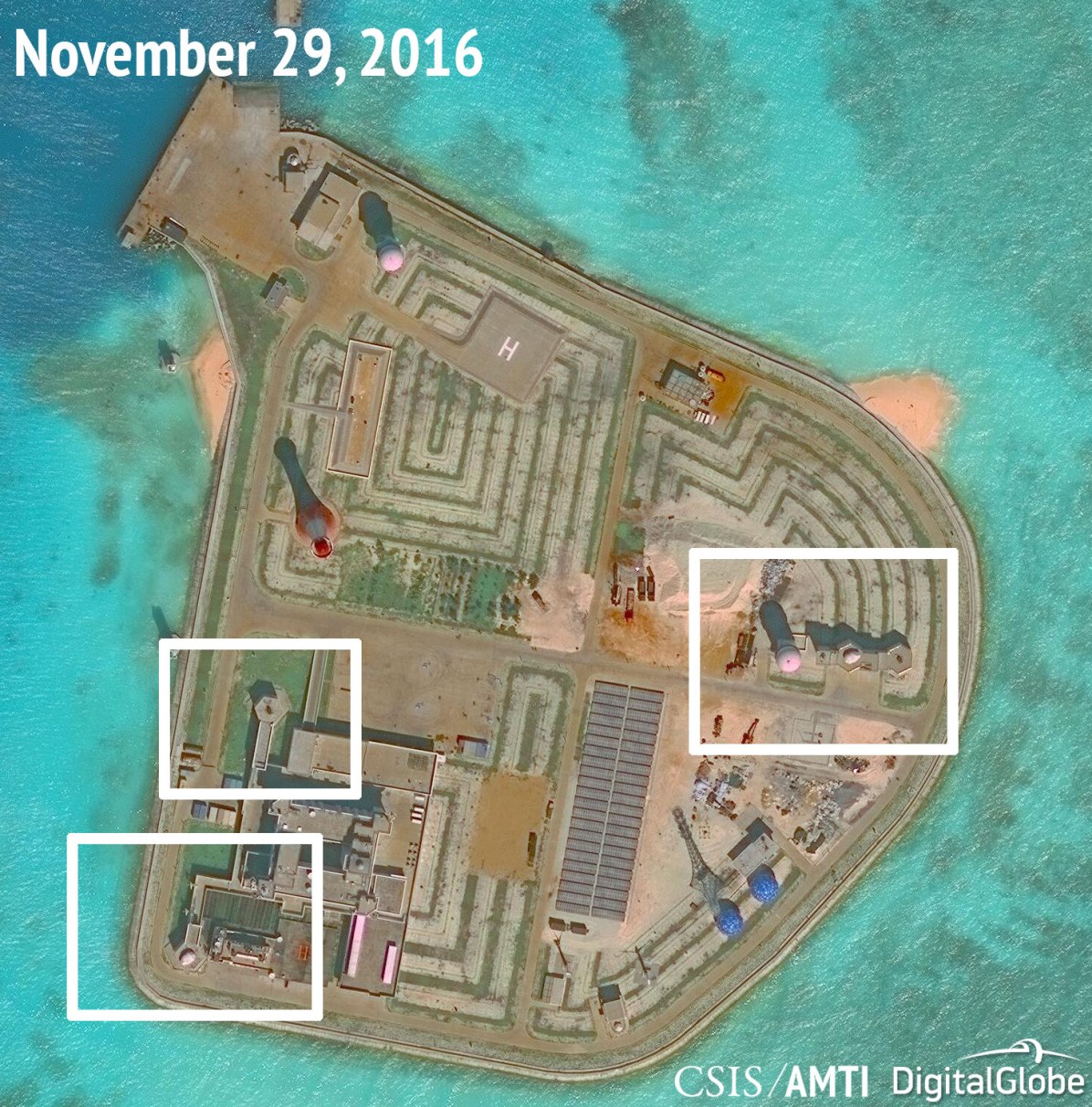
So while all of this change in tone, and all of this diplomatic effort was going on, we still saw the completion of 72 small hangars for combat aircraft at the three biggest islands in the Spratlys, the construction of larger hangars for maritime patrol, heavy lift, and refueling craft, continued upgrades to ports and docking facilities that allow the Chinese Navy, coast guard, and paramilitary forces to stay out in the southern regions of the South China Sea 24/7 in a way they haven’t been able to prior to the artificial island construction, and we continue to see the increase in their monitoring capabilities with radar facilities, signals and intelligence. Fiery Cross Reef looks like it’s being turned into a hub for all of this data collection apparatus.
Johnson Reef, with key facilities indicated (CSIS AMTI/Digital Globe)
What I’m going to be looking for next – which seems almost inevitable – is the first deployment of combat aircraft to the Spratlys, and I think that’s really a matter of when, not if. The Chinese did not build all of this air infrastructure to not use it. I think we should expect to see the deployment of surface-to-air missiles pretty soon. The HQ-9 systems that made waves last year are still emplaced on Woody Island. Woody Island has in many ways been a lower scale model of what we see in Mischief, Subi and Fiery Cross Reef. So I think we’ll see those deployments soon. And they might very well be used early in the next U.S. administration, as a test of the Trump team’s willingness to confront the Chinese.
If you are a Southeast Asian claimant, life is going to get a lot harder this year. So far we’ve seen a backing off of the most aggressive behavior by the Chinese. But it’s also the middle of storm season, so we don’t have hundreds of fishermen getting into it with the Chinese like we will in the spring. I think we are going to see the next escalation triggers sooner rather than later as the math works against us – the sheer number of Chinese vessels willing to try to close off the disputed area to the claimants is going to increase, whether we like it or not.
And on the code of conduct – much has been made of this pledge by Foreign Minster Wang Yi on the sidelines of the ARF that China would agree to a framework code of conduct by mid-2017. But that is a pretty “squishy” commitment. First, I have no idea what a “framework” for a code of conduct means. I don’t think anybody does. Second, we’ve seen no willingness by China to agree to a binding code of conduct – and even if they did, they have no willingness to clarify their claims, so it’s hard to imagine where that even applies. Third, if China’s past behavior is the best indicator of future behavior, then this seems to be nothing more than a delaying tactic. It took a decade to get China to agree to the guidelines for implementation of the DOC, which have still not been implemented, and have really done nothing to stop the escalation. Even if we get a toothless precursor to the COC this year, I don’t think it really changes anything.
Mina: Thank you, Greg. Elina, focusing more on the bilateral aspect of the U.S. relationship with Southeast Asian states, and how the U.S. is trying to promote the rule of law in this complicated dispute, how significant are the changes we saw in 2016 in terms of the U.S. relationship with Vietnam? And with the Philippines? How are other states – such as Malaysia, Singapore, Indonesia – trying to respond to the increasing U.S.-China tension in the region?
Elina Noor: I think the short answer to your last question is, is with difficulty. But I think context is very important to keep in mind here. When considering Southeast Asian states and the sometimes puzzling behavior of their respective leaders, we often tend to superimpose a geopolitical, major power rivalry – in this case the U.S. and China – to understand some of their complex behavior, and we often fail to see things from the national perspective.
The Philippines for example – I think there was this perception that the Philippines was casting aside the U.S. as its long-term ally, and moving close towards China in particular towards the end of last year. But if you look at developments more closely, you see that President Duterte was only trying, and is still only trying, to do is what many other Southeast countries have been doing for a very long time – which is trying to balance the major powers in the region. We’re all very small countries here, with maybe the exception of Indonesia. And under President Aquino, the Philippines was seen as completely being in the U.S. orbit, while President Duterte, in my view, is just trying to “rebalance” that relationship, so to speak, and trying to bring it back closer to the center, to reposition the Philippines among all these different and influential powers in the region while also trying to extract maximum benefits for the Philippines itself.
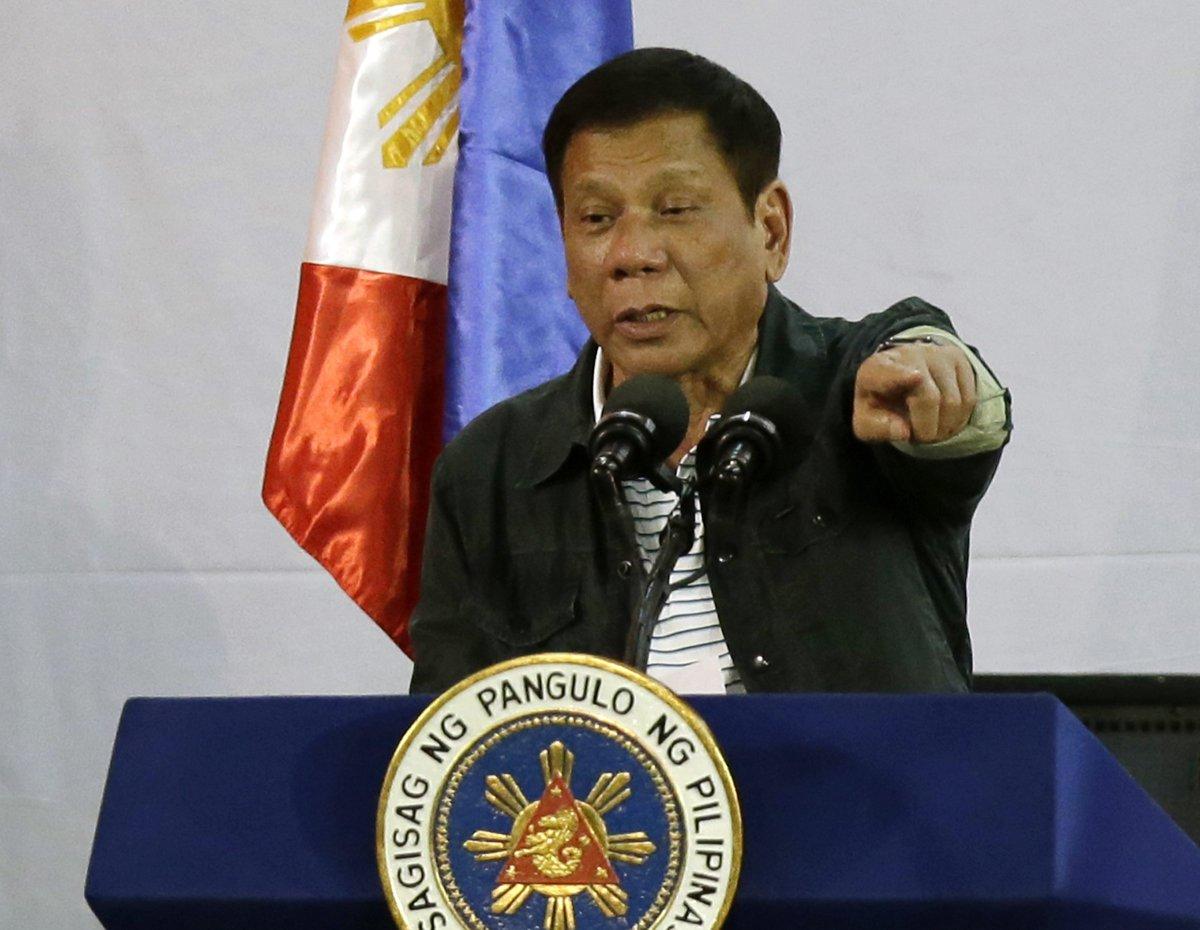
Phillipine President Rodrigo Duterte (Aaron Favila/AP)
For Vietnam, definitely the lifting of the arms embargo as conditional as it was, was still very significant. We know the bitter history between the U.S. and Vietnam. But, again, to cast this in light of this big U.S.-China rivalry is only one aspect of the consideration.
Similarly, there has been a lot talk of Malaysia turning towards China because of all these deals. These are mostly economic deals and investment-based. But there was also the defense deal that was done during Prime Minister Najib’s official visit to Beijing in late October/early November 2016. The fact that Najib himself called it a “landmark deal” lent even more flavor to the idea that it was about Malaysia aligning itself more closely with China. But when you look more closely at the details, you will see that the China-Malaysia defense relationship is still very nascent and underwhelming, especially considering that China and Malaysia had signed a defense MOU back in 2005. It hasn’t really developed over the years, and it’s only been in recent times, during the last two to three years, that it culminated in a tabletop exercise and a command exercise, and from now on, on an annual basis, we will see joint exercises of friendship and cooperation. But this is really just a confidence building exercise that both the Chinese and Malaysian military is embarking on, really just trying to assess the comfort level between the two militaries. On the other hand, consider the fact that Malaysia has a long, established, solid defense relationship with the U.S., in particular, but also with other countries in the region – like Australia, Singapore, and New Zealand.
If we view things more holistically and drill down to the details, you will see that the U.S. relationship with Southeast Asian states is still very significant, but I caution anyone against trying to understand national developments in the Philippines, Vietnam, Malaysia, Singapore, and Indonesia as mainly a U.S.-China-and-“pick your Southeast Asian country” trilateral relationship. It’s more about the national interest of each of the Southeast Asian states and how they position themselves between the major powers of the U.S. and China or try to optimize their national interest in the midst of all this rivalry.
Mina: Thank you, Elina. And finally, Scott, taking a macro view of developments in the Asia-Pacific in 2016, how do you assess President Obama’s “rebalance”? Did the U.S. succeed in creating new partnerships and strengthening existing relationships in the naval domain? Have other U.S. allies or partners been successful in this regard? One of the most exciting stories early on in 2016 was whether Japan and Australia, two key US allies, would cooperate on submarine production, but that initiative fizzled. Is defense technology cooperation a feasible area for future U.S. leadership in the Asia-Pacific?
Scott Cheney-Peters: Thank you so much for that. Absolutely so. I think the key underpinning of the strategic rationale of the “rebalance” was correct and it still holds true. And that is, that outside of North America, Asia will be the most important region for the U.S.’s security and its values. Dan Rather had a good piece in the Washington Post about how President Obama’s foreign policy focus was a little bit like Jon Snow’s from the Game of Thrones in that it was right in the big picture about the “rebalance” to Asia but a little bit negligent about the dangers of conflicting agendas. It talks about how things like the Iran deal could be seen in the framework of removing these distractions, but also how, despite these efforts, many real world events and folks with other goals, like Putin, get in the way of this vision. As such, the record in prioritizing and safeguarding U.S. interests in Asia against other threats has been something of a mixed bag.
I’m going to focus on the security front in particular. And since my esteemed colleagues have talked a lot about China, I’m going to put that a little on the backburner, but it has brought us this focus through the “rebalance,” this enhanced substantial cooperation with many countries in the region including Japan, Australia, Vietnam, the Philippines, Singapore, Indonesia, India, Sri Lanka, and even China. But these gains can be seen as tactical and reversible – as we saw with Thailand and the coup, and in the Philippines as Elina alluded to, because our interest is not singular. It’s not just security, or economics, or values. It’s a mix of those because we understand the intertwined nature of these interests over the long run.
While eight years without any major conflict in Asia during this past administration is not insubstantial, and several long-running internal disputes and boundary issues were resolved or moved closer to resolution, other security threats have increased. The U.S. is going to have to figure out how to deal with North Korea, which seems to be determined to pursue increasingly capable nuclear weapons. And as Jim and Greg alluded, also dealing with a China that is undertaking this campaign of maritime coercion while violating international norms and laws. In the maritime domain, there are non-state threats, such as resurgent piracy, kidnapping, and armed robbery at sea and increasingly aggressive competition for marine resources. We’re seeing also an influx of Islamist radicalism that could potentially inflame ongoing insurgencies in Thailand and the Philippines. Of late, we’ve also seen the potential for radicalization of the repressed Rohingya in Burma. So we’re seeing a lot of security threats and issues that have somewhat metastasized over the past several years.
On other fronts, like economics, we obviously spent a lot of time and effort trying to develop the Trans-Pacific Partnership, which I understand now has been withdrawn prior to ratification and it remains to be what seen what will replace it – but that cannot be counted as a win for the “rebalance.”
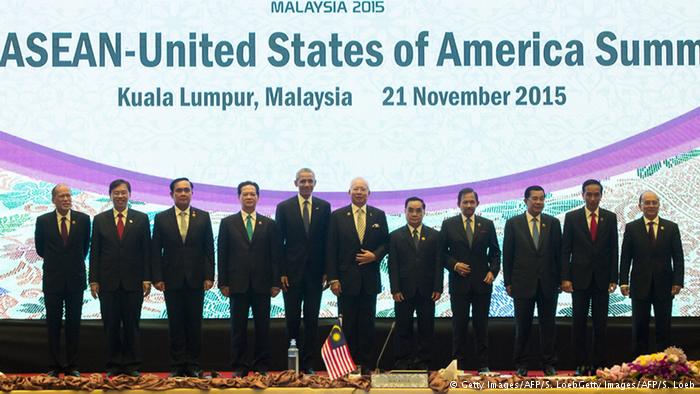
World leaders gathered at the ASEAN-U.S. Summit (Getty Images)
Regionally, we have seen a lot of participation by the U.S. in things that are going to build and strengthen regional framework for maritime security cooperation, things like the Maritime Security Initiative, the DoD-led initiative to help develop the maritime security capabilities of some of our Southeast Asian partners; ReCAAP, the regional agreement for countering piracy and armed robbery; and the ASEAN Regional Forum. These all have really gotten their feet under them, really developed, just over the past eight years or so. But without sustained diplomatic effort, which is one of the things the “rebalance” was good at investing, it remains to be seen how much further these can develop. The good news for the region is that, probably, other than the MSI, they can support themselves without U.S. support and participation, but certainly our involvement would help to mature and strengthen them.
As to our partners, I think Japan has been quite successful in constructing maritime partnerships in part due to what I call “patrol boat diplomacy” of helping Southeast Asian partners develop their maritime capability on generous terms, whether it’s Vietnam, the Philippines or Malaysia. And this is something that Australia has also long undertaken, especially in the South Pacific. India has also been warming to this approach. We see a couple of new deals between India through no longer just its “look east” but also its “act east” policy. In the future we are likely to see all three continue to pursue maritime technology cooperation and defense export opportunities. I would add a caveat that the exact nature of those deals remain to be seen and will depend on the calculation of both sides, not just in terms of security considerations, but also, sometimes primarily, on domestic economic and political concerns – for things like shipbuilding jobs and technology transfers.
I don’t know how much of a leadership role the U.S. will take in technology transfers or technology cooperation, but I remain optimistic about improved ties in technology cooperation with India, and what that means in terms of developing naval aviation capabilities. So that’s a broad stroke, and I’m looking forward to our discussion, I have some questions I want to ask our fellow panelists
Mina: Great, thanks, Scott. I’m going to begin with one follow up question, and then we can have a little bit of a discussion. There’s still plenty of questions about what policies this administration will pursue, but I think we can already say that this administration will be characterized by unexpectedness, unpredictability, and misinformation. How are these traits of the Donald Trump administration going to shape how states in the Asia-Pacific, including key allies such as Japan, craft their maritime strategy and foreign policy?
Scott: I’d like to put a spin on that question and shoot it over to Elina. I’m curious what you think the nations in Southeast Asia, what signals or messages from the United States will help them breathe a sigh of relief?
Elina: I think that’s a tough one, Scott. As Mina pointed out there does seem to be a lot of unpredictability and uncertainty right now. We heard President Trump’s speech during his inauguration, and his emphasis on America First. I think what we can see in Southeast Asia – subject to whatever develops in the next few months – is that the relationship will be a transactional one as many people have said. And that transactional relationship will be dependent on how much the Trump administration can draw from its partners in Southeast Asia. Now this will be a bit of bargaining back and forth between Southeast Asia and the U.S. Obviously, the smaller Southeast Asian nations will not have the bargaining chips to play that the United States does.
Some of the signs Southeast Asian states are looking for will not be forthcoming in the next few months, because I think they’re looking for signs of predictability, reassurance and stability – none of which has been present thus far. ASEAN in particular, given its fiftieth anniversary this year, will be looking for some form of commitment, at least the presence of President Trump at the EAS, and I’m not sure that we can even expect that. I know that in the past the U.S. has sort of downplayed the appearance of its leaders at events like the EAS and even senior officials at the ARF, but I think as we all know, in Southeast Asia just showing up is key. And at this stage, I don’t think we can even expect that come November.
All the signs Southeast Asia is looking for – predictability, certainty, stability, assurance, it’s all coming now from the one unpredictable actor that was around and has been around and will continue to be around: China. In the past, we saw signs of reassurance from the U.S. against China, but now the situation seems to be reversed.
Scott: That’s a great answer and great points. Greg, I’m wondering if you’ve seen to Elina’s point, any policies coming out from Trump’s administration pertaining to Asia outside the U.S.-China context.
Greg: Well, no, not outside of the U.S.-China relationship. Despite its many shortcomings, the one thing the Pivot did quite well was focus on middle powers and Southeast Asia states. It situated China policy within Asia policy, not the other way around. So far, for Trump and most of his senior advisers and the transition team, what we’ve heard is an Asia policy almost entirely dominated by China with a sprinkling of North Korea. If you expect a transactional approach to interstate relations, which I think is reasonable, you’re perceived value vis-à-vis U.S.-China relations is going to determine your value to a large degree. If you’re sitting in a Southeast Asian capital, that’s the one thing that should really worry you. Elina mentioned the importance of just showing up in Asia – I don’t think we should expect Trump at the East Asia Summit. That seems extremely unlikely. We’re not going to see the same focus on Southeast Asian states, Australia, India, Japan except through that bilateral U.S.-China prism.
The biggest factor of uncertainty though, is how much does the stated policy and platforms of the president-elect and nominee Trump actually translate into foreign policy? How much does President Trump want to be involved in foreign policy? We’ve certainly heard suggestions that he’s not going to play a very active role. He’s going to allow a much bigger role for players like Michael Flynn, the NSC, Mike Pence, and General Mattis, so it is possible that all of these statements from the president don’t actually frame the way the president pursues foreign policy.
Mina: That makes a lot sense – just from the flip-flopping we’ve been seeing between the campaign and what is now a two-days-old presidency at the time of this recording. I’m still curious how states are reacting to the U.S., but breaking out of Southeast Asia, what are the signs that Japan and Taiwan in Northeast Asia are looking for? We haven’t really touched on the East China Sea but that’s also a hot spot in the Asia-Pacific that has gotten increasingly tense over the past year.
Scott: Jim, maybe that’s an opportunity for you to jump in here. You mention the Red Star Rising, but perhaps you could provide a little more context for our listeners about that and if you’ve seen any discussion about the role of Taiwan in the new administration.
Jim: First of all, the Red Star Rising is just an email distribution list that I’ve had going on for 11 years. Got a number of people at State, DOD, academia and the press, and people in theater, in the country and regions are on the list so we try to follow things from their perspective. Anybody listening to this send us an email at kimo.fanell@gmail.com and we’ll add you to the list.
Second, before we get to Taiwan, I would like to give an alternative view about the characterization of the Trump administration. One, Mina said it, they’ve been in power a day and a half. Two, if you go back and look at the Obama administration’s announcement of the rebalance or the pivot that was a year and a half into his administration before it was announced, and it was certainly another two years before we started seeing tangible aspects of that policy being implemented. I would caution people not just in the United States but also overseas to give it a little more of a “breather” here. There have been no stated policies on anything, so to make judgments about what these will be and to make assumptions that everything is going to be transactional is very premature.
Especially when you listen to testimonies of Secretary of Defense Mattis and Secretary of State nominee Tillerson, their comments reflect an understanding of the requirements and necessities to sustain our alliance structure. General Mattis’ first statement yesterday after he was confirmed, he said to the Department of Defense “I’m glad to be working with you,” and to the people of the intelligence community, and the last portion of that two or three sentence message to the Department, he said we need to have “friends and alliances,” so I think we need to see US foreign policy through the lens of greater continuity in the post-WWII environment. In my opinion, our commitment to the international order is not going to be upended, and take it for what it’s worth, but I think that’s the message you’ll be seeing coming out of this new administration. There will be parts of it that will echo and reinforce what the president-elect said, but I didn’t hear those statements even in the Inauguration speech. He talked about America not forcing its view on other countries, but I think there’s a lot there to work with. People may not like all that is said, but there is a longer continuity to history.
With respect to Taiwan, I do think it’s an area where this new administration is not going to be constrained by previous history. I’m kind of undercutting what I just said, but I think it’s very clear what happened is not just happenstance, and we can expect to see more direct challenges to the idea that the United States cannot deal with and talk to Taiwan. I think there’s been a lot of discussion about what is the “One China” policy. And if you go back and look at the original statements from the 70s, we said we accepted the understanding that China believed Taiwan was part of China, but we were not making a judgment on that. I think that hasn’t been focused on in the past two, three decades, but I think that will be under discussion again and that will certainly upset Beijing. I think the purposes for that, you may attribute to transactional relationships in other aspects, like economics. I think this new administration is going to challenge China on its unwillingness to uphold the international order – such as their unwillingness to follow the PCA ruling – and they might do that through an indirect or asymmetric approach.
Mina: Thank you very much. I’m sure our listeners will appreciate this. And now finally, before we sign off, I have one last question for each of our panelists, in the same order as initial responses, and it is, what project are you most excited to be working on this year, that CIMSEC readers and listeners should keep an eye on?
Jim: I’m always working on all kinds of different things, but I think my focus will stay on watching what the Chinese Navy is doing in terms of enforcing their view of the task to rejuvenate and restore China, including in their maritime domains. That’s where my focus will remain.
Greg: Not to parrot Jim’s answer but me personally and at AMTI, we will be looking to do more of the same. We’re looking to boost readership of the site, increase our ability to bring pressure and transparency. Part of this is, for instance, we just launched multilingual versions of the website in Chinese, Malay and Vietnamese to drive readership outside of the United States. We’re also looking to do a couple new projects that move beyond just pulling back the curtain on what China’s doing in the South China Sea but look at, well, what do we do about that, beyond just the military realm, which is what we have been working on. We want to look at environmental issues, legal issues, law enforcement, et cetera.
Elina: I’m excited to be focusing more on cyber issues. It doesn’t have direct links to what we are talking about now, maritime security, but as you know, operations in cyber space cut across all traditional domains. So in the next few months, you will hear about a global commission on stability in cyberspace being announced. I don’t want to preempt or undercut any public announcement, but I think you will hear exciting news coming from that space, and I will particularly be helping try to craft norms and rules for state behavior in cyberspace and international relations. That’s what I’m looking forward to this year.
Scott: Those all sound like fascinating projects, and I look forward to learning more about those. I do want to take the opportunity to thank my co-panelists and colleagues for joining us on this podcast and for those listeners out there, if you are interested in heading out – especially in DC – to any CIMSEC events, we often get the opportunity to host some of these great thinkers in more informal discussions and more give-and-take in person events. So look for those events coming up on our website.
For myself, I am looking forward to continuing on our work on the Crowded Seas project, which is looking at the maritime domain in Asia in the 2030-2040 timeframe and looking at some of the potential security implications. If you haven’t had a chance yet, you can take a look at the amazing, speculative fiction that I’ve written with my colleague Richard Lum on our website. Feedback is appreciated. Don’t expect any Pulitzer prize-winning writing, it’s just for fun, but we will have a more serious think tank take a look at our more creative approaches to the problem. With that, I’m going to thank Mina and turn it back to her.
Mina: Thank you. It looks like there’s a lot for our listeners and readers to look forward to coming out of your projects. Again, thank you so much to all our panelists for joining us on this call, and I can’t wait to get this out to our listeners!
Mina Pollmann is CIMSEC’s Director of External Relations.
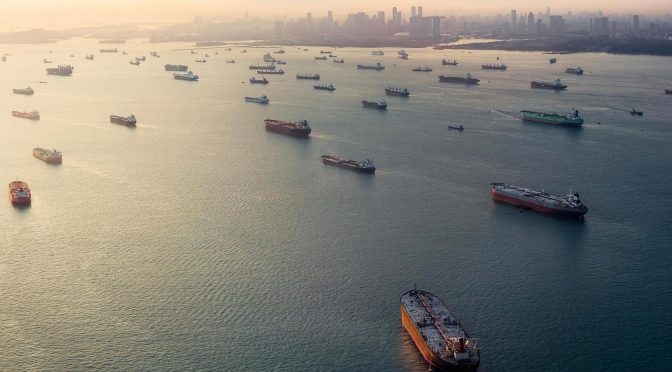
Featured Image: Ships sit idle off Singapore (Andrew Rowat\The Image Bank \Getty Images)
“Alliance does not mean love, any more than war means hate.” The words of Francis Parker Yockey accurately suggest that states build relationships with other states to advance mutual interests. The U.S.-Philippines alliance is no exception. Though the very close relationship between the two countries has experienced some hiccups recently, this article suggests that the mutual interests of both states are substantial enough to sustain cooperation between the two countries.
Forging Alliances
For the majority of American history, the lawmakers of the country were apt in following George Washington’s advice on foreign affairs: “It is our true policy to steer clear of permanent alliance with any portion of the foreign world.” As a result, for the first 165 years of its existence, the U.S. did not form any alliances with the exception of France during the revolutionary war. However, a completely different course has been taken since WWII, when the U.S. became heavily involved in global affairs. With the preeminence of transnational organizations and multi-party international treaties such as the United Nations and the North Atlantic Treaty Organization, Washington made numerous alliances. To this end, Washington’s isolationist policy was replaced by a highly inclusive and internationalist one.
However, there has been another noticeable episode in the United States’ relationships with its allies. From Europe to the Middle East and the Asia-Pacific, relationships with countries that at one point seemed politically untouchable have increasingly become vulnerable. The past few years have seen some uneasy episodes with Saudi Arabia, Israel, Turkey, the UK, and Japan. In that sense, the Philippines is only the latest chapter in the recent history of weakening partnerships.
Friend of the Philippines
The U.S.-Philippines relationship has been historically strong and is often categorized as a special relationship. It has seen its evolution from conflict to partnership to friction to re-emergence. Yet despite its unsettling history, the relationship between the two countries has been on the rise in recent years. The Enhanced Defense Cooperation Agreementbetween the Philippines and the United States signed on April 28, 2014 not only gave U.S. access to select Philippines bases, but also allowed the Philippines access to American ships and planes. In addition, the Philippines was set to gain invaluable training and assistance lessons to defend its sovereignty, which included more than $41 million – or almost 85 percent of the $49.72 million total amount this year of the Maritime Security Initiative funding for capacity-building initiatives in Southeast Asian states near the South China Sea. Philippines is also the largest recipient of U.S. assistance in Asia. The U.S. Agency for International Development (USAID) has facilitated more than $5 billion in infrastructure investments since 2013.
Though the relationship has been very close over the past few years, the election of Philippine President Rodrigo Duterte in June 2016 has instilled doubt in the future of the U.S.-Philippine alliance. In October 2016, Duterte announceda Philippines separation from the U.S. in favor of a closer relationship with China. The State Department, baffled by Duterte’s suggestion, said that it would seek an explanation of what the Philippines leader meant. This initial exchange was only the beginning of what became a series of episodes leading to an uneasy relationship between the two countries.
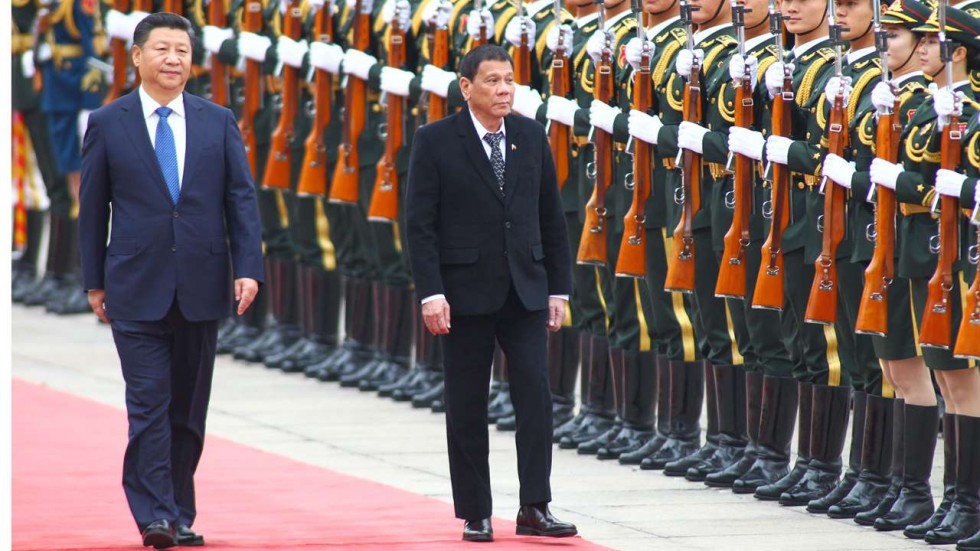
President Xi Jinping (left) pictured with Rodrigo Duterte as they inspect an honor guard in Beijing. (Photo: Simon Song)
However, despite heavy rhetoric and passionate speeches, it is unlikely that the world has seen an end to the decades-old alliance. The reason is simply that the practical advantage of such an arrangement is beneficial to both the U.S. and the Philippines, and both countries are better off in cooperation than in discord.
Enduring Interests and Ties
Though the President of the Philippines wants to exercise an “independent foreign policy,” the reality is that the country is still heavily dependent on the U.S., especially in the matter of defense. As one of the region’s weakest militaries, the Armed Forces of the Philippines (AFP) rely significantly on the U.S. to address its security challenges, including tension in the South China Sea, terrorism, and natural disasters. Even domestically, the AFP will not look too favorably upon an isolationist policy towards Washington. The military plays an instrumental role in the security of the country and is vital for peace processes with communist rebels and insurgent groups. Duterte would not go far in achieving his objectives unless the basic security condition is met. For that, he is much better off having the U.S. on his side.
A fundamental question remains unanswered by Duterte or his aides: which country would the Philippines turn to for help if it chooses to end its bond with Washington? Granted, there have been some talks with China and Russia, but it is unlikely either of the two countries will be able to fill a void as big as the U.S. Dependence on China would be problematic for the Philippines due to the disputed territorial claims, especially when China’s ambitions over the South China Sea have been described as the biggest threat to Philippines sovereignty. Moreover, the early proposals of buying equipment from China and Russia have already seen some pushback in the defense circles both privately and publicly.
Practically speaking, even if there is a genuine desire to escape any relations with the U.S., the wise policy would be to incrementally remove its dependence on Washington instead of revolutionary-style revisionism. This would allow the Philippines some time to become more self-sustaining as well as to forge alliances with other countries. However, such an arrangement may take several years for Manila and can certainly not be achieved in the six-year term of Duterte.
There is already elite and bureaucratic resistance to Duterte. For instance, the Defense secretary, Delfin Lorenzana, has voiced clear support for the U.S. mutual defense treaty. Moreover, separation from the U.S. is also going against the local public, which has long been heavily in favor of the U.S. According to the Pew Research Center, 92 percent of respondents in the Philippines said they had a favorable view of the United States. In comparison, only 54 percent said they regarded China favorably.
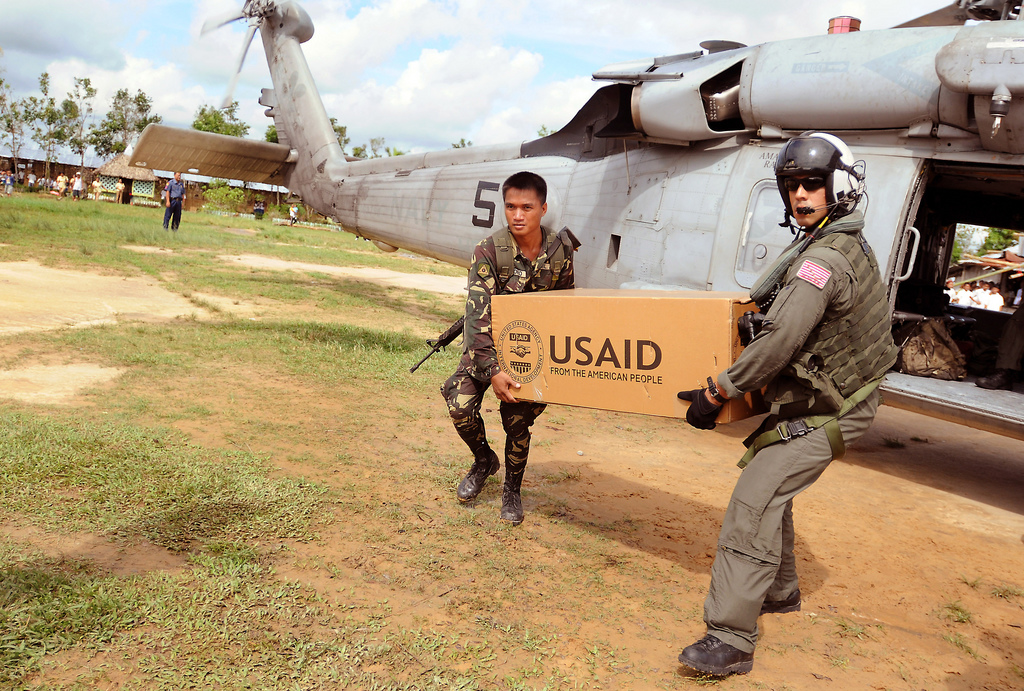
Petty Officer 2nd Class Anthony Chavez, a native of San Bernardino, Calif., works with a soldier from the Armed forces of the Philippines to move relief supplies to a school on the Panay Island in the wake of Typhoon Fengshen. (U.S. Navy photo by Senior Chief Mass Communication Specialist Spike Call)
Economically, Japan, a strong American ally, is the largest trading partner of Philippines followed by China, the U.S., and Singapore. The Philippines exports 42.7 percent of all its exports to the U.S., Japan, and Singapore, compared to only 10.5 percent to China. The Philippines imports 16.1 percent of its total imports from China, while almost all the remaining imports are from the U.S. and its allies.
These realities have at least in part been recognized by Duterte. For instance, though he initially called for the withdrawal of U.S. troops from the nation’s south, he later conceded that the country would need U.S. presence for the South China Sea. His aides have also accepted that the existing treaties would also remain enact.
Conclusion
The Philippines, Southeast Asia’s oldest democracy, is an important trade and security partner for the U.S. The Philippines has grown to become one of Southeast Asia’s strongest growing economies with GDP growth of about six percent a year and trade with the U.S. at $18 billion last year. If the Philippines aligns itself with China, Washington will struggle to hold the “first island chain” in the Western Pacific that encompasses “the Japanese archipelago, the Ryukyus, Taiwan, and the Philippine archipelago.” Defending the first island chain has been an important U.S. foreign policy objective since the Cold War and Washington is unlikely to change that policy given its significance for deterrence. Freedom of navigation in the South China Sea is a contentious issue where $5.3 trillion in goods is estimated to pass through the South China sea annually, including $1.2 trillion in U.S. trade. With the Philippines no longer on its side, the U.S. Navy would find it much harder to protect important sea lanes and sustain military operations.
The U.S.-Philippines alliance may have suffered but it is certainly not dead. Both countries gain a strategic advantage by being in such a relationship. Ups and downs are a natural course for alliances and the U.S.-Philippines relationship is no exception to the rule. It is possible that some change may occur in the conduct of the relationship, but sooner or later both countries will realize it is better to remain in such an arrangement, even if they do not see eye to eye, than to stray to a path unknown.
Usman Javed holds an MPhil from the Judge Business School from the University of Cambridge. As the author of several articles, editorials, reports and media publications, he has presented his research at a number of conferences. His work experience includes working for the World Bank, consulting for a number of start-ups in the UK, Asia-Pacific, and North America and co-founding an Ed-Tech start-up.
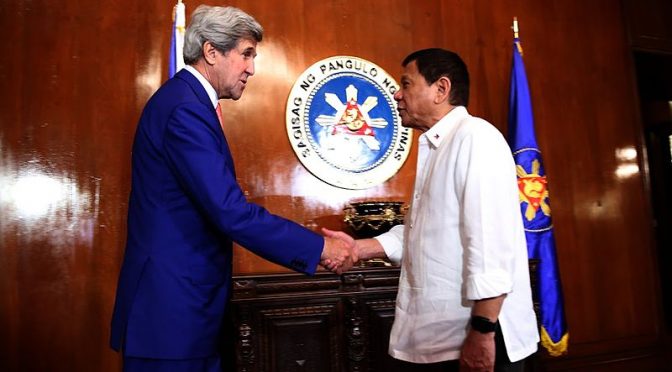
Featured Image: President Rodrigo R. Duterte meets with U.S. Secretary of State John F. Kerry during a courtesy call at Malacañan Palace on July 27, 2016. (Philippines Presidential Communications Operations Office)
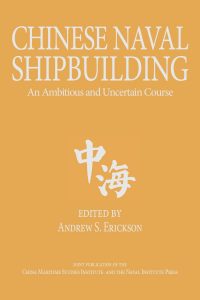
Chinese Naval Shipbuilding Capability: An Uncertain Course, adds the most recent volume to Dr. Andrew Erickson’s excellent edited collections on the increase of the People’s Republic’s military, economic, and industrial power published by the Naval Institute Press. Erickson’s credentials include a professorship in strategy at the Naval War College, a research associateship at Harvard’s Fairbank School for Chinese Studies, and a regular congressional witness on areas pertaining to Chinese capabilities and strategy. He is a giant in the field. The work combines seventeen articles written by thirty-two authors, among them storied names such as CRS naval analyst Ronald O’Rourke and former former Director of Intelligence and Information Operations (N2) for U.S. Pacific Fleet CAPT James Fanell (ret). The volume provides a nuanced and insightful view of a major Chinese strategic investment, its shipbuilding industry, and is required reading for anyone, academic or laymen, trying to understand the associated capabilities and implications of the People’s Republic’s maritime rise.
The three hundred-forty-page tome is broken into five sections, describing the PRC’s shipbuilding industry’s foundation and resources, infrastructure, approach to naval architecture and design, remaining challenges, and a section which provides strategic conclusions and predictions for the future of American naval and maritime power. The articles are easily readable, each approximately ten to fifteen pages of crisp, synthesized content, with end notes allowing readers to further explore the author’s research, although most references are translated from Mandarin Chinese. The works also feature multiple graphs, tables, and illustrations, providing further resources for students and researchers. While each article provides fascinating insights into the past, present, and future of Chinese shipbuilding, four areas of study especially stood out as enjoyable, informative, and useful.
First, Christopher P. Carlson and Jack Bianchi’s Chapter I review of the People’s Republic’s naval and maritime history from the formation of the communist state to Xi Jinping provides a concise review of the People’s Liberation Army Navy’s (PLAN) strategic development. Carlson and Bianchi first review the PLAN’s operational shift from Near Coast Defense, to Near Seas Active Defense, and finally to Near Seas Defense and Far Seas Operations, as the PLAN’s resources, capabilities, and objectives adapted to match the nation’s goals. The pair provide an excellent linkage between China’s strategic situation since Mao’s victory and the requirements of PLAN platforms as the force shifted from a coastal force to a limited blue water force and finally to a force intended to defend Chinese interests on both the near and far seas. This evolution brought an increase in the complexity and technical sophistication to the Chinese military shipbuilding industry.
Second, Leigh Ann Ragland-Luce and John Costello provide insight into a major limitation of Chinese military shipbuilding: combat electronics. Ragland-Luce and Costello point out that, while PLAN hull and mechanical systems are regularly manufactured using modern industry standards such as modular construction, the PLAN remains unable to field a top-tier indigenously developed combat control system. The authors use the Jiangkai-II (054A)-class guided missile frigate, a modern warship by any standard, whose combat control system (CCS) is based upon the French TAVITAC, vice a comparable Chinese design. This potential lack of integration between the French CCS and developing Chinese weapons and sensor systems might well prove a combat handicap for PLAN forces in future conflicts. Similarly, editor Andrew Erickson with Jonathan Ray and Robert T. Forte provide an excellent dissertation on the limitations of Chinese propulsion plant designs. According to the trio, the PLAN appears proficient in coastal diesel submarine propulsion technologies. The PLAN effectively integrates Sterling Engine Air Independent Propulsion (AIP) systems into its Yuan-class diesel-electric boats (SSPs), and it leads research into safe Lithium-Ion battery storage systems, potentially increasing coastal submarine endurance. It still lags considerably in both modern integrated surface propulsion plants and nuclear powered propulsion designs.
Third, the work uses present shipbuilding capacity to extrapolate future PLAN capability and force structure. CAPT James Fanell (ret) and Scott Cheney-Peters (Founder of CIMSEC) provide a realistic warning regarding the long-term challenge of Chinese strategic depth in military shipbuilding. Ronald O’Rourke caps the work with a set of implications for the U.S. Navy if PLAN force structure continues to expand.
Fourth, the work also provides an excellent overview of the curious public-private nature of an industry. The ten-year old split of Chinese shipbuilding into competitive public-private corporations Chinese State Shipbuilding Company (CSSC) and Chinese Industrial Shipbuilding Company (CSIC), induced formidable challenges to reintegrate as demand for commercial Chinese-built shipping demand drops and the People’s Republic attempts to cut excess overhead in its public ventures. The work also appropriately conveys the confusing and byzantine structure of the Chinese military-industrial complex, broken into multiple institutes and directorates with potentially overlapping responsibilities.
The edition could have improved by better integration between authors. Several articles re-visit the growth of PLAN naval strategy over the PRC’s history, which becomes redundant. Secondly, in some cases, it is difficult at times to compare Chinese shipbuilding structure and practices to those of other industries worldwide. Is China’s anticipated post-merger structure in line with other shipbuilding industries? The work does not, at times, draw clear comparisons.
Overall, Chinese Naval Shipbuilding provides a very useful window into an area of intense Communist Party strategic investment. The work gives the reader an excellent overview of the industry as a whole, overlapped with strategic context and geopolitical implications. As discussed, the volume also provides a unique look at the industry’s challenges, including increased engineering costs, poor integration with modern combat systems, and challenges in surface ship engineering plants and nuclear propulsion technologies. Nuanced and complex, it describes both the accomplishments of an industry that now leads the world in commercial tonnage produced, but also lags behind in critical areas mastered by much smaller and less-rich nations. Erickson’s volume is a worthy addition to his series and an enjoyable read.
Read CIMSEC’s interview with editor Dr. Andrew Erickson on this book here.
Michael DeBoer is a U.S. naval officer. The views herein are his alone and do not represent the views of the Department of Defense, the Department of the Navy, or any other organization.
Featured Image: China’s first indigenously produced aircraft carrier CV-17/001A under construction at Dalian shipyard. (CJDBY.net)