This article originally featured at the Pathfinder Foundation and is republished with permission. Read it in its original form here.
By Bernard Goonetilleke, Chairman & Admiral Dr. Jayanath Colombage, Director Centre for India -Sri Lanka Initiatives of the Pathfinder Foundation
Introduction: Fish do not respect boundaries but humans should!
India and Sri Lanka are two neighboring Indian Ocean states. A shallow and narrow strip of sea called the ‘Palk Bay’ and the ‘Gulf of Mannar’ separates the two countries. There is a clearly demarcated, mutually agreed upon and legally binding International Maritime Boundary Line (IMBL), separating the territorial waters of the two countries. There are binding commonalities in the form of linguistic, cultural, religious and vocational, between Tamil Nadu and the Northern Province of Sri Lanka. Until the signing of IMBL agreements in 1974 and 1976, fishermen from coastal districts of both countries used this sea, mainly for traditional fishing. There was a harmonious coexistence between these communities for a long time. However, Tamil Nadu fishermen changed their fishing methods in the late 1970s and upgraded to steel hulled fishing vessels and engaged in bottom-trawling in order to boost production. Continuous bottom trawling on the Indian side of the IMBL resulted in depleting fish stocks therein. Gradually, these trawlers began to cross over to the Sri Lankan side of the IMBL. The newly introduced Indian trawlers were much bigger and more powerful than traditional craft, as they had to trawl and recover nets heavy with the catch. The fishermen of northern Sri Lanka found it extremely difficult to venture in to the sea during the days when Indian trawlers were poaching, as they feared damage to their boats and fishing gear, as well as safety for their lives.
During the time of the conflict, the Sri Lankan government was compelled to restrict fishing by local fishermen in the north and the east due to security concerns. However, the Indian trawlers continued to bottom trawl in Sri Lankan waters regardless, at times coming 2-3 nautical miles off the Sri Lankan coast. This situation was effectively exploited by the Liberation Tigers of Tamil Eelam (LTTE), who used Indian trawlers to ferry their cadres, fuel, explosives; mainly from the southern Indian coast to northern, north-western and north-eastern coasts of Sri Lanka. However, the number of Indian trawlers operating in Sri Lankan waters was relatively less during this period, as they feared misidentification as LTTE agents by the Sri Lanka Navy. With the end of the conflict in Sri Lanka, and the gradual resettlement of displaced personnel, local fishermen wished to recommence their livelihood activities and what they encountered was a large hostile Tamil Nadu trawler fleet plundering their resources. With the fishery conflict gaining a new significance, both governments continued discussions at various levels to find an amicable long lasting solution. However, to-date, there has been no solution or even a common agreement of the issues affecting fishermen from both countries.
Legal Implications and Illegal, Unreported, Unregulated (IUU) Fishing
According to the United Nations Food and Agriculture Organization (FAO), International Plan of Action to Prevent, Deter and Eliminate Illegal, Unreported and Unregulated fishing (FAO, 2001):
Illegal fishing refers to activities: Conducted by national or foreign vessels in waters under the jurisdiction of a State, without the permission of that State, or in contravention of its laws and regulations;
Unreported fishing refers to fishing activities: Which have not been reported, or have been misreported, to the relevant national authority, in contravention of national laws and regulations; or
Unregulated fishing refers to fishing activities: In areas or for fish stocks in relation to which there are no applicable conservation or management measures and where such fishing activities are conducted in a manner inconsistent with State responsibilities for the conservation of living marine resources under international law.
From the above definition, it can be seen that Indian fishermen engage in IUU fishing in every aspect and they are clearly violating the UNCLOS, which permits only the right to innocent passage in another state’s territorial waters. According to Gunasekera (2016), “Article 19.2 (i) of the UNCLOS makes proviso for any ‘fishing activities’ by foreign vessels to be regarded as an act of prejudice towards peace, good order or security of the coastal state, thereby confirming that such passage is not innocent.” Further, Tamil Nadu fishermen do not declare the catch and location, and carry out their activities in contravention of state responsibility to conservation of living marine resources by engaging in destructive bottom trawling.
The United Nations Development Summit in September 2015, adopted UN Resolution 70/1, “Transforming our world: The 2030 Agenda for Sustainable Development.” The basis for this resolution was the understanding that global resources in the oceans should be carefully managed for a sustainable future, as the oceans are key in making the earth habitable for humankind. The main objective of Goal 14 of this agenda, ‘Life Below Water’ is to “conserve and sustainably use oceans, seas and marine resources for sustainable development” (UN, 2015).
The spirit of this resolution is clearly applicable to the Indo-Sri Lanka fishery conflict. The UN has set a target year as 2020 to end IUU fishing. The UN resolution also talks about conservation and sustainable use of oceans as per international law as reflected in UNCLOS, and encouraging sustainable artisan fishing. India and Sri Lanka being member states of the UN committed to sustainable development and should abide by this resolution.
Sovereignty of Kachchativu Island
The two governments concluded two IMBL agreements with a view to maintaining cordial relations. They could be termed as landmark agreements, which came into force even before the UNCLOS. Tamil Nadu maintains that the island of Kachchativu was ‘ceded’ to Sri Lanka by the 1974 agreement without the consent of the state, for which it has sought legal remedy. However, the central government maintains that these two agreements are binding. As per Gunasekera (2016), “By virtue of the Agreement entered between the two countries in 1974 regarding the boundary in historic waters between the two countries and related issues, the delimitation process has taken place on grounds of fairness and equity more than the application of the principle of ‘equidistance’ though the final outcome justified the latter.” Hence, sovereignty and exclusive jurisdiction of Kachchativu clearly falls under Sri Lanka. Based on historical facts, the Government of Sri Lanka has maintained that the island was administered by then Ceylon and has been under its jurisdiction even during the time of the Portuguese and later the British. There is evidence to suggest that Surveyor of the Government of India treated the island as part of then Ceylon, as far back as 1876 (Ministry of Foreign Affairs, Sri Lanka, 2008).
Tamil Nadu has consistently maintained that the main issue for this conflict is the ceding of this uninhabited island to Sri Lanka. However, the fact of the matter is that Kachchativu was never ‘ceded’ by India. Instead, India recognized that the island belonged to Sri Lanka. The island of Kachchativu is closer to the landmass of Sri Lanka by one nautical mile than that of India. Tamil Nadu politicians also accuse that the Sri Lankan Navy and Coast Guard harass Tamil Nadu fishermen, who accidentally drift across the IMBL closer to Kachchativu. However, the Indian Coast Guard, filing an affidavit in Chennai High Court, stated that the Indian fishermen are crossing IMBL into Sri Lankan waters for better fish catch as fishery resources are depleted on the Indian side of the IMBL. They also used banned methods of fishing and the Sri Lanka Navy does not cross the IMBL to the Indian side (Indian Coast Guard, 2015). No further argument is necessary, as this statement has come from the most authoritative source in India, which is tasked with the responsibility to guard the IMBL and Indian territorial waters. This affidavit also nullifies the claim often made by Indian fishermen that the Sri Lanka Navy is harassing them, when they are fishing in the Indian waters.
Whenever the Sri Lankan side detains fishermen and their boats engaged in poaching, Tamil Nadu political leaders blame New Delhi for ceding Kachchativu to Sri Lanka, as if that was the core of the dispute. Is Kachchativu Island the real issue in this conflict? Do fishermen from South India accidentally drift across the IMBL in to Sri Lankan side? Do they engage in illegal trawling only around Kachchativu?
The Tamil Nadu fishermen are experts in navigation and know their position well. Besides, most of these trawlers are now fitted with Global Positioning Systems (GPS). However, it has to be highlighted that Indian fishermen are not fishing only around Kachchativu island but come 2-3 nautical miles from the coastal city of Pesali in Mannar island, which is, in fact, 17.5 nautical miles from the IMBL and South West of the Delft island, which is about 11.5 nautical miles from the IMBL (Admiralty Chart, 1987). These two locations are long distances away from the IMBL and Kachchativu and deep inside Sri Lankan territorial waters. Therefore, it can be convincingly concluded that the issue of Kachchativu is only a cover to justify destructive fishing being carried out by Indian trawlers well within Sri Lankan territorial waters to sustain the multimillion-dollar prawn export industry. There are allegations of double standards adopted by the European Union on this clear case of IUU fishing. Although the EU has stated that it is ‘working to close the loopholes that allow illegal operators in the fisheries sector to profit from their activities,’ it has not taken any action to ban export of illegally caught prawns to its member states by India. However, the EU was quick to ban fish exports from Sri Lanka over allegations of IUU fishing though the ban is now removed (Wijedasa, 2015). Of late, northern fishermen have begun to fault the Sri Lanka government for not taking the matter with the EU forcefully.
Fishermen’s Livelihood Issue
Quite often the state of Tamil Nadu argues that their ‘poor fishermen’ are suffering due to enforcement measures undertaken by the Sri Lankan government. However, it is noteworthy that almost all persons, who are engaged in bottom trawling, are contracted employees. It is alleged that the trawlers are actually owned by large-scale businessmen, who are often close to the political elite of the state. Suryanarayan highlights this fact by saying “quick returns from prawns attracted many from non-fishing communities to invest in this profitable venture. As a result, numerous fishermen became daily wage labourers” (2016). A measure of this fact can also be seen from the increased number of trawlers in the three South Indian districts of the Palk Bay (Thanjavur, Pudukkottai and Rameshwaram), from 1568 in 1986 to 3339 in 2000 (Suryanarayan, 2016). All these trawlers engage in bottom trawling in Sri Lanka waters. Prawns have become a multimillion-dollar industry; mainly for exporting to the USA, Japan and Western Europe.
However, when the Sri Lankan authorities arrest a minute percentage of these trawlers for poaching in its territorial waters, and subject offenders to judicial processes, there are huge protests in Tamil Nadu and letters are written to the central government demanding intervention. In order to maintain goodwill between the two neighbors, the government of Sri Lanka releases offenders and their boats are handed over to the Indian Coast Guard at the IMBL at regular intervals. This procedure has become a routine occurrence and is not an effective deterrent at all as they return to engage in poaching no sooner they are released. Enforcement measures such as burning or blowing up captured fishing vessels as being practiced by Australia and Indonesia, are not implemented so as not to adversely affect bilateral relations with India when they capture vessels engaged in IUU fishing in their territorial waters. However, a step in the right direction is that due to severity of poaching, Sri Lanka has refused the demand made at the November negotiations in New Delhi for the release of hundreds of boats it has seized.
Traditional and Human Security Implications
During its heydays, LTTE employed Indian fishing trawlers either seized or hired, to transport war-fighting materials and their cadres, initially between the two coasts and at latter stages to carry out ship to shore transfers. Such activity posed a serious security threat, as the LTTE was able to engage in near-conventional battles using long range artillery and mortar pieces. The conflict ended in May 2009 with the defeat of the LTTE. Although there has not been a resurgence of the organization, there were several attempts by certain segments of the Tamil Diaspora to revive hostilities in Sri Lanka. Against such a backdrop, large number of Indian fishing trawlers coming very close to Sri Lankan coast on a regular basis could lead to serious security implications, should the LTTE decide to revive their violent organization. Further, frequent smuggling of narcotic drugs into Sri Lanka from South India are using Indian trawlers to carry out this illegal trade.
The northern Sri Lankan fishermen engage in most sustainable methods of fishing, employing traditional artisanal methods. They do not operate multi-day fishing vessels, unlike their southern counterparts. They use small boats and venture in to the ocean for short periods, usually not more than 24 hours.
However, large steel hulled Indian trawlers practice bottom trawling, which is considered as one of the most destructive methods of fishing. Bottom trawlers are called “hoovers of the ocean” and “bulldozers mowing down fish and other benthic species” (Suryanarayan, 2016). If this bulldozing of the Sri Lanka Ocean is continued, soon there will be hardly any fish to catch. Bottom trawling scrapes the sea bed, disturbs the marine environment, damages age old corals, affect the growth of planktons and finally affect the reef fish, prawns and other types on benthic marine species, which could result in ‘habitat degradation.’ The majority of the northern coastal population of Sri Lanka depends on fishing or fishery related industry. That is the only livelihood activity they have ever known. If that source of livelihood is destroyed, there will be huge economic, social and political consequences affecting human security.
Progress of High level and Fishermen level Discussions
Traditionally, the Indian side had made it a practice to demand that representatives of fishermen from the two countries should meet and discuss all issues relating to the dispute, to which Sri Lankan authorities seem to agree, despite the fact the issue required negotiation between the two governments and not between offenders and victims. Recently however, representatives of Sri Lankan fishermen have been firm against the systematic exploitation of fisheries resources by their Indian counterparts. During the most recent encounter in New Delhi on November 2, 2016, after a gap of nearly one and half years, Sri Lankan fishermen refused to agree to the demand made by their Tamil Nadu counterparts to fish in Sri Lankan waters for 83 days in a year for three consecutive years as a grace period before they switch into deep sea fishing as an alternative way out of the Indo-Lanka poaching issue (Sunday Times, November 13, 2016).
The Sri Lankan fishermen have been adamant that they would not agree to continuation of illegal poaching and bottom trawling in their waters and had insisted that Tamil Nadu fishermen should stop engaging in such activity forthwith. The Sri Lankan fishermen also demanded compensation for the losses incurred due to poaching and bottom trawling, prior to moving ahead of further talks (The Hindu, 2016). Further, they had pointed out that Tamil Nadu fishermen were engaged in IUU fishing, and threatened to take the matter up in international forums to bring pressure against the illegal activities practiced by them for decades. The stand taken by the Sri Lankan fishermen, who are the victims of IUU fishing, is genuine as it is their livelihood at stake. It is the responsibility of the Indian government to adopt measures to address the livelihood issue of its citizens and, allocate adequate resources help them in their transition from bottom trawling to deep-sea fishing.
Aftermath of the inconclusive fishermen’s talks, the Sri Lankan Foreign Minister and Aquatic Resources Development Minister met with Indian External Affairs Minister and Minister of Agriculture and Farmers’ Welfare, to discuss possible measures to find solutions to the fishery conflict (Lanka Business Online, 2016). This is the first time the two foreign ministers actively participated in fishery talks, which is a clear indication of the commitment of both governments to find a lasting solution. Whilst the details of the discussions are not published, it is reported that they agreed to set up a Joint Working Group (JWG) on Fisheries to meet every three months and a meeting between Ministers of Fisheries every six months. The first Ministerial Meeting was held on January 2, 2017 in Colombo.
Among the several issues to be taken up by the JWG are for “expediting the transition towards ending the practice of bottom trawling at the earliest,” which patently lacks a time bound commitment. Other tasks of the JWG would be to work out modalities for Standard Operating Procedures for handing over apprehended fishermen and ascertain possibilities of cooperation on joint patrolling (Lanka Business Online, 2016).
Conclusion and The Way Forward
Diplomatic initiatives, JWGs and fishermen to fishermen talks have not seen the desired results for the last several decades. There is no common understanding between the two sides, one driven by profits and greed, and the other by poverty and desolateness. Whilst the Sri Lanka side maintains that poaching and bottom trawling by Indian trawlers should not be permitted, the Indian side is demanding licensing, limiting the number of trawlers and days, thereby not harming their fishermen in Sri Lankan waters.
The law enforcement authorities on both sides of the IMBL are forced to restrain themselves due to political pressure wielded by Tamil Nadu business interests. The hostile attitude of Tamil Nadu towards Sri Lanka mainly rests around this dispute, which could result in adversely affecting the excellent bi-lateral relations between the two countries. The solution to the problem is not to permit Tamil Nadu business interests to profit from their illegal activities. Unless a firm position is taken by Sri Lanka with regard to violation of its territorial waters, engaging in illegal bottom trawling by way of stepped up arrests and non-return of fishing vessels may continue. It is clear that poaching in the Palk Bay area and the Gulf of Mannar would continue for some time, while the marine environment is systematically destroyed to a point of no return. However, the ongoing dispute should not result in physical harm to the Tamil Nadu fishermen, due to the failure of authorities concerned to address the dispute in a timely manner.
Both sides should accede that this is a livelihood issue affecting thousands of families on both sides of the divide. It has also to be recognized that taking care of livelihood issues of citizens is a responsibility of the respective governments, who should find solutions to issues affecting bilateral relations without resorting to prevarication. As Suriyanarayanan points out, there are some positive measures being undertaken by the state of Tamil Nadu. There is a planned buy-back arrangement of trawlers, provide alternative livelihood for fishermen engaged in trawling and to construct tuna long liners. Through incentives and persuasion, affected fishermen could be encouraged to switch over to deep sea fishing in the Indian EEZ and international waters or engage in other vocations. However, sincerity, effectiveness and timely implementation of these measures are yet to be ascertained (Suryanarayan, 2016).
Sri Lanka’s concern is whether the fragile marine ecosystem in the Palk Bay would survive until these measures are implemented effectively. There is a need for Sri Lanka to embark on scientific research on the subject area to ascertain the real damage caused by bottom trawling and the resultant impact on the fisheries in the Palk Bay in order to gather sufficient data from primary and secondary sources, make an assessment of the cost of annual losses due to poaching, and be ready to present a incontrovertible case to India. A research station in the island of Kachchativu manned by the National Aquatic Resources Research & Development Agency (NARA) personnel could be entrusted with this task. A joint mechanism for investigation of alleged offences and joint patrolling by both countries merits consideration. If all efforts fail in finding an amicable solution, the government of Sri Lanka should be ready to refer the dispute to the appropriate international authorities on the strength of UN resolution 70/1, Goal 14: ‘to conserve and sustainably use oceans and marine resources for sustainable development.’
References
Admiralty Chart Number 1584- Trincomalee to Point Calimere (2010)
Indian Coast Guard (2015) Indian Fishermen Indulge in illegal acts in Lankan Waters. Available at: [LINK=http://www.dnaindia.com/india/report-indian-fishermen-indulge-in-illegal-acts-in-lankan-waters-says-coast-guard-2081178.]http://www.dnaindia.com/india/report-indian-fishermen-indulge-in-illegal-acts-in-lankan-waters-says-coast-guard-2081178.[/LINK] \[Accessed: 24th Sep 2016]
Lanka Business Online (2016). Indo-Sri Lanka have held ministerial level talks to find solutions to fishermen’s issues. 07 Nov 2016. Available at: [LINK=http://www.lankabusinessonline.com/india-sri-lanka-hold-ministerial-talks-on-fishermen/]http://www.lankabusinessonline.com/india-sri-lanka-hold-ministerial-talks-on-fishermen/[/LINK] \[Accessed: 9 Nov 2016]
Suryanarayan, V. (2016) The India Sri Lanka Fisheries Dispute: Creating a Win-Win in the Palk Bay. Available at: [LINK=http://carnegieendowment.org/2016/09/09/india-sri-lanka-fisheries-dispute-creating-win-win-in-palk-bay-pub-64538]http://carnegieendowment.org/2016/09/09/india-sri-lanka-fisheries-dispute-creating-win-win-in-palk-bay-pub-64538[/LINK] \[Accessed: 25th Sep 2016]
Sustainable Development Goals: 17 goals to transform our world. UN Available at: [LINK=http://www.un.org/sustainabledevelopment/oceans/]http://www.un.org/sustainabledevelopment/oceans/[/LINK] \[Accessed: 24th Sep 2016]
The Hindu (2016). Indo-Sri Lanka Fishermen talks end in Stalemate, The Hindu, 02 Nov 2016. Available at: [LINK=http://www.thehindu.com/news/national/indosri-lanka-fishermen-talks-end-in-stalemate/article9296510.ece]http://www.thehindu.com/news/national/indosri-lanka-fishermen-talks-end-in-stalemate/article9296510.ece[/LINK] \[Accessed: 10th Nov 2016]
The Maritime Border Between Sri Lanka and India Stand Settled, (2008). Ministry of Foreign Affairs, Sri Lanka. Available at: [LINK=http://www.mfa.gov.lk/index.php/en/component/content/1396?task=view]http://www.mfa.gov.lk/index.php/en/component/content/1396?task=view[/LINK] \[Accessed:25th Sep 2016]
Saikia, J. and Stepanova, E. (2009) Terrorism: Patterns of Internationalization. SAGE publications, New Delhi
Wijedasa, N. (2015) Politics bedevils solution to Palk bay Poaching, Sunday Times, 20th Dec 2015, Available at: [LINK=http://www.sundaytimes.lk/151220/news/politics-bedevils-solution-to-palk-bay-poaching-176067.html]http://www.sundaytimes.lk/151220/news/politics-bedevils-solution-to-palk-bay-poaching-176067.html[/LINK] Accessed: 25th Sep 2016
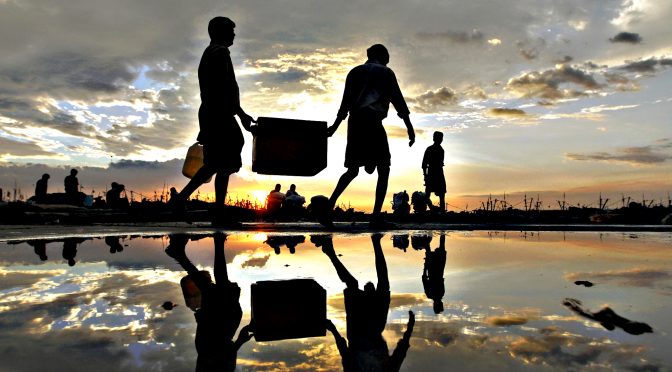
Featured Image: Fishermen carry a box filled with fishes at a fishing harbor in the southern Indian city of Chennai. (Babu/Reuters)