Category Archives: Future Tech

What is coming down the pipe in naval and maritime technology?

Unmanned Naval Helicopters Take Off in 2013

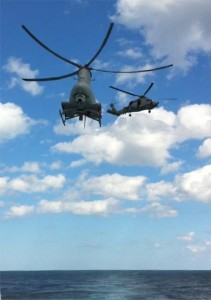
Manned (SH-60B) and unmanned (MQ-8B) helicopters working together on USS Halyburton (FFG 40)

The carrier take-off and arrested landings of the U.S. Navy’s X-47B demonstrator have garnered significant press attention this year.  Less noticed however, is the rapid development of rotary-wing unmanned aerial vehicles in the world’s navies.  Recent operational successes of Northrop Grumman’s MQ-8B Fire Scout aboard U.S. Navy frigates have led to many countries recognizing the value of vertical take-off and landing UAVs for maritime use.

International navies see the versatility and cost savings that unmanned rotary wing platforms can bring to maritime operations.  Like their manned counter-parts, these UAVs conduct a variety of missions including intelligence, surveillance, and reconnaissance (ISR); cargo resupply/vertical replenishment; and in some future conflict will perform armed interdiction at sea.  However, unlike the two- or three-hour endurance of manned helicopter missions, some of these UAVs can fly 12-hour sorties or longer.  Other benefits include the ability for some models to land on smaller decks than manned aircraft, a much lower cost per flying hour, and importantly, limited risk to human aviators.  Several international VTOL UAV projects have been recently unveiled or are under development, many of them based on proven light manned helicopter designs.  Starting with a known helicopter design reduces cost and technical risks and allows navies to pilot the aircraft in no-fail situations involving human passengers such as medical evacuations.

Poland has two designs in the works, the optionally manned SW-4 SOLO and the smaller composite ILX-27, which will carry up to 300 kg in external armament.  In July, the Spanish Navy announced  a contract with Saab to deploy the Skeldar V-200 unmanned air system aboard its ships for counter-piracy operations in the Indian Ocean.

Russia’s Berkut Aero design bureau, in collaboration with the United Arab Emirate’s Adcom Systems have announced plans to develop an unmanned combat air vehicle (UCAV) based on Russia’s two-seat coaxial Berkut VL helicopter.

One of Schiebel’s rapidly proliferating S-100s mysteriously crashed in al-Shabaab-held Southern Somalia earlier this year, but in a successful turn-around, Camcopter S-100 conducted at-sea trials with a Russian Icebreaker in the Arctic later this summer.

Back on the American front, in July, Northrop Grumman delivered the Navy’s first improved MQ-8C, a platform largely driven by U.S. Special Operations Command’s requirements for a longer endurance ship-launched aircraft capable of carrying heavier payloads including armament.  The Marine Corps’ operational experimentation in Afghanistan with two of Lockheed Martin/Kaman’s K-MAX unmanned cargo-resupply helicopters from 2011 until earlier this year was largely successful, but suspended in June when one of the aircraft crashed while delivering supplies to Camp Leatherneck in autonomous mode.  Because of this setback, Lockheed has improved K-MAX’s autonomous capabilities, and added a high-definition video feed to provide the operator greater situational awareness.  Kaman has also begun to market the aircraft to foreign buyers.  Finally, a Navy Research Laboratory platform, the SA-400 Jackal, took its first flight this summer.

There are minimal barriers to VTOL UAVs wider introduction into the world’s naval fleets over the next few years.  How much longer will it take for their numbers to exceed manned helicopters at sea?

This article was re-posted by permission from, and appeared in its original form at NavalDrones.com.

A Post-Sequestration Blueprint for a Leaner and Smarter Military

Five months after the much-dreaded sequestration went into effect, many defense analysts and military officials alike are worried about the negative repercussions of the drastic budget cuts on military readiness. In his latest commentary, the rightwing commentator Alan Caruba declared that “The U.S. military is on life support.” Defense Secretary Chuck Hagel also argued in his Statement on Strategic Choices and Management Review (SCMR) that “sequester-level cuts would ‘break’ some parts of the strategy, no matter how the cuts were made [since] our military options and flexibility will be severely constrained.”

Secretary of Defense Chuck Hagel answers reporters' questions during a Pentagon press briefing on the recent Strategic Choices. Navy Adm. James A. Winnefeld Jr., right, vice chairman of the Joint Chiefs of Staff, joined Hagel for the briefing. (DOD photo by Glenn Fawcett)
Secretary of Defense Chuck Hagel answers reporters’ questions during a Pentagon press briefing on the recent Strategic Choices. Navy Adm. James A. Winnefeld Jr., right, vice chairman of the Joint Chiefs of Staff, joined Hagel for the briefing. (DOD photo by Glenn Fawcett)

To its credit, the SCMR seemed to hint at operational and structural adjustments underway by offering two options—trading “size for high-end capacity” versus trading modernization plans “for a larger force better able to project power.” Nevertheless, one important question which went unasked was whether or not the US Armed Forces alone should continue to play GloboCop.

The current geostrategic environment has become fluid and fraught with uncertainties. As Zhang Yunan avers, China as a “moderate revisionist” will not likely replace the United States as the undisputed global champion due to myriad factors. As for the United States, in the aftermath of a decade-long war on terror and the ongoing recession, we can no longer say with certainty that the United States will still retain its unipolar hegemony in the years or decades to come.

That said, Secretary Hagel is correct that the United States military may need to become leaner in the face of harsh fiscal realities. To this must be added another imperative: The US Armed Forces must fight smarter and must do so in ways that may further America’s strategic and commercial interests abroad.

So how can the United States military fight smarter and leaner?

COCOMs
Possible Combatant Command Realignments

First, given massive troop reductions whereby the Army personnel may be reduced to 380,000 and the Marine Corps “would bottom out at 150,000,” while at the same, the DoD is seriously considering restructuring existing Combatant Commands (COCOMs), it no longer makes sense to deploy or train troops for protracted counterinsurgency campaigns or foreign occupations. Instead, should another transnational terrorist group or a rogue state threaten homeland security, the United States could rely on SOF (Special Operations Forces) commandos and UAV (Unmanned Aerial Vehicles) to selectively target and neutralize potential threats. While the SOF and UAV surgical raids should not be viewed as substitutes for deft diplomacy, they can provide cheaper and selective power projection capabilities.

Second, since the United States Navy may be forced to “reduce the number of carrier strike groups from 11 to 8 or 9,” it can meet its power projection needs by encouraging cooperation among its sister navies and by bolstering their naval might. One example of such partnerships would be to form a combined fleet whereby America’s sister navies “may share their unique resources and cultures to develop flexible responses against future threats” posed by our adversaries.

Third, the United States may encounter more asymmetric threats in the form of cyber attacks, CBRN (Chemical, Biological, Radiation, Nuclear) attacks, and may also be subjected to attacks from within by homegrown terrorists and drug cartels—all of which may wreak havoc and may even cripple America’s domestic infrastructures. As retired Admiral James Stavridis argues, such asymmetric attacks may stem from convergence of the global community. Such threats require that the United States take the fight to its adversaries by cooperating with its allies to “upend threat financing” and by strengthening its cyber capabilities.

Fourth, where rogue states such as Iran, Syria and North Korea, are concerned, the United States could implement what General James Mattis refers to as the “proxy strategy.” Under this arrangement, while “America’s general visibility would decline,” its allies and proxies would police the trouble spots on its behalf.

Fifth, the United States must be prepared to defend homeland against potential missile attacks from afar. The United States may be vulnerable to hostile aggressions from afar following North Korea’s successful testing of its long-range rocket last December and Iran’s improved missile capabilities. Thus, improving its missile defense system will allow greater flexibility in America’s strategic responses both at home and abroad.

Last but not least, the United States Armed Forces needs to produce within its ranks officers who are quick to grasp and adapt to fluid geostrategic environments. One solution, as Thomas E. Ricks proposes, would be to resort to a wholesale firing of incompetent generals and admirals. However, it should be noted that rather than addressing the problem, such dismissals would ultimately breed resentment towards not only the senior brass but civilian overseers, which will no doubt exacerbate civil-military relations that has already soured to a considerable degree. Instead, a better alternative would be reform America’s officer training systems so that they may produce commanders who possess not only professional depth but breadth needed to adapt to fluid tactical, operational, and strategic tempos.

ohmanmarchjpg-4e06c3b3e4dd8566
“The US Military Establishment’s Greatest Foes” By Jack Ohman/Tribune Media Services

Despite the hysteric outcries from the service chiefs and many defense analysts, in the end, the sequestration may not be as dire as it sounds. In fact, Gordon Adams argues that after several years of reductions, “the defense budget…creeps upward about half a percentage point every year from FY (Fiscal Year) 2015 to FY 2021.” Simply stated, one way or the other, the US Armed Forces may eventually get what it asks for–as it always has been the case. Nonetheless, the sequestration “ordeal”—if we should call it as such—offers the US military object lessons on frugality and flexibility. Indeed, American generals and admirals would do well to listen to General Mattis who recently admonished them to “stop sucking their thumbs and whining about sequestration, telling the world we’re weak,” and get on with the program.

Note: This article was originally published in its original form in the Naval Institute’s blog and was cross-posted by permission.

Jeong Lee is a freelance writer and is also a Contributing Analyst for Wikistrat’s Asia-Pacific Desk. Lee’s writings on US defense and foreign policy issues and inter-Korean affairs have appeared on various online publications including East Asia Forum, the Georgetown Journal of International Affairs, the World Outline and CIMSEC’s NextWar blog.

Supply Bots

If you haven’t spent much time aboard a naval vessel, the Supply Department is the part of the ship charged with managing spare parts and ordering more. The Supply Department’s spaces also have a strange tendency to be the first fitted out with the nicest kit and upgrades. So it wouldn’t shock me to one day stroll in and find something like this:

A voice-activated storage unit with to help keep track of thousands of parts:

According to Danh Trinh, creator of the StorageBot:

The hardest parts to find were always those rare miscellaneous parts that were thrown somewhere into a “junk” bin. StorageBot solves the location problem by listening to my voice commands, processing the location of parts from a master database and then delivering the matching bins in a manner that only a robot can do!

Of course all the normal disclaimers bear stating: the system would need to be ruggedized, would likely have sea state restrictions, and each user would need to set up their voice recognition. Then again there’s the question of whether such a system would be worth it, or even practical. At a COTS or DIY price of roughly $700 (according to a PopSci.com article I can no longer access) the monetary burden doesn’t appear to high, and after all, Supply could never let one of the other shipboard “shops” get their hands on this tech first.

Leading the Blind: Teaching UCAV to See

In “A Scandal in Bohemia”, Sherlock Holmes laments, “You [Watson] see, but you do not observe. The distinction is clear.” Such is the current lament of America’s fleet of UCAVs, UGV’s, and other assorted U_V’s: they have neither concept nor recognition of the world around them. To pass from remote drones living on the edges of combat to automated systems at the front, drones must cross the Rubicon of recognition.

To See

Still can't see a thing.
Help!

The UCAV is the best place to start, as the skies are the cleanest canvas upon which drones could cast their prying eyes. As with any surveillance system, the best ones are multi-faceted. Humans use their five senses and a good portion of deduction.  Touch is a bit too close for UCAV, smell and hearing would be both useless and uncomfortable at high speed, and taste would be awkward. Without that creative deductive spark, drones will need a bit more than a Mk 1 Eyeball. Along with radar, good examples for how a drone might literally “see” besides a basic radar picture are the likes of the layered optics of the ENVG (Enhanced Night Vision) or the RLS (Artillery Rocket Launch Spotter).

Operators for typical optical systems switch between different modes to understand a picture. A USN Mk38 Mod-2 24MM Bushmaster has a camera system with an Electro-Optical System (EOS), Forward Looking Infrared (FLIR), and a laser range-finder. While a Mod-2 operator switches between the EOS and FLIR, in the ENVG, both modes are combined to create an NVG difficult to blind. For a drone, digital combination isn’t necessary, all inputs can be perceived by a computer at one time. Optical systems can also be put on multiple locations on the UCAV to aid in creating a 3D composite of the contact being viewed. Using an array of both EOS and FLIR systems simultaneously could allow drones to “see” targets in more varied and specific aspect than the human eye.

For the deployment of these sensors, the RLS is a good example of how sensors can “pass” targets to one another. In RLS, after target data is collected amongst audio and IR sensors, flagged threats are passed to the higher-grade FLIR for further designation and potential fire control solution. A UCAV outfitted with multiple camera systems could, in coordination with radar, pass detected targets within a certain parameter “up” to better sensors. Targets viewed in wide-angle scans (such as stealth aircraft only seen) can be passed “down” to radar with further scrutiny based on bearing. UCAV must be given a suite of sensors that would not merely serve a remote human operator, but for the specific utility of the UCAV itself that could take advantage of the broad-access of computer capabilities.

And Observe

In-game models for real-life comparison.

However, this vast suite of ISR equipment still leaves a UCAV high-and-dry when it comes to target identification. Another officer suggested to me that, “for a computer to identify an air target, it has to have an infinite number of pictures of every angle and possibility.” With 3-D rendered models of desired aircraft, UCAV could have that infinite supply of pictures with varying sets of weapons and angles of light. If a UCAV can identify an aircraft’s course and speed, it would decrease that “range” of comparison to other aircraft or a missiles by orienting that contact’s shape and all comparative models along that true motion axis. Whereas programs like facial recognition software build models from front-on pictures, we have the specifications on most if not all global aircraft. Just as searching the internet for this article, typing “Leading” into the search bar eliminates all returns without the word. In the same way, a UCAV could eliminate all fighter aircraft when looking at a Boeing 747. 3-D modeled comparisons sharpened by target-angle perspective comparisons could identify an airborne contact from any angle.

A UCAV also need not positively identify every single airborne target. A UCAV could be loaded with a set of parameters as well as a database limited to those aircraft of concern in the operating area. AEGIS flags threats by speed, trajectory, and other factors; so too could a UCAV gauge its interest level in a contact based on target angle and speed in relation to the Carrier Strike Group (CSG). Further, loading every conceivable aircraft into an onboard database is as sensible as training a pilot to recognize the make and model of every commercial aircraft on the planet. A scope of parameters for “non-military” could be loaded into a UCAV along with the specific models of regional aircraft-of-interest. The end-around of strapping external weapons to commercial aircraft or using those aircraft as weapons could be defeated by the previously noted course/speed parameters, as well as a database of weapons models.

Breaking Open the Black Box

The musings of an intrigued amateur will not solve these problems; our purpose here is to break open the black box of drone operations and start thinking about our next step. We take for granted the remote connections that allow our unmanned operations abroad, but leave a hideously soft underbelly for our drones to be compromised, destroyed, or surveilled at the slightest resistance. Success isn’t as simple as building the airframe and programming it to fly. For a truly successful UCAV, autonomy must be a central goal. A whole bevy of internal processes must be mastered, in particular the ability of the UCAV to conceive and understand the world around it. The more we parse out the problem, the more ideas we may provide to those who can execute them. I’m often told that, “if they could do this, they would have done it”… but there’s always the first time.

Matt Hipple is a surface warfare officer in the U.S. Navy.  The opinions and views expressed in this post are his alone and are presented in his personal capacity.  They do not necessarily represent the views of U.S. Department of Defense or the U.S. Navy.