Category Archives: Future Tech

What is coming down the pipe in naval and maritime technology?

Game-Changers: Two Views on CNAS Disruptive Tech Report

By Scott Cheney Peters and Przemyslaw Krajewski

Game ChangersLast month, the Center for a New American Security (CNAS), a Washington, DC, think tank, released the intriguing report “Game Changers: Disruptive Technology and U.S. Defense Strategy.” The analysis contained within is a result of a series of wargames done in conjunction with the U.S. Department of Defense. What follows are two views on the value, highlights, and weaknesses in the work.

Scott:

For regular visitors to this site, a good part of Game Changers serves as a familiar retread covering technologies through to hold the most promise of upsetting the current way of war. Additive manufacturing, autonomous drones, directed energy, cyber capabilities, and human performance modification (HPM) are all evaluated for their potential to drastically affect how future militaries function and wars are fought. Admittedly we have not talked much about HPM beyond human-machine interaction, such as augmented reality devices.* If you have not had a chance to read up on these topics, the report serves as a nice primer.

As for the purpose of the work, the key argument is that the U.S. should not rest on its laurels in science and technology (S&T) investments because it has, post-WWII, relied on a qualitative over quantitative military. If the qualitative edge slips, the thinking goes, the military’s edge over potential adversaries slips. The take-away is that “technological dominance is a strategic choice.” Unfortunately, having had this dominance for some time there is an inertia-inducing temptation to believe that it will always be so, necessitating that the U.S. actively guard against a desire to rest on its laurels. The report intriguingly argues that this complacency is compounded by the fact that a technologically dominant power has less incentive to develop revolutionary tech because it would be relatively less useful than for a weaker power.

The authors sound two additional warnings. First, thanks to globalization they note it has never been easier for competitors and even non-state actors to access disruptive technology and nip at the heels of American technological dominance. It is certainly true that information-sharing advances have enabled technology diffusion. Yet some tech, even when accessible, requires a high-degree of expertise and training to be used, or requires specialized components and rare material. Nuclear weapons come to mind. Even in these cases info-sharing lowers the barriers, but it does not completely remove them.

The second point is more of a double-edged sword, and that’s how the commercial sector will drive the development of much of the innovation in these technologies. On one hand, this leaves the same tech more accessible to groups of varied motives, as noted above. On the other, it means that private investments will advance the tech that the military wants. But not all the way. In many instances the larger commercial market will prove more lucrative, leaving a gap in specifications between the commercial supply and military demand, so the authors are correct to note that the military must retain the capability to “translate key technologies from the commercial world and apply them to tomor¬row’s military challenges.” Unstated, but also important, is the ability to identify early on what those key gaps will be (certainly no easy task) so that the military can continue to exploit the latest advances. As the report later notes, the potential for a new tech to be game-changing falls within is short time-frame.

My biggest disappointment with the report was that the analytical framework for explaining what makes a new technology a game-changer was somewhat muddled. There’s a disconnect between figures, introduced-but-unexplained terms, and the text of the report. I assume that these were explained in more detail during the series of wargames, but for those without access to that background the result is a little bit confusing. It does raise some interesting points about cultural factors that can act as hindrances to tech adoption, and the broader point comes through, that even with the emergence of a revolutionary technology a series of other factors must converge to make it useful and utilized to game-changing effect in the military. But it would be interesting to learn more about the thinking behind particularly the “perspectives” and “congruence” factors.

LT Scott Cheney-Peters is a surface warfare officer in the U.S. Navy Reserve and the former editor of Surface Warfare magazine. He is the founding director of the Center for International Maritime Security and holds a master’s degree in National Security and Strategic Studies from the U.S. Naval War College. The opinions and views expressed in this post are his alone and are presented in his personal capacity. They do not necessarily represent the views of U.S. Department of Defense or the U.S. Navy.

*Full disclosure, Andrew Herr, whose work on HPM is cited is a former classmate of mine and friend, while fellow CIMSECian Matt Hipple and I had the honor of having our Proceedings article on naval applications of 3d-printing cited.

Prezymek:

The title of CNAS’ new report might more appropriately be called “Looking Beyond Technology.” Faith in technology is so strong in this document that the authors make technology the central theme of American dominance? in spite of the fact that the otherwise-excellent arguments presented show something different. The authors admit that technology by itself is not a game-changer—it needs to be applied under specific circumstances:

“The framework includes four primary areas that all must converge for a technology to be truly game changing: congruence, perspectives, societal values and organizational culture and time. The core elements of a game-changing technology are the technology itself, a concept for its use and a relevant problem.”

This raises a series of questions: Why the stress on technology and not on the concept, relevant problem, or other conditions described so well? Does a technology itself possess inherent attributes making it a game changer? If not, is it possible that ANY technology could become a game changer given the right circumstances? Or maybe the best model to use would be Aristotle’s golden mean and the interaction of a technology and a concept? To better understand the subject the authors offer some examples. One of them is Blitzkrieg:

“Blitzkrieg is a clear example of how such congruence works: integrating fast tanks, aircraft and two-way radios into an operational concept of advanced maneuver warfare obviated the largely defensive technologies of Germany’s opponents (most famously, France’s Maginot Line).”

Blitzkreig: Looking Back, Looking Forward

There is no need here to search for the game-changing technology. Tanks, airplanes, and radio were not only well known to Germany’s opponents but were invented by them. Blitzkrieg is, in fact a tactical concept and the one which wasn’t successful from the beginning so needed refinement in many exercises. Williamson Murray in his essay, “May 1940: Contingency and Fragility of the German RMA,” offers an interesting comment on this military innovation:

“For French and British officers in summer 1940, the Germans had clearly developed a revolutionary style of war. But to some German officers the secret of German success was the careful evolutionary development of concepts that had their origins in the battles of the First World War.”

Downplaying the role of concept is visible in another example in the report, that of aircraft carriers:

“The adoption of these platforms by new actors may be disruptive, or may increase competition in terms of power projection, but is not fundamentally game changing.”

I agree. It was Germany’s adoption of tanks, planes, and radio in the case of Blitzkrieg, but how they used them. But what will happen if U.S. adversaries would merge carriers with an innovative concept of operations? Would the aircraft carrier become a game changer again?

There are many technical innovations that offer U.S. qualitative advantage. During the Cold War cruise missiles, MLRS, IDF Tornado strike fighters among others offered possibility to counterbalance quantitative superiority of Warsaw Pact armies. But these were also blended together with a deep-strike concept allowing the U.S. to isolate first echelons from reinforcements, thus avoiding immediate overwhelming numbers of defenders.

Paradoxically, the report offers remedy to its own concentration on technology. In the very beginning there is a phrase, “Whether a stone or a drone, it simply becomes a tool we apply to a task.” We should never forget that technology, however useful and important, it is just a tool in the hands of a man. As the military thinks about the future, my recommendation is to empower tactics-oriented naval officers who possess a basic understanding of the implications technology brings to tactical situations. Such officers, willing to think through the tactical advantages emerging technologies could bring, offer the best chance to keep a technical advantage, if that is a pillar of strategy.

Przemek Krajewski, alias Viribus Unitis, is a blogger in Poland.  His area of interest is the broad context of purpose and structure for navies and promoting discussions on these subjects in his country.

New UUV Mothership Hits the Fleet: The Coastal Command Boat

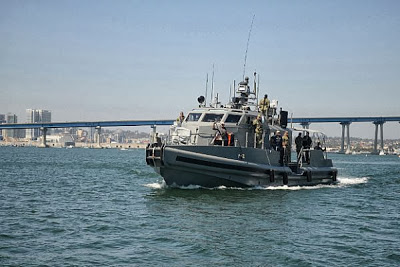
CCB3The U.S. Navy recently introduced the new 65-foot Coastal Command Boat (65PB1101, or CCB) into the fleet.  Among other maritime security missions, the CCB will test new concepts in employing unmanned underwater vehicles.  The one-of-a-kind vessel was developed following a 2008 Congressional earmark for $5 million.  After a transit from its building location in Bremerton, the SAFE Boat-manufactured CCB arrived in Coronado, California in August, where it been assigned to Coastal Riverine Group 1 (CRG-1).  The CCB is a preview of the Navy’s upcoming 85-foot Mark VI patrol boats, six of which have been planned for delivery in FY13/14.

The boat has been configured to operate the MK 18 Mod 2 Kingfish UUV for mine counter-measures operations.  Two of the 800-pound, 12-inch diameter UUVs sit in cradles on the stern of the CCB and are launched with the boat’s hydraulic crane.  The Navy is considering deploying the CCB to the Middle East for operational testing sometime in the next year.  Operating up to day-long missions from a shore base or even the well deck of a larger amphibious mothership, the CCB and MK VI PBs will deploy multiple mine-hunting UUVs. 

The Navy has also tested the man-portable SeaFox mine neutralizer from rigid-hull inflatable boats (RHIBs).  If equipped with SeaFox, the CCB and MK VI could not only find, but clear, detected mines, a capability that today is conducted with much larger dedicated mine countermeasures ships.

This article was re-posted by permission from, and appeared in its original form at NavalDrones.com.

What Can the Navy Learn from Netflix?

Or: How the Military Can Use a Content Delivery Network (CDN)
By ENS William McGough, USN

ENS William McGough will speak at the San Diego chapter of Disruptive Thinkers on Monday, September 23rd at 7pm at the Co-merge workspace.  This post was inspired by a question on the application for this year’s U.S. Chief of Naval Operations Rapid Innovation Cell (CRIC): “If you had $1 million and 18 months to change the Navy, what would you do, and how would you accomplish it?” We will be running additional innovative ideas in this series in conjunction with the CRIC’s new discussion forum “The Whiteboard.”
——————————————————————————————————————————-

NetflixWhat is a CDN?
Several years ago, leading internet companies began to encounter a problem.  As broadband internet became increasingly available, consumers’ demand for digital content likewise increased.  However, in spite of the new speed afforded by end-users’ high-speed connections, content providers found it difficult to supply their data at the high-speed rates consumers could now handle and expected.

This problem resulted from the way the internet is organized.  There is no direct connection between your computer and the server hosting the website you are accessing.  Instead, an indirect connection is established via several intermediate servers.  A similar arrangement is found in air travel, in the same way you might connect through a “hub” airport to fly to a regional airport not serviced by a direct flight.  As in the analogy, the actual travel between hubs is quite rapid, occurring at the speed of light via fiber-optic connections. However, delay occurs at the hubs in a process called switching, where incoming data is analyzed for completeness and then retransmitted along the best-calculated path to its destination.

To solve this problem, the technology industry borrowed a technique from the military: forward staging/basing.  Militaries often send soldiers and supplies to a base near an area of anticipated action (so that the troops can arrive on final station rapidly and with very little advance notice).  Similarly, technology companies began to set up geographically-distributed servers which could transmit their content to nearby end-users much more rapidly than a more-distant central server could.  These servers became known as Content Delivery Networks (CDNs).  To use Netflix as an example, the company has even begun placing its CDN servers directly in the offices of local Internet Service Providers (ISPs) creating an almost-direct connection between their customers and their content.

Why does the Navy need a CDN?
At the time of writing, the rapid delivery of high-definition TV programs was not one of the CNO’s three tenets, nor could it be found in his more-exhaustive Sailing Directions.  So, this raises the question: why would the Navy want or need a CDN? The answer is simple. Bandwidth at sea is very limited and demand for bandwidth is ever-increasing.

There are two potential approaches to this problem: 1) launch newer satellites in greater numbers or 2) make smarter use of bandwidth.  In any fiscal environment, let alone a constrained one, the Navy/DoD can only afford to launch a limited number of billion-dollar communications satellites.  Therefore, it is prudent to examine how to maximize the use of existing bandwidth.  And, as internet-based companies have learned, the best way to maximize existing bandwidth is to employ a CDN.

What could a Navy CDN do?
1.Eliminate the duplicate transmission of data
Instead of transmitting a file to a ship every time a user on that ship requests it, a CDN server aboard the ship would cache (store) the file after it is originally downloaded, and deliver the file directly across the ship’s local network to any users who subsequently requested it.  (Instead of retrieving the same file from the internet every time it was requested.)  The end-user would notice no difference, except that the file would load considerably faster if they were not the first person to access it.

For example, every year sailors are required to complete online training in several areas (such as sexual-assault prevention and information security).  If a sailor is deployed when the training is due, they will access the training presentation via ship’s internet.  Without a CDN, all 5,500 sailors aboard an aircraft carrier might each download identical copies of the presentation across the ship’s limited internet connection (consequently slowing the connection speed to a crawl).  With a CDN, that multimedia-rich presentation would be downloaded only once across the ship’s internet connection.  The 5,500 sailors would then access it across the ship’s much faster Local Area Network (LAN).  Messages indicating that each sailor had completed a training module would still have to be sent across the internet connection for each sailor; however, these messages are extremely small in size and so do not constitute a great problem – even when multiplied by 5,500.  While some sailors achieve the bandwidth advantage by manually downloading frequently used files and storing them on a ship’s LAN “sharedrive,” a CDN can greatly reduce the administrative burden of such a method.    

2.Smarter Content Delivery

a. Offline-download:
Placing a CDN server on a ship or submarine would enable new methods of delivery – especially for the “Silent Service.”  Surface ships typically have some degree of internet connectivity; however, submarines only have internet connectivity a minority of the time (typically while surfaced – their least-favorite state).  If a submariner wanted to download a new publication or training file, they would have to wait until their boat next surfaced, quickly navigate the internet to find the correct file, and download it completely before they submerged (and lost connectivity).

However, with a CDN server, a sailor could request a file be downloaded when the internet was next available (which might be while he/she was otherwise engaged).  If the file was only partially downloaded during the first period of connectivity, the incomplete file could be retained by the CDN server and the remainder downloaded during the next period(s) of connectivity.  The sailor could then access the complete file, even when his/her ship had no internet access.

This would be similar to emailing a person on shore and asking them to send a reply email with the requested file attached.  However, use of a CDN as described would have such advantages as being faster (as it is automated) and not being subject to the attachment-size limits of email.

b. Content Subscription:
Similarly, a ship’s CDN server could automatically download the latest version of a file (such as a reference publication) made available on the Navy’s shore-based CDN server.
• Ships in different fleets and of different classes could be subscribed to relevant files by shore commands.
• Each ship could subscribe to additional content as desired.
• When an update to an existing file is sent, the shore-based CDN server would calculate and transmit a diff file (a file describing the difference between the original file and the updated version).  Upon receiving the diff file, the ship-based CDN server would patch (combine) the existing file with the diff file to recreate the updated version.  This would save bandwidth by eliminating the transmission of all of the content which remained the same across the two versions of the files.  (In the case of long publications with minor revisions, this savings would be substantial.)  This would also eliminate the need to physically mail to ships CDs with revised publications that were too big to email or otherwise download in their entirety.
• Content updates could be scheduled during hours when bandwidth utilization is minimal (e.g. during the midwatch).

Impetus for a Navy CDN:
Implementing a Content Delivery Network will not provide the Navy with a new warfighting capability in the way a new weapons system would.  However, at minimal cost – my rough back-of-the-envelope calculations estimate $100,000 for total software development, $2,500 for hardware per ship, the cost of day’s worth of contractor labor per ship, plus the additional government contract mark-up – it would eliminate a great deal of time wasted on administrative distractions and offer new support capabilities for submarines.

What is the Navy Doing?
At the time of writing, the Navy is implementing a service with many of the CDN features described above: the Navy Information Application Product Suite (NIAPS).  This service has been used, for example, to allow consolidated and offline access to online training materials through a program called “NKO at Sea”.

Potential for Future Development
If development of the NIAPS CDN service continues and is successful, there is great potential for it to serve as the platform for a new generation of web-applications which would replace the Navy’s current myriad of outdated and poorly-designed software packages (or even, as this author argues for, a single web service progressively integrating all of these features into a single system).  When combined with proposed on-ship WiFi networks, these applications could allow sailors efficiently complete work from anywhere onboard ship, regardless of internet connectivity.  Although this may not sound like a great technological breakthrough for the military, it has great potential to free the Navy from the burdens of its paperwork while retaining the high-standards said paperwork was created to maintain.

William is a Surface Warfare Officer assigned to USS Shiloh (CG-67).  He received his commission through the Naval ROTC program at the University of Notre Dame from where he graduated with a B.S. in Computer Science.  He has eight years of experience designing websites and web applications on a freelance basis.

Unmanned Naval Helicopters Take Off in 2013

Manned (SH-60B) and unmanned (MQ-8B) helicopters working together on USS Halyburton (FFG 40)

The carrier take-off and arrested landings of the U.S. Navy’s X-47B demonstrator have garnered significant press attention this year.  Less noticed however, is the rapid development of rotary-wing unmanned aerial vehicles in the world’s navies.  Recent operational successes of Northrop Grumman’s MQ-8B Fire Scout aboard U.S. Navy frigates have led to many countries recognizing the value of vertical take-off and landing UAVs for maritime use.

International navies see the versatility and cost savings that unmanned rotary wing platforms can bring to maritime operations.  Like their manned counter-parts, these UAVs conduct a variety of missions including intelligence, surveillance, and reconnaissance (ISR); cargo resupply/vertical replenishment; and in some future conflict will perform armed interdiction at sea.  However, unlike the two- or three-hour endurance of manned helicopter missions, some of these UAVs can fly 12-hour sorties or longer.  Other benefits include the ability for some models to land on smaller decks than manned aircraft, a much lower cost per flying hour, and importantly, limited risk to human aviators.  Several international VTOL UAV projects have been recently unveiled or are under development, many of them based on proven light manned helicopter designs.  Starting with a known helicopter design reduces cost and technical risks and allows navies to pilot the aircraft in no-fail situations involving human passengers such as medical evacuations.

Poland has two designs in the works, the optionally manned SW-4 SOLO and the smaller composite ILX-27, which will carry up to 300 kg in external armament.  In July, the Spanish Navy announced  a contract with Saab to deploy the Skeldar V-200 unmanned air system aboard its ships for counter-piracy operations in the Indian Ocean.

Russia’s Berkut Aero design bureau, in collaboration with the United Arab Emirate’s Adcom Systems have announced plans to develop an unmanned combat air vehicle (UCAV) based on Russia’s two-seat coaxial Berkut VL helicopter.

One of Schiebel’s rapidly proliferating S-100s mysteriously crashed in al-Shabaab-held Southern Somalia earlier this year, but in a successful turn-around, Camcopter S-100 conducted at-sea trials with a Russian Icebreaker in the Arctic later this summer.

Back on the American front, in July, Northrop Grumman delivered the Navy’s first improved MQ-8C, a platform largely driven by U.S. Special Operations Command’s requirements for a longer endurance ship-launched aircraft capable of carrying heavier payloads including armament.  The Marine Corps’ operational experimentation in Afghanistan with two of Lockheed Martin/Kaman’s K-MAX unmanned cargo-resupply helicopters from 2011 until earlier this year was largely successful, but suspended in June when one of the aircraft crashed while delivering supplies to Camp Leatherneck in autonomous mode.  Because of this setback, Lockheed has improved K-MAX’s autonomous capabilities, and added a high-definition video feed to provide the operator greater situational awareness.  Kaman has also begun to market the aircraft to foreign buyers.  Finally, a Navy Research Laboratory platform, the SA-400 Jackal, took its first flight this summer.

There are minimal barriers to VTOL UAVs wider introduction into the world’s naval fleets over the next few years.  How much longer will it take for their numbers to exceed manned helicopters at sea?

This article was re-posted by permission from, and appeared in its original form at NavalDrones.com.