The Long Range Strike Bomber (LRS-B), also known as the Next Generation Bomber, is a developmental program aimed at producing a bomber[1] that will replace the current United States Air Force (USAF) B-1 and B-2 bomber fleet by the mid-2020s. [2]
As the United States Armed Forces reduces its Counter Insurgency (COIN) and nation-building operations and pivots towards the Pacific, it will increasingly require the ability to engage in state-to-state conflict. Unlike COIN operations, missions flown against nation states require the ability to penetrate enemy airspace without detection, requiring both stealth and the ability to travel long distances without aerial refueling. The rise of Anti-Access/Area Denial (A2/AD) capabilities by potential adversaries and the limited combat radius of fifth generation aircraft will put our ability to project force via air strikes at risk. The United States strategy cannot rely on a handful of aging B-2 Spirit Stealth Bombers whose ability to evade enemy radar is no longer a certainty.[3] Therefore, the DOD must develop a multi-role stealth aircraft based on existing technologies while using lessons learned from the F-35 development to minimize costs. If properly developed, the LRS-B will not only drop lead on target, but also serve a variety of stealth roles that would fully complement the future systems of all four branches of service.
The Current United States Bomber Fleet
As of December 2013, the United States Bomber Fleet is composed of approximately twenty B-2 Spirit “stealth” heavy bombers, seventy-six B-52 heavy bombers and sixty-six B-1B Lancer heavy bombers.[4]
The B-52 Stratofortress
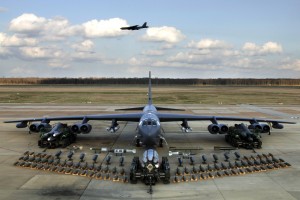
The B-52 is a highly versatile multi-role bomber which can perform strategic bombing, nuclear strikes, close air support (CAS), interdiction and other operations which include anti-ship and mine laying missions. Its versatility derives from the wide variety of weapons that it is able to carry, through both an internal bay and external hard points. It has been the primary U.S. heavy bomber since the 1960s and was the cornerstone of the air arm of the U.S. Military nuclear triad. As technology advanced, the B-52 was adapted to carry up to twenty air launched conventional and nuclear cruise missiles whose ranges vary between 690 and over 2000 miles depending on the type of missile employed. This upgrade maximizes the range of the B-52 (8,800 miles, 4,400 combat radius) while maintaining a safe standoff distance from enemy air defenses. Five B-52s could deploy upwards of 100 AGM-86C/D Conventional Air- Launched Cruise Missiles (CALCM) simultaneously. [5] Due to its large radar signature, it requires a significant amount of Suppression of Enemy Air Defense (SEAD) missions prior to it entering the battle space. [6] According to US Air Force roadmaps, the B-52 will remain in service until 2040 or until the replacement is fielded. [7]
The B1B Lancer
The B1 Bomber program was the third attempt to create a high-speed long-range nuclear bomber that would replace the effective, yet vulnerable, B52. The first two attempts, the B-58 Hustler and the XB-70 Valkyrie, could reach Mach 2 and Mach 3 respectively and outrun Soviet interceptor aircraft enroute to delivering their nuclear payloads. Soviet technical advancements thwarted both projects.
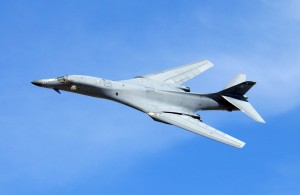
The development of high altitude Surface to Air Missiles (SAMs) rendered the B-58 obsolete and forced it into a low-level penetrator role. [8] Designed for high speed-high altitude flight, the B-58 failed at low altitudes. The B1A succeeded where the B-58 failed. By utilizing variable wing technology and terrain mapping radar, it is able to efficiently travel long distances then utilize its supersonic dash to penetrate enemy air space at low levels below enemy radar and SAM coverage. However, like most innovations in the cold war, it soon rendered obsolete thanks to another technological advancement, Look Down/Shoot Down Radar.[9] In light of this development, the DOD cancelled the B1A in 1977. Political pressure restarted the program by in 1980. The DOD decided the B1B would take over the heavy bomber role for the B-52 while the USAF transitioned to the B-2 Spirit.[10]
This “transitional” aircraft has endured to become the workhorse of the war on terror, dropping 60% of all ordnance in Afghanistan. Despite flying 1% of the combat missions in Iraq, it dropped 43% of all the Joint Defense Attack Munitions (JDAM) used in theatre. Loitering over the battlefield, the B1B can travel anywhere in Afghanistan in 45 minutes in order to support ground troops carrying 48 JDAMs, all capable of being accurately delivered on target. The B1B is integral to the Air-Sea battle concept for the Pacific Theatre, having the capacity to travel long distances and use up to 24 Joint Air to Surface Stand Off Missiles (JASSM) against enemy targets. [11] Despite its combat record, the B-1B is beginning to show its age, with each plane having to spend 48.4 hours in the repair shop for every hour it is in the air. Furthermore, each hour in the air costs $60,000 in fuel, maintenance and other costs.[12]
The B2 Spirit
The B-2 Spirit “stealth” bomber is the only bomber in the U.S. arsenal that is still capable of penetrating enemy airspace without the need for prior SEAD missions. Originally designed to drop unguided munitions, the advent of the JDAM now greatly multiplies the B-2’s combat effectiveness. During Operation Odyssey Dawn over Libya, three B-2s eliminated 45 targets in a single mission. [13]

In the 1980s, the USAF anticipated the number of B-2’s in the USAF would number close to 100 and it would be the primary strategic bomber in the U.S. arsenal, replacing the B-52 and its stopgap replacement, the B-1B. The shifting requirements of the end of the cold war, combined with a price tag of nearly two billion per plane, reduced this number to 20, a fifth of the original estimate. [14]
The large price tag of the B-2, F-22, and F-35 highlights the problems inherent in the USAF procurement process.[15] The cost of these stealth programs, albeit high, has provided the USAF with the technologies to develop the LRS-B at a significantly lower cost. The B-2 program, despite its costs, has been a success and remains our only stealth heavy bomber.
Limited Options
The U.S. policy makers originally set the target date for the LRS-B at 2018, however that date is no longer feasible.[16] The 1999 USAF roadmap planned to continue with the current fleet until 2037; however, the nation can no longer afford to delay the development of a modern and robust deep strike large payload aircraft.[17] As currently composed, the current U.S. bomber fleet cannot meet the challenges of the 21st century. When faced with the need to engage another nation, this aged fleet leaves war planners limited options:
- Launch cruise missiles from a standoff distance
- Risk sending B-2 bombers into enemy airspace, with each aircraft lost reducing the total number of B-2s in the U.S. Fleet by 5%.
- Utilize the above two options in conjunction with a larger SEAD effort
An attack against a nation with five buried and hardened nuclear facilities would require employing the GBU-57 Passive Ordnance Penetrator (MOP) to destroy them. Dropping four MOPs per target would involve risking half the entire B-2 fleet to accomplish the mission.[18] As a nation, the U.S. cannot afford to rely on such a small number of aircraft to execute U.S. policy. The B-2 has never flown a daytime mission due to its size and observeability, limiting enemy airspace penetration to a predictable 12 hours per day. [19] Since its inception, the United States has enjoyed the ability to penetrate any nation’s air defenses at any time with this remarkable weapon. Unfortunately, as SAM capabilities continue to improve, the B-2’s survivability is no longer a certainty.
The Evolving Threat of Air Defense Networks
The USAF 1999 Roadmap which assessed the B-1B, B-2 and B-52 bombers were sufficient to meet the strategic requirements of the U.S. until 2037 was based upon the enviable position in which the U.S. and its allies found itself in the 1990s.[20] The B-1B and B-2 aircraft, designed to penetrate the Soviet Union, entered service amidst the crumbling of their intended adversary. The USSR was the only non-allied nation capable of developing and manufacturing Integrated Air Defense Systems (IADS) and modern SAMs. IADS links various radars and early warning systems with SAM missile emplacements to a command and control station that detects tracks and intercepts enemy aircraft.[21] Previous SAM systems relied on a single radar array linked to a missile battery. IADS incorporates numerous elements that eliminate a single point of failure. Advanced American SEAD missions overwhelmed the IADS fielded by former Soviet client states such as Iraq and Serbia, however not without losses. The destruction of an F-117 by Serbian SAMs exposed its stealth limitations.
Russia, despite struggling to stabilize and adapt to a new political and economic system in the 1990s, continued to upgrade IADS systems needed to intercept U.S. combat aircraft.[22]The S-300 system, originally fielded in the late 1970s, is highly mobile and effective against targets at most altitudes due to constant upgrades. The system can be deployed quickly, and is designed to “shoot and scoot,” making it elusive to cruise missiles whose long flight time prevent it from hitting mobile targets without updated target data. All U.S. Aircraft, to include the F-35, are vulnerable to the S-300V/VM with the exception of the F-22 Raptor. [23]
China’s IADS budget is a fraction of the United States and its air defense and interceptor aircraft capabilities have lagged behind Russia and the U.S. for years. Based on recent assessments, China lacks a linked nationwide IADS. However, by using commercial technology to augment and upgrade its air defense infrastructure, China is at a pace equal to the development of commercial electronics. This use of commercial technology frees China from investing in long term and complicated military systems that are less flexible than the free market.[24] A comparison of Google Earth and Garmen GPS systems to the U.S. Army’s Falconview and Blue Force Tracker, respectively, is an example of this problem. China, using the S-300 as well as other SAM systems, has incorporated mobile launchers as well as ambush tactics to augment its fixed SAM sites and render its airspace inaccessible to the majority of US aircraft. [25]
Air-Sea Battle: Achieving American Power Projection in the Pacific
The emerging Air-Sea Battle strategy is counters Anti Access Area Denial (A2/AD) measures by utilizing various joint capabilities to penetrate enemy territory. In order to execute this strategy, the Navy and the Air Force will train, equip and organize their forces to seamlessly work in tandem to ensure the U.S. maintains operational access to the entire Pacific Rim. Air-Sea Battle is being developed to counter the increasing A2/AD capabilities of some nations in the western Pacific, such as China.
These A2/AD capabilities prevent a carrier battle group (CBG) from approaching within, at a minimum, 1200 Miles from the coast, which is the half the alleged maximum range of the Chinese HN 2000 Surface to Surface (SSM) Low Altitude Cruise Missile (LACM). A variant of the DH-10, the HN 2000 is still in development but it on the horizon. Following the DH-10 variant, China has the CSS-5C Medium Range Ballistic Missile (MRBM) , CSS-5D (Anti-Ship Ballistic Missile), CSS-6 Short Range Ballistic Missile (SRBM) and the CSS-7 (SRBM). The CSS-5D ASBM, also known as the DF-21D, it the world‘s first ASBM. The CSS-5D launches into the upper atmosphere and releases one or more reentry warheads that descend on the target from directly above. The speed of the warhead and attack angle makes it impervious to standard anti-missile missiles and to the Close in Weapons System (CWSS) or the RIM-116.[26] Granted the ability of this weapon system to accurately adjust its trajectory during terminal guidance is unknown. However, the potential threat of these missiles may be great enough to prevent war planners from risking a Gerald Ford Class aircraft carrier, whose price tag is greater than the yearly military expenditure of 136 nations, including Spain and Columbia.
The range of these anti-ship missiles denies not only the entry of a CBG into the South China Sea, but prevents the CBG’s aviation element from getting within range. This is due to the combat radius of the F-35C and F-18 E/F being 707 miles and 449 Miles respectively. In order to attack mainland China using carrier strike aircraft, refueling aircraft must be stationed 250 miles from land to avoid the S-300 IADS, thereby requiring refueling missions both inbound and outbound of any strike mission. Air Force and Marine Corps Aircraft operating out of Japan and Korea could augment a long-range naval air strike force, utilizing F-18 E/F Super hornets, F-15 D Eagles and F-15E Strike Eagles as well as any F-35A/B’s or forward deployed F-22’s. The strike aircraft will be limited in the amount of air to surface missiles that they can carry, reducing the overall effectiveness of the strike.
In light of China’s A2/AD missile perimeter, war planners have limited options. If they do not want the risks associated with a traditional SEAD penetration airstrike, only standoff attacks would remain an option.
One possible method of a standoff attack is the employment of converted Ohio Class SSGN Cruise Missile Submarines, which are capable of carrying up to 154 Submarine Launched Cruise Misses (SLCM). The SSGN’s would approach by stealth and shower IADS, SAM, and SSM emplacements with cruise missiles to pave the way for naval forces and follow-up strikes by air assets. However, this capability suffers from the same numeric limitations as the B-2 Spirit. There are only four SSGNs currently in service, and are scheduled to be replaced by upgraded Virginia Class Submarines between 2023 and 2026. [27] The loss of one SSGN would result in a 25% reduction in the overall force. A second option is also a large cruise missile assault, albeit launched from the air. B-52, B-1 and B-2 aircraft would launch cruise missiles from a standoff distance of at least 250 miles with a similar target package as the SSGNs. The two options can be used in tandem, but require on-station surveillance to perform Battle Damage Assessments (BDA) and track the mobile SSMs and other IADSs.
Limitations of Cruise Missiles
Cruise Missile strikes from a standoff distance has three primary vulnerabilities.
1. Cruise missiles are equally vulnerable to enemy air defenses as U.S combat aircraft. Enemy Radar will be able to detect and track the first wave of inbound cruise missiles. Once detected, a cruise missile is vulnerable to SAM interception and can be tracked and destroyed by air-to-air missiles.
2. The majority of Chinese SSM, IADS and SAM equipment are mobile, allowing them to redeploy rapidly. The cruise missiles will strike the original target area without real-time target updates.
3. Fixed targets, such as large radar arrays, command and controls bunkers and airfields will be hardened and may require multiple strikes as the payload of a cruise missile its minimal due for its need to carry fuel and guidance systems. Thus to compensate for the relatively small warheads found on conventional cruise missiles, adversaries could simply harden their high value assets. Furthermore, conventional cruise missiles cannot destroy heavily reinforced bunkers thus requiring the GBU-57 Massive Ordinance Penetrator (MOP).
The employment of this bomb requires heavy bomber presence over the target area. This requirement, due to the stealth limitations of our bomber force, will require SEAD activities prior to their going “feet dry” over the mainland. This requirement runs counter to the purpose of striking fixed positions, which is to blind the enemy and to eliminate command and communication elements. The LRS-B will be able to carry 5,000-pound GBU-28’s as well as the MOP.
One of the critical roles which the LRS-B will perform is Command, Control, Communications, Computers, Intelligence, Surveillance and Reconnaissance (C4ISR). The current USAF and USN C4ISR systems are currently not organic to any strike aircraft other than the existing and vulnerable bomber fleet. The USN will continue to develop C4ISR assets that are stand-alone platforms.[28] When conducting blue water fleet operations, such platforms are ideal. However, when operating in enemy air space, these systems will be vulnerable to Electronic Counter Measures (ECM), SAMs, and may require fighter escort, further risking its detection in the battle space. A stealth LRS-B would be combine C4ISR functions with its other capabilities. One such capability is the ability to find, fix and finish. The LRS-B could illuminate targets for other aircraft, perform BDA and conduct immediate follow-up strikes on remaining and partially destroyed targets with its large array of armaments.
Required Capabilities
The goal of the LRS-B Program is to create an airframe that combines the capabilities of the B-1 and B-2 utilizing existing technologies that is updates easily. In order to fulfill its future role as a stealthy long-range strategic bomber, the LRS-B must meet or exceed the following criterion:
• Crew: 4
• Low Observable/ Stealth Capability
• Cyber Warfare Capable
• C4IRS and advanced targeting capabilities
• Able to network with equipment from all service branches
• Avionics
o Full suite of Air to Air, Air to Ground offensive phased-array radar.
o Extensive jamming and radar warning equipment
o Internal targeting equipment capable of guiding USN and USAF ordinance.
• Armament
o 2 rotary launcher mounted multiple ejector racks
o Able to carry all weapons systems of the B-1 and B-2 to include the planned Long Range Stand Off Cruise Missile
o AIM-120D Air to Air Missile
o B61-12, B83 Nuclear weapons
• Performance
o Service ceiling of 60,000 ft.
o Combat Radius of 4,000 miles
o Fuel efficient engines which allow for a maximum loiter time over the AO as well Supersonic Dash capability of Mach 1.25
o Capable of Daytime Operations
The Multirole Potential of the LRS-B
The LRS-B will be a multirole aircraft that fills critical gaps in capabilities of every branch of service based on two principles that our military currently lacks: The ability to penetrate and persist over enemy airspace and the ability to remain invisible to IADS.
The Missileer
In the late 1950’s, the U.S. Navy conceived of a fleet defense fighter with limited maneuverability. Douglas aircraft was awarded the contract and began development of the F6D Missileer. This plane was designed to loiter over the Carrier Battle Group for long periods while using its powerful radar and long range air-to-air missiles to intercept incoming enemy aircraft.[29] The concept, developed simultaneously with the F-4 Phantom, represented the popular mindset of the obsolescence of dog fighting due to the development of long-range air-to-air missiles. To this point, the F-4 Phantom was fielded as the primary aircraft for three branches of service without an internal cannon! As we know from literature on the topic (or by watching Top Gun), this concept was discarded following the experiences of the USAF, USMC and USN over the skies of Vietnam. The missile development portion of the missileer program did not fail, as it bore the long range AIM-54 Phoenix and the AIM-120 AMRAAM.
The F6D concept was a 20th Century failure that could easily be a success in the networked military of the 21st century. As part of the Air-Sea Battle Concept, the LRS-B could act as a large missile platform working in concert with the F-22 and F35. Both smaller aircraft have limited internal bay capability and limited range. Upon confronting enemy air defenses during interdiction and anti-fleet operations, the smaller aircraft could act as spotters while a LRS-B defeats the initial wave of interceptors with air-to-air missiles, allowing the F-35 and F-22s to retain their weapons and carry a larger amount of strike weaponry. While such an arrangement is not ideal, the LRS-B should at least have such a capability in order to give future war fighters the maximum amount of tactical options. Given the distances involved, redundant capabilities are essential in the event of a conflict which produces heavy losses of naval and aerial weapons platforms.
Airborne Refueling
If current budgetary trends continue, it will force the U.S. Military to reduce its bases overseas. Even with the current worldwide base structure, airborne refueling operations are essential to almost every significant air operation. Fifth generation aircraft such as the JSF and F-22 lose their stealth capability when burdened with external drop tanks. Given that our current air-borne refueling aircraft, the MC-130P/J and KC-135, is highly vulnerable, the concept of a modified LRS-B acting as a tanker a necessary option. [30] [31]
Strike Capability/Air Defense
The primary mission of the LRS-B is air-space penetration. It will also retain the abilities of the current bomber force to launch standoff attacks with cruise missiles. A LRS-B designed with an organic air-to-air capability, will be able to defend the vulnerable bomber fleet during standoff attacks. In this role, a Bomber Wing can act independently, freeing up air superiority aircraft for other missions
SEAD/Electronic Warfare/Cyber
Utilizing its stealth capability, the LRS-B will be able to travel unmolested over the battlefield. By using electronic warfare, cyber-attacks and conventional anti-radiation weaponry, the LRS-B will wreak havoc on an enemy’s air defense network. When used in conjunction with non-stealth aircraft on the perimeter of radar coverage, war planners can further deceive an enemy to the true origin of the attack. This variant of the LRS-B would also replace/augment the propeller driven EC-130H electronic warfare aircraft. [32]
Unmanned Capability
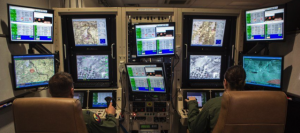
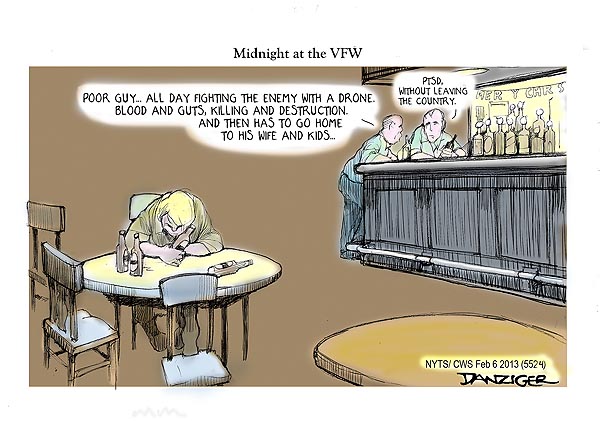
The capability may exist for the LRS-B to operate unmanned. Given the current budgetary environment and lack of risk associated with using unmanned vehicles, this capability could tempt future policymakers to choose expedience over reason.[33] An unmanned bomber carrying nuclear ordinance eliminates the human element in the direct release of nuclear weapons. Furthermore, no amount of automation or electronics can substitute for having seasoned pilots at the helm of our most potent aircraft in combat conditions.
The F-4/F-35 of Bombers?
To be clear, one aircraft does not have to fill the aforementioned potential roles of the LRS-B. The fact that the LRS-B is a bomber means the design will require a large internal space in which to carry payload. This large space allows the bomber to be modified, with other items being placed within the confines of the airframe. The F-35, by contrast, was designed around the need of one of its versions to have a SVOTL capability.
The LRS-B is a tremendous opportunity to field a large fleet of Stealth Aircraft to replace airframes that were being developed and fielded during the Cold War. The offensive capability of the United States has always served as the backstop for U.S. Foreign Policy, with our adversaries ever conscious of the U.S. Military’s innate ability to project force on land, air and sea. If the LRS-B is rendered a casualty to budget cuts, it will weaken our ability to respond to potential aggressors, limit our ability to strike an enemy in his own backyard and will ensure our aging bomber fleet will eventually be rendered obsolete.
Robert Hodge is a U.S. Army veteran and graduate student at George Washington University in Washington, D.C.
[1] Carlo Munoz, DoD Fast Tracks New Bomber; ‘Planning Number is $550 Million Per Plane, http://defense.aol.com/2012/02/15/dod-fast-tracks-new-bomber-planning-number-is-550-million-pe/, (February 2012).
[2] Sanda Erwin, “New Stealth Bomber Can’t Be Another B-2,” National Defense 96.700 (Mar 2012): 8.
[3] David Hambling and Becky Ferreira, “Invisible Warriors,” Popular Science 280.1 (Jan 2012), pg 50
[4] United States Air Force Factsheets; http://www.af.mil/AboutUs/FactSheets/tabid/131/Indextitle/B/Default.aspx
[5] United States Air Force Factsheets; http://www.af.mil/AboutUs/FactSheets/Display/tabid/224/Article/104465/b-52-stratofortress.aspx
[6] “Air Force faces tough decisions on aging fleet,” 24 March 2013, Dayton Daily News, Main; Pg. A1
[7] Adam J. Herbert, “Great Expectations,” Air Force Magazine, Vol. 90, No. 8 (Aug. 2007),
[8] Bill Gunston and Mike Spick, Modern Air Combat, (New York: Crescent Books, 1983), pg 132
[9] Bill Gunston and Mike Spick, Modern Air Combat, (New York: Crescent Books, 1983), pg 41.
[10] “Air Force Activates B1B Bomber Unit,” The Washington Post, 2 October 1986, pg. A17.
[11] “B-1B bomber mission shifts from Afghanistan to China, Pacific,” USA Today, 8 July 2012
[12] “The Air Force Needs a Serious Upgrade,” The Wall Street Journal, 15 July 2010, Opinion.
[13] John Tirpak, “Bombers over Libya,” Air Force Magazine (July 2011), Vol. 94, No. 7.
[14] David Axe, “Why can’t the Air Force Build an Affordable Plane?” The Atlantic (March 2012).
[15] Sanda Erwin, “New Stealth Bomber Can’t Be Another B-2,” National Defense 96.700 (Mar 2012): 8.
[16] Tech. Sgt. Russell Wicke, “Gen Moseley: New long-range bomber on horizon for 2018,” U.S. Department of Defense Information / FIND (26 July 2006).
[17] Hearing before the Military Procurement Subcommittee, Performance of the B-2 Bomber in the Kosovo Air Campaign, H.A.S.C. No. 106-24, U.S. Government Printing Office, Washington: 1999, pg. 48-50
[18] Brooks McKinney, Northrop Grumman Begins Work to Equip B-2 Bomber with Massive Penetrator Weapon, http://www.irconnect.com/noc/press/pages/news_releases.html?d=123187 (July 2007).
[19] Barry Watts, The Case for Long Range Strike: 21stCentury Scenarios, Center for Strategic and Budgetary Assessments, www.CSBAonline.org (December 2008).
[20] John Tirpak, “The Bomber Roadmap,” Air Force Magazine Vol. 82, No. 6.
[21] NATO Integrated Air and Missile Defense, http://www.nato.int/cps/en/natolive/topics_8206.htm
[22] Carlo Kopp, “Surviving the Modern Integrated Air Defense System,” Air Power Australia Analysis 2009-02 (Feb. 2002).
[23] Carlo Kopp, “Self Propelled Air Defense System/SA-12/SA-23 Giant/ Gladiator,” Technical Report APA-TR-2006-1202, http://www.ausairpower.net/APA-Giant-Gladiator.html#mozTocId650591
[24] Sharon Weinberger, China’s Off-the-Shelf Air Defense, http://www.wired.com/dangerroom/2008/01/chinas-off-the/ (January 2008).
[25] Roger Cliff..[et al], Shaking the Heavens and Spitting the Earth: Chinese Air Force Employment Concepts in the 21st Century (Santa Monica: RAND Corporation, 2011) Pg. 80-83 and appendix xxiv.
[26] Office of the Secretary of Defense, “Annual Report to Congress: Military Power of the People’s Republic of China, 2008, Pg. 30; http://www.defense.gov/pubs/pdfs/China_Military_Report_08.pdf.
[27] Cruise-missile submarines being phased out,” Kitsap Sun 8 February 2013. http://www.kitsapsun.com/news/2013/feb/08/cruise-missile-submarines-on-the-way-out/#axzz2SiisIChY
[28] Committee on C4ISR for Future Naval Strike Groups, National Research Council, C4ISR for Future Naval Strike Groups (Naval Studies Board, 2006).
[30]United States Air Force Factsheets; http://www.af.mil/AboutUs/FactSheets/Display/tabid/224/Article/104534/mc-130eh-combat-talon-iii.aspx
[31]United States Air Force Factsheets; http://www.af.mil/AboutUs/FactSheets/Display/tabid/224/Article/104524/kc-135-stratotanker.aspx
[32]United States Air Force Factsheets; http://www.af.mil/AboutUs/FactSheets/Display/tabid/224/Article/104550/ec-130h-compass-call.aspx
[33] “The Air Force’s simple, no-frills, advanced new bomber” DOD Buzz, 13 February 2012, http://www.dodbuzz.com/2012/02/13/the-air-forces-simple-no-frills-advanced-new-bomber/