Category Archives: Future Tech

What is coming down the pipe in naval and maritime technology?

Building a DoD Outpost in Silicon Valley: DEF Innovation Competition

As part of our continuing Innovation Week (or two weeks – call it innovation), we will be posting the contestant pieces from the DEF Innovation Contest. Originally posted at the DEF Website.

On Sunday, 26 October, the Defense Entrepreneurs Forum hosted an innovation competition sponsored by the United States Naval Institute. $5,000 in prizes were awarded after the eight contestants made their pitches. We will feature the one-pagers from the competition over the next 8 days. The following contribution is from Josh Steinman, a US Naval Officer.

[otw_shortcode_button href=”https://cimsec.org/buying-cimsec-war-bonds/18115″ size=”medium” icon_position=”right” shape=”round” color_class=”otw-blue”]Donate to CIMSEC![/otw_shortcode_button]

Software is increasingly becoming the defining mechanism by which the Army, Navy, Air Force and Marine Corps achieve tactical, operational, and strategic decision dominance. Previously the Department of Defense had achieved this ability through industry.

As software takes on increasingly prominent roles in the Department of Defense, we will need to establish closer relations with the industry that builds it, much like the Department of Defense built long-standing ties to the industrial base during the pre-War, inter-War, and post-War periods of the early 20th century. These close links will ensure that the DoD retains the ability to rapidly integrate cutting edge digital technologies into our operations, as well as influence their development at all stages.

ref-mobile-lab1

One high-impact, low cost way to advance this goal is to establish a small joint detachment of hand-picked DoD personnel to operate primarily in Silicon Valley that would act as an intellectual “long-range reconnaissance squad”. This entity would consist of approximately 10 personnel nominated by a small group of senior officers and civilians (plus 1 support and 1 General or Flag Officer), stationed in the greater San Francisco Bay Area. Their mission would be to help integrate the defense and software industries by achieving the following tasks:

a. Ensure continuity of action before, during, and after senior officer and civilian visits with entities in the non-Defense technology sector. Achieve this by acting as travel agent for senior officials before they depart (coordinating visits with local technology companies), local guide upon arrival, note-taker and action officer while engaged on the ground, and execution agent upon the senior’s departure.

b. Identify early-stage ventures with potential DOD applicability and connect them with appropriate resources to utilize their technology for DOD purposes. Interface with DOD and service-centric early-stage and midstage venture capital firms, and liaison with entities such as DARPA, IARPA, US Army REF, CNO’s Rapid Innovation Cell, and OSD RTTO.

c. Educate students, entrepreneurs, academics, and venture capitalists on DOD challenges and process with an eye towards changing attitudes towards the DOD. This would include conducting “presence missions” at regular events like SXSW, TECHCRUNCH DISRUPT, and even Burning Man.

My proposed first step is to send an exploratory detachment of 3-5 officers out to Silicon Valley for a one-month site survey mission that would result in a full proposal white-paper, to be submitted to the Joint Chiefs of Staff within 90 days of their return. Costs for such a survey are on the order of $6,000 per person, for one month.

[otw_shortcode_button href=”https://cimsec.org/buying-cimsec-war-bonds/18115″ size=”medium” icon_position=”right” shape=”round” color_class=”otw-blue”]Donate to CIMSEC![/otw_shortcode_button]

Camouflage: You Ain’t Screen Nothin’ Yet

By James Drennan

Using a television to watch TV is so 20th Century. Screens can do much more these days. The civilian sector is proving that and the Navy needs to take heed. Specifically, the Navy should use electronic displays in new and innovative ways to communicate among its deployed forces, confuse potential enemies, and even disguise its ships and shore facilities. It is not often that one talks about screens as innovative since the television has been commercially available for almost a century, but display technologies have advanced so dramatically since the early days of television that they can now be used cost-effectively for entirely new purposes. Considering the ever tightening budgets looming in the Navy’s future, it would do well to invest in proven technology, like the digital electronic display, and generate operational advantage through creative employment. What if an aircraft carrier could change its hull number at will? Or if a strike group could communicate at high data rates without transmitting a signal? Imagine a warship being able to sail right through an enemy fleet in broad daylight by simulating the appearance of a merchant vessel. These ideas may seem like science fiction, but they are all possible through the use of technologies that are used by millions every day.

Digital electronic display technologies, such as light emitting diode (LED), liquid crystal display (LCD), plasma, and digital projection, have advanced and proliferated rapidly in recent years. This has caused unit cost to decrease and quality and capability to increase. These technologies are no longer just for watching television or working on a computer. Massive LED screens are common on digital billboards, while nearly half of all Americans carry high resolution displays in their pockets in the form of smartphones. Displays are even beginning to break out of their traditional rectangular shape. LEDs can now be manufactured so that panels can be flexibly conformed to curved or irregular surfaces. Projection mapping techniques enable projectors to display images on three dimensional surfaces. All of these technologies have the potential to revolutionize the way the Navy operates for pennies on the dollar.

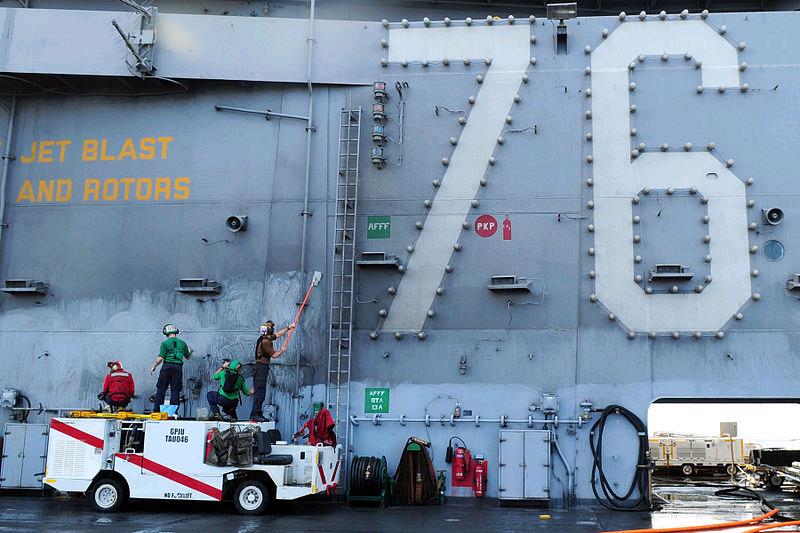
Consider the island superstructure on an aircraft carrier. Large white painted hull numbers take up about a quarter of the inboard and outboard faces of the island. They serve one purpose: identify the ship in order to comply with international regulations. The numbers are lined with dozens of light bulbs which can either be turned on or off. Aside from ceremonial ambience, it is difficult to see what value they provide.
CVN76

Sailors scrub down the island superstructure on the flight deck of the aircraft carrier USS Ronald Reagan (CVN 76). They could be watching the latest episode of Game of Thrones. Image Courtesy: U.S. Navy photo by Mass Communication Specialist 3rd Class Shawnte Bryan/Released. Retrieved from: www.wikipedia.org.


If the lights and the painted numbers were replaced with digital displays, the Commanding Officer of the carrier would have several new options at his or her disposal. For one, the screens could be set to display any hull number or none at all. Obviously, removing or changing hull numbers would not hide the ship, but against a capable and professional enemy it might confuse their decision making process enough to delay or deter an attack. As an example, the US Navy today requires significant confirmation, often visual, to establish and maintain maritime domain awareness (MDA). If the same ship were to be reported in three different locations, mission effectiveness would suffer while watchstanders tried to sort out the discrepancy. Conflicting reports are like poison to a networked force. Even if the superstructure screens were blank, the CO may find advantage in denying the enemy useful intelligence. In World War II, the Pacific Fleet removed visible numbers from aircraft carriers and did not return them until the Japanese were no longer a threat.

An island superstructure screen could also be used as a visual aid for flight deck operations. The flight deck of an aircraft carrier is an extremely loud and dangerous work environment. It is often difficult for crews to hear anything but jet noise. Visual messages could supplement audible alarms to indicate emergencies, not only grabbing attention but also relaying critical information. Conversely, an outboard screen could aid in force protection efforts, particularly in precarious situations like anchoring in popular foreign ports. If a wayward sightseer saw his leisure craft on the screen with the word “STOP” written in several different languages, the message would be received loud and clear.

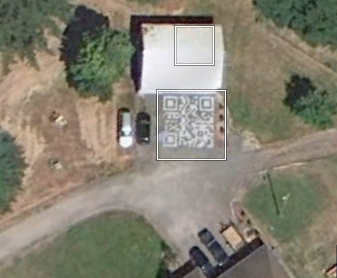
Digital displays can also be a cost-effective means of communicating messages over long distances. In an effort to move the Navy away from highly detectable radio communications, optical communication techniques are gaining attention, but they often rely on technologies such as laser, which require more research and development (R&D) investment. Digital displays offer the possibility of optical communications without any R&D required. For example, a popular manufacturing and advertising concept called a quick reaction (QR) code uses a matrix of black and white squares to store data, which can be read by a camera on a smartphone or other computing device. When large digital displays (such as the aforementioned “superstructure screen”) are coupled with high resolution digital cameras (another readily available technology), ships within sight of each other could communicate optically, much like age old flashing light or semaphore techniques, but with much higher data rates.
QRCode

A driveway turned QR code as viewed from space. Using a screen, this house could become a satellite communications node. Image Courtesy: Google Earth. Retrieved from http://qrazystuff.wordpress.com/2011/01/28/qr-codes-big-is-beautiful/


Since the interpretation of QR codes is automated, data rate is only limited by a computer’s ability to process each new code. Data rate, fidelity, and communications range will only increase as display and camera technologies improve. This concept could easily be applied to satellite communications, as shown above. Communication would depend heavily upon adequate visibility, but this “digital semaphore” technique could offer a cost-effective method of optical communication while recapitalizing some of the capabilities lost by the disestablishment of the Signalman rating in 2003.

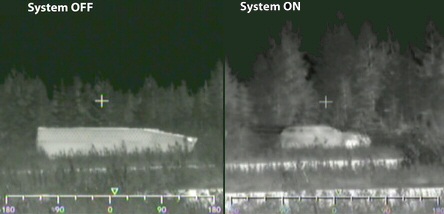
Perhaps the most ambitious use of digital display technologies would be to disguise an entire ship. Much like “digital semaphore” could revolutionize optical communications at sea, the digital version of deceptive lighting could revolutionize naval deception. Deceptive lighting is a standard technique used by US Navy ships to conceal their identity at night by changing their normal lighting configurations. The effectiveness of deceptive lighting is debatable and, in any case, it offers no cover from the enemy when the sun rises. Digital displays could be used in daylight hours to complete the deception. Research into this concept, called active camouflage[1], is well underway. In fact, in 2011 BAE released an active camouflage for tanks called Adaptiv© that works in the infrared, not visible, portion of the spectrum.
Adaptiv

The frames in the image show an armoured vehicle with Adaptiv off (left) and on (right), where the chosen object is a large car. Image Courtesy: BAE Systems, Copyright © 2011. Retrieved from: www.wikipedia.org.

The visible version is not far off. In March 2012, Mercedes Benz made one of their new vehicles nearly invisible by covering it with flexible LED panels that displayed images from a camera on the other side of the vehicle. The aim of active camouflage in naval applications would not be to make a warship invisible, but rather to appear as a different kind of ship not worthy of the enemy’s attention. Displaying a false hull form instead of trying to make the ship invisible actually could reduce some technical challenges of active camouflage, such as the requirement to know the viewer’s look angle in advance. Furthermore, a warship has several other signatures, such as radar return and visible wake, which are impossible to eliminate completely.

hiddencar

To promote the environmental ‘invisibility’ of the zero-emission, hydrogen-fuelled Mercedes F-Cell, ad agency Jung von Matt covered the car in LED sheets which would display a live video image whatever was behind the car, as filmed by a camera attached to the other side. (Image Courtesy: Mercedes-Benz. Retrieved from: http://amazingstuff.co.uk/technology/invisible-car/)


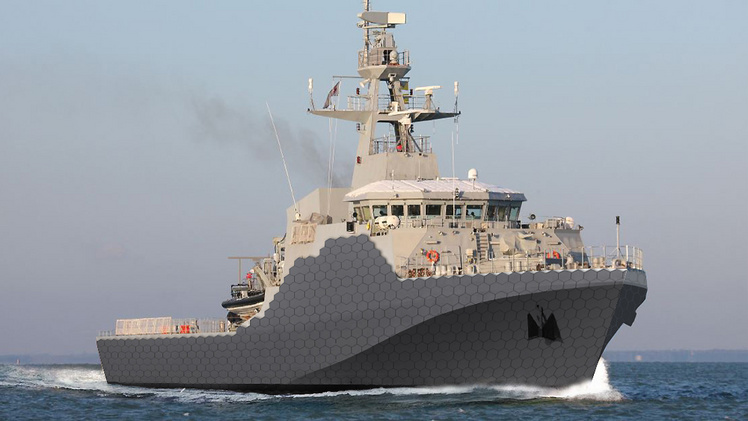
Although the technology still needs to mature in order to be feasible for use on ships at sea, the concept is simple (indeed BAE is already working hard to apply Adaptiv to warships at sea). A ship’s freeboard and superstructure could be covered in conformal LED paneling to display an image of a merchant or some other vessel, provided it is not protected by international treaties like a hospital ship.
adaptivship

Artist rendition of Adaptiv camouflage applied in the maritime domain. (Image Courtesy: BAE Systems, Copyright © 2014, retrieved from: http://www.baesystems.com)


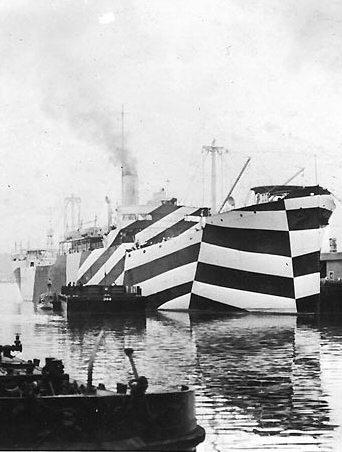
Naval active camouflage would be intended to fool routine enemy surveillance from near-horizon distance, not ships in close contact or aircraft conducting targeted search efforts. However, in combination with emissions control (EMCON) and careful maneuver (i.e. staying within shipping lanes and avoiding close approaches to enemy assets), the appearance of a merchant vessel on the horizon would fit the enemy’s expectations and cause him to focus his surveillance efforts elsewhere. Another potential use of naval active camouflage can be found in a historical example. In World Wars I and II, the Allies took inspiration from the art world and painted their ships with irregular patterns of contrasting geometric shapes, called dazzle camouflage, to confuse enemy rangefinders, particularly on submarines. Dazzle camouflage fell out of favor with the advent of radar, but today the digital version could prove valuable, particularly against low end threats. Without advanced fire control radars, terrorists and pirates rely on their vision to target or avoid naval warships, depending on their particular goals. Even without disguising identity, creative use of adaptive camouflage could make it nearly impossible for a threat to determine a warship’s true aspect, just like dazzle camouflage, and consequently, how to engage or maneuver effectively.
mahomet

USS Mahomet (ID-3681) in port, circa November 1918. The ship has a “dazzle” camouflage scheme that distorts the appearance of her bow. Image Courtesy: Naval History and Heritage Command. Retrieved from: www.wikipedia.org.

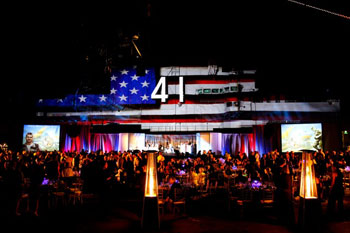
Using display technologies to make warships appear as something else is not a completely new concept for the modern US Navy. In September 2011 as part of the 5th Annual Midway American Patriot Awards gala, the island superstructure of the USS Midway was transformed into a waving American flag using a different kind of display technology called projection mapping. AV Concepts, Inc. used 3D projectors, advanced graphics software, and creative lighting techniques to virtually “paint” the flag onto the ship with stunning clarity and realism.
midway

The American flag virtually draped over USS Midway using projecting mapping technology at the 5th Annual Midway American Patriot Awards. The projection of the flag onto the hull was so precise, some guests thought ship was covered with a flat projection screen. Image Courtesy: AV Concepts, Inc. Retrieved from: http://livedesignonline.com/excellenceawards/uss-midway-aircraft-carrier-projection

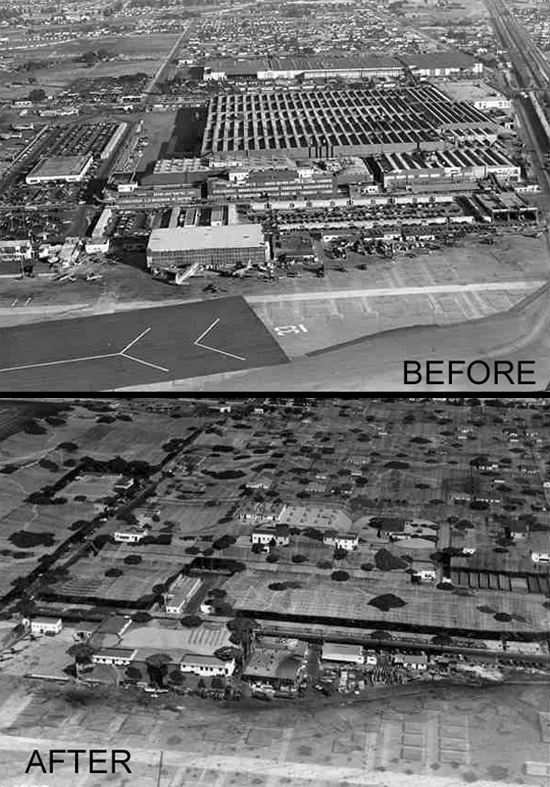
While not an ideal technology for afloat forces, projection mapping could be used to fool optical sensors by blending shore facilities into their surroundings. Again, history provides an intriguing parallel. After the 1941 raid on Pearl Harbor, Lockheed Martin desperately needed to hide its Burbank, CA aircraft plant from Japanese fighters. With the help of nearby Walt Disney Studios, they used canvas, paint, and chicken wire to cover the massive industrial facility with scenery of a quiet rural community. By employing a little artistic creativity, the Burbank plant was able to continue operations throughout the war. Blending this type of creativity with modern display technology could provide cover against today’s more advanced optical sensors.
base

An aircraft manufacturing plant disguised as a suburban Burbank neighborhood during World War II. With modern display and projection technology, the same concept could be applied to counter modern enemy surveillance efforts. Image Courtesy: Lockheed Martin Corporation. Retrieved from: http://www.themarysue.com/camouflage-aircraft-plant/#geekosystem.


The decreasing cost and increasing performance trends of proven display technologies offer the Navy a cost-effective way to generate revolutionary capabilities. Emerging technologies, such as electronic paper (e.g. E Ink® on Amazon’s Kindle®) and phased array optics[2] (think “the Holodeck from Star Trek”), promise to bring even more capabilities into the fold. Certainly, there will be challenges like increased maintenance requirements that must be considered to determine operational feasibility. Also, enemies will undoubtedly adapt to the capabilities described here, but simply affecting an enemy’s operations can have real value. Still, all of these capabilities are useless if the Navy does not have operational concepts for them. Without imagination and an innovative mix of art and science, the Navy will miss this opportunity to increase its combat power and, instead, give potential enemies a few more ways to bring parity to the world’s oceans.


[1] Unfortunately, the term “digital camouflage” is already in use to describe patterns on uniforms.

[2] The technology behind phased array optics is still several decades from reaching maturity.

Lebanese Hezbollah and Hybrid Naval Warfare

This is an article in our first “Non Navies” Series.

Historically, weapons disparities with conventional forces has driven terrorists, insurgents, and other non-state actors towards asymmetric fighting tactics. But as with most long term trends, arms gaps tend to be cyclical as each side’s relative combat power waxes and wanes.  For example, pirates in the 19th Century used pretty much the same artillery as their naval counterparts, albeit on smaller ships.  Now, pirates relying on small arms and skiffs are countered by an international armada of heavily armed frigates and destroyers. The suicide improvised explosive boat attack on USS Cole was another example of David versus Goliath tactics.  In the realm of Anti-Access/Area Denial (A2/AD) though, we are witnessing an upswing in the conventional capabilities of non-state actors.  The mix of regular and irregular tactics is sometimes referred to as hybrid warfare. The proliferation of modern precision-guided weaponry is once again changing the balance of lethality between state navies and para-naval forces.  Regardless of whether these weapons are acquired from state sponsors or captured on the battlefield, the threat posed to regular naval forces is similar.  As demonstrated in recent air and ground engagements, non-state actors can field weapons on par with their conventional counterparts.  Ukrainian separatists with Soviet-era SA-11 missiles shoot down jet fighter (and civilian!) aircraft and Islamic terrorists in Iraq destroy American-made main battle tanks with advanced Russian-supplied Kornet missiles.  Advances in non-state naval weaponry are a natural evolution of these trends.

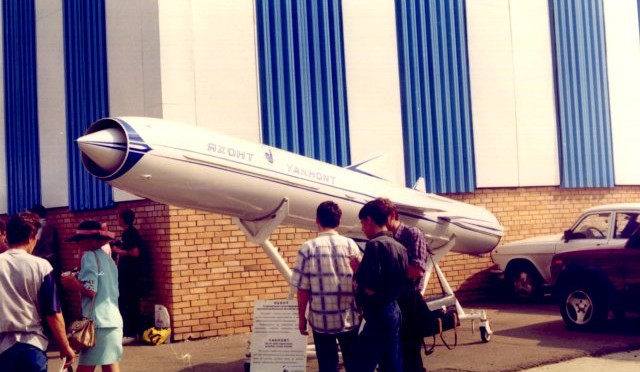
With a rash of recent fighting in the Levant and the potential for Western Naval intervention in various forms,  it’s worth taking a look at the sea denial capabilities of one of the region’s more potent non-state actors, Lebanese Hezbollah (LH).  However one wants to characterize LH – shadow government, proto-state, or simply non-state actor – their ability to contest the littorals in the Eastern Mediterranean has grown tremendously in the past decade.  Despite a number of interdictions by Israeli Defense Forces – some high profile and others intentionally less so – a nearly constant pipeline of increasingly advanced Syrian and Iranian weapons has resupplied LH by air, ground, and sea.  The most noteworthy display of LH’s A2AD network was the C-802 missile attack on INS Hanit in 2006. Subsequent to that engagement, LH’s anti-ship cruise missile inventory has advanced significantly.  Among these stockpiles is the supersonic 300 km range P-800 Yakhont. LH possibly acquired 12 P-800s from Syria, who received a shipment of 72 missiles and 36 launcher vehicles from Russia in 2011.  Over-the-horizon weapons are important, but without an adequate targeting mechanism, they are more of an indiscriminate terror weapon than a precision A2/AD tool.  A variety of means exists to target enemy ships, to include the surface search radar systems normally accompanying the missile batteries.  More crudely, third-party cueing could be provided by simple fishing vessels or UAVs.  Since at least the early 2000s, LH has flown mostly Iranian-manufactured Mohajer-4 unmanned aerial vehicles over Israel along with over-water transits.

The Yakhont ship killer

Some open-source reporting assesses that LH possesses SA-8 and SA-17 truck-mounted surface-to-air missile. The latter type can engage aircraft or missiles at altitudes of up to 24,000 meters and ranges out to 50 km.  To complicate matters, the counter-battery problem for navies facing missile launchers will be challenging because like the insurgents who fire them, mobile launchers will be well ensconced in urban population centers, and employing “shoot and scoot” tactics.

Closer into shore, LH Soviet-era AT-4 Spiggot or the more modern Kornet anti-tank guided missiles might be effective against Israeli small combatant craft, such as those which would be involved in launching a special operations raid.  Mines would be a cheaper, but more indiscriminate sea denial weapon LH might utilize to thwart amphibious operations.

Ostensibly, LH could gain access to any of the robust A2AD weapons its patron Iran possesses.  In 2011, Brigadier General Yaron Levi, the Navy’s intelligence chief, noted that “in the future, we will have to deal with missiles, torpedoes, mines, above-surface weapons and underwater ones, both in Gaza and Lebanon.”   The Iranians have elevated multi-axis, multi-layer anti-ship attack to a high art; with mines and ground-based missiles complemented by swarming missile, torpedo, and gunboat attacks, rounded out by numbers of Wing In Ground-effect aircraft and mini-submarines.  None of these systems are beyond the reach of a non-state actor.

So this network portends a viable sea denial capability, but to whom?  Clearly, LH fears Israel’s naval force and has demonstrated the willingness to engage the Israeli navy.  During the 2006 war, Israeli patrols blockaded Lebanon for eight weeks to prevent maritime resupply of LH forces.  Any advanced sea denial capability would complicate these operations in a future conflict.  Israel’s growing offshore oil infrastructure would also make a tempting fixed target for LH missiles.

And although it is possible that a missile might inadvertently target a U.S. or other allied naval combatant or aircraft operating in the Eastern Mediterranean, for self-preservation reasons, it’s unlikely that LH would deliberately target U.S. platforms without significant provocation. Even so, modern navies operating in the littorals in the vicinity of these threats will need to be continuously on a higher alert status than they might be with a more predictable state adversary.  As asymmetry cycles towards parity, developing ways to counter non-state actors with powerful conventional weapons should become the focus of naval wargames and experimentation.

Chris Rawley is the Vice President of CIMSEC. Any opinions in this piece are the his alone and in his personal capacity.

Super Tornadoes vs Wind Farms

Rather than destroying the eye of the storm, which, according to the US National Oceanic and Atmospheric Administration (NOAA), is suggested every hurricane season, a new (crazy?) study from a Stanford University professor notes an additional advantage of building offshore wind farms. Besides creating clean energy, offshore wind farms could dissipate hurricanes!

At a time of the year when Pacific countries and islands are struck by this destructive phenomenon, this study comes as good news!

It almost sounds too good to be true. But scientists from Stanford University, Cornell University and the University of California-Davis, are categorical: “You can dissipate hurricanes so much that you can reduce wind speeds, peak wind speeds by more than half, and the storm surge by almost 80 percent in the case of New Orleans and hurricane Katrina,” says Mark Jacobson, professor of civil and environmental engineering at Stanford University.  The authors even declared that 78,000 turbines 90 meters high placed off the coast of New Orleans could have reduced Hurricane Katrina’s wind speeds by as much as 158 km per hour by the time they reached land. And they go on: 100,000 turbines located between New York and Washington, D.C., could have weakened the winds of hurricane Sandy by up to 140km/h and reduced storm surge by 34 per cent. It is not without mentioning the financial benefits of producing huge amounts of clean energy.

Professor Jacobson argues that the turbines could reduce the power of a hurricane so much that the turbines themselves would not be damaged: “The wind speeds are dissipated, the hurricanes are dissipated sufficiently so that you never get to the destructive wind speed of a turbine even in a hurricane such as hurricane Katrina, which destroyed much of New Orleans.”

When winds blow in the turbine blades, some of their kinetic energy is converted into electric energy. In theory, the winds converted could no longer be used within the hurricane, which would therefore slow it down.

Jacobson explains: “We found that when wind turbines are present, they slow down the outer rotation winds of a hurricane. This feeds back to decrease wave height, which reduces movement of air toward the center of the hurricane, increasing the central pressure, which in turn slows the winds of the entire hurricane and dissipates it faster.”

Another consequence of hurricanes are storm surges. This is when a hurricane causes waters along the coast to rise above the normal tide, resulting in wide-ranging flood. However, the study also affirms that wind farms could reduce storm surge by up to 79 per cent, due to lower wind speeds.

However, installing 78,000 offshore wind turbines would have a cost of hundreds of billions of dollars. But Jacobson is optimistic: “You get all that money back by electricity sales over 25-30 years, and you reduce storm surge and wind speed associated with a hurricane.” Still, is it realistic to think that this can be done?

Could this be true?

Hell, yes!

Professor Cristina Archer of the University of Delaware, who is a co-author of the study, is sure that wind farms are a new solution against the disasters that the U.S are often facing. She suggests locating wind farms in offshore areas where they could use the wind for electricity, offsetting fossil fuel use and its resulting emissions and pollution. “If you can be smart about it, then you can have still very, very high benefits and locally. So, for example, for [Hurricane] Katrina, we placed the turbines just up wind of New Orleans,” she said. “And, so we protected New Orleans by taking action in New Orleans. So [we showed that] local actions had actual local benefits.”

A climate scientist at Massachusetts Institute of Technology, Kerry Emanuel, is also optimistic “It’s a fairly straightforward calculation,” he says.”It’s not at all implausible.”

And they are not the only ones: Mark D. Powell, a hurricane researcher at the American National Oceanic and Atmospheric Administration is excited about the conclusions of Jacobson’s study. He declared that the agency would fly its data-gathering planes (with the pretty name of “Hurricane Hunter“) which are piloted into storms every season for meteorological research, into areas where Jacobson proposed to install turbines. Powell believes that by gathering hurricane wind data from those areas, scientists could be able to forecast how the hurricanes would impact turbine blades.

Hell, no!

However, NOAA is not planning to investigate any technique to reduce hurricanes for the moment. Powell explains that the organization is currently rather focusing on improving hurricane forecasts.

Dr. Ioannis Georgiou, director of the Pontchartrain at the Institute for Environmental Sciences from the University of New Orleans, with a background in storm surge and hydrodynamic modeling, also examined the study but he is not convinced.

“I’m not questioning the reduction in winds.” However, the scientist argues that more research are needed on certain aspects of the study, in order for before an investment to be made into offshore wind farms aiming at reducing hurricanes.

For example, he explains that the shoreline of Louisiana is far more complex than the research model shows. He also asserts that the research doesn’t entirely take into account the numerous ways storms could reach the coasts.

Professor Georgiou also affirms that storm surge is not directly related to wind speed. Therefore, reducing wind speed is not the solution to avoid storm surges.

Well, maybe?

An expert in northern hurricanes at Queens College in New York, Nicholas Coch, is sceptical. He said: “That wind farm couldn’t possibly drain that much energy out of the wind”. However, he is not surprised by the idea, which is not new, he says.  Indeed, many years ago, one man “wanted to build windmills along the Florida coast to blow hurricanes back to Africa,” Coch recalls.

Offshore wind farms are not welcome in the United States of America!

There is a good reason why scientists are looking for new ideas to fight against hurricanes: from levees to storm barriers, seawalls and dunes: nothing has worked yet!

Through stats, Jacobson showed that 14,000 offshore wind farms could supply 45 percent of energy demands of the State of New York by 2050. However, there are currently no offshore wind farms in the U.S.

And Jacobson’s proposal might be difficult to apply in America. Indeed, there has been political and social resistance in the United States to installing even a few hundred offshore wind turbines. Undeniably, public acceptance is an important hurdle to U.S offshore wind power has to deal with. For example, the Cape Wind project of 130 turbines for a potential output of 468 megawattshad been delayed by many lawsuits, saying that the deal would drive up electricity costs.

However, this project could be running by 2016 and be the first offshore wind farm. It would be placed off the shores of Cape Cod and it would be run by Cape Wind.

So, is it the time for Americans to turn to offshore wind energy? We would then see if Jacobson was right!

Alix is a writer, researcher, and correspondent on the Asia-Pacific region for Marine Renewable Energy LTD. She previously served as a maritime policy advisor to the New Zealand Consul General in New Caledonia and as the French Navy’s Deputy Bureau Chief for State Action at Sea, New Caledonia Maritime Zone.