This piece by Mark Jacobsen is re-printed with permission from the War Stories Anthology as part of our Future Military Fiction Week for the New Year. The week topic was chosen as a prize by one of our Kickstarter supporters.
By Mark Jacobsen
HAMZA HAD JUST FINISHED PUMPING gas into a fruit truck when he jerked upright and swatted the back of his neck with one palm. He whirled around, eyes bulging, searching frantically for his Wasp before his eyes rolled up into his head and he collapsed sideways onto the hot pave- ment. The fruit truck was already pulling away. The driver didn’t stop.
Um Hamza didn’t see it happen, but that was how Tariq described it through his breathless sobs, the screen door still banging on its hinges behind him. She had been sitting at her desk composing an email on her phone. When Tariq finished, he threw his arms around her and cried into her neck like a child. Um Hamza set the phone down carefully and sat and stared into the distance, heart beating savagely.
She had lived this moment so many times in her nightmares, both sleeping and waking. How could she not? Even without war, there were so many ways it could come: a neighbor backing out of a driveway, an aspi- rated grape, a toppled bookcase, a tangled bed sheet, an electrical outlet, a few centimeters of water in an unattended bath.
For Um Hamza, it was immeasurably worse. There were government tanks, air strikes, roadside bombs, poison gas, cruise missiles, collapsing buildings, malnourishment, disease, kidnappings, Farsi-speaking trainers with rocket launchers and machine guns. And of course, there were the masked militiamen who had executed her brother, burned their home, and driven them across the Jordanian border into the Za’atri refugee camp. So when she’d held that warm bundle for the first time in the camp clinic and looked into her son’s wrinkled pink face, all she could think about was his death. For two weeks, depression kept her in bed. Her mother changed Hamza’s diapers, rocked him, played with him and brought him to her for mechanical feedings. Hamza’s seventeenth birthday was like a sentencing. When the card arrived from the Syrian Transitional Authority, she sobbed for hours. It still sat on her desk, a wretched, superstitious totem that she was terrified to destroy. Birthday cake and candles on one side; on the other, a happy, smiling, cartoon bee. FOR YOUR PROTECTION, the card said in Arabic above a QR code and an explanation of “What You Need to Know.” When the Wasp itself buzzed into the olive grove a few days later, she watched it for hours, shaking feverishly. For weeks she wouldn’t let Hamza outdoors without her. She even walked him down to the gas station and back, to his burning shame, their two Wasps buzzing along in trail. It was inevitable, she knew. And she was right.
She put an arm around Tariq’s shoulders and walked outside with him. Her Wasp sat on a sunny spot of the porch railing, recharging. When it saw her it fluttered skyward, an obscene little blot against the blue sky.
As they walked the kilometer down to the gas station, she could see the cars pulling off the highway, the men running. When she came around from the back of the gas station, she saw her husband kneeling on the pavement, muttering to God and rocking their limp boy in his arms. A ring of bystanders stood around them, whispering and praying. Uncle Fouad stood among them, red-faced, yelling into his cell-phone. Something about a fruit truck.
The Wasp lay on the ground, broken, twitching. Hamza must have caught it with his final slap. A machine, gray and small, muscle wire sup- porting insectile wings that were solar cells, coiled around a microproces- sor and communications link and of course the toxin pouch and stinger. She raised a foot to grind it beneath her heel, but then considered how her own Wasp might react and gently placed her foot back on the ground.
She looked back to Hamza. Her beautiful, sweet boy, undiminished by seventeen years of poverty and war. Her boy, who had spent his summer turning wrenches and changing spark plugs with his father and grandfather in the auto shop. Who went door-to-door each Ramadan, on his own initiative, collecting donations for the Islamic Relief Mis- sion. Who once sobbed with guilt when he shot a stray cat with a pellet gun, back when the possession of such things was not a death sentence. Dear, sweet Hamza.
She realized there was a separate group crowding around the doors of the convenience store on the far side of the pumps. She blindly grabbed at Uncle Fouad’s arm. He pulled away from the cell phone for a moment.
She pointed at the store. “What…?”
“It’s your father. They got him too. I’m sorry.”
Her legs gave out, and she sank to the pavement beside her husband. She had held herself together only because she had rehearsed this dreaded theater so many times in her mind’s eye, but this was a blow she had not seen coming.
She touched Hamza’s cold face and began to scream.
The police were afraid to approach the bodies, as this was an Occupation strike. There was no telling what might provoke another Wasp attack. They masked their fear and incompetence by blowing whistles and barking orders and making half-hearted efforts to clear out the spectators who were shooting video with their mobiles or AR glasses. One officer ques- tioned witnesses, but his questions followed no logical path and he didn’t bother to write down the answers. No, sir, he didn’t do anything threaten- ing. He was pumping gas. Yes, gas. He was filling up a fruit truck.
Ten minutes after the police came, Uncle Fouad’s phone rang. He
listened without speaking and hung up. He said, “They took out the fruit truck about five kilometers north of here. Three people.”
A murmur passed through the crowd. Another piece in the puzzle.
Above them, their Wasps whirled and danced, glimpsing faces, recording their expressions and judging their body language.
An entourage from the mosque arrived in a rusting blue van. The crowd parted as Hajj Omar disembarked, leaning on a wooden crutch to compensate for the leg he had lost in Homs. A scar divided the right side of his face from top to bottom, running clean through a cloudy gray eye. The crowd fell silent before this presence. He recited the Fatiha and per- formed the final rites for Hamza and Abu Khalid, and then delivered a sermon which became a blistering tirade against the Syrian Transitional Authority and the Occupation.
Um Hamza left before he was finished. She collapsed into bed and cried until sleep took her.
She woke after sunset, when Abu Hamza climbed into bed and touched her shoulder. She turned brusquely away from him, but he started to cry. Ashamed, she rolled over to touch him. It was dreary sex, sad and distant, a feeble echo of what their marriage had once been. Afterwards they held each other, but even that tenderness lacked intimacy. It was like two strangers holding hands as their crippled plane careened to the earth.
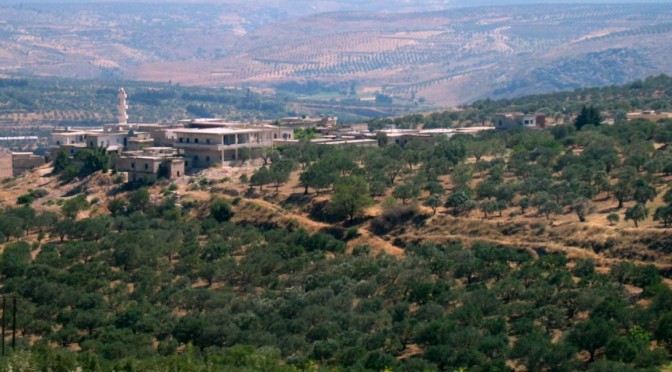
She woke to sunlight and quiet. The entire household was still asleep. She brewed a cup of tea, then went outside to pluck some fresh mint from the garden. She marveled at the serenity of the still-waking world. The olive trees were perfection itself: rows of them standing like sentinels, unmoved by even the faintest of breezes. A single black bird flapped across the sky.
She sat beneath an olive tree and leaned up against the trunk and sipped her tea. This is all she had ever wanted, this moment stretched into a lifetime. Cool mornings and olive trees and silence.
Her Wasp took up station over her.
“Good morning,” she said in English.
The Wasp gave no indication it had heard, but of course it had. It heard everything. Saw everything. Even smelled everything. All that data was aggregated and beamed to the United States and Canada and God knew where else, where it was filtered and analyzed and processed in vast server farms. Intelligent algorithms crunched away, drawing connections, matching words and behavior to pattern libraries, then sent their conclu- sions before hordes of young analysts sitting in the blue wash of computer screens. Perfect seeing. Perfect knowledge. And, when the wrong two pat- terns overlapped, perfect death.
He’d been pumping gas. What kind of pattern was that?
She went inside and found a pack of cigarettes in her husband’s jacket. She returned to her shaded spot under the tree and lit up. She smoked three cigarettes while she cruised the social networks on her phone, trying to forget, procrastinating. She’d been a queen in that world, once, back in the heady days when the revolution was young and the future was theirs for the making.
She had been a true believer. She marched with the protestors and shot video and live-tweeted massacres and built a following of more than fifteen thousand people. She made friends with activists and journalists and Middle East experts across the world. When the regime met their protests with war, she redoubled her efforts. And then, when the artillery barrages and the gunmen came to her village and they fled across the border to the Za’atri camp, she blogged every- thing.
She won prizes. Journalists sought her in person. She struck up an online friendship with a hacker in the Free Syrian Army, and when they discovered weeks later that they were both in the Za’atri camp, the future was written. The pregnancy came first, then a hasty marriage. A few years earlier this would have destroyed her family, but in Za’atri honor and shame were relics. They had never imagined the war would rage for nearly two decades. Never imagined it would end like this, in this frozen horror that was somehow worse than all that had come before. All that history had ground her down to almost nothing.
Her writing output was a lethargic trickle these days, and she was mostly forgotten. Mostly, but not entirely. She still knew people.
She started to compose an email.
It was around five o’clock that evening when Tariq came running to tell her that Wasp Keepers were approaching on the highway. She sent a text to Abu Hamza and Uncle Fouad, who were down at the gas station work- ing, and then went to the bathroom to wash her face and reapply her makeup. When she was finished, she put on her hijab and went out to the porch. The convoy had just turned off the highway. A cluster of dusty children watched mutely from the side of the road, one of them holding a soccer ball under his arm.
The convoy consisted of a mine-resistant Army truck and a silver
BMW surrounded by a swarm of Wasps. A squat steamroller the size of a Smart Car preceded the vehicles, feeling for IEDs buried in the road.
There were four soldiers, enveloped in so much armor and gear that the only things recognizably human about them were the square jaws ex- posed beneath the black goggles. When the first three dismounted, they went right past her and took up positions on the road. The fourth was a captain.
The captain nodded at her, then looked expectantly back to the BMW. The sole occupant of the car was a Syrian man about her father’s age, dressed in a striped collared shirt and a dusty blue sport coat. AR glasses enveloped his face. He did not immediately get out of the car. His window was rolled down, and Um Hamza could hear that he was on a call, negoti- ating a price. He drummed one hand on the steering wheel and gesticulat- ed with the other. He looked familiar, so while they all waited, Um Hamza discreetly snapped a photo of him and ran a search. The match was instant. The district police chief.
When he was finally finished, he got out of the car and both he and the captain came forward.
“As-salaam aleykum,” the captain said. He raised his goggles and there was a human face beneath, handsome and blonde and blue-eyed. “Ana kteer aasif likhsarit ibnik wa abooki.”
Um Hamza was impressed that this soldier had learned enough Arabic to say that. She also thought that if he offered any more sympathy for her loss, she would rip out his tongue and shove it down his throat.
The captain said that it would be best to visit the scene of the strike, so they walked down to the gas station, their Wasps a snarled cloud above them. The captain took off his helmet as they walked, a gesture Um Hamza knew was calculated to demonstrate trust, as if the mere act of exposing his sunburned scalp could somehow atone for the death of her boy and her father. By the time they reached the gas station they were pale with dust and the sweat ran down their backs. The captain intro- duced himself to Abu Hamza and Uncle Fouad, and then they all sat in plastic chairs in the customer service area adjacent to the auto shop while Tariq served Arabic coffee. When they were finished, he stacked the cups and sat down opposite the captain, glaring murderously at him. Um Hamza’s sister-in-law Noor arrived shortly after with a fruit tray and a bowl of dates. Um Hamza took the plate from her and offered it to the captain, and kept insisting until he finally took a single slice of apple. The police chief waved at her dismissively and lit up a cigarette.
“Why did you come?” Um Hamza asked while Noor poured a round of tea.
“You have some friends who really care about you,” everyone heard in a mechanical Arabic dialect. The captain subvocalized in English as a device on his chest translated.
“For God’s sake, turn that thing off,” Um Hamza said. “Which one was it?”
The captain shrugged and touched the device. In English he said,
“Logan Keesler ran a story. It got noticed in Washington.”
Um Hamza translated for her family. “So they sent you to pacify me?” “I just came to talk,” he said. His eyes were bloodshot and distant. He looked like he hadn’t slept in days. “You have the right to know why your son was targeted.”
“He was seventeen,” Um Hamza said.
The captain opened a camouflage bag at his side and handed them each a pair of AR glasses. Everyone turned them over in their hands suspiciously before putting them on. The captain said, “We know your family has been in the auto service industry for a long time. A whole chain of gas stations and auto shops before the war, right? You lost everything at the start of the war, but after three years in Za’atri, the three brothers returned home and got back into the business. It’s pretty remarkable you were able to finance all this.”
Um Hamza translated. Fouad glared at the captain.
The captain rose and stepped outside to survey the gas station. He said, “You made some interesting friends.”
They rose to join him so they could see what he was looking at.
A row of beat-up pickup trucks and vans was parked in front of the little masjid where customers could pray during gas stops. Gathered outside the door was a crowd of grim, thickly bearded Salafists toting handguns and AK-47s. The imagery was perfectly positioned and scaled, but it was black and white and heavily pixilated. While she watched, a younger clone of Uncle Fouad appeared and embraced one of the Islamists. They exchanged kisses on their cheeks.
“They were fighting the regime,” Fouad said in Arabic. “They just came to pray.”
“Understandable,” the captain said without missing a beat. He was probably still receiving machine translations. “But you spent hours with them. And they came a lot. Even after you knew they were pledged to al- Qa’eda, even after they toppled the regime and created their own government and you saw what they were capable of. Your brother Abu Khalid led prayers for them. He sat for hours with them teaching them about Islam. I don’t think it’s an exaggeration to say he was a spiritual mentor of sorts.”
“He taught anybody who would listen,” Um Hamza protested. “He thought they were misguided, maybe not even Muslim, but he thought the answer to that was more Islam, more truth.”
“And that’s why he smuggled weapons for them?”
Um Hamza broke into tears. The captain knew so much, he knew everything, and yet he understood nothing. It was all wrong, it was all cameras and robots and a string of connected dots that added up to something different from the wretched story they had lived.
She remembered when the Islamists first turned up at their gas sta- tion. Uncle Fouad, as it turned out, had worked some kind of deal with a mujahideen group in the Za’atri camp. They’d needed to smuggle weapons and ammunition into Syria, which meant they needed someone who knew vehicles and logistics. Fouad had acquired startup capital, bought the gas station, and used his contacts on both side of the border to build up a logistics network to import auto parts into Syria. Auto parts, that is, with a few bonus packages in the mix.
It had seemed a small enough thing, the kind of shadow bargaining on which survival depended in those violent days, but that deal took on a life of its own. The gas station got a reputation. Anti-regime fighters converged there, both the moderate types who’d been trained by the Americans in Jordan and the sneering Salafists who were just as likely to kill in- sufficiently pious Sunnis as they were regime soldiers. At first they negotiated business deals. Then they asked favors. Then they made demands. Uncle Fouad said no precisely one time. That experiment ended with Uncle Hatim, the third brother, dead in a ditch after torture by power drill.
That was the partnership Um Hamza remembered. Angry, bearded men. Guns. Terror. Extortion. But the captain walked them through his own narrative of these events, which unfolded before their eyes in a hurri- cane of light and color, the quality of the visuals improving sharply as the years raced by. Here was a full-service gas station that was a virtual safe house for terrorists and a key node in an arms smuggling ring. That’s what the Wasps saw. What the fusion centers assessed. Seventeen years of fear, condensed into one storyline, missing context and everything that comprised the normal fabric of their lives. Yes, they’d made terrible compromises, but hadn’t everyone? What choice did they have?
“But Hamza had nothing to do with this,” Um Hamza said.
“Three months ago your son took possession of an SA-14, an advanced MANPAD for shooting down airplanes. He was to hold it for safekeeping. He stashed it right there, in the back of your parts storeroom.”
Fouad swore in Arabic and wiped his face with one hand.
The transaction unfolded before their eyes, a living recreation of the past. An old gray Mazda pulling up to the pump. Hamza leaning in the window and talking to the driver. The driver extending a wad of bills. Hamza looking around, then signaling the driver to pull into the auto shop. The visuals were flawless. Um Hamza fought the urge to run to him, to embrace him, to plead with him to stop.
“He just wanted money,” Um Hamza said, the tears running down her cheeks now. “He probably didn’t even know what it was.” “He knew. Later he showed Tariq.”
Um Hamza shot a look at Tariq, who shook his head violently. He was crying.
“Yesterday, a customer arrived to claim the package,” the captain said. Here came the fruit truck, rumbling up to the gas pumps belching greasy black smoke. Hamza went to meet it, oblivious to the fact that he had only minutes to live.
The captain said, “It was an active plot. The Islamists intended to use the weapon a few hours later, when the Syrian president returned from Paris. The Transitional Authority acted.”
The captain slowly took off his glasses and tucked them carefully in the bag, as if sobered by the tragedy of what he had just explained. “I am genuinely sorry for the loss of your loved ones, but you brought this on yourselves. This is the life you raised Hamza into. When he came of age, he made some terrible choices of his own.”
“You know nothing about him!”
“On the contrary, we know everything about him.”
“Do you have any idea what it’s like?” Um Hamza cried. “What? ”
“War. ”
“I know about war. ”
“No, that’s not what I mean. Not what you’re doing. I mean war. The things you have to do. The choices you have to make. The consequences if you don’t. The fear. ” She wiped her eyes. “You don’t have any idea what I’m talking about. ”
The captain frowned and looked out at the horizon for a long time, as if lost in some terrible memory. Despite all his gear, armor, and the cloud of Wasps ready to make war on his behalf, he looked exhausted beyond his years, even a little fragile. Um Hamza wondered how many times he had had this conversation.
“Just once,” he said softly, still looking to the sunburnt horizon, “I want to find one Syrian who is grateful for what we’ve done for this country. What we’ve sacrificed, the friends we’ve lost. You’ve been at war almost as long as I’ve been alive, and we’ve stopped the cycle. Do you realize how incredible that is?”
“You killed my father and my son.”
“They chose to fight,” the captain said, shrugging. “I don’t get it. I wish someone could explain it to me. How many more decades of war do you want?”
“We want to be free,” said Abu Hamza.
“You are free, as long as you don’t fight. No one dies unless he chooses to. There’s no more strategic bombing, no more ground occupation, no more drone strikes, no more collateral damage. It’s just…awareness. Knowledge. Insurgency is impossible. We’ve freed you from violence, given you the best chance in years for a peaceful new future. I don’t understand why you can’t accept that.”
Peace? she thought, looking at the police chief, who had wandered off and was negotiating some new deal on his expensive imported AR head- set. This is peace?
“I am sorry for your loss,” the captain said “This was a needless tragedy. I hope you’ll think long and hard about the choices that lie ahead. You still have one son. I pray to God that you will choose a future of peace, in sha’ Allah.”
The captain put on his helmet and nodded to the police chief that it was time to leave.
“Thank you for the tea,” he said.
That night they sat on the patio, drinking coffee and smoking sullenly. Their Wasps hovered above them in the warm orb cast by the porch light. It would have been safer to stay inside, but it was a pleasant night and they refused to be intimidated. There was something thrilling about sitting in front of those watchful eyes, putting their hatred on open display. In a world where resistance was impossible, even talking was an act of courage. “That police chief,” Fouad said between angry puffs on the nargeelah.
“That fucking BMW.”
He was drunk. Um Hamza didn’t know when or how he’d achieved that feat, as he never drank in front of the family, but he’d done a thor- ough job of it.
“You know him?” Um Hamza asked.
“Yeah, I know him,” Fouad said, the smoke pouring forth from his lips, as if he was trying to excise the very memory of the police chief from his body. “You two haven’t asked the question, but I know you’re dying to. Why the hell is it Fouad that’s sitting here smoking and drinking instead of your father?”
It was true. She had wondered exactly that. Her father had been a simple man, kind and pious and respectable, without a hint of guile. Fouad was the shrewd empire builder who had turned an auto parts supply chain into a profitable arms smuggling network.
“About six months ago, that police chief came by the gas station. The Occupation was sharing all its intel with him. He knew everything. You know why he came by? He wanted a cut. To keep quiet. I told him no.”
Fouad started to laugh, and swung his head from side to side in exag- gerated, drunken disbelief.
“Son a bitch knew how to pay me back,” he said. He raised his coffee cup. “Long live the peaceful new Syria.”
Um Hamza knocked gently on the boys’ door. When she heard nothing, she turned the knob. She stood in the doorway, the light behind her illuminating the shape of Tariq asleep in one bed and the tangled, empty sheets on the other. She studied the sheets, marveling at them. Exactly as Hamza had left them when he rose from bed yesterday.
She knelt beside her living son. He was so different from his brother.
Even with all that had happened, Hamza had a natural sweetness to him, a legacy of his grandfather. He loved God. But Tariq hated, and for him life itself was a war. That manifested itself in everything. The rage. The argu- ments. He often came home bruised and bloody, and refused to say where he had been or what had happened. At least twice, he had sent other boys to the hospital. He needed violence the way he needed air.
Sleep effaced all that, wound the clock back to a time before the war had damaged him. Amazing that her child still lurked in there, after all that he had suffered. It wasn’t his fault, being the way he was. He was a good boy, a strong boy who in a better life would have gone on to do such great things. But here…
In three years they would receive another birthday card, and another Wasp would find its way into their olive grove. One more node would appear in the Occupation’s vast Syrian intelligence matrix. When that hap- pened, Tariq would die. It might be two days or it might be two years, but the boy who couldn’t help fighting in the streets would most certainly fight the Occupation.
If the Occupation did not end, Tariq would die. But it wouldn’t end. It couldn’t. The least relaxation of control would mean chaos.
She thought back to the captain’s words. The Wasp Keepers had ended almost two decades of war. It was nothing short of a miracle, unprecedented in history. Perfect knowledge. Perfect killing. War that was as intimate as a friend sitting next to you, a friend that would protect you from all harm but would also kill you with a kiss if you let slip any hint of treason.
It was hatefully, intolerably perfect.
And yet there were no winners, not even the Occupation. The captain had understood that. He was exhausted and embittered by a war that, for all his impressive ability to control, had not delivered victory. The things that mattered most were still beyond their reach.
If they could not win, that meant they could still lose. The thought electrified her. After that revelation, everything fell into place.
She kissed Tariq on the head. Maybe she could yet save his life.
There was one thing she could still do. One choice they could all make. It was the single choice that eluded the Occupation’s control, and that terrified them.
The rest of the night passed like a dream. For the first time since childhood, she was free. She went to her husband and gave herself to him, not because he was entitled to it but because she chose to. For a few moments she felt something of what she’d once known with this talented young revolutionary in the Za’atri camp. Afterward, while he slept, she wrote letters. Longhand. Beyond the reach of the Occupation. She left them trifolded on her desk, the names written on the back in elegant Arabic calligraphy.
After that she sat outside beneath her olive tree. It was still, and silent, and the stars wheeled freely in the sky as if there had never been a war and war was something altogether inconceivable. The peace she had always wanted. She recalled memories of Hamza, and of Tariq, and of her husband before the war had changed him. Of her father, leading prayers in the gas station masjid for poor refugees with their battered cars, limping their way northward again after the first lull in the fighting.
She sat beneath the tree until the sky began to lighten in the east, and the first cars appeared down on the highway. Then she rose on stiff joints and brushed herself off. One leg had fallen asleep. She hobbled over to the porch, shaking the leg awake again. She had composed the email to Logan Keesler earlier in the night. She sent it now, then propped the phone up on the railing and started a video recording.
She said a few words into the camera. Then she smiled and turned.
Her Wasp stared down at her, a motionless black smear in the sky. The other family Wasps were perched on the railing, charging in the morning sun. Stupid, mindless things. They knew everything and they knew nothing.
She reached into the folds of her robe and withdrew the cigarette lighter and the can of hairspray. With one flick of her wrist, her Wasp was a burning point of brightness in the sheet of flame.
It hadn’t yet hit the ground when the other Wasps converged on her. She felt the hot pricks of the stingers, and a moment later the olive grove spun sideways.
Mark Jacobsen is a C-17 Instructor Pilot and Middle East Specialist in the US Air Force, and is currently working towards a PhD in Political Science at Stanford University. When he isn’t writing about drones in Syria, he is building them; as the Executive Director of the Syria Airlift Project he is developing a new paradigm for swarming humanitarian aid into besieged or hard-to-reach areas. He has one novel available, The Lords of Harambee, about a military peacekeeping force that is ordered not to intervene in a genocide.