Category Archives: Future Tech

What is coming down the pipe in naval and maritime technology?

Death From Above

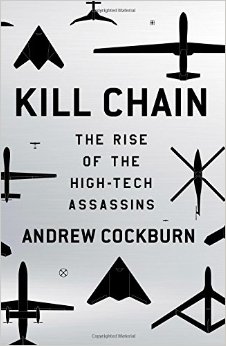
Kill Chain

Andrew Cockburn. Kill Chain: The Rise of the High-Tech Assassins. Henry Holt Publishers. 307pp. $28.00.

It’s not often that a book review coincides with current events. Books, particularly nonfiction, are usually written and published months, if not years after an event has occurred. That’s because good nonfiction is written in retrospect: writers have spent some time absorbing their subject, researching and analyzing the facts; authors are hesitant to be rash in judgment or thought.

However, there are exceptions. Some pieces of nonfiction, particularly journalists’ works, are appropriate now — not later. Andrew Cockburn’s new book, Kill Chain: The Rise of the High-Tech Assassins, is one of them.  Cockburn’s book is timely.  In just the past few weeks there has been a flood of reporting from media outlets stating that a drone strike killed an American and an Italian hostage when targeting a group of Al-Qaeda members operating near the Afghanistan-Pakistan border.

Suddenly, questions about drone strikes, the debate about targeted killing, and the transparency of the drone program are on the front page of print and online news media worldwide.

Yes, timely indeed.

Although Cockburn’s book cover is plastered with silhouettes of unmanned aerial vehicles — with what appears to be the X-47B, Predator, Global Hawk, and Fire Scout, among others — he is making a larger argument.  Cockburn it seems, is arguing that all technology is suspect.  It’s not simply unmanned aerial vehicles, but it’s the idea that human beings are continuously so bold as to come up with technological solutions that will win our wars.   History, however, tells us a much different story.

Cockburn, then, starts his book with an interesting tale.

In 1966 the Vietnam War was not going well.  Secretary McNamara, a man who was fond of scientific solutions to difficult problems, turned his attention to “The Jasons.”  The Jasons, Cockburn says, were a small group of scientists and scholars, many of whom would go on to become Nobel Prize winners. These were also some of the same men — Carl Kaysen, Richard Garwin, George Kistiakowski — that were part of the Manhattan Project some twenty years earlier.

The Jasons tried to do what Rolling Thunder could not — they tried to figure out a way to defeat North Vietnam’s ability to use the Ho Chi Minh trail — to cut off their supply routes.  They ended up deploying small sensors along the trail that could, presumably, pick up the noise, vibration, and in some cases, the ammonia of someone urinating, all in an attempt to locate men and machines moving goods to the South.  Then, if they could hear them and find them, U.S. commanders could task air strikes against the communists on the trail.  It didn’t take long, Cockburn says, for the North Vietnamese to find a work-around.  How long?  It took one week.  Cockburn notes that all the North Vietnamese had to do was to use cows and trucks, often running over an area of the trail multiple times to create a diversion while the real logistical effort was moved elsewhere.  So simple and so effective — and relatively inexpensive.  However, Cockburn says the cost of the electronic barrier for the U.S. was around six billion dollars.

This formula is repeated throughout the rest of the book.  That is 1) There is a military problem 2) Someone always tries to find a technological solution, and then 3) Spends a lot of money only to find out the U.S. has made the problem worse.

Now fast forward almost sixty-years to the age of drones, and Cockburn introduces us to Rex Rivolo, an analyst at the Institute of Defense Analysis.  It’s 2007 and improvised explosive devices are a major problem; they are killing and maiming hundreds of U.S. troops in Iraq.  Asked to analyze the networks behind the IEDs, Rivolo, Cockburn says, discovers that targeted killings of these networks  lead to more attacks, not fewer.  This is because someone more aggressive fills the place of the leader who was recently killed.  Rivolo would return to D.C., even getting the ear of the Director of National Intelligence, Dennis Blair, telling him that attacking high- value targets was not the right strategy — the IED networks and individuals setting them off were more autonomous then was initially thought.  Going after the senior guy, Rivolo noted, was not the answer.  But, as Cockburn says, nothing changed. Now people simply refer to the continous cycle of targeting and killing  high-value targets as “mowing the grass.”

The idea of killing  senior leaders or HVTs is not new, it’s been around for a long time (think Caesar).  Cockburn, then, brings up one of the more interesting “what if’s” that military officers — or any student of military history — likes to debate.  That is, what if someone had killed Hitler before the end of the war?  Would the war have ended?  Or would he have become a martyr and someone worse or someone better have taken his place?  Cockburn tells us about British Lieutenant Colonel Robert Thornley, who argued during WWII that, no, the Fuhrer should not be killed.  Thornley noted, that if Hitler was killed, his death would likely make him a martyr for national socialism.  And that Hitler was often a man that “override completely the soundest military appreciation and thereby helped the Allied cause tremendously.”  Therefore, the thinking went, we should let Hitler live and dig his own grave.

However, the problem with this debate is that context matters.  Was it Germany in 1933? 1938? Or 1944? It matters because while Cockburn does not differentiate between the killing of a leader of a state and the leader of a terrorist network, they are indeed different systems that have different levers of power and legitimacy.

He is on firmer ground when he rightly notes how difficult it is for anyone to predict systemic effects when targeting a network.  He reiterates these difficulties throughout the book.  The most historical compelling case is WWII and the strategic bombing campaign.  All one has to do is pick up the WWII U.S. Strategic Bombing Survey and read the fine work done by John K. Galbraith, Paul Nitze, and others.  Disrupting or destroying networks from the air — in this case, Germany’s economy — was incredibly difficult.  In many cases, assumptions of German capabilities or weaknesses were far from correct.  And as Cockburn notes, the term “effects based operations,” namely, operations that are military and nonmilitary that can disrupt complex systems while minimizing risk, was a term that was outlawed in 2008 by General Mattis while the head of Joint Forces Command.

Ultimately, the debate over drones — who should control them, what should they be used for, should the U.S. target particular individuals — will continue.  It’s an important topic.  There are, however, a few shortcomings in this book.  One of the biggest questions that goes unanswered is this: If the U.S. should not strike identified enemies or high-value targets…then what?  Do nothing? Allow a Hitler to simply remain in power?  Is this not a form of moral ignorance?

The questions military planners and policy makers should ask is this:  Do we understand the character of this war?  And are these the right tools we should use to win this war?  We should not blame a drone — or any other type of tech for that matter — for bad strategies, poor operational planning, and gooned up tactics.

Drones are the future.  But we should read Cockburn’s book as a cautionary tale.  We should disabuse ourselves of the illusion that future technologies will be our savior.  And finally, we should not let those illusions crowd out the very difficult task  of understanding our adversaries and the enduring nature of war.

Andrew Cockburn’s book is worth reading.  But have your pencil ready — you’ll want to  argue with him in the margins.

Lieutenant Commander Christopher Nelson, USN, is a naval intelligence officer and recent graduate of the U.S. Naval War College and the Navy’s operational planning school, the Maritime Advanced Warfighting School in Newport, RI.  LCDR Nelson is also CIMSEC’s book review editor and is looking for readers interested in reviewing books for CIMSEC.  You can contact him at books@cimsec.org.  The views above are the authors and do not necessarily represent those of the US Navy or the US Department of Defense.


Can Small AUVs Work at Sea?

This post published on NavalDrones.com and was republished with permission. It may read in its original form here.

The researchers at CoCoRo continue to push the limits of autonomy and swarming behavior with autonomous underwater vehicles (AUVs). Recently, they’ve taken their AUVs out of the controlled laboratory tanks and into the wild, with small scale tests in ponds, lakes, and protected ocean harbors. These robots are prototypes designed to explore small scale autonomous group behavior. But the ocean tests hint at possibilities of using smaller marine robots to perform useful functions.

Unmanned Underwater Vehicles employed in military and research operations range in size from man portable, weighing less than 100 pounds, to monsters such as Boeing’s Echo Ranger, which weighs more than 5,000 kilograms. Small scale AUVs weighing less than a few kilograms or so are limited in endurance primarily due to battery size. More importantly, the ocean environment presents a number of challenges for tinier AUVs including surf and currents, poor visibility, and even hungry marine predators. But CoCoRo’s tests of their “Lily” and “Jeff” robots are early indications that these types of AUVs can operate on a limited scale in ocean conditions. What say you, readers? Can small AUV’s do real work in a maritime environment? If so, what are some potential applications for mini-AUVs? Can the obstacles the ocean presents to AUVs be overcome with larger numbers of vehicles or swarming behavior? 

The Importance of Space in Maritime Security

Honorable Mention – CIMSEC High School Essay Contest

As long as man has walked the Earth and gazed into the stars, he’s asked “what’s out there what’s waiting for me?” Today, our country asks that very same question, although not for what we can find, but how we can use Space and its resources to advance our scientific and military might into, and hopefully beyond the 21st century.

GPS_Satellite_NASA_art-iifWith the dawn of rockets and the nuclear confrontation between the United States and the Soviet Union during the height of the Cold War, Space would soon become a vital asset for the interests of both countries and other major players for the years to come (particularly China). With the sudden rise of China, and the reemergence of the Russia as a major military power, it is absolutely vital that the United States once again pursue Space for economic, political, and commercial purposes, as well as for strategic military purposes which will benefit not only the military, but the United States as a whole; and how our Navy can play a big role in helping us make this happen.

As of the time of this writing, the United States and other Western European Countries are currently embroiled in a geopolitical dispute with Russia over Ukraine and the rights of its territory such as Crimea and Eastern Ukraine. As a result of this, the United States and the European Union declared economic sanctions on Russia which are meant to cripple the Russian economy and force Russia out over its interference in Ukraine. In response to this, the Kremlin has threatened to stop shuttling Astronauts to and from the International Space Station, and cut off supplies to the ISS.  In 2007, the Chinese military carried out its first antisatellite missile test when it launched a ground based missile 500 miles to destroy an aging satellite of theirs.

Both of these events are very disturbing as they easily threaten the United States and its space capability to carry out intelligence gathering and reconnaissance missions in Space using the latest technology and satellites. If these satellites, whether civilian or military, ever happen to be threatened in a time of war, the results could be catastrophic. The Navy should invest in further developing laser weapons like the LaWS that are capable of punching holes through thick steel plates on ships as well as a countermeasure against any ballistic missile that may threaten our satellite capability in Space or onboard the ISS. Laser weapons are surprisingly very cheap and affordable. According to Rear Admiral Matthew Klunder in an interview for defense-aerospace.com, “with affordability a serious concern for our defense budgets, this will more effectively manage resources to ensure our sailors and marines are never in a fair fight.” The article goes on to claim that firing this type of weapon can cost less than $1 dollar per shot; a great bargain in a time that our military is starting to see a drawdown in military spending. Christopher Harrier, an analyst at the Institute for the Study of War was quoted as saying that: “The existing naval weapons systems, small-caliber cannons, large-caliber naval guns, and missiles, are at or near the limits of their potential capability. Guns and missiles just aren’t going to get much more accurate or lethal while lasers have significant potential for increases in range, accuracy, lethality, reliability, and cost-effectiveness.”

It is clear that if the Navy wants to confront new 21st Century threats, it must research and develop new combat systems, whether it is by land, sea, air, or space.  The Russians and the Chinese are also looking into developing similar weapons systems, while also trying to implement a missile defense system capable of intercepting and eliminating enemy targets. With a resurgent Russia and emerging China, this has become a must for defense of our allies and overseas military installations all around the world. It has been stated that an enemy country wouldn’t necessarily have to launch a direct nuclear strike if it wanted to destroy the United States. Countries like China and Russia could simply detonate a nuclear weapon in the upper atmosphere right over the Midwestern United States and knock out most, if not all, of the electrical power grids in the continental United States through an Electromagnetic Pulse Effect. An EMP would be devastating to the United States as it would cripple our infrastructure, down all of our technology, leave the US Government and military crippled and slow to react, and cause the global economy to collapse. It would be a scene right out of a post-apocalyptic film like The Postman or The Book of Eli. Not to mention the millions of casualties and deaths that would occur due to starvation or anarchy. It would truly be a shame and a complete lack of competence if our Government doesn’t have a contingency plan already in place for an event like this.

In order for this plan on space based missile defense to work however, it must learn from the mistakes made in the 1980’s when Ronald Reagan famously proposed in 1983 his SDI (Strategic Defense Initiative) or the “Star Wars Program”. As many people know, SDI was announced in 1983 by Ronald Reagan as a means of countering the Soviet threat with space based weaponry capable of shooting down any Soviet missile before it entered American airspace. Unfortunately, due to the slow technological development at the time of space based missile defense systems, as well as other factors including the Dissolution of the USSR, inefficiency, and overall lack of continued public support, SDI did not succeed in meeting its goals.

In comparison to the 1980’s-early 90’s, America does have the infrastructure in 2015 to support a new SDI type program. For starters, in 1983 something called: “private space companies” did not exist. With companies such as SpaceX, Virgin Galactic, Orbital Sciences, and Blue Origin starting to appear and establish themselves as legitimate companies in the aerospace sector, there’s no reason why they couldn’t be expected to help the American military develop a space based missile defense system. Similar to how other Aerospace contractors such as Boeing and Lockheed Martin have helped the Air Force in its development of their new aircraft and weapons systems, a joint government/private program with the DoD and Navy providing the funding, and the private companies will handle the testing and development could be developed. That way there won’t be as large of an outcry by the public as there was with SDI in the 1980’s and the politicians/military leaders don’t have to worry so much about any failures and the potential political backlash with the program, as it will fall on the shoulders of the private contractors. Plus, this program will be more affordable now than it ever was in the 1980s.

SpaceX is currently developing the Falcon-9 space rocket with the intention of making it reusable and cheaper to launch into orbit. According to NASA, the average typical launch cost for the Space Shuttle Program was $450 million dollars. With the SpaceX designed Falcon-9 rocket, that cost is now about 50-56 million USD, an absolute bargain when compared to how much NASA’s launches cost. The biggest obstacle to this plan would not necessarily be the technical or financial challenges involved, but compliance with international law such as the 1967 Outer Space Treaty. Article IV of the 1967 Space Treaty states: “States Parties to the Treaty undertake not to place in orbit around the earth any objects carrying nuclear weapons or any other kinds of weapons of mass destruction, install such weapons on celestial bodies, or station such weapons in outer space in any other manner.

The moon and other celestial bodies shall be used by all States Parties to the Treaty exclusively for peaceful purposes. The establishment of military bases, installations and fortifications, the testing of any type of weapons and the conduct of military maneuvers on celestial bodies shall be forbidden. The use of military personnel for scientific research or for any other peaceful purposes shall not be prohibited. The use of any equipment or facility necessary for peaceful exploration of the moon and other celestial bodies shall also not be prohibited. “

The key words in this text being: “Nuclear or any kinds of weapons of mass destruction.” WMD’s are most often defined as being either: Biological, Chemical, Radiological, or Nuclear.  Since lasers do not fall into either of these specifically defined categories (as lasers are electromagnetic), this would not violate international law regarding space and weapons of mass destruction. And their primary purpose would be defensive in nature. The Navy could easily place these interceptors on ships or in bases around the world in order to be alerted by any of these threats, as well as satellites which can track and locate enemy ships and submarines before they attack.

It is obvious that space will play a critical role in the development of naval affairs and maritime security through the use of satellites and space based defense which will be used to further America’s Naval supremacy in both the Sea and Space throughout the rest of the 21st century and beyond. As we can see, the Navy will not just be limited to the sea but will have an increasingly expanded role as technology and space travel progresses.

Citations:

http://bart.tcc.virginia.edu/classes/200R/Projects/fall_2002/nasa/casestudies–sdi.html

http://www.fas.org/spp/starwars/offdocs/m8310017.htm,

http://history.nasa.gov/1967treaty.html,

http://www.spacex.com/falcon9

http://www.politico.com/story/2013/06/electromagnetic–pulse–newtgingrich–emp–attack–93002.html

About the Author 

Nolan McEleney was born in Jacksonville, Florida in 1996 and is a diehard fan of the Jacksonville Jaguars. His family moved to CT in 2005, before finally settling in MD in 2008. Nolan is currently a cadet officer in the Civil Air Patrol for the Bethesda-Chevy Chase Composite Squadron where he is currently assigned as a flight commander. Nolan currently attends The Avalon School in Gaithersburg where he is the Washington house captain. In extracurriculars, he is heavily involved with the Civil Air Patrol. Nolan is also a part of his squadrons cyberpatriot team which deals with cybersecurity and other threats as part of a nationwide competition. He has also taken online courses with the Cisco Networking Academy and Hillsdale College. 

 In the future, Nolan would like to work with NASA, a private space company, or any science and tech company. Whether it be in a technical or non-technical role, he feel like a lot of these companies such as SpaceX are on the cusp of history with proposed missions to the Moon, Mars, and beyond. He would also like to be a part of and contribute to that in any way he can. Nolan currently intends on going to the University of Washington and participating in ROTC so that he can become an officer.  

To Safeguard the Seas

The United States Navy is the most preeminent naval force in the world.  Following Alfred Mahan dictum that “a truly powerful nation must have thriving international trade, a merchant fleet to carry these goods and a strong navy to protect its sea lanes,” the U.S. Navy has provided stability, tranquility and maintained the global order since the end of World War II.   However, in this age of austerity, the ability of our aging fleet to secure our interests, protect our allies and confront our adversaries is being sorely tested.

As we paused in remembrance of the 73rd anniversary of the surprise attack on Pearl Harbor, Hawaii, by the Imperial forces of Japan, we again see a rising power in Asia bent on changing the status quo, increasing pressure on our allies and challenging America’s preeminence in the Pacific.

China’s assertiveness in the South China Sea over the past few years is significant as it “directly challenges America’s position as the primary maritime power in Asia and as the guardian of the old regional order,” said Hugh White.  As Ronald O’Rouke, specialist in Naval Affairs at the Congressional Research Service testified before Congress, he expects China “to continue putting pressure on its neighbors’ short of war in the East China and South China Seas to get its way in the region.”

It is clear our Navy is facing ever-increasing operational challenges, including not only air and sub-surface threats but also supersonic cruise missiles and ballistic missiles (both anti-ship and surface to surface).   Individually, these threats are difficult enough to combat, however, when encountered simultaneously; these threats severely challenge the current capabilities of our Navy.  With a rapidly expanding Chinese Navy, coupled with the increased pace of Russia’s ship building efforts, the pressure to do more with less compels us to develop new technologies to maintain the advantage if or when confrontations occur.

For the last 70 years, radar has played a key role in maintaining technological superiority over our adversaries.  Over the last decade, however, our radar capabilities have proved to be increasingly incapable of addressing existing and emerging threats.  This, in turn, directly impacts the Navy’s ability to assure maritime security and freedom of the seas.

Fortunately, the Pentagon has taken positive steps to rectify the situation by making investments in the next generation of radars.  The Air and Missile Defense S-Band Radar (AMDR) is an excellent example of advanced radar technology that will fill critical capability gaps and ensure our sailors can meet the ever changing demands of today’s global threat environment.

Designed to replace the ageing Aegis combat system currently employed in the fleet the AMDR is constructed as a self-contained radar that is scalable for any platform for any mission, with the ability to exponentially increase radar sensitivity.  Not only will the AMDR more accurately detect missile threats, but it will also help ships run more efficiently.  This new system reduces space, weight, power, and cooling demands of naval vessels, thereby maximizing the service life of the ships that incorporate this new technology.   These long-term cost savings make AMDR a wise use of limited taxpayer dollars in today’s austere budget environment.

With the ability to confront multiple threats simultaneously — even in the presence of heavy land, sea, and rain clutter — the technological advancement of the AMDR is truly remarkable. Scheduled to begin installation on the Arleigh Burke class destroyers’ starting in 2016 the AMDR is the technologically advanced, low-risk, cost-effective radar solution to combat today and tomorrow’s threats.

Tasked with the daunting challenge of maintaining freedom of the seas, deterring international aggression, and playing pivotal roles in times of war the U.S. Navy has earned naval supremacy, not only because of the skill of our sailors, but also because it has invested great effort and money to provide the finest technology in modern warfare.  This trend must continue with essential defense programs so that we may stay one step ahead of evolving threats.  Doing so will protect our national interests and ensure the safety of our sailors and war fighters. John F. Kennedy said it best, “Control of the seas means security. Control of the seas means peace. Control of the seas can mean victory. The United States must control the sea if it is to protect our security.”

Commander Feldkamp is a retired Naval Electronic Counter-Measure Officer (ECMO).  He flew combat missions in Desert Storm off the U.S.S. Midway and served as the international outreach officer for the National Maritime Intelligence-Integration Office and the Office of Global Maritime Situational Awareness in Washington, D.C. He currently is an adjunct professor teaching the theories and politics of terrorism at George Mason University.