Category Archives: Current Operations

On-going Naval Ops or Maritime Current Events

A Bill Too Far? Japan’s Security Legislation and East Asian Security Dynamics

By Justin Chock

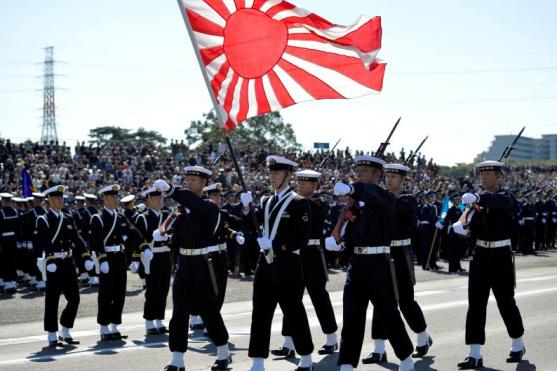
Recently, Japan’s parliament approved a set of historic bills: Japan is no longer limited to only defending its own military hardware, and is now able to use its Japan Self-Defense Force (JSDF) to assist its allies whether through military action or logistical support. The original restriction stems from Article 9 of Japan’s constitution, stating that “the Japanese people forever renounce war as a sovereign right of the nation and the threat or use of force as means of settling international disputes.” These bills now reinterpret that passage.

The first bill, as explained by the Japan Times, amends ten laws, and includes lifting the previous restrictions on the JSDF’s collective self-defense capability (the ability to defend an ally under attack rather than one’s own units). Collective self-defense will be limited to three conditions however: Japan, or a close ally, must be attacked with a result threatening Japan’s survival and posing a clear danger to people; force must be the only appropriate means available to repel the attack; and the force is the necessary minimum to negate the aforementioned threat.

The second bill is a permanent law that allows Japan to deploy the JSDF overseas to support UN-authorized military operations by providing logistic support (which Japan previously conducted with the US).
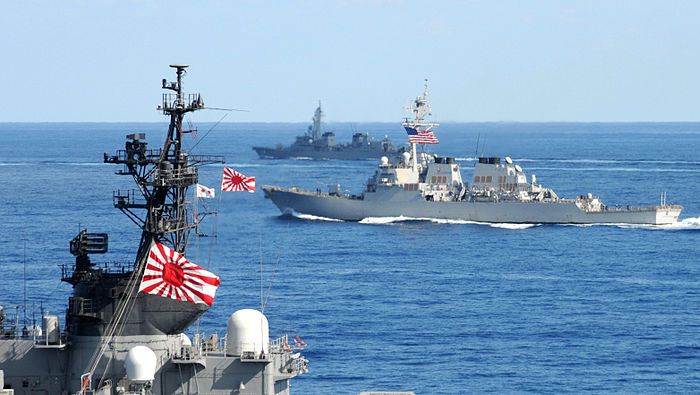
But now that the long-anticipated bills are through, how does this change the strategic calculus in East Asia? Will the maritime territorial disputes over the Senkaku/Diaoyu Islands or the South China Sea ignite over a stronger, more capable Japan?

I argue that while the bills strengthen Japan’s alliances, especially the US-Japan Alliance, this change will not lead to conflict as the bill’s opponents suggest.

From Renouncing War to Proactive Peace

A brief look at the history of Japan’s pacifist constitution is in order for understanding these recent developments. During the US occupation of Japan following World War II, America held two complimentary worries in East Asia: a remilitarized Japan and the onset of the cold war, including a stronger Soviet Union and the increasingly popular Japanese Socialist Party. The solution to both concerns was to maintain an American foothold in Japan as was the same in Germany.

But the US presence was in many ways, like the European case, invited; both General MacArthur and the newly appointed Prime Minister, Kujiro Shidehara, agreed that the introduction of the Article 9 peace clause to Japan’s new constitution would be to the benefit of all (although the originator of the idea is still under dispute). Japanese foreign policy soon adapted to Article 9, as seen by Japan’s newly elected government under Prime Minster Shigeru Yoshida. His “Yoshida Doctrine” relied on the US for security while Japan focused on its economy, and subsequent administrations did not stray far from this baseline (for example, the “Fukuda Doctrine” reiterated Japan’s peaceful orientation while adding a focus on development assistance).

But the most recent framework for Japan’s foreign policy, the “Abe Doctrine,” took a dramatic shift. Under Prime Minster Abe, Japan would no longer be held back by concerns over remilitarization, and would deepen engagement with the US while globally emphasizing “value-oriented” diplomacy. Japan as a “Proactive Contributor to Peace” expanded its defense organizations in various ways during the previous few years through the second-ever update of the US-Japan Defense Cooperation Guidelines (since its last version in 1997), the creation of a National Security Council modeling the American version, the update of the Japan National Defense Program Guidelines, and the recent expansion of Japan’s Defense Equipment and Technology Transfer program, among many other initiatives.

But the projects named above, as expansive for Japan’s defense policy as they were, all came in 2013. Even the 2015 bills were simply a formality to an already accepted change in interpretation by the Japanese cabinet in July 2014, and as noted earlier, there are many restrictions with the bills that keep the JSDF within its typical roles. Thus Japan’s security apparatus was already significantly transformed before any voting took place in the parliament, and the bills are not in and of themselves groundbreaking when seen in the backdrop of all of the other recent changes.

The Chinese Dragon’s Puff?

Supporters in Japan often argue that the bills are necessary in light of China’s growth as an Asian power, to include its military modernization and increasingly assertive foreign policy. So as a response, will China view the Japanese bills as the beginning of a security dilemma with its neighbor and force an East Asian arms race?

The answer is “not likely.” China’s response was actually quite muted. The Chinese government’s solemn but simple “urge” seems beneath its regional power standing, especially when directed to a country that some don’t even rank in the Top 5 militaries in Asia, and even more so when the US comparatively receives “strong opposition” for simply publishing a routine, annual report on China’s Military and Security developments.

But China’s restrained statement supports the idea that, despite anti-Japanese nationalistic protests and extravagant military parades commemorating WWII (read: “War of Resistance Against Japanese Aggression”), China’s focus isn’t Japan. If anything, the US and its Southeast Asian partners like the Philippines are China’s true focus with artificial island building in the South China Sea and ships sailing within 12 nautical miles of the US coast in Alaska.

So if China isn’t overly concerned with these bills nor with Japan itself, what do they, if anything, mean for Asia-Pacific security?

Shifting Security Tides?

First, the bills seem to make few changes to the JSDF’s defensive orientation. As noted earlier, the reinterpretation has already been in effect for a year, and although much has happened since July 2014, the JSDF’s operations have remained fairly routine. With the bills, the options for military action increase, but the probability of their implementation remains quite low and only toward the higher-end of the spectrum of conflict. Fears of a remilitarized Japan that stem from the post-WWII era seem similarly unlikely at this point, and a Sino-Japanese arms race seems similarly unlikely given China’s minimal response.

Second however, Japan’s international involvement will become increasingly global in nature in the “proactive” way that Abe hopes. The legal opening to participate in UN operations will allow Japan to send troops to a wider expanse of the globe as a part of these peacekeeping missions. Similarly, seeing the bills as strength for the US-Japan alliance could lead decision makers to begin the proposed joint patrols in the South China Sea, a move to China’s dismay. Japan playing a larger military role in the Asia-Pacific would, in theory, provide a counterweight to recent increases in Chinese military power (although perhaps the upcoming troop reduction is signaling the end of this growth), but it could just as easily create opportunities for friction that lead to an undesired crisis. The implications of a more proactive Japan are up to the future, but the idea of Japan operating in a wider expanse of the globe is quite certain.

Third, the US-Japan Alliance is receiving a legal and psychological upgrade. In addition to Japan’s new capabilities to include intercepting a missile bound for a US warship, the legislation mitigates America’s historic complaint of Japan not pulling its weight in the alliance. In addition, working alongside JSDF forces during UN operations or increased bilateral training supporting a stronger US-Japan Alliance will have a psychological effect on these countries. Trust is already increasing, as 2015 Pew polls show, “two-thirds of Americans trust Japan a great deal or a fair amount and three-quarters of Japanese say they trust the United States.” This trust will only increase as the two forces work even closer together.

Lastly, the political process for reinterpretation is somewhat worrying from a Japanese domestic legal order standpoint. The current bills still came at a substantial political cost; PM Abe’s approval rating now stands at 40 percent, with his disapproval rating at 47 percent. The bill’s disapproval rating was 54 percent (although the cause was linked to a perceived lack of explanation from the government) with only 31 percent approving, and protests outside the building further demonstrated the depth of opposition. The resulting physical “scuffle” within the parliament itself during the signing was also rare for Japanese politics. Despite all of the pushback, the bills still passed, once again demonstrating how Japan is historically adept at reinterpreting rather than amending its constitution. Technically speaking however, the constitution’s Article 96 outlines the amendment process, and requires both a two-thirds vote in the parliament and a majority vote by the public, with no such amendment ever occurring in the constitution’s history. While these current bills maintain the East Asian balance of power, future legislation may go too far; the potential still exists for a future government to reinterpret the constitution through this same process in a way that inadvertently starts a security dilemma.

Admittedly though, reinterpretations aren’t inherently bad. Reading a strict, literal interpretation of Article 9’s stipulation that “land, sea, and air forces… will never be maintained” would have rendered the JSDF unconstitutional a long time ago. Yet the reinterpretation (or rather the “self-defense” title) leading to their creation turned out to be the right decision as the JSDF continues to prove itself in numerous ways to be an incredibly beneficial force (the discussion of the JSDF itself to be saved for another day). Thus on the point of reinterpretations, the responsibility will be up to the Japanese public and government to continue striking just the right balance of force to maintain security for all.

Only time will tell whether the bills will make Abe’s “proactive contribution to peace” or create regional friction. But despite the domestic uproar in Japan over the bills’ passage, the Asia-Pacific relations as a whole looks set to proceed on its prior course.

Justin Chock is currently an MPhil in International Relations student at Oxford University. The views expressed in this article are his own.
Protraction: A 21st Century Flavor of Deterrence

This interview originally appeared on the Small Wars Journal website and was republished with permission. You may find the interview in its original form here. 

Interview with Jim Thomas (CSBA) conducted by Octavian Manea

Jim Thomas is Vice President and Director of Studies at the Center for Strategic and Budgetary Assessments (CSBA). He served for thirteen years in a variety of policy, planning and resource analysis posts in the Department of Defense, culminating in his dual appointment as Deputy Assistant Secretary of Defense for Resources and Plans and Acting Deputy Assistant Secretary of Defense for Strategy. In these capacities, he was responsible for the development of defense strategy, conventional force planning, resource assessment, and the oversight of war plans. He spearheaded the 2005-2006 Quadrennial Defense Review (QDR), and was the principal author of the QDR report to Congress.

During the last sequences of the Cold War, the US and NATO emphasized new capabilities and new operational concepts – Assault Breaker, Air Land Battle, Follow-On Forces Attack. What role did these elements have in changing Soviet perceptions about the military balance, including restoring a credible deterrence on the NATO’s Central Front?

Four things stand out as contributing to allied success in influencing the military balance in the early 1980s.

The first and probably the most important was political: allied solidarity. The Alliance successfully deployed highly controversial systems like Pershing 2 to force the Soviet Union back to the negotiating table on intermediate nuclear forces. Showing the alliance solidarity surprised the Soviet leaders and made the situation more difficult for them. Soviet leaders had high hopes that peace movements in Western Europe would scuttle any such deal and they were dead wrong.

The second is financial: beginning in the last year of the Carter Administration and continuing into, and intensifying during the Reagan Administration, decisions were taken to increase military spending. The so-called Reagan rearmament began and continued throughout the 1980s as an effort to outspend the Warsaw Pact forces.

The third is the development of new operational concepts, the American Air Land Battle concept and NATO’s complementary Follow-On Forces Attack, which emphasized being able to hold at risk second echelon forces, to “look deep and shoot deep.”

And that leads to the fourth element: technology. A DARPA initiative called Assault Breaker that was designed to harness advanced technologies that would allow for the implementation of Air Land Battle. It was the R&D centerpiece of a new technological investment strategy and the second offset strategy launched by Harold Brown and Bill Perry during the Carter Administration focusing on three technological areas: precision warfare, low observable aircraft, and the ability to use micro-processors to create the datalinks between sensors, controllers and shooters. Assault Breaker helped to spur development of new airborne sensors, networking, stealthy strike aircraft, and precision guided munitions.

All these trends were observed in Moscow. In 1984, Marshal Ogarkov, the chief of the Soviet General Staff, acknowledged that the so-called reconnaissance strike complex was emerging and that it offered a new revolution in military affairs beyond the nuclear revolution in which conventional weaponry with precision guidance could assume some roles that were previously monopolized by nuclear forces. He was also very pessimistic about the ability of the Soviet military and its defense industry to keep pace with these developments. This military pessimism converged with also changing political currents in Moscow. It wasn’t a decisive factor, but I think it contributed to the decisions made by the Soviet political leadership in the late 1980s to seek a better relationship with the West and try to reduce military competition, which increasingly was seen as a losing proposition.

How do Russia’s contemporary A2/AD capabilities change the security landscape in Europe?

First, Russia has some very capable air and sea denial systems. Russia’s ability not only to protect its own airspace but also to deny the use of airspace over the territory of NATO frontline states in a crisis or conflict has improved dramatically. This poses real problems to the Alliance especially if NATO continues to maintain a defense in depth posture with only lightly defended frontline states.

Second, since the end of the Cold War and especially since the NATO-Russia Founding Act and the adoption of the so called 3 No’s [“no intention, no plan and no reason to deploy nuclear weapons on the territory of new members”], the alliance relied on expeditionary, so-called rapid reaction forces that in a crisis or conflict would be dispatched from the more Western countries of NATO to reinforce the Eastern frontline states. But in the presence of advanced Russian air and sea denial systems this may be very difficult. In a crisis it may be in fact destabilizing to deploy NATO forces eastwards and in conflict it could be even suicidal as transport aircraft and ships, not to mention receiving ports and airbases would be vulnerable to Russian surface-to-air, anti-ship and land-attack missiles.

Third, there is this intermingling of anti-access/area denial capabilities that can essentially check conventional power-projection by other traditional militaries to reinforce frontline allies and at the same time this greater emphasis on non-linear/sub-conventional operations as emphasized by Valery Gerasimov, chief of the Russian general staff. These two types of endeavors really work hand in glove. It is this non-linear warfare area where NATO has been quite slow in terms of both defense (how it addresses these threats) as well as how it too might opportunistically exploit these similar approaches. The same can be said when it comes to A2/AD: how can the frontline states emulate or mimic some of the A2/AD approaches others are adopting to create an effective bear trap. And NATO countries also need to rethink the so called 3 NOs. It may be past time to return to a forward defense posture and permanently station US and other allied forces on the territory of the frontline states. We shouldn’t wait until the next crisis to move in this direction.

Is it accidental that revisionist powers in the Middle East, Far East and Europe are projecting their anti-status-quo interests at a time when they are feeling more confident in their own A2/AD capabilities and their ability to keep at bay traditional power projection?

Definitionally, the intention of a revisionist power is to challenge the status-quo and try to maximize its power and expand its sphere of influence. The character of revisionism is different across the three regions. Many in Europe were surprised by Putin’s annexation of Crimea because they took for granted the borders that were established at the end of the Cold War and that were perceived as indisputable as opposed to the situations in Middle East or maritime Asia.

All these revisionist powers appear less hesitant about employing irregular operations as a surrogate or as a complement to traditional military power projection. Especially when confronting other great powers, the ambiguous nature of irregular actions undertaken not by uniform soldiers, but by fishermen, by civilian protesters or by “little green men” offers a more insidious form of power projection.

Is this an incentivize for a revisionist power that had the intent, and now increasingly the capabilities and the ability, to wage low cost irregular warfare campaigns under an A2/AD umbrella?

Yes, that appears to be the case. Anti-access/area denial at the conventional level buys time and space for revisionist powers to conduct salami-slicing creeping aggression or coercion underneath whether it is in Crimea, in East China Sea, or in the future in the Middle East. Anti-access capabilities can enable conventional or unconventional forms of power projection by providing the umbrella to protect them from conventional counter-attacks especially during movements.

Rather than seeing the irregular gambit as a form of warfare distinct from conventional warfare, the revisionist powers appear to integrate these concepts in ways that combine different approaches. They are able to combine anti-access and area-denial, conventional capabilities with these irregular and sub-conventional capabilities in very effective combinations. These combinations could be differentially applied depending on the circumstances and their specific objectives at any time whether it is in Georgia, Ukraine or perhaps the Baltics or Moldova in the future. The anti-access/area-denial capabilities allow them to hold off conventional military forces and create an umbrella underneath which they can use their sub-conventional capabilities.

Do nuclear weapons have an A2/AD role? Can a nuclear umbrella play the role of an A2/AD umbrella underneath which a revisionist power can employ conventional or sub-conventional forces?

Nuclear weapons are sort of the original A2/AD threat. States that have them tend to be far more effective in dissuading others not to get too close or to think twice before attacking. Coupled with conventional A2/AD capabilities, Russia’s posture poses a vexing problem for allied planners. The range of Russia’s conventional air defense, anti-ship, and land-attack missiles blankets large portions of some frontline allies like the Baltics. Russia has declared that any attack against its territory could invite nuclear retaliation. Thus, its nuclear forces may be perceived as providing some form of sanctuary for its western conventional A2/AD capabilities.

Does NATO need a new updated 21st century Air Land Battle doctrine? How should NATO be re-postured for a security environment where parts of its territories are covered by the competitor’s A2/AD umbrella?

For NATO, the highest priority should be improving local defense of the countries on the frontline. I like Wess Mitchell and Jakub Grygiel’s proposal to establish a preclusive defense posture. Frontline states with assistance from their allies need to develop their own air, sea, land denial capabilities to negate and reduce the risks posed by the Russian conventional force aggression.

At the same time, NATO needs to develop an irregular dimension or irregular characteristics to Alliance deterrence to complement the conventional and nuclear forces. We need to expand the capacity of all NATO frontline states to conduct popular resistance, a defense that is highly irregular in its characteristics and holds out in particular a much greater risk of protracted warfare, denying quick wins for potential adversaries. We want to raise the costs dramatically for any potential aggression against NATO states and hold out the prospect of conflict widening while buying time for allies to respond and avoiding any fait-accompli on the ground. The emphasis should be put on the small highly distributed irregular resistance forces, prepositioned concealed weapons and clandestine support networks and auxiliaries. Modern guerilla forces armed with short-range man and truck portable guided rockets, guided artillery, guided mortars can conduct very rapid and very lethal maneuvers, ambushes and sabotages. We talk a lot about deterrence by denial and deterrence by punishment, but I think increasingly in the 21st century we must talk in terms of deterrence via protraction.

Should NATO have the ability to put in danger the Russian anti-access/area-denial capabilities more along the lines of the Air-Sea battle concept articulated in East Asia?

In Europe, the frontline states should make themselves indigestible and at the same time, NATO should expand its conventional strike capabilities, kinetic and non-kinetic, while preserving its nuclear options for escalation control. We want to demonstrate that there can be no possibility of aggression against NATO frontline states whether that would be classic armed conflict or would be subtle, insidious forms of subversion. We have to demonstrate unquestionable intolerance for the full range of threats that could be posed.

How should emphasis on defense modernization look like for a country like Romania exposed to the Russian A2/AD capabilities and in a time when the Black Sea is rapidly becoming a Russian A2/AD lake?

The sine-qua-non should probably be land, air, sea denial capabilities with greater emphasis on ground based air and coastal defenses, as well as distributed anti-tank weapons and mines. Romania has to return to its history and reintroduce its unique concept of popular resistance. In the long term, it may be an option to build a small fleet of coastal submarines as an asymmetric sea denial force.

This interview was published in the context of the Romania Energy Center project “Black Sea in Access Denial Age”, a project co-financed by the North Atlantic Treaty Organization (NATO). To read more, go to http://www.roec.biz/bsad/

Russia, Syria, And Refugees: Policy from a Systems Perspective

By Jack Hays

Let’s briefly discuss the Russian expeditionary force in Syria and the European refugee crisis, because from a systems standpoint they are both emanations of the same phenomenon.

The great challenge of international relations and national security is to maintain a system in being: specifically, defending a global order presided over and more or less guaranteed by the United States, while preserving a toleration for the inevitable dynamism of that system. American hegemony will not last if it is expressed as a frozen status quo, nor if it sees an absence of American engagement. The problem is that American policymakers understand this rather poorly.

Two sorts of arrogance have characterized the American approach to this systemic-preservation imperative in this century. The first was the belief that American systemic hegemony was sufficient to impose outcomes on individual subsets of that system without accounting for their own dynamism. This brought us the outcomes we saw in Iraq and Afghanistan. The second, succeeding the first and in reaction to it, was that American systemic hegemony on its own — absent deliberation and engagement — was sufficient to defend America and its core interests from the consequences of unattended disorder in those same subsets of the system. This brought us the outcomes we see in Syria and Europe, and deserves some exposition.

Both types of hubris were on display in the September 2013 Syrian crisis, in which the President of the United States first declared that America would make war on the Assad regime (type one, determinative arrogance), and then declared that it was not necessary to make war on the Assad regime (type two, the arrogance of self-sufficiency). Having declared enmity against a power engaged in an existential struggle, and then having failed to act upon that enmity, the United States reaped all the disadvantages of antagonism with none of the potential advantages. One specific disadvantage it relinquished was the friendship of that power’s own enemies, all of whom perceived that alliance with the Americans would yield no positive outcomes. Those enemies instead turned to perceived-effective foes of that power, among whom the radical Sunnis of Al Qaeda and (arguably worse) ISIS emerged as chief. Further muddying the waters have been American efforts to placate the Assad regime’s major ally and sponsor in Iran, guaranteeing that no anti-Assad force in its right mind will trust us — and in fact many believe we are secretly in league with their antagonists.

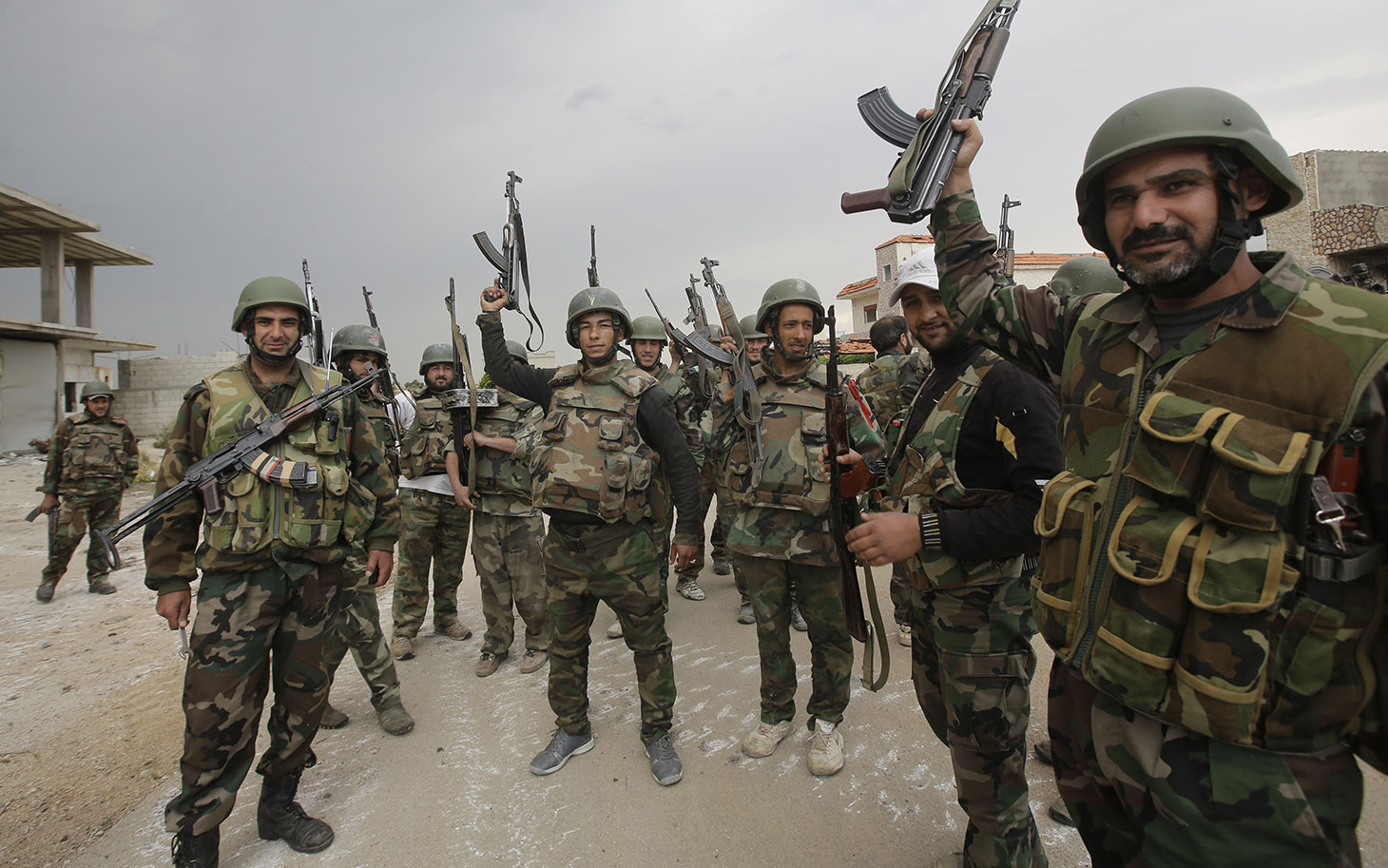
Soldiers of the Syrian Arab Army (SAA).

The outcomes in Syria ought to be a testament to the futility of existing policy. Disorder in the system, left unattended, has spread as entropy does. The Assad regime, once perceived as the worst player in the region — or the system’s local minimum — is now arguably the best, and inarguably not the worst. Disengagement has completely failed for all parties, as disorder emanates to Europe in the form of refugee flows, and to America as a challenge to its hegemony with the dispatch of a Russian expeditionary force. The refugee crisis is a rebuke to the Europeans, who pay the price of freeloading off an American-led order (and therefore suffer when the Americans refrain), and also (along with the Greek crisis) seen their continental union project exposed as mostly a superstructure for the benefit of elites. European separation from the broader system has failed. Similarly, Americans are learning that their disinterest in war does not diminish war’s interest in them.

It is worth noting that the Russian expeditionary commitment to Syria may be, given visionary strategic leadership, a master stroke. (That given is of course not a given where the Russians are concerned.) The narrative roles the Russians have the potential to fill are a cornucopia of goodwill-generating engagements: defender of Christians, destroyers of ISIS, vigorous great power, guarantor of order, ender of refugee flows, et cetera. Every single one of these narrative roles is in direct contrast to American and European actions (or more properly inactions), and have the added benefit of likely commanding the sympathy of significant minorities within both populations. Russia is not well-equipped to pacify a fractious nation of 20 million people — but it is eminently qualified to ruthlessly crush a local faction, and that is all that matters here. A task leveraging the player’s strengths with such massive prospective benefits embedded in the narrative flaws and faulty assumptions of strategic rivals is either the result of strategic genius — or stupefying luck.

Here’s the bottom line: both conceits that have governed the American approach to foreign engagement are false. Entropy extends throughout systems, and one does not get to secede from them as situations demand. We cannot impose control upon dynamic systems. Nor can we secede from those systems and their effects. We are all part of a gigantic meta-system, as a nation and a people, and so our charge is to see to its continuance. That does not mean decisive engagement or disengagement. It means entanglement and — this is unpopular and opaque — maintenance. It means we venture abroad, not to decide and direct, but to contend and affect. It means that sometimes the choice is between dangerous great-power opportunism and catastrophic migrations on the one hand, and desultory and interminable expeditions to strange lands on the other.

This is the logic of hegemony and the nature of systems, and it is therefore what we must do. The tragedy is that a democratic society bottle-fed a narrative of “progress” is increasingly unable to do it.

Jack Hays is a pseudonym of a public-policy professional and amateur Russophile. See his 2014 analysis of the Crimean annexation here.

Naval Aviation Week: The Conclusion

By Wick Hobson

As a man who as spent entirely too much time flying in the immediate vicinity of the colloquial Death Star (and by that, I mean the aircraft carrier) over the last year, I know firsthand how forgone a conclusion naval aviation can seem. Naval aviation, as the world knows it, is a multibillion dollar power projection leviathan that literally catapults fire control solutions from mobile sovereign territory to the bad guys du jour, right? Kick the tires, light the fires, open and shut case… Or is it? From future capabilities to current funding limitations, reality is inescapably more complex.

While GCC allies transition toward hegemonic peacekeeping operations in the Middle East and posture their forces for a long term dichotomy with Iran, you can almost feel the deck of American air power at sea roll beneath your feet in new directions. Every day, the emphasis shifts incrementally away from permissive, asymmetric conflict in the Arabian Gulf and toward modern, access-denied conflict with technologically contemporary rivals. Although Operation Inherent Resolve may retain focus on surgical strikes flown overhead, our authors looked ahead to the next generation of challenges awaiting the proverbial fleet.

Speaking of ISR, how did an article summarizing the future of naval aviation go four full paragraphs without mentioning drones? Ben Ho Wan Beng arrived in time to keep my bitterness against unmanned aviation in check with a fantastic look at the rise of UAS proliferation among littoral states seeking bang for their maritime buck in his piece, “What’s the Buzz: Ship-Based Unmanned Aviation & Its Influence on Littoral Navies.”

Jon Paris gave us a taste of the war none of us want to fight in his article, “Parallax and Bullseye Buoys.” An edge-of-your-seat thriller, Jon straps you into the cockpit for an IMC, EMCON recovery onboard a lights-out carrier in hostile skies. I don’t want to live in that world, and fortunately we aren’t in that kind of extremis yet, but Jon prepares the reader. He articulated the complexities of navigating in GPS-denied airspace and the necessity of electromagnetic spectrum fluency for the modern A2/AD environment, an issue recently addressed by CAPT Mark Glover at C4ISR.

Meanwhile, what good is a debate on the direction of military planning without a healthy dose of fiscal reality? Bridging the well funded past to the unaffordable future, Timothy Walton gave us a sneak peek from next month’s report due from The Hudson Institute’s Center for American Seapower. He reviewed the shrinking scale of the carrier air wing by the numbers and illustrated unmistakable mission gaps created along the way. From the salad days of the Tomcats to the uncertain future of the Joint Strike Fighter, Mr. Walton illuminated the reduced footprint of the current air wing and possible ramifications facing the CSG of the future in “The Evolution of the Modern Carrier Air Wing.”

CDR Gregory Smith broadened the topic of integrated manned and unmanned operations with his article, “Trusting Autonomous Systems: It’s More Than Technology.” Beyond the short-term friction of terrified Djiboutian air traffic controllers, CDR Smith illustrated the essential progress required to instill the confidence required for fully integrated manned and unmanned combat operations. From C2 structures in flight to command structures in the Pentagon, the ground truth on drone warfare at sea has yet to reach IOC by any definition. CDR Smith’s article provided clear context for the way ahead.

Michael Glynn delivered the cold, hard truth on data collection efforts in Naval Aviation: if a P-8A Poseidon collects 900GB of data on a sortie with no client for the information, does it validate its R&D costs? His article, “Information Management and the Future of Naval Aviation,” provided a resounding YES while detailing the challenges facing efficient data extraction from maritime ISR operations.

Peter Marino adds international affairs into the mix by assessing the scope and implications of American technology transfer to India for the development of a powerful new carrier. Through a video review of “Making Waves: Aiding India’s Next Generation Aircraft Carrier,” he explores the unique value of naval aviation in foreign policy. 

Our selections here delve into the challenges that lay ahead. I find the common thread unifying all of our authors to be the pursuit of value to the proverbial customer in an environment defined by change. What is it, exactly, that we are creating with all of this jet fuel?

The delivery of value to the stakeholder is incumbent on any military initiative from weapons safe to weapons free. On the one hand, that means providing maritime security and intelligence collection in the absence of conflict. Our authors speak from ground truth experience on the importance of developing and maintaining a cogent strategy for the proliferation of ISR and the subsequent decoding of the data collected.

On the other hand, delivering to the stakeholder requires a conscientious investment in fire control solutions against technologically advanced adversaries in denied airspace. There is no future without U-CLASS and there is no future without the JSF. These have to be integrated into the future of naval combat at least in the intermediate term. But what good is a fire control solution without C2 assurance? Are we ready for a GPS-denied environment? What will it take for tomorrow’s navy to compete in the conflicts of the future?

Ultimately, the sting of sequestration and the pain of acquisitions make the road ahead formidable. The hardest question to answer may be the most simple. What ends are we attempting to achieve by the means of naval aviation? Once our days of busting bunkers in the Middle East with precision guided munitions no longer carry the bulk of our workload, how do we leverage the unique capabilities of naval aviation across the entire spectrum of the rules of engagement to provide value to the theater commander?

It’s an exciting time to be a part of naval aviation. With such seismic shifts in sensor capabilities, adversary technological acumen, and A2/AD threat proliferation cast against cutthroat funding and acquisitions, this is not a sport for the faint of heart. Vision, flexibility, and creativity will define the success or failure of our transition to the next war we fight. Please join me in congratulating our authors on a job well done for their contribution to the next step, and feel free to join the discussion with your own feedback at nextwar@cimsec.org!

LT W. W. Hobson is an MH-60R pilot. The views expressed in this article are entirely his own and are not endorsed by the US Navy.