Category Archives: Current Operations

On-going Naval Ops or Maritime Current Events

Why the US Navy’s first South China Sea FONOP wasn’t a FONOP

By Timothy Choi

The eagerly-anticipated Freedom of Navigation Operation (FONOP) by the United States Navy (USN) in the South China Sea was initially viewed as a strong demonstration of the United States’ resolve that the waters surrounding China’s artificial islands and claimed reefs are high seas. China’s attempt to establish a de facto 12 nautical mile territorial sea around these features is, as most readers of CIMSEC will know, in direct contravention of the United Nations Convention on the Law of the Sea (UNCLOS). UNCLOS clearly specifies that man-made islands and underwater features like reefs are not eligible for the 12NM zone granted to more robust geographic features, such as rocks or naturally-formed islands capable of sustaining human habitation or economic life; the latter of these are also eligible for the prized 200 NM Exclusive Economic Zone.

Acknowledging implicitly that their features are not legally entitled to any kind of territorial sea, the Chinese instead have attempted to establish a normative regime aiming to make other actors treat the waters surrounding their features as though it were a territorial sea. Under customary international law, consistent behavior towards a particular issue can result in the practice becoming legally binding, either through generally agreed norms of behavior or a gradual solidification it into written law. Thus, for countries wishing to prevent the high seas around the Chinese features from becoming a territorial reality, it is crucial for interested parties to halt the norm-creation process before it can gather steam.

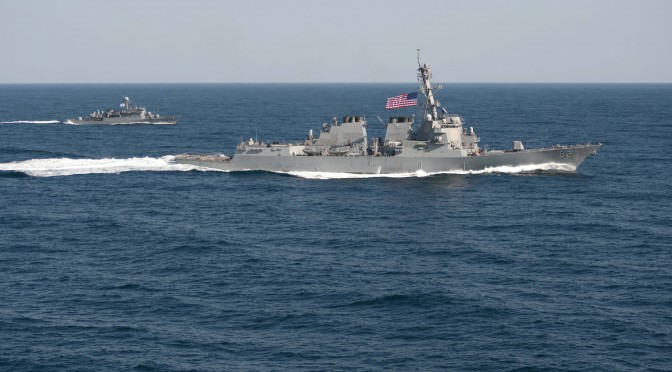
To do this, the USN thus carried out its first FONOP, sending the Arleigh Burke class destroyer USS Lassen within 12 NM of the Chinese build-up on Subi Reef. However, simply sailing within 12 NM is not sufficient to demonstrate American resolve that the waters are high seas.

Rather, the Lassen had to have behaved within those 12 NM in the same manner allowed on high seas. Under UNCLOS, a warship on the high seas may carry out its whole array of activities including launching helicopters, turning on fire-control radars, and carrying out arms exercises. However, these and other activities (including fishing and research) are all prohibited when sailing in another country’s 12 NM territorial waters – a condition known as “innocent passage”, detailed under UNCLOS Part II, Article 19.
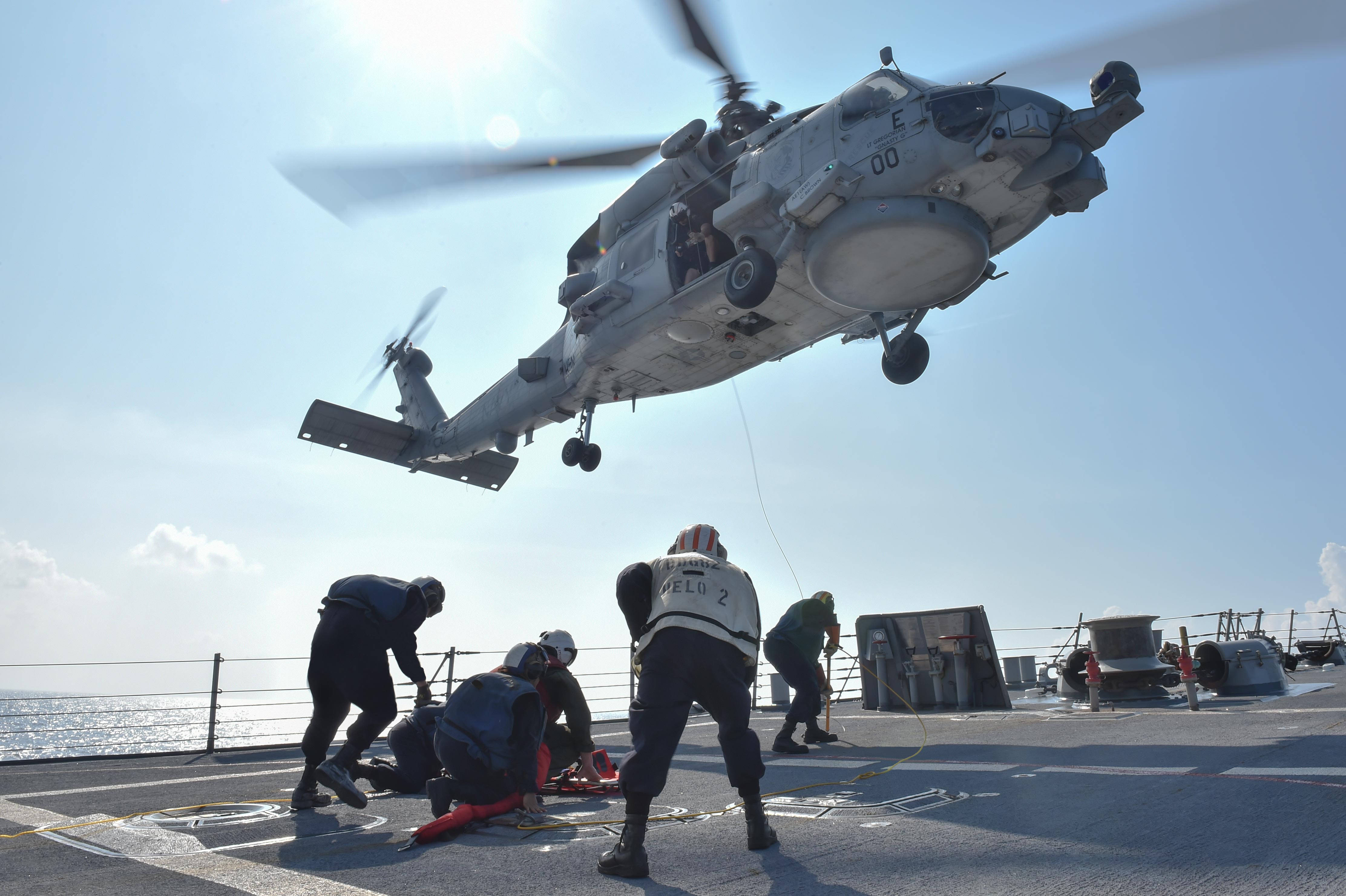
USS Lassen's crew carries out a medical training exercise with an airborne MH-60R Seahawk helicopter in the South China Sea some time before the FONOP. (credit: Navy.mil) -Had this been done within 12 NM of Subi Reef, America's commitment to Freedom of Navigation would be unambiguous.
USS Lassen’s crew carries out a medical training exercise with an airborne MH-60R Seahawk helicopter in the South China Sea some time before the FONOP. (credit: Navy.mil)
-Had this been done within 12 NM of Subi Reef, America’s commitment to Freedom of Navigation would be unambiguous.

Thus, in order for the USN to send the unequivocal message that it saw the 12 NM around Subi Reef as high seas, it had to have carried out at least one of those activities. Else, its transit would have been identical in form to that of an innocent passage, which is only required for territorial waters. Carrying out such a transit would therefore legitimize, or at least be viewed as legitimizing, the Chinese claim that Subi Reef has a 12 NM territorial sea. In so doing, Lassen’s voyage, far from contesting the Chinese position, would actually reinforce it by behaving in the same way it would have to in an actual territorial sea.

So how did Lassen actually behave during its transit? It appears more and more likely that Lassen in fact behaved exactly as she would in territorial waters. Sam LaGrone’s post on USNI News quotes US defence officials and sources as stating that Lassen carried out an innocent passage, though claiming it did not mean a recognition of the Chinese position. Lassen’s transit, then, was not any more a FONOP than any regular transit through another state’s territorial waters under the articles of UNCLOS. 

If the United States wants to demonstrate its resolve on the issue, its FONOPs need to not only sail within 12 NM of a Chinese feature, but also involve activities prohibited under “innocent passage” conditions while in the area. Such activities can be as mundane as lowering a fishing lure over the side, or as visually impressive as launching a Seahawk or UAV.

As the US plans for further, more regular FONOPs in the South China Sea, America’s willingness to challenge China on the issue will manifest not in dramatic debates at the United Nations or stern press releases, but in the minute activities of the ships and sailors involved. Photographs and videos of such activities would go far to prove the United States’ unwillingness to compromise on Freedom of Navigation and gain the confidence of its regional allies. A strong and unambiguous message now can nip a problem in the bud before it can fester to point where actual violence may break out. To paraphrase Sun-Tzu, it is much better to defeat an enemy’s strategy than to defeat them in battle. Heading off the Chinese at their own norm-creation game now will decrease the opportunities for misunderstandings leading to violence in the future – but only if the message cannot be misinterpreted.

Timothy Choi is a PhD student at the University of Calgary’s Centre for Military & Strategic Studies. Interested in all areas of maritime security and naval affairs, he struggles everyday with the fact that he studies at an institution located hundreds of kilometres away from the nearest ocean. When not on Twitter (@TimmyC62), he can be found building tiny ship models and headbanging to some kind of northern European folk metal. 
Should the U.S. Navy Help with the Med. Refugee Crisis?

A Modest Proposal to Help this Generation’s “Boat People”  

By John T. Kuehn

First, this article may be too late.  What do I mean?  I mean that we—as in the global community and the United States in particular—may be too far behind the power curve to do something meaningful about helping the refugees fleeing across the sea from the Syrian Civil War-Islamic Thirty Year’s War raging in the Middle East.  This is my way of saying I wish I had written this about six months ago when the problem was manifest to all.  So why write at all?  Something might be STILL done with forward deployed naval forces of the United States today, perhaps with like-minded maritime allies to help the unfortunate masses of humanity fleeing their homelands from a particularly cruel conflict.    Even if it is too late for current policy, the trend of “boat people” fleeing war to a better life elsewhere has many precedents in history, especially the last one hundred years and it will most certainly occur again.   This means that ringing the clarion now might contribute to effective humanitarian policy action in the future.  So it is worth a try.

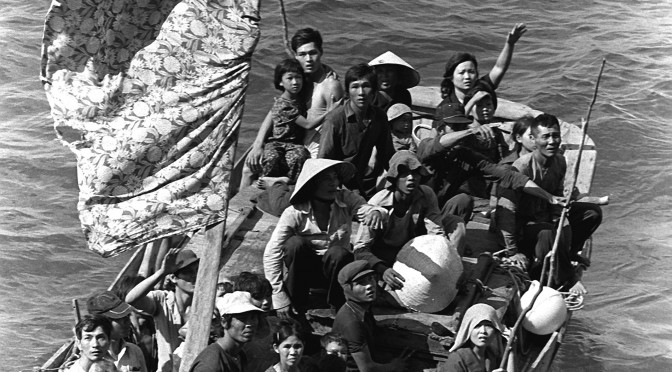
First, let us briefly review some relevant history on these sorts of refugee crises as they pertain to migration in unseaworthy craft in search of a better life on distant shores. Case one takes us back to 1975 and the late 1970s when the United States’ lost war in Vietnam resulted in the flight of the boat people of South Vietnam  (and Cambodia, too) from the proletarian utopias established by the new Vietnamese government in Hanoi and the Khmer Rouge. The United States was caught napping somewhat on this one, too, but before long had started making efforts with naval assets based in the Western Pacific to help with this crisis. However,   years later a particularly unfortunate incident occurred in the 1980s wherein the captain of a U.S. warship (the USS Dubuque) failed to render proper assistance to fleeing “boat people” who later survived to present evidence against him. We will return to this issue since it is a feature of the law of the sea that mariners must render aid to people in danger on the high seas.  More recently Americans saw the flight of people from both Cuba and Haiti to the United States in the 1990s, fleeing various natural and man-made disasters in the Caribbean.

Why should the United States use its assets, especially its Navy, to help these people? There are three principle reasons: moral obligation, humanitarian, and practical.    The practical value for the United States involves two factors, leadership and what, for lack of a better term, might be called “good press.” If the U.S. is to be a leader it must take the lead in areas where it claims an interest.  By getting more involved and working with other states of the region while at the same time committing actual naval forces to help, we build partnerships, lead, and help. It is a win-win-win result.

From a moral standpoint we owe it to these people.  Here is the causal logic—when the U.S.-led coalition invaded Iraq all those years ago we removed the government in power and destabilized the region.  From that context Al Qaeda in Iraq (AQI) developed.  During the final years in Iraq we estimated we had pretty much solved the problem of AQI, but instead it had simply transformed itself into the current Islamic State (ISIS).   At the same time Syria fell into civil war, a conflict not unrelated to our actions in Iraq and has been further de-stabilized, especially since 2013, by an increasingly powerful and dangerous ISIS.  The upshot is that some, not all, of these refugees can be traced to American policy choices, so there exists something of a moral obligation to help with the result of our, for lack of a better word, blundering in the Middle East.

Finally, we get back to the purely humanitarian reasons—the salvation of (mostly) innocent human life.   Obviously things are being done, but there is little reason to allow people to helplessly drown or die of exposure at sea on un-seaworthy craft.   They already think they can make it and so the arguments that they would not flee if they did not think someone would help are not only ill-informed, they are morally wrongheaded.   In fact, the United States by simply having ships in the Eastern Mediterranean is obligated to “render assistance” should it run across people in distress on the high seas. Simply stationing ships on patrol in that area will naturally result in a requirement to render assistance because we certainly do not want any more Dubuques like we had in the South China Sea after the Vietnam War had ended.

As with any use of American taxpayer-funded projects, use of U.S. Navy assets must be judicious.  Also, we must coordinate with partners and allies in the region, but rendering assistance on the high seas is part of international law and a moral imperative, more than one might think given our distance from the Eastern Mediterranean. However, if the United States is to use its Navy as the “sysadmin” of the global maritime regime, as Captain Peter Haynes discusses in his recent book on the “new maritime strategy,” then this sort of action and use of naval power is part of the responsibility that the mantle of maritime leadership confers.   Or perhaps we no longer aspire to lead in this domain?  I think not.

Dr. John T. Kuehn is the General William Stofft Chair for Historical Research at the U.S. Army Command and General Staff College CGSC).  He retired from the U.S. Navy 2004 at the rank of commander after 23 years of service as a naval flight officer flying both land-based and carrier-based aircraft.  He has taught a variety of subjects, including military history, at CGSC since 2000.  He authored Agents of Innovation (2008), A Military History of Japan:  From the Age of the Samurai to the 21st Century (2014), and co-authored Eyewitness Pacific Theater (2008) with D.M. Giangreco as well as numerous articles and editorials and was awarded a Moncado Prize from the Society for Military History in 2011.  His latest book, due out from Praeger just in time for the 200th Anniversary of the Battle of Waterloo is Napoleonic Warfare: The Operational Art of the Great Campaigns.

The views are those of the author and do not reflect the official policy or position of the Department of the Army, Department of Defense, or the U.S. Government.

Canada’s Naval Fuel Crisis

This article originally appeared on the CDA Institute and was republished with permission. You can find the article in its original form here. 

CDA Institute guest contributor Ken Hansen, a research fellow at Dalhousie’s CFPS, comments on the necessity of logistics in light of the decommissioning of HMCS Protecteur and HMCS Preserver.

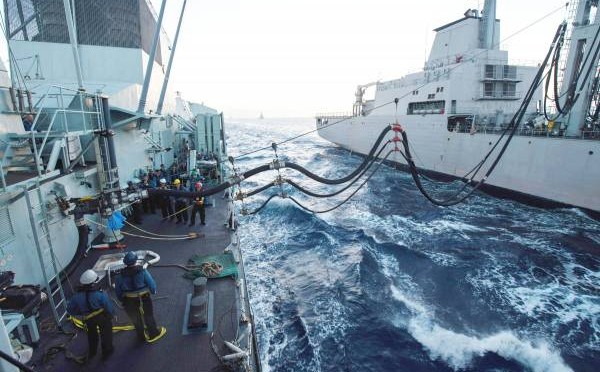
The loss of at-​sea replenishment capability has dropped the Royal Canadian Navy’s (RCN) standing from a blue-​water, global force projection navy to an offshore territorial defence organization. The major fire in HMCS Protecteur and the severe rust-​out problems in HMCS Preserver have resulted in the decommissioning of both ships and a logistical crisis that requires corrective action. Some signs for optimism have arisen recently in two contracts with the Spanish and Chilean navies for the use of two of their replenishment ships for a period of 40 days each. The total cost is rumoured to be approximately $160M CAD.

Forty days of sea time will allow each coastal formation to run an exercise involving replenishment at sea training and perhaps a tactical scenario for task group readiness. By doing this, Canadian sailors will get a chance to preserve complex and perishable skills that are vitally important in modern naval operations.

Replenishment at sea involves all of the ship’s departments. Navigation, operations, deck, engineering, and supply must all understand the sequence of events intimately if all is to go as planned. While sailing a ship alongside another at 20 to40 metres distance is demanding in calm seas, at night and in rough weather is no place to be doing this for the first time. The most graphic example of what can go wrong occurred off the coast of South Africa on the night of 18 February 1982, when the South African navy’s replenishment ship SAS Tafelberg rammed and sank the frigate SAS President Krugerafter the latter made the fatal mistake of turning in front of the bigger ship. Sixteen sailors were lost in this incident.

The South African accident occurred due to confusion in close-​quarters manoeuvring during an anti-​submarine exercise. Replenishment is a common activity in multi-​ship exercises and is often scheduled to coincide with other tactical ‘challenges’ to raise the complexity of challenges facing commanders. I have had many first-​hand experiences with these exercises and their hazards. On one occasion, north of Iceland, nearly four hours spent attempting to refuel in stormy winter conditions resulted in a mere 20 cubic meters of fuel transferred, much damage to the equipment, plus lots of frozen fingers and faces from the spray. We nearly lost one sailor overboard from the icy deck before the two captains conferred and agreed to call it off. Another occasion resulted in a side-​swiping by our ship of the much larger oiler. We slid backward along her side, leaving a long smear of distinctive Canadian naval paint on her hull and eventually cleared her stern ignominiously. Everyone knew trying to extricate ourselves by going the other way was potentially fatal.

The history of replenishment at sea training is full of such near misses and embarrassing moments. The calamity that befell President Kruger is actually a rarity. More common are parted fueling hoses and span wires, fouled screws, plus minor dents and scratches. Such tough lessons become legend amongst seafarers and we learned vicariously from these mistakes.

In operations, failure during replenishment at sea takes on a more serious nature. Less well known are replenishment events from the Second World War. Canadian escorts frequently had to abandon their convoys despite the presence of attacking U-​boats, owing to the difficulty of mastering the intricacies of refueling at sea. At one point in the war, the Admiralty forbade Canadian warships from refueling in eastbound convoys due to the amount of damage they were doing to scarce replenishment equipment. A related problem arose during the Cuban Missile Crisis when returning Canadian warships had to pass right through their assigned anti-​submarine patrol stations and carry on to Halifax to refuel. They returned days later. The accompanying aircraft carrier simply did not carry enough fuel to sustain her ‘thirsty’ escorts. Analysis showed that the navy needed a minimum of three replenishment ships to sustain short-​range escorts at a distance of only 250 to 500 nautical miles from base.

Today, the Government of Canada has a penchant for deploying the RCN worldwide. The fuel capacity of our current frigates (.1 tonne of fuel per tonne of displacement) equals historic pre-​war lows. This has forced planners to assume replenishment is a given in fleet operations. That assumption is now false. Without replenishment ships, the navy’s status has fallen and precious seamanship skills are wasting away.

Contracting foreign naval replenishment ships for short-​term training is a necessary expedient but it is only a stopgap measure. It may be that Chantier Davie will be able to produce an interim solution in short order, but if it goes longer than six months you can expect the RCN to re-​contract with the Spanish and Chileans on a regular basis.

The cost of leasing replenishment at sea services must now be added to the construction costs of the two new ships being built at Seaspan plus the cost of the building the interim ship by Chantier Davie. It should have been obvious that delaying the replacements for Protecteur and Preserver would result in added expense and more complexity in operations. It is a sad but entirely predictable mess and there is no real end in sight.

The blame for all this has to lay with the naval leadership. Somehow, generations of Canadian admirals decided that logistics is less important than combat capability. The National Shipbuilding Procurement Strategy (NSPS) is based on a one-​for-​one replacement plan of the Cold War Fleet, with the notable exception of the DeWolf-​class arctic/​offshore patrol ships. The logistical demands of this new security era are vastly greater than they were during the Cold War. The history of the RCN since 1989 has an abundant array of examples to prove this point.

I find it sad that the admirals care more about politics than they do about the history of their own service. A much more robust logistical capacity is needed immediately. They should remember this advice from American General Omar Bradley: “Amateurs talk tactics; professionals study logistics.”

Ken Hansen is an adjunct professor in graduate studies at Dalhousie University and a research fellow with the Centre for Foreign Policy Studies. He served for 33 years as a maritime surface warfare officer with the RCN. (Image courtesy of the Royal Canadian Navy.)

Examining the Flaws of the South China Sea Code of Conduct

By Ching Chang

The South China Sea has turned into a hotspot for potential regional conflicts in recent years. Nonetheless, parties concerned have already tried their best efforts to establish certain mechanisms to prevent crisis and reduce tension together. The first significant initiative was the “Declaration on the Conduct of Parties in the South China Sea”, known as the DOC, signed by all the members of the ASEAN and the People’s Republic of China on November 4, 2002.

 Although the Article Ten of the DOC explicitly noted with “The Parties concerned reaffirm that the adoption of a code of conduct in the South China Sea would further promote peace and stability in the region and agree to work, on the basis of consensus, towards the eventual attainment of this objective.”, yet no substantial progress has been achieved since then. On July 20, 2011, another joint statement signed by the ASEAN members states and the PRC known as the “Guidelines for the Implementation of the DOC” was noted as another milestone for “embodying their collective commitment to promoting peace, stability and mutual trust and to ensuring the peaceful resolution of disputes in the South China Sea.” Nonetheless, the Code of Conduct was never mentioned by the later established guidelines. It may also imply the actual pessimistic situation for formulating the South China Sea Code of Conduct.

According to the present structure for negotiating the South China Sea Code of Conduct, there are several arrangements that can be challenged since they may eventually undermine the legitimacy of the COC as an effective mechanism to affect behaviors of every party involved in theSouth China Sea.

 First, the Republic of China now in Taiwan was never invited to join the COC negotiation process. It is obviously opposed by Beijing for negating the ROC presence in the international community. And all ASEAN members follow the “one China” policy as the prior condition when they established the diplomatic relationship with the PRC. It is not surprised to see that the ROC is excluded from the collective effort so far. Nonetheless, the ROC is not only a claimant of the territories and waters of the South China Se,. Taipei is a substantial occupant of a major island, Tai-Ping Island, in the South China Sea. Further, Taiwan also actively conducts various maritime activities in the South China Sea. Without Taipei’s involvement and consent, how can the South China Sea Code of Conduct be a meaningful mechanism to assure the stability and peace in the South China Sea?

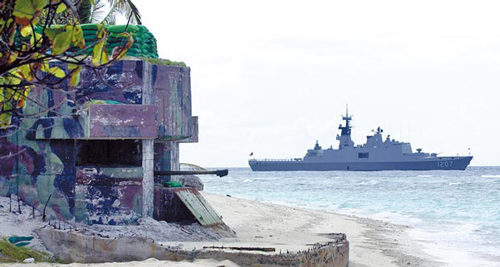
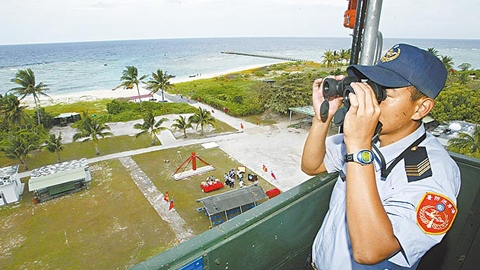
The ROC Coast Guard stationed in the South China Sea.

Compared to Myanmar, Thailand, Cambodia, Singapore and Laos, the Republic of China should have more reasons to be involved in the negotiation process since all these ASEAN states noted above are not adjacent to the South China Sea at all. Taipei should also have the better reason than Jakarta to sit together with other claimants of the territories in the South China Sea since Indonesia is not even a claimant but only concerned of its Economic Exclusive Zone. Although Beijing frequently implies that all Taipei’s privileges and interests in the South China Sea will be guaranteed by the People’s Republic of China, the proposal has never been accepted by Taipei. Any assurance like this will not be recognized by ASEAN member states.

Second, nations’ individual interests in the South China Sea have not been totally covered by the negotiation process. As addressed by the Article Nine of the DOC, “The Parties encourage other countries to respect the principles contained in this Declaration;” how can we expect that states never involved in the negotiation process of the future South China Sea COC can be constrained by a mechanism that they never explicitly accept. Many states use the South China Sea as major sea lanes of communication to serve their maritime interests and supporting their national economic welfare. If we expect the South China Sea COC to be a meaningful document to assure the peace and stability in the South China Sea, it should allow more states to be involved in the codification process and even subsequently signing and ratifying the international decree.

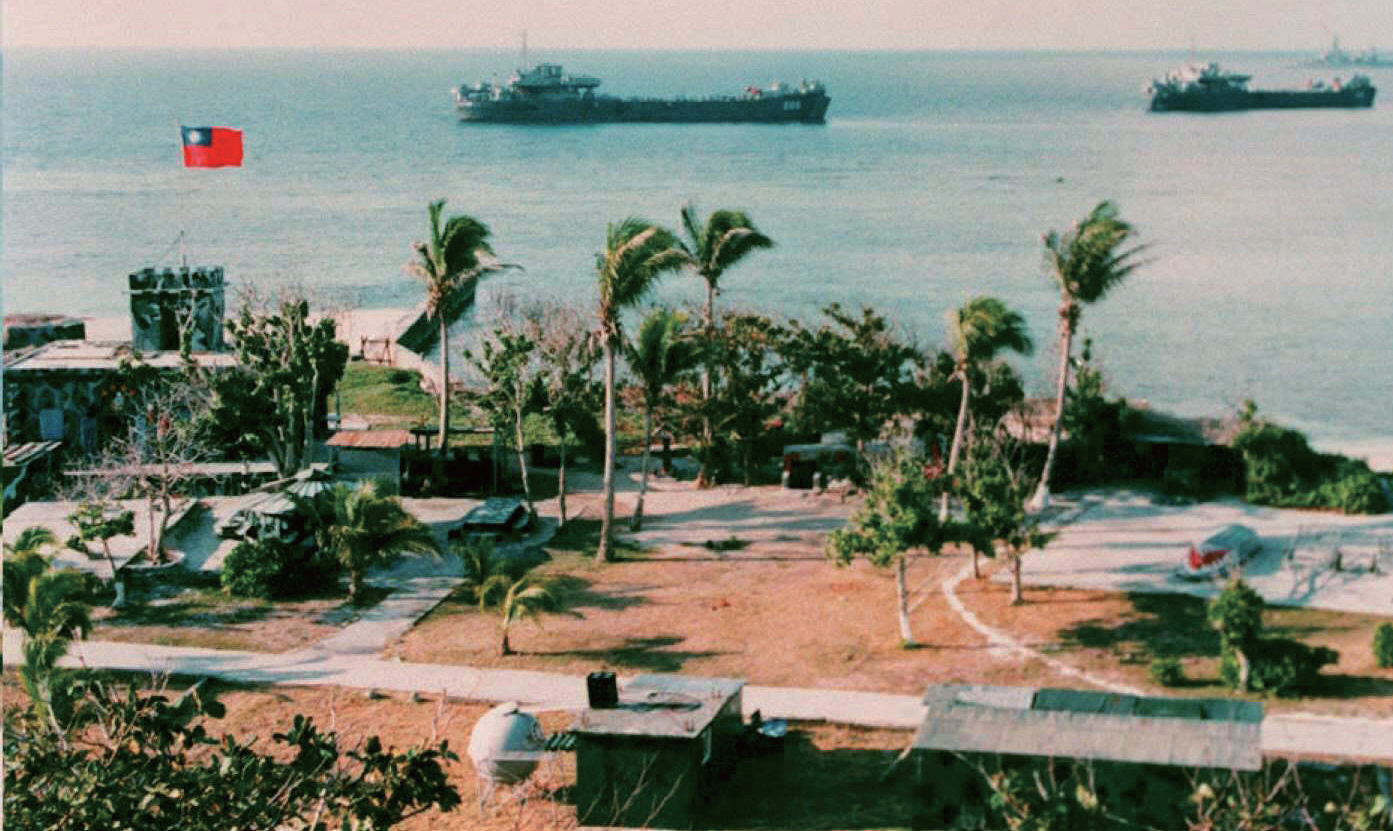
Tai-ping Island in the South China Sea is substantially stationed by the ROC garrison forces after World War II.

Based on the flaws already mentioned, the author would like to propose a “Multi-chaptered South China Sea Code of Conduct” in order to make this document can be more sensible and functional also. The South China Sea Code of Conduct should be categorized into several chapters according to participants’ conditions. In another word, it should be modularized by function and status accordingly.

Those who are concerned with the situations in the South China Sea are encouraged to read the contents of the “Declaration on the Conduct of Parties in the South China Sea” and the “Guidelines for the Implementation of the DOC.” It is obvious that many terms are totally irrelevant to some ASEAN member states since they have no position to engage with those activities. To some extent, these ASEAN member states are so innocent to be kidnapped into a process that may not serve their true interests simply because of the plot to use ASEAN to balance the PRC in the South China Sea. On the other hand, for many states actually involved into activities in the South China Sea, the negotiation process does not consider preparing a document for them to participate so that establishing constraints on their behaviors or activities in the South China Sea is unlikely.

A multi-chaptered South China Sea Code of Conduct may allow states using the South China Sea for whatever reason to choose those chapters they would like to sign and promise to follow the code accordingly. Several chapters like environmental protection, fishery regulation, search and rescue, scientific research, climate report, oceanographic survey, anti-piracy and smuggling, nature preservation, sewage and waste process, navigation aid and regulation can be easily established with no controversy. For those codes that intentionally restrict behaviors enhancing future territory claim position, we should consider to replace the term of “claimants” into “occupants” so reducing the de jure proclamation by more objectively expressing the de facto statement.

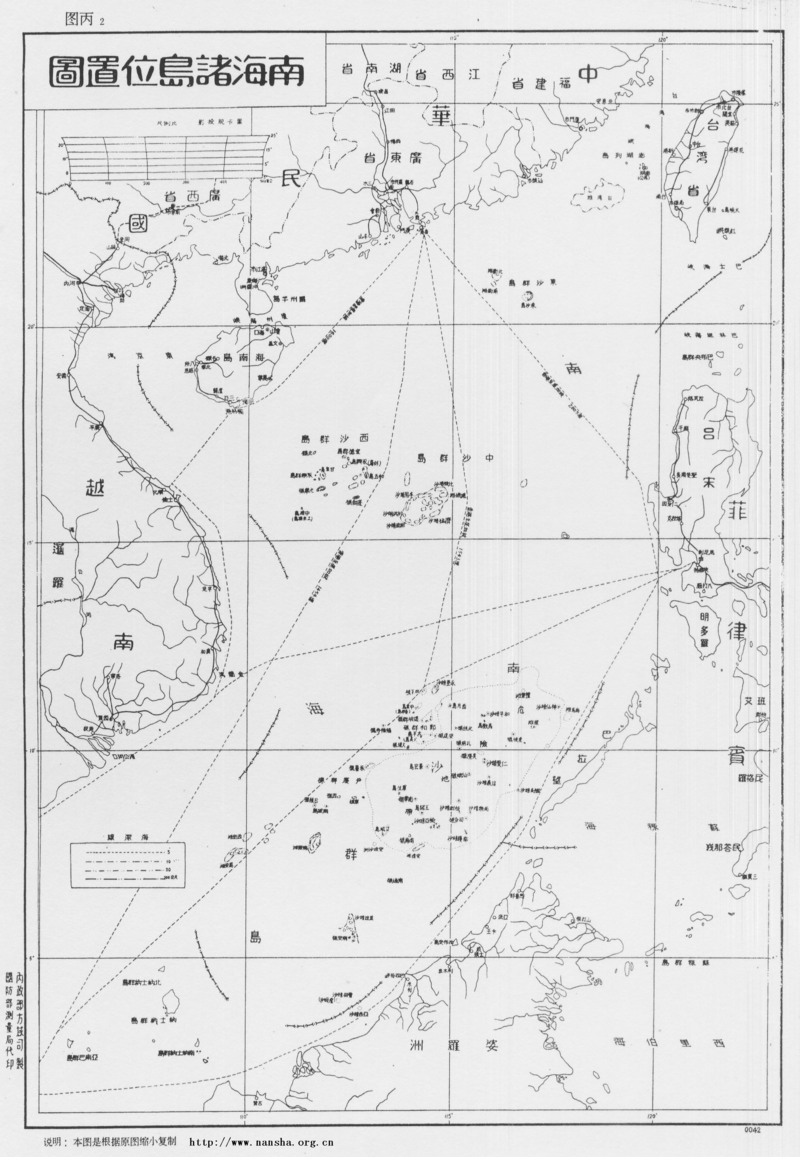
Eleven dash line map the territory and waters in the South China Sea published by the Republic of China in 1946.

This may be the only way to accommodate the Republic of China in Taipei and have it join this mechanism but not provoking Beijing. Beijing is very sensitive to anyone who violates the one China principle by accepting any term that may imply “Two Chinas” or “One China, One Taiwan.” Taipei has no intention to use the South China Sea Code of Conduct as a stage to irritate Beijing. Adopting the term of occupants to replace claimants may allow the specific chapter to be a description of realities in the South China Sea but not a statement of expressing political aspirations. The author would like to remind all the readers that without the Republic of China, the South China Sea Code of Conduct is only a self-deceived paper. Without all other states actually involved in the maritime activities in the South China Sea to promise following the terms noted in the chapters they choose to sign, the South China Sea Code of Conduct cannot be meaningful.

Chang Ching is a Research Fellow with the Society for Strategic Studies, Republic of China. The views expressed in this article are his own.