Category Archives: Current Operations

On-going Naval Ops or Maritime Current Events

Can’t Anybody Play This Game? US FON Operations and Law of the Sea

This article originally featured on Lawfare. It may be read in its original form here. 

By Raul “Pete” Pedrozo and James Kraska

The United States has been unable to synchronize successful air and sea freedom of navigation (FON) operations in the South China Sea with an erratic diplomatic message and a legal case that is too clever by half. Our colleagues Bonnie Glaser and Peter Dutton tried to reconnect these dimensions when they wrote in the The National Interest that while the administration has not done a “stellar job of explaining its actions,” the U.S. approach was still a sophisticated signaling mechanism. But their laudable effort to square the circle is not supported by the law of the sea.

Here’s why.

The past two FON operations in the South China Sea – the USS Lassen (DDG 82) surface navigation on October 27 and the flight of B-52s on November 8-9 – are models in how to squander flawless operational execution with confused, inconsistent, and ultimately damaging messaging that in some ways left the United States in a worse position than it would have been had it not done the operations.

After more than a month of dithering, the United States ordered the USS Lassen to challenge something – many are still unsure what – in the South China Sea. Some American officials characterized the operation as “innocent passage,” while others described it as “not innocent passage.” As confusion over the true nature of the FON challenge mounted, Senator John McCain requested the Department of Defense to “publicly clarify…the legal intent behind this operation.” Just days later, the U.S. did it again. Air Force B-52 bombers from Guam overflew the South China Sea. A U.S. official told The Hill that the aircraft did fly within 12 nm of China’s artificial islands, whereas another U.S. official said it did not. The confusion in both cases appears to be a mixture of politics combined with a lack of understanding of the law of the sea, presenting the United States with two unforced errors that should not be repeated.  

The legal implications of the Lassen operation are inexplicable to this day. The Lassen could not have transited near Subi Reef in innocent passage because the feature is a low-tide elevation (LTE) that does not generate a territorial sea. High seas freedoms apply around low-tide elevations. Although Subi Reef is a an LTE, it is located within 12 nautical miles (nm) of Sandy Cay, an uninhabited rock that is entitled to a 12 nm territorial sea. Under article 13 of UNCLOS, an LTE located within the 12 nm territorial sea of a “mainland or island” may generate a territorial sea as though it were itself a rock. Accordingly, Glaser and Dutton conclude that Subi Reef was used “as a baseline to ‘bump out’ the territorial sea” of Sandy Cay. Under this theory, the USS Lassen was compelled by law to transit the territorial sea of Sandy Cay/Subi Reef in innocent passage.

There are four reasons why this rationale is unsupported by the law of the sea. First, article 13 of UNCLOS clearly states that an LTE within 12 nm of a “mainland or island” may extend out the territorial sea of the primary feature as though it were a rock. This is called a “parasitic” LTE, since its territorial sea depends on an adjacent mainland or island. But Sandy Cay is neither a mainland nor an island – it is a rock, so it may not be used by Subi Reef to generate a territorial sea.

Our colleagues appear to suggest that “mainland or island” includes mere rocks – that islands are just a form of rock. This argument confuses the text in Article 121 on the regime of islands, which forms Part VIII of the Convention and addresses what features are entitled to an exclusive economic zone (EEZ) with the rules in Part II on the territorial sea. Islands are naturally formed areas above water at high tide [Article 121(1)]. Islands are entitled to the full suit of zones of sovereignty, sovereign rights, and jurisdiction [Article 121(2)]. All that Article 121(3) says is that “rocks which cannot sustain human habitation or an economic life of their own” are not entitled to an EEZ or continental shelf. This text does not mean that islands are simply a type of rock – they are not and to make this argument is a circular reading that defies the negotiating history of the convention that sought to distinguish rocks from islands, as well as common sense that would have the two distinct words imbued with two discrete meanings.

Furthermore, the feature of one country cannot be used to generate maritime entitlements for a feature of another country. The only way for Subi Reef to be a parasitic LTE and have a territorial sea generated from Sandy Cay’s territorial sea is if the same country has lawful sovereign title to both features. Is the United States ceding both features to China?

Second, perhaps more fundamentally, no feature in the Spratly Islands, including Subi Reef, has a territorial sea. None. UNCLOS Article 3 allows states to “establish” a territorial sea – it is not automatic. Neither China nor any other claimant has established a territorial sea around a feature in the Spratly Islands. The law of the sea requires affirmative action by a sovereign state – China has not done so, so why does the United States appear to recognize (and therefore encourage) such action? There is no territorial sea around Subi or any other Chinese occupied feature, and therefore no purported requirement in Chinese law for prior consent of transit for the Lassen to challenge. Whether U.S. ships or aircraft stay beyond or transit within 12 nm of any these features is legally immaterial – none of them have a territorial sea.

Third, in order for a rock to generate a territorial sea it must be under the sovereignty of a coastal state. The United States does not recognize any country as having sovereignty over the features occupied or claimed by China, and in fact China has the weakest claim to the features of any nation in the region. No country recognizes China’s claim of sovereignty over any Spratly feature. Consequently, even if China declared a territorial sea around one or more feature, which it has not, the declaration would be legally nugatory. It would be the same as the United States declaring a territorial sea around Antarctica – no other state would recognize it. So why does the United States appear to recognize Chinese sovereignty over any of these features by trying to challenge provisions of Chinese law that even China has refrained from imposing?

Fourth, Glaser and Dutton suggest the Lassen challenged China’s law that purports to require prior notification for innocent passage in its territorial sea. Yet the operation appears to have been leaked to the media by a U.S. official the day before it was conducted, giving de facto notice – probably in a vain effort to “reduce tension” over the transit. That move undermined the U.S. legal case and created operational risk. It was not a coincidence that China’s maritime militia was already in position to harass the Lassen when the U.S. warship approached Subi Reef – potentially placing the security of the mission and the lives of U.S. Sailors at risk.

So did the FON operations challenge anything at all? Yes, but not what the United States or outside observers have claimed. Both the Lassen and the B-52s challenged China’s ubiquitous nine-dashed line claim to “indisputable sovereignty” over the South China Sea. Of course nobody, including our interlocutors in Beijing, have any idea what China’s preposterous claims mean in terms of the law of the sea. The difficulty in trying to fit U.S. FON operations into the prism of the law of the sea – combined with a lack of understanding of the law of the sea – has driven U.S. officials and pundits bananas. This falls into the trap laid by China, which has, at least since 1995, intentionally used confusion and ambiguity over its maritime claims in the South China Sea as a strategic weapon. It would be far better for the United States to continue to operate freely, persistently, and without the hand-wringing and drama, with ships on the surface, submarines under the water, and aircraft in overflight of the South China Sea, within and beyond 12 nm of all the features in the region.  

Raul “Pete” Pedrozo is Deputy General Counsel for the Defense POW/MIA Accounting Agency (DPAA). Previously he was a Professor of International Law in the Stockton Center for the Study of International Law at the U.S. Naval War College, where he now serves as a Non-Resident Scholar.

James Kraska is Howard S. Levie Professor of International Law at the Stockton Center for the Study of International Law, U.S. Naval War College, Distinguished Fellow at the Law of the Sea Institute, University of California at Berkeley School of Law, and Senior Fellow, Center for Oceans Law and Policy, University of Virginia School of Law.

Cutting Through the Fog: Reflexive Control and Russian STRATCOM in Ukraine

Russia Resurgent Topic Week

By Robert C. Rasmussen

“But if I wanted to I could take Kiev in two weeks.” – President Vladimir Putin

Introduction

As the Russian Federation continues to fuel a protracted war in Ukraine, it is employing a method of strategic communication that has left policy makers, media outlets, and ordinary people confused and worried. The decades-old Soviet doctrine of Reflexive Control Theory1 is a method of information warfare at the strategic and operational levels. This use of Reflexive Control Theory is an attempt to influence the decision-making processes of the Ukrainian government, the rebels, the international community, and the Russian people.  It is designed to support Russia’s strategy of maintaining Ukraine as a semiautonomous region with independence as a mere formality.

[otw_shortcode_button href=”https://cimsec.org/buying-cimsec-war-bonds/18115″ size=”medium” icon_position=”right” shape=”round” color_class=”otw-blue”]Donate to CIMSEC![/otw_shortcode_button]

Reflexive Control Theory as Doctrine

Reflexive Control Theory was developed by Soviet military strategists in the 1960s. The premise is relatively simple: use deception and disinformation to shape an opponent’s perceptions of the situation so it voluntarily selects the courses of action most conducive to one’s own interests. It is exactly this type of application of Reflexive Control that a young Vladimir Putin would have learned in his early development at the 401st KGB School and in his career as a KGB/FSB officer. While in principle applicable at many levels, it particularly lends itself to communications at the strategic level.

Russia’s Use of Reflexive Control in Strategic Communications

Russia’s strategic communications regarding Ukraine are calculated to shape outside perception of Russian actions, and opponents’ reactions. In doing so, Russia hopes to induce actions that work in favor of the Russian government.2 A combination of the haze of battle and political obfuscation can help create whatever story Russia wants for whatever audience it wants. The targeted audiences for specific messaging campaigns are pro-Russian separatists, the international community, and lastly the Russian people.

Russia’s strategic communications towards the rebels in eastern Ukraine have focused on keeping them in the fight. Two key messages pushed by Russia to keep rebels fighting are the message about Ukrainians in power being anti-Russian fascists, and how Russian administration of their territory would be better for the people there. There has been additional focus on the damage caused by warfare and the disruption of the lives of ordinary people in order to continually focus the anger of the rebels and keep up their will to fight.

The focus on the international community seems to be deterrence from entering the conflict at all. By keeping the fog of war rolling over the combat zone and increasing chaos, the situation is unpredictable.  This unpredictability combined with a lack of political will effectively eliminates any possibility of direct action by an external actor.  Russian displeasure at international sanctions encourages other actors to take out their displeasure through sanctions instead of directly supporting Ukraine with personnel, equipment, and aid money. In a very real sense, sanctions are a diversion. Russia has a large territory with a large quantity of people. Russia has previously isolated and restructured its economy in a manner that ensured relative strategic successes, and this capability is within the generational memory of current leadership. Accepting sanctions in the short term is strategically analogous to giving up territory to Napoleonic and Nazi armies, knowing that time is on Russia’s side.

Messages to the domestic population create moral justification for supporting rebels and the prospect (now realized in an on-again, off-again fashion) of widespread combat operations in eastern Ukraine. The overwhelming majority of news media is either state-controlled or controlled by owners loyal to President Putin. Meanwhile Putin’s political party, United Russia, has a simple majority in the State Duma. There is an overwhelming support base that is loyal to Putin’s government. These elements, put together, create unquestioned messaging pushing the idea of a fascist government in Kiev that does not represent the views of even a plurality of Ukrainians. This “illegitimate” Ukrainian government, according to the message, is only in control due to the brute force of a small Euromaidan mob.  By sending humanitarian convoys with military escorts into Eastern Ukraine, Russia is trying to demonstrate its humanity. The point of this messaging is to focus popular rage on the Ukrainian government. Such rage can be channeled into support of sustained combat operations and weathering the effects of economic sanctions.

Conclusion

Russian strategic communications regarding Eastern Ukraine have involved messaging crafted with the doctrine of reflexive control in mind. The concept of reflexive control focuses on tricking an opponent or audience into making decisions that works to an actor’s advantage, and has been a core doctrine of Soviet and Russian security forces since the 1960s. This concept shows itself in the messaging that Russia has given to various audiences and its pronounced effects – it keeps separatists fighting, maintains popular support, and prevents foreign intervention.

Robert C. Rasmussen is a Second Lieutenant in the New York State Guard, and currently serves as Aide-de-Camp to a Brigadier General. He has a MA in International Relations and a Certificate of Advanced Studies in Security Studies from Syracuse University’s Maxwell School of Citizenship & Public Affairs. He also has a BA in International Relations & Geography from the SUNY College at Geneseo. He has previously worked as a Legislative Policy Fellow for the New York State Senate, a Research Intern at the U.S. Military Academy, and as a Research Intern the National Defense University. His views are his own and do not reflect the views of the New York State Guard or the New York State Division of Military & Naval Affairs.

Read other contributions to Russia Resurgent Topic Week.

[otw_shortcode_button href=”https://cimsec.org/buying-cimsec-war-bonds/18115″ size=”medium” icon_position=”right” shape=”round” color_class=”otw-blue”]Donate to CIMSEC![/otw_shortcode_button]

1 Thomas, Timothy L., “Russia’s Reflexive Control Theory and the Military,” Journal of Slavic Military Studies, Vol. 17: 2004, 237-256, http://www.rit.edu/~w-cmmc/literature/Thomas_2004.pdf, Accessed: 4 September 2014.

2 Ginos, Nathan D., “The Securitization of Russian Strategic Communication,”  U.S. Army School of Advanced Military Studies, Defense Technical Information Center, Fort Belvoir: 2010, http://www.dtic.mil/dtic/tr/fulltext/u2/a536578.pdf, Accessed: 4 September 2014.

From Russia With Love…To Ceuta

This post originally appeared on Common Sense. You may read it in its original form here. 
By Fernando Betancor
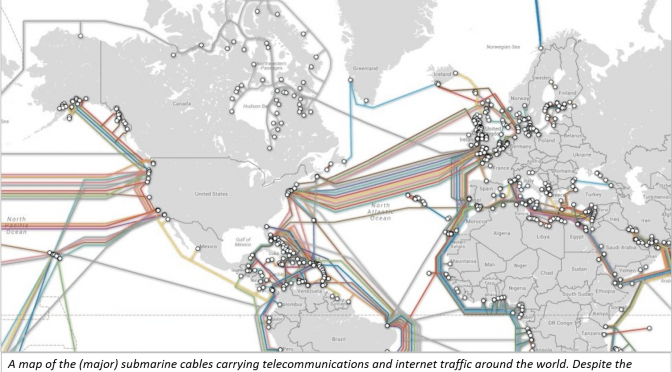
Defense experts on both sides of the Atlantic have expressed concern about the increase in Russian submarine activity in the Atlantic Ocean[1]. Russian patrols have risen by 50% to what one unnamed European diplomat described as “Cold War levels”. Not only the frequency of excursions has increased: the submarines are approaching the United States and Europe in areas with undersea cable routes. The cables are used for communications and internet data transmission; along with the fleet of satellites in low earth orbit, they are the spine of our digital world. The United States and NATO allies still rely on these cables for vital military traffic.
So far, the Russians have not been observed doing anything to the cables. But because of their importance, the presence of the submarines is alarming. The Russian Navy could be identifying the best places to cut the cables in the event of hostilities with the West; it could also be making efforts to tap them as a source of intelligence. Or they may have a different, unguessed purpose that is unrelated to the communications cables. What is certain is that the Russians are not simply passing the time of day; the Russian Navy is executing a mission and that mission somehow involves NATO.
ceuta 1
ntelligence gathering and signals interception remains the most probable activity. It has a long and distinguished history in warfare; the capture of a lost set of Confederate orders allowed General McClellan to bring General Lee’s Army of Northern Virginia to battle in unfavorable circumstances in Sharpsburg, Maryland, leading to an important Union victory in the Civil War. It has become critically important since the widespread adoption of wireless and radio communications during the First and Second World War. Everyone knows that the British built the world’s first computer at Bletchley Park in order to crack the German ENIGMA codes, though the incredible Polish contributions to that effort remain overlooked. The United States had successfully broken Imperial Japanese diplomatic codes prior to Pearl Harbor, and were used to prepare the US Navy for the critical Battle of Midway. The US Navy also pioneered the use of submarines and deep-sea submersibles for intelligence gathering, tapping the unencrypted military communications between the mainland and facilities along the Kurile Islands. We continue to deploy these assets, such as the USS Impeccable.
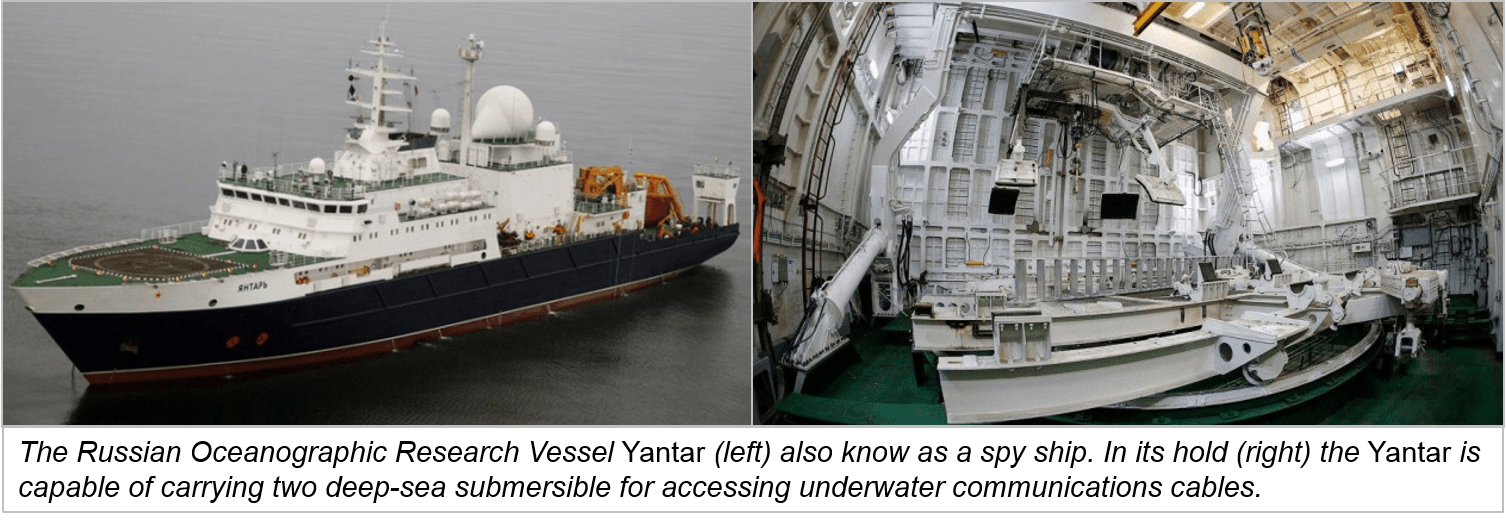
Assisting the submarines is the Russian Navy’s Oceanographic Research VesselYantar[2]. The Yantar is newly commissioned, having come off the Kaliningrad slips early this year, and has nothing in common with Jacques Cousteau and the Calypso despite its scientific-sounding designation. It is an intelligence platform, operated by the Russian Navy for the Glavnoje Razvedyvatel’noje Upravlenije, or Main Intelligence Directorate. Although less infamous than its sister organization, the KGB (now FSB), the GRU is the larger of the two organizations with six times more foreign agents deployed that the Foreign Directorate of the FSB[3]. The Yantar was tracked by the Department of Defense as it approached and followed the North American coast from Canada down to the Caribbean. The Yantar carries deep-sea submersibles of the same kind the US Navy uses for a similar purpose: finding, tapping and potentially cutting undersea communications cables.
ceuta 2
After its leisurely voyage, including passing the US nuclear submarine base in Kings Bay, Georgia, the Yantar made its way across the Atlantic back towards Europe. On the 19th of October, the spy ship arrived at its destination: the Spanish port of Ceuta[4]. There it received a warm welcome, with a protected berth and round-the-clock security provided by the port authorities. It took on fuel and consumables while its sailors stuffed their gobs with paella and vino tinto while also engaging in the other profligate activities typical of sailors ashore. As comradely a reception as Ivan could have received in Kaliningrad.
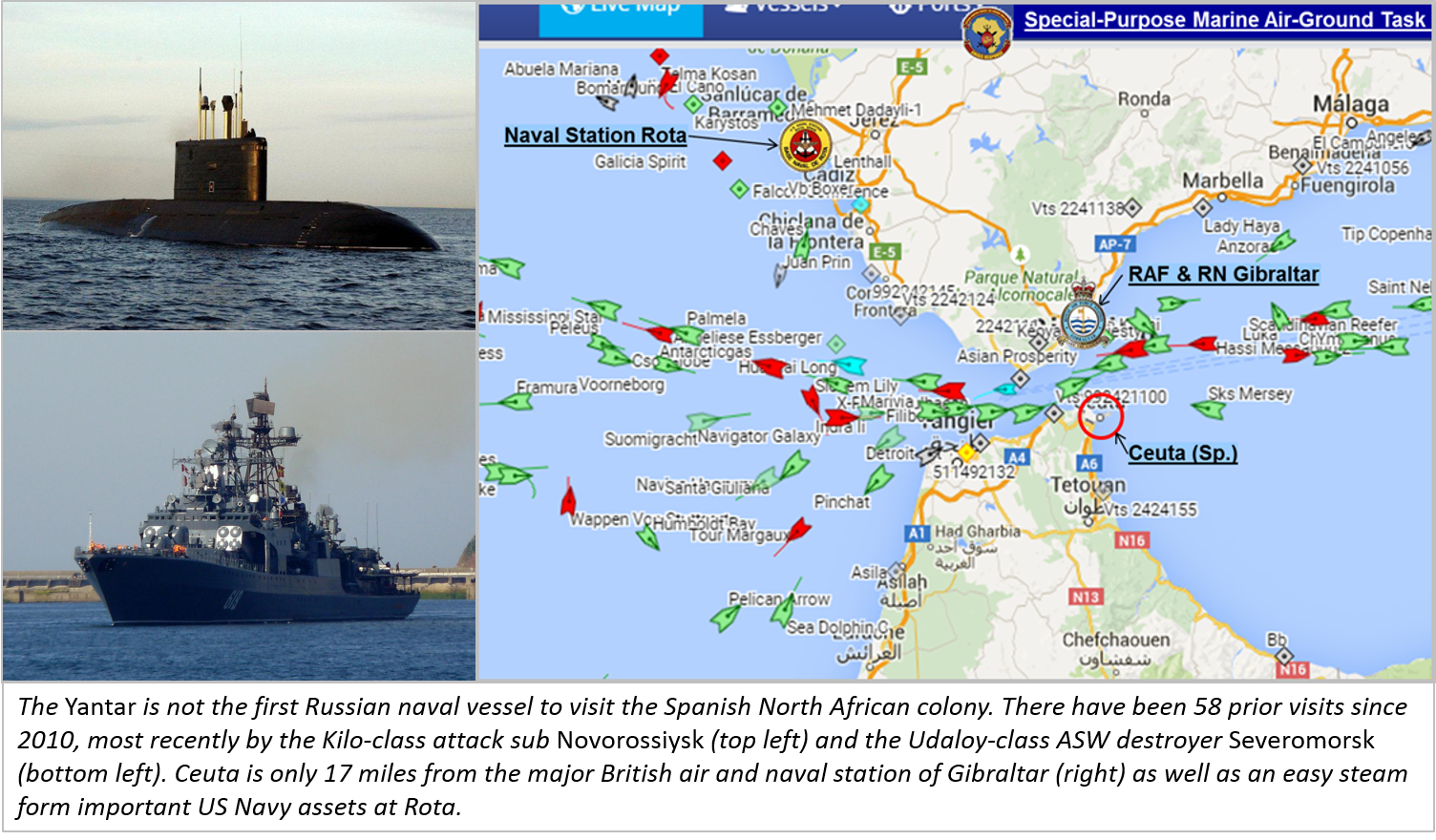
But Ceuta is not Kaliningrad. It is a port belonging to a NATO ally. It is strategically located on the North African coast next to the Straits of Gibraltar, one of the busiest maritime transit points in the world. And it is an easy day’s steaming from RN Gibraltar, a port that Royal Navy vessels often visit, as well as the naval station of Rota, a base leased by the US Navy from Spain. That is where the US is basing four Aegis-equipped destroyers as part of the European Phased Adaptive Approach to ballistic missile defense. What in God’s name is a Russian intelligence vessel doing there?
The Yantar visit is not an isolated incident: this year alone there have been 14 port calls by Russian naval vessels to Ceuta and 58 in total since 2010. In August, the diesel attack submarine, RFS Novorossiysk passed three days in the Spanish colony, with Gibraltar well within range of its SS-N-27 “Sizzler” anti-ship missiles. In April, it was the Udaloy-class ASW destroyerSeveromorsk; and in February another ASW frigate, the Yaroslav Mudry. The city fathers are happy to have 2,000 lonely sailors spending their rubles on “shore leave” and local businesses benefit too. Nothing to comment on in normal times; except that we’re not living in normal times. Russian troops are still in Ukraine; NATO aircraft are intercepting Russian bombers over allied airspace; Turkey is reporting violations of its airspace by Russian drones and jets; and we are not sending troops and equipment to Eastern Europe because relations are warm and fuzzy.
ceuta 3
It is long past time the United States took a firmer line with Spain. Spain may be an important ally for us and NATO, with a strategic location and shared interest in the stability of North Africa and the Sahel. It is not a question of gratuitously humiliating or infuriating them. But the US must make it crystal clear to Spain that they must choose their side and stick with their friends. They cannot play both sides: they cannot take American dollars for the use of Rota and Russian rubles for the use of Ceuta. Our concern and extreme displeasure at having half the Russian fleet pass the time of day within a hundred miles of our ballistic missile defense assets must be communicated to the Spanish in no uncertain terms. And the consequences of this perfidious attitude should also be made known – discretely.
Intelligence sharing between the two nations might begin to suffer. The notable successes of Spanish police in intercepting and arresting ETA operatives and potential jihadists in recent years is not due entirely to the keen sense of the beat cops, but to good intelligence and timely cooperation between the Spanish, French and American agencies. If Spain still refuses, the US should consider a relocation of US assets to the Port of Lisbon (USN) and to Beja for the Marine Crisis Response Force – Africa. Both are almost as well situated as the current locations and the Portuguese are not hosting Russian warships.
Unless the US and NATO take firm measure, Spanish will remain indifferent and their “business-as-usual” attitude will continue. It is not only avaricious and in bad faith, it is dangerous to Spain’s own interests. They may come to find, like the Crimeans, Moldovans and others, that once Ivan gets comfortable, he is not an easy houseguest to get rid of. And neither Ceuta nor Melilla are covered by NATO’s Article 5 provision for mutual defense.
Sources and Notes
[1] David E. Sanger and Eric Schmitt, “Russian Ships Near Data Cables Are Too Close for U.S. Comfort,” The New York Times, 25 October 2015
[3] The SVR, Sluzhba vneshney razvedki.

An Update on Narco Submarines and Maritime Law Enforcement Agencies’ Efforts to Thwart Their Operational Effectiveness

This article originally appeared on the Small Wars Journal, and has been republished with permission. You can read it in its original form here. 

By  Byron Ramirez and Robert Bunker

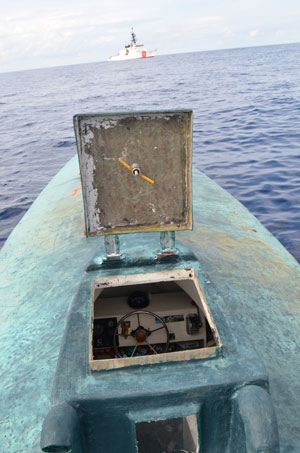
During recent months, media outlets have dedicated special coverage to the latest narco submarine seizures carried out by the U.S. Coast Guard and other partner agencies.  In our 2015 Foreign Military Studies Office report, Narco-Submarines: Specially Fabricated Vessels Used for Drug Smuggling Purposes, we discussed the strategic implications associated with this innovative method of transporting narcotics. We explained that narco submarines originated in the early 1990s and have been used since then as an alternative to other less covert methods of distribution. Over time, narco submarines’ design, features, and technical capabilities have continued to evolve. This advancement in technology has certainly presented challenges to law enforcement authorities and militaries. Nonetheless, in spite of the evolution of narco submarine technology, the U.S. Coast Guard and U.S. Navy have developed their own sophisticated set of technologies which allows them to improve their ability to detect and capture these vessels.

Who: Drug cartels, especially many based in Colombia, manufacture narco submarines.

What: Narco submarines are used to transport narcotics from Colombia to other countries in Central America as well as Mexico.

When: This method of distributing narcotics became more prominent around the year 2006. A larger number of narco submarines have been seized since around 2007, mostly in the Pacific Ocean, with a smaller number in the Caribbean Sea. [1]

Where: Drug traffickers have used mostly low profile vessels (LPVs) to transport narcotics from Western Colombia and Northwest Ecuador to Central America, frequently via the Pacific Ocean. The majority of these vessels travel past Panama, Costa Rica, and Nicaragua, and often are intended to reach other countries in Central America as well as Mexico, where their merchandise is then collected and re-routed to other destinations via other delivery methods.

Why: Because of their technical features and low profile design characteristics, narco submarines allow drug traffickers to reduce the risk of detection and seizure. Although there have been several confiscations, it is believed that many of these vessels continue to travel undetected and ultimately reach their intended destinations.

Synopsis

Incident 1: On June 2, 2015, the USS Kauffman [FFG-59] seized 582 kg. of cocaine from an Ecuadorean semi-submersible that was traveling in the Pacific Ocean. The vessel was intercepted near Guatemala. The three crewmen included two Ecuadoreans and one Colombian. [2] A later article placed the seizure at 779 kg with a street value of USD$15.5 million. [3] 

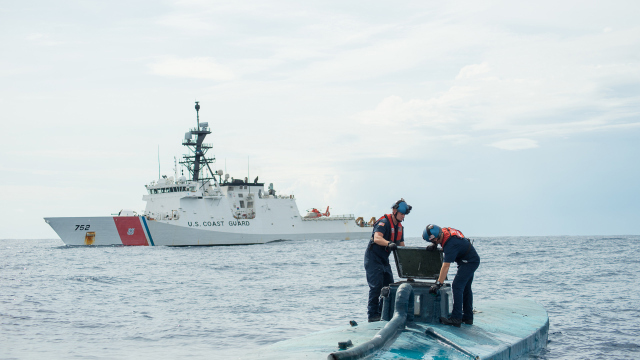
Incident 2: On July 19, 2015, the U.S. Coast Guard Cutter Stratton [WMSL 752] intercepted and captured a 40 foot long, semi-submersible, low profile vessel in the Pacific Ocean which carried more than 16,000 pounds (over 6 tons) of cocaine.  According to reports, the seized narcotics are worth more than USD$180 million wholesale. This represented the largest seizure of its kind in U.S. Coast Guard history at the time. The vessel was detected by U.S. Navy maritime patrol aircraft in international waters about 200 miles south of Mexico. CBS reports that the same U.S. Coast Guard crew which intercepted this vessel has also intercepted 15 other drug smuggling vessels since April 2015, and has seized over 33,000 pounds of cocaine worth over USD$540 million since May 2015. [4]

A Coast Guard Cutter Stratton boarding team seizes cocaine bales from a self-propelled semi-submersible interdicted in international waters off the coast of Central America, July 19, 2015. The Coast Guard recovered more than 6 tons of cocaine from the 40-foot vessel. (Coast Guard photo courtesy of Petty Officer 2nd Class LaNola Stone)

A Coast Guard Cutter Stratton boarding team seizes cocaine bales from a self-propelled semi-submersible interdicted in international waters off the coast of Central America, July 19, 2015. The Coast Guard recovered more than 6 tons of cocaine from the 40-foot vessel. (Coast Guard photo courtesy of Petty Officer 2nd Class LaNola Stone)

[FOR PUBLIC RELEASE]

9 July 2015 Seizure of Narco Submarine U.S. Coast Guard Image from Video [FOR PUBLIC RELEASE] U.S. Agencies Stop Semi-Submersible, Seize 12,000 Pounds of Cocaine 94th Airlift Wing, U.S. Coast Guard Pacific Area. DVIDS/DMA, 19 July 2015.
9 July 2015 Seizure of Narco Submarine U.S. Coast Guard Image from Video
[FOR PUBLIC RELEASE] U.S. Agencies Stop Semi-Submersible, Seize 12,000 Pounds of Cocaine 94th Airlift Wing, U.S. Coast Guard Pacific Area. DVIDS/DMA, 19 July 2015.
See the 3:31 Minute Coast Guard Video of this Incident

With respect to this same narco submarine seizure, The Washington Times [5] reported:

“Our extremely efficient and experienced aircrews are fully engaged in protecting the United States’ maritime borders from all threats including those posed by drug trafficking organizations,” said Director of National Air Security Operations Center — Jacksonville Robert Blanchard. “Our collaborative interagency partnerships and long-range tracking capabilities allow us to interdict dangerous vessels before they reach our coastal borders.”

Meanwhile, The Washington Post [6] stated:

“The July effort (interdiction) marked the second time that the (U.S. Coast Guard Cutter) Stratton had stopped this type of narco-submarine in a two-month span. In June, the Stratton crew also stopped a submersible carrying 5,460 pounds of cocaine.”

Taking part in this July 19 interdiction was the U.S. Navy, U.S. Coast Guard, and the U.S. Customs and Border Protection (CBP) Office of Air and Marine (AMO). This joint operation off the coast of El Salvador shows the collaboration taking place across agencies to thwart drug trafficking operations. [7]

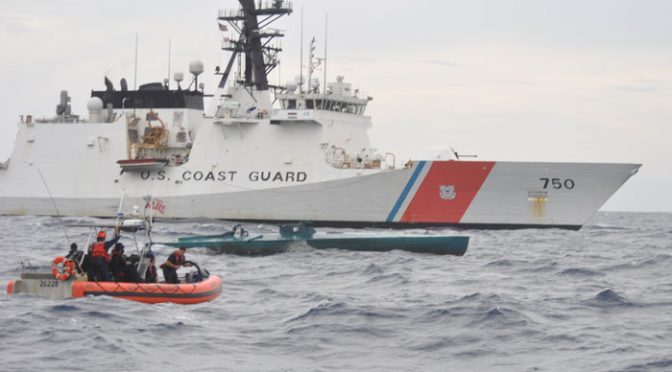
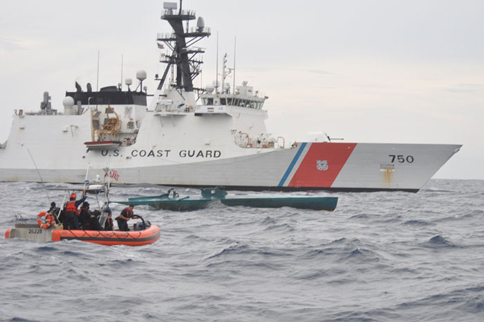
Incident 3: On August 31, 2015, the U.S. Coast Guard seized yet another semi-submersible in the eastern Pacific Ocean. This particular seizure by the USCG Bertholf [WMSL 750] represented nearly 15,000 pounds of cocaine. The vessel was 50 feet long and carried a 4 person crew. It is estimated that the value of this shipment, which was captured west of Mexico, is approximately USD$227 million. The vessel was spotted by U.S. maritime patrol aircraft and intercepted by two long-range U.S. Coast Guard interceptor boats. [8]

A Coast Guard Cutter Bertholf boarding team aboard an Over the Horizon Long-Range Interceptor boat approaches a self-propelled semi-submersible vessel suspected of smuggling 7.5 tons of cocaine in the Eastern Pacific Ocean, Aug. 31, 2015. The seized contraband is worth an estimated $227 million. (U.S. Coast Guard photo)

[FOR PUBLIC RELEASE]

31 August 2015 Seizure of Narco Submarine U.S. Coast Guard Photo

[FOR PUBLIC RELEASE]

Incident 4: In September 2015, Colombia’s navy captured a semi-submersible that was being prepared to be launched into the Pacific Ocean. According to the official report, the vessel was 12 meters long, 3 meters wide, and could carry 5 tons of narcotics. It is believed that this vessel was built by FARC in the southwestern region of Colombia. [9]

Analysis

As we indicated in our 2015 FMSO report, low profile vessels can mask their heat signature, evade sonar and radar, and use lead siding to help mask their infrared signature. These particular technical aspects make their detection and capture exceedingly difficult and have forced law enforcement authorities to design their own technology and methods that counteract this technological race.

The U.S. Coast Guard has increased its technological capabilities as it attempts to intercept drug running vessels in both the Gulf of Mexico and in the Pacific Ocean. The Coast Guard is collaborating with the U.S. Navy and other agencies as well as utilizing military surveillance aircraft and nuclear fast attack submarines to search for narcotics carrying vessels. The Coast Guard has also been using HC-130 Hercules aircraft which provide surveillance and tracking of drug trafficking vessels in the Pacific Ocean. [10]

The U.S. is also working through the Joint Interagency Task Force (JIATF) South, a component of SOUTHCOM composed of multiple federal and partner nation agencies and military forces. Together, these agencies carry out detection and monitoring operations and share information that supports law enforcement interdictions of illicit trafficking. [11]

It is difficult to determine how many drug carrying vessels are currently being deployed and which specific routes they are using. Drug traffickers realize that there are risks involved with these operations, yet they consider captured vessels as a cost of doing business. In spite of the interdictions to date, we can suppose that drug traffickers continue to use this transportation and delivery method as it continues to yield high profits even when seizures are factored into the cost-benefit analysis.

The efforts carried out by the Joint Interagency Task Force (JIATF) South, including the U.S. Coast Guard and the U.S. Navy, must continue to reconcile the complexity of the challenges presented by evolving narco submarine technology and the ingenuity of drug trafficking organizations.

Collaboration and communication between law enforcement agencies and militaries are imperative to improving the efficiency and effectiveness of ongoing interdiction efforts. Although detection and monitoring technology have improved, this alone is not sufficient. In order to more accurately disrupt drug trafficking operations, governments and their law enforcement agencies must improve their exchange of intelligence and share best practices that enable them to adjust to the dynamic counter actions introduced by drug traffickers.   

Sources

[1] Byron Ramirez, and Robert J. Bunker, Narco-Submarines: Specially Fabricated Vessels Used For Drug Smuggling Purposes. Fort Leavenworth, KS: U.S. Army Foreign Military Studies Office (FMSO), 2015, http://fmso.leavenworth.army.mil/Collaboration/Interagency/Narco-Submarines.pdf

[2] Lic. Marco Proaño, “Embarcación ecuatoriana fue capturada con 582 Kg de droga.” Armada del Ecuador. 15 June 2015, http://www.armada.mil.ec/embarcacion-ecuatoriana-fue-capturada-con-582-kg-de-droga/

[3] “USS Kauffman Finds 775 Kg of Cocaine in the Eastern Pacific.”  Naval Today. 8 July 2015,http://navaltoday.com/2015/07/08/uss-kauffman-finds-775-kg-of-cocaine-in-the-eastern-pacific/

[4] “Alameda Coast Guard Crew Seizes Narco-Submarine Carrying 8 Tons Of Cocaine.” CBS San Francisco. 5 August 2015, http://sanfrancisco.cbslocal.com/2015/08/05/alameda-coast-guard-crew-seizes-8-tons-of-cocaine-from-narco-submarine/

[5] Douglas Ernst, “‘Narco-submarine’ with 8 tons of cocaine seized by U.S. off in the eastern Pacific Ocean.” Washington Times. 23 July 2015,http://www.washingtontimes.com/news/2015/jul/23/narco-submarine-8-tons-cocaine-seized-us-coast-el-/

[6] Sarah Larimer, “Why the Coast Guard calls narco-submarines the ‘white buffalo’ of the seas.” The Washington Post. 10 August 2015, http://www.washingtonpost.com/news/morning-mix/wp/2015/08/10/why-the-coast-guard-calls-narco-submarines-the-white-buffalo-of-the-seas/

[7] Amanda Macias, “US authorities seize a ‘narco-submarine’ filled with 8 tons of cocaine.” Business Insider. 23 July 2015, http://www.businessinsider.com/narco-submarine-with-8-tons-of-cocaine-2015-7

[8] Kirk Moore, “Coast Guard busts another narco sub.” Work Boat. 24 September 2015,http://www.workboat.com/news-feed/2015/coast-guard-busts-another-narco-sub

[9] “Al sur de Colombia incautan un ‘narcosubmarino’ en construcción.” El Comercio. 24 September 2015,  http://www.elcomercio.com/actualidad/colombia-incautan-narcosubmarino-construccion-ecuador.html

[10] United States Coast Guard – Office of Aviation Services. 1 January 2014,http://www.uscg.mil/hq/cg7/cg711/c130h.asp

[11] Evan Munsing and Christopher J. Lamb, Joint Interagency Task Force–South: The Best Known, Least Understood Interagency Success. Strategic Perspectives 5. Washington, DC, Center for Strategic Research – Institute for National Strategic Studies – National Defense University, June 2011,http://ndupress.ndu.edu/Portals/68/Documents/stratperspective/inss/Strategic-Perspectives-5.pdf

Dr. Byron Ramirez is a researcher and analyst who specializes in international political and economic affairs.  He completed his PhD in Economics and Political Science at Claremont Graduate University and holds an MA in Economics, a MS in Management, and an MBA.  His areas of research include geopolitics, international affairs, globalization, economic and social development, and illicit economies. His most recent publication is the co-edited work Narco-Submarines Specially Fabricated Vessels Used For Drug Smuggling Purposes. Fort Leavenworth, KS: U.S. Army Foreign Military Studies Office.

Dr. Robert J. Bunker is an Adjunct Research Professor, Strategic Studies Institute, US Army War College and Adjunct Faculty, Division of Politics and Economics, Claremont Graduate University. He holds university degrees in political science, government, social science, anthropology-geography, behavioral science, and history and has undertaken hundreds of hours of counterterrorism training. Past professional associations include Distinguished Visiting Professor and Minerva Chair at the Strategic Studies Institute, U.S. Army War College; Futurist in Residence, Training and Development Division, Behavioral Science Unit, Federal Bureau of Investigation Academy, Quantico, VA; Staff Member (Consultant), Counter-OPFOR Program, National Law Enforcement and Corrections Technology Center-West; and Adjunct Faculty, National Security Studies M.A. Program and Political Science Department, California State University, San Bernardino, CA. Dr. Bunker has hundreds of publications including Studies in Gangs and Cartels, with John Sullivan (Routledge, 2013),  Red Teams and Counterterrorism Training, with Stephen Sloan (University of Oklahoma, 2011), and edited works, including Global Criminal and Sovereign Free Economies and the Demise of the Western Democracies: Dark Renaissance (Routledge, 2014), co-edited with Pamela Ligouri Bunker; Criminal Insurgencies in Mexico and the Americas: The Gangs and Cartels Wage War (Routledge, 2012); Narcos Over the Border: Gangs, Cartels and Mercenaries (Routledge, 2011); Criminal-States and Criminal-Soldiers (Routledge, 2008); Networks, Terrorism and Global Insurgency(Routledge, 2005); and Non-State Threats and Future Wars (Routledge, 2002).

Featured Image: A Coast Guard Cutter Bertholf boarding team aboard an Over the Horizon Long-Range Interceptor boat approaches a self-propelled semi-submersible vessel suspected of smuggling 7.5 tons of cocaine in the Eastern Pacific Ocean, Aug. 31, 2015. The seized contraband is worth an estimated $227 million. (U.S. Coast Guard photo)