Week Dates: Mar. 28 – Apr 3. 2016 Articles Due: Mar. 27 2016 Article Length: 800-1800 Words (with flexibility) Submit to: Nextwar@cimsec.org
Natural disasters are often unpredictable and capable of inflicting mass devastation. The Asia-Pacific is especially prone, with over half a million lives lost and $500 billion in damages incurred within the last decade due to natural disasters. Time and time again, naval forces have performed admirably as first responders by performing Humanitarian Assistance/Disaster Relief (HA/DR) missions.
CIMSEC is launching a Naval HA/DR Topic Week to highlight importance of this mission and the role of naval forces in its execution. Can HA/DR operations refine warfighting skills? What are the political challenges and benefits of deploying naval forces in support of humanitarian operations? How may climate change and rising sea levels affect the demand for naval HA/DR? Contributors can explore these lines of inquiry and many others, as well as analyze HA/DR in a greater context.
Dmitry Filipoff is CIMSEC’s Director of Online Content. Contact him at Nextwar@cimsec.org.
On 11 February 2016, fourteen Nigerian and Ghanaian pirates in two speedboats attacked the product tanker MAXIMUS (ex-SP BRUSSELS) 70 nm south of Abidjan, Ivory Coast. They hijacked the ship with the intention to steal part or all of its 4,700 metric tonne diesel fuel cargo, sailing it to a position ca. 300 nm south of Lagos, Nigeria over the next few days. The case ended with an opposed boarding of the tanker by the Nigerian Navy, which left one pirate dead and six apprehended; the remainder fled on their support vessel, taking two crewmembers of the MAXIMUS as hostages.
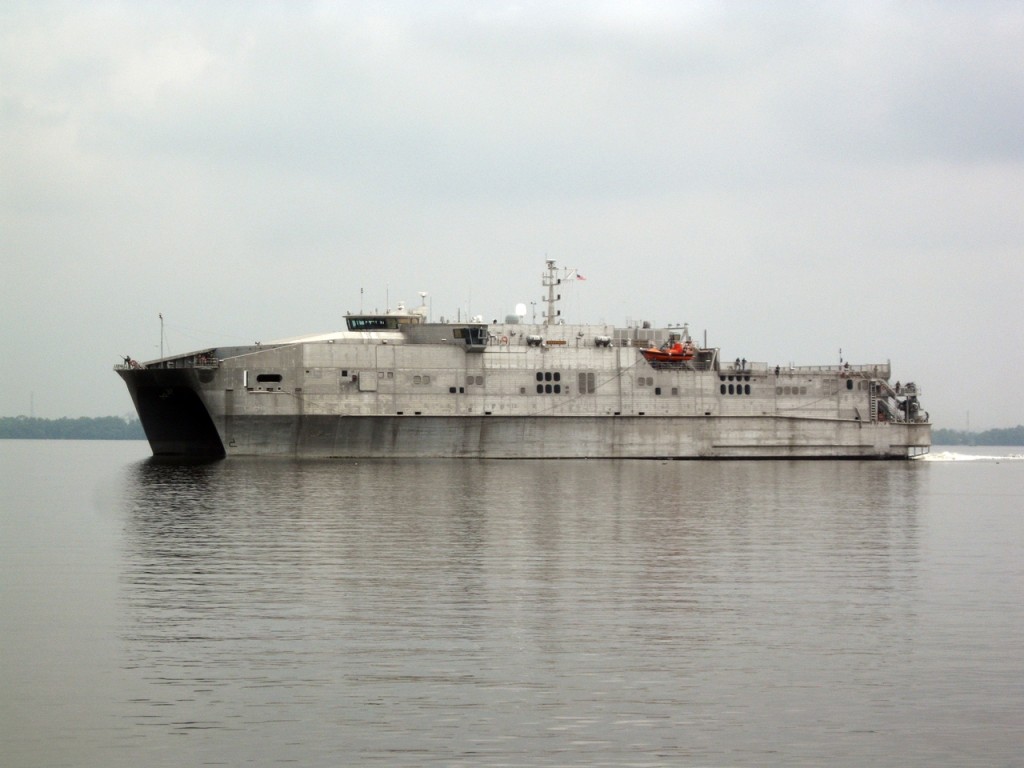
What began as just another product tanker hijacking developed into a model case for regional maritime security cooperation under the Yaoundé Code of Conduct. The first asset to track the hijacked tanker was the Military Sealift Command’s expeditionary fast transport vessel USNS SPEARHEAD, stationed in the region for training and exercise support as a part of the African Partnership Station. SPEARHEAD identified the hijacked ship and shadowed it for two days as it sailed from Ivorian into Ghanaian waters. Then the CTF 63, Capt. Heidi Agle, handed over to the Ghana Navy, which continued to shadow the ship until it crossed the extension of the maritime boundary to Togo, about 200 nm offshore at that point. While Benin and Togo were not able to mobilise vessels to that distance from the shore, Nigeria was.
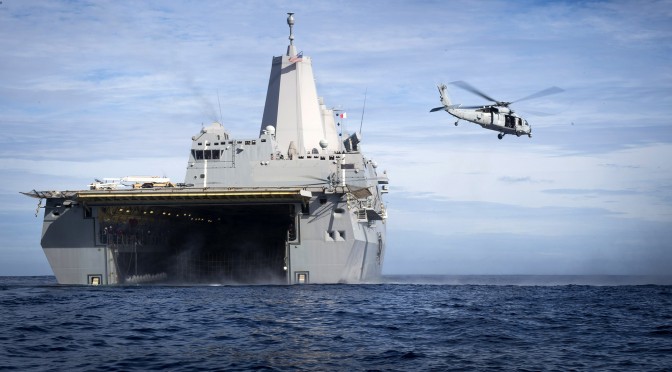
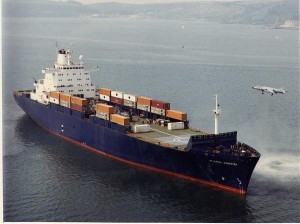
USNS SPEARHED leaving Douala in March 2015 (Photo: Dirk Steffen).
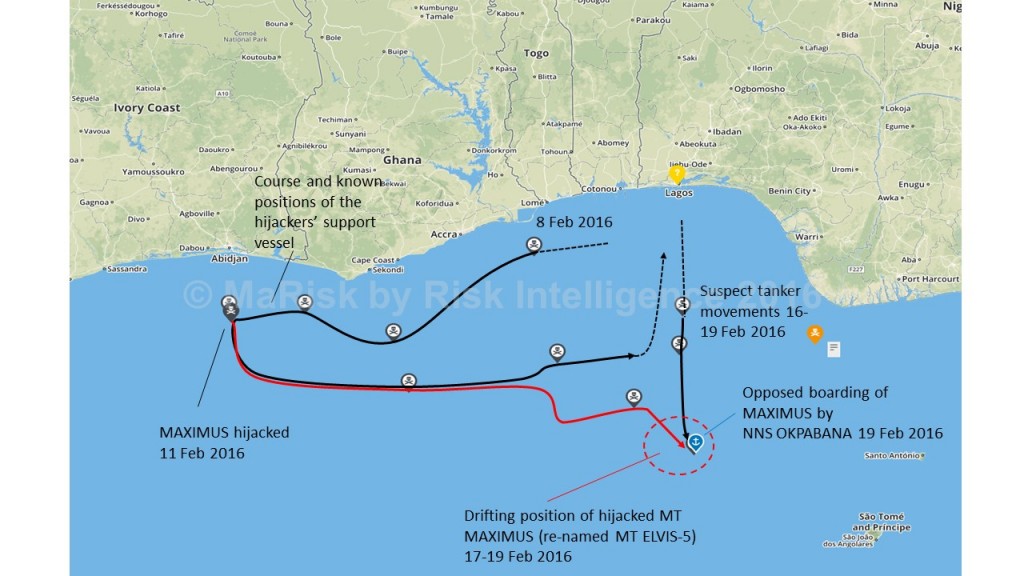
On 17 February the MAXIMUS, now re-named MT ELVIS-5 by the hijackers, had reached a position about 300 nm south of Lagos, roughly north-west of the island nation of Sao Tome and Principe. While an unknown mother ship had probably supported the actual attack on the tanker, another vessel, the small Cambodian-flagged tanker DEJIKUN, was likely used by the pirates in an attempt to steal part of the MAXIMUS’s cargo. The DEJIKUN was tracked heading south from Lagos on 16 February, arriving in the general area of the MAXIMUS on midday of 18 February.
The hijacking of the product tanker MAXIMUS and the tracks of the pirate support vessels between 8 and 19 February 2016 (source: MaRisk by Risk Intelligence).
Close on her tail was the Nigerian offshore patrol vessel NNS OKPABANA followed by NNS SAGBAMA. Meanwhile, the Nigerian Navy’s Chief of Training and Operations (CTOP), Rear Admiral Henry Babalola, obtained permission to operate in Sao Tomé and Principe waters although the MAXIMUS was technically in international waters (albeit inside the Sao Tome and Principe exclusive economic zone). What followed on 19 February were eight hours of negotiations via VHF before a Nigerian Navy boarding team from NNS OKPABANA boarded the MAXIMUS in the evening of 19 February. The pirates briefly offered resistance, before one of their number was killed and the remaining six on board the MAXIMUS fled into the engine room where they eventually surrendered.
Both from an operational point of view, especially with regards to regional co-operation as well as from a tactical perspective, the mission was a success. None of the MAXIMUS’s crewmembers were injured, although several pirates escaped with two hostages onto the DEJIKUN. The ship was later found drifting off Benin, abandoned by the pirates who had also taken the hostages with them.
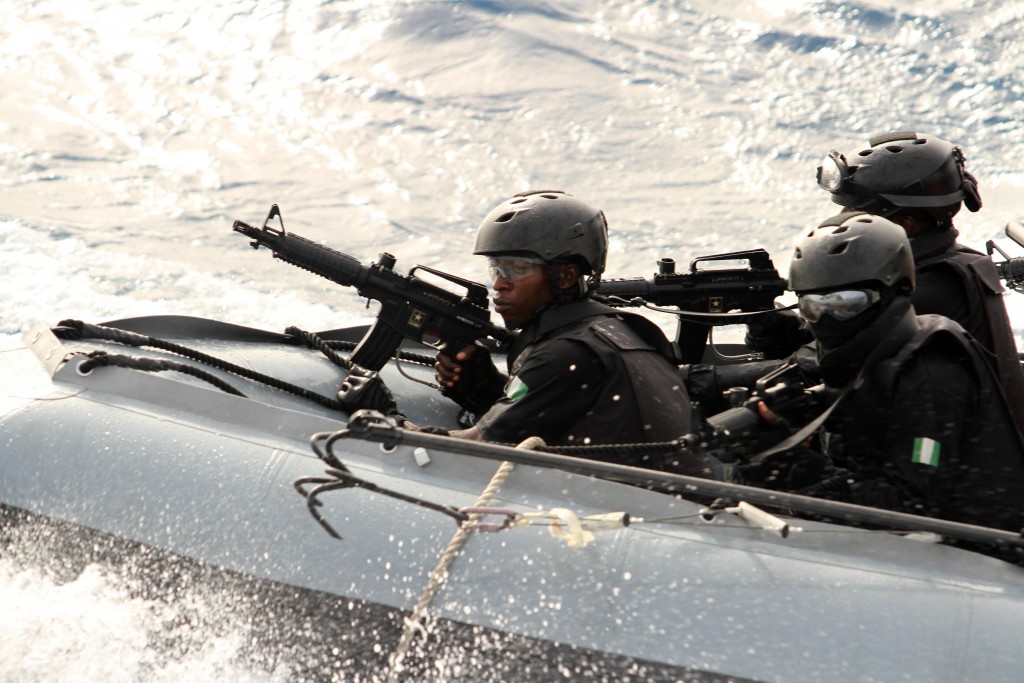
Nigerian Navy SBS team (Photo: German Navy/Steve Back).
The liberation of the MAXIMUS was lauded as a model of regional co-operation under the Yaoundé Code of Conduct, even though Sao Tome and Principe, a nation with virtually no maritime security capacity, never reported to Nigeria or to the relevant Zone D reporting centre in the region (contrary to the official statements) when the MAXIMUS or DEJIKUN entered her waters. Nigeria eventually asked for permission to pursue the MAXIMUS into the Sao Tome and Principe exclusive economic zone under a bilateral agreement, which in the end achieved its objective, but also exposed some of the still extant weaknesses in the regional framework and capacities.
While diplomatically relevant, the message that the operation sent to the criminals was equally important: Gulf of Guinea states are increasingly willing and able to suppress maritime crime. It may only have been a beginning, but it may well be that the prospect of a forceful naval intervention has upset the plans of would-be tanker hijackers at a time when the economic situation in Nigeria is becoming increasingly conducive to the theft and smuggling of fuel into the country.
For the navies of the region, especially the Nigerian Navy, success may become self-reinforcing. The Nigerian Navy has long labored under its dismal performance and reputation relative to its assets and manpower potential.It remains beset by corruption and inefficiency, but it appears that the change that the Buhari presidency has brought over Nigeria may have begun to affect the navy as well. The Nigerian Navy had already responded with some alacrity to the brief hijacking (turned kidnapping) of the LEON DIAS on 29-31 January, the attempted kidnapping of crewmembers from the SAFMARINE KURAMO on 5 February near Bonny River Fairway Buoy and more recently, assisting the BOURBON LIBERTY 251, which had two crewmembers kidnapped on 23 February 2016. In all cases, the Nigerian naval vessels arrived well after the attacks, although in the case of the SAFMARINE KURAMO the attackers had to abandon their attempt to extract the crew from their citadel and were forced to leave the ship. While not entirely satisfactory to those involved, it is progress over previous years. Before, the navy hardly ever responded to distress calls at all, and when they did, it more often than not created bad blood between them and the merchant marine community through heavy-handed practices.
It is likely that the response to similar incidents will remain hit-and-miss for some years to come, especially if the circumstances are less favorable than in the MAXIMUS case. The MAXIMUS episode benefited from the presence of the USNS SPEARHEAD, which was conveniently deployed in the area for the upcoming African Partnership Station’s OBANGAME EXPRESS 2016 exercise (17-25 March 2016) as well as from some serious tactical mistakes made by the pirates. However, amongst other contingencies, the OBANGAME EXPRESS exercise seriesrehearses responses to precisely this type of scenario. In a way, the incident therefore reflects the journey the navies of the regions have made since the inception of OBANGAME EXPRESS and it will surely provide interesting input for the upcoming iteration of the exercise. The Nigerian Chief of the Naval Staff (CNS), Vice Admiral Ibok- Ete Ekwe Ibas, has credited OBANGAME EXPRESS with meeting its objectives. His challenge will now be to follow up and maintain, as he said, the “resolve of the navy to deploy more ships to maintain the current record of sea patrol in order to tackle maritime security challenges.”
Dirk Steffen is a Commander (senior grade) in the German Naval Reserve with 12 years of active service between 1988 and 2000. He took part in exercises OBANGAME EXPRESS 2014 and 2015 both at sea and ashore for the boarding-team training and as a Liaison Naval Officer on the exercise staff. He is normally Director Maritime Security at Risk Intelligence (Denmark) when not on loan to the German Navy. He has been covering the Gulf of Guinea as a consultant and analyst since 2004. The opinions expressed in this article are his alone, and do not represent those of any German military or governmental institutions.
A popular quote reads “A ship in port is safe. But that’s not what ships are made for.” Correspondingly, one could quip “Navies are very good in constabulary tasks. But that’s not what they’re maintained for,” echoing noted political scientist Samuel Huntington in the process. More than sixty years ago, Huntington wrote about the purpose of naval forces in the early Cold War, yet some of his thoughts have an enduring value for 2016. In the Mediterranean, not one but two naval task groups are working hard to contain a humanitarian crisis at sea. While their service is admirable and strictly necessary, even as it is only a drop in a bucket, naval capabilities which are in high demand elsewhere are bound in a mission that is only a secondary role for navies. Instead, Germany should lead the way in investing in an EU auxiliary force.
A crowded boat with migrants awaits rescue by EU NAVFOR MED.
In May 2015, the German Navy began participating in the search and rescue mission in the Central Mediterranean north of the Libyan coast, dubbed EU NAVFOR MED (Operation “Sophia”) shortly thereafter. The pressure to act had become unbearable for political decision-makers in Berlin and Brussels after yet another devastating humanitarian catastrophe which occurred somewhere on the High Seas between Libya and Italy. An overloaded boat sank during the night of 18/19 April, costing the lives of up to 800 migrants. Hundreds others had perished in the Mediterranean during the months before. Following a European Council decision and a parliamentary green light, the German Navy dispatched the frigate Hessen (F221) and the combat support ship Berlin (A1411) to provide a presence north of Libyan territorial waters. At the time, both ships were operating off the Horn of Africa and in the Easter Mediterranean to provide the German Navy with an operational reserve. Hessen and Berlin joined a number of other EU vessels, which ranged from warships to auxiliary and coast guard ships. EU NAVFOR MED was just the latest mission that the German government engaged its shrinking military forces in; on the maritime domain alone, Germany is continuously involved in naval operations in the central Mediterranean (ACTIVE ENDEAVOUR, since 2002), off the coast of Lebanon (UNIFIL, since 2006), and on the Horn of Africa (EU NAVFOR Atalanta, since 2008). German Navy participation in one or often two of the four Standing NATO Maritime Groups, exercises, training, and out-of-the-schedule naval operations such as providing cover for the destruction of Syrian chemical weapons at sea in 2014 have added pressure to (wo)men and material.
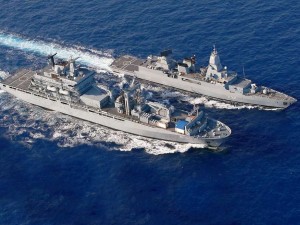
Combat support ship Berlin and frigate Hessen steam side by side in the initital provision of humanitarian assistance on the Southern flank.
Cue: Queen, “Under Pressure”
Since the summer of 2015, rotating up to two ships in and out of the EU NAVFOR MED mission – such as the Berlin’s sister ship Frankfurt (A1412), or the tender Werra (A514) – put a truly severe strain on German military-operational planning. It goes without saying that adapting these venerable warships and supply vessels, which are optimized for many things other than housing, feeding, and medically caring for hundreds of castaways on board, has put a strain on the Deutsche Marine. The noble task of saving lives at sea has challenged the well-trained crews of the ships, but it hardly obscured the fundamental problem that more than two decades of defense budget cuts, strategic disorientation, and a larger disinterest in all things hard power by the German public (and most of its political masters) have caused. By default, the German Navy has turned into a low-end, operationally-minded force, where high intensity should be a design guide.
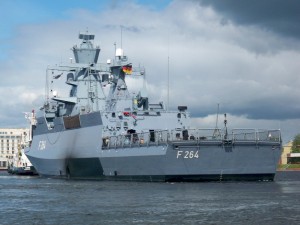
The German Navy’s dilemma, at 16,000 people and just 62 vessels at the smallest it has ever been by a December 2015 count, was illustrated best right before Christmas. In response to the November attacks in Paris, the frigate Augsburg (F213) was re-assigned from EU NAVFOR MED to provide air defense for the French aircraft carrier Charles de Gaulle in the Eastern Mediterranean and Persian Gulf. The mine hunter Weilheim (M1059), en route to return from UNIFIL to its homeport on the Baltic Sea right in time for the holidays (and probably the least-capable vessel to offer space for potentially hundreds of migrants), was tasked to remain in the Central Mediterranean. It joined the corvette Ludwigshafen am Rhein (F264), another warship tasked with a humanitarian assistance task that was hardly envisioned by strategic and operational planners in Berlin and Rostock, site of the naval command. Samuel Huntington, who warned that navies should concentrate on providing high end options and not be used for low-end missions, would probably turn over in his grave. This is not to say that other countries did not have their own challenges in providing assets to the mission, but some of them are better equipped to attend to low-end missions. The Royal Navy, for instance, dispatched HMS Enterprise (H88), a multi-role hydrographic oceanographic vessel.
The corvette Ludwigshafen am Rhein is currently part of Germany’s contribution to EU NAVFOR MED. Germany’s naval missions can sometimes be as complicated as its ship-naming policy.
When all you have is a hammer, every problem looks like a nail
In February 2016, the German Navy is still tied up in the EU NAVFOR MED. Privately owned platforms such as the Phoenix, operated by the Malta-based Migrant Offshore Aid Station (MOAS), and two vessels operated by Doctors without Borders (Medicines Sans Frontiers, MSF), the offshore supply ships Bourbon Argos and Dignity 1, have also at some point joined the operation (although they are not integrated into the EU force). At the same time, the Aegean Sea, which offers the shortest distance between Turkey and Greece, has moved into focus for human trafficking. The cold of winter has hardly deterred the refugees from mounting unseaworthy dinghies, rubber boats, or derelict fishery vessels that the criminal networks of human traffickers operate. In response, NATO stepped in and dispatched its Standing NATO Maritime Group 2 (SNMG2). The task force is commanded by the German rear admiral Jörg Klein and currently consists of the German Navy combat support Ship Bonn (A1413) and four frigates from Turkey, Italy, Greece, and Canada. As the New York Times noted in an article on 11 February,
“while the hastily made decision reflected the growing urgency of the situation, it was not clear that it would have much practical effect on the flow of refugees fleeing Syria’s five-year civil war: The alliance said it would not seek to block the often rickety and overcrowded migrant vessels or turn them back, and military officials were scrambling to determine precisely what role their warships would play.”
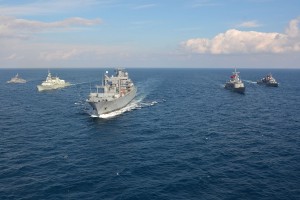
Standing NATO Maritime Group 2, seen here steaming in formation, is currently tasked with operating on the Aegan Sea refugee route.
A European Auxiliary Navy
Granted, the political leverage for European integration is low at the moment. The European Union is struggling to fend off tendencies that call not for an ever closer union, but in fact work towards dismantling some of the EU’s accomplishments in the wake of the refugee crisis. Still, with security and defense in increasing demand, including maritime security from on Europe’s southern flank, there need to be fresh ideas that can be operationalized quickly. In the face of the deteriorating relations between the West and Russia and the disintegrating Middle East, warships should contribute to the more robust stance against political aggression and hard threats, thus focusing on more of their core tasks (no doubt requiring doctrinal and conceptual re-assessments in some European capitals). This would give NATO a stronger role, and leave the EU to take care of the low-end maritime task. It could thus serve as an example of burden-sharing between the two entities.
Germany could play a leadership role in drawing up a European auxiliary navy, reenergizing the European spirit of cooperation in the process. Such a task force could have a number of political advantages. First, it would send a strong signal that European nations are willing to work together to address the ramifications of maritime trafficking. Second, Germany would address calls from inside and outside to do more. As a maritime nation with strong normative impulses, the Federal Republic would also demonstrate to the electorate (long weary of military engagement) that it is aware of the utility of naval forces in crisis response. Naturally, German investment into an auxiliary EU navy should not come at the expense of more robust naval tasks with the German Navy, but these could be better tailored if the combat support ships, frigates, and corvettes need not be used in lesser operations. Third, if and when the current migrant crisis ebbs, the European auxiliary navy could concentrate on the public diplomacy role of naval forces, providing anything from humanitarian assistance to the provision of medical services on goodwill tours around the world (like the U.S. Navy and the Chinese PLAN routinely do already). This auxiliary navy could also lend a hand to regional coastal and constabulary navies and coast guards (e.g. in West or East Africa) to train and exercise.
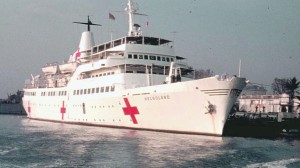
The last dedicated German hospital ship was the MS Helgoland, which saw extensive action in Saigon (South Vietnam) between 1966 and 1972. The ship was operated by the German Red Cross.
To this end, it is strictly necessary to inject some fresh thinking into how such as force could be tailored. It is imperative that an idea such as this can be put into action rather quickly before being brought to grinding snail speed by bureaucrats in Brussels or Berlin. First, one should look at the market of commercial vessels. Ro/Ro ships or offshore supply ships are available, usually even on short notice. They could be painted gray or white, manned by a mixed civilian-military crew, and quickly form the backbone of an auxiliary navy.
The Royal Navy used the Ro/Ro vessel Atlantic Conveyor in the 1982 campaign to retake the Falkland Islands from Argentina. The makeshift helicopter and Harrier carrier was sunk by Argentine forces in the course of the conflict.
Other opportunities arise as well. The offshore patrol vessel L’Adroit (P725) is a demonstrator vessel built by French shipbuilder DCNS and was placed at the disposal of the French Navy for three years, a period that is now drawing to a close. The ship could be introduced as a French contribution to the auxiliary navy, which need not limit itself to state-run ships. If done properly, NGOs like SOS Mediterranee could be integrated (the non-profit organization operates the MS Aquarius, a former German fishery protection vessel). The former rescue cruiser Minden, built in 1985 and serviced by volunteers from the German Maritime Search and Rescue Service, will join what is already emerging as a multinational, civilian, and military task force in the Mediterranean.
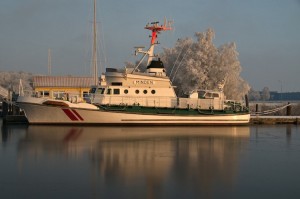
The former SAR cruiser Minden, for thirty years operated in the North Sea and Baltic Sea by an NGO, will soon begin rescue operations in the Mediterranean.
In the medium term, one could consider the charter of vessels which could be converted quickly as dedicated hospital ships, also crewed by civilian mariners and military. A logistics ship would also come in handy, as well as a simplistic command platform. To provide range, ships taken up from trade (not such a novel concept after all) could be selected if they provide the opportunity to operate reconnaissance drones or helicopters. In the long term, there are even further ideas that could be floated. For example, the 2016 German federal budget has earmarked the procurement of three new patrol vessels for the Bundespolizei See, Germany’s quasi Coast Guard. It is entirely plausible that these ships could also be detached as part of the EU’s auxiliary fleet, akin to NATO’s SNMGs – that is, if Germany politically resolves its constitutional conflict between police and military jurisdiction and respective responsibilities. To go even further, the German Navy is currently in the early stages of procuring the future multi-role combat ship MKS180, designed as a modular warship. Is it too far-fetched to consider adding a civilian variant, a MKS180CIV, for the auxiliary “Great EU White Fleet”?
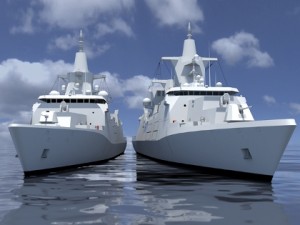
The German Navy’s next project: Multi-role combat ships MKS180 (artist conception).
To be clear: Such an auxiliary navy would have to be organized, trained, and equipped properly. This requires financial and political investments. The task force, more of a 10-ship navy than a 100- or even 1000-ship navy, would provide a vision for European cooperation. EU or United Nations mandates would be desirable. It appears that it is also a much more sensible road leading to further defense and security cooperation than political soap-box oratories about the need for a European army could ever do. Politically and operationally, it could provide Berlin with a sense of regaining some degree of initiative when it comes to maritime security.
Sebastian Bruns directs the Center for Naval Strategy and Security at the Institute for Security Policy, University of Kiel (Germany). He is the editor of “The Routledge Handbook of Naval Strategy and Security”(Routledge: London 2016).