Category Archives: Capability Analysis

Analyzing Specific Naval and Maritime Platforms

New Forms of Naval Operational Planning for Earning Command of the Seas

Sea Control Topic Week

By Bill Shafley 

Introduction

Sea Control operations require a delicate balance of protecting the hunters and releasing the hounds. Strike Group and subordinate staff’s tactical planning, general thinking, and day-to-day operations are biased toward the defense of a High Value Unit. This is a direct result of nearly thirty years of fighting from-the-sea not for-the-sea – or to use operational terms – existing as a power-projection force without the burden of first establishing maritime superiority through sea control operations. Future operations against peer competitors will require a different mode of thinking to understand the nuances of employing a strike group’s combat power where near-constant tradeoffs are required between offense and defense. Staffs must refine their thinking and improve their methods in three ways to make planning for Sea Control operations more effective.

Warfighting staffs must develop an increased understanding of sea control from the strategic to tactical levels. This would improve risk assessment by ensuring decision-makers can link a resource informed theory, of establishing and maintaining it, to the value that maritime superiority brings to the larger operation. A review of Sir Julian Corbett’s Some Principles of Maritime Strategy provides this basis.

Planners must organize their tactical thinking around the joint battlefield and all domains of warfare to plan for sea control operations. Planning in terms of these functions (movement/maneuver, fires, protection, intelligence, and sustainment, and command and control (C2) will force staff members out of thinking about the tactical problem through the stovepiped Composite Warfare Commander (CWC) structure. Planners should appropriately balance limited strike group resources in a manner that sets task and purpose for each warfare commander to execute.

Staff and planners require a framework to examine and visualize the tactical problems associated with establishing and maintaining maritime superiority operations. Wayne Hughes’ well-known work Fleet Tactics and Coastal Combat provides this inclusive framework. His methodology helps warfighters understand the resourcing tradeoffs necessary to establish and maintain the level of maritime superiority needed for mission accomplishment and effectiveness. And, more importantly, Hughes work can help staffs identify and capture risk in a manner that informs and communicates a commander’s risk appetite.

Theories and Degrees of Command of the Sea

It is important to understand sea control from its historic origins. Planners must apply critical thinking to the operational and tactical considerations of achieving the proper level of maritime superiority through sea control operations. While doing that, Sir Julian Corbett’s Some Principles of Maritime Strategy and the Green Pamphlet provide a good place to start. “Command at-sea exists only in a state of war.”1 This is an important distinction, where the use of the expression presupposes a fleet structure adequate to confront a maritime adversary and prevail.2

The relationship between war and command of the sea is an important one. In an active state of conflict with another maritime power, naval forces compete for command of the sea, or as modern doctrinal language would call it, maritime superiority or supremacy. The navy that leaves the competitor unable to seriously interfere with their ability or achievement of their own objectives is said to have it.3 Corbett structures command of the sea in terms of degree. It can be general or local, temporary or permanent.

This discussion of scope in terms of area and duration is important for planners to comprehend. The Fleet’s requirement to establish command of the seas are born of the necessity its operations support. Command of the sea comes with a price tag in terms of opportunity costs and scarce resources. Generally permanent command of the sea must be achieved throughout the theater of operations and it must be maintained indefinitely. This condition may be achieved only by the annihilation of the enemy’s capabilities and an associated set of resources and level of effort. Local temporary command more narrowly scopes the requirement in terms of a location and duration, tied to the necessary theater military objective of a fleet’s operations support.4 It is this more temporal control of the sea that is the providence of carrier strike groups and subordinate staffs, and may be met with a different set of resources and effort.

This logic forms the basis of a basic strategy question, which is answered at higher level echelons. Operational level fleet staffs do their best to translate Corbett’s thinking into action. Command of the sea as Corbett worked to define it, has been replaced with discussions of maritime superiority as achieved through sea control operations. Sea Control operations (the destruction of enemy naval forces, suppression of enemy sea commerce, protection of vital seal lanes, protection of shipping, and establishment of local maritime superiority in areas of naval operation) are introduced as terms of art to aid planners in further developing tactical tasks to subordinate units to achieve it.           

It’s important for planners, regardless of the what echelon they work at, to ensure Corbett’s distinctions do not get lost. His nuances are important. Corbett’s degrees of command of the sea are directly tied to the operational and tactical discussions surrounding establishing and maintaining maritime superiority. The degree of maritime superiority required shapes a theory of control that is based upon its relation to the larger operation it supports. If the success of the entire operation requires unencumbered access to seaborne lines of communication, then planners need to develop a theory of control and dedicate the resources necessary to ensure that objective is met. If in a more limited conflict, the seaward approaches must be made available to enable timed seaborne fires and effects to set the conditions for land-based operations, then planners will need to develop a different theory of control and dedicate a commensurate set of resources to meet those objectives. In either case, the type and degree of command of the sea required is different. Thinking through command of the sea in this manner allows a commander to communicate risk appetite, establish task priorities, and help planners assign tactical tasks and intimately understand the extent of resourcing necessary to meet the condition.

Command of the Sea in Operational Context

Warfighters responsible for sea control require a tool to help them better visualize a war at sea and the level of maritime superiority it requires. Strike group commanders must be able to issue intent that captures risk appetite, task priorities, and the tactical problems associated with establishing sea control. Wayne Hughes’ in his well-known work Fleet Tactics and Coastal Combat provides such a model. Hughes contends that war at sea is attrition based and therefore revolves around the timing of successful delivery of effective firepower. To successfully deliver effective firepower, some sort of command and control must exist to task units to find, fix, and engage enemy ships and aircraft before they do the same to the friendly force. War at sea is therefore a dance where commanders, through C2, maneuver, firepower and scouting assets achieve successful engagements within the battle space to.6

Firepower, the ability to destroy an enemy, is countered with counterforce, the capacity to reduce the effect of delivered firepower. Scouts, units tasked to deliver tactical information about the enemy’s position, vulnerabilities, and intent are countered with anti-scouts, units tasked to destroy or disrupt, or degrade a scouting force. Command and Control Systems, the processes and equipment used to define missions and transform them into actions are met with actions and processes taken to limit their effectiveness.7 The goal of a commander being to achieve “[t]he fundamental tactical position…the early detection of the enemy”8 and therefore concentrate firepower at long ranges.9

With a refined sense of the level of maritime superiority required for mission success, this rubric can be a powerful tool. It can help a staff visualize the solution to the tactical problem associated with establishing command of the sea, prioritize tasks, as well as further the scope and communicate risk appetite from the commander to subordinate units. Thinking through a sea control problem using this method allows the commander to assess available combat power and think through the maneuver considerations necessary to place it in position to achieve effect. Firepower and counterforce considerations allow a commander to think through how much firepower will be necessary to adequately attrite an enemy in the face of active and passive defenses. Scouting and anti-scouting considerations allow a commander to think through how much firepower must be taken away from the main body to find and fix first. By considering maneuver with these pairings in mind, the commander has an opportunity to look beyond stationing considerations and really dig into where the strike group and its assets need to be to attack effectively first with resources and task priorities aligned to risk.

Augmenting the Composite Warfare Commander Construct

A Sailor’s thinking regarding operations at sea is informed by the Composite Warfare Commander (CWC) construct. The CWC organization is structured around warfare commanders and coordinators. Warfare commanders manage the defense of the carrier across various domains such as air, land, maritime, and space, as well as the information environment (cyberspace). Warfare coordinators manage common resources required by warfare commanders to enact those missions such as data in the case of tactical datalinks, aircraft, and ships as they are necessary to screen the main body. Operational Tasking (OPTASK) messages are drafted and generated to provide procedural controls put into action through command by negation. Each warfare commander has a modest staff that coordinates warfare responsibilities with the CSG staffs, as they are the primary point of entry for tasking from the Fleet Commander. This staff structure has proven effective for steady state operations for decades.

The application of Hughes’ tactical model does not align well with the CWC concept. As a result, it is important to understand possible implications and the effects on planning for sea control operations. The notion of a CSG planning staff generating planning products that inform the Warfare Commanders’ execution loses credibility as the sea control fight drives the warfighting staffs to resource problems to the balance of offense and defense required to attack effectively first. The CSG staff and warfare commanders will be challenged to create risk informed and prioritized phased courses of action (COA) that are nuanced enough to be successful.

Shifting the planning construct from a warfare commander-centric mode to one of joint battlefield functions (movement/maneuver, fires, protection, intelligence, sustainment and C2) may prove more beneficial. Achieving a degree of maritime superiority requires balancing offense and defense in the context of risk. It requires setting priorities. Hughes’ tool provides the framework to visualize the fight and communicate commander’s intent. Approaching COA development through joint battlefield functions will take advantage of the insights gained through Hughes’ model. Instead of each warfare commander and coordinator looking at a tactical problem through a narrow lenses of domain, battlefield functions afford a unifying approach to resourcing and prevailing in the fight.

If the sea control problem favors preserving combat power for prolonged action on station, a bias toward a Hughes’ counterforce approach may prevail. This makes less scouts available to find and fix the position of enemy targets in favor of protecting the main body. It could also portend that maneuver and counter-C2 approaches take precedence over offensive considerations until the timing is right. Protection tasks take precedence based upon the nature of the highest probability threat, intelligence demand is shifted from finding targets to looking for indications and warnings, fires (air and surface launched weapons) are prioritized appropriately, and the force is dispersed and maneuvered in a manner that mitigates detection risk. Starting the planning dialogue from here is a much different approach than to have warfare commanders take a supporting/supported commander approach to develop a COA.

Battlefield functions will provide a richer forum to discuss common questions such as:

  • Which warfare commander is in charge of protection in a threat environment that is coming from all domains (air, surface, subsurface, and information)?
  • Which warfare commander owns dual use fires and the associated targeting process?
  • How are priorities determined and risk appetite communicated?

It is not the point to propose a new operating construct. The CWC organization remains fit for purpose in most regards and would be impractical to change. Yet, introducing battlefield functions to staff planners across all echelons, to use in COA development, will complement their ability to plan for complex sea control operations.

Conclusion

Effective sea control operations require staffs to understand the nuances associated with establishing and maintaining maritime superiority. A deeper study of the background thinking surrounding command of the sea affords planners a solid foundation to build tactical plans to achieve maritime superiority. The degree of maritime superiority requires a theory of control that is balanced between resources and effort to meet joint force objectives. The CSG Commander and his or her warfighters should consider incorporating Hughes’ thinking about maneuver, firepower, counterforce, scouting, anti-scouting, and command and control to help better understand and communicate their priorities and risk appetite to ensure its limited assets make that necessary contribution to that theory of victory. Battlefield functions as an organizing heuristic in planning over one that is warfare commander centric improves the understanding of the associated tasks and will lead to better CONOPS development.

The Carrier Strike Group will be the primary maneuver element in the maritime based engagements of the future. Fleet Staffs will look to CSGs and their warfighters to provide the sustained combat power necessary to exploit sea control for maximum effect. Staffs must understand their contribution to this larger fight, communicate priority and risk both down and up echelon to win. These three small shifts in thinking could have much larger impacts on the lethality of every CSG’s ships, aircraft, and Sailors and their readiness to plan for battle in the future fight.

Captain Bill Shafley is a career Surface Warfare Officer and currently serves as the Deputy Commodore, Destroyer Squadron 26. He has served on both coasts and overseas in Asia and Europe. He is a graduate of the Naval War College’s Advanced Strategy Program and a designated Naval Strategist.  He thanks Lieutenant Commander Matt Noland for his continued dialogue on these important issues. These views are presented in a personal capacity.

References

1. Corbett, Julian S. Some Principles of Maritime Strategy. New York: AMS Press, 1972. Print. p. 337

2. Ibid, p. 337

3. Ibid, p. 338

4. Ibid, pp. 338-339

5. CAPT Chris Senenko, LtCol Rob Gardner, and CDR Scott Croskey have been experimenting with this model with their Maritime Adavnce Warfare School students at the Naval War College. I am grateful for them exposing me to this thinking.

6. Hughes, Wayne P, Fleet Tactics and Coastal Combat. Annapolis, Md: Naval Institute Press, 2000. Print. p.174

7. bid, p.175

8. Ibid, p.179

9. Ibid, p.179

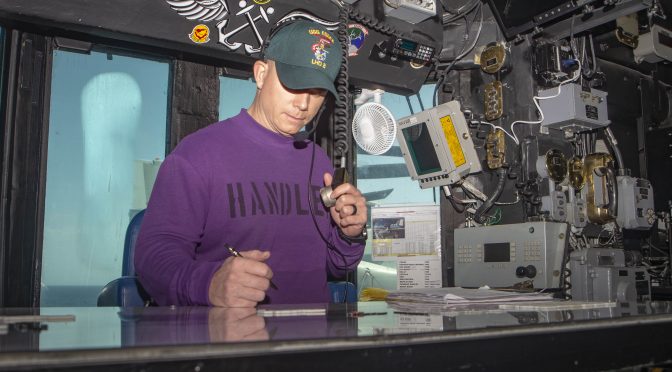
Featured Image: GULF OF ADEN (Sept. 4 2018) – Lt. William Maloney, ship’s aircraft handler, uses the ship’s 3MC announcement system from flight deck control aboard Wasp-class amphibious assault ship USS Essex (LHD 2) during a regularly scheduled deployment of Essex Amphibious Ready Group (ARG) and 13th Marine Expeditionary Unit (MEU). (U.S. Navy photo by Mass Communication Specialist 3rd Class Matthew Freeman)
Topic Week on Bringing Back Sea Control Kicks Off on CIMSEC

By Dmitry Filipoff

This week CIMSEC will be featuring articles sent in response to our Call for Articles on bringing back sea control. Below is a list of articles and authors that will be featured during the topic week and could be updated as prospective authors finalize additional submissions. 

New Forms of Naval Operational Planning for Earning Command of the Seas by Bill Shafley
Sea Control at the Tactical Level of War by Adam Humayun
Bringing Back Sea Power from the Deckplate on Up by Olivia Morrell
For Sea Control, First Control the Electromagnetic Spectrum by Damien Dodge
The Nature of Sea Control and Sea Denial by Dr. Ching Chang
Merchant Warships and Creating a Modern 21st Century East Indiaman by Steve Wills
Fighting For Sea Control in the Next War by Lars Wedin
Adjusting to New Conditions for Command of the Seas by Theodore Bazinis

Dmitry Filipoff is CIMSEC’s Director of Online Content. Contact him at Nextwar@cimsec.org

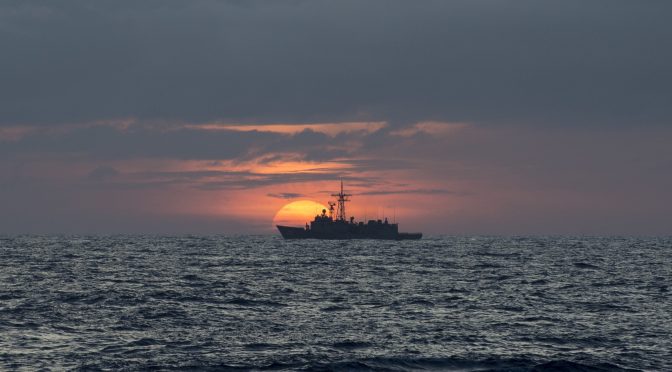
Featured Image: PACIFIC OCEAN (July 24, 2018) The Royal Australian Navy guided-missile frigate HMAS Melbourne (FFG 05) is underway at sunset July 24, during the Rim of the Pacific (RIMPAC) exercise. (U.S. Coast Guard photo by Petty Officer 2nd Class David Weydert/Released)

Contested Ship-to-Shore Movement, Pt. 2: Firepower Overmatch

Part One of this series focused on the role of quantity in contested ship-to-shore movement. Read it here.

By Josh Abbey

The age of battleships laying broadsides into beaches may have been over when the USS Iowa was decommissioned, but the increasing threat of anti-ship missiles and A2/AD may draw a curtain on the modern surface combatant doing likewise. For a contested ship-to-shore movement to be successful at the shore overmatch is required at the landing zone both in terms of quantity of troops and firepower. Unable to conjure enough firepower out on the beach due to obvious constraints, extensive supporting firepower must come from the air and the sea.

Contesting the Beach in the Modern Age

Anti-ship and surface-to-air missiles are a constant and pervasive complication to ship-to-shore movement against a well-equipped foe. Prior to the creation of precision weapons amphibious fleets could often stage just over the horizon or even closer. Now amphibious fleets can be challenged from land more than 100 miles out to sea.1 The increasing range and speed of anti-ship missiles necessitate over-the-horizon capabilities for amphibious fleets to operate safely.2 Increasingly capable integrated air defense systems also greatly threaten the viability of fire support from the air.3 A2/AD strategies can situate long-range artillery and rocket batteries within air defense bubbles, forming extensive threat zones while using unmanned vehicles for ISR. The proliferation of ASMs and SAMs means even some non-state actors can hold amphibious fleets at risk further out to sea. For example, Hezbollah posses Noor anti-ship missiles with a range of 75 miles,4 and for state actors the range is even greater.5

Modern missile systems present a major problem to ship-to-shore movement in that they can also force out of range what little exists of gun-based fire support from ships. Given how anti-ship missiles may be fielded in fewer numbers than anti-air missiles, ships may find themselves providing fire support when aircraft cannot. Even so, the land attack cruise missiles they may contribute could also be held at risk by anti-air systems, and where closing the range to use guns more effectively could put ships at risk from smaller, anti-armor guided weapons.6

In any case accurate fire support is vital and in high demand. Naval gunfire support played a considerable role in Vietnam and particularly in the Falklands, enabling small British units to combat larger Argentine forces.7 However, the transition from gunfire to missiles as the default weapon of modern ships decreases the availability of fire support. Navies are unlikely to fire expensive munitions such as a Tomahawk missile to destroy a machine gun emplacement or a vehicle, whereas gunfire can be brought to bear on numerous targets of opportunity. Ships also carry limited numbers of land attack missiles due to the need to maintain a diverse inventory of missiles for a variety of multi-domain threats. In a contested theater one would also be loath to expend many Tomahawks on minor land targets a short distance away. Land attack missiles may be able to carry some of the burden for amphibious troops, but if fired at a great distance out to sea the long flight time for subsonic missiles is hardly ideal for troops in contact.11 These cruise missiles would also likely need some form of in-flight retargeting support to ensure their precision.  

The sea denial aspect of certain precision weapons can be mitigated to an extent by extending the range of gun-based fire support. These capabilities can include the Advanced Gun System firing the Long-Range Land-Attack Projectile (LRLAP) which can reach out to over 70 nautical miles.8 However, the cost of the LRLAP makes this exception prohibitively expensive. One LRAP at approximately $800,000 is around half the cost of a Tomahawk missile.9 One could purchase 11 guided Excalibur shells for that price able to hit targets over 30 miles away or 266 precision guidance kits for M549 shells and reach out to over 15 miles away.10

Spent shell casings from a naval gunfire support mission by HMS Cardiff (D108) on the night of 5 June, 1982, as part of the Falklands War. Photograph was taken the morning after on 6 June, also the top of her charred Sea Dart launcher can be seen bottom right. She fired 277 rounds that night and also shot down AAC 656 Squadron Gazelle XX377 in ‘Blue on Blue’ friendly fire incident killing four British servicemen. (Wikimedia Commons)

Airpower to an extent has filled the vacuum gunfire or cruise missiles cannot. In the Falklands campaign for example, airstrikes from Harrier jets helped make up for the lack of gunfire support.11 However, air defense systems have become increasingly sophisticated and potent. As they will continue to grow in capability and proliferate amongst state and non-state actors, aircraft operating in A2/AD environments will be restricted to more advanced platforms.12 Rotary wing aircraft could be of little value if their ships have been forced out to sea by anti-ship missiles since the combat radius of many rotary wing attack aircraft is around 120 nautical miles.13 Instead, viable firepower support will be best provided via tube artillery, rockets, or cheaper missile systems that can operate closer to shore.

While surface combatants can undertake the task of providing fire support the range of most current gun systems places them well within the range of ASMs as well as tube and rocket artillery.14 It is unlikely one would take an Arleigh Burke or Type 45 destroyer into such an environment. Instead, cheaper and more expendable gun or missile boats carrying missiles like the Spike NLOS or ALAS, rocket artillery systems, or advanced naval guns will need to provide the firepower required. GMLRS equipped boats, capable of firing the ground-launched Small Diameter Bomb, the Deep Strike Missile, the Alternative Warhead, and other munitions could provide a powerful mix of close-in fire support and deeper interdiction fires. However, the key vulnerability of missile or rocket artillery boats will be logistical sustainment. These indirect fire systems could be used from the flight decks of larger ships as an intermediate measure.15

Such craft will also require point defense systems for survivability. This is a necessity to provide survivability for ship-to-shore connector because one can expect increasingly precise artillery and rocket systems. Laser-guided munitions capable of striking moving targets and top attack munitions such as the BAE Bofors 155 BONUS or SMArt 155 will be capable of significant devastation. It is conceivable that counter-battery fire can be swapped between defending land-based artillery and ships providing fire support for an invading force as artillery grows more precise.

Once visible on the horizon direct fire systems like anti-tank guided missiles can target landing craft and their fire support assets. Thus, hard and soft counter rocket, artillery, and mortar (C-RAM) systems, air defense, and active protection systems like Trophy will need to be equipped by both connectors and the vessels providing their fire support. Transit times to the shore will place both under fire for considerable lengths of time and sustaining close fire support for an amphibious force will be highly risky.

Conclusion

In an A2/AD environment ship-based fire support may often be limited to the unattractive option of cruise missiles given current capabilities and threats. Cheaper long-range missile and artillery systems will need to become more available in order to provide the requisite fire support to develop overmatch. One potential solution is the utilization of cheaper gun and missile boats that can be risked close in to shore to provide fire support and to project an area of point-based air defense around the approaching landing craft to increase survivability. In any case amphibious flotillas will require plenty of firepower and protection so as not to be disabled before arriving on the beach, but providing fire support against modern threats involves complicated and frequently unfavorable tradeoffs.

Josh Abbey is a research intern at the Royal United Services Institute of Victoria. He is studying a Bachelor of Arts at the University of Melbourne, majoring in history and philosophy. He is interested in military history and strategy, international security and analyzing future trends in strategy, capabilities and conflict.

References

[1] Andrew Feickert, Marine Corps Amphibious Combat Vehicle (ACV) and Marine Personnel Carrier (MPC): Background and Issues for Congress (Washington, DC: Congressional Research Service, 2018), 6.

[2] Bryan Clark and Jesse Sloman, Advancing Beyond the Beach: Amphibious Operations in an Era of Precision Weapons (Washington, D.C: Center for Strategic and Budgetary Assessments, 2016), I.

[3] Carlo Kopp, “Proliferation of Advanced Air Defence Systems,” Defence Today (2010): 27. “Surviving the Modern Integrated Air Defence System”, Carlo Kopp, Air Power Australia, 2009, accessed, July 1, 2018,  http://www.ausairpower.net/APA-2009-02.html#mozTocId418713. Jeff Harrigan and Max Marosko, “Fifth Generation Air Combat Maintaining the Joint Force Advantage”, JAPCC Journal 24, spring/summer (2017): 54.

[4] “Hezbollah” Missile Defence Advocacy Alliance, accessed June 30, 2018, http://missiledefenseadvocacy.org/missile-threat-and-proliferation/todays-missile-threat/non-state-actors/hezbollah/.

[5] Office of the Secretary of Defense, Annual Report to Congress: Military and Security Developments Involving the People’s Republic of China 2015 (Washington, DC: Office of the Secretary of Defense, 2015), 10.

[6] “For Want of a Broadside: Why The Marines Need More Naval Fire Support,” Vince DePinto, CIMSEC, accessed July 3, 2018, https://cimsec.org/want-broadside-marines-need-naval-fire-support/31347.

[7] Carter A. Malkasian, Charting the Pathway to OMFTS A Historical Assessment of Amphibious Operations From 1941 to the Present (Virginia: CNA, 2002), 41.

[8] “The 155mm Advanced Gun System-Lite (AGS-L) for DDG-51 Flight III,” Brent Weyer and Al Panek, BAE Systems, accessed July 10, 2018, https://ndiastorage.blob.core.usgovcloudapi.net/ndia/2012/armaments/Tuesday14034weyer.pdf

[9] “Navy Planning on Not Buying More LRLAP Rounds for Zumwalt Class,” Sam LaGrone, USNI News, accessed July 14, 2018, https://news.usni.org/2016/11/07/navy-planning-not-buying-lrlap-rounds. Chief Technical Officer, Program Acquisition Cost by Weapon System (Washington, D.C: Office of the Under-Secretary of Defense, 2017), 63.

[10] Michael Craig Harris, Is Tube Artillery a Viable Fire Support Platform for the United States Military on the Battlefields of the Future? (Alabama: Air War College, 2017), 22. “XM 982/Excalibur,” BAE Systems, accessed July 16, 2018, https://www.baesystems.com/en/download-en/20151124114142/1434555562238.pdf. Peter J., “XM1156 Precision Guidance Kit (PGK) Overview,” Burke and Anthony Pergolizzi, Fuze Conference, accessed July 19, 2018, http://citeseerx.ist.psu.edu/viewdoc/download?doi=10.1.1.386.3598&rep=rep1&type=pdf.

[11] Earl H. Tilford, “Air Power Lessons,” in Military Lessons of the Falkland Islands War: Views from the United States, eds. Bruce Watson and Peter Dunn (Colorado: Westview Press, 1984), 45.

[12] Carlo Kopp, “Proliferation of Advanced Air Defence Systems,” Defence Today (2010): 27. “Surviving the Modern Integrated Air Defence System”, Carlo Kopp, Air Power Australia, 2009, accessed, July 1, 2018,  http://www.ausairpower.net/APA-2009-02.html#mozTocId418713. Harrigan and Marosko, “Fifth Generation Air Combat Maintaining the Joint Force Advantage,” 54.

[13] “For Want of a Broadside: Why The Marines Need More Naval Fire Support,” Vince DePinto, CIMSEC, accessed July 3, 2018, https://cimsec.org/want-broadside-marines-need-naval-fire-support/31347.

[14] “Mk 45 Mod 4 Naval Gun System,” BAE Systems, accessed July 20, 2018, https://www.baesystems.com/en/product/mk-45-mod-4-naval-gun-system. John Matsumura, Randall Steeb, and John Gordon IV, Assessment of Crusader: The Army’s Next Self-Propelled Howitzer and Resupply Vehicle (Santa Monica, CA: RAND Corporation, 1998), 10.

[15] “For Want of a Broadside: Why The Marines Need More Naval Fire Support,” Vince DePinto, CIMSEC, accessed July 3, 2018, https://cimsec.org/want-broadside-marines-need-naval-fire-support/31347.

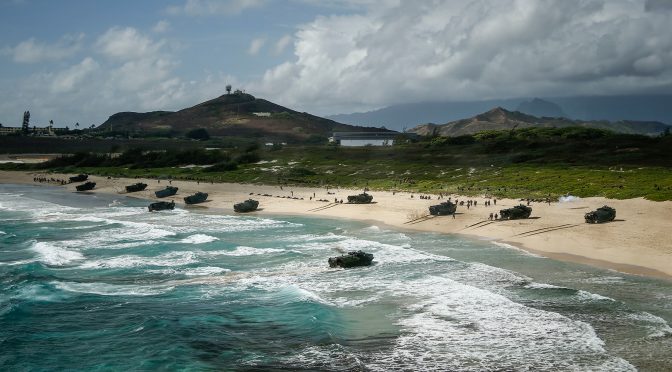
Featured Image: 180729-M-QH615-0222 MARINE CORPS BASE HAWAII (July 29, 2018) AAV-P7/A1 assault amphibious vehicles assigned to Combat Assault Company, 3rd Marine Regiment, unload service members during an amphibious landing demonstration as part of Rim of the Pacific (RIMPAC) exercise at Pyramid Rock Beach on Marine Corps Base Hawaii July 29, 2018. (U.S. Marine Corps photo by Sgt. Aaron S. Patterson/Released)

Contested Ship-to-Shore Movement, Pt. 1: The Role of Quantity

By Josh Abbey

Few navies are disposed to undertake ship-to-shore movement in a contested environment.1 With the exception of very powerful nations such as the U.S., few nations have the number of troops and equipment necessary for success against moderate opposition. Contested ship-to-shore movement presupposes that landing craft and aircraft will be engaged while moving to and at the landing location. Achieving air and naval superiority is a significant factor in this calculus, however, so does the size and firepower of the landing force and those who may oppose them.2 The role of quantity in contested ship-to-shore movement undertaken by surface craft is especially key.

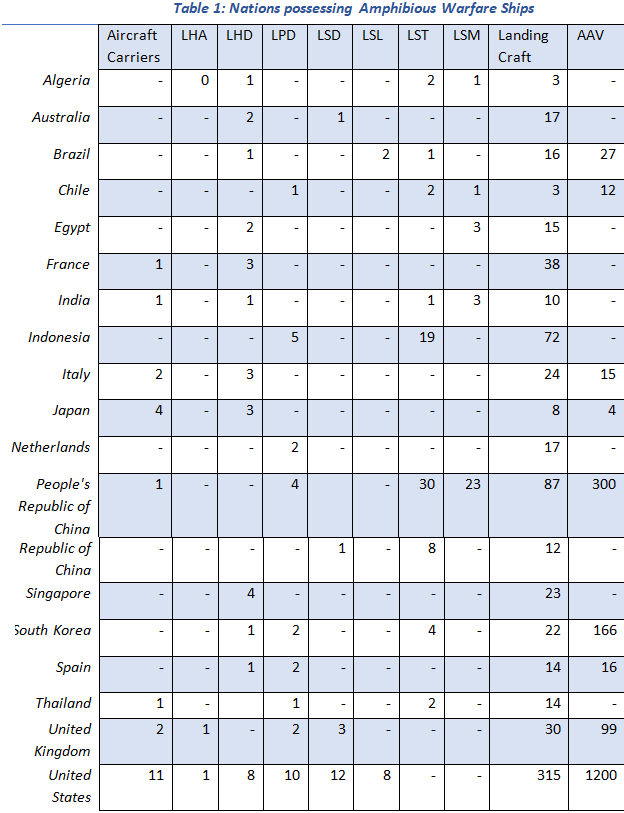
No amphibious force is likely to survive a contested assault without significant losses.3 Yet few can deliver the volume of troops to generate force overmatch against a foe while accounting for potential casualties. The majority of amphibious fleets are too small to generate overmatch by quantity alone. Such a task requires vast amphibious fleets. In the Gulf War, it took 31 amphibious ships to muster an assault force of 17,800 marines, 39 tanks, 96 mobile TOW antitank missile systems, 112 amphibious assault vehicles, 52 light armored vehicles, 52 artillery pieces, 63 attack aircraft, and six infantry battalions.4 Excluding the U.S., for nations with amphibious capabilities, the average amphibious fleet size is just two ships (refer to table 1).5 An amphibious fleet such as Australia’s can only embark 2,600 troops in two Canberra-class landing helicopter docks and one dock landing ship, HMAS Choules.6 An unsupported landing force of this size would face a serious struggle if opposed by even a few battalions.

The number of troops and vehicles that can be delivered per wave severely worsens the problem of successful ship-to-shore movement. Again, Australia’s amphibious capacity shall serve as the example as its three-ship Amphibious Ready Group is representative of many first-rate nations’ amphibious fleets. A Canberra-class warship can embark four LCM-1Es, whilst HMAS Choules can carry one LCM-1E.7 With each LCM-1E able to carry 170 troops, the nine LCM-1Es can deploy approximately 1500 troops in one wave.8 However, it is unlikely they would be utilized in this way. Carrying vehicles and equipment in waves while deploying troops in tactical formations would likely decrease the rate of troops delivered. Defenders can likely bring a greater proportion of their force to bear compared to amphibious troops that are limited by their rate of delivery. And, while vehicles such as an Abrams tank or even a Stryker can deliver considerable firepower, they must be able to get off the beach to make way for follow-on assets. Beaches can condense landing troops into denser formations and where targeting buildup locations will be a priority for any defender. Unless the landing location is suitable to allow vehicles to quickly get off the beach, they present attractive stationary targets that are less able to influence affairs much beyond the shoreline.

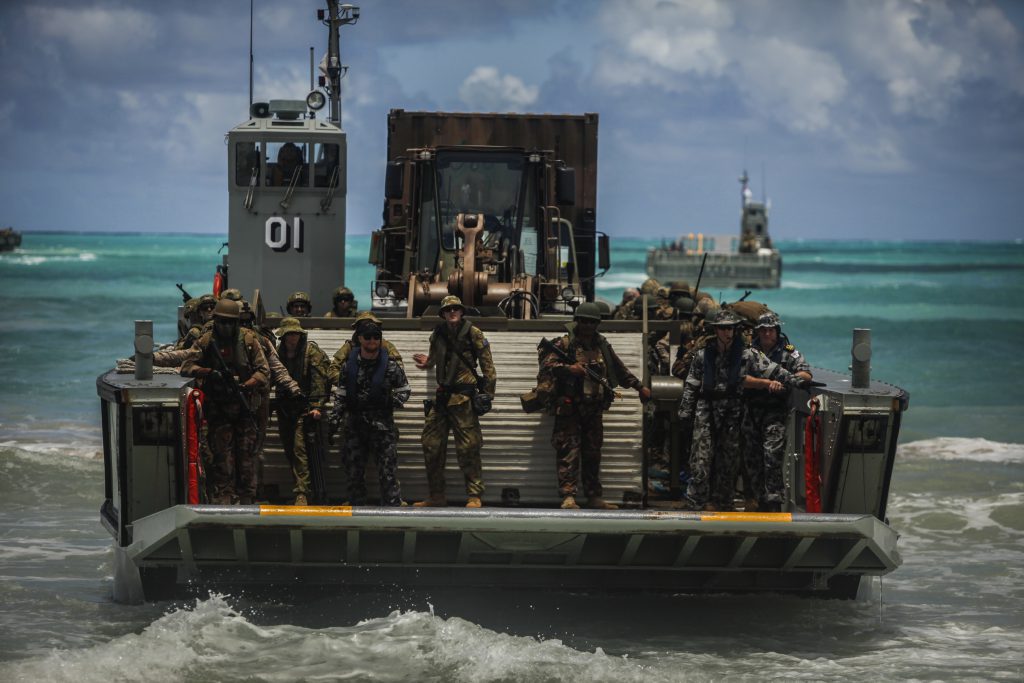
MARINE CORPS BASE HAWAII (July 30, 2016) A Royal Australian Navy LHD Landing Craft, transports Australian, New Zealand, Tongan, and U.S. armed forces to Marine Corps Training Area Bellows during Rim of the Pacific 2016 in Hawaii. (U.S. Marine Corps photo by Sgt. William L. Holdaway/Released)

Infantry will play a major role in the initial ship-to-shore movement because of greater freedom of movement and ability to disperse. However, embarked troops do not equate to immediate combat manpower on the beach.  It is problematic that troops must disembark and find a favorable tactical disposition before they can bring their full influence to bear, a process that is unlikely to be as rapid as desired. Further, utilizing landing craft with high capacities such as LCMs, with a capacity of 170, or an LCU 1700 which can carry 350 troops, presents a small number of highly dense targets.9 If it only deployed from embarked landing craft Australia’s entire amphibious landing force could present just nine targets. An opponent could counter this force before it lands with a handful of guided missiles or several accurate barrages of cluster or airburst artillery.

Key: Landing Helicopter Assault (LHA) Landing Helicopter Dock (LHD) Landing Platform Dock (LPD) Landing Ship Dock (LSD) Landing Ship Logistics (LSL) Landing Ship Tank (LST) Landing Ship Medium (LSM) Amphibious Assault Vehicle (AAV) (Source: The Military Balance, 118, 1 (2018): 49-396.)

While landing craft and amphibious fleets can deploy a reasonable number of troops from the surface they can be effectively opposed by far fewer troops using modern weapons. Utilizing smaller landing craft in greater numbers would increase the number of targets an enemy must account for, and dilute a defender’s efforts. Increasing the number of landing craft also decreases the time it takes for troops to influence combat by speeding up debarkation. In effect, increasing the number of exits can increase the space through which troops can disembark and achieve greater flow of deployment. These changes would increase the effectiveness of the force embarked by deploying them into combat faster and likely with less casualties.

Conclusion

Quite simply to generate overmatch via the quantity of troops amphibious fleets must go big or go home. They also, by way of contradiction in terms of landing craft, must go little if they wish to quickly generate a reasonable number of combat-ready troops at the landing location rapidly. Small numbers of slow-deploying troops can easily be victim to defeat in detail. Generating overmatch at the landing location will then be more a matter of greater firepower and less the the quantity of assets for navies with small amphibious fleets. However, credibly confronting reasonably-sized adversaries in a contested ship-to-shore context will be limited to coalition operations or large nations such as the U.S. for the foreseeable future.


Part 2 of this series will focus on firepower overmatch.


Josh Abbey is a research intern at the Royal United Services Institute of Victoria. He is studying a Bachelor of Arts at the University of Melbourne, majoring in history and philosophy. He is interested in military history and strategy, international security and analyzing future trends in strategy, capabilities and conflict.

References

1. See Table 1.1

2. Michael Hanlon, “Why China Cannot Conquer Taiwan,” International Security 25, 2 (2000): 4.

3. B. Martin, Amphibious Operations in Contested Environments: Insights from Analytic Work (Santa Monica, CA: RAND Corporation, 2017), 9.

4. Michael F. Applegate, Naval Forces: Valuable Beyond the Sum of Their Parts (Newport, RI: Naval War College, 1993), 5.

5. See Table 1.1

6. Ken Gleiman and Peter Dean, Beyond 2017: the Australian Defence Force and amphibious warfare (Canberra: APSI, 2015), 24.

7. “Amphibious Assault Ship (LHD),” Navy, accessed July 25, 2018, http://www.navy.gov.au/fleet/ships-boats-craft/lhd. “HMAS Choules,Navy, accessed July 24, 2018, http://www.navy.gov.au/hmas-choules.

8. “Lanchas de desembarco LCM-1E” Navantia, accessed July 24, 2018, https://www.navantia.es/ckfinder/userfiles/files/lineas_act/Fichas_antiguas%20espa%C3%B1ol/lanchas.pdf.

9. “Landing Craft, Mechanized and Utility – LCM / LCU,” America’s Navy, accessed July 25, 2018, http://www.navy.mil/navydata/fact_display.asp?cid=4200&tid=1600&ct=4.

Featured Image: 180729-M-FA245-1234 MARINE CORPS BASE HAWAII (July 29, 2018) U.S. Marines push toward an objective on Pyramid Rock Beach during an amphibious landing demonstration as part of Rim of the Pacific (RIMPAC) exercise on Marine Corps Base Hawaii July 29, 2018. (U.S. Marine Corps photo by Lance Cpl. Adam Montera)