All posts by Dmitry Filipoff

Transforming the Marine Corps Topic Week Kicks Off on CIMSEC

By Dmitry Filipoff

For the next two weeks CIMSEC will be featuring articles sent in response to our call for articles on transforming the U.S. Marine Corps. 

The Marine Corps is in the midst of a far-reaching and controversial transformation. As the USMC sheds many of the legacy platforms and capabilities that helped define it for years, it has taken on new roles and technologies to conduct Expeditionary Advanced Base Operations and function as stand-in forces. These reforms are being implemented through the overarching Force Design 2030 initiative, which has sparked heated debate about the merits of this transformation and what the Marine Corps ought to become to remain relevant through the 21st century. 

Below are the articles and authors being featured in this series, which may be updated with further submissions as Transforming the Marine Corps Topic Week unfolds.

“Stand-In Forces: Disrupting Anti-Access Systems,” by Joseph Mozzi
“Locate, Close With, Destroy,” by Ian Brown
“EABO Beyond the Indo-Pacific: Reimagining the “Battle of the Aegean,” by Capt. Ross W. Gilchriest, USMC
“Preparing for Change is as Important as Change Itself: Change Management and Force Design 2030,” by Carl Forsling
“Antisubmarine Warfare for the Amphibious Warfare Team,” by The Good Sailor Svejk
“The First Stand-in Forces: The Role of International Affairs Marines in Force Design 2030,” by Majors Zach Ota and Eric Hovey, USMC
“Marine Corps Metamorphosis: Legal Considerations,” by Brent Stricker
“The Importance of Unmanned Logistics Support For a Transforming Marine Corps,” by George Galdorisi
“When Only a Chisel Will Do: Marine Corps Force Design for the Modern Era,” by Capt. Jesse Schmitt
“Missing: Expeditionary Air Defense,” by Ben DiDonato

Dmitry Filipoff is CIMSEC’s Director of Online Content. Contact him at Content@cimsec.org.

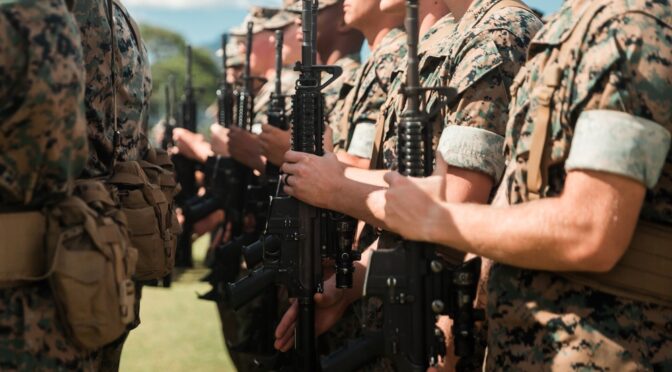
Featured Image: U.S. Marines with 3d Marine Littoral Regiment, 3d Marine Division present arms during the redesignation ceremony of 3d Marines to 3d MLR aboard Marine Corps Base Hawaii, March 3, 2022. (U.S. Marine Corps photo by Cpl. Patrick King)

Flotilla SITREP: Russia-Ukraine War at Sea, Lightning Carriers, Wardroom Wargaming

By Dmitry Filipoff

This month the CIMSEC Warfighting Flotilla will be discussing recent naval combat of interest and the latest in naval force development.

Down below is a look at the invites for our upcoming May discussions. The Flotilla will be holding discussions on naval combat in the Russia-Ukraine War, the viability of Lightning carrier platforms and concepts of operation, and the usefulness of wargaming as a unit-level combat training method. If you haven’t already, sign up through the form below to become a Flotilla member and receive the invites to our upcoming off-the-record May sessions.

Last month the Flotilla held discussions on the ongoing transformation of the Marine Corps, improving feedback in warfighting culture, and the themes of the Lying to Ourselves report that was recently republished on CIMSEC. These conversations helped advance some of the debates surrounding these issues and engendered stronger understanding of the cultural elements that shape warfighting organizations.

Feel free to visit the Flotilla homepage to learn more about this community, its activities, and what drives it.

____________________________________________

Upcoming May Sessions

Russia-Ukraine War at Sea

The Russia-Ukraine war has featured significant naval combat, even as the conflict has predominantly taken place over land. From the sinking of the Moskva and the Orsk, to amphibious landings and submarine-launched missile strikes, the maritime domain remains active and contested. How do we make sense of the maritime domain and its role thus far in the Russia-Ukraine conflict, and what are the lessons learned for force development and force employment? Join us to discuss these questions and more as we consider the maritime dimensions of this ongoing conflict.

Read ahead: “The Russo-Ukraine War at Sea: Retrospect and Prospect,” by B.J. Armstrong

____________________________________________

The Viability and Roles of Lightning Carriers

Flattops ranging from LHDs to allied platform such as the Izumo are offering carrier air wing capabilities, although at smaller proportions. How could these “Lightning” carriers help in conflict and steady-state competition? Are they a viable compliment to modern naval force structure, or do they divert resources from larger-scale carrier capabilities that are much more effective? Join us to debate the effectiveness of lightning carriers and their potential roles.

Read aheads: “Marines Load Record 16 F-35Bs Aboard USS Tripoli Test of ‘Lightning Carrier’ Concept,” by Gidget Fuentes

“Whither the Lightning Carrier in an Asia-Pacific War?” by Ben Ho

____________________________________________

Bringing Wargaming to Wardrooms

Wargaming is a versatile teaching tool, but what value can it have as a training device at the unit-level? Can wargaming be broadly adopted in wardrooms and ready rooms across the fleet to enhance readiness and warfighter understanding? Join us to discuss these questions and more as we consider the merits of wargaming as a training method at the unit level.

Read ahead: “Introduce Wargaming to Wardrooms,” by Commander Thomas T. Dixon

____________________________________________

Completed April Sessions

Stand-In Forces and Transforming the Marine Corps

The Marine Corps is in the midst of a transformation. After decades of focus on low-end conflicts in the Middle East, Marine Corps leadership is looking to transform elements of the force into units that can hold the line against China in forward island chains. But this transformation is not without internal friction and much uncertainty. What are the merits of the concepts of EABO and stand-in forces? How can the Marines better implement these concepts? Join us to discuss these questions and more as we consider the ongoing transformation of the Marine Corps.

Read Ahead: “Stand-in Forces: Adapt or Perish,” by ACMC General Eric Smith, USMC and “Jeopardizing national security: What is happening to our Marine Corps?” by Lt Gen Paul Van Riper, USMC (ret.)
____________________________________________

Developing Feedback Culture for Warfighters

Warfighting culture demands healthy and robust feedback mechanisms to ensure professional growth and pursue tactical excellence. But organizational culture can often stifle feedback and allow issues to fester or go unresolved. How can warfighters give better feedback? How can leaders create an atmosphere where feedback is encouraged and delivered constructively? Join us to discuss how to improve feedback in warfighting culture.

Read Ahead: “Encourage a Feedback Culture,” by LCDR Andrew Poulin
____________________________________________

Lying To Ourselves and Navigating Zero Defect Culture

Overwhelming requirements and zero-defect imperatives can combine to erode culture and norms of trust that are critical for warfighting effectiveness. How can warfighters better navigate these contradictions and dilemmas? How can leaders change the broader conditions that yield these dynamics? How can warfighters interpret the extent of their responsibility and agency in these circumstances? Join us to discuss these questions and more.

Read Ahead: “Lying To Ourselves,” by Dr. Leonard Wong and Dr. Stephen Gerras (Parts One, Two, Three).
____________________________________________

Dmitry Filipoff is CIMSEC’s Director of Online Content and Community Manager of the Warfighting Flotilla. Contact him at Content@cimsec.org.

Russia-Ukraine Week Kicks Off on CIMSEC

By Dmitry Filipoff

This week CIMSEC will be featuring submissions sent in response to our call for articles on Russia, Ukraine, and the related dimensions of naval power.

The war between Russia and Ukraine rages on, with mounting losses and destruction. While primarily a land conflict, the maritime dimension has witnessed its fair share of contested operations. Russia’s broader development of naval capabilities and strategy has gained especially acute salience with the outbreak of conflict and as the possibility of escalation remains ever present.

Below are the articles and authors featuring in the topic week, which may be updated with further submissions.

“Reconsidering Russian Maritime Warfare,” by Michael B. Petersen
“An Anti-Access Denial Strategy For Ukraine,” by Jason Lancaster
“For Ukraine, the 1,000-Ship Navy Finally Sets Sail,” by J. Overton
“Russian Naval Strategy for the Indo-Pacific,” by David Scott

Dmitry Filipoff is CIMSEC’s Director of Online Content. Contact him at Content@cimsec.org.
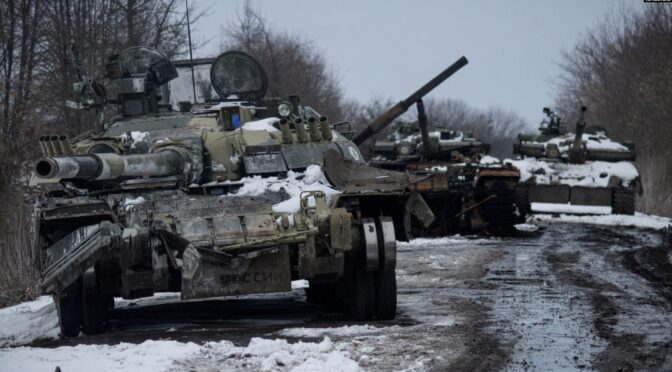
Featured Image: Destroyed Russian tanks are seen amid Russia’s invasion of Ukraine, in the Sumy region, Ukraine, March 7, 2022. (Press Service of the Ukrainian Ground Forces/Handout via Reuters)

Call for Articles: Transforming the Marine Corps

Submissions Due: May 13, 2022
Topic Week Dates: May 23-27, 2022
Article Length: 1,000-3,000 words
Submit to: Content@cimsec.org

By Dmitry Filipoff

The ongoing transformation of the Marine Corps has become more controversial. A new working group of senior retired Marine Corps generals is reportedly engaged in opposing initiatives of the incumbent Commandant, General David Berger. These initiatives are aimed at modernizing the Marine Corps for modern great power competition, as expressed in key documents such as the Commandant’s Planning Guidance, Force Design 2030, and the tentative manual for Expeditionary Advanced Base Operations (EABO). These initiatives have been implemented through the divestment of legacy force structure, among other lines of effort, and are characterized as a return to the maritime identity of the USMC. 

What are the merits of these operating concepts and their associated force structure, including EABO, stand-in forces, and Marine units equipped with more missiles and sensors instead of heavier armor and cannon artillery? Are these concepts fit to meet modern threats, and if so, how best to proceed with implementation?

If these concepts are not fit to meet modern threats, especially China, then what should the Marine Corps do instead? Do the Marine operating concepts and force structure of preceding decades effectively meet the challenges of today and tomorrow? Or should the Marines move in a different direction, and if so, what should that look like? What scope and pace of change is necessary?

Authors are invited to answer these questions and more as we debate the merits and implementation of the ongoing transformation of the Marine Corps. Send all submissions to Content@cimsec.org.

Dmitry Filipoff is CIMSEC’s Director of Online Content. Contact him at Content@cimsec.org.
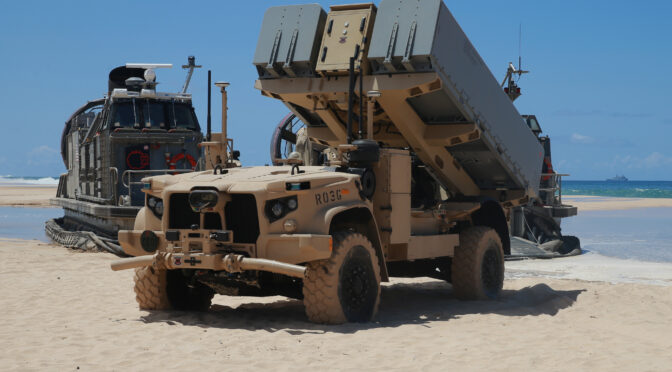
Featured Image: A Navy Marine Expeditionary Ship Interdiction System launcher deploys into position aboard Pacific Missile Range Facility Barking Sands, Hawaii, Aug. 16, 2021. (U.S. Marine Corps photo by Maj. Nick Mannweiler, released)