All posts by Guest Author

South China Sea arbitration: Beijing puts forward her own views Part One

By Alex Calvo

Introduction: restatement or small Filipino victory? Manila’s international arbitration bid has been repeatedly rejected by Beijing, which argues that it does not fall under the compulsory arbitration provisions of UNCLOS. Even after the Court ruled on jurisdiction, on 29 October 2015, China stuck to this position, as clear from an official statement the following day. However, despite repeatedly refusing to appear before the court, last year Beijing chose to issue a formal document stating her posture. For some this may simply be a restatement of China’s position, confirming that it will not take part in the proceedings. For others, it amounts to a small victory for the Philippines and the rule of law at sea, since China has finally been unable to completely ignore the proceedings. Whatever one thinks about it, it is useful to examine the document, dated 7 December 2014 (unclear whether any pun intended), while we wait for the Permanent Court of Arbitration to hold the first oral hearings on the substantive aspects of the case, scheduled for late November 2015. We shall be doing so in this four-part series.

[otw_shortcode_button href=”https://cimsec.org/buying-cimsec-war-bonds/18115″ size=”medium” icon_position=”right” shape=”round” color_class=”otw-blue”]Donate to CIMSEC![/otw_shortcode_button]

Chinese attitudes towards international law. Post-Mao China has followed a somewhat contradictory approach to international law. To a large extent, this mirrors the country’s complex domestic relationship with the concept of the rule of law. On the one hand, China’s reopening of her law schools after the Cultural Revolution and huge expansion of the legal profession and the practical, day to day, presence of the law, has led to a similar move in the international arena. However, this greatly expanded role of the law both domestically and internationally has been accompanied, in the internal domain, by a persistent rejection of the concept of “rule of law”, authorities rather leaning towards “rule by law.” In Chinese foreign relations, international law has had to contend with two obstacles. First, there is a mistrust of international tribunals, and the fear that they may impinge on Chinese sovereignty. Moreover, the South China Sea has been defined as a “core national interest,” although the exact meaning of this term may not be completely clear. Second, with the notion that public international law is a creature of Western nations and thus inextricably linked to a historical period of foreign domination that only began to be reversed after the 1949 Communist victory, or now that Chiang Kai-shek seems to be enjoying some sort of rehabilitation in China the 1943 Cairo conference. This applies particularly to the law of the sea, seen as unfairly constraining the legitimate aspirations of a nation that has grown increasingly dependent on maritime trade and which feels surrounded by a chain of islands in hostile hands.

The paper’s purposes, according to Beijing. After an introduction, making it clear that issuing the paper does not amount to taking part in the arbitral proceedings, the text lists in Paragraph 3 the main purposes of the paper, each such purpose covered in sections II to V. These goals are first of all (Section II, Paragraphs 4-29) to stress that the case concerns “the territorial sovereignty over several maritime features in the South China Sea,” which, contrary to Filipino assertions, “is beyond the scope of the Convention and does not concern the interpretation or application of the Convention.” Section III, Paragraphs 30-56 explains that “China and the Philippines have agreed, through bilateral instruments and the Declaration on the Conduct of Parties in the South China Sea, to settle their relevant disputes through negotiations” and that the arbitration proceedings are thus a breach by Manila of “its obligation under international law.” Section IV, Paragraphs 57-75 explains Beijing’s position that, “assuming, arguendo, that the subject-matter of the arbitration” was interpreting or applying UNCLOS, this would still be “an integral part of maritime delimitation” thus falling squarely within China’s derogation from compulsory arbitration. Section V, Paragraphs 76-85 underlines that “the Arbitral Tribunal manifestly has no jurisdiction over the present arbitration” and defends the view that China’s refusal to take part in the proceedings stands “on solid ground in international law.” These sections are followed by a set of Conclusions (Section VI, Paragraphs 86-93).

The 1898 Treaty of Paris in the PRC’s narrative of the conflict. In Section II, the document (5) explains that “Prior to the 1970s, Philippine law had set clear limits for the territory of the Philippines, which did not involve any of China’s maritime features in the South China Sea,” citing Article 1 of the 1935 Constitution, which reads “The Philippines comprises all the territory ceded to the United States by the Treaty of Paris concluded between the United States and Spain on the tenth day of December, eighteen hundred and ninety-eight, the limits of which are set forth in Article III of said treaty, together with all the islands embraced in the treaty concluded at Washington between the United States and Spain on the seventh day of November, nineteen hundred, and the treaty concluded between the United States and Great Britain on the second day of January, nineteen hundred and thirty, and all territory over which the present Government of the Philippine Islands exercises jurisdiction.” It added that the 1961 Philippine Republic Act No. 3046, titled “An Act to Define the Baselines of the Territorial Sea of the Philippines,” confirmed such territorial limits.
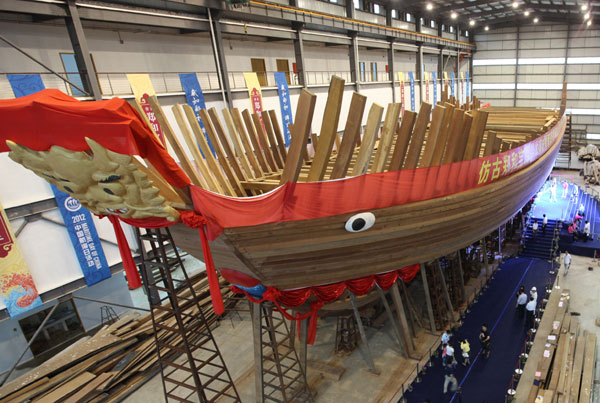
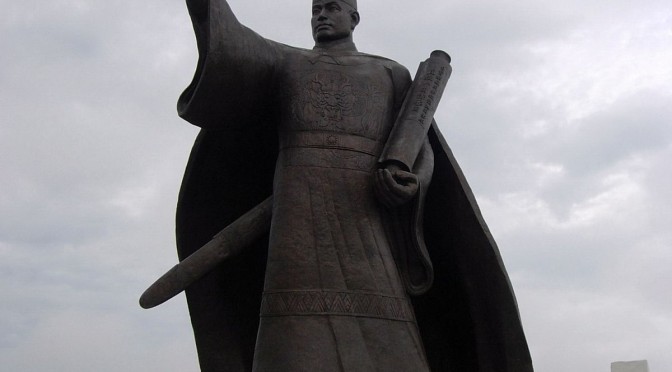
Replica of one of Admiral Zheng He's treasure ships, built in 2014. As China turns to the sea, she is stressing his figure.
Replica of one of Admiral Zheng He’s treasure ships, built in 2014. As China turns to the sea, she is stressing his figure.

Setting aside for a moment whether Manila has indeed redefined the limits to her national territory, this is potentially very significant because as reiterated in last year’s US Department of State “Limits on the Sea” No 143 paper, devoted to China, Washington has persistently stressed that it was taking no sides concerning the ultimate issue of sovereignty. Yet, while this may be sustainable in the case of other territorial disputes in the region, the case of the Philippines is rather different, given that the country was under US sovereignty for more than half a century. Thus, whatever one makes of Beijing’s case, it is difficult not to agree that past treaties signed by the United States may be relevant to the issue at hand. A question may be what, if any, may be Beijing’s motivation in bringing up such treaties, in addition to providing arguments in favor of its posture concerning the extent of Filipino territorial claims. Is Beijing perhaps hoping to prompt Washington to publicly comment on the matter in a way that may be detrimental to Manila? Or to quietly lean on the Philippines not to go too far? These may be speculative questions, yet ones difficult to avoid given the complex nature of the South China Sea dispute, with not only different immediate players, that is the coastal states, but plenty of other interested contenders, including the United States, Japan, India, and Russia. China’s document also refers to a UK-US Treaty, and while London has traditionally chosen a low profile posture in the region, it has recently been upgrading defense cooperation with Japan. Going back to Washington, the possible impact of past treaties and other diplomatic practice has already been considered important by observers in the case of Taiwan and the Senkaku/Diaoyu/Diaoyutai Islands, given Formosa’s change of status following the end of the Second World War and the American occupation of the Ryukyu Archipelago for three decades after its conclusion. However, the connection with the United States is much closer in the case of the Philippines, and Washington’s non-committal posture on sovereignty may come under increased pressure, although as mentioned this could result from different, even opposed motivations. 

Read the next installment here. 

Alex Calvo is a guest professor at Nagoya University (Japan) focusing on security and defence policy, international law, and military history in the Indian-Pacific Ocean Region. A member of the Center for International Maritime Security (CIMSEC) and Taiwan’s South China Sea Think-Tank, he is currently writing a book about Asia’s role and contribution to the Allied victory in the Great War. He tweets @Alex__Calvo and his work can be found here.

[otw_shortcode_button href=”https://cimsec.org/buying-cimsec-war-bonds/18115″ size=”medium” icon_position=”right” shape=”round” color_class=”otw-blue”]Donate to CIMSEC![/otw_shortcode_button]
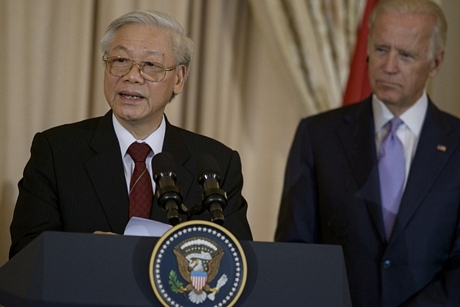

US – Vietnam Ties: The China Dimension

By Peter Marino

As the issue of influence in Southeast Asia gains in prominence, Vietnam is emerging as a critical proxy ground for the US and China to jostle. After having fought a brutal war with each other within living memory, Vietnam and the US are now growing closer than ever before, as Vietnam seeks a balancer against Chinese influence in its backyard. But the Vietnamese prize nothing so much as their own independence and autonomy, and the US and China, despite their strength, would be well-advised that Hanoi has its own interests to play for, as well.


https://www.youtube.com/watch?v=DJ1_9d4dSuA

Peter Marino holds an MSc in Global Politics from The London School of Economics and is a graduate of Norwich University. He lived in Shanghai from 2003 to 2008 and served as head of China development for London-based Aurigon, Ltd. He founded and sold Quaternion, a political risk startup, and is currently establishing a new Think Tank for International Affairs aimed at promoting engagement with the “Millennial Generation.” He also produces Globalogues, a video blog with commentary on global politics and economics. The views expressed in this article are his own.

REAL TIME STRATEGY 3 – STAR WARS BATTLEFRONT

RTS_Logo2

The RTS crew discusses the recently released Star Wars Battlefront just in time for the new movie.  Join us, and new RTS stars August Cole and Crispin Burke, as we discuss everything from Battlefront’s gameplay to galactic TRICARE for the stormtroopers.

“Real Time Strategy,” is a discussion on the lessons and non-lessons of the simulations we use to both learn and entertain in the realm of military strategy, tactics, and history.

DOWNLOAD: STAR WARS BATTLEFRONT

iTunes Link

Saudi Navy Expansion Program

By Chuck Hill

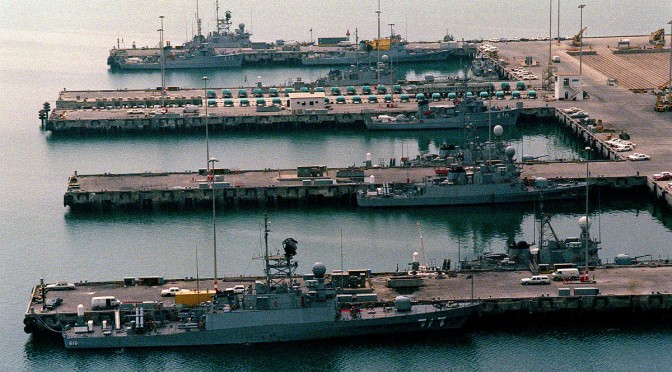
The Royal Saudi Navy is planning to replace virtually all of its Eastern Fleet. The expected price tag has been variously reported as between $11.25 and $20B. One of Saudi Arabia’s two fleets, the Eastern Fleet is based in the Persian Gulf and faces off squarely against Iran’s Navy and Revolutionary Guard Corp. The Western Fleet is based in the Red Sea and includes seven French built frigates.

[otw_shortcode_button href=”https://cimsec.org/buying-cimsec-war-bonds/18115″ size=”medium” icon_position=”right” shape=”round” color_class=”otw-blue”]Donate to CIMSEC![/otw_shortcode_button]
The existing Eastern fleet, all American built, includes four 75 meter (246 foot), 1,038 ton corvettes and nine 58 meter (190 feet), 495 ton guided missile boats. All are nearing the end of their useful lives, having entered service in the early ’80s.

It appears Saudi Arabia is again looking to the US to build this new fleet, reportedly buying  four up-rated Lockheed Martin Freedom Class Littoral Combat Ships.  While these ships have been much in the news, they are only part of a much larger program.

In February Defense News reported that Saudi Arabia had sent a letter of request to the US Navy that outlined the entire program.  It specified:

  • Four 3,500-ton “frigate-like warships” capable of anti-air warfare, armed with an eight-to-16-cell vertical launch system (VLS) capable of launching Standard SM-2 missiles; fitted with an “Aegis or like” combat system using “SPY-1F or similar” radars; able to operate Sikorsky MH-60R helicopters; with a speed of 35 knots.
  • Six 2,500-ton warships with combat systems compatible with the frigates, able to operate MH-60R helos.
  • 20 to 24 fast patrol vessels about 40 to 45 meters long, powered by twin diesels.
  • 10 “maritime helicopters” with characteristics identical to the MH-60R.
  • Three maritime patrol aircraft for coastal surveillance.
  • 30 to 50 UAVs, some for maritime use, some to be shore-based.

This shopping list sounds remarkably specific. This suggest that they already have a good idea what they expect to buy.

Four 3,500-ton “frigate-like warships”

Plans have firmed up for the four frigates. While they will not have the Aegis like radars they will have a, “…16-cell (Mk41) VLS installation able to launch Evolved Sea Sparrow missiles, and will carry Harpoon Block II surface-to-surface missiles in dedicated launchers, and anti-air Rolling Airframe Missiles in a SeaRAM close-in weapon system. The MMSC will also mount a 76mm gun… a Lockheed Martin COMBATSS-21 combat management system, which shares some commonality with the much larger Aegis combat system, and feature the Cassidian TRS-4D C-band radar.”

Six 2,500-ton warships with combat systems compatible with the frigates, able to operate MH-60R helos.

The design for the six smaller ships hasn’t been discussed openly, so this is a bit of speculation, but at least I think we can expect something like this. The video below, from Swiftship, recently appeared without much explanation.  The similarity in design to the Freedom class is striking and it claims to be a proven hull form. If Marinette Marine is too busy to build these smaller ships in addition to the LCS and the Saudi Frigates, having Swiftships build them might be a way have having them delivered relatively quickly and it looks like it might fit the description. Note there is no mention of an ASW capability for these ships (other than the ability to embark an MH-60R). This parallels the current fleet structure where only the four largest vessels have an ASW capability and the next largest class vessels do not.

Swiftships has a record of selling vessels through “Foreign Military Sales” and the vessel in the video shares a number of systems in common with the projected Saudi frigates including a 76mm gun, RAM missiles, MH-60s, and possibly Harpoon (they show only a generic representation of an ASCM).

20 to 24 fast patrol vessels about 40 to 45 meters long, powered by twin diesels.

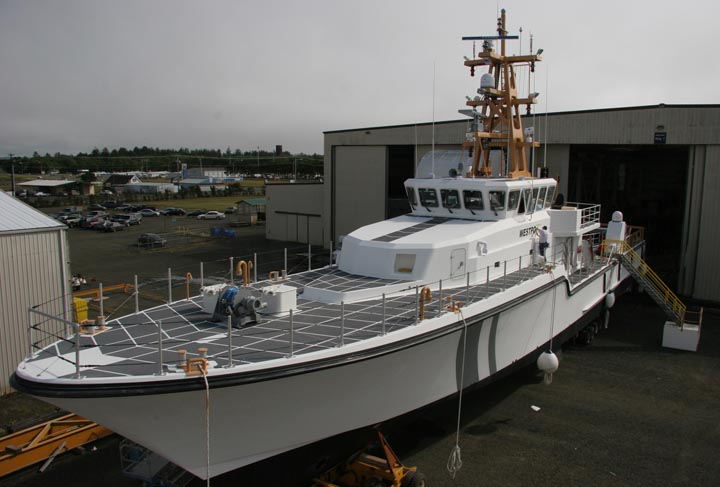
A likely choice for the patrol boat is this one, eight of which were sold to Pakistan. Reportedly these 43 meter, 143 foot vessels can make 34 knots and operate a ScanEagle UAS.

Westport143
Westport Yachts photo

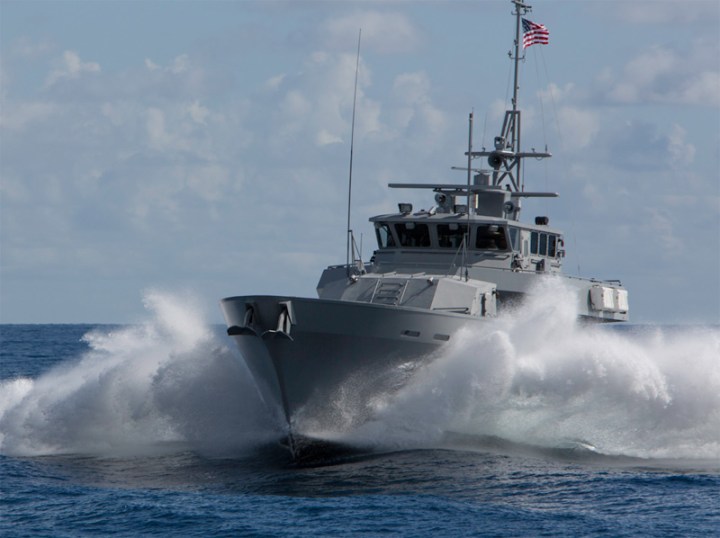
Another possibility is this 43.5 meter vessel that was provided to Lebanon under FMS.

RiverHawk-LCSC-42

Both of these PCs have the capability to stern launch an RHIB.

10 “maritime helicopters” with characteristics identical to the MH-60R.

A request for ten MH-60Rs was submitted earlier and has been approved by the State Department.

Included in the buy of the helicopters are, “one-thousand (1,000) AN/SSQ-36/53/62 Sonobuoys; thirty-eight (38) AGM-114R Hellfire II missiles; five (5) AGM-114 M36-E9 Captive Air Training missiles; four (4) AGM-114Q Hellfire Training Missiles; three-hundred eighty (380) Advanced Precision Kill Weapons System rockets; twelve (12) M-240D crew served weapons; and twelve (12) GAU-21 crew served weapons.”

I note that the 380 Advanced Precision Kill Weapons System (APKWS) semi-active laser homing 70mm rockets is exactly the number to fill twenty 19 round launchers. These weapons are probably an ideal counter to the much vaunted Iranian “swarm.”

Three maritime patrol aircraft for coastal surveillance:

These are almost certainly P-8s.

30 to 50 UAVs, some for maritime use, some to be shore-based:

While there is no indication which system is favored.  This sounds like too many systems for Firescout.

ScanEagle or one of Insitu’s slightly larger systems seems more likely, and if the Swiftships Offshore Patrol Vessel video is any indication, it includes a ScanEagle launch and recovery.

Conclusion:

This will be a major upgrade to the Saudi fleet that should allow them to maintain an advantage relative to the Iranian Fleet.

  • The ships and patrol boats will be three to five times larger than those they replace and far more survivable.
  • Fleet air defense systems which have been limited to 76mm guns and Phalanx CIWS will get a basic local area defense in the form of Evolved Sea Sparrow Missile, which will be backed up by rolling airframe missiles.
  • ASW  capability will take a quantum leap with the addition of the three Maritime Patrol Aircraft (MPA), the ten MH-60R.
  • The Eastern fleet was relatively well equipped to target larger surface targets with a total of 68 Harpoon launch tubes on the existing ships, but they were less well equipped to deal with numerous Iranian small craft.  MH-60Rs  armed with Advanced Precision Kill Weapon System guided rockets should provide an effective counter to Iran’s swarm strategy.
  • MPA and Unmanned systems will enhance ISR capability.
  • The larger patrol craft should significantly improve maritime security.
  • According to my “Combat Fleets of the World,” the Saudi Navy has a Marine Corp of 3,000, but their only Amphibious Warfare ships are four LCUs and two LCMs. The addition of at least 30 ships with RHIBs, assuming the patrol craft have this capability, should allow the Saudi Navy to consider at least small scale raids and other forms of maritime Special Ops. If the six 2500 ton ships are configured like the ship in Swiftships video, with four RHIBs, it would seem particularly appropriate for this role.  The addition of ten helicopter decks where there were none before also opens up options for these types of operations.

Chuck retired from the Coast Guard after 22 years service. Assignments included four ships, Rescue Coordination Center New Orleans, CG HQ, Fleet Training Group San Diego, Naval War College, and Maritime Defense Zone Pacific/Pacific Area Ops/Readiness/Plans. Along the way he became the first Coast Guard officer to complete the Tactical Action Officer (TAO) course and also completed the Naval Control of Shipping course. He has had a life-long interest in naval ships and history. Chuck normally writes for his blog, Chuck Hill’s CG blog.  

[otw_shortcode_button href=”https://cimsec.org/buying-cimsec-war-bonds/18115″ size=”medium” icon_position=”right” shape=”round” color_class=”otw-blue”]Donate to CIMSEC![/otw_shortcode_button]