All posts by Guest Author

Trafalgar of the East: Why the Russian Navy Failed in the Russo-Japanese War

By Aidan Clarke

The Russo-Japanese War saw the Imperial Russian Navy soundly beaten by the Imperial Japanese Navy. While much of the analysis on the Russo-Japanese War focuses on the Battle of Tsushima and the success of the Japanese Admiral Tōgō Heihachirō, one can also look to understand the deficiencies present in the Imperial Russian Navy that contributed to this defeat. The causes for this shocking defeat can be compared with the challenges of the Russian Empire as a whole. Russian naval culture, like that of its civilian society, had been built on an outdated system of social class, with nobles (particularly nobles with partial German ancestry) rising as officers, while talented sailors languished in the conscripted ranks. Just as the Tsar’s attempts at reforming Russian society failed to fully solve the deep-seated cultural problems of the Empire, and prevent the 1905 Revolution, Russian attempts at naval reform through the 1885 naval qualifications statute would also fail creating a new class of risk-averse and bureaucratic officers. The initial naval battle outside Port Arthur, and the ultimate defeat of the Port Arthur squadron in the Battle of the Yellow Sea, reflect these failings.

A Fish Rots from the Head

Of all the weaknesses which the Imperial Russian Navy suffered from during the Russo-Japanese War, none were so glaring as the failings of the officer corps. These officers were generally more concerned with their own advancement rather than success in battle. Tellingly, they suffered from over-bureaucratization and a failure to encourage initiative among their ranks.

Before the war, the Russian Navy was more superficial than substantive, suffering from general disorganization, as well as shortcomings of its personnel. While Tsar Nicholas “was attracted to military traditions and pageantry” he was also uninformed, and willing to tolerate “the often unproductive interference of uniformed Grand Dukes in the running of the army and navy.”1 The role of the nobility in the navy was a pernicious problem for Imperial Russia. In 1881, the highest position in the Imperial Navy, the General Admiral, was given to Grand Duke Alexei Alexandrovich, who was Tsar Nicholas’ uncle. Almost certainly his position was not given on his merit, as the Director of the Navy Ministry, Vice Admiral I.A. Shestakov, felt the Grand Duke was “not an efficient administrator, being more interested in external appearances and the opposite sex than tackling professional issues.”2 The professional problems of the Imperial Russian Navy also extended to the realm of strategic planning and discourse. Prior to the war, the navy had no general staff, and “until the outbreak of the war in 1904, the Navy Ministry had not issued a coherent official tactical doctrine.”3 There was almost no centralized planning at all in the navy, with operational strategy left to “makeshift fleet staffs in different geographical theaters” and subject to the “personal directions and whims” of regional commanders.4

In order to reduce nepotism in the advancement of naval officers and promote professionalism in the navy, the Russian state implemented the naval qualifications statute of 1885, under which “promotions were regulated by a rigid system hinging on specific terms spent at sea, available vacancies, and recommendations by superiors.”5 Ostensibly, this common-sense reform ought to have improved professionalism and efficiency within the fleet. Unfortunately, in most cases it had the opposite effect. The new promotion system “stifled talent and initiative”6 while encouraging officers to maintain a “bureaucratic temperament.” This meant that rather than adapting to the circumstances and seizing on enemy weaknesses, Russian officers “placed great stress on avoiding situations where they might attract criticism from above.”7 They focused on “external appearances and the superficial completion of service requirements.”8 In other words, captains and admirals spent more time inspecting brass pipes and white uniforms than they did testing the readiness of their men for war. This system meant that “the typical Russian officer seemed more at peace within himself when it was the enemy who had the initiative.”9 According to J.N. Westwood, “Russian naval officers were the product of a bureaucratic society in which avoidance of blame was more important than technical competence or imaginative enterprise.”10 This has been a common problem in naval history, perhaps most visible in the stagnation of the Royal Navy, laid bare in the Battle of Jutland.11

From the onset of the war, this failing reared its ugly head. The Commander of the Russian Pacific Squadron, Vice-Admiral Oscar Victorovich Stark, had recognized the dangers posed by Japan in light of the deteriorating diplomatic situation. He had repeatedly requested Admiral Yevgeni Ivanovich Alekseyev, Commander in Chief of Imperial Forces in Port Arthur and Manchuria, as well as Viceroy of the Imperial Russian Far East, “to permit him to prepare the fleet for war.”12 However, Alekseyev dismissed Stark’s fears on the grounds that they were “premature and escalatory.”13 Admiral Alekseyev did not see much of a threat from the Japanese, and a report from Vice-Admiral Wilhelm Withöft (a Russian-German noble) argued that the Russian “plan of operations should be based on the assumption that it is impossible for our fleet to be beaten.”14 Regardless, Vice-Admiral Stark did attempt to work around these restrictions, ordering his crews to put out torpedo nets and prepare for a Japanese surprise attack. However, he could not appear to undercut the noble Withöft or Alekseyev (who was a son of the Tsar), and in the end, “so low-key was the instruction in relation to the Supreme Commander’s known views that…nothing was done.”15 Captains and crews did not wish to contradict Admiral Alekseyev, regardless of the orders from the local commander, and few took any precautions.
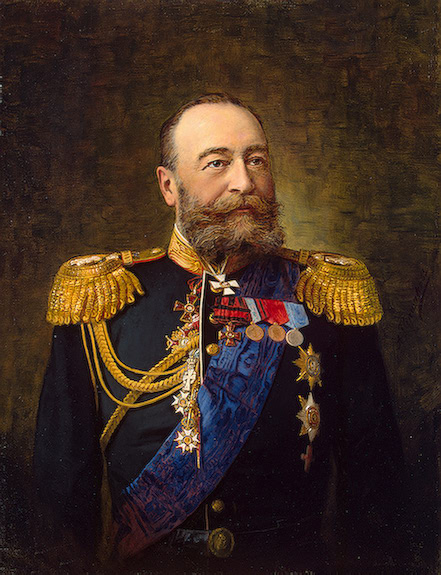
Admiral Yevgeni Ivanovich Alekseyev (By Alexander Fedorovich Pershakov/Wikimedia Commons)

There is a common misperception of soldiers and sailors as mindless automatons, following orders like pieces on a chess board. In this image, there is little wrong with the decision of the officers of the Pacific Squadron to yield to the will of Alekseyev and not that of Vice Admiral Stark. However, by the time the Russo-Japanese War began, this model was already outdated, and had largely been replaced with the relatively new concept of auftragstaktik (commonly translated as mission command in English).16 Mission command requires junior officers to “use their own initiative” and adapt to their own circumstances in order to achieve a mission defined by “a superior commander’s concept of operations.”17 Mission command is ultimately a superior model because it recognizes that those on the frontlines often have the best perception of their own situation, and that communication in war is susceptible to interruption, confusion, and misunderstanding (the fog of war). Allowing local commanders to maneuver as best suits them will allow them to minimize their casualties and complete their objectives more rapidly, while avoiding wasted opportunities or fatal miscommunications. In this context, as the local commander, Vice-Admiral Stark had a much clearer view of the threat posed by Japan, while Alekseyev, concerned with Russian objectives across all of Asia, did not. Admiral Alekseyev’s failure to defer to the local awareness of Vice Admiral Stark reflects Russia’s failure to adapt to modern military thought. 

Admiral Alekseyev deserves special attention in considering the failures of the Russian officer corps. Directly beneath him in the chain of command were Vice-Admiral Makarov (after his replacement of Vice-Admiral Stark) and General Kuropatkin. It should be recognized that these two figures were viewed as “the two best officers for their respective posts.”18 Makarov in particular was “Russia’s most competent admiral” and “was certainly Tōgō’s equal.”19 Despite this, Russia’s cultural deference to the nobility left Makarov and Kuropatkin “under Alekseyev, whose ego far outstripped his energy and competence.”20 Stark, Makarov, and ultimately, Withöft all found themselves hamstrung by their superiors, while the Japanese left Admiral Tōgō Heihachirō free to operate as he saw fit. This was a critical difference, and it played a major role in Russia’s ultimate defeat.

That is not to say that Vice-Admiral Stark or any of his replacements should be absolved of blame. Frederic William Unger, an American war correspondent who followed and wrote extensively about the war, noted that when the first Japanese attack on Port Arthur began, “Many of the Russian naval officers were ashore, celebrating with appropriate festivities the birthday of Admiral Stark.”21 While others including J.N. Westwood dispute this claim, Richard Connaughton argues that the party was “entirely in keeping with his reputation as a fun-loving partygoer.”22 Perhaps more importantly, the party’s guests included Admiral Alekseyev himself, as well as several other critical officers. Thus, on the night of February 8th, when Admiral Tōgō launched his initial torpedo attack, the Russian pacific squadron was unprepared and leaderless. Within ten minutes a Russian cruiser, the Pallada, a battleship, the Retvizan, and worst of all, the pride of the Russian Navy and most powerful ship in the Pacific Squadron, the Tsarevitch, had all been hit by torpedoes and were at least temporarily disabled. The Retvizan in particular suffered badly. Having hit Retvizan in the bow, a Japanese torpedo was able to open “a hole through which a car could be driven.”23 
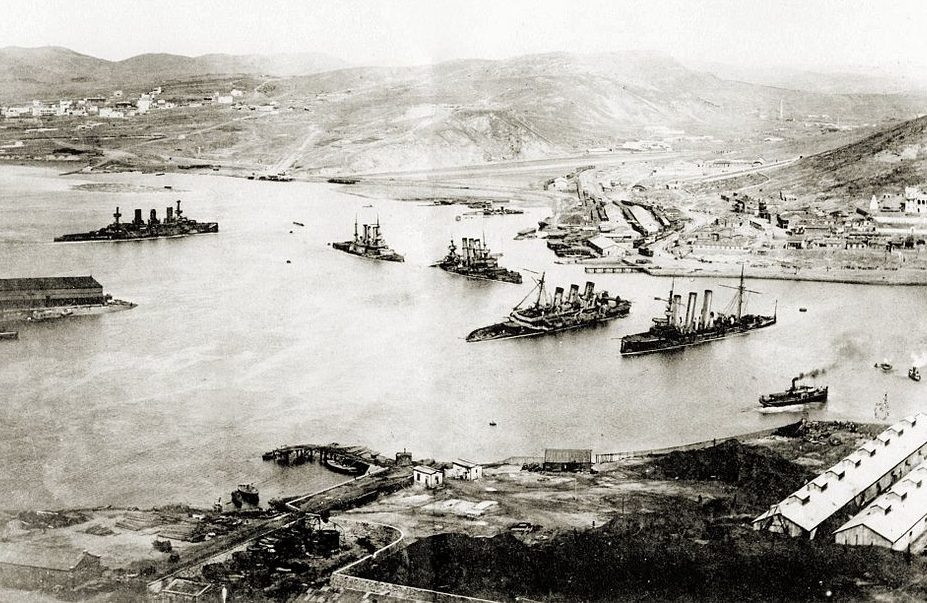
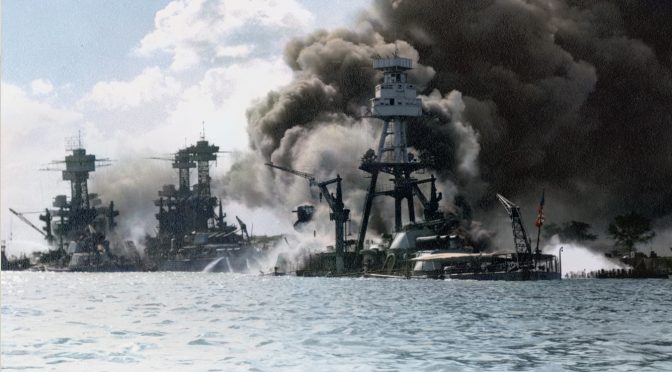
Port Arthur viewed from the Top of Gold Hill, after capitulation in 1905. From left wrecks of battleships: Peresvet, Poltava, Retvizan, Pobeda and Pallada cruiser. (Wikimedia Commons)

The loss of these ships, although temporary, would prove critical. Over the next several months, the Japanese enjoyed total control of the seas, while the Russian Navy could only attempt to rebuild its capabilities. This allowed the Japanese a free hand to land vast numbers of troops in Manchuria, forcing the hand of the Russian Navy, and creating the circumstances for Japan’s ultimate victory.

Battle of the Yellow Sea: The Death of the Pacific Squadron

As Japanese ground forces fought their way closer to Port Arthur, they began raining artillery down on the Pacific Squadron, which for the last six months had failed to even attempt to contest control of seas.24 Petrified as they were of failure, the death of Admiral Makarov in the entrance to the harbor as his ship hit a mine, paralyzed all ensuing Russian officers. In August 1904, as the land battle continued to rage, Viceroy Alekseyev demanded that the most recently appointed commander of the Pacific Squadron, Rear-Admiral Wilhelm Withöft, take the remainder of the Russian Pacific Squadron to Vladivostok. Withöft stalled as long as he could, but before long he “received orders of a more peremptory tone from both the Viceroy and the Tsar.”25 Despite the urging of his superior, Withöft held several councils of war, and together he and his captains agreed that their position dictated they stay in port. Alekseyev ignored Withöft and repeated that this decision was not only in contradiction to his orders, but was also against the wishes of the Tsar.26 Finally, after yet more protests from Withöft, Alekseyev informed the Vice-Admiral that “if the Port Arthur squadron failed to put to sea despite his and the Tsar’s wishes, and was destroyed in Port Arthur, it would be a shameful dishonor.” Furthermore, Alekseyev reminded Withöft of the example of “the cruiser Varyag” which had “put to sea fearlessly to fight a superior force.”27 Of course, Alekseyev did not mention the fate of the Varyag, though Withöft doubtless knew it had been demolished by heavy Japanese fire and had been scuttled at great cost to its crew.

The refusal of the squadron to put to sea appears as cowardice, but in truth, there was good logic to Withöft’s decision to stay in port. Firstly, Withöft was still under the impression that the Russian Baltic Squadron would arrive by October. So reinforced, the Russian Pacific Squadron would be able to concentrate their force, allowing them to confront Tōgō with “overwhelming Russian battleship superiority,” forcing the Japanese admiral to either abandon the field or face near certain defeat. Port Arthur only needed to hold on for three months, and the war could yet be won. Furthermore, the ships of the Port Arthur squadron were contributing supporting fire to the defenders of the Port, and their mere presence prevented the possibility of a Japanese amphibious attack. In short, “an inert Russian squadron in Port Arthur was of far greater strategic value than a bold squadron at the bottom of the sea.”28 

Withöft’s logic had one inherent flaw: the Baltic squadron would not arrive by October, in fact it would not even arrive for another nine months. Alekseyev was “probably aware”29 that this was the case, but neglected to inform the local commander, instead offering only strict and inflexible orders. Under these circumstances, bureaucratic Russian officers responded the only way they could, with fatalistic obedience. Accusations of cowardice on the part of Withöft and his captains are inaccurate: “they were more frightened of failure than death.”30

On August 10th, 1904, the Pacific Squadron put to sea with six battleships, four cruisers, and eight torpedo boats. The Japanese matched them with four battleships, six or seven cruisers, 17 destroyers, and 29 torpedo boats.31 While this did give the Russian fleet a nominal advantage in first-class battleships, two of the six “were the old, lumbering, Poltava and Sevastopol.32 There seemed to be no doubt of the outcome in the mind of Admiral Withöft, whose last words before stepping onto his flagship were: “Gentlemen, we shall meet in the next world.”33 As the ships of the Port Arthur squadron began their flight for Vladivostok, they “displayed the unwelcome effects of a fleet cooped up in port.”34 Stricken with mechanical issues, Russian engineers worked frantically to achieve the maximal speed of the squadron, while their ships lagged and the formation was repeatedly forced to stop and wait for others to catch up. Later, the Russian gunnery would suffer from a lack of practice as well. As the Russian ships affected their repairs, the faster Japanese ships were also allowed to catch up, and the battle began in earnest at 12:30 PM.35 
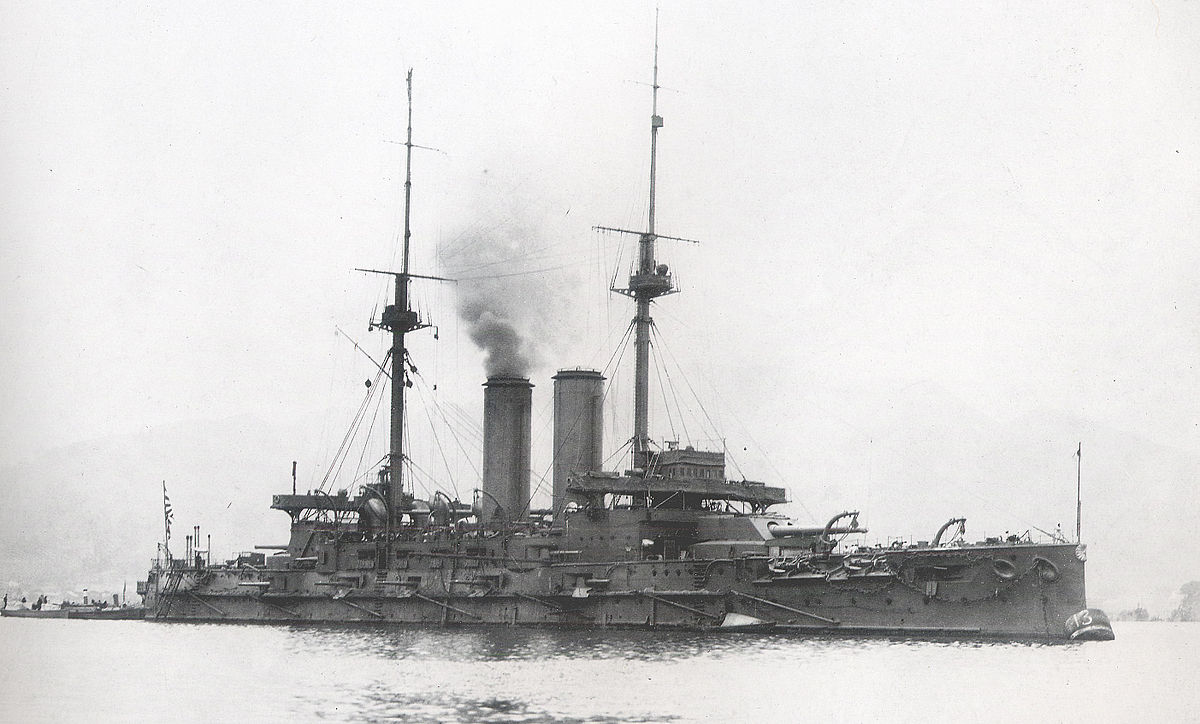
Japanese battleship Mikasa (Wikimedia Commons)

For the next five hours, the two fleets would shell each other from long range. For most of the battle, the Russians gave as good as they got, scoring powerful hits on the leading Japanese ships, Mikasa, Shikishima, and Asahi. As Mikasa took a number of hits, she, and the Japanese line, began to slow. Tōgō soon found himself trailing behind the Russian fleet. “He had been out-maneuvered” and Vice-Admiral Withöft “had secured the best position possible.”36 Then, as it so often does, pure chance completely changed the course of the battle.

At 5:45 PM, a pair of Japanese 12-inch shells slammed into the bridge of the Russian flagship Tsarevitch, killing Admiral Withöft and all of his staff, and jamming the wheel of Tsarevitch hard over, forcing the Russian flagship into a dramatic circle.37 It was at this point in the battle that the failings of the Russian officer corps became manifest. Contemporary accounts and modern historians agree that “the effort of the Russian ships to fight their way through the Japanese would probably have been successful…had it not been for the disaster to the battleship Tsarevich.”38 Without Withöft, chaos reigned in the Russian fleet. Withöft’s replacement as commander of the squadron was Prince Pavel Petrovich Ukhtomsky. Ukhtomsky’s immediate problem was that his signals mast and lines were shot away, forcing him to signal from the bridge, where only the ships nearest him could see them. However, this was probably the least of the Prince’s problems. As he signaled “follow me” to his ships, Prince Ukhtomsky turned back toward Port Arthur – a somewhat ironic decision given that he had been one of the officers pushing Vice Admiral Withöft to attempt a breakout to Vladivostok in the first place.

Ukhtomsky was not held in any high regard in the Russian Navy. Many in the fleet believed that “he owed his position to connections rather than ability” and he was derided as “a second rate man.”39 His decision to return to Port Arthur made little sense, as the Russian stronghold “could no longer offer a safe haven” and “there was a strong probability that that a significant part of the squadron could have reached Vladivostok.”40 Just as in the forthcoming 1905 revolution, some of the Russian ships simply refused to follow the orders of the nobility, personified by Prince Ukhtomsky. In particular, the light cruiser Novik made a dash for Vladivostok, but was finally defeated after being sighted by a Japanese freighter.41

While the majority of the Russian ships did return to Port Arthur, the Russian mission was a dramatic failure. Although it had lost only one battleship (Tsarevich was forced to shelter in a German port where she was interned), the Port Arthur squadron was so damaged that it would never put to sea again. Russian ground troops were disgusted by this failure, and according to a Russian correspondent, “there was nothing but abuse and curses for the naval officers, from the highest to the lowest.”42 Prince Ukhtomsky’s decision to turn around and return to Port Arthur was an enormous blunder. In so doing, he trapped himself and the squadron in the port, where they would be shelled and sunk, eliminating any value they could have offered to Admiral Rozhestvensky and the Baltic fleet. While he may have feared the loss of most of his ships, “even one battleship at Vladivostok would have been a serious embarrassment for Tōgō when he faced the oncoming Baltic squadron.”43 Instead, Ukhtomsky’s decision removed the Port Arthur squadron entirely from the playing field.  This was an immense strategic victory for Japan, who could now use their artillery to sink the Russian ships, while allowing Tōgō and the Navy to prepare for the upcoming battle with the Baltic Squadron. 

Conclusion

The Battle of Tsushima was decided well before the Russian and Japanese Fleets met. Admiral Rozhestvensky’s words on the expedition indicate his feelings on the prospects of the mission: “We are doing now what needs to be done still, defending the honor of the flag. It was at a previous stage that another course ought to have been taken….Sacrifice the fleet if need be, but at the same time deliver a fatal blow to Japanese naval power.”44 These words, so drenched in the presumption of defeat and complete fatalism, rival those of Admiral Villeneuve on the eve of Trafalgar as some of the least inspiring in naval history. Rozhestvensky was right of course, he had little hope of defeating the Japanese. His fleet was comprised of untrained officers and crews on brand-new ships, which were as yet untested. He had to sail across the globe, hardly stopping for shore, and having to deal with embarrassments such as the Dogger Bank incident, when his untested and nervous crews mistook British fishing trawlers for Japanese torpedo boats, and began pouring fire into them. This incident caused a great deal of enmity towards Russia, causing the Royal Navy to shadow Rozhestvensky for much of his journey, and a number of other nations to deny him access to their port facilities for resupply. When the time for battle finally came, the Russians were disorganized and unprepared. Untested in battle, their fire was “indifferent and ineffective.”45 The exhausted and overwhelmed Rozhestvensky was badly wounded and could only watch as the Japanese picked his fleet apart.

However, Russia’s naval failures in the Russo-Japanese War cannot be laid entirely on his account. Had the Tsar been able to consolidate his squadrons before giving battle to the Japanese, the outcome of the war would likely have been vastly different. However, without any fleet-wide strategic or operational planning, the Imperial Navy was left disjointed and dispersed, while the Japanese could concentrate their forces in their home waters. What little planning there was took place on a localized level, and was hampered by feckless, disinterested officers, parochial interests, corruption, and nepotism, wasting Russia’s quantitative advantages. 

However, perhaps the decisive factor in the Russo-Japanese War was the bureaucratic and indecisive nature of the officers in the Russian Navy. Rather than encourage initiative and free their captains to adapt to the circumstances at hand, Russian naval culture rewarded paper pushers and officers whose crews spent more time cleaning their guns than firing them. Worse still, a gerontocratic Russian state meant that modern techniques and technologies were ignored in favor of the outdated practices of noble officers, who had little interest or ability in naval warfare. Russian officers were thus hesitant in the moments of crisis, incapable of decisive action. Meanwhile, their crews, filled with conscripts and trained for inspections rather than combat, were entirely outmatched by the remarkably professional and extremely well-motivated Imperial Japanese Navy.

Japanese victory in the Russo-Japanese War was undoubtedly the result of Japanese superiority in a number of critical areas. However, the most telling asymmetry between Japan and Russia in the war was the disparity between their leadership, laid bare in the heat of battle.

Aidan Clarke is an undergraduate student at Furman University, double majoring in History and Politics and International Affairs, with an interest in naval affairs. He has previously researched the U.S.-Soviet naval showdown during the Yom Kippur War, and is currently conducting a research project on the Russo-Japanese War.

References

1. Nicholas Papastratigakis, Russian Imperialism and Naval Power, Military Strategy and the Build-up to the Russo-Japanese War, 2011, (New York: I.B. Tauris & Co. Ltd), 45.

2. Ibid, 46.

3. Ibid, 47; Ibid, 42.

4. Ibid, 48.

5. Ibid, 53.

6. Ibid, 53; J.N. Westwood, Russia Against Japan, 1904-05. 1986, (New York: State University of New York Press), 1.

7. Ibid 29

8. Papastratigakis, Russian Imperialism and Naval Power, Military Strategy and the Build-up to the Russo-Japanese War, 53.

9. Westwood, Russia Against Japan, 1904-05. 29.

10. Ibid, 35.

11. Andrew Gordon, The Rules of the Game, 2012, (Annapolis, MD, US Naval Institute Press).   

12. Richard Connaughton, The War of the Rising Sun and the Tumbling Bear, 1991, (New York: Routledge, Chapman, and Hall, Inc.) 30.

13. Ibid

14. Westwood, Russia Against Japan, 1904-05, 37.

15. Connaughton, The War of the Rising Sun and the Tumbling Bear, 30.

16. Connaughton, The War of the Rising Sun and the Tumbling Bear, 117.

17. Ibid; “Concept of operations” should be understood as the overall strategic or operational objective.

18. Ibid, 38.

19. Westwood, Russia Against Japan, 1904-05, 46.

20. Connaughton, The War of the Rising Sun and the Tumbling Bear, 38.

21. Frederic William Unger, The Authentic History of the War between Russia and Japan, 1904, (Philadelphia: World Bible House), 345.

22. Connaughton, The War of the Rising Sun and the Tumbling Bear, 31.

23. Connaughton,The War of the Rising Sun and the Tumbling Bear, 32.

24. Unger, The Authentic History of the War between Russia and Japan, 344.

25. Westwood, Russia Against Japan, 1904-05, 80.

26. Ibid, 81.

27. Ibid, 80.

28. Ibid, 81.

29. Ibid.

30. Ibid.

31. Unger, The Authentic History of the War between Russia and Japan, 391; “Japanese Win Naval Battle in Corean Strait,” Chicago Tribune, August 14, 1904, Pg. 1, Accessed via ProQuest Historical Newspapers; Connaughton, The War of the Rising Sun and the Tumbling Bear, 172. 

32. Connaughton, The War of the Rising Sun and the Tumbling Bear, 171.

33. Ibid, 172.

34. Ibid.

35. Connaughton, The War of the Rising Sun and the Tumbling Bear, 172.

36. Westwood, Russia Against Japan, 1904-05, 83.

37. Westwood, Russia Against Japan, 1904-05, 85; Connaughton, The War of the Rising Sun and the Tumbling Bear, 173.

38. “Japanese Win Naval Battle in Corean Strait,” Chicago Tribune, August 14, 1904, Pg 1.

39. Connaughton, The War of the Rising Sun and the Tumbling Bear, 174.

40. Westwood, Russia Against Japan, 1904-05, 86.

41. Westwood, Russia Against Japan, 1904-05, 86; Connaughton, The War of the Rising Sun and the Tumbling Bear, 174.

42. Connaughton, The War of the Rising Sun and the Tumbling Bear, 174.

43. Westwood, Russia Against Japan, 1904-05, 86.

44. Westwood, Russia Against Japan, 1904-05, 138.

45. Connaughton, The War of the Rising Sun and the Tumbling Bear, 266.

Bibliography

Chicago Tribune (Chicago, IL). “Japanese Win Naval Battle in Corean Strait.” August 14, 1904. https://search-proquest-com.libproxy.furman.edu/docview/173171585/7CB7EBC23EDC4AE5PQ/13?accountid=11012.

Connaughton, Richard. The War of the Rising Sun and Tumbling Bear. 2nd ed. New York, NY: Routledge, 1991.

Gordon, Andrew. The Rules of the Game. Annapolis, MD: US Naval Institute Press, 2012.

Koda, Yoji. “The Russo-Japanese War—Primary Causes of Japanese Success.” Naval War College Review 58, no. 2.

Papastratigakis, Nicholas Papastratigakis. Russian Imperialism and Naval Power, Military Strategy and the Build-up to the Russo-Japanese War. New York, NY: I.B. Tauris, 2011.

Stone, David R. A Military History of Russia. Westport, CT: Praeger Security International, 2006.

Unger, Frederic William. The Authentic History of the War between Russia and Japan. Edited by Charles Morris. Philidelphia, PA: World Bible House, 1904.

Westwood, J.N. Russia against Japan, 1904-05. New York, NY: State University of New York Press, 1986.

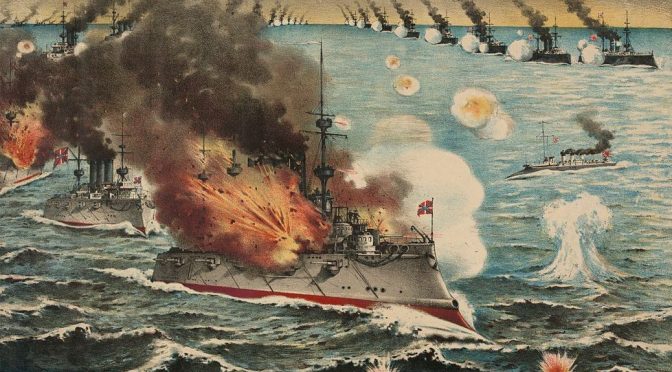
Featured Image: Print shows, in the foreground, a Russian battleship exploding under bombardment from Japanese battleships; a line of Japanese battleships, positioned on the right, fire on a line of Russian battleships on the left, in a surprise naval assault on the Russian fleet at the Battle of Port Arthur (Lüshun) in the Russo-Japanese War. (Torajirō Kasai/Wikimedia Commons)
The Space Force Needs Policy and Strategy, Part 1

By Tuan N. Pham

Last year on June 18, President Donald Trump directed the Department of Defense (DoD) to establish the “Space Force.” The Space Force would be a distinct but equal military service to the Air Force, which has presided over U.S. military space operations since the establishment of an Air Force major command (Space Command) in 1982, subsequent elevation to a unified combatant command (U.S. Space Command) in 1985, and then finally relegation back into the U.S. Air Force as the Air Force Space Command years later. On August 9, the president further instructed DoD to immediately begin the process to establish a Space Force as the sixth branch of the armed forces. On October 23, the National Space Council served up six recommendations to the president to further advance the establishment and sustainment of the proposed sixth military branch. The recommendations call for a unified space command to be known as U.S. Space Command; a legislative proposal for a Space Force; a funding plan in the FY2020 budget; an interagency authorities review; a joint Space Development Agency for technology procurement; and strengthened relationships between military space and the intelligence community. On December 18, the president ordered the Pentagon to re-establish the U.S. Space Command as a unified combatant command for space operations. Two days later, the president announced the Space Force will reside within the Department of the Air Force.

Since the President’s directives, subsequent think tank and media commentaries have focused largely on the necessity for a Space Force. This includes the imperative to counter Chinese (and Russian) growing space ambitions and capabilities, and managing the multitude of bureaucratic, budgetary, doctrinal, command relationship, and legal implications and challenges to establish the sixth military service.

One of the more thoughtful and insightful analysis on the imperative to counter growing Chinese space ambitions and capabilities – in terms of great powers competition – was written by Namrata Goswami in The Diplomat. In the article titled “Waking Up to China’s Space Dream,” he posited that the “political vision for space, championed by the Chinese leadership, is to build internal capacity that can support a space presence and establish dominance and industrialization that would in turn enhance the national rejuvenation of the Chinese nation.” Underscoring Goswami’s point, China’s Chang’e-4 lunar probe made the world’s first landing on the far side of the moon on January 3, and Beijing announced shortly thereafter more lunar missions later in the year to lay the groundwork for a moon base and an ambitious plan to explore Mars by 2020. 

Interestingly, Chinese media and punditry have also offered their opinions on the proposed U.S. Space Force, most notably the People Liberation Army’s (PLA) Daily and Global Times (subsidiary of the PLA Daily). The former proffered a Chinese assessment of U.S. challenges and opportunities. The Chinese authors surprisingly understood the complexity and nuances of U.S. space policies and operations and the underlying politics and bureaucracy involved. The latter asserted that “outer space has been a place of peace…the United Nations resolutely opposes the militarization of outer space and all countries have remained constrained in terms of their research of military space systems…by establishing a Space Force the United States has started an outer space arms race.” The provocative (and perhaps contradictory) statement was made despite the 2015 establishment of the PLA Strategic Support Force (PLASSF), and recent plans by the PLA Air Force to expand its presence in space. The PLASSF, China’s own Space Force, consolidated, integrated, and synchronized all of its space, cyber, and electronic warfare capabilities under one umbrella organization.

More strategic guidance is needed to guide and manage the operations of the new U.S. Space Force. Hence, this is part one of a three-part series that revisits past recommendations for a new U.S. space policy and strategy in terms of ends, ways, and means – freedom of space, space preeminence, and full-spectrum space deterrence, respectively. Part two will take a step back for strategic context and re-examine a conceptual framework characterizing the dynamics that contribute to instability and stability in the space domain. Part three will then discuss suggestions on how America (through the Space Force) can promote stability while prolonging U.S. space preeminence into the 21st century…additional considerations for U.S. policymakers as they develop a new strategic guidance for the Space Force. Altogether, these erstwhile proposals have become more relevant and acceptable with the passage of the new muscular National Security Strategy and National Defense Strategy, and can help provide a strategic framework for space operations, as well as advocacy for space requirements and capabilities.

Freedom of Space (Ends)

One of the principal goals of current U.S. strategic guidance for space – 2010 National Space Policy, 2011 National Security Space Strategy, and 2012 DoD Space Policy– is maintaining the stability, sustainability, and free access to and use of space for all. They specifically call for the conduct of space operations without interference and in ways that promote transparency and enable the sharing of benefits provided by the peaceful use of space. These lofty and benevolent U.S. goals are consistent with those of the United Nations that supports the conduct of space activities for peaceful purposes and the benefit of all mankind.

There are historical precedents for guiding the consideration of universal space security and stability, the naval precedent perhaps foremost. For more than 500 years, great nations (maritime powers) maintained powerful and globally deployed navies to guarantee the freedom of the seas for all (net providers of maritime security), a pre-condition for international trade, economic development, and global prosperity underwritten by naval power ensuring the free flow of maritime commerce. Hence, there is a strong need going forward for a comparable guarantor of the freedom of space (net provider of space security) to ensure the free flow of space commerce, a leadership role that calls out to America, with allied support to fill. 

Space Preeminence (Ways)

Just as maritime preeminence is necessary to guarantee the freedom of the seas, so too is space preeminence needed to guarantee the freedom of space. The extant strategic guidance implicitly acknowledged the necessity of space preeminence to enable the stated goals, but stopped short of explicitly affirming them outright. The next space policy and strategy should openly and fully commit America to maintaining that “degree of preeminence in space of one force over another that permits the conduct of operations by the former at a given time and place without prohibitive interference by the opposing force (freedom of action).” If not, the United States may unwisely cede this critical domain to China (and Russia).

In its latest white paper on space published in December 2016, Beijing reaffirmed its strategic intent to use its rapidly growing space program (largely military space) to transform itself into a military, economic, and technological power in accordance with its strategic plan for national rejuvenation (the Chinese Dream). Ye Peijian, the head of China’s lunar exploration program, remarked that the high grounds of space will bear directly on Chinese strategic interests in the coming decades. He made references to the Japanese-administered Senkaku Islands and Philippine-claimed Scarborough Shoal, and suggested that China sees space in terms of astro-strategic terrain rather than simply the focus of scientific exploration: 

“The universe is an ocean, the moon is the Diaoyu Islands (Senkaku), Mars is Huangyan Island (Scarborough). If we don’t go there now even though we’re capable of doing so, then we will be blamed by our descendants. If others go there, then they will take over, and you won’t be able to go even if you want to. This is reason enough.”

Full-Spectrum Space Deterrence (Means)

Many space strategists view space deterrence through the doctrinal lens of denying benefit, imposing cost, and encouraging restraint. On the whole, the current strategic guidance appears to rely heavily on denying benefit (resilience; mission assurance; shared reliance; and capability and capacity to operate in and through a degraded, disrupted, or denied space environment) to deter and defeat aggression by blunting the adversary’s offensive counter-space (OCS) capabilities. The other viable deterrent tools (threat of preemption, active defense, and redline) appear neither considered nor accepted. This limiting take on space deterrence is largely rooted in the hopeful belief of assured resilience, and therefore may have put too much confidence on denying benefit at the expense of imposing cost and encouraging restraint. U.S. policymakers may want to consider adopting a broader, more complete, and more balanced approach toward space deterrence if it hopes to “fully” deter or make a potential adversary think that starting a war or escalating a conflict would be worse than not doing so – particularly if that potential adversary is less reliant on space capabilities than America.

Tactical Preemption and Active Defense

The language and tone of the standing strategic guidance are largely ambiguous in terms of deterrence. The vague and imprecise language can be inadvertently misinterpreted by a potential adversary as perceived U.S. willingness to absorb a possibly disabling first strike, and could encourage a highly destabilizing preemptive attack since America has far more to lose in terms of warfighting capabilities than the attacker due to the offense-inclined nature of space conflict itself. Holding space assets at risk seems far easier and cheaper than defending them considering the wide range of threat vectors, large target sets, and predictable satellite orbital profiles. Moreover, absorbing such a first strike with all of its potential destructiveness, and then striking back against an adversary fully anticipating a retaliatory strike, can be militarily unsound and risky.

In space, offense dominance scales up – “a power that strikes aggressively should be, in theory, able to get the upper hand, or at least get the greatest possible use of whatever OCS it has invested in.” Thus, employment of tactical preemption and tactical active defense may be appropriate. “Tactical preemption” is the use of military power to deny an adversary specific terrain or gains by attacking potential imminent threats before they can be employed. “Tactical active defense” is the interception and disruption of an imminent attack before it can affect its intended target. Including related language into the next strategic guidance can keep all deterrent options on the table, and coupled with resilience and declaratory statements (redlines), may give greater pause to any potential adversary contemplating a highly destabilizing first strike.

Redlines

Declaratory statement of redlines – actions beyond which would trigger a significant U.S. response – is one important means to shape and influence a potential adversary’s risk perception and calculus, lower the likelihood of misinterpretation, promote transparency, and encourage restraint. Declarative redlines make it explicit that certain actions carry unacceptable risks and consequences, and clearly lay out the conditions and willingness to inflict unacceptable retaliatory damage or destruction. In contrast, “ambiguity in deterrent threats, often held up as strategically artful, may actually encourage a potential adversary’s miscalculation and lead to greater risk taking.” To be effective, redlines need to be credible. Potential adversaries will not take redlines seriously if Washington does not back-up them up with concrete and consistent actions.

Current U.S. declaratory space statements are deliberately vague to provide national leaders a wide range of policy options. The unintended consequences of such political flexibility might be a potential adversary not knowing what to expect, being surprised by the response, and misinterpreting the intent of the response. Therefore, declaratory statements may be warranted for military space capabilities relating to missile warning and C2 of nuclear forces and positioning, navigation, and timing systems relating to key force-projection capabilities. Attacks (kinetic and non-kinetic) on these critical military space systems should be declared unacceptable and that they will be met with “dire” consequences – keeping the consequences deliberately vague in this case. U.S. retaliation should be at the time, place, manner, and degree of own choosing. Potential adversaries do not need to know what, how, when, and where America would retaliate; just that America would in some fashion.

Offensive Counterspace Capabilities

That being said, redlines only work if they are backed up by proven capabilities to carry out the deterrent threats. The continued development, deployment, and employment of OCS capabilities is necessary to enable space warfighting capability and full-spectrum space deterrence unless military space assets can be given far greater resilience than what little they have today. A credible second strike capability requires credible OCS capabilities, preferably ones that are the least destabilizing. There is also danger for America in falling behind strategic competitors like China (and Russia) in OCS capabilities. Both nations are unilaterally and aggressively pursuing robust OCS capabilities of their own. 

The heart of the matter remains what type of OCS capabilities, how much, and to what extent should they be publicly disclosed. Regarding the former, some argue none or limited quantities are required while others call for robust OCS capabilities. Whatever the right answer may be, it is difficult to see how one can deter without “some” OCS capabilities. As for the latter, it may be best for now to keep OCS capabilities deliberately vague. Potential adversaries do not need to know what type or how much America has, just that America has the capability to act if it so chooses.   

Tuan Pham has extensive professional experience in the Indo-Pacific, and is widely published in national security affairs and international relations. The views expressed therein are his own.

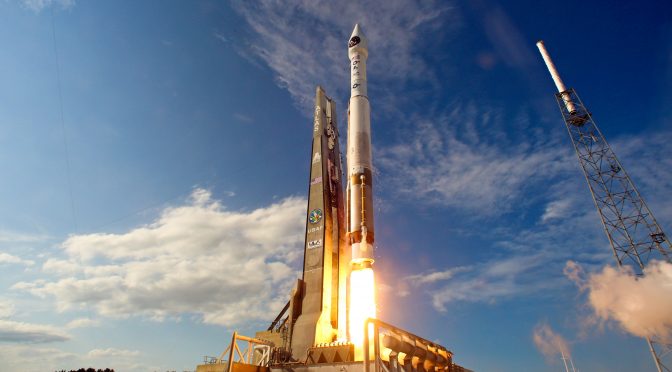
Featured Image: A United Launch Alliance Atlas V rocket blasts off from Space Launch Complex-41 carrying the second U.S. Air Force Space-Based Infrared System GEO-2 satellite March 19, 2013, at Cape Canaveral Air Force Station, Fla. (United Launch Alliance photo by Pat Corkery)

The Deep Ocean: Seabed Warfare and the Defense of Undersea Infrastructure, Pt. 1

By Bill Glenney

Introduction

Given recent activities by the PLA(N) and the Russian Navy, the matters of seabed warfare and the defense of undersea infrastructure have emerged as topics of interest to the U. S. Navy.1,2 Part One of this paper presents several significant considerations, arguably contrary to common thinking, that highlight the challenges of bringing the deep sea and benthic realm into cross-domain warfighting in the maritime environment. Part Two presents three warfighting concepts drawn from the body of work done by the CNO Strategic Studies Group (SSG) that would give the Navy capabilities of value for the potential battlespace.

The Deep Ocean Environment

For clarity the term “deep ocean” will be used to cover the ocean bottom, beneath the ocean bottom to some unspecified depth, and the ocean water column deeper than about 3,000 feet.3 The deep ocean is where the U.S. Navy and the submarine force are not. Undersea infrastructures are in the deep ocean and on or under the seabed for various purposes.

How does the maritime fight on the ocean surface change when there must be a comparable fight for the deep ocean? In the maritime environment, it is long past time for the U.S. Navy to be mindful of and develop capabilities that account for effects in, from, and into the deep ocean, including effects on the ocean floor. Cross-domain warfighting demands this kind of completeness and specificity. As the Army had to learn about and embrace the air domain for its Air-Land battle in the 1980s, the Navy must do the same with the deep ocean for maritime warfare today and for the future.

However, the current frameworks of mine warfare, undersea warfare, and anti-submarine warfare as practiced by the Navy today are by no means sufficient to even deny the deep ocean to an adversary let alone control the deep ocean.  To “own” a domain, a force must have the capability to sense and understand what is in and what is happening in that domain. The force must also have the capability to act in a timely manner throughout that domain.

Today, the Navy and many nations around the world have radars and other sensors that can detect, track, and classify most of anything and everything that exists and happens in the atmosphere from the surface of the ocean and land up to an altitude of 90,000 feet altitude or higher, even into outer space. The Navy and many nations also have weapons – on the surface and on land, and in the air – that can act anywhere within the atmosphere. Some nations even have weapons that can act in the atmosphere from below the ocean surface. In short, with regard to the air domain, relevant maritime capabilities abound, including  fixed or mobile, unmanned or manned, precise or area. Naval forces can readily affect the air domain with capabilities that can cover the entire atmosphere.

But the same cannot be said for the deep ocean. Figure 1 below is based on information drawn from unclassified sources. Consider this depiction of the undersea in comparison with the air domain. Notice that there is a lot of light blue space – space where the Navy apparently does not have any capability to sense, understand, and act. The Navy’s capability to effect in, from, and into the deep ocean is at best extremely limited, but for the most part non-existent. Capabilities specifically relative to the seabed are even less, and with the Navy’s mine countermeasures capabilities also being very limited. What systems does the Navy have to detect unmanned underwater vehicles at very deep depths? What systems does the Navy have to surveil large ocean areas and the resident seabed infrastructure? What systems does the Navy have to act, defend, or attack, in the deep ocean?

Figure 1 – The Deep Ocean

Arguably, the Navy has built an approach to maritime warfighting that dismisses the deep ocean, and done so based on the assumption that dominating the top 3,000 feet of the waterspace is sufficient to dominating the entire waterspace – ocean floor to ocean surface. Undersea infrastructure is presumably safe and protected because the ceiling over it is locked up.

However, the force must have the capabilities to sense, understand, and act in the deep ocean.

While the assumption for dominating the deep ocean by dominating the ceiling may have been useful in the past, it clearly is no longer valid. In the past, it was very expensive to do anything in the deep ocean. The technology was not readily available, residing only in the hands of two or three nations or big oil companies. This no longer holds true. The cost of undersea technology for even the deepest known parts of the ocean has dropped dramatically, and also widely proliferated. If one has a couple hundred million dollars or maybe a billion dollars, they can sense, understand, and act in the deep ocean without any help from a nation or military. Unlike the U.S. government-funded search for the SS Titanic by Robert Ballard, Microsoft co-founder Paul Allen independently found USS Indianapolis in over 15,000 feet of water in the Philippine Sea. The capabilities to sense, understand, and act in the deep ocean are available to anyone with a reasonable amount of money to buy them.

Figure 1 is misleading in one perspective. At the level of scale in figure 1, the ocean floor looks flat and smooth. If something is placed on the ocean bottom, such as a towed payload module, a logistics cache, sensors, or a weapon system, could it be easily found?

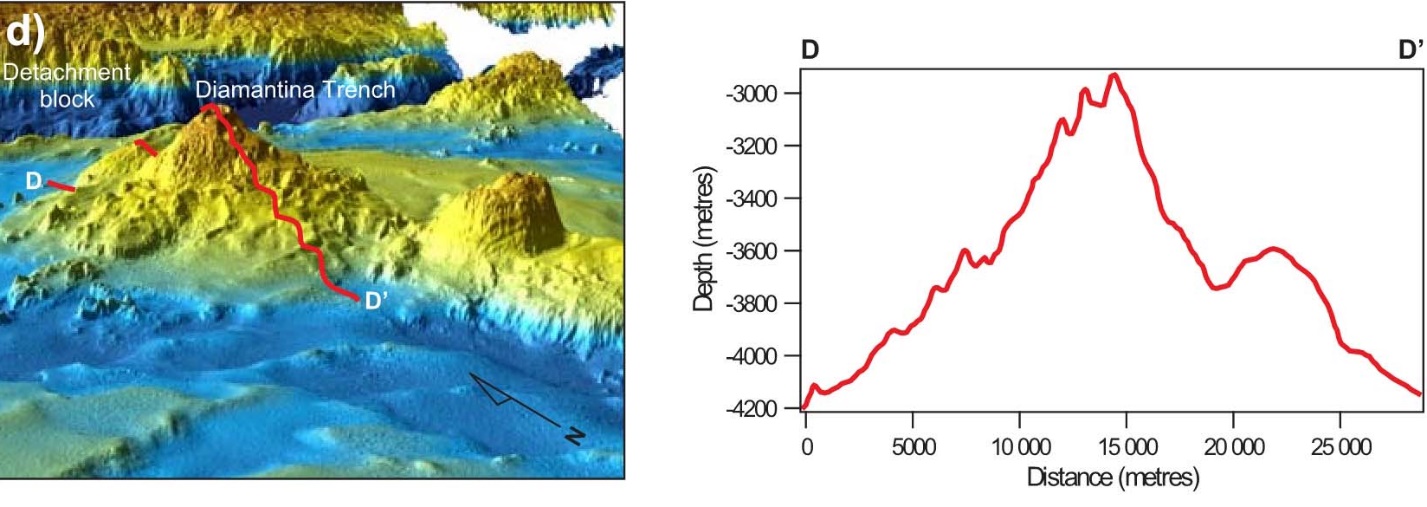
Figure 2 is a picture of survey results from the vicinity of the Diamantina Trench approximately 700 miles west of Perth, Australia in the Indian Ocean. The red line over the undersea mountain is about 17 miles in length. The water depth on the red line varies from 13,800 feet to 9,500 feet as shown on the right.4

Figure 2 – Diamantina Trench

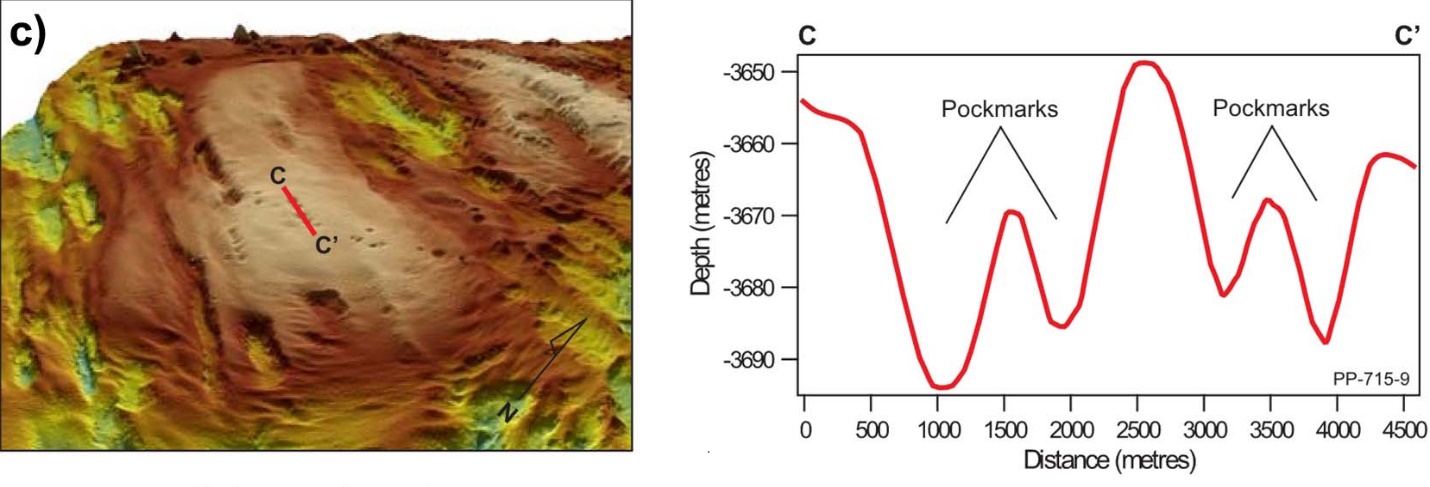
Consider figure 3. The red line is just under three miles in length. The depth variation ranges from 12,100 feet to 11,900 feet.5 These figures provide examples of evidence that the abyssal is not featureless. The assumption of a flat and smooth ocean floor is simply wrong, and severely understates the challenge of sensing and acting in the deep sea.

Figure 3 – A Closer View in the Diamantina Trench

How hard would it be to find a standard-sized shipping container (8ft x 8ft x 20ft or even 40ft) on this floor? It could be incredibly difficult, requiring days or weeks or even months with many survey vehicles, especially if the area had not been previously surveyed. This is a lesson the U. S. Navy learned in the Cold War and has long since forgotten from its “Q routes” for port access. And it would be harder still if one were purposefully trying to hide whatever they placed on the ocean floor, such as in the pockmarks of figure 3.

Based on reported results from a two-year search for Malaysian Airlines flight MH-370, approximately 1.8 million square miles of the ocean floor were searched and mapped to a horizontal resolution on the order of 100 meters and vertical resolution of less than one meter.6 Yet, the plane remains unlocated.

Hiding things on the seabed is fairly easy, while finding things on the seabed is incredibly difficult. Unless one is looking all the time, and has an accurate baseline from which to start the search and compare the results, sensing in the deep sea is significant challenge. The next consideration is that of the matter of scale of the geographic area and what resides within it. This is what makes numbers matter.

Figure 4 provides a view of the Gulf of Mexico covering about 600,000 square miles in area and with waters as deep as 14,000 feet. There are about 3,500 platforms and rigs, and approximately 43,000 miles of pipeline spread across the Gulf.

Figure 4. – The Gulf of Mexico (National Geographic)

Of note, the global economy and worldwide demands for energy have caused the emergence of a strategic asymmetry exemplified by this figure. China gets most of its energy imports by surface shipping which is vulnerable to traditional anti-shipping campaigns. The U. S. gets much of its energy from undersea systems in the Gulf of Mexico. While immune from anti-shipping, this infrastructure is vulnerable to seabed attack. In late 2017, the Mexican government leased part of their Gulf of Mexico Exclusive Economic Zone seafloor to the Chinese for oil exploration.

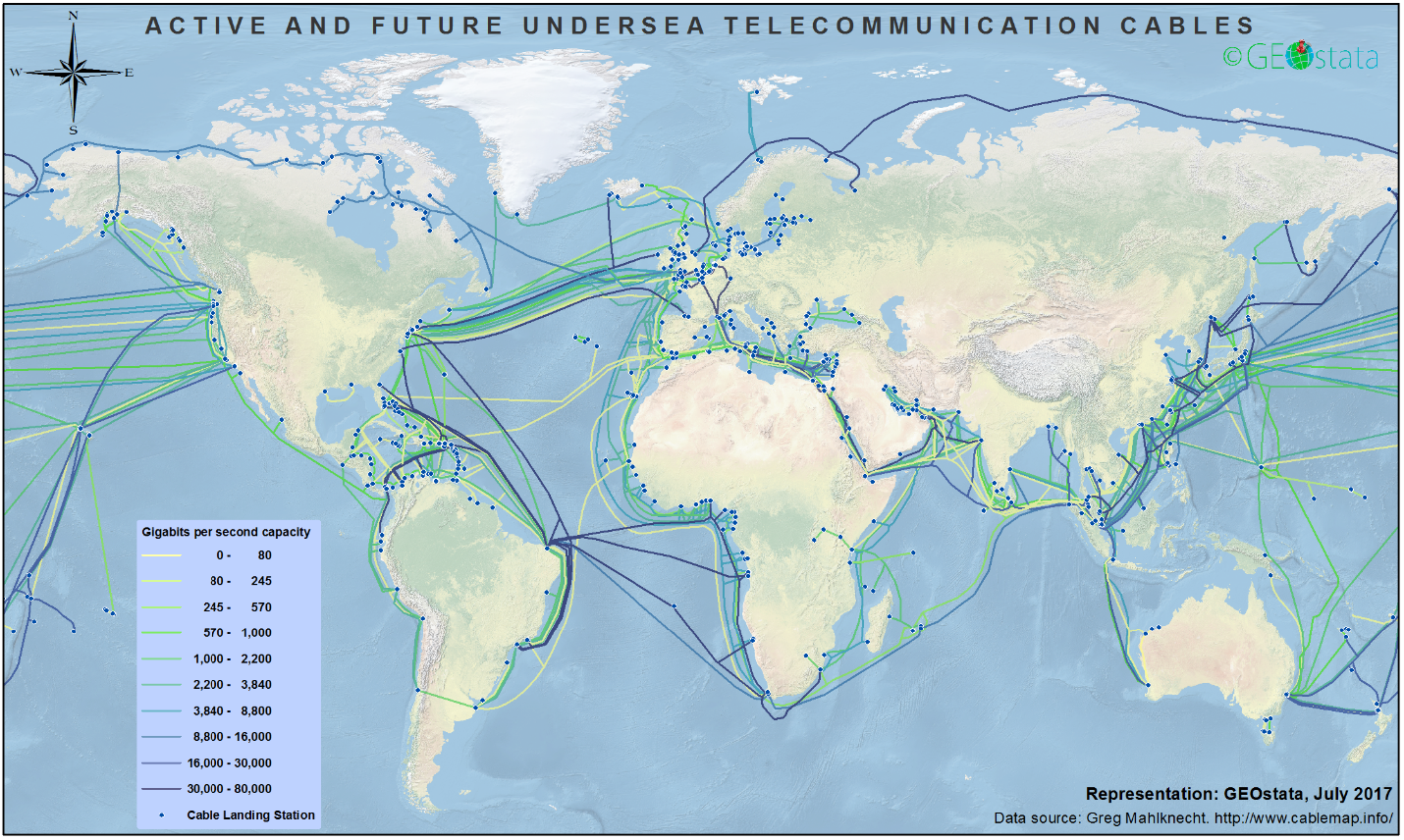
Figure 5 provides a depiction of global undersea communication cables with some 300 cables and about 550,000 miles of cabling.

Figure 5 – Global Undersea Telecommunications Cables

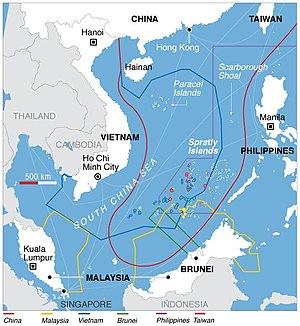
Figure 6 provides a view of the South China Sea near Natuna Besar. This area is about 1.35 million square miles with waters as deep as 8,500 feet. Recall that in the two-year search for Malaysian Air flight MH 370 they surveyed only 1.8 million square miles, and did so in a militarily-benign environment. 

Figure 6 – The South China Sea

The deep ocean demands that a maritime force be capable of surveilling and acting in and over large geographic areas just like the ocean surface above it. Undersea infrastructure is already dispersed throughout those large areas. In addition, because the components of undersea infrastructure are finite in size, the deep ocean also demands that a maritime force be capable of surveilling and acting in discrete places. While it is arguable that defense in the deep ocean is a wide-area challenge and offense is a discrete challenge, the deep ocean demands that a maritime force be capable of doing both as part of the maritime battle. Therefore, the deep ocean presents an “area” challenge and a “point” challenge simultaneously, and both must be addressed by maritime forces.

In addition, the size of the area and the number of points of interest means that a dozen UUVs or a couple of nuclear submarines are not in any way sufficient to address the maritime warfighting challenge of defending the deep ocean and undersea infrastructure of this scale. Furthermore, the situation is exacerbated by systems and vehicles in the deep ocean above the seabed. The threat is not a few, large, manned platforms, but many small unmanned vehicles and weapons.

The historical demarcation among torpedoes, mines, and vehicles is no longer productive except maybe for purposes of international law and OPNAV programmatics. Operationally and tactically, the differentiation is arbitrary and a distraction from operational thinking. The Navy should be talking in terms of unmanned systems – some armed or weaponized, and some not; some mobile and some not; some intelligent and some not. Torpedoes can easily become mobile, armed UUVs with limited intelligence. Mines can also become mobile or fixed UUVs with very limited intelligence.

In the course of the author’s research and in research conducted by the CNO SSG, there were no situations or considerations where reclassifying mines and torpedoes as UUVs was problematic with regard to envisioning war at sea. Doing so eliminated a significant tactical and operational seam and opened up operational thinking. The systems for the detection and neutralization of UUVs are the same as those needed to detect and neutralize torpedoes and mines, and the same for surveilling or attacking undersea infrastructure.

Conclusion

Ultimately, understanding the deep ocean and warfare in the deep ocean is a matter of numbers and time – requiring plenty of sensors, and plenty of time. Part Two will present three warfighting concepts drawn from the body of work done by the CNO Strategic Studies Group (SSG) that would give the Navy capabilities for the deep sea battlespace.

Professor William G. Glenney, IV, is a researcher in the Institute for Future Warfare Studies at the U. S. Naval War College.

The views presented here are personal and do not reflect official positions of the Naval War College, DON or DOD.

References 

1. This article is based on the author’s remarks given at the Naval Postgraduate School Warfare Innovation Continuum Workshop on 19 September 2018. All information and conclusions are based entirely on unclassified information.

2. See for example Rishi Sunak, MP, Undersea Cables:  Indispensable, Insecure, Policy Exchange (2017, London, UK);  Morgan Chalfant and Olivia Beavers, “Spotlight Falls on Russian Threat to Undersea Cables”, The Hill, 17 June 2018 accessed at http://thehill.com/policy/cybersecurity/392577-spotlight-falls-on-russian-threat-to-undersea-cables;  Victor Abramowicz, “Moscow’s other navy”, The Interpreter, 21 June 2018 accessed at https://www.lowyinstitute.org/the-interpreter/moscows-other-navy?utm_source=RC+Defense+Morning+Recon&utm_campaign=314b587fab-EMAIL;  Stephen Chen, “Beijing plans an AI Atlantis for the South China Sea – without a human in sight”, South China Morning Post, 26 November 2018 accessed at https://www.scmp.com/news/china/science/article/2174738/beijing-plans-ai-atlantis-south-china-sea-without-human-sight;  and Asia Times Staff, “Taiwan undersea cables ‘priority targets’ by PLA in war”, Asia Times, 6 December 2017 accessed at http://www.atimes.com/article/taiwan-undersea-cables-priority-targets-pla-war.

3. Based on unclassified sources, manned nuclear submarines can operate to water depth of 1,000-1,500 feet, manned diesel submarines somewhat shallower, and existing undersea weapons to depths approaching 3,000 feet.

4. Kim Picard, et. al., “Malaysia Airlines flight MH370 search data reveal geomorphology and seafloor processes in the remote southeast Indian Ocean,” Marine Geology 395 (2018) 301-319, pg 316.

5. Kim Picard, et. al., “Malaysia Airlines flight MH370 search data reveal geomorphology and seafloor processes in the remote southeast Indian Ocean,” Marine Geology 395 (2018) 301-319, pg 317.

6. Kim Picard, Walter Smith, Maggie Tran, Justy Siwabessy and Paul Kennedy, “Increased-resolution Bathymetry in the Southeast Indian Ocean”, Hydro International, https://www.hydro-international.com/content/article/increased-resolution-bathymetry-in-the-southeast-indian-ocean, accessed 13 December 2017.

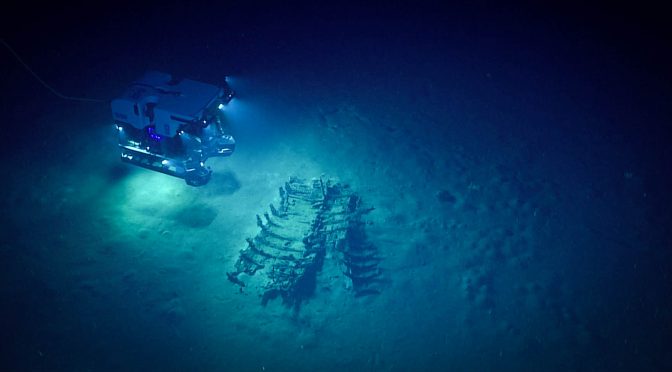
Featured Image: Deep Discoverer, a remotely operated vehicle, explores a cultural heritage site during Dive 02 of the Gulf of Mexico 2018 expedition. (Image courtesy of the NOAA/OER)

Pearl Harbor 1941: The First Energy War

This article originally featured in The Foreign Service Journal and is republished with permission. Read it in its original form here.

By Charles Maechling, Jr.

In the summer of 1941, Japan had been at war on the mainland of Asia for four years. After amputating Manchuria from China proper in 1931, and recreating it as Manchukuo under a puppet regime, she had plunged into a full-scale war of conquest with China in 1937. But although a Japanese army of well over a million men occupied vast stretches of the Chinese mainland, active hostilities showed no sign of diminishing. Despite the installation of a puppet regime in Nanking, and a campaign of intimidation and brutal reprisals to pacify the conquered areas, the drain of manpower and supplies continued unabated.

Just as today, Japan was wholly dependent on outside sources for the minerals, petroleum, and other raw materials necessary to fuel its economy, which in 1941 was already highly industrialized. In fact, the whole aim of Japan’s program of expansion on the Asian mainland was to carve out a continental economic system, insulated from the forces which had caused the world-wide economic depression, in which raw materials from China and Southeast Asia would flow into Japan for conversion into a stream of manufactured goods aimed at the limitless Asian market. The conquest of China—or more accurately, her forced conversion into a compliant economic partner—was the first step in a grand design called the Greater East Asian Co-Prosperity Sphere which was ultimately supposed to embrace Indo-China, Malaysia, and the Dutch colonies of Indonesia.

The Achilles’ heel of Japan’s economy—and the greatest drawback to military ambitions—was her energy resources. Despite the fact that civilian gasoline consumption was minimal, and the Japanese armies were largely unmechanized, Japanese oil consumption, including military, had since 1931 climbed steadily from a level—unbelievably low by modern standards—of about 21 million barrels a year to over 32 million barrels in 1941. (Japan’s current annual consumption is about 2 billion barrels.) The most imperative defense need, on which the safety of the island empire depended, was to ensure ample reserve stocks for the large and powerful imperial navy, and it was largely to this end that Japan, at great pains to her strained economy, had accumulated a stockpile of around 54 million barrels of which 29 million was reserved for the navy.

In 1941 Japan was just as dependent on outside sources for its oil supply as it is today. Domestic production of synthetic fuel amounted to only three million barrels annually; the rest of Japan’s needs—over 90 percent—were made up by imports. In the late ’30s total imports varied from a low of 30.6 million barrels in 1939 to 37.1 million in 1940, the excess over domestic requirements going into the stockpile. Fifteen percent of petroleum imports of all categories came from Venezuela, the Dutch East Indies, and the Middle East—the vast reserves of Saudi Arabia and the Persian Gulf had not yet been developed. Eighty five percent of imports came from one monolithic supplier—Japan’s own private OPEC—the United States of America. And by 1941 relations with the United States had deteriorated to the verge of war.

It had not always been so. The United States had been instrumental in securing a favorable settlement for Japan in the Russo-Japanese War of 1905, had been an ally in World War I, and was Japan’s most important trading partner. Despite resentment over the Japanese Exclusion Act, there was a considerable reservoir of good will for the United States among the educated classes of Japan and vast admiration for American education and technological achievement. But since 1931, the United States had been the principal and most outspoken opponent of Japanese expansion in Asia. Under the Stimson Doctrine the United States had refused to recognize the puppet regime in Manchukuo and regarded the program for a Greater East Asian Co-Prosperity Sphere with hostility and moral disapproval—attitudes reinforced by the barbaric atrocities perpetrated by the Japanese forces in the course of their slow advance through the Chinese provinces. But, until the late ’30s, isolationist sentiment and the rigid constraints of neutrality legislation not only prevented military assistance from being given directly to threatened friendly countries, but inhibited any form of economic sanctions against aggressor nations that might lead to military confrontation. When these policies were finally reversed, it was owing to the tide of German aggression in Europe and the threat to Britain rather than to events in Asia. Even then President Roosevelt was under pressure at first from the Western European powers to avoid a crisis in East Asia until the Nazi menace could be dealt with.

In late 1939, President Roosevelt took the first step toward economic sanctions by imposing a “moral embargo” on sales of aircraft and aviation material. Over the next year, this was expanded to include a wide range of metals and raw materials—rubber, tin, magnesium, molybdenum, aluminum, etc. But where Japan was concerned the administration was careful to avoid any interference with the flow of the most precious commodity of all, oil—this was regarded as too dangerous. In May, 1939. Ambassador Joseph C. Grew in Tokyo had warned the president that “…if we cut off Japanese supplies of oil…and she cannot obtain sufficient oil from other commercial sources to ensure her national security, she will probably send her fleet down to take the Dutch East Indies.”

The outbreak of war in Europe presented the United States with a policy dilemma that took the form of a conflict of priorities. The attention of the president, the press and the American public was riveted on Europe, and after the fall of France on the plight of Britain. The prevailing view was that the Nazi menace to European civilization was the overriding problem of the time. True, the United States was also committed to a policy of resistance to aggression in Asia and support for the Nationalist regime of Chiang Kai Shek. But while there was a growing consensus for all-out aid to Britain, opinion was divided on how to cope with the Japanese menace. Within the Cabinet, Secretary of the Treasury Morgenthau and Secretary of the Interior Ickes. along with elder statesman Henry L. Stimson (soon to become secretary of war) believed that there was “linkage” between all outbreaks of aggression. They pressed for “economic sanctions” against Japan, including the cut-off of scrap iron and oil. But Secretary of State Hull and the State Department, guided by the cautionary warnings of Ambassador Grew, were wary of pushing Japan into an act of desperation that would compound the difficulties of the European colonial powers and divert public attention from Hitler.

The U.S. Navy was even more cautious. Successive chiefs of naval operations had warned the president that until the 1934 naval building program was completed and outlying bases in the Philippines, the central Pacific, and Hawaii were reinforced and fortified, any military confrontation with Japan would find the navy at grave disadvantage. The navy had neither the auxiliary supply vessels nor the carrier air strength to fight its way through the Japanese-mandated Marshall and Caroline Islands, bristling with air bases, to face the formidable Japanese navy in its home waters.

The reluctance of the admirals to risk a military confrontation with Japan became even more pronounced in 1940, after the German submarine campaign to cut supply lines to Britain got underway. Substantial units of the Pacific Fleet, including the destroyers necessary to protect heavy ships from submarine attack, were now being transferred to the Atlantic for patrol and convoy duty. One chief of naval operations, the redoubtable Admiral James O. Richardson, had actually been replaced for pouring cold water on the president’s fantasy of running a cruiser patrol line from the Philippines to Hawaii, and for too outspokenly recommending that the fleet be withdrawn to its West Coast bases because of its vulnerability in Pearl Harbor. When a decision was finally made to give the Atlantic top priority, it made a temporizing stance in the Pacific almost mandatory.

The passage of the Export Control Act in July of 1940, however, gave the president a weapon for retaliating against Japanese expansion without appearing to be punitive. The rearmament program and aid to Britain had produced shortages in some materials and the prospect of future scarcity in others. When in September, 1940, the Japanese moved into bases in the northern region of French Indo-China, President Roosevelt promptly imposed an embargo on the export of scrap iron and steel, citing U.S. defense needs as justification. Soon afterwards he prohibited the export of aviation gasoline and lubricants to all but Britain and western hemisphere countries. But the flow of oil and regular gasoline to Japan continued without interruption. In the embargo year of 1940, Japan’s oil imports from the United States only dropped to 23 million barrels from 26 million the year before.

Meanwhile, Japanese foreign policy had been undergoing reappraisal through a convoluted process which can properly be described as agonizing in the literal sense of the word. The Japanese military—or more properly the army high command—had, since the Manchurian takeover, exercised a baleful influence over civilian cabinets, especially on matters of foreign policy. On several occasions this had reached the point of permitting the assassination, by fanatical young officers, of elderly and conservative ministers who were considered to have “become unworthy” of the Japanese imperial mission. The longer the campaign in China dragged on the more the army high command itself risked loss of face and disgrace in the eyes of the emperor and the people. Fearful of the Soviet menace on the long and exposed Manchurian flank, and frustrated over its inability to settle the “China incident,” the high command was the principal proponent both of closer ties with Germany and Italy and an aggressive move south to achieve the long-promised dream of self-sufficiency in Asia.

On the other side, strong forces were at work for a policy of moderation. These included the nobility, the business and financial leadership, the diplomatic service, and the imperial navy. Though dismayed and resentful over American policies past and present, these circles had a more healthy respect for American industrial might than the insular army and genuinely dreaded the unforeseeable consequences of war with the United States. Compared with the deep geographical, historical and economic bonds that linked the United States and Japan, the new ties with Japan’s far distant allies of expediency, Germany and Italy, seemed somehow flimsy and artificial. In these quarters the unrelenting opposition of the United States to Japan’s program in Asia was upsetting and threatening, but could be tolerated as long as the oil supply remained intact. In the meanwhile, there was always a chance that the “China incident” could be settled, or that the mounting involvement of the United States in the defense of Britain would make some kind of compromise possible.

Before a clean-cut policy could evolve, however, these differences had to be thrashed out within the imperial circle. Although crudely styled “fascist” by American politicians and the press, and lumped in with Germany and Italy as a grinning partner in iniquity, Japan and its political system had little in common with European dictatorships. Except for the predominant influence exercised by the military caste, which was deemed to incarnate the warrior virtues, Japanese society before World War II was no more, or rather no less, “totalitarian” than the “Japan Incorporated” of 1979. Under an overlay of parliamentary forms the Japanese decision-making process was almost morbidly traditional. In all vital questions concerning the future of the empire, decisions were not dictated by an upstart tyrant but reached after a painful process of soul-searching and mutual consultation between the traditional power groups. The resulting consensus, couched in the euphemistic and abstract style unique to Japanese culture, was then given a sort of mystical endorsement by the emperor, after an elaborate ritual called a “Throne Conference” in which all groups were represented.

Predictably, this system often produced policy compromises that embodied fatal contradictions. Typical was the decision reached in the summer of 1940 to install a civilian premier of impeccably conservative stripe, Prince Konoye, to pursue a policy of negotiation with the United States, while at the same time the army was given a limited mandate to obtain bases in French Indo-China. Then in September, 1940, under pressure from the army high command, Japan signed a defensive alliance with Germany and Italy known as the Tripartite Pact. The terms of the pact had no operative effect except in the event of a future attack on one of the parties by an unspecified outsider, but the Axis label it now gave Japan was to have a devastating political effect and prove a serious impediment to negotiations with the United States. It would henceforth be extraordinarily difficult for President Roosevelt and Secretary Hull to make meaningful concessions to Japan without the risk of being called appeasers.

At about the same time Japan took steps to solve the problem of its oil dependence. Civilian consumption of gasoline was cut from 6-7 million barrels annually to 1.6 million. By diversifying supply she managed in 1940 to reduce the proportion of oil imports from U.S. sources down to 60 percent as compared to the prior level of 80 percent. But the attitude of the United States, combined with disruption of the international oil market and competing demands of the warring powers, made reliance on distant sources imprudent to say the least. The one alternative closer at hand, on which Japan had cast covetous eyes for years, was the Dutch East Indies, now cut off from the mother country by the German sweep through Western Europe.

In June, 1940, immediately after the Nazi occupation of Holland, Japan demanded assurances from the colonial government in Batavia that exports of oil and mineral exports to Japan would be maintained at present levels. This was merely a stopgap, however, taken more out of fear of German intentions than anything else.

In September, 1940, a large Japanese mission was dispatched to Batavia to make “proposals” to the colonial government for access to raw materials on a greatly increased scale. Oil was given top priority: oil imports from the Dutch Indies were 4.5 million barrels a year, and now the Japanese demand was for a guarantee of 22 million barrels annually. This would have represented 40 percent of the annual production of the Indies at that time (55 million barrels) and a figure almost exactly equal to the current level of Japan’s oil dependence on the United States. The Dutch colonial administration, however, though well aware of its vulnerability, proved tough and obstinate. It protracted the negotiations over nearly three months, and when in November an agreement was finally reached, the Japanese were granted 14.5 million barrels annually and no more. Even this amount was made subject to the concurrence of the oil companies and hedged about with escape clauses.

In the winter of 1940-41 the war reached a condition of temporary stalemate with American attention increasingly focused on the plight of Britain. In April, 1941, Germany invaded Yugoslavia and Greece, and inflicted heavy defeats on the British in Crete and North Africa. In May, President Roosevelt proclaimed a state of unlimited national emergency. During this period the pendulum in Japan again oscillated and a new Japanese ambassador, Admiral Kichisaburo Nomura, known to be well-disposed to the United States, was sent to Washington with a fresh set of proposals. In essence these offered a freeze of Japanese military operations in Asia and a promise to negotiate peace with Chiang Kai Shek. In return, Japan requested from the United States a lifting of all embargoes on critical items, resumption of normal trade relations, American assistance in obtaining a continuing supply of raw materials from Southeast Asia, and the exercise of influence on Chiang Kai Shek to force him to negotiate peace terms with Japan in good faith. The State Department agreed to discuss these proposals, but after fifty private meetings between Secretary Hull and Ambassador Nomura in the Spring of 1941, no basis for agreement could be found. The United States clung to its rigid formulations—withdrawal from Indo-China, acceptance of the principle of non-interference in internal affairs, and respect for the territorial integrity of China as preconditions for negotiations. These Japan could not accept.

In June, 1941, Germany invaded the Soviet Union. In the same month the United States suspended all petroleum exports to Japan from East Coast and Gulf ports, throwing supply contracts into temporary disarray. The handwriting was now on the wall, even though once again genuine shortages caused by U.S. military demand and shipments to British forces in the Middle East had prompted the action. The new factor was that at long last the Soviet threat along the Manchurian border had been neutralized. Pressed by the army high command, the Japanese establishment again went into conclave, and in a Throne Conference in July it was agreed that the empire now had no choice but to resume the march southward. Planning was ordered for the military conquest of Malaysia, the Philippines and the Dutch East Indies, to be combined with preparations for war with the United States, Great Britain, and Holland. But no specific deadlines were set. On July 24th the Japanese, with the reluctant acquiescence of the Vichy government, occupied key positions throughout French Indo-China. Two days later the dreaded blow fell.

On July 26th President Roosevelt ordered the freezing of all Japanese funds and other assets in the United States and the placing of all petroleum exports to Japan under embargo subject to license. Britain and the Dutch East Indies quickly followed suit. It was originally intended to use the licensing authority as a lever for further bargaining or to avert a crisis. But it soon became apparent that in the current political climate no licenses could be issued and none ever were. The oil cut-off was now complete and Japan was thrown back on her stockpile. To quote from a leading historian of the period: “There was no way, no uncontrolled source of supply from which Japan could get as much as it would have to use even with the most rigid economy. Ton by ton, it could be foreseen, Japan would have to empty the tanks which had been filled with such zealous foresight…From now on the clock and the oil gauge stood side by side. Each fall in the level brought the hour of decision closer.” (Feis, The Road To Pearl Harbor, p. 244.)

The oil embargo represented a triumph for the hard-liners of the Roosevelt administration who were convinced that an oil cut-off would force Japan to its knees. The navy, however, again stressing U.S. naval inferiority in the Pacific—now outnumbered in aircraft carriers by 10-3—had strongly urged delay at least until air and ground forces of the Philippines could be strengthened. Ambassador Grew had once more cautioned that if pushed to the wall it was in the Japanese character to react violently and without warning. According to the historical records, President Roosevelt believed that although he was running a risk, it was one that did not close off his options or entail serious consequences to the United States. He was reassured in this regard by the virtual unanimity of his advisers that if Japan struck it would be against Malaysia and the Dutch East Indies. The safety of the United States was not considered at issue.

In Japan the freezing of its assets and the embargo on oil was greeted with shock and dismay. Any mitigation of popular feeling against the United States was prevented by sightings of U.S. tankers headed for Vladivostok with oil for Soviet armies. By August, 1941, there was only a 12-month supply of fuel left for the army, and an 18-month supply for the navy.

When the Japanese records and diplomatic cables of the four months preceding Pearl Harbor were published after the war they revealed an atmosphere of desperation. In October a hardline cabinet headed by General Hideki Tojo replaced the now discredited ministry of Prince Konoye. Three more Throne Conferences were held, of which the last, on November 5, 1941, committed the emperor irrevocably to war unless a last minute diplomatic solution could be found. At the same time a final effort was authorized to reach some kind of compromise or modus vivendi that would restore the flow of oil without forcing Japan to totally abandon her acquisitions in Asia. Accordingly, new proposals embodying further concessions were carried to Washington by a special envoy, Saburo Kurusu, who henceforth participated with Admiral Nomura in all negotiations. These went so far as to agree to immediate Japanese withdrawal from Indo-China, renunciation of further expansion in Asia, and withdrawal from most of China upon conclusion of a peace treaty with Chiang Kai Shek. It was made plain that Japan was prepared to treat the Tripartite Pact as a nullity. But in the end, like all previous diplomatic efforts, these proposals foundered on the rock of an irreconcilable conflict. Japan would not totally withdraw from the Asian mainland and return to a pinched and impoverished existence on its overcrowded islands. The United States would not accept a compromise that left Japan in physical domination of any part of China. Under pressure from Chiang Kai Shek, Secretary Hull on November 26th confronted the Japanese negotiators with a reversion to the earlier U.S. demand for complete Japanese withdrawal from China. Repeated Japanese pleas for a summit meeting between Prince Konoye and President Roosevelt were met with stony silence.

Throughout these events, the highest circles of the Roosevelt administration were at all times aware of Japan’s sincere desire for a negotiated settlement. Since August, 1940, the president, Secretary Hull, and the civilian and military heads of the army and navy had followed every twist and turn of Japanese policy through the secret cable and radio traffic of the Japanese themselves. Cryptographic experts of the United States Army Signal Corps, headed by the legendary William E. Friedman, had broken the Japanese diplomatic code, styled PURPLE. Thereafter, intercepts of messages from Tokyo to its overseas embassies and consular posts were on Secretary Hull’s desk within a few hours of receipt. After the oil cut-off in July 1941 the president and his advisers not only knew of Japan’s desperation, but of its intention to take drastic military measures unless the embargo was lifted. All indicators pointed to an outbreak of war on either the weekend of December 1st or December 7th, with Malaysia, the Dutch East Indies, and the Philippines to be the immediate objectives. But partly owing to the indirection employed by the Japanese in communicating with each other, and partly to the tight security imposed by the Japanese military—whose codes were still unbroken—there was no certainty precisely when and where the first blows would fall. On November 27, 1941 a general war warning was sent to the commander of the U.S. Pacific Fleet in Pearl Harbor, the army’s Hawaiian department, and General MacArthur in Manila. Not a hint of impending war was given to Congress, the press, or the American public.

The Japanese air raid on Pearl Harbor of December 7, 1941—the “date that will live in infamy”— lives in history as the military catastrophe that plunged America into World War II. But for the Japanese naval staff, the attack was essentially a sideshow introduced out of excessive deference to the “worst case scenario.” Admiral Yamamoto, the Japanese naval commander, had convinced himself, in the teeth of all the evidence of American naval inferiority in the Pacific, that only if the U.S. battle fleet was dealt a knockout blow would his convoys be secure from interception and time afforded to build a defensive ring around the new conquests.

That the attack on Pearl Harbor was a strategic and political blunder of the first magnitude became apparent only later. Instead of trapping underarmed battleships far from their home base, they were sunk in shallow water where they could be raised and modernized to fight again. Instead of confronting President Roosevelt with the dilemma of how to persuade a refractory Congress to declare war on Japan in defense of the British and Dutch colonial empires, while resisting the Nazi menace across the Atlantic, the attack brought a unified America headlong into war.

What followed can properly be called the first energy war. Oil was not the primary cause of the steady deterioration of relations between the United States and Japan, but once employed as a weapon it made hostilities inevitable. Historians continue to debate endlessly about the extent to which President Roosevelt provoked the attack, but two lessons stand out: Regardless of the legal and moral rectitude of its position, the United States recklessly cut the energy lifeline of a powerful adversary without taking due regard of its own preparedness and the predictably explosive consequences. When the victim struck back he blundered badly and thereby unleashed forces of incalculable fury.

It could all happen again—but in reverse!

Charles Maechling, Jr., Washington lawyer and former State Department officer, was on the secretariat of the Joint Chiefs of Staff 1943-1944. 

Featured Image: The attack on Pearl Harbor, December 7, 1941. USS-Arizona (BB-39) is in the center. To the left are USS Tennessee (BB-43) and the sunken USS West Virginia (BB-48). (Naval History and Heritage Command NH: 97378. Colorized by Irootoko Jr.)