Category Archives: Space

Space Cowboys and Cyber Pirates, Part II

By Christopher Rice

Space-based technology empowers American leadership—economic, cultural, and military.  Further, as Part I of this essay noted, the nation’s rivals have made significant investments towards targeting the vulnerabilities of her space sectors, both in orbit and online.  Part II will outline current space cybersecurity policy at the national level and identify some of its risks.  Finally, this essay will suggest another way for American policymakers to secure the nation’s space infrastructure:  a renewed system of letters of marque and reprisal empowering American space and cyber firms to better protect themselves.

Fortress America?

The emphasis competitors have placed on contesting American space dominance has not gone unnoticed in American policy-making circles.  Recent policy documents have reflected the importance of space systems and their related cyber and information infrastructure to American economic and military success.  While such policy measures are certainly a step in the right direction, the current policy structure encodes structural weaknesses and ambiguities that threaten the security of the commercial space sector, and national security more broadly.

The United States has long recognized the importance of space systems in maintaining its national security; however, attention to cyber threats is comparatively new.  Broad support for space development within the U.S. government stretches back to the Eisenhower administration.1  In contrast, the Department of Defense did not produce a comprehensive cybersecurity plan until 2011.2  In the decade since, American policymakers have struggled to keep pace with accelerating technology development and proliferating, network-borne threats.

American space operations have a reasonably strong base in government policy and have received high-profile attention in recent years.  The Trump Administration’s series of Space Policy Directives (SPD) offer a helpful foundation for understanding the importance of American space infrastructure and the threats it faces.  The seven directives cover a variety of topics from space traffic management to the establishment of the Space Force.  The directives most relevant to the security of American space systems are SPD-5 and SPD-7. 

SPD-5 establishes a basic policy framework for space cybersecurity.  It notes that space systems are vulnerable to cyber and information attacks throughout their lifecycles, from supply chain through design, construction, and launch, as well as in operation.3  Every stage of a satellite’s lifecycle is controlled through complex information networks, offering hostile actors a profusion of potential vectors through which to attack.  In response to such thoroughgoing vulnerability, the directive goes on to call for space system owners and operators “to collaborate to promote the development of best practices, to the extent permitted by applicable law,” while also “shar[ing] threat, warning, and incident information within the space industry.”4  This emphasis on cooperation is a necessary precondition of securing U.S. space infrastructure.

SPD-7’s focus is sharper, centering on importance of the U.S. Global Positioning System (GPS) constellation.  SPD-7 identifies the “widespread and growing dependence on GPS by military, civil, and commercial applications, systems, and infrastructure” and the critical role of GPS in maintaining situational awareness in space itself.5  It further emphasizes the interconnectedness of space systems, information, and security, by identifying the threat of navigation warfare (NAVWAR).  Mirroring aspects of  Chinese thinking on informationized warfare, NAVWAR “refers to the deliberate defensive and offensive action to assure and prevent positioning, navigation, and timing information through coordinated employment of space, cyberspace, and electronic warfare.”6  SPD-7 also calls for increased attention to cyber and electromagnetic security measures to ensure the continued operation of the GPS constellation in the face of opponents’ NAVWAR efforts.7  While the SPD series is not the first set of government policies concerning space and information security, it does provide valuable insights into current U.S. policy thinking.

Other policy documents help further define the current U.S. approach to ensuring the security of its space infrastructure in the face of information threats.  The 2017 National Security Strategy identifies both space and cyberspace as key security sectors, calling for the greater attention to maintaining American leadership in space and development of enhanced cyber “attribution, accountability, and response” abilities.8  The DOD’s 2018 Cyber Strategy acknowledges the importance of “defend[ing] forward to disrupt or halt malicious cyber activity at its source,  including activity that falls below the level of armed conflict.”9  Given the tremendous interpenetration of networks and space systems into all aspects of American life and the proliferation of both human and artificially intelligent threats, there is simply no possibility of fortifying the nation completely against cyber-attack.  Instead, malign actors must be identified and actively deterred or defeated.  The 2020 National Space Policy builds on the aforementioned documents, reinforcing the importance of total-lifecycle cyber security, public-private and interagency collaboration, and resilience.10  These documents clearly illustrate the importance of space cyber security, but some critical vulnerabilities remain.

While seemingly resolute in its promotion of space cyber security, current U.S. policy remains dangerously vague in key areas.  First, U.S. policy is ambiguous about what actions might be authorized in response to hostile cyber action against American space systems or infrastructure.  Although current policy reflects the possibility of NAVWAR and identifies the systemic vulnerability of the space sector to cyber exploitation, it fails to set forth a range of possible responses.  It is even unclear whether the United States views cyber-attacks against critical infrastructure as more or less escalatory than a more traditional, kinetic attack on the same systems.  Compounding the ambiguity, U.S. policy fails to clarify the position of U.S. commercial space sector assets within American retaliatory decision making.  With U.S. firms providing everything from digital communication and imaging to the launch of GPS satellites, the commercial space sector is a source of irreplaceable capacity—and a high-payoff target to America’s enemies.11 

Ambiguity, like that built into U.S. space cybersecurity policy, may inadvertently invite miscalculation.  An opponent’s perception of American commitment matters: “if we[, the United States,] leave ourselves loopholes through which to exit—our opponent will expect us to be under strong temptation to make a graceful exit.”12  Given the critical importance of space in U.S. economic stability and national security, a graceful response to provocation may not be possible.  Although they may appear less threatening than other forms of conflict, cyber operations may be, as Thomas Schelling described limited war generally, “like fighting in a canoe. [Any] blow hard enough to hurt is in some danger of overturning the canoe.”13  The risk of aggression is magnified further because, unlike traditional means of limited warfare, cyber-attacks—especially those directed at space sector targets—need not involve the clarifying shock of bloodshed.  An opponent, like China whose views of deterrence are heavily shaded with coercion and fundamentally distinct from those of the United States, might see cyber action against American commercial space firms as both useful and minimally escalatory, only to be met by an unanticipated, forceful response.14  In such a situation, the ambiguity of American space cybersecurity policy inadvertently catalyzes dangerous escalation.  The risks of ambiguity are too high.  To preserve American leadership in space and establish more effective deterrence, policy makers must communicate more clearly.

The United States must ensure the security of critical space systems and infrastructure, whether government- or commercial-sector.  To close the nation’s space security gaps and reduce the risk of miscalculation by potential adversaries, America must begin to marshal the resources and design regulations to protect all of its space infrastructure, including the commercial space sector.  U.S. policy makers must identify the American commercial space sector’s networks and infrastructure as defended assets. 

Not All Smooth Sailing

While there are obvious advantages to a clearer and more expansive national space policy, there are also notable risks.  Critics might suggest that such a broad expansion of the number of defended entities will be prohibitively expensive or potentially hazardous in itself.  The United States government assuredly cannot actively secure every single computer terminal in every firm that participates in the commercial space industry and its suppliers.  While rigorous cybersecurity standards, like zero trust frameworks, are necessary across government and commercial sectors alike, they are unlikely to change an opponent’s risk calculus on their own.15

Across such an expansive and potentially porous ecosystem, a successful defense must rely on deterring threats before they attack.  Credibility is necessary for effective deterrence.  The capacity to deter an opponent is based on the “[t]he willingness to hurt, the credibility of a threat, and the ability to exploit the power to hurt.”16  Unfortunately, as incidents like the recent Colonial Pipeline hack suggest, the United States may not have the capacity to defend its critical non-space infrastructure now, much less to make credible a significant expansion of its defensive cyber perimeter to encompass the commercial sector.17  Worse, it remains unclear whether the government can gather the talent necessary to ensure security.  Although the defense establishment is beginning to take meaningful steps to attract personnel with high-value abilities, including cyber security and other high-tech skills, doubt remains.18  The average personnel cost of the active-duty force increased by 64% between 2000 and 2012—a period where counterinsurgency operations emphasized large numbers of comparatively affordable dismounted infantry.19  An exponential growth in demand for exquisitely-trained technical specialists may impose insurmountable financial demands on the all-volunteer force, given the intense competition to attract specialized talent playing out across the economy.  Worse, the establishment of an implausible threat could undermine the perceived sincerity of the United States’ other deterrence arrangements, leaving it in even greater danger than before. 

Navigating clear of these obstacles will not be easy, but it is nonetheless necessary.  Given the deep integration of commercial space infrastructure into all aspects of American life, there is simply no option.  A more limited approach will not meaningfully address the magnitude of the potential risks.  Efforts to secure a limited number of “trusted partners” in the commercial sphere will leave significant vulnerabilities within the space and space-cyber environment, leaving opponents free to threaten the entire ecosystem. 

Half-measures simply will not suffice, nor will business as usual.  As General Paul Nakasone, the former Commander of U.S. Cyber Command and Director of the National Security Agency, recently noted, America’s habitual approach to deterrence imagines a “‘binary world’ of ‘yes or no’ in regards to conflict.”20  While useful in managing the Cold War, this model is a poor fit for a world “where much of the nefarious activity — whether by nation-states, cybercriminal ransomware gangs, or other threat actors — plays out non-stop in an ambiguous strategic gray zone.”21  It is only a matter of time before threat actors turn their attention on America’s space industries with their growing economic value and central importance to national power.  The United States must identify a new approach that will enable it to simultaneously deter a multitude of threats each pursuing its own unique goals.

Luckily, there is a better way.  Policy makers can chart a new course, magnifying the impact of the limited resources available within the government itself, while still increasing the commercial sector’s security.  Just as maritime strategy—with its attention to the complex interrelations of sea, land, culture, technology, global politics, and economics22 across a hazardous domain that resists permanent control—offers a valuable model for visualizing interactions in space, American maritime history suggests a way to address the challenges of the nation’s future in space.23

Back to the Future

Although the threats to America’s space industries are many and capable, its commercial firms are hamstrung by federal law.  Under current U.S. law, American companies are limited to passive defense; they have no ability to take more proactive measures.  Companies are forbidden from conducting even the most basic back-tracing in response to hostile action.24  These restrictions create an environment full of soft targets and lay the burden for all but the most trivial cyber defense activities on the U.S. government.  Just as increasing the slope of an armor plate improves its protective capacity without requiring additional material and weight, resurrecting a time-obscured fragment of American law can provide a significant improvement in the nation’s security posture at minimal public cost.

A key to securing American space infrastructure can be found in the Constitution itself.  Article I, Section 8 authorizes the U.S. Congress to declare war and to establish regulations for the nation’s military forces, among other well-known powers.  It also gives legislators the ability to “grant Letters of Marque and Reprisal, and make Rules concerning Captures on Land and Water”—a little remembered power but one that has the potential to restore and even improve America’s position of leadership in space.25

A renewed system of letters of Marque and Reprisal offers a way to dramatically shift the cost structure of space and cyber warfare in America’s favor.  Letters of Marque and Reprisal are legal documents that “authorize private actors to seek international justice and use force in a public cause.”26  During the War of 1812, the United States issued letters of marque and reprisal to authorize American privateers, or privately-owned armed ships, to harass British vessels.27  While the British remained the dominant naval power, American privateers provided a valuable augmentation to America’s small navy.  Changes in the material demands of warfare made private entities acting on their own direction appear less beneficial in the intervening two centuries.28  However, a renewed system of letters of marque and reprisal can be used to magnify U.S. capability in space and cyberspace by empowering America’s vibrant high-tech industries to defend themselves.

The rebirth of letters of marque and reprisal would rapidly change the cost-benefit analysis of any hostile actor considering action against the United States.  Under such a system, private actors would have the legal authority to defend themselves, raising the cost of hostile action and, in some cases, likely deterring it completely.29  While maintaining international stability requires meaningful oversight and regulations governing the acceptable conduct of cyber or space privateers, even limited authorities would be a step in the right direction.  In the cyber domain, such authorities might consist of a tiered system of threat responses running from a mere trace-back identifying the source of an attack, through a blockade or sanction limiting traffic involving the hostile servers, to “employment of an electronic force as a countermeasure directed at the source of a cyberattack immediately terminating the attack or preventing it from attacking again.”30  These responses would be overseen by the modern equivalent of the prize courts that governed maritime privateers.  Instead of establishing legitimate ownership of seized property,31 these courts would ensure that American commercial cyber defense activities conform to proper evidentiary standards and relevant areas of the law of war.  With greater authority to defend themselves, American space- and cyber-technology companies would simultaneously impose greater risk of detection and threat of response on malign actors, reducing the attractiveness of cyber-attack. Although the construction of a fully established system of legitimate cyber privateering is beyond both the scope of this essay and the ability of its author, the utility of such a system—once wholly developed—appears clear.

The principles of letters of marque and reprisal apply to the space domain as well.  Given both the key role of space systems in maintaining networks and their vulnerability to network-based threats, cyber privateers would likely play a valuable role in a more integrated system of space infrastructure defense.  American commercial actors may be able to provide improved additional security for themselves and the nation in the physical domain as well.  Private companies could offer orbital security-as-a-service, utilizing constellations of small satellites to deny opponents the ability to endanger critical assets with direct ascent ASAT weapons or threatening RPO approaches.  Stronger physical measures, like the potential use of commercial space debris removal systems against threatening satellites, are likely limited by the 1967 Outer Space Treaty’s (OST) assignment of jurisdiction and control for orbiting objects to the state that launches and registers them.32  Yet, it is clear that many nations—and an increasing number of commercial players—have the capacity to weaponize their RPO capabilities, if not currently the intent.  Use of such systems before the outbreak of outright hostilities is certainly not in keeping with the spirit of reserving space for “peaceful purposes,” as the OST repeatedly insists.  The legitimacy of on-orbit counter-space operations in response to an overt hostile act in space is less clear.  In any case, a robust and responsive retaliatory capability remains a reliable means of raising the costs of aggression and upholding international law.  The dual-use orbital capabilities of America’s space and cyber technology sectors—if empowered by a well-regulated system of letters of marque and reprisal—can make an invaluable contribution to maintaining national security and global stability.

 Conclusion

Powering its vibrant economy and unsurpassed military capabilities, U.S. capacity in space is second to none, yet its vulnerability is equally peerless.  The borders of the U.S. space and cyber remain largely unpatrolled.  While efforts to develop and implement best practices are certainly valuable, they are not enough.  No wall can be built around America’s space industry to defend it from external threats, but no wall is truly necessary.  As Carl von Clausewitz noted, “the defensive form of war is not a simple shield, but a shield made up of well-directed blows.”33  The United States has the resources and talent to construct such a shield.  Letters of marque and reprisal are a time-proven approach to address today’s security challenges. 

As with their maritime forbearers in the Age of Sail, America’s unequaled high-technology industries have the talent and the capacity to contribute to securing their own perimeters.  The nation’s legal experts, civil servants, and diplomats are no less competent than those who fought for desegregation or implemented the Marshall Plan.  The nation can create a legal and diplomatic framework able to safeguard American security, while respecting the security of other nations and the principles of international law.

To do so, America must take stock not so much of its vulnerabilities, but of its incredible strengths.  It must unite the foresight and will to leverage those strengths with the courtesy and discipline to regard the safety of others.  In short, America must lead.  Should it choose to do so, American space and cyber industries will be, as its maritime economy once was, “the dagger which strikes at the heart of the enemy,” deterring aggression and upholding a stable, free world.34

Chris Rice is a US Army veteran. A graduate of the United States Military Academy and Georgetown University’s Security Studies Program, he has overseas experience in both South Korea and Afghanistan.

He works as a consultant in Northern Virginia, assisting in the delivery of critical technologies to the warfighter. When not at work,  Chris is typically cooking various dals for his wife and two children, carrying around a large bag full of sand, or (p)reenacting future battles with small, plastic robots.

References

1. Robert Pfaltzgraf, “Space and U.S. Security:  A Net Assessment,” X.

2. John T. Bennett, “Pentagon declares the Internet a war domain,” The Hill, July 14, 2011, https://thehill.com/policy/technology/171531-pentagon-declares-the-internet-a-domain-of-war.

3. Executive Office of the President, “Space Policy Directive-5—Cybersecurity Principles for Space Systems,”  https://trumpwhitehouse.archives.gov/presidential-actions/memorandum-space-policy-directive-5-cybersecurity-principles-space-systems/. 

4. Ibid.

5. Executive Office of the President, “Memorandum on Space Policy Directive-7,” https://trumpwhitehouse.archives.gov/presidential-actions/memorandum-space-policy-directive-7/.

6. Ibid.

7. Ibid.

8. Executive Office of the President, National Security Strategy, December 18, 2017, https://trumpwhitehouse.archives.gov/wp-content/uploads/2017/12/NSS-Final-12-18-2017-0905.pdf, 31-32.

9. U.S. Department of Defense, Summary:  Department of Defense Cyber Strategy 2018, September 18, 2018, https://media.defense.gov/2018/Sep/18/2002041658/-1/-1/1/CYBER_STRATEGY_SUMMARY_FINAL.PDF, 1.

10. Executive Office of the President, National Space Policy, 18-19.

11. Sandra Erwin, “Falcon 9 launches GPS satellite in first national security mission with reused booster,” Space News, June 17, 2021, https://spacenews.com/falcon-9-launches-gps-satellite-in-first-national-security-mission-with-reused-booster/.

12. Thomas C. Schelling, Arms and Influence (Kindle Edition), (New Haven, CT:  Yale University Press, 2008), 46.

13. Schelling, Arms and Influence, 123.

14. Cheng, Cyber Dragon, 16.

15. Scott Rose, Oliver Borchert, Stu Mitchell, and Sean Connelly, “NIST Special Publication 800-207:  Zero Trust Architecture,” National Institute of Standards and Technology, August 2020, https://doi.org/10.6028/NIST.SP.800-207, ii.

16. Schelling, Arms and Influence, 3.

17. David E. Sanger and Nicole Perlroth, “Pipeline Attack Yields Urgent Lessons About U.S. Cybersecurity,” New York Times, Updated June 8, 2021, https://www.nytimes.com/2021/05/14/us/politics/pipeline-hack.html.

18. Headquarters Marine Corps, “Talent Management 2030,” November 2021, https://www.hqmc.marines.mil/Portals/142/Users/183/35/4535/Talent%20Management%202030_November%202021.pdf?ver=E88HXGUdUQoiB-edNPKOaA%3D%3D, 9.

19. Seamus P. Daniels, “Accounting For The Costs Of Military Personnel,” War On The Rocks,  September 22, 2021, https://warontherocks.com/2021/09/accounting-for-the-costs-of-military-personnel/.

20. Brad D. Williams, “Nakasone: Cold War-style deterrence ‘does not comport to cyberspace,’” Breaking Defense, November 4, 2021, https://breakingdefense.com/2021/11/nakasone-cold-war-style-deterrence-does-not-comport-to-cyberspace/.

21. Williams, “Nakasone: Cold War-style deterrence ‘does not comport to cyberspace.’”

22. John J. Klein, “Corbett in Orbit,” Naval War College Review, Volume 57, Number 1 (Winter), 2004, https://digital-commons.usnwc.edu/cgi/viewcontent.cgi?article=2073&context=nwc-review, 4.

23. Julian S. Corbett, Some Principles of Maritime Strategy, Project Gutenberg, https://www.gutenberg.org/files/15076/15076-h/15076-h.htm, 16, 91.

24. Michael T. Hopkins, “The Exceptionalist’s Approach to Private Sector Cybersecurity: A Marque and Reprisal Model,” George Washington University Law School, August 15, 2011, https://scholarspace.library.gwu.edu/concern/gw_etds/rf55z794d, 16

25. U.S. Const. art. I, § 8.

26. Theodore M Cooperstein, “Letters of Marque and Reprisal: The Constitutional Law and Practice of Privateering,” April 2009, http://citeseerx.ist.psu.edu/viewdoc/download?doi=10.1.1.1008.6588&rep=rep1&type=pdf, 45.

27. Jonathan L. Still, “Resurrecting Letters of Marque and Reprisal to Address Modern Threats,” United States Army War College, March 2012, https://apps.dtic.mil/sti/pdfs/ADA590294.pdf, 7.

28. Hopkins, “The Exceptionalist’s Approach to Private Sector Cybersecurity: A Marque and Reprisal Model,” 43.

29. Ibid., 88.

30. Ibid., 50, 52-54.

31. Ibid., 37.

32. “Treaty on Principles Governing the Activities of States in the Exploration and Use of Outer Space, including the Moon and Other Celestial Bodies,” opened for signature January 27, 1967, https://www.unoosa.org/oosa/en/ourwork/spacelaw/treaties/outerspacetreaty.html.

33. Carl Von Clausewitz, On War (Kindle Edition), (Princeton:  Princeton University Press, 1976), 357.

34. “Thomas Jefferson to James Monroe, 1 January 1815,” Founders Online, National Archives, https://founders.archives.gov/documents/Jefferson/03-08-02-0150.

Featured image: Tracy Caldwell Dyson in the Cupola module of the International Space Station observing the Earth below during Expedition 24. (Wikimedia Commons)

Space Cowboys and Cyber Pirates, Part I

By Christopher Rice

As the 2025 National Security Strategy notes, commercial and military space capabilities are one of the United States’ greatest geopolitical advantages.1  The nation’s civil, commercial, and military sectors have profited immensely from unrivaled incorporation of space-based capabilities.   However, competitors have identified weaknesses and shaped their strategic approaches to exploit them.  Worse still, although the U.S. civil, commercial, and military space communities are interrelated, the distinctions between them present malign actors with seams through which to hazard American security.  To compete successfully in space and retain its advantages in other domains the United States must establish a new, more integrated approach to securing its total space infrastructure—civil, commercial, and military alike—against attack in space or cyberspace. 

This essay makes the case for more coherent efforts to actively secure the nation’s space infrastructure, including the commercial space sector, against hostile action.  First, it will offer a discussion of the invaluable contributions of the U.S. commercial space sector.  Next, it will summarize the threats competing nations, specifically China, may choose to bring to bear against it.  In Part II, it will outline the current U.S. approach to space infrastructure security and identify risks built into that approach.  Finally, it will propose and defend one potential approach for maximizing the aggregate security of America’s space sectors while minimizing cost:  establishing a renewed system of letters of marque and reprisal to empower the civil sector to defend itself.

Space Cowboys—The U.S. Commercial Space Sector

The U.S. commercial space sector is an irreplaceable strategic asset to both the economy and national security broadly.   The Space Force’s Commercial Space Strategy recognizes that America’s strategic space environment is “driven, in part, by national security and civil needs.”2 However, “hybrid architectures” integrating commercial space capabilities offer improved capabilities and defray the costs of government investments. 3 American policy defines the commercial space sector as goods, services, or activities provided by private sector enterprises that bear “a reasonable proportion of the investment risk,” that are available for purchase, and governed by free market incentives.4 This definition covers a wide spectrum of systems and effects.  American commercial space firms offer world-leading capabilities across numerous sectors of space operations, including satellite manufacturing, satellite services, launch capacity, and ground equipment.5  The satellite services sector comprises the majority of the economic value of the space industry,6 providing products direct-to-home television, satellite communications, satellite radio, consumer broadband, and Earth observation.7  These services, along with satellite-based positioning, navigation, and timing (PNT) services, enable the network-connected experience of modern, American life.

The strength of U.S. companies in these fields has made the industry an invaluable part of American economic capacity, and its importance is likely only to grow further.  The U.S. commercial space industry generated $158 billion in 2016.8  In addition, the commercial space sector contributed to over 2 million American jobs.9  The commercial launch industry alone has undergone blinding growth, from a single commercial launch in 201110 to 48 launches in 2021.11  The global space economy is expected to nearly triple in value by 2040 from $400 billion to $1.1 trillion with American companies leading the way.12  The promise of rapid growth has drawn significant investment from American entrepreneurs.

The nature of satellite services makes separating commercial and military capabilities nearly impossible, and U.S. policies have further blurred the lines separating the communities. Common commercial services like “[s]atellite communication, remote sensing, and global positioning services are extensively used during the conduct of normal military operations.”13  Further, the Space Force’s consideration of a proposed Commercial Augmentation Space Reserve—while a reasonable acknowledgement of the critical role of commercial space in national security—will, if adopted, further obscure the divisions between military and commercial space sectors and elevate the value of American commercial space firms as military targets.14  Indeed, Russian posturing against Starlink for providing internet services to support Ukrainian command and control offers evidence of the geopolitical impacts of U.S. commercial space firms and a foretaste of the threats they might come to face.15  For powers contemplating hostile action against U.S. interests, denying the United States access to space-based capabilities will require targeting both government and commercial systems. 

Complicating matters yet more, the U.S. government is the largest global customer for commercial space services, consuming 23% of the global market.16 The Department of War purchases 80% of its satellite communication bandwidth from commercial providers.17  The U.S. government is also heavily reliant on the commercial sector for launch capacity. Government investment in heavy launch capacity began to flag after the explosion of the Space Shuttle Challenger in 1986.18  While commercial launch expanded briefly in the late 1990s, the United States failed to generate “significant investment in heavy lift launch until SpaceX, aided by NASA investments in 2008, brought the Falcon 9 to market.”19  This period of decay in U.S. space investment has made the government space communities—both civil and security—heavily dependent on commercial capabilities.  Such dependence on agents outside of the U.S. government’s direct control invites additional operational risk. The size and pace of growth within America’s commercial space industry magnifies the scope of potential vulnerabilities.  America’s competitors have prepared to exploit any potential weaknesses to the greatest extent possible.  

Cyber Pirates and Other Threats to U.S. Space Security

The tremendous value of the U.S. commercial space sector is not without risk.  As the Institute for Foreign Policy Analysis’s Space and US Security:  A Net Assessment notes, space-based capabilities like “early warning and strike capabilities . . . [as well as] critical communications and navigation support,” are invaluable for successful military operations.20  In the event of large-scale conflict, commercial space infrastructure will be a target.  These capabilities are also “intertwine[d] with the civilian sector[,]” meaning that “any effect on U.S. space-based capabilities carries national security implications and commercial consequences.”21  U.S. rivals have taken note of the importance of space capabilities in enabling its global military preeminence and have shaped their forces and doctrine to offset those capabilities.  While China is certainly not the only competitor to have shaped its capabilities to contest American dominance in space, its efforts offer a valuable example of broader trends.

As a rising power, China has benefited from years of observation of the American-maintained global order and formulated methods to target its vulnerabilities.  The first of these insights is that “[i]nformation technology, including computers and telecommunications systems, has permeated all aspects of society and economies and become an integral part of a nation’s infrastructure.”22  Managing the course of this expanding informationization was identified by the 16th Party Congress “as essential for growing ‘comprehensive national power.’”23  The value of information systems extends beyond economic leadership or cultural soft power.  Information dominance is seen as a prerequisite for military dominance.  Chinese analysts noted the critical role that information technology played in enabling lopsided coalition success in Operation Desert Storm and in later operations in Bosnia.24  According to Chinese policy, networks and information technology are not only critical to national development, they allow China to “[outflank] traditional military forces” like those of the United States.25  Finally, Chinese observers noted the central role of space systems in delivering U.S. information dominance.  As Dean Cheng notes in his book, Cyber Dragon:  Inside China’s Information Warfare and Cyber Operations, Chinese estimates suggest that satellites transmitted 70% of all coalition data during Desert Storm and between 70% and 100% of multiple sectors of critical battlefield information during operations in Bosnia.26  From these estimates, Chinese thinkers concluded that “without space dominance, one cannot obtain information dominance and aerial dominance, and therefore one cannot achieve land or maritime dominance.”27 In the future,  victory will likely go to whatever nation can establish and maintain superiority in the space domain.

To seize superiority in the space or information environments, however, China must be able to contest American operations in space.  Chinese analysts believe that control of the space domain is a prerequisite for effective information warfare, as so many information networks interact with space-based systems.  States without the ability to operate in space are functionally “’deaf and blind.’”28  Chinese experts have developed five operational concepts to confound opposing space operations and ensure that such sensory deprivation is reserved only for China’s opponents.  These operational categories are closely interconnected and mutually supporting, consisting of space deterrence, space blockades, space strike operations, space defense operations, provision of space information support.29  In Chinese doctrine, space deterrence consists of efforts to shape an opponent’s perceptions—and thereby its actions—to conform with Chinese intentions through the use of space-based technologies.30  Space blockades involve the use of forces in any domain, including direct action against launch sites, physical obstruction of orbits or launch windows, or cyber-attacks, to deny an opponent’s access to space.31  Space strike operations involve offensive use of space- or Earth-based, physical or cyber-attacks against “the range of enemy space-related targets, including those in orbit, on land, sea, and air,” to better enable space deterrence or blockade.32  Chinese space defense efforts center on protection of space infrastructure, as well as shielding key national targets from space-based or ballistic missile attack.33  Space information support involves many aspects of the satellite services sector, including imaging and surveillance, communications, and PNT, in addition to missile early warning.34  These space-centric but cross-domain efforts will be employed simultaneously to help China gain the advantage in space.  Further, because Chinese thinking on informationized warfare holds “peace and war, military and civilian [as] increasingly indistinguishable[,]” they will likely be employed before the apparent outbreak of conflict and against the broadest possible range of space targets, commercial, civil, and security alike.35

China has developed world class counter-space capabilities in support of their space and information warfare concepts.  One area of critical development is kinetic anti-satellite (ASAT) weapons and operations.  China has repeatedly tested direct ascent, ASAT weapons systems demonstrating its ability to hazard U.S. satellites in orbit.36  In addition, recent Chinese satellite operations have included up-close inspections of other satellites, a form of rendezvous and proximity operation (RPO).37  While not overtly threatening, such operations may indicate rehearsal for on-orbit ASAT capabilities.  The development of a new robotic arm by Tianjin University—ostensibly for orbital debris removal, but likely too short to safely grapple with tumbling objects—further suggests on-orbit ASAT development.38  China’s counter-space capabilities are not limited to kinetic action.  There are indications that the Chinese military has constructed five fixed and two mobile laser systems capable of counter-space operations.39  In addition, there are some unconfirmed reports of China deploying mobile satellite jamming systems near the contested portion of Kashmir.40  Finally, China maintains an active cyber warfare capability, which it has directed against a variety of space, defense, and financial sector targets, indicating the capacity to attack U.S. systems in the future.41  These non-kinetic counter-space methods offer varying degrees of reversibility in their effects, allowing China to temporarily degrade an opponent’s systems at a potentially lower escalatory cost.

Other nations also maintain credible counter-space capabilities.  Russia has long maintained robust kinetic ASAT programs, in addition to highly developed electronic warfare and cyber operations capabilities.42  Russia, like China, has demonstrated both the means and the intent to disrupt American military and commercial infrastructure, as well as the capacity to carry such efforts into space.43  India, too, has conducted successful direct-ascent ASAT testing and operates electronic jamming systems capable of targeting space systems; although, it enjoys notably better relations with the United States.44

While any of these varied counter-space systems may be at least potentially threatening to a space-faring nation, cyber weapons may prove most attractive to revisionist powers seeking to contest American space capabilities.  Unlike kinetic ASAT weapons, cyber weapons offer more scalable effects.  Cyber weapons may degrade an opponent’s space systems or infrastructure for a limited period of time before returning them to normal operations.   Such reversibility suggests cyber weapons may be less inherently escalatory than more overt means.  Investments in cyber-capabilities offer the potential for lopsided effects, without the level of expenditure that the development of major weapon systems usually requires.  Further, cyber weapons are generally less attributable than other counter space systems.45  States may be less likely to respond forcefully to attacks that are both limited in effect and difficult to trace to a definite point of origin.  In fact, in a well-executed attack, the target may not even recognize hostile action has even taken place.  Generally, successful cyber-attacks benefit from an advanced level of knowledge about the workings of the targeted system; however, they need not be especially resource intensive to conduct.46  The relative affordability of cyber action puts it within the reach of a growing number of state and non-state actors.  In fact, recent advances in artificial intelligence have produced autonomous cyber agents able to conduct a variety of attacks even without apparent human guidance intent. 47  Cyber weapons’ combination of scalability in effects, deniability, and affordability is a powerful incentive for their use, and American space infrastructure will remain an attractive target.

Given America’s uniquely broad space ecosystem, its potential vulnerabilities are equally unrivaled.  While cybersecurity is an increasingly active concern of policymakers, resources are limited.  The current national policy around space cybersecurity admits significant risk.  However, tools exist to harden the space sectors’ cyber perimeter at minimal cost.  Part II of this essay will show that a better approach could include removing the restrictions preventing American firms from actively defending their own cyber systems and replacing them with an oversight model drawn from America’s early days as a maritime power.  Empowered by modernized letters of marque and reprisal, U.S space cowboys and cyber operators can shift the balance of cyber risk in America’s favor.

Chris Rice is a U.S. Army veteran. A graduate of the United States Military Academy and Georgetown University’s Security Studies Program, he has overseas experience in both South Korea and Afghanistan. He works as a consultant in Northern Virginia, assisting in the delivery of critical technologies to the warfighter. When not at work,  Chris is typically cooking various meals for his wife and two children, carrying around a large bag full of sand, or (p)reenacting future battles with small, plastic robots.

References

1. Executive Office of the President, 2025 National Defense Strategy, November 2025, https://www.whitehouse.gov/wp-content/uploads/2025/12/2025-National-Security-Strategy.pdf, 21.

2. U.S Space Force, Commercial Space Strategy, April 2024, https://www.spaceforce.mil/Portals/2/Documents/Space%20Policy/USSF_Commercial_Space_Strategy.pdf.

3. Executive Office of the President, National Space Policy, December 9, 2020, https://trumpwhitehouse.archives.gov/wp-content/uploads/2020/12/National-Space-Policy.pdf, 20.

4. Ibid. 8

5. John J. Klein, Understanding Space Strategy:  The Art of War In Space (Kindle Edition), (New York:  Taylor and Francis, 2019), 7.

6. Tina Highfill, Patrick Georgi, and Dominique Dubria, “Measuring the Value of the U.S. Space Economy,” Bureau of Economic Analysis, December 2019, https://apps.bea.gov/scb/2019/12-december/1219-commercial-space.html.

7.  Author redacted, “The Commercial Space Industry and Launch Market,” Congressional Research Service, April 20,  2012, https://www.everycrsreport.com/files/20120420_R42492_63f6f0770a711eb5094b9871844ae5fe28e34a4e.pdf, 1.

8. Tina Highfill, Patrick Georgi, and Dominique Dubria, “Measuring the Value of the U.S. Space Economy.”

9.  US Space Industry “Deep Dive,” https://www.bis.doc.gov/index.php/documents/technology-evaluation/769-final-dataset-overview/file, 29.

10. Federal Aviation Administration, “New Era of U.S. Commercial Space Transportation Begins,” March 22, 2021, https://www.faa.gov/newsroom/new-era-us-commercial-space-transportation-begins.

11. Federal Aviation Administration, “Commercial Space Data,” Accessed November 24, 2021, https://www.faa.gov/data_research/commercial_space_data/.

12. Federal Aviation Administration, “New Era of U.S. Commercial Space Transportation Begins.”

13. John J. Klein, Understanding Space Strategy:  The Art of War In Space (Kindle Edition), (New York:  Taylor and Francis, 2019), 203.

14. Courtney Albon, “Space Force may seek civil reserve fleet of spaceships for emergencies,” Federal Times, October 19, 2022, https://www.federaltimes.com/govcon/2022/10/19/space-force-may-seek-civil-reserve-fleet-of-spaceships-for-emergencies/.

15. Jeffery Kluger, “Ukraine Has Been Using Elon Musk’s Satellites And Russia Is Not Happy About It,” Time, October 28, 2022, https://time.com/6226133/russia-ukraine-spacex-satellites-elon-musk/.

16. Redacted, “The Commercial Space Industry and Launch Market,” 1.

17. Redacted, “The Commercial Space Industry and Launch Market,” 20.

18. Bonnie L. Triezenberg, “Protecting the U.S. Supply on Heavy Lift Launch Vehicles,” The RAND Blog, May 6, 2020, https://www.rand.org/blog/2020/05/protecting-the-us-supply-on-heavy-lift-launch-vehicles.html.

19. Triezenberg, “Protecting the U.S. Supply on Heavy Lift Launch Vehicles.”

20. Robert Pfaltzgraf, Space and U.S. Security:  A Net Assessment, Institute for Foreign Policy Analysis, January, 2009, http://www.ifpa.org/pdf/Space_and_U_S_Security_Net_Assessment_Final_Dec15_08.pdf, 12.

21. Pfaltzgraf, Space and U.S. Security:  A Net Assessment, 13.

22. Dean Cheng, Cyber Dragon: Inside China’s Information Warfare and Cyber Operations (Kindle Edition), (Westport, CT:  Praeger Security International), 1.

23. Ibid., 1, 5.

24. Ibid.,, 155, 156.

25. Ibid., 1, 3.

26. Ibid., 155, 156.

27. Ibid., 164.

28. Ibid., 163, 164.

29. Ibid., 165.

30. Ibid., 165.

31. Ibid., 167.

32. Ibid., 168.

33. Ibid., 169.

34. Ibid., 171.

35. Ibid., 15.

36. Todd Harrison, Kaitlyn Johnson, and Makena Young, March 31, 2021, “Space Threat Assessment 2021,” Center For Strategic and International Studies, https://csis-website-prod.s3.amazonaws.com/s3fs-public/publication/210331_Harrison_SpaceThreatAssessment2021.pdf, 13.

37. Harrison, Johnson, and Young, “Space Threat Assessment,” 13.

38. Ibid.

39. Brian G. Chow and Henry Sokolski, “U.S. satellites increasingly vulnerable to China’s ground-based lasers,” Space News, July 10, 2020, https://spacenews.com/op-ed-u-s-satellites-increasingly-vulnerable-to-chinas-ground-based-lasers/.

40. Harrison, Johnson, and Young, “Space Threat Assessment,” 14.

41. Ibid.

42. Ibid., 16-20.

43. U.S. Department of Defense, 2022 National Defense Strategy, 5.

44. Harrison, Johnson, and Young, “Space Threat Assessment,” 28.

45. Ibid., 5

46. Ibid., 5.

47. Sam Schechner and Robert McMillan, “A User’s Guide to the Universe of Rogue AI Bots,” Wall Street Journal, 6 August 2026, https://www.wsj.com/tech/ai/a-users-guide-to-the-universe-of-rogue-ai-bots-ef9d9d43?mod=Searchresults&pos=5&page=1

Featured image: NASA astronaut Nicholas Patrick, STS-130 mission specialist, doing extravehicular activity (EVA) on the International Space Station. (Wikimedia Commons)

The Influence of Naval Strategy on the Future of Spacepower

By Dylan “Joose” Phillips-Levine and Trevor Phillips-Levine

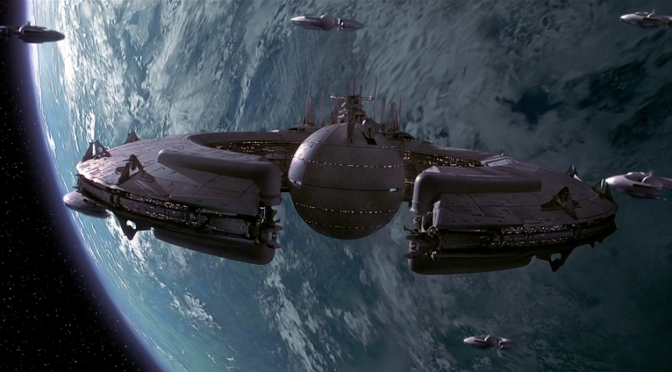
Turmoil has engulfed the Galactic Republic. The taxation of trade routes to outlying star systems is in dispute. Hoping to resolve the matter with a blockade of deadly battleships, the greedy Trade Federation has stopped all shipping to the small planet of Naboo, rich in raw materials vital to the economic health of the Republic.1

A long time ago in a galaxy far, far away… Trade Federation officers must have read Alfred Thayer Mahan’s naval classic, The Influence of Sea Power Upon History. In true Mahanian fashion, the Trade Federation massed their capital battleships to blockade Naboo.2 The Trade Federation pays homage to the East India Company that once controlled the trade routes and paved the way for Britain to become a world power.3,4 In The Influence of Sea Power Upon History, Mahan believed that sea control could be gained in part by blockades – an observation borne out by Great Britain’s ascent as an economic and military powerhouse.5 Renowned navalist Milan Vego offers further guidance of how to ensure sea control in his canonical book, Maritime Strategy and Sea Control: Theory and Practice.6 In it, Vego demonstrates through historical examples that sea control can be achieved by strategically positioning forces in straits and chokepoints. Mahan’s focus on blockades combined with Vego’s theory for sea control in straits and chokepoints can guide United States interplanetary grand strategy as the United States, China, India, Russia, the European Union, and countless others shift their sights towards the final frontier.

Straits and Chokepoints

Vego asserts that sea control, in its simplest form, is the ability for a nation to use a given part of the sea and associated air (and space) across the spectrum of conflict to deny the same to the enemy.7 Applying Vego’s definition of sea control and its application to specific geographic regions, the importance of straits becomes evident. Straits or “chokepoints” are a textbook case of sea control limited to a specific region and have remained of great importance throughout history. Nations that control these chokepoints can asphyxiate the enemy by halting commerce causing major economic impacts or denying freedom of maneuver in wartime. During the Napoleonic War, the British had a vested interested in ensuring a neutral Denmark and thus neutral Danish Straits. The plains to the north provided timber for the British and French Navy and were also critical for transporting grain amongst other vital commerce. A century later, Germany’s de facto control of the Danish Straits prevented Britain from reinforcing its Russian ally during the First World War. During the Second World War, the occupation of Denmark allowed Germany to leverage the full economic resources of Scandinavian countries while denying the Royal Navy access to the Baltics.8 Even in a galaxy far, far away the Trade Federation realized the importance of blockading Naboo by placing their battleships in key locations with the goal to leverage the full economic resources of the planet.

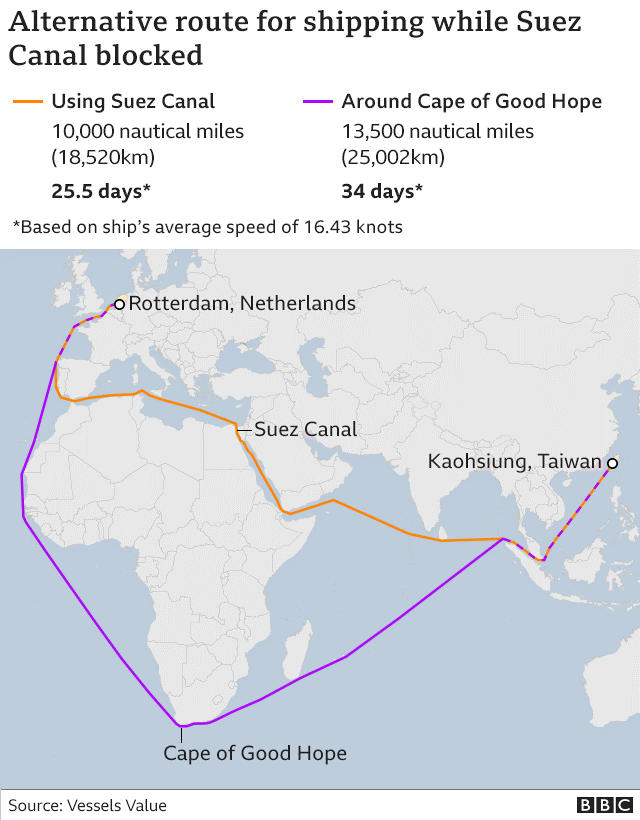
Admiral John Fisher, the First Sea Lord of the Royal Navy and founding father of the Dreadnought battleship, identified the strategic importance of Straits when positing this rhetorical question, “Do you know that there are five keys to the world? The Strait of Dover, the Straits of Gibraltar, the Suez Canal, the Straits of Malacca, the Cape of Good Hope. And every one of these keys we hold.”9,10 Although oversimplified, his aphorism still rings true today. In March of 2021, the M/V Ever Given became lodged in the Suez Canal disrupting commerce and causing an estimated 9.6 billion dollars of economic damage per day.11 Ships once waiting in line to transit the Suez Canal extended their voyage and incurred additional fuel and crew costs by sailing around the Cape of Good Hope to their destinations.12,13

Fig. 1. Ships sailing around the Cape of Good while the Suez Canal was blocked in March incurring extra fuel, time, and crew costs. (BBC graphic)

Lagrange Points and Halo Orbits

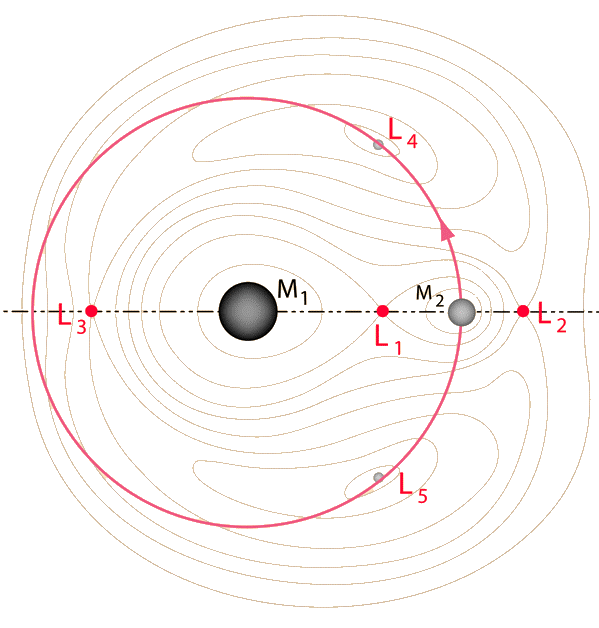
The same analogy holds true for space travel. Despite the incomprehensible distance, times, and vastness required for interplanetary travel, the chokepoints of sea control can also be distilled down to Lagrange points for space control.14 Lagrange points are specific points (orbits) between any two orbiting celestial bodies where gravitational and centrifugal force negate each other, resulting in orbits that can be maintained with little to no propulsion.15 In simpler terms, only five Lagrange points (labeled L1 through L5) exist between planets and their respective moons or the Sun and its planets.16 Due to the gravity-stable properties and low fuel requirements of Lagrange points, they are ideal for satellites and are understandably well known by space agencies. In 2017, the Director of NASA’s Planetary Science Division, Dr. Jim Green, proposed the radical idea of placing a magnetic dipole shield at Lagrange point L1 in the Sun-Mars system to create an artificial magnetosphere, shielding Mars from solar winds and radiation. This shield would allow the volcanic activity on Mars to continually build up the atmosphere until a point of self-sustainment.17 If a state or non-state actor saturates or even blockades critical Lagrange chokepoints, the ramifications could range from economic depression and collapse of critical space infrastructure to the loss of interplanetary colonies that may eventually inhabit the cosmos.18

Closer to home, satellites from both NASA and the European Space Agency have already made home in earth-system Lagrange points. Lagrange points, specifically L1, L2, and L3, can also host an ecosystem of satellites through halo orbits.19 Although halo orbits are dynamically unstable and require more fuel than the stable Lagrange points at L4 and L5, satellites in halo orbits at L2 can serve as communication relays from the dark side of the moon, Mars, and other celestial bodies. In May of 2018, China placed the first-ever lunar relay satellite, Queqiao, into a halo orbit at the Earth-Moon L2. The following year, China landed their Chang’e 4 rover on the far side of the moon using Queqiao as a communication relay.20 In addition to China, NASA and the European Space Agency have already placed satellites in Lagrange point L2 while countries such as Russia, India, and Japan have their own Lagrangian aspirations.21 Because Lagrange points and associated halo orbits can only host a limited number of spacecraft, the contest for this limited real estate by spacefaring nations can have terrestrial consequences.22,23 These important areas in space are not treatise to international norms and measures yet will be essential for lunar and interplanetary space lines of communication.24

Fig. 2. The Five Lagrange points, L1 through L5. M1 represents the larger celestial body and M2 represents any celestial body whose orbit is anchored to it. If M1 represents the sun, M2 represents the planets. If M1 represents the planets, M2 represents its moons. Source: http://hyperphysics.phy-astr.gsu.edu/hbase/Mechanics/lagpt.html

Access to Resources

The Trade Federation blockaded Naboo in an attempt to leverage the rare economic resources found in the planet. Similar to here on Earth, access to resources is necessary to lift countries and their populations’ standard of living. It is unlikely that much of the world will sacrifice their consumerism to live in harmony with each other and Mother Nature, leaving the limited resources on Earth to support an ever-growing consumer economy. Governments in the future are likely to look to space to solve their growth problems, much as European colonization looked to supplement sapped domestic resources in the 17th and 18th centuries. Beyond Lagrange chokepoints serving as potential flashpoints for real-estate between countries launching satellites, Martian trojan asteroids make home in the gravity-stable environment at Lagrange points L4 and L5 in the Mars-Sun system.25 The imperative of space lines of communication is not necessarily scientific exploration or protection of desirable orbits, but the ability to leverage the vast resources that abound in space. One asteroid floating between Mars and Jupiter is assessed to contain over 10 quintillion dollars of precious metals, more than 10,000 times larger than the 2019 global economy, far more wealth than Han Solo could have ever imagined.26,27

Interplanetary Transport Network and Space lines of Communication

Alfred Thayer Mahan’s unmistakable first lines in the Influence of History Upon Sea Power state:

“The first and most obvious light in which the sea presents itself from the political and social point of view is that of a great highway; or better, perhaps, of a wide common, over which men may pass in all directions, but on which some well-worn paths show that controlling reasons have led them to choose certain lines of travel rather than others. These lines of travel are called trade routes; and the reasons which have determined them are to be sought in the history of the world.”28

While the great highway, wide common, and well-worn paths refer to the sea, his quote can be analogous to Star Wars as well. The hyperspace routes in Star Wars, or trade routes, link the major worlds in the galaxy like an intergalactic superhighway. The routes are safe and account for traveling without colliding into celestial bodies including their gravitational pull. Han Solo couldn’t just punch it when blockade running from Imperial Cruisers. As the Imperial Cruisers closed on him, he quipped to a young Luke Skywalker that, “Traveling through hyperspace ain’t like dusting crops, boy! Without precise calculations we could fly right through a star or bounce too close to a supernova and that’d end your trip real quick, wouldn’t it?”29

Fig. 3. Punch it! Still from “Star Wars: Episode V”. Copyright Lucasfilm Limited. Used under the terms of Fair Use per 17 U.S. Code § 107.

Although hyperspace only remains a reality in the Star Wars Universe, a great highway through our solar system already exists. Lagrange points serve as interplanetary straits, connecting celestial bodies in our solar system through the Interplanetary Transport Network (ITN).30 The halo orbits around Lagrange points can be used to alter spacecraft and satellite trajectories to arrive at any point in the solar system with minimal energy, although reaching Mars could take a millennium using the ITN – far longer than the record breaking 12 parsec Kessel Run flown by Han Solo in the Millennium Falcon.31,32 However, the slowness of ITN trajectories can be modified with external speed injections. In 2003, Cal-Teach professors introduced a Multi-Moon Orbiter concept.33 The concept proposed that a spacecraft could use Lagrange points to modify its trajectory to survey the moons of Jupiter with a final touch down on Europa where NASA speculates both water and life could exist.34 Lagrange points will serve as the keys to unlock the universe that could transform mankind into a multi-planetary species.

Fig. 4. Artist’s depiction of the ITN that connects our solar system. Abrupt changes in trajectory are due to Lagrange points. Image credit: NASA/JPL

The Line between Prescient and Far-fetched

While critics may point to the astronomical costs and technological gaps that make interplanetary travel an impossibility, the critique is confined to now. In 1945, some mainstream scientists felt that satellites and intercontinental ballistic missiles were fool hardy errands that would be too technologically complex and cost prohibitive to develop.35 Less than twelve years later, Sputnik orbited the planet and within fifteen years, intercontinental missiles rested in silos. The once lone small metal ball named Sputnik launched by the Russians in 1957 has given way to a world that depends on complex networks of satellites. While GPS has become a household name in a few short decades, Russia’s GLONASS, China’s Beidou, and Europe’s Galileo systems offer competing location services with global navigation satellite systems (GNSS) receivers. The recent out-of-control Chinese rocket shows that China’s Communist Party is serious about becoming a space-based power and willing to pursue this capability at all costs without due regard for safety.36 Even more recently, the Chinese landed their Zhurong rover on Mars where President Xi Jinping proudly praised all involved by saying, “You were brave enough for the challenge, pursued excellence and placed our country in the advanced ranks of planetary exploration.”37 On July 11th, 2021, Richard Branson along with five other crewmates flew to space aboard the VSS Unity proving the viability of space tourism.38,39 The following week, Jeff Bezos and Blue Origin followed suit in achieving spaceflight in the New Shephard.40

The rapid pace of artificial intelligence (AI) advancement and Space X’s Falcon 9 rockets, Starhopper, and now Starship all show that a manned mission to Mars is a matter of when, not if, and might occur as soon as 2024. SpaceX has plans to colonize Mars with one million people by 2050.41,42

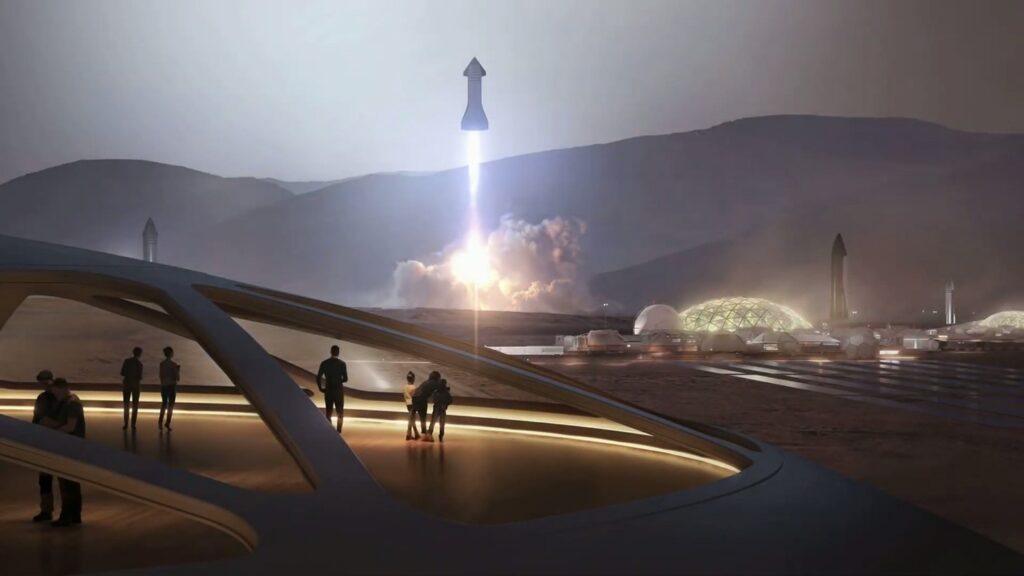
To sustain and develop a Martian colony and more, established and secure space lines of communication will be of critical importance. Interplanetary pursuits are being pursued at a break-neck pace by both allies and adversaries, including China, Russia, India, United Arab Emirates, the United Kingdom, and European Union.43 As each country pursues its own interests among the solar system, the United States must develop a grand strategy in the solar system to protect US interests against both state and non-state actors. The reflection of this reality came to fruition on June 7th, 2021, when Congressman Ted Lieu introduced the Space Infrastructure Act which will “issue guidance with respect to designating space systems, services, and technology as critical infrastructure.”44

Fig. 5. The success of Martian colonies will require an intelligent space strategy. Artist’s illustration of SpaceX Starships on Mars. Image credit: SpaceX.

Conclusion

The blockade of Naboo never happened, but it does have historical precedents and very real implications for space exploration and exploitation. As countries vie to expand their resources, they not only gaze across the vast oceans but upwards towards the final frontier. The increased focus on Mars and beyond demands a robust US interplanetary strategy to protect the United States’ interests in the cosmos. While the United States is rightly focused on earth-based priorities, Milan Vego’s canonical book Maritime Strategy and Sea Control: Theory and Practice, can provide guidance for interplanetary strategy in ensuring a “a free and open [solar system] in which all nations, large and small, are secure in their sovereignty and able to pursue economic growth consistent with accepted international rules, norms, and principles of fair competition.”45 If the United States neglects interplanetary strategy, the United States will be left behind as other countries not only develop but execute their interplanetary strategies.46 If Admiral Fisher was alive today, he would ask, “Do you know that there are five keys to the solar system?” We need to ask ourselves, who will control these keys?

Lieutenant Commander Dylan “Joose” Phillips-Levine is a naval aviator and serves with TACRON-12.  His Twitter handle is @JooseBoludo.

Lieutenant Commander Trevor Phillips-Levine is a naval aviator and serves as a department head in Strike Fighter Squadron Two. His Twitter handle is @TPLevine85.

Endnotes

1. George Lucas, 1999, ¨Star Wars: Episode I The Phantom Menace”, Lucasfilm Limited.

2. “Databank Naboo,” Star Wars, https://www.starwars.com/databank/naboo.

3. Tim Veekhoven, “The Trade Federation And Neimoidians: A History,” Star Wars (14 October 2014), https://www.starwars.com/news/the-trade-federation-and-neimoidians-a-history.

4. Erin Blakemore, “How the East India Company became the world’s most powerful business,” National Geographic, (6 September 2019) https://www.nationalgeographic.com/culture/article/british-east-india-trading-company-most-powerful-business.

5. Dr. Milan Vego, “Naval Classical Thinkers And Operational Art” Naval War College (2009) 3 Naval War College https://web.archive.org/web/20170131144505/https:/www.usnwc.edu/getattachment/85c80b3a-5665-42cd-9b1e-72c40d6d3153/NWC-1005-NAVAL-CLASSICAL-THINKERS-AND-OPERATIONAL-.aspx.

6. Dr. Milan Vego, Maritime Strategy and Sea Control: Theory and Practice, Routledge; 1st edition, (14 April 2016), 189 https://www.amazon.com/Maritime-Strategy-Sea-Control-Practice-ebook/dp/B019H40ST2

7. Ibid, 24

8. Ibid 188

9. The Editors of Encyclopaedia Britannica, “John Arbuthnot Fisher, 1st Baron Fisher,” Encyclopaedia Britannica https://www.britannica.com/biography/John-Arbuthnot-Fisher-1st-Baron-Fisher.

10. Dr. Milan Vego, Maritime Strategy and Sea Control: Theory and Practice, Routledge; 1st edition, (14 April 2016), 188 https://www.amazon.com/Maritime-Strategy-Sea-Control-Practice-ebook/dp/B019H40ST2

11. Kshitij Bhargava, “Single ship stuck causing Suez Canal ‘traffic jam’ may cost $9.6 billion per day,” Financial Express (26 March 2021) https://www.financialexpress.com/economy/single-ship-stuck-causing-suez-canal-traffic-jam-may-cost-9-6-billion-per-day/2220575/.

12. Daniel Stone, “The Suez Canal blockage detoured ships through an area notorious for shipwrecks,” National Geographic (29 March 2021) https://www.nationalgeographic.com/history/article/suez-blockage-detoured-ships-through-cape-good-hope-notorious-shipwrecks.

13. Peter S. Goodman and Stanley Reed, “With Suez Canal Blocked, Shippers Begin End Run Around a Trade Artery,” New York Times (26 March 2021, Update 29 March 2021) https://www.nytimes.com/2021/03/26/business/suez-canal-blocked-ship.html.

14. Lead Authors: Clementine G. Starling, Mark J. Massa, Lt Col Christopher P. Mulder, and Julia T. Siegel With a Foreword by Co-Chairs General James E. Cartwright, USMC (ret.) and Secretary Deborah Lee James in collaboration with: Raphael Piliero, Brett M. Williamson, Dor W. Brown IV, Ross Lott, Christopher J. MacArthur, Alexander Powell Hays, Christian Trotti, Olivia Popp, “The Future of Security in Space: A Thirty-Year US Strategy” Atlantic Council (April 2021) 35 https://www.atlanticcouncil.org/wp-content/uploads/2021/04/TheFutureofSecurityinSpace.pdf.

15. NASA/WMAP Science Team, “What is a Lagrange Point?,” NASA (27 March 2018) https://solarsystem.nasa.gov/resources/754/what-is-a-lagrange-point/.

16. Shane D. Ross, “The Interplanetary Transport Network,” American Scientist, Volume 94 (April 2006) 234 http://www.dept.aoe.vt.edu/~sdross/papers/AmericanScientist2006.pdf.

17.Matt Williams, “NASA proposes a magnetic shield to protect Mars’ atmosphere,” Universe Today (3 March 2017) https://phys.org/news/2017-03-nasa-magnetic-shield-mars-atmosphere.html.

18. Lead Authors: Clementine G. Starling, Mark J. Massa, Lt Col Christopher P. Mulder, and Julia T. Siegel with a Foreword by Co-Chairs General James E. Cartwright, USMC (ret.) and Secretary Deborah Lee James in collaboration with: Raphael Piliero, Brett M. Williamson, Dor W. Brown IV, Ross Lott, Christopher J. MacArthur, Alexander Powell Hays, Christian Trotti, Olivia Popp, “The Future of Security in Space: A Thirty-Year US Strategy” Atlantic Council (April 2021) 35 https://www.atlanticcouncil.org/wp-content/uploads/2021/04/TheFutureofSecurityinSpace.pdf.

19. Ibid 70.

20. Luyuan Xu, “How China’s lunar relay satellite arrived in its final orbit,” Planetary (15 June 2018) https://www.planetary.org/articles/20180615-queqiao-orbit-explainer

21. Lead Authors: Clementine G. Starling, Mark J. Massa, Lt Col Christopher P. Mulder, and Julia T. Siegel with a Foreword by Co-Chairs General James E. Cartwright, USMC (ret.) and Secretary Deborah Lee James in collaboration with: Raphael Piliero, Brett M. Williamson, Dor W. Brown IV, Ross Lott, Christopher J. MacArthur, Alexander Powell Hays, Christian Trotti, Olivia Popp, “The Future of Security in Space: A Thirty-Year US Strategy” Atlantic Council (April 2021) 35 https://www.atlanticcouncil.org/wp-content/uploads/2021/04/TheFutureofSecurityinSpace.pdf.

22. Ibid 70.

23. Ibid 10.

24. Ibid 72.

25. Jesse Emspak, Are Mars’ Trojan Asteroids Pieces of the Red Planet?,” Space (July 24, 2017) https://www.space.com/37565-mars-trojan-asteroids-pieces-of-the-planet.html.

26. Adam Smith, “Asteroid Worth $10 Quintillion Could Be Only One of Its Kind,” Independent (29 October 2020) https://www.independent.co.uk/life-style/gadgets-and-tech/asteroid-10-quintillion-psyche-19-iron-nickel-b1419635.html.

27. “Star Wars IV: A New Hope Quotes,” Movie Quote Database, https://www.moviequotedb.com/movies/star-wars-episode-iv-a-new-hope/quote_29904.html.

28. Alfred Thayer Mahan, “The Influence of Sea Power Upon History, 1660-1783,” Dover Publications; Revised ed. edition (November 1, 1987) https://www.amazon.com/Influence-History-1660-1783-Military-Weapons/dp/0486255093.

29. “Star Wars IV: A New Hope Quotes,” Movie Quote Database, https://www.moviequotedb.com/movies/star-wars-episode-iv-a-new-hope/quote_29894.html.

30. Shane D. Ross, “The Interplanetary Transport Network,” American Scientist, Volume 94 (April 2006) 230 http://www.dept.aoe.vt.edu/~sdross/papers/AmericanScientist2006.pdf.

31. Ibid 236.

32. Kyle Hill, “How the Star Wars Kessel Run Turns Han Solo into a Time-Traveler,” Wired (12 February 2013) https://www.wired.com/2013/02/kessel-run-12-parsecs/.

33. Ross, S. D. and Koon, W. S. and Lo, M. W. and Marsden, J. E. “Design of a Multi-Moon Orbiter,” Spaceflight Mechanics 2003. Advances in the Astronautical Sciences. No. 114. American Astronautical Society, 1. https://resolver.caltech.edu/CaltechAUTHORS:20101007-131136558

34.“ Ingredients for Life?,” NASA https://europa.nasa.gov/why-europa/ingredients-for-life/

35. John. A. Olsen, “A History of Air Warfare,” Potomac Books Incorporated (2010), audiobook. Part 5 Chapter 16, time: 16:42.

36. Alison Rourke, “‘Out-of-control’ Chinese rocket falling to Earth could partially survive re-entry,” The Guardian (4 May 2021) https://www.theguardian.com/science/2021/may/04/out-of-control-chinese-rocket-tumbling-to-earth.

37. Jonathan Amos, “China lands its Zhurong rover on Mars,” BBC (15 May 2021) https://www.bbc.com/news/science-environment-57122914.

38. Chelsea Gohd, “Virgin Galactic launches Richard Branson to space in 1st fully crewed flight of VSS Unity,” 12 July 2021) SPACE.COM https://www.space.com/virgin-galactic-unity-22-branson-flight-success

39. Mike Wall, “ Virgin Galactic Unveils New SpaceShipTwo Unity for Space Tourists,” Scientific American (23 February 2016) SPACE.COM https://www.scientificamerican.com/article/virgin-galactic-unveils-new-spaceshiptwo-unity-for-space-tourists/.

40. Paul Rincon, “Jeff Bezos launches to space aboard New Shepard rocket ship,” BBC (20 July 2021), BBC https://www.bbc.com/news/science-environment-57849364

41. Hanneke Weitering, “Elon Musk says SpaceX’s 1st Starship trip to Mars could fly in 4 years,” Space (16 October 2020) https://www.space.com/spacex-starship-first-mars-trip-2024.

42. Morgan McFall-Johnsen and Dave Mosher “Elon Musk says he plans to send 1 million people to Mars by 2050 by launching 3 Starship rockets every day and creating ‘a lot of jobs’ on the red planet,” Business Insider (17 January 2020) https://www.businessinsider.com/elon-musk-plans-1-million-people-to-mars-by-2050-2020-1.

43. “Once a two-country race, Mars missions now on radar of multiple nations,” Times of India (18 February 2021) https://timesofindia.indiatimes.com/home/science/once-a-two-country-race-mars-missions-now-on-radar-of-multiple-nations/articleshow/81096583.cms.

44. Mr. Lieu, “Space Infrastructure Act,” House of Representatives (17 May 2021) https://lieu.house.gov/sites/lieu.house.gov/files/LIEU_172_xml.pdf.

45. The Deparment Of Defense, “Indo-Pacific Strategy Report” Department of Defense (1 June 2019) https://media.defense.gov/2019/Jul/01/2002152311/-1/-1/1/DEPARTMENT-OF-DEFENSE-INDO-PACIFIC-STRATEGY-REPORT-2019.PDF.

46. Brien Flewelling, “Securing cislunar space: A vision for U.S. leadership,” Space News (9 November 2020) https://spacenews.com/op-ed-securing-cislunar-space-a-vision-for-u-s-leadership/.

Feature Image: Still from “Star Wars: Episode I” depicting the blockade of Naboo. Copyright Lucasfilm Limited. Used under the terms of Fair Use per 17 U.S. Code § 107.

The Space Force Needs Policy and Strategy, Part 3

By Tuan N. Pham

Part one of this three-part series revisited past recommendations for a new space policy and strategy in terms of ends, ways, and means. It made the case for America to guarantee the freedom of space, embrace space preeminence, and adopt a broader and more complete approach toward space deterrence.

Part two took a step back for strategic context and re-examined a conceptual framework characterizing the dynamics that contribute to instability and stability in the space domain. All in all, instability arises when there is a real or perceived lack of order and security, while stability arises when there is a real or perceived sense of order and security.

Part three concludes the series and completes the circle with a relook on how America (through the Space Force) can mitigate instability and strengthen stability in space, while prolonging U.S. space preeminence into the 21st century.

Challenges for the Space Force

Preeminence Puzzle. As the guarantor of the global economy and provider of security, stability, and leadership because of its powerful military and vast network of allies and partners, the United States delivers global public services that others cannot. Thus, there is a strong need going forward for a comparable guarantor of the freedom of space to ensure the free flow of space commerce. If so, just as maritime preeminence is necessary to guarantee the freedom of the seas, so too is space preeminence needed to guarantee the freedom of space. The puzzle for American policymakers is whether it may be more cost-effective to invest now and maintain space preeminence or pay more later to make up for diminished space capabilities and capacities while accepting greater strategic risk in the interim and possibly ceding space preeminence to strategic competitors like China (and Russia) in the long term. If the former, then the answer to the puzzle is the Space Force, whose preeminent presence – enabled by a vast network of allies and partners – guarantees the freedom of space and ensures the free flow of space commerce for all.

Domain Dilemma. America fundamentally has two space deterrent and response options – threaten to respond (or actively respond) in the same domain, or threaten cross-domain retaliation to underwrite the deterrence of attacks on U.S. space capabilities (or respond across domains as retaliation). The scope, nature, and degree of these two courses of action must ultimately strike the delicate balance between the need to demonstrate the willingness to escalate and the imperative to not provoke further escalation in order to maintain space stability. The dilemma for the United States is where, when, and how best to deter; and if deterrence fails, where, when, and how best to respond. The Space Force lessens the dilemma by providing a flexible and capable deterrent and response force to keep the common peace.   

Reliance/Resilience Riddle. Enhancing and securing space-enabled services is essential to U.S. national security, a daunting task considering that space has become more and more “congested, contested, and competitive,” less and less permissive for the United States, and increasingly disproportionate in reliance on space capabilities and vulnerable to growing attack vectors. The riddle for America is how best to manage the dichotomy between reliance and vulnerability through resilience. The Space Force tackles the riddle by better and more informed management of and advocacy for mission-focused space requirements to enhance and protect U.S. critical capabilities in space.      

Offensive Counter-Space (OCS) Conundrum. Space warfare is intrinsically offense-inclined due to the vulnerability, predictability, and fragility of space assets. Ever-increasing OCS capabilities are able to threaten and destroy space systems. The latter can be destabilizing (warfighting capability) or stabilizing (deterrence) depending on one’s perspective. Hence, the conundrum for the United States is not whether or not to possess OCS capabilities, but how best to use them to deter and retaliate if deterrence fails. The United States must consider what type, how much, and to what extent should OCS capabilities be publicly disclosed, and how to leverage the existing international legal framework and accepted norms of behavior to manage them without constraining or hindering one’s own freedom of action. OCS capabilities continue to grow in number and sophistication driven by the “offense-offense” and “defense-offense” competition spirals. OCS developments to defeat defensive counter-space (DCS) measures drive further OCS developments for fear of falling behind in offensive capabilities and encouraging a first strike by an adversary, while DCS developments to mitigate OCS measures drive further OCS developments to remain viable as deterrent and offensive tools. The Space Force addresses the conundrum by providing a strategic framework to better direct and synchronize OCS and DCS operations (balanced management).  

Opportunities for the Space Force

Sustain and Enhance Space Preeminence. Just as maritime preeminence is necessary to guarantee the freedom of the seas, so too is space preeminence needed to guarantee the freedom of space. To do otherwise invites strategic misalignment and  miscommunications and encourages strategic competitors to further advance their counter-balancing efforts. Put simply, if the United States does not preserve its current strategic advantages in space through a Space Force, a rising power like China may gradually eclipse America as the preeminent power in space which will have cascading strategic ramifications on Earth. Recall that China already has a Space Force – the People’s Liberation Army Strategic Support Force.

Develop Cross-Domain Deterrence Options. Deterrence across the interconnected domains may offer the best opportunity to deter attacks on U.S. space capabilities, and if deterrence fails, retaliate across domains to deter further attacks. Prudence then suggests the need for some level of active planning prior to the onset of increased tensions and hostilities. American policymakers and defense planners should have on hand a broad set of potential cross-domain responses to the threats of space attack or the space attack itself for timely execution by the Space Force. 

Strengthen Space Governance. Since the elimination of OCS capabilities is unlikely, attention and efforts should be placed on managing them instead. The extant international legal framework and accepted norms of behavior offer some ways and means to reduce OCS capabilities to a manageable level, restrict their proliferation, and establish constraints and restraints on their employment. Space powers should review the existing international agreements (treaties) and legal principles, and determine what additional conventions or provisions are needed to set the acceptable limits of OCS capabilities. This can include efforts to establish confidence building measures to include verification, and limit the possession of OCS capabilities to select space powers and out of the hands of space “pariah” states (North Korea and Iran) and undesirable non-state actors (terrorist, criminal, and business groups). The Space Force, dedicated and committed to monitoring and checking emerging threats in the space domain, will better inform U.S. policymakers and diplomats as they navigate the legal and diplomatic minefields to establish new international agreements to further universal space stability and safeguard U.S. national interests.

Continue to Invest in OCS Capabilities. The heart of the matter remains what type of OCS capabilities (reversible, irreversible, or both) and how much may be needed by the Space Force. Regarding the latter, some argue none or limited quantities are required while others call for robust OCS capabilities. Whatever the right answer may be, it is difficult to see how the Space Force can deter or retaliate if deterrence fails without “some” OCS capabilities, especially considering that strategic competitors like China (and Russia) are actively developing their own OCS capabilities to challenge U.S. space preeminence and by extension U.S. terrestrial preeminence. 

Continue to Increase Resiliency. Strengthening the resiliency of the U.S. national security space architecture may offset the offensive inclination of space warfare by lessening the vulnerability and fragility of space assets, assuring retaliatory capabilities, and denying the benefits of OCS operations. Hence, three suggested resilience lines of operations for the Space Force can include building up space protection capabilities to decrease the vulnerability and fragility of high-value space assets by presenting more targets, hiding targets and maneuvering targets, and ensuring mission continuity in a disrupted space environment.  

Continue to Expand Partnerships. The extant strategic guidance calls for building enduring partnerships with other space-faring nations, civil space organizations, and commercial space entities to share benefits, costs, and risks. Strategic guidance also encourages efforts to strengthen existing alliances through increased cooperation across the various space sectors, spreading space services reliance to others, and providing greater space deterrence and stability through collective defense. That being said, partnerships also carry with them opposing risks and concerns. Risks include the unpredictability of horizontal escalation and greater potential damages and unintended consequences. Concerns center around autonomy, operational security, legality, and the interoperability of disparate space systems. All things considered though, the benefits outweigh the costs, risks and concerns are manageable in varying degree, and partnerships can ultimately be a stabilizing influence if done right. The Space Force, where the rubber meets the road, can help get it right. The Space Force will ultimately be where the preponderance of the complex working relations between allies and partners will be managed on a day-to-day basis. Future U.S. space leaders (military and civilian) and foreign counterparts will now have intersecting careers paths (touchpoints) to meet and cultivate enduring friendships that will translate into deeper international collaboration.

Conclusion

All major space-faring nations increasingly rely on space capabilities, but none more so than the United States. America presently has a lot more to lose, and therefore must take all necessary measures to protect its critical strengths in space and preserve its economic prosperity on Earth. Hence, to direct and guide the new Space Force, U.S. policymakers must develop a new space policy and strategy to sustain and enhance U.S. space preeminence in accordance with the new muscular National Security Strategy and National Defense Strategy. Otherwise, America risks losing in space and consequently losing on Earth.

Tuan Pham has extensive professional experience in the Indo-Pacific, and is widely published in national security affairs and international relations. The views expressed are his own.

Featured Image: View of a rocket launch from the rocket garden of Cape Canaveral museum. (USAF Museum)