Tag Archives: Sea Control

Fit to be a Frigate?

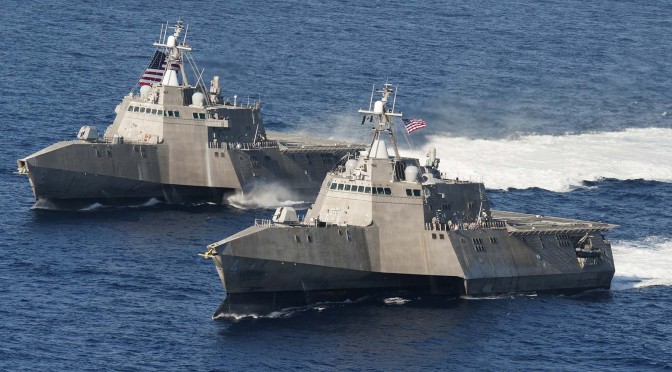
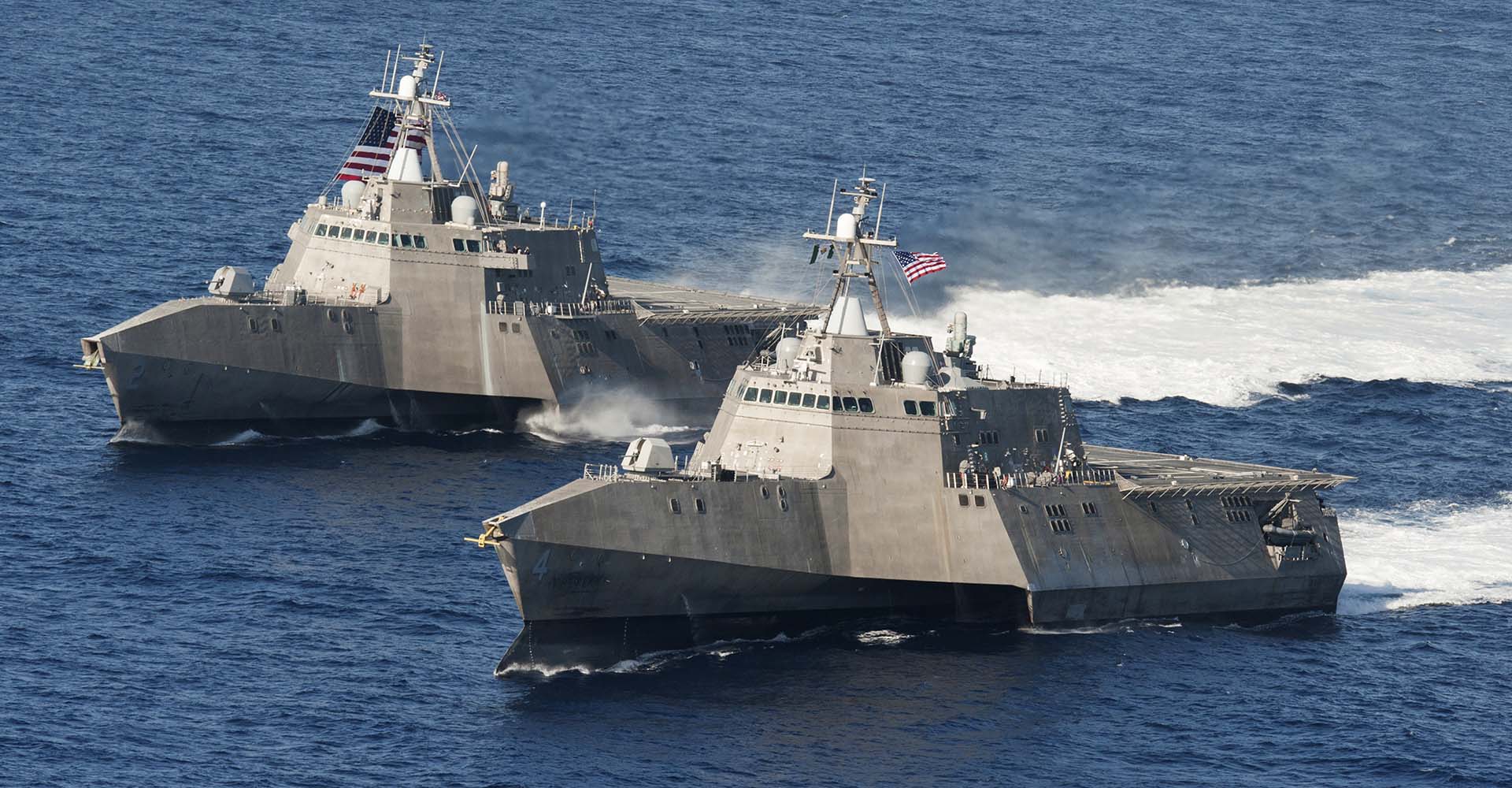
LCS 3One of the most persistent complaints about the Littoral Combatant Ship (LCS) is that it is not fit to replace the retiring Perry class frigates. LCS has been characterized as under-armed in comparison with the Perry class, and not capable of assuming the roles and missions of a frigate. In light of these criticisms it’s useful to examine what constitutes a frigate in the second decade of the 21st century. What sort of frigate does the U.S. Navy need to meet present requirements? Finally, does the LCS, in both its current form, and as envisioned in the frigate upgrade meet those requirements, particularly in armament? The answers may surprise LCS critics who continue to call for a Cold War frigate as the solution for 21st century naval missions.

The definition of the frigate as a naval combatant has been in constant flux since the end of the Second World War. It appeared in the Second World War as a British Royal Navy (RN) classification for an independent antisubmarine warfare vessel. By 1945, the term “frigate” generally meant a ship of 1300-2000 tons; less than 350 feet in length; a speed of less than 25 knots, and an armament focused on antisubmarine weapons.

The U.S. Navy substantively changed the frigate designation after World War 2 with its first generation of purpose-built aircraft carrier escorts. The demise of the Axis surface fleets, the well-established threat from air attack, and the rise of a Soviet Navy based on submarines called for a new, affordable combatant that could meet these challenges. A ship roughly 6000 tons in displacement, a speed comparable to fleet carriers, and capable of mounting significant antiair (AAW) and antisubmarine (ASW) weapons was seen as an ideal cross between the expensive, man-power intensive cruiser and the cheaper, but less capable destroyer class. The new ship was designated first as a “hunter killer” (CL) and later as a “frigate” (DL) with missile armed versions classified as DLG’s. Destroyers, such as the Forrest Sherman class and their missile-armed immediate successors, the Charles Adams class remained general purpose combatants optimized for a variety of roles, but generally less capable than frigates. Smaller combatants optimized for antisubmarine warfare remained labeled as destroyer escorts (DE’s).

This condition persisted until the mid 1970’s. U.S. frigates had approached the size and capabilities of World War 2 cruisers in the California and Virginia class DLGN (nuclear-powered) frigates of 10000 tons and nearly 600 feet in length. The traditional antisubmarine warfare escort had also grown in size and capability. Many of these ships, such as the FF 1052 Knox class were significantly larger than the 1940’s-era ships they were replacing. These changes compelled the U.S. to re-designate a number of its warships in 1975 to better reflect the changes in the frigate classification since 1945, as well as to combat a persistent myth that the U.S. had less cruiser-designated ships than the Soviet Union. The frigates were divided into guided missile cruisers and destroyers based on size and capability. U.S. destroyer escorts were renamed as frigates.

The patrol frigate, later the FFG-7 Oliver Hazard Perry class was the zenith of American Cold War escort design. The Soviet Union was expected to deploy a significant force of subsurface, surface, and aviation platforms to destroy the expected Reforger re-supply convoys crossing the Atlantic to support embattled North Atlantic Treaty Organization (NATO) forces in Western Europe. Unlike previous escort classes, the FFG-7 was designed as a multimission combatant in order to better meet the expanding Soviet threat. It too, like the LCS,  ballooned in cost. According to a January 3, 1979 General Accounting Office (GAO) report, the cost per ship increased from 64.8 million dollars a ship in 1973, to 194 million a copy by 1979.

This general classification system of U.S. surface combatants persisted through the end of the Cold War and the first decade of the 2000’s. After 1991, however, the international definition of the frigate category again began to change. Falling defense budgets across the Western world in the wake of the Cold War’s end compelled many nations to put more capabilities into fewer hulls, often designated as frigates, as a cost savings measure. These ships now occupy a place in many European navies analogous to that of the U.S. Arleigh Burke class DDG as the primary surface warships of those nations’ navies. Japan and South Korea have made similar changes, but have retained the destroyer classification for these larger vessels. Russia maintained the Cold War classification structure throughout most of the last 20 years, but its recent frigates are smaller than their late Cold War cousins. The Chinese Navy has followed the Russian Cold War model and gradually increased the size of its frigates as general patrol and escort ships. Although there remain several descriptions of the frigate type warship, the post-Cold War ship now associated the frigate classification has generally grown into a large and capable surface combatant for many nations.

Does the U.S. Navy need a frigate as defined by these new standards? At the end of their service lives, the Perry class had lost much of their (AAW) and (ASUW) sensors and weapons. Their MK 92 fire control system, MK 13 single arm missile launchers, and medium range Standard Missile (SM-1 MR) systems were largely out of date against the growing antiship cruise missile threat by the turn of the century. They had become the early 21st century equivalent of the late 19th century colonial cruiser, whose chief purpose was to show the flag and conduct low-intensity combat operations.

The U.S. high capability combatant class is well filled by the CG 47, DDG 51 and DDG 1000 class ships. Such a mass of AAW capable ships was not in service when the Perry’s were conceived. While the U.S. Navy requires a replacement for the Perry’s “show the flag” role, there appears to be no requirement for another medium capability convoy escort in the tradition of past U.S. frigate designs. The cruise missile threat is considerable for even high capability warships such as the DDG 51. A supporting frigate similar in size and capability to current European designs could be built, but would provide little in the way of additional capability beyond present ships. It would also not be a cost effective product for low end presence missions. Unlike during the Cold War, no potential U.S. opponent yet deploys a global naval force capable of simultaneously effectively threatening U.S. seaborne communications in multiple geographic locations. The absence of this threat for now obviates the need for 21st century version of the FFG-7. If that threat develops, advances in missile and torpedo technology will require high capacity escorts like the DDG 51 rather than a new FFG-7.

The frigate needed for the present Navy is not another Cold War antisubmarine combatant, or an expensive, but less capable version of the DDG 51. It should instead be a general-purpose warship capable of multiple tasks. It must conduct low threat missions such as counter-piracy and presence operations in order to free the DDG force for offensive and defensive missions in high intensity combat. It should be able to perform escort missions for amphibious and logistics force ships for limited periods in appropriate threat environments. The addition of a surface to surface missile armament should allow the frigate to conduct limited ASUW under the Navy’s emerging concept of distributive lethality. LCS’ endurance is 70% of the FFG-7, but it’s still sufficient for extended operations in comparison with smaller corvettes or missile patrol craft. The LCS baseline platform with 57mm gun, Rolling Airframe Missile (RAM), electronic warfare gear, boats, and large flight deck and hangar is an excellent replacement for the FFG-7 in low threat, presence missions. The ship can accomplish escort and additional warfare missions with the weapons and sensors provided in its warfare modules and frigate upgrade. The ship’s modular design readily accepts additional weapons and associated equipment. The frigate upgrade to the basic LCS hull has been derided as insufficient, but only if a 21st century FFG 7 is the desired product. The modifications envisioned for the LCS-based frigate meet current requirements and definitions for the 21st century frigate the Navy requires.

No would deny the LCS program has suffered significant problems over the course of its history. It introduced multiple new technologies in one platform in order to replace three classes of ship. Problems associated with this effort remain and will likely persist for some time. In spite of these issues, the LCS and its frigate variant represent the best choice for replacing the retiring Perry class frigates in their current role as presence, patrol, and low intensity combat platforms, as well as emerging surface warfare missions. The Navy does not need a 21st century Perry class frigate.

Steve Wills is a retired surface warfare officer and a PhD student in military history at Ohio University. His focus areas are modern U.S. naval and military reorganization efforts and British naval strategy and policy from 1889-1941. He posts here at CIMSEC, sailorbob.com and at informationdissemination.org under the pen name of “Lazarus”.
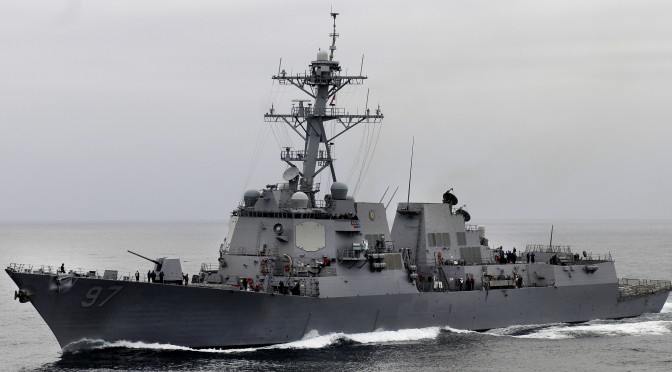
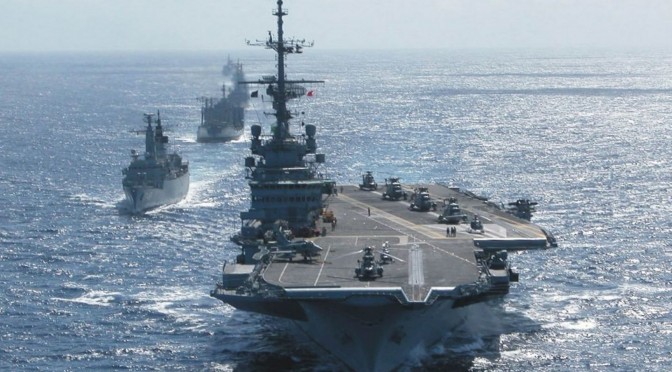
To Safeguard the Seas

The United States Navy is the most preeminent naval force in the world.  Following Alfred Mahan dictum that “a truly powerful nation must have thriving international trade, a merchant fleet to carry these goods and a strong navy to protect its sea lanes,” the U.S. Navy has provided stability, tranquility and maintained the global order since the end of World War II.   However, in this age of austerity, the ability of our aging fleet to secure our interests, protect our allies and confront our adversaries is being sorely tested.

As we paused in remembrance of the 73rd anniversary of the surprise attack on Pearl Harbor, Hawaii, by the Imperial forces of Japan, we again see a rising power in Asia bent on changing the status quo, increasing pressure on our allies and challenging America’s preeminence in the Pacific.

China’s assertiveness in the South China Sea over the past few years is significant as it “directly challenges America’s position as the primary maritime power in Asia and as the guardian of the old regional order,” said Hugh White.  As Ronald O’Rouke, specialist in Naval Affairs at the Congressional Research Service testified before Congress, he expects China “to continue putting pressure on its neighbors’ short of war in the East China and South China Seas to get its way in the region.”

It is clear our Navy is facing ever-increasing operational challenges, including not only air and sub-surface threats but also supersonic cruise missiles and ballistic missiles (both anti-ship and surface to surface).   Individually, these threats are difficult enough to combat, however, when encountered simultaneously; these threats severely challenge the current capabilities of our Navy.  With a rapidly expanding Chinese Navy, coupled with the increased pace of Russia’s ship building efforts, the pressure to do more with less compels us to develop new technologies to maintain the advantage if or when confrontations occur.

For the last 70 years, radar has played a key role in maintaining technological superiority over our adversaries.  Over the last decade, however, our radar capabilities have proved to be increasingly incapable of addressing existing and emerging threats.  This, in turn, directly impacts the Navy’s ability to assure maritime security and freedom of the seas.

Fortunately, the Pentagon has taken positive steps to rectify the situation by making investments in the next generation of radars.  The Air and Missile Defense S-Band Radar (AMDR) is an excellent example of advanced radar technology that will fill critical capability gaps and ensure our sailors can meet the ever changing demands of today’s global threat environment.

Designed to replace the ageing Aegis combat system currently employed in the fleet the AMDR is constructed as a self-contained radar that is scalable for any platform for any mission, with the ability to exponentially increase radar sensitivity.  Not only will the AMDR more accurately detect missile threats, but it will also help ships run more efficiently.  This new system reduces space, weight, power, and cooling demands of naval vessels, thereby maximizing the service life of the ships that incorporate this new technology.   These long-term cost savings make AMDR a wise use of limited taxpayer dollars in today’s austere budget environment.

With the ability to confront multiple threats simultaneously — even in the presence of heavy land, sea, and rain clutter — the technological advancement of the AMDR is truly remarkable. Scheduled to begin installation on the Arleigh Burke class destroyers’ starting in 2016 the AMDR is the technologically advanced, low-risk, cost-effective radar solution to combat today and tomorrow’s threats.

Tasked with the daunting challenge of maintaining freedom of the seas, deterring international aggression, and playing pivotal roles in times of war the U.S. Navy has earned naval supremacy, not only because of the skill of our sailors, but also because it has invested great effort and money to provide the finest technology in modern warfare.  This trend must continue with essential defense programs so that we may stay one step ahead of evolving threats.  Doing so will protect our national interests and ensure the safety of our sailors and war fighters. John F. Kennedy said it best, “Control of the seas means security. Control of the seas means peace. Control of the seas can mean victory. The United States must control the sea if it is to protect our security.”

Commander Feldkamp is a retired Naval Electronic Counter-Measure Officer (ECMO).  He flew combat missions in Desert Storm off the U.S.S. Midway and served as the international outreach officer for the National Maritime Intelligence-Integration Office and the Office of Global Maritime Situational Awareness in Washington, D.C. He currently is an adjunct professor teaching the theories and politics of terrorism at George Mason University.

The Brazilian Navy: Green Water or Blue?

Although much attention has been directed toward the uncertain fate of the Mistral-class amphibious assault ships that were being built in Saint-Nazaire, France for export to Russia, there has been considerably less reporting on Brazil’s quiet naval expansion. The Brazilian Navy has frequently been dubbed a ‘green-water’ force to distinguish it from conventional ‘blue-water’ or ‘brown-water’ navies. Whereas a blue-water navy is concerned with operations on the high seas and engaging in far-ranging expeditions, brown-water navies are geared toward patrolling the shallow waters of the coastline or riverine warfare. Green-water navies, however, mix both capabilities, focusing mainly on securing a country’s littorals but also retaining the ability to venture out into the deep waters of the oceans.

For several decades, this green-water label has been accurate to the Brazilian Navy. Although possessing a vast array of inland patrol ships and river troop transports to exert sovereignty over Brazil’s many rivers and drainage basins, the Brazilian Navy also boasts the BNS Sao Paulo, a Clemenceau-class aircraft carrier purchased from France in 2000. But there has recently been a shift in Brazil’s maritime priorities, suggesting that it may soon be more accurate to regard the Brazilian Navy as a blue-water force with some lingering vestiges of brown-water capabilities. Begun under Luiz Inacio Lula da Silva, President of Brazil from 2003 until 2011, and intensified under the Dilma Rouseff’s current government, Brazil has been on a shopping spree for military hardware. Although this has included procuring 36 Gripen NG multirole fighter aircraft from Saab for use by the Brazilian Air Force, much of the recent contracts have pertained to the purchase of vessels intended to modernize the Brazilian Navy. Brazil’s five Type 209 diesel-electric attack submarines, acquired from Howaldtswerke-Deutsche Werft, will be joined by four Scorpène-class diesel-electric attack submarines to be built domestically with completion of the first vessel expected in 2017.

In March 2013, Brazil’s President Dilma Rousseff inaugurated a domestic shipyard at which Brazil’s first nuclear-powered submarine – the fittingly named BNS Alvaro Alberto – will be built with French support. Delivery of the completed vessel is not expected until 2025 but the success of the project would bring Brazil into a very small club of countries with operational nuclear-powered submarines: the United States, United Kingdom, France, Russia, India, and China.S34 Tikuna

The Barroso-class corvette commissioned in late 2008 also seems to have inspired a new series of ships for the Brazilian Navy. The domestic shipbuilder Arsenal de Marinha do Rio de Janeiro has been contracted to build four vessels based on the design of the Barroso-class but with “stealth capabilities” and which will possess both anti-ship and anti-air armaments. Delivery of the first of these new stealth corvettes is expected in 2019 and as such many specific details about the design are currently unknown. Furthermore, delivery of two new Macaé-class offshore patrol vessels is expected in 2015, while an additional two will be delivered in 2016-2017, bringing Brazil’s fleet of these patrol vessels to seven in total.

But why is there this rapid buildup in maritime forces for Brazil? To some degree, these new procurement projects are intended to offset the Brazilian Navy’s diminished capabilities following the retirement of 21 vessels between 1996 and 2005. This would not explain the focus on vessels with longer-range expeditionary capabilities, though. Some observers may attribute the acquisition of ships with capabilities clearly not intended for the patrol of inland waterways, such as the new “stealth-capable” Barroso-class corvettes, to the threat posed by Guinea-Bissau’s instability. That Lusophone West African country, which has been dubbed a “narco-state”, has been a major hub in the international drug trade; Colombian cocaine often makes its way to Guinea-Bissau from the Brazilian coast, only to then be exported onward to Europe. But President José Mário Vaz, who was elected by a decisive margin to lead Guinea-Bissau in May 2014, has quickly moved to crackdown on corruption in the Bissau-Guinean military and seems set to make counter-trafficking a priority during his term in office. Even if Brazilian policymakers believe it may be necessary to exert a stronger presence in the South Atlantic to discourage narcotics trafficking, a nuclear-powered attack submarine is not at all the right tool for the task.

Rather, it seems most likely that there are two principal factors motivating Brazil’s naval procurement projects. With regard to BNS Alvaro Alberto and the potential acquisition of a second aircraft carrier, Brazil craves the prestige of at least appearing to be the leading maritime power in the Southern Hemisphere. Participation in major international maritime exercises, such as the IBSAMAR series conducted jointly with Indian and South African forces, are intended to promote a view of Brazil as a power that ought to be respected and consulted, particularly as Brazilian policymakers continue to pursue a permanent seat for their country on the United Nations Security Council. More importantly, however, the shipbuilding projects on which Brazil has embarked are intended to build up domestic industry and contribute to economic growth.

Brazil is already attracting considerable interest as a shipbuilder. In September 2014, the Angolan Navy placed an order for seven Macaé-class offshore patrol vessels, with four to be built at Brazilian shipyards. Over the past several years, Brazil has exported various vessels and equipment for use by the Namibian Navy. Equatorial Guinea has expressed its intent to acquire a Barroso-class corvette from Brazil for counter-piracy purposes. The A-29 Super Tucano, a turboprop aircraft intended for close air support and aerial reconnaissance, is produced by Brazilian manufacturer Embraer and has been exported for use in roughly a dozen national air forces. If Brazilian industry is successful in producing submarines and stealth corvettes, demand for Brazilian military hardware will only grow, generating impressive revenue and creating many jobs.

 Of concern, however, are Brazil’s long-term intentions with regard to the construction of BNS Alvaro Alberto. There are few navies in the world with the infrastructure and know-how necessary to successfully operate one or more aircraft carriers; after all, the club of those countries with aircraft carriers in service is limited to just nine. But the export of nuclear-powered attack submarines would undermine the international community’s non-proliferation treaty and could potentially harm international peace and stability. The Islamic Republic of Iran has been rumored to occasionally entertain plans to obtain a nuclear-powered submarine, while the Democratic People’s Republic of Korea has allegedly expressed a private interest in obtaining Soviet-era nuclear-powered submarines from the Russian Federation. This is not to say that Brazilian authorities would consider exporting such vessels to Iran, North Korea or other such regimes, but there is certainly a market for future submarines modelled on BNS Alvaro Alberto. It will be necessary to keep a very close eye on the Brazilian shipbuilding and nuclear industries in the 2030s, especially as domestic demand for this class of vessel is satisfied. 

To obtain a deeper understanding of Brazil’s long-term strategic goals and to perhaps exert some degree of influence over Brazilian arms exports, it would be advisable for NATO to seek a partnership with the country. In August 2013, a partnership was established between NATO and Colombia, demonstrating that the Alliance certainly is interested in security affairs in the South Atlantic. Brazil could also contribute much know-how to NATO members, especially as the Alliance attempts to find its place post-Afghanistan. Clearly, there is much work to be done in the area of trust-building if such a partnership is to be found prior to the expected completion of BNS Alvaro Alberto: as Colombian officials visited with NATO counterparts to discuss the partnership, Brazilian policymakers were among those Latin American figures who condemned Colombia for the initiative.

Partnering with Brazil will be very challenging diplomatically, but it is an effort that must be made. This rising power will soon find itself with a blue-water navy and, as such, military vessels flying the Brazilian ensign will become an increasingly frequent sight in the South Atlantic.

Paul Pryce is a Junior Research Fellow at the Atlantic Council of CanadaThis article can be found in its original form at Offiziere.ch

Members’ Roundup Part 11

Welcome back to another edition of the Member Roundup. For those readers who have recently joined CIMSEC, or have just started reading the NextWar blog, this series seeks to promote the works that CIMSECians have published or been involved in on other sites. These include blog posts, journal articles, interviews and podcasts.

The roundup usually consists of articles and blog posts. This edition will be the first to feature a podcast with CIMSECians as panel members. Scott Cheney-Peters and Mira Rapp-Hooper (CSIS) were joined by Bryan McGrath of the Hudson Institute’s Centre for American Seapower, as well as RADM Mike Devitt (retd.) from CNA. The discussion ranged from maritime boundary and territorial disputes to the balance of seapower in Asia. You can stream and/or download the podcast here.

The Center for a New American Security’s Bavevich Fellow, Jacob Stokes, co-authored a policy brief titled ‘Slow Thaw: Testing Possibilities for Cooperation with Iran After a Nuclear Deal.’ The policy brief explores sources of disagreement and continued obstacles to cooperation, despite progress being made in the nuclear area. An analysis of possible areas of cooperation is presented, particularly within maritime security and the stability of Afghanistan. Finally, the paper provides a set of recommendations on how to maintain a positive relationship moving forward. You can access it via CNAS.

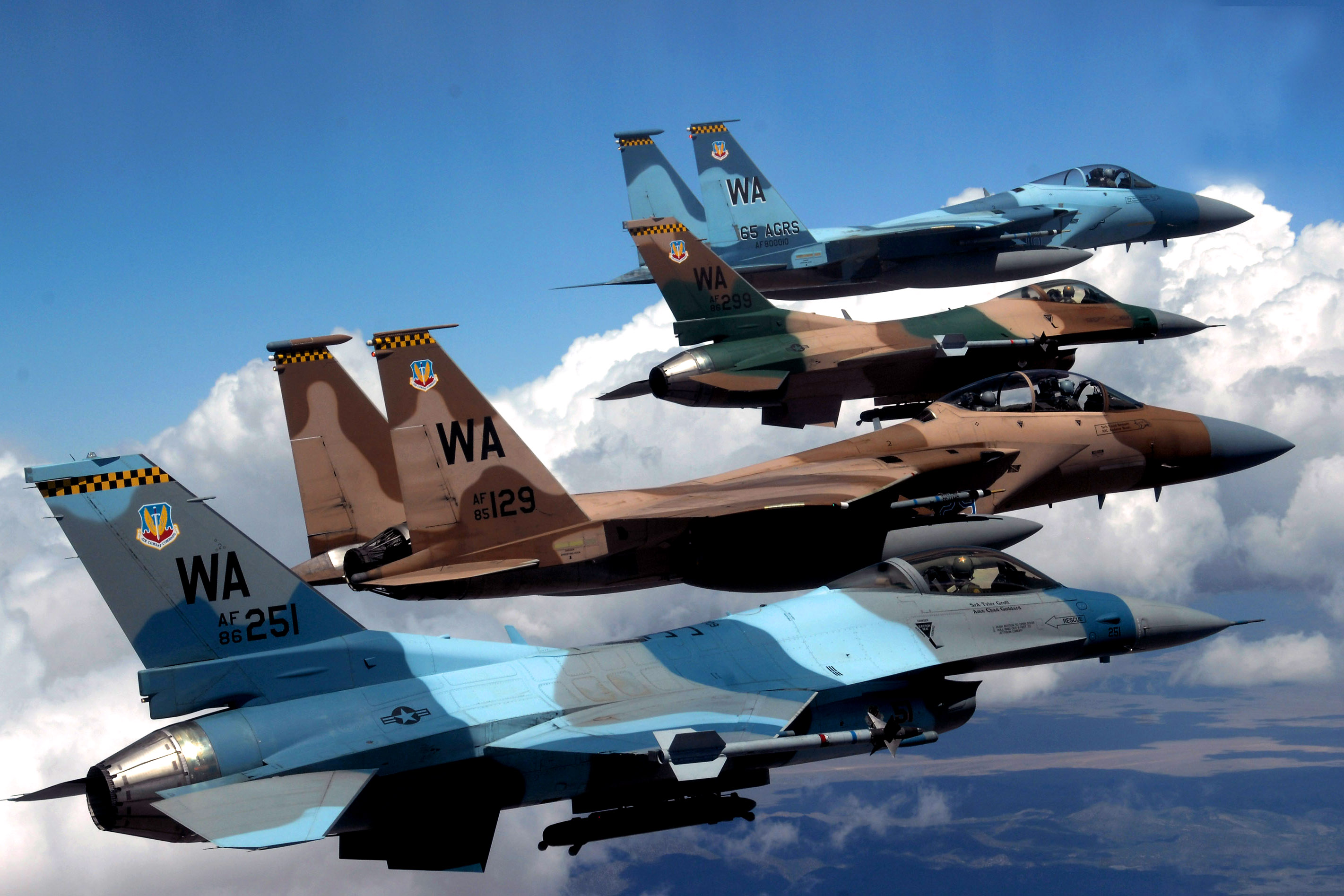
A flight of Aggressor F-15 Eagles and F-16 Fighting Falcons fly in formation. The jets are assigned to the 64th and 65th Aggressor squadrons at Nellis Air Force Base.

Over at The Daily Beast, freelance Defense reporter (and CIMSECian) Dave Majumdar reports that the U.S. Air Force are considering hiring military contractors in order to train their fighter pilots. There are some mixed opinions within the military in pursuing this type of training support. Certainly, those who have a background or interest in training and simulation will find this an interesting read.

Additionally, in a roundup of his own Dave assesses the top 4 weapons in the U.S. arsenal that should be retired. These include the Classic or “legacy” F-18 Hornets (A, B, C & D), as well as the M16 and M4 family of rifles. For a dissenting opinion on the M4 family of rifles, you might find this post over at War is Boring an interesting counter to Dave’s argument.

Finally, Zachary Keck from The National Interest returns with four posts for this week’s roundup. The first is his analysis of the top  5 U.S. Weapons of War Iran should fear. The second is a report that Russia’s Nuclear forces conduct surprise drill. Alliances are not perfect; here is Keck’s analysis of the 5 Most Precarious U.S. Allies of all time. Finally, the truth is revealed on how China purchased the Liaoning, its first aircraft carrier.

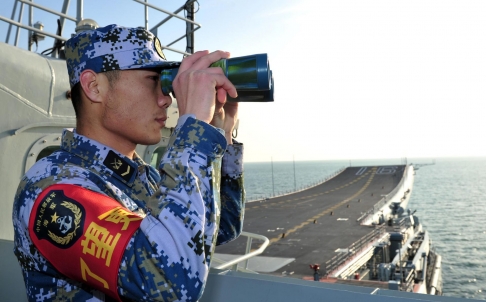
An officer maintains lookout on China's aircraft carrier, Liaoning, during initial sea trials.
An officer maintains lookout on China’s aircraft carrier, Liaoning, during initial sea trials.

At CIMSEC we encourage members to continue writing, either here on the NextWar blog or through other means. You can assist us by emailing your works to dmp@cimsec.org.