Tag Archives: Russia

Fast Response Not Necessarily the Best in Crimea

As matters continue to escalate between Ukraine and Russia in Crimea, many are quickly calling for action in response by the United States. They say it is our duty as a leader on the world stage, and claim that if the U.S. does not take action then it conveys to the world that we are inept and will not take action in response to aggression around the world. Of course, when people call for action they really mean military action. This is probably because utilizing the military is the most overt, visible, and rapid response. We are living in a very fast time. We used to think the 24-hour-news reporting cycle was fast, but then we discovered live-tweeting of world events. We find out about things quickly and along the same vein we want to see responses quickly. There can be no doubt in the media and public perception that if missiles start firing and troops begin landing then we are taking action. Though always defaulting to the military might convey action, it might not be the best course of action.

We too often confuse military strategy with grand national strategy and military power with national power. We oversimplify and forget the diplomatic, information, and economic aspects. When these are coupled with the military aspect we get the nice acronym DIME (diplomatic, information, military, and economic) that many of us are familiar with from doctrine. A military response would most certainly be the most rapid and overt, but those features alone do not make it the most appropriate. Military power is so much more than utilization of force. Possessing credible military capability can add validity to efforts of diplomacy, economics, and gathering of information. The military is an essential element of national power, but as the saying goes, if all I have is a hammer (or all I think about is a hammer), then all of my problems look like nails.

Unfortunately we tend to think of events in terms of a duel. Each side takes their predetermined shot and in the end whoever is left standing wins. In reality, international relations are more like a game of chess. You have many different moves at your disposal and every more you make (or do not make) will have implications for every following move. The question of what we lose or gain from action – as compared to inaction – must be asked. Inaction by a party does not imply maintaining a status quo. International relations are dynamic and continuously evolve regardless of whether the U.S. takes proactive military action or not.

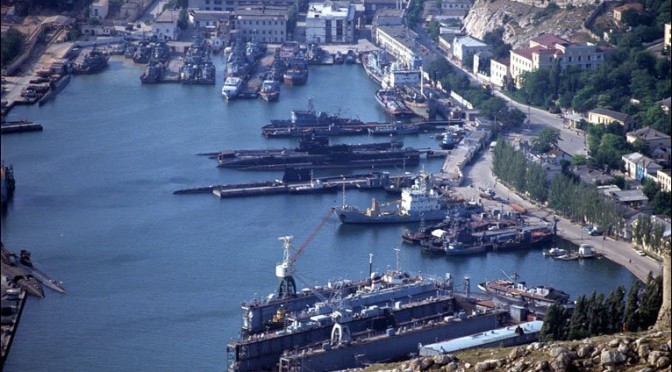
If military action is not taken by the U.S. or NATO in Ukraine, what is to gain and what is to lose? If Russia expands its sphere of influence to encompass Crimea, it will secure control of Sevastopol and its coveted warm-water port for the Black Sea Fleet. This has been a strategic goal for Russia since the 17th century, but is it worth the cost? In the end it might be that Russia is winning the battle but losing the war. An invasion of Crimea could have long-lasting political ramifications that overshadow gaining lasting control of a warm-water port. Gaining Crimea could mean Russia losing its influence in Ukraine and Georgia. Seeing Russia’s aggressiveness and willingness to take military action to achieve its goals could be just the motivation Ukraine and Georgia need to grow closer to NATO and the European Union.

This port is so nice and warm

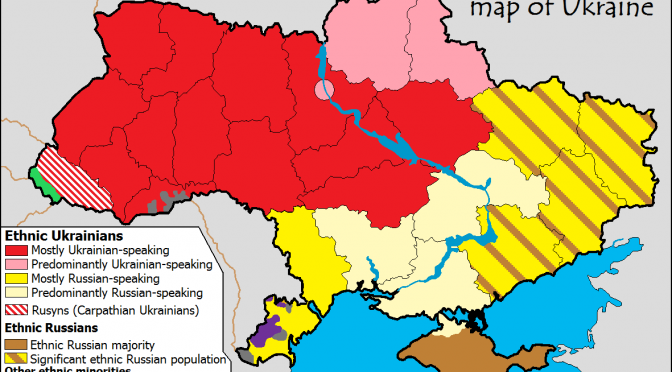
Though it appears Russia will expand its influence to encompass Crimea, it may not be a lasting influence. The major ethnicities in Crimea are 58% Russian, 25% Ukrainian, and 12% Crimean Tatars. Even before the invasion, the Ukrainians were not very fond of the Russians, so the sentiment from Crimea’s 2nd largest ethnic group will only worsen. Along the same lines, the Crimean Tatars have been very anti-Russian since the mid-20th century. Russia may gain its coveted warm water port, but it may come with a hornet’s nest throughout Crimea that it will have to deal with for years to come.
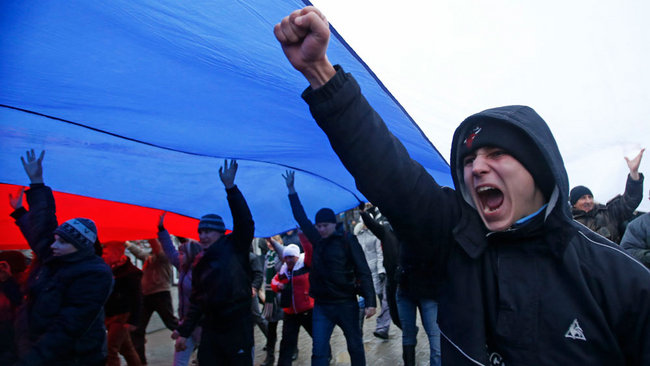
It looks like about 58% of the people like us here

Even before committing forces in Ukraine, Russia had a lease for use of the naval base at Sevastopol, so Russia gaining control of Crimea is not a significant change in that respect. What is much more significant is it coming with the opportunity to expand the influence of NATO to former Soviet bloc nations and potentially having unrest in Crimea that Russia will have to dedicate resources to address for years to come. Military inaction in favor of expanded diplomatic, information, and economic actions in the region could be the best option.

LT Jason H. Chuma is a U.S. Navy submarine officer who has deployed to the U.S. 4th Fleet and U.S. 6th Fleet areas of responsibility. He is a graduate of the Citadel, holds a master’s degree from Old Dominion University, and has completed the Intermediate Command and Staff Course from the U.S. Naval War College. He can be followed on Twitter @Jason_Chuma.

The opinions and views expressed in this post are his alone and are presented in his personal capacity. They do not necessarily represent the views of U.S. Department of Defense or the U.S. Navy.

NATO on the Edge: Obama’s Reply of Honorius?

Sometime in the year A.D. 410, Honorius, the last Roman emperor to rule the Western Roman Empire before the sack of Rome by the Visigoths that year, received a request for military aid from Britain, then a Roman province.  The island was under attack by barbarians.  We do not know exactly what the letter to Honorius contained, but Honorius’ response, now referred to by historians as the Reply of Honorius, essentially told the Britons – theoretically Roman citizens who could count on the protection of the Empire – that they would have to make do on their own; Rome had troubles of its own and could not send help this time.

The Reply of Honorius is often considered to mark the end of Roman rule in Britain, as well as the end of Rome’s military dominance over any part of the empire.  Rome had all it could do to protect itself; imperial clients, whatever their legal claims to help from the central power, would have to fend for themselves.  Though the Roman Empire sputtered onward for another two generations after Rome was sacked in 410, this was the point where the central tenet of Roman rule – that Rome protected its own – was exposed as a fiction.  Nothing was the same after that.  Where Britain was concerned, the island was cut off from the Empire and never returned to it; it did, indeed, fend for itself.

There are a lot of bad comparisons made between America’s worldwide defense posture and the Roman Empire.  The two do, however, have one obvious thing in common:  in both cases a powerful state made promises to defend far-flung territories.  As with Rome, the U.S. is finding out how expensive such promises can be to keep.

As of this writing, Russian forces in Ukraine have seized the Crimea.  Ukraine is in the process of a general military mobilization, but Russian forces are already securing the strategic Perikop isthmus to the north of the Crimea, which controls access to the rest of the country; unless Ukrainian forces, with or without assistance, can similarly entrench along these lines, Russian forces will be able to break out of the Crimea and move toward strategic crossing points along the Dnieper river.  If that is the case, protecting Kiev will become very difficult, if not impossible.  It remains unclear how many Ukrainian units are even active at this point; units in the predominantly ethnically Russian east of the country have already defected or surrendered, including the Ukrainian navy’s flagship frigate.  There are an unknown but sizeable number of Russian forces on alert along the northeastern border of the country, leaving open the possibility of a general invasion.

President Obama has publicly stated that Russia would face “serious costs” were it to go forward with plans to invade Ukraine.  It is a matter of speculation what those costs may be, although it is becoming clear that there is little that the U.S. and its allies can do to stop the invasion without intervening directly.  As German Marshall Fund analyst Joerg Forbrig has remarked, there is very little evidence up to now that Putin’s government is motivated by an economic cost-benefit analysis, as opposed to nationalism and, perhaps, calculations of security.  Although the majority-ethnic Russian east of Ukraine may indeed make more sense as a Russian satellite than a fractious part of Ukraine, it is likely that Russia will seek to take Kiev, both to send a message (as was the case with its seizure of Gori in the 2008 invasion of Georgia) and because, as the ancient capital of one of the earliest Russian kingdoms, it has sentimental importance for Russian nationalists.  There is little reason to believe sanctions, or any similar actions, will stop Russia from seizing at least a part of Ukraine, or inflict any meaningful punishment on it for doing so.  Indeed, such sanctions will be hard to impose:  Europe is more dependent on trade with Russia (most notably natural gas shipments, many of which go through Ukraine) than the other way around.

From the point of view of several of the U.S.’ NATO allies, on the other hand, imposing “serious costs” on Russia, even if it could be done, means the game has already been lost:  the challenge is to prevent Russia from taking Ukraine, not punish it once it has done so.  This especially applies if Russia is not content to take the Crimea and the pro-Russian east, but decides to seize Kiev and control the entire country.  Ukraine borders on four NATO member states – Poland, Slovakia, Hungary, and Romania – and up to now has served as what might pass for a buffer zone between the Alliance and Russia; Russian ground forces in Ukraine in force – particularly western Ukraine – are therefore literally too close for comfort.  What applies to these states applies even more strongly to the three Baltic states – Lithuania, Latvia, and Estonia – all of which are also NATO members, have minimal strategic depth or defensible terrain, and share a border with Russia – and are therefore quite concerned about U.S. resolve in the face of Russian aggression.

It might have been advisable in the past to debate or question the appropriateness of NATO expansion or consider the merits of negotiating an arrangement with Russia with regard to eastern Europe; now, however, the U.S. has given its word to defend practically all of eastern Europe from Russian military attack, Russia is now expansionist and hostile to U.S. interests, and the eastern European states are understandably curious whether the U.S. is serious about its commitments.  The legal argument that Ukraine is not a NATO member and that therefore the U.S. has no obligation to it is a hair they are unwilling to split.  What they see is an American patron that was caught flat-footed by a crisis, made empty threats, was unwilling when the time came to confront Russia, and was not substantively concerned about their well-being.  If the situation in Ukraine is not quickly brought under control, America’s nominal allies in eastern Europe may make the same difficult calculation that Finland made in the last century:  that no outside ally can be relied on, and that they would do better to make their peace with Russia.  The result would be a hollowed out NATO, perhaps even leading to a disintegration of the Alliance over the longer term.

Although eastern Ukraine, as a pro-Russian region at odds with the new government, may be too far gone to save, and although its detachment (de jure or de facto) from the rest of the country might in any case form part of a negotiated settlement, there is a rapidly closing opportunity to stave off the worst possible outcome of the crisis – Russian conquest of the country with no meaningful U.S. response.  To deter Russia from making further inroads into the country, the U.S., with Ukrainian Prime Minister Yatsenyuk’s consent, would need to deploy a rapid reaction force to western Ukraine, effectively signaling that it might become involved if Russia moved to take the western half of the country, and hopefully deterring Russia from moving on Kiev.  (It might still be possible to secure the neck of the Perekop Isthmus and block off the Russian forces’ main route out of the Crimea, but if reports are true, it may be too late.)  The next best option could be the placement of a similar force along the border of any of the neighboring NATO states, as a precaution and show of resolve, and to preserve some options if the situation got worse.  (CIMSEC’s Robert Rasmussen has eloquently summarized the available forces and possible order of battle.)  Unfortunately, the window for action is closing, if it hasn’t already:  it would take a while for forces from EUCOM to get to Ukraine, and time is becoming scarce; arranging logistics would likewise be difficult.  If there was a time for action, it was when Russian forces along the border went on alert for an “exercise” last week – precious time has been lost.  As goes the U.S., so will go other NATO states.  The NATO states that border Russia and Ukraine will be watching what happens.

It may well be the case that a negotiated solution to the conflict is both the best option and even the inevitable one.  Unless the U.S. moves directly to deter a general assault on Ukraine, however, there will be little to negotiate with.

But in fact the U.S. faces a much more difficult set of options than even all this would suggest.  Russia and the U.S. have been cooperating on Afghanistan; as has been noted, Russia is a major link in the tenuous supply line that supports U.S. operations there.  Confronting Russia over Ukraine could jeopardize not only operations in Afghanistan, but potentially the safety of U.S. forces there.  It might be possible to find alternate supply routes, but not at short notice.  The ugly reality is that the U.S. might have to choose between breaking its promises in Afghanistan – drawing down faster than it otherwise would – or failing to demonstrate sufficient resolve in eastern Europe.  At least in terms of preserving a global balance of power that keeps America safe and powerful, Europe is undoubtedly more important – but it will hurt either way, if the choice does ultimately have to be made.

Either way, the U.S. is in danger of issuing its own Reply of Honorius – those whom we have promised protection may have to rely on their own resources.  There may still be opportunities to make the best of this situation and even turn it around, but time is fleeting:  what happens this week may make all the difference in the world.

Martin Skold is currently pursuing his PhD at the University of St. Andrews in Scotland, with a dissertation focused on analyzing long-term security competition between states.

Ukraine: Sink or Swim

Ще не вмерла України і слава, і воля

Ukraine has not yet perished, nor her glory, nor her freedom
Upon us, fellow Ukrainians, fate shall smile once again.

These words of the Ukrainian National Anthem are full of passion, but they are a key to understanding the dynamics of the events and determination in Kiev. What pushed thousands of people to remain in Majdan Square for 3 winter months in spite of more than 70 victims? Clausewitz’s trinity of passion, chance, and reason is in some way applicable to today’s situation in Ukraine. There is clearly passion, and chance was evident in that this was the second opportunity for revolution – the first being the Orange revolution of 2004-2005. Now reason must govern a way forward full of compromises. For those in the U.S. public who would like to be more informed about these events, a series of questions arises:

– What Happened and Why?
– What Comes Next?
– What is the Larger Meaning for U.S. Interests and Strategy?

The direct cause of the protest was President Yanukovich’s rejection of the European Union Association Agreement. Aleksander Kwasniewski, former president of Poland, said that protests were predictable as one half of Ukraine wants to join the EU and the other half was persuaded by Yanukovich for three years that the agreement should be signed. So nearly everyone was surprised when the agreement was discarded.

Commenters often talk about two parts of Ukraine that are very different. This is true, there is a difference in culture, religion, and business preferences, which comes from history. But both parts want to live in independent Ukraine, without neighbors interfering in domestic matters, and they want to have a chance to realize their ambitions. For many of us this sounds natural, sentimental, or simply trivial. This is a very old nation but very young state. Ukraine gained independence for a brief period between 1918 and 1920 and most recently again in 1991. Not surprisingly they are very sensitive to problems of national independence. Nationalism is strong and could be equally constructive or destructive. The fact that Ukraine was and continues to be very important to Russia, doesn’t help. And it makes a difference. We speak about the vital interests of a former hegemon and a country that has the ambition to regain its status as a world-class power.

So what comes next? We should start with the simple statement that the situation is unpredictable and volatile. There are at least two reasons for that. One is the pace of change and dynamic course of action, full of unexpected turns. Using an analogy to Boyd’s OODA Loop, Majdan acts inside the decision loop of any potential opponent. The second reason is that given the history of the country and the very short period of independence, Ukraine needs time to work on the many soft elements constituting a state: well-crafted law and respect for the rule of it, transparency, accountability, democratic traditions, mature political elites, and so on. This alone is challenging without speaking of external circumstances. The biggest and most immediate threat to Ukraine’s stability is the legitimization of the new President and the economic situation. Such arguments have already been raised by Russian Federation officials, according to Reuters:

“We do not understand what is going on there. There is a real threat to our interests and to the lives of our citizens,” Prime Minister Dmitry Medvedev was quoted by Russian news agencies as saying.

“There are big doubts about the legitimacy of a whole series of organs of power that are now functioning there.”

Russian naval vessels in Sevastopol, Ukraine.

Strong rhetoric is not a mere ghost from the past. It is a sign that other tools from the Soviet epoch could also find their way into the hands of state leaders. We could witness subtle diplomacy interweaving with hard politics. The references to Russian citizens are especially worrisome. It seems natural, but we shouldn’t forget that there is a strong ethnic Russian minority in Crimea [who reportedly “elected” a Russian citizen as mayor this week] and that Sevastopol is a major naval base for Black Sea Fleet. The situation seems to be serious enough to cause a series of public statements by officials from both the United States and Poland.

Bronisław Komorowski, President of Poland considers honest and transparent presidential elections, producing an undeniable outcome, as a top priority. This was quickly countered by Russian Federation Minister of Foreign Affairs Sergey Lavrov, who stated, “We consider it premature to hold presidential elections in Ukraine in May, as it contradicts the agreement dated February 21.”

On Feb 23rd, the U.S. State Department on Twitter said “US expects Ukraine’s sovereignty, territorial integrity, democratic freedom of choice to be respected by all states”.

Prof. Stanislaw Koziej, Chief of BBN (Poland’s National Security Counsel) expressed his concern more directly: “Intervention in Ukraine by foreign power would have significant consequences for international security”.

In order to facilitate strategy shaping for dealing with Ukraine, Prof. Zbigniew Brzezinski offers his long-term vision in an article titled “Ukraine Should Join EU, but No Military Alliance” and says “In brief, the Finnish model is the ideal example for Ukraine, and the EU, and Russia.”

From the geo-strategic point of view, the big problem is that any formal or institutional link of Ukraine with the EU drastically limits Russia’s options and potential to influence this country.

What does this mean for the United States? Even if it doesn’t seem to be a priority, Ukraine’s future could have many indirect and strategic consequences. If the United States really believes in its values, it needs to respect the sovereign decision of Ukrainians. However, any chance of a scenario in which a weak Ukraine becomes a satellite state to Russia, would certainly resonate in all of Central Europe. That means adapting strategy, military modernization programs, and priorities at the NATO Summit in Wales, UK. A Strong or stronger Russia in this region is also an argument in favor of the “Three-Hub Navy” proposed by Brian McGrath.

But even then the hub in the Mediterranean still wouldn’t be among the top strategic priorities until we will assume that a powerful Russian Federation is a link between Europe and Asia. Russia is absent from most discussions about the Rebalance to the Pacific or events in China’s Near Seas, perhaps because the focus is on South China Sea. The way the Russian Federation is going to protect their interests in the Far East and Arctic, and interact with major players there, is likely to impact perceptions of security at least in Central Europe if not in the whole of Europe.

Any discussion about the future of Ukraine is impossible without considering the broader context in which Russia plays a key role. It has been this way for centuries. Poland is ready to offer its own experiences with the transformation process, which was long and painful, but the U.S. is probably the only power capable to persuade an assertive Russia.

Przemek Krajewski alias Viribus Unitis is a blogger In Poland. His area of interest is the context, purpose, and structure of navies – and promoting discussion on these subjects in his country.

Sea Control 22 – Behind the Curtain

seacontrolemblem(Download: Sea Control 22 – Behind the Curtain, the First.)

A. Denis Clift, former Naval Officer, president emeritus of the National Intelligence University, and Vice President for Operations of USNI, joins us to talk about his reflections on his time in the Antarctic, Cold War intelligence, life, and the United States Naval Institute. This is the first of a bi-monthly series that will be investigating his career during the Cold War.

We are available on Itunes, Stitcher Stream Radio, etc… Remeber to subscribe, leave a comment and a 5-star rating.