Tag Archives: featured

What Moral Leadership Looks Like

By William C. Spears

It has been twenty years since the passing of Vice Admiral James Bond Stockdale, a celebrated American leader and moralist whose heroic example continues to inspire new generations.

Stockdale’s story is commonly regarded at a surface level, reduced to that told in his citation for the Congressional Medal of Honor. The simplified account goes something like this: As the senior officer among American POWs in Vietnam, he exhibited unyielding courage and resilience in the face of brutal captivity and torture. Learning he would soon be forced to reveal information that would compromise a resistance network and endanger his comrades, Stockdale attempted suicide to prevent this outcome. His act not only demonstrated moral resolve but also led to the cessation of torture by the North Vietnamese. Many former POWs now credit their survival to his actions.

Although Stockdale is now upheld within the U.S. military as a prototypical model of moral leadership, the real story is more complex than widely understood, or what can be captured in any award citation. To fully appreciate it requires a venture into the North Vietnamese prison system as well as the deeper philosophical underpinnings of Stockdale’s leadership practice.

The etymological connection between “morality” and “morale” offers a point of departure. Both words share a root in the Latin moralis, derived from mos (plural mores), meaning “custom” or “way of life.” Moralis originally referred to proper conduct aligned with societal norms, while “morale” later entered English through French, describing the collective emotional or mental state of a group bound by shared values. Both concepts hinge on the ancient concept of a telos — the purpose, or mission that defines what individuals and groups are meant to be or achieve.

Morality, then, is not merely things like honesty and decency, though these are certainly part of it. It encompasses everything that a mature individual is supposed to be: wise, just, brave, and self-controlled. Similarly, morale refers to what a group is supposed to be: not just cheerful but also disciplined, internally cooperative, and successful in the fulfillment of shared purpose. Thus, no losing team ever possesses high morale, even if they might look happy, and morale cannot be possessed by an individual. Furthermore, whether the group in question is a small crew or an entire country, a crisis in morale is definitionally a crisis in morality on a collective scale.

To convert individual qualities into collective qualities is precisely what a leader does. This is something I have witnessed firsthand as a tactical evaluator of nuclear submarines, where I observed numerous crews operating under intense pressure. A crew inevitably absorbs the personality traits of its captain, with these traits manifesting in both visible behaviors and intangible attitudes. A disorganized or perpetually victimized captain will likely lead a similarly disorganized or victimized crew, while one preoccupied with reputation and appearances may foster an environment where flaws are concealed rather than addressed. Conversely, a crew marked by unwavering professional discipline or an indomitable warrior spirit will almost always reflect a similarly dispositioned leader. These shared traits are normally detectable within minutes of stepping aboard a ship.

The literature of management and organizational psychology tacitly acknowledges this phenomenon within academic concepts like ‘leader imprinting’ and ‘organizational culture.’ Yet, it has been intuitively understood by those who lead humans since ships were powered by oars. It represents the enduring responsibility of moral leadership: defining through example what an individual — and, by extension, the group — is supposed to be.

Stockdale’s crew was the POW colony. Command of this organization was not a position he sought, nor was it a privilege. There was no added pay or prestige, only the immense pressure that came with being the senior officer present, responsible to hold everyone together despite his own natural impulses to fall apart. His means of communication was encoded wall taps, relayed from cell to cell.

The crisis Stockdale faced was a re-education program of diabolical genius. Through a calculated combination of torture and promises of special favor, prisoners would be compelled to reveal harmful information. Then, placed before cameras, they would “confess” to “war crimes” and denounce their country’s policy as immoral and illegal. This testimony would be broadcast to receptive audiences worldwide, attacking the national will to fight in the living rooms of American citizens. This exploited a strategic flaw in the American war effort, in that it was founded upon false— and therefore immoral — pretenses. Stockdale would later point to the disaster in Vietnam, and the attendant collapse in morale at every societal level, as the bitter consequence of untruthful leadership:

“To take a nation to war on the basis of any provocation that bears the smell of fraud is to risk losing national leadership’s commitment when the going gets tough… Moral corners were cut in Washington in our top leaders’ interpretation of the events of August 4th at sea in order to get the Tonkin Gulf Resolution through Congress in a hurry.” –James Stockdale, 1995.

While the exploitation program was conceived for strategic effect, from the perspective of the individual prisoner, the effect was decidedly tactical: It left them psychologically isolated. After being exploited, a broken prisoner would be returned to their cell, now clothed in the indignity of guilt and remorse. “You don’t want to talk to me,” they would respond to a tapped inquiry. “I’m a traitor.”

“Snap out of it, man,” would come the reply. “There are no virgins here.”

Illustrations of the rope torture technique, as drawn by Navy Captain Mike McGrath. (Graphic via the United States Naval Institute)

The telosor what philosophers would call the overriding mission or purpose — of the POW organization was the survival of its members. As the commander of this organization, Stockdale understood that mere physical survival was inadequate and fleeting. To truly endure, one had to preserve their identity — as an American and as a human being. A permanent loss of this identity amounted to kind of moral death, which was usually soon followed by physical death. This presented a dilemma: under torture, any action, no matter how degrading, could be compelled. Everybody broke. The commander’s role, then, was to find some way to preserve a sense of agency and dignity, even in those forced to betray their own countrymen, in word if not deed.

Stockdale’s answer was to throw out the rulebook and create a new one. Instead of a rigid list of prohibited actions — unrealistic under the circumstances — Stockdale directed that one must accept torture to acquiesce to certain demands from the enemy, such as revealing information or participating in the propaganda machine. The critical principle was this: you had to make them torture you. Thus, to survive torture became an act of resistance and will. 

Stockdale survived it himself on fifteen occasions, and yet the enemy never got him on camera . He bashed his own face in when they tried.

Cdr. James B. Stockdale pictured in captivity in 1966. (Photo via Naval History and Heritage Command/Defense Prisoner of War/Missing Personnel Office)

The new code created a psychological permission structure for POWs: breaking could not be a source of shame because everyone would eventually break. What mattered was how one endured and resisted until that point. There would be no sympathy for one’s enemy — one’s torturer — no deals. One does not ‘act reasonably’ toward a torturer or ‘meet them halfway.’ A prisoner could return from a session with head unbowed, confident they had done everything within their power. Their agency and dignity would ripple through the prison colony, fortifying the collective spirit of resistance. To their captors, this behavior was bizarre and incomprehensible.

From Stockdale, the American POWs absorbed moral clarity, fortitude, and the unshakable confidence that they would survive their ordeal and return with honor. Such qualities cannot be faked or imposed by fiat; they can only be transmitted through unmistakable personal example.

Stockdale, then, is far more than a war hero. He serves as the ultimate benchmark for what we should expect from leaders and what we should value when selecting them, clarifying that the ideal leader is, always and everywhere, an ideal human. Stockdale’s legacy endures, not through statues or memorials, but through the lasting power of example.

This article originally appeared at the William C. Spears blog on the 20th anniversary of VADM Stockdale’s passing and is republished with permission. Read it in its original form here.

Commander William C. Spears is a submarine warfare officer in the U.S. Navy and the author of Stoicism as a Warrior Philosophy: Insights on the Morality of Military Service, forthcoming in November by Casemate Publishers. 

Featured Image: March 4, 1976: President Gerald R. Ford presents the Medal of Honor to Rear Admiral James B. Stockdale, USN, during an awards ceremony in the East Room of the White House. (U.S. Navy photo)
Sea Control 581: The MLR’s Missing Link

By Brian Kerg

Captains Brendan Costello and Tyler Muniz of the United States Marine Corps join Brian to discuss their article, “The Marine Littoral Regiment’s Missing Link,” published in the Marine Corps Gazette.

Download Sea Control 518

Notes

Brendan Costello and Tyler Muniz, “The Marine Littoral Regiment’s Missing Link,” Marine Corps Gazette (15 August, 2024) https://www.mca-marines.org/gazette/the-mlrs-missing-link/. 

Brian Kerg is the Co-Host of the Sea Control Podcast. Contact the podcast team at Seacontrol@cimsec.org.

Why the U.S. Should Support South Korea’s Naval Expansion

By Ju Hyung Kim

When people think about the U.S.-ROK alliance, they often envision the Korean Peninsula: joint ground drills, combined air exercises, and the perennial challenge of deterring a North Korean invasion. But the next chapter of this alliance is unfolding at sea. With the U.S. Navy stretched across multiple theaters—from the Mediterranean to the South China Sea—South Korea’s maritime ambitions are no longer a peripheral concern. They are a strategic asset.

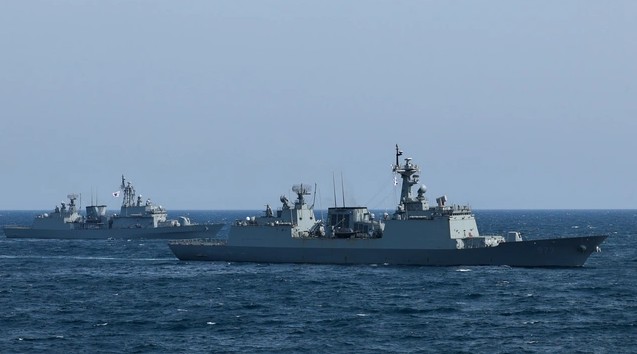
The first-in-class destroyer ROKS Gwangaeto the Great (DDH 971), left, and the Chungmugong Yi Sunsin-class destroyer ROKS Dae Jo-yeong (DDH-977), right, sail in formation during Maritime Counter Special Operations Exercise (MCSOFEX) May, 8, 2025. (Photo: Gavin Arnoldhendershot)

South Korea is undertaking a deliberate and ambitious transformation of its navy into a blue water force capable of regional power projection. This evolution is not simply about prestige or symbolism. It is a calculated move rooted in geostrategic necessity. As tensions rise in the Taiwan Strait and Chinese naval power expands across the first and second island chains, Washington should see Seoul’s naval modernization not as redundant or overlapping, but as a critical force multiplier.

This is especially relevant in the Yellow Sea, where a better-integrated U.S.-ROK naval posture could significantly enhance sea denial capabilities South Korea’s geographic proximity to China’s northern coastline presents a strategic opportunity to constrain the PLA Navy’s North Sea Fleet, which is headquartered in Qingdao and tasked with defending China’s most vulnerable maritime approaches. By jointly developing anti-access/area-denial (A2/AD) strategies focused on the Yellow Sea, the alliance could effectively impose strategic costs on China’s northern naval operations and blunt its access to the first island chain.

The Rise of South Korea’s Blue-Water Navy

The Republic of Korea Navy (ROKN) has traditionally played a coastal defense role focused on deterring North Korean provocations in the Yellow Sea and the Sea of Japan. But over the past two decades, a combination of economic capability, strategic awareness, and domestic political will has pushed Seoul to rethink its naval posture.

The evolution began with the KDX series of destroyers—KDX-I, KDX-II, and the 10,000-ton KDX-III (Sejong Daewang-class guided-missile destroyers)—equipped with Aegis combat systems, long-range anti-air missiles, and sophisticated sensors. These ships have given the ROKN capabilities far beyond the littorals. More recently, the KDDX program—slated to deploy stealthier, AI-integrated destroyers by the early 2030s—signals an even greater leap in warfighting capability.

Beneath the surface, South Korea is producing the Jangbogo-III class submarines, featuring Air-Independent Propulsion (AIP), advanced sonar, and the ability to launch indigenous cruise missiles. These quiet, long-endurance platforms are designed for regional influence, extending beyond traditional deterrence roles.

Then there is the controversial CVX program, which remains stalled due to political debate and lack of budgetary support. Initially conceived as a 30,000-ton light aircraft carrier to deploy short take-off and vertical landing (STOVL) aircraft like the F-35B, CVX was intended to give Seoul the ability to project power far from its shores. Critics within Korea have questioned its cost and doctrinal utility, and recent administrations have deprioritized the project in favor of counter-North Korean capabilities. Still, the strategic rationale behind the program reflects Seoul’s growing maritime confidence and its long-term ambition to contribute more meaningfully to regional security.

Strategic Drivers of Naval Expansion

South Korea’s shift toward a maritime posture is driven by three primary strategic imperatives. First, North Korea’s expanding maritime threat has grown increasingly sophisticated. Pyongyang’s development of submarine-launched ballistic missiles (SLBMs), its recent experimentation with unmanned maritime strike systems, and its emphasis on asymmetric naval tactics all underscore the need for a robust undersea deterrent. A capable Republic of Korea Navy (ROKN) is essential not only for defending territorial waters, but also for denying North Korea sanctuary beneath the surface. It is worth noting that the Atlantic Council’s recent report, “A Rising Nuclear Double-Threat in East Asia: Insights from our Guardian Tiger I and II Tabletop Exercises,” demonstrates how a naval skirmish in the Yellow Sea between North and South Korea could plausibly escalate—by 2030—into a dual contingency, triggering simultaneous crises on the Korean Peninsula and in the Taiwan Strait.

This scenario underscores the critical importance of effective naval deterrence and denial capabilities against North Korean maritime threats. It also implies a wider operational logic: improved U.S.-ROK naval integration could serve not only to deter North Korea but also to enhance regional readiness for broader contingencies involving both China and Russia. As Russia’s Pacific Fleet increases its operational tempo in the Sea of Japan—particularly near Vladivostok, its key naval hub—a forward-deployed and interoperable ROK Navy can play a vital role in surveillance, anti-submarine warfare, and presence operations. Greater alliance coordination in these waters would enable the U.S. Navy to retain pressure on Russian forces without further stretching its already overtasked carrier and submarine assets.

Second, South Korea’s economic vulnerability via its sea lines of communication (SLOCs) compels a more active naval presence. As a global trading nation heavily dependent on maritime imports—particularly energy—South Korea is acutely exposed to regional disruptions in maritime routes. Any conflict in the South China Sea or Taiwan Strait would pose serious risks to these lifelines, and protecting them requires more than the reach of coast guard patrols.

Third, shifts in U.S. force posture are creating strategic space—and necessity—for capable allies to assume greater responsibilities. As the United States confronts the demands of great power competition and redistributes its naval resources, a strengthened and regionally integrated South Korean navy can help relieve pressure by taking on critical missions in Northeast Asia, thereby enabling U.S. forces to concentrate on high-end deterrence operations elsewhere.

Naval Power and the U.S.-ROK Alliance

Historically, maritime coordination has not been the centerpiece of the U.S.-ROK alliance. While Combined Forces Command (CFC) has focused primarily on land and air integration, naval cooperation has traditionally been limited to joint drills and port visits—though this has begun to evolve in recent years with increased trilateral and ASW cooperation. But this is beginning to change.

The U.S. Indo-Pacific Strategy explicitly calls for networked security architecture, encouraging allied navies to coordinate maritime domain awareness (MDA), logistics, ISR (Intelligence, Surveillance, Reconnaissance), and undersea capabilities. South Korea has begun participating more actively in multilateral exercises like RIMPAC and Pacific Vanguard. Trilateral maritime exercises with the U.S. and Japan have also become more routine, despite political sensitivities in Seoul. However, these efforts remain fragmented and largely ad hoc, lacking the continuity and command structure necessary for sustained strategic impact. As the alliance faces increasingly complex, multi-domain maritime challenges—ranging from North Korean subsurface threats to regional contingencies involving China and Russia—the case for deeper institutional coordination becomes compelling. One promising pathway is the establishment of a Combined Maritime Command: a mechanism that could integrate planning, synchronize task force deployments, and enable real-time information fusion.

Unlike the existing ground-focused Combined Forces Command, such a structure would reflect the evolving character of naval warfare and anchor maritime cooperation in a permanent, mission-ready framework. Additionally, both Washington and Seoul are exploring data sharing and co-development in AI-enabled maritime systems. Seoul’s defense sector, spearheaded by companies like Hanwha Ocean and LIG Nex1, has the technological foundation to contribute to next-generation maritime warfare, from unmanned surface vehicles (USVs) to AI-supported sonar systems.

Policy Recommendations for Washington

Supporting South Korea’s naval rise requires more than rhetorical endorsement; it demands a set of deliberate and concrete policy actions by Washington. First, the United States should identify opportunities for joint research and development as well as limited technology transfer in key areas such as undersea warfare, autonomous maritime systems, and AI-enhanced command and control. Co-developing these capabilities with a trusted ally like South Korea would not only bolster interoperability but also strengthen Seoul’s defense industrial base.

Second, Washington should work with Seoul to institutionalize robust maritime intelligence-sharing mechanisms. Drawing inspiration from frameworks like the Five Eyes, a Northeast Asian naval intelligence partnership could significantly enhance regional maritime domain awareness and sharpen tactical decision-making across allied navies.

Third, joint training and exercises should be expanded beyond the waters near the Korean Peninsula. South Korea should be regularly included in U.S.-led naval operations throughout the second island chain, including in the Philippine Sea, South China Sea, and broader Western Pacific. Such participation would normalize long-range ROKN deployments and allow the U.S. Navy to maintain presence across a wider expanse without overstretching its own assets.

Finally, the alliance should explore the creation of a combined maritime command structure that parallels the existing Combined Forces Command on land. Although politically sensitive—particularly in light of ongoing discussions around OPCON transfer—such a structure would better reflect the realities of modern maritime warfare and the shared regional burdens that come with it. More concretely, a Combined Maritime Command could offer a standing bilateral mechanism for coordinating patrol areas, real-time sensor fusion, and logistics prepositioning. It would also allow for joint operational planning in response to overlapping threats from North Korea, China, and Russia—threats which increasingly defy traditional geographic boundaries. A permanent command structure would facilitate the joint execution of distributed maritime operations (DMO) and enable more dynamic force employment (DFE) within the alliance, aligning with current U.S. Navy doctrinal trends. However, such an initiative would need to overcome several significant hurdles.

Domestically, South Korea’s evolving but cautious posture on OPCON transfer and joint command structures could stir political controversy, especially amid ongoing debates over military sovereignty. Bureaucratically, the absence of a tradition of joint maritime commands within South Korea’s naval doctrine would necessitate a paradigm shift in command culture and planning processes. Operationally, issues such as legal authorities, peacetime rules of engagement, and joint logistics would need to be ironed out. To navigate these complexities, a phased approach may be prudent—starting with joint maritime planning groups, mission-specific task forces, and gradually evolving toward a permanent Combined Maritime Command as trust, interoperability, and strategic alignment mature.

Why the U.S. Needs a Strong South Korean Navy

Critics may ask whether the U.S. really needs another blue-water ally when it already works closely with Japan and Australia. But the answer lies in geography, capability specialization, and political flexibility. Japan’s navy is world-class in terms of technology and training, fielding advanced destroyers, submarines, and even F-35B-capable carriers. Yet it remains politically constrained by constitutional limitations—most notably Article 9—and cautious public sentiment that continues to shape the scope of Japan’s overseas military activities. Even after the 2015 legislative reforms and revised U.S.-Japan defense guidelines, Tokyo’s ability to engage in high-intensity or preemptive operations remains narrowly defined and heavily restricted. Australia, meanwhile, boasts potent naval assets but is geographically removed from key Northeast Asian flashpoints. South Korea, by contrast, offers an increasingly capable and politically willing partner, situated at the frontline of regional hotspots: the Yellow Sea, the East China Sea, and even the Taiwan Strait. Its navy is not only modernizing rapidly but is also unconstrained by many of the domestic limitations that hinder its allies.

Moreover, South Korea brings industrial capacity to the table. Its shipbuilding firms are already among the best globally. If the U.S. seeks to build a coalition-based maritime deterrent in the Indo-Pacific, Seoul is indispensable—not just as a consumer of U.S. systems, but as a producer of regionally relevant platforms.

At a time when the U.S. Navy is confronting widening capability gaps, the need for trusted, interoperable allies is more pressing than ever. Chronic delays in shipbuilding—exacerbated by industrial base constraints, workforce shortages, and budget uncertainty—have slowed the delivery of key platforms like the next-generation DDG(X) destroyers and the Columbia-class ballistic missile submarines. Meanwhile, maintenance backlogs have reduced the operational availability of existing surface combatants and submarines, straining fleet readiness. Carrier strike groups are being over-deployed to meet simultaneous demands in the Middle East, Europe, and the Indo-Pacific, often without sufficient dwell time, degrading both materiel and personnel endurance. Amphibious readiness is also under pressure, with debate continuing over the future of the LPD and LHA programs. In this environment, having a capable ally like South Korea—with Aegis-equipped destroyers, modern submarines, and ambitions for its own light aircraft carrier—is not a luxury or symbolic gesture. It is a strategic necessity. Seoul’s platforms are increasingly interoperable with U.S. systems, and their regional positioning allows the ROK Navy to help secure key maritime corridors and reinforce deterrence at precisely the time and place where U.S. naval bandwidth is most strained.

Conclusion: A Maritime Alliance for the Indo-Pacific Era

The U.S.-ROK alliance was forged in ground combat but will be tested in maritime competition. As the Indo-Pacific becomes the primary arena of strategic contestation in the 21st century, navies—not just armies—will shape deterrence outcomes.

Washington must therefore adapt its mindset. Supporting South Korea’s naval expansion is not about shifting the burden, but about co-creating a more resilient, integrated, and capable maritime network. Seoul is rising to meet the challenge. The U.S. should meet it alongside.

From undersea sensors to carrier decks, the next phase of alliance credibility will be forged at sea. It is time to set sail together.

Dr. Ju Hyung Kim, President of the Security Management Institute—a defense think tank affiliated with the South Korean National Assembly—led a study commissioned by the South Korean Navy titled ‘Regional Naval Modernization Trends and Future Directions for the ROK Navy’s Core Capabilities.’

Sea Control 579: Partnering for Conflict in the Western Pacific

By Brian Kerg

Major Ben Van Horrick and LtCol Scott ‘Chuck’ Blyleven of the United States Marine Corps join the program to discuss the article, “Partnering Will Determine the First Days of Conflict in the Western Pacific.”

Download Sea Control 579: Partnering for Conflict in the Western Pacific

Links

1. “Partnering Will Determine the First Days of Conflict in the Western Pacific,” by Ben Van Horrick, Proceedings, December 2024.

2. “Resolute Dragon: Reassurance, Deterrence, and a Call for Coordination,” by Bill Matory and Ben Van Horrick, War on the Rocks, December 6, 2023.

Brian Kerg is Co-Host of the Sea Control podcast. Contact the podcast team at Seacontrol@cimsec.org.