Tag Archives: distributed lethality

The Legal Implications of Arming MSC Ships

Distributed Lethality Topic Week

By Tony Freedman with contributions from Mark Rosen

What are the legal implications of arming MSC ships, both for self-defense and for a more robust offensive role?

With the apparent shortage of amphibious ships, the prospect of using Military Sealift Command’s (MSC) auxiliary ships to add depth to Navy and Marine Corps operations is being considered. These ships could be used to supplement the low end of military operations to provide sealift for missions such as a humanitarian assistance/disaster relief (HA/DR) and noncombatant evacuation. They could also provide an alternative platform for high end operations, such as launching offensive weapons, or become a floating base to support offensive operations. However, these ships are not a simple substitute for combatants or amphibious ships. Operationally, they lack ship-to-shore connectors and communication systems, and are not survivable (built mostly to commercial, not military standards). Additionally, these ships are currently not equipped to defend themselves. While adding weapons would not increase the ship’s survivability, it would provide some defensive capability and the potential to conduct offensive missions. This changes the nature and role of these ships. Unlike warships, these ships are manned by civilian crews, either Civil Service Mariners (CIVMARS) or licensed U.S. citizen contract mariners (CONMARS), which introduce questions regarding their legal status if weapons systems are added to the mix.[1] Despite legal reviews by MSC and Navy legal experts, the use of civilian manning is relatively untested and may pose a legal risk to civilian crews. Below, we outline legal precedents that come into play in regard to risk to civilian crews. There are two main aspects of concern: first is the potential lack of legal protection and the second, the willingness of crews to potentially go into harm’s way.

[otw_shortcode_button href=”https://cimsec.org/buying-cimsec-war-bonds/18115″ size=”medium” icon_position=”right” shape=”round” color_class=”otw-blue”]Donate to CIMSEC![/otw_shortcode_button]

The first concern is the potential lack of legal protection under article 4 of the Geneva Convention. Under the law of armed conflict (LOAC), civilians that support military operations receive legal protections including prisoner of war (POW) status. While MSC ships crews always have the right to self-defense, their legal protections depend on whether the individual is classified as a lawful combatant or not. The key is whether the activities conducted by the civilians are considered to be 635508601340653813-military-sealift-command-logo“belligerent.”[2] Even though civilians may accompany the armed forces they may not be intentionally targeted and, if they are ever captured, would be entitled to POW status. However, civilians that “cross the line” and involve themselves in belligerent activities would not be entitled to the combatant privilege (immunity). In other words, they can be prosecuted as common criminals or worse as illegal combatants. The civilians would risk prosecution by the International Criminal Court or some other body if an “offense” occurred in an adversary’s territorial waters.  
Historically, U.S. policy safeguards civilians from conducting belligerent duties, per se, by aligning with internationally recognized roles for authorized civilians who accompany the armed forces, such as deck, engineering, purser, or supply duties that do not cause direct impact on the enemy. Civilians that command or man weapons systems (apart from self-defense purposes) do have a direct impact. In line with U.S. policy, naval auxiliaries have been operating for many years and maintain their status as “state vessels,” which are entitled to sovereign immunity so long as the vessel is operated for non-commercial service and does not engage in belligerent acts.[3] In spite of these distinctions, a hostile nation could take a more restrictive view by viewing the ship holistically as a single unit, meaning any civilian aboard the ship vicariously participates in any activities that the ship conducts against the enemy.

The second concern with the addition of weapons, particularly offensive weapons, is the willingness of civilian crews to operate these ships in forward locations. One compounding issue that needs to be resolved is whose authority does the civilian crew fall under: military or civilian? Many scholars contend that the concept of “regular armed forces discipline” applies to civilian crews as it does for military crews. In 2007, the Uniform Code of Military Justice (UCMJ) was amended to allow for civilian personnel accompanying or serving with the armed forces to be subject to the UCMJ during contingency operations. However, the constitutionality of this amendment is not yet settled. Specifically, U.S. citizens are afforded certain trial rights (to include jury trials) under the Fifth and Six amendments of the U.S. constitution that military members do not enjoy.

We conclude that the use of weapons aboard MSC ships is appropriate if used for defensive purposes. However, there still remains a risk to the civilian crews with regard to whether these weapons can be used in certain roles which approach belligerent activities, for instance, if the weapons are operated by military personnel with direct civilian support. Direct use and control of weapons by civilians could place the crew under risk of prosecution if captured by a foreign adversary. Furthermore, there is the potential for unintended consequences and risk to future U.S. operations. As a leader in international law and in naval operations, the United States should not set a precedent for confusion between belligerents and non-belligerents which could result in a breakdown of LOAC/LOS norms that we depend on. If the world loses confidence in the LOAC because the U.S. is perceived as ignoring the rules, then the U.S. could lose the rights and protections assured by LOAC, such as sovereign immunity for our ships in foreign ports.

Dr. Tony M. Freedman is a senior research scientist at CNA; he has led studies on mine warfare, non-traditional platforms, afloat forward staging base (AFSB), Special Forces, and SSGN operations. Additionally, he was the Deputy Test Director (Testing Analysis, & Evaluation) to the Joint Command and Control War on Terror Activities (JC2WTA) Joint Test and was CNA’s on-site scientific analyst to OPNAV N00X at the Pentagon. Prior to CNA, Dr. Freedman worked in academia and industry.

Mark E. Rosen, an international and national security lawyer, is senior vice president, general counsel, and corporate secretary at CNA. Rosen is a retired Navy Captain (JAGC) and served in various international law positions in the Pentagon including the ocean policy legal advisor to the Deputy Chief of Naval Operations for Plans, Policy, and Operations; political military planner, Strategic Plans and Policy Directorate (J-5), Joint Staff; and head of the International Programs Branch, Navy International Law Division, Washington, DC. Views expressed are his own.

[otw_shortcode_button href=”https://cimsec.org/buying-cimsec-war-bonds/18115″ size=”medium” icon_position=”right” shape=”round” color_class=”otw-blue”]Donate to CIMSEC![/otw_shortcode_button]

Notes:

[1] There is little legal distinction between CIVMARs or CONMARs according to the LOAC. However, CONMARs do have fewer legal protections than CIVMARs under most bilateral status of forces (SOFA) agreements that DoD has negotiated. Depending on where these vessels operate, the availability of SOFA protections, and the practical benefits of being able to issue a CIVMAR an official passport, should be given weight in deciding whether to make use of CONMAR crew.

[2] The definition of “belligerent” is often referred to as taking part in hostilities.

[3] The U.S. Navy’s claims sovereign immunity (freedom from involuntary boarding, inspection, arrest, or the imposition of coastal state environmental regulations) for all government owned and most leased vessels provided they are engaged in non-commercial service. While the term “naval auxiliary” is not defined in the Law of the Sea (LOS) Convention, the rights and entitlements of such vessels is established in years of state practice and learned texts like the San Remo Manual and the Naval War College’s Commander’s International Law Handbook.
Distributed Leathernecks

Distributed Lethality Topic Week

By LCDR Chris O’Connor 

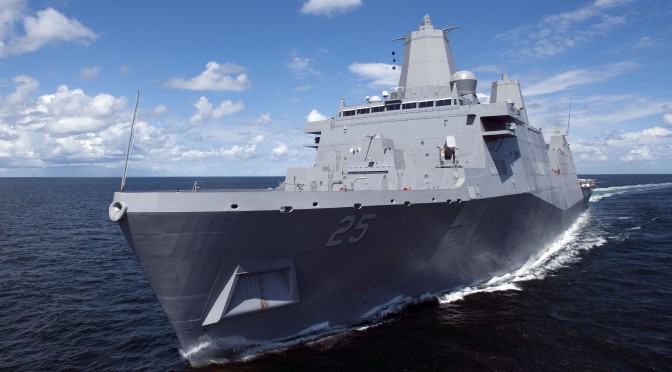
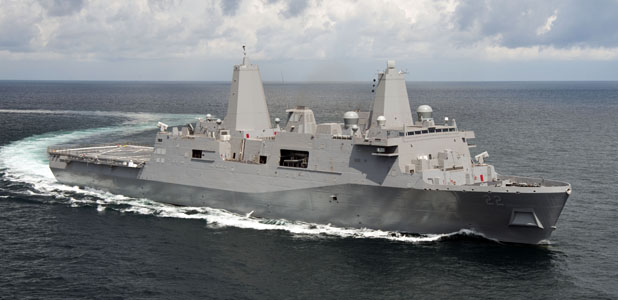
This year, the Navy plans to send out a surface action group (SAG) comprised of three DDGs in order to test distributed lethality CONOPS. This is an important first step, but the next SAG deployed should include a completely different unit. A San Antonio-class LPD. One LPD-17 class ship in the mix will considerably change the capabilities of a SAG across the warfare spectrum, making it a true Adaptive Force Package (AFP) that is more lethal in a number of different ways.

[otw_shortcode_button href=”https://cimsec.org/buying-cimsec-war-bonds/18115″ size=”medium” icon_position=”right” shape=”round” color_class=”otw-blue”]Donate to CIMSEC![/otw_shortcode_button]

Why an LPD? It is a large littoral combat ship. The LCS classes were designed to have mission bay space so that capabilities could be swapped out as the mission required. LPD-17 class ships, if loaded with a specialized set of MAGTF (Marine Air-Ground Task Force) equipment, have room for equipment that no DDG or CG could dream of carrying, at a greater volume than an LCS. While serving on the USS BUNKER HILL (CG-52), the author recognized that the guided missile cruisers in the US Navy have been built for specific weapon systems, sensors, and engineering equipment. A modification to add more systems that are significant departures from the original design will be at the expense of the baked-in warfare capabilities. More unmanned systems or connectors can be put on a surface combatant, but they will be limited to the constraints of the torpedo magazine, hangar, or boat deck space, and will take away from the important uses those shipboard locations currently have.

LPD 22 Sea Trials
LPD 22 Sea Trials, Huntington Ingalls photo. 

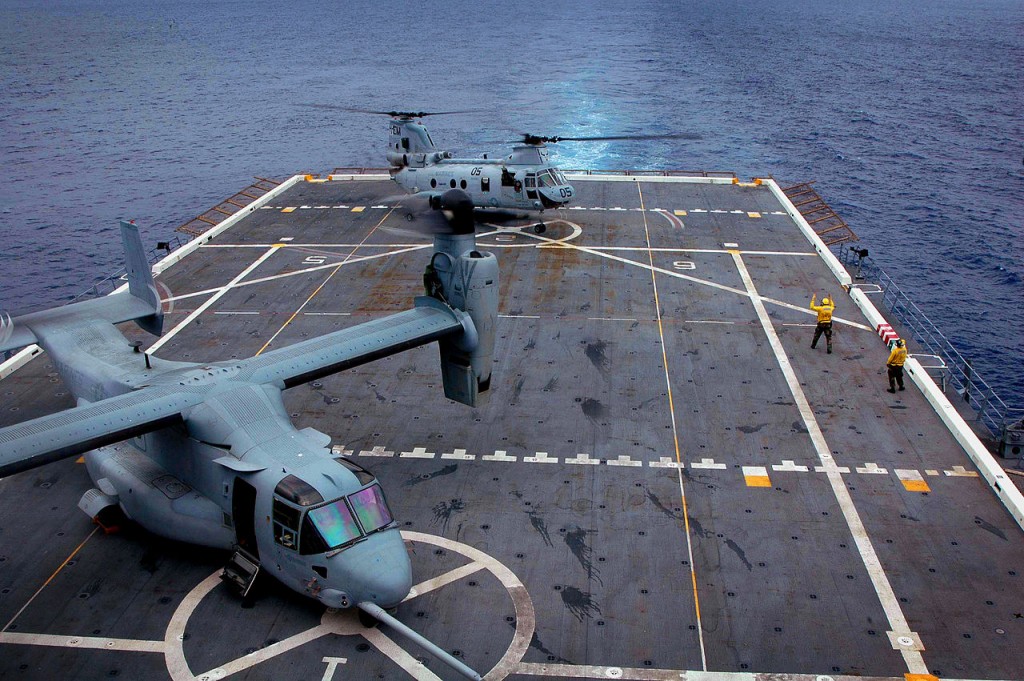
On top of the “open concept” interior (so in vogue these days), the LPD also has a flight deck that dwarfs that of any surface combatant; it can launch or recover two V-22s simultaneously. It has massive potential to carry more aviation systems due to the aircraft storage space in the large hangars and deck tie-downs. Not to mention that if a DDG wants to put something in the water, it has to lower it with the boat davits or other limited means. A LPD has a well deck that can splash LCACs, LCUs, and unmanned systems that use the sea interface.

During a recent distributed lethality wargame (of which the author was part of), game participants were given objectives and a choice of AFPs to use towards those aims. The choices included a mix of DDGs, LCSs, America-class LHAs, and “Hughesian” (the author is taking liberties with that word) small missile combatants a la “streetfighter.” We then employed these mixed forces against a red force that was trying to reach an objective, break a blockade, or put troops ashore on an island. The decision-making process was constrained to a surface picture, speed/capability/weapons employment solution set. This was the explicit purpose of this game, being early in the distributed lethality wargame process.

Early in the game a different way of meeting the same goals came to the author, and they involved using Marines with surface or aviation connectors. For example, we can deter an island invasion with the proper positioning of surface ships, but what if that island already had US forces on it? If a red force landing craft was able to get through, it would have to contend with defenders on the island. It is much less politically tenable for red forces to land on an occupied island than to occupy an island that is not populated (or at least has no security or military forces on it) with the guise that it is helping or providing unasked-for security assistance. Blue landing forces would enhance the maritime security exclusion zone around an island or completely obviate it. V-22s can get to the objective a lot faster than surface ships. In the recent DL wargame, if the blue forces chose to use America-class LHAs as part of their a la carte AFPs, V-22s were not an option, they and landing forces from the LCSs were adjudicated from the game for aforementioned reasons.

Flight deck loaded with V-22 Ospreys, defenselink.mil photo.
Active flight deck , defenselink.mil photo.

An LPD can be part of a disaggregated ARG and be used as part of a DL task force. An LPD loaded with MEU equipment that can be quickly employed and join up with an LHA and LSD would be especially useful if needed to create a larger landing force. A red force that wants to land troops to provide “security assistance” or “fight terrorists” would have to contend with LCAC delivered and V-22 delivered vehicles with TOWs, Marines with Javelins and Stingers, and in a longer time period, LAVs, AAVs, and MPCs that have swum ashore from the LPD’s well deck. At the least, the LPD will be a sea base lily pad for long-range V-22 missions, such as non-combatant evacuations or special operations strikes. All three ARG ships do not have to be present for this capability to be delivered.

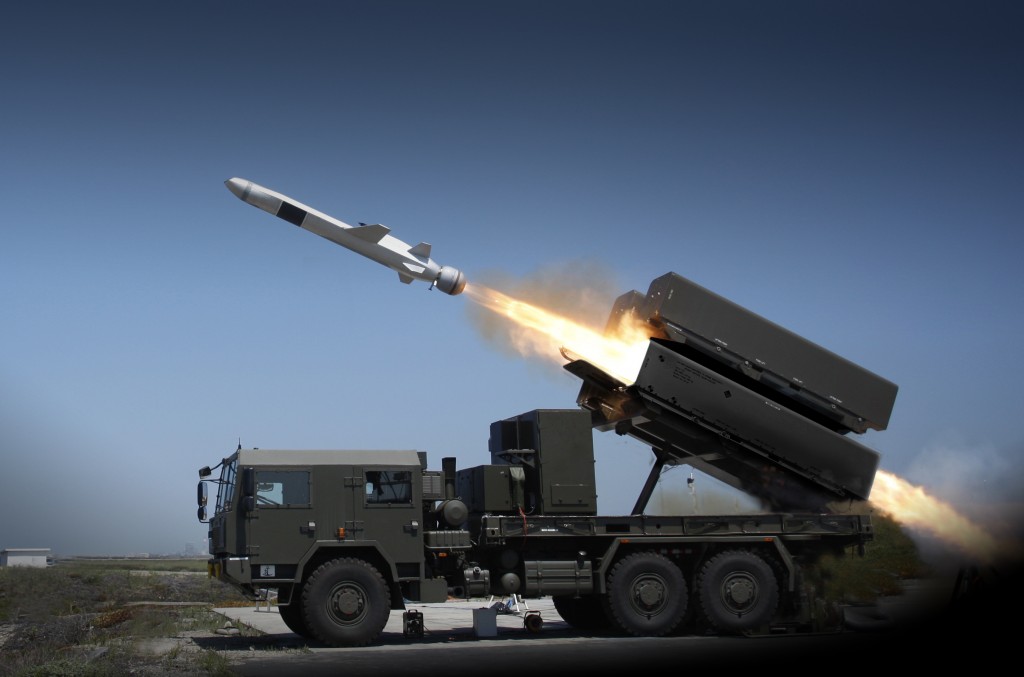
The future brings even more options. A DL MAGTAF assigned to a LPD could be specifically modified to perform specialized deterrent landings at short notice, or bring ashore capabilities we do not currently use. TOW and Javelin missiles would make landing craft think twice, but there are truck mounted Naval Strike Missiles and other antiship and surface-to-surface missiles. A lot of those systems, including HIMARs, are too large to be delivered by an LCAC as they are currently fielded. These weapons, or other systems such as Hellfire or JAGM, could be modified and put on smaller vehicles that are purpose built to provide anti-access/area denial capabilities. On top of this, the flight deck of the LPD can launch and recover even larger UAVs than the surface combatants can employ. The hangars can support USMC aircraft such as the AH-1Z and UH-1Y that can carry out different mission sets than the H-60 variants that deploy on current surface combatants. New capabilities could use up some of this non-skid real estate, such as strike missile box launchers, additional communications and EW equipment. Not to be forgotten, the well deck could be used to put UUVs and USVs in the water, creating defensive swarms around contested geographic points or high-value units. Being a Supply Corps officer, the author is obliged to point out the additional logistics capability that an LPD brings to the fight; more storage for supplies, mothership capability for smaller units, and space for new capabilities that can be bolted on such as additive manufacturing.

Norweigan Strike Missile (NSM) launched from a truck, Kongsberg photo.

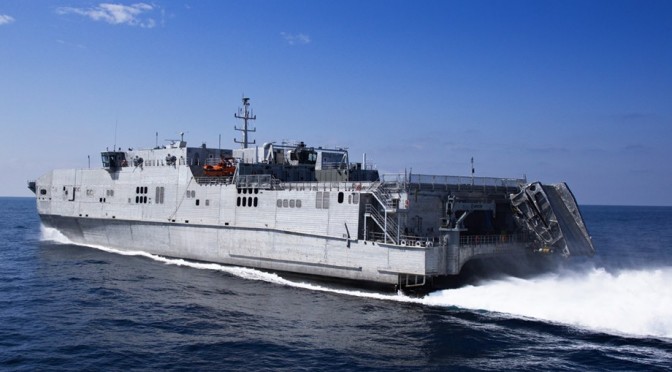
The new E-series ships such as the EPF, ESB, and ESD can all do parts of these missions, but would not survive as well in a contested environment as an LPD-17. That class has EW, communications, self-defense, and logistics endurance capabilities that the newly minted expeditionary classes do not have. This is not discounting them, but they just cannot play in the same environment as the other members of the DL SAGs can; there is a place for them in other parts of the littoral arena.

This is not an original idea. If you have heard this all before, it is because many people saw the potential from the very beginning of the LPD-17 class. James H. Cobb wrote a series four novels from 1997-2002 that were the closest thing for the Navy to Dale Brown was for the Air Force. In his books, then-experimental technology was used to fight battles in new ways. The third novel Seafighter (2002) exhibited the gonzo awesome idea of armored LCACs armed with chain guns, hellfire missiles and even SLAM missiles (as a “streetfighter” concept). The linchpin of the Navy task force that employed these systems was an amphibious warship used to the fullest extent of its capabilities- supporting the battle hovercraft, launching helicopter strikes, and the like. When the author was a member of the CNO Strategic Studies Group, one of the areas of investigation was new uses for current classes of ships, and there were already think pieces out on the LPD-17. These ideas should be used in the distributed lethality concept to bring Marines to that fight.

The Navy-Marine Corps team is at its most lethal when each naval service uses its unique capabilities to the utmost. And the best way to cohesively bring them together for the good of distributed lethality is with an LPD in the fight, part of a Surface Action Group. This will certainly make our potential adversaries sit up and pay attention.

LCDR Chris O’Connor is a supply corps officer in the United States Navy and a member of the Chief of Naval Operations Rapid Innovation Cell. The views expressed here are his own and do not represent those of the United States Department of Defense.

[otw_shortcode_button href=”https://cimsec.org/buying-cimsec-war-bonds/18115″ size=”medium” icon_position=”right” shape=”round” color_class=”otw-blue”]Donate to CIMSEC![/otw_shortcode_button]

Enabling Distributed Lethality: The Role of Naval Cryptology

Distributed Lethality Topic Week

By LCDR Chuck Hall and LCDR David T. Spalding

The U.S. Navy’s Surface Force is undergoing a cultural shift.  Known as “Distributed Lethality,” this strategy calls for our naval combatants to seize the initiative, operate in dispersed formations known as “hunter-killer” surface action groups (SAG), and employ naval combat power in a more offensive manner. After years of enjoying maritime dominance and focusing on power projection ashore, the U.S. Navy is now planning to face a peer competitor in an Anti-Access/Area Denial (A2AD) environment. Long overdue, Distributed Lethality shifts the focus to one priority – warfighting.  Far from a surface warfare problem alone, achieving victory against a peer enemy in an A2AD environment will require leveraging all aspects of naval warfare, including naval cryptology.

[otw_shortcode_button href=”https://cimsec.org/buying-cimsec-war-bonds/18115″ size=”medium” icon_position=”right” shape=”round” color_class=”otw-blue”]Donate to CIMSEC![/otw_shortcode_button]

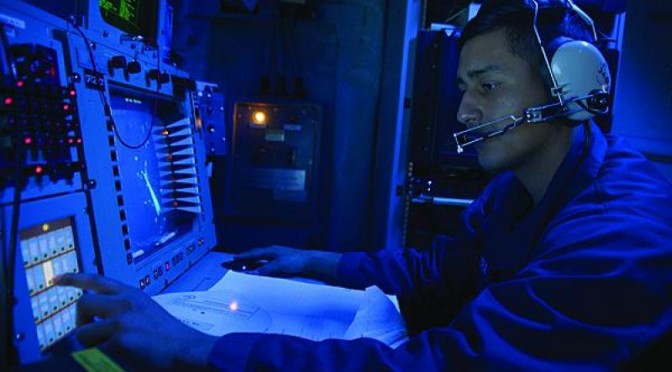
Naval Cryptology has a long, proud history of supporting and enabling the Fleet. From the Battle of Midway in 1942, to leading the Navy’s current efforts in cyberspace, the community’s expertise in SIGINT, Cyber Operations, and Electronic Warfare is increasingly relevant in an A2AD environment. Led by Commander, U.S. Fleet Cyber Command/U.S. TENTH Fleet, the community is comprised of officers and enlisted personnel serving afloat and ashore and who are well integrated with the Fleet, intelligence community, and U.S. Cyber Command. Given its past history and current mission sets, naval cryptology is poised to enable distributed lethality by providing battlespace awareness, targeting support, and effects, in and through the electromagnetic spectrum and cyberspace.   

Battlespace Awareness

Battlespace Awareness, as defined in the Information Dominance Roadmap, 2013-2028, is “the ability to understand the disposition and intentions of potential adversaries as well as the characteristics and conditions of the operational environment.”  It also includes the “capacity, capability, and status” of friendly and neutral forces and is most typically displayed as a Common Operating Picture (COP).  To be effective, however, battlespace awareness must seek to provide much more than just a COP. It must also include a penetrating knowledge and understanding of the enemy and environment — the end-user of which is the operational commander. The operational commander must be able to rely on predictive analysis of enemy action in the operational domain to successfully employ naval combat power in an A2AD environment.  

Naval Cryptology has historically provided battlespace awareness through the execution of Signals Intelligence (SIGINT) operations.  During World War II, Station HYPO, located in Pearl Harbor and headed by Commander Joseph Rochefort, collected and decrypted the Japanese naval code, known as JN-25. Station HYPO’s exploitation of Japanese naval communications was sufficient to provide daily intelligence reports and assessments of Japanese force dispositions and intentions. These reports were provided to naval operational commanders, to include Admiral Chester W. Nimitz, Commander in Chief, U.S. Pacific Fleet and Commander in Chief, Pacific Ocean Areas. On May 13, 1942, navy operators intercepted a Japanese message directing a logistics ship to load cargo and join an operation headed to “Affirm Fox” or “AF.”  Linguists from Station HYPO had equated “AF” to Midway in March after the Japanese seaplane attack on Hawaii (Carlson, 308) and was thus able to confirm Midway as the objective of the upcoming Japanese naval operation.  Station HYPO was also able to give Nimitz the time and location of the Japanese attack point: 315 degrees, 50 nm from Midway, commencing at 7:00AM (Carlson, 352). This allowed Nimitz to position his forces at the right place, designated Point Luck, northeast of Midway, placing the U.S. fleet on the flank of the Japanese (Carlson, 354). Had Station HYPO’s efforts failed to provide this battlespace awareness, Admiral Nimitz would not have had enough time to thwart what might have been a surprise Japanese attack.  

Photo shows work being done on the Japanese Naval code J-25 by Station HYPO in Hawaii. The Japanese order to prepare for war was sent in J-25 prior to the attack on Pearl Harbor, but decoders had been ordered to suspend work on the Naval code and focus efforts on the diplomatic code. Later, enough of J-25 was broken to be used as an advanced warning to the Japanese attack on Midway. NSA photo.

Victory at Midway was founded on the operational commander’s knowledge of the enemy’s force construct and disposition. Currently the product of both active and passive, organic and non-organic sensors, achieving battlespace awareness in an A2AD environment will require more emphasis on passive and non-organic sensors, and increased national-tactical integration in order to prevent detection and maintain the initiative.  The “hunter-killer” SAGs will be entirely dependent upon an accurate and timely COP – not just of enemy forces, but of dispersed friendly forces as well.  Just as battlespace awareness enabled triumph against the Imperial Japanese Navy, so too will it be the very foundation upon which the success of distributed lethality rests. Without it, the operational commander cannot effectively, and lethally, disperse his forces over time and space.    

Targeting Support

Another key enabler of the Surface Navy’s shift to the offensive will be accurate and timely targeting support.  Though support to targeting can come in many forms, as used here it refers to the triangulation and precision geolocation of adversary targets via communications intelligence and radio direction finding (RDF).  In an environment in which options to “fix” the enemy via radar or other active means introduces more risk than gain, RDF presents itself as a more viable option.  Indeed, the passive nature of direction finding/precision geolocation makes it particularly well suited for stealthy, offensive operations in an A2AD environment.  Leveraging both organic and non-organic sensors in a fully integrated manner — RDF will provide “hunter-killer” SAG commanders with passive, real-time, targeting data.     

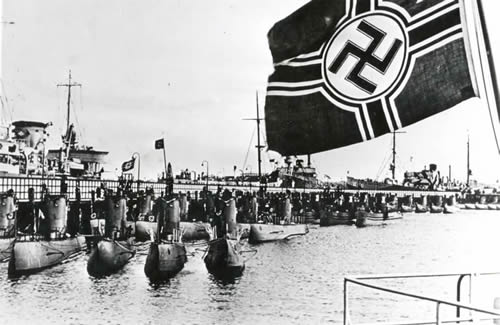
Perhaps one of the best historical examples of Naval Cryptology’s support to targeting can be seen in the Battle of the Atlantic. The Third Reich had threatened the very lifeline of the war in Europe as Admiral Donitz’ U-boats were wreaking havoc on Allied merchant vessels throughout the war. Though America had begun intercepting and mapping German naval communications and networks as early as 1938, it was not as critical then as it was upon entry into the war. By the time America entered the war, the U.S. Navy’s SIGINT and cryptanalysis group, OP-20-G, boasted near 100 percent coverage of German naval circuits. Many of these circuits were used for high frequency (HF), long range shore-ship, ship-shore, and ship-ship communications. The ability to both intercept these communications and to locate their source would be necessary to counter the Axis’ attack. That ability was realized in an ever growing high frequency direction finding (HFDF) network.

The HFDF network originally consisted of only a handful of shore stations along the Atlantic periphery. Throughout the course of the war it grew to a rather robust network comprised of U.S., British, and Canadian shore-based and shipborne systems. The first station to intercept a German naval transmission would alert all other stations simultaneously via an established “tip-off” system.  Each station would then generate a line of bearing, the aggregate of which formed an ellipse around the location of the target.  This rudimentary geolocation of German U-boats helped to vector offensive patrols and enable attack by Allied forces — thus taking the offensive in what had previously been a strictly defensive game.  The hunter had become the hunted.        

German U-boats threatened the very lifeline of the war in Europe by wreaking havoc on Allied merchant vessels throughout the war.

Enabling the effectiveness of increased offensive firepower will require more than battlespace awareness and indications and warning.  Going forward, Naval cryptologists must be agile in the support they provide — quickly shifting from exploiting and analyzing the enemy, at the operational level, to finding and fixing the enemy at the tactical level. Completing the “find” and “fix” steps in the targeting process will enable the “hunter-killer” SAGs to accomplish the “finish.”

Cyber Effects

Finally, cyber.  Receiving just a single mention, the original distributed lethality article in Proceedings Magazine refers to the cyber realm as, “the newest and, in many ways most dynamic and daunting, levels of the battlespace—one that the Surface Navy, not to mention the U.S. military at large—must get out in front of, as our potential adversaries are most certainly trying to do.” Indeed, the incredible connectivity that ships at sea enjoy today introduces a potentially lucrative vulnerability, for both friendly forces and the adversary. Similar to battlespace awareness and targeting, Naval Cryptology has history, albeit limited, in cyberspace. Cryptologic Technicians have long been involved in Computer Network Exploitation (CNE) and the Navy was the first service to designate an enlisted specialty (CTN) in the cyber field. According to the FCC/C10F strategy, not only do they, “operate and defend the Navy’s networks,” but they also, “plan and direct operations for a subset of USCYBERCOM’s Cyber Mission Forces.”  The combination of history and experience in cyberspace, coupled with the FCC/C10F designation as the Navy’s lead cyber element, clearly places the onus on naval cryptology. As the Navy seeks to protect its own cyber vulnerabilities, and exploit those of the adversary, the execution of effective cyber operations by the cryptologic community will be critical in enabling distributed lethality.

Going Forward

Today, through a wide array of networked, passive, non-organic sensors, and integration with national intelligence agencies and U.S. Cyber Command, naval cryptology is well-positioned to enable distributed lethality by providing battlespace awareness, targeting support, and effects, in and through the electromagnetic spectrum and cyberspace. Yet, similar to the surface force, a cultural shift in the cryptologic community will be required. First, we must optimize national-tactical integration and better leverage and integrate off-board sensors. The uniqueness of the A2AD environment demands the integration and optimization of passive, organic and non-organic sensors in order to prevent counter-targeting. Second, we must prioritize the employment of direction finding and geolocation systems, ensuring they are accurate and sufficiently integrated to provide timely targeting data for weapons systems. This will require a shift in mindset as well, from simple exploitation to a focus on “find, fix.” Third, we must continue to lead in cyberspace, ensuring cyber defense in depth to our ships at sea while developing effects that effectively exploit adversary cyber vulnerabilities. Finally, naval cryptology’s role in distributed lethality cannot occur in a vacuum — increased integration with the Fleet will be an absolute necessity.

Distributed lethality is the future of Naval Surface Warfare — a future in which the cryptologic community has a significant role. In order to ensure the Surface Force can seize the initiative, operate in dispersed formations known as “hunter-killer” SAGs, and employ naval combat power in a more offensive manner in an A2AD environment, Naval Cryptology must stand ready to provide battlespace awareness, targeting support, and effects, in and through the electromagnetic spectrum and cyberspace.

LCDR Chuck Hall is an active duty 1810 with more than 27 years of enlisted and commissioned service.  The opinions expressed here are his own.

LCDR David T. Spalding is a  former Cryptologic Technician Interpretive.  He was commissioned in 2004 as a Special Duty Officer Cryptology (Information Warfare/1810).  The opinions expressed here are his own.

[otw_shortcode_button href=”https://cimsec.org/buying-cimsec-war-bonds/18115″ size=”medium” icon_position=”right” shape=”round” color_class=”otw-blue”]Donate to CIMSEC![/otw_shortcode_button]

Works cited:

Ballard, Robert. Return to Midway. Washington, D.C: National Geographic, 1999.

Parshall, Jonathan. Shattered Sword : The Japanese Story of the Battle of Midway. Dulles, Va. Poole: Potomac Chris Lloyd distributor, 2007.

Carlson, Elliot. Joe Rochefort’s War: the Odyssey of the Codebreaker Who Outwitted Yamamoto at Midway. Annapolis, MD: Naval Institute, 2011. Print.

Distributed Lethality: Old Opportunities for New Operations

Distributed Lethality Topic Week

By Matthew Hipple

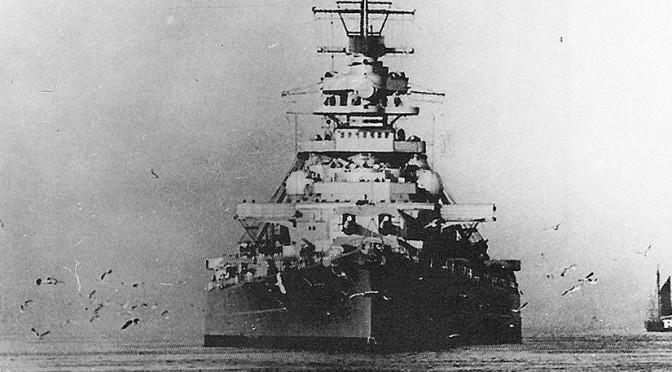
The BISMARCK, a single ship capable of striking fear into the heart of an entire nation.
The BISMARCK, a single ship whose threat was sufficient to muster an entire fleet for the hunt.

The essence of naval warfare has always been opportunism – from the vague area of gravity generated by an in-port “fleet in being,” to the fleet-rallying threat generated by even a BISMARK or RANGER alone. The opportunity is generated by forces more mobile and self-contained than any army, more persistent than an air force, and empowered to act with no connection to higher authority in a domain that leaves no trace.  It is that ability for a small number of independent ships, or even a single vessel, to provide opportunity and create, “battlespace complexity,” that is distributed lethality’s core. Distributed lethality is not naval warfighting by new principles; it is a return to principles.

[otw_shortcode_button href=”https://cimsec.org/buying-cimsec-war-bonds/18115″ size=”medium” icon_position=”right” shape=”round” color_class=”otw-blue”]Donate to CIMSEC![/otw_shortcode_button]

The best defense is not an overwhelming obsession with defense.

Unfortunately, the virtuous autonomy of the past was, in part, only protected by the limited technology of the day. As technology allowed, decentralized execution was replaced by the luxury and false confidence of constant connection to higher authority through an electronic umbilical. It is the kind of devolution that turned into Secretary Gates’ nightmare, “I was touring a [Joint Special Operations Command] in Kabul and discovered a direct line to somebody on the NSC, and I had them tear it out while I was standing there.” In parallel, America began the ahistorical project of investing all offensive opportunity not even in a single class of ship, but a single ship surrounded by a fleet obsessed with its defense.  As early as 1993, President Clinton stated that when a crisis broke out, his first question would be, “where is the nearest carrier.” Sorry, other ships! For the Navy to sensibly rebalance, distributed lethality must succeed. For distributed lethality to succeed, we must decentralize and de-tether mission command, weapons release authority, and weapons support systems.

Decentralized and disconnected methods of command must be embraced, as centralization is only an imagined luxury. Modern centralization is based on the assumption we will have the connectivity appropriate for it. This is no longer tenable in a world of increasingly advanced peers and hyundaized lesser adversaries. Anti-Access, Area-Denial (A2/AD) depends on opponents making themselves visible, of which electronic emission is critical. A2/AD will also inevitably seek to disrupt our C2 connections.

doyle-dday
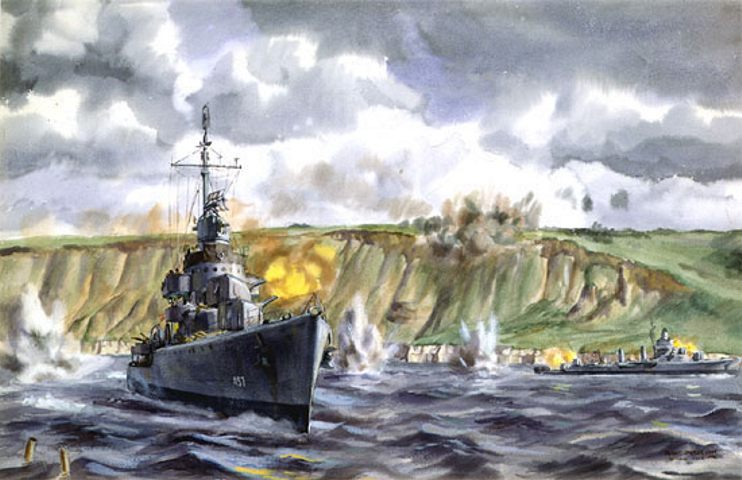
“Permission? We don’t need no stinkin’ permissions.” “The Battle for Fox Green Beach,” watercolor by Dwight Shepler, showing the Gleaves class destroyer USS Emmons(DD 457) foreground and her sister-ship, the USS Doyle, to the right, within a few hundred yards of the landing beach, mixing it up with German shore batteries on D-Day.

The current major-node CWC concept will need to be broken down to a more compact, internal model designed around the Hunter Killer Surface Action Group. Rules of Engagement must be flexible to the point that American commanders need not look over their shoulders to a higher OPCON. Consider, the destroyer CO’s at Normandy didn’t consider waiting for direction or requesting approval before shifting from small boat screening to shore bombardment from the shoals. They recognized the opportunity – the necessity – and executed of their own will.

In contrast, today it might be a regular occurrence to double-and-triple check our actions with American OPCON while operating with NATO in TACON off Somalia. American CO’s could use the freedom to make pragmatic, on-the-spot decisions not only for immediate concerns of mission effectiveness, but as representatives of their higher military command and, potentially, the state. Coalition commanders would have greater trust in the spot decisions of their American counterparts, rather than worry they sit precariously atop a changing several-step staffing process.

Though encouraging equivalent RoE flexibility for coalition partners may be challenging, our autonomy may encourage our partners to interpret their home nation guidance in a flexibility equivalent to their trust in the US commander they fight beside. That lack of hesitancy will be critical during a conflict, and in that sudden moment in the South China Sea or Mediterranean when a small SAG of coalition partners find themselves in the midst of a conflict that has just begun. Imposing the peacetime discipline necessary to trust the CO’s we have trained, prepared, and empowered to do their jobs is the only thing that will jump-start a shift in a mind-set now dominated by subordination. 

In the execution of more flexible orders, ships must be re-invested with control of their own weapon systems. CO’s oversee non-nuclear weapon systems that they do not control – that are solely the purview of off-ship authorities. In particular, as weapon systems like Tomahawk become deployable for ASuW, off-ship authority’s iron grip on their control must break.  This decentralization also matters outside the stand-up fight at sea. The organic ability to program and deploy Tomahawk missiles for land strike allows surface ships to execute attacks of opportunity on land infrastructure, or execute and support opportunistic maritime raids as groups of marines harass adversaries, or turn isolated islands into temporary logistics or aviation operations bases. For winning the sudden-and-deadly fight in the littoral environment but integrating with opportunistic amphibious operations, the surface fleet could find some inspiration from the USS BARB, the only submarine in WWII to “sink” a train with its crew-come-amateur-commandos. From Somalia to the South China Sea, naval commanders should be told what to do, not how – and be allowed to do it. The less reliant the force is on these ephemeral links and the less these links are unnecessarily exercised in peacetime, the greater a force’s instinct to operate independently and with confidence in an imposed or needed silence. 

CAPT Ramius, relieved to discover he is not dealing with "some buckaroo."
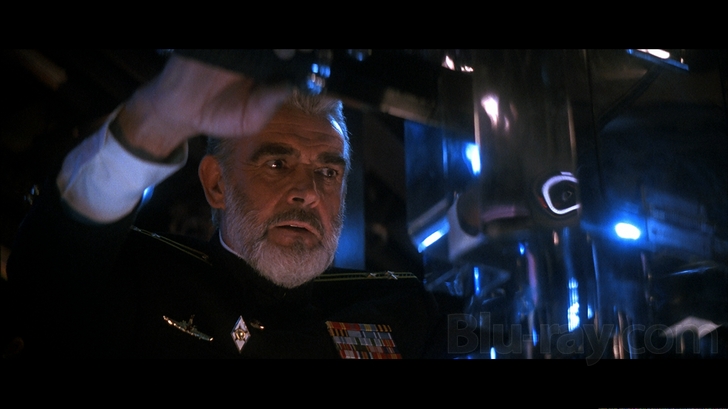
CAPT Ramius, relieved to discover he is not dealing with “some buckaroo.”

There may be a level of discomfort with decentralization and disconnection. If leaders fear the impact of a “strategic corporal,” surely a “buckaroo,” as  CAPT Ramius would call him, that would be truly horrifying. That fear would be a reflection of a failure of the system to produce leaders, not the importance and operational effectiveness of independence. There is a reason the US once considered the Department of the Navy to be separate and peer to the Department of War – noting the institution and its individual commanders as unique peace and wartime tools for strategic security and diplomacy. Compare today’s autonomy and trust with that invested in Commodore Perry during his mission to Japan or Commodore Preble’s mission to seek partnership with Naples during the First Barbary Pirates War. Reliance on call-backs and outside authority will gut a naval force’s ability to operate in a distributed manner when those connections disappear. Encouraging it by default will ensure the muscle memory is there when needed.

Finally, Distributed Lethality requires the hardware to allow surface combatants to operate as effective offensive surface units in small groups. The kinetic end of the spectrum, upgraded legacy weapons and an introduction of new weapon systems has been extensively discussed since the 2015 Surface Navy Association National Symposium when VADM Rowden and RADM Fanta rolled out Distributed Lethality in force. However, weapon systems are only as good as the available detection systems. Current naval operations rely heavily on shore-based assets, assets from the carrier, and joint assets for reconnaissance. In the previous Distributed Lethality topic week, LT Glynn argued for a suite of surveillance assets, some organic to individual ships, but most deploying from the shore or from carriers.  Presuming a denied environment, and commanders empowered to seek and exploit opportunities within their space, the best argument would be for greater emphasis on ship-organic assets. They may not provide the best capabilities, but capabilities are worthless if assets cannot find, reach, or communicate with a Hunter-Killer SAG operating in silence imposed by self or the enemy. They also prevent an HKSAG from being completely at the mercy or limitations of a Navy or joint asset coordinator – while simultaneously relieving those theater assets for higher-level operations and opportunity exploitation.

Ultimately – distributed lethality is the historical default mode of independent naval operations given a new name due to the strength of the current carrier-based operational construct. Admiral Halsey ordered CAPT Arleigh Burke to intercept a Japanese convoy at Bougainville, “GET ATHWART THE BUKA-RABAUL EVACUATION LINE ABOUT 35 MILES WEST OF… IF ENEMY CONTACTED YOU KNOW WHAT TO DO.” The surface fleet must embrace a culture assuming our commanders “KNOW WHAT TO DO.” We must build an operational construct in which acting on that instinct is practiced and exercised in peacetime, for wartime. The operational and diplomatic autonomy, as well as the OLD IRONSIDES style firepower of single surface combatants, is necessary to rebalance a force gutted of its many natural operational advantages. Distributed lethality must return the surface force to its cultural and operational roots of distributed autonomy, returning to the ideas that will maximize opportunity to threaten, undermine, engage with, and destroy the adversary.

Matthew Hipple is the President of CIMSEC and an active duty surface warfare officer. He also leads our Sea Control and Real Time Strategy podcasts, available on iTunes.

[otw_shortcode_button href=”https://cimsec.org/buying-cimsec-war-bonds/18115″ size=”medium” icon_position=”right” shape=”round” color_class=”otw-blue”]Donate to CIMSEC![/otw_shortcode_button]