Tag Archives: Counterinsurgency-COIN

Defending Global Order Against China’s Maritime Insurgency – Part 2

By Dan White and Hunter Stires

Dan White:

China’s behavior in the South China Sea, along with efforts to highlight it such as the Philippines Transparency Initiative, and deter it such as the Maritime Counterinsurgency Project do appear to be changing public opinion. This year 51.6% of respondents to the State of Southeast Asia 2025 Survey ranked China’s aggressive behavior as their top geopolitical concern, the highest level recorded since the survey started in 2019.

But China is learning as well. How has China’s behavior in the region evolved over the past few years of encountering resistance from the Philippines and changes in U.S. strategy?

Hunter Stires:

China is certainly learning and innovating at the tactical level. At the same time, I tend to think that China’s problem is that it is not learning and they are instead doubling down on this maritime insurgency strategy.

They are going to fail if they continue this strategy. This is a fight about who governs in a particular space. If you’re having a fight about who governs, you’re really having a fight about whose laws are enforced. Laws need to be accepted, and more importantly, adhered to in practice by the substantial body of the population that law aspires to govern. The laws civilians follow are both a metric of success as well as a mechanism of victory. Right now, Filipino mariners, both government and civilian, are still getting out on the water in defiance of Chinese actions. That is a bad sign for China.

Think of the billions and billions of dollars that China has sunk into this campaign. They have built numerically the largest Coast Guard in the world. They have spent approximately $13 billion constructing each of the three major island air bases they built in the Spratly Islands. These bases are also proving difficult to sustain due to the nature of the environment on a fake island so close to saltwater. They are also fixed assets that are highly vulnerable to attack in the event of war. They are helpful for supporting their maritime insurgency by helping to sustain Coast Guard and maritime militia forces but are less useful than investment into their broader navy. They could have bought Ford-class aircraft carriers for the money they spent constructing these islands.

After all this time, after all this effort, 51.6% of respondents, as you said, list China as the problem. And that is China’s greatest weakness here—no one likes them.

China is clearly banking that they can kind of cow everybody into compliance with their will by coercing them. But Beijing doesn’t understand that as long as the local Southeast Asian civilian mariners keep sailing, China will lose. China can keep on building ships but there are always going to be more civilian ships than there are Naval or Coast Guard forces. They will run out of money and people before they can impose their will on every civilian economic actor in the South China Sea where half the world’s fishing fleet resides.

The Philippines and other Southeast Asian states just have to stay in it. As long as they don’t give up they will ultimately prevail. The task of the United States and our allies and partners is to continue to reassure those countries’ governments and civilian maritime populations that we are with them and the rules of the freedom of the sea haven’t changed.

The U.S. also does not need to be everywhere Filipino fishing boats or other civilian mariners are either. That is what the Philippine Coast Guard is there for and has done an incredibly good job at. The U.S. is a key enabler that raises the effectiveness of local forces. Think of the Combined Action Program model that the Marines pioneered in Vietnam and which we then put to work very successfully in the Counter-ISIL campaign ten years ago. We bring heavy artillery, we bring air support, we bring helicopter medevacs, we bring logistics. And then the local force brings the commitment to defend their home, they bring local knowledge, and they bring mass. When those two things, military might and local resolve, come together they provide a very efficient economy of force for the U.S. and much more effective operations by that local home defense force than it would otherwise be able to accomplish on its own.

As the Philippine Coast Guard and Navy continues to grow and strengthen capability, it takes more and more of a leading role. The U.S. Navy is then able to remain in standby and deter Chinese aggression by conveying that an attack on one will bring the intervention of the whole group.

Dan White:

A criticism of this approach is that it is a side show that distracts from the fight China is really preparing for, which is an invasion of Taiwan. China might abandon its maritime insurgency in exchange for prioritizing all its resources for an all-out attack on Taiwan. In which case America’s naval resources will have been focused on the wrong fight. How would you respond to that?

Hunter Stires:

You absolutely have to be ready for that high-end fight. But the high end is not the only way that China could get its way.  If China is successful at overturning the freedom of the sea, it will position itself to secure control over the Eurasian continental heartland while shutting out America from access to the overwhelming majority of the world’s population and markets.  This is what Napoleon tried and failed to do to Britain during the Napoleonic Wars. France created a continental system to mobilize the resources of Europe for France’s purposes and deny Britain trade, but Britain was able to survive because they had an overseas empire and other people they could trade with.

China is similarly trying to create a continental system across Eurasia and Africa with its One Belt, One Road initiative. That is most of the world’s population. If they also succeed in balkanizing the world’s oceans they could shut the United States out of Eurasia. Seas that are no longer free become obstacles to trade and influence. China could then relegate the U.S. to the world’s economic and geopolitical periphery unless we submit to its dictates. Looking at the logical end-point of China’s actions if successful, we can deduce that this is probably Beijing’s desired end state.

Dan White:

It sounds like what you are saying is that the broader Chinese strategy is to turn its much weaker maritime geography, where it is enclosed by chains of large islands, into a geopolitical advantage by weakening open access to those seas. By getting local actors to bend the knee, China makes its unfavorable geography into a moat that it can use to seal off the world island of Eurasia, and use it as a springboard for projecting power outward. Once China controls the South China Sea it can more safely attack Taiwan and then put pressure on the U.S. across the broader Indo-Pacific. At this point the U.S.’s distance from the region becomes more of a liability than an advantage. It then becomes much harder for the U.S. to match the amount of power it can project at a distance in the Indo-Pacific than China is able to project closer to its shores. Is that a fair characterization?

Hunter Stires:

I think you got it exactly. China’s approach here is inherently continentalist. Its maritime strategy involves land-centric thinking. I would argue that’s actually a weakness of their strategy, because you can’t permanently occupy the ocean.

Think about the nature of China’s strategy here, as an insurgency, in the context of China’s strategic canon. Sun Tzu and Mao are the two most important figures. Of course, there are others, but these are the two principal writers that everybody reads. They’re both land commanders.

Sun Tzu advocates the indirect approach of winning without fighting or winning before the other side gets a chance to form ranks. Mao is the most successful insurgent in history. As a result, insurgent strategies permeate everything that China does. Insurgency is fundamental to the DNA of the Chinese Communist Party, because that’s how they came to power.

The fortunate news for us is there are a lot of different ways that we can cause that strategy to fail. Most of the targeted countries have a lot of incentives to reject Chinese domination. China has looming internal issues that will test the compact the Chinese Communist Party has with the people: how it continues to deliver prosperity while maintaining control over innovation; how it contends with upholding the social safety net while its population declines.

The key question is, will China become more outwardly aggressive once it faces these headwinds and perceives its window of opportunity to assert its power to be closing?

Certainly, there’s a lot going on here in the United States that also concerns me greatly. Developments in the United States are going to have a significant impact on China’s own calculus. But if I had to choose between America’s problems versus China’s problems. I would pick our problems every time. Ours are inherently solvable. We just have to choose to solve them. That is often hard, because we’re a big country, we’re a fractious country, and we love to argue about things. But we are generally a good, reasonable group of people and we also have the benefit of the greatest geography in the world.

There is really no reason that we could not choose to solve the major problems that we have. China’s problems are much more structural. They are going to be a lot harder for them to solve.

Dan White:

This summer, China constructed new dual-use aquaculture facilities in Yellow Sea waters shared with South Korea—complete with helicopter pads and watchtowers—then imposed unilateral closures of those waters. In September, according to the Center for Strategic International Studies, the Coast Guards of China and South Korea engaged in a 15-hour standoff in the region, as China sought to impose further restrictions on South Korean movement within the Yellow Sea. Do you see this as an early sign that China is exporting its South China Sea playbook to the Yellow Sea, or is China’s behavior in the region motivated by another set of interests?

Hunter Stires:

That’s a really good way of putting it, that they are looking to export and expand that maritime insurgency into the Yellow Sea. And getting back to China making this profound set of mistakes in terms of antagonizing all its neighbors, it’s completely in keeping with their modus operandi. They’re needlessly antagonizing South Korea.

I think people throughout the region are also connecting China’s behavior to the Taiwan conversation. People are starting to see that if China decides to go to war in Taiwan, that it is not going to be an isolated thing. Japan and South Korea are dependent on sea lines of communication that pass by Taiwan. They are increasingly of the opinion that there is no way that they could stay out of a conflict. Same with the Philippines. This behavior reinforces that belief to some extent.

I think targeting South Korea will prove to be a mistake by China. While it may be challenging for South Korea, it has the means to hold its own. They have one of the world’s most formidable shipbuilding industries, which is an element of our broader Maritime Statecraft strategy, and key means of countering China’s maritime insurgency. The South Koreans are playing an important role in rebuilding our commercial and naval shipbuilding capability in the United States, as well as for other allies. South Korea is likewise playing an enormously important role in the development of the Philippines Navy.

I would not be surprised, by the way, if China were using some of these techniques to try and pressure South Korea or at least impose costs on it for its temerity in helping the United States and Philippines to stand up to Chinese aggression.

China’s present leadership has an instinct to escalate matters, which I think is frequently counterproductive to their broader diplomatic relationships. Look at the Wolf Warrior diplomacy, or as my mentor at the Naval War College, Jim Holmes, likes to call it, “jackass diplomacy.” Being a jerk to everyone is actually not a good foreign policy. Obviously, the U.S. is in the middle of finding that out the hard way for ourselves.

God willing, our political system retains the ability to change course. Self-correction is one of the most important strengths of democratic political systems and the great weakness of authoritarian political systems. China has less capacity for self correction, and they’re going to have a much harder time than we will.

So China’s behavior in the Yellow Sea could push South Korea to play an increasingly important role in maritime counterinsurgency. South Korea is effectively an island. They have a closed border to the north that cuts them off from the rest of the continent. Their trade can’t go by land. It has to go by sea. They must be a maritime power. This prompted them to create one of the most formidable maritime industries in the world. South Korea now has a highly capable navy and coast guard. We should not hesitate at the opportunity to engage them more directly across the theater, not just in the Yellow Sea and the East China Sea, but in the South China Sea as well.

The prospect of bringing South Korea in to join this broader coalition to implement a maritime counterinsurgency campaign, not just in the South China Sea, but across the entire breadth of the theater, I think this has the potential to be a very positive development for us and an unforced error by China.

Dan White:

I would be remiss not to connect Japan into all of this. Over the past couple months there’s been a huge rift in Sino-Japanese relations. This was prompted by Japanese Prime Minister Sanae Takaichi suggesting that a military invasion and blockade of Taiwan would constitute an existential threat to Japan. Do you think that’s been informed by Japan just watching this creeping expansion of Chinese maritime territorial claims?

Hunter Stires:

I wholeheartedly agree, this is an especially timely conversation. Japanese Prime Minister Takaichi is just telling the truth. If you look at the strategic geography, and you envision what Chinese control of Taiwan actually means for Japan, it very quickly becomes existential for Tokyo.

Japan is an island power. It is completely dependent on sea lines of communication for its survival. To have a hostile air and naval base just off its shores, bestriding those critical sea lines of communication, that is a big problem for Japan.

Japan is also a direct target of China’s broader maritime insurgency, with China’s challenge to the Japanese administration of the Senkaku Islands.

The Chinese clearly have a tendency and a preference t target one opponent at a time. They will escalate against the Philippines in a big way, and then they’ll potentially back off a bit, then they’ll escalate against Japan. Like a classic schoolyard bully, China tries to make everybody feel like it’s just them, that they are alone.  But of course, they are not alone.

This is again, a major opportunity for the U.S. and a major strategic liability for the Chinese. They are effectively horizontally escalating their maritime insurgency across their entire maritime periphery. They are now actively antagonizing the U.S. and this set of our allies and partners. If we can sustain the engagement and the commitment among our allies to continue pushing back on Chinese encroachment this will put China in a position where it is effectively fighting a five front war.

The bigger risk is that China gets wise and goes back to the previous strategy, of trying to appeal to countries one at a time, and isolate and peel them off individually. That worked really well for them for a long time. Thankfully, the region has really wisened up to China’s bad faith in its dealings, so a return to that previous strategy might very well be unsuccessful. The best thing that China could do for itself is moderate its positions, end the maritime insurgency and develop genuine win-win relationships with its neighbors. The United States should continue to do the same and be good friends and allies and uphold international law.

As Jim Mattis liked to put it, “be strategically predictable, be operationally unpredictable.” The U.S. should be a country everyone can rely on. The last year has not been particularly healthy on that score and we should not be antagonizing so many of our friends and allies. Ideally, Congress should start to take a more active role in the conduct of our foreign policy to ensure we remain strategically predictable.

Thankfully, the foundations of these relationships for the United States are very strong. I love the expression that Kisun Chung, the CEO of HD Hyundai, one of South Korea’s leading shipbuilders, used to describe the South Korea-U.S. relationship when the Chief of Naval Operations came to a few weeks ago. He put it very eloquently that the United States and South Korea are “blood allies.” We have shed blood together. That is powerful.

Notwithstanding the political ups and downs of any given moment, that bond endures. It endures with South Korea, it endures with the Philippines. It endures with Taiwan and Japan too. We have shed blood together. We have stood alongside each other. We would be making an enormous mistake if we harm those relationships.

I think that the foundations of our bonds, of our alliances, of our strategy are much stronger than China’s.  If we continue working together to grow our shipbuilding capability with South Korea and Japan; if we continue working with the Philippines, with Taiwan, with Korea and Japan and their world-class navies, and coast guards to protect and empower civilian mariners; if we support our friends in standing up for their sovereign rights against China’s maritime insurgency, I have great confidence that we are going to prevail.

Dan White is an independent foreign policy analyst based in the New York Metro Area. Dan is a former member of the The Wilson Center and The Kennan Institute, and a veteran of the War in Afghanistan. Dan maintains a newsletter, OPFOR Journal, which analyzes strategic competitions with Russia, China, Iran and North Korea.

Hunter Stires served as the Maritime Strategist to the 78th Secretary of the Navy, where he was recognized for his work as one of the principal architects of the Maritime Statecraft strategy. He serves as the Project Director of the U.S. Naval Institute’s Maritime Counterinsurgency Project, a Non-Resident Senior Fellow with the Navy League’s Center for Maritime Strategy, and the Founder and CEO of The Maritime Strategy Group. 

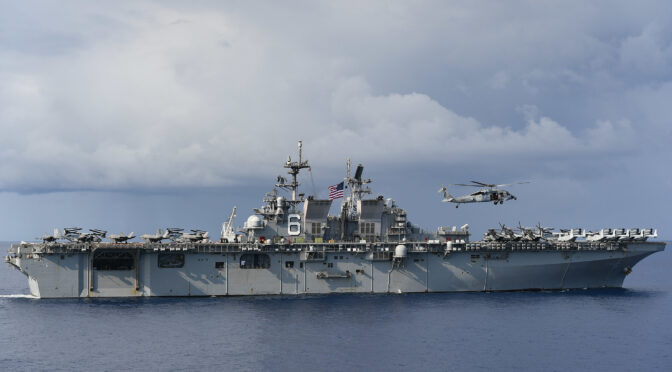
Featured Image: The amphibious assault ship USS America (LHD 6) transits in formation March 24, 2020.  Courtesy: U.S. Navy

Defending Global Order Against China’s Maritime Insurgency – Part 1

By Dan White and Hunter Stires

The international order has come under immense strain in recent years. Major wars have erupted between the great powers in Ukraine and the Middle East. The U.S.’s top geopolitical rivals have increasingly coalesced, with China and Russia both rapidly modernizing and expanding their arsenals of strategic weapons. Meanwhile, a Chinese invasion of Taiwan looms, possibly backed by Moscow. The current challenges make China’s years-old claims to the entirety of the South China Sea seem quaint and insignificant in comparison.

Hunter Stires, who served as the Maritime Strategist to the Secretary of the Navy during the tenure of Secretary Carlos Del Toro, views each of these challenges as interconnected parts of a global struggle for the Freedom of the Sea and the international order, with the central front in the South China Sea. Stires believes the future of global order rests on the extent to which China succeeds in claiming ownership to one of the world’s most important waterways and disrupting the centuries-old concept of the freedom of the seas upon which the modern global order was founded. Stires helped found the U.S. Navy’s Maritime Counterinsurgency (COIN) Project to better conceptualize and combat China’s battle to overturn the international order at sea. This interview captures Stires’ thoughts on the history of the Maritime COIN project and its ongoing relevance for intensifying strategic competition between the US and China.

Dan White: When most Americans think about China’s naval activities or aggressive behavior in the South China Sea, the predominant topic of discussion is challenging U.S. regional dominance and laying the groundwork for the invasion of Taiwan. You started the Maritime Counterinsurgency Project because you believe China’s actions in its near seas have much broader implications. Can you summarize what you believe is at stake and why Americans who may be skeptical of commitments to regional security in Asia should be concerned about China’s behavior, particularly in some of its more low-level aggressive behavior that it has exhibited towards our allies in the Philippines, or elsewhere in the South China Sea.

Hunter Stires: I think you hit the nail on the head, that when we think about China, we very often like to think about the big things. Every so often you hear about island building, although that was done about 10 years ago. You hear about the growth and the development of the People’s Liberation Army Navy, particularly in capital ships like carriers, cruisers, and destroyers.

What you don’t hear about are these lower intensity efforts to coerce and intimidate local civilian maritime populations in Southeast Asia. It bears repeating, half the world’s fishing fleet operates in the South China Sea. There are probably 3 to 4 million people who depend on access to this body of water for their livelihoods, whether as fishers, or resource extractors in the hydrocarbon industry, etc. China is subjecting this very substantial civilian population to a concerted campaign of intimidation and harassment.

What we are seeing, as you’ve noted, is that these Chinese forces will steal fishermen’s catch. They will confiscate radios and navigational equipment that are essential to safe navigation in busy waters. They will pour gasoline in drinking water supplies of Vietnamese fishermen to force them to return to shore. We see them ram and, occasionally sink or attempt to sink, not only civilian vessels, but ram Philippine Coast Guard vessels in attempts to sinks or disable them as the Coast Guard defend their sovereign rights to their exclusive economic zone as recognized under the UN Convention on the Law of the Sea.

And so, to your point about this broader implication of these kinds of seemingly minor activities in and of themselves, what’s really being contested are actually some of the foundations of that Rules-Based International Order. And beyond international order, it’s really one of the most fundamental principles of the modern system of international law, freedom of the seas.

Freedom of the seas is a principle that is four centuries old. It started with Hugo Grotius, who popularized the idea that the seas are open to everybody. They are a global commons for all mankind. And whatever rights countries have at sea is based on what they have on land. This was a foundational principle of customary international law.

More recently, it has been codified into the UN Convention on the Law of the Sea, which has been accepted by pretty much everyone—China included. The United States hasn’t ratified it because Congress had issues about deep-sea mining, but the rest of the time, we say this is a codification of customary international law, and therefore, we not only follow the law better than anybody else, we take the lead in enforcing it.

The freedom of the sea has been a foundational principle for the United States since before we were a country. It is a principle for which the United States has gone to war no less than six times, not counting numerous smaller constabulary actions by U.S. Naval Forces around the world over the past two and a half centuries.

China is trying to overturn this system of international law and the freedom of the seas, and replace it with its own sino-centric, hierarchical, authoritarian vision of what they refer to as “blue national soil.” As the phrase implies, this means the oceans can be claimed as if they are land. You basically fence off a patch of ocean and stick a flag in it, regardless of where that happens to be. In doing so, they seek to disenfranchise their less powerful neighbors from their rightful exclusive economic zones under international law.

There are generally two ways these two legal orders can contend with each other.

One is the conventional approach, which is where each side gets out their military, they have a fight, and then after the fight is over, the winner sequentially imposes their laws on the civilian population. That’s the sequential method, we generally refer to that as conventional war.

Now for the other option. If one side either doesn’t think they would win that fight, or if they just choose not to engage in that kind of conventional force-on-force confrontation, they have the option to decline battle with the defender of the established order and instead, seek to impose their own laws on a civilian population. That is what you are seeing China do. And we have a term for that kind of campaign design: it’s an insurgency.

Why does this matter, and why should Americans continue to care about the freedom of the seas? Taking a strictly national perspective here, the United States is dependent on the sea for its political, economic, and military access to the overwhelming majority of humanity, which lives outside North America.

If you want to reach anyone in the world in Europe, Asia, and Africa, you’ve got to travel there on or over the water. If the freedom of the sea goes away and can be overturned without so much as a shot being fired—which is a very real possibility if we allow China’s maritime insurgency to proceed unchecked—it will lead to the balkanization of the world’s oceans. This means a variety of avaricious coastal states come along in addition to China and lay claim to a patch of ocean, just because they really want to and have the means to enforce it.

This cuts against this fundamental principle of the rule of law in international affairs as opposed to might makes right. Over the last 80 years since World War II, that principle of the rule of law, has been very positive for humanity. The freedom of the sea in particular has been the foundation of the post-war international order. It is the fundamental enabler of the free and open trading regime that has lifted more people out of poverty and oppression than in any other period of time in human history. The freedom of the sea is worth defending.

In the present environment, where you have China seeking to undo the freedom of the sea without having to go to war against the guarantor of international maritime order, the challenge for the United States is to devise a strategy that can arrest China’s creeping expansionism without having to go to war ourselves, while reassuring these local civilian maritime populations that the rules have not, in fact, changed—that the rule of law remains in force and that they can continue to exercise their rights and pursue their economic interests.

Dan White: On October 28th, the National People’s Congress Standing Committee passed a new maritime law for China that will go into effect in May 2026. China is now creating a framework for settling local cases in its own courts and establishing a parallel regional system of maritime law.

Hunter Stires: That is very consistent with the way China has been pursuing its strategy in the South China Sea. As you said, China seeks to impose its own laws—made in Beijing—on the civilian maritime populations of its neighbors. They seek to do this, again, not by going to war, but by going out and imposing their laws and forcing these fishermen and oil and gas merchants to submit to Chinese dictates or face some pretty horrible consequences.

These laws are designed to intimidate. And now, by creating dispute resolution mechanisms, they seek to position themselves as the arbiter of who governs where, and how resources are allocated in the South China Sea.

The allegory of a mafia group, or a local street gang is instructive here. Imagine you’re minding your own business, living in your neighborhood, and then one day a bunch of scary-looking guys with guns decide they really like your neighborhood, too. And they have decided it’s now their neighborhood, and now nobody gets to walk down the street, nobody gets to operate or patronize a business, without acknowledging the authority of the gang.

It doesn’t matter who they are, by the way. This same story could be told about a Mafia syndicate, a street gang, a drug cartel, a terrorist group. It’s all the same modus operandi. The mafia calls it protection money, China calls it “joint development of offshore resources in the South China Sea.” And so now China is creating a court to adjudicate its protection rackets. Think about the opening of The Godfather. What is Don Corleone doing? He is receiving supplicants and adjudicating cases as a local potentate would in the old days of kings and princes. China would like to do this as well. That certainly fits with China’s vision of itself as the center of world civilization, as the Middle Kingdom surrounded by progressively expanding concentric rings of tributary states and vassals. This is very much in keeping with China’s strategic culture and its sense of itself as the hegemonic power in the region.

What is helpful for the United States and our allies and partners is that the countries that have lived for periods of their history under Chinese domination have found that they don’t like it. Now they are keen to maintain their independence, and especially from such a coercive group of international gangsters as the regime in Beijing. They don’t want to submit to that. And international law has given them rights to these resources under an international order that is fair and equitable—which, by the way, China itself substantially shaped.

The Chinese government claims that, “oh my goodness, the UN Convention of the Law of the Sea was decided before we were powerful, and we didn’t get a say.” That’s complete horseshit. The Chinese delegation was instrumental in the negotiations, particularly in the development of what has become the globally accepted concept of the Exclusive Economic Zone. So, the notion that they were not consulted, that this is like one of the unequal treaties or something that was imposed on China during its century of humiliation, it’s a load of baloney. We should all be much louder in calling it as such.

It’s a good system that is equitable, and we should stand up for it.

Dan White: The Maritime COIN Project began three years ago. How has China’s behavior in the South China Sea evolved since the project started? What changes in behavior has China exhibited in the South China Sea, and has its behavior in the South China Sea expanded into other areas?

Hunter Stires: I’ll back up a bit in terms of the origins of the idea and the project. The concept of maritime insurgency and counterinsurgency we originally put forward in a piece in Proceedings in 2019 called “The South China Sea Needs a COIN Toss,” with a companion piece called “Why We Defend Free Seas.”

The very first person to reach out after those articles was then-Rear Admiral Fred Kacher, who was on his way out to the 7th Fleet to take command of Task Force 76, the 7th Fleet’s amphibious Task Force.  Shortly after he got out there, there was this major international incident off Malaysia involving a Malaysian-chartered survey ship called the West Capella, out exploring for oil inside Malaysia’s rightful Exclusive Economic Zone—that has the misfortune of being located inside China’s outlandish claim to indisputable sovereignty the 9-dash line.

And so, this is between March and April 2020, at the moment when COVID started and both of our carriers’ readiness in the region were greatly affected by COVID. Admiral Kacher basically goes to Vice Admiral Merz, the Commander of 7th Fleet, and says, “put us in coach,” because he has a baby flat top, the USS America, which at the time is the first ship in the U.S. Navy equipped with the F-35. So he’s got this very interesting group of capabilities, and he also commands the rotationally Forward Deployed Littoral Combat ships in Singapore. They then set about essentially implementing a trial run of this Maritime Counterinsurgency playbook, where it was a highly successful operational prototype.

Unlike the legacy naval playbook of taking large surface ships, driving through a disputed area, and then leaving, the thesis of the work of this task force was, “how do you influence the local civilian mariners?” The thesis is that the relationship with the civilians and their perceptions are the decisive relationship, not the relationship between U.S. forces and Chinese forces. Under these circumstances a transient operation is not going to have an impact on civilian behavior, whereas demonstrating a persistent presence at that point of gray zone attack is going to be much more effective.

Getting back to the local street gang allegory, it is about demonstrating you have the back of locals. The decisions of the civilians in that situation are going to be based on whether or not they believe that the defenders of the established order can protect them against the reprisals of the gang, should they choose to defy them. In this situation, if the local cops say, “you don’t need to pay the gang protection money,” but the cops are only there 10 minutes out of every day, and when the police cruiser rolling through, the gang will lie low but will reappear and take charge after the cruiser turns the corner.

This is not to say the U.S. Navy doesn’t need the SWAT team, the capability to break down your door, which it very much has in the region, but it also needs that persistent low-end presence, closer to that of the beat cop. This is where assets like littoral combat ships have the potential to be a very effective beat cop in the South China Sea. It’s frankly the mission they were actually designed for.

And so, Admiral Kacher starts out with his larger forces, his big deck amphib, a cruiser, and an Australian frigate.  They show up, and they stick around. They are visible and persistent, with very clear public messaging to the world to say, “we are here in support of our Malaysian allies and partners in pursuit of their lawful economic interests.” Every level of the Pacific Fleet followed this very clear and consistent messaging, and the Chinese became quite reticent.

Eventually, Kacher’s big ships have to rotate out but in their place he starts bringing in those littoral combat ships to sustain that presence over time and to continue to demonstrate that persistence. Despite notable Chinese pressure, the Malaysians stuck it out and finished all their planned work as previously scheduled and the Chinese got noticeably de-escalatory.  Within the next year, three major regional players, Indonesia, Malaysia, and the Philippines each took a more assertive posture to stand up for themselves and their economic and diplomatic interests in the South China Sea, which is something that hadn’t been seen in years of running the legacy playbook.

The success of that operational prototype was the genesis of the Maritime Counterinsurgency Project, mobilizing the leading minds of maritime strategy to think about how to sustain this effort in a systematic way.

The effect has been fairly noticeable. The Taiwanese press was all over it and covered the Project launch in the same breath as Nancy Pelosi’s visit to the island, framing both as examples of how the United States is putting serious thought into how to back up allies in the region against Chinese coercion. The Chinese were really quite displeased. There was a fair amount of coverage in both English language and Chinese language papers such as the South China Morning Post and the Global Times, basically saying “if the Americans actually do this, this is going to be a real problem for us.”

The effort coincided with the Marcos Administration coming to power in the Philippines, and the dawn of the Philippine Coast Guard’s assertive transparency campaign. U.S. naval operations have subsequently evolved in the region with increased deployments of littoral combat ships to places like Singapore, which give the U.S. Navy a cop on the beat in the South China Sea to serve as a force multiplier to our local partners.

By far the most significant positive change has been the growing strength and effectiveness of both the Philippine Navy and the Philippine Coast Guard. Over the last couple of years the Philippines Coast Guard has coupled its operations at sea with very clear messaging that they are there to protect their local civilian mariners against Chinese depredations. They are providing fuel and food supplies to fishermen and are directly challenging the China Coast Guard. They are filming it as well to show the world the brutish tactics that the China Coast Guard has practiced such as stealing fisherman’s cash, pouring gasoline in people’s drinking water, holding fishermen for ransom at several times for annual income, ramming and sinking boats. Showing the world that China is engaging in systematic maritime lawlessness, if not outright state piracy.

The Chinese have been ramping up their pressure on the Philippines in response. But the most important thing is that the Philippines hasn’t given up and as a result the Chinese have largely failed in achieving most of their objectives.

A number of other organizations have cropped up since the launch of the Maritime Counterinsurgency Project such as Project Myoushu at Stanford University’s Gordian Knot Center for National Security Innovation led by retired Air Force officer Ray Powell.

The U.S. Army, too, has gotten in the game in a pretty exciting way. Look at what General Charlie Flynn was able to accomplish at U.S. Army Pacific with the deployment of multi-domain task force assets and systems like the Typhon missile launcher to the Philippines. The Typhon represent a turnabout of the anti-access, area denial capabilities the Chinese had been trying to establish in the region for years. I highly recommend General Flynn’s contribution to the Maritime Counterinsurgency Project.

Rear Admiral Rommel Ong, the retired vice commander of the Philippines Navy, has made the observation based on the writings of counterinsurgency expert David Galula that the support of the population is gained by an active minority. He asserts that if you look at the entire region of Southeast Asia, and if you position the nations of the region as the population in that insurgency-counterinsurgency relationship, most of them are not going to get off the fence. There is a really long diplomatic tradition of hedging and neutrality in the region and deep relationships, economic and political and otherwise, with China. But he observes that all that is needed is an active minority to succeed here. This active minority can be the United States, Japan, and the Philippines.

I would add South Korea to this grouping as well. South Korea and Japan have played an indispensable role in the buildup of capability of the Philippine Coast Guard and the Philippine Navy. The Philippines now has a highly capable, Japanese-built coast guard and an increasingly capable South Korean-built navy.

China has attempted to reassert itself in response, recently declaring a 30-mile exclusion zone around Scarborough Shoal, declaring it a nature reserve. An ironic gesture given that Chinese activity, including dredging for giant clams, destroyed the place from an environmental standpoint.

The Philippines are holding their own, and their political will is a critical part of deterring China. Admiral Ong has also written about the importance of national will and references “The Cod Wars and Lessons for Maritime Counterinsurgency,” which discusses the brief maritime conflict between Iceland and Britain over access to fishing grounds in the Arctic.

Admiral Ong’s take away is that the Philippines is in a similar position to Iceland, and must sustain the same level of national will to afford the tactical innovation and assertiveness in the water to defend its interests against a bigger opponent. Looking at the Philippines and what they have been able to accomplish over the past couple years, I’d say they are working very assiduously to be more like Iceland in the Cod Wars, and as we know, Iceland won.

Dan White is an independent foreign policy analyst based in the New York Metro Area. Dan is a former member of the The Wilson Center and The Kennan Institute, and a veteran of the War in Afghanistan. Dan maintains a newsletter, OPFOR Journal, which analyzes strategic competitions with Russia, China, Iran and North Korea.

Hunter Stires served as the Maritime Strategist to the 78th Secretary of the Navy, where he was recognized for his work as one of the principal architects of the Maritime Statecraft strategy. He serves as the Project Director of the U.S. Naval Institute’s Maritime Counterinsurgency Project, a Non-Resident Senior Fellow with the Navy League’s Center for Maritime Strategy, and the Founder and CEO of The Maritime Strategy Group. 

Featured Image: The amphibious assault ship USS America (LHD 6) transits in formation March 24, 2020.  (U.S. Navy photo)

Scotland, Counter-Insurgency, and Sea Control

This article is part of a series hosted by The Strategy Bridge and CIMSEC, entitled #Shakespeare and Strategy. See all of the entries at the Asides blog of the Shakespeare Theatre Company. Thanks to the Young Professionals Consortium for setting up the series.

1_FYwDrMPjtw8FffAcTb8iwQWhen curtains close on Shakespeare’s 1606 The Tragedy of Macbeth, audiences are left to ponder the fate of Scotland. Contemporaries of the playwright were well aware of the Union of the Crowns a mere three years prior in 1603, uniting the rule of England and Ireland under James the VI, King of the Scots. But few could claim to know the events that followed Macbeth’s toppling by the hands of an English army half a millennium earlier. Part of the problem is that as with many popular pieces on Scottish history, such as Braveheart, a factual recounting – if one could be determined in the first place – is sacrificed to good story-telling.

Dunsinane, written by David Greig and playing in an excellent National Theatre of Scotland production at the Shakespeare Theatre Company’s Sidney Harmon Hall in Washington, DC, through February 21st, brings a few elements of the story closer to what is known: Macbeth ruled for over 15 years and wasn’t widely considered a tyrant. The narrative largely picks up where Macbeth left off, chronicling England’s attempt to establish a friendly regime across its northern border and the subsequent insurgency and counter-insurgency campaigns. Greig uses this context to explore military, political, and moral themes (more on those later) quite familiar to those who’ve lived through or in the shadows of the wars in Iraq and Afghanistan.

But what does sea power have to do with a land war and occupation of physical territory? A monologue from a boy soldier opens the show:

“We boarded our ships at the Thames mouth.
There were two thousand of us and also
Some horses for the knights to ride and animals
For us to slaughter on the way.

_MG_0095 (2)We stood on the Essex shore a mess of shingle,


Some of us new and eager for a fight and others
Not so sure but all of us both knowing and not knowing

What lay ahead of us.

Scotland.

Scotland. Where we would install a king.

…..

Of the river Forth and we landed in a place called Fife –
Which is wild compared to Kent –
And there we camped in woods near the abbey of Inchocolm.

And waited until at last he came to us – Siward
Our commander – and he told the sergeants it was time
To prepare us to fight.

Clearly sealift and local sea control can smooth the path for an initial military assault. The sea journey described above is just shy of 400 nm, and would have taken far less time than a northward march, thereby increasing the chance the expedition maintains some element of surprise. Whether the landing force is completely unexpected or merely arrives sooner after word reaches Macbeth and his advisors at Dunsinane, seat of his power, the force would have faced less entrenched and ready resistance. Additionally, had Macbeth received early warning, the mobility afforded by the sea would still have allowed the expedition some latitude in choosing where to disembark – a perennial complication for military planners facing an amphibious landing, from the American revolutionaries accounting for the movements of the British to Nazi Germany awaiting the Americans.

Invasion by sea would also have impacted the campaigns’ logistics. The initial requirements for foodstuffs and military supplies would have been greater than on a march, which could have offered a mix of supplies provided by other vassals when available and foraging in their absence. But the fact that the force set off from Essex indicates many of the forces were raised by southern nobles, easing the burden on the expedition’s northern commander, Siward, Earl of Northumbria. A march through his lands, bordering Scotland, would also have risked engendering a hostile populace enroute that might have joined Macbeth’s cause.

As in a later invasion of Scotland during the (2nd) English Civil War, the sealift could have been retained for resupply over open sea lines of communication (SLOCs) to limit the need of the expedition to disperse and forage after landing. It is unclear in Dunsinane whether the ships were kept at hand. But indications are that the English did not anticipate a long phase of contested nation-building to defend their installed king’s regime, and likely expected to rely on Siward’s neighboring realms as the situation changed. They may also have believed local sea control and predictable SLOCs would be challenged by other powers such Norway, which commanded more allegiance from some Scottish chiefs than the king at Dunsinane. This allegiance in turn was easier to command when, due to Scotland’s extensive coastlines, sea control could be no more than a localized or transitory thing, meaning other foreign powers could provide even overt support to prop up local proxies with little risk of interception.

Whether fleeting or near-absolute, a mastery of the waves confers both advantages and dangers. When it comes unchallenged at the start of a campaign it can breed an overconfidence that the rest of the endeavor will be as easy. Additionally, while command of the seas can be a great enabler in projecting power against an enemy state, it is of more limited use if a war transitions to a counter-insurgency phase where the nexus of success resides with the support of the people. This is not to say it’s of no use – the success of the U.S. counter-insurgency campaigns in the Philippine-American War were possible only through extensive naval activities – but unhindered SLOCs could only set the stage in cases such as Vietnam and Iraq, where what happened ashore was in many ways divorced from what happened at sea. It’s a lesson those eying an enemy (or wayward province) across the waters would do well to remember.

unnamed

In Dunsinane, sea power is a minor character, and the end of major combat operations it supported does not mark the beginning of peace. That comes with acceptance of defeat by the enemy, which as Clausewitz notes cannot always be imposed through the mere “total occupation of his territory.” And, as the German states learned in the Franco-Prussian War, the destruction of a regime’s forces can create a power vacuum filled by those even more loathe to throw in the towel. In the face of a recalcitrant foe, an occupier that increases its stay tempts provoking the people and swelling the ranks of the enemy.

While Siward and the English may have factored in the risk of rising resentment in their decision to invade by sea, they seem to overlook that of outlasting their welcome. In lines that could have been taken from The Accidental Guerilla, a book by Gen. Petraeus’s senior counter-insurgency advisor, David Kilcullen, Siward’s subordinate Egham says:

They’re not fighting us because of their Queen. They’re fighting us because we’re here. The Scots will fight anyone who’s standing in front of them. They like fighting. In fact – they’re fighting us partly because we’re stopping them from fighting each other.

Image-5 470x394Successful insurgencies and counter-insurgencies make this fighting personal. The former try to provoke an emotional (over-) response from the latter, while the later try to win the hearts and minds (or at least acquiescence) of the people through a return to a semblance of normalcy. In the forthcoming novel Ghost Fleet, by Peter Singer and August Cole, which also draws inspiration from the recent decades of counter-insurgency, a colonel chides another commander for “taking the losses from the insurgency personally…missing [the] greater responsibilities.” The death of Siward’s son at the beginning of the play makes the campaign immediately personal for him. While he and Egham both try to protect their men from harm by seeking accommodation with their former enemy, once the blood of their comrades is spilled in the insurgency phase Siward quickly goes through the seven stages of grief to punitive violence.

I don’t have as much experience with counter-insurgency as others writing in this series do, so I can’t say with certainty how I would handle the personal nature of it. Twice – in 2009 and in 2015 – I was ordered to spend a year with the war in Afghanistan, but twice those orders were cancelled – after 1 week and 4 hours respectively (I learned after the first time to wait awhile before telling my wife, just to be sure). But I’ve been lucky. Sailors by the thousands have been called from Active Duty assignments and the Reserve to serve in the counter-insurgency campaigns in Iraq and Afghanistan, and some are still being sent to the latter to this day. This is to say nothing of the contributions of the U.S. Marine Corps. Sea control may not make much difference in the counter-insurgency campaigns of Dunsinane or Afghanistan, but at the individual level the line between sea power and land power, between sailor and soldier, has blurred.

Scott Cheney-Peters is a surface warfare officer in the U.S. Navy Reserve and the former editor of Surface Warfare magazine. He is the founder and president of the Center for International Maritime Security (CIMSEC), a graduate of Georgetown University and the U.S. Naval War College, and a member of the Truman National Security Project’s Defense Council.

Developing an Assessment for the IO Environment in Afghanistan

You may be wondering what an article about Afghanistan is doing on a site about maritime security. Well, I found myself asking a very similar questions when, within six months of joining the U.S. Navy and graduating from Officer Candidate School (OCS) in Pensacola, FL, I found myself in a land-locked country serving on a Provincial Reconstruction Team (PRT) conducting counterinsurgency operations. The irony was not lost on me since I had joined very late in life (I was 35 when I went to OCS). The recruiter had said, “Join the Navy and see the world!” Little did I know we’d be starting in alphabetical order …

Meeting the requirements of an “individual augmentee” – (Fog a mirror? Check!) – and having just enough training to know how to spell “IO,” I arrived in Khost province in early 2008. I was fortunate to relieve a brilliant officer, Chris Weis, who had established a successful media and public diplomacy program and laid the groundwork for a number of future programs.

I decided that before setting out to win the “hearts and minds” of the local population, we needed to take stock of where we were and whether our efforts were achieving the effects we desired.

The goal of Information Operations (or “IO”) is to “influence, corrupt, disrupt, or usurp adversarial human and automated decision making while protecting our own.”[i] But how does one know whether the decision process, either human or automated, has actually been influenced in some way? We can assume or surmise that, based on the actions of the target of the IO campaign, some desired effect was achieved or not achieved. But how much of that was based on our IO campaign and how much on other factors, perhaps unknown even to us? We can also attempt to ask the target after the fact whether campaign activities influenced their decision making. But such opportunities might rarely arise in the midst of on-going operations. 

Commanders conducting counterinsurgency operations should have two primary IO targets: the insurgents and the local population. Retired U.S. Army officer John Nagl notes that “persuading the masses of people that the government is capable of providing essential services—and defeating the insurgents—is just as important” as enticing the insurgents to surrender and provide information on their comrades.[ii] A PRT is not charged with directly targeting insurgents. Instead, its mission is to build the capacity of the host government to provide governance, development, and these “essential services” for the local population.[iii]

Information Operations traditionally suffer from a lack of available metrics by which planners can assess their environment and measure the effectiveness of their programs. It may be impossible to show direct causation, or even correlation, between Information Operations and actual effects (i.e., did my influence program actually have its desired effect?). This often places IO practitioners at a distinct disadvantage when attempting to gain the confidence of unit commanders, who are tasked with allocating scarce battlefield resources and who are often skeptical of Information Operations as a whole.

Given these constraints it was clear that the PRT in Khost province, Afghanistan, needed a tool by which the leadership could benchmark current conditions and evaluate the information environment under which the population lived. We hoped that such a tool could help provide clues as to whether our IO (and the overall PRT) efforts were having the intended effects. As a result, we developed the Information Operations Environmental Assessment tool, which can be used and replicated at the unit level (battalion or less) by planners in order to establish an initial benchmark (where am I?) and measure progress toward achieving the IO program goals and objectives (where do I want to go?). 

Since my crude attempt was first published in 2009, the U.S. Institute of Peace (yes, there is such a thing) developed the metrics framework under the name “Measuring Progress in Conflict Environments” or “MPICE.” This project seeks to:

provide a comprehensive capability for measuring progress during stabilization and reconstruction operations for subsequent integrated interagency and intergovernmental use. MPICE enables policymakers to establish a baseline before intervention and track progress toward stability and, ultimately, self-sustaining peace. The intention is to contribute to establishing realistic goals, focusing government efforts strategically, integrating interagency activities, and enhancing the prospects for attaining an enduring peace. This metrics framework supports strategic and operational planning cycles.

No doubt the MPICE framework is far more useful today than my rudimentary attempt to capture measures of effect in 2008, but I hope in some small way others have found a useful starting point. As I learned firsthand, and as practitioners of naval and maritime professions know, what happens on land often draws in those focused on the sea. 

The author would like to thank Dr. Thomas H. Johnson and Barry Scott Zellen, both of the Naval Postgraduate School, for their professional mentorship and constructive advice, and for including my work in their book.

LT Robert “Jake” Bebber is an information warfare officer assigned to the staff of Commander, U.S. Cyber Command. He holds a Ph.D. in public policy from the University of Central Florida and lives with his wife, Dana and son, Vincent in Millersville, Maryland. The views expressed here are not those of the Department of Defense, the Navy or those of U.S. Cyber Command. He welcomes your comments at jbebber@gmail.com.


[i] Joint Publication 3-13 Information Operations, p. ix

[ii] Nagl, John A. Learning to Eat Soup With a Knife: Counterinsurgency Lessons from Malaya and Vietnam. Chicago: University of Chicago Press, 2002, p. 93.

[iii] Ibid.