
By Dan White and Hunter Stires
Dan White:
China’s behavior in the South China Sea, along with efforts to highlight it such as the Philippines Transparency Initiative, and deter it such as the Maritime Counterinsurgency Project do appear to be changing public opinion. This year 51.6% of respondents to the State of Southeast Asia 2025 Survey ranked China’s aggressive behavior as their top geopolitical concern, the highest level recorded since the survey started in 2019.
But China is learning as well. How has China’s behavior in the region evolved over the past few years of encountering resistance from the Philippines and changes in U.S. strategy?
Hunter Stires:
China is certainly learning and innovating at the tactical level. At the same time, I tend to think that China’s problem is that it is not learning and they are instead doubling down on this maritime insurgency strategy.
They are going to fail if they continue this strategy. This is a fight about who governs in a particular space. If you’re having a fight about who governs, you’re really having a fight about whose laws are enforced. Laws need to be accepted, and more importantly, adhered to in practice by the substantial body of the population that law aspires to govern. The laws civilians follow are both a metric of success as well as a mechanism of victory. Right now, Filipino mariners, both government and civilian, are still getting out on the water in defiance of Chinese actions. That is a bad sign for China.
Think of the billions and billions of dollars that China has sunk into this campaign. They have built numerically the largest Coast Guard in the world. They have spent approximately $13 billion constructing each of the three major island air bases they built in the Spratly Islands. These bases are also proving difficult to sustain due to the nature of the environment on a fake island so close to saltwater. They are also fixed assets that are highly vulnerable to attack in the event of war. They are helpful for supporting their maritime insurgency by helping to sustain Coast Guard and maritime militia forces but are less useful than investment into their broader navy. They could have bought Ford-class aircraft carriers for the money they spent constructing these islands.
After all this time, after all this effort, 51.6% of respondents, as you said, list China as the problem. And that is China’s greatest weakness here—no one likes them.
China is clearly banking that they can kind of cow everybody into compliance with their will by coercing them. But Beijing doesn’t understand that as long as the local Southeast Asian civilian mariners keep sailing, China will lose. China can keep on building ships but there are always going to be more civilian ships than there are Naval or Coast Guard forces. They will run out of money and people before they can impose their will on every civilian economic actor in the South China Sea where half the world’s fishing fleet resides.
The Philippines and other Southeast Asian states just have to stay in it. As long as they don’t give up they will ultimately prevail. The task of the United States and our allies and partners is to continue to reassure those countries’ governments and civilian maritime populations that we are with them and the rules of the freedom of the sea haven’t changed.
The U.S. also does not need to be everywhere Filipino fishing boats or other civilian mariners are either. That is what the Philippine Coast Guard is there for and has done an incredibly good job at. The U.S. is a key enabler that raises the effectiveness of local forces. Think of the Combined Action Program model that the Marines pioneered in Vietnam and which we then put to work very successfully in the Counter-ISIL campaign ten years ago. We bring heavy artillery, we bring air support, we bring helicopter medevacs, we bring logistics. And then the local force brings the commitment to defend their home, they bring local knowledge, and they bring mass. When those two things, military might and local resolve, come together they provide a very efficient economy of force for the U.S. and much more effective operations by that local home defense force than it would otherwise be able to accomplish on its own.
As the Philippine Coast Guard and Navy continues to grow and strengthen capability, it takes more and more of a leading role. The U.S. Navy is then able to remain in standby and deter Chinese aggression by conveying that an attack on one will bring the intervention of the whole group.
Dan White:
A criticism of this approach is that it is a side show that distracts from the fight China is really preparing for, which is an invasion of Taiwan. China might abandon its maritime insurgency in exchange for prioritizing all its resources for an all-out attack on Taiwan. In which case America’s naval resources will have been focused on the wrong fight. How would you respond to that?
Hunter Stires:
You absolutely have to be ready for that high-end fight. But the high end is not the only way that China could get its way. If China is successful at overturning the freedom of the sea, it will position itself to secure control over the Eurasian continental heartland while shutting out America from access to the overwhelming majority of the world’s population and markets. This is what Napoleon tried and failed to do to Britain during the Napoleonic Wars. France created a continental system to mobilize the resources of Europe for France’s purposes and deny Britain trade, but Britain was able to survive because they had an overseas empire and other people they could trade with.
China is similarly trying to create a continental system across Eurasia and Africa with its One Belt, One Road initiative. That is most of the world’s population. If they also succeed in balkanizing the world’s oceans they could shut the United States out of Eurasia. Seas that are no longer free become obstacles to trade and influence. China could then relegate the U.S. to the world’s economic and geopolitical periphery unless we submit to its dictates. Looking at the logical end-point of China’s actions if successful, we can deduce that this is probably Beijing’s desired end state.
Dan White:
It sounds like what you are saying is that the broader Chinese strategy is to turn its much weaker maritime geography, where it is enclosed by chains of large islands, into a geopolitical advantage by weakening open access to those seas. By getting local actors to bend the knee, China makes its unfavorable geography into a moat that it can use to seal off the world island of Eurasia, and use it as a springboard for projecting power outward. Once China controls the South China Sea it can more safely attack Taiwan and then put pressure on the U.S. across the broader Indo-Pacific. At this point the U.S.’s distance from the region becomes more of a liability than an advantage. It then becomes much harder for the U.S. to match the amount of power it can project at a distance in the Indo-Pacific than China is able to project closer to its shores. Is that a fair characterization?
Hunter Stires:
I think you got it exactly. China’s approach here is inherently continentalist. Its maritime strategy involves land-centric thinking. I would argue that’s actually a weakness of their strategy, because you can’t permanently occupy the ocean.
Think about the nature of China’s strategy here, as an insurgency, in the context of China’s strategic canon. Sun Tzu and Mao are the two most important figures. Of course, there are others, but these are the two principal writers that everybody reads. They’re both land commanders.
Sun Tzu advocates the indirect approach of winning without fighting or winning before the other side gets a chance to form ranks. Mao is the most successful insurgent in history. As a result, insurgent strategies permeate everything that China does. Insurgency is fundamental to the DNA of the Chinese Communist Party, because that’s how they came to power.
The fortunate news for us is there are a lot of different ways that we can cause that strategy to fail. Most of the targeted countries have a lot of incentives to reject Chinese domination. China has looming internal issues that will test the compact the Chinese Communist Party has with the people: how it continues to deliver prosperity while maintaining control over innovation; how it contends with upholding the social safety net while its population declines.
The key question is, will China become more outwardly aggressive once it faces these headwinds and perceives its window of opportunity to assert its power to be closing?
Certainly, there’s a lot going on here in the United States that also concerns me greatly. Developments in the United States are going to have a significant impact on China’s own calculus. But if I had to choose between America’s problems versus China’s problems. I would pick our problems every time. Ours are inherently solvable. We just have to choose to solve them. That is often hard, because we’re a big country, we’re a fractious country, and we love to argue about things. But we are generally a good, reasonable group of people and we also have the benefit of the greatest geography in the world.
There is really no reason that we could not choose to solve the major problems that we have. China’s problems are much more structural. They are going to be a lot harder for them to solve.
Dan White:
This summer, China constructed new dual-use aquaculture facilities in Yellow Sea waters shared with South Korea—complete with helicopter pads and watchtowers—then imposed unilateral closures of those waters. In September, according to the Center for Strategic International Studies, the Coast Guards of China and South Korea engaged in a 15-hour standoff in the region, as China sought to impose further restrictions on South Korean movement within the Yellow Sea. Do you see this as an early sign that China is exporting its South China Sea playbook to the Yellow Sea, or is China’s behavior in the region motivated by another set of interests?
Hunter Stires:
That’s a really good way of putting it, that they are looking to export and expand that maritime insurgency into the Yellow Sea. And getting back to China making this profound set of mistakes in terms of antagonizing all its neighbors, it’s completely in keeping with their modus operandi. They’re needlessly antagonizing South Korea.
I think people throughout the region are also connecting China’s behavior to the Taiwan conversation. People are starting to see that if China decides to go to war in Taiwan, that it is not going to be an isolated thing. Japan and South Korea are dependent on sea lines of communication that pass by Taiwan. They are increasingly of the opinion that there is no way that they could stay out of a conflict. Same with the Philippines. This behavior reinforces that belief to some extent.
I think targeting South Korea will prove to be a mistake by China. While it may be challenging for South Korea, it has the means to hold its own. They have one of the world’s most formidable shipbuilding industries, which is an element of our broader Maritime Statecraft strategy, and key means of countering China’s maritime insurgency. The South Koreans are playing an important role in rebuilding our commercial and naval shipbuilding capability in the United States, as well as for other allies. South Korea is likewise playing an enormously important role in the development of the Philippines Navy.
I would not be surprised, by the way, if China were using some of these techniques to try and pressure South Korea or at least impose costs on it for its temerity in helping the United States and Philippines to stand up to Chinese aggression.
China’s present leadership has an instinct to escalate matters, which I think is frequently counterproductive to their broader diplomatic relationships. Look at the Wolf Warrior diplomacy, or as my mentor at the Naval War College, Jim Holmes, likes to call it, “jackass diplomacy.” Being a jerk to everyone is actually not a good foreign policy. Obviously, the U.S. is in the middle of finding that out the hard way for ourselves.
God willing, our political system retains the ability to change course. Self-correction is one of the most important strengths of democratic political systems and the great weakness of authoritarian political systems. China has less capacity for self correction, and they’re going to have a much harder time than we will.
So China’s behavior in the Yellow Sea could push South Korea to play an increasingly important role in maritime counterinsurgency. South Korea is effectively an island. They have a closed border to the north that cuts them off from the rest of the continent. Their trade can’t go by land. It has to go by sea. They must be a maritime power. This prompted them to create one of the most formidable maritime industries in the world. South Korea now has a highly capable navy and coast guard. We should not hesitate at the opportunity to engage them more directly across the theater, not just in the Yellow Sea and the East China Sea, but in the South China Sea as well.
The prospect of bringing South Korea in to join this broader coalition to implement a maritime counterinsurgency campaign, not just in the South China Sea, but across the entire breadth of the theater, I think this has the potential to be a very positive development for us and an unforced error by China.
Dan White:
I would be remiss not to connect Japan into all of this. Over the past couple months there’s been a huge rift in Sino-Japanese relations. This was prompted by Japanese Prime Minister Sanae Takaichi suggesting that a military invasion and blockade of Taiwan would constitute an existential threat to Japan. Do you think that’s been informed by Japan just watching this creeping expansion of Chinese maritime territorial claims?
Hunter Stires:
I wholeheartedly agree, this is an especially timely conversation. Japanese Prime Minister Takaichi is just telling the truth. If you look at the strategic geography, and you envision what Chinese control of Taiwan actually means for Japan, it very quickly becomes existential for Tokyo.
Japan is an island power. It is completely dependent on sea lines of communication for its survival. To have a hostile air and naval base just off its shores, bestriding those critical sea lines of communication, that is a big problem for Japan.
Japan is also a direct target of China’s broader maritime insurgency, with China’s challenge to the Japanese administration of the Senkaku Islands.
The Chinese clearly have a tendency and a preference t target one opponent at a time. They will escalate against the Philippines in a big way, and then they’ll potentially back off a bit, then they’ll escalate against Japan. Like a classic schoolyard bully, China tries to make everybody feel like it’s just them, that they are alone. But of course, they are not alone.
This is again, a major opportunity for the U.S. and a major strategic liability for the Chinese. They are effectively horizontally escalating their maritime insurgency across their entire maritime periphery. They are now actively antagonizing the U.S. and this set of our allies and partners. If we can sustain the engagement and the commitment among our allies to continue pushing back on Chinese encroachment this will put China in a position where it is effectively fighting a five front war.
The bigger risk is that China gets wise and goes back to the previous strategy, of trying to appeal to countries one at a time, and isolate and peel them off individually. That worked really well for them for a long time. Thankfully, the region has really wisened up to China’s bad faith in its dealings, so a return to that previous strategy might very well be unsuccessful. The best thing that China could do for itself is moderate its positions, end the maritime insurgency and develop genuine win-win relationships with its neighbors. The United States should continue to do the same and be good friends and allies and uphold international law.
As Jim Mattis liked to put it, “be strategically predictable, be operationally unpredictable.” The U.S. should be a country everyone can rely on. The last year has not been particularly healthy on that score and we should not be antagonizing so many of our friends and allies. Ideally, Congress should start to take a more active role in the conduct of our foreign policy to ensure we remain strategically predictable.
Thankfully, the foundations of these relationships for the United States are very strong. I love the expression that Kisun Chung, the CEO of HD Hyundai, one of South Korea’s leading shipbuilders, used to describe the South Korea-U.S. relationship when the Chief of Naval Operations came to a few weeks ago. He put it very eloquently that the United States and South Korea are “blood allies.” We have shed blood together. That is powerful.
Notwithstanding the political ups and downs of any given moment, that bond endures. It endures with South Korea, it endures with the Philippines. It endures with Taiwan and Japan too. We have shed blood together. We have stood alongside each other. We would be making an enormous mistake if we harm those relationships.
I think that the foundations of our bonds, of our alliances, of our strategy are much stronger than China’s. If we continue working together to grow our shipbuilding capability with South Korea and Japan; if we continue working with the Philippines, with Taiwan, with Korea and Japan and their world-class navies, and coast guards to protect and empower civilian mariners; if we support our friends in standing up for their sovereign rights against China’s maritime insurgency, I have great confidence that we are going to prevail.
Dan White is an independent foreign policy analyst based in the New York Metro Area. Dan is a former member of the The Wilson Center and The Kennan Institute, and a veteran of the War in Afghanistan. Dan maintains a newsletter, OPFOR Journal, which analyzes strategic competitions with Russia, China, Iran and North Korea.
Hunter Stires served as the Maritime Strategist to the 78th Secretary of the Navy, where he was recognized for his work as one of the principal architects of the Maritime Statecraft strategy. He serves as the Project Director of the U.S. Naval Institute’s Maritime Counterinsurgency Project, a Non-Resident Senior Fellow with the Navy League’s Center for Maritime Strategy, and the Founder and CEO of The Maritime Strategy Group.
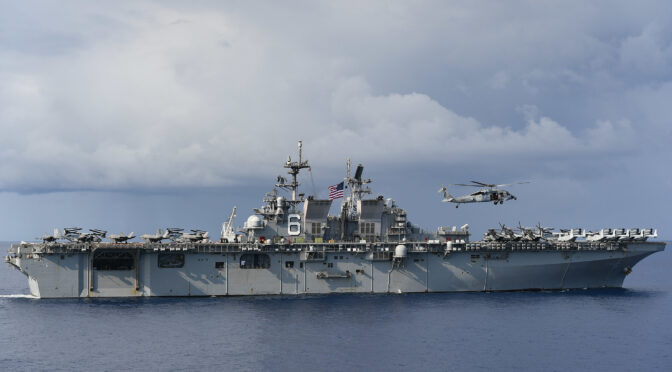
Featured Image: The amphibious assault ship USS America (LHD 6) transits in formation March 24, 2020. Courtesy: U.S. Navy
Discover more from Center for International Maritime Security
Subscribe to get the latest posts sent to your email.
Just superb! Thank you for this excellent comprehensive discussion of the srategic realities of the Pacific theater.
RADM Marfiak USN Ret.
Maritime Strategic planner
Olmsted Scholar