PLA Air and Maritime Maneuvers Across the First Island Chain

By Ching Chang

Between late 2016 and early 2017, there were several People’s Liberation Army (PLA) air and maritime maneuvers penetrating the so-called First Island Chain, including a deployment of the only People’s Liberation Army Navy (PLAN) aircraft carrier Liaoning battle group, for a routine exercise in the South China Sea. It went through the Miyako Strait between Miyako Island and Okinawa Island as well as the Bashi Channel, a part of the Luzon Strait between Taiwan and Philippines. All these maneuvers were perceived by strategic commentators and military observers as a milestone that can be signified in the efforts of the PLA’s force building.

Nonetheless, all the military maneuvers penetrating the First Island Chain during this period of time were not entirely revolutionary. Since early 2015, similar air maneuvers have been executed eight times. The Liaoning battle group only cruised through the waters on the east side of the First Island Chain, but no significant or even substantial drill was executed during this leg of maritime maneuvers. While these air and maritime maneuvers are intentionally showing off the PLA’s strength, these military deployments exposed many weaknesses strategically, operationally, and tactically.

First, it is debatable whether these maneuvers are really fulfilling the strategic blueprint of maritime dominance of various island chains as set forth by PLAN Admiral Liu Huaqing in 1982. Liu’s perspectives are widely addressed by many Western strategic thinkers, yet his argument had never been converted into any official PLAN doctrine. At least, the actual developments of PLAN deployments and operations are not consistent with Liu’s original concepts. We must consider whether the PLAN’s strategic planning is still directed and guided by Liu’s visions as presented in 1982. Otherwise, the blindness of self-fulfillment conviction can be a fatal factor in interpreting the PRC’s maritime or naval endeavors.

Second, penetrating the First Island Chain itself is not a strategic barrier but merely a psychological threshold. There are three factors in operational planning and execution: force, space, and timing. The essential strategic space is a geographical space which must be dominated or be occupied by the offensive forces as well as secured or controlled by the defensive side. The nature of the strategically essential space is quite dynamic. A perfect match of the three operational planning and execution factors may turn any geographical space into a strategically essential space at the right time for the right forces. It is meaningless for maritime forces to cruise in the waters that nobody would like to utilize and declare the dominance of these waters. 

On the other hand, cruising through several international waterways during peacetime does not prove the capacity of breaking wartime blockage since no other party had ever expressed objection to these legitimate maritime maneuvers. The fundamental question about these PLAN air and maritime maneuvers is how these maneuvers may imply potential wartime actions. The answer will be inconclusive since these maneuvers can be interpreted as everything but will not be firmly identified as anything. If dominating the waters around the East side of the First Island Chain failed to undermine potential adversaries’ maritime interests, then all the significance emphasized by various strategic commentators are in essence overstated. No matter how routine the People’s Liberation Army Navy and the People’s Liberation Army Air Force crossing the First Island Chain for air and maritime exercises may be, the strategic significance is relatively limited.

Third, unless all the island territories of the associated island chains can be well-controlled before executing any maneuvers, dispatching maritime forces and their airborne counterparts through the First Island Chain runs many risks during wartime periods. In fact, adopting the island chains as the relative geographical indexes may expose the strategic thinking as nothing but an extension of coastal defense. The core of maritime strategic thinking should be the command of the sea, including sea control and sea denial. The essence of maritime majesty is to compel adversaries to follow your will, not to control a space with no strategic value. As compared with Chinese global maritime activities, interests, and naval presence, the actual deployments of the PLAN fleet are already beyond those island chains. Without the dominance of the island chain land territories, the wartime operational sustainability beyond the island chains can be very questionable.

Fourth, many political commentators insisted these People’s Liberation Army exercises and military maneuvers penetrating the First Island Chain are about sending coercive signals to neighboring states, particularly, Taiwan, Japan, and the United States, about the Taiwan issue. The viewpoint can be another overstated bias. Given the three major channels of the PRC for declaring external policies associated with Taiwan, those spokesmen of the Foreign Ministry, Defense Ministry and Taiwan Affairs Office had never taken the initiative to deliver any related intimidating statements during these military maneuvers. In contrast, as many media expressed such speculations, all the PRC mouthpieces, including these three formal spokesmen systems, denied any association between the situations in Taiwan and these military activities. Of course, we still need to scrutinize the realities with the People’s Republic of China’s official statements. Although the cross-strait relationship has significantly deteriorated after President Tsai’s inauguration, the likelihood of employing these military exercises to coerce the Republic of China is still reasonably slim.

Fifth, as reflected by these military maneuvers and exercise scenarios, many operational and tactical features are worthy of discussions. These air maneuvers not only put the focus on air battles but also emphasize the considerations of engaging with the surface combatants, either surface vessels or military sites on land. Attempts for combining different air platforms and integrating units from People’s Liberation Army Air Force and People’s Liberation Army Naval Air Force (PLANAF) are obvious. Certain rules of engagement can be expected since a stable modus operandi is revealed by these maneuvers in different periods of time. The major task for the PLANAF is to practice engagement tactics for targeting surface vessels. Several PLAN surface vessels are concurrently directed as the counter forces for such exercises. Maritime patrol aircraft attend as the scouting platforms, and the airborne early warning and mission control platforms are effectively conducting their command and control functions for air combat and surface attack missions.

No indication of live fire exercise has  been seen with the air and maritime maneuvers across the First Island Chain conducted by PLAN surface vessels or their airborne counterparts so far, but it is only a matter of time. Also, very little evidence proves any significant electronic warfare drills having been executed during these maneuvers, though certain platforms may have the inherent capability for electronic warfare. There are flaws in the exercise plans as well. There are few indications for search-and-rescue arrangements or mechanisms or contingency measures for malfunctions or emergencies. Whether we need to praise the bravery of these PLA military professionals for long-range exercise without a bailout mechanism or speculate the reckless of the PLA operational staff is a topic for further observation.

Last but not least, nobody could ever properly describe the exact scenario for these air and maritime maneuvers until now. There is no clear PLA doctrinal norm to support these exercises with different combinations of platforms. The possible operational concepts reflected by these exercises are still yet arguable. Whether these military exercises may well support the possible political aim is still a myth to be further scrutinized. We fail to generalize any possible operational directive from the same well-known modus operandi for concluding possible rules of engagement since it is very hard to tell what should be the expected operational situations for employing these air or maritime maneuvers. After all, to firmly conclude any meaningful implication from events that only occurred less than ten times is indeed a challenge.

At most, we may successfully exclude some plausible speculations and groundless accusations with political smear intentions. To summarize a prompt judgment on these PLA maneuvers penetrating the First Island Chain recklessly, without military professionalism and political consciences, would be a sin of contributory negligence as we misperceive the potential challenge today and are forced to swallow the catastrophic failure in the future.

Dr. Ching Chang was a line officer in the Republic of China Navy for more than thirty years. As a visiting faculty member of the China Military Studies Masters Program at the National Defense University, ROC, he is recognized as a leading expert on the People’s Liberation Army with unique insights on its military thinkings. 

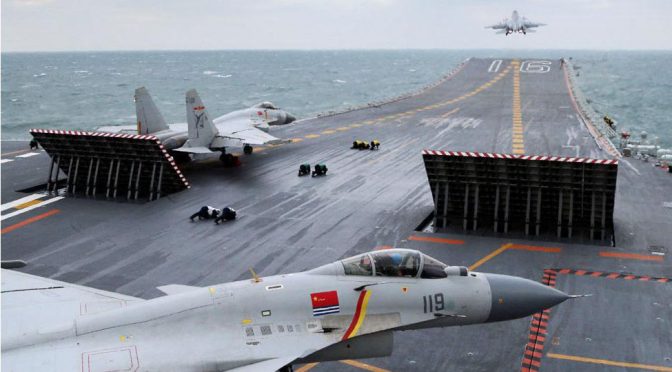
Featured Image: J-15 fighters launching off of PLAN carrier Liaoning (China Daily)

India’s Submarine Arm — Returning to Even-Trim

This article originally featured in Geopolitics and is republished with permission.  

By Vice Admiral Pradeep Chauhan, AVSM & Bar, VSM, IN (Retd)

The Indian Navy’s Submarine Arm will celebrate its Golden Jubilee Year in 2017. The imminent commissioning of the Kalvari — in her new avatar as India’s first Scorpène Class submarine — is, therefore, an especially timely portent of happier times for the underwater sentinels of our freedom. For some time now, much media-time has been devoted to lamenting the several perceived inadequacies in the country’s submarine prowess, especially after the tragedy that struck INS Sindhurakshak in Mumbai on 14 August 2013, resulting in the loss of 18 precious lives and the loss of an invaluable combat platform. As the Scorpène program ran into time overruns and as the People’s Republic of China began submarine forays into the Indian Ocean, breathless TV anchors defense correspondents have invoked ‘Upgrade’ as a new and urgent mantra against Chinese machinations. The truth is, of course, somewhat more prosaic. ‘Upgrades’ are part of a normal naval response to the technological and tactical changes wrought by the evolution of naval operations through which armed combat is prosecuted upon, over or under the sea. Can technological upgrades make up for numerical limitations? The answer is not straightforward. Although quantity does have a quality all of its own, in undersea warfare, technology has an inordinate influence upon the outcome of combat. So how do we currently fare in terms of both, absolute quantity, and the quality of the quantity that we do have — and what is the prognosis for the immediate future?

Before answers to these questions can be attempted, it is important to understand that warfare at sea differs markedly from that of armed combat upon the land. Terrain is arguably the most important determinant of land-based combat and, as a consequence, armies have goals of ‘occupation’ or ‘possession’ or ‘eviction.’ At sea, however, the effect of terrain diminishes sharply as the distance from the coast increases. The sea is fundamentally a medium of movement and cannot be ‘fortified’ or ‘occupied’. Navies cannot ‘dig-in’ and ‘hold’ sea areas that have great intrinsic value. Consequently, the aims of naval operations revolve around the ‘use’ or ‘denial-of-use’ of specific areas of the sea for a specific period of time. If we want to use a specific area of the sea for a specific period of time AND we don’t want the enemy to interfere with our use, we must exercise what is called ‘Sea Control’ in that sea area and for that period of time. If, however, we do not have any interest in using a specific area of the sea for a specific period of time, BUT we merely do not want the enemy to use it, we must exercise what is called ‘Sea Denial’ — once again in that sea area and for that period of time. Submarines (along with sea-mines) are classic platforms for sea-denial operations. Another feature of combat at sea is that the hunter and the hunted can operate in totally different mediums (surface, sub-surface, air/aero-space), each pretty much oblivious of the presence of the other — as in the case of submarines versus ships or submarines pitted against aircraft — whether fixed-wing or rotary-wing, manned or unmanned. 

Submarines have traditionally been used as a counter to surface ships — both, merchantmen (easy pickings) and warships (far riskier an endeavour). This is where they have the most advantage, operating in a different medium from their adversary and being able to vary their depth to take advantage of the various density-layers that lie between the surface and the sea-bed and affect the propagation of sound underwater. Weapons employed in such cases are typically anti-ship torpedoes and/or anti-ship cruise (i.e., non-ballistic) missiles. Submarines can also be used against targets ashore (on the land) — i.e., for land-attack. They must then be equipped (or be retrofitted) with suitable land-attack missiles with either conventional or nuclear warheads. Naturally, this impacts the size of the submarine’s hull and imposes restrictions upon how close it can approach the coast. 

When submarines are designed or deployed to operate against other submarines, the advantages accruing from disparity of medium no longer apply, for both opponents are now within the same (underwater) medium and torpedoes become weapons-of-choice. Since submarines generate underwater sound in a variety of frequencies, the factor determining surprise is relative noisiness — more usually expressed as ‘stealth.’ SSBNs are inherently noisy. Consequently, smaller and equally speedy but much quieter SSNs, equipped with missiles and torpedoes instead of nuclear-tipped, long-range ballistic missiles are deployed to detect and continuously track an adversary’s SSBNs. Likewise, modern diesel-electric submarines (SSKs) are often far quieter than an SSN and are designed to track and, where necessary, attack not just surface ships but also SSNs — or even other, relatively-noisier diesel-electric submarines. 

Nuclear propulsion maximizes underwater speed and endurance, but demands a larger hull and constrains the submarine in littoral waters. Diesel-electric submarines are far smaller than SSNs and SSBNs and can, consequently, operate both, in the deep seas and in relatively-shallow littoral waters. They make-up for their relative lack of underwater-endurance by one or another type of Air Independent Propulsion (AIP) package, but nevertheless yield enormous underwater speed-advantages to SSNs/SSBNs.

It is against this very rudimentary and fairly simplistic backdrop that one should review the state of Indian submarines (aka boats) and their upgrades. 

India currently operates two classes of nuclear-propelled boats: SSBNs (the Arihant) and SSNs (the Chakra), and, two classes of diesel-electric SSKs (the KILO or Sindhughosh Class, and the Type 209/1500 Shishumar Class), with the commissioning of the lead boat of a third class — the Scorpène Class (which will thereafter be known as the Kalvari Class) — imminent. 

Current upgrades to the Arihant revolve about the replacement of its twelve ‘K-15’ submarine-launched ballistic missiles (which have a range of 750 km) by four longer-range (3,500 km) ‘K-4’ Intermediate Range Ballistic Missiles (IRBM), which have already been successfully test-launched (in April 2015) from the Arihant. This weapon-upgrade is well in hand.  However, as India takes the next step in the K-series and begins to produce K-5 — a true submarine-launched inter-continental ballistic missile (ICBM) — the submarine will need to be correspondingly larger with a greater displacement-tonnage. Consequently, for the next boat of the Class, the Arindham, there is a clear need to upgrade the reactor. The Arihant has an 85-MWt reactor (≈17 MWe, since in a naval reactor, roughly 5 MWt = 1 Mwe). The one for the larger and heavier Arindham will need to be somewhere between 160-190 MWt (32-38 MWe) and this is an upgrade that is ongoing.

There is no immediate equipment upgrade planned for the Chakra whose 10-year lease is at the halfway mark. However, the fact that in February 2015, the Modi government accorded political approval for six SSNs, makes a training and manpower upgrade for the Navy a critical objective over the next decade.

Turning now to the central issue of upgrades to India’s conventional submarines, two overarching aspects need to be borne in mind: 

  • The first is that contrary to some mildly hysterical reports in the electronic media, these upgrades are not a knee-jerk reaction to the large Chinese submarine inventory or Pakistan’s submarine program. Nor are they some desperate measure being taken to counter inadequacies in the numbers of submarines held by India. Even if the Indian Navy had three times as many submarines as it does, periodic upgrades would still be the norm. 
  • The second is that contrary to the alarmist lament that India’s diesel-electric submarines — especially the nine surviving boats of the Sindhughosh Class — have crossed their designed-life and are not much better than floating coffins the truth is much more reassuring. The authorized total technical service life of each submarine is actually 35 years. At or around the 13th year of service, each boat undergoes what is known as a ‘Medium Refit’ (MR). This takes two-to-three years, during which time, major upgrades are effected and the submarine is made ready to operate in the contemporary environment for another decade-plus. Then, around the 26th year of service, each boat undergoes a 27-month Service Life Extension Program (SLEP), which enables it to be materially and operationally viable — once again within the prevailing contemporary environment — for the next 9-10 years.

Most MRs of the Sindhughosh Class, have been undertaken in Russia. However, two — Sindhudvaj and Sindhudvaj — underwent MRs at the Naval Dockyard, Visakhapatnam, while the Sindhukirti suffered a dreadfully protracted MR in HSL. The Sindhukesari is the first to have commenced her SLEP. The residual life of the Class may be assessed through the following tabulation:

Submarine Commissioned 13th Year Medium Refit

(MR)

MR done in: 26th Year SLEP (done in) 35th Year
Sindhughosh 30 Apr 86 Apr 99 2002-05 Russia Apr 12 Apr 21
Sindhudhvaj 12 Jun 87 Jun 00 2002-05 India (ND[V]) Jun 13 Jun 22
Sindhuraj 20 Oct 87 Oct 00 1999-01 Russia Oct 13 Oct 22
Sindhuvir 26 Aug 88 Aug 01 1997-99 Russia Aug 14 Aug 23
Sindhuratna 22 Dec 88 Dec 01 2001-03 Russia Dec 14 Dec 23
Sindhukesari 16 Feb 89 Feb 02 1999-01 Russia Feb 15 2016-2018 (Russia) Feb 24
Sindhukirti 04 Jan 90 Jan 03 2006-15 India (HSL) Jan 16 Jan 25
Sindhuvijay 08 Mar 91 Mar 04 2005-07 Russia Mar 17 Mar 26
Sindhushastra 19 Jul 00 Jul 13 2013-17 India (ND[V]) Jul 26 Jul 39

The corresponding tabulation in regard to the Shishumar Class (Type 209/1500) SSKs is similarly instructive:

Submarine Commissioned 13th Year Medium Refit

(MR)

MR done in: 26th Year SLEP (done in) 35th Year
Shishumar 22 Sep 86 Sep 89 Jun 98-Mar 01 Mumbai Sep 15 Sep 24
Shankush 20 Nov 86 Nov 89 Aug 00-Mar 06 Mumbai Nov 15 Nov 24
Shalki 07 Feb 92 Feb 05 Mar 07-Jul 10 Mumbai Feb 18 Feb 27
Shankul 28 May 94 May 07 Feb 08-Jun 12 Mumbai May 20 May 29

With ‘alarm’ having been removed from the equation, it is possible to dispassionately examine a few major thrust lines relevant to ongoing and planned upgrades. For the professional naval submariner — planner and practitioner alike — upgrades-of-choice are those that enhance:

  • Stealth
  • Endurance
  • Sensor Performance:
    • Radar
    • Sonar
    • ESM
  • Communication
  • External Situational Awareness (Combat-Information Management Systems)
  • Internal Situation Awareness and Control of the Internal-Environment (Platform-Management-and-Control Systems)
  • Weapons and weapon-delivery systems
  • Safety and Survivability Systems

These upgrades may be either through indigenous or foreign replacements of the original equipment. Obviously, the former is preferable and, indeed, has yielded laudable results. 

Stealth-Enhancement. Although such upgrades are often considered by our breathless media analysts as not being ‘sexy’ enough to merit focused-attention, in truth, stealth is always a life-and-death issue in submarine combat. With the hull design being resistant to any modification or change, these upgrades pertain to the reduction of vibrations and the underwater transmission of these vibrations as sound waves that can be picked up by an adversary’s passive listening devices. Thus, engineering-improvements to propulsion equipment such as speed-governors, bearings, fuel racks, supercharges clearances, and rotating machinery such as superior bearings, pumps, rubber-mounts, etc., count as major— albeit largely unacknowledged — upgrades.  Indigenization has been both successful and invaluable, with the increasing involvement of the Indian private sector companies such as L&T, Mahindra, Reliance, Tata, Siemens, Yeoman, Exide, Elcome, etc., being most encouraging.

Endurance-Enhancement. Although enhanced submarine endurance is almost invariably associated with the provision of AIP systems or nuclear-propulsion, habitability is another factor that directly impacts submarine endurance. For instance, the original air conditioning plants (35 TR capacity) aboard the Sindhughosh Class, which were grossly inadequate in Indian conditions, have been upgraded by indigenous (KPCL) plants of 67 TR capacity. This upgrade has increased the life of the on-board weapon-sensor suites and allied equipment, and, has enhanced operational endurance by improving habitability and reducing environmental human-fatigue. Where batteries are concerned, the upgrade to indigenous production by Exide Industries is stable and world-class — so much so that exports to Algeria and Iran have also been achieved. HBL-Nife is another success story in battery-production. 

Sensor-Performance Enhancement

Sonars

  • The NSTL-developed and BEL-produced Panchendriya FCS and USHUS bow-mounted cylindrical array — have certainly had their share of protracted teething troubles but the systems have settled down and are delivering world-class performances on each of the six retrofitted boats of the Sindhughosh. This upgrade is in progress as part of the ongoing MR of Sindhukirti, leaving only Sindhuratna and Sindhuvir with the original (Russian) MGK-400 sonar. 
  • Likewise, all four boats of the Shishumar Class have been upgraded with the ATLAS Elektronik’s ISUS-90 combat management system, the CSU-90 cylindrical active/passive bow-mounted sonar, passive planar flank arrays and intercept arrays (for providing warning against approaching torpedoes), passive ranging array, a three-dimensional mine and obstacle avoidance sonar.
  • As part of their SLEP, the Shishumar Class boats Shalki and Shankul are being retrofitted with thin-line towed-array sonars.
  • Electronic Warfare (EW) systems — especially Electronic Support Measures — are crucial to submarines. The upgrade of the originally-fitted ESM suites of all 13 Indian submarines, through their replacement with the indigenously-developed Porpoise EW system, represents a significant enhancement of combat capability.

Optronics. By and large, the Indian media has a suboptimal understanding of the criticality of optronics aboard submarines and, consequently, little interest in periscope-upgrades. This notwithstanding, the fitment of new optronic periscopes onto the Shalki and the Shankul as part of their SLEP is an extremely significant upgrade.

Communications. Within the many criticalities of submarine warfare, communications enjoy a degree of centrality that is underappreciated. The upgrades provided by the retrofitment of the indigenously-developed CCS-Mk2 communications-suite are hugely significant. Where shore-to-submarine VLF communications are concerned, on-board upgrades by way of receiving equipment and Trailing Wire Antennae (TWA) have resulted in noteworthy improvements in combat deployments of all classes of our submarines.

Weapon Upgrades

Missiles. The most telling upgrade to the weapon-suite of Indian Naval SSKs has been the addition of anti-ship cruise missiles (ASCM) and land-attack cruise missiles aboard the Sindhughosh Class. Of the nine boats of this Class, six now have land-attack missile capability by way of ‘Klub-S’ [3M-14Э] missiles, while seven have anti-ship cruise missile capability by way of ‘Klub-3M-54Э. Likewise, the two boats of the Shishumar Class (Shalki and Shankul) that have commenced their SLEP in Mumbai by ThyssenKrupp Marine Systems (TKMS) are being retrofitted with 12 x UGM-84L Harpoon Block II Encapsulated Missiles and 10 x UTM-84L Harpoon Encapsulated Training missiles.

Torpedoes. India’s investment in infrastructure for the development and testing of torpedoes notwithstanding, each such program is time-consuming and can take upwards of 15 years. However, the successful induction of the Varunastra heavyweight torpedo aboard the IN’s surface combatants has led to an ongoing development of a submarine-launched version (an upgrade of DRDO’s now-defunct Takshak project). An unfortunate spinoff from the Sindhurakshak tragedy (and that of the Russian Kursk) is a loss of confidence in thermal torpedoes and consequent uncertainties in respect of DRDO’s development of the Shakti thermal heavyweight torpedo, which was expected to be the main armament of India’s nuclear submarines and additionally represented an upgrade-option for the Sindhughosh Class. 

External Situational Awareness. The Maritime Domain Awareness (MDA) of all boats has received a significant fillip with the upgraded communication-and-data capability provided by the Navy’s Rukmini satellite, coupled with excellent progress in VLF communication and its remote keying by naval Long-Range Maritime Patrol-cum-ASW aircraft. Moreover, the indigenous Combat-Information Management Systems (CMS) developed by WESEE represents another critical combat-capability and is fitted aboard all boats.

Internal Situation Awareness and Control of the Internal-Environment (Platform-Management-and-Control Systems). The motion-control system of the Sindhughosh Class has been upgraded from the PIRIT-2E to the PIRIT-M. Likewise, the diving-and-surfacing control system has been upgraded from the PALLADI-2E to PALLADI-M. Functionally-corresponding systems are being upgraded as part of the ongoing SLEP of the Shalki and the Shankul.

Safety and Survivability Systems. Critical upgrades in terms of safety and survivability include the installation of the AIDSS (Advanced Indigenous Distress Alert Sonar System) on the nine boats of the Sindhughosh Class submarines, as also the ongoing retrofit of the Shishumar Class boats Shalki and Shankul with the Alenia Sistemi Subacquei’s C-310 submarine-fired torpedo decoy dispensers and a self-noise monitoring system, being part of their SLEP. Seldom recognized but hugely critical nevertheless, are rubber sealants, O-rings, gaskets, etc., that are used to seal the various periscopes and retractable masts that every submarine operates. There have been past incidences of an otherwise fully-operational submarine being rendered unseaworthy for the lack of rubber sealing devices! Consequently, indigenous upgrades under the aegis of the Indian Rubber Board and the Indian Rubber Institute, are far more significant than most media analysts are aware. 

Conclusion

Even as the country awaits — with bated breath — the arrival of the Indian Navy’s Scorpènes, the process of upgrading the combat capability, safety and survivability of our existing sub-surface assets is continuing apace. The truth of the Indian Navy’s subsurface capability lies somewhat removed from the breathless Cassandran prophets of doom that currently crowd our media airwaves. Perhaps this is because of the abiding belief that bad news — even alarmist bad news — sells.  On the other hand, perhaps our countrymen and countrywomen should be considered mature enough to decide for themselves based upon the facts as they are.

Vice Admiral Pradeep Chauhan retired as Commandant of the Indian Naval Academy at Ezhimala. He is an alumnus of the prestigious National Defence College.

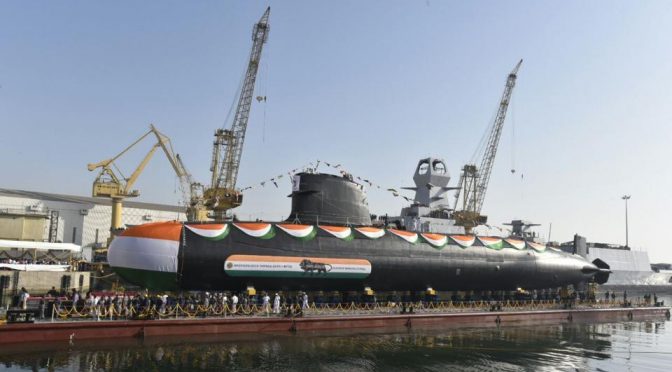
Featured Image: INS Khanderi gets launched at the Mazagon dock in Mumbai.(Kunal Patil/HT Photo)

Reagan-Era Navy Secretary John Lehman on Naval Recapitalization

By Dmitry Filipoff

John F. Lehman Jr. served as Secretary of the Navy in the Reagan administration from 1981-1987. In this role, he advocated for the 600-ship Navy and went on to lead one of the most significant naval buildups in American history. In this interview, he recalls the critical elements that drove the Reagan-era naval buildup and what lessons can be applied to the new administration’s effort to build a 350-ship Navy. 

In building up to the 600-ship Navy, what role did strategy play in informing budget? How did the 1980s Maritime Strategy help justify a naval buildup when many powerful voices argued against it?

Strategy played an essential role – arguably THE essential role. I spent years thinking about naval strategy before I became Secretary, sitting at the feet of masters, and I was able to hit the ground running to both promulgate and also implement that strategy through exercises at sea, within the context of President Reagan’s own well-thought-out goals, from the first day I was in office. I was blessed by CNOs who “got” strategy – especially Admirals Tom Hayward and Jim Watkins – and who developed and maintained a superb set of institutions and strategically-minded officers that were able to explain and carry out our Maritime Strategy from the get-go whether at sea; in Washington; in Newport, Annapolis and Monterey; and in Navy and joint commands all around the world. We were able to counter those “powerful voices arguing against it” time and time again.

How did you build a strong relationship with Congress and what arguments sustained their support?

We had many strong and experienced Navy supporters in Congress. First among them were Senators John Stennis, Scoop Jackson, John Tower and former SecNav John Warner. Our message to Congress was loud and clear: We had a disciplined logical  strategy that would lead to American maritime superiority and success at sea. To carry out that strategy successfully, we needed a 600-ship Navy. And, recognizing that such a navy would undeniably cost money, we committed ourselves to fundamentally change Navy weapons development and procurement, bringing costs down dramatically.

We did this by restoring authority and accountability to officials, not to bureaucracies. Gold-plating and a change order culture were ended, which enabled fixed-price contracts and annual production competition. Navy shipbuilding actually had a net cost underrun of $8 billion during the Reagan years, the first and only time in history. Congress saw that we kept our word and did what we said we would, and gave us its support year after year.

The new administration is seeking to build a 350-ship Navy. What will it take to achieve this goal sooner than later, and should this buildup be used as an opportunity to augment existing force structure?

First, it will take immediate enunciation of a clear, compelling strategy. Next, as the fleet shrank from 594 to the current 274, the Defense bureaucracy has grown. Bureaucratic bloat must be slashed immediately through early retirement, buyouts, and natural attrition. Next, the kind of line management accountability that marked the Reagan years can end constant change orders and enable fixed price competition.

In addition to these deep reforms it will of course take an immediate infusion of more money. And it will take an immediate refocus on drastically ramping up competition within the defense industry

With regard to force structure, the Navy desperately needs frigates. We do not need more LCSs nor can they be modified to fill the frigate requirement. We do not need to have a wholly new design as there are several excellent designs in European navies that could be built in American yards with the latest American technology. Indeed, the now-retired Perry class could easily be built again with the newest weapons and technology.

Naval aviation needs more and longer range strike aircraft. The advanced design F-18 can help fill this need with a program to procure a mix of both F-35s and advanced F-18s with annual buys, effectively competing the two aircraft for the optimum lowest cost mix.

The Navy faces multiple competing demands for resources including deferred maintenance that is hampering readiness and insatiable combatant commander demand for greater capacity. Additionally, the rapid rate of technological change is opening up numerous possibilities for new capabilities. Where should the Navy prioritize its investments to ensure credible combat power going forward?

There are some who argue that the dismal state of readiness must be dealt with first, and then the procurement of a larger fleet after. That would be a mistake. The priority is to achieve balance. Readiness and sustainability must be dealt with simultaneously with embarking on procuring the necessary new ships and aircraft.

In the 80s I was a vocal proponent of 15 carrier battle groups. But I was no less an advocate for 100 attack submarines. The Navy defends the nation across the entire spectrum of conflict—from what my old shipmate CNO Jim Watkins called the “violent peace,” through deterring and controlling crises around the world, to fighting and winning wars and deterring nuclear holocaust. That’s a tall order, but a necessary one.

Navy Secretary John Lehman in October 1982 (Wikimedia Commons)

The Navy needs to be able to pummel targets ashore, land Marines and SEALs, sink submarines and surface ships, knock sophisticated airplanes and missiles out of the sky by the dozens, lay and neutralize mines, get the Army’s and Air Force’s gear to the fight, and use both hard kill and soft kill power to do all that, as required.

The force structure needed to perform successfully at sea across that range of operations is extraordinarily varied, and must be continually balanced and adjusted, as we did with our 600-ship force goal all through the 1980s. It can be done, and the new administration and Congress must do it.

Your time as SECNAV involved hard-fought battles with industry to ensure better and more cost-effective shipbuilding. How can the Navy better work with industry to facilitate a buildup and improve acquisition?

The Navy must get its procurement system under control. It must end gold plating and constant design changes. Industry cannot sign fixed price contracts unless the Navy has completed detailed design and frozen the requirements. When that is done the disciplines of competition and innovation can return. Shipbuilders can make good profits by performance, cost reduction, and innovation in such a disciplined environment.

Of the possible operational contingencies the Navy faces around the world, which poses the greatest challenge to the Navy in successfully defending American allies and interests?

Would that it were so simple. The Navy is the nation’s premier flexible and global force. It must be able to deter disturbers of the peace like Islamist terror, and potentially the Chinese, Russians, Iranians, and North Koreans, and to destroy their forces if deterrence fails. The Navy must meet them toe-to-toe all around the world wherever they stir up trouble.

True, during the Cold War, we focused – and appropriately so – on pushing Soviet naval bears back into their cages in the North Atlantic, the North Pacific, the Med, and the Arctic. But we also had to be prepared – and were prepared – to turn on a dime to carry out President Reagan’s orders in and off Lebanon, in Grenada and off Nicaragua, over Gaddafi’s Libya, in the Gulf during the Iran-Iraq War, and all over the world against Middle Eastern hijackers and terrorists. Simultaneously we were engaged in saving hundreds of lives rescuing Vietnamese boat people in the South China Sea, and performing many other humanitarian missions around the globe.  

What strategic and operational concepts would best apply naval power to today’s threats and adversaries?

To reestablish maritime supremacy and “Command of the Seas.”

The size, deployments, and capabilities of the U.S. Navy are indicative of America’s chosen role in world affairs. What would it mean for the Navy if the incoming administration adopts isolationism?

Despite occasional tweets to the contrary, an administration that has sworn to protect its citizens and businesses everywhere, renegotiate trade deals, and destroy ISIS cannot be characterized as “adopting isolationism.” Such a policy is unthinkable today.

200 years ago, Thomas Jefferson tried to get by with isolationism on the cheap, invested in a fleet of low-end gun-boats of limited value, and set his successor James Madison up to fight the War of 1812 to no better than a draw.

A little more than 100 years later, a succession of administrations adopted isolationism as their policy and disarmed their by-then world-class Navy through bad international treaties and worse budgets. As a result, the Navy struggled during the first two years of World War II before hitting its stride and surging to victory (read Jim Hornfischer’s and Ian Toll’s recent books for how we did that).

Threats to the nation won’t go away just because the country may turn inward. They will just try to push the country back across the oceans and then keep pushing ashore. American naval supremacy will guarantee that can’t happen.

What final advice do you have for the next Secretary of the Navy?

Have a sound strategy, and stick to it. Have a robust but achievable force goal. Cut costs and increase competition everywhere you can. Balance and adjust the fleet among all its competing missions, regions, and levels of conflict, and above all, ensure the capability to deter or defeat the most dangerous potential enemies of our nation. The new secretary must immediately go on the offensive against bureaucratic bloat, against sloppy contracting, against gold-plating and for fixed price production competition, and technological innovation through block upgrades.

While engaged in this righteous offensive he must constantly explain and articulate his strategy, his objectives, and his vision to Congress, to the Sailors and Marines, and to the American people.

The nation elected a new President with a set of clear and purposeful goals. The Secretary of the Navy must ensure that – under his charge – the nation’s Navy becomes stronger and readier to carry them out.

The Hon. John F. Lehman Jr. is Chairman of J.F. Lehman & Company, a private equity investment firm. He is a director of Ball Corporation, Verisk, Inc and EnerSys Corporation. Dr. Lehman was formerly an investment banker with PaineWebber Inc. Prior to joining PaineWebber, he served for six years as Secretary of the Navy. He was President of Abington Corporation between 1977 and 1981. He served 25 years in the naval reserve. He has served as staff member to Dr. Henry Kissinger on the National Security Council, as delegate to the Force Reductions Negotiations in Vienna and as Deputy Director of the U.S. Arms Control and Disarmament Agency. Dr. Lehman served as a member of the 9/11 Commission, and the National Defense Commission. Dr. Lehman holds a B.S. from St. Joseph’s University, a B.A. and M.A. from Cambridge University and a Ph.D. from the University of Pennsylvania. He is currently an Hon. Fellow of Gonville and Caius College, Cambridge University. Dr. Lehman has written numerous books, including On Seas of Glory, Command of the Seas and Making War. He is Chairman of the Princess Grace Foundation USA and is a member of the Board of Overseers of the School of Engineering at the University of Pennsylvania.

Dmitry Filipoff is CIMSEC’s Director of Online Content. Contact him at Nextwar@cimsec.org.

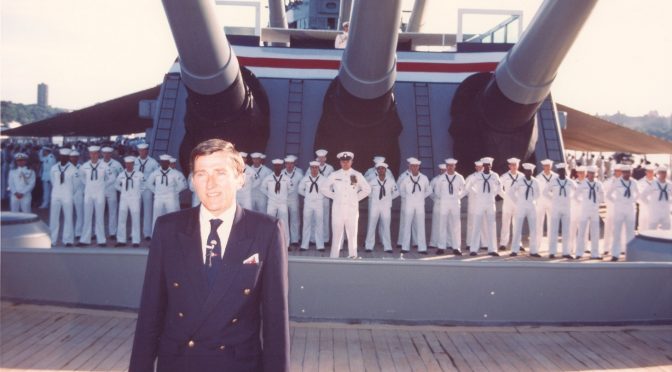
Featured Image: Secretary of the Navy John Lehman aboard USS Iowa in July, 1986. 

Russia’s Evolving Arctic Capabilities

By Steve Micallef

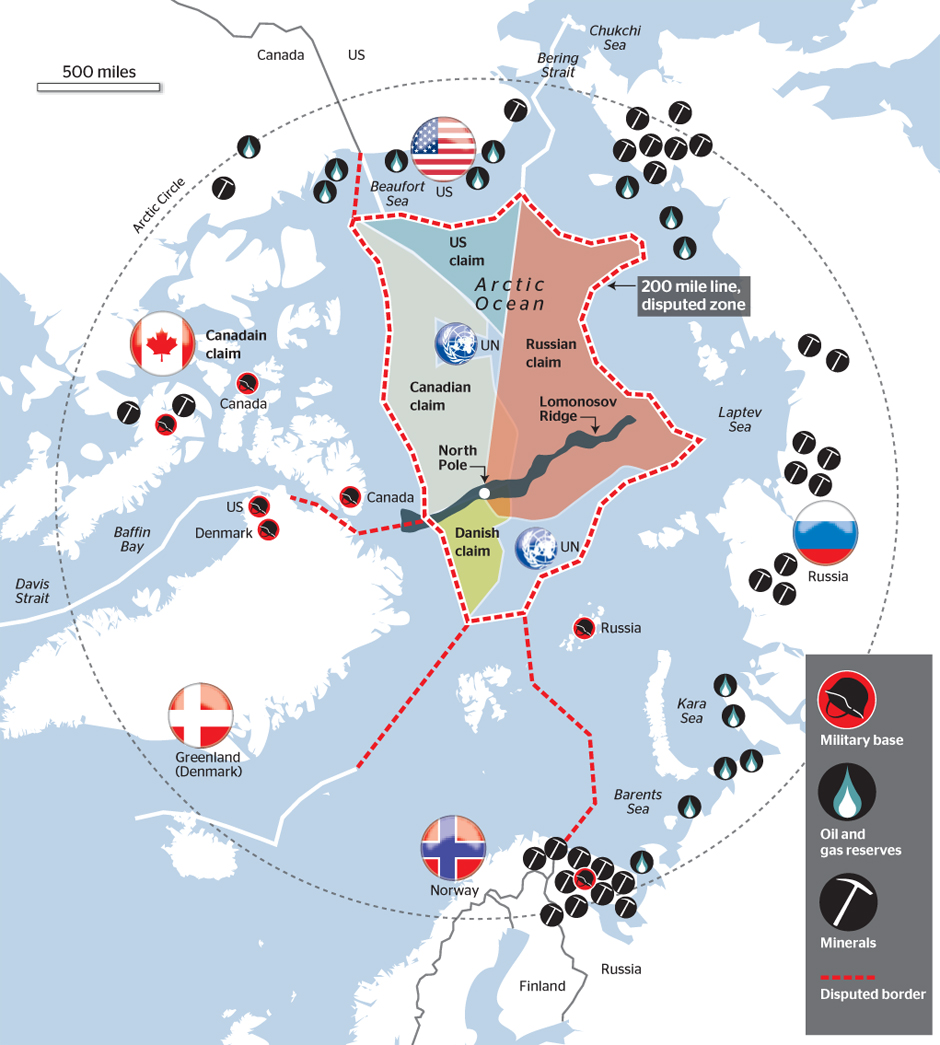
Far from the battlegrounds of East Ukraine and Syria another confrontation with Russia is brewing. As the Arctic ice retreats countries with claims in the Arctic are more willing to extract the resources found in this inhospitable location. The U.S. estimates the Arctic seabed is home to about 15 percent of the world’s remaining oil, up to 30 percent of its natural gas deposits, and about 20 percent of its liquefied natural gas. Like the U.S., Canada, Denmark and Norway, Russia has its own claim on a section of the Arctic which it is now looking to defend and expand. Today we are witnessing a resurgent Russia in the Arctic, deploying more troops and equipment to the Arctic in support of its claims.

The Cold History

There is a long history of territorial claims around the North Pole; Canada was the first to claim sovereignty over vast areas of the arctic in 1925. This was followed by the Soviet Union in 1926 which claimed an area stretching from Murmansk, east to the Chukchi Peninsula and north, towards the North Pole including both the Mendeleev and Lomonosov Ridges. This was followed by claims from the U.S., Norway, and Demark that where never internationally recognized until 1999 and the adoption of the United Nations Convention on the Law of the Sea (UNCLOS). UNCLOS, the melting ice caps, and the vast amounts of natural resources on the sea floor are the root causes of current Arctic confrontations.

Overlapping Arctic claims and resources. (TheTimes.co.UK)

Under the provisions of UNCLOS, states have ten years after treaty ratification to claim and extend territorial limits beyond the 200-mile Exclusive Economic Zone provided by the convention. Russia ratified UNCLOS in 1997 and had until 2007 to apply for a concession. Whilst Russia has always looked at the Arctic as an integral part of Russian identity (indeed until the collapse of the Soviet Union, Moscow maintained a large presence in the Arctic), it was Vladimir Putin who revived Russian ambitions in the Arctic. In December 2001, Russia applied for an extension of territory, claiming that the Lomonosov Ridge is an extension of the Siberian continental shelf and therefore entitles Russia to a bigger claim in the Arctic. However, this was inconclusive and the UN commission neither rejected nor accepted Russia’s proposal, citing a need for more research.

In the face of the melting icepack the Russian administration has declared the Arctic a region of strategic importance for Russia; due to both the potential Northern Sea Route as well as the energy and rare earth element reserves under the ice. Since 2002, Russia has sent expeditions in support of it claims over Lomonosov Ridge, including a 2007 expedition that planted a Russian flag on the seabed. Vladimir Putin has also taken the bold step of increasing Russian military presence in the inhospitable north.

Icebreaker Development

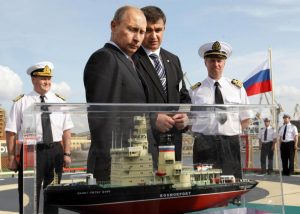
Icebreakers are the cornerstone of any capability in the Arctic. Icebreakers have multiple uses from resupplying far-flung communities and outposts to scientific exploration, search and rescue, and ensuring that sea lines remain ice-free for shipping. They are the backbone of any presence in the Arctic, both military and civilian. In this department Russian Arctic capabilities are significant, especially when compared to those of other Western claimants.

Russian President Putin views a model of Project 21900 icebreaker ST PETERSBURG (Getty Images)

Russia has as many as 40 icebreakers, both nuclear powered and conventional (see table below). Although some of these vessels are relatively old, with many of them built during the Soviet era, Russia also has various new designs under construction. In total, there are currently some 14 icebreakers of various types being built in Russia.

Class Displacement in Tons Build Qty Comments
Nuclear Powered Vessels
LK-60Ya

(Project 22220)

33,540 3 New class of nuclear powered vessels; will be the world’s largest icebreakers.
Arktika

(Project 10520)

23,000 6 Soviet era nuclear vessels- 4 remain in service.
Conventionally Powered Vessels
Project 21900 & 21900M 10,000 2 & 3 2x 21900s are in service along with 2x upgraded 21900Ms (1 additional under construction)
Ilya Muromets Project 21180 6,000 4 First one expected to be delivered in 2017.
LK-25
Project 22600
22,000 1 Largest diesel-powered icebreaker in the world; may be delivered in 2018 after several years’ delays.
Project 70202 3,8000 1 Oil spill response, fire extinguishing, and ecological monitoring vessel. Constructed by Finnish Aker Arctic Technology. A unique hull shape allows the vessel to operate efficiently sideways and backwards.
Aker Arc 130/A


8,699 2 Constructed for Gazprom Neft for use as support ships in Arctic oilfields. Constructed by Aker Arctic.
Arc7 ice-classed LNG carriers 80,200 14 First delivered in 2016, others are under construction in Geoje, South Korea for service in the Arctic. Able to break through 2.1m of ice.

Of particular interest are the LK-60Ya nuclear ice breakers and Arc-7 LNG carriers. Three LK-60Yas are under construction; the first (the Arktika) was launched in June 2016 and will be commissioned in 2018 with others commissioning in 2019 and 2020. These vessels are intended for use in the Northern Sea Route along Russia’s Arctic coast and are capable of breaking through ice over nine feet thick.

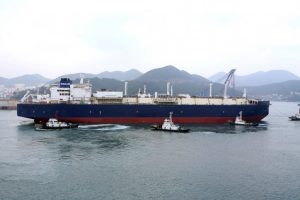
SCF Yamal/ Christophe de Margerie, the first Arc-7 Ice Classed LNG carrier. (IHS)

The development of LNG and oil carrying ice-capable tankers is an area of particular economic interest for Russia. In this area, Russia is collaborating with Daewoo Shipbuilding and Marine Engineering in South Korea and an international consortium for the construction of the first Arc 7 ice-classed LNG carriers. The aim is to reliably deliver the LNG produced from the Yamal LNG project in the Yamal Peninsula.

Military Development

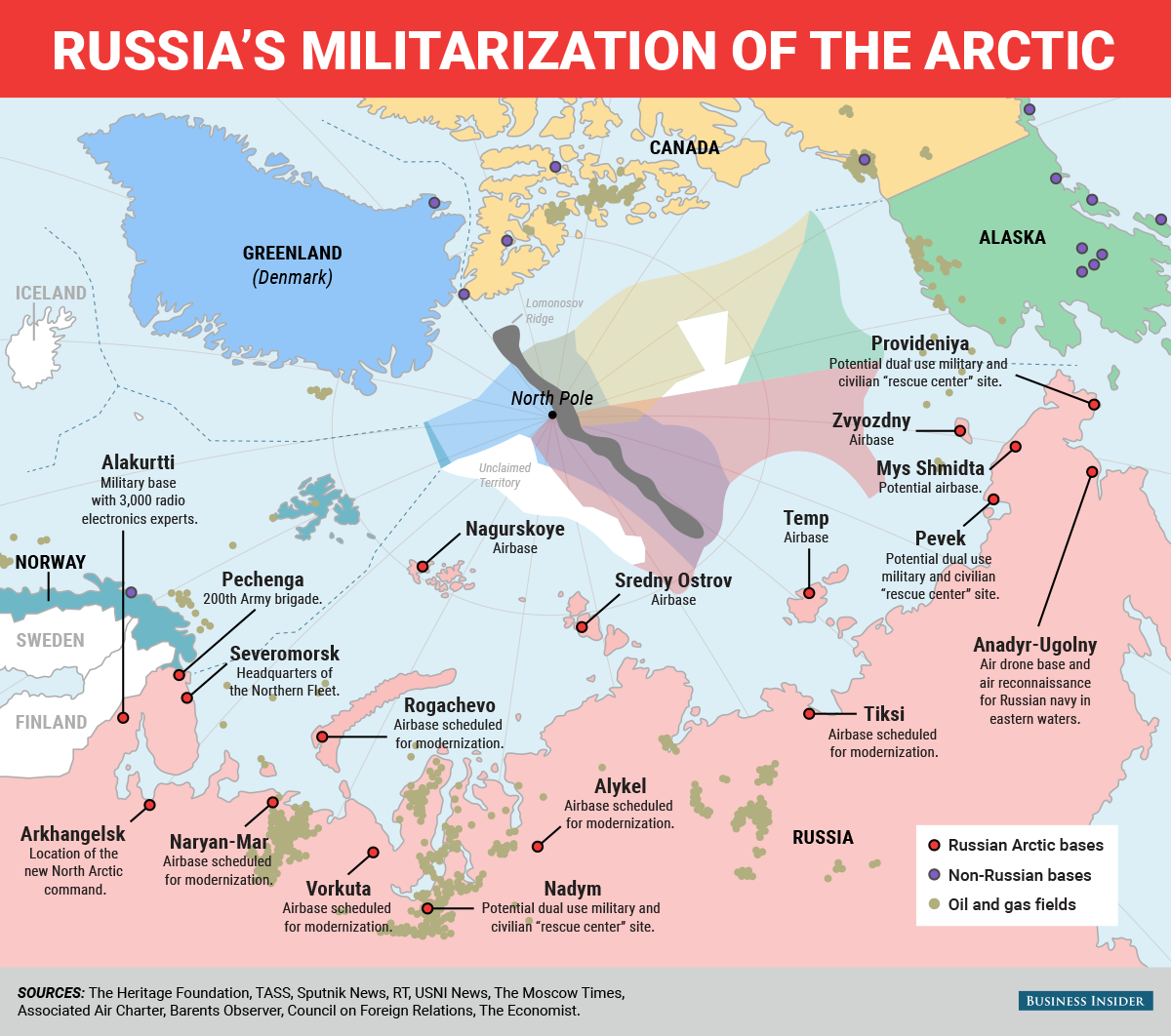
Icebreakers are not the only things Russia is constructing to help it control the Arctic. All along its northern frontier Russia has begun rebuilding and reoccupying its military bases, some of which have not been used since the end of the Cold War. Russia is upgrading its docking facilities in Murmansk, one of the few ports which is ice free year round and home to Russia’s nuclear icebreaker fleet, to provide more space for the larger nuclear icebreaker and submarine fleets.

Aerial facilities are also being upgraded to improve coverage over the Arctic. Since 2015 Russia has equipped six new bases in the region, both on the mainland and on islands. These have included airbases on the islands of Franz Josef Land, Severnaya Zemlya, Wrangel Island, Kotelny Island and Novaya Zemlya. On the mainland, the facilities at Mys Shmidta, including the port and the airport, are also being upgraded.

Russian military installations proximate to the arctic.

Moreover, the Russian Navy has stepped up its presence in the Arctic with a permanent base on Kotelny Island and in 2016 when it started using new facilities on Alexandra Land. Beyond the ability to conduct search and rescue operations and support other Russian forces operating in the Arctic (mainly through the use of submarine forces), the Navy is also looking to stop infiltration by other powers into sovereign Russian territory.

Weapons-wise, Moscow has deployed two long range S-400 regiments to Novaya Zemlya and the port of Tiksi alongside short range surface-to-air Pantsir-S1 systems to protect them. Arctic bases have also been reinforced with P-800 Oniks supersonic anti-ship missiles, although the number of these systems present in the Arctic remains unclear.

Ground forces are being deployed to the region as well. The 99th Arctic Tactical Group has been permanently deployed to Kotelny Island to protect and aid in the construction of the airfield and piers there. Two other formations, the 200th Independent Motor Rifle Brigade and the 80th Independent Motor Rifle Brigade, have been converted into Arctic Brigades. Both formations appear stationed in the Murmansk Oblast and seem to be equipped with two-tiered tractors, snowmobiles and other vehicles, including the DT-30P Vityaz articulated track vehicle. Allegedly, these troops receive reconnaissance, airborne, and mountain training.

All these elements are under the command of Russia’s Arctic Joint Strategic Command, recently formed in December 2014. This command is responsible for the training and operational employment of Russian assets in the region; including all combat units, radar stations, airfields and support units. Northern Fleet units based at Kotelny Island also fall under the authority of this command.

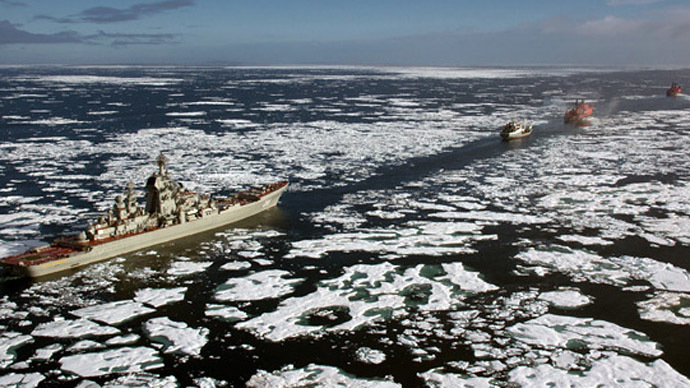
A Russian Northern Fleet warship transits Arctic waters with icebreaker escort in 2013. (RT)

Russian will continue to build new facilities in the future. A large year-round airbase is being built on the New Siberian Islands Archipelago, which will enable the deployment of Tu-95MS and Tu-160 bomber and the stealth PAK DA bomber in the future. A network of 10 Arctic Search and rescue stations, 16 deep-water ports, 12 new airfields and 10 air-defense radar stations is planned. The Russian Defense Ministry also recently announced it will build over 100 infrastructure facilities in the Arctic by the end of 2017. Together, these units and facilities will allow Russia to maintain a watchful eye over the Arctic, its oil reserves and, in the future, maritime shipping.

Conclusion

Russia has developed its Arctic capabilities to a level that was inconceivable a couple of years ago – one that has not been seen since the end of the Soviet Union. Nor is there is any sign that Russia will stop here – in November 2016 Putin called for accelerating development of the Arctic region. Whatever the outcome, these huge investments in the Arctic leave Russia in a much better position to exploit the benefits brought by the melting ice fields.

Steve Micallef graduated from the University of Malta with a B.A. (Honors) in International Relations in 2015. He also holds an MSc in Strategic Studies from the University of Aberdeen, Scotland. He currently works at Bugeja Geopolitical Consulting, Malta.

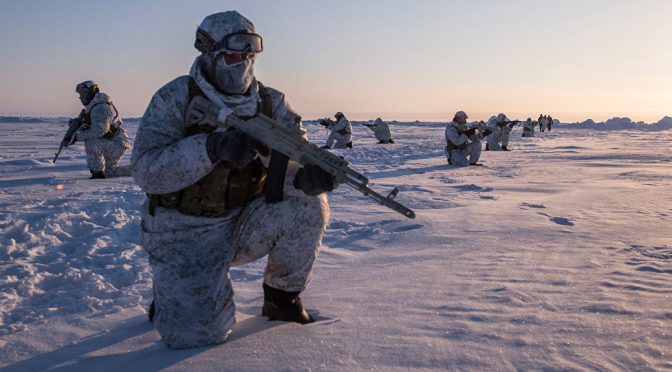
Featured Image: Russian arctic troops (Sputnik/ Valeriy Melnikov)

Fostering the Discussion on Securing the Seas.