A Thoroughly Efficient Navy for the 21st Century, Pt.1

By David Tier

America has grown weary of the post-9/11 wars. Long, drawn-out conflicts have worn down American resolve and left many defense officials nostalgic for “the good-old days” when adversaries were easier to describe and devoted military efforts toward preparing for conventional warfare. Seizing an opportunity, the U.S. Navy has capitalized on growing disillusionment and sought to exaggerate the military challenges posed by an ascendant China for parochial benefit in terms of gaining larger budgets and greater quantities of more expensive ships. The Navy should consider an external strategy review that accounts for efficiency as an aspect of its operating concept. This article reviews America’s current naval strategy and is divided into two parts. Part 1, below, analyzes U.S. naval defense strategy in light of 21st Century national defense threats. Part 2 will recommend changes to the Navy’s force structure to gain significant cost savings while still satisfying America’s naval defense requirements. 

Introduction

In 1987, William W. Kaufmann analyzed U.S. Navy force requirements and determined that the Navy sought to procure a force much larger than necessary to meet realistic Cold War-era force projection demands.His review dissected the Navy’s threat assessments and his work was used as a successful tool to stunt the Navy’s attempts at inducing greater budgets. Today, in much the same way as then, we see the Navy favor approaches like AirSea Battle and “sea-basing” that counter anti-access/area-denial strategies but are anchored in conventional warfare concepts that discount the less-sophisticated threats more likely to challenge our nation. The attention and resources diverted from chasing terrorists on land will almost surely have negative consequences for the U.S., while the challenge of using naval power to forcefully gain access into contested regions will likely not be necessary, or perhaps even suicidal if tried. Despite implications to the contrary of the Navy’s parochial interests, naval officers should advise America’s leaders that the danger of being denied military access to a theater of operation is manageable and that the threat of terrorism is the greater national security problem. To do otherwise puts American interests at greater risk. This article explores the Navy’s missions in the context of the current strategic environment, proposes adjustments to its missions to align with its national defense role, analyzes the number of platforms and capabilities required to counter projected threats, and recommends reallocating budget to reduce excessive capacity in the Navy’s force projection mission in favor of sustaining the Army and Marines’ counterinsurgency capability.

The Navy’s Missions

Throughout its nearly 70-year history, the Department of Defense has struggled to build a joint force portfolio that distributed resources in proportion to priorities established in the national defense strategy. However, intra-service politics often hampered efforts to cross-level in line with the strategy and each Service wound-up with nearly equal budgets instead. There have been a couple of noteworthy exceptions to this strategy-to-resources mismatch, however. The Eisenhower Administration’s policy of “massive retaliation” emphasized the role of nuclear forces over conventional, whereby the Air Force and Navy benefitted from budget increases at the expense of the Army. The Kennedy Administration reversed Eisenhower’s course with its “flexible response” policy, which sought to improve the Army’s ability to withstand a conventional attack in Europe as well as to develop counterinsurgency forces.

The military strategies that followed these policy changes gave birth to a principle that the U.S. should maintain capability to simultaneously fight at least two major regional wars. The U.S. maintained this defense strategy for decades and only recently sought to scale back. Still, not all was smooth sailing in the Defense Department, as defense analysts noted the need to curb budget waste that resulted from factors ranging from Congressional pork barrel projects to misplaced Service priorities. Kaufmann observed that the Navy had drifted off course in his 1987 analysis titled, A Thoroughly Efficient Navy.

At the time the Navy sought a 622-ship fleet cruising with 15 aircraft carriers, and submitted budget requests based on a vision articulated in 1986’s The Maritime Strategy. Overseen by then-Chief of Naval Operations Admiral James Watkins, the document went so far as to envision decisive warfare against the Soviet Navy called “Carrying the Fight to the Enemy,” which advocated using naval power to attack the flanks of the Soviet Union during the course of a potential war.2 The Maritime Strategy persuaded defense planners of the need for a large Navy to accomplish this end.3 Although the Navy advertised its conclusions to justify necessary means to accomplish assigned missions, outsiders viewed it as a parochial argument intended to gain force structure.

Kaufmann deconstructed the Navy’s approach and determined that a naval attack against the Soviet Union would incur losses that outweighed the value of the strikes, or might even be suicidal.4 In his analysis of the maritime threats, he observed an overstated stated need for aircraft carriers, and proposed force reductions that would have substantially curbed Navy carrier-building. 

Like The Maritime Strategy, the Navy’s 2015 A Cooperative Strategy for 21st Century Seapower is similarly off course. Section III of the document, titled “Seapower in Support of National Security,” overstates the need to achieve “all domain access” and to project power. It conditions the reader to expect that inflated anti-access threats imply that the most prudent solution is to apply brute force of naval power. One must examine the Navy’s purpose and missions within the context of today’s strategic security environment to establish a baseline for more reasonable Navy force requirements.

Notwithstanding the national defense strategy’s pivot to the Asia-Pacific, the Navy’s enduring missions in priority sequence are:

1. Protect the U.S. and deter enemy attack, particularly from seaborne threats
2. Secure economic sea lines of communication (SLOCs) to support national livelihood
3. Deny an adversary the use of the sea for military advantage
4. Secure military SLOCs to ensure access to distant theaters of operation, and enable military transport vessels safe transit to discharge their matériel in support of joint operations inland from the sea
5. Project forces that can attack adversary interests on land in support of other combat operations

Some may argue that these missions omit important tasks that the Navy is required to perform and others may argue that they are incorrectly prioritized. However, these arguments do not hold water. Although there is no mission listed above to provide “presence,” humanitarian assistance and disaster relief, or establish maritime superiority, these missions can be accomplished with the same assets needed for the other missions described, or otherwise derived from a combination of them. Forces conducting the first mission could assist humanitarian relief efforts and, in effect, the second, third, and fourth missions combine to describe graduating levels of sea superiority. No further forces would be necessary to accomplish these other missions. A close examination of the five listed missions can help identify and determine the capabilities required of America’s Navy.

Reconsidering Threats and Missions

First, protecting the nation from attack is the purview of all armed forces. Military threats to the U.S. are the primary reason America should procure military capability. Naturally, the Navy’s portion of this mission should focus on seaborne threats and, to an extent overlapping with the Air Force, threats overflying the sea. The primary maritime military threat to the United States today is the threat of ballistic missile submarines operating within firing range of American shores. There is no real threat of an amphibious attack against the U.S. There is also no serious threat of any enemy carrier or surface strike group threatening American territory, nor will there be any in the foreseeable future. The threat of submarine-launched missiles however, particularly nuclear ballistic missiles, should be the number one priority for the Navy to defeat. Therefore, the capability to detect, track, and destroy “boomers,” and even intercepting their missiles, should be the Navy’s primary focus. This places a premium on anti-submarine warfare (ASW) platforms such as long-range patrol aircraft, attack submarines, ASW helicopter-equipped surface action groups, and ballistic missile defense systems such as Aegis-equipped ships. Although fixed-wing ASW aircraft aboard an aircraft carrier also perform well in this role, aircraft carriers are not optimally employed in ASW and are an inefficient means to address this threat. Likewise, nuclear deterrence through deployment of U.S. ballistic missile submarines is an important capability for the Navy to maintain as part of the strategic deterrence triad. In conjunction with the other legs, it helps discourage enemy attacks against the U.S. by providing a credible second-strike threat.

Second, securing SLOCs to enable global maritime traffic and foiling an enemy’s attempt to blockade the U.S. is a vital maritime mission that ensures the nation’s way of life can continue despite attempts to wage war against it. This mission does not include protecting traffic in or through an active theater of war, but requires a capability for the Navy to establish safe lanes of transit from the territorial waters of the U.S. to the territorial waters of major international shipping ports around the globe. The primary military threat that sea-going commercial traffic might encounter would be attack submarines, although land-based long-range attack aircraft, and, to a lesser extent, surface groups or small water craft, could pose a threat. Accordingly, these threats require the Navy to maintain a transoceanic ASW capability, defensive anti-air warfare (AAW) capability, and the capability to defend against smaller surface threats. These are largely the same capabilities required in the first mission above, and greater numbers of the same types of assets can effectively be used for this second purpose. 

The third mission for the Navy is to deny, or at least inhibit, enemy use of the sea for military advantage. An enemy must not be able to outflank land forces using maritime maneuver. This is where the need for sea-based fixed-wing attack and air-intercept aircraft makes their first appearance, as the Navy needs a limited strike and air combat capability to prevent an enemy from gaining localized sea control. America’s potential adversaries, however, do not furnish a strong blue-water capability that threatens to overturn the Navy’s long-established control of the sea. Even the most vaunted projected maritime threat, the People’s Liberation Army Navy of China (PLAN), will possibly field three aircraft carriers in the coming years, 85 ocean-going surface combatants, and nine nuclear-powered attack submarines.Although this may sound like a substantial challenge at first glance, a closer look assuages concern about blue water contests with the Navy. In a potential war against the U.S., the PLAN would not survive beyond the reach of land-based air cover since the Navy’s attack submarines would almost assuredly destroy their task forces on the open seas, and even be a significant threat for PLAN forces in their home waters. Furthermore, the Air Force’s long-range bombers would severely hamper Chinese maritime freedom of maneuver outside of the East and South China Seas. Therefore, only a few cruise missile-equipped ships, and possibly a single aircraft carrier with multi-role fixed-wing aircraft would be necessary to accomplish this third mission per theater of war. Even the amphibious assault ship-based U.S. Marine Corps attack aircraft may sufficiently address this role. A joint task force of attack submarines, amphibious assault ships, and Air Force strike aircraft could fulfill this task, thus lessening the demand for supercarriers. 

The fourth mission for the Navy is to secure SLOCs into a theater of war, which necessitates a stronger offensive capability. This mission includes the possibility of forcefully gaining access to contested theaters and, combined with the second and third, accounts for the Navy’s desired capability of sea control as articulated in the Navy’s vision statement, A Cooperative Strategy for 21st Century Seapower.6 The AirSea Battle concept envisions the most challenging aspect of this fourth mission. AirSea Battle considers a worst-case scenario where the Navy must escort military transports into the full weight of sophisticated enemy defenses—within ample range of the enemy’s inventory of attack aircraft, cruise missiles, attack submarines, and mines. However, there are only a few locations in the world where Navy forces would have to confront this most challenging task by themselves, and only one current location where this is even conceivable: the South China Sea. Regardless, even the worst-case scenario there would probably require no more naval forces than required during Operation Desert Storm or in the opening phase of Operation Iraqi Freedom where the Navy deployed six aircraft carriers in each instance.7 Although this may seemingly vindicate the Navy’s need to maintain a double-digit number of carriers, we must be realistic about the threat faced. Admittedly, the challenge to escort convoys would substantially increase as task forces approached theaters of war but the chance that regional partners would not allow greater basing access assumed in some studies is overly pessimistic. This, combined with the low likelihood that a severe South China Sea problem would actually occur, reduces the challenges posed.

From a different perspective, consider more pessimistic accounts such that there were no bases in the region from which American forces could launch attacks, no allies contributing meaningful forces to assist the cause, and an enemy force that actually developed into the great adversary it is predicted to become. Were six carriers required in both wars against Iraq that sought to eject entrenched forces from an occupied country or force regime change as the 1991 and 2003 military missions respectively, or was that overkill? Couldn’t four carriers have accomplished the more limited objective of simply “gaining access” to that theater?  Self-serving parochial aspects aside, the Navy should recognize that overselling the capability to execute a highly-contested South China Sea mission under the worst circumstances promises to divert resources that could be employed against other, more likely threats, such as transnational terrorism.

The Navy has encountered difficulties persuading defense planners of the full narrative for its fifth mission—power projection—since the end of the Cold War. The Navy should indeed maintain a capability to project power into distant theaters of operation since there is great value in an ability to assail an enemy in as many ways as possible. The main problem with the Navy’s approach, however, is that it single-mindedly envisions large carrier strike groups for this role. Carrier strike groups should, at best, only be one part of a comprehensive package that could be accomplished by guided missile-capable attack submarines alone or with surface combatants, and possibly to a greater degree, by long-range bombers and tactical aircraft controlled by the Air Force. This is a joint, overlapping mission set. Because the power projection argument has lost favor in recent years, the Navy has sought a different narrative to justify its service size. Hence, the AirSea Battle concept was born.

Conclusion

This examination has identified, prioritized, and placed limiting stipulations on five core missions the Navy must accomplish. Next, an examination of the Navy’s present forces it has to carry out these missions, particularly its aircraft carriers, will help determine if there is excess capability it could reduce in favor of other national defense interests. 

David Tier is a Lieutenant Colonel in the U.S. Army and serves as a strategic plans and policy officer. He holds a Master in Public Administration from the Harvard Kennedy School, has served three combat tours of duty in Iraq, served a tour of duty in the Pentagon, and has authored several articles. The views expressed here are those of the author and do not necessarily reflect the policy or position of the U.S. Government, Department of Defense, or any of their components.

References

1. William W. Kaufmann, A Thoroughly Efficient Navy (Washington, D.C.: The Brookings Institution, 1987), 123.

2. Admiral James D. Watkins, The Maritime Strategy, (Annapolis, MD.: US Naval Institute Proceedings Supplement, January 1986), 9-13; John B. Hattendorf, Ph.D., Peter M. Swartz and Eds., U.S. Naval Strategy in the 1980s, (Newport, R.I.:  Naval War College Press, 2008), 221.

3. Hattendorf, Swartz, and Eds., U.S. Naval Strategy in the 1980s, 204.

4. Kaufmann, A Thoroughly Efficient Navy, 102-104.

5. Kenji, Minemura, “China to start construction of 1st aircraft carriers next year,” The Asahi Shimbun, December 31, 2008, available online at http://web.archive.org/web/20090526192305/http://www.asahi.com/english/Herald-asahi/TKY200812310046.html, accessed on October 16, 2014.

6. Department of the Navy, A Cooperative Strategy for 21st Century Seapower, March 2015, 22.

7. U.S. Navy Captain (Ret.) Marty Erdossy, “Why Does The United States Only Have Eleven Aircraft Carriers?” Forbes.com, available online at http://www.forbes.com/sites/quora/2012/07/17/why-does-the-united-states-only-have-eleven-aircraft-carriers/, accessed on October 16, 2014.

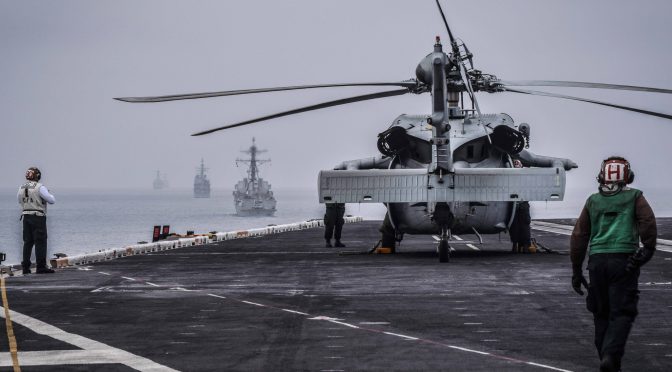
Featured Image: PACIFIC OCEAN (May 3, 2017) Sailors aboard the aircraft carrier USS Theodore Roosevelt (CVN 71) observe the guided-missile destroyers USS Sampson (DDG 102), USS Halsey (DDG 97), USS Preble (DDG 86) and guided-missile cruiser USS Bunker Hill (CG 52) during a Group Sail training unit exercise with the Theodore Roosevelt Carrier Strike Group. (U.S. Navy Photo by Mass Communication Specialist 3rd Class Spencer Roberts/Released)
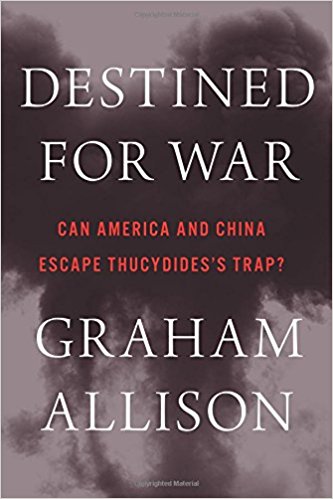
Destined for War: Can America and China Escape Thucydides’s Trap?

Graham Allison, Destined for War: Can America and China Escape Thucydides’s Trap? Houghton Mifflin Harcourt, 2017, $18.30/hardcover, 384 pp.

By David Edgar

The “Thucydides Trap” refers to the line in Thucydides’s History of the Peloponnesian War which states “it was the rise of Athens, and the fear that this inspired in Sparta, that made war inevitable,” and the application of this insight, that rising powers can easily come into conflict with established powers, to present-day relations between the United States and China. Graham Allison’s book, Destined for War: Can America and China Escape Thucydides’s Trap, is instructive about the nature of this challenge for policymakers and strategists and lays out what options are available to avoid conflict. But value of the book’s contribution to advancing the discussion reflects the challenging nature of the subject it covers and leaves the reader still in search of answers.

The Thucydides Trap is at the same time one of the most-discussed and the most not-discussed-enough topics among scholars, journalists, and practitioners of international relations. On the one hand, new developments in South China Sea territorial disputes consistently make headlines around the world, with the Obama Administration’s “pivot to Asia” often discussed and critiqued in the same settings. Comparisons between the contemporary United States-China relationship and historical relations between, for example, pre-WWI Great Britain and Germany are hard to miss in magazines and books that examine issues of national security. Allison did much to further this discussion with his 2015 Atlantic article on the Thucydides Trap. On the other hand, some argue that the United States’ reaction to China’s rise lacks a clear direction and that regional tensions in the Middle East and Eastern Europe are taking policymakers’ attention away from East Asia.

Destined for War restates much of the previous discussion about China, the United States, and the dynamics of relative power that led potential rivals to go to war in the past. As such, it is a good overview of the current state of discussion, and one that is remarkably in-depth without being daunting to a reader who is not already familiar with the subject matter. Allison presents an impeccably well-researched history of the lead-up to WWI as well as the Thucydidean relationship between the United States and Great Britain at the beginning of the Twentieth Century. Furthermore, Allison ably depicts the current relationship between the United States and China, with particular attention to statistics showing that China has already surpassed the United States in many meaningful measures of economic power. The strength of the book, alongside Allison’s painstaking research, is its presentation of the historical record and economic statistics in a readable way.

But while the book is an excellent introduction for those who are not already up-to-speed on the present and potential state of relations between the United States and China, it will likely leave the reader wanting more. He does not firmly answer the question of what can be done about it. Allison himself admits that the Thucydides Trap is too monumental to have an easy solution, that proposing such a solution “would demonstrate only one thing: failure to understand the essence of the dilemma that this book has identified.” He calls for a “multiyear, multiminded effort. It will be no less ambitious than the four-year debate that ran from Kennan’s Long Telegram to Nitze’s NSC-68 to shape what ultimately became America’s Cold War strategy.”

In Allison’s defense, he provides a series of “hints for peace” drawn from previous “Thucydides Trap” international relationships and gives several approaches that the United States can take to either confront or accommodate China’s rise. This shows the potential of Destined for War – had these lessons from history and potential avenues for future discussion been the focus of the book, it would surely have been a strong start to the discussion that Allison calls for.

Instead, despite ably presenting the current state of discussion about the Thucydides Trap, Destined for War does little to further that discussion. The book’s “Big Idea,” Allison says, is “in a phrase, Thucydides’s Trap. When a rising power threatens to displace a ruling power, alarm bells should sound: danger ahead.” This is neither groundbreaking nor controversial. History is replete with examples of such conflicts, and political scientists account for them in their theories of why wars happen. Indeed, Destined for War is by no means the first book to introduce this idea, and Allison himself stated it much more concisely in the Atlantic article.

Allison is right – America needs a sustained, honest, and focused discussion about how to react to the fact that China is rising and will rival the United States for hegemony in East Asia sooner rather than later. It is disappointing that Destined for War was a yet another call for such discussion, rather than a start to it.

David Hervey is a senior at Emory University, studying Political Science and Economics. He is writing his senior thesis on The History of the Peloponnesian War.

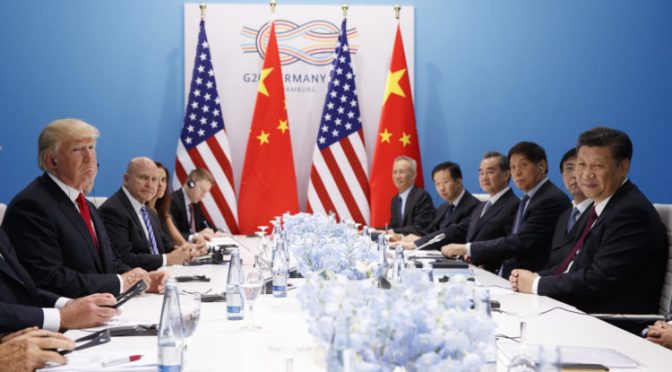
Featured Image: President Donald Trump meets with Chinese President Xi Jinping at the G20 Summit, Saturday, July 8, 2017, in Hamburg, Germany. (AP Photo/Evan Vucci)

Why Does the United States of America Need a Strong Navy?

The following essay is the winning entry of the CIMSEC 2017 Commodore John Barry Maritime Security Scholarship Contest.

By Patrick C. Lanham

The United States of America was, is, and will remain a maritime nation. Flanked by vast oceans, covered from the north by Canadian arctic and the south by Mexican desert, the United States occupies one of the strongest strategic positions of any nation in history. This, however, comes at a cost: to trade and interact with most of the world, America must cross the Atlantic and Pacific Oceans. This exposes American trade to hostile nations, even relatively weak ones. This is not a new concept for American strategic planners. The United States’ first overseas conflict, the Barbary Wars, stemmed from this exact vulnerability. That struggle continues to this day, with the most recent example being U.S. Navy intervention in the Maersk Alabama hijacking by pirates off Somalia in 2009. Therefore, it has always been in the vital interest of this country to maintain a strong, well-resourced, and well-led navy. Without one, there is no conceivable way the United States could continue to maintain the world’s greatest economy in today’s globalized world.

Whenever America was most threatened or imperiled by conflict, the United States Navy has always stepped up to meet the challenge. From sparring with the great powers of Europe, to constricting the Confederacy, decisively defeating the Imperial Japanese Navy, and deterring the Soviet Union, the U.S. Navy has a proven track record of keeping America safe. By projecting outwards, the United States has kept war and devastation away from American shores. This is a solid policy, but it is one that requires a strong navy to pursue in any meaningful manner. This is further enhanced by a robust network of allies which the United States currently enjoys, but these nations will not sit on the frontlines without clear evidence of credible and capable American commitment to their own security. In this regard, what better signal of commitment is there than the strongest Navy in the world off their coast?

A strong navy, used in concert with allied nations and backed up by a vigorous economy, is a potent deterrent to conflict and enables diplomacy. It convinces adversaries that war is either unwinnable or too costly to wage. This helps the United States negotiate favorable outcomes through diplomacy, which will always be preferable to war. Some might argue that by building a strong navy or military in general, it promotes jingoism and can escalate tensions between rivals. While this is certainly true in some historical instances, I would argue that in America’s case it has prevented conflict much more than it has incited it. For example, during the Cold War, the U.S. Navy integrated with the rest of the North Atlantic Treaty Organization (NATO), and played a crucial role in containing the Soviet Navy in the North Atlantic. If not for their strong presence, any effort to reinforce NATO forces at the inner German border, in the event of a war with the Warsaw Pact, would have been spoiled by Soviet submarines. As we know, that war never happened and that is due in no small part to the U.S. Navy, which was both large and technologically advanced during that time period.

Yet again the United States stands at another crossroads in history. The post-Cold War peace is slowly eroding as revisionist powers seek to alter, through coercion, the international order to their benefit. Some nations, considered “near-peer” competitors, boast strong naval capabilities of their own. China is in the midst of a particularly large naval buildup using their extensive industrial base and newfound wealth to rapidly increase the quality and quantity of their naval forces. The U.S. Navy once again finds itself center stage in a great power rivalry after a nearly three-decade hiatus. The conflicts are dynamic, the competition is intense, and the advantages are fleeting. This is the new reality that we face today as a nation returning to competition with near-peer states. A strong United States Navy brings with it many tools that are useful to strategically outmaneuver these competitors. Chief among these tools is flexibility. In a world diseased with uncertainty, flexibility is the cure. It is not only critical to warfighting, but critical to avoiding conflict. A strong, well-trained, flexible navy is able to respond and adapt to new situations to maintain escalation control, but also fight to win if things go south. More on the warfighting side of the house, flexibility better enables U.S. forces in key regions to counter asymmetric threats or weapons – a favorite among some of the more prominent American adversaries. Another key tool is presence. A bigger, stronger navy is able to be deployed to build partnerships, deter potential enemies, and quickly respond to threats in more places across the globe. One only has to look at the recent chemical weapons use in Syria and the subsequent American response to realize that this not an abstract theory, but a proven concept.

For the United States, a strong navy is not a “want” but a “need.” Historically, it has been extremely effective at advancing U.S. national interests.  It is critical to deterring foreign adversaries and maintaining prosperity, not just for the U.S., but for all nations. Nations that have free and unrestricted access to global sea lanes for trade are more likely to grow and prosper which reduces the chance of conflict inside and outside its own borders. Throughout history, a strong navy has been a source of national pride and the United States is no exception. It gives us confidence and optimism as a society, and allows us to sleep at night knowing that someone has our backs.

Patrick C. Lanham graduated from Cocoa Beach High School and will be attending the University of Central Florida to study International and Global Studies. He may be reached on Twitter @p_lanham or via e-mail at pclanham@cfl.rr.com.

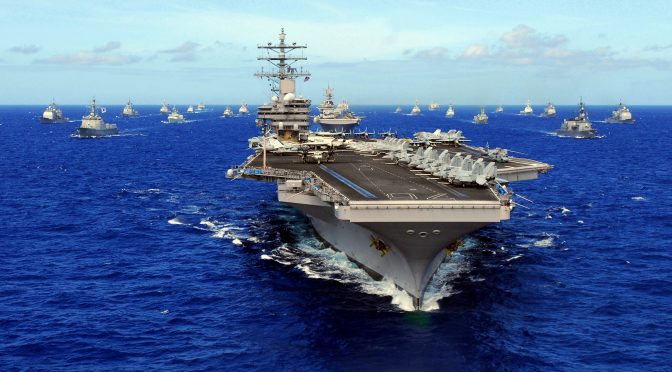
Featured Image: USS Ronald Reagan (CVN 76) transits the Pacific Ocean with ships participating in the RIMPAC 2010 combined task force. (U.S. Navy/MC3 Dylan McCord)

The Evolution of Chinese National Security Debates on Maritime Policy, Pt. 1

The following two-part series will delve into the evolution of China’s national security debates pertaining to maritime security. Part One will focus on changes and trends during Deng Xiaopeng’s administration and the immediate post-Cold War era. Part Two will analyze Chinese maritime policy debates going into the modern era.

By Sherman Xiaogang Lai

In his recent speech on China’s security policy on 17 February 2017, Xi Jinping, the General-Secretary of the Chinese Communist Party (CCP) and President of the People’s Republic of China (PRC) reiterates his Concept of Total Security (COTS, Zongti anquan guan) that he announced for the first time in April 2014.1 The COTS is a call for a kind of balanced approach to China’s post-Cold War security dilemmas that comes out of the country’s varied domestic and international security interests. On the top of Xi’s priority list is the balance between China’s continental and maritime interests, an ongoing intensive subject of debates involving a wide range of Chinese agencies from the military to civilian universities.2 At one end of the debates are rhetorical nationalistic outcries while at the other end are well-considered proposals. These polarized arguments came from fundamental socio-economic changes from when Deng Xiaoping started his market-oriented reforms at the end of the 1970s. They reflect a series of challenges that the Chinese government is facing. A review of these debates could help us identify not only the changes to Chinese national leaders’ priorities but also some of their underlying reasons. As Chinese research institutions are behind the changes, a review of the evolution of debates reveals some dynamics and developments within China’s research institutions. It would therefore help us understand China’s current security dilemma in maritime affairs and Chinese researchers’ intellectual restraints in finding solutions to the dilemma. As Deng’s reforms was the seed of this dilemma, it is necessary to review the impacts of Deng’s reform on China’s national security first.   

Deng’s Reforms, the Security Dilemma and the Ban Lift

Deng’s reforms saved the People’s Republic of China (PRC) from the same fate of the Soviet Union through re-entering the international community and the world market. Thirty years after the start of the reforms, the People’s Republic has become the world’s second largest economy in 2010. In the meantime, however, Chinese leaders find that their country is falling into a security dilemma.3 On the one hand, China’s well-being is dependent on its overseas trade. This means that China has shared interests with the United States and other countries in the security of Sea Lines of Communication (SLOC). And it serves China’s interests for China to develop a blue-water navy in order to contribute more to the international naval campaign of SLOC protection. But on the other hand, some legacies of China’s imperial and revolutionary past are pushing the country toward confrontation against its maritime neighbors and the United States. Among these outstanding legacies are the issues of Taiwan4 and China’s territorial disputes with countries around the South China Sea.5 Many of these countries are dependent on the presence of the United States to negotiate with China. Because Japan’s SLOC go through the South China Sea and close to Taiwan, these issues concern Japan’s security. Japan reinforces its ties with South China Sea countries with the tacit support of the United States. A formidable maritime coalition is therefore formed. To make the situation worse is the wild card of North Korea. Although China saved North Korea in 1950 and has been the latter’s quiet patron, Pyongyang does not trust Beijing, especially after China established diplomatic relations with South Korea in 1993.6 North Korea’s nuclear program not only poses a direct threat to China’s Northeast, but also led to the deployment of the American THAAD system that undermines the credibility of China’s missiles forces against Taiwan and the U.S. forces that might come to its rescue.

Facing these unprecedented and complicated security issues, the Chinese government quietly lifted its ban on discussions on national security among the Chinese public. This lift resulted in a flood of publications. Many of them came from government-funded research projects.7 A few are from the Chinese diaspora. The Chinese public’s involvement in the discussion of China’s national security added a group of new players in the process of policymaking and implementation. Until this quiet lift of the ban in the mid-1990s, the discussions were restricted within the military and the relevant government agencies. Because the Chinese government altered research institutions after the Cold War, a brief review of China’s institutional evolution and historiography on maritime and naval affairs would help understand the reasons of this change and this change’s relations with current debates. 

The pre-1992 Research Institution in China

China did not have a public community of defense and security thinkers until the mid-1990s.8 Although the Ministry of Foreign Affairs (MoFA), the Ministry of State Security (MSS) and the People’s Liberation Army (PLA) had their institutes of research and enjoyed support from the Chinese Academy of Social Sciences, these highly bureaucratized institutes were extensions of the executive branches of the Chinese Communist Party (CCP). Few researchers questioned CCP leaders’ decisions. The PLA monopolized strategic and military studies and was indulged in its victory over the Nationalists and its achievements during the Korean War. Few PLA researchers had incentives to do independent research. Nor did they have necessary skills such as foreign language skills. Because the PLA was modeling the Soviet Red Army, the Academy of Military Science (AMS), the PLA’s principal research institute, had more researchers with Russian language skills instead of English until the early 1990s.9 Therefore, China’s defense study had been a hybrid discourse of the Soviet military doctrines and Maoist doctrines of revolutionary warfare. Soviet military publications were the PLA’s principal intellectual source. As Russia/Soviet Union was a land power and had few mentionable naval victories, it was not surprising that seapower was downplayed. The same situation occurred in China. Although Admiral Sergei Gorshkov’s works were translated almost immediately into Chinese after they were published in the 1970s,10 it was not until 1978 when some of Alfred T. Mahan’s views were introduced into China in Maoist discourse.11 In the same year, Deng started his market-oriented reforms and altered the dynamics of PLA’s naval studies. In April 1979, Deng appointed General Ye Fei as the commander of the People’s Liberation Army Navy (PLAN). In addition to the daunting task to cleaning-up the devastating factional struggles within the PLAN, Deng asked Ye to consider China’s naval strategy. He told him that he did not want a blue-water navy, which always reminded him of the West’s invasions.12

In 1982, Deng replaced Ye of poor health with General Liu Huaqing, a veteran of the CCP’s revolutionary wars and a graduate of a Soviet naval academy. Liu, who was later dubbed as “China’s Gorshkov,”13 continued Ye’s unfinished task of exploring a proper strategy for the PLAN. As early as 1969, Liu served as a PLAN’s deputy chief of staff responsible for shipbuilding affairs. He had recognized that foreign trade was increasingly important to the Chinese economy and China would need a blue-water navy, even aircraft carriers, to protect its SLOC.14 In order to have necessary intellectual support, Liu, with Deng’s approval, established the PLAN’s Institute of Naval Affairs (INA) in 1985. The INA served Liu’s drive for a naval strategy and aircraft carriers. In 1987, Liu and the PLAN submitted a formal proposal for a PLAN strategy to the Central Military Commission (CMC), the commanding agency of China’s armed forces.15 But Deng did not approve the proposal and suspended the discussion on China’s naval strategy. However, in the meantime, he promoted Liu into the CMC and asked him to take charge of the PLA’s equipment affairs. By the time of Liu’s promotion, the Cold War was coming to an end, and the CMC began considering transforming toward the post-Cold War era. But the following discussions were strictly restricted to a few PLA senior officers. In 1991, three years after Liu’s promotion, the First Gulf War broke out and ended with an overwhelming Western victory that surprised the CMC.

General Zhang Zheng’s Reform (1993)

The First Gulf War demonstrated to the Chinese leaders and public that the Soviet and Maoist military doctrines were outdated, and the United States enjoyed comprehensive military superiority over China. The PLA would be in a disadvantageous situation if Taiwan’s efforts for de jure independence led to war. By that time, Chinese leaders had hardly taken into account the prospect of Taiwan’s de jure independence because the Chinese Nationalists were ruling the island. In the meantime, China and the West had a common enemy of the Soviet Union. As Taiwan was in rapid democratization and the Soviet Union no longer existed, the prospect of Taiwan’s independence became imminent. In response to the challenges across the Taiwan Strait, Deng, in 1992, ordered General Zhang Zheng, then 78 years old, to develop a new military strategy.16 The outcome of Zhang’s efforts was the Military Strategic Guideline of the New Era (MSGNE). The PLA’s focus of attention then began shifting from continental defense to a potential war across the Taiwan Strait.

Zhang was open-minded. He acknowledged frankly to the PLA’s entire officer corps in many speeches that the West had left the PLA behind not only in equipment but also in military theories and doctrines. In order to promote research, he ordered the PLA to open its doors to graduates from civilian universities, a practice that was suspended after the Tiananmen Incident in 1989. Zhang’s new policy also encouraged the PLA’s young researchers to work on maritime and naval issues. One of them was Pi Mingyong, the current director of a research department of the AMS. He proved that the Chinese imperial and Republican governments had done their best to protect China’s maritime interests.17 The concept of seapower then began entering into the PLA’s thinking about future conflicts.18 In 1997, a collection of Mahan’s articles and book chapters were translated and published in Beijing.19 These were the first translated publications of Mahan’s works in China.

 While General Zhang encouraged the PLA to develop its intellectual power to meet the post-Gulf War challenges, the Gulf War also provoked Chinese public’s interest in military affairs. Commercial markets for military publications expanded tremendously. Publishers approached AMS researchers for manuscripts. At that time, PLA researchers including those in AMS were underpaid. AMS leaders had been tacitly permitting, even encouraging their researchers to work for extra income.20 The coincidence of General Zhang’s new policy and the market drive therefore altered the dynamics of research inside and outside of the PLA.

Part Two will analyze Chinese maritime policy debates going into the modern era.

Dr. Sherman Xiaogang Lai is an adjunct assistant professor at the Department of Political Science, Royal Military College of Canada (RMC). Before he immigrated to Canada in 2000, he served as a frontline foot soldier in China’s war against Vietnam, UN military observer and researcher in history and military strategy in the Chinese People’s Liberation Army during 1987-1997. The views expressed in this article are his own.

References

1. “Xi Jinping called and chaired a seminar on national security affairs,” (习近平主持召开国家安全工作座谈会), Xinhua, 17 February 2017 (http://news.xinhuanet.com/politics/2017-02/17/c_1120486809.htm ); Xi Jinping (习近平:坚持总体国家安全观 走中国特色国家安全道路), 15 April 2014, Xinhua, (http://news.xinhuanet.com/politics/2014-04/15/c_1110253910.htm); Liu Jianfei, “The Concept of Total Security,”(总体国家安全观:理论指导和根本方法), Xuexi shibao, 3 May 2016, (http://theory.people.com.cn/n1/2016/0503/c376186-28319452.html).

2. See: Sherman Xiaogang Lai,  “China’s Post-Cold War Challenges and the Birth of its Current Military Strategy,” Journal of Military and Strategic Studies 16.4 (2016):183-209; Zhang Li and Ren Linlan (张丽任灵兰), “A Review of the Study of Maritime History in China in the Last Five Years” (“近五年来中国的海洋史研究”), World History (世界历史) 1 (2011): 118–27; Xu Qiyu, “A Study of the Dilemmas of Big Powers during their Rises,” PhD dissertation, Graduate School of Chinese Academy of Social Science, 2007, p. 112. 98 Wu Zhengyu (吴征宇), “Combined Powers of Seapower and Landpower” (“海权与陆海复合型强国”), World Economics and Politics (世界经济与政治) 2 (2012): pp. 49–50; Ke Chunqiao (柯春桥), “Historical Lessons of Big Powers’ Responses to ‘Syndromes of Rising,’(大国应对“崛起综合征”经验教训), Cankaoxiaoxi, 25 August 2016, (http://www.cankaoxiaoxi.com/world/20160825/1281068.shtml).

3.  Graham Allison, “Thucydides’s trap has been sprung in the Pacific,” Financial Times 21 (2012); Xi Jinping, “Rising China should avoid Thucydides’s trap,” (习近平:中国崛起应避免陷修昔底德陷阱), Fenghuang1 January 2014 (http://news.ifeng.com/mainland/detail_2014_01/24/33325262_0.shtml)

4. U.S. Department of Defense, Office of the Secretary of Defense, Annual Report to Congress: Military and Security Developments Involving the People’s Republic of China 2016, pp. 86-88 (https://www.defense.gov/Portals/1/Documents/pubs/2016%20China%20Military%20Power%20Report.pdf)

5. Eric Hyer, The Pragmatic Dragon: China’s Grand Strategy and Boundary Settlement (Vancouver, BC: University of British Columbia Press, 2015), pp. 237-262.

6. Zhang Tingyan (张庭延), “Kim Il-song’s ominous comments on China’s establishment of diplomatic relations with South Korea,” (中韩建交,金日成对中国说出惊人之语), Fenghuang, 10 August 2009 (http://v.ifeng.com/zt/zhongguochaoxianhanguo/)

7. Why does Jingping pay extra attention to the ‘building of new-type think tanks’?”  (习近平为何特别强调“新型智库建设”?), 29 October 2014, Renmin wang (http://theory.people.com.cn/n/2014/1029/c148980-25928251.html)

8. David Shambaugh, “International Relations Studies in China: History, Trends, and Prospects,” International Relations of the Asia-Pacific, Volume 11 (2011), pp. 339–372

9. The author served in this unit during 1987-1997.

10. Ge’ershikefu (戈尔什科夫), Navies in War and Peace (战争与和平时期的海军) (Beijing: Sanlian chudian, 1974); See also: Robert G.Weinland, Robert W. Herrick, Michael MccGwire and James M.McConnell, “Admiral Gorshkov’s ‘Navies in War and Peace,” Survival, Volume 17, No.2 (1975): 54-63.

11. Feng Chengbo and Li Yuanliang (冯承柏, 李元良).  “Alfred Mahan and his Seapower Theory (马汉的海上实力论).” History Studies (历史研究), No.2 (1978):72-83

12. Wu Dian Qing (吴殿卿), “Ye Fei” (“叶飞”), in Leading Generals of the Chinese People’s Liberation Army (中国人民解放军高级将领传), Vol. 7 (Beijing: Jiefangjun chubanshe, 2007). See also Sherman Xiaogang Lai, “Ensured Loyalty versus Professionalism at Sea: A Historical Review of the PLA Navy (1949–1982)” (paper presented at the annual meeting of Chinese Military History Society 2016, Ottawa, Ontario, Canada, 14 April 2016).

13. You Ji, The Armed Forces of China (London: I.B. Tauris & C Lit, 1999) from Peter Howarth, China’s Rising Sea Power: The PLA Navy’s Submarine Challenge (London: Routledge, 2006): 126

14. Liu Huaqing’s Memoir (刘华清回忆录) (Beijing: Jiefangjun Chubanshe, 2004), 349.

15. Liu Huaqing’s Memoir, 431 and 439.

16. Lai, “China’s Post-Cold War Challenges and the Birth of its Current Military Strategy,” p.199.

17. Pi Mingyong (皮明勇), “Seapower Concepts and Theories of Naval Development in late-Qing China,” (海权论与清末海军建设理论), Studies of Modern History (近代史研究), No.3 (1994): 37-47; Pi Mingyong, “A Review of Theoretical Exploration to China’s Naval Strategies and Tactics in the early Republican China,” (民国初年中国海军战略战术理论述论), Military History (军事历史研究), No.5 (1994):101-108.

18. Zhang Zongtao (张宗涛). “Alfred Mahan and his Seapower Theory (马汉及其’海权论’). Military History, No.6 (1993): 42-43; Xiao Defang (肖德芳). “Alfred Mahan’s Theory and the Evolution of the Maritime Strategies of the United States and Japan (马汉理论与美日海上战略演变).” Journal of Yibin Teachers College. No. 3 (1993): 70-74; Zhang Xiaolin and Liu Yijian (张晓林 刘一健). “Alfred Mahan and his The Influence of Seapower Upon History (马汉与海上力量对历史的影响).” Military Historical Research, No.3 (1995):121-134; Qi Qizhang (戚其章). “The Command of Sea and the Outcome of the First Sino-Japanese War (从制海权看甲午海战的结局).” Dong Yue Tribune (东岳论丛), No.4 (1996): 91-97;

19. Alfred T Mahan, Haiquan lun (海权论) (Naval Strategy: Compared and Contrasted with the Principles and Practice of Military Operations on Land (Beijing: Zhongguo yanshi chubanshe, 1997).

20. The author’s experience. A PLA captain’s monthly salary in 1992 was around RMB 300 while the official exchange between USD and RMC was around 1:5.5. But the exchange rate in black market in Beijing was around 1: 8. A couple of PLA junior officers could not raise their nuclear family of three in Beijing. See: Pi Mingyong reminded the PLA and CCP leaders of the severe impacts of underpaying servicemen by using an example of the late Qing China. See: Pi Mingyong, “An Exploration into Servicemen’s Financial Situation,” (晚清军人的经济状况初探), Studies of Modern History (近代史研究), No.1 (1995): 11-35

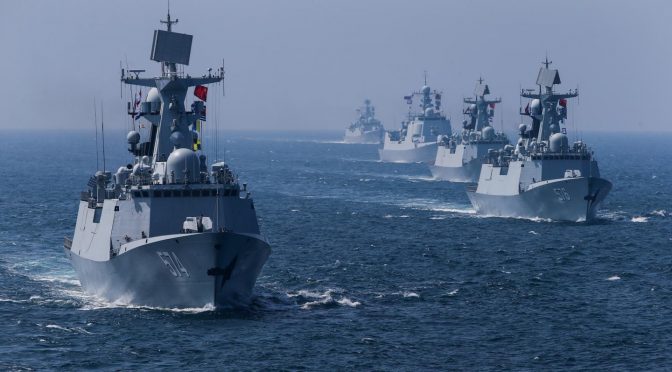
Featured Image: PLA Navy warships (Reuters/Stringer)

Fostering the Discussion on Securing the Seas.