Turkey’s Air-to-Air Drone Test and the Logic of Middle-Power Alliance Stress

By Lawrence J Kaiser

In late 2025, Turkey conducted a successful test of an air-to-air missile launched from an unmanned combat aerial vehicle (UCAV).  At first glance, the event appeared to be a narrow technical milestone – another incremental advance in the rapid evolution of drone warfare. Yet in strategic terms, the test reveals something far more consequential:  a structural shift in Turkey’s strategic posture as a middle power, a shift that increasingly tests, reshapes, and exploits alliance boundaries rather than choosing sides within them.

However, for U.S. and NATO planners, the significance of the test lies elsewhere.  Turkey’s air-to-air UCAV capability alters the escalation calculus of the alliance itself while remaining formally inside NATO’s institutional framework.  The episode signals less about alliance defection than an emerging pattern of alliance stress-testing – one that exploits gray-zone ambiguity from within.

The Event and the Misreading

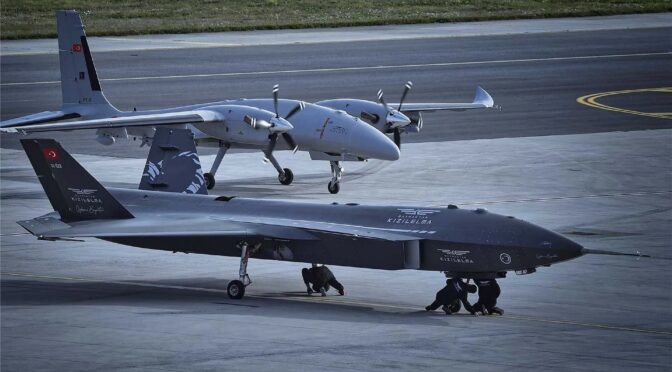
Turkey’s successful air-to-air missile launch from a UCAV, reportedly conducted using Bayraktar’s Kizilelma platform, was widely reported as evidence of Ankara’s growing defense-industrial sophistication.  Commentators emphasized technical details:  sensor fusion, indigenous missile development, and the potential export market for Turkish drones.  While accurate, this framing misses the strategic significance of the test.

Air-to-air capability is qualitatively different from the ground-attack roles that have defined drone warfare in Nagorno-Karabakh, Ukraine, and the Middle East.  Ground-attack UCAV’s typically operate against fixed or surface targets in permissive or degraded air-defense environments where escalation remains geographically bounded and politically intelligible. However, air-to-air systems directly contest air sovereignty and interact with the manned aircraft of other states. They enter, then, a domain historically governed by tightly managed rules of engagement and alliance de-confliction arrangements. As a result, their use moves these weapons from supporting roles in peripheral conflicts, to potential instruments of direct interstate belligerence within contested airspace. In doing so, Turkey is not merely adding a new weapon, it is redefining the political and strategic meaning of unmanned force.

Why Air-to-Air Matters for a Middle Power

For a middle power like Turkey, air-to-air UCAVs offer three distinct advantages. First, they reduce political risk. The absence of a pilot lowers the domestic and alliance costs of escalation, enabling assertive signaling without immediate reputational or human consequences. Second, they enhance ambiguity in the escalation environment. Unmanned aircraft do not hold a distinct legal status under the U.N. Charter, the Law of Armed Conflict, or U.S. Standing Rules of Engagement. The destruction of such a platform remains a use of force. Yet the absence of a pilot materially alters the political and psychological dynamics of confrontation. Without the risk of killed or captured personnel, incidents involving unmanned systems generate lower immediate domestic or alliance pressures to retaliate. As a result, leaders are able to frame them as limited coercive signals – or even technical miscalculation – rather than as acts demanding a reciprocal military response. Third, they strengthen bargaining leverage. Indigenous air combat capability signals autonomy from alliance supply chains and constraints.

These advantages are not merely theoretical. Turkey has repeatedly demonstrated a preference for tools that expand its room for maneuver, while preserving plausible deniability. From drone operations in Syria and Libya to naval posturing in the Eastern Mediterranean, Ankara has favored capabilities that allow it to probe limits without triggering decisive retaliation. Air-to-air UCAVs fit squarely within this pattern.

Supply Chains, Material Sourcing, and Strategic Autonomy

Turkey’s progress in unmanned air combat cannot be understood solely in terms of platforms or doctrine. Its deeper significance lies in the supply chains and material sourcing strategies that underpin Turkey’s drone ecosystem. These industrial foundations are what allow Ankara to sustain operational tempo, absorb potential political friction, and maneuver within alliance constraints without triggering formal rupture.

Unlike many NATO allies, Turkey has pursued defense-industrial depth rather than specialization. Over the past decade, Ankara invested heavily in a more vertically integrated production model across a host of sectors: airframes, avionics, sensors, and – perhaps most critically – munitions. Firms like Baykar operate within a broader ecosystem of domestic subcontractors that, in turn, reduce reliance on single foreign suppliers. This matters because air-to-air UCAVs are not one-off prestige systems. They require reliable access to not only propulsion components and guidance systems, but missile inventories and data links that can be replenished under conditions of political stress.

Supply chain autonomy has already proven decisive in earlier phases of Turkey’s drone deployment. Western export controls on engines, optics, and precision components following operations in Syria and Nagorno-Karabakh forced rapid substitution and indigenous development. Rather than halting progress, these constraints accelerated Turkey’s efforts to diversify its sourcing and indigenize critical subsystems. While the result is not complete autarky, it is a fairly resilient hybrid model that limits the coercive leverage of any single supplier or alliance partner.

In the air-to-air domain, this resilience takes on heightened strategic importance. Unlike ground attack drones, the use of air-to-air UCAVs implicate alliance airspace management, rules of engagement, and escalation control. Capability that exists only on paper – or even depends on fragile supply chains – would offer only limited leverage.  In contrast, a system backed by secure production lines and scalable munitions supply enables Turkey to signal persistence rather than experimentation.  It tells allies and adversaries alike that these platforms are not exceptions, but part of a durable force structure.

Material sourcing also shapes Turkey’s export behavior which reciprocally feeds back into its posture within the alliance. Because Turkish drones are not fully captive to U.S. or European components, Ankara can sell them to partners that Western suppliers would exclude or delay. This export flexibility strengthens Turkey’s diplomatic reach, while reinforcing domestic production volumes and, thereby, further insulating its supply chains from external pressure. In effect, Turkish exports subsidize Turkish autonomy.

For NATO, this presents a subtle but consequential challenge. Alliance influence has traditionally flowed through shared logistics, interoperability standards, and supplier dependence. Turkey’s drone supply chain strategy erodes that leverage without violating formal commitments. Ankara remains interoperable where it chooses, while retaining the option to diverge when alliance consensus constrains Turkish interests.

This pattern is not unique to Turkey. Arms-transfer data from the Stockholm International Peace Institute (SIPRI) suggest that other middle powers, including India and South Korea, also have long pursued analogous diversification and domestic production strategies in order to reduce supplier leverage, while remaining formally aligned with U.S.-led security frameworks.

Viewed in this light, Turkey’s air-to-air UCAV capability is not merely a technological leap. It reflects the mindset of a deeper industrial strategy that converts supply chain resilience into strategic optionality. This material foundation is what allows Turkey to stress-test NATO from within, while remaining confident that any resulting political friction will not translate into immediate operational vulnerability.

Alliance Stress-Testing Rather Than Alliance Exit

Much of the commentary on Turkey’s defense trajectory assumes a binary choice: either Ankara is drifting away from NATO or it remains a difficult but ultimately loyal ally. This framing obscures a third possibility: Turkey is deliberately stress-testing the alliance to extract concessions, redefine roles, and maximize its autonomy.

The UCAV air-to-air test exemplifies this approach. By developing capabilities that NATO itself is still debating conceptually and doctrinally, Turkey positions itself as both indispensable and disruptive. It contributes innovations while simultaneously complicating alliance planning. This duality is not accidental. It allows Ankara to argue for greater voice and flexibility within NATO, while retaining the option to act independently when alliance consensus falters.

Importantly, this is not equivalent to the logic behind Turkey’s acquisition of the Russian S-400 system. Whereas the S-400 represented a clear breach of alliance norms, indigenous UCAV development does not violate formal commitments. Instead, it creates informal pressure, thereby forcing allies to adapt to Turkish capabilities rather than constrain them.

For NATO, while alliance commitments remain unchanged, incidents involving unmanned platforms may unfold at a tempo that tests NATO’s consultation processes, thereby increasing the risk that political coordination lags behind rapid escalation dynamics.

Escalation Optionality and the Compression of Thresholds

One of the most significant implications of the air-to-air UCAVs is their effect on escalation dynamics. Traditional air combat involves high thresholds: the deployment of manned fighters, formal rules of engagement, and alliance consultation mechanisms. In regions such as the Aegean and the Black Sea, where air encounters are frequent and politically sensitive, this ambiguity creates new risks of miscalculation that are difficult to manage through existing alliance procedures. For example, a Turkish unmanned interceptor operating near contested airspace in the Aegean could shadow a Greek aircraft or conduct a radar lock without immediately triggering the political shock associated with a manned confrontation. If the unmanned platform was damaged or downed in such an encounter, the absence of a captured or killed crew would reduce the immediate domestic and alliance pressures that typically accompany the loss of a pilot, even though the legal characterization of the incident would remain unchanged. The legal threshold would be the same, but the political demand for swift retaliation would be lower. Unmanned air-to-air platforms alter escalation tempo without altering legal thresholds.

For Turkey, the effect is not the creation of new legal authorities but the expansion of escalation flexibility. Manned fighters are equally capable of conducting warning intercepts or employing force in self-defense, and neither NATO policy nor the UN Charter establishes a distinct approval regime for unmanned systems. The distinction lies in the consequences attached to the loss of personnel. When a crewed aircraft is damaged or downed, the presence of killed or captured aircrew generates immediate domestic and alliance pressures that narrow response options and accelerate consultation demands. Incidents involving unmanned platforms, while still constitute a serious use of force, do not carry the same immediate human stakes, thereby allowing greater room for graduated signaling and a controlled response. In contested environments such as the Aegean, northern Syria, and the Black Sea, that marginal difference can matter.

From a strategic perspective, Turkey is acquiring not just a weapon, but a spectrum of options that blur the line between peace and conflict. This is a hallmark of contemporary middle power strategy under conditions of multipolarity and institutional strain.

Turkey as Systems Integrator, Not Mere Spoiler

A common caricature portrays Turkey as a spoiler within NATO: unpredictable, transactional, and disruptive. The UCAV test suggests a more nuanced reality. Turkey is increasingly acting as a systems integrator, combining indigenous platforms, tailored doctrines, and selective alliance participation into a coherent strategic posture. But this integrative posture also introduces alliance friction. A Turkey able to conduct limited unmanned air operations in contested airspaces – such as an intercept or retaliatory strike in the Aegean or northern Syria – without incurring immediate personnel loss may act more rapidly than NATO’s consultation processes can accommodate. While such an action might fall below the threshold of collective defense, it could nevertheless trigger countermeasures from a third party, thereby placing the alliance in the position of managing escalation dynamics it did not collectively authorize.  Allies may diverge over what constitutes a proportional response, levels of risk tolerance, or the necessity of consultation, exposing internal fractures and complicating deterrence signaling. The issue, then, is not alliance collapse, but the strain placed on cohesion and decision-making under compressed timelines. 

This posture does not reject the West, nor does it align fully with revisionist powers like Russia or Iran. Instead, it seeks leverage against all sides by creating capabilities that others must account for. In this sense, Turkey resembles other middle powers that pursue strategic autonomy without formal non-alignment (e.g. India or Brazil), albeit within a more militarized and volatile regional context.

Forward Indicators: What to Watch

If the UCAV test is a signal, what does it signify? Several indicators merit close attention. First, integration with naval aviation, particularly Turkey’s ambitions for carrier-based drone operations, would further enhance its independent power projection. Second, export behavior – whether Turkey restricts or proliferates air-to-air drone capabilities – will reveal how Ankara balances profit, influence, and restraint. Third, NATO doctrinal debates on unmanned air combat will indicate whether the alliance adapts to Turkey or attempts to constrain it.  Finally, shifts in Turkish strategic rhetoric will signal how Ankara seeks to justify its posture diplomatically.

Conclusion

Turkey’s successful air-to-air missile launch from a UCAV should be understood as a strategic signal rather than a technical curiosity. It reflects an emerging middle power logic that prioritizes escalation optionality, alliance stress-testing, and indigenous capability development. Far from signaling a simple drift away from NATO, the test underscores Ankara’s efforts to redefine its role within (and occasionally beyond) the alliance.

For analysts and policymakers, the lesson is not that Turkey is drifting away from NATO, but that an alliance may increasingly face stress from within as members acquire tools that compress escalation thresholds without breaking formal rules. Turkey’s air-to-air UCAV highlights how military innovation can outpace alliance governance, turning institutional ambiguity into leverage. Understanding this dynamic is essential not only for managing Ankara’s trajectory, but for adapting alliance strategy to an era in which escalation control is no longer monopolized by manned platforms.

Dr. Lawrence Kaiser is a geopolitical strategist focused on alliance politics, middle-power hedging, and escalation dynamics. He holds a Ph.D. in philosophy and an ALM in international relations from Harvard University.

Featured Image: Turkey’s KIZILELMA UCAV: A next-generation unmanned combat aerial vehicle designed for precision strikes, with supersonic speed, 1.5-ton payload capacity, and advanced autonomous flight capabilities. (Picture source Ugur Ozkan via X)

Sailor’s First – Aligning the Leadership Continuum

By CAPT Paul W. Nickell, USN, MA, MBA

The Sailor is the Navy. No Navy is better than its Sailors. An unstructured, disconnected leadership continuum is a disservice to our Sailors and our Navy. The ideal Navy starts with the ideal Sailor. Now is the time for a coherent, connected Sailors First leadership continuum.

Introduction

Admiral Caudle provided a systematic build-up to framing his vision (priorities) for how our Navy will fight: C-NOte #1 on Sailors and their Quality of Life to C-NOte #2 on the Foundry and envisioned infrastructure necessary to generate and sustain naval power to the Worldclass Fleet in C-NOte #3 described for the fight: Sailors First–Foundry Always–Worldclass Fleet.1 

Now, in C-NOte #4, he outlines the vision for how that force will operate: a Golden Fleet capable of Enhanced Mission Command, delegated autonomy, and winning in a strategic environment (that is) fundamentally different from that of two decades ago. This is a fleet that is built in the foundry and forged to fight. We must assume a new foundry and a new forge – not old legacy ways and means.

Though the vision is sound, it faces a critical obstacle. While the Navy has issued Fighting Instructions in the past to address tactical application, we still lack a coherent philosophical doctrine for warfighting leadership.2,3  Instructions and notes alone are insufficient to achieve a timeless model for naval warfighting, as exemplified by the United States Marine Corps’ FMFM-1: Warfighting.4 

Doctrine, Notes, Pamphlets aside, we must also win the mind and truly cultivate the cognitive edge of the command leader at sea – Education. Currently, the Navy’s mechanism for winning that mind – our Leadership Development Framework (Enterprise) – is fractured and requires a fresh look.

Unifying Navy’s Leadership Enterprise: A Strategic Imperative for Warfighting Excellence

The fundamental flaw in our current alignment of leader development is not merely bureaucratic; it is philosophical. This creates a strategic category error. By housing the Navy Leadership and Ethics Center (NLEC) and the Senior Enlisted Academy (SEA) within a training command, the Service imposes a mechanistic training framework on an adaptive human problem.4 

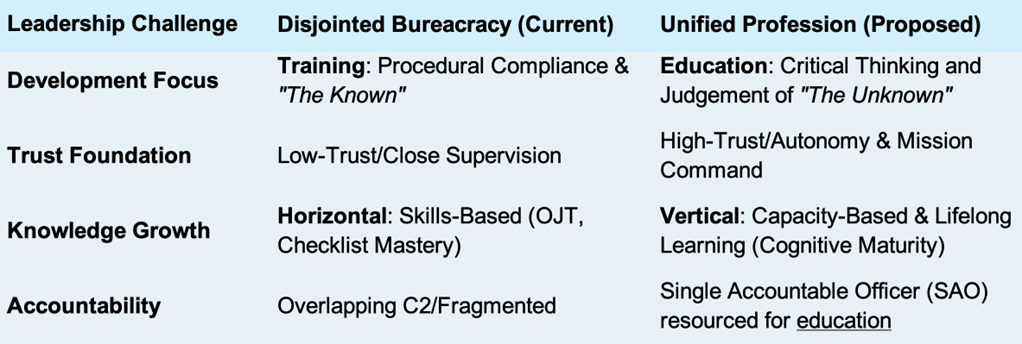
To help the reader understand this distinction, we must look to the Navy’s own professional doctrine. The U.S. Naval War College’s primer on the Navy Profession explicitly differentiates between a bureaucracy and a profession. Training is the tool of the bureaucracy; it is skills-based, compliance-based, and focused on the efficiency of resource expenditure through checklists and standard operating procedures (SOPs). This approach is inherently mechanistic, designed for routine work and the known.

In contrast, education is the tool of the profession. It is expert-based, requiring life-long learning to develop the discretion and judgment necessary to achieve mission effectiveness in the face of the unknown.6 As Admiral P. Gardner Howe III observed, “a bureaucratic organization will never succeed in combat; only a professional organization can and will.”7

By relegating leadership development to a training command, we are effectively using checklists to solve for culture. The result is a force trained for compliance and ill-equipped for the ambiguity of command. This structure restricts our ability to develop leaders who can out-think the adversary because it prioritizes hardware and routines over the development of critical-thinking skills – the primary driver of innovation and adaptability.

To fix the output, Navy must fix the input structure. Reintegrating NLEC and SEA under the USNWC replaces a mechanistic training model with a dynamic educational framework, offering a coherent model from E-1 to O-10.8 This move leverages the War College’s research power for adult development (vertical growth) – expanding a leader’s capacity to think in more complex ways – rather than just horizontal learning (adding more technical facts).

Furthermore, this unification restores a massive, currently dormant strategic potential (from the 2013 Navy Leader Development Strategy). Prior to COVID, CNO directed that senior Flag Officers speak to every NLEC class, ensuring that the CNO’s message reached every Triad leader in the Navy. Today, this engagement has greatly diminished, often replaced by administrative or junior Flag representation. Unifying the enterprise under the USNWC would institutionalize the “leaders engaging leaders” model, ensuring that the warfighting goals of C-NOte #4 are forged into the minds of every front-line leader.9 This is the human capital solution required to achieve the cognitive overmatch our current strategic environment demands.

Education: The Framework for a Disciplined Mind

True education is what remains after one has forgotten everything they learned in school.10 It transcends memorizing transitory facts – specific dates, formulas, or administrative procedures – to cultivate lasting, under-the-hood professional skills: critical thinking, problem-solving, empathy, curiosity, and adaptability. While training minimizes variance to prepare us for the expected (the known), education expands our cognitive capacity to handle the unexpected (the unknown). We train for certainty; we must educate for uncertainty.

For a Naval leader, education is how learning transforms the mind to handle life-and-death challenges in complex, high-stakes environments. To achieve this, the Navy must move away from its current bifurcated structure and toward a single, unified enterprise that manages the leadership journey from “Day One” to Flag rank.

The Strategic Advantage of a Single Entity

Currently, leadership development is split: NLEC (E1–O6) and SEA (E7-E9) fall under the Naval Education and Training Command (NETC), while the USNWC College of Leadership and Ethics (CLE) handles Flag Officers (O7–O10). Reintegrating NLEC and SEA under the USNWC offers three decisive advantages:

Unified Command of the Continuum: A single entity ensures the Warrior Ethos – a mindset marked by honor, integrity, and resilience – is consistently developed across every career milestone. When the NLEC was established as an Echelon III under the Naval War College in 2014, the intent was to create a single “Home of Thought” for leader development from E1 to O10.11 Returning to this structure resolves the current philosophical disconnect. Furthermore, bringing NLEC and SEA back under one roof mirrors the reality of the Fleet. The CO and CMC do not lead in silos; they lead together as a Triad under a unified vision. Their development should reflect that partnership, rather than separating their educational foundations into disparate training and education

Research-Driven Excellence: The USNWC is a research powerhouse that outshines the bureaucratic focus inherent to NETC’s Street to Fleet mission. In the Service’s own professional doctrine, training is defined as “skills-based” and focused on “efficiency of resource expenditure” within a bureaucracy.12 While NETC excels at this training – horizontal learning that is designed for technical competence in finite systems – leadership is an infinite human activity that requires vertical development to foster judgment of the unknown.

By keeping NLEC and SEA under a training command, the Navy commits a strategic category error: attempting to apply mechanistic solutions (checklists and administrative procedures) to organic, adaptive problems like culture and trust. Bureaucracies exist to support professions, not the other way around. Housing an educational powerhouse like USNWC under a training command would be a “category error” of the highest order, as it would subject discretionary professional judgment to procedural compliance. As RDML P. Gardner Howe III observed, “a bureaucratic organization will never succeed in combat; only a professional organization can and will.”13

Unifying these bodies under the USNWC allows for the expert application of specialized knowledge through the discretion and judgment of the individual leader. NETC’s mission is to efficiently expend resources for routine training. The USNWC’s mission, as tasked by the CNO, is to educate and develop leaders capable of out-thinking the adversary. These missions are complementary but must remain distinct, with the professional educational authority (USNWC) setting the standard for the leadership continuum.

Bridging the Flag Officer Gap: There is currently a significant visibility gap between Flag leadership and the foundational leadership schoolhouse, limiting understanding of NLEC’s role in Navy leadership development. While Flag Officers are intimately aware of the benefits of the USNWC CLE team’s Flag and Executive (FLEX) courses, their understanding of NLEC’s current evolution is often limited to their own past participation in legacy courses.

This gap is evidenced by the decline of the Leaders Engaging Leaders model. Prior to NLEC’s move to a training command, the CNO mandated that senior Four-Star Admirals engage with every NLEC class, ensuring that the CNO’s strategic vision was institutionalized directly into the minds of every Triad leader in the Navy (Howe, 2015).14 Today, this top-level engagement has largely been replaced by administrative or junior Flag representation.

Reintegration leverages the established trust Flag Officers have in the War College Brand as the Home of Thought to restore this critical engagement. By placing NLEC and SEA back under the NWC, the Navy ensures that senior leaders remain the primary drivers of professional identity for the commanders they lead, restoring the prestige, credibility, and visibility of command-level leadership development across the Navy.

The Cost of a Disjointed Continuum: Lessons from the Press

A fragmented leadership model – where “reins” are split – creates a disconnect between theoretical wisdom and practical application. This disjointed continuum often leads to systemic failures that result in negative press and eroded public trust:

  • Institutional “Lessons Noted” vs. “Lessons Learned”: Insights from isolated seminars rarely translate into sustained action, leading to recurring patterns of failure.
  • Crisis of Character and Trust: High-profile episodes of misconduct or Command failure often stem from leadership deficits – poor judgment, lack of clear vision, or a “zero-defect” mindset that breeds paralysis.
  • Operational Risk: Public crises regarding Sailor Quality of Life – housing, galley facilities, and pay delays – highlight a failure to manage the “Total Force” with a unified leadership mindset.

Institutionalizing CNO Goals: The Untapped Potential

Prior to COVID, the CNO directed each of the Navy’s Four-star Admirals to speak to every NLEC class (14 classes annually). This ensured that both the CNO’s message reached every “Triad” leader in the Navy within a 2-3-year span and that the wisdom and vision of our most senior flag officers across the fleet were shared with our front-line command leaders. Today, that engagement has diminished, with the occasional Four-star engagement largely in the shadows of predominantly administrative and junior Flag representation replacing Fleet leadership – Senior Fleet leaders are not engaging in this dedicated and precious time for thinking with Command (Combat) leaders.

The potential of a unified enterprise is incredible:

  • Unmatched Reach: In 2-3 years, a unified message delivered at NLEC and SEA can reach every single triad leader in the entire Navy – a feat that even the War College’s current student body load alone cannot achieve.
  • Strategic Hedge: A unified entity serves as a strategic hedge, reducing operational risk by investing in the People who address high-consequence contingencies.
  • Single Point of Accountability: Command is an action, not a position. Reintegration ensures that every leader, from the deckplates to the Pentagon, is forged in the same “Foundry” of leadership excellence.

Figure: Enterprise Alignment of Leadership Education

Conclusion: A Warfighting Imperative

Reintegrating NLEC under the U.S. Naval War College is not merely a structural change; it is a strategic and cognitive realignment of how the Navy forges the mind of the warfighter. For too long, the Service has treated leader development as a bureaucratic checklist of skills to be trained rather than a professional capacity to be forged. By unifying the organizational reins, the Navy will achieve a philosophical unity – A Service of Thought – that ensures the Warrior Ethos and the CNO’s warfighting priorities are messaged with one voice from the deckplates to the Pentagon.

As Admiral Caudle reminds us, the Fleet must be built in the foundry. A true foundry does not merely assemble parts; it applies heat and pressure to change the fundamental properties of the material. This is the essence of our new approach: moving beyond the horizontal, skills-based learning of technical facts (better left to the Type Command (TYCOM) schoolhouses) to the vertical development of the mind. This is the work of education, and it requires a unified foundry – one standard, one discipline, and one leader development continuum from the deckplates to the Pentagon.

To build this foundry, the Navy must act with the same decisiveness it expects of its commanders. We must stop fragmenting the development of our most decisive asymmetric advantage – our people. By aligning development under the U.S. Naval War College, we move from a mechanistic model of compliance to a dynamic model of professional excellence. We ensure that every Naval leader is trained for the weapon station and educated for the command.

We build the Leader(ship) not just to float, but to fight and win in the most complex and unpredictable waters ahead – Forged to fight, Tempered in the Fleet.

Captain Paul Nickell recently completed his tour as a Military Professor at the College of Leadership and Ethics within the Naval War College, and before that as an Instructor at the Navy Leadership and Ethics Command, where he facilitated learning of Major Commanders and Commanding Officers, and developed tomorrow’s Joint Force Leaders. Flying the P-3C, P-3SPA, and the P-8A, he has commanded a P-8A squadron and was the Battle Director for CENTCOM Air Operations. He is currently the Prospective Major Commander for Naval Air Station Corpus Christi, Texas. He holds advanced degrees from both the Naval War College and the Naval Postgraduate School, where his thesis explored “How the Navy Can Become A Learning Organization,” and his subsequent research at the Naval War College has focused on learning as it applies to leadership development.

References

1 “Chief of Naval Operations,” January 2026, https://www.navy.mil/Leadership/Chief-of-Naval-Operations/.

2 Paul Nickell, To Win the Fight, We Must First Win the Mind: Create NDP-1.1 Naval Warfighting | Center for International Maritime Security, September 30, 2025, https://cimsec.org/to-win-the-fight-we-must-first-win-the-mind-create-ndp-1-1-naval-warfighting/.

3  Paul Nickell & Arthur Valeri, “How the Navy Can Become a Learning Organization, Again.” 2024. https://hdl.handle.net/10945/73501

4 Sailors First and the Ideal Navy: Inside the Pentagon with the New CNO, directed by Fed Gov Today, 2025, https://www.youtube.com/watch?v=lKaV0iiQ_c0.

5 Martin L. Cook et al., “The Navy Profession,” U.S. Naval War College, April 2, 2016.

6 Cook et al., “The Navy Profession.”

7 P. Gardner Howe, Professionalism, Leader Development Key to Future, May 19, 2015, https://usnwc.edu/News-and-Events/News/Rear-Adm-Howe-Professionalism-leader-development-key-to-future.

8 Walter E. Carter Jr., “President’s Forum,” Article 2, Naval War College Review 67, no. 1 (2014); James Kelly, “Strengthening Our Naval Profession through a Culture of Leader Development,” Article 3, Naval War College Review 67, no. 1 (2014).

9 Howe, Professionalism, Leader Development Key to Future; Daryl Caudle, “Chief of Naval Operations,” https://www.navy.mil/Leadership/Chief-of-Naval-Operations/.

10 Albert Einstein, Ideas and Opinions, 3rd ed (Crown/Archetype, 2010).

11 Carter Jr., “President’s Forum.”

12 Cook et al., “The Navy Profession.”

13 Howe, Professionalism, Leader Development Key to Future.

14 Howe, Professionalism, Leader Development Key to Future; “CNO’s Navy Leader Development Strategy Advances at Naval War College,” United States Navy, https://www.navy.mil/Press-Office/News-Stories/display-news/Article/2265556/cnos-navy-leader-development-strategy-advances-at-naval-war-college/.

Featured Image: The Naval War College, RI. (U.S. Navy photo)

The United States Can’t Deter China Without Allied Shipyards

By Patrick M. Cronin and David Glick

Introduction

Industrial endurance and allied integration are indispensable to making deterrence-by-denial against China credible under the 2026 National Defense Strategy. The Trump administration’s Maritime Action Plan rightly elevates cooperation with South Korea and Japan. But viewing these allies as a temporary bridge to U.S. revitalization understates the scale and longevity of the China challenge. What is needed is a fully integrated, long-term allied shipbuilding ecosystem, that can generate surge capacity, distributed production, and wartime repair across the Indo-Pacific. Without that durable industrial architecture, denial remains declaratory rather than operational. This essay makes that case.

If a war erupts over Taiwan, what will sink the U.S. Navy first: Chinese missiles or American shipyards? Analysts have catalogued the widening gap between China’s defense industrial base and America’s. Shipbuilding sits at the center of that imbalance. What began the decade as a pacing challenge has become a structural industrial advantage for Beijing. In the Indo-Pacific, deterrence now depends less on the number of hulls afloat than on the ability to replace, repair, and regenerate them under fire. On that measure of industrial endurance, the United States is dangerously behind. 

The U.S. fleet lacks the scale, resilience, and regenerative capacity to compete with China’s expanding navy and the industrial base behind it. Even with higher funding and domestic reform, the United States alone cannot build the fleet required to match–let alone “overmatch”–China’s output. The U.S. Navy fleet currently stands at 290 ships compared to China’s 331. That gap, by itself, is not decisive. But Beijing can draw on a vast coast guard, merchant marine, and dual-use civilian fleet that allows Beijing to surge up to 5,500 hulls for support, refueling, and transport. The United States has roughly 80 comparable auxiliary and sealift vessels. This disparity reflects more than fleet size; it exposes structural constraints in American industrial capacity.

America’s defense industrial base, and shipbuilding in particular, has become structurally brittle after the collapse of commercial shipbuilding, decades of consolidation and specialization, workforce attrition, and highly inconsistent demand signals. Today, a remarkable degree of U.S. Navy major combatants are constructed at a handful of specialized yards run by two defense juggernauts: Huntington Ingalls Industries and General Dynamics.

These structural limitations matter because deterrence against Beijing now requires maritime power at a level the U.S. industrial base cannot produce independently. Attempts at domestic reform including President Trump’s ambition to build a “Golden Fleet” reflect a correct diagnosis of the problem, and executing the Maritime Action Plan may be key to reviving America’s claim to be a maritime nation. But execution is far from guaranteed. Previous U.S. efforts to slow China’s seapower ascendancy, including during Trump’s first term, have focused on massive increases in defense spending, radical policy changes, or both and many of these plans have stalled out.

As one of America’s top naval analysts, Ronald O’Rourke, argues, U.S. shipbuilding shortfalls reflect a systemic, self-reinforcing failure in which unaffordable plans, industrial limits, workforce bottlenecks, and flawed acquisition processes have collectively undermined capacity. The bottom line is that no amount of additional spending on ships or marginal policy reform within the United States alone can resolve the problem, especially as China’s larger, dual-use shipbuilding ecosystem turns American naval production capacity into a strategic liability.

“America First” rightly underscores the imperative to rebuild U.S. industrial capability, including its shipbuilding. But America alone, or cooperation limited to full onshoring, is insufficient. Unless Washington fully leverages the capabilities of allied seapowers, China’s maritime edge will grow. As Brent Sadler notes in Naval Power in Action, China has managed to “out-Mahan” the United States through an “aggressive and focused prioritization of a powerful civil-military national maritime sector.” His proposed remedy of a G-7-like consortium of maritime nations to meet the challenge is sound, but the foundational starting point must be to better harness the collective shipbuilding capabilities of the United States, South Korea, and Japan.

Although President Trump may instinctively support integrating allied shipbuilding capacity, current policy concentrates on comprehensive onshoring. The Maritime Action Plan, for all its strengths, largely confines allies to providing foreign direct investment in U.S. shipyards and maritime infrastructure. That contribution is important but insufficient.

A politically sustainable solution requires durable mutual benefit. Deterring China at scale will demand the systematic integration of allied shipbuilding capacity, especially from South Korea and Japan, into U.S. naval force planning. Capital that flows into American docks from threats of tariffs and placing conditionality on security alliances will undermine the alliance bonds on which our strategy depends. Without deep industrial cooperation, the United States will lack the industrial and thus operational resilience needed for credible Indo-Pacific deterrence. Absent complementary reforms, such as targeted modifications to the Jones Act and related statutes that tether shipbuilding exclusively to domestic yards, Washington will struggle to erect a shipbuilding defense industrial base that is both politically acceptable at home and economically sustainable for South Korea and Japan.

But let us start by briefly considering the strategic objective of deterrence by denial of China, because that is at the heart of calls for reviving shipbuilding capacity in the first place.

The Deterrence Challenge: Responding to Pressure with Endurance

The Trump administration’s National Security Strategy identifies China’s bid for dominance within and beyond the First Island Chain as a direct challenge to regional stability, while the National Defense Strategy prioritizes a defense-by-denial approach anchored along that same geography. This framework highlights that successful deterrence must operate not only against invasion, but across the subtler and more pervasive forms of coercion that Beijing prefers. Xi Jinping appears to recognize that a forcible seizure of Taiwan would carry extraordinary risks, yet his purging of senior generals heightens the danger of miscalculation and reinforces the need for full-spectrum deterrence.

A central danger is that Beijing seeks to exhaust Taiwan psychologically, economically, and militarily rather than gamble on an all-out invasion. China commands a broad menu of coercive options, ranging from gray-zone harassment and maritime quarantine to incremental blockade or amphibious assault, all designed to impose cumulative pressure while exploiting gaps in allied endurance and logistics rather than inducing a single decisive battle. For example, China has recently rehearsed navigating some 1,400 fishing vessels to form a 200-mile-long sea barrier that could support a blockade of Taiwan. This, alongside other graduated options, allows Beijing to vary pace and intensity, steadily degrading Taiwan’s resilience while testing allied political will.

China’s sprawling military-industrial complex further broadens its operational choices. The People’s Liberation Army (PLA) can field large quantities of long-range anti-ship missiles, submarines, and other systems designed to deny U.S. forces freedom of action at increasing distances. Operating close to home, Chinese forces benefit from interior lines of communication, proximate shipyards, and rapid repair and replacement capacity. These advantages allow the PLA to absorb losses and continue operations in ways that impose disproportionate strains on allied forces. In this context, deterrence erodes not through dramatic battlefield defeat, but through persistent pressure that gradually constrains Taiwan’s strategic breathing room.

China’s approach is reinforced by Xi’s “Overall National Security Outlook” and military-civil fusion, which together harness military, economic, technological, and political instruments into an integrated system for applying sustained pressure. The PLA Navy has increasingly revealed strategies of exhaustion, strangulation, and decapitation, all of which hinge on wearing down an opponent’s ability to regenerate combat power. These concepts can only be countered by adversaries whose own industrial and logistical systems can absorb shocks, reconstitute forces, and continue operating under demanding wartime conditions.

The human reality of protracted conflict underscores this requirement. Carl von Clausewitz reminded strategists that war is a “dangerous business” defined by fear, friction, and the grinding down of human will. E. B. Sledge’s graphic portrait of amphibious warfare at Peleliu and Okinawa captures how terror and attrition consume both personnel and equipment. Deterrence, therefore, fails not only when forces are defeated in battle, but when political will, logistics networks, and industrial capacity collapse under constant pressure. Industrial sustainment is not an afterthought but the oft-neglected backbone of strategic endurance.

History underscores this lesson. The high watermark of American shipbuilding came in World War II, when the rapid production of Essex-class carriers transformed U.S. naval power and reshaped the global maritime balance. This capacity for rapid regeneration was a strategic capability in its own right, enabling the United States to outlast a determined adversary in a prolonged contest of endurance.

The same logic applies today. Against a peer competitor prepared for protracted conflict, deterrence requires a fleet designed not only for initial advantage but for the ability to fight, absorb blows, and regenerate combat power over time. This demands a large, balanced, and modern force supported by industrial capacity for rapid maintenance, repair, and replacement. Such depth must underpin a “hedge force” emphasizing quantity, distribution, and survivability across manned and unmanned platforms, and avoiding over-reliance on a small number of exquisite, vulnerable assets.

Ultimately, regeneration becomes a deterrent mechanism. A force that can endure is a force that can deny, dissuade, and defeat an opponent.

United States Constraints

The U.S. Navy’s strengths are not well matched to the challenges of a conflict with China. Although American platforms may possess momentarily superior individual capability, a fight in the South China Sea would unfold inside a dense Chinese A2/AD envelope, sustained by large inventories of land-based anti-ship missiles. In a missile-saturated battlespace, deterrence cannot rest on qualitative superiority alone. It requires layered capability, what the Hudson Institute defense team has conceptualized as “edge,” “pulsed,” and “core” forces, all supported by critical enablers. Industrial endurance is indispensable to field such layers while retaining the capacity to absorb and regenerate losses. Combat experience and alliance exercises enhance readiness, but qualitative advantages cannot offset numerical and industrial imbalance in a protracted war fought in China’s near seas.

Countering Beijing’s coercive strategy therefore demands endurance as much as lethality. Taiwan must demonstrate the political will, societal resilience, and frontline resistance to withstand sustained pressure. The United States and Japan, supported by South Korea as a rear-area sustainment, repair, and replacement hub, must present a unified posture that undercuts Chinese confidence across the spectrum of coercion. Any visible alliance seams will be exploited, perhaps as suggested by a recent U.S.-China air encounter in the Yellow or West Sea.

A credible deterrence-by-denial strategy integrates these elements: resilient frontline forces at the edge; long-range strike forces that can be surged or “pulsed” into theater; sufficient “core” forces to sustain operations over time; and the enabling architecture of ISR, logistics, command and control, and industrial capacity, that binds them together. Without this layered military and industrial integration, the United States military will display significant operational gaps and deterrence in the Indo-Pacific will remain vulnerable.

The United States currently lacks the industrial foundation required to meet this challenge. While the PLA Navy has been built primarily for high-intensity regional conflict, much of the U.S. fleet reflects decades of emphasis on power projection and presence missions in permissive environments. At the same time, as China’s shipbuilding capacity has swelled, the U.S. Navy has struggled merely to sustain a large and ready fleet to meet its global commitments.

The United States has particularly lagged behind China in the construction of platforms suited to navigate the South China Sea’s littoral and archipelagic geography. Fast, maneuverable frigates are likely to be central to distributed operations in the Indo-Pacific. China can now launch multiple modern frigates annually, with construction timelines measured in months. By contrast, the United States’ Constellation-class frigate program has yet to deliver a single operational hull after nearly a decade of effort amid design instability and cascading delays. At the same time, the United States has been upgrading cutters designed for the Coast Guard as stopgap naval vessels, despite their lack of vertical launch systems, even as China has shifted naval platforms into its formidable coast guard.

These and other difficulties stem from persistent structural weaknesses in domestic shipbuilding and maintenance infrastructure, as suggested at the outset of this essay. Consolidation has reduced competition and flexibility. Skilled labor shortages constrain manufacturing. Inconsistent procurement planning disrupts both workers’ lives and capital investment. Regulatory red tape slows production and increases cost. New construction routinely runs late and over budget, while maintenance backlogs keep operational ships tied to the pier. Industrial shortcomings sap U.S. naval credibility.

Civilian and military leaders alike acknowledge the shipbuilding gap with China. President Trump’s “Make Shipbuilding Great Again” initiative, calls for a Golden Fleet, and proposal for defense spending approaching $1.5 trillion, all of which preceded the Maritime Action Plan of February 2026, underscore growing recognition of the problem. These gestures matter, but slogans and topline numbers do not build ships. Reviving U.S. shipbuilding will require sustained political discipline, industrial reform, workforce development, and years of execution. For example, the idea of 100 maritime prosperity zones sounds appealing, but risks overreach without delivering serious production. None of this is guaranteed. Failure would leave the United States attempting to deter a maritime peer with an industrial base unfit for protracted competition.

The reality is that U.S. domestic shipbuilding capacity cannot expand fast enough to match Chinese production rates within the timeframe deterrence demands. Building new shipyards or dramatically expanding existing ones requires time, secure supply chains, and skilled labor that the United States currently lacks. The Trump administration has recognized this constraint and begun to pursue serious allied cooperation. Agreements with Australia, Japan, and South Korea are steps in the right direction, but they remain insufficient. Incremental progress will not produce the fleet needed to compete with China.

Allied Shipbuilding Capacity

Integrating allied industrial capacity into U.S. naval force planning offers several advantages.

First, allied shipyards represent an immediate force multiplier by bolstering collective shipbuilding. South Korea and Japan possess advanced shipbuilding industries with available capacity, skilled workforces, and resilient supply chains. Leveraging these yards would allow the United States to accelerate production without waiting years for domestic capacity to mature. In key areas such as automated manufacturing and AI-enabled shipbuilding, allied firms already lead global best practices.

Second, forward-deployed repair and maintenance capacity in allied countries would provide crucial operational benefits during a Taiwan or South China Sea contingency. Damaged ships could reach allied yards in days rather than weeks, preserving combat power and reducing exposure during trans-Pacific transits. This distributed sustainment architecture materially enhances fleet readiness and resilience.

Third, allied cooperation can modernize the combined naval industrial base. Different engineering traditions and production methods can complement U.S. designs and spur innovation. Key U.S. allies remain leaders in advanced manufacturing and high-tech shipbuilding. Collaborative development will spread research and development costs while expanding the menu of available platforms, particularly for modular and unmanned systems.

Fourth, integrated allied production strengthens deterrence by signaling coalition resolve. When allies invest directly in building U.S. naval power, they demonstrate commitment to collective defense and complicate Chinese strategic calculations by expanding the scale and durability of any potential response.

The accompanying graphic demonstrates not only scale but trajectory. While U.S. naval tonnage has remained stagnant over the last 15 years, China’s has more than doubled. South Korea and Japan’s rates of growth make it clear that their shipbuilding ecosystems have remained dynamic, making them key partners in an American shipbuilding resurgence.

South Korea

South Korea hosts some of the world’s most capable and efficient shipyards and is second only to China. Firms such as Hanwha Ocean, HD Hyundai Heavy Industries, and Samsung Heavy Industries routinely deliver complex naval vessels at lower costs and faster timelines than U.S. yards. Their success rests on a comprehensive industrial ecosystem encompassing regional steel production, automation, lifecycle sustainment, and a deep pool of trained shipbuilding engineers.

Korea’s advantage is not only in cost and speed, but also in their advanced technical shipbuilding ecosystem. Seoul’s leading yards operate cutting-edge digitally integrated production systems that use 3D modeling and advanced simulation tools to improve workflow and enhance efficiency. Korea is prioritizing developing their technological advantage and government officials have pledged to spend over 320 billion won ($240 million) on artificial intelligence driven shipbuilding, a 23% increase from the previous year.

Cooperation is already expanding. Shipbuilding is a core element of South Korea’s strategic investment in the United States. Hanwha Ocean is investing heavily in its Philadelphia shipyard and exploring additional U.S. facilities, even as it pursues contracts with Canada that might help strengthen Hanwha’s massive Geoje shipyard that produces about 45 commercial and naval ships a year. Seoul’s decision to develop a nuclear-powered submarine represents a political breakthrough made politically conceivable by signals of greater U.S. flexibility on nuclear cooperation; with sustained U.S. support and a willingness to allow submarine production in South Korea, the SSN could deepen alliance industrial integration while advancing shared maritime capabilities.

Strategic alignment reinforces the case for cooperation. Both Washington and Seoul view China’s military modernization with concern and share an interest in stability in the Taiwan Strait. South Korea’s geography and industrial capacity make it a pivotal partner in any strategy to expand U.S. naval power, particularly given the strategic aim of defending the First Island Chain.

Japan

Japan, the world’s third-largest shipbuilder, offers complementary strengths. While its shipyards operate at a smaller scale than South Korea, they excel in precision manufacturing and systems integration. Mitsubishi Heavy Industries leads a group of seven major shipbuilders in Japan. Mitsubishi Shipbuilding was created in 2018 to bring cutting-edge technology and a new business model to building a wide variety of ships. Its shipyard at Nagasaki, founded in 1857 by the Tokugawa Shogunate, will build the first three Mogami-class frigates for Australia.  The Japan Maritime Self-Defense Force operates sophisticated warships incorporating advanced sensors, propulsion, and weapons, and Japanese yards have proven adept at integrating complex systems to exacting standards.

Cooperation has moved from concept to execution. U.S. naval vessels have already undergone maintenance in Japanese yards, establishing technical interoperability and operational trust. Agreements reached in late 2024, reaffirmed and substantially enlarged by President Trump and Prime Minister Sanae Takaichi, outline frameworks for expanded joint shipbuilding capabilities and potential co-production.

Japan’s strategic incentives are strong. Chinese military activity near Japanese territory has intensified, prompting Tokyo to accelerate defense spending and once again revise and update key national security documents. This political commitment provides a durable foundation for long-term industrial partnership. Prime Minister Takaichi’s landslide LDP victory in the lower house enhances Tokyo’s determination to strengthen alliance cooperation in general and defense industrial cooperation in particular.

Other Regional Partners

Other Indo-Pacific allies can provide vital supporting capacity. Australia’s participation in AUKUS (the Australia, UK, U.S. defense partnership) demonstrates allied willingness to make substantial, generational investments. Canberra’s pledge to invest $3 billion in U.S. submarine shipyards is among the most concrete steps toward revitalizing American undersea production capacity, and Australian yards may eventually contribute more broadly.

Southeast Asian allies and partners also matter. The Philippines, as a treaty ally and frontline state facing persistent Chinese coercion, is also ranked among the world’s leading shipbuilding nations by commercial gross tonnage. Thus, Manila can contribute beyond providing critical access through implementation of the Enhanced Defense Cooperation Agreement. Expanded development of Subic Bay could support forward maintenance and overhaul, especially as Manila grows its naval and coast guard forces. Korean investment has helped reopen the long-dormant Subic Bay shipyard, offering a potential hub for additional allied maintenance and repair. Japan is another critical source of maritime support and its acquisition and cross-servicing agreement with the Philippines thickens the web of cooperation among America’s key maritime allies.  

Together, these initiatives point to the emergence of an allied maritime industrial network across the Indo-Pacific, still uneven but increasingly consequential. While some leading regional analysts argue for formalizing this cooperation into a treaty-based Asian alliance, the more feasible and immediate task is to build the industrial sinews that would give any future alliance real weight in the form of shared production capacity, repair and regeneration capacity, and interchangeable shipbuilding and sustainment ecosystems. Industrial integration is not a substitute for alliance commitments, but it is the foundation that makes alliance commitments credible in crisis and resilient over time.

Current Partnerships and Their Limits

Existing initiatives underscore both promise and limitation. AUKUS is the most ambitious effort to date, while agreements with South Korea and Japan on repair, maintenance, and potential co-production reflect growing momentum. Yet these efforts remain fragmented and largely ad hoc. Many rely on waivers, pilot programs, or working groups without permanent institutional backing.

Even sanctioned initiatives face friction. The Korean-operated Philadelphia shipyard has encountered regulatory and workforce hurdles, illustrating the difficulty of scaling cooperation under current rules. Execution risk remains substantial. Regulatory friction, workforce constraints, and shifting political priorities on both sides of the Pacific could delay or derail even well-intentioned initiatives. Allies contemplating major capital investments remain uncertain whether U.S. policy will endure across administrations or whether cooperation will move beyond pilot programs and waivers. These risks do not weaken the case for allied shipbuilding integration; they strengthen it. Without early institutionalization, deterrence will rest on assumptions about capacity that may never materialize.

Areas for Cooperation: Destroyers

A U.S. fleet capable of countering China will require a strong destroyer fleet. Destroyers offer exceptional operational versatility through their anti-air, anti-ship, and anti-submarine capabilities. In describing the hedge force needed to confront China, Bryan Clark identifies the destroyer as a central element of the force mix because of its role in air and missile defense and in protecting other ships. As China expands its missile arsenals and extends their range, the United States must continue to build and expand its destroyer program to keep pace.

The Arleigh Burke-class destroyer (DDG 51), first commissioned in the early 1990s, remains the vital pillar of the U.S. surface fleet.  The United States currently has 74 of these destroyers in service, with 23 more hulls in the planning pipeline. Yet frequent cost overruns and delays make relying on this program alone a precarious bet. The ship has been repeatedly updated to meet changing needs, but these modifications have been imposed on a deteriorating industrial base. The result has led the Congressional Budget Office to conclude that average construction delays for the ship class have worsened significantly in recent years, with new ships now taking more than eight years to build. Meanwhile, China reportedly takes roughly two years to build its 52D destroyer and approximately three years for its more advanced Type 055.

While destroyers are crucial in a conflict against China, Beijing has more capacity to build these ships, and its advantage is only increasing. South Korea, however, is one of the world’s leading builder of destroyers. The Korean Jeongjo the Great-class destroyer is approximately one-quarter larger than the Arleigh Burke-class. The Korean destroyer also features a mix of U.S. and Korean systems on board which allow it to fire both long- and short-range missiles. Most impressive is the speed and cost with which South Korea has been able to build this ship. The destroyer was built in about three years. Secretary of the Navy John Phelan, noting the quick timeline, also observed that Korean shipyards can build this class at roughly a third of the cost of a comparable U.S. destroyer, attributing this performance to yard efficiency, workforce skill, and limited regulatory friction.

South Korea is thus a world leader in a military technology that the United States urgently needs. Working with Korea to reform U.S. yards, integrate Korean building techniques, expand co-production and licensing, and eventually purchase Korean-designed military technology will be key to developing the destroyer fleet that the United States requires.

Areas for Cooperation: Advanced Technologies

Another common criticism of U.S. shipbuilding is that the industry does not make sufficient use of advanced technologies to support the shipbuilding process. A report by the GAO found that naval shipyards have been slow to adopt digital modeling, planning tools, and other advanced technologies that can speed construction and reduce delays. Additionally, outdated equipment and reliance on labor-intensive processes rather than automation reduce U.S. efficiency. While there is a legitimate balance between preserving jobs and adopting new technology, both suffer if strategic objectives cannot be delivered on time and at scale.

Policymakers have identified increased automation as essential to improving shipbuilding effectiveness. Palantir Technologies has been working on a $448 million project to integrate AI into naval shipbuilding through the ShipOS initiative, and senior naval leaders have pledged to prioritize automation and digitalization in public and private yards. As the United States continues to develop these capabilities, South Korea and Japan should be treated not merely as investors or licensees, but as core partners.

Both South Korean and Japanese shipyards are renowned for leveraging cutting-edge technologies to improve efficiency. In South Korea, HD Hyundai is building a world-class digital shipyard that uses automation and digital modeling to enhance speed and precision; yards have begun using AI robots to weld, cutting down welding times by one-third in the process. Japanese shipbuilders employ similarly advanced 3D modeling and are investing in laser-arc hybrid welding and other techniques. South Korea and Japan have the tools and expertise to be key collaborators in identifying, developing, and deploying the technologies that will shape the future of naval shipbuilding.

As the war in Ukraine has shown, Soviet-era weapon systems and battle plans struggle to hold up in modern warfare shaped by cutting-edge technology, including AI-enabled systems and increasingly advanced requirements for speed, precision, and accuracy. In several of these areas, China faces limitations, while Korea and Japan possess notable strengths. For instance, China’s submarines have long faced criticism for acoustic noise. Meanwhile, Korean yards are building some of the most advanced conventional submarines, setting high standards for stealth and effectiveness. Working with allies to continue pushing the frontier of military technology is a valuable way to achieve economies of scale while leveraging some of the world’s most capable technical talent.

Naval shipbuilding integration would not be limited to destroyers or technology sharing. A U.S.-South Korean nuclear-powered submarine could ultimately be joined by Japan, too. Another project with lower hurdles would be an “Asian corvette” produced by the United States, Japan, and South Korea, with the aim of exporting the VLS-equipped, fast-attack vessel to help regional partners and ASEAN navies facing Chinese maritime coercion.

Barriers to Cooperation

Despite the potential for cooperation, two constraints loom largest. First, U.S. ambitions remain too narrow. Outside AUKUS, cooperation focuses mainly on maintenance, with limited progress on new construction, technology co-development, or integrated force planning. Second, legal and regulatory barriers deter sustained partnership.

The U.S. defense establishment lacks a single, empowered senior official responsible for international defense industrial cooperation. The 2018 reorganization of acquisition leadership, while intended to sharpen innovation and procurement, had the effect of diffusing authority across multiple offices. Allies were left without a clear counterpart for industrial coordination.

Even as South Korea, Japan, Australia, and other partners increase investment in U.S. and allied dual-use and defense industrial capacity, cooperation remains managed through existing channels within the Office of the Under Secretary of Defense/War for Acquisition and Sustainment. These mechanisms are functional but insufficiently empowered for the scale and strategic importance of emerging allied industrial integration. Expanding cooperation requires commensurate authority.

The Defense Innovation Board’s proposal to establish an Undersecretary of Defense for International Industrial Cooperation therefore merits urgent consideration. Shipbuilding may not be strategy, but a maritime strategy without a fleet will not sail. 

Statutory constraints–including the Jones Act and the Byrnes-Tollefson Amendment, which restrict foreign-built ships in U.S. domestic trade, and the International Traffic in Arms Regulations, which govern technology transfer–serve legitimate purposes but significantly hamper cooperation on hull construction, systems integration, and design data sharing. Case-by-case waivers, such as those granted under AUKUS, may suffice in the short-term, but they also create uncertainty and administrative burden that can hinder long-term success. Recent legislative proposals, including the SHIPS for America Act and the Ensuring Naval Readiness Act, offer partial relief and deserve prompt consideration.

Brent Sadler’s recommendations in Naval Power in Action rightly emphasize that restoring American sea power requires more than mere fleet modernization. He underscores the need to rebuild U.S. merchant shipping and shipyard capacity, while advancing a maritime alliance able to integrate industrial regeneration as deliberately as operational planning. This logic points toward a more comprehensive solution: establishing a “trusted shipbuilding partner” framework with allies such as South Korea and Japan, whose advanced shipyards, skilled workforces, and shared security standards make them natural anchors for allied naval production and sustainment. By streamlining contracting, enabling secure technology transfer, and aligning long-term production planning, such a framework would reduce friction, accelerate fleet regeneration, and transform allied shipbuilding capacity into a standing component of deterrence rather than an ad hoc supplement in crisis.

Conclusion

The United States faces a narrowing strategic choice. One path is to attempt to outbuild China domestically, but trends suggest that approach will fail. China’s shipbuilding dominance is the product of decades of focused policy and massive state-led investment. The United States cannot replicate that achievement on its own within the timeframe effective deterrence demands.

The alternative is to integrate allied shipbuilding more fully into American maritime power. The combined industrial capacity of the United States, South Korea, Japan, and other capable allies can match Chinese output while producing a force that is more resilient and adaptive over time.

Achieving this will require institutional reform, legal change, and sustained political commitment. Without such integration, however, the United States risks entering the 2030s with insufficient naval power to deter Chinese aggression, inviting the very conflict it seeks to prevent. With systematic allied integration, the United States can build the fleet required to maintain stability across the Indo-Pacific while strengthening alliances that are effective rather than entangling.

This is not about outsourcing responsibility. It is about aligning industrial reality with strategic necessity. Successful military alliances rest on shared goals, shared burdens, and shared decision-making. The purpose of integrated allied shipbuilding is not cooperation for its own sake, but the preservation of U.S. influence and therefore peace in the world’s most consequential region, what Nicholas Spykman famously described as the “Asiatic Mediterranean.”

A stronger homegrown U.S. shipbuilding and maritime industry remains essential. But domestic revitalization and allied integration are not alternatives; they are mutually reinforcing. A revitalized U.S. industrial base working closely with selected, capable, and willing maritime allies is indispensable to a strategy of deterrence along the First Island Chain. Understood in this light, allied shipbuilding is not optional. It is imperative.

Dr. Patrick M. Cronin is Asia-Pacific Security Chair at the Hudson Institute and a Scholar in Residence at Carnegie Mellon University’s Institute for Strategy and Technology (CMIST), where David Glick is a student.

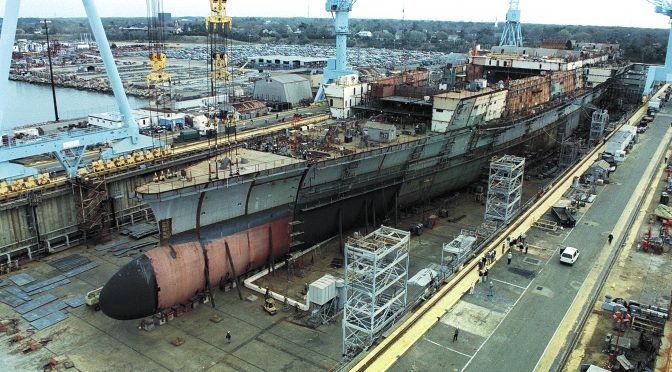
Featured Image: Newport News, Virginia (Mar. 16, 2000) — The lower bow unit of the aircraft carrier Ronald Reagan (CVN 76) is lowered into place at the Northrop Grumman Newport News Shipbuilding facility. (U.S. Navy photo)

Mass Drones to Save Missiles: A High–Low Mix for the Pacific

By Connor Keating

 The future of conflict in the Western Pacific will hinge on sustaining firepower over vast distances with finite magazines and vulnerable logistics. The Russia‑Ukraine war and much of history show that victory has never relied on a small inventory of exquisite, high‑cost weapons.1 Instead, success increasingly rests on combining massed, affordable drones with a more limited stock of precision‑guided munitions—a munitions‑centric high–low mix. To deter and, if necessary, defeat aggression, the U.S. should build a mix of long‑range, payload-modular drones. This approach is about designing an economically favorable, attrition‑resilient strike architecture that forces an adversary into unfavorable cost‑exchange ratios.

Originally a Cold War concept that paired high‑ and low‑end manned platforms against the Soviet Union, the high–low mix has re-emerged in a new form centered on munitions rather than platforms. A munitions‑centric high–low mix forces adversaries to choose between defending against slow, numerous drones or conserving interceptors for higher‑end threats, thereby creating gaps in their air defenses.2 In a theater defined by extended supply lines and constrained magazines, such a mix will be essential to sustaining combat power and imposing escalating costs on the People’s Liberation Army.

Lessons from Ukraine

At the onset of the war, Russia relied heavily on conventional combined arms but quickly transitioned—much as Ukraine did earlier—to a new toolset of drones to contest the land, sea, and air domains. Two lessons stand out for U.S. planners preparing for a conflict in the Pacific.

First, Ukraine has effectively combined maritime drones with traditional missiles and employed “mothership” drones to extend range at sea. The integration of sea drones with missile air defense systems significantly degraded Russia’s presence in the Black Sea by simultaneously threatening ships and their helicopter escorts.3, 4 The operations in the Black Sea demonstrate how relatively inexpensive unmanned systems, when integrated with existing traditional weapons, can constrain an adversary’s freedom of action and impose enduring costs.

Second, and most importantly, both sides utilized one‑way attack drones in conjunction with precision munitions to saturate and exhaust air defenses. Russia pummeled Ukraine with long-range drones, depleting valuable interceptors and straining Ukrainian air defense.5, 6 This pattern would likely repeat in any high‑intensity air and maritime campaign in the Western Pacific. Therefore, the grinding stalemate in Ukraine is less a model to emulate than a warning of the nature of future war.

Requirements for a Pacific High-Low Mix

In the Pacific, drones will require operational ranges approaching 2,000 nautical miles to be meaningful, with a minimum of 100 nautical miles for tactical systems if basing rights near key terrain can be established. Longer‑range systems provide greater operational leverage but will substantially increase costs and reduce temporal fires volume (the weight of effects delivered per unit of time). With these facts in mind, three key requirements emerge.

First, missiles and drones must be deployable from land, sea, and air. Cross‑domain employment or launch-system interchangeability reduces platform-specific dependencies and mitigates the need for extreme‑range systems that may arise in a contested single domain. Interchangeability will streamline supply chains and logistics, as a munition can be fired from multiple platforms with minimal modification, usually with a simple software update.7 The Harpoon anti-ship missile illustrates this principle by being employable from surface, subsurface, and airborne platforms. A surface launch from a ship or ground launcher achieves greater than 70 nautical miles. From an aircraft, the effective range is boosted by the aircraft’s range, often over 500 nautical miles, and can be extended via aerial refueling.8 The same logic should guide the integration of drones against integrated air defense systems.

The risk posed by Chinese long‑range ballistic missiles will likely push the effective denial boundary for surface forces greater than 1,000 nautical miles.9 The U.S. faces a shortfall in strategic sealift capacity, and any Pacific campaign will expose sustainment ships and aircraft to long‑range strike.10 To reduce risk, sustainment forces may be pushed even further from the fight. To sustain combat power, mass must be delivered efficiently and quickly at acceptable risk levels. Taken together, these constraints imply that the U.S requires families of drones binned by range: shorter‑range systems that exploit forward bases near key terrain and longer‑range systems that can operate from well outside threat weapons’ reach.

Because of the ranges involved, purpose‑built drones for the Pacific theater will be more expensive than those used in Europe or the Middle East. In Ukraine, Shahed or Geran drones, with ranges of up to roughly 1,600 nautical miles, provide Russia with coverage of the entire battlespace with multiple routing options, offering significant operational flexibility at relatively low cost.11 By comparison, a similar drone launched from Guam would be on a straight-line attack, approaching its maximum range.

Long-range drones typically use small reciprocating engines and thus avoid some of the solid‑rocket‑motor supply‑chain constraints that affect missiles, as well as the technical complexity associated with gas turbines.12 LUCAS, a new one‑way attack drone reportedly based on the Iranian Shahed‑136, has an estimated range of approximately 1,500 nautical miles and may be among the most promising near‑term options.13 Other candidates include systems such as Altius and Barracuda, with ranges from roughly 100 to over 500 nautical miles.14, 15, 16 While the exact design line between drones and cruise missiles may be blurred, their ability to carry multiple payloads and operate autonomously places them conceptually within the drone portion of the high–low mix. Forcing an adversary to divert resources or believe that one effort is more important than another can have far-reaching strategic effects.

For example, expending large numbers of expensive interceptors against relatively cheap drones increases an adversary’s defensive missile expenditures and creates temporary windows when their air defenses are saturated. During those windows, U.S. forces can employ exquisite missiles against high‑value targets at lower risk, as already seen in Ukraine.17 This tactic increases the effectiveness of individual exquisite munitions and, over time, reduces the cost per target of the combined effect. It also forces adversaries into persistently unfavorable spending patterns and increasing long‑term operational costs. This may potentially force a shift in money or production away from other key weapon systems to fill gaps in air defenses.

For example, the conflict between Israel and Iran following the October 7th attacks. Across three major engagements in October 2024, April 2025, and June 2025, Iran employed more than 1,000 drones and 500 missiles.18 By the end of the exchange, reports indicated that Israel was running critically low on interceptors, and the U.S. had significant shortages of THAAD missiles, while Iran was assessed to still have thousands of missiles and drones remaining in its inventory.19, 20

Moreover, Iranian attacks became increasingly effective over time. By the final round of strikes, more than 60 missiles were impacting Israeli territory—over twice the number that got through in the initial October attack.21 The most consequential aspect of this campaign was not the tactical success but the operational effects Iran achieved. The time and cost required for Israel to repair infrastructure and replenish high-end interceptors are many times greater than the expense of the relatively low-cost, improvised missiles and drones that Iran employed. Iran consumed valuable maintenance hours and sortie-generation capacity that would otherwise support offensive strike missions. If Iran possessed a more capable air force, this kind of coercive, resource‑draining approach could be decisive in shifting the operational balance in its favor by steadily degrading Israel’s ability to generate credible offensive power.

The core operational lesson is that a sustained high–low mix can impose continuous defensive burdens, consume precious economic capital, and erode an opponent’s ability to sustain offensive operations. For the Indo‑Pacific, U.S. and allied forces must be prepared to wage a drawn‑out contest in which the key question is not who fields the most exquisite platforms on day one, but who can afford to keep firing on day one hundred.

The U.S. fields broad capabilities but limited depth in its weapons inventory. A perfect example is the U.S. pursuit of hypersonic weapons since the early 2000s, with little advancement in programs’ operational numbers despite Russia and China likely now fielding operational systems at scale.22 The simple fact regarding U.S. weapons is this: specialized but less scalable than many of their potential adversaries. That creates limits and risks for the platforms that provide the “punch” in potential conflict. To remain competitive, U.S. planners should prioritize modular, cross‑domain-capable drone and missile platforms that can be field-modified and mass‑produced, with an emphasis on range, speed, and flexibility.

Sustainment and Modularity for the High-Low Mix

Modern war is a voracious consumer of munitions. Therefore, the ability to conduct sustainment at scale is critical. Containerization for transport and employment should be the baseline requirement for any drone adopted into U.S. military service. Standardized launch containers can be dispersed on ships, barges, trucks, and austere airstrips across the theater. This distribution complicates adversary targeting, reduces the risk of preemptive strikes on centralized depots, and eases movement into the theater, potentially allowing contracted non-traditional shipping to carry containerized drones and freeing dedicated military sealift for other cargo. The CONSOL concept, in which fuel from civilian tankers is delivered to U.S. Navy oilers and warships, could serve as a model for sustaining containerized drones with minor modifications.23 In practice, this would allow containerized drones to move through commercial and military logistics channels much like fuel or standard cargo, enabling surge munitions flows into the theater without overexposing scarce sealift and major logistics hubs.

The final key enabler is the use of modular drone payloads. A common airframe that can be configured as a jammer, decoy, sensor, or one‑way attack munition allows commanders to tailor each salvo to the mission. Existing systems already demonstrate this potential, carrying payloads ranging from electronic‑attack packages to surveillance sensors.24, 25, 26, 27 Modularity achieves two ends. First, it reduces sustainment risk by minimizing the number of unique systems or components that must be transported into the theater. Second, it increases the probability of a salvo’s success by integrating jammers, decoys, and attack drones into a single, coordinated attack. Determining the optimal drone-to-missile mix requires experimentation to identify force packages that achieve the desired outcomes at minimal cost. Modularity also improves cost‑exchange performance by allowing commanders to reconfigure existing airframes for new tasks rather than fielding separate, specialized systems for each mission set.

Drone-from-Drone and Mothership Concepts

Recent testing of a Switchblade 600 one‑way attack drone launched from a larger MQ‑9A Reaper, the same drones synonymous with the War on Terror, illustrates how drone‑from‑drone concepts can extend the reach and responsiveness of unmanned systems.28 Because the MQ‑9 has roughly twice the speed and greater range than a LUCAS‑type drone, this approach could increase engagement options and compress timelines.29

A more resilient system would include theater‑range modular drones and a dedicated mothership, such as the MQ-9 or other long-range drone, which would carry shorter‑range attack drones. Modular theater drones conduct missions requiring greater payload and power, such as jamming. This nested architecture reduces dependence on manned, high‑value platforms and provides additional means to generate the force mass required to penetrate layered defenses.

Mothership concepts introduce additional command‑and‑control and deconfliction challenges that will require rigorous experimentation and wargaming before adoption at scale. Yet if implemented effectively, they would confront adversary commanders with overlapping dilemmas: theater‑range modular drones launched from ground, sea, or air; shorter‑range munitions deployed from motherships; and exquisite missiles capable of rapid, penetrating strikes. Together, these elements complicate air defense planning and increase the likelihood that some portion of each salvo reaches its targets. Crucially, the U.S. must not lose sight of the fact that China is also experimenting in this field. To maintain its edge, the U.S. must begin rapid live‑fire experimentation to formalize doctrine, create feedback loops for software, and refine command‑and‑control architectures for the inevitable drone‑on‑drone fights.

Conclusion

A future war in the Western Pacific will not be decided by which side fields the most exquisite platforms on the opening day of combat, but by which side can afford to keep firing on day one hundred. The U.S. is currently organized around a force-and-munitions paradigm that assumes short, decisive campaigns that do not exist in reality. Against a peer with a large, industrialized economy and an asymmetric approach designed to circumvent U.S. short-range precision strike, the result is likely paralysis if not outright defeat.

This is not a call for more technology for its own sake, but for different economics in how we design and employ firepower. Containerized, cross‑domain‑launchable drones; modular payloads that can be rapidly reconfigured between jamming, sensing, decoy, and strike; and drone‑from‑drone or mothership concepts that multiply the reach of each sortie—all are tools for building a strike architecture that can absorb attrition and generate effects at scale.

If the U.S. fails to make this shift, it risks entering a Pacific conflict on China’s terms: overextended logistics, shallow magazines, and a force trapped in a defensive, interceptor-driven pattern of expenditure. But if senior leaders move now and implement the suggested changes, the balance changes.

The choice, then, is straightforward. The U.S. can continue to organize its Pacific posture around a shrinking set of exquisite platforms and munitions and hope they survive long enough to matter. Or it can accept that the defining contest of a Western Pacific war will be industrial and economic output at scale. The window to make that choice is closing fast.

Lieutenant Connor Keating commissioned from the Virginia Tech NROTC and served aboard a forward-deployed destroyer in Yokosuka, Japan. On shore duty, he was a protocol action officer to the Chairman and Vice Chairman of the Joint Chiefs of Staff. He is an integrated air-and-missile defense warfare tactics instructor and participated in the Naval War College’s Halsey Alfa Advanced Research Project as a resident student.

References

1. Trevor Phillips-Levine, Andrew Tenbusch, and Walker D Miles. “Gilded Capability: Overinvestment and the Survivability Paradox.” War on the Rocks, February 12, 2026. https://warontherocks.com/2026/02/gilded-capability-overinvestment-and-the-survivability-paradox/.

2. Trevor Phillips-Levine. “Return of the Gunfighters.” Behind The Front, August 15, 2024. https://behindthefront.substack.com/p/return-of-the-gunfighters.

3. Mark Temnycky. “Ukraine Has Innovated Naval Warfare – Center for Maritime Strategy.” Center for Maritime Strategy – Center for Maritime Strategy, July 25, 2025. https://centerformaritimestrategy.org/publications/ukraine-has-innovated-naval-warfare/.

4. Stefano D’Urso and Andrea Daolio. “Ukrainian Surface Drone Equipped with R-73 Air-to-Air Missiles Shot down Russian MI-8 Helicopter.” The Aviationist, January 1, 2025. https://theaviationist.com/2024/12/31/ukrainian-magura-usv-r-73-vs-mi-8-helicopter/.

5. Matthew Bint and Fabian Hinz. “Russia Doubles down on the Shahed.” The international institute for strategic studies, April 14, 2025. https://www.iiss.org/online-analysis/military-balance/2025/04/russia-doubles-down-on-the-shahed/.

6. Vytis Andreika. “Russia’s Changes in the Conduct of War Based on Lessons from Ukraine Adapting Technology, Force Structures, and the Defense Industry.” Military Review, 5, 105, no. September-October 2025 (September 2025): 109–24. https://doi.org/Professional Bulletin 100-25-09/10.

7. Trevor Phillips-Levine and Andrew Tenbusch. “Allied Arsenal: Building Strength through Shared Production.” War on the Rocks, July 22, 2025. https://warontherocks.com/2025/07/allied-arsenal-building-strength-through-shared-production/.

8. No author. “AGM UGM RGM-84 Harpoon Anti Ship Missile SSM SLAM-ER.” n.d. www.seaforces.org.https://www.seaforces.org/wpnsys/SURFACE/RGM-84-Harpoon.htm.

9. No author. “Missiles of China | Missile Threat.” 2018. Missile Threat. 2018. https://missilethreat.csis.org/country/china/.

10. Andrew Rolander. “The Dangerous Collapse of US Strategic Sealift Capacity | the Strategist.” The Strategist. March 25, 2025. https://www.aspistrategist.org.au/the-dangerous-collapse-of-us-strategic-sealift-capacity/.

11. Joe Emmett, Trevor Ball, and N.R. Jenzen-Jones. n.d. Review of Shahed-131 & -136 UAVs: A Visual Guide. Open Source Munitions Portal. Open Source Munitions Portal. Accessed February 12, 2026. https://osmp.ngo/collection/shahed-131-136-uavs-a-visual-guide/.

12. Theresa Hitchens, “With the Boom for Solid Rocket Motors for Missiles, a Perilous Crunch in the Supply Chain,” Breaking Defense, January 12, 2026, https://breakingdefense.com/2026/01/with-the-boom-for-solid-rocket-motors-for-missiles-a-perilous-crunch-in-the-supply-chain.

13. No author. “US Develops Lucas Kamikaze Drone to Surpass Iranian Shahed as Loitering Munitions Become Core to Future Warfare.” US develops LUCAS kamikaze drone to surpass Iranian Shahed-136 as loitering munitions become core to future warfare, July 18, 2025. https://armyrecognition.com/news/army-news/2025/us-develops-lucas-kamikaze-drone-to-surpass-iranian-shahed-136-as-loitering-munitions-become-core-to-future-warfare.

14. Shield AI, “V-Bat,” accessed January 26, 2026, https://shield.ai/v-bat.

15. Anduril Industries, “Altius,” accessed January 26, 2026, https://www.anduril.com/altius.

16. Anduril Industries, “Barracuda,” accessed January 26, 2026, https://www.anduril.com/barracuda.

17. Hugo Bachega, “Russian Air Strikes Get Deadlier and Bigger, Hitting Ukraine’s Very Heart,” BBC News, September 9, 2025, https://www.bbc.com/news/articles/cgrqwpee05ro.

18. Sam Lair. “Shallow Ramparts: Air and Missile Defenses in the June 2025 Israel-Iran War – Foreign Policy Research Institute.” Foreign Policy Research Institute, October 17, 2025. https://www.fpri.org/article/2025/10/shallow-ramparts-air-and-missile-defenses-in-the-june-2025-israel-iran-war/.

19. Ibid.

20. Rising, David, and Sam Metz. “Iran’s Military Degraded by 12-Day War with Israel, but Still Has Significant Capabilities.” AP News, February 13, 2026. https://apnews.com/article/iran-israel-us-trump-military-carrier-war-931c25411eeef7d8cee679b3544b792a.

21. Sam Lair. “Shallow Ramparts: Air and Missile Defenses in the June 2025 Israel-Iran War – Foreign Policy Research Institute.” Foreign Policy Research Institute, October 17, 2025. https://www.fpri.org/article/2025/10/shallow-ramparts-air-and-missile-defenses-in-the-june-2025-israel-iran-war/.

22. No author. “Hypersonic Weapons: Background and Issues for Congress.” February 20, 2026. https://www.congress.gov/crs-product/R45811.

23. Sarah Burford. Review of Tanker Ships Deliver Fuel to MSC Ships via CONSOL in Support of RIMPAC 2022. U.S. Navy. U.S. Navy. July 25, 2022. https://www.navy.mil/Press-Office/News-Stories/Article/3103496/tanker-ships-deliver-fuel-to-msc-ships-via-consol-in-support-of-rimpac-2022/.

24. No author. “US Develops Lucas Kamikaze Drone to Surpass Iranian Shahed as Loitering Munitions Become Core to Future Warfare.” US develops LUCAS kamikaze drone to surpass Iranian Shahed-136 as loitering munitions become core to future warfare, July 18, 2025. https://armyrecognition.com/news/army-news/2025/us-develops-lucas-kamikaze-drone-to-surpass-iranian-shahed-136-as-loitering-munitions-become-core-to-future-warfare.

25. Shield AI, “V-Bat,” accessed January 26, 2026, https://shield.ai/v-bat.

26. Anduril Industries, “Altius,” accessed January 26, 2026, https://www.anduril.com/altius.

27. Anduril Industries, “Barracuda,” accessed January 26, 2026, https://www.anduril.com/barracuda.

28. No author. “AV Switchblade 600 Loitering Munition System Achieves Pivotal Milestone with First-Ever Air Launch from MQ-9A.” AeroVironment, Inc., September 10, 2025. https://www.avinc.com/resources/press-releases/view/av-switchblade-600-loitering-munition-system-achieves-pivotal-milestone-with-first-ever-air-launch-from-mq-9a.

29. No author. “MQ-9 Reaper.” Air Force, January 2025. https://www.af.mil/About-Us/Fact-Sheets/Display/Article/104470/mq-9-reaper/.

Featured Photo: A U.S. LUCAS drone on a tarmac in the U.S. Central Command area of responsibility. (Photo via Wikimedia Commons)

Fostering the Discussion on Securing the Seas.