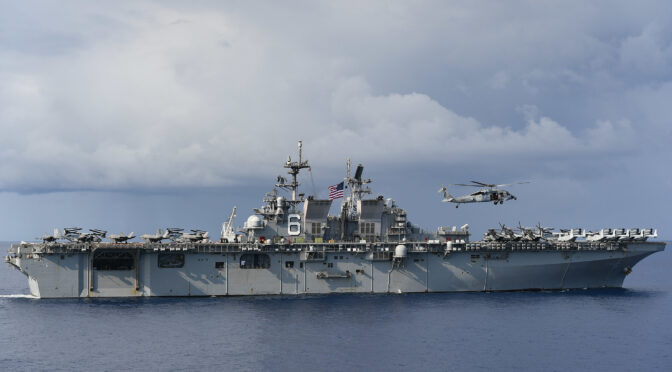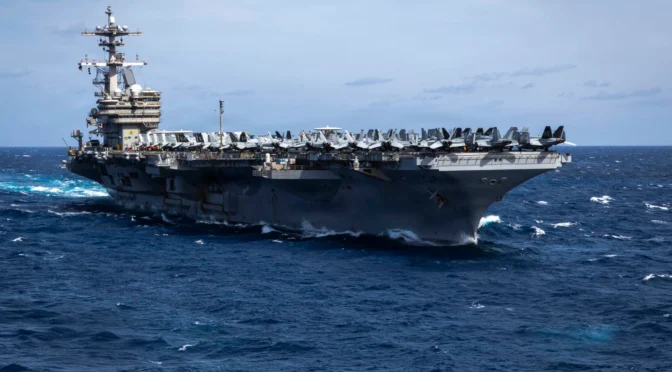
Task Force Rust Bucket

Fiction Week

By Tyler Totten

February 5th – 0340
Amphibious Strike One
Palanan Bay, Philippines

“Handshake confirmed,” Lieutenant Parodi reported from the copilot seat, his voice low.

“Relax Juan, the drones won’t hear us. Let’s get on the deck.” Commander Valerie Cunningham smirked. Still her own nervousness caused her to glance at the weapon status, seeing green across the board on the defensive systems. While appreciated, she missed the offensive role.

When this was an offensive platform…

“Yes ma’am,” his seriousness remained but his tone level. “Petrel Six, One. Follow us down.”

Cunningham kept further comments to herself. Looking to port, she could see their destination. The base looked half abandoned but she knew better.

“They’ve taken some hits since while we’ve been gone.”

“Docks are holed, yeah.” Cunningham saw impact points in the floating concrete piers, blackened gouges. One broken cargo ship sat on the gravelly bottom. She highlighted it in their joint augmented reality environment. “That wasn’t there before.”

“Most of the spare sections have been slotted in.” Parodi likewise highlighted only two of the floating concrete pre-built sections remained moored off to the side.

They touched down gently and taxied to their mooring point, keeping at least 200 meters of separation from each other and the base itself, dispersing to remain as unattractive a target as they could. An automated small boat was there to collect both aircraft’s crew before their engines even wound down. The tender with fuel and provisions was moving up to Petrel Six as the boat whisked them across to the entrance.

“Welcome, ma’am, sirs.” The ensign saluted them as they stepped inside, their identification read by base security system as they crossed the threshold. “Admiral Stevens is waiting for you.”

“Lead on Ensign.” They all followed him in and below the waterline, feeling the air change as they moved deep underwater. The base’s protection came from its section replaceability and from using tens of meters of water as armor. Stepping quickly into the briefing room and exchanging another round of salutes, Admiral Stevens waved them to their seats.

“Let’s get started.” Stevens was direct and liked to get down to business. Cunningham couldn’t blame him, most of the stiff, stand-on-ceremony flags had either been removed from command or killed. There wasn’t time to be inefficient, the war moved too fast. They had barely sat before Stevens began speaking, gesturing to his aide to bring up the AR briefing.

“As you are aware, losses among manned surface combatants have been heavy. Even with the dispersed approach and pairing each with three or four autonomous surface vessels, the PLA has proven adept at targeting the manned assets specifically. The stealthy command frigates have had better success, but are in short supply. Until that is rectified, we must improvise.” The aide zoomed in, the theater ship loss map fading, replaced by the waters of northeast Luzon and three groups of ten small ships.

“These autonomous squadrons are inbound for strike operations. The PLA has been picking at them for the last four days but they are still 60 percent combat effective and carrying 80 percent of their strike package. You will be providing human-in-the-loop command and control in lieu of manned ships.” An overlay appeared, showing two plane flight with infiltration and exfiltration routes and alternates. Mission time stamps showed their tanking points and flight profiles. “Low and on the deck all the way in, land and establish control of your squadron, wait for the targeting data. Approve the shots, get out. Questions?”

“Are we expecting to pull out our squadron?” Cunningham asked, considering the timings and geometry against known PLAN coverage.

“Negative, these are one-way assets. They have tasking if they survive to launch but it will not be your concern.”

“No on-call support from loitering assets?” Lieutenant Commander Bulan, Petrel Six inquired.

“Not this run. The PLAN has finally pushed substantial numbers of UUVs and that little underwater dogfight has become vicious.” Stevens frowned at that, not mentioning the SSN losses that had come with that surge.

A few additional questions around the room before the admiral dismissed them. Less than 2 hours after landing, both powered up and headed east for the first leg of their route. Behind them, the base’s air raid siren sounded and the base braced for another round.

February 5th – 0720
Dawn Seas Field Team
Houma, Louisiana, USA

Tim Masson stepped across the gangway, the first morning rays cutting through the light fog and creating glistening outlines across the handful of supply vessels tied up along the piers. This was his first vessel of the day, the hour drive from New Orleans having delayed his normally early start.

“Susan, pilothouse. Mark, topside. I’ll take engineering.” His two engineers nodded, having already known this would be the plan.

“Bet you’ll still be done first,” Susan joked.

“Only if you keep sandbagging,” Tim quipped back.

They parted ways and Tim noted how rough of shape this vessel was in. Not that any of the ones tied up to this set of piers were beauty queens, rusting and covered in flaking paint. It was clear they had not received much maintenance in the two years they had sat idle. Tim was honestly surprised they hadn’t been scrapped altogether, but that had a cost as well.

“Better just get on with it…” He grumbled to himself. Setting his small pelican case down he opened it and extracted his augmented reality glasses. Settling them into place but not energizing the system yet, he opened the hatch and made his way down into the main engineering space. Once firmly on the deck plates he turned the AR glasses on and allowed them to go through their few seconds of boot cycle.

It had taken him some time to get used to them, still feeling he was entirely too old for learning new tricks, much to the bemusement of Susan and Mark, both twenty years his junior. Tim grumbled and complained about the systems yet he wasn’t too much of an old man yet to deny their utility. Even just a quick glance around the space and the computer-vision system was measuring the space and identifying key systems. Much of the basics, like the main engines, were more confirmatory of what limited data they already had. For others, like vales, pumps, and electrical panels, the algorithms got to work matching them and identifying compatibility. Where the system struggled, he helped find the right component. Sometimes he needed to wipe off a greasy label plate or fill in the blanks on a name when it ran up against the CV algorithms’ limits. He still prided himself on knowing most of the systems almost as fast as the system could match them.

As with the dozens of vessels they had already worked on, these old rust buckets were destined to be turned into rapidly automated platforms. His team, and others like them, catalogued their status and systems. The AR glasses of each team member rapidly formed work orders, 3D models, and queued purchases or pulls from existing supply to outfit the vessels. This vessel would take more than most, many of its systems manual or had broken equipment so old that they were obsolete and could not be replaced with a form-fit-function replacement. Even still, he was confident they could meet the deadline. Twenty minutes later he had finished in the engineering spaces and climbed back to the working deck. Susan was already there, confirming the alterations for the bridge systems on her tablet.

“Better,” Tim remarked in jest. “Mark?”

“Here.” Mark said coming down the ladder behind him. “She’s in rough shape, don’t you think?”

“These will be one-way drone ships for sure but that’s still something, if they can launch their missiles before they break.” He considered his data for a moment, AR glasses letting him look back down into the engineering spaces and the work out diesels contained there. He shook his head slightly. “My bet is four days, assuming all the parts can get here on time. Last shipment was delayed by reported drones over Highway 51. Nothing came of it but still snarled traffic.”

“Do you blame them after Long Beach?” Susan shuddered, mentally replaying the footage of an entire bridge span full of cars and trucks collapsing into the water under the surprise drone swarm.

“Fair enough, still destroys our schedule.” Tim shook his head again, trying not to dwell on things beyond control. “Let’s get over to the next vessel.”

Almost 98 hours later, Tim watched six boxes land on the freshly automated OSV. Each housed a variety of missiles, though he didn’t know which types. He suspected these were strike weapons, given the one-way nature of the old rusty wrecks. One express routing through the Panama Canal and they’d be in the war.

Everything west of Panama is “in the war.” He snorted to himself. Shaking his head he turned and walked to his truck. There were still a few more vessels to salvage. He could only hope all that reported new construction was about to start launching. They were running out of wrecks.

February 5th – 1450
Amphibious Strike One
20 nm north of Farallon de Pajaros

The engines thrummed with power, the comforting sound louder and more in Cunningham’s chest than usual. Her two-plane flight was on the deck and the engines were working hard, having left their buddy tankers behind three hours ago. The run was at a bare 300 meters, staying well below the anticipated radar horizon. It was expected they would even avoid detection by the over-the-horizon systems thanks to their small form factor. The only real risk was getting spotted by a visual or infrared satellite pass. For that, they had to make use of a regular window in which PLA overhead birds would be blinded. The Navy had been keeping a regular-as-clockwork blinding campaign since the war’s start, typically doing nothing in the window. The hope by this point was that the PLA largely ignored the window other than to recheck the locations of the three prowling CSGs that threatened but did not move west from their racetracks around Midway. Further west of that had…unfortunate outcomes.

Cunningham shivered at the thought, remembering their search-and-rescue sortie to recover who they could from the burning ocean around the remains of the Big E. Her stern hadn’t quite slipped below when secondary explosions erupted from her hull as they struggled to pull a few dozen from the dark waters. The surviving escorts had already fled, protecting the wounded Ford running for Midway’s air cover.

“Coming up on initiation point,” Parodi noted. “Confirming Petrel Six in green.”

The laser pulse hit Six precisely on its flank array, the beam tight even at one kilometer. The return pulse was instantaneous.

“Six confirms.” Parodi checked the automated navigator system for their position. “Still good positional fix, within acceptable GPS-denied bounds.”

With that final perfunctory check, the computer would have flagged any issues, Cunningham gripped the controls again and toggled off the autopilot. The computer could fly this alone but she wanted to at least start the run herself.

“Powering up, Six to follow.” Cunningham advanced the throttles, bringing her aircraft up to full power. Like its predecessor, they were capable of a Mach 0.9 sprint. On this lightly loaded run, with only a few defensive weapons, her Seamaster II easily advanced across Mach 0.9 to Mach 0.94. The only change was a small shudder in the stick.

February 5th – 1635
Task Force Romeo Bravo 15 (TF-RB15)
15 nm south of Taiwan

Self-elected commander of TF-RB15 noted the new command node come online, linking up with one of the task force’s UAVs maintaining a line-of-sight (LOS) laser communication net over the entire group. Having departed Hawaii with 16 ships, the surviving nine pressed on with the same undaunted progress that came with being automated. The command unit had been lucky, positioned mid-group and carrying a majority offensive payload. It had directed the defense against a half dozen raids on the group. Several, mostly outer pickets, had fallen to enemy fire.

As valid command codes filtered in from the new arrival, the command unit transmitted a task force status update. It also added a positional fix, pulling from the collective task force’s GPS-denied positional assessment. A combination of inertial, star fixes, and tracking known satellites in orbit all coordinated with triple-redundant atomic clocks. The result was remarkably accurate, at least for open-ocean navigating.

Receiving a simple acknowledgement of the update but no orders, it continued as before. Launched UAVs passively searched for threats with cameras and radio-direction-finding sniffed for radars. And onward they sailed.

Amphibious Strike One

“Command Unit confirms no contacts,” Parodi reported for the third time in the hour since arrival. Out there somewhere, their brethren should have linked up with the other two Romeo Bravo task forces, more SeaMasters bobbing on the wavetops near the ships plowing west.

“Wow, these things are struggling. Rust Bucket task force indeed.” Parodi looked over the updates, driven by boredom rather than need. The system would flag anything they needed to review. “Half these ships are down an engine. Two only have half power and are running flat out. Lucky if they survive past launch, enemy or not.”

“They just need to launch.” Cunningham checked the time. “Any minute now.”

As if having willed it into existing, a soft trill announced the satellite orders. They saw it simultaneously as it was decrypted.

“Full salvo,” Parodi noted.

“As expected, probably going to get jumped as soon as we light off anyway,” Cunningham said casually as she confirmed the proper codes had been transmitted. She waited, though only a few seconds, for the command unit to provide proposed strike package edits.

“Light edits,” Parodi highlighted, the command unit providing modifications to reflect the latest inventory and positions of the task force.

“I see no issues, let’s get Six’s concurrence,” Cunningham ordered.

“Six confirms.”

“Lock them in, clear task force to fire by the numbers.”

Task Force Romeo Bravo 15 (TF-RB15)

The command unit received the confirmation of its recommended plan and disseminated launch authorization and final timing, syncing the group. Within seconds, each ship was executing at pre-launch. Across the waves in the fading dusk light, containers opened to reveal racks of cruise missiles. A few red and yellow lights came back, weapons not waking or showing partial faults. While there was nothing to be done about unresponsive weapons, the command unit authorized the launch of any partially responsive weapons. Its mission parameters allowed for maximum risk to launch platforms, no self-preservation was required. They sequenced flagged weapons to fire last to mitigate possible damage.

With a minute left to launch, a UAV picket flashed an alert, processed in a microsecond. Inbound missiles, skimming the surface at subsonic speeds but closing fast.

With only seconds to respond, the command unit ordered an interceptor salvo. Though low on interceptor inventory, the outer picket also had few offensive weapons to preserve. The command unit ordered it to maximize its electronic emissions and deploy radar reflectors, making itself a large target. The inbounds may not care but any advantage was worthwhile.

Calculating the closure rates, the command unit ordered an early and immediate launch from all ships. It provided the update to the human-in-the-loop with two seconds to countermand. The weapons could still make their trip, the change in launch distance trivial, but a deviation was a deviation. Command must be allowed a countermand opportunity. The time passed, slowly, and confirmation to deviate was received.

All across the task force, rusty ships were momentarily lit up and then disappeared under billowing clouds of rocket exhaust as each disgorged its deadly cargo into the night.

Amphibious Strike One

“Inbounds!” Parodi didn’t yell but he was still loud. Cunningham set that aside and examined the threats on screen. “Command unit is moving to immediate launch, providing for override.”

“Allowing,” Cunningham confirmed.

She noted the likely enemy launch positions were flagged, well beyond their own engagement range. She queued a prosecution request and set to transmit from one of their task force’s SATCOMs. Those ships were already exposed, she wasn’t risking her position.

“Sub-launched, old YJ-82s.” Cunningham noted. “Must be a UUV, no way they’re loading that trash on a manned sub.”

“We’re clear of all twelve inbounds, definitely targeting the task force.” Parodi’s calm had returned.

Better, she thought.

They watched the task force’s defensive fire, downing five of the approaching weapons. Four more, lacking any in-flight collaboration, slammed into the decoying ship nearly in unison and massive overkill. A final missile was intercepted in terminal by a last-ditch launch, the interceptor not even getting up to speed. Even still, shrapnel ripped into the converted commercial ship and she lost all power.

The last two missiles spread to either side of the stricken ships and found their own targets, slamming into one each as they launched the last of their own missiles. On one, it found a container with two missiles that had failed to launch and added their fuel and warhead to the conflagration that quickly consumed the ship. On the other, the midship strike was mortal but less spectacular. Still under power but with flooding it could not contain, the ship continued forward and prepared to scuttle itself.

“Well, that’s it.” Cunningham turned away from the screen, glancing only momentarily at the horizon where she could just make out two of the burning ships of her temporary task force. “We’re out of here.”

“Yes ma’am. Powering up.” Parodi worked the abbreviated pre-flight and within 90 seconds they were pointed into the wind and starting their take-off run.

“Another successful hurry up and wait for the fearless Amphibious Strike One,” Cunningham remarked, eliciting a snort from Parodi.

“You just want another splash twelve moment. War’s moved on with that sort of opportunity. It’s all drones, drones, drones nonsense now.”

“I can dream, can’t I?”

Tyler Totten is a naval engineer working on autonomous systems, including autonomous surface vessels, in the maritime domain. Previous roles have included supporting several Navy and Coast Guard programs including LCS, DDG(X), and PEO Ships Futures Directorate. He has a strong interest in international and maritime security. He is also an amateur science fiction writer published on Kindle. He holds a B.S from Webb Institute in Naval Architecture and Marine Engineering and can be found on Bluesky at @azuresentry.bsky.social and X/Twitter at @AzureSentry.

Featured Image: Art created with Midjourney AI. 

Annual Fiction Week Kicks off on CIMSEC

By Dmitry Filipoff

For the next two weeks, CIMSEC will be featuring short stories submitted in response to our Call for Fiction.

These thoughtful stories examine the future of maritime security and war at sea. Authors creatively envision emerging threats and technologies through novel scenarios and narratives. These stories can help us gaze into the future and flesh out the possibilities of future conflict.

Below are the authors and stories that will feature during this edition of CIMSEC’s annual fiction week. 

Task Force Rust Bucket,” by Tyler Totten
Anna palaa!” by Ben Plotkin
The Narco Sea: Three Headings to One Target,” by Till Andrzejewski

Decapitation,” by Malcolm Reynolds
Friendly Fire Isn’t,” by Paul Viscovich
Phantom Cable,” by Sandro Carniel
Locks and Shadow Swarms,” by Philip Kiley

Habeas Corpus,” by Jay Turner
No Fly Zone,” by Bryan Williams
The Henry Protocol,” by Joe Huskey
Fit to Print,” by Ben Van Horrick
Perspective,” by Daniel Lee
The Phantom’s Last Ride,” by Karl Flynn
Ghost Town,” by Kenyan Medley
What is Old Is New Again,” by Mike Hanson

Dmitry Filipoff is CIMSEC’s Director of Online Content. Contact him at Content@cimsec.org.

Featured Image: Art created with Midjourney AI. 

The Optimum Pathway for Building Nuclear Submarines with South Korea and Japan

By Brent D. Sadler

Introduction

Riding a wave of success during his Asia tour, President Donald Trump triumphantly announced the U.S. would be working with South Korea to build nuclear submarines.1 To those familiar with the AUKUS (Australia-U.K.-U.S.) deal, this may seem a repeat of that effort to build nuclear submarines with Australia. By all accounts, this is not what is at hand.

South Korea’s growing investment in American shipbuilding could foster the development of ships capable of using next generation small modular nuclear reactors (SMNR), to include their use on modified South Korean submarines appropriate to their operational needs. This likewise has applicability to Japan, who should be included should the effort proceed.

Given the unique naval needs of South Korea and Japan, their decades of experience in building conventional submarines, and the U.S. need for allies in reviving its maritime industry – this deal could be very opportune. That said, it will not be AUKUS and to succeed it must also contribute to a revival of America’s shipbuilding to best serve America’s national interests. 

South Korea’s National Security Situation

South Korea’s capital, Seoul, is within range of hundreds of North Korean artillery pieces. For them danger is always near, and has focused their military to the threat ever since the armistice paused the Korean War.2 Adding to the dangers, the North has in recent years accelerated development of its own nuclear-armed submarine-launched ballistic missile – the Pukguksong series that began testing in 2015 and now has six iterations.3 Given this at-sea nuclear threat, as in the Cold War, there will be a necessity of locating and keeping track of North Korean submarines with nuclear-armed SLBMs, like the SSB 841 Hero Kim Kun Ok launched in September 2023.4

An Oct. 2, 2019 North Korean Pukguksong-3 SLBM test. (Rodong Sinmun photo)

Beyond the North Korean threat, China has also encroached into its waters and strong-armed the South. Most notably, the Chinese Communist Party was the hand behind political interference and public agitation in 2017 over the placement of the THAAD missile defense system.5 Keeping its economy free of coercion will require a Navy able to keep the People’s Liberation Army Navy (PLAN) in check in the East China Sea and Yellow Sea. Should war break out in Asia over the fate of Taiwan, critical shipping routes through the South China Sea and potentially across the North Pacific will need to be guarded. 

Unlike the Australian strategic challenges that drive them to pursue a nuclear submarine in the AUKUS initiative, South Korea’s maritime threats are closer to home. This operational situation prioritizes stealth and on-station endurance with the ability to conduct high-speed sprints without needing to come near to the surface to recharge submarine batteries. These operational requirements inform South Korea’s submarine program, today led by production of its 3,600 ton KSS-III Batch-2 submarine with 10 vertical launch cells and torpedo tubes built by shipbuilder Hanwha.6 SMNRs offer a way to enhance the lethality on a potentially modified South Korean submarine like a future batch of the KSS-III.

October 22, 2025 – Hanwha Ocean launches the first KSS-III Batch-II submarine, Jang Yeongsil ship (SS-087) (ROK Navy photo)

A Brief History of SMNRs Backfitted on Conventional Submarines

Twice in the recent past have navies attempted to extend the undersea endurance of existing conventional submarines with small modular nuclear reactors. The first was in the mid-1980s, when the Soviet Navy installed a 600kWh VAU-6 600 nuclear power plant on a project 651 (Juliett-class) diesel submarine and greatly extended its range.7 The implications of this development were never felt in the West, as the Cold War was coming to a rapid end by the time this was completed.

The idea of greatly increasing the tactical capabilities of existing conventionally-powered submarines has surfaced again. For the past several years, experts looking over satellite images of China’s sole naval nuclear shipyard at Huludao have noticed the expansion of production lines and what appeared as components of a new class of nuclear-powered warship. The answer would be clear in September 2024 following months of speculation that a new larger Yuan-class conventional submarine was being readied for sea with a new type of propulsion.8 That month, reports of its pier side sinking drew a subsequent U.S. Department of War response that confirmed it was a variant being fitted out with an auxiliary nuclear power plant. And so the Soviet idea was reborn with Chinese characteristics.

Given China’s large and modern conventionally powered submarine fleet, its use of SMNRs to complement air independent propulsion would have severe ramifications for the U.S. and its allies. Already fairly stealthy, the latest Yuan-class Chinese submarine would see its endurance greatly extended and survivability improved with the ability to sprint at high speeds to evade hostile contacts without having to come to the surface to recharge its batteries soon afterwards. Moreover, the limited nuclear construction capacity at Huludao could be augmented by numerous conventional submarine shipyards, with SMNRs being produced and backfitted on Yuan-class submarines in shipyards like Wuchang and Jiangnan.

Schematic of Soviet Juliet-class submarine equipped with a VAU-6 small power plant. (Graphic via Global Security.org)

Shared Allied Interest in SMNRs

As news broke of President Trump’s announcement on building nuclear submarines with South Korea, Japan also got interested.9 Japan is no stranger to maritime nuclear propulsion with its own Mutsu launched in 1969 and retired in 1992.10 This ship was a flawed attempt at exploring the commercial potential of nuclear power, with unacceptable radiation leakage dooming the ship. Recently, there have been calls by Japanese politicians to pursue developing a nuclear submarine – a call first triggered by the AUKUS initiative in 2021 and now with a potential U.S.-South Korean project.

Like South Korea, Japan too has a robust, successful, and longstanding conventional submarine program. The latest addition to the Japanese Maritime Self Defense Forces (JMSDF) is the 3,000 ton Taigei-class.11 However, Japan’s operational needs are more extended than South Korea’s, given its expansive archipelago that stretches deep into the Pacific Ocean and critical shipping lanes threatened by Russia, China, and North Korea. This threat is in part why Japan began a military modernization during the later Cold War to protect its shipping lanes 1,000 miles from Japan – a mission that lives on today. As such, the added endurance and survivability offered by SMNRs as an augmented power source for existing conventional submarines would be welcome.

A comparison of speed and endurance characteristics between conventional, SMR, and nuclear subs. Click to expand.

Additionally, both Japan and South Korea are today the only viable rivals to China’s shipbuilding colossus. As such, both are looking to invest in the U.S. as a means of expanding market share, which could be amplified by harnessing the potential of SMNRs to cleanly power the next generation of commercial ships and revolutionize the maritime industry. However, only the U.S. has the experience (thanks to its naval nuclear program) and capacity (based on existing nuclear research and development) to bring this new nuclear technology quickly to market with confidence.

Recent developments have the hallmarks of a potential consortium of investors forming to bring SMNRs to sea and soon. Already two South Korean shipbuilders have invested in the U.S. and Japan has signaled investments are coming. What especially stands out is the investments since December 2024 in Philadelphia Shipyard by South Korean shipbuilder Hanwha. The proverbial canary in the coal mine is how well Hanwha will be able to turn a profit in the long term when taking orders for commercial ships at its new American shipyard.

Newer to the scene is Hyundai, another South Korean shipbuilder, who has joined into a partnership with American naval ship and submarine builder Huntington Ingalls Industries (HII).12 The scope of this new partnership is relatively undefined as of November 2025, but signals an intent to deeply integrate into domestic American naval shipbuilding. The most explicit expression of this is a commitment of $150 billion by the South Korean government to back investment in American shipbuilding.13 On the other hand, Japan has only recently signaled its intent to move into the American market, with $4 billion of government backing to $2.5 billion of private investment.14 Focusing some of this foreign investment in what could be a market-setting technology can leverage the shipbuilding capacities and expertise of allies, while mitigating the risks in getting SMNRs to sea.

Key submarine bases and operating areas in the western Pacific. (Heritage Foundation graphic)

Proliferation and Compromised Supply Chain Concerns

In the case of both Japan and South Korea, there are grounds for concern regarding the potential for compromised maritime industrial supply chains and information security. Less of a concern is the threat of proliferation of weapons-grade nuclear material in the SMNRs under development. This is due to the use of lower enriched nuclear fuel (approximately 5% compared to weapons grade above 90%) and the fuel assemblies that complicate the separation and refinement of the fuel to weapons grade.

Nonetheless, memories of Brazil’s past attempts to develop a nuclear submarine as pretext for a nuclear weapons program are informative and cautionary.15 Putting a check on such possibilities are counter-proliferation protocols enshrined in the so-called “123 agreement” named for the section 123 of the 1954 Atomic Energy Act. These agreements are conditional by the U.S. prior to entering into any agreed transfer of nuclear technology or materials. Both Japan and South Korea have active 123 Agreements.16

Regarding maritime supply chains, however, both Japan and South Korea conduct significant shipbuilding related activity in China.17 This is primarily in the prefabrication of sections or modules and supply of components like pumps or solenoids that are then assembled outside China. Should either nation enter into a new SMNR developmental project and associated shipbuilding endeavor with the U.S., exposure to associated Chinese supply chains must be addressed, especially as it relates to military use in South Korean and Japanese submarines.

A sunken Chinese submarine at a shipyard near Wuhan, China, on June 15, 2024. (Planet Labs PBC photo via AP)

Finally, tight information security, such as done with Naval Nuclear Propulsion Information (NNPI) addressed for AUKUS, will be a necessity. A complicating factor for allies will be the dual-use applicability of SMNRs and how to ensure associated high information security for both military and commercial programs. Thankfully, the U.S. has current information-sharing agreements with both Japan and South Korea that includes industrial security. In 2025, memorandums of understanding signed with both South Korea and Japan make clear an intent to bolster supply chains as the three nations progress and work together in reviving America’s maritime industry.18 However, statements of intent are not enough to ensure the sensitive next-generation nuclear power technology behind SMNRs remains an American comparative advantage.

The Optimum Pathway for American Maritime SMNR

Developing SMNRs and then putting them to sea on commercial and backfitted allied conventional submarines will be a multifaceted task. First, the technology needs to be perfected in a way that makes it compatible for use in commercial shipping and scaled for use as an alternative power source for today’s conventional submarines built in Japan and South Korea. Second, trust in sharing sensitive nuclear technologies for SMNR will be needed, to include their safe operation and maintenance. Third, an industrial plan will need to be implemented for building SMNRs that can be installed on commercial ships and on allied conventionally powered submarines. To preserve American investment in developing next generation SMNR and foster an American comparative advantage in the global maritime market space, construction and installation should be initially confined to occur at U.S. shipyards. Much of this can be accomplished taking a similar approach used for the AUKUS optimum pathway and as advocated in an earlier Heritage Foundation report.19

Almost two years after its September 2021 announcement, the Australian government, in concert with U.K. and the U.S., announced the “optimum pathway” to deliver a domestic nuclear submarine capability.20 This plan addresses developing domestic nuclear industrial competencies, training a cadre of nuclear-certified shipyard workers to sustain this nuclear fleet, and begin the nuclear training of the crew of these future boats. Unlike AUKUS, development of overseas SMNR construction would not be a goal. Nonetheless, bringing a SMNR forward with allies like South Korea and Japan will require a similarly multifaceted approach to ensure it is viable and safe.

Recommendations

The U.S. and its allies should form a private-public consortium to inform and oversee development of a naval SMNR. There are several designs all progressing to working prototypes with initial criticality (first time nuclear fission) tests before the end of the decade.21 This consortium would be critical in accelerating the testing and maturity of viable designs currently being planned at the federal nuclear test labs in Idaho (i.e. INL). Given the commercial and potential military use, the effort should be led by U.S. Department of Energy with technical support from Naval Reactors (design), Coast Guard (regulatory), and Maritime Administration (commercial use).

Putting an operational SMNR on a commercial ship or submarine is likely at least seven years away. Waiting until that time to develop the demand for commercial shipping would guarantee its failure or worse, cede dominance of this capability to hostile competitor China. As such, orders for new commercial ships (i.e. ultra large container ships, LNG carriers, etc.) today should be of designs that are forward-compatible for installation of SMNRs.22 This would also guarantee those ships meet stringent International Maritime Organization (IMO) carbon requirements while removing uncertainty that has delayed ship orders over which green energy will be embraced by the market. As the second and third largest shipbuilders, Japan and South Korea are best placed to ensure uptake of this new technology. Moreover, information security amongst members of this consortium will be paramount, especially as variants of the SMNR are installed on allied submarines. For AUKUS, this was an early achievement given the bedrock of the Five Eyes intelligence sharing program.23 A similarly structured approach, but narrowly focused on SMNR use, would be warranted with allies Japan and South Korea.

Today there is one U.S. shipyard owned by a South Korean shipbuilder. Philadelphia Shipyard, owned by Hanwha since December 2024, is a natural choice to base this new endeavor and future SMNR installations. Already Hanwha is continuing the U.S. Maritime Administration’s (MARAD) third of five National Security Multi-mission Vessel (NSMV) and making a $5 billion capital investment to upgrade the shipyard for orders of 10 new medium-range tankers and bulk carriers.24 Doing nuclear shipyard work here will require added investments to attract future SMNR builders to locate fabrication and installation facilities nearby. In the meantime, future upgrades should be done with an eye to nuclear certification of the yard.

This shipyard should not be the only place where this type of commercial nuclear maritime installation will occur. Given the national security aspects of backfitting SMNRs on submarines, shipyards with history in naval shipbuilding make the most sense. In this case, the expertise of HII and its budding partnership with Hyundai makes a natural fit for backfitting operations of SMNRs. Caution is warranted in this case, as the U.S. submarine industrial base is tardy in growing its capacity to meet U.S. orders for nuclear submarines.25

As such, HII and Hyundai, to include Japanese submarine builders Kawasaki and Mitsubishi Heavy Industries, with American submarine shipbuilders HII and Electric Boat, should look to set up facilities favorable to shipyards not involved in building American or AUKUS nuclear submarines. A logical choice is the former naval nuclear shipyard at Mare Island, which has dry docks, warehouses, and pier space ready to be upgraded to the purpose. Moreover, there is ongoing Navy and Coast Guard maintenance being done on cutters and naval logistic ships, providing ample workload to justify the investment until SMNRs become operational.

Designing, building, and installing SMNRs on commercial ships and allied submarines is one thing, operating them is another. For AUKUS, this was addressed by embedding Australian sailors on U.S. and U.K. nuclear submarines and sending Australian shipyard workers to American shipyards to learn the nuclear trades. It is too early to know if this will succeed, but the goal is to create the institutional culture and expertise to securely maintain and safely operate nuclear-powered ships. Unlike AUKUS, this new SMNR endeavor will have a commercial aspect which will mean the U.S. Maritime Administration and its Merchant Marine Academy at Kings Point will need to resurrect its defunct nuclear training program. This program was begun to crew and conduct associated shipyard nuclear work for the first and only U.S. nuclear powered commercial ship in 1964 – the Savannah, subsequently retired in 1972. The U.S. Coast Guard, the lead agency for regulating maritime credentials in the U.S., too must revisit its certification programs to include standards for crew and shipyard workers on SMNR-powered commercial ships. Given that allies will be involved, associated programs will have to be opened for their training and certification. 

NS (Nuclear Ship) Savannah, the first commercial nuclear power cargo vessel, en route to the World’s Fair in Seattle in 1962. (Photo via National Archives and Records Administration)

Initial Steps

There will be a lot of work ahead should the President’s words prove prophetic, and a new national endeavor is launched with allies to build nuclear-powered commercial ships and backfit allied conventional submarines. When AUKUS was announced an 18-month assessment and planning phase was begun before actual work was undertaken. A similar planning effort will be critical, though need not be as long as 18 months. Given this, a potential optimum pathway for SMNRs should take the following steps.

Establish a White House-Led Planning Cell. The President of the United States should formally invite both Japan and South Korea to send delegates to a planning cell to formulate a pathway to developing and operating SMNRs for commercial shipping and backfitting their conventionally powered submarines. The primary goal of this group is to produce an agreed regulatory framework, credentialing program, and industrial plan with associated investment strategy. This in total would represent the optimum pathway for this endeavor.

Reestablish Civilian Nuclear Training and Credentialing Programs. The Secretary of Transportation should direct the Maritime Administrator to re-establish the nuclear program at the Merchant Marine Academy and seek funding from Congress. This should be accomplished within two years to ensure adequately credentialed crew and shipyard workers ready when the first SMNR installed and operated by early 2030s. Additionally, the Maritime Administrator must further direct these programs be open to participating allies, staff, and students to ensure a coherency amongst participants and assist in rapidly standing up an SMNR-powered commercial fleet. Lastly, the U.S. Coast Guard must conduct a review and as needed update to its credentialing and regulatory standards appropriate for operating SMNRs at sea and associated shipyards and port operations.

Create an SMNR Information Sharing Framework. The U.S. Chief of Naval Operations should direct the development and approval of a dedicated information sharing classification and handling standard that can be agreed to by all participant nations. This would be similar but distinct from Naval Nuclear Propulsion Information that Australia was allowed to gain access to as part of AUKUS. The goal is to prevent unauthorized access to sensitive design and operational details regarding SMNR in both commercial and military uses.

Designate and Certify American Shipyards for SMNR Work. The Secretary of Energy should seek and act on the recommendation of Naval Reactors and the Maritime Administration to designate shipyards for work on maritime SMNRs. Initially two shipyards should be named – one focusing on the commercial uses and a second suitable for naval installation on conventional submarines.

Establish SMNR Support Facilities in Participant Nations. The Secretary of State, with the advice of Submarine Forces Pacific and the Maritime Administrator, should update existing nuclear agreements and establish support facilities overseas. Initially, the only participants to consider should be major shipbuilders and treaty allies South Korea and Japan. As such, commercial and military facilities should be established in both countries to support future SMNR operations. For the time being, all major refueling and maintenance should be conducted in the U.S. Importantly, both Japan and South Korea (re-negotiated in January 2025) already have “123 Agreements” with the U.S. for peaceful nuclear cooperation.

Conclusion

President Trump’s comments may have preempted and even accelerated what has been a slowly developing effort – joint development and operation of at-sea SMNRs. Done right, advanced SMNR technology will offer an avenue to develop a new American maritime industrial comparative advantage while rapidly making allied conventional submarines many times more lethal against competitors.

Captain Brent Sadler (Ret.) joined the Heritage Foundation as a Senior Research Fellow in 2020 after a 26-year naval career in nuclear submarines and as a foreign area officer. He has extensive operational experience in the Western Pacific, having served at Seventh Fleet, Indo-Pacific Command, as Defense Attache in Malaysia, and as an Olmsted Scholar in Tokyo, Japan.

References

[1] Paul McLeary and Phelim Kine, “Trump Will Arm South Korea with a Nuclear Submarine,” POLITICO, October 29, 2025, https://www.politico.com/news/2025/10/29/trump-south-korea-nuclear-submarine-00629402 (accessed November 9, 2025).

[2] Terence Roehrig, “South Korea: The Challenges of a Maritime Nation,” NBR, December 23, 2019, https://www.nbr.org/publication/south-korea-the-challenges-of-a-maritime-nation/ (accessed November 9, 2025).

[3] Sam-man Chong, “The Implications of North Korean SLBM for KSS-III Submarines,” Korea Institute for Maritime Strategy, January 27, 2024, pg. 2-3, https://drive.google.com/file/d/1dYb2_ui_BaLe4rC8VhuDmeMuI309OBJH/view?pli=1 (accessed November 9, 2025).

[4] Josh Smith and Soo-Hyang Choi, “North Korea Unveils First Tactical Nuclear-Armed Submarine,” Reuters, September 8, 2023, https://www.reuters.com/world/asia-pacific/north-korea-launches-new-tactical-nuclear-attack-submarine-kcna-2023-09-07/ (accessed November 9, 2025).

[5] Ethan Meick and Nargiza Salidjanova, “China’s Response to U.S.-South Korea Missile Defense System Deployment and Its Implications,” July 26, 2017, pg. 7-10, https://www.uscc.gov/sites/default/files/Research/Report_China%27s%20Response%20to%20THAAD%20Deployment%20and%20its%20Implications.pdf (accessed November 9, 2025).

[6] Chen Chuanren, “South Korea Launches First KSS-III Batch 2 Submarine,” Asia Military Review, October 28, 2025, https://www.asianmilitaryreview.com/2025/10/south-korea-launches-first-kss-iii-batch-2-submarine-foc/ (accessed November 9, 2025).

[7] “VAU-6 Auxiliary Nuclear Power Plant (ANPP) Dollezhal eggs – Submarines,” Global Security, https://www.globalsecurity.org/military/world/russia/reactor-vau-6.htm (accessed November 9, 2025).

[8] Brent Sadler, “China’s Great Submarine Sinking: What We Know and Why It Matters,” National Security Journal, October 9, 2024, https://nationalsecurityjournal.org/chinas-great-submarine-sinking-what-we-know-and-why-it-matters/ (accessed November 9, 2025).

[9] “Japan Eyes Nuclear Subs After U.S. Gives OK to S. Korea,” Asahi Shimbun, November 7, 2025, https://www.asahi.com/ajw/articles/16143129 (accessed November 9, 2025).

[10] Kaoru Ohno, “Nuclear Powered Ship Mutsu Designated as Special ‘Ship Hertiage’,” Japan Atomic Industrial Forum Inc., https://www.jaif.or.jp/en/news/4725 (accessed November 9, 2025).

[11] Kosuke Takahashi, “Japan Launches Sixth Taigei-class Submarine,” Naval News, October 14, 2025, https://www.navalnews.com/naval-news/2025/10/japan-launches-sixth-taigei-class-submarine-for-jmsdf/ (accessed November 9, 2025).

[12] “Huntington Ingalls, HD Hyundai Sign MOA to Expand US-Korea Shipbuilding Cooperation,” WorkBoat, October 27, 2025, https://www.workboat.com/huntington-ingalls-hd-hyundai-partner-to-expand-u-s-korea-shipbuilding-cooperation (accessed November 9, 2025).

[13] Chris Panella, “White House says South Korean shipbuilding giants are going to pour billions into reviving America’s shipbuilding industry,” Business Insider, October 29, 2025, https://www.businessinsider.com/trump-south-korean-shipbuilders-will-invest-billions-into-us-industry-2025-10 (accessed November 9, 2025).

[14] “Report: Japan and U.S. to Sign Memorandum on Shipbuilding Cooperation,” The Maritime Executive, October 26, 2025, https://maritime-executive.com/article/report-japan-and-u-s-to-sign-memorandum-on-shipbuilding-cooperation (accessed November 9, 2025).

[15] Michael Barletta, “The Military Nuclear Program in Brazil,” Center for International Security and Arms Control, August 1997, pg. 6, https://www.files.ethz.ch/isn/22239/14_Military_Program_Brazil.pdf (accessed November 19, 2025).

Carlo Patti, “Origins and Evolution of the Brazilian Nuclear Program (1947-2011),” Nuclear Proliferation International History Project, November 15, 2012, https://www.wilsoncenter.org/publication/origins-and-evolution-the-brazilian-nuclear-program-1947-2011 (accessed November 19, 2025).

Shane Ward, “The Strategic Rationale for Brazil’s Nuclear Submarine Does Not Hold Water,” Georgetown Security Studies Review, https://gssr.georgetown.edu/the-forum/topics/defense/the-strategic-rationale-for-brazils-nuclear-submarine-does-not-hold-water/ (accessed November 19, 2025).

[16] “123 Agreements for Peaceful Cooperation,” U.S. Department of Energy, July 11, 2025, https://www.energy.gov/nnsa/123-agreements-peaceful-cooperation (accessed November 11, 2025).

[17] Kawasaki Heavy Industries (KHI) has significant operations in China across various business segments, including shipbuilding, robotics, hydraulic equipment, and environmental systems, primarily through joint ventures and local subsidiaries: https://global.kawasaki.com/en/corp/sustainability/creation/rd.html (accessed November 11, 2025).

Mitsubishi Heavy Industries (MHI) does not have wholly-owned shipyards building complete vessels in China, but it has several joint ventures, licensing agreements, and service operations in the country related to marine machinery, engines, and engineering services: https://www.mhi.com/group/mhimsb/company (accessed November 11, 2025).

Hanwha Shipbuilding has operations in China, specifically a shipyard in Shandong province that builds ship components for final assembly in South Korea. These components are critical to the company’s production and supply chain: https://www.hanwhaocean.com/en/whoweare/gn/aff/ (accessed November 11, 2025).

[18] “Fact Sheet: President Donald J. Trump Drives Forward Billions in Investment from Japan,” The White House, October 28, 2025, https://www.whitehouse.gov/fact-sheets/2025/10/28195/ (accessed November 11, 2025).

“Memorandum of Understanding Between the Government of the United States of America and the Government of the Republic of Korea regarding the U.S.-ROK Technolgy Prosperity Deal,” The White House, October 29, 2025, https://www.whitehouse.gov/articles/2025/10/u-s-korea-technology-prosperity-deal/ (accessed November 11, 2025).

[19] Brent D. Sadler, “AUKUS: U.S. Navy Nuclear-Powered Forward Presence Key to Australian Nuclear Submarine and China Deterrence,” The Heritage Foundation, October 27, 2021, pg. 7-9, https://www.heritage.org/sites/default/files/2021-10/BG3662.pdf

[20] “Pathway to Australia’s Nuclear-Powered Submarine Capability,” Australian Submarine Agency, March 14, 2023, https://www.asa.gov.au/sites/default/files/documents/2024-10/Nuclear_Powered_Capability_Fact_Sheet_0.pdf (accessed November 9, 2025).

[21] “Advanced Small Modular Reactors (SMRs), U.S. Department of Energy, https://www.energy.gov/ne/advanced-small-modular-reactors-smrs (accessed November 9, 2025).

[22] Brent D. Sadler and Peter St. Onge, “Regaining U.S. Maritime Power Requires a Revolution in Shipping,” The Heritage Foundation, May 15, 2023, pg. 18-20, https://www.heritage.org/sites/default/files/2023-05/SR272.pdf (accessed November 9, 2025).

[23] Adam Broinowski, “AUKUS Pillar 2,” Parliament of Australia, August 15, 2024, https://www.aph.gov.au/About_Parliament/Parliamentary_departments/Parliamentary_Library/Research/FlagPost/2024/August/AUKUS_Pillar_2 (accessed November 9, 2025).

[24] “Hanwha Announces $5 Billion Philly shipyard Investment as Part of South Korea’s Commitment to US Shipbuilding Growth,” Hanwha, August 25, 2025, https://www.hanwha.com/newsroom/news/press-releases/hanwha-announces-5-billion-philly-shipyard-investment-as-part-of-south-koreas-commitment-to-us-shipbuilding-growth.do (accessed November 9, 2025).

[25] “U.S. Navy Shipbuilding Is Consistently Over Budget and Delayed Despite Billions Invested in Industry,” GAO, April 8, 2025, https://www.gao.gov/blog/u.s.-navy-shipbuilding-consistently-over-budget-and-delayed-despite-billions-invested-industry (accessed November 9, 2025).

Featured Image: The JMSDF submarine Taigei (SS-513) (JMSDF photo).

Fostering the Discussion on Securing the Seas.