By Rob Watts
The debate over whether Surface Warfare Officers (SWOs) should be “generalists” or “specialists” is an old and vigorous one.1 For more than 125 years, SWOs have followed a generalist career path.2 This means that division officers typically serve in two different departments during their first two tours, often one tour in engineering and another in a topside (non-engineering) department. During their two department head tours they might serve in different departments or two of the same type. Officers also must qualify in three watchstations to be eligible for command: Officer of the Deck (OOD), Tactical Action Officer (TAO), and Engineering Officer of the Watch (EOOW). These qualifications build an officer’s experience in seamanship, warfighting, and engineering respectively. The alternative would be “specialist” career paths enabling officers to focus their tours and qualifications in one field.
Some argue that generalism readies officers for the broad responsibilities of command.3 Others contend that specialization would enable officers to master the complexities of modern naval warfare and become more effective leaders and warfighters earlier in their careers.4 This debate is ultimately about the culture and values of the surface warfare officer community. It forces us to decide whether it is more important to prepare leaders over many years for command or to more quickly build tactical and technical experts with greater depth of skill.
Authors advocating each approach have employed personal experience and beliefs, historical analysis, and comparisons with other navies to make their cases. Data has had little role in this debate. To add data to this discussion, this author collected and analyzed information about the careers of current (as of December 1, 2025) destroyer commanding officers (COs) and executive officers (XOs) encompassing 148 people across 74 ships. Using their biographies posted on each ship’s public website, this author built a dataset that records what department each of them served in during their division officer and department head tours. This data focused on destroyers because they provide the largest group of officers across a single ship class. This dataset can be downloaded here.5
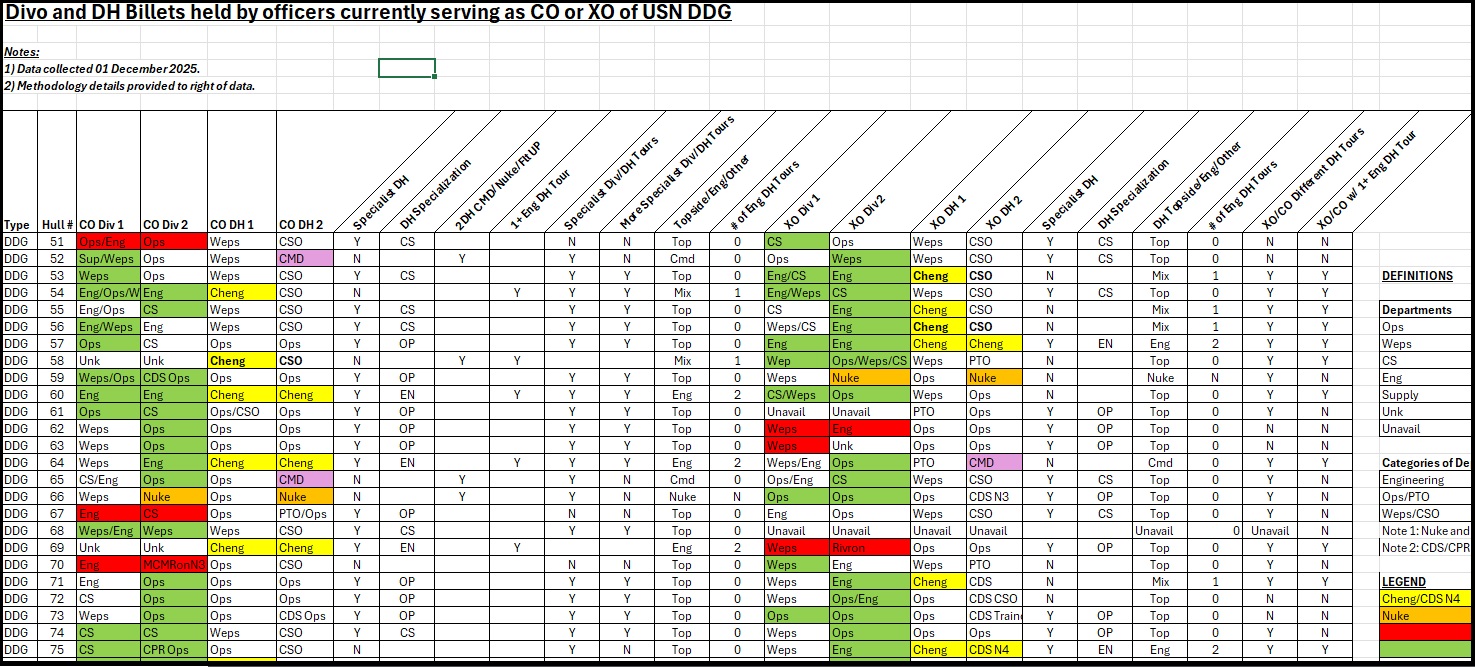
Three things stand out in this data about the value of generalism and the costs of specialization. First, the current generalist approach still enables most officers to build specialized experience in one type of department. Second, specialist career paths would impose career costs on engineers and shrink the pool of officers eligible for command. Third, the generalist approach also builds leadership teams with complimentary expertise and experience. This analysis helps quantify why the generalist career path remains the right choice for the surface Navy.
Are SWOs Generalists?
We must better understand the outcomes of generalism. It aims to provide future commanding officers with a broad foundation, but the data shows that it does more than just that.6 Although some assert that the generalist approach develops officers who are “jacks-of-all-trades” and “masters of none,” we can see that within the generalist system most of today’s COs and XOs actually gain an important degree of specialized experience across their sea tours.7
According to Commander, Naval Surface Forces (CNSF), “the vast majority of SWOs remain within the same department (or at least will remain topside or non-engineers) during department head tours.”8 The data validates this description. At least 82% of today’s XOs and COs served in different departments across their division officers tours. After this generalist start, most of them then specialized at the department head level. 80% of this group were either a topsider or an engineer for both department head tours (see Chart 1).

If we divide departments into three categories for a more granular analysis (Engineering, Operations/Plans and Tactics, Weapons/Combat Systems), nearly two-thirds of current XOs and COs led only one type of department across both tours. Half of those who did not specialize had a tour that precluded specializing. They either fleeted up on the same ship, took early command, or served in a nuclear billet (see Chart 2).
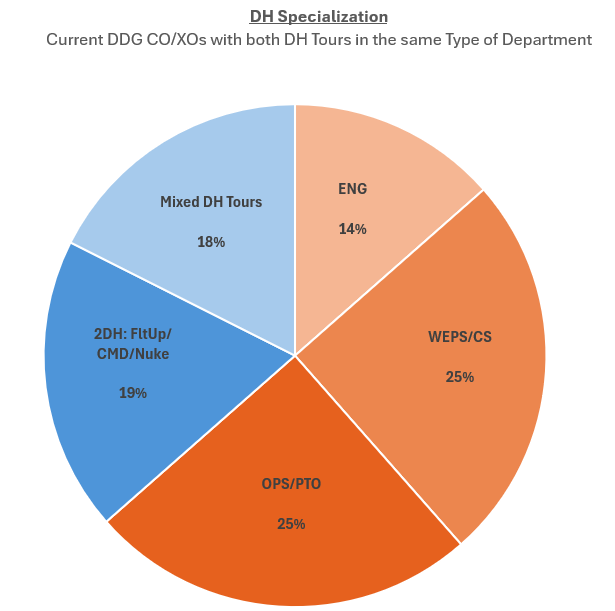
We see more signs of specialization when we look at division officer and department head tours together. Most (81%) of today’s COs and XOs had at least one tour in the same type of department across their division officer and department head tours. Notably, over half (53%) of today’s COs and XOs had at least three of their division officer and department head tours within the same type of department.
Should Engineers Command at Sea?
EOOW is the focus of several critiques of the generalist approach, including most recently an article in CIMSEC by Seth Breen. He contends that EOOW does not contribute to the “tactical competencies” of surface warfare. Applying a zero-sum logic, he argues that time spent qualifying to run an engineering plant comes at the expense of building warfighting skills.9
Instead of requiring EOOW for all officers, proponents of specialization recommend a “two-track system” that would split the surface community into engineering and warfare specialists.10 Some say this approach would enable officers to build more tactical expertise, to focus on leadership, and to improve their watchstanding.11 This view ignores the likely impact on engineering officers’ career prospects and on the vitality of the surface community.
In navies with specialized career paths, engineers are usually not eligible to command at sea. In Britan’s Royal Navy, for example, engineers cannot command. Some navies, like France’s, allow engineers to choose to pursue command, but they have limited opportunities.12 From the advent of steam engines to 1899, the U.S. Navy also had a two-track system. Engineers were not eligible for command.13
Specialization today would likely be no different. This change would shrink the pool of command-eligible officers, making it even harder for the community to select ship captains from among its very best. At the individual level, engineers would no longer have the opportunity or incentive to build seamanship and warfighting skills. The “battle cheng” would become extinct. Specialization could also reduce retention among engineers. Some navies with specialized career paths have challenges retaining engineers both because of limited advancement opportunities in the fleet and competing demand for their skills in the civilian sector.14
The data helps quantify the potential cost of specialization. 14% of current destroyer XOs and COs — 20 officers — served both of their department head tours as chief engineers or squadron N4s. If we consider these officers as a surrogate for those who might be specialist engineers, we can see how many talented officers could be excluded from command.
Teamwork
The generalist approach tends to create command leadership teams (CO and XO) with different experiences and expertise. This means they can better support and backstop each other. Recognizing this benefit, the nuclear submarine community creates leadership teams with one leader who served as an engineer and one who was either a weapons officer or navigator.15
Although the surface navy does not formally balance leadership teams, destroyers often have COs and XOs with different department head backgrounds. 79% of today’s destroyer COs and XOs led different types of departments from each other when they were department heads. Scoping down to engineering, 46% of destroyers — 34 ships — have a CO or XO who served as a chief engineer. This valuable synergy within leadership teams would fade away if only certain types of officers could command.
Culture and Command
The generalist career path reflects the culture of the surface navy. This culture emphasizes both the importance of command and the breadth of experience across seamanship, warfighting, and engineering required to wield it. This is not new. An 1898 congressional report recommending the Navy adopt the generalist approach said, “The personnel must fit the materiel.…In other words, the commanding officer must be a fighting engineer. To fight his ship he must know her, and to know his ship he must know engineering. [Not only that, but] he must know other things as well, such as ordnance and navigation, and have the ‘habit of command.’”16
This century-old conception of command holds true today. Seamanship, warfighting, and engineering are inseparable from each other. Each domain is complex. Each domain depends on the other two. So, the commanding officer, unlike anyone else on their ship, must master all three — blending the technical with the tactical — while leading their team.
The generalist system underpins how the Navy develops potential future commanding officers over the first dozen (or more) years of their career. In other words, generalism is a marathon towards command. Recent arguments for specialization often advocate shifting to a sprint towards TAO, a very different goal with a much shorter time horizon. While the sense of urgency is commendable, this argument neglects that ample time exists in an officer’s career to hone all of these skills before reaching the goal of command.
Some may say that placing primacy on command incorrectly frames this issue. Not every SWO aspires to command.17 For many, though, the drive to command takes time to set in. A generalist approach preserves the opportunity to command and provides time for junior officers to decide if they want to captain a warship.
Conclusion
While keeping the generalist approach, the surface navy should still continue to create more opportunities to specialize — to build more tactical and technical proficiency — across an officer’s career.18 The Warfare Tactics Instructor program and the new Advanced Engineering Instructor program — paired with follow-on production tours — are particularly impactful ways for officers to develop expertise and return it to the fleet.19 As the surface force continues to invest in improving seamanship proficiency through initiatives like the Maritime Skills Training Program, it should establish an Advanced Seamanship Instructor program to also build a cadre of experts in this essential field.20 At the unit level, COs should continue to encourage junior officers to make the most of their limited time at sea to keep building their proficiency in seamanship, warfighting, and engineering with an eye towards one day commanding at sea themselves.
Changing from a generalist to a specialist approach would be a significant culture shift in the surface navy. Perhaps change is needed, but the data presented here helps to understand the likely impacts of specialization. A two-track system would not afford officers many more opportunities to gain expertise than they already have. For that marginal gain, it would narrow opportunity for command by excluding engineers and reduce the breadth of experience across leadership teams, especially in engineering.
On the other hand, the generalist approach provides each officer equal opportunity to strive for command. It helps them build leadership experience and establish a technical foundation across different types of departments. It requires them to learn core seamanship, warfighting, and engineering skills. It enables them to develop specialized expertise over time. It readies them for command. The surface community should hold fast to generalism.
Captain Rob Watts is the military speechwriter to the Secretary of War and commanded USS John Paul Jones (DDG 53). He holds a B.A. in Foreign Affairs and History from the University of Virginia and a Master’s in Public Policy from Princeton University. The views expressed here are those of the author and do not necessarily represent the official views of any U.S. government department.
References
[1] For an early argument in favor of a generalist approach see reports by Secretary of the Navy Gideon Wells written in 1864 and 1865 which are quoted in U.S. House of Representatives, “Personnel of the Navy,” House Report No. 1375, 55th Congress, 2nd Session, 19 May 1898, p. 4, https://www.govinfo.gov/content/pkg/SERIALSET-03721_00_00-182-1375-0000/pdf/SERIALSET-03721_00_00-182-1375-0000.pdf.
[2] Donald Chisholm, Waiting for Dead Men’s Shoes: Origins and Development of the U.S. Navy’s Officer Personnel System, 1793-1941 (Stanford University Press: Stanford CA, 2001) p. 175,193-4, 456-7, 463-4.
[3] Bryan McGrath, “Back Off Congress: Don’t Meddle with the US Navy’s Command Philosophy,” Defense One, May 23, 2018, https://www.defenseone.com/ideas/2018/05/back-congress-dont-meddle-us-navys-command-philosophy/148430/.
[4] Michael L. Crockett, “SWOs Should be Specialists, Not Generalists,” Proceedings, August 2002, https://www.usni.org/magazines/proceedings/2002/august/swos-should-be-specialists-not-generalists, Nathan Sicheri, “Redesign the SWO Junior Officer Pipeline: Centralized Training, and Extended Pipeline, and Specialized Tours Could Increase Surface Warfare Officer Retention and Expertise,” Proceedings, September 2023, https://www.usni.org/magazines/proceedings/2023/september/redesign-swo-junior-officer-pipeline, and Seth Breen, “Reprioritize SWO Tactical Qualifications for the High End Fight,” Center for International Maritime Security, 03 September 2025, https://cimsec.org/reprioritize-swo-tactical-qualifications-for-the-high-end-fight/.
[5] The complete data set can be downloaded at https://cimsec.org/wp-content/uploads/2026/01/XO-CO-DH-Billet-Analysis-Watts-Dataset.xlsx.
[6] Bryan McGrath.
[7] Jon Paris, “The Virtue of Being a Generalist, Part 3: Viper and the Pitfalls of Being ‘Good Enough’,” CIMSEC, August 19, 2014, https://cimsec.org/virtue-generalist-part-3-viper-pitfalls-good-enough/, and Thibault Delloue, “Create an Engineering Officer Corps for Surface Ships,” Proceedings, June 2022, https://www.usni.org/magazines/proceedings/2022/june/create-engineering-officer-corps-surface-ships.
[8] Government Accountability Office (GAO), Navy Readiness: Actions Needed to Evaluate and Improve Surface Warfare Officer Career Path, June 17, 2021, p. 165, https://www.gao.gov/products/gao-21-168.
[9] Breen.
[10] Crockett and Delloue. For a proposal for a nuclear-trained SWO career path see Matthew Phillips, “Master of None: the Nuclear Surface Warfare Officer Career Path Must Change,” Proceedings, November 2018, https://www.usni.org/magazines/proceedings/2018/november/master-none-nuclear-surface-warfare-officer-career-path-must.
[11] Breen, Crockett, Delloue, and Paris.
[12] GAO, p. 45, 79-82.
[13] Chisholm, p. 193-4.
[14] GAO, p. 45, 88, 99.
[15] James P. McGrath, “Engineer-Warriors or Engineers and Warriors,” Proceedings, January 2019, https://www.usni.org/magazines/proceedings/2019/january/engineer-warriors-or-engineers-and-warriors.
[16] U.S. House of Representatives, “Personnel of the Navy,” p. 4, quoted in Chisholm, p. 457.
[17] GAO, p. 40-3, 131-3.
[18] For a recent example of surface warfare training initiatives see Jeffrey Bolstad and Matthew Bain, “Building Tactical Excellence: How SWCTC Supports LT Breen’s Call for Higher SWO Proficiency,” Center for International Maritime Security, 08 October 2025, https://cimsec.org/building-tactical-excellence-how-swctc-supports-lt-breens-call-for-higher-swo-proficiency/.
[19] U.S. Navy, “Warfare Tactics Instructor Program Qualification,” Surface Advanced Warfighting School Instruction 1402.2B, 07 May 2024, https://www.surfpac.navy.mil/Portals/54/Documents/Command/NSMWDC/WTI/SAWSINST%201402.2B%20-%20WARFARE%20TACTICS%20INSTRUCTOR%20PROGRAM%20QUALIFICATION.pdf, and John Goulette, “SWSC – Advanced Engineering Instructor Program,” 04 April 2025, https://www.dvidshub.net/news/494604/swsc-advanced-engineering-instructor-program.
[20] Joseph A. Baggett, “Not Your Father’s Surface Warfare Training,” Proceedings, January 2026, https://www.usni.org/magazines/proceedings/2026/january/not-your-fathers-surface-warfare-training, and U.S. Navy, “Surface Warfare Officer Career Manual,” Commander, Naval Surface Forces Instruction 1412.7B, 06 May 2025, Ch. 4.
Featured Image: ATLANTIC OCEAN (Oct. 16, 2025) The Arleigh Burke-class guided-missile destroyer USS Paul Ignatius (DDG 117) renders honors to the USS Roosevelt (DDG 80). (U.S. Navy photo by Mass Communication Specialist 2nd Class Joseph Macklin)