Category Archives: Strategic Outlook

Predictions and forecasting.

Taming the East Asian Naval Race

Note: This article was originally published in its original form in the Naval Institute’s blog and was cross-posted by permission.

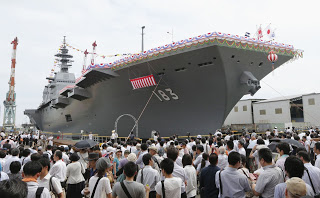
On August 6th,CIMSEC ran a feature on the latest Japanese helicopter destroyer, the Izumo (DDH-183). CIMSEC contributor Miha Hribernik observed that the Izumo, which is supposedly capable of carrying an aviation squadron and boasts a 814 feet-long (248 meters) STOBAR (short take-off but arrested recovery) flight deck, is “sure to cause concern in China…[since the launching of the ship] presents a potent addition to the operational capabilities and strategic reach of the JMSDF.”

22ddh-compAccording to Business Insider, the helicopter destroyer “came in” shortly after China’s recent statement that it is in “no rush [to sign the proposed Code of Conduct] since [Southeast Asian nations involved] harbor unrealistic expectations.” Japan’s territorial row involving Diaoyu/Senkaku coupled with threats emanating from the DPRK (Democratic Republic of Korea) might have triggered increased defense spending. However, the two aims of Japan’s burgeoning defense spending, pre-emptive strike capabilities and the creation of an amphibious assault unit similar to the United States Marine Corps, have made its East Asian neighbors uneasy. As for America’s reaction, Zachary Keck believes that while it is “unclear” how the Obama Administration will respond to Japan’s pre-emptive attack on its “adversary’s bases,” the Obama Administration could become “vocal” should Japan act upon its “threats to review [its] past apologies.”
Japan's Prime Minister Shinzo Abe poses inside the cockpit of a T-4 training jet plane of the Japan Air Self-Defense Force's (JASDF) Blue Impulse flight team at the JASDF base in Higashimatsushima, Miyagi prefecture, in this photo taken by Kyodo May 12, 2013 and released on May 16, 2013. Mandatory Credit REUTERS/Kyodo

In light of the fact that the ROK (Republic of Korea)China and Japan are seeking to boost their naval capabilities in recent years, some now fear that East Asian countries may have entered into a “regional naval competition.” One explanation for the naval race, as recent territorial rows and controversies over Japan’s wartime atrocities demonstrate, is that the ongoing tension in East Asia remains rooted in historical grievances. Osaka mayor Toru Hashimoto’s remark in May that wartime brothels were “necessary…to maintain military discipline” coupled with the photo of Shinzo Abe inside the cockpit of a T-4 trainer with thenumber 731 stenciled on its fuselage seemed to evoke among the Chinese and Koreans memories of  Japan’s imperial aggression during the Pacific War. Indeed, Japan’s seemingly strident militarist overtone may have worsenedthe extant historical enmity among the three major East Asian countries.

To the historical grievances must be added another dimension—the fierce competition for energy resources. According to the National Geographic, “how much oil and natural gas is at stake, in either the South China or the East China Sea, is unclear [since] territorial disputes have prevented any reliable survey.” Nonetheless, each country’s efforts to “guarantee access to resources” will indubitably enhance its ability to “to shape international events according to a new definition of self-interest, one matching [the country’s] status.” As regards the territorial row over Dokdo/Takeshima, some aver that contradictory claims are based on “sequence of centuries-old records and half-told versions of more recent history.” To the extent that natural resources may be concerned, the Dokdo/Takeshima islets, although “poor in fresh water necessary to sustain human life,” are “abundant in fish.” Furthermore, the island is said to “contain natural gas reserves estimated at 600 million tons.” It can be argued, therefore, that in the Dokdo/Takeshima dispute, as with that of Senkaku/Diaoyu, energy security will retain “great salience” in the years, if not decades, to come.

However, one major factor that may explain the exacerbating the East Asian arms race is the recent sequestration cuts within the Department of Defense which may make it more difficult for the United States to “manage its alliances and strategic partnerships in the region.”  Keck argues that a new geostrategic environment whereby the United States increasingly desires to see its East Asian allies “shoulder more of the burden for regional security” may the create the perception that the United States presence in the region has diminished despite its commitment to the “pivot to Asia” strategy.

Nevertheless, it is unlikely that peace in the region can be successfully maintained without the continued American presence in the region. While it may be true that “rational trust-building” diplomatic measures among East Asian states may somewhat temper the extant tension in East Asia, at present, the basis for mutual trust among East Asian states remains flimsy at best. For this reason, the United States must learn to “lead from behind” in East Asia by demonstrating its diplomatic prowess. To that end, the United States must seek cooperation with China in order to achieve stability on the Korean peninsula and to temper the tension over Senkaku/Diaoyu. With respect to Japan and the ROK, the United States can work to defuse tension over the competing claims to the Dokdo/Takeshima islets. One way in which the United States can defuse the naval race would be to help form a combined fleet whereby the United States Navy, together with its sister East Asian navies, “may share their unique resources and cultures to develop flexible responses against future threats.”

In short,  the ongoing naval race, as represented through the launching of the Izumo, is an outcome of deep-seated historical enmity and rivalries over increasingly scarce energy resources. While some may dismiss the possibility of a regional war, slight miscalculation among East Asian state actors may indeed spiral out of control and lead to a lethal war.

Notwithstanding the substantive defense budget cuts which could hamper flexible strategic responses, the United States nevertheless has a role to play to ensure peace in East Asia. “Leading from behind” to tame the ongoing East Asian naval race just may be the most cost effective way in which to exercise influence in the region.

Jeong Lee is a freelance writer and is also a Contributing Analyst for Wikistrat’s Asia-Pacific Desk. Lee’s writings on US defense and foreign policy issues and inter-Korean affairs have appeared on various online publications including East Asia Forum, the Georgetown Journal of International Affairs, the World Outline and CIMSEC’s NextWar blog.

______________

NOTE: In a follow-up article entitled “More Than Meets the Eye in Asian Naval Race” published at RealClearDefense, I argue that the naval competition among the three East Asian countries is driven by each country’s desire to look after its own self-interests and not necessarily by desire for imperial expansion.
Who Is Ahead In Asia’s Carrier Arms Race?

Asia’s maritime arms race has again highlighted the emerging relevance of aircraft carriers. China, India and Japan made significant progress with their flattops. As all major powers in the region run for more and larger carriers, the question is: Who is ahead?

Japan

Japan Unveils Izumo Class Helicopter Destroyer (Light Aircraft Carrier)Japan Maritime Self-Defense Force ah-64 sh-60 (1)    First of all, Tokyo, please stop these ridiculous wordplays. Carriers are carriers and not “helicopter destroyers”, no matter what official spokespersons are saying. Back in the Cold War, nobody believed the Soviet’s heavy flight deck cruisers were actually “cruisers”.

Japan’s present fleet includes two Hyuga-Class and one Izumo-Class helicopter carriers (CVH). Lacking a well deck, they have no amphibious role and are only able to operate helicopters or fixed wing aircraft. Such helicopters can either be used for any number of missions, from Search and Rescue (SAR), surface warfare (SUW), anti-submarine warfare (ASW), or troop movements. Moreover, purchasing some V-22 Ospreys is another option for Japan. Recent maneuvers with the US Navy showed, V-22s are able to operate from the Hyugas.

The main issue is whether Japan’s CVH can operate fixed wing STOVL aircraft, in particular Lockheed’s F-35B (STOVL – Short Take-off and Vertical Landing). Japan’s three CVH are not yet ready to host F-35B, though they could easily be converted into smaller carriers to operate V/STOL aircraft. Due to “no obvious technical obstacles“, the only issue left is the political decision.

The the F-35B has been critiqued for the poor performance of its STOVL variant: enormous fuel consumption during takeoff and landing, limited payload, limited range. In the maritime East Asia, distances are not so far that long range would be necessary. The F-35B may be superior to Chinese warplanes as a whole program, because China has presented prototypes rather than a factory-ready mass-produced model of its 5th generation carrier fighters.

Japan’s main obstacle is the complete absence of combat experience since 1945. However, its navy enjoys the opportunity to train with the US and perhaps Britain in the future: countries with proven combat experience. GlobalSecurity.org reports, moreover, that Japan may consider a program for a larger carrier starting in the 2020s. However, there current evidence says that Japan is about to go for STOBAR or CATOBAR carriers. Hence, Japan will play an important role in the carrier arms race. Maybe the F-35B will boost Japanese maritime power, if Tokyo decides to go for it. However, size and nature of Japan’s carrier program will not bring the country into leading position.

South Korea

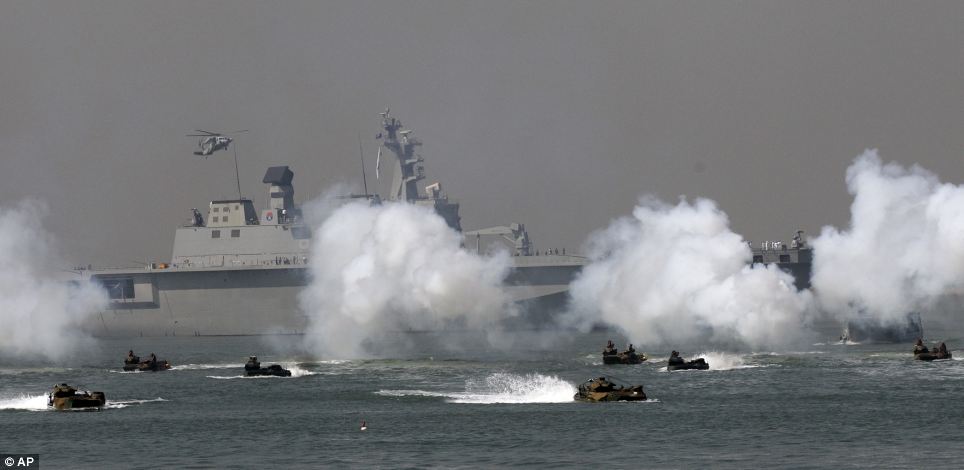
article-1312184-0B3144C1000005DC-215_964x470Seoul’s flattop program is less developed than Japan’s. The South Korean Navy (ROKN) runs one Dokdo-class helicopter carrier and aims to operate three at the end of the decade. Like Japan, these flattops are said only to operate helicopters, but they could be modified to host F-35B. Drones could also be an option. Unlike Japan, the ROKN’s Dokdo has a well deck and can therefore be used for amphibious operations.

However, even though there are reports about South Korean interests in the F-35B, officially plans for converting the Dokdos into a small carrier have been denied. Such a political move is logical. In the U.S, the F-35B has proved to be a budget disaster and has yet to show its operational capabilities. Fortunately, China has not crossed the threshold of full operational capability; the LIAONING is still relatively green and there are no Chinese indigenous carriers. Seoul has still time to weigh its options.

South Korea will only keep regional military weight if Seoul broadens its pursuit of “blue-water ambitions“. In particular, this means spending much more money on an expeditionary navy to include additional flattops. With its sophisticated shipbuilding industry, South Korea would be able modify the Dokdos to small carriers or develop new indigenous carriers. However, the political consequence would be entrance into the great power competition between the navies of the US, China, India and Japan. The ROKN will definitely not take a lead, but do not count South Korea out. If things in maritime Asia get worse, Seoul made decide to follow the Japanese example.

Australia

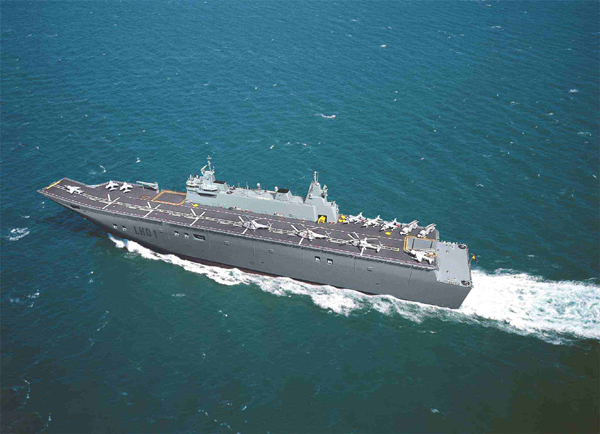
2005_S1237_02.JPGThe two forthcoming Canberra-Class LHDs would able to operate F-35B. The ski-jump on prow is credible evidence. However, right now Australia has no intention to go for the F-35B. Needless to say, political landscapes can quickly change. We will see what happens in Canberra after the F-35B has proven its operational abilities and the carrier arms race continues. Australia could also operate UAVs from her carriers.

We will not see high-profile patrols of Australian LHDs in the East and South China Sea. The Royal Australian Navy may use Canberras for joint exercises with the US, Japan, South Korea, or the Philippines. In terms of operations, the use of the LHD will be to underline Australia’s hegemonial role in the Pacific Islands, disaster relief, and potentially in tackling the refugee issue.

Thailand

As long as Thailand does not seriously invest in its single carrier, the Chakri Naruebet will be nothing else than the “Royal Yacht“. Thailand’s carrier rarely operates and the crews have rare practical experience. Do not bet on Thailand. The Thai carrier will only make a difference in disaster relief.


Singapore

Singapore has yet to jump for a flattop. However, due its very limited space for air force bases, the tiny city-state seriously considers an F-35B purchase. In the future, LHD or small Izumo-style carriers could be an option for Singapore. Basing the fighters offshore would save urgently needed space on land. Nevertheless, there is no credible evidence yet that Singapore is really planning to buy warships like the Izumo (if anybody comes across news regarding this issue, please drop me a line). Thus, Singapore remains a known unknown. What would make Singaporean carrier very relevant is its geographic location close to Malacca Strait and southern end of the South China Sea.

Russia

From the four Mistral LHDs Russia’s navy is about to commission, two will be based in the Pacific. There are no indications that Russia is planning to develop a new STOVL aircraft, although the country’s industry would be capable of doing so (Yak-38, YAK-141). Thus, the Mistrals will only be outfitted with helicopters and, therefore, not make a significant difference in the Indo-Pacific’s maritime balance of power.

Moreover, it cannot be ruled out that Russia use the new LHDs in waters other than the Pacific. Recently, the Russian Navy deployed warships from its Pacific Fleet to the Mediterranean for a show of force offshore Syria.

New Russian aircraft carriers are only discussed, but far away from being realized. If the Russians would start to build new carriers, they would first replace the aging Kuznetsov and, thereafter, strengthen their Northern Fleet to protect their interests in the Atlantic and Mediterranean.

India

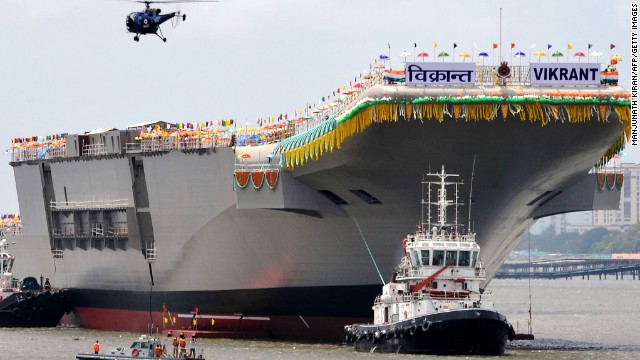
130812065726-01-ins-vikrant-0812-horizontal-galleryThe Indian Navy should definitely be taken into account for a front position. Due to the operational experience of its single operational carrier INS Viraat and its soon to be commissioned two new STOBAR carriers INS Vikramaditya and INS Vikrant, India is now Asia’s number one in maritime aviation. In the 2020’s, an even larger carrier INS Vishal is in the works; perhaps a CATOBAR design, which would provide far better striking capabilities, and maybe even nuclear powered. While future expansion has yet to be determined, in the present India is going to build up a sophisticated three-carrier fleet. The Indian Navy will be able to maintain always one carrier battle group at sea and to project power in the western Pacific.

However, India lacks access to a carrier-capable 5th generation fighter. There is no carrier-version of Indo-Russian Suchoi PAK FA under development. Joining India’s forces in the early 2020, the PAK FA will only be available as a land based fighter. India’s Mig-29 and the potential Rafale are definitely combat capable aircraft, but surely behind the F-35’s abilities and probably, too, behind China’s J-31. Once other Indo-Pacific powers operate their 5th generation fighters from carriers, India will fall behind in quality if not quantity.

In addition, operating different fighter and carrier models, as India is about to do, increases maintenance costs significantly. Nevertheless, just by the numbers of operational vessels and the operational experience, India will take the lead in Asia’s carrier arms race for this decade and maybe also in the early 2020s, but not longer.

China

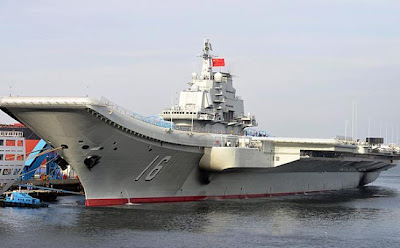
carrier_liaoningAs much has been written about China, we keep it brief here. Given China’s “Two-Ocean-Strategy”, seeking to operate always one carrier in the Pacific and Indian Ocean, the PLAN will need up to 5-6 flattops. We have physical evidence now for what everybody knew before: Chinas is commencing an indigenous aircraft carrier program. The hot issue is, for which design China will go. Will they re-build LIAONING‘s STOBAR design? Alternatively, will they go straight for a more advanced CATOBAR design?

Probably the first and second indigenous Chinese carrier will be a conventional powered STOBAR flattop. Thereafter, we may either see conventional or even nuclear powered CATOBAR carriers. Beside military requirements, for political prestige Beijing will not accept its carrier fleet to be behind the level of India. Instead, after the “century of humiliation” China will seek for clear superiority over India, Japan, and other potential Asian naval powers.

Who is ahead?

Right now India is definitely ahead due to operational experience and the number of vessels. Regarding technology, Japan is likely to be number one. However, both will be surpassed by China either at the end of his decade or surely within the 2020s. South Korea, Australia, Thailand, and Singapore are economically too weak to be a maritime game changer. However, it will be interesting to watch how these and other countries are seeking for maritime alliances to balance China. Russia will not play a major role in maritime Asia, especially not with carriers, because its core interests are located elsewhere.


After Obama scrapped US foreign policy almost entirely in the last years, what will a weakened America do in the Indo-Pacific? States like Japan, South Korea, Singapore, and Australia will rely on US security guarantees. However doubts remain as to whether Obama and his successors are willing to deliver should serious conflicts occur. For a clear message to China, the US needs a credible and increased forward presence throughout the Indo-Pacific. Therefore, Washington should leave theaters like the western Indian Ocean and the Mediterranean to the Europeans as much as possible. If necessary, let Europe learn the hard way that in the Indo-Pacific Century, the times of US military bailouts are over and Europe has to do carry its share of the load.

Felix Seidler is a PhD candidate at the Institute for Security Policy, University of Kiel, Germany, and a German security affairs writer. This article appeared in original form at his website, Seidlers Sicherheitspolitik.

A Post-Sequestration Blueprint for a Leaner and Smarter Military

Five months after the much-dreaded sequestration went into effect, many defense analysts and military officials alike are worried about the negative repercussions of the drastic budget cuts on military readiness. In his latest commentary, the rightwing commentator Alan Caruba declared that “The U.S. military is on life support.” Defense Secretary Chuck Hagel also argued in his Statement on Strategic Choices and Management Review (SCMR) that “sequester-level cuts would ‘break’ some parts of the strategy, no matter how the cuts were made [since] our military options and flexibility will be severely constrained.”

Secretary of Defense Chuck Hagel answers reporters' questions during a Pentagon press briefing on the recent Strategic Choices. Navy Adm. James A. Winnefeld Jr., right, vice chairman of the Joint Chiefs of Staff, joined Hagel for the briefing. (DOD photo by Glenn Fawcett)
Secretary of Defense Chuck Hagel answers reporters’ questions during a Pentagon press briefing on the recent Strategic Choices. Navy Adm. James A. Winnefeld Jr., right, vice chairman of the Joint Chiefs of Staff, joined Hagel for the briefing. (DOD photo by Glenn Fawcett)

To its credit, the SCMR seemed to hint at operational and structural adjustments underway by offering two options—trading “size for high-end capacity” versus trading modernization plans “for a larger force better able to project power.” Nevertheless, one important question which went unasked was whether or not the US Armed Forces alone should continue to play GloboCop.

The current geostrategic environment has become fluid and fraught with uncertainties. As Zhang Yunan avers, China as a “moderate revisionist” will not likely replace the United States as the undisputed global champion due to myriad factors. As for the United States, in the aftermath of a decade-long war on terror and the ongoing recession, we can no longer say with certainty that the United States will still retain its unipolar hegemony in the years or decades to come.

That said, Secretary Hagel is correct that the United States military may need to become leaner in the face of harsh fiscal realities. To this must be added another imperative: The US Armed Forces must fight smarter and must do so in ways that may further America’s strategic and commercial interests abroad.

So how can the United States military fight smarter and leaner?

COCOMs
Possible Combatant Command Realignments

First, given massive troop reductions whereby the Army personnel may be reduced to 380,000 and the Marine Corps “would bottom out at 150,000,” while at the same, the DoD is seriously considering restructuring existing Combatant Commands (COCOMs), it no longer makes sense to deploy or train troops for protracted counterinsurgency campaigns or foreign occupations. Instead, should another transnational terrorist group or a rogue state threaten homeland security, the United States could rely on SOF (Special Operations Forces) commandos and UAV (Unmanned Aerial Vehicles) to selectively target and neutralize potential threats. While the SOF and UAV surgical raids should not be viewed as substitutes for deft diplomacy, they can provide cheaper and selective power projection capabilities.

Second, since the United States Navy may be forced to “reduce the number of carrier strike groups from 11 to 8 or 9,” it can meet its power projection needs by encouraging cooperation among its sister navies and by bolstering their naval might. One example of such partnerships would be to form a combined fleet whereby America’s sister navies “may share their unique resources and cultures to develop flexible responses against future threats” posed by our adversaries.

Third, the United States may encounter more asymmetric threats in the form of cyber attacks, CBRN (Chemical, Biological, Radiation, Nuclear) attacks, and may also be subjected to attacks from within by homegrown terrorists and drug cartels—all of which may wreak havoc and may even cripple America’s domestic infrastructures. As retired Admiral James Stavridis argues, such asymmetric attacks may stem from convergence of the global community. Such threats require that the United States take the fight to its adversaries by cooperating with its allies to “upend threat financing” and by strengthening its cyber capabilities.

Fourth, where rogue states such as Iran, Syria and North Korea, are concerned, the United States could implement what General James Mattis refers to as the “proxy strategy.” Under this arrangement, while “America’s general visibility would decline,” its allies and proxies would police the trouble spots on its behalf.

Fifth, the United States must be prepared to defend homeland against potential missile attacks from afar. The United States may be vulnerable to hostile aggressions from afar following North Korea’s successful testing of its long-range rocket last December and Iran’s improved missile capabilities. Thus, improving its missile defense system will allow greater flexibility in America’s strategic responses both at home and abroad.

Last but not least, the United States Armed Forces needs to produce within its ranks officers who are quick to grasp and adapt to fluid geostrategic environments. One solution, as Thomas E. Ricks proposes, would be to resort to a wholesale firing of incompetent generals and admirals. However, it should be noted that rather than addressing the problem, such dismissals would ultimately breed resentment towards not only the senior brass but civilian overseers, which will no doubt exacerbate civil-military relations that has already soured to a considerable degree. Instead, a better alternative would be reform America’s officer training systems so that they may produce commanders who possess not only professional depth but breadth needed to adapt to fluid tactical, operational, and strategic tempos.

ohmanmarchjpg-4e06c3b3e4dd8566
“The US Military Establishment’s Greatest Foes” By Jack Ohman/Tribune Media Services

Despite the hysteric outcries from the service chiefs and many defense analysts, in the end, the sequestration may not be as dire as it sounds. In fact, Gordon Adams argues that after several years of reductions, “the defense budget…creeps upward about half a percentage point every year from FY (Fiscal Year) 2015 to FY 2021.” Simply stated, one way or the other, the US Armed Forces may eventually get what it asks for–as it always has been the case. Nonetheless, the sequestration “ordeal”—if we should call it as such—offers the US military object lessons on frugality and flexibility. Indeed, American generals and admirals would do well to listen to General Mattis who recently admonished them to “stop sucking their thumbs and whining about sequestration, telling the world we’re weak,” and get on with the program.

Note: This article was originally published in its original form in the Naval Institute’s blog and was cross-posted by permission.

Jeong Lee is a freelance writer and is also a Contributing Analyst for Wikistrat’s Asia-Pacific Desk. Lee’s writings on US defense and foreign policy issues and inter-Korean affairs have appeared on various online publications including East Asia Forum, the Georgetown Journal of International Affairs, the World Outline and CIMSEC’s NextWar blog.

Shipping as a Repository of Strategic Vulnerability

The following article is special to our International Maritime Shipping Week. While we often discuss the threats to maritime shipping, this week looks at dangers arising from such global trade, and possible mitigations.

“Where the carcase is, there will the eagles be gathered together.”

                                            Julian S. Corbett, Some Principles of Maritime Strategy (1911)

In a global system marked above all by its complexity and interconnectedness, dependence on international shipping is universal. Yet some nations are far more vulnerable than others. As students of naval history well know, such vulnerability is often turned into a source of strategic leverage. To what extent can this leverage actually be exploited under 21st century conditions?

The needs of a nation, the opportunity of a foe

The globalized economy is, in a very real sense, a system of maritime exchange. As Thomas Friedman points out, as much as any other recent innovation, it was the shipping container that shaped our daily lives by making the economic transformation of the late 20th Century possible.[1] In the past two decades alone, the volume of sea-borne commerce has more than doubled, from 4 billion tons in 1990 to 8.7 billion tons in 2011. According to the International Maritime Organization, if the overall trend of trade growth observed over the last one and a half centuries continues, the figure will be 23 billion tons in 2060. And, while the exact share of global trade in goods that is moved by is a matter of some debate, it is sea well in excess of 75 percent by most reckonings. Further, it is clear that only cheap and plentiful shipping in a secure maritime environment can sustain this transformation. As a result, the stakes in international shipping are widespread.

But while any nation that wishes to prosper in the current global environment shares in the global dependency on shipping, the vulnerabilities that arise from it are distributed unevenly. This is mainly for two reasons: First, the degree to which specific nations sustain themselves by means of ship-borne imports, and to which they found their prosperity upon maritime exports, varies greatly. Secondly, depending inter alia on a country’s geopolitical setting, it will be more or less able to manipulate the degree to which it has to rely on shipping for its economic security. A resource-rich, continental-size state with landward access to sizeable markets – like Russia – has serious alternatives to maritime transportation. A small island nation with an export-oriented economy that runs on imported hydrocarbons – such as Taiwan – does not. It is where dependency gives rise to vulnerability that it turns into a potential source of leverage for outside powers.

Targeting Shipping for Strategic Effect

In what ways can vulnerabilities in the area of maritime transportation be exploited for strategic effect? There is, of course, a whole spectrum of options available to would-be-predators. Unilateral or multilateral sanctions have been a mechanism of choice since the end of the Cold War. But historically, it has been direct military action against the opponent´s shipping that has had the greatest impact on trade. Two main methods of waging war on commercial shipping can be distinguished, at least at an analytical level: (1) the blockade, and (2) guerre de course, or commerce raiding. The blockade relies on concentration and persistence to choke off the flow of sea-borne goods into enemy harbors, and as such will usually require some form of command of the sea. Commerce raiding, on the other hand, relies on dispersed, attritional attacks by individual vessels (or small groups of vessels), which makes it an attractive option for navies that find themselves in a position of inferiority. Both methods leverage the disruption of shipping to impose a cumulative toll on the adversary’s economy, which is expected to have a significant indirect impact on the war effort and/or erode the opponent´s will to resist.

Recsuing the survivorsHistorical examples of shipping being turned into a strategic lever are abundant. In the age of sail, preying on adversaries’ commerce was an integral part of most naval campaigns, including those of the Dutch Wars, the Seven Years’ War, and the Wars of the French Revolution. While it was seldom decisive, it was often “exceedingly painful,”[2] as Colin Gray observes. During the late 19th and early 20th centuries, innovations in naval technology all but brought to its termination the “close blockade” of enemy harbors while also providing means – the submarine, torpedo, and naval mine – that would transform guerre de course into a method of total warfare. Much ink has been spilled on Germany’s failed – and strategically counterproductive – attempts subdue Britain by way of Handelskrieg (the German variation of commerce raiding), while a slightly more specialized literature focuses on the “distant blockades” of Germany that were a key feature of British naval operations in both World Wars.  However the case of Japan is most the instructive for the purposes at hand.

An island nation with an extremely circumscribed resource base, Japan was utterly dependent on ship-borne imports of a range of raw (and precursor) materials. In a very real sense, the Empire´s huge naval modernization program during the 1930s was based on its maritime commerce with the United States. Among other things, the U.S. covered 80 percent of Japanese liquid fuel needs. Given its political and military trajectory, Japan´s demand for key commodities was highly inelastic. The only alternative to trade with the United States and other potential adversaries was the unilateral extraction of resources from Japan´s near abroad – which could decrease its dependence on this particular foreign power, but (crucially) not on maritime transportation. When war came, the U.S. was able to exploit this vulnerability to devastating effect. Despite the many operational and technical inadequacies revealed by its initial operations in 1941-42, the U.S. Navy´s all-out war on Japanese shipping eventually came as close to strategically decisive as can reasonably be expected from any indirect use of military power.[3] Aided by the dire lack of defensive measures on the part of the Imperial Japanese armed forces, U.S. submarines alone sent more than 1,100 Japanese merchantmen to the bottom, and nearly as many were sunk by aircraft and mines. By the spring of 1945, Japanese sea-borne logistics had virtually ceased to exist, and so had Japan´s ability to sustain its war effort.

It has been suggested that other attempts throughout history at disrupting shipping flows might well have been equally successful in exploiting strategic vulnerabilities, had it not been for the predators´ “technical incapacity, operational ineptitude, and policy incompetence […] in the conduct of commerce raiding.”[4] Whether this assessment is accurate or not, there is little doubt that – despite the moral opprobrium that has often accompanied attacks on civilian vessels – the vulnerable dependence on sea-borne trade can be exploited to considerable effect. What relevance this finding might possess in an era of global economic integration is, however, much less clear.

Execute against China?

Until very recently, the explosion of maritime trade supporting economic globalization has not resulted in a resurgence of military strategies based on the (selective) disruption of international shipping. An important exception has been Iran´s focus on the Strait of Hormuz, which has played a critical role in Iranian strategic thinking since the 1980s. But it is the rise of China that has reignited naval strategists´ interest in shipping as a source of strategic vulnerability.

One set of scenarios that has been debated in detail involves Chinese offensive operations against Taiwan´s economic lifeline.  Given the island´s vulnerable dependency on shipping and the enduring limitations of the People´s Liberation Army with regard to a full-scale invasion, it is hardly surprising that the imposition of a coercive blockade should hold some appeal in PLA planning circles.

Considerably greater attention has been attracted, however, by the possibility that the People´s Republic might itself become the target of offensive military action against the sea-borne commerce on which the integrity of its economic model stamds. After all, 90 percent of China’s exports and 90 percent of its liquid fuel imports – which, as Sean Mirski observes are “functionally irreplaceable”[5] – are transported by sea. The oft-cited ‘Malacca dilemma’ is but one expression of a suspicion that now unites an increasing number of strategic thinkers, both Chinese and foreign: namely, that its dependence on maritime transportation may prove to be China´s Achilles’ heel on its way to greatness.

While the vulnerability of the PRC’s sea lines of communications has become an official justification for naval expansion and a rallying cry for naval nationalists, it is also a focal point for U.S. strategizing in the context of increasing access challenges in the Western Pacific. Thus, a blockade of Chinese (or rather China-bound) shipping has been debated both as an element of, and as an alternative to, the AirSea Battle Concept that is designed to enable operations in the face of an anti-access/area-denial challenge, such as U.S. military planners anticipate in case of conflict along the Chinese periphery.

Shipping LanesWhile Western treatments of the subject tend to agree that a blockade would be militarily feasible – given an adequate investment of resources – and could have a very considerable impact on the Chinese economy, the assumptions under which they arrive at these conclusions are extremely restrictive. For example, Mirski assumes that (1) the U.S.-China conflict in question would not be limited in scope, yet would stop well short of nuclear use, (2) the U.S. would find itself in the position of defender of the status quo against a blatantly aggressive China, (3) the U.S. would be able to build a coalition that includes Russia, India, and Japan; and (4) under these conditions, a ‘sink-on-sight’ policy towards civilian vessels in China’s near seas would be politically viable. Even with these preconditions, he concludes that despite the American blockade “China would be able to meet its military needs indefinitely.”[6]

Recent publications also points to changes in the nature of international shipping itself as potential complicating factors: in a prospective blockade scenario, few – if any – civilian vessels would fly the Chinese flag and, given the practice of selling and reselling cargo on spot markets, a ship´s final destination might not be known until it actually enters port.[7] But while Mirski’s proposal of instituting a system of digital navigational certification is ingenious, he dodges the broader question of how the United States and the nations of the Asia-Pacific would deal with the myriad repercussions of what would amount to a major disruption of the globalized economic sphere for an extended period of time.

Conclusion: Return of the commerce raiders?

If nothing else, the current debate about a U.S. naval blockade of China reveals that – much like their predecessors in past centuries – strategists in a globalized era see shipping as a repository of strategic vulnerability, particularly in cases of high-intensity conflict between great or medium-size powers. But while the potential leverage to be gained from nations’ dependence on international shipping is perhaps greater than ever before, the actual leverage might not correspond to planners’ expectations. The sources of this disconnect lie primarily in the political and economic context in which any concerted military action against sea-borne trade would be embedded. Given the U.S. Navy’s determined stewardship of freedom of navigation, the U.S. in particular would find itself on the wrong side of the norms it has been upholding for the past 60 years. And while the economic fall-out of any great power war is likely to be significant, the willful disruption of trade flows for strategic effect would only serve to accentuate the costs to regional allies and global trading partners.

As a result, unrestricted commerce warfare of the type pursued by the U.S. Navy against Japan in 1941-45 is just not in the cards. On the other hand, anything short of a strategically counterproductive ‘sink-on-sight’ policy might not produce sufficient strategic impact to justify the cost of embarking on such a risky course of action in the first place. Finally, once we move beyond the context of open interstate warfare, multilateral economic sanctions offer the possibility of causing many of the same effects at markedly lower cost to the attacker’s international standing.

Overall, the recent surge of interest in economic warfare strategies does little to encourage faith in the potential decisiveness of military actions against globalized trade, and serves to underline the practical and political challenges presented by any attempt at leveraging the vulnerabilities of a major trading power under 21st-century conditions. While the dependence on international shipping poses many risks, the strategic leverage it provides as a direct result of its crucial contribution to the prosperity of nations is now more apparent than real.

Michael Haas is a researcher with the Global Security Team at the Center for Security Studies, ETH Zurich. The views presented above are his alone. Michael tweets @the_final_stand.


[1] Thomas L. Friedman (2006), The World Is Flat: The Globalised World in the Twenty-first Century (London: Penguin), 468.

[2] Colin S. Gray (1992), The Leverage of Sea Power: The Strategic Advantage of Navies in War (New York: Free Press), 13.

[3] Robert A. Pape (1996), Bombing to Win: Air Power and Coercion in War (Ithaca, NY: Cornell UP), 100-01.

[4] Gray 1992, 13.

[5] Sean Mirski (2013), “Stranglehold: The Context, Conduct and Consequences of an American Naval Blockade of China,” Journal of Strategic Studies 36:3, 389.

[6] Mirski 2013, 416.

[7] Ibid., 402; Gabriel B. Collins and William S. Murray (2008), “No Oil for the Lamps of China?,” Naval War College Review 61:2, 84.