Category Archives: Strategic Outlook

Predictions and forecasting.

7-13 October: Future African Navies Week

No, no, no. This part where you have 18 committees and ruin the design? That's where you're supposed to buy it.
No, no, no. This part where you have 18 committees and ruin the design? That’s where you’re supposed to buy it.

We are used to broad discussions on procurement and force development. The pre-requirement requirements have to be vetted by a blue-ribbon committee for vetting before formal review for potential review. After a semester of National Security and Defense Industrial Capacity at Georgetown, it was like whiplash sitting in African Security and hearing a Senegalese officer discuss his one-man assignment to develop requirements for, procure, and fly aircraft back to Senegal for the Armée de l’Air Sénégalaise. Such breathtaking freedom comes with a price, since the procurement program consisted of only one aircraft.

Strategic September is a project dedicated to the grand art of Strategy, from force planning to the blue ribbon commissions as the colossal body of “Blue Force” navies the world over make ponderous course corrections. From 7-13 October, we will discuss the potential for our yet developing compatriots south of the Mediterranean. These are not merely the conventional problems of defining missions and smaller budgets. While a vast body of work is dedicated to “security assistance”, we will endeavor to discuss the internal challenges, solutions, and questions faced by African Navies. The Senegalese officer not only discussed procurement, but the harrowing issues of government corruption, loyalty to the goverment vs. the state, and the disturbing threat of coups in nearby nations. We pursue the challenges of professionalism, sailors duel-hatting as pirates by night, patronage recruiting, and the like. Join us, won’t you?

Matt Hipple is a surface warfare officer in the U.S. Navy.  The opinions and views expressed in this post are his alone and are presented in his personal capacity.  They do not necessarily represent the views of U.S. Department of Defense or the U.S. Navy.

Upcoming Events for Week of 08-15SEP

September continues to be a busy month in DC and abroad.  Check out these upcoming events while you monitor world events.  Also note we’ve added a new “favourite” for events – Rethinking Seminar.  Entering it’s 10th year, the wildly successful seminar that JHU/APL has organized and sponsored features a recurring series of seminars on national security and foreign relations topics.  These free events, held near the Pentagon, bring together distinguished speakers and those interested in exploring such important issues.  The evening seminars are open to the public with videos and related materials later posted to this website.

Upcoming Events:

09 September – Doha – This Brookings Doha Center discussion aims to address the underlying problems facing the political situation in Iraq. What are the key problems hindering national reconciliation? What are the effects of regional developments – especially the crisis in Syria – on the Iraqi political system? What is the role of outside powers in shaping the political future of Iraq?  Doha Center Director Salman Shaikh moderates Ali Al-Dabbagh, Former Government Spokesman, Republic of Iraq; Falah Al-Nakib, Former Minister of Interior, Republic of Iraq; and Nisar Talabany, Senior Advisor to the Prime Minister, Kurdistan Regional Government.

11 September – Washington, DC – U.S. Representative Michael Turner, Chairman of the House Armed Services Committee on Tactical Air and Land Forces provides the keynote address on invigorating U.S./ Japanese relationships through natural gas partnerships.  Sponsored by the American Enterprise Institute.

13 September – Washington, DC – The Center for Strategic and International Studies will host a Technology-Strategy Seminar in their Washington, DC headquarters.  NATO’s culminating military strategy in the end-game of the Cold War was AirLand Battle. Tailored for deterrence and to win if deterrence failed, AirLand Battle was also structured to account for the political necessities of assurance and NATO cohesion. Cold War assurance and deterrence is essentially the only experience available on which to base thinking about extended deterrence in the future; although of course not all the Cold War lessons may be valid for the future. Dr. Jim Tegnelia and Dr. Rich Wagner were involved in helping to invent and implement AirLand Battle. They will discuss what it was, how it came to be, and how it worked, politically and militarily, and will speculate on lessons for the future.

10 October – Washington, DC – For the Rethinking Seminar Dr. Payne will examine and discuss the minimum requirements for U.S. nuclear weapons and the underlying assumptions behind the calls for nuclear weapons reductions, subjects which were recently examined in the NIPP monograph Minimum Deterrence: Examining the Evidence.  Dr. Payne acted as the study director along with his duties as President and CEO of NIPP, a non-profit research center.   If you have any additional events that might be of interest t our readers, please email operations@cimsec.org.

Syria: Lord of the Flies

“The rules!” shouted Ralph. “You’re breaking the rules!”

   “Who cares?”

   Ralph summoned his wits.

   “Because the rules are the only thing we’ve got!”

   But Jack was shouting against him.

   “Bollocks to the rules! We’re strong-we hunt! If there’s a beast, we’ll hunt it down! Well close in and beat and beat and beat-!”

   He gave a wild whoop and leapt down to the pale sand. At once the platform was full of noise and excitement, scramblings, screams and laughter. The assembly shredded away and became a discursive and random scatter from the palms to the water and away along the beach, beyond night-sight. Ralph found his cheek touching the conch and took it from Piggy.

   “What’s grownups going to say?” cried Piggy again. “Look at ‘em!”

   The sound of mock hunting, hysterical laughter and real terror came from the beach.

   “Blow the conch, Ralph.”

   Piggy was so close that Ralph could see the glint of his one glass.

   “There’s the fire. Can’t they see?”

   “You got to be tough now. Make ‘em do what you want.”

   Ralph answered in the cautious voice of one who rehearses a theorem.

   “If I blow the conch and they don’t come back; then we’ve had it. We shan’t keep the fire going. We’ll be like animals. We’ll never be rescued.”

From the Suez Crisis to Libya, the United States has held the Conch. Whether America has been early or late, right or wrong, both enemy and ally have heeded America’s call to tend to the fires of security, stability, and justice. Syria has indeed broken the rules and run off in a fit of mayhem. However, we should be wary of blowing the Conch in Syria if we are unwilling to exceed half-steps; we risk undermining our own military/political credibility and revealing the thinning nature of our global leadership.

Fire for Effect

lordoftheflies61If the Conch is to have any authority, it must have a very clear effect. In Lord of the Flies, Ralph knows well that if the Conch is blown and no one comes, it loses its authority.

When asked by Senator Robert Corker (R-Tenn) what our military operations were seeking, the answer from General Martin Dempsey, Chairman of the Joint Chiefs of Staff (CJCS) was also that of the at-large observers of U.S. policy: “I can’t answer that, what we’re seeking.” To be fair to the CJCS, at multiple points he, DoD Secretary Chuck Hagel, and DoS Secretary John Kerry state that the U.S.’s goal is to degrade and deter the Assad regime’s ability to deploy chemical weapons. That said, there was a continuing disconnect between the stated goal of overall U.S. strategy and the stated goal of the strikes and a disconcerting attempt to disconnect the two. Senator Ron Johnson (R-WI) brought up, and was affirmed by Secretary Kerry, that the administration’s overall goal is aiding the opposition. However, it was clearly noted that the strikes were to be separated from that goal; “The action, if it is authorized… that the consequence of degrading his chemical capacity inevitably will also have downstream impact on his military capacity” (Secretary Kerry) but not in such a way as to significantly shift the balance of the conflict. That conflict being Assad’s main concern, if we don’t mount a larger threat than the opposition, the conch becomes mere background noise.

It is a confusing and round-about series of objectives we are laying out for ourselves, talking about “tailored” strikes in a very un-tailored conflict towards goals disassociated with the main thrust of U.S. policy towards targets not directly associated with the WMD operations we’re concerned about. Overall, the entire enterprise seems to be a muddle. The U.S. will likely avoid striking the actual chemical weapons because of concerns that we’ll inadvertently release those weapons into populated areas where depots are located. The way the plan is beginning to shape up to the public, the best way to describe it is a story about Milton Friedman…

“At one of our dinners, Milton recalled traveling to an Asian country in the 1960s and visiting a worksite where a new canal was being built. He was shocked to see that, instead of modern tractors and earth movers, the workers had shovels. He asked why there were so few machines. The government bureaucrat explained: “You don’t understand. This is a jobs program.” To which Milton replied: “Oh, I thought you were trying to build a canal. If it’s jobs you want, then you should give these workers spoons, not shovels.”

-Stephen Moore’s Missing Milton: Who Will Speak for Free Markets?

A middle policy consisting of operations meant to “shake things up” or in the words of Senator Rand Paul (R-KY), “not win” is a waste. It shows that those who use WMD need only survive a tepid response. We have no room for an action program, only results.The US has two real options:

1. Blow Conch, Beat Jack to a Pulp: Commit to a robust response to severely degrade the Assad’s regime’s ability to conduct the war against the opposition, in such a way that the US’s increased involvement is clearly the result of Assad’s WMD use. This is a clear sign to the regime, and to the world, that use of WMD will have severe consequences with severe impacts. It does embroil us further into the conflict and may aid parties we do not wish, but at the very least it has the stated effect of setting a global precedent that use of WMD will not be accepted and will have consequences of consequence.

2. No Strikes, Just Save the Survivors: It’s guilt-inducing and feels unsatisfactory but the conflict is too big and too messy for half measures that might feel judicious. If Assad walks away from a military strike by the world’s last remaining superpower with the continued ability to survive the onslaught of a legion of rebels, how much weaker does the US appear? The world recognizes that both sides are corrupted in the extreme in Syria, and a failure to act against internal use of chemical weapons in a conflict already defined by endless atrocity and will likely not encourage nations to develop WMD as some administration strategists suggest. The Assad regime already found itself looking down a smoking barrel of sanctions and isolation. With pre-existance serving as the only precedent that saves Assad from a strike for merely having weapons, his battle with the US’s enemies serves as his only defense now. No nation would want to pay that protection fee for chemical weapon employment, namely turning their borders into the walls of a blood-soaked charnal house. In that particular case, there is a sad, but real difference set by the precedent by internal atrocities in a no-good-side civil war and the use of chemical weapons on foreign states. The best help the US can provide is to serve in every way it can to aid who have left Syria and those trying to leave.

Saving Grace?

Lord of the Flies ended in death and disaster, as a conflict spiraled wildly out of control. I’ve before voiced my grave concern at the idea of getting involved in Syria, based on the fact there is virtually nothing left of the original moderate “just looking to go to work without getting shot or sent to a secret prison” crowd of normal righteously angry people. During the hearing, Secretary Kerry said:

The opposition has increasingly become more defined by its moderation, more defined by the breadth of its membership and more defined by its adherence to some, you know, democratic process and to an all-inclusive, minority-protecting constitution, which will be broad-based and secular with respect to the future of Syria.

And General Dempsey followed with:

Syria historically has been secular, and the vast majority of Syrians, I believe, want to remain secular. It’s — it’s our judgment that — and the judgment of our good friends who actually know a lot of this in many ways better than we do because it’s their region, their neighborhood — I’m talking about the Saudis, the Emirates, the Qataris, the Turks, the Jordanians — they all believe that if you could have a fairly rapid transition, the secular component of Syria will re-emerge

It’s doubtful the political landscape has changed significantly since AQ funding and foreign fighters began overwhelming reasonable agendas and arsenals, but what a blessing it would be if it has. In the words of General Patton, “Take calculated risks. That is quite different from being rash.” Syria still feels like the latter.

Matt Hipple is a surface warfare officer in the U.S. Navy.  The opinions and views expressed in this post are his alone and are presented in his personal capacity.  They do not necessarily represent the views of U.S. Department of Defense or the U.S. Navy.

Learning from History: British Global Trade and the Royal Navy

large
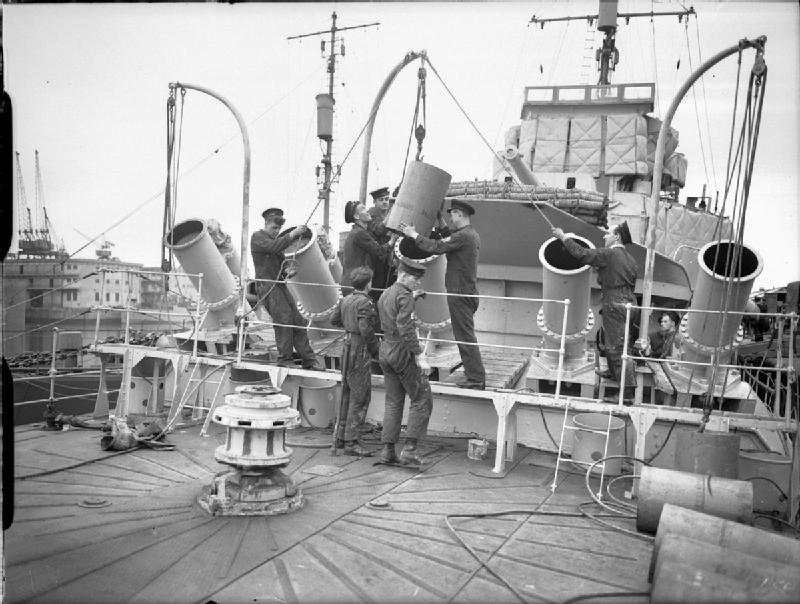
                      Doggy treats for the wolf pack.

Earlier this year, Britain marked the 70th Anniversary of the Battle of the Atlantic (BOA 70), to commemorate those sailors and airmen who lost their lives in serving and defending the vital trade routes into British ports throughout the Second World War. The Battle of the Atlantic was not a unique struggle; it was instead only the latest historical incident where an enemy of Britain had taken to the seas to harass British shipping with the aim of bringing the country under submission. The Germans had attempted it before in 1917, and the French numerous times throughout history, even developing an entire naval mindset around the idea, the Jeune E’cole. But as with many national commemorations, BOA 70, appears to have failed to engender a greater political and public understanding of the patent fact of Britain’s geo-strategic position as an island nation and the vulnerability inherent in such a position. Whilst reflection and contemplation on lives lost is apposite, it has a tendency to appeal to national sentiment and myth instead of to a rational appreciation of the historical lessons it can offer. One of the fundamental problems of our day is that the maritime realm resides on the fringes of the British psyche, resulting in a lack of awareness and understanding of the nation’s maritime heritage and continued reliance on the sea.

Britain is a ‘just enough, just in time’ economy. Around 90 – 95% of British economic activity is dependent of the sea. UK based shipping contributes £10bn to GDP and £3bn in tax revenues and is placed as the third largest service sector industry in Britain after tourism and finance. In 2011 the Centre for Economics and Business Research (Cebr) forecasted that the march of globalisation is forcing a dramatic rise in British dependence on maritime trade. British seaborne imports are projected, after adjustments for inflation, to grow 287% over the next two decades, and exports delivered increasing by 119%. The value of British imports in 2010 stood at £345bn and is expected to reach £1.95tn by 2030. In the same twenty-year period export values are expected to rise from £233bn to £1.63tn[1]. These figure are unsurprising as globalisation continues to drive up the level of international trade and sea transport remains the cheapest option for serving this trade. But what these figures do is underline the perennial fact that Britain remains heavily dependent on the sea for its prosperity and economic stability. However, perversely, the global commons lack the levels of policing required to guard against disruption to the global Sea Lines of Communication (SLoC)[2] which would inevitably have a palpable and dramatic impact on the daily life of British citizens; from the latest ‘Apple’ products not appearing on the shelves to more concerning shortages in food, gas and oil. But what is the likelihood of this? What actors would be in a position to be able to mount a credible threat to the free flow of goods around the globe.

The answer is, nobody can be sure. Nevertheless the possibilities are multifarious. Piracy, interstate confrontation, terrorism, civil war, resource competition, natural disasters, climate change and cyber warfare could all pose future risks to international shipping. The future is inherently unpredictable. Any suggestion in 2000 that NATO would be fighting a 12 year war in Afghanistan would have been dismissed as fanciful; 9/11 serves to demonstrate the destructive potentialities of terrorism; recent confrontations in the South China Sea reveal an interstate conflict which has taken on a distinctly maritime dimension and recent events in Egypt raise the threat to the free movement of international shipping through the Suez Canal. ‘Today, the assumption is that good order is a natural condition and can be taken for granted because ‘nothing happens’. But that ‘nothing happens’ is no accident, but is rather because of pre-emption and deterrence’[3]. This writer would strongly contend that the Royal Navy currently has insufficient numbers to deal with the low level threats posed by piracy and terrorism in addition to its other commitments. However the challenge is trying to convince taxpayers and the political establishment to make provisions for all eventualities, not just asymmetric. There is a tendency to assume that the interconnected nature of the international trade system means it is unlikely any nation state, with the capability to do so, would seriously consider disruption of the SLoCs or the key trading choke points as a way of advancing its national interests. Additionally, faith in international institutions and their role in diffusing crises is undermining public and political desire for increased expenditure on armed forces. Admiral Sir Jeremy Blackham and Gwyn Prins, writing in 2010 urged that ‘defenders of the status quo base their arguments on two strong assumptions. The first is that in a globalised and increasingly interdependent world, the powers of multilateral institutions and of supranational jurisdictions will and should wax, as those of the nation state wane. The second premise is that the utility of ‘hard power’ is being swiftly eclipsed by that of ‘soft power’, such as development aid. This stance has been given material expression in consistent year-on-year real money increases in the budget of the Department for International Development, at the expense of the chronic underfunding of the Ministry of Defence (MoD)’[4]. But as more nations with divergent national interests look to exploit the sea for their national advantage or to generate strategic leverage over regional rivals, the likelihood of confrontation can only increase. As Dr Lee Willett of the Royal United Services Institute (RUSI) wrote ‘[Globalisation] increases the perception of the gap between the ‘haves’ and the ‘have nots’ and can fuel radicalisation and conflict, in particular with regard to resources such as energy, food and water. Globalisation also enhances the impact of events overseas on the UK’[5]. Should a crisis emerge where a state actor mounts a sustained and determined attack on the international trade routes, protracted procurement timelines would preclude any rapid generation of the forces required to counter such a threat.

It is, or at least it should be, a simple assumption, that any government has a fundamental responsibility to take every possible action to protect its people from threats to their way of life, both through diplomatic means and military preparedness. In the case of Britain, maritime trade protection should be a key focus, or at the very least a constant consideration in defence planning, due to its critical contribution to the nation’s prosperity. The present size of the Royal Navy is dictated by current challenges as opposed to the full spectrum of future threats. The Royal Navy currently has 19 frigates and destroyers supporting a British commercial fleet of some 900 vessels. Once the new Aircraft Carriers are launched escort duties will further reduce the number of ships available for dedicated trade protection and counter-piracy operations[6]. The SDSR had promised catapults and arrestor gear for the new carriers to ensure interoperability and greater opportunity for the formation of Joint Maritime Task Groups that would ‘reduce the overall carrier protection requirements on the rest of the fleet’, freeing up RN vessels for trade protection[7] but a recent government u-turn means a reversion to the STOVL variant of the Joint Strike Fight and the abandonment of ‘cats and traps’ has inevitably made this more problematic. ‘Use of the sea demands presence along the sea routes. Presence is the prerequisite for the silent deterrent messages that naval force alone can articulate’[8] and a credible presence requires numbers and therefore greater investment in frigates and destroyers. It is mystifying that the Royal Navy is struggling to garner a greater share of the public purse, but a key reason for this is a lack of public appreciation of the increasing levels of maritime trade entering British ports delivering the goods, both vital and luxury, that they take for granted. A clearer definition of national strategy could clarify military force structures and diffuse tri-service infighting through sober appraisals of long-term national strategy, of which the Royal Navy, as the guardian of trade, is the key component.

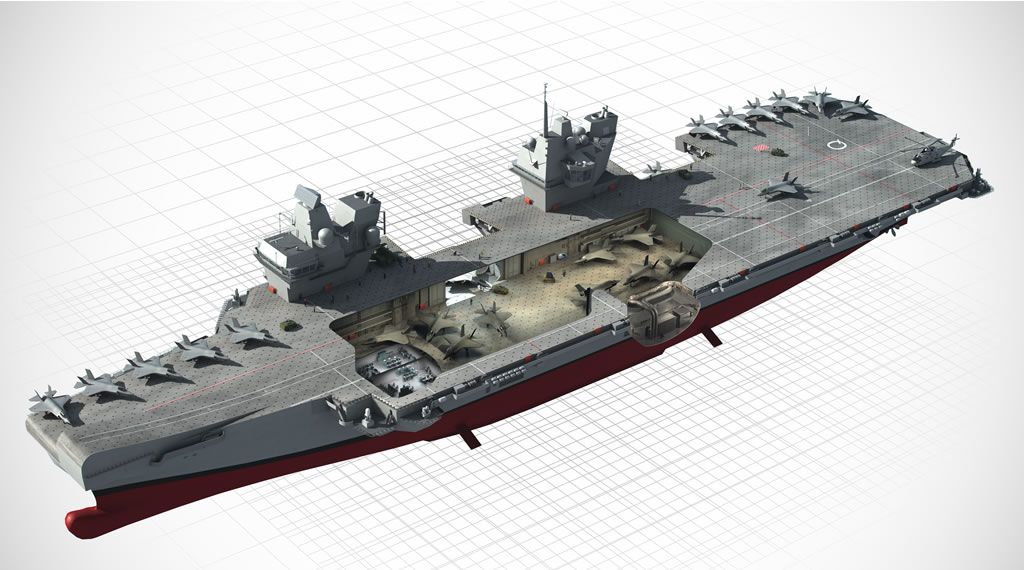
British sea power on the drawing board.
                                                                   British sea power on the drawing board.

In a recent article in the Naval Review entitled ‘Affordability in a Wider Context’, Paul Fegan investigated defence inflation and the impact this has had on the costs of warship procurement programmes. He concludes that, if this subject is examined through the lens of GDP as opposed to money spent in real terms, it is clear there has been ‘little change in the amount of national income needed to buy a new ship, even a ship which is technologically advanced and matched to contemporary threats…It is perhaps reassuring that we are asking no greater a national commitment to buying a warship than we were 50 years ago’[9]. One example he cites is that in cash terms HMS Daring (launched in 2006) cost 4,509 per cent more than HMS Devonshire (launched in 1960) yet the latter required 0.049 per cent of GDP against Daring’s 0.047. Paul Fegan rightly concludes that it is then not a question of defence inflation and the notion that we simply can’t afford to sustain a large fleet but it is instead an issue of priorities, and when it comes to prioritising those election-winning strategies, welfare and health among other immediacies will almost always trump defence. But it would seem appropriate to recognise that in order to sustain health and welfare, defence must deliver with respect to global trade protection and therefore should be treated as an equal partner rather than as an aged relation, no longer needed in this modern world. Such short-termism is dangerous and failing to acknowledge the prospective threats to shipping and taking measure to counter these threats, borders on the negligent.

Britain is an island. It is a Sea Power in the truest sense; its history and its future will be to a great extent shaped by its interaction with the world’s oceans. The sea has for centuries been a source of strength, providing her with a barrier against invasion and a source of economic prosperity and in so doing forging a resilient national character. However the sea, if under appreciated as a key strength has the potential to become a key vulnerability. The continued reduction in the Royal Navy’s size has, without doubt, dramatically hit its capability and flexibility. This has been the inevitable consequence of government policy, authored by policymakers with little grasp of strategy, more concerned with securing international kudos by focusing on high profile ‘kinetic’ conflicts as opposed to supporting the mundane but critical tasks performed by the Royal Navy on a daily basis.  Having a flexible maritime force to counteract potential threats to international SLoCs, no matter how remote they may seem at the present time, is common sense for an island nation and a duty of its government. It must be cautioned that reliance on the support of other navies is a risky approach; any action has to assume political agreement and interoperability questions remain with regards to the new Royal Navy carriers after the removal of the proposed ‘cats and traps’. The decline of the Royal Navy, reflects political and other military priorities and from this we can only assume there is either ignorance as to the significance of the maritime trade sector or an arrogant disregard of the threats posed to it. The days of lobbying on behalf of the Royal Navy; ‘we want eight, we wont wait’, are regrettably long gone, and with the government’s short term horizon and a public ignorant of our maritime dependency there is a need for the key stakeholders both in the forces and in the maritime shipping and insurance industries, to work together to engender a greater understanding amongst the public and politicians.

It would not be an exaggeration to claim that Britain owes its existence, as a free and democratic nation, to its merchant marine and its Royal Navy, as the recent Battle of the Atlantic celebrations highlighted. But the memory of that struggle, if it is to have a lasting legacy, must be transposed into tangible lessons and sensible policy planning for the future. Britain’s strength derives from her island status, but it is this that is also her greatest weakness. She risks being hostage to events until there is a realisation in Whitehall that ships are relatively inexpensive and ignoring the threats to prosperity they guard against could come at an intolerable price.

Simon Williams received a BA Hons in Contemporary History from the University of Leicester in 2008. In early 2011 he was awarded an MA in War Studies from King’s College London. His postgraduate dissertation was entitled The Second Boer War 1899-­1902: A Triumph of British Sea Power. He continues to write on naval history and strategy and in 2012 he hosted the Navy is the Nation Conference, in Portsmouth, UK. The aim of this event was to explore the impact of the Royal Navy on British culture and national identity. His second event on Navies and National Strategy is due to be held in early 2015.


[1] Osborne, A. (2011) ‘Britain’s reliance on sea trade ‘set to soar’’ http://www.telegraph.co.uk/finance/newsbysector/transport/8696607/Britains-reliance-on-sea-trade-set-to-soar.html accessed on 19/08/13
[2] Despite the commendable efforts of Operation Atalanta, the European Union Naval Force’s (EUNAVFOR) efforts to curtail piracy off the Horn of Africa.
[3] Prins, G. & Blackham, Sir, J. (2010) ‘Britain’s trade depends on the sea. In the coming public expenditure cuts we cannot afford to ‘sign off’ from maritime security and naval defence’ http://blogs.lse.ac.uk/politicsandpolicy/archives/3871 accessed 18/08/13
[4] Ibid.
[5] Dr Lee Willett (2008) ‘BRITISH DEFENCE AND SECURITY POLICY: THE MARITIME CONTRIBUTION’ p.2 http://www.rusi.org/downloads/assets/BDSP_MaritimeContribution.pdf accessed 12/08/13
[6] I discuss the question of numbers in another of my Next War entries on the Type 26 Frigate https://cimsec.org/the-royal-navys-type-26/
[7] HM Government ‘Securing Britain in an Age of Uncertainty: The Strategic Defence and Security Review’ (October, 2010) p.23 http://www.direct.gov.uk/prod_consum_dg/groups/dg_digitalassets/@dg/@en/documents/digitalasset/dg_191634.pdf accessed on 20/08/13
[8] Prins, G. & Blackham, Sir, J. (2010) ‘Britain’s trade depends on the sea. In the coming public expenditure cuts we cannot afford to ‘sign off’ from maritime security and naval defence’ http://blogs.lse.ac.uk/politicsandpolicy/archives/3871 accessed 18/08/13
[9] Fegan, Lt. P. (RNR) ‘Affordability in the Wider Context’ Naval Review Vol 101, No. 3, p.235