Category Archives: Shipbuilding

The Optimum Pathway for Building Nuclear Submarines with South Korea and Japan

By Brent D. Sadler

Introduction

Riding a wave of success during his Asia tour, President Donald Trump triumphantly announced the U.S. would be working with South Korea to build nuclear submarines.1 To those familiar with the AUKUS (Australia-U.K.-U.S.) deal, this may seem a repeat of that effort to build nuclear submarines with Australia. By all accounts, this is not what is at hand.

South Korea’s growing investment in American shipbuilding could foster the development of ships capable of using next generation small modular nuclear reactors (SMNR), to include their use on modified South Korean submarines appropriate to their operational needs. This likewise has applicability to Japan, who should be included should the effort proceed.

Given the unique naval needs of South Korea and Japan, their decades of experience in building conventional submarines, and the U.S. need for allies in reviving its maritime industry – this deal could be very opportune. That said, it will not be AUKUS and to succeed it must also contribute to a revival of America’s shipbuilding to best serve America’s national interests. 

South Korea’s National Security Situation

South Korea’s capital, Seoul, is within range of hundreds of North Korean artillery pieces. For them danger is always near, and has focused their military to the threat ever since the armistice paused the Korean War.2 Adding to the dangers, the North has in recent years accelerated development of its own nuclear-armed submarine-launched ballistic missile – the Pukguksong series that began testing in 2015 and now has six iterations.3 Given this at-sea nuclear threat, as in the Cold War, there will be a necessity of locating and keeping track of North Korean submarines with nuclear-armed SLBMs, like the SSB 841 Hero Kim Kun Ok launched in September 2023.4

An Oct. 2, 2019 North Korean Pukguksong-3 SLBM test. (Rodong Sinmun photo)

Beyond the North Korean threat, China has also encroached into its waters and strong-armed the South. Most notably, the Chinese Communist Party was the hand behind political interference and public agitation in 2017 over the placement of the THAAD missile defense system.5 Keeping its economy free of coercion will require a Navy able to keep the People’s Liberation Army Navy (PLAN) in check in the East China Sea and Yellow Sea. Should war break out in Asia over the fate of Taiwan, critical shipping routes through the South China Sea and potentially across the North Pacific will need to be guarded. 

Unlike the Australian strategic challenges that drive them to pursue a nuclear submarine in the AUKUS initiative, South Korea’s maritime threats are closer to home. This operational situation prioritizes stealth and on-station endurance with the ability to conduct high-speed sprints without needing to come near to the surface to recharge submarine batteries. These operational requirements inform South Korea’s submarine program, today led by production of its 3,600 ton KSS-III Batch-2 submarine with 10 vertical launch cells and torpedo tubes built by shipbuilder Hanwha.6 SMNRs offer a way to enhance the lethality on a potentially modified South Korean submarine like a future batch of the KSS-III.

October 22, 2025 – Hanwha Ocean launches the first KSS-III Batch-II submarine, Jang Yeongsil ship (SS-087) (ROK Navy photo)

A Brief History of SMNRs Backfitted on Conventional Submarines

Twice in the recent past have navies attempted to extend the undersea endurance of existing conventional submarines with small modular nuclear reactors. The first was in the mid-1980s, when the Soviet Navy installed a 600kWh VAU-6 600 nuclear power plant on a project 651 (Juliett-class) diesel submarine and greatly extended its range.7 The implications of this development were never felt in the West, as the Cold War was coming to a rapid end by the time this was completed.

The idea of greatly increasing the tactical capabilities of existing conventionally-powered submarines has surfaced again. For the past several years, experts looking over satellite images of China’s sole naval nuclear shipyard at Huludao have noticed the expansion of production lines and what appeared as components of a new class of nuclear-powered warship. The answer would be clear in September 2024 following months of speculation that a new larger Yuan-class conventional submarine was being readied for sea with a new type of propulsion.8 That month, reports of its pier side sinking drew a subsequent U.S. Department of War response that confirmed it was a variant being fitted out with an auxiliary nuclear power plant. And so the Soviet idea was reborn with Chinese characteristics.

Given China’s large and modern conventionally powered submarine fleet, its use of SMNRs to complement air independent propulsion would have severe ramifications for the U.S. and its allies. Already fairly stealthy, the latest Yuan-class Chinese submarine would see its endurance greatly extended and survivability improved with the ability to sprint at high speeds to evade hostile contacts without having to come to the surface to recharge its batteries soon afterwards. Moreover, the limited nuclear construction capacity at Huludao could be augmented by numerous conventional submarine shipyards, with SMNRs being produced and backfitted on Yuan-class submarines in shipyards like Wuchang and Jiangnan.

Schematic of Soviet Juliet-class submarine equipped with a VAU-6 small power plant. (Graphic via Global Security.org)

Shared Allied Interest in SMNRs

As news broke of President Trump’s announcement on building nuclear submarines with South Korea, Japan also got interested.9 Japan is no stranger to maritime nuclear propulsion with its own Mutsu launched in 1969 and retired in 1992.10 This ship was a flawed attempt at exploring the commercial potential of nuclear power, with unacceptable radiation leakage dooming the ship. Recently, there have been calls by Japanese politicians to pursue developing a nuclear submarine – a call first triggered by the AUKUS initiative in 2021 and now with a potential U.S.-South Korean project.

Like South Korea, Japan too has a robust, successful, and longstanding conventional submarine program. The latest addition to the Japanese Maritime Self Defense Forces (JMSDF) is the 3,000 ton Taigei-class.11 However, Japan’s operational needs are more extended than South Korea’s, given its expansive archipelago that stretches deep into the Pacific Ocean and critical shipping lanes threatened by Russia, China, and North Korea. This threat is in part why Japan began a military modernization during the later Cold War to protect its shipping lanes 1,000 miles from Japan – a mission that lives on today. As such, the added endurance and survivability offered by SMNRs as an augmented power source for existing conventional submarines would be welcome.

A comparison of speed and endurance characteristics between conventional, SMR, and nuclear subs. Click to expand.

Additionally, both Japan and South Korea are today the only viable rivals to China’s shipbuilding colossus. As such, both are looking to invest in the U.S. as a means of expanding market share, which could be amplified by harnessing the potential of SMNRs to cleanly power the next generation of commercial ships and revolutionize the maritime industry. However, only the U.S. has the experience (thanks to its naval nuclear program) and capacity (based on existing nuclear research and development) to bring this new nuclear technology quickly to market with confidence.

Recent developments have the hallmarks of a potential consortium of investors forming to bring SMNRs to sea and soon. Already two South Korean shipbuilders have invested in the U.S. and Japan has signaled investments are coming. What especially stands out is the investments since December 2024 in Philadelphia Shipyard by South Korean shipbuilder Hanwha. The proverbial canary in the coal mine is how well Hanwha will be able to turn a profit in the long term when taking orders for commercial ships at its new American shipyard.

Newer to the scene is Hyundai, another South Korean shipbuilder, who has joined into a partnership with American naval ship and submarine builder Huntington Ingalls Industries (HII).12 The scope of this new partnership is relatively undefined as of November 2025, but signals an intent to deeply integrate into domestic American naval shipbuilding. The most explicit expression of this is a commitment of $150 billion by the South Korean government to back investment in American shipbuilding.13 On the other hand, Japan has only recently signaled its intent to move into the American market, with $4 billion of government backing to $2.5 billion of private investment.14 Focusing some of this foreign investment in what could be a market-setting technology can leverage the shipbuilding capacities and expertise of allies, while mitigating the risks in getting SMNRs to sea.

Key submarine bases and operating areas in the western Pacific. (Heritage Foundation graphic)

Proliferation and Compromised Supply Chain Concerns

In the case of both Japan and South Korea, there are grounds for concern regarding the potential for compromised maritime industrial supply chains and information security. Less of a concern is the threat of proliferation of weapons-grade nuclear material in the SMNRs under development. This is due to the use of lower enriched nuclear fuel (approximately 5% compared to weapons grade above 90%) and the fuel assemblies that complicate the separation and refinement of the fuel to weapons grade.

Nonetheless, memories of Brazil’s past attempts to develop a nuclear submarine as pretext for a nuclear weapons program are informative and cautionary.15 Putting a check on such possibilities are counter-proliferation protocols enshrined in the so-called “123 agreement” named for the section 123 of the 1954 Atomic Energy Act. These agreements are conditional by the U.S. prior to entering into any agreed transfer of nuclear technology or materials. Both Japan and South Korea have active 123 Agreements.16

Regarding maritime supply chains, however, both Japan and South Korea conduct significant shipbuilding related activity in China.17 This is primarily in the prefabrication of sections or modules and supply of components like pumps or solenoids that are then assembled outside China. Should either nation enter into a new SMNR developmental project and associated shipbuilding endeavor with the U.S., exposure to associated Chinese supply chains must be addressed, especially as it relates to military use in South Korean and Japanese submarines.

A sunken Chinese submarine at a shipyard near Wuhan, China, on June 15, 2024. (Planet Labs PBC photo via AP)

Finally, tight information security, such as done with Naval Nuclear Propulsion Information (NNPI) addressed for AUKUS, will be a necessity. A complicating factor for allies will be the dual-use applicability of SMNRs and how to ensure associated high information security for both military and commercial programs. Thankfully, the U.S. has current information-sharing agreements with both Japan and South Korea that includes industrial security. In 2025, memorandums of understanding signed with both South Korea and Japan make clear an intent to bolster supply chains as the three nations progress and work together in reviving America’s maritime industry.18 However, statements of intent are not enough to ensure the sensitive next-generation nuclear power technology behind SMNRs remains an American comparative advantage.

The Optimum Pathway for American Maritime SMNR

Developing SMNRs and then putting them to sea on commercial and backfitted allied conventional submarines will be a multifaceted task. First, the technology needs to be perfected in a way that makes it compatible for use in commercial shipping and scaled for use as an alternative power source for today’s conventional submarines built in Japan and South Korea. Second, trust in sharing sensitive nuclear technologies for SMNR will be needed, to include their safe operation and maintenance. Third, an industrial plan will need to be implemented for building SMNRs that can be installed on commercial ships and on allied conventionally powered submarines. To preserve American investment in developing next generation SMNR and foster an American comparative advantage in the global maritime market space, construction and installation should be initially confined to occur at U.S. shipyards. Much of this can be accomplished taking a similar approach used for the AUKUS optimum pathway and as advocated in an earlier Heritage Foundation report.19

Almost two years after its September 2021 announcement, the Australian government, in concert with U.K. and the U.S., announced the “optimum pathway” to deliver a domestic nuclear submarine capability.20 This plan addresses developing domestic nuclear industrial competencies, training a cadre of nuclear-certified shipyard workers to sustain this nuclear fleet, and begin the nuclear training of the crew of these future boats. Unlike AUKUS, development of overseas SMNR construction would not be a goal. Nonetheless, bringing a SMNR forward with allies like South Korea and Japan will require a similarly multifaceted approach to ensure it is viable and safe.

Recommendations

The U.S. and its allies should form a private-public consortium to inform and oversee development of a naval SMNR. There are several designs all progressing to working prototypes with initial criticality (first time nuclear fission) tests before the end of the decade.21 This consortium would be critical in accelerating the testing and maturity of viable designs currently being planned at the federal nuclear test labs in Idaho (i.e. INL). Given the commercial and potential military use, the effort should be led by U.S. Department of Energy with technical support from Naval Reactors (design), Coast Guard (regulatory), and Maritime Administration (commercial use).

Putting an operational SMNR on a commercial ship or submarine is likely at least seven years away. Waiting until that time to develop the demand for commercial shipping would guarantee its failure or worse, cede dominance of this capability to hostile competitor China. As such, orders for new commercial ships (i.e. ultra large container ships, LNG carriers, etc.) today should be of designs that are forward-compatible for installation of SMNRs.22 This would also guarantee those ships meet stringent International Maritime Organization (IMO) carbon requirements while removing uncertainty that has delayed ship orders over which green energy will be embraced by the market. As the second and third largest shipbuilders, Japan and South Korea are best placed to ensure uptake of this new technology. Moreover, information security amongst members of this consortium will be paramount, especially as variants of the SMNR are installed on allied submarines. For AUKUS, this was an early achievement given the bedrock of the Five Eyes intelligence sharing program.23 A similarly structured approach, but narrowly focused on SMNR use, would be warranted with allies Japan and South Korea.

Today there is one U.S. shipyard owned by a South Korean shipbuilder. Philadelphia Shipyard, owned by Hanwha since December 2024, is a natural choice to base this new endeavor and future SMNR installations. Already Hanwha is continuing the U.S. Maritime Administration’s (MARAD) third of five National Security Multi-mission Vessel (NSMV) and making a $5 billion capital investment to upgrade the shipyard for orders of 10 new medium-range tankers and bulk carriers.24 Doing nuclear shipyard work here will require added investments to attract future SMNR builders to locate fabrication and installation facilities nearby. In the meantime, future upgrades should be done with an eye to nuclear certification of the yard.

This shipyard should not be the only place where this type of commercial nuclear maritime installation will occur. Given the national security aspects of backfitting SMNRs on submarines, shipyards with history in naval shipbuilding make the most sense. In this case, the expertise of HII and its budding partnership with Hyundai makes a natural fit for backfitting operations of SMNRs. Caution is warranted in this case, as the U.S. submarine industrial base is tardy in growing its capacity to meet U.S. orders for nuclear submarines.25

As such, HII and Hyundai, to include Japanese submarine builders Kawasaki and Mitsubishi Heavy Industries, with American submarine shipbuilders HII and Electric Boat, should look to set up facilities favorable to shipyards not involved in building American or AUKUS nuclear submarines. A logical choice is the former naval nuclear shipyard at Mare Island, which has dry docks, warehouses, and pier space ready to be upgraded to the purpose. Moreover, there is ongoing Navy and Coast Guard maintenance being done on cutters and naval logistic ships, providing ample workload to justify the investment until SMNRs become operational.

Designing, building, and installing SMNRs on commercial ships and allied submarines is one thing, operating them is another. For AUKUS, this was addressed by embedding Australian sailors on U.S. and U.K. nuclear submarines and sending Australian shipyard workers to American shipyards to learn the nuclear trades. It is too early to know if this will succeed, but the goal is to create the institutional culture and expertise to securely maintain and safely operate nuclear-powered ships. Unlike AUKUS, this new SMNR endeavor will have a commercial aspect which will mean the U.S. Maritime Administration and its Merchant Marine Academy at Kings Point will need to resurrect its defunct nuclear training program. This program was begun to crew and conduct associated shipyard nuclear work for the first and only U.S. nuclear powered commercial ship in 1964 – the Savannah, subsequently retired in 1972. The U.S. Coast Guard, the lead agency for regulating maritime credentials in the U.S., too must revisit its certification programs to include standards for crew and shipyard workers on SMNR-powered commercial ships. Given that allies will be involved, associated programs will have to be opened for their training and certification. 

NS (Nuclear Ship) Savannah, the first commercial nuclear power cargo vessel, en route to the World’s Fair in Seattle in 1962. (Photo via National Archives and Records Administration)

Initial Steps

There will be a lot of work ahead should the President’s words prove prophetic, and a new national endeavor is launched with allies to build nuclear-powered commercial ships and backfit allied conventional submarines. When AUKUS was announced an 18-month assessment and planning phase was begun before actual work was undertaken. A similar planning effort will be critical, though need not be as long as 18 months. Given this, a potential optimum pathway for SMNRs should take the following steps.

Establish a White House-Led Planning Cell. The President of the United States should formally invite both Japan and South Korea to send delegates to a planning cell to formulate a pathway to developing and operating SMNRs for commercial shipping and backfitting their conventionally powered submarines. The primary goal of this group is to produce an agreed regulatory framework, credentialing program, and industrial plan with associated investment strategy. This in total would represent the optimum pathway for this endeavor.

Reestablish Civilian Nuclear Training and Credentialing Programs. The Secretary of Transportation should direct the Maritime Administrator to re-establish the nuclear program at the Merchant Marine Academy and seek funding from Congress. This should be accomplished within two years to ensure adequately credentialed crew and shipyard workers ready when the first SMNR installed and operated by early 2030s. Additionally, the Maritime Administrator must further direct these programs be open to participating allies, staff, and students to ensure a coherency amongst participants and assist in rapidly standing up an SMNR-powered commercial fleet. Lastly, the U.S. Coast Guard must conduct a review and as needed update to its credentialing and regulatory standards appropriate for operating SMNRs at sea and associated shipyards and port operations.

Create an SMNR Information Sharing Framework. The U.S. Chief of Naval Operations should direct the development and approval of a dedicated information sharing classification and handling standard that can be agreed to by all participant nations. This would be similar but distinct from Naval Nuclear Propulsion Information that Australia was allowed to gain access to as part of AUKUS. The goal is to prevent unauthorized access to sensitive design and operational details regarding SMNR in both commercial and military uses.

Designate and Certify American Shipyards for SMNR Work. The Secretary of Energy should seek and act on the recommendation of Naval Reactors and the Maritime Administration to designate shipyards for work on maritime SMNRs. Initially two shipyards should be named – one focusing on the commercial uses and a second suitable for naval installation on conventional submarines.

Establish SMNR Support Facilities in Participant Nations. The Secretary of State, with the advice of Submarine Forces Pacific and the Maritime Administrator, should update existing nuclear agreements and establish support facilities overseas. Initially, the only participants to consider should be major shipbuilders and treaty allies South Korea and Japan. As such, commercial and military facilities should be established in both countries to support future SMNR operations. For the time being, all major refueling and maintenance should be conducted in the U.S. Importantly, both Japan and South Korea (re-negotiated in January 2025) already have “123 Agreements” with the U.S. for peaceful nuclear cooperation.

Conclusion

President Trump’s comments may have preempted and even accelerated what has been a slowly developing effort – joint development and operation of at-sea SMNRs. Done right, advanced SMNR technology will offer an avenue to develop a new American maritime industrial comparative advantage while rapidly making allied conventional submarines many times more lethal against competitors.

Captain Brent Sadler (Ret.) joined the Heritage Foundation as a Senior Research Fellow in 2020 after a 26-year naval career in nuclear submarines and as a foreign area officer. He has extensive operational experience in the Western Pacific, having served at Seventh Fleet, Indo-Pacific Command, as Defense Attache in Malaysia, and as an Olmsted Scholar in Tokyo, Japan.

References

[1] Paul McLeary and Phelim Kine, “Trump Will Arm South Korea with a Nuclear Submarine,” POLITICO, October 29, 2025, https://www.politico.com/news/2025/10/29/trump-south-korea-nuclear-submarine-00629402 (accessed November 9, 2025).

[2] Terence Roehrig, “South Korea: The Challenges of a Maritime Nation,” NBR, December 23, 2019, https://www.nbr.org/publication/south-korea-the-challenges-of-a-maritime-nation/ (accessed November 9, 2025).

[3] Sam-man Chong, “The Implications of North Korean SLBM for KSS-III Submarines,” Korea Institute for Maritime Strategy, January 27, 2024, pg. 2-3, https://drive.google.com/file/d/1dYb2_ui_BaLe4rC8VhuDmeMuI309OBJH/view?pli=1 (accessed November 9, 2025).

[4] Josh Smith and Soo-Hyang Choi, “North Korea Unveils First Tactical Nuclear-Armed Submarine,” Reuters, September 8, 2023, https://www.reuters.com/world/asia-pacific/north-korea-launches-new-tactical-nuclear-attack-submarine-kcna-2023-09-07/ (accessed November 9, 2025).

[5] Ethan Meick and Nargiza Salidjanova, “China’s Response to U.S.-South Korea Missile Defense System Deployment and Its Implications,” July 26, 2017, pg. 7-10, https://www.uscc.gov/sites/default/files/Research/Report_China%27s%20Response%20to%20THAAD%20Deployment%20and%20its%20Implications.pdf (accessed November 9, 2025).

[6] Chen Chuanren, “South Korea Launches First KSS-III Batch 2 Submarine,” Asia Military Review, October 28, 2025, https://www.asianmilitaryreview.com/2025/10/south-korea-launches-first-kss-iii-batch-2-submarine-foc/ (accessed November 9, 2025).

[7] “VAU-6 Auxiliary Nuclear Power Plant (ANPP) Dollezhal eggs – Submarines,” Global Security, https://www.globalsecurity.org/military/world/russia/reactor-vau-6.htm (accessed November 9, 2025).

[8] Brent Sadler, “China’s Great Submarine Sinking: What We Know and Why It Matters,” National Security Journal, October 9, 2024, https://nationalsecurityjournal.org/chinas-great-submarine-sinking-what-we-know-and-why-it-matters/ (accessed November 9, 2025).

[9] “Japan Eyes Nuclear Subs After U.S. Gives OK to S. Korea,” Asahi Shimbun, November 7, 2025, https://www.asahi.com/ajw/articles/16143129 (accessed November 9, 2025).

[10] Kaoru Ohno, “Nuclear Powered Ship Mutsu Designated as Special ‘Ship Hertiage’,” Japan Atomic Industrial Forum Inc., https://www.jaif.or.jp/en/news/4725 (accessed November 9, 2025).

[11] Kosuke Takahashi, “Japan Launches Sixth Taigei-class Submarine,” Naval News, October 14, 2025, https://www.navalnews.com/naval-news/2025/10/japan-launches-sixth-taigei-class-submarine-for-jmsdf/ (accessed November 9, 2025).

[12] “Huntington Ingalls, HD Hyundai Sign MOA to Expand US-Korea Shipbuilding Cooperation,” WorkBoat, October 27, 2025, https://www.workboat.com/huntington-ingalls-hd-hyundai-partner-to-expand-u-s-korea-shipbuilding-cooperation (accessed November 9, 2025).

[13] Chris Panella, “White House says South Korean shipbuilding giants are going to pour billions into reviving America’s shipbuilding industry,” Business Insider, October 29, 2025, https://www.businessinsider.com/trump-south-korean-shipbuilders-will-invest-billions-into-us-industry-2025-10 (accessed November 9, 2025).

[14] “Report: Japan and U.S. to Sign Memorandum on Shipbuilding Cooperation,” The Maritime Executive, October 26, 2025, https://maritime-executive.com/article/report-japan-and-u-s-to-sign-memorandum-on-shipbuilding-cooperation (accessed November 9, 2025).

[15] Michael Barletta, “The Military Nuclear Program in Brazil,” Center for International Security and Arms Control, August 1997, pg. 6, https://www.files.ethz.ch/isn/22239/14_Military_Program_Brazil.pdf (accessed November 19, 2025).

Carlo Patti, “Origins and Evolution of the Brazilian Nuclear Program (1947-2011),” Nuclear Proliferation International History Project, November 15, 2012, https://www.wilsoncenter.org/publication/origins-and-evolution-the-brazilian-nuclear-program-1947-2011 (accessed November 19, 2025).

Shane Ward, “The Strategic Rationale for Brazil’s Nuclear Submarine Does Not Hold Water,” Georgetown Security Studies Review, https://gssr.georgetown.edu/the-forum/topics/defense/the-strategic-rationale-for-brazils-nuclear-submarine-does-not-hold-water/ (accessed November 19, 2025).

[16] “123 Agreements for Peaceful Cooperation,” U.S. Department of Energy, July 11, 2025, https://www.energy.gov/nnsa/123-agreements-peaceful-cooperation (accessed November 11, 2025).

[17] Kawasaki Heavy Industries (KHI) has significant operations in China across various business segments, including shipbuilding, robotics, hydraulic equipment, and environmental systems, primarily through joint ventures and local subsidiaries: https://global.kawasaki.com/en/corp/sustainability/creation/rd.html (accessed November 11, 2025).

Mitsubishi Heavy Industries (MHI) does not have wholly-owned shipyards building complete vessels in China, but it has several joint ventures, licensing agreements, and service operations in the country related to marine machinery, engines, and engineering services: https://www.mhi.com/group/mhimsb/company (accessed November 11, 2025).

Hanwha Shipbuilding has operations in China, specifically a shipyard in Shandong province that builds ship components for final assembly in South Korea. These components are critical to the company’s production and supply chain: https://www.hanwhaocean.com/en/whoweare/gn/aff/ (accessed November 11, 2025).

[18] “Fact Sheet: President Donald J. Trump Drives Forward Billions in Investment from Japan,” The White House, October 28, 2025, https://www.whitehouse.gov/fact-sheets/2025/10/28195/ (accessed November 11, 2025).

“Memorandum of Understanding Between the Government of the United States of America and the Government of the Republic of Korea regarding the U.S.-ROK Technolgy Prosperity Deal,” The White House, October 29, 2025, https://www.whitehouse.gov/articles/2025/10/u-s-korea-technology-prosperity-deal/ (accessed November 11, 2025).

[19] Brent D. Sadler, “AUKUS: U.S. Navy Nuclear-Powered Forward Presence Key to Australian Nuclear Submarine and China Deterrence,” The Heritage Foundation, October 27, 2021, pg. 7-9, https://www.heritage.org/sites/default/files/2021-10/BG3662.pdf

[20] “Pathway to Australia’s Nuclear-Powered Submarine Capability,” Australian Submarine Agency, March 14, 2023, https://www.asa.gov.au/sites/default/files/documents/2024-10/Nuclear_Powered_Capability_Fact_Sheet_0.pdf (accessed November 9, 2025).

[21] “Advanced Small Modular Reactors (SMRs), U.S. Department of Energy, https://www.energy.gov/ne/advanced-small-modular-reactors-smrs (accessed November 9, 2025).

[22] Brent D. Sadler and Peter St. Onge, “Regaining U.S. Maritime Power Requires a Revolution in Shipping,” The Heritage Foundation, May 15, 2023, pg. 18-20, https://www.heritage.org/sites/default/files/2023-05/SR272.pdf (accessed November 9, 2025).

[23] Adam Broinowski, “AUKUS Pillar 2,” Parliament of Australia, August 15, 2024, https://www.aph.gov.au/About_Parliament/Parliamentary_departments/Parliamentary_Library/Research/FlagPost/2024/August/AUKUS_Pillar_2 (accessed November 9, 2025).

[24] “Hanwha Announces $5 Billion Philly shipyard Investment as Part of South Korea’s Commitment to US Shipbuilding Growth,” Hanwha, August 25, 2025, https://www.hanwha.com/newsroom/news/press-releases/hanwha-announces-5-billion-philly-shipyard-investment-as-part-of-south-koreas-commitment-to-us-shipbuilding-growth.do (accessed November 9, 2025).

[25] “U.S. Navy Shipbuilding Is Consistently Over Budget and Delayed Despite Billions Invested in Industry,” GAO, April 8, 2025, https://www.gao.gov/blog/u.s.-navy-shipbuilding-consistently-over-budget-and-delayed-despite-billions-invested-industry (accessed November 9, 2025).

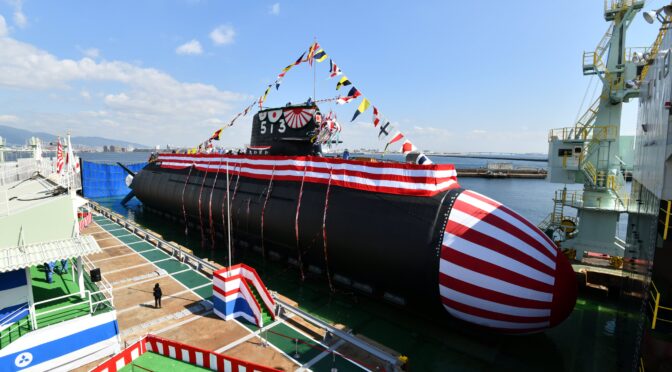
Featured Image: The JMSDF submarine Taigei (SS-513) (JMSDF photo).

Design, Decide, Forget: Why the Navy Needs a Lessons-Learned Center for Shipbuilding

By Marcus Jones

In March 2025 testimony before the House Armed Services Committee’s Seapower and Projection Forces Subcommittee, Ronald O’Rourke, naval analyst for the Congressional Research Service since 1984, sharpened an excellent recommendation he has raised over more than a decade: the U.S. Navy should establish a dedicated institutional mechanism for systematically capturing, analyzing, and transmitting lessons learned from its shipbuilding programs.1

Although the U.S. Navy has accumulated an extraordinary body of experience in ship design and construction over more than two centuries, it continues to make avoidable mistakes in major acquisition programs such as proceeding into construction with incomplete designs, integrating immature technologies, projecting unrealistic cost and schedule estimates, and eroding accountability structures once a program becomes politically or industrially “too big to fail.” These errors are not unique to the Navy, but they are particularly consequential in the context of shipbuilding, where program timelines are long, platforms are few and expensive, and consequences are measured in strategic as well as fiscal terms.

O’Rourke’s solution is a “lessons-learned center” for naval shipbuilding: a dedicated, continuous, and institutionalized effort to capture knowledge from past programs, distill it into accessible form, and ensure it informs future design, acquisition, and oversight decisions. The value of such an entity, he argues, would lie in its ability to prevent repeated mistakes, reduce waste, improve program outcomes, and help sustain the Navy’s long-term force design and industrial base goals. It addresses key features of the Navy’s acquisition environment: the discontinuous and generational nature of major shipbuilding programs; the structural fragmentation of knowledge across commands, contractors, and government agencies; and the absence of an educational or doctrinal home for critical institutional memory.

Unlike weapons or aircraft programs, which may see dozens or hundreds of iterations within a single career, major ship classes are often designed and constructed once every 20 or 30 years. The effect of this long cycle time is that most individuals involved in a new class of ships – whether program managers, naval architects, flag officers, or congressional staffers – may have had no direct role in the last one. What should be institutional memory therefore becomes diffuse personal recollection, vulnerable to retirement, reassignment, or obsolescence. Moreover, the knowledge necessary to understand past program outcomes is distributed across a complex web of organizations: Program Executive Offices, NAVSEA and its affiliated labs and centers, shipyards and primes and sub-tier contractors, OPNAV resource sponsors, the Office of the Secretary of Defense, and various congressional committees and watchdogs. Each retains only partial and often incompatible records, and there is little incentive or mechanism for aggregating these into a unified analytic understanding. While internal program reviews, GAO reports, and RAND studies may document lessons after the fact, there has never been an entity within the Navy tasked with curating, synthesizing, or teaching these insights.

Interestingly, O’Rourke does not propose a narrowly bureaucratic mechanism but envisions a range of possible instantiations, from a structured repository of documents to a more active, curriculum- and wargame-integrated enterprise. But what matters in his framing is not form but function: the institutionalization of a reflective capacity for learning from experience and applying that learning prospectively in ways that materially improve outcomes.

Such a capability, if properly implemented, would amount to a kind of strategic memory for the Navy, one able to withstand changes in leadership, budget, and political context, while enabling the service to treat shipbuilding not as a sequence of isolated procurements but as a continuous and evolving system of practice. It is not, therefore, a technocratic fix for acquisition inefficiencies, but a cultural transformation within the Navy’s approach to its own history of design, development, and production. It holds out the prospect that the Navy would not only save money and avoid failure, but reaffirm its preferred identity as a thinking, adaptive, and strategically serious organization. It is this deeper institutional value – far beyond process improvement – that makes O’Rourke’s proposal for a naval shipbuilding lessons-learned center important and long overdue.

Joint Lessons on Lessons Learned

The idea has modest precedent and ample justification. One of the most robust models of institutional learning in the defense sector is the U.S. Army’s Center for Army Lessons Learned (CALL), established in 1985 in response to the operational shortcomings revealed during Operation Urgent Fury in Grenada. CALL’s mission was to systematically collect, analyze, and disseminate operational and tactical lessons. Over time, it became fully integrated into Army doctrine and planning, fielding collection teams, producing analytic bulletins, and shaping professional military education. But of particular relevance to the Navy’s shipbuilding enterprise is a less widely known but equally instructive initiative: the Center for Army Acquisition Lessons Learned (CAALL), housed within the Army Materiel Systems Analysis Activity.2

Established following the 2010 Army Acquisition Review, which cited the absence of a centralized mechanism for analyzing acquisition successes and failures, CAALL provides an authoritative source for acquisition-specific lessons across the Army’s program offices. It operates a web-enabled Acquisition Lessons Learned Portal (ALLP) through which project teams submit concise, structured, and searchable lessons, each tagged by acquisition phase, milestone, cost and schedule impact, and functional category.

These are not vague observations, but distilled from real program experience and embedded in metadata-rich formats that support both searchability and trend analysis. CAALL analysts conduct deep-dive studies of recurring issues, such as documentation burden, Earned Value Management failures, or test duplication, and prepare “just-in-time” lesson packages for project managers entering specific acquisition phases. The Center also engages in outreach, publishes bulletins, curates spotlight topic zones, and supports internal Army decision-making with synthesized data on the top five systemic challenges facing Army programs. It demonstrates that institutional learning is within reach but requires structured data, a deliberate submission pipeline, professional analytical support, and educational integration. It also shows how lessons can be transformed from static reflections into dynamic inputs for decision support, policy revision, and curriculum development. Most importantly, CAALL demonstrates that such a capability can be sustained over time, through leadership endorsement, modest staffing, and the aggressive use of digital tools.

A shipbuilding-focused counterpart – scaled appropriately to the Navy’s size, resourced modestly, and empowered to draw insight from both current and historical programs – would not need to reinvent the wheel. It would only need to learn how others have made their institutions learn.

Other models further underscore the feasibility and necessity of such a capability. The Joint Lessons Learned Program (JLLP) applies a five-phase process – discovery, validation, resolution, evaluation, and dissemination – to lessons arising from joint exercises, operations, and experiments. Its information system, JLLIS, acts as a system of record for tracking, archiving, and analyzing lessons that affect force development and joint capability planning.3

A more technical and directly relevant precedent is found in NASA’s Lessons Learned Information System (LLIS).4 NASA’s LLIS arose from the hard-won awareness, following the Challenger and Columbia disasters, that high-stakes engineering efforts demand not only risk management tools but a durable culture of reflection and improvement. NASA’s system integrates lessons into program planning and design reviews and allows for long-term traceability of decisions and failures. The agency’s approach, emphasizing root cause analysis, organizational memory, and education, aligns with the intended mission of an NSLLC to translate the history of naval shipbuilding experience into anticipatory guidance for future programs. Like NASA, the Navy deals with one-off, bespoke, high-cost platforms with life cycles spanning decades. The discipline required to learn systematically from such endeavors is the same.

Even in the commercial sector, complex system integrators such as Boeing, Airbus, and multinational energy firms have turned to lessons-learned systems, both formal and ad hoc, to analyze catastrophic failures and to course-correct future programs. The Construction Industry Institute’s lessons-learned repositories, used by engineering and construction firms to improve execution of large-scale infrastructure projects, is still another model for post-project analysis and feedback. These efforts are often grounded in shared technical taxonomies, design decision trees, and “causal maps” that allow construction organizations to relate performance outcomes to earlier architectural or managerial choices. The Navy’s shipbuilding community, which is distinguished by even greater system and technological complexities and similar exposure to path-dependent design choices, lacks such a coherent and systematized mechanism. An NSLLC would hold out the promise of that capability.

Of course, these precedents cannot simply be imitated wholesale, but they offer essential lessons in form, function, and value. Each succeeds not by relying on passive documentation and informal processes, but by embedding structured learning into the decision cycles and professional cultures of their organizations. What an NSLLC must do is adapt this logic to the particularities of U.S. naval shipbuilding: its long timelines, institutional fragmentation, industrial dependencies, and strategic visibility. It must provide an analytic and educational platform that helps naval leaders and engineers reason more effectively about cost, capability, risk, and design. It must produce continuity across ship classes and across generations of acquisition professionals. And it must do so not as a retrospective archive alone, but as a living resource embedded in professional education, program governance, and future planning.

Over the past several decades, the U.S. Navy has been the subject of repeated and increasingly urgent calls to establish a formal mechanism for doing just that, all of which have, time and again, failed to take root. While the service has often acknowledged the recurrence of major programmatic mistakes – most notably in high-profile acquisition efforts such as the Littoral Combat Ship, the Zumwalt-class destroyer, and the Ford-class aircraft carrier – it has not developed a durable, institutionalized capacity for engineering and acquisition-oriented organizational learning. This failure has not gone unremarked. A lineage of initiatives, proposals, and critiques – some internal, some external, some aspirational, others postmortem – has identified the absence of such a capacity as a root contributor to the Navy’s persistent shipbuilding troubles.

Perhaps the most compelling of these efforts is a 2022 MIT thesis by naval engineer Elliot Collins, which deserves attention not only for its technical sophistication but for its diagnosis of a deep institutional shortcoming.5 Collins, a Navy officer serving in the DDG(X) design program, observed firsthand what he describes as a structural absence of organizational memory in Navy ship design and acquisition. His thesis, written under the auspices of MIT’s Naval Construction and Engineering program, proposes the creation of a Navy Design Notebook System (NDNS): a digital, structured, and lifecycle-aware framework for recording and organizing design decisions, assumptions, lessons, and engineering rationale across a ship’s development. Drawing inspiration from both Toyota’s engineering notebook practice and the best traditions of systems engineering, Collins lays out a clear taxonomy and architecture for capturing knowledge in real time and rendering it useful across multiple programs and decades. Crucially, the NDNS is not just a data storage concept, but a model for how design reasoning can be institutionalized so that the lessons of one generation are accessible and intelligible to the next.

The significance of Collins’s proposal lies in the lineage of failed or underdeveloped efforts that it implicitly seeks to redeem. As far back as the 1970s, the Navy undertook an informal initiative known as the REEF POINTS series, pamphlet-style reflections on acquisition experience intended to help incoming program officers.6 But the REEF POINTS effort lacked formal backing, consistent authorship, or archival permanence, and it quickly faded as personnel rotated out and no office assumed responsibility for sustaining it. Later assessments, including a 1993 Department of Defense Inspector General report, found that the Navy lacked a centralized system for capturing acquisition lessons learned, and more critically, that it made little practical use of the systems it did possess. Data were gathered, but not applied; observations made, but not preserved; patterns noted, but not internalized.7 The diagnosis repeated itself in a 2002 analytical review commissioned by the Army’s War College, which found that across the Department of Defense, lessons-learned programs often failed not for lack of insight but for lack of organizational stewardship, cultural support, and procedural integration.8

Why, then, despite these longstanding recognitions, has the Navy failed to institutionalize a lasting lessons-learned capability in its shipbuilding enterprise? The reasons are multiple and reflect a misalignment between the operational culture of the Navy and the administrative and engineering demands of ship design. Unlike the tactical communities of naval aviation or undersea warfare – where debriefing, checklist revisions, and iterative training are ingrained – the acquisition enterprise lacks a comparable feedback loop. Moreover, the Navy’s engineering education pathways, from undergraduate technical training to postgraduate systems curricula, have not systematically incorporated acquisition case studies or design failures into their pedagogy. There is no consistent mechanism to bring shipbuilding experience into the classroom, the wargame, or the design studio. Lessons remain tacit, siloed, and anecdotal.

That the Navy has lacked such a capacity for so long is a failure of imagination and institutional design, but it not an irremediable one. The architecture of such a capability already exists in other domains, from NASA to the Army to the commercial nuclear sector. The Navy does not need to invent a solution from whole cloth; it needs to adapt proven models to its own technical and cultural context. What is required is not another ad hoc study or retrospective review, but the establishment of a permanent Naval Shipbuilding Lessons-Learned Center, a durable institutional home where technical memory, engineering reasoning, and acquisition insight can be collected, structured, and applied. The central question, then, is not whether such a center is needed, but what it should consist of, how it should function, and where it should reside.

The Devil in the Details

To be more than a bureaucratic corrective or another forgotten archive, a shipbuilding lessons-learned program must fulfill a set of core functions as intellectually rigorous as the failures it seeks to prevent and not just catalog what has gone wrong in previous programs or indulge in generalities about process improvement. The first and most essential function is to identify and preserve actual lessons: not loose observations or platitudes, but knowledge with clear causal content, derived from real program experience, and supported by traceable evidence.

To qualify as such, a lesson must demonstrate causal specificity: what precisely caused the outcome it describes, and why. It must be replicable or at least transferable across contexts, suggesting how it might inform other ship types or acquisition models. It must be traceable to primary sources – engineering drawings, test data, milestone reviews – so that its logic can be reconstructed and its authority verified. It must be actionable, capable of informing future decisions, whether at the level of design margin, contract structure, or policy architecture. And ideally, it should possess counterfactual depth: the ability to show not only what happened, but what might have happened differently under other choices.

When filtered through this lens, the lessons that matter and that a center must preserve fall broadly into five categories. First are design integration lessons, insights into how complex systems interact within the hull, and how early design assumptions or immature technologies can generate cascading failures, as in the DDG-1000’s power system or the Ford-class’s EMALS launch mechanism. Second are construction and manufacturing lessons, which speak to the translation of design into physical product: the timing of block assembly, the thresholds at which digital coordination outperforms paper-based workflows, the effects of workforce experience on productivity. Third are program management and acquisition lessons (perhaps the most politically fraught) concerning contract type selection, milestone pacing, and the dangers of concurrency. Fourth are industrial base and supply chain lessons, which trace how changes in the broader defense industrial ecosystem—supplier attrition, workforce bottlenecks, fragility in the materials base—constrain program execution in ways the Navy and its private shipbuilders often fail to anticipate. And finally, there are historical, strategic, and doctrinal lessons, which reveal how misalignments between strategic ambition and industrial reality (fleet design concepts that outpace build capacity, for instance) can derail even well-managed programs.

Still, it is not enough just to identify them; lessons must be preserved and organized within a structure that allows them to be used. Here, the Navy can draw on models such as that proposed by Collins in his thesis: a digital, lifecycle-aware knowledge framework that tags and stores design decisions, assumptions, and lessons in a manner that makes them accessible not only to current program staff but to future generations. Such a system would form the backbone of the NSLLC’s information architecture: structured, searchable, phase-referenced, and durable. It would allow engineers working on SSN(X) to understand not just that the Virginia-class succeeded or stumbled in certain areas, but why, under what constraints, and according to which tradeoffs. It would enable program sponsors to distinguish between lessons that were context-specific and those that reflect deeper structural patterns.

Ultimately, the most critical function of the NSLLC, however, is not archival but pedagogical. Lessons, to be meaningful, must be taught as part of a living curriculum, and not simply as dry memoranda or summary slides. The center must work directly with educational institutions to embed lessons into the professional formation of officers, policy officials, engineers, and acquisition professionals. This means developing decision-forcing cases that place students in the shoes of historical program leaders, confronting them with the actual dilemmas and constraints those leaders faced. It means designing wargames and exercises that test tradeoffs in acquisition, industrial surge, and fleet composition. It means seeding capstone projects, research initiatives, and faculty development efforts with questions drawn from real program history. And it means, above all, creating a culture in which experience is not simply remembered but used as a guide to reasoning, as a check against institutional hubris or forgetfulness, and as a source of comparative advantage in a strategic environment where time and resources are finite. Finally, the Center must function diagnostically on behalf of Navy decision-makers, as a resource for the review of future program plans, bringing to bear its corpus of structured knowledge to identify early warning signs of known failure modes, or to highlight opportunities for constructive borrowing across ship classes. This is not a matter of punitive oversight, but of anticipatory guidance and bringing past reasoning to bear on present decisions in a way that deepens accountability and reduces risk.

What this amounts to is a knowledge institution, not in the narrow academic sense but in the most operationally vital sense of the term. The NSLLC would exist to ensure that the U.S. Navy no longer builds its ships without memory. It would translate past pain into future prudence, and costly failure into usable foresight. And it would mark, at last, the point at which naval shipbuilding began to behave not just as a procurement function, but as a learning system worthy of the stakes it bears.

The Way Ahead

What would such a center look like in practice? If the value of a Naval Shipbuilding Lessons-Learned Center lies in the integrity and usability of its knowledge, then its organizational structure must be equally deliberate. It should not replicate the diffuse and stovepiped landscape of existing program oversight offices, but rather bridge engineering, acquisition, policy, and education communities. And in keeping with the realities of today’s defense fiscal environment, it must be lean, digitally enabled, and architected from the start to minimize overhead. The NSLLC should be organized as a small, hybrid analytical and educational unit with as small a group of affiliated personnel as circumstances permit, including naval engineers with experience in major design and production programs; acquisition professionals familiar with contracting and program management dynamics; historians of technology and naval policy who can trace institutional lineages and doctrinal consequences; and digital knowledge architects to manage its structured repository and analytic tools. Core activities would be augmented by short-term fellows – rotating billets for officers, civilians, or academics on sabbatical or detail – who would conduct targeted case studies, contribute to curriculum development, or lead diagnostic reviews of current programs. Rather than attempt to recreate or replace existing program data flows, the Center should connect to them and draw from NAVSEA, PEO Ships and Submarines, CRS, GAO, and DoD IG reports, but synthesize across them with the purpose of creating pedagogically and analytically coherent insights.

To reduce cost and footprint, the Center must leverage digital tools aggressively. A cloud-based digital architecture, modeled in part on the NDNS framework, would form the heart of the operation: a searchable, metadata-tagged, phase-referenced archive of lessons that supports analysis, instruction, and red-teaming of future programs. Visualization tools like interactive timelines, decision trees, and traceability matrices should be prioritized over staff-intensive publishing or editorial operations. Whenever possible, the Center’s materials should be reusable across formats: a single case study might underpin a midshipman seminar, an acquisition wargame, and a policy memo to ASN(RDA). In this sense, the Center is less a physical institute than a virtual and modular capability: one that enables reflection, instruction, and anticipatory decision support wherever shipbuilding is debated or taught.

As to its location, the author will admit to a conflict-of-interest, being a longtime member of the U.S. Naval Academy faculty. It may, therefore, sound parochial to suggest that the NSLLC be housed at Annapolis. That said, there are good reasons, symbolic and practical, why the Naval Academy may be a fitting institutional home. The Academy is the Navy’s enduring schoolhouse, the place where generations of officers are introduced not just to the fleet, but to the long arc of naval experience. It offers a rare confluence of technical education, historical reflection, and leadership formation.

Moreover, it sits proximate to the Washington-area institutions with which the NSLLC would regularly interact – NAVSEA, the Navy labs and warfare centers, OPNAV and the Secretariat organization, and the various acquisition and oversight bodies headquartered in the capital region. Perhaps most importantly, the Academy is a place not just of training, but of memory. To locate the Center there would signal that lessons are not just compliance artifacts or after-action musings, but a core component of professional identity. It would allow the Center’s work to be integrated directly into engineering coursework, capstone design, fleet seminars, and acquisition electives. And it would give midshipmen, from the beginning of their careers, access to a body of knowledge that has existed until now only in fragments.

But what matters is not the administrative chain but the Center’s function: to make memory usable, to make learning permanent, and to help the Navy move from a culture of crisis improvisation to one of cumulative, adaptive competence. Wherever it is housed, a Naval Shipbuilding Lessons-Learned Center should embody the values it seeks to cultivate: frugality, clarity, and strategic discipline. And in doing so, it may just help the Navy build not only better ships, but a better institution.

Dr. Marcus Jones is an associate professor in the history department at the United States Naval Academy

Endnotes

1. Ronald O’Rourke (11 March 2025), “Statement before the Armed Services Committee Seapower and Projection Forces Subcommittee, U.S. House of Representatives, Hearing on ‘The State of U.S. Shipbuilding’” (Congressional Research Service Report 7-5700) pp.1-3.

2. Iracki, Jill, 2014. “Army acquisition lessons learned,” Defense AT&L (September–October 2014) pp.36-40.

3. Thomas, J.T. and Schultz, D.L. (2015), “Lessons about Lessons: Growing the Joint Lessons Learned Program.” Joint Forces Quarterly 79, pp.113-120.

4. Ganopol, A., Oglietti, M., Ambrosino, A., Patt, F., Scott, A., Hong, L. and Feldman, G., 2017. “Lessons learned: an effective approach to avoid repeating the same old mistakes.” Journal of Aerospace Information Systems14(9), pp.483-492; Also Miller, S.B., 2005. “Lessons Learned or Lessons Noted: Knowledge Management in NASA.” In ASTD 2005 Research-to-Practice Conference Proceedings (p. 140).

5. Collins, E.J., 2022. “A Method for Organized Institutional Learning in the Navy Shipbuilding Community” (Doctoral dissertation, Massachusetts Institute of Technology).

6. Wellborn Jr, R.M., 1976. “Formulation and Use of Lessons Learned in NAVSEASYSCOM Acquisition Programs” (Project Report, Defense Systems Management College)

7. Reed, D.E., Gimble, T.F., Koloshey, J.L., Ward, E.J. and Alejandro, J.K., 1993. “Acquisition-Type Lessons-Learned Programs Within the Military Departments” (No. IG-DOD-93173).

8. Snider, K.F., Barrett, F.J. and Tenkasi, R., 2002. “Considerations in acquisition lessons-learned system design.” Acquisition Review Quarterly9(1), pp.67-84.

Featured Image: The USS Harvey C. Barnum Jr. under construction at Bath Iron Works in July 2023. (Photo via Bath Iron Works)

Japan’s Submarine Industrial Base and Infrastructure – Unique and Stable

By Jeong Soo “Gary” Kim

The Japan Maritime Self Defense Force (JMSDF) possesses a modern and highly capable fleet, including light carriers, large AEGIS destroyers, and advanced conventional submarines which are renowned for their size and stealth. While individual Japanese naval vessels and their crews are certainly world class, Japan’s unique approach to naval industrial base strategy is often underappreciated, especially its submarine industrial base. This approach relies on three deliberate policy pillars:

  • Ensuring an extraordinarily stable production system for new boats,
  • Decommissioning operational boats with plenty of service life left in them, and
  • Maintaining these retired submarines in training and ready reserve fleets.

This industrial policy admirably balances cost, readiness, and wartime surge capacity. 

Pillar 1: Stable Production Capacity

The JMSDF received its first submarine, the JS Kuroshio (ex-USS Mingo) as Foreign Military Aid in 1955. Soon after, the JMSDF started ordering domestically produced submarines based on both Imperial Japanese Navy and U.S. Navy designs. Starting in 1965, the JMSDF consistently built ocean-going fleet submarines, and by 1980 starting with the Yushio-class of submarines, Japan had established an incredibly stable submarine industrial base. Mitsubishi Heavy Industries and Kawasaki Heavy Industry’s shipyards in Kobe each produce one boat every two years. With the exception of 1996 (due to the great Kobe earthquake of 1995) and 2014, Kawasaki or Mitsubishi has delivered a submarine on March of every single year like clockwork. This production scheme has held steady through the massive expansion of the Soviet Navy during the 1980s, the peace dividend era of the 1990s and 2000s, and even through the PLA Navy’s surge in the 2010s and 2020s.

Another stabilizing leg of the JMDSF’s submarine industrial base is the forward-looking and well institutionalized research and development scheme. For example, detailed design for the current Taigei-class of submarines kicked off in 2004, even before the previous Soryu-class was laid down. Detailed engineering for a follow-on class, including such features as pump jet technology, was already in the works when the JS Taigei entered service in 2022. Furthermore, when the JMSDF implements new technology, like Air Independent Propulsion (AIP) or large lithium battery packs, it inserts these technologies into an existing class of submarines to validate technical maturity. For example, in 2000 the JMSDF retrofitted a conventional, Harushio-class submarine, JS Asashio, with a Sterling-type Air Independent Propulsion (AIP) module to test its effectiveness before applying the technology to the future fleet. Similarly in 2020, Soryu-class submarines JS Oryu and JS Toryu were fitted with large lithium-ion battery packs instead of the Sterling AIP modules in anticipation of the lithium-ion power pack transition in the Taigei-class. 

Apra Harbor, Guam (April 12, 2013) – Japan Maritime Self Defense Force (JMSDF) Soryu-class submarine Hakuryu (SS 503) visits Guam for a scheduled port visit. (U.S. Navy photo by Mass Communication Specialist 1st Class Jeffrey Jay Price/Released)

Pillar 2: Unique Utilization Strategy at the Operator Level

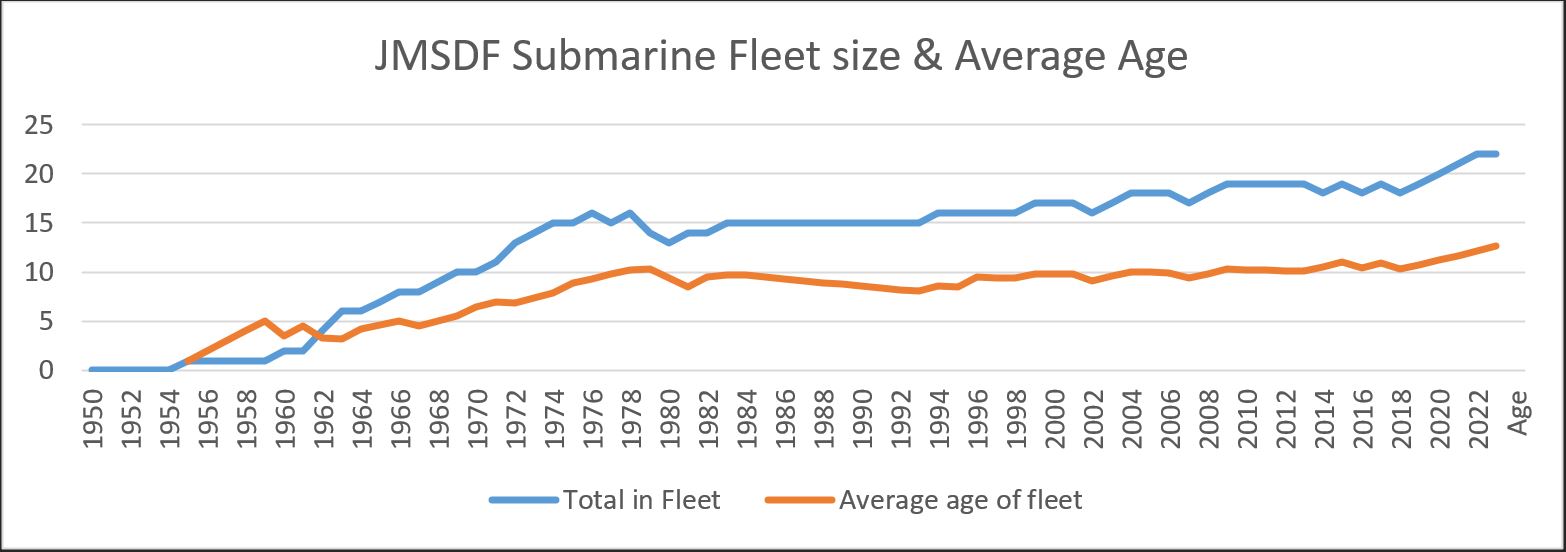
The JMSDF’s submarine utilization system is unique and may seem odd to American and other Western Navies. While Japanese submarines are well-built and likely could serve as long as their American counterparts (35-40 years), they serve around 18 years before being decommissioned or transferred to training status. While most navies try to sustain submarines as long as economically feasible, the JMSDF “prunes” serviceable submarines out of its operational fleet in order to maintain the number of boats required in Japan’s maritime strategy. For example, between 1980 and 2018, the national strategy called for 18 submarines in the operational fleet, therefore most submarines were decommissioned between the 17-20 years of service to achieve this fleet goal. Starting in 2019, in order to match China’s rising naval power (and perhaps to hedge against the U.S. submarine base’s sluggish production increase), Japan’s maritime strategy increased its submarine requirement to 22 submarines in the operational fleet, and the JMSDF raised the “retirement age” of its submarines from 18 to 22 years until annual submarine production rate allowed the fleet size to reach 22. Officers in the JMSDF’s ship repair unit describe maintaining older submarines as “more costly, but not particularly difficult”, implying that if operational needs dictate, they could increase the number of operational submarines without having to increase the production rate.

Figure 1. Historical JMSDF submarine fleet size and average age of fleet. Credit: Author’s work.


Figure 2. Age in which JMSDF submarines were decommissioned. (Author graphic)

Another unique aspect to the Japanese submarine industrial base planning is that submarines typically do not go into an extensive mid-life refit like their American counterparts. JMSDF leaders cite that overhauling older vessels can often be unpredictable and lead to schedule growth, as submarines can be in much worse material condition than anticipated. They admit that conducting a mid-life upgrade could save cost in peacetime, but the current system that prioritizes new construction ensures more stability in the submarine industrial base. On the ground level, JMSDF ship repair officers cite that cutting holes into a pressure hull and then replacing major components in already tightly packed submarine is time consuming, and believe that new submarine construction “delivers more submarine sea power per man-hour worked” than conducting a midlife overhaul. They jokingly called this practice similar to the “Shikinen Sengu”, which is a ritual where one of the most revered Shinto shrines in Japan, Ise Shrine, is traditionally torn down and rebuilt every 20 years.

Pillar 3: Consistent Supply of Reserve Submarines

Another benefit of consistent production and early retirement is the ability to keep several reserve submarines in good material condition on reserve prior to final decommissioning and disposal. Typically, when submarines are decommissioned from the operational fleet, they are transferred to the training squadron and then consistently sail to train and qualify sailors prior to assigning them to operational boats. The training submarine fleet not only helps supplying the operational fleet with sailors already equipped with sea time inside a submarine, but also allows boats to be quickly transferred back to the operational fleet whenever new construction and delayed decommissioning cannot meet requirements. While the JMSDF has yet to recommission a training submarine back to active service, it has transferred older destroyers, the JS Asagiri and JS Yamagiri, from the training fleet back to the operational fleet in 2011/2012 to meet increased operational surface vessel demand. It is not unimaginable that the JMSDF would be willing to use its training submarines in a similar manner during a period of surging demand.

Furthermore, when submarines stop sailing with the training squadron, they stay on a reserve status receiving a certain amount of maintenance until they are finally stricken and disposed of. The number of submarines kept in this status is not well known, but parts are typically not salvaged to sustain other boats for a number of years. If submarine demand were to outstrip operationalizing the training submarines, the reserve boats could possibly be put out back to sea after some period in maintenance. Consequently, the combination of operationalizing the training and reserve submarines could give the JMSDF the ability to surge up to four additional operational submarines without accelerating its build schedule, which would constitute an impressive 20% increase in capability from the current fleet of 22 boats. 

Conclusion

All in all, Japan sustains an advanced, powerful conventional submarine fleet staffed by dedicated, overworked sailors, and supported by a robust, stable shipbuilding industry. Considering how quickly a shipbuilding industrial base atrophies without consistent inflow of new construction orders, the Japanese method of consistent production and fleet size control through early decommissioning may prove to be a viable template that even the U.S. Navy can incorporate into its long-term naval shipbuilding plan.

Jeong Soo “Gary” Kim is a Lieutenant in the U.S. Naval Reserves and currently a student at the Lauder Institute at the Wharton School of the University of Pennsylvania earning an MBA and MA in East Asian studies. He previously served with the Seabees of Naval Mobile Construction Battalion 5, and with NAVFAC Far East in Sasebo, Japan. He graduated from Columbia University with a bachelor’s degree in mechanical engineering and a minor in history.

The author would like to give special thanks to LCDR Hiroshi Kishida of the JMSDF’s Sasebo Ship Repair Facility, and various junior officers serving in Sasebo-based ships for assisting with the research for this article.

References

Dominguez, Gabriel. “Recruitment Issues Undermining Japan’s Military Buildup.” The Japan Times, The Japan Times, 2 Jan. 2023, www.japantimes.co.jp/news/2023/01/02/national/japan-sdf-recruitment-problems/.

Kevork, Chris. “The Revitalization of Japan’s Submarine Industry, From Defeat to Oyashio.” NIDS Journal of Defense and Security, 14, Dec. 2013, 14 Dec. 2013, pp. 71–92.

Ogasawara, Rie. “Observing the Horrible State of JSDF Military Housing through Photos.” ダイヤモンド・オンライン, 27 Sept. 2022, diamond.jp/articles/-/310137?page=2.

Takahashi, Kosuke. “Japan Launches Fourth Taigei-Class Submarine for JMSDF.” Naval News, 17 Oct. 2023, www.navalnews.com/naval-news/2023/10/japan-launches-fourth-taigei-class-submarine-for-jmsdf/.

일본 신형잠수함 타이게이(大鯨)진수의 의미 (Implications of the JMSDF’s New Taigei Class of Submarines), Korea Institute for Maritime Strategy, 11 Dec. 2020, kims.or.kr/issubrief/kims-periscope/peri217/.

Featured Image: Launch Ceremony of SS Taigei. (Japanese Ministry of Defense photo)

Adam Smith Would Oppose the Jones Act

By Colin Grabow

Earlier this year, Michael D. Purzycki argued—as others have before him—that the writings of Adam Smith bolster the case for maintaining the Jones Act to address U.S. national security needs. But notions that a law roundly rejected by economists across the ideological spectrum would be embraced by one of history’s great economic thinkers should be met with considerable skepticism. To the extent the Jones Act provides any benefits to the country’s defense, it does so in grossly inefficient fashion that could be better accomplished through alternative means. It is more likely that Smith would view the law as a protectionist relic that imposes a heavy economic burden while undermining the country’s maritime industry and national security.

Passed in 1920, the Jones Act restricts the domestic waterborne transport of goods to vessels that are U.S.-flagged, U.S.-owned, U.S.-crewed, and U.S.-built. These restrictions were ostensibly put in place to help provide the United States with shipyards, U.S.-controlled ships, and a pool of mariners that can be relied upon for auxiliary sealift support in time of war.

The problem is that this approach does not work. U.S. commercial shipbuilding is small and uncompetitive, the Jones Act oceangoing fleet is in a state of perpetual decline, and there is a documented shortage of mariners to meet national security needs. The Jones Act is a clear failure and should be replaced with a more effective and efficient policy.

The Sad State of Domestic Shipbuilding

The Jones Act’s most unusual and self-defeating component is its U.S.-built requirement. When the United States first adopted shipping protectionism in 1789—including restricting the U.S. flag registry to vessels constructed in the United States—U.S. shipbuilders were some of the world’s best. Sadly, this is no longer the case—and has not been since vessels of wood and sail gave way to iron and steam.

By the late 1800s, U.S.-built ships were estimated to be 25-35 percent more expensive than those constructed in British shipyards, with a similar estimate made in 1922. By the 1960s, U.S. shipbuilding costs were double those of leading international yards, while by the 1990s they were three times higher. Ensconced behind its protective Jones Act wall, U.S. commercial shipbuilding’s competitiveness has now deteriorated to the point that a U.S.-built ship is estimated to cost four to five times as much as one constructed abroad.

Unsurprisingly, demand for U.S.-built merchant ships has been relegated to the increasingly diminutive and captive domestic Jones Act market. Since 2000, deliveries of oceangoing cargo ships from U.S. shipyards have averaged just three per year. Last year American shipyards produced zero. The few ships that are delivered, meanwhile, are highly dependent on foreign ship designs and components, shattering any notions that the Jones Act frees the United States of foreign reliance for its commercial shipbuilding needs.

Jones Act protectionism is complicit in the industry’s diminished state. A complete shielding from the competitive pressures of global shipyards as well as the limited scale and reduced specialization from building for a small domestic market makes its lack of competitiveness a foregone conclusion. Put differently, U.S. shipbuilding inferiority is baked into the Jones Act cake.

That a small handful of larger shipyards still exist is owed far more to taxpayer expenditures than commercial Jones Act shipbuilding. As a 2021 U.S. Maritime Administration report notes, 14 of 15 large deep-draft vessels delivered the previous year were for the U.S. Navy and Coast Guard. Nearly 80 percent of U.S. private shipbuilding and repair industry revenue in 2019 came from the U.S. military.

It is unclear how much benefit, however, even this limited commercial shipbuilding offers U.S. warfighting capabilities given the lengthy, often delayed construction timelines of Jones Act ships. The last ten Jones Act-compliant tankers delivered required an average of approximately 17 months to build while the last ten containerships took 30. The small remaining Jones Act shipyard base is wholly inadequate to support Defense Department requirements during any large-scale, enduring conflicts, and any new-build cargo ships built could well arrive after the fighting has already ceased.

Ships and Mariners in Decline

Though the U.S.-built requirement’s benefits are unclear, its costs to the U.S. fleet are obvious. Simply put, forcing Americans to pay dramatically higher prices for new ships means fewer of them. As a 1965 interagency maritime task force report noted, requiring the purchase of new vessels from U.S. shipyards at double the cost of those purchased by foreign ship operators “seriously impedes the economic growth of the U.S. fleet.” That was written nearly 60 years ago. Today one must replace “double” with “quadruple” or “quintuple”.

In large part due to the burden of such high capital costs, the Jones Act ships are principally employed where no other transportation option exists. The nation’s 23 Jones Act containerships almost exclusively ply the non-contiguous trades, while tankers are generally employed serving those parts of the countries that are either pipeline constrained or lack them entirely.

But even serving the non-contiguous trades is no guarantee that actual ships will be used. Of the 13 vessels engaged in liner service to Puerto Rico, only five are self-propelled ships (one of which was built in Poland) with the remainder consisting of cheaper oceangoing barges. That the major Jones Act shipping firm Crowley uses two ships and four barges for its Jones Act service to Puerto Rico, whereas in its unconstrained Caribbean international routes solely employs self-propelled vessels, seems a clear indication of high capital costs discouraging the use of proper ships. Oceangoing tugboats and barges require fewer American mariners, reducing operational expenses, but also having the perverse effect of obviating the qualifications necessary for auxiliary sealift employment.

From 257 ships as recently as 1980, the fleet of Jones Act-compliant oceangoing merchant ships has declined to just 93 today. For the world’s largest economy, this shrunken fleet stands in stark contrast to the nearly 54,000 ships in operation globally.

Jones Act ships are not just few in number but also kept in service far longer than global shipping fleet standards due to sky-high replacement costs: the last 15 Jones Act ships scrapped or removed from the fleet had an average age of nearly 43 years, far beyond that commonly found in commercial shipping. Notably, commercial ships participating in the Maritime Security Program to provide military sealift cannot be accepted beyond 15 years of age. In a perverse twist of national security, meanwhile, aging Jones Act ships are not only of debatable military utility, but generate significant repair and maintenance work for China’s state-owned shipyards.

Unsurprisingly, a declining fleet of ships (with unnaturally long lives of increasing decrepitude) has had a detrimental impact on mariner numbers. In fact, a 2017 government report concluded that the United States faced a deficit of 1,839 mariners with the needed credentials to conduct concurrent operations of the U.S. commercial fleet and a sustained sealift operation. In 2019, the former U.S. Maritime Administrator Mark Buzby noted that making up this shortfall would require an additional 45 ships in the U.S. fleet. Thanks to the damaging effects of the Jones Act, however, the fleet has since declined by 6 hulls.

Given the Jones Act fleet’s depleted and deteriorated state, it is unsurprising that its ships play only a de minimis role in sealift planning assumptions. A 2020 U.S. Maritime Administration report, for example, referenced privately-owned U.S.-flag ships engaged in international trade—i.e. the 85 non-Jones Act U.S.-flag ships—and the mariners they employ as “primary resources” to serve as an auxiliary force in time of war or national emergency, while no mention of the domestic Jones Act fleet was made in this context. This stance appeared to be confirmed by the head of the U.S. Transportation Command, who testified last year that wargaming has revealed Jones Act ships to be unlikely candidates for meeting national defense needs.

As two RAND Corporation analysts wrote last year, beyond 60 foreign-built ships in the U.S.-flag non-Jones Act fleet that receive Maritime Security Program stipends, there are “very few, if any, additional U.S.-flagged vessels, certainly not a sufficient number of the type required to move large amounts of military cargo.”

Whether measured in terms of shipbuilding, ships, or mariners, the Jones Act has failed to meet U.S. national security needs. Meant to promote the fortunes of both the domestic shipping and shipbuilding industries, it has succeeded only in making both vastly uncompetitive. Given this bleak record, it is unclear why a man of Smith’s caliber would support such a law.

Failure of the Navigation Acts

That Smith is viewed by some as a likely Jones Act supporter owes to the economist’s endorsement of Great Britain’s own protectionist Navigation Acts. His support, however, is perhaps due to Smith simply not living long enough to fully appreciate their shortcomings. In 1847 a pronounced drop in trade led to the laws being suspended, and that same year the House of Commons conducted an inquiry into the Navigations Acts. After a select committee issued several reports documenting the damage inflicted by these protectionist laws, they were repealed in 1849.

Far from visiting harm on the British maritime industry, the Navigation Acts’ repeal coincided with a great flourishing. As a Library of Congress report points out:

In just over a decade, there was a 52.2 percent increase in tonnage owned, and the yearly average of British tonnage which entered and cleared from British ports increased by 102.7 percent…An overwhelming, demand for shipping caused the price of vessels to rise and British shipyards were kept busy.

The United States, meanwhile, saw its own shipping and shipbuilding industries decline as the country clung to shipping protectionism. In his 1876 book History of Merchant Shipping and Ancient Commerce, British author William Schaw Lindsay pointed out these contrasting fortunes:

…I cannot refrain from directing the attention of my readers to the fact that the nations which have adopted a liberal policy have made much the greatest advance; while the United States of America, to which I have so frequently referred, have, with all their natural advantages, materially retrograded as a maritime people.

This retrogression, aided and abetted by the Jones Act, continues today. U.S maritime policy, both for the country’s economic prosperity and national security, is crying out for a dramatic overhaul.

Overhaul of Maritime Policy Sorely Needed

One obvious corrective would be to dispense with the Jones Act’s U.S.-built requirement—at the very least for oceangoing ships. Accepting a smaller and less modern fleet (and the resulting stultifying impact on domestic trade) in exchange for the construction of a tiny number of commercial ships highly reliant on foreign inputs is a terrible bargain. Instead, policy should be dramatically revised by scrapping Jones Act restrictions in favor of a more purposeful measure such as targeted, direct subsidies. This is an approach straight out of Adam Smith’s playbook. As he wrote in The Wealth of Nations:

If any particular manufacture was necessary, indeed, for the defense of the society, it might not always be prudent to depend upon our neighbors for the supply; and if such manufacture could not otherwise be supported at home, it might not be unreasonable that all the other branches of industry should be taxed in order to support it.

Using taxpayer-funded subsidies to assure the specific types of ships, mariners, and maritime infrastructure required in times of war would offer at least two key advantages over Jones Act protectionism. 

Transparency: The Jones Act is an implicit subsidy whose vast cost of provision is challenging to derive with any great precision. Indeed, the federal government has not even attempted to calculate its economic damage since 2002. Also unknown are the law’s benefits, with the number of ships, mariners, and shipbuilding that would exist in the law’s absence rendered a mere guessing game. Such opacity may serve the small orbit of maritime special interests that profit from Jones Act protectionism but renders a cost-benefit analysis a highly fraught if not impossible task.

Fairness: To the marginal extent the Jones Act provides ships, mariners, and shipbuilding, the burden of doing so is borne in vastly disproportionate fashion by the residents of Alaska, Guam, Hawaii, and Puerto Rico. While comprising less than 2 percent of the U.S. population, these non-contiguous states and territories account for more than half of ships employed in Jones Act trades. This inequity is further compounded by the fact that residents of Guam and Puerto Rico have no voting representation in Congress and must bear the burden of high shipping costs while suffering from some of the country’s highest poverty rates. If the Jones Act is truly rooted in national security, then it should be paid for by a broad swath of Americans rather than a small percentage based on geographical happenstance.

Perhaps most importantly, subsidies would be far more effective than current policy given the Jones Act’s demonstrable failures. Handcuffing domestic vessel operators to a wildly uncompetitive shipbuilding industry has proven a formula for maritime mediocrity.

A system of direct subsidies could eliminate such dynamics and link expenditures to discrete goals. If more ships are needed, fund ships. If more mariners are needed, subsidize their hiring or fund an expansion of the fleet for increased billets (which could perhaps be done in conjunction with the establishment of a robust Merchant Marine Reserve to assure their availability and proper training).

National security should be paid for with transparent spending linked to clear goals, not K Street-funded protectionism with opaque costs.

None of this is pie in the sky thinking. The Maritime Security Program provides a $5.3 million stipend to 60 vessels in exchange for their availability for Department of Defense use in time of war or national emergency. That means not just ships but billets for mariners. If more ships and mariners are needed, why not simply expand the program (ideally paired with reforms such as a bid system to promote cost containment)?

Aiding shipyards, meanwhile, is a trickier proposition. While the use of subsidies to cover the difference between U.S. and foreign shipbuilding costs would be preferable to the Jones Act’s U.S.-built requirement, such an approach should be regarded warily given past experience. One alternative might be a long-term shipbuilding program to replace aging vessels in the Ready Reserve Force and Military Sealift Command fleets. Such a recapitalization effort could be opened to shipyards from NATO and Major Non-NATO Allies to promote competition but with a reasonable price preference to U.S. yards to level the playing field. Subsidies linked to the realization of certain performance metrics might be another alternative. While the exact approach can and should be debated, the shortcomings of current policy demand new and innovative thinking.

There is much that Jones Act supporters and critics disagree on, including how Adam Smith may have thought about the law in the 21st century. But there should be a clear consensus that the military must be provided with the tools it requires to accomplish its mission—including sealift. These needs should be met in the most effective and efficient manner possible. As ample evidence shows, the Jones Act is not it. After more than a hundred years of maritime failure it is time for a new approach, one that Adam Smith himself would have been willing to lend his support to.

Colin Grabow is a research fellow at the Cato Institute’s Herbert A. Stiefel Center for Trade Policy Studies.

Featured Image: Tanjong Pagar Container Terminal seen from Asia Square, Singapore. (Photo by Nicolas Lannuzel via Wikimedia Commons)