Category Archives: History

Naval and maritime history section.

Sea Control 41: The View From China

seacontrol2Dean Cheng joins us to discuss China. Like a flourless brownie, this podcast is dense and delicious. We hit China’s goals and perspectives: From the Chinese “status quo”, to the South China Sea, to India, to the use of crises as policy tools. If you want to see behind the headlines, this is your podcast.

DOWNLOAD: Sea Control 41 – The View from China

Remember, subscribe on iTunes or Stitcher Stream Radio. Leave a comment and rate five stars!

Lessons from the Late Roman Army

Our “Sacking of Rome series continues” with a sixth installment!

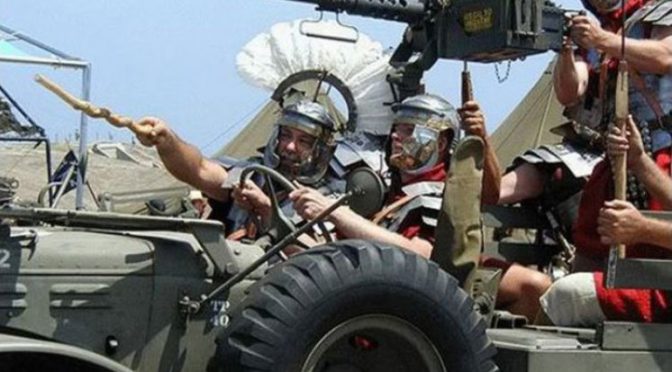
The unfamiliar face of the late Roman Army (Photo courtesy of Britannia).

By Steven Wills

Most popular portrayals of the Roman Army focus on the collapse of the Republic, as in the HBO “Rome” series, or the classical “high” empire as illustrated by the Russell Crowe epic “Gladiator”.  In contrast to these theatrical efforts is the period of the  so-called “late” Roman Empire of 220 A.D. to the 600’s. It offers significant lessons in how not to manage the army of a great power. While there are many possible causes for the downfall of the Roman Empire and resultant Dark Ages, military historians generally agree that three specific actions of Roman elites in the late Empire specifically contributed to the Empire’s eventual collapse. Cutting the retirement benefits of a small professional force in favor of smaller taxes for the elite and greater benefits for the masses served only to weaken the desire of Roman citizens to serve.  When the Roman citizenry would not join in the numbers required to protect the Empire, Roman elites turned to conscription, which produced only disgruntled recruits, and mass recruitment of barbarian tribes such as the Goths, Visigoths and Vandals. These tribesmen could be paid less and did not require expansive pensions as an incentive to serve. The so-called “barbarization” of the Roman Army seriously weakened its core values, made it more likely to rebel against Roman authority, and ultimately brought disaster to the gates of Rome itself in 410 A.D. These three mistakes in the management of the late Roman Imperial Army should serve as a powerful warning to American elites seeking inexpensive solutions to the maintenance of American military power. While some military spending can always be reduced, a great power that seeks very low-cost solutions does so at its own peril.

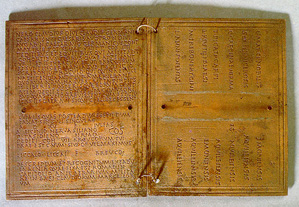
The Roman Army began providing pensions to retiring soldiers during the fall of the Roman Republic in the late first century B.C. Competing Roman leaders such as Julius Caesar, his great rival Pompey Magnus, Caesar’s nephew Octavian, later known as Augustus Caesar, and his famous opponent Marc Antony all offered grand incentives to retain the loyalty of their soldiers. These promises often included financial rewards, exemption from taxes and grants of land from captured enemy territory. Augustus Caesar continued this practice  when he consolidated power in the first century A.D. and became virtual dictator of the Empire under the title of Princeps (first citizen).  Augustus reduced the Roman Army to a voluntary, professional force of approximately 150,000 active duty soldiers and a similar number of auxiliary troops.  A soldier who served 20-25  years of active military service (accounts vary) would be eligible for the honesto missio, or honorable discharge from military service. Similar benefits were provided for soldiers disabled in the line of duty and unable to return to service. The soldier was provided an exemption from Roman taxes, a plot of land and appropriate work animals, and often a job in the imperial administration of the territory in which they settled. Roman veterans could be recalled to active duty in case of emergency and often provided a reliable, loyal citizenry in newly conquered territories. As the Empire grew, successive leaders, now styled as Emperors widened the veteran benefits until the mid third century A.D. After this troubled period of revolts, barbarian attacks and economic downturn and collapse, Roman authorities gradually reduced pensions and lengthened the period of active service necessary to receive full credit for service. This appears to have been done to reduce taxes for wealthy Romans living in the provinces.  Record are fragmentary from the later empire, but at some point in the third century A.D., bronze tablets replaced parchment documents as official evidence of service due to the inability of veterans to get the benefits they deserved. In addition, the empire’s policy of “bread and circuses” (generous food benefits and cheap entertainment) seemed a much better deal for the average lower class Roman citizen rather than increasingly dangerous and unrewarded services in the late Roman Army. As a result of these changes it would appear that the average lower class Roman citizen, the historical pool for legionary recruitment was much less inclined to a military career.

Bronze Roman Army pension document (diploma)

As Roman citizen recruitment failed to provide enough troops to protect an increasingly threatened Empire, Roman elites turned to conscription and barbarian recruitment. Conscripts were often ineffective and actively avoided reporting for duty. Some maimed themselves to ensure they would be found unfit for service. Recruitment of barbarians however offered a low cost solution to the manpower drain on the Roman Army. German tribes fleeing from the vicious Huns were desperate for sanctuary within the Empire and Roman officials equally needed soldiers to resist invasions. They negotiated with tribal chiefs for the military service of whole tribes in return for farmland for the tribe within Roman borders. Unfortunately, unscrupulous Roman officials were happy to defraud the tribesmen of their promised land, or commit them into combat situations where the highest casualties resulted. Such actions bred intense distrust and contributed to a uneasy co-existence of Roman and tribesman within the empire’s borders.

Artist conception of a 5th century A.D. Visigoth warrior.

The Romans further weakened their “barbarized” Army by neglecting the “Romanization” of the new recruits. Since the city on the Tiber River first mounted military operations, it actively absorbed new soldiers from the ranks of its enemies. These new recruits were not only trained in Roman ways of war, but were culturally and constitutionally converted into Roman citizens. They eagerly embraced Roman baths, aqueducts, regular salaries,  and other aspects of Roman law and culture. While such a procedure was effective with small groups of new soldiers, whole tribes of new barbarian recruits actively resisted Romanization. Roman officials were either unable or frankly too lazy or disinterested to continue this long-running successful process. Instead, the Roman Army was “barbarized” and became more German than Roman. The rigorous individual and team training that had been the hallmark of Roman arms for centuries was allowed to degrade in order to more easily employ the cheaper barbarian forces.  The tribal contingents’  loyalties often swung between imperial employers and barbarian roots and culture. The Roman elite’s disdain for this force caused further tension and when the tribes were denied pay and food, they actively rebelled. This rebellion brought the Visigoth leader Alaric to the gates of Rome in 410 A.D. seeking food and payment for prior military service. When Roman elites refused, common people in Rome, fearing a long siege and starvation, opened the gates of the city to Alaric and his men. Then in turn sacked the city and destroyed or stole countless  works of art. They also seized most of the city’s gold and silver. The Western half of the Roman Empire never recovered from this disaster. It lingered on with greater barbarian influence until tribesmen deposed the last Western Roman Emperor Romulus Augustulus in 476 A.D. The Eastern Empire had suffered a similar devastating defeat at the hands of Goths in 378 A.D. Rather than continue to accept barbarian recruits, it purged its army of tribesmen and returned to traditional Roman methods of training. In contrast with the west, this Eastern Empire endured for nearly another 1000 years. In summation, the Roman attempt to employ cheap alternatives for defense was an unmitigated disaster.

What can the United States learn from the example of the late Roman Empire? First, the maintenance of a professional force requires a generous pension system in order to maintain a steady supply of proficient recruits. According to former Chairman of the Joint Chiefs of Staff Admiral Mike Mullen in 2011, only 7-11% of  all military personnel complete 20 or more years of service and become eligible for a pension. Given that only 1% of Americans even serve in uniform, is a well funded U.S. military pension system such a great price to ensure a steady supply of recruits to serve the military needs to the Republic?  Reduced benefits may convince many Americans, as it did Romans, that long-term military service is not worth the low pay and arduous conditions involved to attain an increasingly modest pension.

Distributing smaller benefit amounts to a wider percentage of the active duty force, or worse yet, paying larger benefits only to those who served in combat will likely weaken the force cohesion and generate needless class struggle within the ranks. The Romans attempted similar measures by paying barbarians less than purely Roman forces and price was a loss of cohesiveness and team-building within the ranks.  In addition, rather than weld the fighting forces together in the shared experience of American culture, the services emphasize their differences by an over-emphasis on cultural diversity. The Romans Army of the high empire was extremely diverse and fielded units recruited from the British Isles to the deserts of Syria. It accommodated dozens of faiths and creeds within the shared Roman experience without the need to over-emphasize their differences. This successful system endured for centuries and served to insulate the legions from purely nationalistic strife.

The experience of the late Roman Army has much to offer the United States in the present. A professional military force needs a healthy pension structure.  Post service benefits are essential to the retention of a moderate-sized group of highly trained professionals necessary to wage modern war.  It is unwise to ignore the traditional sources of voluntary recruitment in search of lower-cost military solutions.  Finally, the shared experience of voluntary service to a strong national ideal united disparate nationalities within each Roman legion. Discarding this unifying, albeit expensive construct in favor of larger numbers of low cost conscripts and barbarians served only to hasten the empire’s end. The United States would do well to consider the fate of the late Roman Army as it seeks low cost, effective substitutes for current defense expenditures. In the end, a nation gets either what it pays or refuses to pay for in maintenance of national security.

Steve Wills is a retired surface warfare officer and a PhD candidate in military history at Ohio University. His focus areas are modern U.S. naval and military reorganization efforts and British naval strategy and policy from 1889-1941. 

And If We Became the Barbarians…

The “Sacking of Rome” series continues with this fifth installment.

Much is made of the imagery of barbarians storming the gates of Rome. It conjures the picture of masses of foreign hordes bursting over the walls and crashing through the gatehouse, razing a great city to the ground and subjecting its people to horrible torment, slavery and death. Today we can perhaps wonder whether Slavic or Asiatic armies can overwhelm a crumbling Western alliance, subduing Western Europe, the United States and our allies in Asia, achieving decisive victory. While this may make for popular filmmaking (see “Red Dawn” – the original, not the awful remake), it is hardly likely.


Consider the etymology of the word “barbarian.” The ancient Greek word, “barbaros,” literally meant “non-Greek,” and was used to describe any foreigner, which to the Greeks would include such advanced civilizations as the Egyptians and Persians as well as the uncivilized tribes they came into contact with. Its direct antonym is “polites,” Greek for “citizen” and where we get our words “polity” and “politics.” To be a barbarian meant more than just being uncivilized, it meant that you were not a citizen. The word would become a pejorative used by the Greeks to even describe other Greeks, suggesting they were not worthy of citizenship, and the responsibilities that would come with it. This would be an important distinction from the word “subject,” used to describe an individual who is subjected to the rule by elites, such as feudal subjects.


No one better understood these distinctions than Alexis de Tocqueville, who in his magisterial overview of the American polity Democracy in America[i] identified the mores, or the “habits of mind” that served to protect the political liberties that mid-19th Century Americans enjoyed. These mores and habits can be best thought of today as “the whole moral and intellectual state of the people,” or our national character. He observed that institutions such as our political order – republican democracy – as well as the rule of law, religion, family and private associations (what Edmund Burke would call “little platoons”) created a network of self-reinforcing pillars that permitted the continued growth of freedom and served as America’s greatest source of national power.


Tocqueville was quick to point out the vulnerability of a “democratic social state like that of the Americans [to] the establishment of despotism.”[ii] Unlike the time of the ancient emperors of Rome or Persia, where “the details of social life and of individual existence ordinarily escaped his control” the despotism that America was particularly vulnerable to “would be more extensive and milder, and it would degrade men without tormenting them.” He goes on at length to define this form of despotism. As the citizenry begins to “fill their souls” with “small and vulgar pleasures,” it begins to withdraw from the institution that buttress republican democracy, “becoming like a stranger to the destiny of all others.”[iii] The American will “exist only in himself, and for himself alone.” He will elevate the role of the federal government to “take charge of assuring their enjoyments and watching over their fates.” It becomes “absolute, detailed, regular, far-seeing and mild. It would resemble paternal power if, like that, it had for its object to prepare men for manhood; but on the contrary, it seeks only to keep them fixed irrevocably in childhood …” The purpose of the government, and the bureaucracy that underlies it is to “willingly work for their happiness, but it wants to be the unique agent and sole arbiter of that [emphasis added]; it provides for their security; foresees and secures their needs, facilitates their pleasures, conducts their principal affairs, directs their industry, regulates their estates, divides their inheritances, can it not take away from them entirely the trouble of thinking and the pain of living?”[iv]


In short, Tocqueville is warning not against the rule of tyrants, but of “schoolmasters.”[v] The schoolmaster “does not break wills, but it softens them, bends them, and directs them; it rarely forces one to act, but it constantly opposes itself to one’s acting; it does not destroy, it prevents things from being born; it does not tyrannize, it hinders, compromises, enervates, extinguishes, dazes and finally reduces each nation to being nothing more than a timid and industrious animals of which the government is the shepherd.”[vi]


How can this happen? People have two conflicting desires, the “need to be led and the wish to remain free.” We foolishly try to satisfy both at the same time. We demand that the federal government continue to centralize more power and control over the most intimate parts of individual and social life, in tutelage to our schoolmaster, while consoling ourselves “by thinking that [we] had chosen [our] schoolmasters” in our national elections. We become deluded in believing that we have “guaranteed the freedom of individuals well enough when [we] deliver it to the national power.”[vii]


A “schoolmaster” form of absolute federal power – commonly known today as the “nanny state” – has profound implications on the character of the American polity. It would be hard to argue that we are not in danger of falling into the soft despotism that Tocqueville warned about before the Civil War. If his warnings are true, then as Americans shed their sense of rugged individualism and self reliance, we would expect to see more dropping out of the workforce, finding it easier to accept wealth transfers from those who still continue to produce. We may find the expansive reach of government into all aspects of private life, from what we consume to our very own health. Even the nature of private and business relations will become matters of the state. Perhaps we will see a growing sense of narcissistic entitlement seep into the public culture and consciousness, eating away at the very mores that Tocqueville lauded as uniquely responsible for our republican democracy. Media, corporate and government elites will align to maintain a hold on that public consciousness (and power over the federal government), fundamentally altering the narrative of “American exceptionalism” so that we consider our nation just one of many, no better and often worse.


To the more immediate topic at hand, a nation fixed irrevocably in childhood will begin to face significant obstacles to maintaining the military power and strength necessary to keep its status as a world super power. It would not cease to exist or become absorbed by another country. Instead, it would slowly decline to a position of near irrelevancy, unable and unwilling to affect events on the global stage beyond the perfunctory speech and endless diplomacy. To be a super power is very hard work, and requires not only sacrifice and commitment, but a sincere belief in the mission and purpose of maintaining that status. It requires a nation of adults.


There are many potential military “game changers” today, from nuclear rogue states to far reaching anti-ship cruise missiles, anti-satellite weapons, swarm boats, electro-magnetic pulse weapons and cyber attacks that could all be destabilizing and devastating. Changes in military hardware and the strategies and tactics used by our adversaries who employ them are nothing new however. Nor is the ability to adapt to those changes, even after suffering a defeat. Victory in war has more to do with popular will than it does with hardware. Some new “out of the box” strategy, tactic or toy will always be adapted to eventually. Defeat on the battlefield, or even in war, is “transitory” as Clausewitz notes, with the adversary often just biding time until political events can cause him to rectify the situation.


The American military is reflective of its population, and as our national character changes, the military will change accordingly, over time and albeit slowly. Nations that choose the path of decline do not maintain a dominant military force. Its power, much like the “habits of mind” that Tocqueville wrote of, will erode if not nurtured and sustained.


So, to answer the question of how might the U.S. find itself sacked like ancient Rome should be one of introspection and self-evaluation. I posited a few of the many indicators that, if the great Frenchman’s warnings are true, we should begin to see, perhaps in our own lifetime. No doubt there are others. But the point remains that we probably need not fear potential barbarians at our gates, but turn our attention instead to the barbarians we may become.

Robert “Jake” Bebber is an information warfare officer. He holds a doctorate in public policy from the University of Central Florida. He lives in Millersville, Maryland with his wife, Dana and their son, Vincent. The views expressed here are his own, and do not represent the U.S. Department of Defense, Department of the Navy or the U.S. Cyber Command. He welcomes your comments at jbebber@gmail.com


[i] De Tocqueville, Alexis. Democracy in America. trans. Harvey C. Mandfield and Debra Winthrop. (Chicago: University of Chicago Press: 2000), 274.

[ii] Op cit, p. 661

[iii] Consider the growth in the use of social media, where the veneer of a Facebook wall post or Tweet has replaced actual human interaction.

[iv] Op cit, p. 662-663.

[v] Op cit p. 662.

[vi] Op cit. p. 663

[vii] Op cit p. 664

Lessons from History: The Parthian Defeat of Rome

This is the first article of our “Sacking of Rome” week: red-teaming the global order and learning from history. It is also the first of Merighi’s independent “Lessons from History” regular series for CIMSEC.

They poured gold down his throat, cut off his head, and sent it back as a warning to others.

No, this is not a scene from the latest episode of Game of Thrones; this was the passing of Marcus Licinuis Crassus in 53 BC.[1] Rome’s richest man, a member of the First Triumvirate with Julius Caesar, and the man responsible for putting down the pirates that menaced the Mediterranean, met his ignoble end fighting the greatest challenge the Romans ever faced in the east: Parthia.

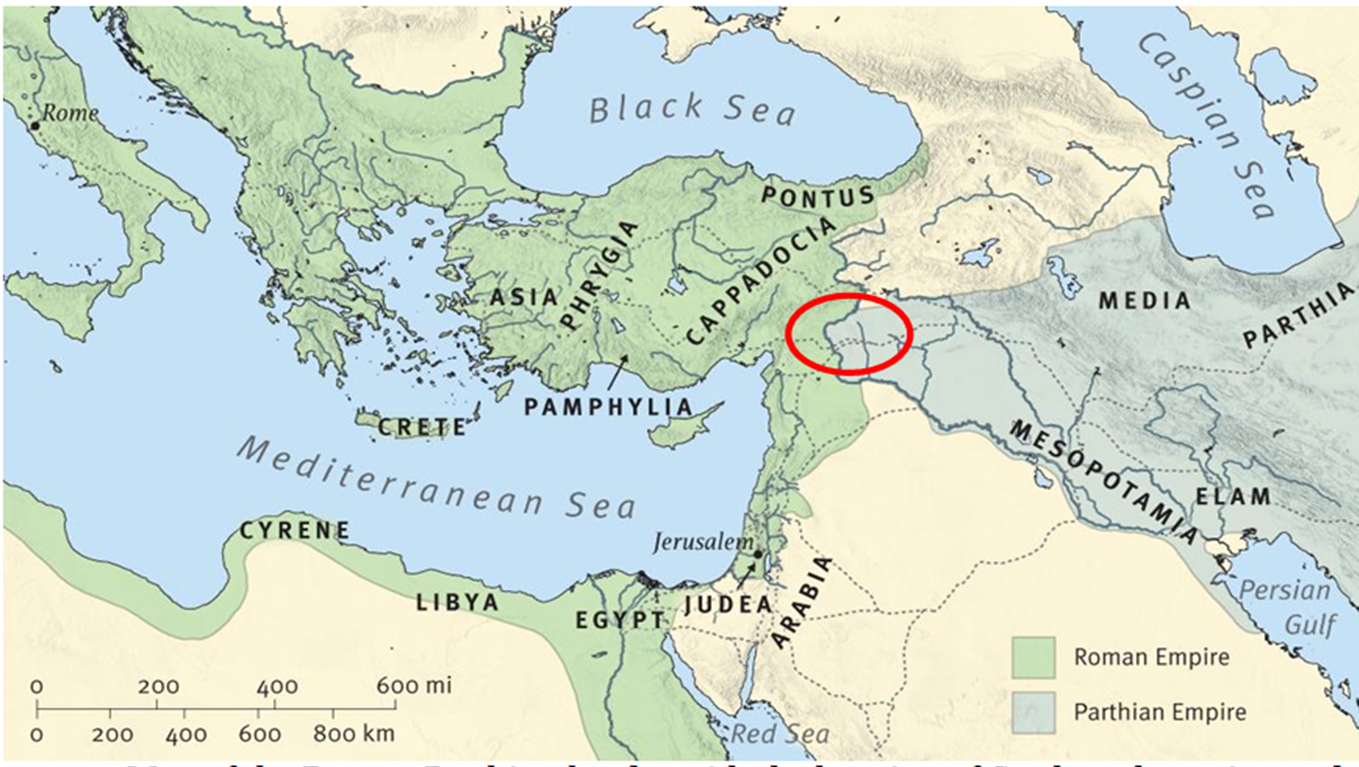
Map1
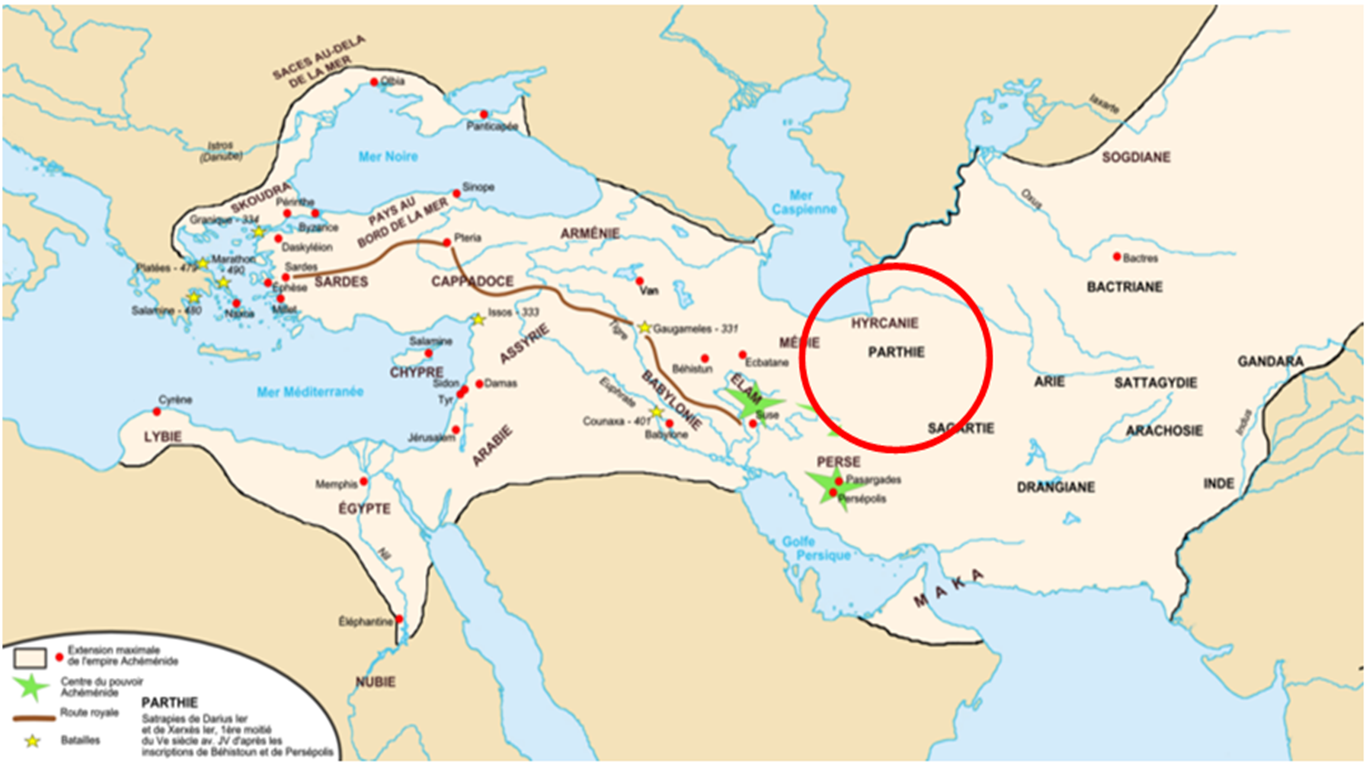
Map of the Achaemenid Persian Empire at its height with the region of Parthia marked in a red circle (Wikimedia Commons)


Persia was the preeminent military, political, and cultural power in the ancient world from 550 B.C. to 330 B.C. With its heartland in modern day Iran, its empire spanned from Afghanistan to Turkey at its apex. It all came crashing down in spectacular fashion when Alexander of Macedon rose to power and led a ruthlessly efficient military machine on a path of conquest that brought him all the way to the Indus River. He tried his hardest to unify the Persian state with his own but, when he died at the age of 33 in 323 B.C., his empire immediately collapsed into a host of warring factions. Three of his Greek generals went on to found the three largest states in the Eastern Mediterranean by the time Rome rose: the Seleucids in Turkey and Syria, the Antripatrids (later the Antigonids) in Greece, and the Ptolemians in Egypt. In the Persian heartland, however, ethnic Persians waging a proto-nationalist campaign kicked out the remnants of the Greek invaders. Known as Parthians due to the origins from the titular province in north-eastern Iran, they established a small state that expanded outward as the Alexandrian generals quarreled with one another.

For centuries after his death, every Greek warlord in the Western World claimed their legitimacy through Alexander and the desire to rebirth his Empire. Rome, too, took up this mantle as it expanded eastward into the Greek mainland. Beginning first in Greece and Macedonia, they waged a brutal war with the beleaguered Seleucids and conquered all the territory they possessed in the modern Middle East. This brought Rome’s borders right onto those of Parthia. Both were rising states with expansionist ambitions and a border that sat on porous, easily invadable territory. The stage was set for an epic confrontation between the two great powers.

Map2
Map of the Roman-Parthian border with the location of Carrhae shown in a red circle (University of Guelph)


Unfortunately for Rome, this manifested in the ill-fated expedition of the afore-mentioned Crassus in 54 BC. The expedition met its unfortunate end on the plains of Carrhae in south-eastern Turkey along the Syrian border.

How did the Parthians manage to resist Rome for so long? Their success rested on three key disparities between them and their Roman opponents:

1)     Assymmetric Military Advantage

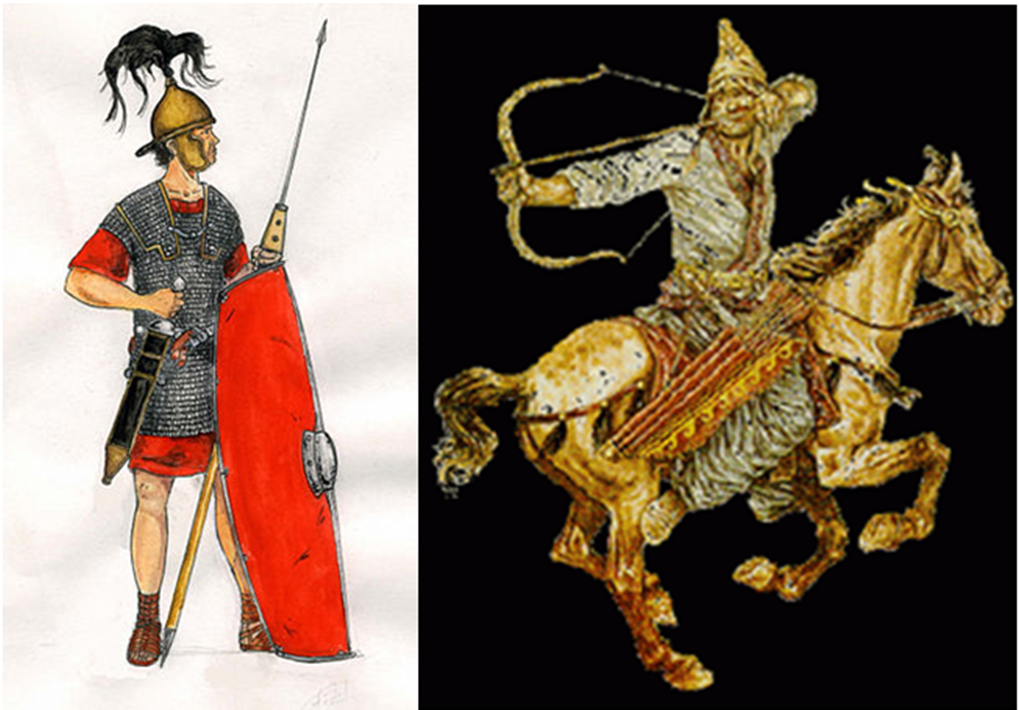
romanparthian
A Roman Legionnaire (left) facing his greatest threat since Hannibal: Parthian horse archers using the Parthian Shot (Wikimedia Commons)

The Roman legion was the paragon of military efficiency in its day. The strict discipline, advanced military technology, and sheer numbers were widely feared even before they began leaving the Italian peninsula. It was by no means a perfect force, as its travails against Hannibal in preceding centuries demonstrated, but the system itself was markedly better than any other fielded even with bad generalship. How then was it so ineffective against Parthia?

Unlike the other opponents the Romans fought in the preceding six centuries, the great bulk of the Parthian army were horse archers rather infantry or melee cavalry. Noted for the infamous “Parthian Shot,” their horsemen would rush forward to engage Roman infantry, retreat, then abruptly turn in their saddles to fire a shot directly behind them. The slow, methodical legionnaires were then rendered ineffective since they could not physically reach their assailants. The horse archer can be equated with modern fears about Medium-Range Ballistic Missiles (MRBMs); they were mobile, highly survivable, and could take out slower assets with near impunity.

These techniques were perfect for the open terrain on the Roman-Parthian border. If the topography had been less open, such as the forests of Gaul or Germania, Parthian tactics would have been less effective. The Parthians, though, did not need an army that could fight on different terrain because that is not where they needed to fight nor chose to fight. This brings us to the second advantage Parthia held over the Romans.

2)   Strategic Focus

The Parthians never harbored ambitions to conquer Rome; their strategy consisted of resisting Roman incursions and making their own when Rome was politically weak (see discussion below). Since the Parthians did not commit their resources into futile all-or-nothing fights with Rome or engage them on disadvantageous terrain, they always maintained a strong conventional deterrent that altered Rome’s calculus away from intervention.

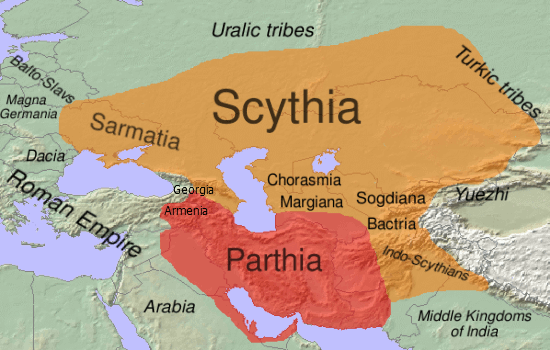
Map3
Map showing the Parthian Empire in relation to the territory of the Scythian nomads. Without a central government, the Scythian tribes could only pose occasional threats in Parthia’s east (Wikimedia Commons)

The Parthians also had the strategic benefit of having fewer serious external competition; its western border was solely with Rome and the neutral kingdom of Armenia (the site of many proxy wars between Rome and Parthia). To their east were far weaker and divided opponents, namely the Scythians and Bactrians. Rome, on the other hand, was beset by strong enemies on all sides. These included: restive tribes in Gaul and the Danube region, lingering discontent in Numidians North Africa, a still-unitary Egypt, and a vascillating client state in northern Turkey. These challenges both demanded military resources and political attention to effectively control. Even if Rome had more money and soldiers than the Parthians, only so many of them could be dedicated toward fighting the Parthians.

3)   Stronger Political Core

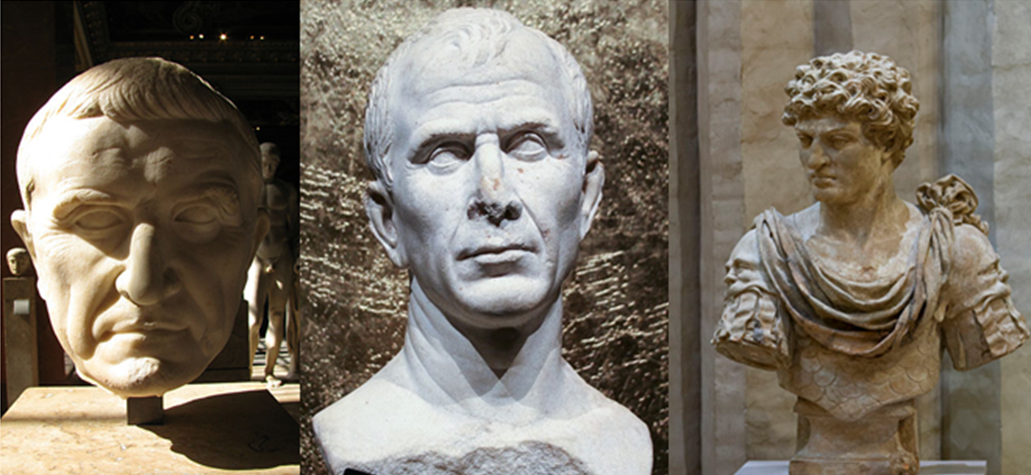
faces
(From the Left) Marcus Licinuis Crassus, Julius Caesar, and Marc Antony. All of the men tried to invade Parthia. The first one actually crossed the border and was killed. The other two were killed by Romans before even getting there (Wikimedia Commons and the Musee Des Augustins)

Parthian politics were cold and brutal. Succession crises were common and factions killed one another as they vied for the Parthian crown. There were even instances of Parthian claimants to the throne finding refuge in Rome, like exiled dictators, waiting for the opportune moment to return.

Roman politics during the late Republic and early Empire made Parthia look like Switzerland. The invasion of Parthia planned by Julius Caesar in 44 BC to avenge the death of Crassus (and punish the Parthians for their support of his rival, Pompey) was cancelled when Caesar fell to assassins’ blades on the Ides of March. The resulting civil war claimed thousands of Roman lives both on the battlefield and during the infamous proscriptions during which whatever faction happened to hold power would murder people and then “nationalize” their assets. After years of civil war, Rome finally found its footing under the Second Triumvirate. Marc Antony amassed his own army to take on the Parthians and managed to expel them from Syria in 33 BC only to have to turn around to fight his political partner Octavian in yet another civil war.

Octavian eventually succeeded in unifying the Roman state under his autocratic rule but, by then, he was in no position to challenge any external power. Crippling debts were poised to ruin the state. Opposing factions, though cowed by Augustus’ power, still opposed him behind the scenes. Octavian was forced to reduce to total number of legions to consolidate his hold on the Empire and reduce the risk of another civil war. Rather than risking another Parthian encounter in his weakened state, Octavian instead signed a landmark peace agreement that designated permanent borders in exchange for the legionary standards lost during Crassus’ expedition 33 years earlier. The Roman-Parthian drama would continue in fits and starts over the remainder of their very existences but, after that fateful treaty signed by Augustus, Rome finally admitted that it would fully never replicate Alexander’s conquest of Persia.

The cruel lesson for the United States to take from the Roman experience with Parthia is that an adversary with technology designed specifically to defeats its army, combined with stronger political will, is bound to come out on top of any conflict. Defeat does not just come on the battlefield. Just like Rome, the United States has a great number of serious threats: a bellicose Russia, an increasingly-assertive China, a still-problematic Iran, and trans-national terrorism. Unlike many of these antagonists (and the Parthians before them), the United States does not have the luxury of dedicating its resources to countering just one of these threats. The United States’ political system, after years of war and deep partisanship that conjures images of Caesar’s Rome, is brittle and unable to tackle any of these challenges. The lesson from Parthia is that to defeat the United States is merely to outlast it and negotiate for what you truly want.

Fortunately, for the United States, the peace under Augustus is not the end of the story. Over the following two centuries, the tables would turn and the Parthians’ political structure collapsed. Years of dynastic feuds and rival claimants to the throne made Parthia vulnerable to strong Roman Emperors such as Trajan (115 A.D.) and Septimus Severus (198 A.D.). The Parthian state was overthrown by internal revolution and a new Persian dynasty took its place. The final lesson for the United States is this: it is never too late to recalibrate and nothing is over until it is over.

Matthew Merighi is a civilian employee with the United States Air Force’s Office of International Affairs (SAF/IA) currently transitioning to pursue a Masters’ Degree at the Fletcher School. His views do not reflect those of the United States Government, Department of Defense, or Air Force but hopes his country can stand up to the Parthians.

[1] There is no concrete proof that the gold-pouring incident is true apart from the reports of the Roman historian Cassius Dio but it definitely gets the point across.