Category Archives: History

Naval and maritime history section.

Father Fernando Oliveira: A Pioneer of Naval Strategy

By CDR Luis Nuno Sardinha Monteiro, Portuguese Navy, for our Forgotten Naval Strategists Week

“Good war makes good peace”
In “Art of War at Sea” (Part I, Chapter 1)

Introduction

The Discoveries Era, a period of expansive exploration initiated by Portuguese navigators, prompted the emergence of a structured naval thinking in the 16th century. This originated mainly in the Mediterranean countries (specifically France, Italy, Portugal and Spain). Among the works produced at that time stands out a treatise written in 1555 by Portuguese Priest Fernando Oliveira, entitled “Arte da Guerra do Mar” (“Art of War at Sea”). It addresses, in a truly comprehensive and integrated way, a wide range of nautical and naval warfare issues, but it goes beyond a mere tactical and operational perspective, revealing a strategic vision with regard to the engagement of navies at the service of national interests, as well as other innovative strategic insights.

Life
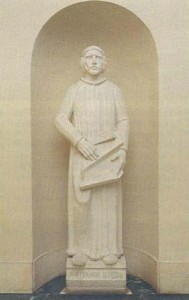
statue

Fernando Oliveira was born circa 1507 and at the age of 10 entered a Dominican Convent, where he acquired the humanist values manifested in his writings. In 1536, he published a grammar of the Portuguese language. This was his first book and also the first Portuguese grammar ever published.

Oliveira was a venturesome man, with a profound love of seafaring. Therefore, he took every opportunity to get underway, be the ships Portuguese, French, English or Spanish. Sometimes Oliveira volunteered as chaplain, but most of the time he was hired as pilot, due to his extensive knowledge and experience of nautical sciences. Every now and then these ships engaged in naval combat and he was even taken prisoner on several occasions.

Oliveira parlayed his vast experience at sea to produce seminal treatises on nautical and naval warfare issues. Besides the already mentioned treatise “Art of War at Sea” (published in 1555), he also wrote:

  • An encyclopedic treatise dated circa 1570 and entitled “Ars Nautica” (“Art of Navigation”). This work was written in Latin and has three parts: one about navigation, another about naval construction (the first known scientific work on this topic), and a third addressing generic navies’ logistical and administrative matters;
  • A companion work on naval construction, written around 1580 in Portuguese and entitled “Livro da Fábrica das Naus” (“Book on the Building of Ships”);
  • A book entitled “História de Portugal” (“History of Portugal”), written probably in 1581.

With regard to naval strategy, Oliveira’s keystone work is “Art of War at Sea”, which is therefore the main subject of this text and from which all citations contained in this article have been taken.

“Art of War at Sea”
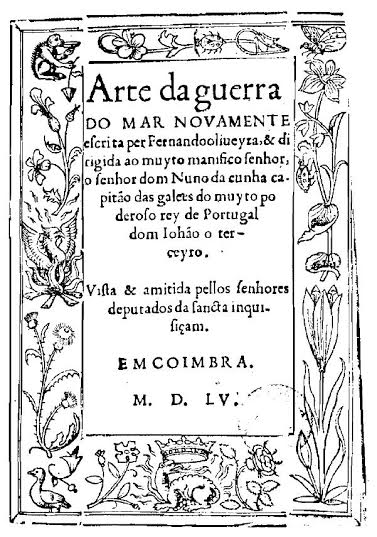
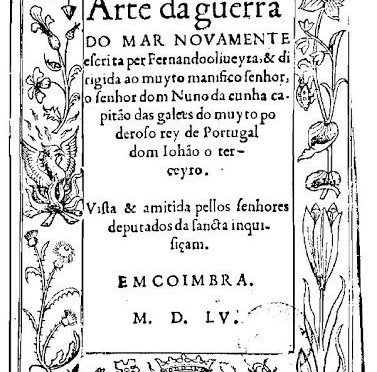
cover“Art of War at Sea” has one prologue and two parts, each of them containing fifteen chapters. It addresses a broad array of topics, such as naval construction, ship’s commissioning, navigation, seamanship, meteorology, oceanography, logistics, recruitment, training, education, command skills, maritime ceremonial and intelligence.

To illustrate his ideas, Oliveira often recalls warfare episodes from the Classical Era (ancient Greece and Rome) and from the Discoveries Era (with a focus on episodes of the Portuguese history).

In Chapter 14 of Part II, Oliveira lists 39 “general rules of war” that summarize and synthetize most of the issues covered in the book. These are very simple aphorisms, such as “better order than multitude” (stressing the value of military organization) and “war requires fairness and deceit, truth and lie, cruelty and pity, preserving and destroying” (noting the contradictory nature of war).

There is only one copy of the original treatise, which is at the National Library of Portugal, in Lisbon. However, the book has been republished four times: in 1937, 1969, 1983 and 2008. The most recent editions include a facsimile of the original 1555 edition.

Influences in “Art of War at Sea”

Oliveira was an erudite and cultivated person, who was inspired by the classical authors, as was characteristic in the Renaissance. His main reference for “Art of War at Sea” was the Roman writer of the 4th century Publius Flavius Vegetius Renatus, commonly referred to simply as Vegetius. Vegetius wrote “De Re Militari” (“Concerning Military Matters”), a treatise about warfare and military principles, which explained methods and practices used during the Roman Empire. In “Art of War at Sea”, Oliveira mentions Vegetius twenty eight times, and one of his most well-known maxims (“If you search peace, study war”) seems directly derived from Vegetius’ dictum “Qui desiderat pacem, praeparet bellum” (“He who desires peace, prepare for war”).

The other main influence in “Art of War at Sea” is St. Augustine, who lived in the 4th and 5th centuries. St. Augustine was a notable theologian and philosopher, who – among other seminal contributions to western Christianity and philosophy – helped crafting the “just war” theory. According to St. Augustine, Christians should be, by the very nature of their faith, against war. However, he considered that the pursuit of peace should always include the option of going to war (a “just war”) if that was the only option to prevent a grave wrong. Oliveira, as a man of the Catholic Church, also believed firmly in “just wars” and dedicated a whole chapter to this issue. Invoking St. Augustine, he defines “just war” as “the one that defends a people from those who want to offend it without reason or the war that punishes the offenses to God” (Chapter 4, Part I). He also considered that “the war of Christians that fear God is not bad, it is full of virtues, because it is done with a desire for peace, without greediness nor cruelty, as a punishment to the bad and relief of the good” (Prologue).

Strategic Thinking

“Art of War at Sea” reveals a reflection upon the importance of naval power as the key to maintaining a mighty empire, such as the Portuguese, with territories and possessions in all five continents.

In the 16th century, the concept of “naval power” had not been introduced. Nevertheless, a careful reading of “Art of War at Sea” shows that Oliveira used the expression “war at sea” with a meaning that encompasses all the aspects of military organization for sea warfare, including construction, commissioning, training and operation of warships, i.e. very similar to what would later be defined as “naval power”.

In the prologue, Oliveira emphasizes the importance of “war at sea” (i.e. “naval power”):

“In particular for this land’s men, that now use the sea more than any others, thus acquiring high profit and honor. (…) Nurturing this war [i.e. this power], Portuguese people have gained lots of wealth & prosperity (…) & have gained honor in a short period of time, as no other nation in longer periods” (Prologue).

In the 3rd chapter, Oliveira returns to this idea that nations must defend their interests at sea through the use of naval power. He emphasizes that maritime security must not be taken for granted, reiterating the importance of naval power to preserve political and economic interests:

“Because the sea is very licentious (sic) and men cannot avoid using it to trade, to fish and to other purposes, taking supply and profit from it, it is essential to safeguard it, through fear or severe punishment. (….) Due to all these reasons, it is necessary to have navies at sea, that safe keep our coasts and passages and that protect from the surprises that can storm from the sea, which are much more sudden than the ones coming from land” (Chapter 3, Part I).

In addition, I would like to briefly present some of the perennial strategic principles than can be found in Oliveira’s work and illustrate each of them with a citation from “Art of War at Sea”.

  • Importance of readiness at sea: “Promptitude gives victory to the diligent and negligence defeats the careless”.
  • Importance of the surprise factor: “Sudden attacks terrify the enemies, but expected encounters do not frighten them”.
  • Time as a fundamental element of strategy: “There is a time to engage in battle, when we have an opportunity or when the advantage is on our side”.
  • Space as a fundamental element of strategy: “The location is often worthier than the force”.
  • Importance of deception: “Let us dissimulate as much as we can, so that we will be taken as liars”.
  • Importance of intelligence: “As important as covering our intentions, is trying to know the opponent’s”.
  • Importance of unity of command: “It is necessary that man of war have a head (…) and one that commands over everyone”.

Finally, another characteristic of Oliveira’s thinking was his backing of the use of naval power for spreading Christianity. In fact, he praised the Portuguese Discoveries as to “allow multiplying the God’s faith & the salvation of men” (Prologue).

Conclusion
signature

Although written more than 450 years ago, Oliveira’s “Art of War at Sea” is a very comprehensive work, addressing the various elements related to the building up, organization and employment of naval power. Oliveira sought inspiration in the doctrines of Classical authors and in the philosophy of Church thinkers, innovating in the conceptualization of the use of naval power as an instrument to serve the political goals and the economic interests of his country. He was a man ahead of his time, establishing some of the basis of modern naval strategy.

Father Fernando Oliveira anticipated notable strategists such as Alfred Thayer Mahan, who (350 years later) brilliantly theorized about the influence of sea power upon history and its importance, to enhance nations’ wealth and prestige. It is interesting to note two other similarities between Oliveira and Mahan: (1) both resorted extensively to history, choosing specific episodes to illustrate their ideas; (2) both were very religious Christians (although Oliveira was Catholic and Mahan Protestant), having views consistent with the theories of “just war” and advocating the use of naval / sea power to disseminate Christianity.

Unfortunately, “Art of War at Sea” did not have the international projection it deserved and Oliveira remains an obscurity. That can be partially explained because his treatise was written in ancient Portuguese and was never translated to another language. Hopefully, that shortfall is about to be overcome, since my countryman Tiago Maurício is currently translating Father Fernando Oliveira´s “Art of War at Sea” to English. This may allow that treatise getting the attention it deserves, due to its historical value, to the broad range of issues addressed and to its strategic insights – much of which are still valid in the 21st century.

Luís Nuno Sardinha Monteiro is a Commander of the Portuguese Navy. He was Commanding Officer of the fast patrol craft “Dragão” (1992-1994) and of the Portuguese sail training ship “Sagres” (2011-2013). He holds a MSc and a PhD in Navigation Technology, both from the University of Nottingham (UK). He published several books and papers on navigation and naval / maritime strategy. He is currently serving at NATO’s Allied Command Transformation, in Norfolfk (USA).


Lessons from History: Carthage & Transport Supremacy

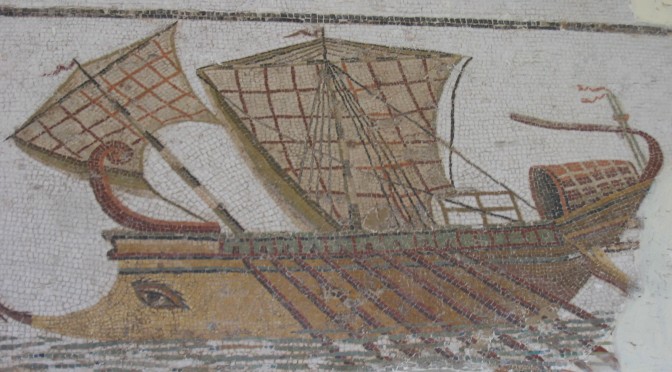
The role of the United States in contingency operations is changing. In all of the large-scale international interventions of the past few years, namely Libya, Mali, and the Central African Republic, the United States’ contributions consisted primarily of transport capacity in both the seas and the skies to bring foreign ground forces to the conflict. This trend appears unprecedented for a global power to pursue its interests but, as the saying goes, there is nothing new under the sun. The ancient maritime power of Carthage utilized the same strategy effectively in the fourth century B.C

For those who are unfamiliar, Carthage was a preeminent maritime power for hundreds of years in the Mediterranean. Pre-saging Alfred Thayer Mahan and 19th century European colonial powers, Carthage embraced an empire not built by massive land holdings but by a disparate collection of trading spheres, ranging from Spain to Sicily, connected by the era’s most powerful navy. There were very few powers that could challenge them on the open seas, making the Western Mediterranean a Carthaginian lake by which it could generate wealth.

Most people know the Carthaginians as the enemies of Rome in the era of Hannibal but that was not always the case. Up until their first dramatic clash in the thirdcentury B.C., the Romans and Carthaginians were allies were allies of convenience. The Carthaginians faced consistent incursions from Numidians in North Africa and colonial wars with the Greeks in Sicily while the Romans had to contend with Greek colonies and restive Samnites to their south. This culminated in the early fourth century B.C. when the Carthaginians used their navy to transport Roman legions to the south to fight their common Greek enemies. Carthage did not have to sacrifice any men to achieve their foreign policy objectives and the Romans, without naval lift, would have spent a much longer time marching their army south through dangerous territory. The Carthaginians were thus able to find manpower to handle operations they could not undertake and the Romans gained rapid mobility. Both sides profited from the arrangement.
  
The United States is in a similar position in the modern as Carthage was in the ancient world. The United States has unmatched transport capacity in both the maritime and air domains, evidenced in all possible measures: numbers of sea/air transport vehicles, total cargo capacity, and experience in deployment logistics. Many other nations have tactical transports but very few others have either the numbers of strategic-level transports or the financial resources necessary to support long deployments. This situation gives the United States a unique position to influence global deployment of forces; it offers a quasi-veto to undesirable deployments and a force-multiplier for operations that it wants to see conducted.
 
While the United States has unmatched transport capacity, there are a host of reasons why the United States cannot project its power simultaneously to tackle every global crisis: ongoing operations in Afghanistan, a lack of popular support for committing troops overseas, and tightening budgets restrict the United States. Carthage had similar limitations, due primarily to budgets and the mercenary make-up of their armed forces, which they circumvented in their wars against the Greeks by leveraging Roman manpower. The United States is already doing the same for France in Mali and the United Nations in the Central African Republic.
 
The story of transport supremacy did not end well for Carthage. In the First Punic War, fought a scant few years after the common war against the Greeks, the Romans raised a substantial navy and challenged Carthage’s dominance on the seas. Defeat in that war, combined with the defeats in the Second and Third Punic wars, would spell the end of Carthage’s empire. While the Carthaginians ushered in their doom by providing transport supremacy to their eventual conquerors, the United States is in no such risk of the same, allowing it to leverage the policy without stoking an existential threat to its existence.
 
The future looks bright for those with transport supremacy.
 
Matthew Merighi is a civilian employee with the United States Air Force. His views do not reflect those of the United States Government, Department of Defense, or Air Force.

The Legacy of Adm. William McRaven

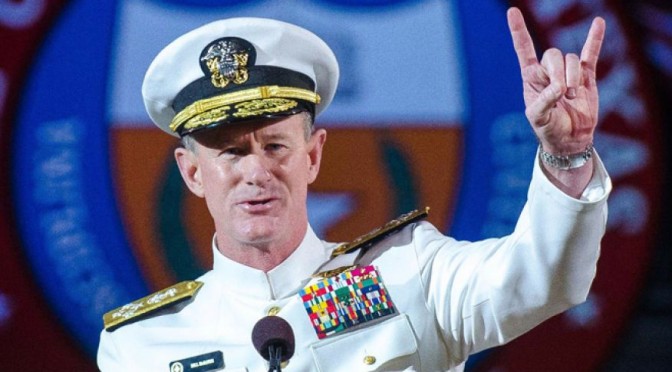
The most impressive intellectual leader working today is a one Bill McRaven.

By Robert Caruso

William McRaven is the most charismatic military leader since Fleet Admiral Chester Nimitz.

Perhaps more than any other serving officer, McRaven has postured the US Armed Forces to be better prepared when conflicts arise. He is the most accomplished flag or general officer of our time.

The future of what the U.S. armed forces looks like is uncertain, but one constant will be the mark McRaven has left. He is preparing to retire as the head of U.S. Special Operations Command, the nerve center of the effort to combat terrorism and other threats in the unlit spaces. While the past decade has been dominated by Iraq and Afghanistan, the United States cannot take its eyes off the threat of transnational terrorism nor the special activities of a Russia, Iran, or China.

To combat those threats, McRaven, his staff, and his counterparts have engaged willing nations the world over in building capacity, strengthening capabilities, and solidifying partnerships.

All national security professionals should know that more than any other serving officer, McRaven has postured the force to be better prepared when conflicts arise.

He holds the title of “Bull Frog”— the active-duty UDT/SEAL operator with the longest period of cumulative service.

SOCOM recently stood up J-3I, an operations directorate focused exclusively on international cooperation under McRaven’s guidance. A global network of special operations forces will be imperative to the future fight, as the nation increasingly turns to a global network of partners to combat a global network of threats.

Concurrently, he has increased SOF’s stature in Washington and established a framework to lead the interagency in the fight against globally dispersed networks.

During his time leading Joint Special Operations Command (JSOC), Naval Surface Warfare Center Crane stood up a customer advocate shop, devoted to resourcing special operations forces—a trend the rest of the sprawling Pentagon equities took to replicating with gusto.

When then-Secretary of State Hilary Clinton wanted to boast of the United States’ success at hacking al Qaeda, she took to the stage at the annual special operations conference, introduced by McRaven.

It was his deputy, Air Force General Marshall Webb, who is featured in the iconic White house situation room photo the night Osama bin Laden was killed.

McRaven is a proponent of the joint approach: early on in the global war on terror, the Pentagon “merged the two commando teams and headquartered the reflagged Task Force 121[McRaven] in Baghdad,” reported The Washington Post.

Indeed, the forces under McRaven’s command time and again revolutionized the way technology was used to win the fight. Much of modern social analysis and mapping techniques, as well as Palantir’s tools and software like Analyst’s Notebook and Webee instant messaging, owe their success with government to organizations he led during his career. And if that wasn’t enough, his 1993 thesis,”The Theory of Special Operations”, is required reading across government.

Many career FBI personnel believe this thesis revolutionized the way FBI looks at counterterrorism. It is considered such a seminal work that Coast Guard special operations forces created a doctrinal foundation based almost exclusively on its contents. In 2012, the President and the Secretary of Defense released new defense strategic guidance, emphasizing the need to rebalance toward the Pacific. But the majority of the crises that the United States will be called on respond to won’t always be in Asia. Globally postured and forward deployed, McRaven has left an indelible mark on the Armed Forces that stabilized the Government of the Philippines, defeated the Islamic Courts Union, captured Saddam, and killed bin Ladin.

In 2012, the President and the Secretary of Defense released new defense strategic guidance, emphasizing the need to rebalance toward the Pacific. But the majority of the crises that the United States will be called on respond to won’t always be in Asia. Globally postured and forward deployed, the Navy that once fielded thousands of river rats to fight in Vietnam and put Seabees on the ground in Afghanistan will be called upon again and again to augment special operations forces. SOCOM will play a large part in the execution, with or without a SEAL at the helm.

As McRaven first said in his June 2011 testimony: “The world’s strategic environment has evolved toward one that is characterized more by irregular warfare activity rather than major nation state warfare […] we must confront this ‘new normal’ and posture our forces to be successful in it.”

The U.S. armed forces and a grateful nation are better prepared to face those challenges because of McRaven’s contributions.

Robert Caruso is a veteran of the United States Navy and served in the Office of the Secretary of Defense at the Department of Defense, in the Bureau of Diplomatic Security at the Department of State and as a contractor for the Department of the Army. He is an Associate Editor at CIMSEC, and concurrently serves as the Tampa Chapter President.

No Money Back? History Lessons on the Russia MISTRAL Sale

Is there a case for historical analogies and the use of military history for contemporary decision-making? Are we just marking the centenary of World War One or, a hundred years on, are we going back to the future? Like others I acknowledge the value of history as a frame of reference, but I try to avoid (too close) analogies. Especially with World War One. Inconveniently, on 17 July 2014, Russian separatists in Ukraine shot down an innocent passenger aircraft killing 298 passengers and crew. Russia’s international credentials headed south, but questions remained also with regards to Ukraine’s role in this sorry episode. As recriminations were flying back and forth I felt reminded of the sinking in 1915 of the British liner LUSITANIA by the German submarine U-20. Then, 159 (neutral) American passengers were killed (out of a total of 1,198 casualties); the episode caused irreparable damage to Germany’s reputation and international relations in World War One.

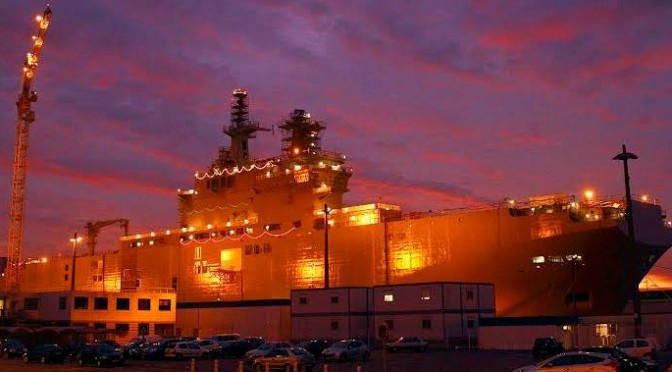
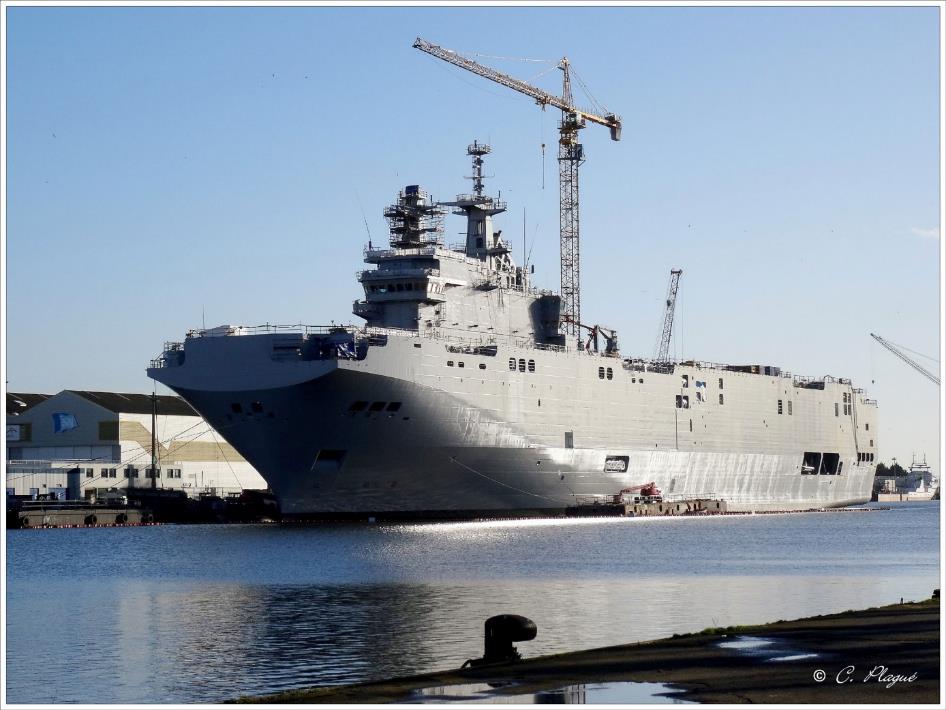
And there I was. I suppose you can find such analogies everywhere, if you cast your net wide enough. But as the discussion flared up again about the sale to Russia of two MISTRAL-class amphibious assault ships (BPC-210 class) by France, I really had the impression that we have been there before in some way or another. One of the vessels (the VLADIVOSTOK) has already paid for and France is in a quandary whether or not to deliver the ship to Russia, a country against which the EU has by now imposed wide-ranging sanctions. Reversing the German government’s tacit approval of Paris’s sale of the ships to Russia, some German politicians have now suggested that instead the EU should step into the contract and buy the ships. France argues the crews have already arrived in France for familiarisation and France cannot back out of the contract.

Vladivostok
BPC-210 type amphibious assault ship VLADIVOSTOK fitting out at DCSN in St Nazaire, January 2014. (Photo: G Plagué, Shipspotting)

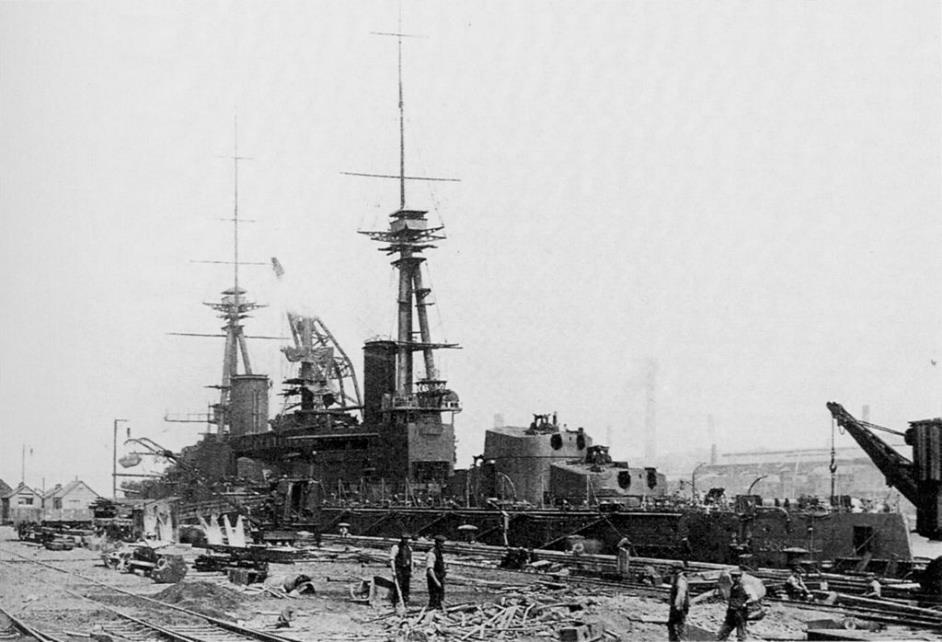
Rewind 100 years: on 2 August 1914 the Ottoman Empire ratified an alliance with the German Empire setting in motion a chain of events whose effects can still be felt today. This step had not been entirely unavoidable for the Entente powers. Unfortunately, the government in Istanbul had placed orders for two dreadnoughts with British shipyards (or rather: it had taken over a Brazilian contract in one case), one in 1911 and the other in 1913 (as well as one in 1914, but work never began on that order). As war loomed large the British government, at the behest of the First Lord of the Admiralty Sir Winston S Churchill, pre-emptively seized the two Ottoman battleships named Sultan Osman-ı Evvel and the Reşadiye after having stalled delivery of the already completed SULTAN OSMAN-I EVVEL for several weeks. The Admiralty offered a fixed payment per day for their usage in war, but this did not mollify the Ottoman government or public. The situation then was, of course, quite different from that of today, since France and Russia are not as war (as the British and Ottoman Empire would soon be after this episode), but the vignette offers a nice object lesson on the diplomatic and strategic reverberations of the cancellation of a major weapons deal in times of heightened tension.

The cancellation of the dreadnoughts’ delivery to the Ottoman Navy pushed Istanbul into the arms of the Central Powers. It also gave the Germans the opportunity to leverage the political and strategic impact of two vessels – the battlecruiser GOEBEN and the light cruiser BRESLAU – that were effectively bottled up inside the Mediterranean. Both ships were sent to the Ottoman Empire, which conveniently “purchased” the vessels as a replacement for the two dreadnoughts on 16 August 1914. However, these two ships were never an adequate replacement for the two heavy dreadnoughts kept by the British. It was only luck and the early demise of Czarist Russia that that prevented the small flotilla from being swept up in the Black Sea by the much bigger Russian dreadnoughts (IMPERATICA MARIJA class) that came into service in the course of the war. The Ottoman Empire also never fully recovered from the loss of her best naval crews that had been interned in Britain, even though the German crews expended much energy on training their Ottoman allies. In this respect, seizing the two vessels made a difference in the balance of power, though one that the Entente was never able to capitalise upon. Ultimately, Russia’s demise was also a result of the Entente’s inability to control the Bosporus.

OSMAN
Battleship SULTAN OSMAN I fitting out at Armstrong in Newcastle upon Tyne, ca. 1913. (Photo: Wikimedia Commons)

Acquiring the two Ottoman dreadnoughts in 1914 was a double edged sword for the Royal Navy. Although it increased the fleet size by two very powerful ships, those never quite fit into the fleet due to the different specifications to which they were built. Agincourt – originally a Brazilian prestige project, failed to impress Admiral John Jellicoe to the point that he initially refused to accept the ship into the Grand Fleet. The ship also required modifications, such as a conversion of the lavatories or addition (in the course of the war) of a better fire control system. The Royal Navy’s lack of enthusiasm for the two gift horses became apparent after the war, when Agincourt and Erin were the most modern major surface combatants to be scrapped in 1922 in order for Britain to meet her obligations under the Washington Naval treaty.

So what is to be done about the MISTRALs due to be delivered to Russia? Just like the dreadnoughts would have been valuable to Ottoman sea control in the Black Sea, the MISTRALs would be just the tool for Russia’s new “ambiguous warfare” and a valuable addition to re-asserting its sea control over the Black Sea rim, as Felix Seidler has argued in a recent post here. Indeed, his suspicion that at least one of the ships would be deployed to the Black Sea, rather than the Pacific, was borne out by a statement made by the Russian Navy on 27 July 2014, stating that one vessel would be based in Sevastopol. Indeed, not just as a C2 platform, but also as a floating base for special operations the MISTRALs would add very convenient capability given Russia’s current security environment and concept of operations in the Black Sea region.

As the Agincourt example shows, purchasing the ships brings its unique set of problems. Beyond the issue of technical integration into western forces, there is Russia’s political response to consider, which includes the small matter of Europe’s (especially Germany’s) dependence on Russian natural gas. The cancellation of the MISTRAL deal (technically only possible if the EU imposes level 3 sanctions) might just be enough to push Russia into retaliating with the “energy weapon”, something that might make even the most vocal German politician pause. France, however, is largely immune to this threat and has little to lose except its credibility as a weapons supplier and the loss of revenue from future arms deals with Russia.

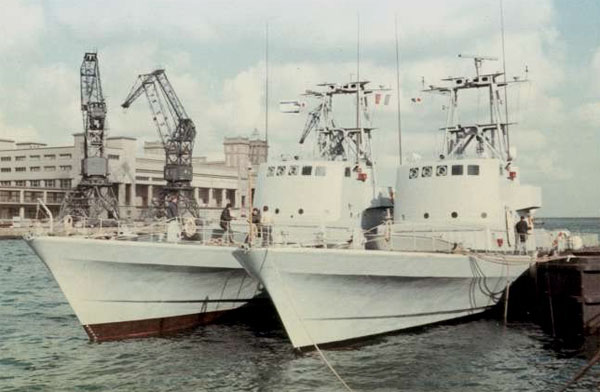
France already has experience with having paid-for warships and problematic (embargoed) customers on her hands. In 1969 the Israelis recovered five Sa’ar 3 guided missile boats that had already been paid for from a French yard after the French had refused to hand them over. This was a somewhat offbeat example of how to resolve such a matter. After the French government under Charles de Gaulle imposed an arms embargo on Israel in 1968, the boats were sold to a mysterious Panamanian-based Norwegian firm which was of course a front for the Israelis. There is some controversy, but it appears that French intelligence was forewarned about Israeli intention to liberate the vessels. So was the shipbuilding supervisor, Felix Amiot, who was later blamed for his part in the affair, but vigorously defended himself by saying “Security is not my problem. My job was to build ships. I got along very well with the Israelis, but as far as I know that is not a crime.” Ironically, Amiot’s shipyard had won the contract largely because it was able to deliver a German-design, which the Germans themselves could not deliver to Israel in the first place due to their restrictive arms export policy. On the morning of Christmas Day 1969 the five boats surreptitiously left Cherbourg and began their transit to Israel. There was some faked outrage, but neither French Mirages who overflew the boats nor Russian, British or American warships engaged the unarmed missile boats on their way.

Two completed Israeli Sa’ar 3 “patrol” boats in Cherbourg in 1969, less their weapons. (Photo credit: forum.valka.cz; photo source: unknown)

Whatever France’s tacit involvement was in the “escape” of the Stars of Cherbourg, the episode left the relationship between France and Israel markedly cooler for the next 10 years. Israel discontinued the purchase of Mirage aircraft and switched to US products for some time, although France is now again Israel’s largest arms supplier from the EU, especially for equipment that Israel is unable to obtain from the US. Given the protectiveness of France towards its defence industry, it is unlikely that the country would want to risk the highly lucrative arms sale (in the range of US$ 1.5 bn) to Russia just to please its EU neighbours. In any case, short of the EU implementing level 3 sanctions or impending hostilities by Russia against NATO or EU members it would seem unlikely that the MISTRAL deal could (and would) be cancelled without great cost to France – and potentially her European allies, if they are seen to be egging Paris on. More likely that France will try and temporize, hoping that the Ukraine conflict will blow over before the ships are to be formally handed over. Perhaps a lesson from the Ottoman battleships can still be learned here and some “unexpected” technical troubles and delays arising during the acceptance trials could buy France the time needed to avoid having to take an unpleasant decision.

Dirk Steffen is a Commander in the German Naval Reserve and the Director Maritime Security for Risk Intelligence. When not wrestling with West African maritime security issues he reflects on naval and military history, particularly the period between 1840 and 1920. Dirk holds an MA in Military Studies (Naval Warfare) from the American Military University. The views expressed in this article are his own.