Category Archives: History

Naval and maritime history section.

Themistocles: The Father of Naval Warfare

By David Van Dyk

“My boy, you will be nothing insignificant, but definitely something great, either for good or evil.” – School teacher of Themistocles

Since he was only a child, he knew he had always wanted the respect and recognition of his fellow citizens. He hungered for it, dreamt of it, and prepared for it. While all the other kids would play and laugh, he would study and write, spending countless hours practicing speeches in his home. His parents were of no special heritage, and royalty did not flow through his blood. In its place, determination coursed through his veins. Themistocles, an Athenian, knew he was meant for something great. History would show that Themistocles, when he became archon, encouraged a naval policy in Athens, and helped drive off the Persian Empire and secure a place of strength and resolve for Athens in the world. Ancient scholars and historians, like that of Plutarch and Herodotus, have documented his life, allowing a glimpse into the magnificence of his achievements. Modern day scholars have shed even more light, suggesting that it was Themistocles himself who saved the future of western civilization. Themistocles, the commander of the Athenian fleet, should be bestowed the title of the Father of Naval Warfare due to his understanding of the Persian Empire, the importance of naval supremacy, and his involvement in the political process.

If we are to understand the rise of Themistocles, then we must first understand the impacts of the Ionian Revolt. R.J. Lenardon, in The Saga of Themistocles, says the Ionian Revolt “was to have momentous consequences for all of Hellenes, not least the Athenians and Themistocles, during the first quarter of the fifth century.”1 How this revolt would shape both Athens and Persia would set the stage for the incredible life of the aspiring, but young, Themistocles.

In the year of 499 B.C., the Hellenes of Asia Minor realized they had experienced enough. The Ionians grew restless of the oppression of the Persian Empire, and decided to fight back. For over 30 years, the superpower of the world, Persia, had subjugated the Greek cities of Asia Minor under numerous tyrannies, forcing the Greeks to build the cities of Persia and further the dominion of their empire. Under the rule of King Darius, he “undertook a thorough and systematic political and financial reorganization of the Persian Empire.”2 With these sweeping changes now taking effect, Darius thought it a no better time than to expand the land and influence of the Persian Empire. Under his guidance, the Persians blazed their way through Europe, “campaigning successfully against the Thracians and even securing the allegiance of Macedonia.”While these accomplishments were impressive, the rising discontent of the Ionians against Persia grew. After failing to convince the Spartans to join their cause against Darius, the Ionians looked toward, as Herodotus says, “the next most powerful state” after Sparta, that of Athens.4

Herodotus writes, “After the Athenians had been won over, they voted to dispatch twenty ships to help the Ionians and appointed Melanthion, a man of the city who was distinguished in every respect, as commander over them.”5 Herodotus goes on to write in a flare of foreboding that “these ships would turn out to be the beginning of evils for … the barbarians.”6 After the allied contingent of the rebellion sailed to Sardis and burned the Persian city to the ground, the Athenians, due to heavy losses, withdrew from the fighting, and “they refused to help the Ionaians any further.”7 Yet their actions, with the help of the Ionians, would send Darius into a rage against the Athenians. Herodotus recounts a chilling tale:

“When it was reported to Darius that Sardis had been taken and burnt by the Athenians and Ionians and that Aristagoras the Milesian had been leader of the conspiracy for the making of this plan, he at first, it is said, took no account of the Ionians since he was sure that they would not go unpunished for their rebellion. Darius did, however, ask who the Athenians were, and after receiving the answer, he called for his bow. This he took and, placing an arrow on it, and shot it into the sky, praying as he sent it aloft, ‘O Zeus, grant me vengeance on the Athenians.’ Then he ordered one of his servants to say to him three times whenever dinner was set before him, ‘Master, remember the Athenians.’” 8

With the Athenian fleet now out of the picture, the Ionian Revolt began to wane. The final Persian push came at Miletus, where the Persian army and navy decided to disregard the more minor cities. Attacking the source of the rebellion, the Persians overtook the Ionians at Miletus and brought them under subjugation once again. The Ionian Revolt virtually ended, and the Persian Empire set about re-conquering the rest of the rebellious cities. This revolt had two major effects: The Persian Empire grew vastly in military power, and the wrath of Darius was now directed toward the Athenians. After all, how could he forget when he was reminded of their actions every time he sat down for dinner?

The Rise of Themistocles

After the successful defeat of the Ionian Revolt in 494 BC, Darius began his march toward Athens. Herodotus’ first mention of Themistocles comes on the heels of the advance of the Persian Empire on all of Hellas after its crushing defeat at the Battle of Marathon in 490 BC. Around 480 BC, after attempting to discern a prophecy from an Oracle, the people of Athens were disturbed as to its cryptic meaning, fearing the gods had predicted their end. “But among the Athenians was a certain man who had just recently come into the highest prominence; his name was Themistocles, and he was called the son of Neokles.”9 Themistocles convinced his fellow Athenians that the Oracle, in summary, was urging them to meet the Persians at sea. According to several ancient sources, the Oracle had spoken of “wooden walls,” and Themistocles used this interpretation to his advantage in his advising of a naval policy.

However,  around 483 BC when Athens was receiving large revenues from lucrative silver mines, Themistocles spoke to the government urging them to spend the increased revenue on their naval fleet. For a long time, Athens was at war with Aegina, who had sided with the Persian Empire in providing them “earth and water.”10 Themistocles saw Aegina as the perfect pretext to build up the Athenian fleet, knowing full well that Athens would need this fleet to face the coming onslaught of the Persian Empire. Plutarch, in his biography of Themistocles in Lives, recounts this tale as well:

“And so, in the first place, whereas the Athenians were wont to divide up among themselves the revenue coming from the silver mines at Laureium, [Themistocles], and he alone, dared to come before the people with a motion that this division be given up, and that with these moneys triremes be constructed for the war against Aegina. This was the fiercest war then troubling Hellas, and the islanders controlled the sea, owing to the number of their ships.”11

Plutarch, in the text above, points out one of the earliest examples of Themistocles’ lobbying for a powerful navy. Calum M. Carmichael, in Historical Methods, makes note of the importance of the Athenian navy as a whole from the years of 480 – 322 BC:

“Of all the public services, the naval [public office] … was arguably the most important. It directly served the strategic and commercial interests of the state: the duties centered on the command and maintenance of the trireme warship for a year. It involved a large outlay: maintaining a single ship could require expenditure in excess of one talent, whereas other liturgies required half as much or less. And, more than any other public service, the naval liturgy was an object of reform throughout the democratic period.”12

As a result of Themistocles’ lobbying, Athens devoted their increased revenues to the building up of the Athenian navy, thus establishing themselves as a powerhouse among the Greek city-states. However, his policies were not met with unanimous praise. Plutarch makes note of it, saying, “…he made [Athenian warriors], instead of ‘steadfast hoplites’ – to quote Plato’s words, sea-tossed mariners, and brought down upon himself this accusation: ‘Themistocles robbed his fellow-citizens of spear and shield, and degraded the people of Athens to the rowing-pad and the oar.’”13
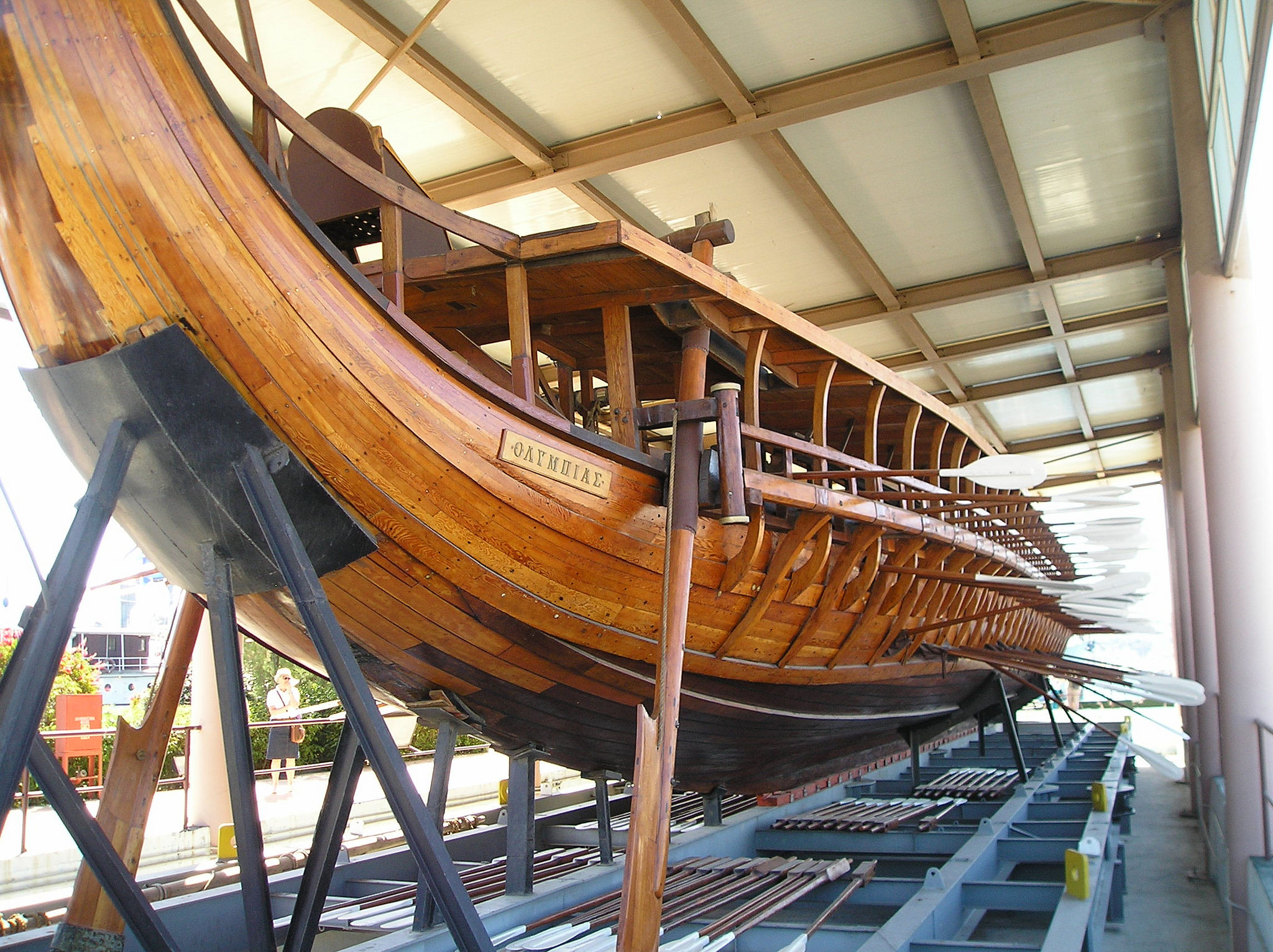
Themistocles was adamant in the construction of a large Athenian fleet, built up mainly of the Trireme class, pictured above. (Creative Commons)
Themistocles was adamant in the construction of a large Athenian fleet, built mainly of the Triremes, pictured above. (Creative Commons)

Yet Themistocles continued with his naval buildup. As he spoke to the Athenians concerning the Oracle’s cryptic message, he convinced them that rather than run and hide from the coming enemy, their salvation would come from the sea. Having just recently built up their naval power through the increased revenues from the silver mines, Themistocles capitalized on the moment, understanding that it was through naval power and not ground forces that would drive back the Persian Empire. Yet to fully grasp the sharp intellect of Themistocles as a naval advocate, we need to go back in time to 493 BC, when Themistocles found himself as archon of Athens, a perfect time to begin his march to the ocean.

Lenardan, in Saga of Themistocles, says, “Dionysius of Halicarnassus tells us that Themistocles was archon at Athens in 493 BC, and the chronographic tradition recorded by Eusebius lends particular support to the assumption encouraged by other evidence that it was as archon in that very year that he began the fortifications of the Piraeus.”14 Themistocles was familiar with the advantage of the Piraeus. This natural harbor provided three ports that had far more strategic value than the smaller Bay of Phalerum that the Athenians were using at the time. Tom Holland, in Persian Fire, says this of Themistocles’ genius:

“Drawing up his manifesto, he began to argue for the urgent down-grading of the existing docks and their replacement by a new port at Piraeus, the rocky headland that lay just beyond Phalerum beach. The shoreline there afforded not one but three natural harbors, enough for any fleet, and readily fortifiable. True, it lay two miles further from the city than Phalerum, but Themistocles argued passionately that this was a small price to pay for the immense advantages that a new harbor at Piraeus would afford: a safe port for the Athenians’ ever-expanding merchant fleet; a trading hub to rival Corinth and Aegina and immunity from Aeginetan privateers.”15

Themistocles understood that trading the convenience of Phalerum for the strategic position of Piraeus was well worth the trade-off. Whether Themistocles began this project during his archonship, or if he started it later, possibly around 483 or 479 BC, is debated among modern-day scholars. Cornelius Nepos, a Roman historian who lived from 110 BC to 25 BC, says this of Themistocles’ involvement with the building of the port at Piraeus: “Themistocles was great in the war [at Salamis], and was not less distinguished in peace; for as the Athenians used the harbor of Phalerum, which was neither large nor convenient, the triple port of the Piraeeus [sic] was constructed by his advice, and enclosed with walls, so that it equaled the city in magnificence, and excelled it in utility.”16 Nepos dates the building up of Piraeus after the Battle at Salamis in 480 BC, and makes no mention of it being started during the time of Themistocles’ archonship. Plutarch also writes “After [he built the walls of Athens] he equipped the Piraeus, because he had noticed the favorable shape of its harbors, and wished to attach the whole city to the sea; thus in a certain manner counteracting the policies of the ancient Athenian kings.” 17

However, there is no reason not to suggest that Themistocles initiated the building of the Piraeus while he was archon. Having desired to build up the naval prestige of Athens as soon as he could, he very well could have looked to the promising port during his early days in office. The National Hellenic Research Foundation appears to solidify this belief: “Thus, within only one year, Athens and the northern part of Acropolis received new fortifications, which incorporated the older building’s pieces and offerings, even tombstones, while beginning the completion of the fortification of the Piraeus port, already launched by Themistocles himself as the 493 BC ruler.”18 The building of the Piraeus port allowed the Athenians a superior advantage in their conquest to become masters of the sea. By encouraging the Athenians to move their current harbor to a more secure one, Themistocles once again proved his intellect in understanding the multiple facets of naval power. He had built up a strong fleet through the use of increased revenue from the state, and moved the focus of their sea power to a safer, more strategic area.
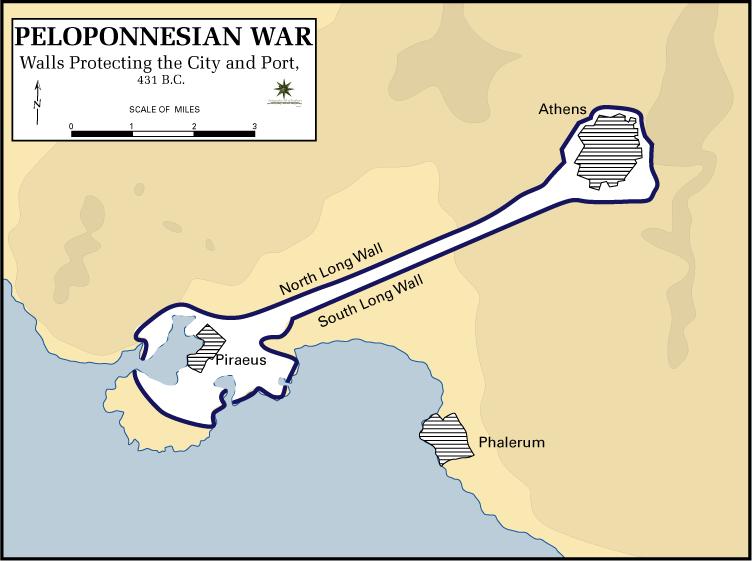
Map depicting Piraeus fortifications. Themistocles thought it prudent to move Athen's main port from Phalerum to Piraeus. This shift would allow Athens three natural harbors, all effectively sheltered from storm and invader.
Map depicting Piraeus fortifications. Themistocles thought it prudent to move Athen’s main port from Phalerum to Piraeus. This shift would allow Athens three natural harbors, all effectively sheltered from storm and invader. (Creative Commons)

What may be more impressive than anything else was his foresight. During the time after the Battle of Marathon, many believed that the Persians were defeated and would not come back. Lenardon makes mention of this: “Most of the Athenians believed that the defeat of the Persians at Marathon meant the end of the war; but Themistocles realized it was only the beginning of greater struggles.”19 Themistocles understood that after the death of Darius, Xerxes would seek vengeance, and it would come swifter and stronger than the last battle at Marathon. Themistocles had his fleet, and the construction of the Piraeus port was nearing completion. Now, he would test the resolve and courage of his fellow allies in battle at Salamis.

At the Battle of Salamis, we encounter first-hand the intellect and courage of Themistocles, now the commander of the Greek allied fleet. His exploits here are perhaps what has made him become the legend he is today.

Manipulating the Enemy

When the Greek allied fleet converged at Salamis, it was the largest contingent to have assembled. Thucydides accounts for the navies present:

“For after these there were no navies of any account in Hellas till the expedition of Xerxes; AeginaAthens, and others may have possessed a few vessels, but they were principally fifty-oars. It was quite at the end of this period that the war with Aegina and the prospect of the barbarian invasion enabled Themistocles to persuade the Athenians to build the fleet with which they fought at Salamis; and even these vessels had not complete decks. The navies, then, of the Hellenes during the period we have traversed were what I have described. All their insignificance did not prevent their being an element of the greatest power to those who cultivated them, alike in revenue and in dominion.”20

Yet the admirals that were also in command of the Greek allied fleet were nervous and unsure. They believed that rather than fight the Persian fleet at Salamis where the Persian army was gathering, they would turn and sail toward the Isthmus at Peloponnese, and defend the city-state of Sparta from there. But Themistocles understood that the only way to defeat the Persian navy was to use their vast numbers against them. The straits and narrow passages at Salamis would force the Persian navy to thin their numbers in order to pass through the waters. From this vantage point, the Greek allied fleet could inflict serious damages on the Persians. Knowing this, Themistocles sent a messenger in secret to the Persian commanders. Herodotus narrates the story, writing that the messenger, acting as a defector, informed the Persian commanders that the Greek fleet was in disarray and unsure of themselves. Encouraging the Persians that now was the time to strike, he “made a quick departure” from the Persian navy.21 

The Persian generals, eager to crush the Greek allied fleet and sail through to Athens and then Sparta, chomped on the bait, hoisted the sails, and sliced through the waters to Salamis. Themistocles was then alerted by a scout that the Persian navy was upon them, and the Greek allied fleet would need to make their stand at Salamis. Themistocles’ plan had worked. The fate of Athens, and the future of Greece, would rest at Salamis.

A Fitting Father Figure

Because of the cunning and intellect of Themistocles, the Greek allied fleet won a decisive victory at Salamis. The Persian navy found an organized and battle-ready Greek fleet, and the narrow passages of Salamis proved too narrow for the great numbers of Persian ships. The Greeks drove back the advance of the Persian Empire once again, reminding Xerxes of an earlier time, when his father, Darius, was defeated at Marathon.   

Herodotus recounts, “Thus it was concerning them. But the majority of [Xerxes’] ships at Salamis were sunk, some destroyed by the Athenians, some by the Aeginetans. Since the Hellenes fought in an orderly fashion by line, but the barbarians were no longer in position and did nothing with forethought, it was likely to turn out as it did.”22

Xerxes’ final push came with the culmination of the land battle at Plataea and the naval battle at Mycale around 479 BC. There, the Greeks destroyed the advances of the Persian forces, and Xerxes retreated back into his homeland.
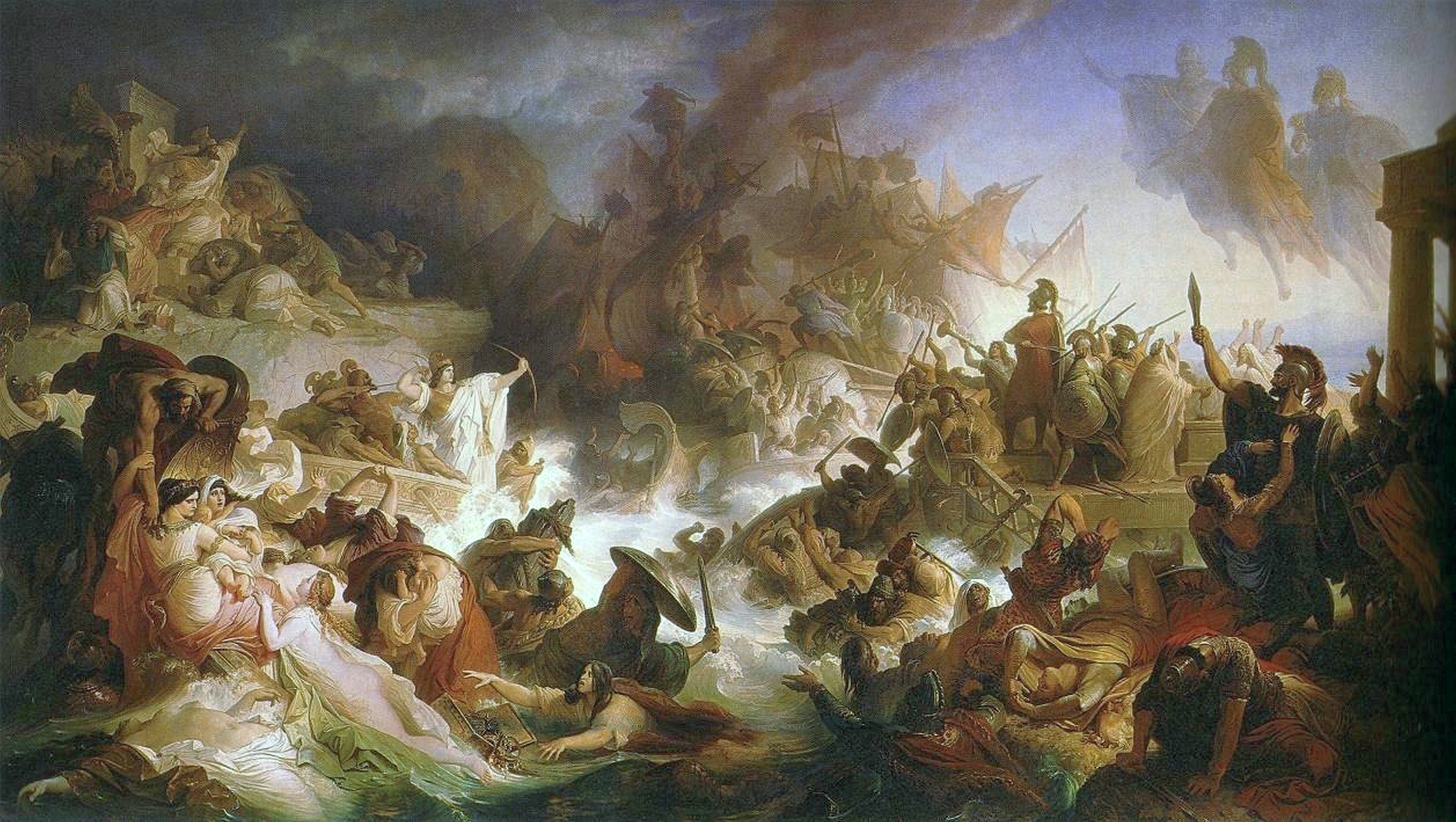
The Battle of Salamis was crucial in deciding the direction of the Greco-Persian Wars. Above, Wilhelm von Kaulbach's romantic painting of the Battle of Salamis. (Creative Commons)
Wilhelm von Kaulbach’s romantic painting of the Battle of Salamis. The Battle of Salamis was crucial in deciding the direction of the Greco-Persian Wars. (Creative Commons)

Modern day scholars, like that of Victor Davis Hanson, an internationally recognized military historian, have credited the battle at Salamis as “one of the most significant battles in human history.”23 Thucydides, in his landmark work of History of the Peloponnesian War, has this to say of Themistocles:

“Themistocles was a man who exhibited the most indubitable signs of genius; indeed, in this particular [war], he has a claim on our admiration quite extraordinary and unparalleled. By his own native capacity, alike unformed and unsupplemented by study, he was at once the best judge in those sudden crises which admit of little or of no deliberation, and the best prophet of the future, even to its most distant possibilities.”24

In earning such praise and admiration from his peers, Themistocles was made a legend. His knowledge and wisdom in naval warfare gave Athens the upper hand against the Persian Empire and, as scholars have argued, saved the future of western civilization. Should the Persian Empire have sacked Athens and Sparta, it would have immediately halted the advance of the Greek city-states. From there, Xerxes would have swept into Europe. But, “among the Athenians was a certain man who had just recently come into the highest prominence; his name was Themistocles.” It would only be fitting then that Thucydides, the Father of Scientific History, would write of the exploits and glories of Themistocles, as this author proposes, the Father of Naval Warfare.

David Van Dyk is a graduate of Liberty University with a Bachelor’s of Science in Communications Studies and a member of the Lambda Pi Eta honor society. He is currently pursuing a Master’s in Public Policy with a focus in International Affairs at the Helms School of Government. He can be reached at dvandyk@liberty.edu.

References

1.  Robert J. Lenardon, The Saga Of Themistocles, London: Thames and Hudson, 1978.

2. Ibid.

3. Ibid.

4. Robert B. Strassler, The Landmark Herodotus: the Histories, New York: Anchor Books, 2009.

5. Ibid.

6. Ibid.

7. Ibid.

8. Ibid.

9. Ibid.

10. Ibid.

11. Lives: Themistocles And Camillus, Aristides and Cato Major, Cimon and Lucullus, 1 Cambridge, Mass: Harvard University Press, 1914.

12. Calum M. Carmichael, “Managing Munificence,”Historical Methods 42, no. 3: 83, 2009.

13. Ibid.

14. Ibid.

15. Ibid.

16. Cornelius Neps, Cornelius Nepos: Lives Of Eminent Commanders, The Tertullian Project, 1886. 

17. Ibid.

18. “The Walls Of Athens” National Hellenic Research Foundation, October 27, 2009, http://www.eie.gr/archaeologia/gr/02_deltia/fortification_walls.aspx.

19. Ibid.

20. Ibid.

21. Ibid.

22. Ibid.

23. Victor Davis Hanson, Carnage And Culture: Landmark Battles in the Rise of Western Power, New York: Doubleday, 2001.

24. The Peloponnesian War, London, J. M. Dent: New York, E. P. Dutton, 1910.

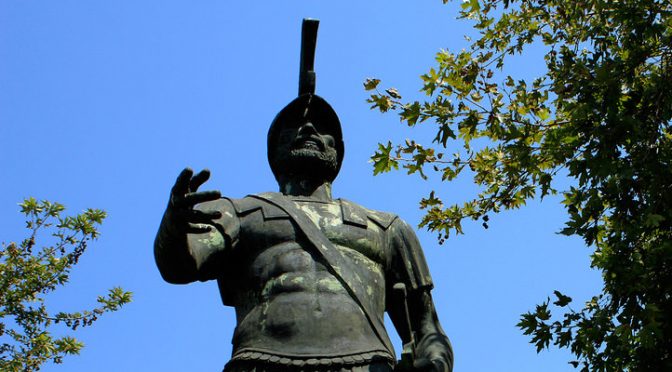
Featured Image: Statue of Themistocles in Piraeus, Greece. (Vassilis Triantafyllidis – www.LemnosExplorer.com)
The Legacy of the 2004 Indian Ocean Earthquake and Tsunami On U.S. Maritime Strategy

Naval HA/DR Topic Week

By CDR Andrea H. Cameron

In less than a century, the notion of humanitarian assistance evolved from a global rarity to a significant component of international relations. Military involvement has escalated so much that  brief mentions in early strategy documents have turned into entire sections and mission areas dedicated to the subject. From 1970 to 2000, the U.S. military was diverted from its regular schedule to conduct humanitarian assistance/disaster relief (HA/DR) operations 366 times.[1] This leads to so many questions around the issue of military involvement in HA/DR. For example, what does the United States gain from doing HA/DR? With so many more serious priorities, why do we need to examine HA/DR? A professional warfighter may say they specialize in destroying things, not fixing them, therefore concluding that HA/DR should not be in the military skillset. Overall, what is the future of the military’s role in HA/DR?

To help answer these questions, we will have to look at the connection between American strategy and maritime strategy. Throughout history, maritime forces were solely defined by their hard power capability. The focus of maritime strategy has historically been the protection of commerce, denial of resources to an enemy, and enabling of ground forces.[2][3] Previous maritime strategists like Alfred Thayer Mahan, Sir Halford Mackinder, and Julian Corbett make no mention of using maritime forces for assistance related missions. However, the grand strategy of American primacy is founded on maintaining the liberal international order, protecting open commerce and international trade, and spreading American values of freedom and self-determination. Additionally, U.S. interests remain inextricably linked to the peace and security of other countries. With globalization, a disruption to the international system like a natural disaster challenges the security of the United States and the rest of the world—particularly the highly interconnected economic system. And getting back to our maritime strategists–that economic system is primarily safeguarded by the forward presence of U.S. maritime forces. It is those same forces that are well positioned to respond to a natural disaster and minimize the disruption through relief operations. It is the convergence of significant economic interests, international responsibility to the world order, and the global humanitarian values that provides strategic motivations for continued involvement in HA/DR operations. 

Humanitarian assistance/disaster relief has emerged as a noteworthy piece of U.S. national strategy. The critical turning point was the strategic, political, and military lessons learned from the 2004 Indian Ocean earthquake and tsunami. As a result, HA/DR operations have elevated not only within U.S. strategy, but also received similar attention from navies around the world.  For the first time, HA/DR was formally named a maritime core capability in the 2007 Cooperative Strategy for the 21st Century Seapower. While the continued justifications for military involvement in HA/DR vary greatly, the increasing emphasis on this subset of the mission has undeniably grown. Understanding the early military contributions to humanitarian assistance, studying what happened in 2004, and examining the strategic guidance afterward reflects the monumental strategic shift of using hard power assets for this soft power mission. This article captures why HA/DR rose to such a high place in national and military strategy and why the military will most likely increase involvement in HA/DR missions in the future. 

Military Support of HA/DR Before 2004

The United States uses all instruments of national power to support U.S. strategic goals. As an instrument of national power, the military can bring significant capability to a disaster relief operation beyond the host nation and international community’s capacity. While all services can and do play a role in humanitarian assistance/disaster relief, the Navy and Marine Corps are uniquely positioned for this mission. Largely self-sustainable, forward deployed, flexible, and trained for mobilization of sea-to-shore assets, the maritime services can provide assistance quickly, on location, and without exacerbating the ashore capacity constraints. Additionally, strategic lift, medical support, construction battalions, air traffic controllers, and maritime pre-positioning ships all contribute to HA/DR.

With the end of the Cold War, the 1990s saw the rise of naval presence as a mission set in and of itself. Peace and economic prosperity were facilitated by developing and maintaining regional stability through the Navy’s forward presence. Also, forward presence could shift from unobtrusive peacetime operations to power projection in short order demonstrating United States commitment while simultaneously promoting American interests.[4]  The Navy and Marine Corps evolved as the key crisis responder in a variety of military-operations-other-than-war. Planning and conducting HA/DR was included in this broader category.[5] Reflecting U.S. values, the Naval Operational Concept of 1997 stated: “When disaster strikes, we provide humanitarian assistance, showing American compassion in action.”[6] HA/DR also provided an opportunity to work with joint and  coalition partners to improve operational cohesion and mutual trust. While HA/DR was by no means predominant, it was routinely mentioned in naval guidance as one of the operational capabilities of the service.

After the terrorist attacks of September 11, 2001, President Bush increased humanitarian assistance particularly in support of spreading democracy throughout the world.[7] In pursuit of the global war on terror, aid was provided to states for improving governance—particularly in areas with ungoverned spaces in which terrorists could dwell. Military-conducted humanitarian assistance was considered part of the preventative actions in the active, layered defense of the United States homeland.[8] After 9/11, military involvement in humanitarian assistance shifted to preventative measures in the fight against terrorism. While these are two very different justifications for humanitarian assistance, the events of the 2004 Indian Ocean earthquake and tsunami significantly altered the role of humanitarian assistance/disaster relief in U.S. strategy and for the military.

2004 Indian Ocean Earthquake and Tsunami

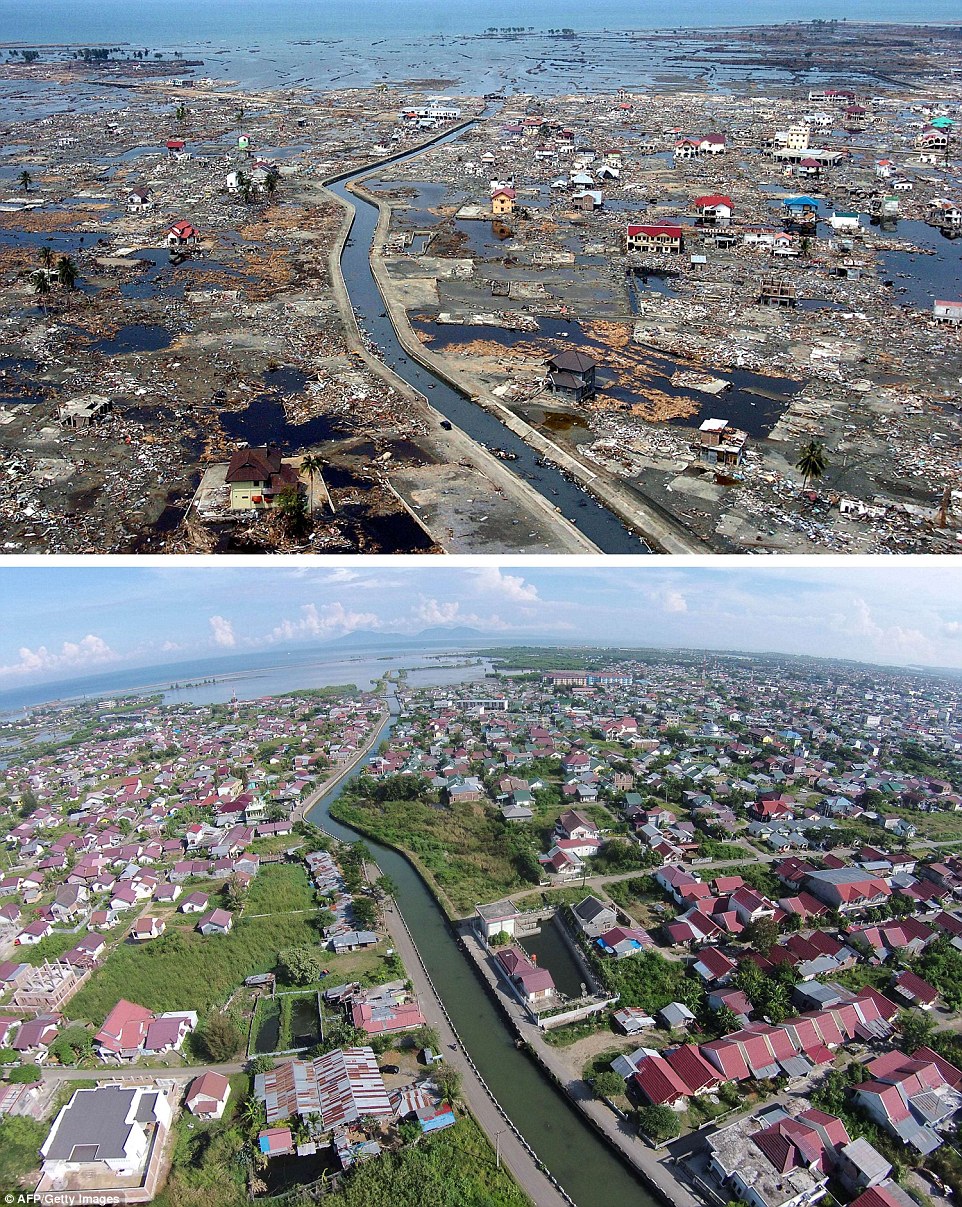
At 7:59 A.M. on December 26, 2004, a 9.15 magnitude earthquake occurred off the western coast of the Sumatra island of Indonesia in the Indian Ocean. During the earthquake, the seabed rose by as much as 16 feet in some areas—displacing an estimated seven cubic miles of water and causing tsunamis across the Indian Ocean. In total, there were over 225,000 reported fatalities and missing people and nearly 1.2 million displaced people.[9] The worst damage occurred in the Banda Aceh province on an island of Sumatra, Indonesia, resulting in 163,000 people dead or missing and over half a million displaced.[10] Basic infrastructure like shelter, medical capacity, transportation routes, emergency services, power, communication, and sanitation were lost. The main highway connecting Banda Aceh to the rest of the island was washed away, cutting off the major city from land-based support. Thailand also reported 8,000 dead or missing.[11] Sri Lanka reported 38,000 dead and missing and 500,000 displaced, and India reported 16,000 dead or missing.[12] Other countries impacted include Maldives, Seychelles, Somalia, Tanzania, Kenya, and one fatality recorded as far away as South Africa. Overall, this one event had a significant impact on all countries around the Indian Ocean and for a variety of reasons had a global affect as well.

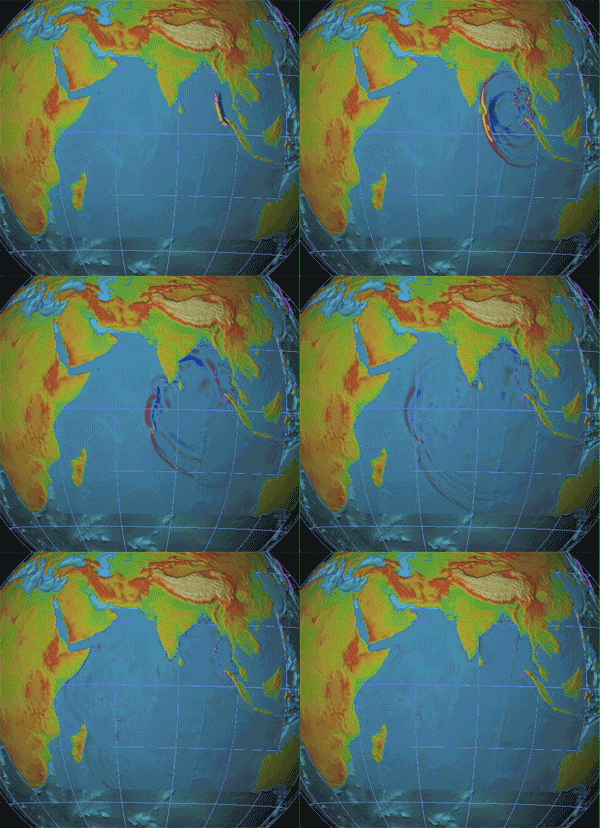
2004_Indonesia_Tsunami_Complete
Animation of 2004 Indonesia tsunami Source: heche un gas [http://www.noaanews.noaa.gov/video/tsunami-indonesia2004.mov video Animation provided by Vasily V. Titov, Associate Director, Tsunami Inundation Mapping Efforts (TIME), NOAA/PMEL – UW/JISAO, USA.
American Political Response

President George W. Bush made the first public commitment of support three days after the earthquake and tsunami.[13] On December 29, 2004, he announced the initial aid contribution of $15 million and military assistance. As more accurate reports came in, he increased the aid to $35 million on the same day.[14] While the primary responses of state department and defense department were already taking action to coordinate efforts within the region, the perception of delayed global leadership put both President Bush and Secretary of State Colin Powell on the defensive. The United Nations Emergency Relief Coordinator, Jan Egeland, openly accused the United States of being stingy with respect to the global crisis.[15] Although massive mobilization was occurring to support relief efforts, the president was losing ground with international public relations and the perception of weak U.S. leadership. By December 31, based on more accurate reports of the damage, President Bush increased the United States contribution to $350 million.

The American response far out-weighed the contributions of any other state, however, the political handling of the situation displayed a perceived passivity, lack of global leadership, and general lack of respect for human life abroad. While untrue, there was the perception that American actions did not match American values. As the United States proceeded in coordinating the global response until the international humanitarian system became established, President Bush consistently had to battle the negative global perception that happened at the start of the event. By the end the United States government donated $950M and American citizens donated $700M to charities.[16]

American Military Response

The U.S. military response was immediate. While the State Department holds the lead in foreign disaster relief, geographic combatant commanders have the ability to act in a window of 72 hours without President/Secretary of Defense approval, provided the combatant commander coordinated with the local Chief of Mission.[17] Based on this authority, the United States military response started before the political response in the 2004 Indian Ocean earthquake and tsunami. Immediately upon notification of the tsunamis, Admiral Thomas Fargo of Pacific Command (PACOM) and Admiral Walter Doran of Pacific Fleet (PACFLT) authorized ship movements toward the region—particularly off the coast of Indonesia.[18] Soon thereafter, at the direction of the President, the Secretary of Defense authorized PACOM to establish a disaster response operation: Operation Unified Assistance.[19] By December 28, before President Bush publically announced the first proclamations of U.S. support, PACOM already established Joint Task Force 536 (JTF 536) and appointed USMC Lieutenant General Robert Blackman from 3rd Marine Expeditionary Force to lead the efforts. By December 30, the first C-130s arrived and December 31 the first helicopters arrived. The headquarters was up and running by January 2—one week after the event. On January 3, the JTF evolved to Combined Support Force 536 (CSF 536) to include and coordinate the assets brought forth from other nations. Australia brought 900 troops to Aceh province, Japan contributed two ships and 350 troops, Singapore provided tank landing ships and helicopters, and Britain, Germany and China supplied medical teams.[20] By January 5, a week and a half after the event, the United States had 25 ships, 45 fixed-wing aircraft, and 58 helicopters and a total of over thirteen thousand military personnel supporting the HA/DR mission.[21]

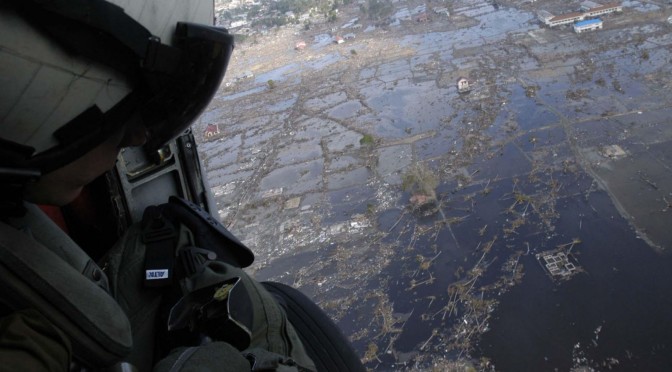
23E810A300000578-0-image-a-112_1418134716383
The district of Banda Aceh in Aceh province, located on Indonesia’s Sumatra island, just days after the massive Boxing Day tsunami of 2004, and below it the same location photographed on December 1, 2014.

Maritime support was vital to this HA/DR mission. The concept of sea-basing was put to the test since Banda Aceh lacked the land based connection and U.S. ships with supplies were available right off the coast. This kept the U.S. military footprint ashore to a minimum, while still delivering significant amounts of aid on short notice. Aid was loaded onto aircraft and maritime pre-positioning ships coming from Japan, Guam, and Singapore staged with relief supplies. Those ships would transfer the supplies to the other ships off the coast and then return for more supplies. Then, the carrier strike group and amphibious readiness group would send supplies ashore using helicopters and Landing Craft Air Cushions (LCAC). The majority of the personnel working relief operations never had to be housed or fed ashore. Operation Unified Assistance proved the operational merit of sea-basing.

The first week focused on the delivery of food and water, rescuing survivors in isolated, cut off areas and delivering medical aid. By the second week, clearing rubble, demolition, tearing down damaged buildings, and salvaging materials to rebuild became the major focus. Most immediate needs were met by mid-February and international and non-governmental organizations were now in place to continue the delivery of aid. CSF 536 ceased operations on February 14, 2005. The total military operation lasted a month and a half, but delivered over twenty-four million pounds of relief supplies and performed 19,512 medical procedures.[22][23]

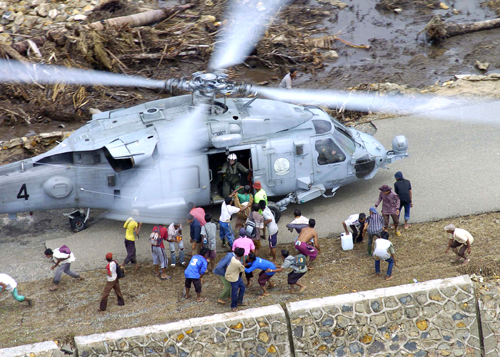
Indonesians from the village of Tjalang, Sumatra, Indonesia, rush towards a SH-60 Seahawk helicopter, assigned to Helicopter Anti-Submarine Squadron 2, as the helicopter touches down to drop off food supplies, Jan. 8, 2005. Helicopters assigned to Carrier Air Wing 2 and sailors from the aircraft carrier USS Abraham Lincoln are supporting Operation Unified Assistance, the humanitarian effort in the wake of the tsunami that struck Southeast Asia. (U.S. Navy photo by Petty Officer 2nd Class Philip A McDaniel)
Indonesians from the village of Tjalang, Sumatra, Indonesia, rush towards a SH-60 Seahawk helicopter, assigned to Helicopter Anti-Submarine Squadron 2, as the helicopter touches down to drop off food supplies, Jan. 8, 2005. (U.S. Navy photo by Petty Officer 2nd Class Philip A McDaniel)

Lessons Learned and After Effects

Numerous lessons learned emerged from the experience with the 2004 earthquake and tsunami. First, the greatest lesson learned by the United States was to better manage the politics and public relations. While the state and defense departments responded with immediacy, the delayed public statements by President Bush gave the impression that the United States would not live up to its values nor lead in a time of need. In the end, the United States, particularly the military, displayed leadership and coordination in a time of crisis and provided solid support to the overwhelmed host nations, United Nations, and governmental and non-governmental organizations all trying to help. The strength of naval capability and coordination also proved the sea-basing concept in support of humanitarian missions in sensitive areas. Another key result for the United States was a reassurance of military support in the future to allied countries in Asia as well as an improved relationship with Indonesia. After Operation Unified Assistance, the United States ended an embargo on military goods and normalized diplomatic relations with Indonesia.[24] U.S. actions also countered the anti-Muslim perception created by the Iraq War and increased public opinion of the U.S. in Indonesia by 39%[25] Internationally, key lessons included education, preventative measures, and pre-coordination. Finally, given that the same event affected so many countries, this showed that countries that had conducted previous exercises and coordination events to prepare for a natural disaster fared better in responding to an actual disaster.

These lessons permanently changed the perception of state response to HA/DR. Internationally, the norms of humanitarianism and state-to-state collaboration had evolved to such a degree that states are expected to offer assistance in times of need. The minimal response of China, a rising international actor, was internationally ridiculed. The delayed political response of United States signaled strategic weakness in global leadership, holes in the security umbrella, willingness to come to the assistance of allies, gaps in forward presence supporting the economic system, and a compromise of U.S. values. Whether true or not, and most of this is untrue, the United States became acutely aware that the proper handling of this type of HA/DR mission has significant strategic consequences.

Shortly after the 2004 Indian Ocean earthquake and tsunami, two major events also supported a changed mindset for humanitarian assistance/disaster relief. On August 29, 2005, Hurricane Katrina struck the Gulf coast of the United States resulting in over 1,800 fatalities and $125 billion in economic damages. Then, on October, 8, 2005, a devastating earthquake in Pakistan killed over 73,000 people and displaced 500,000, prompting another large-scale U.S. HA/DR response supported by the military. Both events created a heightened awareness for the impact of natural disasters and reinforced the lessons of the 2004 Indian Ocean earthquake and tsunami. National strategy started to reflect the new approach.

Impact on United States Strategy

This section chronicles the various ways HA/DR permeated U.S. strategic guidance after the 2004 Indian Ocean earthquake and tsunami. President George W. Bush’s 2006 National Security Strategy listed humanitarian assistance in a stand-alone section at the end of the document addressing international engagement and globalization. Factors like trade, investment, information, and technology were changing the geopolitical landscape in ways that could threaten national security. This strategy placed humanitarian disasters in a category with failed states and ungoverned areas that could become safe havens for terrorists. [26] While climate change was not specifically mentioned, environmental destruction (man-made or natural) addressed these disasters. The tone was matter-of-fact, that the capacities of local governments may be overwhelmed requiring a larger international response and the “full exercise of national power, up to and including traditional security instruments.” [27] United States assistance demonstrated global leadership, unattended events could threaten national security, the U.S. was willing to create new partnerships, and had ardent desire for preparedness and improved coordination. 

The 2006 Quadrennial Defense Review also included an assessment of the 2004 Indian Ocean response among several other humanitarian assistance related items. This document connected military support of humanitarian assistance with everything from  large scale disaster relief operations, to promoting regional stability in general, stability and reconstruction operations specifically, working with international allies and partners, promoting U.S. values abroad, and homeland security after Hurricane Katrina. [28] Fighting the long war continued to include humanitarian and early prevention measures to keep America safe. The QDR stated:

“U.S. forces continue to conduct humanitarian assistance and disaster relief operations around the globe. Preventing crises from worsening and alleviating suffering are goals consistent with American values. They are also in the United States’ interest. By alleviating suffering and dealing with crises in their early stages, U.S. forces help prevent disorder from spiraling into wider conflict or crisis. They also demonstrate the goodwill and compassion of the United States.”[29]

It was the 2007 Cooperative Strategy for 21st Century Seapower, signed by the service chiefs of the Navy, Marine Corps, and Coast Guard, that fully elevated humanitarian assistance and disaster response to one of the six core capabilities of the sea services.[30] The strategy in general placed a great emphasis on the maritime role in maintaining the global economic system and international order—reflecting a broader strategic perspective compared to a typical threat-based approach. HA/DR now held its own place amongst the traditional maritime capabilities of forward presence, deterrence, sea control, power projection, and maritime security.

In 2010, President Barack Obama’s National Security Strategy broadly addressed both climate change and humanitarian assistance. Not only did this reflect the change in leadership, but also the devastating effect of the 2010 Haiti earthquake that resulted in over 222,000 fatalities. The new strategy included humanitarian assistance as part of promoting dignity through meeting basic needs and broad international cooperation for global challenges. For the first time, a national security document reflected the Intergovernmental Panel on Climate Change (IPCC) reports that portend that as a result of climate change, natural disasters will be increasing in frequency and effect.[31][32]

Follow-on strategy documents continue to reiterate the humanitarian assistance mission in a wide variety of contexts. Secretary Robert Gates’ 2010 Quadrennial Defense Review connected HA/DR with climate change and energy security as well as regional destabilization as a result of climate change. The 2011 National Military Strategy addressed HA/DR in strengthening international and regional security—focusing on the joint, interagency, and theater security cooperation aspects before, during, and after an event.[33] The 2012 Defense Strategic Guidance includes HA/DR domestically in support of civil authorities and internationally to provide military response options to major events.[34] By the 2014 Quadrennial Defense Review, HA/DR was listed as one of twelve mission priorities requiring military advice to the President. The QDR also categorized HA/DR as part of the power projection capability of the military.[35] In President Obama’s 2015 National Security Strategy, HA/DR is also mentioned in the context of building our national defense, building partner capacity, and confronting climate change. [36] As the documents show, while the HA/DR mission is a constant, the highlighted reasons for doing it keep shifting.

In the 2015 Cooperative Strategy for 21st Century Seapower, HA/DR is included among the naval functions of defending the homeland, deterring conflict, responding to crises, defeating aggression, protecting the maritime commons, and strengthening partnerships.[37] Following the 2014 QDR categorization of HA/DR as power projection, HA/DR is a “smart power” mission of power projection highlighting the use of military forces as an element of national power for diplomatic, informational, and also economic ends. The HA/DR segment highlights the 2010 Haiti earthquake response, 2011 earthquake/tsunami in Japan, and the 2013 typhoon Haiyan response in the Philippines. The maritime strategy emphasized the increased number of large scale events and the corresponding importance of HA/DR to maritime strategy.

So Why Do HA/DR?

Several trends converge that keep humanitarian assistance/disaster relief on the agenda. First and foremost, as learned after the 2004 Indian Ocean earthquake and tsunami response, if the United States is going to protect strategic, political, economic, and ideological interests abroad, then we must employ all instruments of national power to support HA/DR missions. The consequences of not doing so invite too much risk to destabilizing the current world order. Assisting in response and recovery support U.S. interests by rebuilding economic trade capacity, reassuring allies, shoring up ungoverned spaces that destabilize regions and germinate terrorist safe havens, and living up to the American values. The number of large scale natural disasters continues to escalate since the 2004 earthquake/tsunami and climate change scientists predict increased incidences and severity of natural disasters. Whether HA/DR is a derivative of forward presence or an embedded capability of power projection, whether it is labeled environmental destruction or climate change, whether it is to fight terrorism or promote broad international cooperation for global challenges—the evidence shows that HA/DR will remain a mission for the armed services no matter who is leading the country. Whatever the justification for doing HA/DR operations, it will continue to support U.S. interests and the strategic consequences of getting it wrong are too great. So, let’s do our part in doing it better!

Commander Andrea H. Cameron is a Permanent Military Professor in the National Security Affairs Department teaching policy analysis. She is also a member of the NWC Civilian-Military Humanitarian Response Program (HRP) which partners with leading universities and humanitarian organizations in order to advance civilian-military engagement and coordination during complex emergencies and disasters.

[1] W. Eugene Cobble, H.H. Gaffney, Dmitry Gorenberg. For the Record: All U.S. Forces’ Responses to Situations, 1970-2000 (Alexandria: Center for Naval Analyses Corporation, 2005).

[2] Alfred Thayer Mahan. The Influence of Seapower on History (New York: Dover Publications, Inc., 1890).

[3] Julian S. Corbett. Some Principles of Maritime Strategy (London: Longmans, Green and Co., 1918)

[4] “…From the Sea” reprinted in U.S. Naval Strategy in the 1990s, ed. John B. Hattendorf (Newport: Naval War College Press, 2006) p 91-92.  Retrieved from https://www.usnwc.edu/Publications/Naval-War-College-Press/-Newport-Papers/Documents/27-pdf.aspx

[5] Naval Warfare (Naval Doctrine Publication 1) reprinted in U.S. Naval Strategy in the 1990s, ed. John B. Hattendorf (Newport: Naval War College Press, 2006) p 115-116.

[6] “The Naval Operational Concept,” signed by Chief of Naval Operations Admiral Jay L. Johnson, reprinted in U.S. Naval Strategy in the 1990s, ed. John B. Hattendorf (Newport: Naval War College Press, 2006)  p 163.

[7] National Security Strategy 2002, signed by President George W. Bush.

[8] National Defense Strategy 2005, signed by Secretary of Defense Donald H. Rumsfeld, p 12. 

[9] Office of U.S. Foreign Disaster Assistance (OFDA) Annual Report for Fiscal Year 2005. (Washington, D.C., U.S. Agency for International Development, 2005), 15. Retrieved from http://pdf.usaid.gov/pdf_docs/PDACH800.pdf on 18 October 2014.

[10] OFDA Annual Report 2005, p 18.

[11] OFDA Annual Report 2005, p 25.

[12] OFDA Annual Report 2005,  p 17 and p 22.

[13] Bruce A. Elleman, Waves of Hope: The U.S. Navy’s Response to the Tsunami in Northern Indonesia (Newport: Naval War College Press, 2007), p 22.

[14] Elleman, Waves of Hope,, p 10.

[15] Elleman, Waves of Hope,, p 21.

[16] Elleman, Waves of Hope, p 101.

[17] Department of Defense Directive 5100.46. Foreign Disaster Relief (FDR). Signed by Ashton B. Carter, Assistant Secretary of Defense on July 6, 2012.

[18] Elleman, Waves of Hope, p 28.

[19] Elleman, Waves of Hope, p 28.

[20] Elleman, Waves of Hope, p 9.

[21] Wall of Water: U.S. Troops Aid Tsunami Victims. Department of Defense Year in Review 2005.  Retrieved from http://www.defense.gov/home/features/2006/2005yearinreview/article2.html on December 17, 2014.

[22] Elleman, Waves of Hope, p 92.

[23] Wall of Water.

[24] Elleman, Waves of Hope, p 102.

[25] Elleman, Waves of Hope, p 105.

[26] National Security Strategy 2006, signed by President George W. Bush, p 15.

[27] National Security Strategy 2006, p 47-48.

[28] Quadrennial Defense Review 2006, signed by Secretary of Defense Donald H. Rumsfeld, p 12-13. 

[29] Quadrennial Defense Review 2006, p 14. 

[30] Cooperative Strategy for 21st Century Seapower-2007, signed by Commandant of the Marine Corps, General James T. Conway, Chief of Naval Operations Admiral Gary Roughead, and Commandant of the Coast Guard, Admiral Thad W. Allen, p 14.

[31] IPCC, 2007: Climate Change 2007:The Physical Science Basis. Contribution of Working Groups I to the Fourth Assessment Report of the Intergovernmental Panel on Climate Change [Core Writing Team, Pachauri, R.K and Meyer, L.(eds.)]. IPCC, Geneva, Switzerland.

[32] IPCC, 2007: Climate Change 2007:Impacts, Adaptation and Vulnerability. Contribution of Working Groups II to the Fourth Assessment Report of the Intergovernmental Panel on Climate Change [Core Writing Team, Pachauri, R.K and Meyer, L.(eds.)]. IPCC, Geneva, Switzerland.

[33] National Military Strategy 2011, signed by the Chairman of the Joint Chiefs of Staff, Admiral Michael G. Mullen, p 15.

[34] Defense Strategic Guidance 2012, signed by President Barack Obama, p 6.

[35] Quadrennial Defense Review 2014, signed by Secretary of Defense Chuck Hagel, p 60-61.

[36] National Security Strategy 2015, signed by President Barack Obama, p 7.

[37] Cooperative Strategy for 21st Century Seapower-2015, signed by Commandant of the Marine Corps, General Joseph F. Dunford, Jr., Chief of Naval Operations Admiral Jonathan W. Greenert, and Commandant of the Coast Guard, Admiral Paul F. Zukunft, p 19.

Sea Control 113 – Abraham Lincoln’s Self-Education

Most people know that Abraham Lincoln was an avid reader and self-educated man. But how much did this education influence his conduct during the Civil War?

A tower of books about Abraham Lincoln as seen from the top down.
A tower of books about Abraham Lincoln at Ford’s Theater (Photo from NPR)

Join Sea Control: North America for an interview with Matthew “Matty” Keller, a retired member of the U.S. Navy who is working out the answer to that very question. During the course of the discussion, he addresses how Lincoln taught himself to be a military leader, how a First Lieutenant’s thoughts remade the Union Army, and how reading a map led to the destruction of a Confederate ironclad.

DOWNLOAD: Sea Control 113 – Abraham Lincoln’s Self-Education

A Comparative View of the Ancient and 21st Century Maritime Silk Roads

By Mohid Iftikhar and Dr. Faizullah Abbasi

From a historical perspective, the term Silk Road was not commonly used until it was coined by German Geographer Ferdinand von Richthofen in 1877. The ancient Silk Road continues to captivate various fields of study including history, sociology, archeology, politics, and international relations. In a general sense, the Silk Road is known as a series of routes that connected Asia, Europe and Africa, both through land and the sea. The 20th Century brought about various debates for the Silk Road and its revival. In 2013, Chinese Presient Xi Jinping advocated for the revival of the New Silk Road under objectives of regional cooperation and harmony. The 21st Century Maritime Silk Road is a revitalized phenomenon under the ancient concept that promotes globalization under the principles of peace, mutual economic benefits, and sustainable development in the maritime sphere. This article aims to offer a comparative view between the ancient and 21st Century Maritime Silk Road.

Ancient Maritime Silk Road

In the book “The Silk Road: Travel, Trade, War and Faith” Whitefield and Williams (2004) argue that some discrepancy exists with regard to names and places associated to the Silk Road. Any form of text relating to the Silk Road is on account of human narratives, where myths play an equally important role. Exchange between civilizations (religion art, trade, etc.) has contributed to this variety of viewpoints. One of the most integral elements of the Silk Road was the maritime domain. The ancient maritime Silk Road emerged as a new economic architecture that was beyond trade, embryonic to social interaction, political dependence, and a shift in power relations. However, counterintuitive arguments have been introduced in the 20th century from scholars that reflect upon dimensions of imperialism.

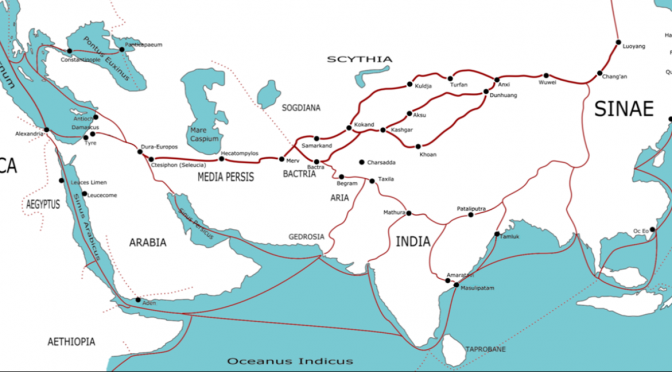
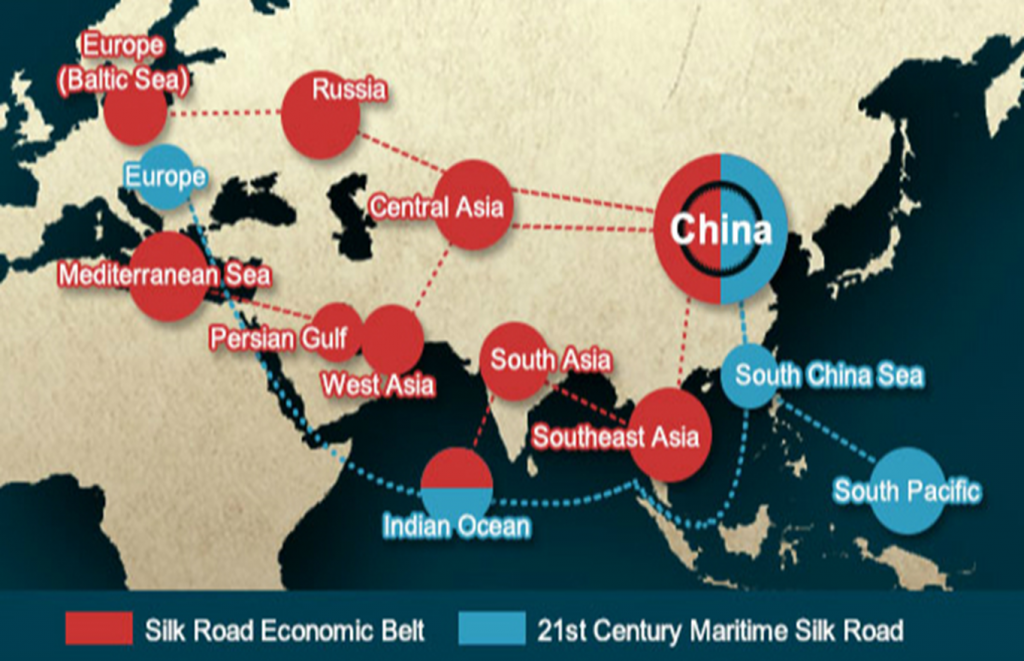
Geographically, the ancient maritime Silk Road had two routes, one from China to the East China Sea linking to the Korean peninsula, and the second from China to South China Sea, Southeast Asia, South Asia, Arabian Sea, Indian Ocean and the Persian Gulf. Archeological evidence suggests maritime transportation dates back to thousands of years before inception of the Silk Road.  However, the seaborne trade routes for the Silk Road strengthened during the time of Han Dynasty in China.  In an article by Koh (2015) “21st Century Maritime Silk Road,” it is suggested that one important aspect of the ancient maritime Silk Road was freedom and autonomy of navigation, which remains the prime reason for exploration of the seas and close contact of civilizations leading to cooperation and trade.

Until the 7th Century, land routes were preferred and profitable. It was an era where Chinese, Romans and Parthians flourished. But later, new powers emerged, and Arabs played a central role in the rise of the maritime Silk Road.  The maritime route gained favor over land due to the capacity for greater volume of shipments and relative safety compared to the looting and thefts on land routes. Historical notes on the ancient maritime Silk Road define constituents of peace beyond commerce. Hence art, culture, and religion were the key factors for co-existence and tolerance amongst various civilizations. But there were noticeable drawbacks to the ancient maritime Silk Road, including unpredictable weather and harsh storms that vanished wreckage of ships. Further, there were dangerous straits which were crucial in relation to navigational expertise and control for power, and later the rise in piracy emerged as a result of Mongol dominance of the Silk Road.

The 21st Century Maritime Silk Road

MSR

The 21st Century Maritime Silk “Road” (MSR) will begin from China, moving on to the South China Sea and then Southeast Asia, the Indian Ocean, Africa, and Europe. The southern extension of the route offers access to the South Pacific. According to the National Development and Reform Commission of China (2015), the New Silk Road is based on five principles of the United Nations charter: mutual respect, mutual non-aggression, mutual non-interference, equality and mutual benefit, and peaceful coexistence. The MSR would play a vital role for development in the seas through regional cooperation based on infrastructure development, financial integration, free trade, and scientific and human exchanges. The same is supported by academic literature and government reports that how the MSR may evolve newer patterns of regional trade and diplomacy.

China’s ambitions support a multilateral approach under international relations where cooperation is promoted on common interests. On similar lines, many experts have raised speculations towards ownership, governance, geo-politics, and prevailing conflicts in the South China Sea.  Can initiatives such as the Asian Infrastructure Investment Bank (AIIB) indicate practical steps from China that defy perceptions limiting political constructs towards hegemony? What is important to understand in today’s context is that development and harmony would fail through a bilateral or a unilateral approach.  Collaboration between states through the MSR not only produces economic gains, but results in greater exchange between societies that will promote culture rooted in harmony and cooperation.

A comparative view of the Ancient and 21st Century Maritime Silk Road includes varying perspectives. However, common grounds are based on principles of economic exchanges through  peace in a humanistic approach that strengthens regional integration through cooperation and cultural avenues. The significant difference for MSR today falls under freedom of navigation. International laws and regulations have defined boundaries, which was not the case in ancient times. Another prominent facet of ancient times was the draw of exploration of the seas. Civilizations wanted to get in contact for trade, prosperity, and learning. What remains a question with regard to today’s geo-political dynamics is the following: can great powers co-exist, especially with today’s complex political dynamics? The rhetorical debate over the 21st Century Maritime Silk Road has ambiguities, but participating nations from Europe, Africa and Asia must realize the need for an integrated network. Like ancient times, states need their economic expertise to be promoted, which not only manifests itself in monetary value, but also in mutually cooperative societies that may initiate a sustainable track towards global peace.

Mohid Iftikhar has a Masters of Philosophy in Peace & Conflict Studies from National Defence University, Pakistan and a Bachelors in Business Administration from University of Southern Queensland, Australia. He has completed a short course on Defence & Security Management in collaboration with Defence Academy, UK, Cranfield University and NDU, PK.  He is a member of Center for International Maritime Security and Associate member, the Corbett Centre for Maritime Policy Studies, King’s College London. At present he is a Deputy Director at Center of Innovation, Research, Creativity, Learning & Entrepreneurship (CIRCLE) at Dawood University of Engineering & Technology Pakistan. His views are his own.

Dr. Faizullah Abbasi has a Masters in Production Management and Manufacturing Technology from Strathclyde, UK, and PhD from University of Sheffield, UK. He is a distinguished Professor and expert on Industrial Growth and Oil and Gas Development. Currently, he is the Vice Chancellor Dawood University of Engineering & Technology Pakistan. His views are his own.