The following article originally featured on The Bridge and is republished with permission. Read it in its original form here.
By Roger Misso
Once upon a time, there was a great and powerful nation. With booming trade, strong defense, and unparalleled pride, this land stood apart from all others as the finest in the world. As others struggled with disease, conflict, and stagnant economies, this country shone as a beacon in a storm. And importantly, its Navy was the envy of the world, protecting trade and sailing the high seas.
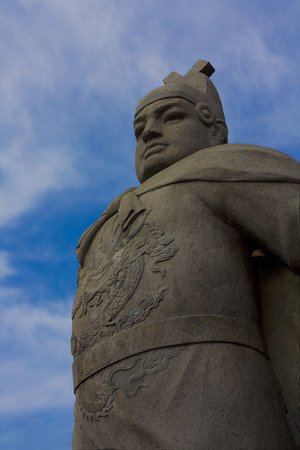
Monument to Admiral Zheng He in Melaka, Malaysia (Hasaan Saeed/Wikimedia)
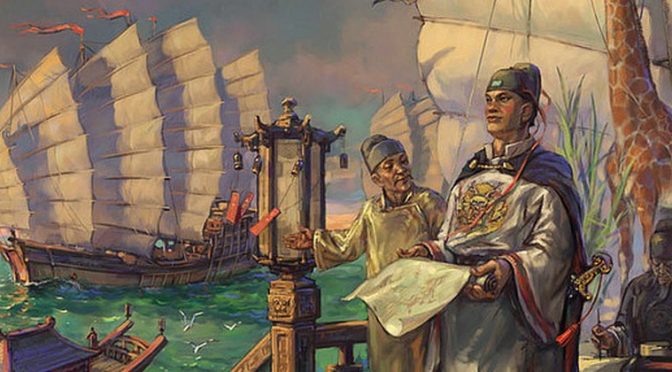
This nation was China, during the Ming dynasty in the 14th Century. The leader of its Navy was the quasi-mythical Zheng He, a palace eunuch who rose to glorious power, but was eventually erased from the history books.The rise and fall of Zheng He has striking parallels to the rise and fall of the United States Navy today. To avoid repeating the unfortunate history of seafaring superpowers, the United States must embrace the role of its Navy as an essential instrument of a successful, enduring nation.
THE RISE
In the middle of the fourteenth century in China, at the end of a line of harsh Mongol rulers, the Ming dynasty rose to power. One of the first acts of the new emperor, Zhu Di, was to build a massive naval armada. Rather than rely only on overland routes, he intended to exercise trade, diplomacy, and prove the sheer awe of Chinese power through his navy.
He nominated a palace eunuch who had risen in favor with the new regime, a Chinese Muslim by the name of Zheng He, to lead this force. Zheng was rumored to have “stood seven feet tall,” and his ability to speak both Chinese and Arabic was seen as a prudent choice for an expedition that would sail the Indian Ocean and interact with other Arabic-speaking peoples.[1]
Zheng He’s fleet boasted more than 300 vessels. Unlike the typical European ships of the day, his were of enormous, complex construction and opulent adornment. Each ship housed more than sailors—doctors, soldiers, engineers, and statesmen made Zheng He’s fleet a floating arm of Chinese influence. Indeed, for more than 30 years, China dominated the sea lanes to its west, ensuring safe passage of its trading vessels and even engaging in limited conflict to secure favorable bases of support for its large fleet.[2]
THE CURSE
China’s dominance of the seas was short lived, however. New emperors came to power who viewed naval voyages as “extravagances.”[3] Rather than respect the value of a navy to a great power, rulers began to look inward. Political power was legitimized by building things Chinese subjects could physically see and attribute to the greatness of the emperor, as opposed to a Navy that operated far from China’s shores.
It is a historical irony that the Ming dynasty traded what was the world’s greatest naval power, and used their treasure to connect and finish the Great Wall into what it is recognized as today. Soon, internecine conflict and pride erased nearly any mention of Zheng He and the grand Chinese armada from the national memory.[4] For much of the next 600 years, China’s focus would remain within, even as their relative global power all but evaporated.[5]
THE PARALLELS
The lessons of Zheng He’s China teach a great deal about how a global superpower maintains its own geopolitical interests in the face of shifting domestic priorities. A strong Navy is a decisive component of the military instrument of national power, based on its unmatched ability to project power around the globe.
From John Paul Jones to The Great White Fleet to today’s Navy, it is easy to view the lens of America’s Navy as another incarnation of Zheng He’s: an awe-inspiring representation of the nation’s technological and economic might. The founders of the United States recognized the importance of a Navy to a prosperous nation, specifically enunciating in the Constitution that Congress must “provide and maintain a Navy.”
Yet, as in Zheng He’s time, competing policy choices and uncertainty as to America’s role in the world has eroded the commitment to maintain a naval force representative of the country’s geopolitical interests. Austerity and sequestration have slashed budgets with scant regard for shipbuilding, maintenance, and future fleet architecture. 650 years later, the United States Navy has fewer ships to its name than Zheng He’s armada.[6]
THE LESSON
The decline in quantity and quality of America’s ships-of-the-line will do great harm to the American people. The United States Navy is the bellwether of American power, protecting the nation from harm and safeguarding global commerce. The tragedy of both Zheng He and contemporary American navalists is their failure to adequately convince the population of the necessity of its Navy.
Thomas Jefferson once wrote that “industry, commerce, and security are the surest roads to the happiness and prosperity of people.”[7] The Navy has been the guarantor of American happiness and prosperity since the nation’s earliest days. Yet, as the visible vestiges of American commerce have transformed from small markets and shops to massive online storefronts with inventory shipped by robots from warehouses, the average citizen’s concept of how commerce is enabled may be declining.
To this citizen, the ubiquitous nature of the Internet and online commerce might seem to suggest that modern military forces are becoming obsolete in the face of digital citizenship. Few people think about the steps between pressing “purchase” and receiving a good at their doorstep. In a tumultuous political climate, this leads many to clamor for decreased military spending and a more insular focus on domestic affairs. Yet this sentiment erodes the very naval service that ensures massive online commerce can thrive in the first place.
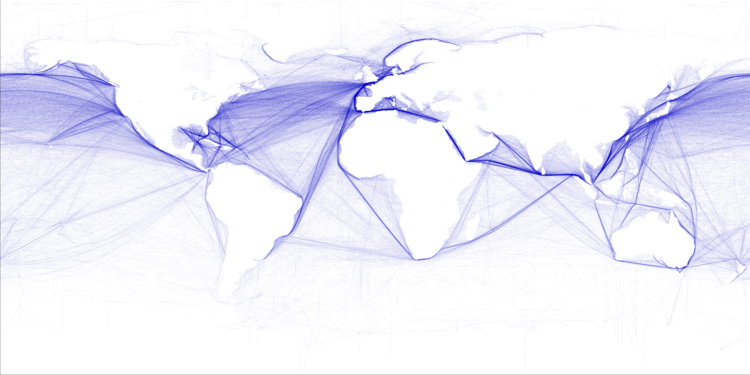
The percentage and volume of global trade by sea has shown no signs of slowing down. Whether iPhones, oil, or automobiles, most of the imported items belonging to a typical household have come to this country by sea. These items are carried on ships without guns or inherent self-defense measures. These ships transit through chokepoints controlled by nations with their own interests, who would rather leverage their own power at the expense of America’s supply of Apple devices.
World shipping routes (T. Hengel/Wikimedia)
The importance of a Navy is not a difficult concept. For example, if a saboteur has blocked both ends of the street on which you live, you may think of three potential responses: 1) stay home; 2) find another way out, though you are likely to leave the house less often and bring fewer things with you; 3) fight back. For businesses and nations who ship goods by sea, the first two options are unprofitable and untenable. It is only through a strong Navy that the third option is possible.
The consequences of a declining Navy are perceptible and stark. Though it took a few centuries, China’s inward focus eventually led to the crumbling of their sovereignty and, eventually, occupation by a foreign power. More contemporary examples, such as Great Britain and Spain, are instructive as they show nations on the declining slope of naval power dependent on a foreign power—the United States—to maintain freedom of the seas in accordance with its own interests.
If the United States abdicates its role as global naval power, either deliberately or through unchecked erosion of capability and credibility, she risks a radical plummeting of national and economic might. Nature and the sea both abhor a vacuum; in yet another irony, if the United States cannot maintain the global sea lanes, China may take its place as guarantor. An American economy and national security dependent on Chinese interests and the application of Chinese naval power would be weak and brittle, bringing extreme hardship to the American people.
THE MANDATE
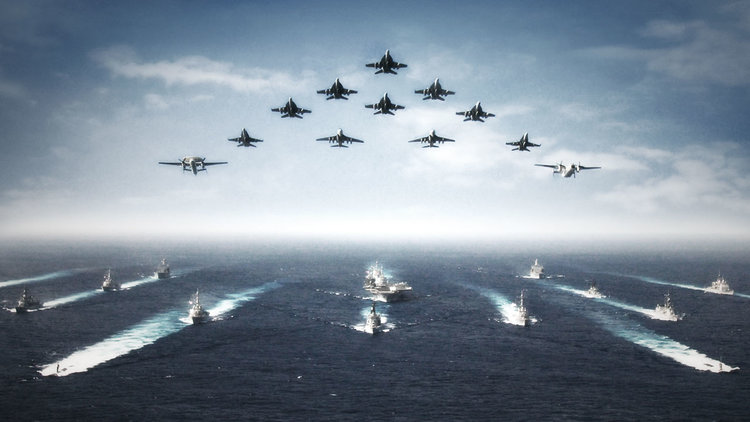
U.S. Navy ships and aircraft. (Navy.com)
More than ever, a strong Navy is required to protect the millions of tons of shipping that make possible American economy, infrastructure, and the basic political lives of her people. A citizenry may grow weary of land wars, but it cannot forsake trade and security. Nations that cannot protect open, unfettered access to the sea will fail. For these reasons, the United States Navy is not a nicety; it is a necessity.
History provides clear channel markers for decision makers today. The United States cannot repeat the curse of Zheng He; she must clearly articulate and re-prioritize a strong Navy that is present, capable, and credible.
Roger L. Misso is a naval officer, aviator, and speechwriter. He is currently a student at the John F. Kennedy School of Government at Harvard University and a featured contributor to The Strategy Bridge. The views expressed in this article are the authors and do not represent the views of the U.S. Navy, the Department of Defense, or the U.S. Government.
NOTES:
[1] Stockwell, Foster. Westerners in China: A History of Exploration and Trade, Ancient times through the Present. Jefferson, NC: McFarland & Publishers, 2003.
[2] Suryadinata, Leo. Admiral Zheng He and Southeast Asia. ISEAS-Yusof Ishak Institute, 2005.
[3] Ibid.
[4] Turturici, Armando Alessandro. “China Across Sea in Early Ming Dynasty – the Figure of Zheng He.” Quarterly Journal of Chinese Studies, no. 3 (Spring, 2016): 111-114.
[5] Ibid.
[6] “Status of the Navy.” Navy.mil. Accessed online 4 Nov 2016. http://www.navy.mil/navydata/nav_legacy.asp?id=146
[7] “From Thomas Jefferson to Francisco Chiappe, 9 September 1789.” National Archives Online. Accessed online 4 Nov 2016. http://founders.archives.gov/documents/Jefferson/01-15-02-0386
Featured Image: Treasure fleet of Admiral Zheng He (Caravan Daily)
The following is a two-part series on the role cruisers played in the Soviet and Russian Navy. The first part examines historical inspiration for developing a cruiser-focused force, concepts of employment, and strategic rationale. Part II will focus on how cruisers shaped the environment through forward presence during the Cold War, and how the nature of presence may evolve into the future.
By Alexander Clarke
“A Man-of-War is the best ambassador.”
This is an often quoted phrase of Britain’s 17th Century Lord Protector Oliver Cromwell;1 a phrase stated in an age when seapower had shown promise of potential,2 but not yet attained the capabilities, or achieved the feats, that would truly make it demonstratively so.3 This words were said before the ministry of William Pitt (the Younger, Prime Minister 1783-1801 & 1804-6),4 before the works of Alfred Thayer Mahan5 and Julian Stafford Corbett6 were published, and before the age of Empire and Gunboat Diplomacy.7 Yet still, in just eight simple words, it sums up the root construct of all this history and thought that have, does, and will continue to shape the world and relations between states to this day. It does this because it succinctly sums up a principle function, and duty, of warships in ‘peacetime.’ A function, which is entirely entwined with navies’ roles of maintaining maritime security8 – enabling freedom of trade, as well as access to the bounty of the sea, and presence,9 the protection of interests, reassurance of allies, and deterrence of potential aggressors.
Maritime Security and Presence are big missions for navies, they are the roles of ‘peacetime’ which make ‘peace’ such a relative term for navies in comparison to armies.10 A situation accelerated by the fact that in ‘peacetime’ the rules of engagement become by necessity stricter, the constabulary duties (fishery protection, counter piracy, counter smuggling, etc.) get greater focus, and engagements with other nations, both friend or potential foe, become more nuanced and subjective. This though is nothing new, and despite the recent phraseological development of the ‘Oceanic Global Commons,’11 patrolling the world’s original super highway – the sea,12 has been the subject of discussion and debate probably since humans first set to sea. The best lesson that has been drawn from these discussions, is that there is always more to be learned.
So with the discussion started, it is necessary to explain the question, why focus on the Soviet, and successor Russian navy? That is explained by the fact that while the Soviets and the Russians have never achieved dominant status at sea, they have successfully managed to enhance their status, maximize their presence, and achieve a growing level of influence through leveraging the capability they had/have in ways that have limited other nations ability to interfere with their interests. This success has not been achieved by accident, instead it is a product of long running analysis;13 analysis which has diverged at a significant point from the traditional Anglo-American Western naval model14 – not through a different understanding of warfighting, but a different perspective on operations outside of warfighting.
As students of history the Soviets had seen how a land power, Germany, had not really gained anything, but lost a lot strategically by building a fleet which was shaped directly to challenge the largest sea power prior to WWI15 – conversely the same nation had got far closer to success with a more asymmetric approach both in that war and WWII. The prime example of this is a weapon of sea denial, the submarine.
Unfortunately, the experience of both WWI and WWII showed that submarines alone were not enough in war time; furthermore, it showed they are only really useful in wartime. In ‘peacetime’ they are good for intelligence gathering, Special Forces operations, and practicing for war. Submarines are so limited in conducting presence operations because they are by their very nature stealth units, and the visibility required for presence goes against this fundamental attribute. Furthermore, due to the physical and technological sensitivity of their hull coats and sonic signatures, even port visits to the closest of allies are fraught with potential risks that are more sensibly avoided. The use of submarines in the presence mission, therefore usually comes at the point of it becoming focused towards ‘conventional’ deterrence16 – rather than just overt presence.
This is where surface combatants come in, and it explains the evolving Russian approach with a growing focus on designs which were far more general purpose than specialists despite their often stated role of Anti-Submarine Warfare.17 No area is this seen more clearly than in the consistent focus on cruisers, and the ‘cruising mission.’18 Understanding the difference is something which will begin to matter more, not only because of the resurgent Russia, but the growth of other navies, for example China and India. These nations have not merely acquired equipment, they also draw heavily from the Russian (and by extension, Soviet) naval experience and practice in conceptualizing naval operations.
How and why the Soviets used the Cruiser…
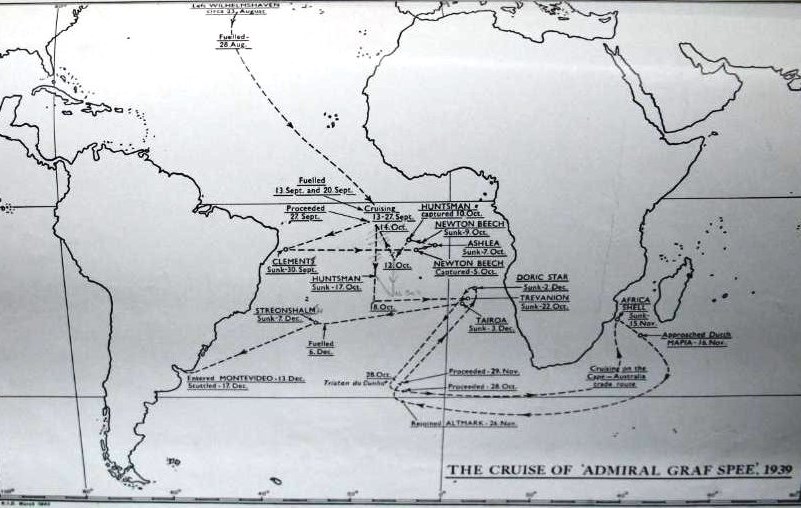
The post-WWII Sverdlov class19 was where the Soviet navy started to bring their vision of cruiser capability to fruition. Pre-war plans had been very conventional and these post-war plans were heavily influenced by their understanding of WWII German naval surface raider operations.20 These operations had tied down large amounts of Royal Navy (RN) combatants, and had been very successful. For example the cruise of the ‘Pocket’ Battleship, the Admiral Graf Spee, whilst ending heroically (for both sides21) at the Battle of the River Plate,22 had sunk nine merchant ships, captured two ships, and ‘frightened’ at least one other. Although these are the easily measurable effects, there is no real way of quantifying how many Captains changed or altered their course, how many loads were late or connections missed, all as a result of the fear of where the German raider was – or just as strong, the fear of where it might be.
In any case, the effects were not limited to the merchant marine. According to the Soviet Historian L.M. Eremeev23 in his work Some Results of the Cruiser Operations of the German Fleet, the RN mobilized numerous forces to catch the Admiral Graf Spee, including Commodore Harwood’s South Atlantic Squadron, seven cruisers, two aircraft carriers, a battlecruiser, and at least three destroyers (although considering the escorts required by the capital ships mobilized, he was likely underestimating this number by a long way). This demonstrated to the Soviet Union the potential of surface ships, if used in a ‘cruiser warfare’ manner, to exert great impact upon operations disproportionate to the realistic capabilities of the vessel.
Figure 1.The Cruise of the Admiral Graf Spee, illustrating not only the number of its success but the range and breadth of them. (UK National Archives)24
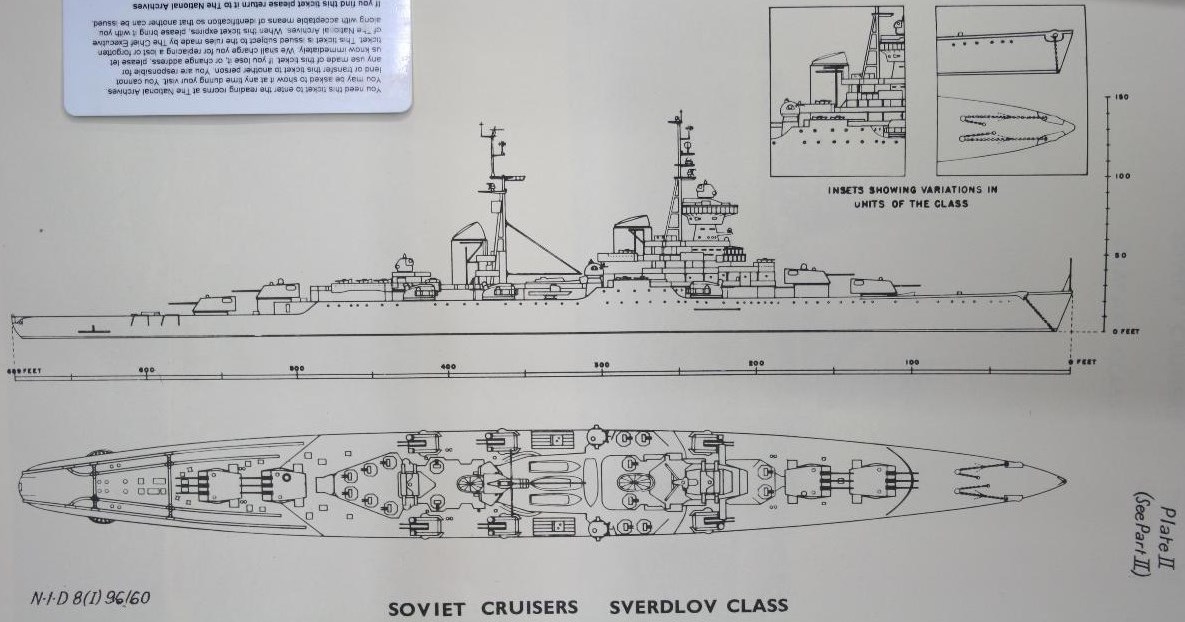
Eremeev not only discusses these wartime achievements, but the political and national impacts of such ships being built. The Sverdlov class were (even in the post-WWII/early Cold War era), powerful looking ships, fitted with the very best radars the Soviets had available,25 and had an impressive array of weaponry (see Figure 2) for the period.26 They were also big – displacing 16,000 tons,27 which is roughly double that of a modern RN Type 45 Daring-class destroyer or the U.S. Navy’s Flight I Arleigh Burke-class destroyers. The Sverdlovs were ships which were just as useful for solo raiding missions and Task Group commands as they were for peacetime ‘impression presence’ and diplomacy missions. What’s more, the Sverdlov was a light cruiser design28 and there were even bigger ships planned.29
Maximum benefit was sought from every rouble of the naval budget30 by making the most of unit presence for peacetime missions and multiplication of assets to make any opponent’s attempts to use the sea as complex as possible.31 Warfighting was about sea denial, raiding, and the tying down of enemy forces while simultaneously making their movement difficult.32 Peacetime was for building relationships, strengthening alliances, for stretching muscles, gaining experience, and hindering other actors such as Britain and the United States in their attempts to shape the world whilst simultaneously seeking to shape it themselves.33 The 1950s Sverdlovs were not though the only class of ship built by the Soviets that would fit into this mould. They were more the beginning of a story, which would continue into the 1970s with the Slava-class, Kara-class,34 and the behemoth 28,000 ton Kirov-class ‘Battlecruisers.’35 Alongside these vessels were other cruiser designs, less capable in terms of combat and command, but still with comparable status, size and armament of cruisers;36 just as large a statement of intent and capability. This capability was different from western navies, as it was not built upon the warfighting prowess of aircraft carriers. The cruiser-centered force better suited the strategic vision and peacetime presence mission profile for the Soviet Union better than any other available option.
Figure 2: The Sverdlov class: this plan illustrates how heavily armed the ship class was with twelve 152mm in four triple mountings, twelve 105mm in six double mountings all combined with a heavy anti-aircraft armament, torpedoes, sophisticated sensors, a top speed of 33kts, and a range of 9000 nautical miles.37 (UK National Archives)38
The advantages were that cruisers are cheaper and easier to build and operate than aircraft carriers, can physically enter more ports to support diplomacy, and while being lesser in range of combat power than aircraft carriers were not necessarily lesser in combat capability within that more limited scope. This made them powerful tools for a nation which was seeking to flex its muscles around the world as a method of spreading its influence but not foment a naval arms race in the way that it was already in a strategic arms race.39 The Soviets realized that aircraft carriers, like Germany’s pre-WWI dreadnought battleships,40 would be seen as provocation and direct challenge. Cruisers were enough of challenge to be status worthy, but did not represent a direct confrontation of the carrier-centric NATO navies41 – therefore, would not be a direct attack on their confidence and thus a provocation. This is a policy though which did not stop with the end of the Cold War; in fact modern Russia has gone to great lengths to continue it.
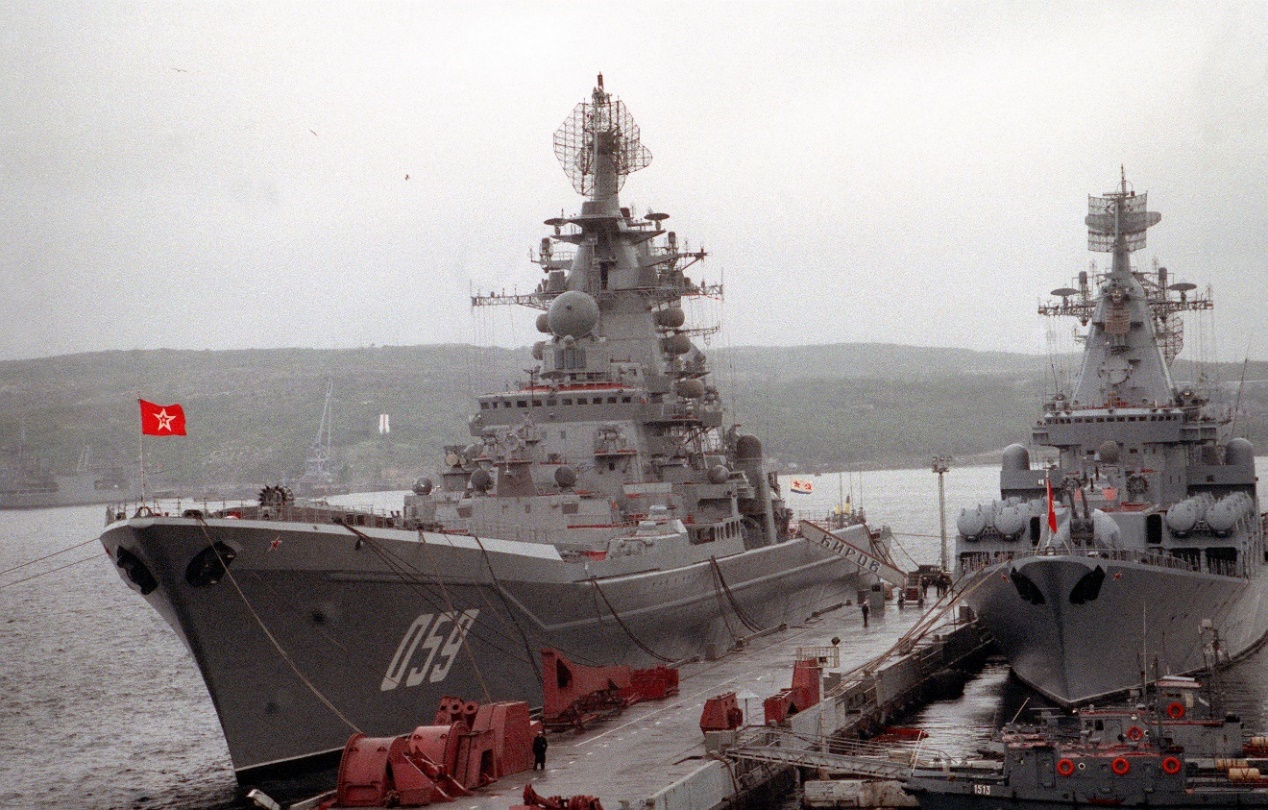
Figure 3: The Kirov-class cruiser Ushakov that was formerly known as the Kirov alongside a Slava-class cruiser which had also been renamed from the Admiral Flota Lobov to the Marshal Ustinov. (CWO2 Tony Alleyne via Wikimedia Commons)42
They have done this by keeping as many of the Soviet-era ships in service as they are able to. Soviet cruisers are still the core of the Russian fleet and its capability to project influence worldwide.43 There has also been a resurgence in submarine production,44 and perhaps more interestingly, a focus on the procurement of new corvette-sized combatants.45 Additionally, there has been a significant reconstituting of amphibious warfare capability.46 Based, as this policy is, in a fairly simple and straightforward analysis of international relations that there are:
Actors – nations which take charge and command events
Reactors – nations which flow with the tide of events, only reacting to what happens
Contractors – nations which get others to act on their behalf
These are classifications which can, and do change from circumstance to circumstance. The Russians have clearly chosen to equip themselves to be ‘actors’ as often as possible. This is understandable as they do not have enough reliable, capable, allies to be ‘contractors’ – and even if they did, possible ‘contractors’ often do not have sufficient influence over the course of events to satisfy and sustain Russian interests. Being a ‘reactor’ would mean that Russia would automatically cede any influence on the pace and circumstance of events. This is more than just theory and direction, it is a policy which has been illustrated by real world events in Georgia,47 Syria48 and Ukraine.49
Dr. Clarke graduated with a PhD in War Studies from KCL in 2014, the thesis of which focused upon the Royal Navy’s development of naval aviation and aircraft carrier design in the 1920s and 1930s. He was supervised during this by Professor Andrew Lambert. Alongside this he has published works on the 1950s with British Naval History, and has also published on current events with European Geostrategy and the Telegraph online as part of the KCL Big Question series. He has maintained an interest in digital history, and is organizing, hosting, and editing a series of Falklands War veterans interviews for the Center for International Maritime Security and Phoenix Think Tank. Recent research outputs include presenting a paper at the National Maritime Museum’s 2016 conference on the ASW capabilities of the RNAS in WWI, and will be presenting a paper on the design & performance of Tribal Class Destroyers in WWII at the forthcoming BCMH (of which he is a member) New Researchers Conference.
1. Tsouras (2005), p.396
2. Rodger, The Safeguard of the Sea; A Naval History of Britain, 660-1649 (2004), pp.263-71
3. Rodger, The Command of the Ocean (2004)
4. Ibid, pp.364-6
5. Mahan (1987)
6. J. S. Corbett (1911)
7. Cable, Gunboat Diplomacy 1919-1979, Political Applications of Limited Naval Force (1981), and Clarke, August 2013 Thoughts: Naval Diplomacy – from the Amerigo Vespucci to a Royal Yacht (2013)
8. Clarke, Protecting the Exclusive Economic Zones – Part I (2014), and Clarke, Protecting the Exclusive Ecconomic Zone – Part II (2014)
9. Clarke, October 2013 Thoughts (Extended Thoughts): Time to Think Globally (2013)
10. Air forces, as has been highlighted recently also experience issues – with other nations probing air space; but still they do not face potential problems on the scale or diversity that navies could experience, especially navies belonging to nations with far flung territories strewn around the globe.
11. Flournoy and Brimley (2009)
12. Hipple (2014)
13. TNA: ADM 223/714 (1959), and TNA: ADM 239/533 (1960)
14. Sergey Gorshkov (1980, p.230) goes into great detail as to the diference between the idea of dominance at sea adopted by Russian in comparison to England, and America which had inherited the English model.
15. Massie (2005) – a conclusion which is further supported by the experience of Japan in WWII, it had also chosen to build a scaled battlefleet, and whilst with its challenges this did make some sense – its lack of infrastructure to support a rapid expansion of its fleet to equivalent levels meant that although it suited the cultural/political perception of its national leaders, it was not necessarily as sensible as a less conventional fleet structure might have been (Stille, The Imperial Japanese Navy in the Pacific War 2014).
16. A. Clarke, August 2013 Thoughts: Sea Based Conventional Deterrence; more than just gunboat diplomacy! (2013)
17. Polmar (1991), and TNA: ADM 239/821 (1959), both highlight how often ships with very capable surface-to-surface and surface-to-air weaponry, for example the Kara Class (Polmar (1991), pp.155-7) are described as ASW Guided Missile Cruisers, yet both their SA-N-3 Anti-Aircraft missiles, and SS-N-14 anti-submairne missiles, had significant anti-ship capability (especially the latter, which being torpedos at their terminal stage are arguably more dangerous than a pure missile system)…furthermore as the class was built, one of the class, Azov, had it’s air-defence upgraded to include the far better SA-N-6 (which also has an anti-ship capability), and all of the class were built with extenseive command and control facilities.
18. Clarke, Europe and the Future of Cruisers (2014)
19. Clarke, Sverdlov Class Cruisers, and the Royal Navy’s Response (2014)
39. Rohwer & Monakov (2006), illustrates this in their work by highlight how many grandiose naval schemes were planned, and enver completed; when if the will had been present, and decision had been made, then the Soviets under Stalin could have allocated the resources to do it.
40. Massie (2005)
41. Clarke, Sverdlov Class Cruisers, and the Royal Navy’s Response (2014)
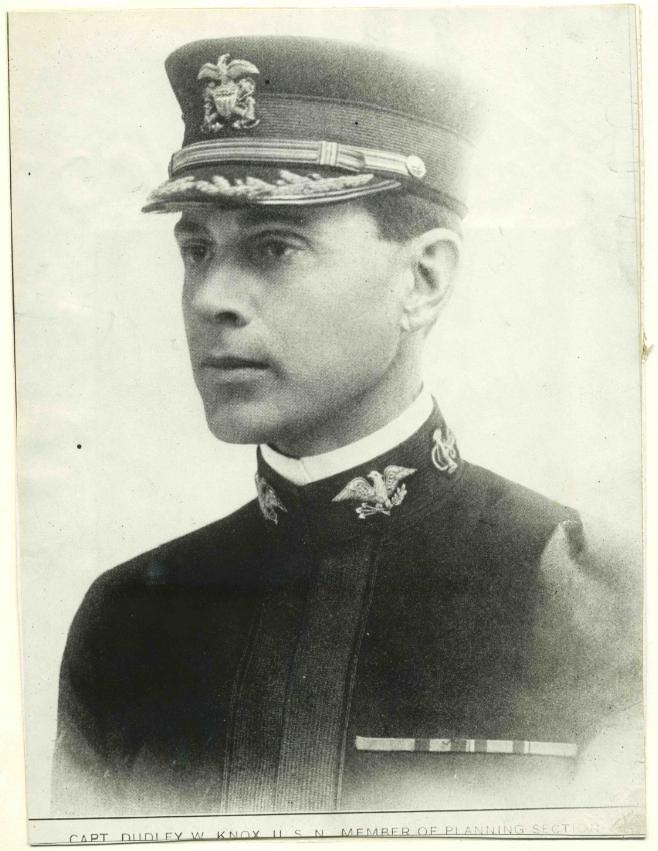
Captain Dudley W. Knox as a member of the “Planning Section” of the “London Flagship” headquarters of the Commander, U.S. Naval Forces in Europe, Admiral William S. Sims. Having arrived in London for Christmas in 1917, Knox synthesized operations with intelligence by organizing future planning efforts within the headquarters. (U.S. Navy Photograph)
In areview published on CIMSEC back in August, Captain Dale Rielage, USN, said that “Knox offers an example of how an officer with ideas and the willingness to challenge the status quo can have a profound influence on the U.S. Navy.” To learn more about Commodore Knox, and how he challenged naval thinking, I talked with Dr. Kohnen about his new book.
Finally, I am excited to tell you that Dr. Kohnen has provided us with pictures of Commodore Knox and Admirals King and Sims that have never been published. They are published here for the first time.
Professor Kohnen, welcome. Thanks for taking the time to talk about your new book. So, to start, why did you want to write a book about Knox?
Chris, thank you, I greatly appreciate this opportunity to discuss Commodore Dudley W. Knox. Indeed, I firmly believe that Knox stands among the most significant naval thinkers in American history. His ideas truly resonate, as the themes he addressed in his historical work during the first fifty years of the twentieth century informed the development of the U.S. Navy “second to none.” Through his close personal associations with President Franklin D. Roosevelt and Fleet Admiral Ernest J. King, Knox became one of the key architects in designing the foundations of U.S. Navy professional military education, in understanding American naval history and traditions, and in advancing the idea of employing the U.S. Navy as an international peacemaker. Knox remains one of the most important figures in understanding American concepts of “sea power” thorough two world wars and into the Cold War era. From my own studies of his life and historical works, I firmly believe that Knox offered strategic observations on concepts of maritime strategy, which transcend into the twenty-first century. I also firmly believe that our Navy should revisit the ideas Knox offers in his writings in order to be better informed of the historical foundations, which have shaped contemporary discussions concerning the future of American sea power and the military policy of the United States.
(Previously Unpublished) U.S. Navy Captain Ernest J. King worked closely with Knox and the London Flagship staff to coordinate Atlantic Fleet operations with intelligence. After 1917, King temporarily served as Chief of Staff to the Commander, Atlantic Fleet, Admiral Henry T. Mayo. Drawing perspective from wartime experience, King collaborated with Knox to frame a U.S. Navy strategy for professional military education after the First World War.
Knox advised the strategic decision makers who created the U.S. Navy “second to none” and the post-imperial vision of replacing historical empires with multinational alliances under the United Nations. Given his close friendship with Roosevelt and King, I have come to view Knox as a figure perhaps comparable to a Thomas Cromwell, or the fictional consigliore from the Godfather movie, as depicted by the Hollywood actor Robert Duvall. By the way, Knox was also a mentor for Duvall’s father, Commodore William H. Duvall, who served in destroyers in both the Atlantic and Pacific during the Second World War.
I first became aware of Knox as I was working on my dissertation, which focused on Ernest J. King. In the process of writing, I started reconstructing the circle of personalities surrounding King in order to understand the bureaucratic culture and primary group dynamics, which characterized the social character of the U.S. Navy during the first fifty years of the twentieth century. As I am sure you know, the story of Ernest J. King begins during the reconstruction era after the Civil War. He eventually served as Chief of Staff of the Atlantic Fleet during the First World War. Among King’s best friends and closest shipmates was a guy named Dudley Wright Knox. Of course, Knox and King shared a deep interest in history.
Knox had ties with historical figures in American military history. His father was a general officer in the Army, and he had relatives in the service going all the way back to the American Revolutionary period. So Knox is already one of these people who is inclined to think in historical terms.
Then I started mapping out his associations. I’m an intelligence officer in the Navy. So in the same way you do that as an intelligence officer, I began doing that with these historical figures. When you look at the association between King and Knox you start to see other associations. You begin to then see the connection between King, Knox, Nimitz, and then Halsey, Spruance, and the whole gang. So you have this close circle of naval officers who periodically bumped into each other during their careers in the naval service.
Now, in this circle of naval officers, Dudley Knox looms large in the discussion. Knox was a little bit older than the rest of them and he was so sharp minded that people like Ernest King would look to him for advice, perspective, and just good conversation.
Of course, those were the days before distractions like television and the internet. These guys, then, spent their time focusing on their profession – reading the professional literature that should be read for people who want to think about strategy, naval operations, and the maritime dimension. These are books that unfortunately have become obscured in the contemporary context. You think about some of the things that Knox and his contemporaries were reading, people like John Knox Laughton and Spencer Wilkinson. These guys were aware of Corbett long before anyone else was aware of Corbett. They are an interesting group of people. That’s why I started gravitating to Commodore Knox.
Knox, however, was not my main focus in my PhD studies — my focus was Ernest King. But now I had all these “left-overs,” the cutting room types of material after I finished the dissertation on King. And all that extra material was there, so I wrote a paper that I gave at the Oceanic Society of History Conference. On the panel was Claude Berube and B.J. Armstrong. I gave this paper about Knox, and shortly after I finished B.J. slipped me a note. B.J. wrote, “You need to write the book on Knox.” I looked at him and was like, ‘OK, whatever.’ After the conference we went to the pub and B.J. told me about the 21st Century Series and its focus. He convinced me that what I had on Knox would work quite well within the context of the 21st Century Series. It came together relatively quickly because I already knew a lot of things about Knox that simply didn’t exist in the secondary literature — and still doesn’t exist. I’m pretty happy how this little piece came together. It was a great way of bringing Knox back to the 21st century professional naval audience.
And we are not done with Knox. Once I get some other things done, it is my full intention to go back and do something more substantial about Knox. He certainly deserves a focused biography for all the work that he did and the influence that he had, which I highlight in the collection, specifically his associations with Ernest King and Franklin Roosevelt.
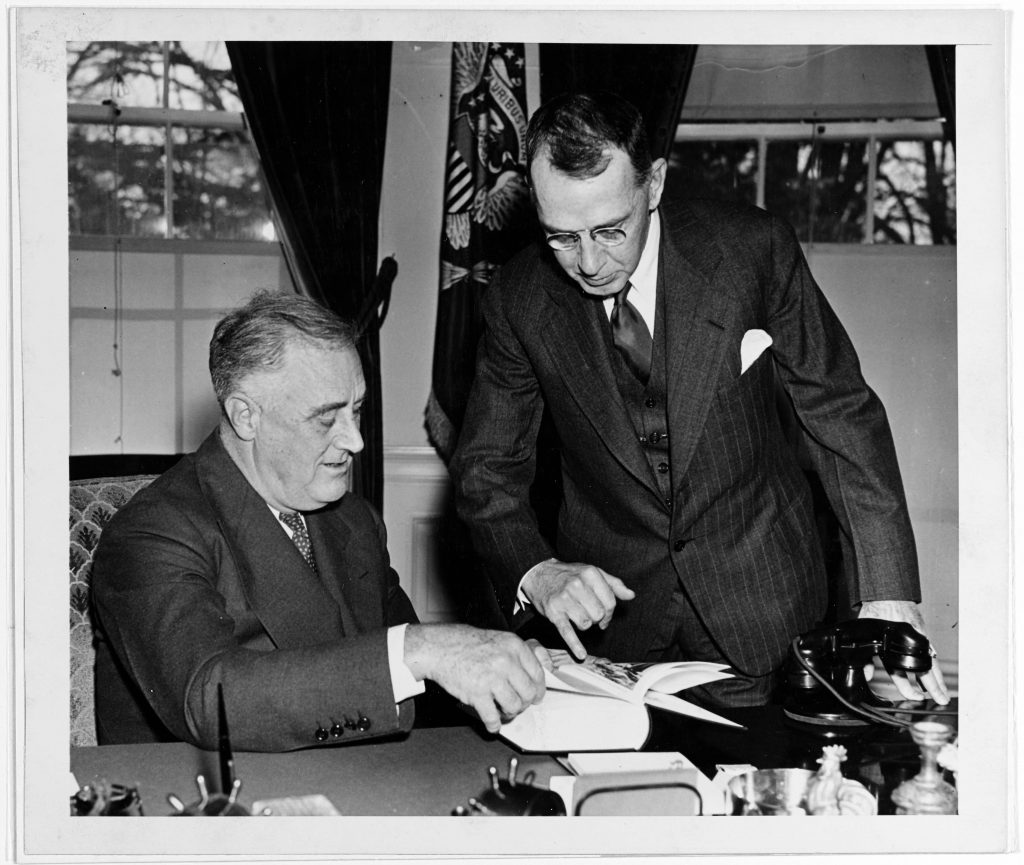
Retired Captain Dudley W. Knox presents President Franklin D. Roosevelt with the final volume of an edited collection official naval records relating to U.S. Navy strategy and operations during the undeclared War with France between 1798 and 1801. After four years work, Roosevelt and Knox worked together to complete these volumes by 1938. Roosevelt insisted upon referring to the “Quasi-War” with France, much to the chagrin of Knox. However, Roosevelt specifically chose this phrase for the title of the work, as the underlying point of the work centered upon how he intended to employ the U.S. Navy in support of American neutrality strategy before the Second World War. Together, Roosevelt and Knox used history to inform American naval strategy in both peace and war.
I assume it is difficult as an editor to decide what to include in a book and what not to include, particularly if a subject is a prolific writer. How did you go about making those decisions?
That’s an interesting question. So, Commander B.J. Armstrong is the editor of the series, and we’re also good friends. I’m prolific in terms of, well, I like to use a lot of words to say things. And I like to use footnotes and I like to explore every avenue in my analysis. That results in large manuscripts. B.J. was draconian as an editor in executing the sixty-thousand word limit. That really constrained me in terms of what I could do in terms of Knox. We actually cut two essays that I wanted to include just to make sure the pieces fit within the context of the 21st Century Series.
So the balance of putting together Knox’s biographical details, which are not out there in the secondary literature, there’s no real comprehensive biography of Knox available to us – so for the time being, at least, this book is a starting point for a detailed biography, which needs to be written. And if somebody else doesn’t do it I’m going to do it once I get King off my plate. When you think about editing and the choices that you have to make, what I did is I focused on the themes that the CNO is focusing on with his “Design for Maintaining Maritime Superiority.”I also considered pieces in light of some of the discussions that are ongoing here at the U.S. Naval War College, contemporary questions of American maritime strategy, naval leadership, ethics (but Knox always talked about the “naval ethos” opposed to ethics), and I think those differences are worthy of discussion. Knox also strongly talked about the importance of understanding the foundations of history in order to frame contemporary discussions about the future. He wrote about these themes. The way he did it was so profoundly unique that Knox remains worthy of consideration in the contemporary context. So, when I assembled these essays I followed those points when selecting the essays in the book.
My favorite essay is actually the last one. It turns out in my mind as the most interesting within the contemporary context. He’s talking about the problem of unification among the services. He’s writing at the time of the revolt of the admirals, which was just erupting. And there all of these problems between the Army and the Navy. The Air Force was newly created; the armed forces security agency; the Central Intelligence Agency; all these new things that came after World War Two. Knox is reeling against the tide as the future was being mapped out. I think Knox was a little bit reluctant to embrace these new ideas because he was still looking at things from the perspective of the past. He understood the problems that came with the bureaucratic changes that happened after the Second World War, which, from Knox’s point of view really didn’t measure up in terms of American ways of war — the American tradition of having a clearly defined civilian command over the military. Knox was worried about a progressive military industrialization of American culture. He wrote about this.
After that last essay, Knox sort of said ‘look, we need to rethink how we are talking about problems of war.’ And he did talk about the importance of how navies are different from armies, and that armies require naval support. Armies are there to conduct operations ashore to achieve an effect ashore. But armies and navies are different, they operate in different environments, and both need airpower to conduct those operations.
So when you follow Knox’s logic he is saying this separation of an air force is a really bad idea. It creates another bureaucracy. As a result you are going to create more flag billets and you are going to see more investment, not less investment, in the military. Knox is reeling against that. Then he does this nice comparison of “Hey if I build an aircraft carrier it is going to last 40 years, you can use it for multiple functions, and use it during peacetime. Rather than if you build a fleet of bombers where its only function is going to be useful if you need to drop a bomb.” Knox did not agree with that sort of approach.
Are there other Knox writings that didn’t make it into the 21st Century Knox but should be read as well?
Dudley Knox was prolific. B.J. and I would go around and around about which essays should go in the book. So like I said earlier, the important part was zeroing in on themes that are immediate interest to the contemporary U.S. Naval professional. That sort of dictated how we were going to put together this little collection. When I compiled the essay that were selected, I focused on the questions of strategy, doctrine, leadership, and of course, the ethos of American naval service. The one thing that I would say that is important in the process of selecting the essays, is that Knox and his associates had this perspective that the naval service has multiple functions. It is not just war. I think Knox would have a problem with contemporary words like “warfighter” because it is too specific. Knox would have reminded us that the Navy is always operational rather if we are at peace or at war. So when you look at his essay titled “Naval Power as a Preserver of Neutrality and Peace,” it is an important essay because he is basically riffing off an essay Teddy Roosevelt published in 1914 titled “Our Navy, Peace Maker.” Now, these themes are important because it is a way of thinking about military service that is different than some of the conversations that we have here in the contemporary era. For example, when you look at their careers, Knox’s generation, coming out of the naval academy at the beginning of the 20th Century, they remained in the naval service for the remainder of their lives. Knox even served in retired status as director of naval history until his death.
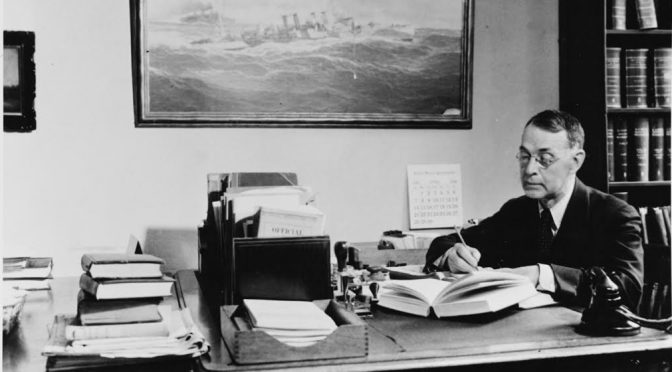
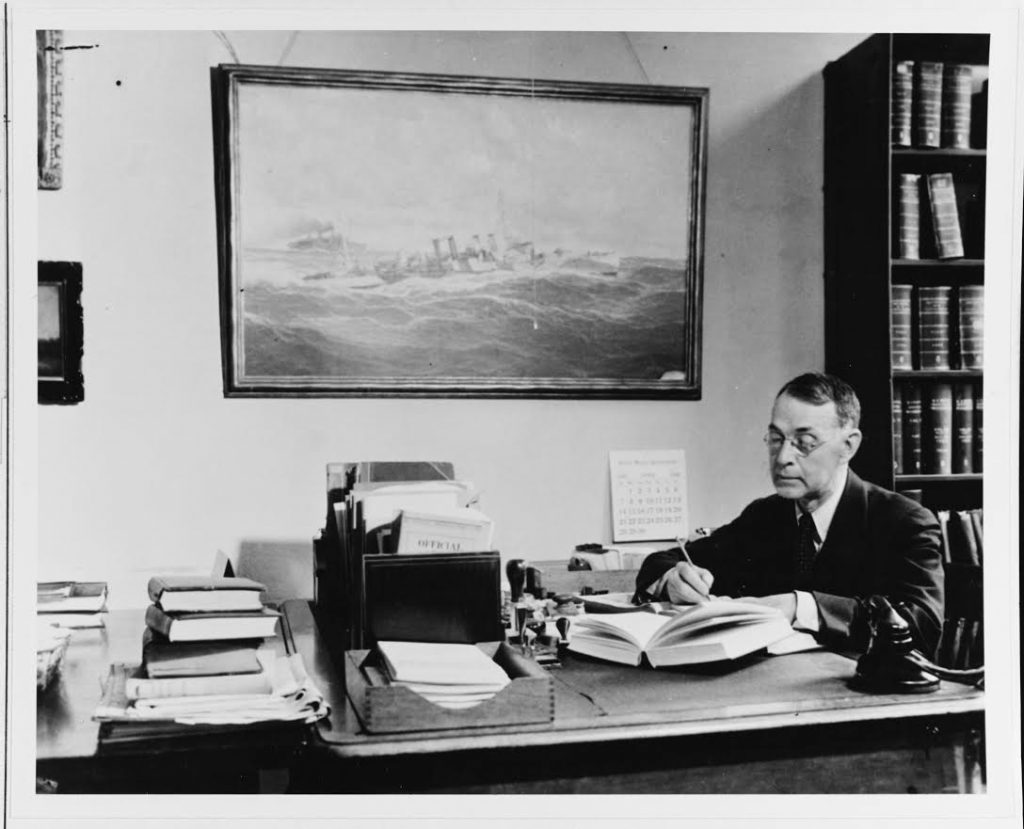
(Previously Unpublished) Dudley W. Knox requested transfer to the retired list of the U.S. Navy, seeking to broaden U.S. Navy efforts to engage the American public in understanding the influence of sea power upon history. During the 1920s and 1930s, Knox helped organize historical research and preservation efforts within the Navy Department. In this role, he also remained heavily involved with the Office of Naval Intelligence. Fusing historical research with efforts to meet contemporary challenges, Knox served as a trusted personal adviser to President Franklin. D. Roosevelt. The painting behind him is that of a destroyer escorting a convoy during the First World War. During the war, Knox was heavily involved in convoy operations.
When you put together the chronology of some of these guys’ naval careers, and the numbers they spent fighting wars, it only adds up to about eight years. So what are they doing during this other time? So here you have people serving, this idea of service, the ethos of naval service, over a sixty odd year period, and their orientation is not to go find a war but to find ways to avoid a war through sea power. And of course this ties into the theories of Mahan and Luce at the end of the 19th century. Of course, their perspectives reflected an informed understanding of John Knox Laughton’s work, Spencer Wilkinson, Alfred Mahan, and others.
Dudley Knox had some well-known mentors. Who were they and how did they influence him?Knox, if I understood correctly, was concerned that there will be some challenges if you have a U.S. Air Force trying to support a naval surface force. He had some concerns about an independent air force. This was in a time when discussions of creating a U.S. Air Force sounded quite contentious. Was he concerned that air force aviators wouldn’t understand naval operations and vice versa?
The problem here centers on the question of who controls what. Knox observed post-World War I events, for example, the Washington Naval Treaty. Those events inspired Knox to write his first substantial book called “The Eclipse of American Sea Power.”He’s reeling against the fact that the average American policy maker is not educated enough to understand what they were doing when they were cutting the Fleet. After that fight in 1923, Billy Mitchell arrives and is fixated in creating an American equivalent to the British Royal Air Force, and Knox is reeling against this during his whole career because Knox is saying that the army needs airpower as much as the Navy needs airpower. But airpower for the sake of airpower is nothing. We don’t need a separate air force, he says. That’s Knox’s position for the remainder of his career.
Knox, I was interested to read, was quite the historian. In fact, one of your selections is his piece titled “Forgetting the Lessons of History.” And in my copy of your book, I underlined a section where he says he was quite frustrated with the lack of accessibility to naval archives — in particular, private collectors upset him. Why?
Knox recognized that private collectors are a major source of material that really doesn’t belong to them. They may have paid for it and they might have acquired these items for investment purposes, but from Knox’s point of view these items belonged to the nation. He became very frustrated with some of them because they liked to hang the painting on the wall or have the original commission of John Paul Jones just sitting there on the fire mantle, and Knox said that something like that does not belong on your mantle piece. It belongs to the Navy and to the nation. Through the good offices of FDR a lot of these pieces were acquired by the Navy at Navy expense for the purpose of preservation. And I must say, in the contemporary context, we have a lot of work to do in that front.
On Knox’s writings on naval leadership, he seems, at least to me, to have a reasonable position on naval ceremonies and etiquette. Why did he think that over-emphasizing naval etiquette was more dangerous than under-emphasizing it?
I think over-emphasizing on anything can be dangerous. Knox is trying to say we should be proud of our naval service and celebrate our traditions. We have to live up to the image that we want to paint for ourselves as naval professionals — that’s what he is trying to say. Etiquette for Knox does not equate to naval proficiency. For instance, you could still wear white gloves and wear a sharp naval uniform but be a terrible naval officer. That’s what he is saying. You look at some of the things we emphasize in the contemporary context: can you do enough push-ups, can you run a mile and half in the right amount of time? Knox would have said ‘that’s ridiculous – who cares?’ Knox would have said if the guy can do the job and do it well, and if they are willing to serve, and as long as they are medically fit to be under-way, I don’t care if he has a beer-belly. If he is a good sailor then he is a good sailor – and he is a shipmate. So what are we doing throwing people out that are good sailors. That’s what Knox would have said. I’m channeling his ghost as I speak. There are these superfluous bureaucratic things that Knox and his generation would be reeling against – general training, that sort of stuff. You can follow the manual all day, but you are still not going to get it, in terms of being a naval professional.
When he is talking leadership, what he is saying is ‘look, if you are getting into the weeds, the details of some poor enlisted man’s job, you are not being a leader, you are trying to be an enlisted man. Let the enlisted people do the jobs that they’ve been assigned and develop a sense of teamwork.’ He would have said you have to develop that sense of cohesion and common vision.
As a historian yourself, I want to talk a bit about your writing and research process. Where did you end up going to do most of your research on Knox?
As an analyst, I looked at his associations, and from there I looked at repositories where papers might be that make references that refer to Knox. The U.S. Naval Academy, The Nimitz Library has some great material, the Library of Congress has a gold mine of material. There’ papers in the National Archives from his official work that are hard to find, but they’re there. And of course, at the U.S. Naval War College, we have a substantial collection of interesting papers that relate to Knox and his associates. Specifically, the post-war efforts to develop professional military education standards under the Knox-King-Pye board. It was Dudley Knox and his associate Tracey Barrett Kitridge who helped Sims expand the library collection at the U.S. Naval War College from roughly 1,000 books to over 45,000 books within about a three year period – breaking all the rules and regulations required to get the job done.
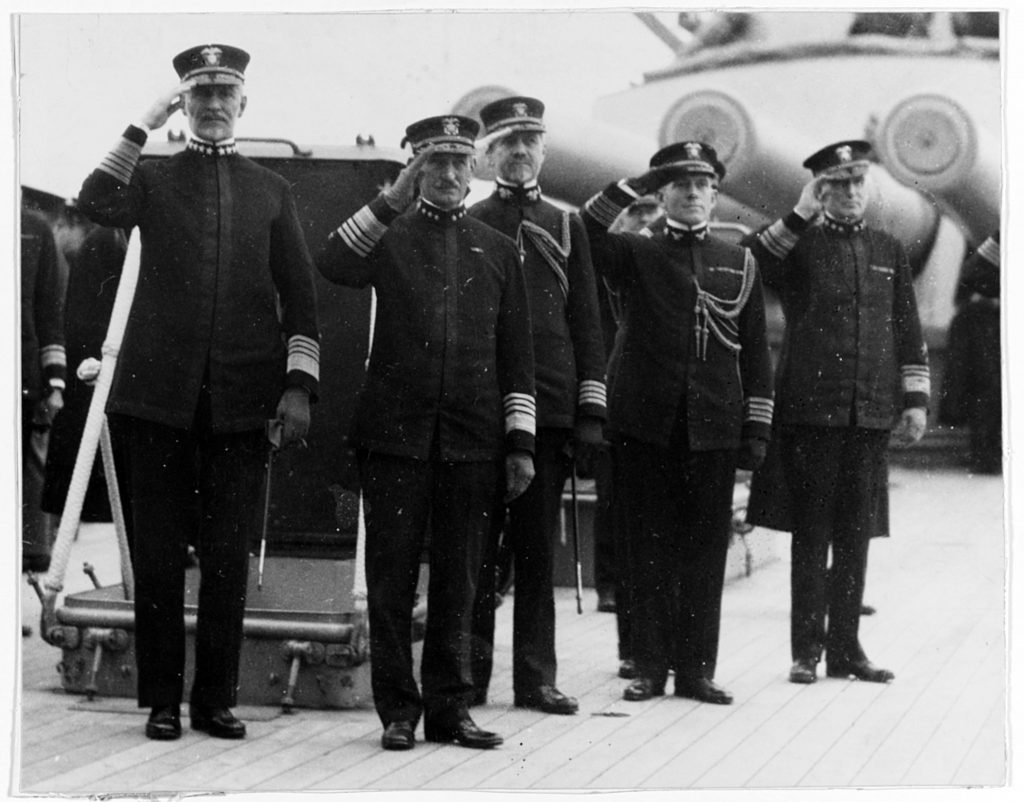
(Previously Unpublished) Commander, U.S. Naval Forces in Europe, Admiral William S. Sims, salutes with the Commander, Atlantic Fleet, Admiral Henry T. Mayo, with their chiefs of staffs on board the flagship of the Atlantic Fleet, USS Pennsylvania (BB-38). After the armistice in November of 1918, Sims and Mayo assumed four star rank. Their close collaboration during the First World War provided the template for headquarters ashore to support future U.S. Navy operations at sea. Together, the staffs serving under Sims and Mayo pioneered contemporary concepts of joint and combined naval command.
The Knox-King-Pye board was another piece that I was unable to fit in this collection. I make some references to it other areas. One of the big things the board highlighted, and the reason it caused so much controversy, is that the board concluded that your average U.S. Navy flag officer was only educated to the lowest commissioned grade. If you think about that, in 1919 they are making the assertion that the average American naval professional went to the naval academy, graduated, became ensigns, and that’s the last time they had any education besides the life at sea. What Knox, King, and Pye concluded was one of the problems in the navy was the poor education of high ranking admirals. One of the people they had in mind when they wrote this was Hugh Rodman, who commanded a battleship division in the First World War. Rodman celebrated the fact that he didn’t read Clausewitz and Jomini – he thought he was just a darn good sailor. King and Knox thought he was a dullard. So in essence what Knox, King, and Pye are trying to do is say, ‘hey, flag officer, you might have the rank, but we are smarter than you.’
Also, as a writer and historian, how did you decide to organize this book? How do you organize your notes and thoughts when you are writing?
I studied with Carl Boyd and the late Craig Cameron at Old Dominion University a long time ago – and both of them had different writing methods. First and foremost as a methodological point, I was conditioned by people like Carl and Craig to study the works of great historians like Michael Howard and Peter Paret. I have been so fortunate in my past studies, as Carl personally made it possible for me to interact with Peter Paret, John Keegan, and Admiral Bobby Inman. Because of Carl, I also had the opportunity to work with and develop close friendships with historians like the late Jürgen Rohwer and Edward L. “Ned” Beach.
Since my studies at Old Dominion all those years ago, I have subsequently had the unique privilege of studying under the immediate supervision of John Hattendorf at the Naval War College and Andrew Lambert at the University of London, King’s College. Hattendorf and Lambert loom very large as inspirations for the type of historian I would like to be. Michael Howard also inspires me to focus on the human dimension, as I consider the strange phenomenon of war. If anything, my studies of past wars have convinced me that contemporary strategic thinkers ought to take the approach that, unlike armies or air forces, Knox argued that navies provided unique means, “not to make war but to preserve peace, not to be predatory, but to shield the free development of commerce, not to unsettle the world, but to stabilize it through the promotion of law and order.”
From my education as a historian, I strive to employ the method that is more closely associated with Leopold von Ranke. Through primary archival research and documentary history, I try to replicate the conditions of the time in order to understand why people acted in the way that they did at the time. I strive not to superimpose 21st century concepts upon personalities like Knox or King. I’m trying to understand why they did things in 1919 within the context of 1919. I do take sort of a broadly humanistic approach in examining historical questions.
Now, it does cause some problems for me, because I was not actually there in 1919 and I will never actually get to meet people like Knox or King. By reading their papers and by placing them into their proper historical context, however, I must say that one can get a visceral sense of what made them tick (so to speak). Since they were able to navigate the unforeseeable cybernetic challenges of technology and the collapse of empires during the unprecedented upheaval of two world wars, I must say that Knox and King would certainly have something to say about the contemporary challenges we face in the twenty-first century.
When I’m talking to contemporary strategic thinkers at the Naval War College, I also have to help them understand why the past is still important within the contemporary context. Obviously, I want people to read my writing. So, one of the challenges is to make it such that these people that are no longer with us – people like Knox and King – that they resonate with contemporary readers. I look for things that provide connections to the contemporary reader, which of course helps us discussions about the future.
I begin with that methodology. I pick people to focus on and then I look for their papers. Of course, I try to read everything I can possibly get my hands on about these people. There’s not much on Knox, unfortunately. Soon you realize that you are dealing with these complicated personalities — and you are dealing with myths in the historiography, all the while trying to figure out what made these people tick. The more you know the more complicated it gets. You have to be disciplined to focus on the themes that are the most important to understanding the person you are dealing with, but also how that person continues to be important to the contemporary reader.
Once I have all my information together I’ll rough out an outline of the themes that I want to hit on. Those then become your chapter headings, and then each chapter has its own focus. Next, you do your best to try to tie all the chapters together into a comprehensive narrative with a strong opening argument in the beginning and a strong conclusion in the end, telling the reader what it means.
My last questions have to do with Knox’s legacy. What do you think, if anything, he anticipated as future challenges for the U.S. Navy? And second, what is the single most important thing you want readers to takeaway from Knox’s work?
Knox is part of that generation of naval officers who followed the vision of the “navy second to none.” He did it through two world wars and he did it during peacetime in efforts to avoid wars in the first place. Arguably, the navy you have today is the navy that Knox and his associates built. If we don’t recognize that then we run the risk of losing what they built. I would argue that Knox is with us everyday when a U.S. Navy warship gets underway. If anything, I would hope that contemporary U.S. Naval professionals just take some time to think about the rich history and traditions of our service. In some respects I am channeling the ghosts of Knox and King in stating that I firmly believe that we must recognize our responsibility of being the curators and caretakers of our U.S. Navy for the future interests of American seapower and in framing an informed approach to the future military policy of the United States. As an aside, I was pleased the other day that they got rid of the blue navy working uniforms. It was a uniform that Knox would have taken time to write about in a negative way. It would be great to see us get back into proper naval uniforms.
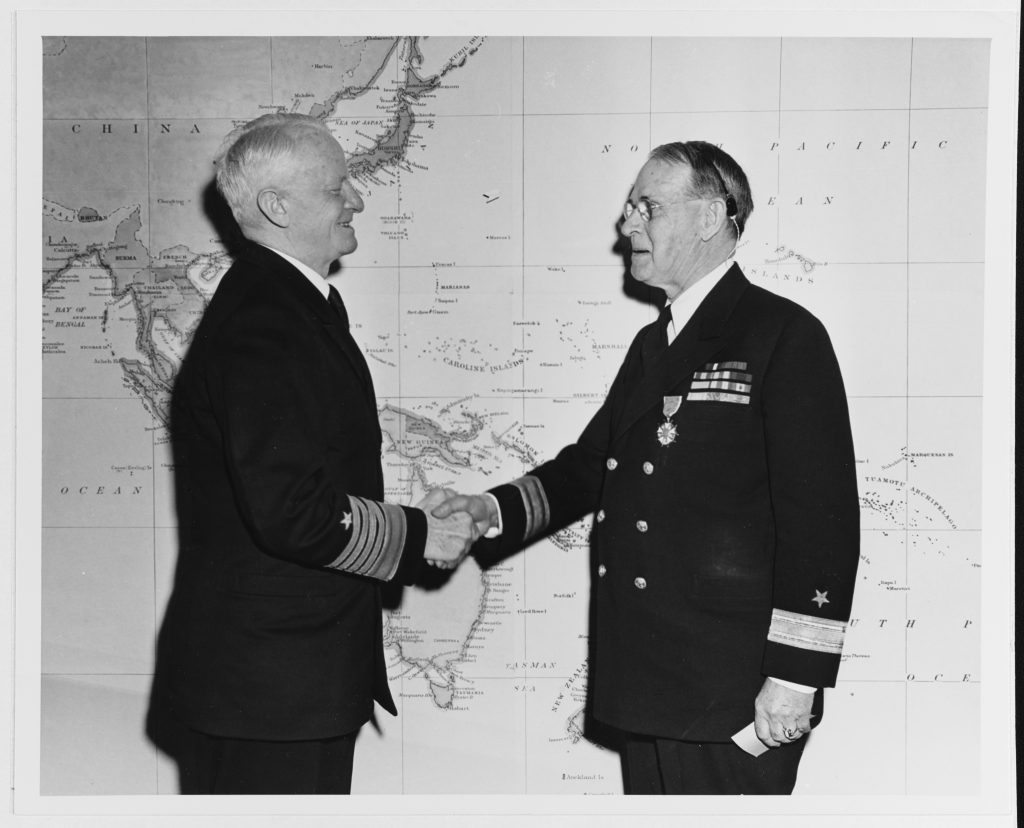
Fleet Admiral Chester W. Nimitz congratulating Commodore Dudley W. Knox with a Legion of Merit in 1946. During the Second World War, Knox returned to active status with assignment to the staff of the Chief of Naval Operations and Commander in Chief, U.S. Navy (CominCh). In this capacity, Knox served at large as a strategic adviser to President Franklin D. Roosevelt and Fleet Admiral Ernest J. King. Through their good offices, Knox established the Office of Naval History as a coequal branch of the Office of Naval Intelligence on the Operations Navy (OpNav) staff. For this service, King nominated Knox for promotion to commodore in 1945. The following year, the postwar Chief of Naval Operations, Nimitz, recognized Knox with the Legion of Merit Medal to mark his return to retired status. Nevertheless, Knox continued working within the Office of Naval History until his death in 1960.
I am chagrined that some bureaucrat, probably sitting in a cubicle in the Pentagon, decided to abandon centuries of naval tradition by abandoning our enlisted rating system in favor of the air force and army models of focusing on rank. The rating system was really emphasized by Rear Admiral Stephen B. Luce who thought that military rank was ancillary to the mastery of a more focused professional trade, such as the quartermaster masters of navigation, the boatswain masters of seamanship, and the medical master corpsmen. If it is the last thing I do, our navy will someday return to its historical roots and develop a better understanding of why our U.S. Navy became what it now is within the contemporary context.
Nobody knows what the future holds, but historical understanding provides means to anticipate and adapt to the unforeseeable future. Historians frequently face challenges in dealing with people who are more interested in bureaucratic routines, or mathematically framed engineering processes, or empirically clear solutions. Historians are unable to do this, because they do not tend to offer clear answers in black and white terms. All they can really do is offer contemporary strategic decision makers an informed perspective or a recommendation for a given course of action. Historians can only stand upon the foundations provided by historical understanding, but are not very good at articulating their ideas within the contemporary context as the engineers, lawyers, politicians, and policy-types tend to dominate the contemporary discussions of future strategy.
Basically, I think it is important for us as naval professionals to consistently seek an informed understanding of the past in order to know in clear terms the influence of history upon seapower and in shaping the future military policy of the United States.
Dr. Kohnen, thanks so much for taking the time to chat. All the best to you.
Thank You, Chris. I enjoyed it.
David Kohnen earned a PhD with the Laughton Professor of Naval History at the University of London (Kings College London). As a maritime historian, he concentrates on naval strategy, organizations, and organizational group dynamics. Focusing on these general themes, he edited the works of Commodore Dudley W. Knox to examine historical foundations in contemporary maritime affairs in, 21st Century Knox: Influence, Sea Power, and History for the Modern Era (Naval Institute Press, 2016). In his previous book, Kohnen focused on the transatlantic alliance between the British Empire and United States in, Commanders Winn and Knowles: Winning the U-Boat War with Intelligence (Enigma Press, 1999).
Outside of his scholarly work, Kohnen’s naval service in the active and reserve ranks include two deployments afloat in Middle Eastern waters, two ashore in Iraq, and one supporting landlocked operations in Afghanistan. Balancing work as a Naval War College civil service instructor, Kohnen also serves in the U.S. Naval Reserve with the Executive Programs faculty at the National Intelligence University in Washington, D.C. The comments and opinions in this interview are his own and do not represent the opinions of the U.S Navy or the U.S. Department of Defense.
Christopher Nelson is a U.S. Naval Intelligence Officer currently stationed in the Pacific. The questions and comments above are his personal opinions and do not reflect the opinions of the U.S. Navy or the U.S. Department of Defense.
This post first appeared on the Small Wars Journal and is republished with permission. Read it in its original form here.
By Rick Chersicla
An American Infantryman, laden with equipment and weaponry, steps off the ramp of a specially modified landing craft. He is not storming the beaches of Normandy or moving ashore on Guadalcanal – in fact, he is not even landing from the open ocean or a sea. Instead, this is the scene of a member of the Mobile Riverine Force (MRF), a joint Army-Navy venture formed during the Vietnam War. In an often-overlooked part of the war, soldiers and sailors worked together in the Mekong Delta of South Vietnam to dominate the fluvial local terrain in the region—rivers, streams, and swampy rice paddies. Using World War II era equipment and creating tactics and techniques while under fire, the men of the MRF wrote the modern chapter on riverine warfare for the U.S. Army.
While preparing for riverine warfare is not a common task, it is not a new challenge for the U.S. Army. Since its inception, the Army has dealt with the tactical challenges caused by rivers – from New Orleans to Vicksburg, and from the Philippine Insurrection to the Rhine. Despite the fact that the Army’s experience with riverine warfare peaked with the MRF of the Vietnam War, the concept is not outdated.
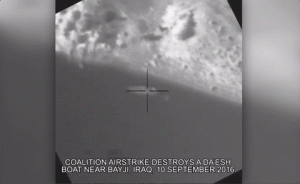
“While Iraq is nearly entirely land-locked, the Tigris and Euphrates rivers that cross that country are navigable, and ISIS has been using watercraft for a variety of purposes, including transporting fighters and conducting improvised explosive attacks.” (CNN)
This topic is relevant for modern strategists for the simple reason that while new technologies and global politics rapidly change and influence the way we fight war, terrain is an enduring aspect of war. Simply put, geography will continue to contribute to how the Army fights its wars. Furthermore, with the increasing focus on operations in littoral regions, riverine operations are a natural outgrowth from littoral concerns if the military is serious about projecting power. In this paper, I seek to explore what could be considered a capability gap in the field of riverine warfare. Using a case study of the MRF as an example, I hope to discern lessons learned in order to guide the possible formation and training of a future joint force similar to the MRF.
Origins of the Mobile Riverine Force
While the MRF was a joint Army-Navy venture, it was established on the bedrock of experience that the Navy had accumulated in South Vietnam. In 1959, naval advisors were approved to accompany the South Vietnamese Navy on operational missions, provided that they did not engage in actual combat. The primary focus of the naval advisors had been to build the interdiction capabilities of the South Vietnamese Navy along the coast. By 1961, as the number of advisors increased, the mission itself was expanded to include the task “patrol the inland waterways.” The early Naval advisors faced significant equipment challenges due to the lack of coastal or riverine crafts in the Navy’s inventory.
In addition to the dearth of equipment, there was a surprising lack of doctrine given the history of “brown water” warfare, as river fighting has occasionally been referred to. The Navy looked to the earlier experience of the French for inspiration. The French involvement in Southeast Asia provided a more immediate blueprint for the basis of American riverine operations in Vietnam. Between 1945 and 1954, the French developed river flotillas, the navales d’assault (naval assault divisions), better know as the Dinnassauts. Organized by the French Army for transportation and patrolling, the flotillas could support roughly a battalion-sized element. The Dinnassauts were comprised of a variety of types of landing craft, generally manned by the French Navy. The composition of the American MRF would mirror some aspects of the French organization, but more importantly, would seek to avoid some of the weaknesses of the French Dinnassauts.
French riverines (dissannauts) conduct operations in Vietnam during the late 1940s. (Histoire du Monde)
The French Dinnassauts did not have a large landing force organically assigned to it, a point that was rectified by Military Assistance Command- Vietnam (MACV) planners for the United States. One of the strengths of the MRF was its joint relationship between the Army and the Navy – the Army units of the MRF did not rotate out to other commands or locations, as had happened during the French experience.
Similarly, the lack of organic infantry posed a challenge for the French with regards to the base defense for the Dinnassauts. The MRF would solve issue a decade later by rotating organic forces through security duty while conducting operations. When reflecting on their riverine experience in Vietnam, the French concluded that two of the key improvements that would have increased efficiency were increased armament, and the permanent joining of Army and Navy forces for riverine operations. These lessons learned would influence the formation of the riverine forces during the American experience in Vietnam, and directly contributed to the MRF’s joint nature and extensive firepower.
With the departure of the French, American military personnel stepped in to advise the military of South Vietnam. U.S. Naval advisors were the first Americans to operate in any appreciable number in the Mekong Delta, where the MRF would eventually conduct combat operations. The Navy gained experience operating in the rivers and off the coast of the Mekong Delta with Task Force 115 (code named MARKET TIME) and Task Force 116 (code named GAME WARDEN). The sailors of MARKET TIME had the key task of interdicting any infiltration attempts along the coast, while the GAME WARDEN sailors focused on interdicting enemy lines of communications along the Delta’s river ways. While there were both tactical and operational successes in both MARKET TIME and GAME WARDEN, the exclusively naval force did not have the ability to project combat power onto the riverbanks and shore line.
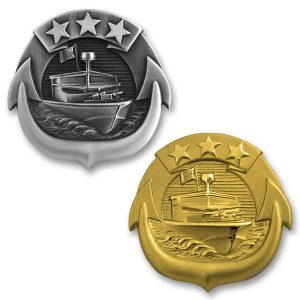
Modern small craft pins in the U.S. Navy draw on the heritage of Vietnam operations: a Patrol Boat Riverine is depicted centered under three stars representing operations GAME WARDEN, MARKET TIME, and SEALORDS. (USA Military Medals)
By 1966, General William Westmoreland began to see the importance of the Mekong Delta to the overall strategy of the Viet Cong. By this time, there was enough evidence that the Viet Cong sought to control the Delta’s Route 4 (the only real overland link between Saigon and the southernmost regions of the country) in addition to using the area to infiltrate supplies and manpower. The Mekong Delta was essentially the breadbasket of South Vietnam, providing the majority of the food and livestock for the rest of the country, and to lose control of the Delta would be a critical blow to the regime in Saigon.
While MARKET TIME and GAME WARDEN were disrupting the enemy’s logistics, it would take a significant number of ground forces to truly project combat power and clear the Viet Cong from the Mekong Delta. With the United States Marine Corps (USMC) elements in country fully committed to the northern portion of South Vietnam, the assault infantry element of the force would have to be provided by the United States Army. General Westmoreland accepted the proposal to create specialized units that could maximize the watery terrain of the Delta to seek out and destroy the Viet Cong, and the concept for the Mobile Riverine Force was born.
Much of the organization for what became known as the MRF sprang from a MACV study entitled Mekong Delta Mobile Afloat Force Concept and Requirements, published on 7 March 1966. While there would be some adjustments made to the initial recommendations, the key element articulated in the plan and later implemented was the utilization of naval ships for the basing of the MRF. Had the Army seized a portion of what little dry land was available in the Delta, it would have provided the Viet Cong with a propaganda coup in the heavily agricultural region – that the imperialist Americans were seizing the land of the farmers.
As a result, the base at Dong Tam, which would serve as the home base for the MRF, was created entirely by dredging sand from the My Tho River. In this way, the Army Corps of Engineers and Navy’s Seabees established a foothold from which the MRF could conduct operations in the Delta by literally creating one. This was an important departure from the French, whose riverine units had operated off of fixed land bases.
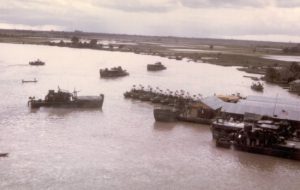
Riverine craft moored at Naval Support Activity Dong Tam in 1968. (Norman Belanger via Cantho-RVN.org)
The Old Reliables Arrive
Providing the combat power of the MRF was the 2nd Brigade of the Army’s 9th Infantry Division. The 9th Infantry Division had been activated at Fort Riley, Kansas, on 9 February 1966, the only Army division specifically stood up for service in Vietnam. Colonel William Fulton, the commander of the 2nd Brigade, participated in what became to be known as the “Coronado Conference” in Coronado, California.
It was at the Coronado Conference that the leaders of each component of the soon to be joint venture, Captain Wade Wells for the Navy and Colonel Fulton, met to discuss the organization and command structure of the MRF. Neither Captain Wells or Colonel Fulton were named as overall commander of the MRF, instead, each officer would follow his own service’s command structure, with General Westmoreland himself being the first common command element. This unusual command relationship would prove to be surprisingly harmonious, with cooperation superseding service rivalries, and each element focusing on working together to accomplish the mission.
The MRF consisted of approximately 5,000 total sailors and soldiers. The Army compliment included the brigade headquarters, three infantry battalions, a field artillery battalion, and support troops, to include engineers. Due to the accumulation of surface water in the area of operations, elements of the MRF lobbied to increase the number of rifle companies per battalion from three to four, in order to allow the units to rotate their troops out of the Delta’s rice paddies. This change allowed for a drying-out period for those infantrymen who had been operating in the paddies inundated with water, without losing the operational tempo that was seen as a key to success by the senior leadership.
Naval ships served as the transportation and logistics element of the joint undertaking of the MRF. At its core, four World War II LSTs serve as barracks ships, equipped with helipads and modified for riverine operations. Additional means of support included a repair ship and an LST that could carry ammunition for 10 days of operations, and food for 30 days of operations.
These support elements as a whole were referred to as the Mobile Riverine Base (MRB), and were capable of moving up to 150 kilometers in a 24-hour period. Perhaps most importantly, elements could launch on day or night operations after only 30 minutes at anchor. The ability to move a force that was tailored to the environment such extreme distances and launch operations so quickly gave the joint force the reach needed to bring the fight to the Viet Cong in the Mekong Delta.
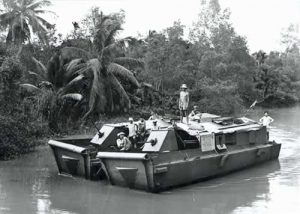
Several types of small craft provided the mobility and firepower components of the Navy’s contribution to the MRF, referred to by the Navy as River Assault Flotilla No. 1. The Armored Troop Carrier (ATC) was a modified LCM-6, a World War II era landing craft. The ATC had significant upgrades to the simple troop carrying variant of the 1940s, carrying twin 20mm guns, two .50-caliber machine guns, seven .30-caliber machine guns, and two 40-mm grenade launchers providing a significant punch in addition to its physical payload of up to 40 troops.
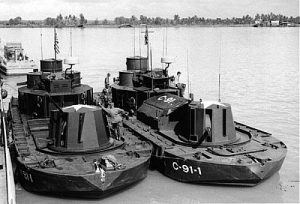
For situations that require even more firepower, the Monitor served in a “support by fire” capacity. The Monitors were essentially “the battleships of the force,” loaded with a 105-mm turret forward and an 81-mm naval mortar amidships, with .50-caliber and 20-mm guns on the aft portion of the craft. The last small craft that served a vital role with the MRF was the Assault Support Patrol Boat (ASPB), a radar equipped, double-hulled minesweeper. During movement, the assault support patrol boats provided reconnaissance and security to the force.
Two Vietnam-era “Monitor” riverine craft. The vessel at right has been modified to support C2 functions by replacing the mortar pit with a communications center. (Doug Lindsey via Rivervet.com)
A striking shortfall of the formation and deployment of the MRF was the lack of dedicated riverine training. While Colonel Fulton had been relatively certain that his brigade would be designated as the brigade afloat for the MRF, the short period of time allotted for training led to a focus on counterinsurgency training. The training that the 2nd Brigade and the rest of the 9th Division underwent focused on lessons learned thus far by Army units in Vietnam, as well as current standard operating procedures for units already in combat. Additionally, Colonel Fulton felt that his brigade had to master “basic operational essentials” before moving on to the little-studied field of riverine operations. For some of the infantrymen of the 2nd Brigade of the 9th Infantry Division, their introduction to riverine training was their assignment to the USS Benewah upon arriving in the Delta.
While the bulk of the infantrymen in the 2nd Brigade did not receive riverine training, the brigade leadership and that of the subordinate battalions did participate in a ten-day course at the Naval Amphibious School in Coronado, California. While short in duration, the course (which had been set up at the request of Colonel Fulton) gave the Vietnam-bound command teams and their staffs the chance to focus exclusively on the challenge of riverine operations for the first time. This short course took place at the end of November 1966, and the bulk of the Coronado-trained officers arrived in Vietnam on 15 January 1967, serving as an advance party. Over the course of 31 January and 1 February 1967, the main body of the 2nd Brigade disembarked at Vting Tau in South Vietnam.
By late January 1967, efforts were underway for the men of the 2nd Brigade, 9th Infantry Division to receive riverine training “in-country.” The lack of time available for training at Fort Riley had prevented the unit from conducting a brigade-level training event in riverine operations, so a dedicated effort was made to provide at least a ten-day period of training. The 3rd Battalion, 47th Infantry Regiment however, was only able to complete three days or the requisite training before enemy actions resulted in the assignment of a mission in the Rung Sat special zone. The resulting mission was referred to as RIVER RAIDER 1, and was the first joint operation by U.S. Army and U.S. Navy units that would constitute the MRF.
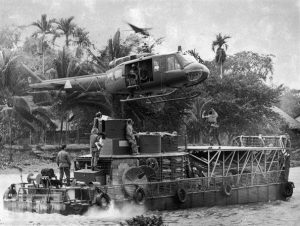
As a result of the lack of dedicated riverine training and the dearth of accepted riverine doctrine (or at least joint doctrine), innovation played a key role in the operations of the MRF. To support medical evacuation and resupply efforts, another form of technology was needed to compliment the river-borne units. The soldiers and sailors of the MRF created what the brigade commander referred to as an “aircraft carrier (light)” when a helideck was added to an armored troop carrier.
An armored troop carrier modified with a landing platform prepares to receive a UH-1 MEDEVAC helicopter. (Mobile Riverine Force Association)
This practice spread, and most of the armored troop carriers eventually sported a one-ship landing zone that could support a light observation helicopter. The men of the MRF also had to innovate when it came to employing indirect fire assets. The original plan called for separate barges to carry an artillery piece, and the prime mover (truck) required to tow it off the barge, up the riverbank, and into a firing position. When operations began, however, it became evident that not only were most of the banks of the rivers too steep and slippery for this practice to be put into effect, but that there was a lack of dry firing points other than the scant number of roads.
The 3rd Battalion, 34th Field Artillery Battalion experimented with the Navy and eventually called for six riverine artillery barges to be built in Cam Ranh Bay and sent to the MRF. The final product could carry two 105-mm howitzers and troop housing as well as up to 1,500 rounds for the howitzers, with the LCM-8 that towed the barge carrying additional ammunition. These artillery barges would travel at night and anchor offshore to supply close-in artillery support during operations. Colonel Fulton, the senior Army officer in the MRF, believed that the “floating” field artillery riverine battalion was the single greatest contribution to riverine warfare by the MRF.
The presence of the MRF is credited with turning the tide of the war in the northern Mekong Delta in the favor of the United States and South Vietnam during 1967 and 1968. Until 1967, enemy Main Force and Viet Cong units had moved virtually unhindered through the Dong Tam area. The enemy’s freedom of maneuver was greatly reduced, two Viet Cong battalions were pushed from the more populated areas, and the overall security in the city of My Tho was improved.
Most importantly, with Viet Cong effectiveness reduced, Highway 4 was reopened in 1967 and produce from the agricultural heart of Vietnam was able to flow to market along the Delta’s main ground route, for both domestic use and export. Overall, the MRF contributed to the overall counterinsurgency effort of the United States by pursuing the Viet Cong into what had long been uncontested sanctuaries, and supporting the local economy by the attrition of the Viet Cong who had closed down Highway 4. Colonel (later Major General) Fulton, credited the organization and mobility of the MRF for its success, writing that “the Mobile Riverine Force, because of its mobility, strength of numbers, and Army-Navy co-operation, was capable of sustained operations along a water line of communications that permitted a concentration of force against widely separate enemy base areas.
Post-Vietnam Operations
With the end of American involvement in the Vietnam War ended, interest from both the Army and Navy in riverine operations waned. The task of training in coastal riverine operations fell to Navy’s Coastal Riverine Squadrons (CRS) until 1978, when they shifted focus to exclusively support special operations. The Marines retained a small number of craft for riverine operations, but neither the boats nor the units were intended or capable of executing large unit operations.
Following the invasion of Iraq in 2003, there was a limited resurgence in riverine operations as first Marine and then Naval units conducted security patrols around dams and other key infrastructure. The Navy embraced the “brown water” concept in 2006 by establishing Riverine Group One (RIVGRU 1), which grew to become three Riverine Squadrons (RIVRONs). However, even this change was fleeting, and by 2012 the Riverine Groups had been consolidated with the Marine Expeditionary Security Squadrons (MISRONs), and reflagged as the Coastal Riverine Groups (CRG). One CRG is located on each coast of the United States, but with only one riverine company per squadron, the focus is overwhelmingly on maritime security.
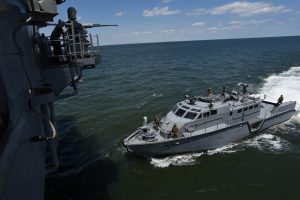
Coastal Riverine Squadron Four (CRS-4) conducted well deck operations with the Mark VI patrol boat for the first time aboard amphibious assault ship USS Bataan (LHD 5) May 15, 2016. (Naval Today)
While the CRGs conduct a variety of important missions, ranging from port defense and harbor security to small unit insertion/extraction and tactical intelligence, surveillance and reconnaissance, they lack the power projection that was available to the MRF of the Vietnam era. The Mark VI Patrol Boat, the most recently acquired craft for the CRF, contains a bevy of advanced systems and weaponry, and will surely provide security to littoral areas. However, with a capacity to support only an eight-man team, the Mark VI provides more of a sharp jab than a knockout punch when it comes to force. Most importantly, the emphasis for both the Mark VI and the CRF that owns it is on coastal, not riverine operations.
Riverine Operations in the 21st Century
There are several reasons why riverine operations deserve more consideration by the Army. Simply put, joint operations can be a complicated affair, one in which “on the job training” can be costly in both lives and resources. As Lester Grau points out, the coordination and “commingling of forces” in a situation such as riverine operations would happen at a fairly low tactical level, among organizations that tend to have the least amount of experience with joint operations. A more detailed study of riverine operations in the context of the current operating environment could mitigate friction and prevent growing pains in the future.
A 2014 research paper from the Combined Joint Operations from the Sea Center of Excellence (CJOSCOE) identified capability gaps in NATO doctrine related to riverine operations. While the paper was commissioned at the request of the French, its authors believe that the trends identified within it could be useful to other countries as well. The most relevant finding to any future U.S. joint riverine force is the conclusion that these types of organizations work best when they are joint.
A joint force, unified under a single commander, would allow that commander to extend influence beyond the riverine environment itself. For example, while a purely naval force would be limited to the rivers themselves, a force that included a conventional infantry platoon or company could be disembarked to move overland or transported up minor waterways and strike at enemy locations. This finding is concurrent with the success the MRF enjoyed as a true joint organization.
Riverine operations in the 21st century may not always be as simple as an infantry squad in a small craft conducting security patrols near a dam. Rivers could provide the mobility for a unit to interdict enemy lines of communication, patrol unit boundaries and move supplies, in addition to move larger strike forces as was seen with the MRF in Vietnam. With the wide array of security challenges facing the United States, there are multiple locations that could feasibly host operations comparable to those of the MRF between 1967-1969, from the Niger River in West Africa, to the Yellow River in China.
Navigable river systems are key lines of communication on every continent except Antarctica. (European Joint Research Centre)
Riverine operations follows logically after the Navy’s newest planning consideration, that of littoral operations. Several of the largest maritime threats of the 21st century, including terrorism and piracy, occur in coastal areas as opposed to the open ocean. Accordingly, the Navy dedicated significant time and money into developing the appropriate capabilities to handle threats in shallow, littoral areas. The Littoral Combat Ship (LCS) has been lauded as the answer to these shallow water threats, possessing the ability to move quickly and with more agility than larger craft. The LCS in many ways has replaced the frigates that have historically operated along coastlines.
The recent Sealift Emergency Deployment Readiness Exercise (SEDRE) conduct in April 2016 by a brigade from the Army’s 101st Airborne Division gives further credence to the argument for this capability. The first SEDRE conducted since the Global War on Terror (GWOT) began over fifteen years ago, it challenged the Army elements involved, as they have not been common practice. The Army brigade worked with the Navy’s Military Sealift Command to load and unload almost 900 pieces of equipment. This SEDRE demonstrates that the Army and the Navy have given at least some thought to larger scale joint operations, and as the lessons learned from this SEDRE are disseminated, more serious thought can be given to developing a MRB concept for the 21st century.
While the Navy has had the prescience to move away from strictly “blue water,” open ocean warfare and expand its field of view with regards to future threats, it is not enough. The focus on littorals, as evidenced by the development of the LCS, is only half of the equation. To be truly effective, the United States has to be able to project power everywhere, and the LCS is too big to navigate most rivers. A modern riverine force would be the logical extension of this littoral focus, and the answer to this problem should mirror many aspects of the Vietnam-era MRF. The LCS fleet being fielded by the Navy could probably serve in a role similar to the MRB of the Mekong Delta. The key is fielding an element that can move platoon and company sized formation, with the option of massing an even conducting battalion sized riverine operations. If this theoretical next step was taken, the biggest challenges would be finding the most appropriate modern craft to recreate the role of the ATCs and Monitors of the MRF.
Hardware Challenges
The focus on larger ships for littoral operations, and the trend of riverine operations being within the domain of Special Operations Forces (SOF), means that one of the largest gaps for potential riverine operations is in existing U.S. Naval hardware. There are several possible contenders for the type of craft that could comprise the fleet of a future MRF. The current workhorse the United States Marine Corps should be a logical option, but the venerable Marine AAV-7 is too small and provides too little by way of firepower to serve as a new ATC. The AAV-7 carries 21 combat loaded Marines, and is armed with a .50 caliber machine gun and 40-mm grenade launcher. While it is tracked, which means it can move from water to land seamlessly, it would not meet the necessary requirements. What a modern MRF would need is something closer to the ATC of the late 1960s, a craft that carry closer to 40 troops and boast a more formidable armament.
The Royal Navy of the United Kingdom has two variants of landing craft that could serve as a good example upon which to improve. The LCVP MK5 can carry thirty-five fully equipped commandos (or vehicles and equipment), and their Landing Craft Utility Mk10 can carry up to 120 fully laden commandos. While these two options are improvements over the AAV-7, they both still lack firepower. Additionally, none of these craft boast the helipads the ATCs of the MRF came to employ.
An LCVP Mk VI and LCU Mk 10 from the Royal Navy conduct an underway demonstration in 2008. (ArRSe.co.uk)
The most likely course of action would have to be a dedicated effort to either build specific craft for platoon and company size riverine operations in the 21st century, or to significantly modify existing watercraft. The British LCVP MK5 is not very different than the existing American LCUs, but they both lack the protection and firepower to fulfill the role of an ATC. The modifications made to the LCUs of the 1960s that resulted in the ATCs were the results of lessons learned from the French and early American river operations. They key to successful riverine operations in the 21st century is the design and adoption of these boats now, so doctrine and tactics can be developed before the threats are ready.
In addition to protection and firepower concerns, a 21st century MRF would have several planning considerations that the Vietnam-era MRF did not. The modern military relies so heavily on tactical satellite (TACSAT) and other advanced communications that there would be a significant increase in the amount of electronics aboard the river craft. Additional steps would probably have to be taken to water proof and safeguard our current systems.
The increase in the use of unmanned aerial vehicles (UAVs) over the past two decades has changed, and continues to change, the face of war. To be relevant, any modern MRF would have to incorporate drone and possibly counter drone measures into operations. Another key different between 2016 and 1967 is the weight and size of the aircraft being used for medical evacuation (MEDEVAC) purposes. The UH-60, the current primary MEDEVAC helicopter, is significantly larger and heavier than the Vietnam-era UH-1s, a consideration that would impact the design and practicality of an onboard landing zone.
Training Recommendations and Conclusions
There are ways to explore this operational concept in a budget-constrained environment. While simultaneously codifying doctrine, acquiring equipment and developing tactics, techniques and procedures would have to be refined before any form of modern MRF could be deployed. While the capability gap exists, acquiring funding for a new initiative or type of unit can be a herculean effort. To train on this task while not creating a large specialized unit in a resource-constrained environment, one solution could be the creation of an equipment set similar in concept to the European Activity Set.
Soldiers from 1st Armored Brigade Combat Team, 3rd Infantry Division road test two M2A3 Bradley Infantry Fighting Vehicles as they draw equipment from the European Activity Set at Grafenwoehr Training Area, Germany ahead of exercise Anakonda 16 (US Army)
The European Activity Set includes 12,000 pieces of equipment, including approximately 250 tanks, Bradley Fighting Vehicles (BFVs) and self-propelled howitzers. There are currently elements of the European Activity Set in Germany, Lithuania, Romania, and Bulgaria. Using that concept, units could rotate to a location, familiarize and train on the riverine craft as needed. An additional benefit to this model is that riverine training could be conducted by U.S. Army Reserve or National Guard units conducting Annual Training (AT), as well as Active Duty (AD) troops since none of them would normally own the requisite equipment. The naval component of this possible force could maintain the watercraft and become the repository of knowledge for the joint riverine concept.
Conclusion
While not advocating any modern gunboat diplomacy, the hard truth is that by not having the capability- the equipment, doctrine, training- the Army is providing an exploitable weakness to any potential enemies. In acknowledging that rivers are not “simply obstacles to be crossed,” but terrain that can be controlled, the argument for another look at riverine operations for the U.S. Army becomes more urgent. The U.S. faces a long list of global threats, from Violent Non-State Actors (VNSAs) to increasingly belligerent states seeking to become near-peer competitors such as China or a resurgent Russia. The U.S. must make hard choices in assessing threats and determining how to resource its national security objectives.
While the MRB was a necessity given the fluvial environment of the Delta, it also provided the MRF with mobility, and a semblance of security. The potential benefits of the ability to influence land operations while not appearing overbearing on the local population cannot be overstated. While that idea may run contrary to population-centric COIN, the lack of a physical footprint could be helpful for a mission set consisting of surgical strikes and raids, or for training missions in which the local population is very concerned with Western influence.
Members of the Nigerian Special Boat Service pose alongside British counterparts. (Beegeagle.Wordpress)
Using Nigeria as an example, an overt presence of larger American units could play into the narrative of the local Islamist group, Boko Haram. Operating from a new-generation MRB would be one way to circumvent the jihadist narrative, while still providing train and assist capabilities, or conducting more kinetic, joint operations. Regardless of any altruistic intentions, the U.S. assumes the moniker of “imperialist” in the eyes of those opposed to U.S. involvement the moment a boot touches foreign soil, and operating on rivers may provide an alternative narrative.
History has shown that riverine warfare is an enduring part of warfare, and an acquired skillset. Given both the history of its occurrence, and the possibility of littoral operations in the future, it would behoove the Army to look more closely at riverine operations and pursue in some capacity a joint riverine organization. The situation may arise that more than a rifle squad or SOF team is needed to effectively project power. If a strong, joint riverine element can be developed, the U.S. can bypass the traditional practice of building up a beachhead, and the “ship to shore” way of moving combat power can truly shift to one of power projection from the littoral, “upriver,” to population centers.
The views expressed in his articles are those of the author, and do not reflect the official policy or position of the United States Army, Department of Defense, or the United States Government.
Rick Chersicla is an active duty Infantry Officer in the United States Army. He is currently pursuing a M.A. in Security Studies at Georgetown University.
End Notes
[1] The CJOSCOE study cited later in this paper defines fluvial in accordance with Joint Test Publication 3-06, describing the fluvial environment as terrain where “navigable waterways exist and roads do not, or where forces are required to use waterways, an effective program to control the waterways and/or indirect hostile movement becomes paramount.” This rarely used term is ideal when describing riverine operations.
[1] Lester W. Grau and Leroy W. Denniston, “When a River Runs Through It: Riverine Operations in Contemporary Conflict,” Infantry, July-September 2014, 31.
[1] Thomas J. Cutler, “Brown Water, Black Berets: Coastal and Riverine Warfare in Vietnam”,(Annapolis, MD: Naval Institute Press, 1988), 19.
[1] Cutler, Brown Water, 21.
[1] Cutler, Brown Water, 24.
[1] Cutler, Brown Water, 44.
[1] Department of the Army, Major General William B. Fulton, Vietnam Studies: Riverine Operations, 1966-1969, (Government Printing Office: Washington, D.C., 1985), 10. MG Fulton, given his experience as the former Brigade Commander of the Army element in the MRF, has authored a comprehensive study of the formation and tactics of the MRF.
[1] Fulton, Vietnam Studies, 10.
[1] Ibid, 11
[1] Ibid, 11.
[1] Ibid, 16.
[1] Ibid, 24.
[1] Ibid, 24.
[1] Ibid, 24
Featured Image: A Patrol Boat Riverine (PBR) MkII conducts operations during the Vietnam War, 1968. (U.S. Army Transportation Museum)