Category Archives: Global Analysis

A Geographical Breakdown of What’s Going on in the World

Common Public Good at Sea: Evolving Architecture in the Indo-Pacific Region

The following piece by guest author Captain Gurpreet S. Khurana, PhD, was originally posted by The National Maritime Foundation, and was republished with permission.  You can read it in its original form here. 

The concept of ‘Common Public Good(s) at Sea’ has lately gained much traction in the context of maritime safety and security in the Afro-Asian swath of the Indo-Pacific region.1 As the centre-of-gravity of world’s economic power shifts eastwards, the salience of this predominantly maritime-configured region is increasing, and the attendant emphasis on security and stability in its maritime domain.

[otw_shortcode_button href=”https://cimsec.org/buying-cimsec-war-bonds/18115″ size=”medium” icon_position=”right” shape=”round” color_class=”otw-blue”]Donate to CIMSEC![/otw_shortcode_button]

One does not recall coming across a precise definition of the phrase ‘Common Public Good(s) at Sea’ (CPGS). The closest one gets is to define it is through exemplification of a navy’s ‘constabulary’ and ‘benign’ tasks at sea, ranging from counter-piracy and counter-terrorism to search and rescue (SAR), and humanitarian assistance and disaster-relief (HADR). This essay attempts to understand CPGS as a concept, examine the regional trends, and extrapolate the emerging CGPS architecture in the Indo-Pacific region.

The Concept

Most of us are familiar to the term ‘public good(s)’ used in the economic context. It draws its genesis from the renowned economist Paul Samuelson, who defined it in his 1954 paper as:

“[goods] which all enjoy in common in the sense that each individual’s consumption of such a good leads to no subtractions from any other individual’s consumption of that good.”2

A ‘public good’ is, therefore, something that is a collective good sans exclusions. Furthelighthouser, it is not amount to a ‘zero-sum’ reckoning; in a sense that its consumption by one entity does not reduce its availability to other entities. In the maritime domain, a public good are best represented by ‘lighthouses’ that beacon weather-beaten seafarers to ports and safe waters.
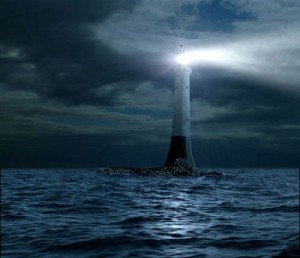
Much of the world’s ocean realm wherein humans undertake multifarious maritime activities is ‘international medium’ not subject to the laws of any single country. The delivery of safety and security in such space of global commons thus becomes a logical extension of ‘public good’. Further, such ‘good’ could be extrapolated to the littoral. The watery medium provides transnational access to maritime security forces to undertake humanitarian missions during adverse contingencies on and off foreign shores. It is pertinent to note that while undertaking such benign tasks – whether at high seas or in the foreign littoral – the maritime forces perform a valuable function for their respective governments as ‘instruments of foreign policy.’ Given the above, in the contemporary context, CPGS may be defined as: ‘measures taken by the maritime security forces to meet their respective States’ international commitments towards facilitating good and lawful order in the maritime global commons, while also meeting their respective foreign policy objectives.’

It is necessary to note, however, that the maritime domain – represented by the seas and oceans of the world – constitutes the most unregulated and treacherous realm on Earth. To develop situational awareness in this domain, deliver safety and regulate activities therein presents a formidable challenge for maritime forces, including those belonging to major naval powers.

The Regional Context

In geographical terms, the Indo-Pacific region has a predominant maritime configuration. While geography has been a ‘constant’ in history, the so-called ‘rise of Asia’ and the attendant maritime-economic activity in the region has made the CPGS concept highly relevant to the regional countries and the extra-regional stakeholders. Traditionally – or at least in more recent times since the beginning of the post Cold War era – CPGS across the globe, and particularly in the Indo-Pacific region, has been provided by the maritime forces of the United States (US); at times, assisted by the forces of what the US calls, its “allies and partners.”

The regional countries, beset by the lack of adequate capacity – besides limited national objectives in terms of geographical scope – have been largely content with the arrangement, and have adopted a ‘free-rider’ approach to security. However, clearly, such a measure is not sustainable, neither for the regional countries, not for the global stakeholders. It is not easy – even for a superpower like the US – to deliver CPGS incessantly in the nearly ‘endless’ stretch of the world’s maritime realm. The military/ naval resources of the US have been increasingly stretched since the end of Cold War due to its increasing military-strategic commitments overseas. The geopolitical challenges added to the US resource ‘overstretch,’ best exemplified by the Proliferation Security Initiative (PSI) and the Regional Maritime Security Initiative (RMSI). This led the US Navy Chief of Naval Operations (CNO) to propound the concept of ‘Thousand-Ship Navy’ (TSN) in 2005.

Seeking support of allies and partners to partake the responsibility of CPGS, the TSN concept continued well into later years, though ‘TSN’ concept was later rephrased as the ‘Global Maritime Partnership’ (GMP) initiative, and the same was highlighted in the US Maritime Strategy document of 2007.

In the long run, the reliance of the Indo-Pacific region on a single power (or even on a group of ‘monolithic’ western powers) for providing CPGS may not be in the interest of the regional countries and global stakeholders alike, including the US. There are nascent indicators of a change, which augurs well for both categories of nations.

Emerging CPGS Architecture

Tier One

For the US, since the beginning of the current decade, delivery of CPGS in the Indo-Pacific has assumed greater salience than ever before in consonance with its national-strategic concept of ‘Re-balance to Asia.’   Strategy-2015 furthers the appeal for the partnership, with the ‘Global Maritime Partnership’ (GMP) – of the 2007 Maritime Strategy document – now rephrased as a “global network of navies” in the 2015 Maritime Strategy. The 2015 document effectively communicates to the potential partners the rationale for such “plug and play” cooperation with the US forces sans “commitment.”

While the US has been a ‘constant’ in terms of delivery of CPGS in the region, and it may continue to be the ‘lead actor’ for some time, it is unlikely to be the ‘only’ provider of ‘net security’8 in the longer run. The Indo-Pacific is witness to the emergence of new major and middle powers with increasing geopolitical, economic and military stakes in the entire Indo-Pacific region. For geopolitical and military-strategic reasons, China is likely to contest the primacy of the US in delivery of CPGS. Notably, however, the Chinese refer to CPGS differently, as ‘Military Operations Other than War’ (MOOTW), as indicated in China’s Defence White Papers since the 2012 document titled ‘The Diversified Employment of China’s Armed Forces.’

Tier Two

While the US-China dialectic may soon emerge as the first tier of the regional CPGS arrangement, other medium powers are likely supplement it and form the second tier. These include Australia, India and Japan: middle powers, all of whom have gained considerably from their alliance/ partnership with the US, but would like to form a concert to hedge against being entangled in the US-China tussle. Towards this end, analysts are increasingly promoting the idea of “middle power coalitions” to offset big-power rivalry in the Indo-Pacific.

Australia’s strategic focus has traditionally been on its eastern seaboard facing the Pacific. Lately, however, Canberra is increasingly looking westwards, akin to a “pivot to the Indian Ocean,” and reminiscent of events of the 1970s leading to Australia’s
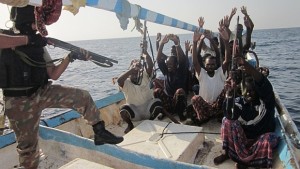
Counter Piracy Operations

‘Two-Ocean Navy’ policy enunciated in 1986.12 Sam Bateman writes, “Australia’s approach to the Indian Ocean in recent decades might appear to have waxed and waned (but) it never withered away…I don’t see any prospect of the current ‘pivot’ withering away!”13

The second tier is likely to be reinforced by the European Union (EU). Through the EU Naval Force (EUNAVFOR) Operation Atalanta, the EU has already proved itself to be a reckonable actor in the Indian Ocean, and the EU Maritime Security Strategy (EUMSS) promulgated in June 2014 is likely synergise the role of EU navies to provide CPGS – and least in the IOR, if not further eastwards – through its “integrated approach to global maritime security.” The Strategy would support the role of France – the only major power besides the US that has maintained a continuous naval presence in the Indian Ocean – and would draw support from the re-establishment of the Royal Navy’s permanent presence east of the Suez after a hiatus of nearly 45 years.

 Tier Three

In due course, some other medium powers and other relevant countries are likely to share the stage by taking on the gauntlet of CPGS in the Indo-Pacific, forming the third tier of the regional CPGS architecture. The potential medium powers include Indonesia and Iran. Indonesia has enunciated for itself the sobriquet of “Porus Maritim Dunia” (global maritime axis) that envisions developing of the maritime power of the archipelagic nation to its full potential. Further, in consonance with its geo-strategic centrality, it seeks to shape events in the maritime space of the Indo-Pacific region. Although Jakarta has accorded priority to internal consolidation, it is likely to play a significant CPGS role in the region.

Iran could be an effective counter to the global threat posed by the Islamic State in Iraq and Syria (ISIS) and bears a high potential of contributing to stability in West Asia and maritime security in the western Indian Ocean. The international community needs to realize the potential of ISIS to disrupt the West Asian international shipping lanes (ISL) by targeting oil and gas tankers, particularly in the maritime choke-points. The Iranian Navy may be a bulwark against the ISIS in securing the global energy trade sourced from the Persian/ Arabian Gulf. The positive trends in P+1 negotiations with Iran over its nuclear programme represents an opportunity for the stakeholders to engage with Iran.

The other relevant powers that could potentially contribute to CPGS in the region are South Africa, Pakistan and a cohesive group of the Gulf Cooperation Council (GCC) countries. Their highly capable and professional maritime forces could contribute significantly to regional CPGS effort. However, the political leaderships in Islamabad and the GCC capitals need to realize the emerging imperative to look beyond their respective sub-regional rivalries.

Concluding Remarks

The postulated CPGS architecture for the Indo-Pacific region conforms to the so-called “inclusive approach to maritime security,” which has been the ‘mantra’ of all the multilateral security institutions of the region: the ASEAN Regional Forum (ARF), the ASEAN Defence Ministers Meeting – Plus (ADMM+), the Western Pacific Naval Symposium (WPNS), the Indian Ocean Rim Association (IORA) and the Indian Ocean Naval Symposium (IONS). However, in the longer term, a formulation of regional security and stability architecture on a select group of regional countries and non-resident powers does not auger well for regional and global security.

The CPGS effort would need to be pan-Indo Pacific and collective, and enmesh the IOR and Western Pacific spheres of multilateralism. While it may be too ambitious and unrealistic to expect ‘all’ regional countries to acquire ‘surplus’ capacity for CPGS, even if the smaller countries develop adequate capacity to police their respective maritime zones and areas of SAR responsibility, they could contribute significantly to the collective regional CPGS effort. The efforts of multilateral institutions, and major and middle powers would need to be directed towards such ‘capacity-building.’

Captain Gurpreet S Khurana, PhD is Executive Director, National Maritime Foundation (NMF), New Delhi. The views expressed are his own and do not reflect the official policy or position of the NMF, the Indian Navy, or the Government of India. He can be reached at gurpreet.bulbul@gmail.com

[otw_shortcode_button href=”https://cimsec.org/buying-cimsec-war-bonds/18115″ size=”medium” icon_position=”right” shape=”round” color_class=”otw-blue”]Donate to CIMSEC![/otw_shortcode_button]

Notes:

1 The term ‘Indo-Pacific Region’ was first used in 2007 by the author. See ‘Security of Sea Lines: Prospects for India-Japan Cooperation’, Strategic Analysis, Vol 31(1), January 2007, pp.139-153.

[ii] Paul A. Samuelson , ‘The Pure Theory of Public Expenditure’, The Review of Economics and Statistics, Vol. 36, No. 4 (Nov., 1954), pp. 387-389

3 The Proliferation Security Initiative: Can Interdiction Stop Proliferation?’ Arms Control Association, June 2004, at https://www.armscontrol.org/act/2004_06/Joseph. Also see, Gurpreet S Khurana, ‘Proliferation Security Initiative: An Assessment’, Strategic Analysis, Vol. 28, No. 2, Apr-Jun 2004, p.237

[iv] Joshua Ho, ‘Operationalising the Regional Maritime Security Initiative’, IDSS Commentary (18/2004), 27 May 2004 at https://www.rsis.edu.sg/wp-content/uploads/2014/07/CO04018.pdf

[v] Address by the US Navy CNO Admiral Mike Mullen to the students and Faculty of the Naval War College, 31 August 2005 at the Naval War College Newport, R.I. See US Navy website at http://www.navy.mil/navydata/leadership/quotes.asp?q=11&c=2

[vi] ‘A Cooperative Strategy for 21st Century Seapower’, October 2007, at https://www.ise.gov/sites/default/files/Maritime_Strategy.pdf

[vii] ‘A Cooperative Strategy for 21st Century Seapower’, US Maritime Strategy, 2015. Also see, Gurpreet S Khurana, ‘Indo-Asia Pacific’ Explained: An Assessment of US Maritime Strategy 2015’, Web-publication of National Maritime Foundation (NMF), New Delhi, 21 August 2015, at http://www.maritimeindia.org/View%20Profile/635756366838030982.pdf

[viii] The concept of ‘net security’ is defined as “…the state of actual security available in an area, upon balancing prevailing threats, inherent risks and rising challenges in the maritime environment, against the ability to monitor, contain and counter all of these”. ‘Ensuring Secure Seas: Indian Maritime Security Strategy’, Integrated Headquarters, Ministry of Defence (Navy), 2015, New Delhi.

[ix] ‘The Diversified Employment of China’s Armed Forces’, Information Office of the State Council, The People’s Republic of China, April 2013, Beijing, at http://news.xinhuanet.com/english/china/2013-04/16/c_132312681.htm

[x] Rory Medcalf and C Raja Mohan, ‘Responding to Indo-Pacific rivalry: Australia, India and middle power coalitions’, Lowy Institute for International Policy, August 2014, at http://www.lowyinstitute.org/files/responding_to_indo-pacific_rivalry_0.pdf

[xi] Gurpreet S Khurana, ‘ AUSINDEX-2015: Australia ‘Pivots’ to the Indian Ocean’, Web-publication of National Maritime Foundation (NMF), New Delhi, 12 October 15, at http://www.maritimeindia.org/View%20Profile/635802023056774316.pdf

[xii] In the 1970s, Australia was wary of Soviet naval activity in the Indian Ocean, which led to the establishment of its lone naval base in west (HMAS Sterling)in 1978 and enunciation of ‘Two Ocean Policy’ in 1986, through which Canberra intended to relocate half of the Navy’s fleet to the Indian Ocean seaboard.

[xiii] E-mail communication with Commodore Sam Bateman (Retd.), Royal Australian Navy (RAN), 24 October 2015.

[xiv] ‘Mr. Modi’s Ocean View’, The Hindu, 17 March 2015, at http://www.thehindu.com/opinion/editorial/mr-modis-ocean-view/article7000182.ece

[xv] ‘Ensuring Secure Seas: Indian Maritime Security Strategy’, Integrated Headquarters, Ministry of Defence (Navy), 2015, New Delhi. For an analysis of the Strategy, see Gurpreet S Khurana, ‘Net Security Provider’ Defined: An Analysis of India’s New Maritime Strategy-2015’, Web-publication of National Maritime Foundation (NMF), New Delhi, 23 November, at http://www.maritimeindia.org/View%20Profile/635838396645834619.pdf

16 ‘Japan to reinforce SDF anti-piracy base in Djibouti for broader Middle East responses’, Asahi Shimbun, 19 January 2015, at http://ajw.asahi.com/article/behind_news/politics/AJ201501190036

17 ‘European Union Maritime Security Strategy’, Council of the European Union, Brussels, 24 June 2014, at http://register.consilium.europa.eu/doc/srv?l=EN&f=ST%2011205%202014%20INIT

[xviii] European Commission Press Release data base, Brussels, 6 March 2014, at http://europa.eu/rapid/press-release_IP-14-224_en.htm

[xix] In December 2015, Britain began construction of is new military base at Bahrain. ‘Work starts on new UK military base in Bahrain’, The Gulf News, 18 December 2015, at http://gulfnews.com/news/gulf/bahrain/work-starts-on-new-uk-military-base-in-bahrain-1.1610885

20 ‘Jokowi’s Inaugural Speech as Nation’s Seventh President’, The Jakarta Globe, 20 October 2014, at http://jakartaglobe.beritasatu.com/news/jokowis-inaugural-speech-nations-seventh-president/ Also see, Gurpreet S Khurana, ‘The Maritime ‘Rise’ of Indonesia: Indicators, Intentions and Inferences’, Web-publication of National Maritime Foundation (NMF), New Delhi, 16 Jan 2015, at http://www.maritimeindia.org/CommentryView.aspx?NMFCID=5381
 

Sea Control 106 – Arctic Circle

seacontrol2Ever wonder what is happening in the Arctic? Sea Control: North America host Matthew Merighi interviews three graduate students running the Fletcher School of Law and Diplomacy’s annual Arctic Conference: Molly Douglass, Rabia Altaf, and Drew Yerkes. The interview examines border claims, resource politics, and how the various regional actors are approaching this new frontier.   

DOWNLOAD: Arctic Circle

South China Sea arbitration: Beijing puts forward her own views Part Three

By Alex Calvo

This is the third installment in a four-part series devoted to China’s 7 December 2014 document, putting forward her views on the Philippines’ international arbitration case on the South China Sea. Although Beijing is refusing to take part in the proceedings, as confirmed following the Court’s 29 October 2015 ruling on jurisdiction, by issuing this document, and communicating in other ways with the Court, the PRC has failed to completely stay aloof from the case. It is thus interesting to analyze China’s narrative as laid down in that document. Read Part One, Part Two. 

[otw_shortcode_button href=”https://cimsec.org/buying-cimsec-war-bonds/18115″ size=”medium” icon_position=”right” shape=”round” color_class=”otw-blue”]Donate to CIMSEC![/otw_shortcode_button]

Has Manila committed herself not to initiate compulsory arbitration proceedings? Section III largely consists of a long list of bilateral agreements and statements, and ASEAN documents, laying down commitments to settle disputes by negotiation and agreement, whose purpose is to prove that Manila is therefore “debarred from unilaterally initiating compulsory arbitration.” In the former category, the text cites among others (31) the “Joint Statement between the People’s Republic of China and the Republic of the Philippines concerning Consultations on the South China Sea and on Other Areas of Cooperation, issued on 10 August 1995” which contains “the principles that ‘[d]isputes shall be settled in a peaceful and friendly manner through consultations on the basis of equality and mutual respect’ (Point 1); that ‘a gradual and progressive process of cooperation shall be adopted with a view to eventually negotiating a settlement of the bilateral disputes’ (Point 3); and that ‘[d]isputes shall be settled by the countries directly concerned without prejudice to the freedom of navigation in the South China Sea’ (Point 8)” and (33) the “The Joint Statement” of 16 May 2000 whose Point 9 states that the two countries “agree to promote a peaceful settlement of disputes through bilateral friendly consultations and negotiations.”

Concerning China-ASEAN documents, the text stresses (35) the 2002 “Declaration on the Conduct of Parties in the South China Sea (‘DOC’),”whose Paragraph 4 reads “The Parties concerned undertake to resolve their territorial and jurisdictional disputes by peaceful means … through friendly consultations and negotiations by sovereign states directly concerned, in accordance with universally recognized principles of international law, including the 1982 UN Convention on the Law of the Sea.” The DOC is of particular interest, not only because it has also been signed by most coastal states in the South China Sea (although not by Taiwan), but because it has often been touted by observers and governments as proof that it was indeed possible to settle the status of the sea without resorting to war. Does this agreement close the doors to compulsory arbitration under UNCLOS? As often in the law, at least two different interpretations are possible. On the one hand, a literal reading of the quoted paragraph seems to restrict the avenues opened to coastal states, although the term “only” or words to that effect do not appear in that section (as China’s position paper openly acknowledges in its Section 40). On the other it could be argued that the reference to UNCLOS is in itself a door open to arbitration, since that treaty provides under certain conditions and limitations for this form of dispute settlement. An intermediate view could be that the DOS forces signatories to first resort to direct consultations and negotiations, with arbitration under UNCLOS as a last resort. Concerning this view, Manila argues that China has no intention to engage in meaningful negotiations, whereas Beijing says (45) that “the truth is that the two countries have never engaged in negotiations with regard to the subject-matter of the arbitration.” This is, at least to some degree, surprising, when we bear in mind the emphasis in the text on China’s commitment to negotiations. Given Beijing’s stress on bilateral negotiations, why have these have not even started with the Philippines? Not that they have not concluded, or progressed, but not even begun. Perhaps with such a question in mind, the position paper provides (47) some possible reasons, such as the fact that “the South China Sea issue involves a number of countries.” This is of course true, but by pointing it out as a reason not to have even begun negotiating with the Philippines, China is contradicting another pillar of its posture in the South China Sea: its insistence on bilateral, as opposed to multilateral, negotiations. One could thus argue that China cannot have its cake and eat it too. If the issue is complex because of the large number of actors involved, would a multilateral forum not be more appropriate? If so, why does Beijing insist on bilateral negotiations? And when someone like Manila argues these are leading nowhere, then the reply is that they have not even started because, among other reasons, of the large number of countries involved. There are of course powerful reasons why China may prefer a bilateral approach, but this illustrates how easy it is to fall into contradictions in the international arena, not something that affects just China of course.

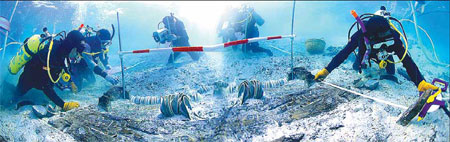
Chinese marine archaeologists working in the South China Sea in 2008. Archaelogy plays a key role in Beijing's narrative.
Chinese marine archaeologists working in the South China Sea in 2008. Archaelogy plays a key role in Beijing’s narrative.

With regard to the absence of an explicit exclusion of third-party settlement, which as pointed out the text acknowledges, China cites the “Southern Bluefin Tuna Case”where the arbitration tribunal stated that “the absence of an express exclusion of any procedure … is not decisive.” Two key words for China are to “agree”, which the text (38) explains often appears in bilateral communiques, and “to undertake”, which features (38) in Paragraph 4 of the DOC. China’s position paper stresses, citing the ICJ in Bosnia and Herzegovina v. Serbia and Montenegro, where the Court ruled that “[t]he ordinary meaning of the word ‘undertake’ is to give a formal promise, to bind or engage oneself, to give a pledge or promise, to agree, to accept an obligation. It is a word regularly used in treaties setting out the obligations of the Contracting Parties …. It is not merely hortatory or purposive.” For China, bilateral agreements and statements with the Philippines and the DOC are not separate realities, but (39) “mutually” reinforce “and form an agreement between China and the Philippines”, giving rise to “a mutual obligation to settle their relevant disputes through negotiations.”

The position paper underlines (50), as a further argument to prove that exchanges of views with the Philippines did not start in 1995, that it was not until 2009 that Manila abandoned claims in excess of UNCLOS. Concerning the doctrine of Estoppel, that is the ban on acting against one’s own acts, the paper rejects (51) Manila’s assertion that Beijing has incurred a “grave breach of the terms of the DOC,” preventing it from invoking Paragraph 4 “to exclude the jurisdiction of the Arbitral Tribunal”, dismissing it as “groundless.” The text considers this to be a “selective” resort to the DOC and a “self-contradictory tactic” amounting to a violation of “good faith.” It is true that a general principle of the law, also of international law, is that one cannot refer in isolation to a given excerpt from a rule or document. The problem is perhaps that the position paper overdoes this by next (55) referring to an alleged “current relationship of cooperation between China and the ASEAN member States in the South China Sea,” to which countries like Vietnam might not fully subscribe. The text (56) also argues that Manila’s resort to arbitration amounts to “running counter to the common wish and joint efforts of China and the ASEAN member States,” and here this is not something that can be so easily dismissed, since the Philippines has indeed been the only littoral state to try to resort to arbitration, although Vietnam and some other states, including non-littoral ones, seem to be at least providing a measure of support to Manila, although framed in terms designed not to overtly provoke China.

Lastly, the position paper argues (73) that when one state has issued a declaration in accordance with Article 298 of UNCLOS, excluding itself from compulsory arbitration in certain areas, another state cannot initiate proceedings arguing that they do not fall within the exemption, before first engaging in negotiations with the defendant state. The text says that otherwise Article 298 would be rendered “meaningless.” To reinforce this, the text adds (74) that this is the first such case, and that “Should the above approach be deemed acceptable, the question would then arise as to whether the provisions of Article 298 could still retain any value,” placing a question mark on “the declarations so far filed by 35 States Parties under Article 298.” Here we should distinguish the core of the matter from the procedural issues at stake. Even if it were to agree with Beijing on this point, the fact that the arbitration court will have to rule on the admissibility of the case and its own powers could be seen as a barrier to any attempt to institute compulsory arbitration in areas covered by an Article 298 exemption. Of course, the problem for the state sued is that in order to argue before the court that the latter should dismiss the case it would be necessary to appear before it, which is precisely what Beijing is bent on avoiding. Issuing this position paper is a way to make its views known, while avoiding this trap. As mentioned earlier, this can be interpreted in many ways. From the point of view of the rule of law and the progress of international law and tribunals, it can cut both ways. On the one hand, we could say that China’s (and Vietnam‘s) decision to address the PAC, despite not joining the proceedings, shows that these, and more generally international arbitration, cannot simply be ignored, whatever the protestations to the contrary. On the other hand, such moves may be seen as bypassing formal proceedings, and showing how imperfect the actual powers of international tribunals remain.

Read the next installment here. 

Alex Calvo is a guest professor at Nagoya University (Japan) focusing on security and defence policy, international law, and military history in the Indian-Pacific Ocean Region. A member of the Center for International Maritime Security (CIMSEC) and Taiwan’s South China Sea Think-Tank, he is currently writing a book about Asia’s role and contribution to the Allied victory in the Great War. He tweets @Alex__Calvo and his work can be found here.

[otw_shortcode_button href=”https://cimsec.org/buying-cimsec-war-bonds/18115″ size=”medium” icon_position=”right” shape=”round” color_class=”otw-blue”]Donate to CIMSEC![/otw_shortcode_button]

That Sinking Feeling: Inflation and the National Shipbuilding Procurement Strategy

This post originally featured on the CDA Institute, and is republished with permission. You can read it in its original form here. 

CDA Institute guest contributor Ryan Dean, a PhD candidate at the University of Calgary, offers a reminder on the dangers of inflation in Canada’s defence procurement efforts.

A good portion of our future navy has been sunk on the drawing board by inflation.

Inflation is an economic term that encompasses all the variables that lead to a general price increase in a good or service. In the case of warships, inflation includes everything from technical issues related to the design of the ships to increases in the wages of the shipyard workers who build the ships. The longer a budget takes to be spent, the less that budget can buy.

Military inflation rates have a voracious appetite and can eat through capital budgets far faster than their civilian counterparts. American warships have historically inflated at an annual rate of 9 to 11 percent. The National Shipbuilding Procurement Strategy (NSPS), modeled on American shipbuilding practices, could suffer from even higher inflation rates as we are dealing with the additional time and costs of resurrecting a shipbuilding industry and we do not enjoy the same economies of scale as our southern neighbour in sustaining this strategic industry.

Long delays between the allocation of budgets for a class of warship and their actual construction allows for high inflation rates to halve these budgets. This has already happened with the Joint Support Ship (JSS) and the Arctic Offshore Patrol Ship (AOPS) procurements. It is now happening with the Canadian Surface Combatant (CSC) Project.

The time invested in designing the JSS to be a highly capable platform backfired. $2.9 billion was budgeted in 2006 to build three replenishment vessels by 2012. Internal pressure for a very ambitious ship led to sealift and command-​and-​control ashore capabilities being added to the original refueling and resupplies tasks of the proposed vessels. Three “big honking ships,” to borrow the term introduced by General Rick Hillier, with those capabilities could not be delivered within budget and the government rejected bids in 2008. The NSPS effectively pushed things back until 2011, at which time the procurement resumed. In 2013 the “off the shelf” German designed Berlin-​class, capable of refueling and resupplying but not sealift and command-​and-​control, was selected as Canada’s next replenishment vessels with construction beginning in 2016 and deliveries scheduled for 2019 and 2020. Instead of three of these vessels, now only two Queenston-​class ships are promised. The negative effects of inflation resulting from years of delays have sunk one of our replenishment vessels on the drawing board.

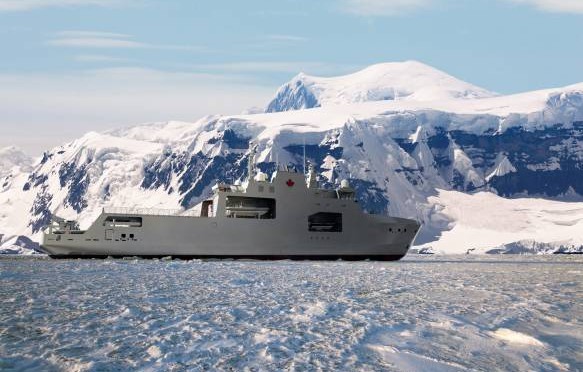
The AOPS was announced in 2007. $3.1 billion was budgeted to build six to eight ships with deliveries starting in 2013. Based on the Norwegian Svalbard-​class, much time and money was invested in attempting to increase the capabilities of the design, though it appears these efforts have largely failed. Time spent on this and the development of the NPSPpushed the AOPS delivery date back to 2018. As with the JSS, the years of delay allowed inflation to hollow out theAOPS budget. A report issued late 2014 by the Parliamentary Budget Officer (PBO) found that the AOPS budget could only afford four vessels at that point. In response, the government added an additional $400 million to the project and revised their official number of ships delivered down to five or six, though these numbers remain optimistic. Inflation has sunk nearly half the proposed AOPS.

$26.2 billion is budgeted to build up to 15 CSCs, at best a one-​for-​one warship recapitalization program to replace the Royal Canadian Navy’s destroyers and frigate fleet. Given that the AOPS was placed first in the NSPS construction queue, the first CSC will not be delivered for another 10 years with the rest following over a 20–30 year period. This affords inflation plenty of time and opportunity to do its worst. A 2013 PBO report and recent news reports draw attention to this fact, with inflation placing nearly half the future CSC fleet in jeopardy. The financial situation is so grim that, as a cost saving measure, there has even been a proposal to start cannibalizing systems from our current fleet with which to outfit our future fleet.

The thrust of this short piece is that we must stay aware of the negative effects of inflation in our military procurements. Delays come with significant costs. In the cases of the JSS and AOPS, the costs are fewer and less capable ships.

How can inflation be addressed, aside from cutting numbers or capabilities to stay within eroded budgets? The best way is speed, something to keep in mind regarding the CF-​18 Replacement Project and proposals by the Opposition parties to restart an open bidding process. Would any benefits that could result from pressing the reset button on that procurement program again outweigh the high costs of additional time and inflation? Similarly, robbing the CF-​18 Replacement Project to pay for the CSC Project would only magnify the problems of the Royal Canadian Air Force’s recapitalization due to inflation. However, in the case of the CSC, speed is not an option due its place in the NSPS shipbuilding queue.

The other way to address inflation is to simply buy back time by increasing capital budgets. The Trudeau-era’s Defence Structural Review did this, increasing the military’s capital budgets which led to the purchases of the CF-​18s and the Halifax-​class frigates in the 1980s. This has historically been something that Canada has been adverse to do but times could be changing. As noted above, the AOPS budget was increased late last year by $400 million despite constraints on across the board federal spending. Additional monies will preserve not just CSC numbers, but their capabilities as well.

Ryan Dean is the winner of the 2015 Canadian Naval Memorial Trust Essay Competition and is a PhD candidate in the Department of Political Science, University of Calgary. (Image courtesy of the Royal Canadian Navy.)