Category Archives: Global Analysis

A Geographical Breakdown of What’s Going on in the World

The Israeli Navy in Context

By Guido Weiss

Introduction

Israel is a majority Jewish state located between the Red Sea and eastern Mediterranean, separating the Arabic speaking world in two geographic regions. Approximately the size of New Jersey, its maritime exclusive economic zone (EEZ) is larger than the state itself. According to an assessment from the Tel Aviv-based Institute for National Security Studies (INSS), maritime trade accounts for 99 percent of Israeli foreign trade. Furthermore, 70 percent of Israel’s population lives on the narrow coastal plain between the West Bank and the Mediterranean. This piece aims to provide an overview of the Israeli Navy and the maritime dimension of Israel’s national security.

The Israeli Navy and Geography

Israel’s southern coast is approximately 10 miles in width, leaving the Israeli Navy (IN) a limited region of operations, comparable to Iraq’s maritime border. The southern Red Sea port of Eilat is Israel’s direct maritime access route to the Indian Ocean and the markets of southern and southeast Asia. In the Red Sea, the IN protects sea lines of communication in the narrow waters between Egypt, Jordan, Saudi Arabia, and onward. Israel’s western coastline on the Mediterranean is approximately 110 miles in length. The primary facilities of Israel’s Mediterranean fleet are in the ports of Ashdod (north of the Gaza Strip), Haifa (south of Lebanon), a small presence of patrol ships in Herzliya, and a center for Israel’s Navy Seals equivalent, Shayetet 13, in Atalit.
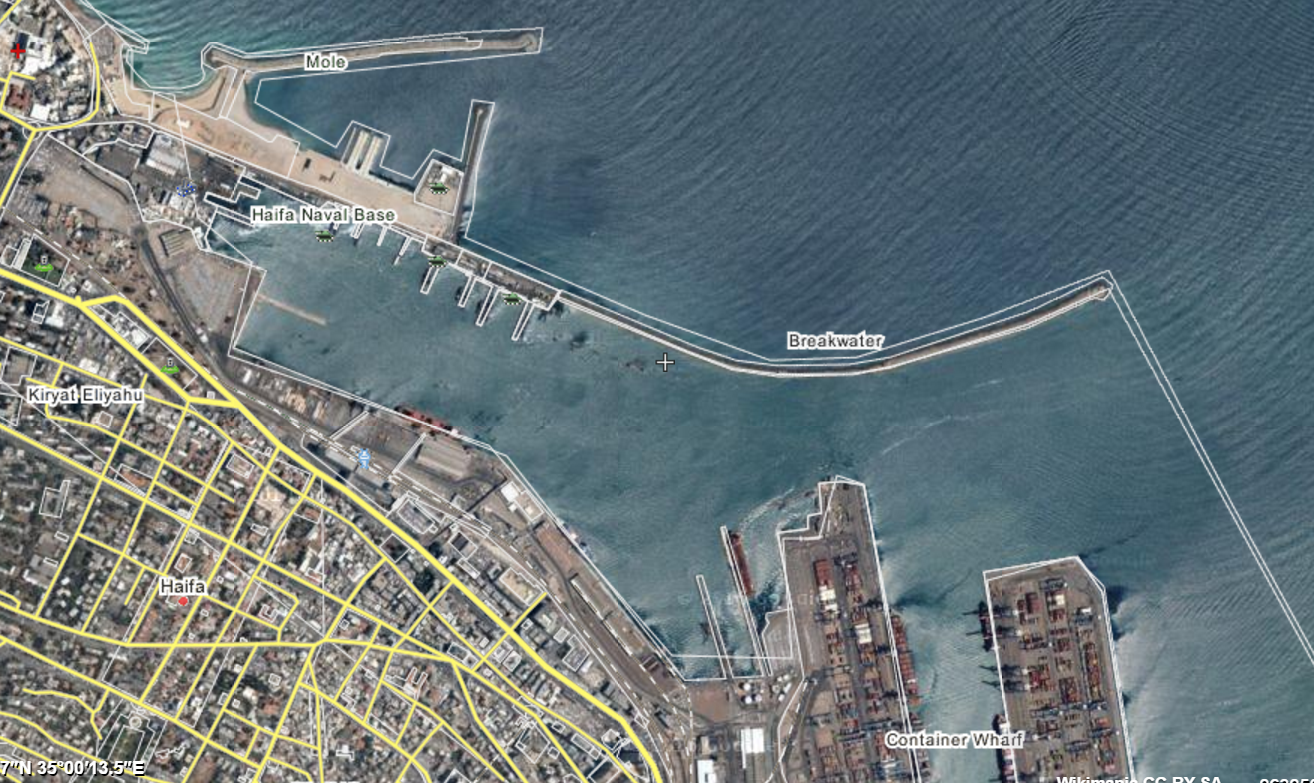
 (Wikimapia 32.826772, 34.999781)
Haifa naval base. (Wikimapia 32.826772, 34.999781)

The IN is primarily a coastal defense force tasked with protecting Israeli shores from seaborne threats originating in the Gaza strip, Egypt, Jordan, and Lebanon. Israel maintains local maritime superiority against conventional threats and has developed capabilities to combat a variety of asymmetrical threats. Despite this, the IN is capable of performing outside of the Red Sea and eastern Mediterranean. IN corvettes and submarines are known to venture into the Indian ocean to counter threats from Iran and the western Mediterranean to address issues related to North Africa.

Procurement

The IN maintains a robust modernization program. While the Israel Defense Forces (IDF) generally receives the bulk of its military hardware from the U.S., its naval procurements are diverse, including acquisitions from ThyssenKrupp Marine Systems (TKMS) (Howaldtswerke-Deutsche Werft), Aérospatiale, Constructions Mécaniques de Normandie, as well as domestic suppliers such as Israel Aerospace Industries (IAI), Rafael, and DSIT. Active procurement programs include four Sa’ar 6 corvettes (set to begin arriving mid-2019), six Dolphin–class submarines, the Barak 8 missile system, the C-dome, unmanned sea vehicles (USV), eight SH-60F Seahawk helicopters, and Unmanned Aerial Vehicles (UAVs).
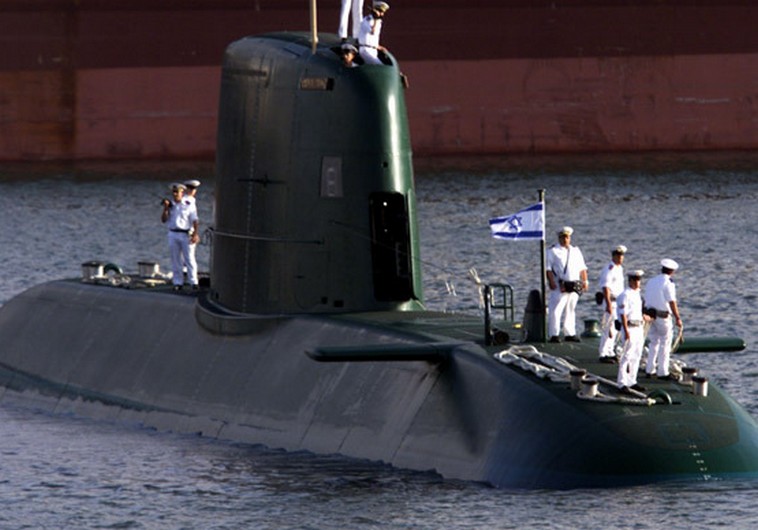
A Dolphin-class submarine arrives in the port of Haifa. Source: Reuters
A Dolphin-class submarine arrives in the port of Haifa. (Reuters)

To assist with territorial water (TTW) defense, Israeli companies have developed innovative technological solutions. Such solutions include the implementation of the sonar-based AquaShield Defense System. Designed to prevent sea infiltration, the IN has deployed the AquaShield sonar system near Gaza and the Lebanese maritime borders. This underwater sensor detects potentially hostile underwater movement. The system can reportedly detect an Open Circuit Diver (SCUBA) at a distance of up to 1000 meters and a Closed Circuit Diver (re-breather) at a distance of 700 meters.

Missile Defense

The IN is a leader in sea-based missile defense with programs designed to combat short range rocket projectiles and shorter range ballistic missiles. Strategic planning concerns Hezbollah in Lebanon and Gaza based organizations including Hamas, Islamic Jihad, as well as other regional terrorist entities.

The IN ballistic missile defense apparatus is evolving to combine a Very Short Range Air Defense (VSHORADs) systems, the such as the Counter Rocket, Artillery, and Mortar (C-RAM) C-Dome and Barak 1, as well as a Long-Range Surface-to-Air Missile (LR-SAM) platform, the Barak 8. Israel is incorporating multilayer maritime anti-ballistic systems in a similar fashion to its three well-known land based systems Iron Dome, David’s Sling, and the Arrow system.

The development of anti-missile systems is a high priority for the IN, which has recent memory of missile attacks on its ships. In 2006 Hezbollah successfully attacked the INS Hanit with a Yakhnot (S-800) anti-ship missile, nearly capsizing the ship. In 1967 the Egyptian Navy sunk the INS Eilat using a P-15 Termit anti-ship missile in the first incident of a vessel being sunk by an anti-ship missile fired in anger.

In May 2016 the IN announced a successful launch of the C-Dome system. Designed by Rafael, the C-Dome is a maritime variant of the acclaimed Iron Dome anti-rocket and projectile system operated by Israel’s Air Force. In addition to C-Dome, the IN maintains the Barak 1 and Barak 8 systems. The Barak 1, which is to be phased out, has a reported range of 5-12 km while the joint Israeli-Indian developed Barak 8 has a reported range of approximately 70-100 km. Facilitating these platforms is the incorporation of the domestically produced iMulti-Function Surveillance, Track and Guidance Radar (MF-STAR) radar system, developed by Israel Aerospace Industries’ (IAI) Elta.

Protecting Offshore Oil Platforms

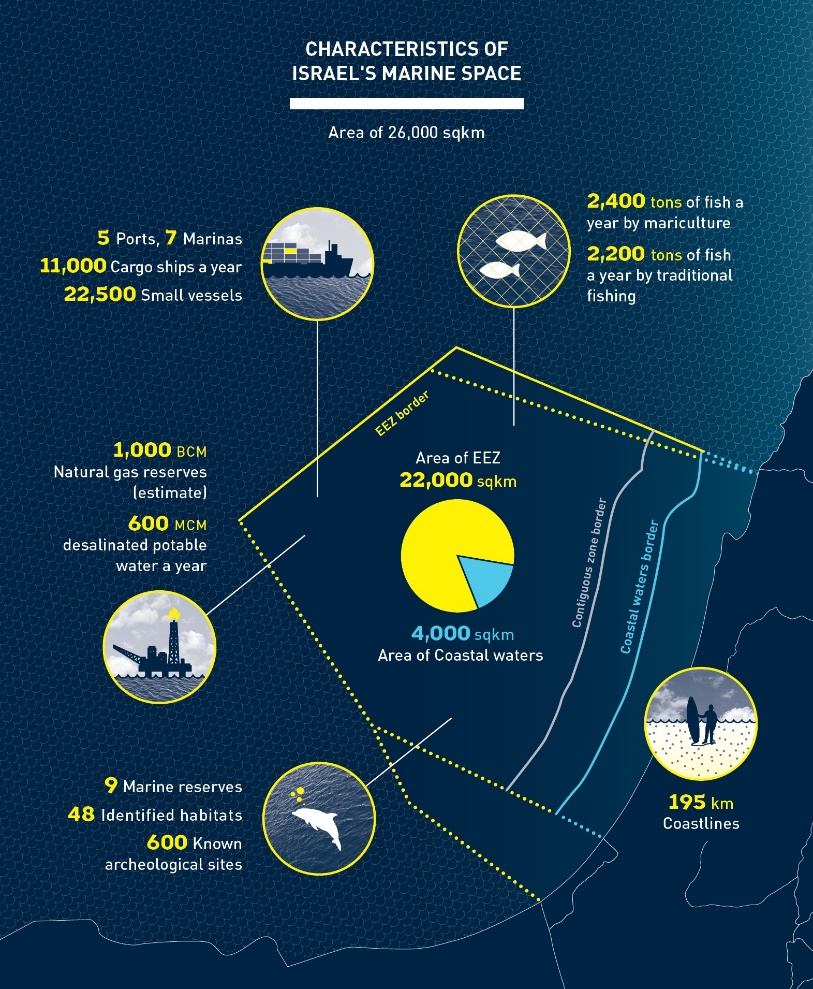
A major component of the IN’s developing maritime strategy is offshore Oil platform (OPLAT) protection. Since the discovery of natural gas in the Tamar and Leviathan fields off of Israel’s west coast, Israel has dedicated naval resources to OPLAT development and protection. To protect Israel’s Mediterranean shores, the IN has a fleet of patrol boats including the Shaldag class and Dvora Mark III. Additionally, Israel is using USVs, particularly the Rafael system’s Protector. USVs play a role in providing surveillance as well as dealing with asymmetric contingencies. Such scenarios include the use of a suicide-explosive rigged boat attack or waterborne improvised explosive devices (WBIED), rocket salvos, and the takeover of an oil platform by a terrorist entity.
IN1
Characteristics of Israel’s Marine Space. (Technion Institute of Technology)

Sea Interception, Infiltration, and Blockade

The IN is experienced in implementing sea denial strategies in times of conflict. The IN conducted a naval blockade on Lebanon during the 1982 war, Operation Peace for Galilee, where its submarines provided early warning information for blockading vessels. Israel’s navy enforced a blockade on Lebanese ports again during the 2006 Lebanon War. From 2007 until today the IN has enforced a blockade of the Gaza strip. The Gaza strip blockade is an effort to prevent the transfer of arms and building materials to the Hamas terrorist organization that is currently in control of Gaza. Patrols intermittently come into contact with fishermen from Gaza who have claimed that Israel enforces the maritime policy inconsistently. After a policy change in March 2016, the IN now permits Gaza fishermen to travel up to nine nautical miles from Gaza’s coastline.

Most recently, Hamas attempted to form a naval commando unit. During the 2014 war with Hamas, Operation Cast Lead, Hamas commandos briefly stormed the Zikim beach north of the Gaza strip. In May 2015 Israel’s internal security service, Shin Bet, intercepted 40 dive suits hidden inside sport suits en route to the Gaza Strip.
IN6
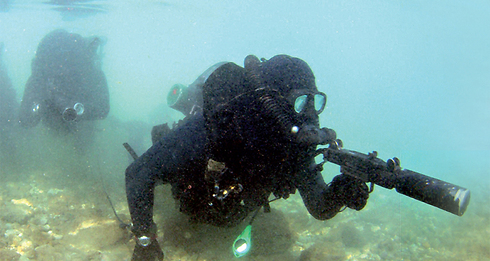
IN’s Shayetet 13 conduct an underwater maneuver. (Ynet)

The IN has demonstrated its ability to operate successfully outside of its immediate coastal area including visit, board, search, and seizure (VBSS) missions. In 2014 IN commandos of Shayetet 13, a unit frequently compared to the U.S. Navy Seals, conducted Operation Full Disclosure, a VBSS mission targeting the Iranian “Klos C” sailing under a Panamanian flag en route from Iran to Port Sudan, 930 miles from Israeli waters. The ship’s cargo included several dozen M-302 missiles, reportedly of Syrian origin. The IDF Spokesman unit claimed  the weapons were en route to Hamas.

Sea to Surface Targeting and Special Operations

In the past decade the IN targeted shore-based threats in both Gaza and Lebanon and directly supported ground forces inside of enemy territory while conducting isolated attacks on enemy positions. The most recent display of sea-to-surface targeting was the targeting of Hamas positions in the Gaza Strip amidst Operation Cast Lead. During Operation Cast Lead, Israeli corvettes reportedly targeted militants in the Gaza strip with Gil or Spike-MR guided missiles. In 2006 the IN is said to have fired 2,500 rounds at Lebanese targets in the 2006 July-August Lebanese war.

Warning: Graphic Content. Israeli Navy fires on Hamas seaborne infiltrators during Operation Protective Edge in July 2014. (Israeli Navy)

During the Second Lebanon War, Shayetet 13 raided an apartment block in Tyre, Lebanon believed to be a staging site for rockets being launched into Israel. During the summer 2006 war, the Israeli Navy bombarded Hezbollah positions, infrastructure, and access routes to the Lebanese coastline. In the 1982 conflict Operation Peace for Galilee the IN inserted IDF units behind enemy lines north of Palestinian Liberation Organization (PLO) – Syrian positions. It was during the 1982 war that the IN demonstrated its ability to conduct an amphibious assault that included troops, tanks, and other vehicles.

Cyber Defense

The IN maintains a cyber defense unit known as MAMTAM (Information Systems, Processes, and Computerization unit). MAMTAM maintains three separate branches: cyber, technology, and operations and industry. According to an officer from MAMTAM, the unit deals with IT and IP networks. The Israeli Navy experienced attempts to breach its cyber networks during Operation Protective Edge in 2014 against the Gaza based Hamas terrorist group. Additionally, the IN plans to incorporate modernized C4i (Command and Control, Communications, Computers and Intelligence) systems into its fleet, particularly with the expected arrival of Sa’ar 6 corvettes.  

Second Strike Capability and Nuclear Deterrence

The IN is suspected of possessing nuclear weapons, an accusation that has traditionally neither been confirmed nor denied by the Israeli government. The Israeli submarine program is believed to incorporate second strike nuclear capabilities for strategic deterrence. In December 2015 Israel’s fifth Dolphin class submarine was delivered by Germany’ ThyssenKrupp Marine Systems (TKMS). Dolphin class submarines have reportedly been armed with submarine-launched cruise missiles (SLCMs).

Security Cooperation with the U.S. Navy

In the eastern Mediterranean, the U.S. Navy port call in Israel is among the most secure and productive for U.S. operations in the region. Haifa offers a friendly port south of Greece and Turkey and north of Djibouti. U.S. security assistance and coordination with Israel has only increased in the past decade. However, the IN is not able to publicly participate in U.S.-led operations such as Combined Joint Task Force – Operation Inherent Resolve (CJTF-OIR). Due to ongoing tensions with Arab and Muslim majority countries, the IN cannot conceivably participate in multinational regional operations, whether against ISIS in Iraq and Syria or the Saudi war with factions in Yemen. For similar political considerations, Israel was also not able to publicly participate in U.S. efforts during the Gulf War, Operation Desert Storm. Israel and the Palestinian Territories also fall under under the AOR of U.S. EUCOM rather than the seemingly more logical CENTCOM, where the majority of the Middle East falls.
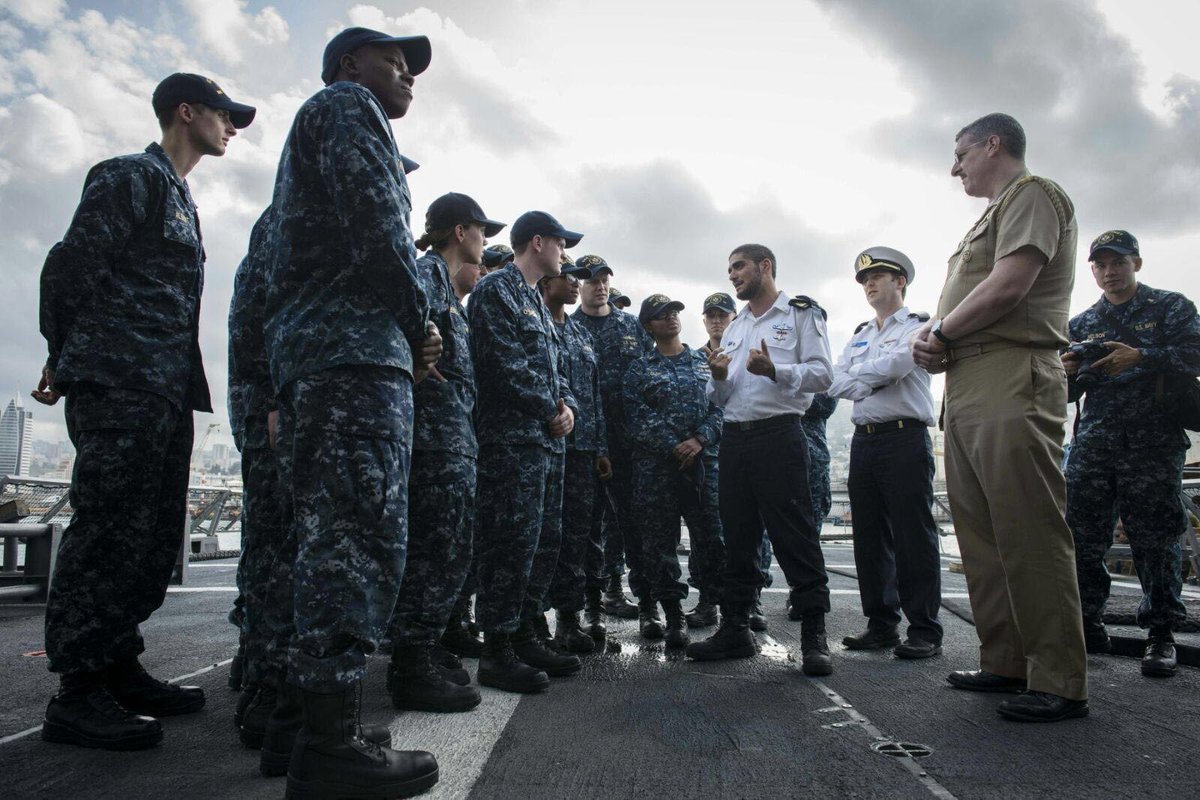
Photo of US-Israeli Naval Exercise in February 2016. Source: IDFSpokesman
U.S.-Israeli naval exercise in February 2016. (IDFSpokesman Twitter)

In addition to India, the U.S. plays a critical role in Israeli missile defense scenarios. EUCOM engages with Israel through its Strategic Cooperative Initiative. The USN participates in maritime Ballistic Missile Defense (BMD) patrols in cooperation with Israel and can deploy when requested to assist Israel with ballistic missile threats. Furthermore, U.S. Aegis platforms have supported bi-annual U.S.-Israel wargames dubbed “Juniper Cobra.” Finally, EUCOM supports Missile Defense Agency test events in coordination with Israel.

In September 2016, a joint U.S-Israel Commission on the Eastern Mediterranean made up of policymakers and former flag officers from both countries noted the potential benefits of U.S. ships hypothetically homeported in Haifa. Benefits included “increased (and stabilizing) presence, deterrence of Benghazi-style attacks, assistance with non-combatant evacuations, and security for drilling rigs, liquefaction plants, and pipeline terminals.”

Closing Remarks

Israel is a small country, with a total land area approximately the size of New Jersey. The active duty navy is estimated at 10,000 mostly conscripted personnel, a force significantly smaller than that of many U.S. Navy bases. Few existing Navies are tasked with similar challenges to those of the IN in a comparable amount of surface space. While its landmass is limited, the maritime sphere allows Israel to gain some form of strategic depth. This is particularly important when the country is less than 11 miles wide at specific locations and has fought conventional and asymmetric wars throughout its existence.

Guido Weiss is an Operations Specialist (OS) in the Navy Reserve and works as a researcher on security and military issues in Iraq. He holds an M.A. in Islamic and Middle Eastern Studies from the Hebrew University of Jerusalem. The views expressed here are of Guido’s alone and do not represent the U.S. Navy or any other organization of the U.S. government.

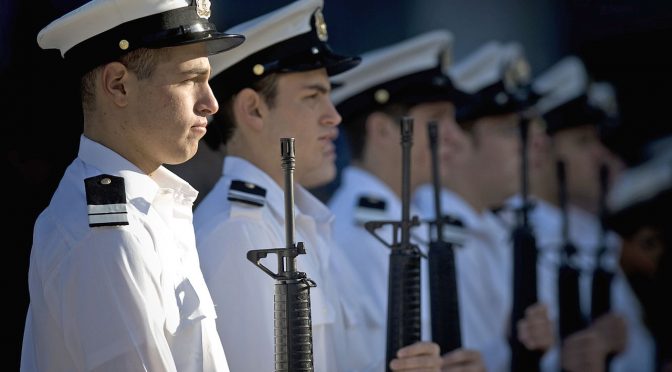
Featured Image: Israeli naval cadets (DoD photo by Mass Communication Specialist 1st Class Chad J. McNeeley, U.S. Navy.)
Riding A New Wave of Professionalization and Militarization: Sansha City’s Maritime Militia

By Conor M. Kennedy and Andrew S. Erickson

On 21 July 2013, several dozen Sansha City “residents” stood before the city government building and swore oaths during an inspection by Mayor Xiao Jie (肖杰) and his military counterpart Garrison Commander Cai Xihong (蔡喜宏). Clad in militia uniforms and toting Type-56 assault rifles, the Sansha Maritime Militia was officially established to uphold Chinese interests throughout the Paracels and beyond. According to the Garrison Commander, Sansha City’s Maritime Militia are given five major missions in China’s struggle for maritime rights protection: regular declarations of sovereignty, conducting reconnaissance and patrols, cooperating with maritime law enforcement, participating in marine rescue, and supporting combat operations. They also repel foreign fishing vessels, safeguard islands and reefs, and provide disaster relief for civilians living there. Such missions represent important, evolving roles for the militia as China seeks to reinforce its claims to the South China Sea. Sansha’s Maritime Militia is on the frontlines of this effort given the municipality’s responsibility for administering all Chinese-claimed features in the South China Sea.

We previously examined in depth the maritime militia forces of Sanya, Danzhou, and Tanmen (Parts One and Two). No examination of the maritime militia of Hainan Province would be complete, however, without scrutinizing the Sansha Maritime Militia. As China’s newest, southernmost municipality, Sansha City is a critical node in China’s South China Sea strategy. Given its responsibility to administer all of China’s claimed features within the nine-dashed line by Beijing, Sansha lies at the apex of Chinese civilian presence in the South China Sea and efforts to exercise administrative control over China’s claimed waters. To better grasp the range of tools China uses to achieve such control, deeper understanding of Sansha’s Maritime Militia is necessary. 

Most importantly, recent organizational developments concerning the Sansha Maritime Militia demonstrate a new professionalization and militarization of China’s elite maritime militia forces. Indicators of increased professionalization include hiring recently separated veterans, standardization and enhancement of training, and in some cases lack of clear fishing responsibilities in return for payment of salaries. Key indicators of increased militarization include preparations to make small arms rapidly available to deploying units according to mission requirements, construction of new bases, deployment for non-commercial purposes, and introduction of new classes of vessels with dedicated weapons and ammunition storage rooms, reinforced hulls, and water cannons.

Significantly, the Sansha Maritime Militia is being created from scratch using personnel that receive extremely generous guaranteed salaries—seemingly independent of any fishing or marine industrial activity on their part, a dedicated arrangement that we have not seen elsewhere. This represents a significant departure from what we have described previously regarding the maritime militias at Sanya, Danzhou, and Tanmen. These militias were formed and evolved over years if not decades, drawing upon the community’s resident skills and resources. The majority of such militia members engaged in fundamentally civilian economic activities with occasional additional purposes assigned through a People’s Liberation Army (PLA) chain of command, including military law enforcement-style activities. While these three elite militias remain important to Chinese “rights protection” activities, Sansha City’s new, purpose-built militia may in the future be even more so.

With logistics and maintenance facilities, as well as family housing, Woody Island has been transformed into something akin to a regional hub base. Other facilities in the Paracels offer the Sansha Maritime Militia sites to deploy for rotational operations. The Sansha Maritime Militia’s organizational structure is increasingly military-like. It is formally organized and operated in a joint, three-layer structure that incorporates China’s three major sea forces, with maritime militia forces on the front line, Coast Guard forces on the second line, and China’s naval and military forces as a third line backstop. Finally, the Sansha Maritime Militia may have front-line responsibilities in the Spratlys in addition to its responsibilities in the Paracels. Alternatively, it may serve as a model for the development of another new leading militia specific to that area, much as the Sansha Maritime Militia seems to have drawn inspiration in part from the Tanmen Maritime Militia. Sansha City Mayor Xiao, who led a delegation to inspect the Tanmen Maritime Militia on 15 November 2013, is in fact a former Party Chief of Qionghai City—the county level city that administers Tanmen Township. He served there from May 2000 to July 2002, which placed him in a position of responsibility for the development of the Tanmen Maritime Militia. This experience likely gave him some degree of familiarity with the dynamics of local militia building, skills that may later have assisted him during the buildup of the Sansha Maritime Militia.

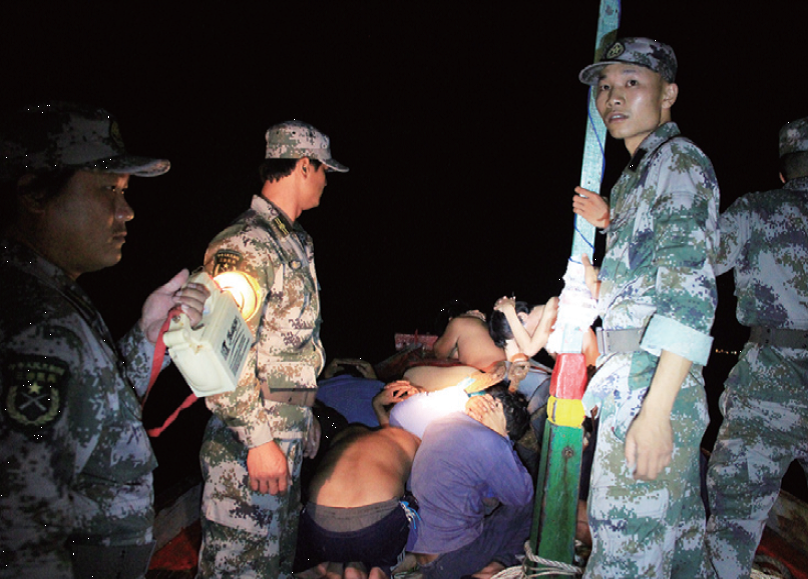
mmilitia2
Sansha Maritime Militia conducting a nighttime inspection of a vessel whose crew was deemed guilty of “rights infringement and illegal fishing.” (National Defense)

The Sansha municipality and a divisional-level PLA garrison were created on 24 July 2012. This involved reorganizing what were previously small “Paracels Militia” (西沙民兵) platoons established by the Paracels Working Committee into the new Sansha Maritime Militia. Lu Le, a Paracels Militia member since 2003, proclaimed that the reorganization catalyzed considerable change, including greater intensity and specialization in training. The scattered fishing communities that live permanently and semi-permanently in the Paracels often hail from different areas, raising challenges for maritime militia organization. The fishermen were not steadily present on the islands and returned to disparate cities along China coasts. To preserve cohesion among the maritime militia and among the residents on the islands, the Sansha City government provides fishermen with stipends and other material support to encourage sustained habitation there. In early 2016 Mayor Xiao stated that the Sansha City government spends ten million RMB (approx. $1.5 million USD) annually to support fishermen transitioning to more permanent livelihoods on the islands in response to deteriorating fish stocks and declining incomes. The government pays stipends to people living on the islands in amounts varying by their island of residence. For example, each person living in the Crescent Group earns 45 RMB ($6.79 USD) per person a day, providing they stay on the islands for 180 days of the year. Those residing on Mischief Reef for 150 days of the year earn 80 RMB ($12.07 USD) per day. Various government-provided benefits foster a more permanent population and generate a relatively stable community from which ranks of the maritime militia can be drawn.  

Efforts to populate the islands have benefited the maritime militia. The force was relatively small when Sansha City was established, with only two maritime militia companies—each responsible for protecting a portion of the islands and reefs in the Paracels. Expanding mission requirements led to an expanded force. Now there are six maritime militia companies with more than 1,800 personnel and 100 fishing vessels. Sansha fishermen have also joined a “law enforcement coordinating team” composed of 30 personnel and five boats. Between its inception and June 2015, the Sansha Maritime Militia conducted 228 missions to report information, expel foreign fishing vessels, prevent foreigners from landing on the islands, and conduct rights protection and stability maintenance.

According to Garrison Commander Cai Xihong, Sansha City’s civilian and military leaders and the maritime militia were recognized for their role in what they refer to as the “Zhongjiannan Security Operation” (中建南安保行动). Chinese maritime forces conducted these maneuvers south of Triton Island when China’s HYSY-981 oil rig was placed in the Zhongjiannan Basin in May 2014. The Sansha City and Garrison leadership established a sea command post and sent a command and coordination group to the China Coast Guard’s “forward command post at sea” (海上前线指挥所) to coordinate efforts among the maritime militia and other task forces operating in the “theater” (战区). While confrontation erupted around HYSY-981, Sansha’s Maritime Militia forces were also engaged in protecting other areas of the Paracels from encroachment by foreign fishing vessels. In support of this “security operation,” militia members reportedly confiscated short-wave radios and binoculars from detained foreign fishing vessels.

As has been observed in other operations involving China’s maritime militia, the former Guangzhou Military Region issued mobilization orders to local commands in Hainan Province which in turn mobilized maritime militia units from various localities to participate in this security operation. Sansha City’s close proximity to the site of the Chinese operation around HYSY-981 suggests the reason why the theater command required Sansha City to commit Maritime Militia resources to the joint effort. While coordination occurred and the Sansha Maritime Militia reportedly completed its portion of the operation, it remains unclear exactly what tasks Sansha’s Maritime Militia performed.

Assembling a New Fleet

While stationing militia units on the islands and reefs and using the militia units to patrol around them remain priorities, efforts are underway to establish a state-owned maritime militia fishing fleet that can work in more distant waters at the behest of the government of the People’s Republic of China (PRC). Accordingly, the Sansha City Fisheries Development Company (三沙市渔业发展有限公司) was established in February 2015. Authoritative sources demonstrate that this company is explicitly meant to serve as a maritime militia organization to “develop maritime rights protection capabilities” for Sansha City.

According to an article in the June issue of National Defense magazine, the Sansha City Fisheries Development Company will organize its vessels into maritime militia units as follows. “The fisheries company will form a flotilla (支队), subsidiaries will set up squadrons (大队), production [groups] will set up companies (中队), and individual vessels will be squads (区队).” (The characters of each unit-level are included because of inconsistent translation of Chinese terminology for units.) The fisheries company will also establish its own People’s Armed Forces Department (PAFD), primarily responsible for managing the “steel-hulled militia fishing vessels.” This fisheries company is different from more commercially oriented fishing enterprises that apply to enter the maritime militia. An online job recruitment posting for this company notes that hiring military veterans is a priority for all positions on board each vessel and offers substantial salaries. Paying a salary represents a departure from the widespread practice by which income is paid as a share of the vessel’s catch plus fuel supplements and performance bonuses. This departure suggests two things. First, that China is professionalizing some units of the maritime militia. And second, that the parent companies may essentially be front organizations, rather than primarily commercial enterprises.

Under this new rubric, ‘patriotism’ pays well for Sansha militiamen. For example, the position of crewmen (水手) advertises an annual salary of 90,000 RMB ($13,494 USD). This compares very favorably to the average annual net income of a Hainanese fishermen, which stands at only 13,081 RMB ($1,961 USD) according to China’s 2014 Fisheries Yearbook. The same posting advertises an annual salary of 170,000 RMB ($25,489 USD) for captains, which is highly competitive by Chinese standards and provides far greater purchasing power than the same salary in the United States or another Western economy. Each advertisement also offers insurance, retirement, medical, unemployment and living benefits for every position, referred to as “five social insurance and one housing fund” (五险一金) according to the standards of similar enterprises under Hainan’s State-owned Assets Supervision and Administration Commission of the State Council. Regular maritime militiamen are typically compensated by local governments for income lost due to service or training, and incentivized with preferential treatment, Party membership, subsidies and potential pensions; but do not receive a salary. Thus, compensation for regular maritime militia units does not match the compensation of a salaried position aboard these new vessels. Furthermore, when juxtaposed with the salary of a second lieutenant (Platoon Leader) in the PLA Ground Force of around 36,000 RMB ($5,413 USD) as reported by the People’s Daily, the relatively high salaries advertised by the Sansha City Fisheries Development Company indicate that China is devoting tremendous resources to hire professional maritime militia personnel.

As reform of the PLA forces the retirement or separation of 300,000 of its personnel, positions in the Sansha City Fisheries Development Company offer continued service, a competitive salary, and robust social welfare benefits, seemingly without relation to any catch performance. The career trajectories of two individuals who are current Sansha Maritime Militia members—Xu Zhuang (许状) and Liu Jianqiang (刘坚强)—serve as useful examples. Xu served in Fisheries Law Enforcement starting in 1994, but applied to join the Sansha City Fisheries Development Company in 2014. He won the position of captain within the newly forming militia fleet. When Xu led a trip to the Spratlys in November 2013, he reported a foreign fishing vessel approaching one of the PRC features and assisted maritime law enforcement forces in expelling the vessel. Liu served in a PLA Army vessel transport unit until he was demobilized three years ago. He has since joined the ranks of the Sansha Maritime Militia. 

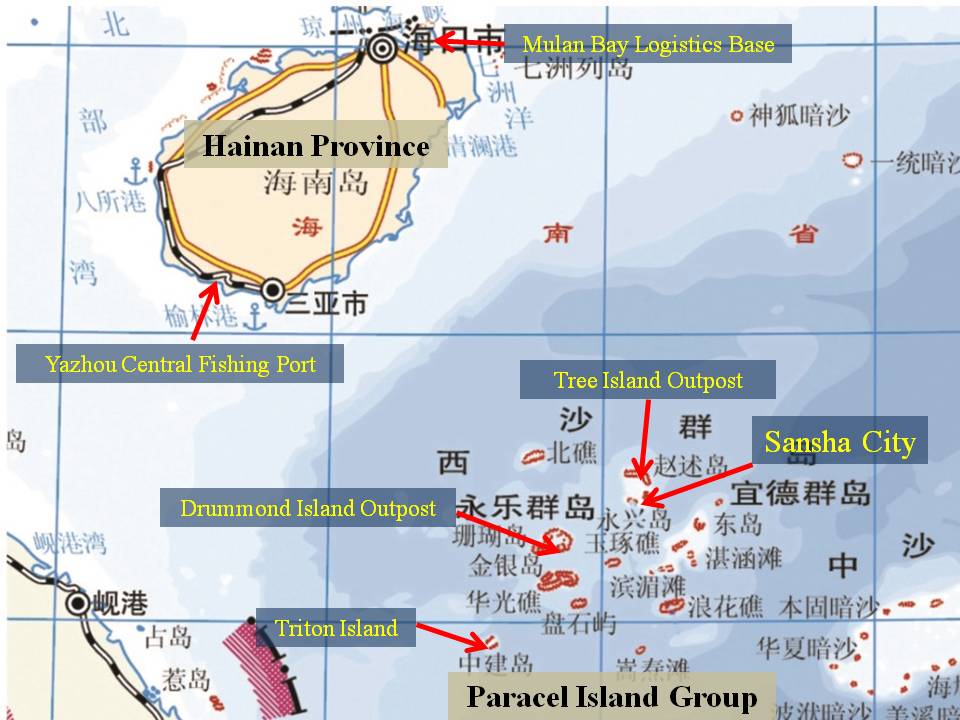
Although construction has not yet started, one proposal submitted to the Hainan Provincial Government in early 2015 reveals a great deal about plans to build up this state-owned militia fishing fleet. The proposal involves development of a new port to act as a strategic rear area for Sansha City, specifically to act as a logistics base for the 84 militia fishing vessels allocated to Sansha City by Hainan Provincial authorities. According to the proposal, ten of these vessels were delivered in 2015, with 70 more expected to be delivered in 2016. Concerned about the fragile environment of Woody Island and the inability of Hainan’s other fishing ports to support this large militia fleet, the proposal makes a case for the appropriation of 20 sq. km of coastal land in Wenchang City’s Puqian Township on Hainan Island’s northern coast, to be designated as a strategic rear area for Sansha City. Hainan Governor Liu Cigui, deputy governor Mao Chaofeng (head of the leading small group overseeing the project) and Sansha City Mayor Xiao Jie have all verified that this project is receiving “special preferential policies.” Currently in the planning phase, the project is also included in the 2016 Hainan Provincial Government Work Report. That the project is included in these reports indicates high political support for the project’s construction as part of a larger plan to develop the Mulan Bay area. The port facility will likely be equipped to support the operations of the Sansha Maritime Militia fleet, with specifics yet to be determined.

Until the new port is built, the militia fleet remains based out of the various fishing ports of Hainan. For example, the Yazhou Central Fishing Harbor that opened 1 August 2016 provides ample mooring for some of the Sansha Maritime Militia. The link embedded here contains aerial footage of the fleet moored at Yazhou Central Fishing Harbor.

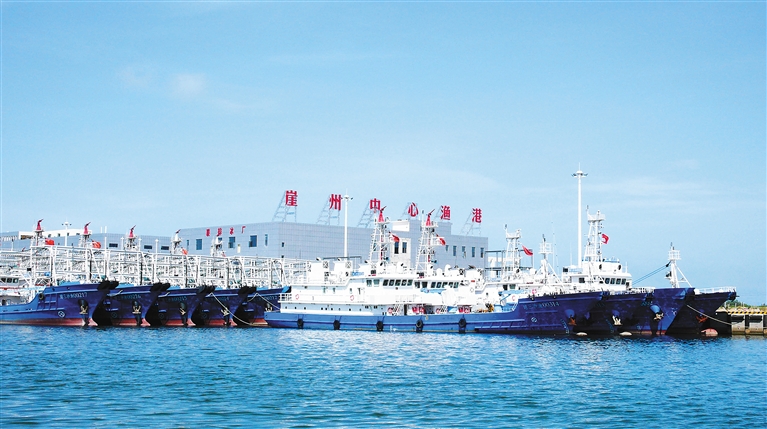
18 June 2016: Newly-built fishing vessels for Sansha City moored at Yazhou Central Fishing Harbor. Note the exterior hull reinforcements and mast-mounted water cannons. Image source: Hainan Government
18 June 2016: Newly-built fishing vessels for Sansha City moored at Yazhou Central Fishing Harbor. Note the exterior hull reinforcements and mast-mounted water cannons. (Hainan Government)
mmilitia4
Map depicting locations mentioned in this article. Source of original baseline image:  Sansha City Government.

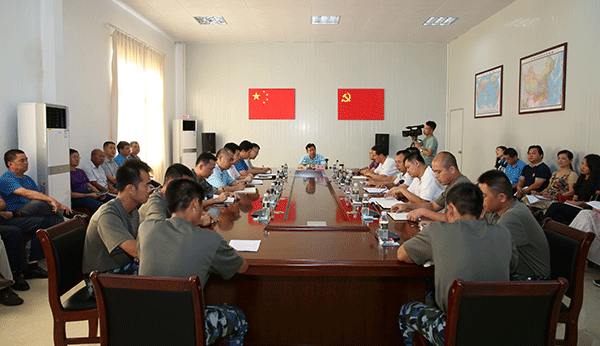
In keeping with his position as local Party-State leader, Mayor Xiao Jie appears to be spearheading development of the Sansha City Fisheries Development Company. In October 2015, Xiao hosted a forum with prominent private fishing companies from Hainan and other provinces to foster cooperation and learn from their experience. One of the six key points Xiao made was to strengthen cooperation in maritime rights protection. In demonstrating his leadership role, Xiao inspected the company in early July 2016. Reflecting the PLA practice of having political instructors of company-sized units also serve as company Party branch secretaries, political instructor Zhang Jun (one of the company Party branch secretaries) pledged to resolutely execute the guidance of General Secretary Xi Jinping and the Central Party while working in the South China Sea. With six of the company’s Party branch secretaries in his meeting room, Xiao emphasized the fishing company’s responsibility to protect China’s maritime rights and interests. This structure of six Party branch secretaries corresponds to the six company-sized units of maritime militia reported by Garrison Commander Cai in June 2015, further indicating that the Sansha Fisheries Development Company is a dedicated, professional maritime militia organization.

28 June 2016: Sansha City Mayor Xiao holds a meeting with Party Secretaries of the Sansha City Fisheries Development Company. Image source: Sansha City Government
28 June 2016: Sansha City Mayor Xiao holds a meeting with Party Secretaries of the Sansha City Fisheries Development Company. (Sansha City Government)

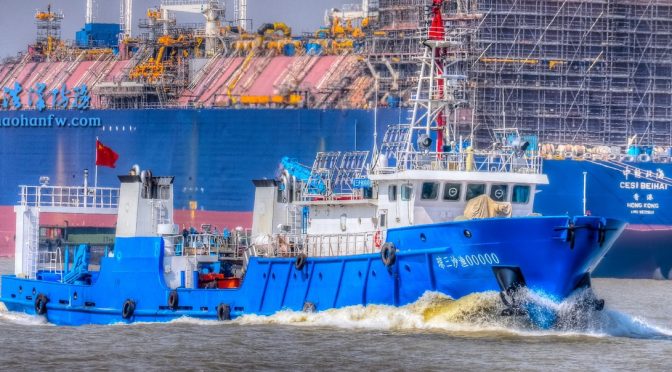
Photos of newly-built Chinese fishing vessels with hull designators “Qiongsanshayu” (琼三沙渔), indicating that they are fishing vessels belonging to Sansha City, have recently received attention on Chinese Internet websites. They look quite different from the average Chinese fishing vessel, bearing comparatively robust hull designs with additional rub strakes (“rub-rails”) welded onto the hull’s steel plating aft of the bow. Such pronounced rub strakes are generally uncommon on Chinese fishing vessel hulls and appear to be added to mitigate damage from potential collisions. These vessels also possess mast-mounted water cannons. Both features could facilitate more aggressive close-in tactics, such as shouldering, ramming, and spraying. For instance, Captain Lu Wei of Sansha City’s Comprehensive Law Enforcement Ship No. 2 complained in May 2015 of difficulties in pursuing foreign fishing vessels as they are no longer permitted to board and inspect them. His only resort is to issue verbal warnings and to use the ship’s water cannon, which, due to the limited agility of his larger ship, is unable to stay on target. Luckily for Lu and his colleagues, Sansha Maritime Militia units are equipped to fill this gap in “maritime rights protection.” They are able to continuously harass foreign vessels with water cannons thanks to their tighter turning radii and shallower draughts, allowing them to sustain such harassment even when foreign vessels seek refuge in the shallows surrounding disputed features. Demonstrating additional official demand for maritime militia vessel capabilities, Hainan Provincial Military District Commander Zhang Jian wrote in the October 2015 edition of National Defense that priorities for fishing vessels in the maritime militia will be based on larger displacement steel-hulled boats that can reach higher speeds and can sustain collisions (抗冲撞). Existing Chinese fishing vessels already clearly outclassed Vietnamese fishing vessels when they clashed near the HYSY-981 oil rig in May 2014. The features of these new vessels can further ensure that neighboring states’ fishing fleets are repelled successfully in future confrontations.   

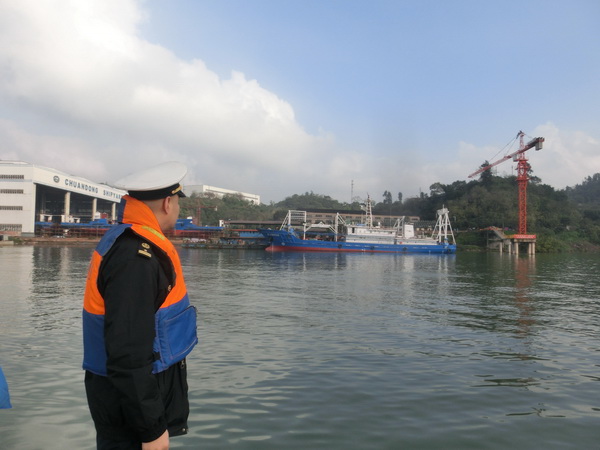
One of the shipyards constructing Sansha’s Maritime Militia fleet is a subsidiary of China Shipbuilding Industry Corporation. Chongqing Chuandong Shipbuilding Industry Co., Ltd. (重庆川东重工船舶有限公司), located in Sichuan Province far up the Yangzi River, has constructed a large number of Sansha City’s new fleet of fishing vessels. Several navigational warnings issued by China’s Maritime Safety Administration indicated that the twelve hulls listed below left the shipyard and were towed down stream between 16 December 2015 and 3 February 2016, a span of less than two months.

Sansha City Fishing Vessels Departing Chuandong Shipyard


Hull Classification


Date of Departure
Qiongsanshayu 00209

Qiongsanshayu 00210


16 December 2015
Qiongsanshayu 00113

Qiongsanshayu 00115

Qiongsanshayu 00118


31 December 2015
Qiongsanshayu 00116

Qiongsanshayu 00119


20 January 2016
Qiongsanshayu 00120

Qiongsanshayu 00121


22 January 2016
Qiongsanshayu 00122

Qiongsanshayu 00114

Qiongsanshayu 00117


1 February 2016
21 December 2015: Fuling Maritime Safety Department posted photos of Qiongsanshayu 00209 and Qiongsanshayu 00210 leaving the Chuandong Shipyard. Additional vessels can be seen under construction in the yard. Image source: Fuling Government
21 December 2015: Fuling Maritime Safety Department posted photos of Qiongsanshayu 00209 and Qiongsanshayu 00210 leaving the Chuandong Shipyard. Additional vessels can be seen under construction in the yard. (Fuling Government)

At least two additional shipyards launched vessels for Sansha City from Guangdong Province—the Huangpu Wenchong Shipyard (中船黄埔文冲船舶有限公司) in Guangzhou and the Xijiang Shipyard (中船西江造船有限公司) in Liuzhou. Both are subsidiaries of China State Shipbuilding Corporation. The two vessels produced by the Wenchong Shipyard, a well-known builder of surface warships for the PLA Navy (PLAN), are the first fishing vessels ever to be produced there. At this rate of production, many if not most of Sansha City’s 84 new fishing vessels will be delivered by the end of 2016. Although an accurate appraisal of the total number of vessels already delivered is difficult, AIS reports from Marine Traffic dating to December 2015 show reported positions of 29 vessels with the name “Qiongsanshayu.”

mmilitia1
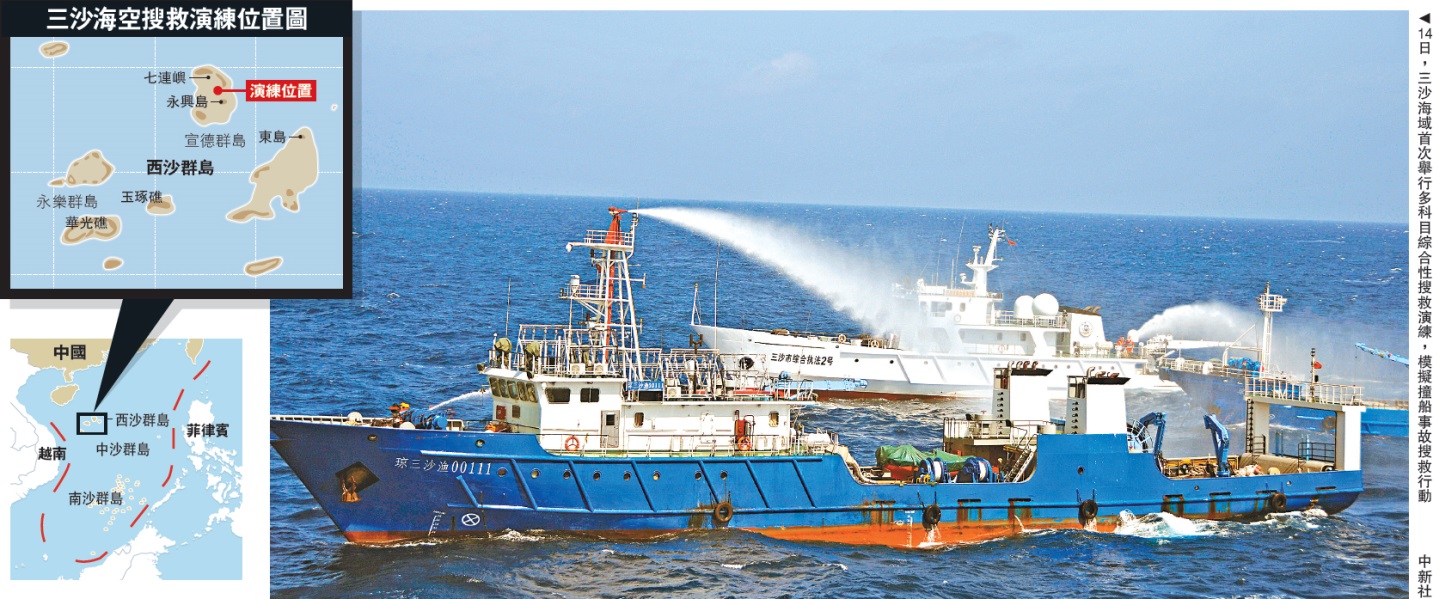
On 14 July 2016, the Sansha City Maritime Safety Administration held its first “Sea-Air Three Dimensional’ Joint Rescue Exercise” in waters north of Woody Island. The newly-built militia fishing vessels “Qiongsanshayu 00111” and “Qiongsanshayu 00310” can be seen participating directly in the firefighting and rescue exercise. (Dagong Bao)

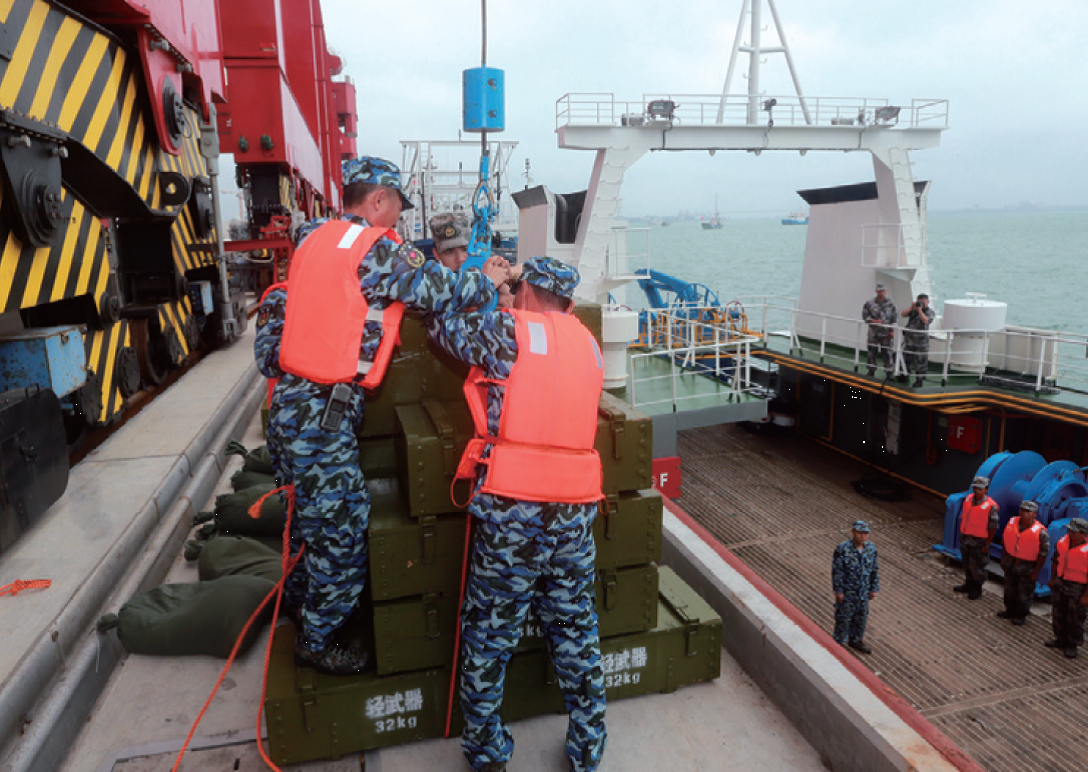
The shipbuilding technology service company Guangzhou Taicheng Shipbuilding Industry Co. Ltd. (广州市泰诚船舶工业有限公司) provided interior furnishing for the vessels produced at the Xijiang and Wenchong Shipyards. The page displaying its furnishing work for a vessel produced by the Xijiang Shipyard describes a “weapons and equipment room” (武备室) and “ammunition store” (弹药库) on the main deck of the vessel. Additionally, the image below appeared in a June 2015 feature article on Sansha City in National Defense showing Sansha Maritime Militia members loading crates labeled “light weapons” (轻武器) onto one of the newly delivered fishing vessels. While China’s Maritime Militia is ostensibly an unarmed force, it is apparent that, at a minimum, preparations are underway to arm at least some of its vessels.

Sansha Maritime Militia participate in exercises to load materials on their vessels. 32-kg crates labeled “light weapons” are shown being loaded with cranes. The exercises were also featured on the Guangzhou Military Region Website in September 2015. Image source: National Defense
Sansha Maritime Militia participate in exercises to load materials on their vessels. 32-kg crates labeled “light weapons” are shown being loaded with cranes. The exercises were also featured on the Guangzhou Military Region Website in September 2015. (National Defense)

A new fleet of vessels is only as effective as its crew. Operating on the front-lines of disputed maritime claims, Sansha’s Maritime Militia will need enhanced training and discipline to conduct its assigned missions. Garrison Commander Cai explains that personnel receive training collectively and in smaller groups while stationed on islands, covering topics such political education, reconnaissance, rescue, “assisting in rights protection” and “shooting at sea.” Sansha Garrison Chief of Staff Li Zhaofeng told reporters in January 2016 that Sansha Maritime Militiamen were sent to a training base in Northern Hainan to receive military training. According to Li, they must pass evaluations in subjects on navigation, communications, fishing practices, and legal regulations before they are allowed to sea. Such efforts will be necessary for the maritime militia units to be effective enough to integrate with PLAN and CCG vessels to execute joint defense of China’s maritime claims.

Building a Militia Network to Defend Outposts

An important priority after Sansha City was established was to form the civil-military institutional structures for Party leadership and national defense building in the South China Sea. Institutions established by Sansha City include its National Defense Mobilization Committee (国防动员委员会), Ocean Defense Committee (海防委员会), Military Facility Security Committee (军事设施保护委员会), and a Double-Support Work Leading Small Group (双拥工作领导小组). A routine of military affairs meetings (议军会) also began. “Double Support,” short for “support the army and give preferential treatment to military families, and support the government and cherish the people” (拥军优属拥政爱民), is a policy based on a reciprocal civil-military relationship whereby military and local civilian work units reinforce each other. For example, military units can assist in local construction projects while local governments help facilitate military exercises. These arrangements help ensure Party control over the military in Sansha City, facilitate Party-State-Military cooperation in military-related construction efforts throughout Chinese-occupied features in the South China Sea, and foster valuable synergies between PLA forces and the civilian population. Present at many of these meetings, Sansha City Mayor Xiao Jie is fulfilling his responsibility as First Party Secretary of the PLA Garrison’s Party Committee. He must work alongside Garrison Commander Cai Xihong and Political Commissar Liao Chaoyi (廖朝毅) to ensure that local military work and construction of the reserves is included in the city’s overall planning, which prominently features matters related to Sansha’s Maritime Militia. There may be no other city in present-day China where the military and civilian populations are so closely linked. Sansha has a high troop-to-civilian ratio stemming from the city’s extremely small population. Not surprisingly, the resources of the central government and military are critical to Sansha City’s development. These dynamics won Sansha City the title of “National Double-Support Model City”—an award for municipalities that provide exceptional support for the military—received by Mayor Xiao in Beijing on 29 July 2016.

An important role for militia units based in China’s border and coastal regions is the participation in military-police-civilian joint defense (军警民联防), a concept included in three of China’s recent Defense White Papers (2013, 2010, 2006). Joint military-police-civilian defense applies Mao Zedong’s People’s War concept to the peacetime security of border and coastal regions through combined use of the PLA, local security or law enforcement forces, and the militia. Sansha City organizes its border and coastal defense in the form of joint defense involving the Navy, Coast Guard, and Maritime Militia. Such efforts aim to improve coordination between the military and local forces to create three lines of operation for maritime rights protection—a “first line of militia, a second line of administrative law enforcement, supported by a third line of the military.” Manning a first line to advance China’s objectives while limiting escalation, maritime militia forces can confront foreign vessels under support provided by China’s Navy and Coast Guard. Employment of this three-tiered structure of force demonstrates an official institutionalized approach to integrating China’s three sea forces. This concept is the subject of ongoing discussion in the PLA and is already put into practice by such localities as Sansha City. Given the concept’s evolving status, it is unclear how successful it would be if executed as envisioned as a full spectrum of operations. One particular weakness may be command and control in real time in a contested environment.

Essential to managing the maritime militia, PAFDs were reportedly established on several South China Sea islands in January 2015, each of which reports to the Sansha City Garrison. Proliferating in step with the expansion of PRC grass roots governance structures, they are located on three Paracels features: Woody Island (永兴岛), Tree Island (赵述岛), and Drummond Island (晋卿岛). Further south in the Spratlys, a PAFD was established at Fiery Cross Reef (永暑礁). Subordinate to China’s Provincial Military Command system, PAFDs are the local PLA organs established in military sub-districts, counties, cities, districts, townships, and enterprises that are responsible for local PLA recruitment and registration work, supporting demobilized troops, and organizing and training the militia. The scant population inhabiting Woody Island and other PRC-occupied features means these PAFDs must be primarily engaged in militia and defense mobilization-related work, rather than conducting the PLA’s grassroots work with the masses. Operational command of the militia belongs to Sansha City Garrison, while the PAFDs are responsible for the regular command and training of Sansha’s Maritime Militia. Additional PAFDs may be established in the future on other PRC-occupied Spratly features. Mischief Reef, for instance, hosts a maritime militia “flag-raising squad,” indicating that elements of the Sansha Maritime Militia are already stationed there.

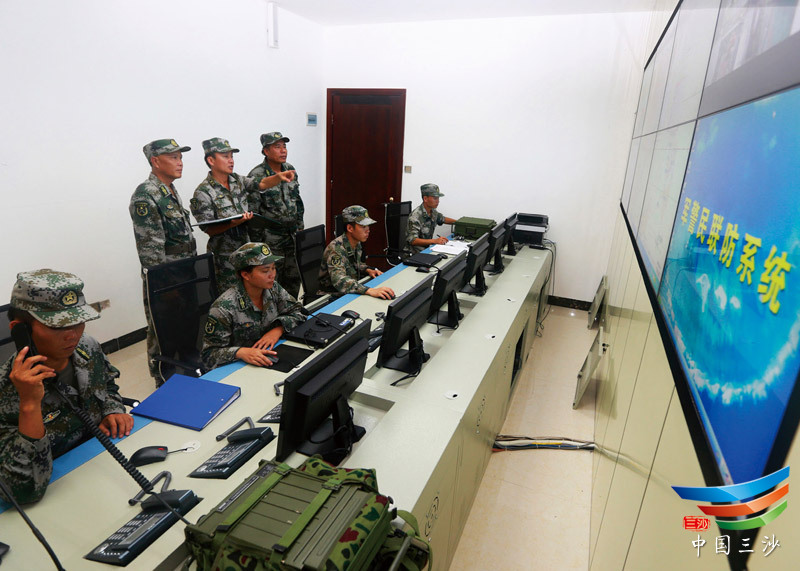
Sansha City has devoted considerable resources to bolstering its joint defense infrastructure on the islands and reefs in the Paracels. According to Mayor Xiao, Sansha has invested over 40 million RMB ($6 million USD) to construct a joint defense command center, officially beginning construction on 25 July 2015. It provides joint command, training, management and “combat readiness materials storage” (战备物资存储) functions. The project supports information sharing and provides the facilities for the unified organization of maritime law enforcement. Some personnel of the Sansha Maritime Militia are receiving training on how to man this joint defense command center, as depicted below. The exact extent to which command and control is exercised over forces in the South China Sea from this center remains unclear.

23 January 2015: Sansha Government Website features its maritime militia operating workstations of the “Naval, Coast Guard, and Maritime Militia Joint Defense System.” Image source: Sansha City Government
23 January 2015: Sansha Government Website features its maritime militia operating workstations of the “Naval, Coast Guard, and Maritime Militia Joint Defense System.” (Sansha City Government)

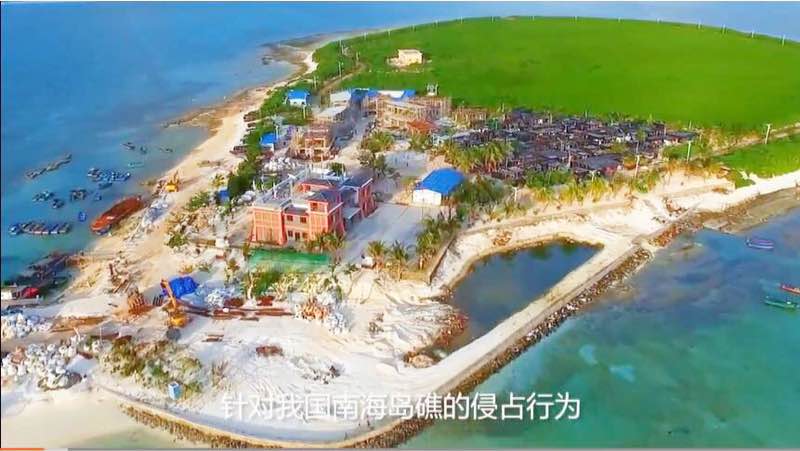
Local militiamen are assigned the important task of manning militia outposts (民兵哨所) established in border and coastal areas around the country. From these outposts, militia units conduct patrols and defensive missions, and monitor the surrounding areas. Such outposts help secure China’s remote regions and act as eyes and ears for the PLA. On the edge of China’s contemporary frontier, Sansha City’s military authorities are also building militia outposts to secure PRC-controlled islands and reef areas. On 24 July 2015, Sansha City built its first “informatized ocean defense militia outpost” (信息化海防民兵哨所). It is manned around the clock by the maritime militia stationed on Tree Island. This militia outpost supplies data to the joint defense command center on Woody Island and is supported by growing communications infrastructure throughout PRC-occupied islands in the South China Sea. The outpost also reportedly tracks targets in the surrounding seas using AIS, marine radar, and video surveillance. These outposts are built within multi-purpose buildings that also house the PAFDs. Sansha’s civilian and military authorities plan to construct more militia outposts to “upgrade capabilities in maritime rights protection, administrative control of sea areas, and emergency response and rescue.” Drummond Island has also completed its militia outpost and PAFD building and has been approved as a future logistics base. In short, these military functions are being performed by organized professional units often dressed as civilians.

Recent Image of Tree Island and construction of its militia outpost (large red building) and pier. Image source: Chinese Internet Bulletin Board System (BBS)
Recent image of Tree Island and construction of its militia outpost (large red building) and pier. (Chinese Internet Bulletin Board System (BBS)
28 July 2016: Drummond Island finishes construction of its PAFD and militia outpost multipurpose building. Image source: Macao Daily
28 July 2016: Drummond Island finishes construction of its PAFD and militia outpost multipurpose building. (Macao Daily)

Documentation of Sansha Maritime Militia activities and infrastructure in the Paracels Island Group is relatively clear. Chinese open sources reveal much less about related activities in the Spratlys, especially on or around the features China built up since 2014. The PRC has stated clearly that these outposts will support China’s fishing industry, but has not acknowledged the existence of China’s Maritime Militia within this context.

Conclusion: The One to Watch

As this dynamic unfolds, the Sansha Maritime Militia and its newly assembled fleet of dedicated vessels is the most important unit to watch. By decree, it is responsible for patrolling and defending China-claimed features in the Paracels, Macclesfield Bank, Scarborough Shoal, and the Spratlys. In future incidents involving the maritime militia in the South China Sea, the Sansha Maritime Militia will likely be the ‘go-to’ unit that Chinese authorities will entrust to enforce claims and confront foreign vessels. Sansha City is making great strides to construct a maritime militia capable of manning and defending PRC-occupied features and venturing into the surrounding seas to uphold China’s maritime claims backed up by the PLAN and China Coast Guard. 

In preparing to fulfill these sweeping responsibilities, the Sansha City Militia is even more militarized in structure, forces, and character than its elite counterparts in Sanya, Danzhou, and Tanmen.

This elite, professional unit is formally integrated into a joint operational structure incorporating all three of China’s major sea forces: the maritime militia, Coast Guard, and Navy. Within this layered conglomerate, Sansha’s Maritime Militia is charged with operating at the front lines and engaging foreign vessels directly, ideally achieving Beijing’s objectives without the other two forces needing to intervene. To this end, it is being professionalized and militarized to an unprecedented degree.

This series covering Hainan Province’s Maritime Militia explores key local units in-depth, exposing much of the details of this inadequately understood tool China uses to uphold and further its maritime claims. The next and final article will examine Hainan’s development of the maritime militia at the provincial military district level, and provide insight into the future course and trajectory of China’s Maritime Militia.

Conor Kennedy is a research assistant in the China Maritime Studies Institute at the U.S. Naval War College in Newport, Rhode Island. He received his MA at the Johns Hopkins University – Nanjing University Center for Chinese and American Studies.

Dr. Andrew S. Erickson is a Professor of Strategy in, and a core founding member of, the U.S. Naval War College’s China Maritime Studies Institute. He serves on the Naval War College Review’s Editorial Board. He is an Associate in Research at Harvard University’s John King Fairbank Center for Chinese Studies and an expert contributor to the Wall Street Journal’s China Real Time Report. In 2013, while deployed in the Pacific as a Regional Security Education Program scholar aboard USS Nimitz, he delivered twenty-five hours of presentations. Erickson is the author of Chinese Anti-Ship Ballistic Missile Development (Jamestown Foundation, 2013). He received his Ph.D. from Princeton University. Erickson blogs at www.andrewerickson.com and www.chinasignpost.com. The views expressed here are Erickson’s alone and do not represent the policies or estimates of the U.S. Navy or any other organization of the U.S. government.

Featured Image: Two to three different classes of these fishing vessels are in production, although their functional differences remain unclear. The vessel depicted above is produced in fewer numbers and with a significantly different design, suggesting a functional specialization. Image source: Twitter.

Sea Control 124 – The Thai Military, Coups, and Strategic Culture

By Natalie Sambhi

Seriously, what’s with Thailand’s coups?

In this week’s episode of Sea Control: Asia Pacific, Natalie Sambhi interviews Greg Raymond, a research fellow at the Strategic and Defence Studies Centre at the Australian National University. He is currently working on a research project looking at Thailand, the United States and China. He is also converting his PhD thesis on Thailand’s strategic culture into a book.

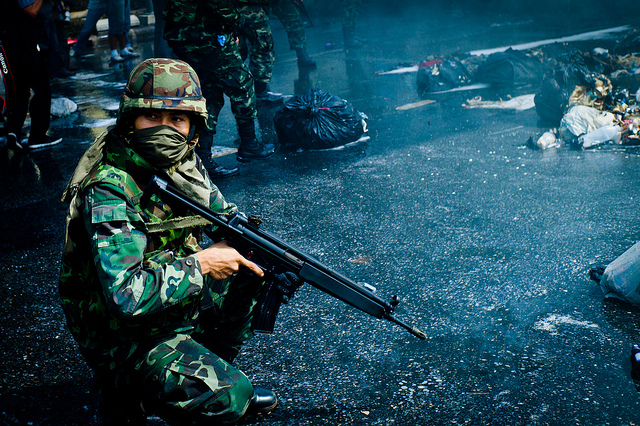
A soldier of the Royal Thai Army awaiting orders near the Red Shirt barricade at Chulalongkorn Hospital. (Courtesy of Flickr user null0)

They delve into what drives the Thai military, why strategic culture matters and how Thailand’s coups have impacted on the development of its doctrine. As Greg explains, understanding the military and its history is key to understanding the future trajectory of this pivotal Southeast Asian state and its civil-military relations.

Download Sea Control Asia Pacific 124 – The Thailand Military, Coups and Strategic Culture

Follow Greg on Twitter @GregoryVRaymond

For more on Thailand and strategic culture, here are Greg’s top reading picks:

The PLA’s Latest Strategic Thinking on the Three Warfares

This piece was originally published by The Jamestown Foundation, and is republished with permission. Read it in its original form here.

By Elsa Kania3WF

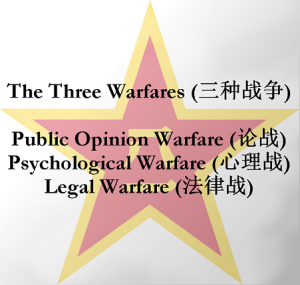
Beijing’s response to the unfavorable South China Sea arbitration outcome has highlighted an important aspect of its military strategy, the “three warfares” (三战). Consisting of public opinion warfare (舆论战), psychological warfare (心理战), and legal warfare (法律战), the three warfares have been critical components of China’s strategic approach in the South China Sea and beyond. In peacetime and wartime alike, the application of the three warfares is intended to control the prevailing discourse and influence perceptions in a way that advances China’s interests, while compromising the capability of opponents to respond.

Beijing has sought to delegitimize the arbitration process and achieved some success in undermining the coalescence of consensus in support of the ruling, while engaging in coercive signaling and deniable attempts to punish the Philippines. China’s response has also included “regularized” “combat readiness patrols” over the South China Sea by H-6K bombers, as well as Distributed Denial of Service (DDoS) attacks against Philippine government websites (China Military Online, August 6; China Military Online, July 19; InterAksyon, July 15). Consistently, Beijing has attempted to advance narratives that frame itself as the upholder of international law, while claiming that the U.S. is to blame for the “militarization” of the South China Sea (China Military Online, June 23). For instance, official media has frequently characterized the arbitration process as a “farce,” and China’s ambassador to the U.S., Cui Tiankai, has argued that the arbitration case would “undermine the authority and effectiveness of international law,” justifying China’s rejection of it as a defense of “international justice and the true spirit of international law” (Xinhua, July 12; PRC Embassy to the U.S., July 13).

These aspects of Beijing’s response should be contextualized by China’s theoretical framework for the “three warfares.” Beyond the South China Sea, this approach has been manifest in a variety of recent cases, including also the East China Sea dispute, China’s opposition to THAAD, and intensifying pressures on Taiwan. The PLA’s evolving strategic thinking on the three warfares, which is linked to its emphasis on information warfare, could influence its efforts to utilize such techniques in future contingencies.

Progression of the PLA’s Approach to Three Warfares:

Although the three warfares constitute a relatively recent addition to Chinese strategy, the PLA’s approach to public opinion warfare, psychological warfare, and legal warfare has been formalized and already advanced considerably. Based on the 2003 and 2010 Political Work Regulations (政治工作条例), the three warfares, under the aegis of “wartime political work” (战时政治工作), were the responsibility of the General Political Department of the former General Staff Department, which, through the recent organizational reforms, has become the Political Work Department (政治工作部), subordinate to the Central Military Commission (CMC) (CPC.com.cn, December 5, 2003; China Brief, February 4). In 2005, the CMC ratified—and the former General Staff Department, General Political Department, General Logistics Department, and General Armaments Department jointly promulgated—official guidelines (gangyao, 纲要, literally “outline” or “essentials”) for public opinion warfare, psychological warfare, and legal warfare, officially incorporating the concepts into the PLA’s education, training, and preparation for military struggle. [1] While these gangyao themselves are not publically available, the open-source PLA literature on the three warfares, which dates back to the mid-2000s, constitutes a valuable resource for analysis and comparison. [2]

Several recent texts present authoritative perspectives on the three warfares and illustrate the extent of their integration into the PLA’s strategic thinking and officers’ curricula. These include the latest editions of influential PLA texts on military strategy, the 2013 Academy of Military Science (AMS) edition of Science of Military Strategy (SMS, 战略学) and the 2015 National Defense University (NDU) SMS, as well as teaching material used by the NDU, An Introduction to Public Opinion Warfare, Psychological Warfare, and Legal Warfare (舆论战心理战法律战概论). [3] Based on these texts, China’s use of the three warfares constitutes a perceptual preparation of the battlefield that is seen as critical to advancing its interests during both peace and war.

Three Takes on the Three Warfares:

2013 Science of Military Strategy:

The 2013 AMS SMS highlighted the significance of the three warfares as a force multiplier in military operations and political or diplomatic scenarios alike. [4] In particular, the text introduced the concept of huayuquan (话语权) through the use of information, belief, and mentality (信息一信仰一心智). Although, in more general or colloquial usage, the term might seem to imply the “right to speak” or “freedom of speech,” the quan (权) in this context apparently alludes not to rights (权利) but rather to power or authority (权力). In this regard, the concept refers to the capability to control the narrative in a given scenario and might therefore be translated as “discursive power.” [5] To contest huayuaquan requires “the integrated usage” of public opinion warfare, legal warfare, and psychological warfare. These three warfare operations should be complementary and mutually reinforcing in future wars or in political and diplomatic struggle.

According to the text, the use of the three warfares in a particular circumstance should be adapted based on the operational context and intended outcome. In particular, the authors argue that achieving international sympathy and support, while diplomatically seizing the initiative, can “provide a powerful pillar to support the whole operational activity.” For instance, if the operational intention must be hidden, the use of propaganda to influence public opinion can reinforce the stratagem of “making a feint to the east and attacking in the west” (声东击西). [6] So too, three warfare operations can have a strong “psychological frightening force” (心理震慑力) against an adversary. Although this text does not define the three warfares or discuss their usage in further detail, this focus on their importance, including in deception, indicates recognition of their potential utility in a range of circumstances.

2014 Introduction to Public Opinion Warfare, Psychological Warfare, and Legal Warfare:

This 2014 text, which serves as discipline teaching materials (学科教材) for the NDU, presented a comprehensive overview of the three warfares, including their primary missions, historical development, theoretical foundation, basic principles, implementation, and tactics. [7] The text illustrates the NDU’s sustained efforts to develop a “science of the three warfares” (“三战”学), which are considered a “major innovation” in the PLA’s political work, and to integrate the concepts into its curriculum. [8] This is informed by the study of variety of traditional, ideological, and contemporary precedents, from the ancient Chinese emphasis on the use of “strategems” (谋略) to the U.S. military’s perceived engagement in analogous practices. At a basic level, the primary purpose of the three warfares is to influence and target the adversary’s psychology through the utilization of particular information and the media as “weapons.” In particular, the three warfares are seen as critical to increasing the PLA’s “soft power” (软实力) and contributing to its success in future wars. As warfare has evolved toward greater “informationization” (信息化), the three warfares have evidently achieved a “breakthrough” beyond their “traditional scope and model,” becoming an “organic” aspect of national strategy and warfare.

While the three warfares “permeate” the “whole course” of military struggle, their functions have also expanded and are relevant to the PLA’s increasingly “diversified” military missions. In particular, the relevant functions include:

· control of public opinion (舆论控制)

· blunting an adversary’s determination (意志挫伤)

· transformation of emotion (情感转化)

· psychological guidance (心智诱导)

· collapse of (an adversary’s) organization (组织瓦解)

· psychological defense (心理防御)

· restriction through law (法律制约)

In more general terms, the primary missions are to seize the “decisive opportunity” (先机) for controlling public opinion, organize psychological offense and defense, engage in legal struggle, and fight for popular will and public opinion. Under the aegis of these missions, this requires efforts to unify military and civilian thinking, divide the enemy into factions, weaken the enemy’s combat power, and organize legal offensives.

According to the text, the implementation of the three warfares should be guided by certain basic principles. These emphasize integration with national political and diplomatic struggle; revolving around the launching of military operations; rapidly taking advantage of the “decisive opportunity” (先机); engaging in offense and defense, with an emphasis on offense; and the integration of peace and warfare (平战结合). Such principles imply advancing a highly coordinated approach that involves proactive peacetime preparation of the perceptual domain in order to enable the PLA to rapidly seize the initiative in a crisis or conflict scenario.

In its entirety, this NDU text highlights the PLA’s focus on these informational, non-kinetic aspects of modern warfare and its extensive efforts to formulate a complex theoretical approach, with a focus on implementation, education, training, and the construction of specialized forces. Beyond the traditional applications of the three warfares, the text also displays efforts to innovate in the application of these concepts to new contexts, such as counterterrorism and stability protection (反恐维稳), international peacekeeping, protecting transportation and escort (保交护航), and closing and controlling borders (封边控边).

2015 Science of Military Strategy:

The 2015 NDU SMS provides an overview of public opinion warfare, psychological warfare, and legal warfare and guidance regarding their implementation. According to the text, public opinion warfare involves using public opinion as a weapon by propagandizing through various forms of media in order to weaken the adversary’s “will to fight” (战斗意志), while ensuring strength of will and unity among civilian and military views on one’s own side. Psychological warfare seeks to undermine an adversary’s combat power, resolve, and decision-making, while exacerbating internal disputes to cause the enemy to divide into factions (阵营). Legal warfare envisions use of all aspects of the law, including national law, international law, and the laws of war, in order to secure seizing “legal principle superiority” (法理优势) and delegitimize an adversary. Each of the three warfares operates in the perceptual domain (认知领域) and relies upon information for its efficacy.

The 2015 SMS emphasizes the “tight connection” of three warfares as an “integrated whole” that should be utilized synthetically. From the authors’ perspective, public opinion warfare and legal warfare primarily operate at the strategic level of warfare, whereas psychological warfare is often implemented at the campaign and tactical levels. If effectively implemented, the three warfares have the potential to establish favorable conditions for battlefield success and eventual victory.

For public opinion warfare, the requirements outlined are to “demoralize one’s opponent by a show of strength” (先声夺人), “create momentum to control the situation” (造势控局), “assail strategic points” (抨击要害), and “seek the avoidance of injury” (趋利避害). In particular, it is critical to be the first to release information in a contingency and actively guide public opinion in order to achieve and preserve the initiative on the “public opinion battlefield.” Beyond efforts to exploit an adversary’s shortcomings, the opponent’s attempts to engage in public opinion warfare must also be countered. For example, this approach is reflected in Beijing’s attempts to influence domestic and international public opinion with regard to the U.S. role in Asia—including claiming that the U.S. is at fault for regional tensions and the “militarization” of maritime territorial disputes, while frequently denouncing U.S. “hegemony” and pursuit of “absolute security.”

The principles articulated for psychological warfare focus on “integrating [psychological attacks] and armed attacks with each other” (与武力打击相结合), “carrying out offense and defense at the same time, with offense as the priority” (攻防并举以攻为主), and “synthetically using multiple forms of forces” (综合运用各种力量). In this regard, psychological warfare is envisioned as closely integrated with all forms and stages of military operations in order to intensify the efficacy of conventional attacks. The implementation of psychological warfare should also focus on taking advantage of “opportune moments” and “striking first” to seize the initiative, based on the efforts of multiple forms of psychological warfare forces, including those from the armed forces, reserves, and society. For instance, the intensification of psychological pressures against and attempted intimidation of Taiwan at times of tension or crisis, especially recently during Tsai Ing-wen’s presidency, reflects the application of such an approach, which has been carried out by the PLA’s “Three Warfares Base,” Base 311 in Fuzhou (Taiwan Link, August 8).

The implementation of legal warfare, which seeks to provide legal support to operational success, is informed by the principles to “protect national interests as the highest standard” (以维护国家利益为最高准则), “respect the basic principles of the law” (尊重法律的基本准则), “carry out [legal warfare] that centers upon military operations” (围绕军事行动展开), and “seize standards [and] flexibly use [them]” (把握规范灵活运用). This approach emphasizes the necessity of a nuanced understanding of relevant domestic and international law in order to engage in “legal struggle” and achieve the initiative. In the context of the South China Sea dispute, this has involved the utilization of rather tortuous interpretations of international law to oppose the Philippines’ position and seek to delegitimize the arbitration process.

Conclusion

Based on these texts, the PLA perceives public opinion, psychological, and legal warfare as of distinctive strategic and operational significance, and the three warfares are evidently being incorporated more systematically into its overall thinking on military strategy. While the conceptualization of the three warfares in these recent texts builds upon the prior PLA literature and thinking on the concepts, these sources particularly highlight the complementarities among the three warfares and the importance of their synthetic integration with conventional military operations. This approach is also informed by the PLA’s concerns about countering the perceived “ideological assaults” (意识形态攻击) of “hostile forces” via the Internet (PLA Daily, August 12). In practice, this involves attempts to take advantage of prior peacetime preparation of this perceptual battlefield to establish favorable conditions for going on the offensive to seize the initiative. Since this is a dimension of strategic competition in which China has already demonstrated the efficacy of its efforts, understanding the three warfares will continue to have immediate, real-world relevance.

Looking forward, the PLA’s future approach to the three warfares could continue to evolve in accordance with its recent and ongoing strategic, doctrinal, and also organizational changes. Beyond the recent changes in Chinese military strategy, with the 2014 revision of the PLA’s military strategic guidelines (fangzhen, 方针), overdue changes to its operational regulations (作战条令) or doctrine also seem to be occurring (China Brief, April 21). The PLA appears to remain in the process of working toward the official promulgation of a fifth-generation doctrine, and the underlying campaign outlines (战役纲要) and combat regulations (战斗条令) might include revised guidance for the implementation of the three warfares, given the recent focus on advancing the PLA’s three warfares “science.” Despite the limitations of the available sources, these three texts present the latest available perspectives on the PLA’s evolving strategic thinking on the three warfares and thus can inform analyses of the PLA’s implementation of these concepts.

Elsa Kania is a recent graduate of Harvard College and currently works as an analyst at the Long Term Strategy Group.

Endnotes

1. Wu Jieming [吴杰明] and Liu Zhifu [刘志富], An Introduction to Public Opinion Warfare, Psychological Warfare, [and] Legal Warfare [舆论战心理战法律战概论], National Defense University Press, 2014, p. 1.

2. For prior discussions of the three warfares, see prior analyses, including: Mark Stokes and Russell Hsiao, “The People’s Liberation Army General Political Department Political Warfare with Chinese Characteristics,” Project 2049, October 14, 2013. “China: The Three Warfares,” prepared for Andrew Marshall, Director of the Office of Net Assessment, by Professor Stefan Halper, May 2013. Dean Cheng, “Winning Without Fighting: Chinese Legal Warfare,” Heritage Foundation, May 21 2012. Dean Cheng, “Winning Without Fighting: Chinese Public Opinion Warfare and the Need for a Robust American Response,” Heritage Foundation, November 26, 2012. Dean Cheng, “Winning Without Fighting: The Chinese Psychological Warfare Challenge,” Heritage Foundation, July 12, 2013.

3. The Science of Military Strategy (SMS) is an authoritative text, typically used as teaching materials for senior PLA officers, that articulates the PLA’s thinking on military strategy in multiple domains and contexts. The latest AMS edition of SMS was the focus of a recent book (Joe McReynolds, China’s Evolving Military Strategy, Jamestown Foundation, 2016), but there has been less published analysis on the 2015 NDU text thus far. Since the AMS plays a more direct role in the formulation of military strategy, the 2013 SMS text might be more authoritative than the 2015 NDU edition. Nonetheless, this NDU text also presents a more recent and perhaps reasonably influential perspective that merits closer examination. Concurrently, it is important to recall that such works are primarily theoretical and reflect the viewpoints of these influential institutions, rather than the PLA as a whole. Given such caveats, these texts’ respective content on the three warfares should not be taken as official articulations of the PLA’s strategic or doctrinal approach but rather constitute more theoretical discussions of the concepts that can inform future analysis of these topics.

4. Academy of Military Science Military Strategy Research Department [军事科学院军事战略研究部], eds.,The Science of Military Strategy [战略学]. Military Science Press, 2013, p. 131.

5. John Costello and Peter Mattis, “Electronic Warfare and the Renaissance of Chinese Information Operations,” in Joe McReynolds, China’s Evolving Military Strategy, Jamestown Foundation, 2016.

6. This particular saying from the Thirty-Six Stratagems, which has been variously attributed to Sun Tzu and Zhuge Liang, seems to have originated from various aspects of Chinese written and oral military history.

7. Wu Jieming [吴杰明] and Liu Zhifu [刘志富], An Introduction to Public Opinion Warfare, Psychological Warfare, [and] Legal Warfare [舆论战心理战法律战概论], National Defense University Press, 2014, pp. 1–7, 14–20, 62–69, 121–132, 133–143, 226.

8. The text was formulated with high-level support from NDU starting from 2009 and authored by a committee of scholars under the leadership of two relatively senior NDU professors as a culmination of that process.

9. Xiao Tianliang [肖天亮], eds., The Science of Military Strategy [战略学]. National Defense University Press, 2015, pp. 216–218.

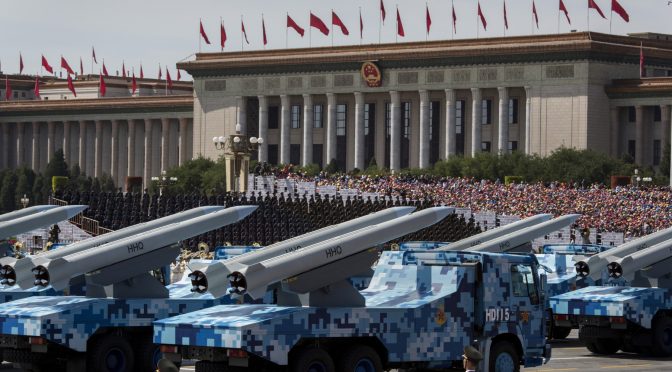
Featured Image: BEIJING, CHINA – SEPTEMBER 03:  Chinese missiles are seen on trucks as they drive next to Tiananmen Square and the Great Hall of the People during a military parade on September 3, 2015 in Beijing, China. (Kevin Frayer/Getty Images)