Category Archives: Asia-Pacific

Analysis relating to USPACOM.

Vietnam Set to Receive Japanese Patrol Boats Next Year

Vietnam’s Vice Defense Minister Nguyen Chi Vinh told Reuters on Monday at the Shangri-La Dialogue in Singapore that the country expects to receive patrol boats from Japan early next year.

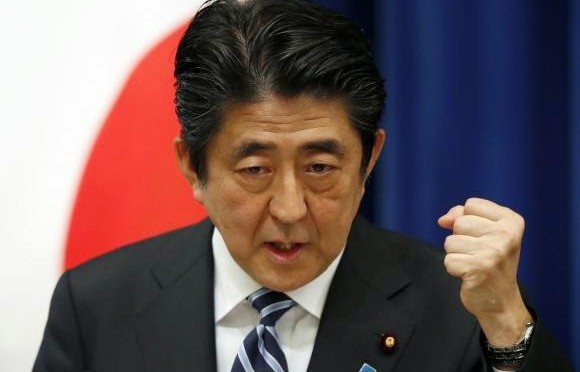
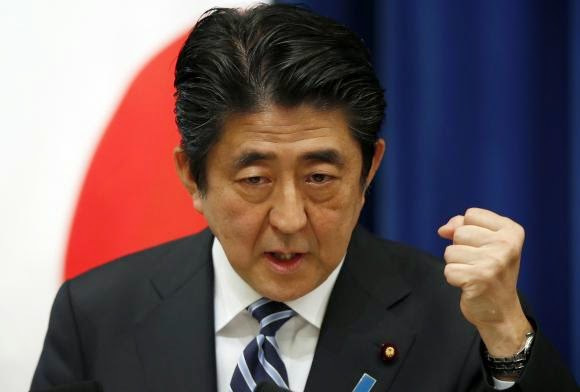
This is the first timeline provided by either side, where as recently as Friday at the same conference Japanese Prime Minister Shinzo Abe said only that Japan was “moving forward with the necessary survey to enable us to provide such vessels to Vietnam.”

Japan’s assistance comes as both nations engage with China in high-stakes territorial rows over disputed islands and their attendant Exclusive Economic Zones (EEZs) – Japan over the Senkakus/Diaoyus in the East China Sea, and Vietnam over the Paracels/Xishas in the South China Sea.

Vietnam’s lack of capacity to defend its claimed EEZ was highlighted when it unsuccessfully tried to disrupt the operations of a Chinese oil rig moved into waters off of Zhongjian Island in the Paracels last month, sparking water cannon battles, collisions, and the sinking of a fishing vessel.

Patrol-boat aid for Vietnam has been on Japan’s agenda since at least late 2013. Vietnam reportedly sought 10 Japanese patrol boats as early as April last year, and Abe confirmed in December that the two nations were in talks over a deal. The exact number of patrol boats, their specifications, and whether they would be procured through a Japanese-secured soft loan have not been confirmed.

AbeLast week, Abe told the Japanese Diet that Japan would be unable to provide Vietnam with used, likely more-capable coast guard vessels in the near term due to its own need for maritime capabilities in the current environment. Abe at the time made no mention of the provision of new vessels for Vietnam, although he had agreed in March to send a survey team to the country to research the possibility of a donation.

While it is unclear which maritime departments within Vietnam would receive the vessels, Hanoi took the step in October of transferring the Vietnam Marine Police from the Navy to the Coast Guard to make it eligible for the vessels under Japan’s Overseas Development Assistance (ODA) rules which prohibit aid from use for military purposes.

Japan has in recent years agreed to other patrol boat “gifts” to Southeast Asian nations. In 2007, it provided three new 27 meter patrol vessels to Indonesia and agreed last July to provide ten 40-meter vessels to the Philippines, slated to begin arriving in the Philippines in the third quarter of 2015. While the Philippines deal is also called a donation, the vessels are being procured through a $184 million soft loan announced in December.

In addition to patrol boats, Japan has over the past decade engaged in a variety of programs aimed at boosting the maritime capabilities of Southeast Asian nations, including counter-piracy, search and rescue, and maritime domain awareness training and assets.

Maritime capacity building aid for Vietnam has been forthcoming from the United States as well. In December U.S. Secretary of State John Kerry announced that the U.S. would give Vietnam $18 million to develop its maritime capacity, including funds earmarked for five fast patrol boats, and the U.S. Navy and U.S. Coast Guard have increased training engagements with the nation since 2010.

In April, Abe and President Obama released a joint statement affirming their joint commitment to, “assist Southeast Asian littoral states in building maritime domain awareness and other capacities for maritime safety and security so that they can better enforce law, combat illicit trafficking and weapons proliferation, and protect marine resources.

Seen as a dual-purpose effort to maintain regional stability by enhancing sea lanes defenses against maritime crime and boosting the deterrence capabilities of those in territorial disputes with China, the partnership is likely to manifest itself in future coordination in the region.

LT Scott Cheney-Peters is a surface warfare officer in the U.S. Navy Reserve and the former editor of Surface Warfare magazine. He is the founder and vice president of the Center for International Maritime Security (CIMSEC), a graduate of Georgetown University and the U.S. Naval War College, and a member of the Truman National Security Project’s Defense Council.

This article was cross-posted in coordination with USNI News.

New Strategic Geography Ends “Long Army Century”

Some historians attempt to reframe the timeline of history in order to highlight trends that might otherwise remain submerged in more traditional categories. The British Marxist historian Eric Hobsbawn, for example, re-classified the long period from the French Revolution to the beginning of the First World War as the “long” 19th century. This change showcased a particular period of European ascendency through the Napoleonic, Revolutionary, Victorian and Edwardian periods. A similar effort might now be applied to the influence of the U.S. Army on United States strategic thinking. A “Long Army Century” is now drawing to a close due to new strategic geography and shrinking defense budgets.

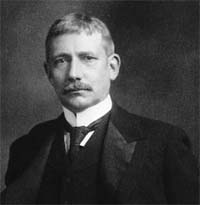
ElihuRoot
Elihu Root

The “long Army century” arguably began in 1904 with the selection of New York corporate lawyer Elihu Root as the Secretary of the Army by President William McKinley in 1899. While the U.S. Army had been victorious in Cuba in the Spanish American War, its organization, operations, and logistics during that conflict revealed deep flaws that might circumscribe future success. Root undertook an aggressive program that created the modern Army General Staff, the Army War College, and the Joint Army Navy board for inter-service cooperation.
The Chief of Staff system, modeled on methods then used by American business, was a great success. Root’s reforms created the “modern” Army that was able to mobilize large numbers of volunteers for the First World War. This system eagerly embraced new technologies such as the tank and the airplane, and was successful in deploying millions of Americans to fight in France in a relatively short time. The Army also had great influence over large numbers of civilians for the first time since the Civil War, as high ranking Army leaders served in key roles on the War Industries Board that coordinated U.S. war production.

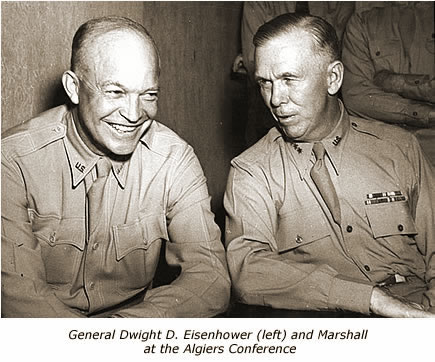
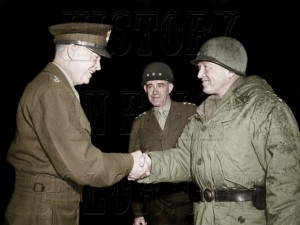
The end of the First World War brought a reduction in overall Army influence, but future influential leaders including George C. Marshall, Dwight D. Eisenhower, George Patton and many others were direct products of Root’s post-1903 reforms. These leaders fought the Second World War, and others again occupied significant roles in civilian government like General Leslie Groves who managed the Manhattan Project. The end of World War 2 should have brought about another reduction in Army strength and influence, but the emerging Cold War and the strong personalities of Marshall, Eisenhower, and other products of the Root Army War College had other ideas.

Eisenhower Patton
Eisenhower Patton Bradley

The Army targeted the Navy as unfairly hoarding resources in a “parochial” manner in order to gain its share of scarce financial resources at the beginning of the Cold War. One of the best ways to do this was to advocate for a unified “joint” military force with relatively co-equal branches under a supreme “generalissimo” of the U.S. armed forces. This is not surprising given the wartime experience of the post World War 2 U.S. Army leadership. Officers such as Marshall, Eisenhower, and Omar Bradley served primarily in the wartime European theater of operations where land and air warfare were the predominant modes of fighting. The “Battle of the Atlantic” against the German U-boat arm never fell under Eisenhower’s direct supervision. He and other Army officers respected the ability of naval forces to mount the Normandy invasion, but had little or no direct experience with naval combat. Postwar naval leaders such as Chester Nimitz, Forrest Sherman, and Arleigh Burke by contrast had experienced a relatively decentralized war in the Pacific. Nimitz and Army general Douglas MacArthur shared command authority and responsibility in a collaborative manner unlike the Army Chief of Staff system with one overall commander. As a result of this difference in leadership style and the fierce competition with the Navy and later the Air Force for funding, the Army enthusiastically adopted concepts of “joint” organization and control of the armed forces throughout the Cold War. Dwight Eisenhower as President tried to implement joint concepts of organization for the Department of Defense as a result of his war experience, but was thwarted in his efforts by key pro-Navy Congressional leaders.

Goldwater Jones
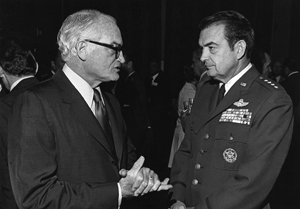
Senator Goldwater and CJCS General David Jones

The long and unsuccessful Vietnam War and end of the military draft in 1973 should have brought about a reduction in Army strength and influence, but the Army was again able to avoid large cuts by shifting to an all-volunteer force and refocusing on the European threat posed by the Soviet Union. Army leadership continued to advocate “joint” leadership of the U.S. Armed Forces in pursuit of desired force structure. The passage of the Goldwater Nichols Act of 1986 further cemented “joint” aspects of U.S. military strategy, policy and operations. The Gulf War of 1991 seemed to confirm that “joint” organization was crucial to U.S. military success. Building on triumph in that conflict, the Army was able to secure a significant force structure in the negotiations that produced the post-Cold War “base force” in 1994. The looming specter of a revanchist Russia, desire to enable a “New World Order”, as well as the continuing specter of Saddam Hussein’s armed forces convinced many decision-makers that there was continued value in a large expeditionary ground force. The Army found further relevance after the terrorist attacks of 9/11 and the subsequent ground invasions and counterinsurgency operations in Iraq and Afghanistan.

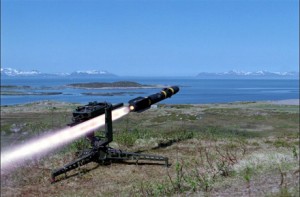
The Army’s success on the battlefield in the last 100 years, especially in more recent “joint” operations has been largely enabled by favorable geography. Combat in and around the Eurasian landmass in both World Wars, the Korean and Vietnam conflicts, and recent wars in the Persian Gulf and Southwest Asia all featured airfields within short range of hostile targets and an emphasis on the effects of land-based operations. The geography of future conflict however would seem to be shifting to largely maritime and air struggles in the Indo-Pacific basin. This region’s large maritime spaces offer few immediate venues for employment of land power as did the plains of Europe, the deserts of the Middle East and the highlands of the Hindu Kush in Afghanistan. The Air Force and Navy, rather than the Army, have the central role in Pacific strategy. The shrinking U.S. defense budget in response to national debt, trade deficits and massive new social welfare spending also works against the maintenance of continued Army force structure and influence. Without a defined mission in an essentially air and maritime battlespace, the Army has resorted to a kind of “me too” strategy advocating its ability to support the other services Pacific efforts through coastal defense, which ironically was one of the U.S. Army’s first missions in the new republic.

Hellfire-Missile-coastal-artillery

The Pacific Ocean, and the lands touched by its waves have always been of U.S. strategic interest. For the first time however since 1941 there is no comparable “land-based” strategic theater in competition with the Indo-Pacific region. The U.S. Army will likely have other expeditionary missions and conflicts in its future, and may again return to a level strategic influence like that it has possessed in the last 100 years. For the moment however, historians might be well served to give the present “Long Army Century” an endpoint in the early second decade of the 21st century.

Steve Wills is a retired surface warfare officer and a PhD student in military history at Ohio University. His focus areas are modern U.S. naval and military reorganization efforts and British naval strategy and policy from 1889-1941. He posts here at CIMSEC, sailorbob.com and at informationdissemination.org under the pen name of “Lazarus”.

Sea Control 34, Asia-Pacific: Game-Changers

seacontrol2This week, Sea Control Asia Pacific looks at ‘gamechangers’ in Asia. Natalie Sambhi, of the Australian Strategic Policy Institute, interviews her colleagues Dr Rod Lyon and Daniel Grant about the ways in which Asia Pacific states are engaged in strategic competition. We also offer an Australian perspective on domestic political changes and military modernization in Southeast Asia, China’s nine-dash line claims, Indonesia and non-alignment, and the US rebalanced.

DOWNLOAD – Sea Control 34: Asian Game Changers

Remember, subscribe on iTunes or Stitcher Stream Radio. Leave a comment and five stars!

Jokowi and the Defence Realm

This was first posted by our good friend Natalie Sambhi at “The Strategist” ASPI Blog.

No doubt by now most Australian readers would have heard that the popular Jakarta governor, Joko Widodo, also known as ‘Jokowi’, is the frontrunner for Indonesia’s upcoming presidential election. His meteoric rise from humble furniture entrepreneur in Solo to what could be the Presidential Palace is best explained simply by his genuine push for effective governance and a crackdown on corruption as well as his grassroots, ‘Mr Fix-it’ image. In short, he’s riding an Obama-like wave of hope and change in Indonesia—most importantly, hope that change is possible and that politics need not be dominated by stale and self-serving elites.

Nearly 32% of Indonesians recently polled by CSIS Jakarta have thrown their support behind Jokowi (Prabowo, the next preferred candidate, trails behind with 14.3%). While it’s not a fait accompli, it’s time to consider what a Jokowi administration might look like. How Indonesia views its strategic environment and how it chooses to manage its diplomatic relations is of great interest to Australia. As the past six months have shown, diplomatic disruptions to the relationship, for one, could harm our defence and security cooperation.

9013009998_a74da2e6ff_zWithout making predictions about who’ll fill a Jokowi cabinet, it’s fair to say there’ll be a period of settling in after the elections. As Gary Hogan points out, ‘If the new Indonesian president is allowed to form a cabinet of clean, capable, technocratic ministers, able to implement sensible fiscal and economic policy, the stake of Australian business in Indonesia’s future looks promising’. The same roughly applies to those who fill the roles of defence minister and coordinating minister for political, legal and security affairs. As always, people matter.

Looking to the bigger strategic picture, Jokowi will have to contend with challenges posed by the increasingly complex relationship between China and ASEAN states, exacerbated by a raft of territorial disputes. For its part, after years of maintaining its neutrality, Indonesia formally announced in early March its own dispute with China’s claim over parts of its territory in the South China Sea. As Ann Marie Murphy notes in today’s PacNet newsletter, this is ‘likely to heighten tensions on an issue that is already fraught with them’. Indonesia will have to work harder to maintain regional stability—and in an environment less conducive to the norms of peaceful settlement of disputes and non-interference from external actors. Jokowi has dipped his toe into ASEAN matters hosting a meeting with governors and mayors of ASEAN capital cities, but it’s not the same as strong Indonesian leadership of ASEAN in the face of a more provocative China.

And that’s where a good VP will help. An experienced hand will help bolster what Jokowi lacks in foreign policy street cred. So far, the serious talk has been of former Vice President to SBY, Jusuf Kalla (who also served in Megawati’s cabinet), running with Jokowi. Kalla’s proven credentials in conflict resolution would be of value: he helped solve inter-religious violence in Sulawesi in 2001 and steered Aceh’s rehabilitation after the 2004 tsunami. Of all potential VP candidates, Kalla can best ease Jokowi into the realm of international politics. The same goes for having a vibrant and experienced foreign minister.

In terms of defence policy, many of the current drivers for Indonesia’s military modernisation—including a focus on maintaining territorial sovereignty and protecting its EEZ—will continue to shape decision-making during a Jokowi term in office. Defence spending will largely depend on economic performance, so we’ll have to see how the Indonesian economy fares first under the new administration before we can expect announcements to increase the defence budget. TNI’s modernisation program aims to develop a ‘Minimum Essential Force’ (MEF) by 2024 which entails major upgrades of naval, land and air capabilities as well as the development of a local defence industry. While many of those developments were driven by SBY, some have made their way into legislation, which a new president might find hard to alter. Indonesia also has a number of capability development projects and acquisition deals on the go with partner countries. Defence officials recently announced that the first batch of F-16 Fighting Falcon fighter jets as part of a US grant are due to arrive in country in October.

Turning finally to how Jokowi will deal with the military itself, there’s been some chatter about current TNI chief General Moeldoko as Jokowi’s running mate. But most opinion polls suggest the public would oppose such a degree of military involvement in politics. Irrespective of historical preferences for a ‘strong man’, Indonesians have indicated that a civilian is up to the top job. At a time when anti-corruption and clean governance are the dominant political flavours, Moeldoko has made all the right noises about reform and professionalism. Hopefully this translates into a continuation of Indonesia’s reformasi project.

For Australia, a changing of the presidential guard is an opportunity to rebuild the defence and security relationship. It’s not possible that all military exercises suspended by SBY last year will automatically and immediately resume. But a few encouraging initiatives—both from Canberra and Jakarta—early in a new administration would provide positive signs for the future. In strategic terms, with growing ambiguity in Indonesia–China relations over territory, it’s timely and appropriate for Australia and other partners to warm the relationship with Jakarta.

Natalie Sambhi is an analyst at ASPI and editor of The Strategist. Image courtesy of Flickr user US Embassy, Jakarta.