What emerging technology is going to most profoundly change the way naval warfare is conducted, and why?
This is the Fourth in our series of posts from our Maritime Futures Project. For more information on the contributors, click here. Note: The opinions and views expressed in these posts are those of the authors alone and are presented in their personal capacity. They do not necessarily represent the views of their parent institution U.S. Department of Defense, the U.S. Navy, any other agency, or any other foreign government.
CDR Chris Rawley, USNR:
Most of CIMSEC’s readers are familiar with Moore’s Law as it relates to integrated circuits increasing in power while falling in cost. Some may have also heard of Kryder’s Law, which deals with shrinking costs for magnetic memory. Other related concepts include Koomey’s Law, which says that battery requirements for a fixed computer load continue to fall and the Shannon-Hartley Theorem, which impacts data transmission speeds. These laws have resulted in increased capability and falling prices for commercial and consumer tools reliant on computing power. It’s a given that military hardware is also becoming more high tech and miniaturized. So why does the cost of military technology continue to skyrocket? There are a number of reasons for this dichotomy, the primary being the U.S. military’s unresponsive and byzantine joint acquisition systems. Those problems aside, the Navy (and DoD) need to figure out how to leverage laws of technology to reduce inflation in new military hardware. One way to do this is with smaller, more numerous, and cheaper systems – many of them unmanned – which can operate distributed over large geographic areas. At Information Dissemination, I frequently discuss a concept for future naval warfare called distributed maritime operations (DMO). DMO as I see it will use highly distributed, highly connected – but independently commanded – small footprint fighting elements. In the same way that special operations forces have used similar concepts to fight a global terrorist threat, I believe DMO will allow small naval forces to work together in a variety of scenarios to produce out-sized combat effects.
LT Drew Hamblen, USN:
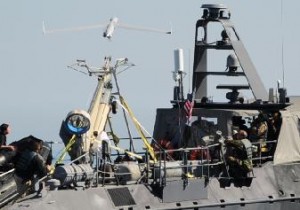
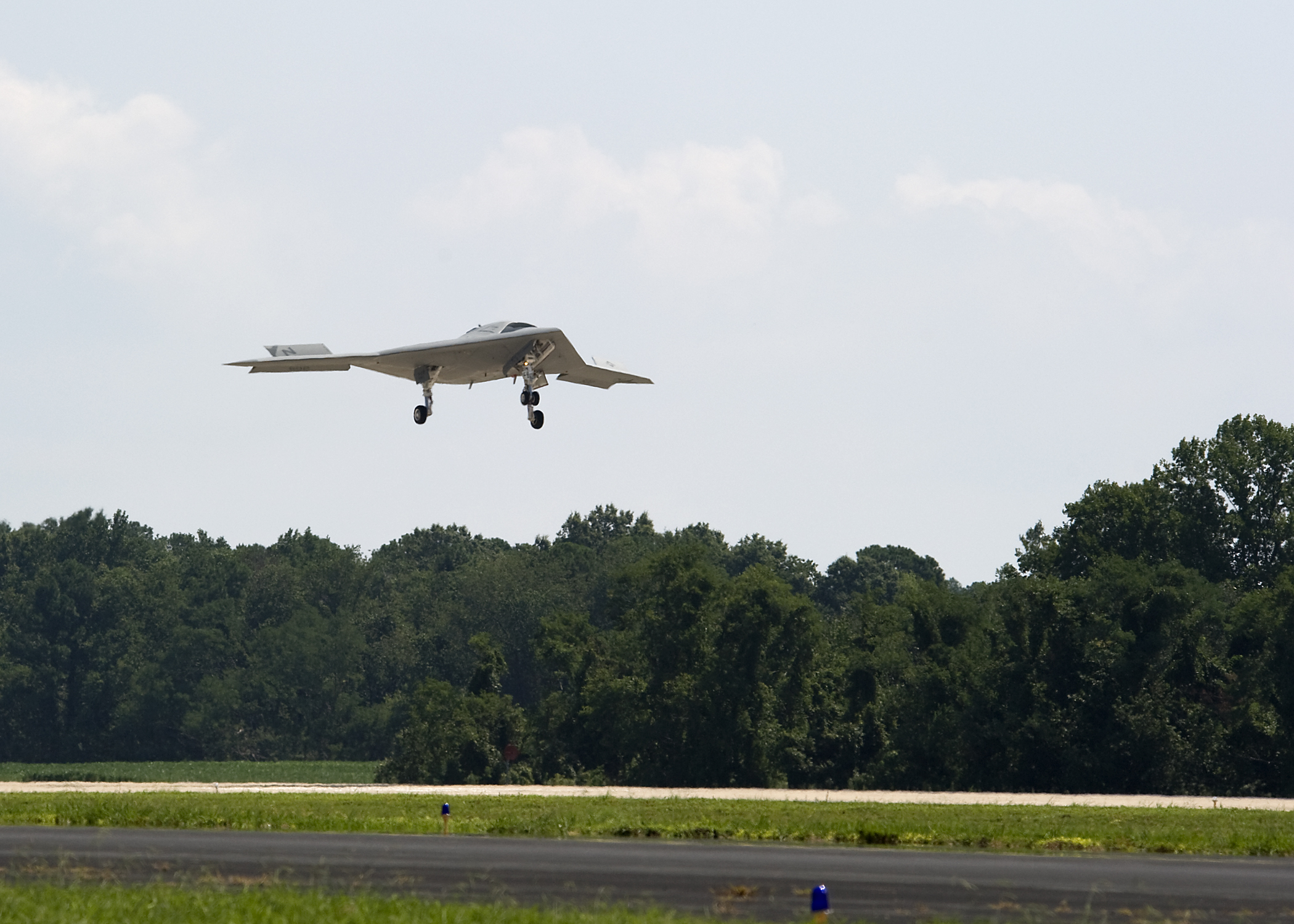
Anti-ship ballistic missiles and the implications of Unmanned Aerial System (UAS) proliferation will shake up carrier battle groups – specifically the ability of UASs to numerically overwhelm manned assets. How will a carrier air wing confront 3 air wings’ worth of unmanned aircraft that have twice the on-station time and no pilot-fatigue limitations?
Marc Handelman, WA, U.S.:
– Naval drones (Surface, Sub-surface, Aerial)
– Power-projection exploitation capabilities (battlespace control, sustainment, and attack via drones)
– Tiny sensors known as MEM (microelectromechnical) devices such as DARPA’s SmartDust project to facilitate ISR exploitation and communication.
– The ONR-funded Sea Jet Advanced Electric Ship (obvious efficiencies in power management, logistics, acoustic signature reduction, et cetera)
Felix Seidler, seidlers-sicherheitspolitik.net, Germany:
Cyber-warfare is going to change things soon. The world’s best warships are worth nothing if the IT systems supporting command, control, communications, intelligence, etc. are offline. Hence, navies will have to pay greater attention to safeguarding their IT. For example, malware intrusions into the targeting and control software for all kinds of sea-launched missiles could not only miss their target, but be redirected to strike their ship of origin instead. For the present and the future, the joint forces approach must also include a nation’s cyber warriors.
YN2(SW) Michael George, USN:
As we are still in the early ages of the internet and wireless technology, I believe that there will be an increasingly important role both play in our country’s defense.
Sebastian Bruns, Fellow, Institute for Security, University of Kiel, Germany:
I think cyber warfare, although more of a concept than a technology is providing the basis for the most profound change in naval warfare. The concept is diffuse, difficult to understand, and impossible to directly feel (cue Donald Rumsfeld’s “known knowns, known unknowns, and unknown unknowns”). In fact, cyber warfare’s challenges, opportunities, and limitations have not been fully grasped. If cyber is understood as a domain, I would compare our current state of mind (and understanding of the subject matter) to the early 1910’s perspective on air power: There has not been a full-fledged cyber war, much like there had not been an appreciation of airpower until World War I. At the same time, the generation of sailors and flag officers that is currently rising through the ranks has already been sensitized (largely by growing up with cyber technology) towards the subject matter; air power and space power did not provide a comparable perspective. It seems logical to quickly adopt cyber warfare concepts and embrace them as part of institutional and individual, strategic and tactical learning.
Rex Buddenberg, Naval Postgraduate School:
Before projecting forward, it may help to look back an equivalent amount of time to see what technologies changed maritime business (warfare included) in the past half-century – essentially since WWII. Some of these technologies, like radars and fathometers, are
gadgets. Others are information systems, such as radionav systems like Loran, GPS, digital GPS, and AIS and its work-alikes including USMER, AMVER, MOVREP, and those built around OTH-Gold, Link 14/11.
Still other technologies constitute the potential components of information systems, chiefly communications. The maritime VHF system has revolutionized the SAR business in the USCG in our lifetimes. And, integration with accurate navigation, has revolutionized it further. For instance, when I was stationed on the Oregon coast, a distressed mariner could give us a pair of Loran TD (time/difference data-points) and a fathometer reading (essentially as a checksum) and we could fly a helo right to him … regularly. This phenomenon has attracted the term ‘maritime domain awareness (MDA)’ albeit without a decent usable definition. Now look ahead a bit…
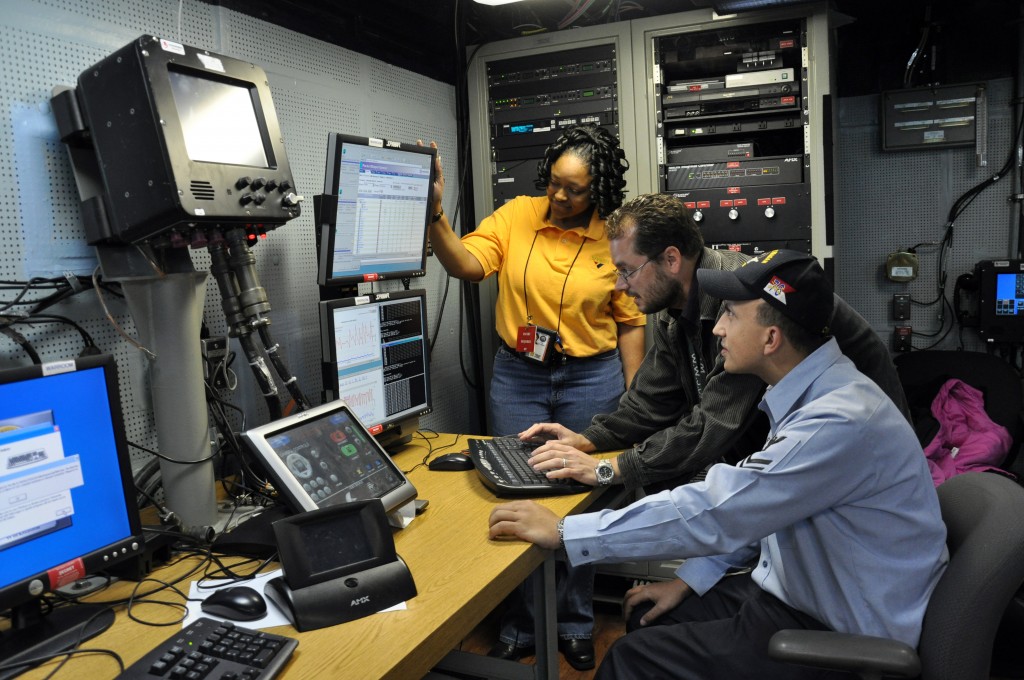
Gadgets: The march of new gadgets will, of course, proceed. The change here will be that the gadget will increasingly export the data rather than only provide a local display. To do that, the gadget will have an internet interface (like webcams). Example: remember PDAs … like Palm Pilots? They had no comms ability to speak of, other than a serial line to sync with local computer. But once the PDA functionality was integrated with the cellphone infrastructure, PDAs morphed into smartphones. I’ve got a PDA … its sitting up on a high shelf.
Systems: The implementation of new systems will also proceed. But there is a sea change in the offing, one that has already occurred elsewhere and is about to occur here: integration and interoperability. Most of the systems above are ‘stovepipe’. The chief characteristic of stovepipe is the locking of a single application (e.g. position reporting) to a single comms system (channels 87B and 88B) to yield something like AIS. The comms channels cannot be used for anything else, such as distress or weather comms, and the systems are usually hard to maintain throughout their life-cycle because you can’t form-fit swap in new components without changes cascading through the system. To get a whiff of the future, look in your office or your residence – we have ‘internet plumbing’ which is application-agnostic. It supports a myriad of applications (messaging, video, scrabble (my wife’s current fixation), … the list is long and ever-changing. The appearance of a new application does not require changes in the underlying comms plumbing. This has partially emerged in the maritime world, but will become ubiquitous, perhaps in the next decade (the technology exists, the problems have to do with infrastructure and mentalities).
The telltale here will be rise of the internet … in this case in the internet’s extension to platforms at sea. We see the harbingers of that now, such as ADNS in Navy. This is the single biggest enabler of integration of the rest.
The operational effect of the increase and integration of information systems is more intelligent application of industrial capability. In slang, less turning circles in the ocean. And in slogan, we might be able to “take the search out of SAR”.
CDR Chuck Hill, USCG (Ret.):
For the Coast Guard’s operations, in both peace and war, the most important aspect is likely to be processed vessel track information. Given the ability to track every vessel in the EEZ, identify it, and correlate it to its past history including the cargoes it has received, would be the ultimate goal. Over-the-Horizon radar/Satellite/AIS (Automatic Identification System)-derived information may eliminate the search in search and rescue (SAR), allow us to know where all the fishing vessels are, and allow us to recognize anomalous voyages that might be smugglers. To do this effectively we need to be able to track small vessels as well as the large.
In wartime this will also make blockade enforcement more effective, and permit prompt response when vessels are attacked.
Dr. Robert Farley, Professor, University of Kentucky:
The expansion of unmanned vehicles (air, surface, and sub-surface) has the potential to work tremendous changes in how we think about naval warfare. We’re already seeing this in littoral projection, and beginning to see it in ASW (anti-submarine warfare). As navies work through the theoretical implications of unmanned vehicles, they’ll begin to develop platforms capable of taking greatest advantage of the technologies, extending both eyes/ears and reach.
LCDR Mark Munson, USN:
Earlier this year, Admiral Greenert, the US Navy’s Chief of Naval Operations, declared that “Payloads were more important than Platforms.” I’m interested in how this plays out in terms of Intelligence, Surveillance, and Reconnaissance (ISR). Traditionally the mission of sensors onboard planes, ships, and subs has been subordinated to the operation of those platforms. Is the Navy’s BAMS (Broad Area Maritime Surveillance) UAV going to be just a P-3 without an aircrew onboard, or will it represent a new approach to collecting the information needed to generate actionable intelligence?
It’s been a long time since the U.S. Navy has fought a sustained war at sea, and no one has actual experience in how our current and future sensors need to be used to generate the intelligence required to engage capable enemy at sea. Unfortunately, the model successfully developed by our counterparts ashore during the last decade was in a permissive air environment. It allowed lots of UAVs to provide Full Motion Video (FMV) to intel analysts, developing a pattern of life for terrorist targets that could be fused with other data in order to generate actionable targeting data, but this most likely would not apply to a fight at sea against a capable enemy.
Bryan McGrath, Director, Delex Consulting, Studies and Analysis:
Although it is hardly an “emerging” technology, electric drives will profoundly change naval warfare. They will make submarines even quieter than they currently are, and they will serve to reverse the precision-guided munitions (PGM) imbalance with China by enabling future generations of electric weapons.
LT Alan Tweedie, USNR:
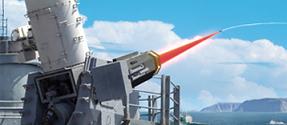
Directed energy and rail guns, while requiring massive up-front R&D costs will produce fantastic combat capability. The ability to have nearly unlimited ammunition without replenishment will make our fleet more capable of conducting sustained operations against enemies.
LT Chris Peters, USN:
I think one of the bigger upcoming changes will come from the installment of rail guns on DDG-1000 and beyond. These could be game-changers in power projection when you combine TLAM (Tomahawk Land Attack Missile)-like range with the cost per round of 5” (NGFS) Naval Gun Fire Support shells.
LT Scott Cheney-Peters, USNR:
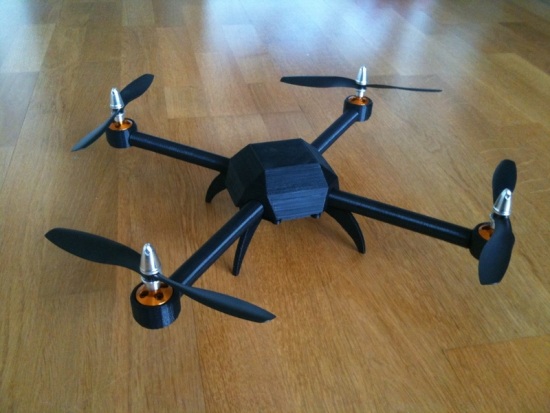
I mentioned the general trend of increasing data integration in MFP 3 – essentially the Navy capitalizing on the spread of what’s possible with the information revolution. On the logistics and design side, we’ve waxed on about the effects 3D printing will have. But as far as actual naval warfare, I’m going to have to agree with those thinking about directed energy weapons and rail guns as the most likely to have a nearer-term impact on the tactical level. Both have technical hurdles to overcome, but when they do, they’ll shake up the modern calculus of naval engagements – giving surface vessels a much greater ability to hold their own in a fight, and greatly increasing the potential of drones once component miniaturization and energy reductions have sufficiently advanced reduced to allow their outfit aboard. Bryan McGrath has a good run down over at Information Dissemination on directed energy and electric weapon systems (DEEWS). Finally, the greatest potential for disruption in naval warfare comes from the use of unmanned systems in myriad combinations that are hard to predict but fascinating to think about – for example the combined cyber warfare assisted by drones.
LTJG Matt Hipple, USN:
Perhaps Scott Cheney-Peters and I are beating a dead horse here, but 3D printing in a big way. I know I’m beating an extra-dead horse when I include automation. 3D printing drastically changes the required logistical chain for both ground and naval forces. It changes the way the entire supply system would work, the kinds of people it would employ, and the navy’s relationship with industry. With an influx of business partners that consider themselves problem “hackers”, the Navy will hopefully get a fresh new perspective on life.
I say automation in the smaller big way because, rather than revolutionizing warfare, it is merely a ramping up of speed and density with a decrease in size. Now, my one caveat is that if laser technology becomes sufficiently powerful, fast, and accurate enough to end missile and aircraft threats at great enough range, we potentially have a game-changer with the return of naval gunnery and a real emphasis on submarine warfare as the counter.
LT Jake Bebber, USN:
While much will undoubtedly be written about advances in computer network operations, A2AD systems and space systems, the most profound impact in naval warfare will be the navy that best adapts to operating and fighting in a communications-denied environment. When satellites are shot down, when internet communications are blocked, and when radar emissions are masked or jammed, which navy will still be able to pull out the paper charts to get to where they need to be, fight, and win? So it won’t be an emerging technology that wins the next war. It will be the navy that best adapts to fighting much as we did during World War II, and before.