Category Archives: Future Tech

What is coming down the pipe in naval and maritime technology?

Swarming Sea Mines: Capital Capability?

Future Capital Ship Topic Week

By Zachary Kallenborn

A ‘capital ship,’ rightly understood, is a ship type that can defeat any other ship type. In the days of sail and dreadnoughts, it was the type of ship having the most and biggest guns. It is the ship type around which fleet doctrine and fleet architecture are established. The question is what kind of killing weapon the capital ship supports.
—Robert Rubel1

Introduction

The Navy’s Strategic Studies Group 35 concluded the “Navy’s next capital ship will not be a ship. It will be the Network of Humans and Machines, the Navy’s new center of gravity, embodying a superior source of combat power.”2

Such a network could consist of networks of sea mine swarms and their support ships. Networked sea mine swarms could converge on masses of adversary ships, bringing to bear overwhelming force. The visibility of surface support ships would enable the network to generate conventional deterrence by signaling the swarm’s presence, while helping maintain the swarm itself.3 The history of mine warfare suggests swarming sea mines could deliver a decisive force.

Sea mines can already inflict significant damage on all other types of ship, including capital ships.4 On April 14, 1988, a single contact mine nearly sank the USS Samuel B. Roberts (FFG 58), causing over $96 million in damage.5 Since World War II, mines have seriously damaged or sunk 15 U.S. ships, nearly four times more than all other threats combined.6 However, unlike aircraft carriers and other capital ships, traditional sea mines offer little ability to project power and, once identified, can be avoided.

But what if sea mines could move themselves intelligently and coordinate their actions? They could rove the seas in advance of friendly fleet movements and position themselves into an adversary’s path. Multiple mines could strike a single target. Naval mines could become a critical aspect of seapower. Networks of naval mine swarms could become the future capital ship. 

Swarming sea mines can do exactly that.

Swarming Sea Mines: The Concept

Swarming sea mines consist of interconnected, undersea drones dispersed over an area. Drones within the swarm communicate with one another to coordinate their actions. Sensor drones7 within the swarm disperse, broadly searching for incoming targets. Sensor drones relay information to attack drones to engage an adversary vessel, or stand down to allow a friendly vessel to pass.

Attack drones may be either undersea turrets or free-roaming munitions. As undersea turrets, attack drones serve as platforms for launching torpedoes or other munitions. Input from sensor drones informs the trajectory for launch. As a free-roaming munition, an attack drone functions like a traditional sea mine. Using on-board propulsion systems, the attack drone maneuvers to the adversary vessel and detonates in proximity.

Interconnectivity enables swarming attacks. Multiple attack drones may launch attacks from different directions. This increases the likelihood of successfully sinking an adversary ship because (1) strikes hit different parts of the adversary hull and (2) it enables multiple strikes on the same target, putting at risk larger ships that may survive a single detonation. Interconnectivity could also enable networks of sea mine swarms to coordinate strikes, significantly increasing the number of attack drones. Such a capability would be useful in attacking an adversary fleet, with multiple swarms coordinating target selection. 

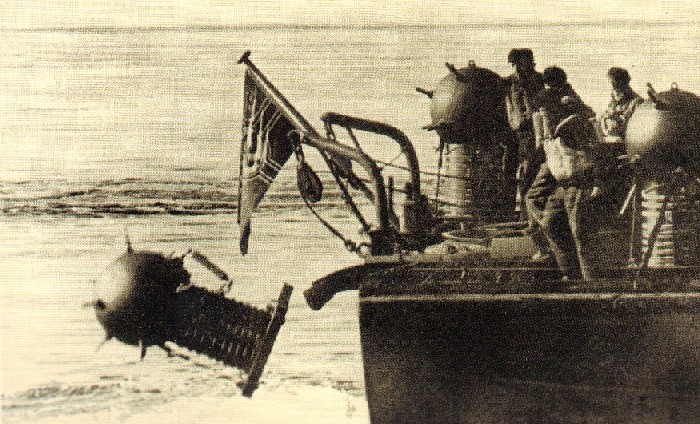
EMB Mine being laid from an S-Boote. (Photo from Suddentscher Verlag)

As the size of the swarm grows, so too does its combat power. Larger swarms mean more sensors in the network and more munitions to overwhelm targets. The Department of Defense (DoD) recently fielded a swarm of 103 aerial drones.8 China also reportedly fielded a swarm of 1,000 aerial drones.7 In theory, a sea mine swarm could consist of tens of thousands of interconnected mines, able to overwhelm any target. The primary limitation on swarm growth is the capacity to manage the rapidly increasing complexity of drone information exchange.

Strategically, swarming sea mines could play the same roles as traditional sea mines. Sea mines may be used to control critical chokepoints. During the Iran-Iraq war, Iran seeded the entrance to the Strait of Hormuz with Soviet contact mines.9 Alternatively, they could be used to inhibit amphibious forces attempting to come ashore. During the 1990-1991 Persian Gulf War, Iraq deployed sea mines to limit coalition forces’ ability to launch an amphibious assault.10 Similarly, during the Korean War, North Korean mining of Wonsan Harbor “prevented over 50,000 U.S. Marines from coming ashore and allowed the North Koreans to withdraw their forces.”11 However, swarming sea mines can play additional roles, such as protecting friendly vessels.

Advantages over Traditional Mines

Swarming sea mines have qualitatively better capabilities. Compared to traditional mines, swarming sea mines have drastically increased the threat through autonomous movement, broad area coverage, and information integration.

Autonomous Movement

Advances in robotics enable unmanned systems to maneuver and act without human decision-making.13 DoD’s Perdix drone swarm shares a “distributed brain” to make decisions and react to the environment.14 The swarm fully controls its own behavior without human direction, other than setting broad mission goals. Other autonomous systems such as the South Korean SGR-A1 gun turret can reportedly identify and engage targets.15 Although DoD policy does not allow autonomous weapons systems to select humans as targets, traditional sea mines already autonomously engage targets.16

Maneuverability enhances the psychological effects of minefields. Fear over encountering a minefield can affect behavior without inflicting damage. Once a vessel passes through a traditional minefield, it is often safe. However, a swarming minefield may move to a new area, adding new uncertainties.

Greater maneuverability enables drone-based naval mines to incorporate automated retreat rules. For example, after a specified time, drones may disarm and leave the area. Friendly vessels may then retrieve and redeploy them in another location. For traditional naval mines, retrieval is a highly fraught task because a retrieving vessel may inadvertently detonate the mine. Emplaced mines cannot be reused; swarming sea mines can.

Autonomous decision-making would enable swarming sea mines to identify and respond to changes in environmental conditions that could mitigate their effects. With traditional bottom mines on the seafloor, strong tides and currents can shift the mines.17 Swarming mines could recognize this shift and adjust.

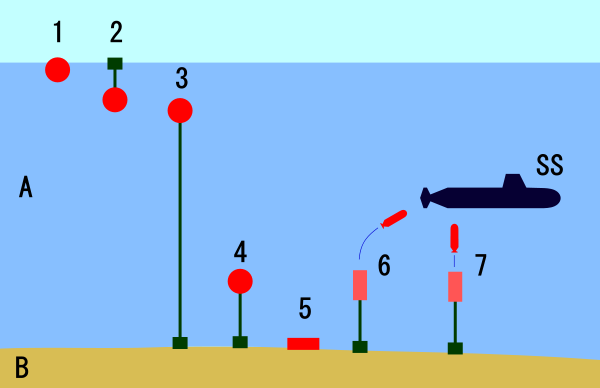
Types of Naval mine.A-underwater,B-bottom,SS-Submarine. 1-Drifting mine,2-Drifting mine,3-Moored Mine,4-Moored Mine(short wire),5-Bottom Mines,6-Torpedo mine/CAPTOR mine,7-Rising mine (Wikimedia Commons)

Autonomous movement is a significant departure from the capabilities of traditional naval mines. While some advanced mobile mines such as the MK 67 Submarine-Laid Mobile Mine can be placed from afar, the MK 67 remains in place.18 Other naval mines are able to move with the current. None of these mines can position themselves intelligently.

Information Integration

The inter-connectivity of a drone swarm enables naval mines to integrate information from many different sensors. Sensor drones could incorporate traditional influence sensors, including magnetic, acoustic, and seismic sensors.19 Data from multiple sensors may be shared to minimize false positives. Sensor drones may roam freely, studying an area for potential targets, creating greater situational awareness. Alternatively, buried sensor drones could enable live battle-damage assessment. If an adversary vessel survives an initial strike, additional attackers may be called to follow and engage.

Swarming naval mines may be connected into broader intelligence and surveillance networks. Information from these networks could enable the swarm minefield to reposition based on adversary behavior. For example, naval intelligence may identify an adversary vessel about to enter a given area and relay that information to the drone swarm to maneuver into the vessel’s path.

While traditional naval mines are already capable of incorporating multiple sensors to prevent false positives, they are unable to share information with one another.20

Broad Area Coverage

Maneuverability and information integration would enable swarming sea mines to greatly increase the threatened area. Sensor drones can disperse broadly to provide maximum situational awareness. Information may then be relayed to other drones to engage an incoming target.

Like attack drones, sensor drones may be free roaming or stationary, though there are trade-offs. Free-roaming sensor drones may actively search an area looking for targets. This enables much broader coverage; however, communication ranges may limit the distance they can travel. Stationary sensing drones may float near the surface or bury themselves in the seafloor. Sensor drones that bury themselves minimize the profile presented to adversaries, lowering detectability. However, stationary drones lose the benefits of mobility, providing less area coverage.

The increased area coverage is efficient because fewer munitions would be required to control a given area. Mines will take up less space on friendly vessels while having the same impact. This is especially important for submarine-launched mines, because submarines have very limited storage capacity. Currently, to equip submarines with mines requires removing torpedoes at the rate of one torpedo for every two mines.21

Challenges

Despite these significant advantages, however, operationalizing the concept entails some significant challenges. None of these challenges appears insurmountable, and work is already being done to address them, but they must be considered for concept viability and to realize the benefits of swarming.

Undersea Communication

The ability of the swarm to function as a unit depends on drone communication. Underwater, this is a major challenge. Traditional communication methods are often based on electromagnetic transmissions that are ineffective underwater.22 Underwater communications must rely on acoustic communication, which is slower, has small bandwidth, and has high error rates.23 The lack of electromagnetic communication also prevents drones from using GPS guidance for coordination and localization.

Initial research points to the inclusion of relays and surface-based control drones as a solution (see footnote 5 for a brief typology of drone archetypes). To address the lack of underwater GPS penetration, Jules Jaffe and his research team incorporated GPS-localized surface buoys that emit acoustic signals.24 Their underwater drones passively receive the buoy’s signals and, based on the known location of the surface floats, determine their own location.25 Similarly, Thomas Schmickl and his research team use a “surface base station” emitting an acoustic signal for localization and establishing boundaries to ensure no drone gets lost in the ocean’s expanse.26 The station also receives status updates from the swarm, such as task completion.

From a military perspective, a surface control drone may be undesirable because it could be identified and targeted, neutralizing the minefield. To prevent this, control drones could be underwater with a GPS periscope extending above the surface to receive and transmit signals. Alternatively, swarms could incorporate redundant control drones. If one is eliminated, the minefield stays live.

More broadly, the underwater environment creates difficulties in countering adversary attempts to disrupt communications. An adversary is likely to target inter-swarm communication because if communications are disrupted, so too is the swarm.27 Unfortunately, the properties of underwater communication mean terrestrial jamming detection technologies do not operate effectively.28

Tethering and Reseeding

Reseeding a minefield is often a significant challenge. If most mines have detonated, the minefield offers little utility. Adding mines in hostile terrain while incur risk such as on January 18, 1991 when Iraqi forces shot down a mine-dropping A-6 aircraft.29 The mobility of drone swarms diminishes some of this challenge because the drones may be deployed from afar to move into position.

Reseeded mines must also tether to the swarm’s network. An added attack drone needs to integrate with the other attackers and with the broader sensor network. Reseeded drones need to recognize that they are a part of the minefield’s network and vice versa. It also requires the distributed brain of the swarm to incorporate the new drones into task assignment and overall control.30

Coordinated re-positioning removes some difficulty. If few attack drones have been destroyed, the other drones can fill any gaps. However, as the losses grow larger, or if the swarm had few attackers to begin with, adding attackers becomes a greater challenge.

Power

The availability of power limits swarm operations. On-board power is required to maintain communications, use propulsion systems, and operate and interpret the results of sensing systems. These requirements limit the amount of time the swarm can pose a threat.

One possible solution is sea-based charging facilities. Support ships could be created whose primary role is to recharge undersea drones, including swarming sea mines. They could also be used for swarm maintenance, reseeding the swarm, or long-range transportation. Alternatively, the Navy’s work on unmanned undersea pods could allow for undersea recharging.31 This would likely be most useful for mining friendly territory because the pods would need to be pre-positioned and adversaries could target them. As swarm size increases, so too will this challenge. Large swarms may also encounter queuing problems if only a few drones can charge simultaneously. Regardless of the solution, time spent traveling to and from recharging facilities also limits time in a mission area.

Conclusion

A 2001 National Research Council study painted a bleak picture of U.S. naval mine warfare: “The current U.S. naval mining capability is in woefully bad shape with small inventories, old and discontinued mines, insufficient funding for maintenance of existing mines, few funded plans for future mine development (and none for acquisition), declining delivery assets, and a limited minefield planning capability in deployed battle groups.”32 This holds true today: the Navy’s FY17 to FY21 budget anticipates spending only $29.4 million on acquiring offensive mines.33 Similarly, the FY17 to FY21 budget for the Navy’s only research and development program for mine systems is $56.9 million.34 All new mine development is relegated to converting Submarine-Laid Mobile Mine warheads for underwater drone delivery.

If networked swarms of sea mines represent the Navy’s future capital ship, that picture must be repainted. Drastically.

Zachary Kallenborn is a Senior Associate Analyst at ANSER pursuing broad research into the military implications of drone swarms.

The author would also like to thank Jerry Driscoll, Steve Dunham, and Keith Sauls for providing useful comments and edits on a draft of the article. Needless to say, any issues or mistakes are the author’s own.

The views herein are presented in a personal capacity and do not necessarily reflect the institutional position of ANSER or its clients.

References


1. Robert C. Rubel, “The Future of Aircraft Carriers,” US Naval War College Review 64, Autumn 2011, https://www.usnwc.edu/getattachment/87bcd2ff-c7b6-4715-b2ed-05df6e416b3b/The-Future-of-Aircraft-Carriers.

2. Bill Glenney, “Institute for Future Warfare Studies Wants Your Writing on the Capital Ship of the Future,” Center for International Maritime Security (CIMSEC), https://cimsec.org/institute-for-future-warfare-studies-wants-your-writing-on-the-capital-ship-of-the-future/33307

3. John Fleming notes the importance of visibility in conventional deterrence in John Fleming, “Capital Ships: a Historical Perspective,” Naval War College, July 12, 1993, 17, http://www.dtic.mil/dtic/tr/fulltext/u2/a266915.pdf

4. John J. Rios, “Naval Mines in the 21st Century: Can NATO Navies Meet the Challenge?” thesis, Naval Postgraduate School, June 2005, 1, www.dtic.mil/dtic/tr/fulltext/u2/a435603.pdf; “Mine Warfare,” Department of the Navy, Office of the Chief of Naval Operations and Headquarters U.S. Marine Corps, NWP 3-15 and MCWP 3-3.1.2, https://archive.org/stream/milmanual-mcwp-3-3.1.2-mine-warfare/mcwp_3-3.1.2_mine_warfare_djvu.txt.

5. Scott C. Truver, “Taking Mines Seriously: Mine Warfare in China’s Near Seas,” Naval War College Review 65, Spring 2012, https://www.usnwc.edu/getattachment/19669a3b-6795-406c-8924-106d7a5adb93/Taking-Mines-Seriously–Mine-Warfare-in-China-s-Ne; Bradley Peniston, “The Day Frigate Samuel B. Roberts Was Mined,” USNI [U.S. Naval Institute] News, May 22, 2015, https://news.usni.org/2015/05/22/the-day-frigate-samuel-b-roberts-was-mined.

6. Scott C. Truver, 2012.

7. In general, there are four drone archetypes: Attacker, Sensor, Controller, and Decoy (the ASCDs). Attack drones carry munitions or are themselves munitions. Sensor drones provide information about the surrounding environment. Control drones manage the swarm’s behavior to ensure the swarm can operate together, providing direct leadership or ensuring the operation of communication channels. Decoy drones serve no role other than to increase the apparent size of the swarm, creating psychological effects, or drawing fire for functional drones. This framework is the author’s own; however, it is consistent with others such as Jeffrey Kline’s Shooter, Scout, and Commander. Jeffrey E. Kline, “Impacts of the Robotics Age on Naval Force Design, Effectiveness, and Acquisition,” Naval War College Review 70, Summer 2017, https://www.usnwc.edu/getattachment/db52797a-a972-44cd-951b-f2b847b193b3/Impacts-of-the-Robotics-Age-on-Naval-Force-Design,.aspx.

8. “Department of Defense Announces Successful Micro-Drone Demonstration,” DoD news release, January 9, 2017, https://www.defense.gov/News/News-Releases/News-Release-View/Article/1044811/department-of-defense-announces-successful-micro-drone-demonstration/.

9. Gary Mortimer, “Chinese One Thousand Drone Swarm Smashes Intel Record,” sUAS News: The Business of Drones, February 13, 2017, https://www.suasnews.com/2017/02/chinese-one-thousand-drone-swarm-smashes-intel-record/.

10. Captain Gregory J. Cornish, U.S. Navy, “U.S. Naval Mine Warfare Strategy: Analysis of the Way Ahead,” U.S. Army War College, April 2003.

11. Gregory J. Cornish, 2003.

12. John J. Rios, citing Gregory K. Hartmann and Scott C. Truver. Weapons That Wait: Mine Warfare in the U.S. Navy. Updated Edition. (Annapolis, MD: Naval Institute Press, 1991), 231.

13. Determining appropriate rules of engagement is also a critical, related challenge; however, that is not within the scope of this article.

14. “Perdix Fact Sheet,” DoD Strategic Capabilities Office, June 1, 2017, https://www.defense.gov/Portals/1/Documents/pubs/Perdix%20Fact%20Sheet.pdf.

15. Alexander Velez-Green, “The Foreign Policy Essay: The South Korean Sentry—A ‘Killer Robot’ to Prevent War,” Lawfare, March 1, 2015, https://www.lawfareblog.com/foreign-policy-essay-south-korean-sentry%E2%80%94-killer-robot-prevent-war.

16. DoD Directive 3000.09: “Autonomy in Weapon Systems,” November 21, 2012, https://cryptome.org/dodi/dodd-3000-09.pdf.

17. Scott C. Truver, 2012.

18. National Research Council, Committee for Mine Warfare Assessment, “Naval Mine Warfare: Operational and Technical Challenges for Naval Warfare,” Washington D.C.: National Academy Press, 2001, 58.

19. For additional details on mine actuation mechanisms, see “Mine Warfare,” section 2.2.3.2, “Influence Actuation Logic.”

20. “Mine Warfare.”

21. “Mine Warfare.”

22. John Heidemann, Milica Stojanovic, and Michele Zorzi, “Underwater Sensor Networks: Applications, Advances, and Challenges,” Philosophical Transactions of the Royal Society A: Mathematical, Physical and Engineering Sciences 370, January 2012, http://rsta.royalsocietypublishing.org/content/370/1958/158.

23. Luiz Filipe M. Vieira, “Underwater Sensor Networks,” in Jonathan Loo, Jaime Lloret Mauri, and Jesus Hamilton Ortiz, Eds., Mobile Ad Hoc Networks: Current Status and Future Trends (Boca Raton, FL: CRC Press, 2012).

24. Jules S. Jaffe, et al., “A Swarm of Autonomous Miniature Underwater Robot Drifters for Exploring Submesoscale Ocean Dynamics,” Nature Communications 8, 2017, https://www.nature.com/articles/ncomms14189; for a more accessible version of their research, see Jesse Emspak, “Scientists Used Underwater Drone Swarms to Solve the Mystery of Plankton Mating,” Quartz, January 24, 2017, https://qz.com/893590/scientists-used-underwater-drone-swarms-to-solve-the-mystery-of-plankton-mating/.

25. Jules Jaffe, et al., 2017.

26. Thomas Schmickl, et al., “CoCoRo—The Self-Aware Underwater Swarm,” 2011 Fifth IEEE [Institute of Electrical and Electronics Engineers] International Conference on Self-Adaptive and Self-Organizing Systems, 2011, http://zool33.uni-graz.at/artlife/sites/default/files/cocoro_SASO_paper_revision_as_finally_submitted.pdf.

27. Paul Scharre, “Counter-Swarm: A Guide to Defeating Robotic Swarms,” War on the Rocks, March 31, 2015, https://warontherocks.com/2015/03/counter-swarm-a-guide-to-defeating-robotic-swarms/.

28. S. Misra, et al, “Jamming in Underwater Sensor Networks: Detection and Mitigation,” IEE [Institution of Engineering and Technology] Communications 6, November 6, 2012, http://ieeexplore.ieee.org/document/6353315/.

29. National Research Council, Committee for Mine Warfare Assessment, 2001, 18.

30. Some initial work has been done on scalable drone swarm control algorithms. See Payam Zahadat and Thomas Schmickl, “Division of Labor in a Swarm of Autonomous Underwater Robots by Improved Partitioning Social Inhibition,” Adaptive Behavior 24, 2016, http://journals.sagepub.com/doi/full/10.1177/1059712316633028.

31. Michael Hoffman, “Undersea Pods to Hold US War Supplies,” Defense Tech, January 16, 2013, https://www.defensetech.org/2013/01/16/undersea-pods-to-hold-us-war-supplies/.

32. National Research Council, Committee for Mine Warfare Assessment, 2001, 57.

33. “Department of Defense Fiscal Year (FY) 2017 President’s Budget Submission: Navy, Justification Book Volume 1 of 1, Weapons Procurement, Navy,” Secretary of the Navy, February 2016, 307, http://www.secnav.navy.mil/fmc/fmb/Documents/17pres/WPN_Book.pdf

34. “Department of Defense Fiscal Year (FY) 2017 President’s Budget Submission: Navy, Justification Book Volume 3 of 5, Research, Development, Test, and Evaluation, Navy, Budget Activity 5,” Secretary of the Navy, February 2016, 947, http://www.secnav.navy.mil/fmc/fmb/Documents/17pres/RDTEN_BA5_Book.pdf.

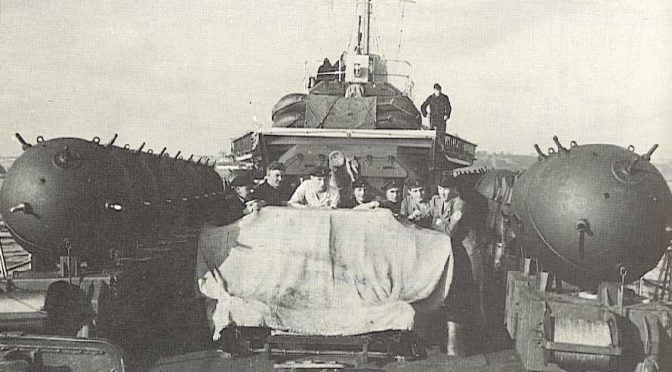
Featured Image: EMC Contact Mines aboard a Leberecht Maas class destroyer in Autumn 1940 (via Navweaps.com)

Why Are Our Ships Crashing? Competence, Overload, and Cyber Considerations

By Chris Demchak, Keith Patton, and Sam J. Tangredi

These are exclusively the personal views of the authors and do not necessarily reflect the views of the U.S. Naval War College or the Department of Defense.

Security researchers do not believe in coincidences. In the past few weeks, a very rare event – a U.S. Navy destroyer colliding fatally with a huge commercial vessel – happened twice in a short period of time. These incidents followed a collision involving a cruiser off Korea and the grounding of a minesweeper off the Philippines, and have now resulted in the relief of a senior Seventh Fleet admiral. Surface warfare officers (SWOs) look to weather, sensors, watchstanders, training requirements, leadership and regulations (COLREGS) as possible contributing factors to the collisions.  

Cyber security scholars, in contrast, first look to the underlying complex technologies trusted by the crew to determine the proper course of action. With the advancements in navigational technology, computer-aided decision making and digital connectivity, it is human nature that seafarers become more dependent on, as well as electronic aids for navigation and trusting the data the systems provide. While the U.S. Navy emphasizes verification of this data by visual and traditional navigation means, the reality is the social acceptance of the validity of electronic data is a feature of modern culture. The U.S. Navy, with an average age in the early 20s for sea-going sailors, is not immune from this effect. But what if the data is invalid or, as an extreme possibility, subject to outside manipulation?

In directing a pause for all warship crews (not currently conducting vital missions) during which to conduct assessments and additional training, the Chief of Naval Operations – Admiral John Richardson – was asked whether the Navy was considering cyber intrusion as a possible cause. The CNO responded that concerning cyberattack or intrusion, “the review will consider all possibilities.”

The truth could be that only mundane factors contributed to the accident, but as an intellectual thought experiment, what follows are explanations following the logic of open-source information. The first set of explanations will focus on the human in the loop to argue that the fundamental cause is likely human miscalculation rather than intentional distortion of data. The second explanation will focus on the criticality of accurate data provided to humans or their technologies. The pattern suggests a lack of ‘normalness’ as the ‘normal accidents’ of complex systems deeply integrated with cyber technologies – in frequency, locations, and effects. In the case of the destroyers, a credible case—based on analysis of land-based systems–could be made for a witting or unwitting insider introduction of malicious software into critical military navigation and steering systems. The conclusion will offer motivations for timing and targets, and some recommendations for the future.

Similarities in the Scenarios      

There are similarities in recent collisions. Both happened in darkness or semi-darkness. Both happened in shipping lanes in which literally hundreds of major ships pass per day, to say nothing of smaller ships and fishing vessels. Crew manning of both vessels approach 300 sailors, with approximately one-eighth of the crew on watch involved in controlling/steering, navigating, as lookouts, and operating propulsion machinery when the ship is at its lowest states of alertness, known as peacetime steaming. It is logical that both ships were at peacetime steaming at the time since they were not conducting military exercises. In contrast, when USS JOHN S. McCAIN conducted a freedom of navigation operation (FONOP) in the vicinity of the artificial islands China has created to buttress its territorial claims to the South China Sea on August 9, her crew was likely at high alert.

In looking for possible explanations, we have downloaded and examined readily available open-source data concerning the two recent collisions, including identified locations of the incidents, vessel characteristics, crew manning, weather, proximity to land, automatic identification system (AIS) ship tracks, and shipping density data. We have consulted with naval experts on ship handling and on the Sea of Japan and Strait of Malacca.

Collision avoidance on Navy vessels can be roughly cast into four elements, three technical and one human. On the bridge, the watchstanders have (1) the AIS system which relies on tracking ships that broadcast their identities, (2) the military radar systems linked into the ships combat systems, (3)the civilian radar and contact management systems, and (4) the eyes of sailors standing watch on lookout normally posted port, starboard, and aft on the vessel. All these systems are complementary and overlapping, but not exactly delivering the same information.  

The AIS system – in which merchant vessels transmit their identities and location data – is an open and voluntary system relying on GPS. In principle, keeping the AIS on is required for the 50 thousand plus commercial vessels over 500 GRT (gross registered tons). As of 2016, 87 percent of merchant shipping uses satellite navigation and 90 percent of the world’s trade is carried by sea. Nonetheless, ship captains can turn it off and travel without identifying themselves (at least until detected by other means). U.S. Navy vessels do not routinely transmit AIS but each bridge monitors the AIS of ships around them in addition to the military and civilian radar systems and the eyes of the sailors.

In quiet or tense times, the bridge watch and the Combat Information Center (CIC) teams of naval warships must synthesize this information and make sound decisions to avoid putting the ship into extremis. This is a continuous, round-the-clock requirement and a tough task for even the most skilled.

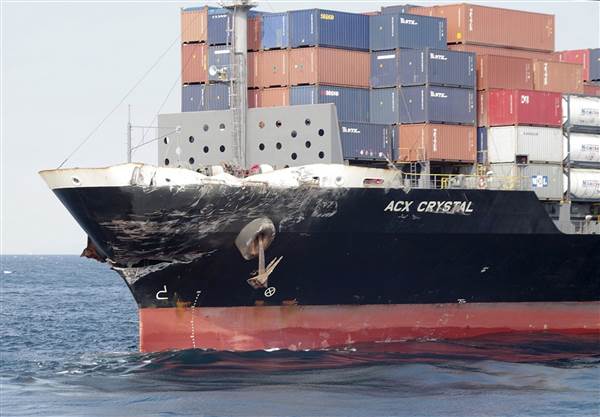
In this photo released by Japan’s 3rd Regional Coast Guard Headquarters, the damage of Philippine-registered container ship ACX Crystal is seen in the waters off Izu Peninsula, southwest of Tokyo, on June 17, 2017 after it had collided with the USS Fitzgerald. (Japan’s 3rd Regional Coast Guard Headquarters/AP)

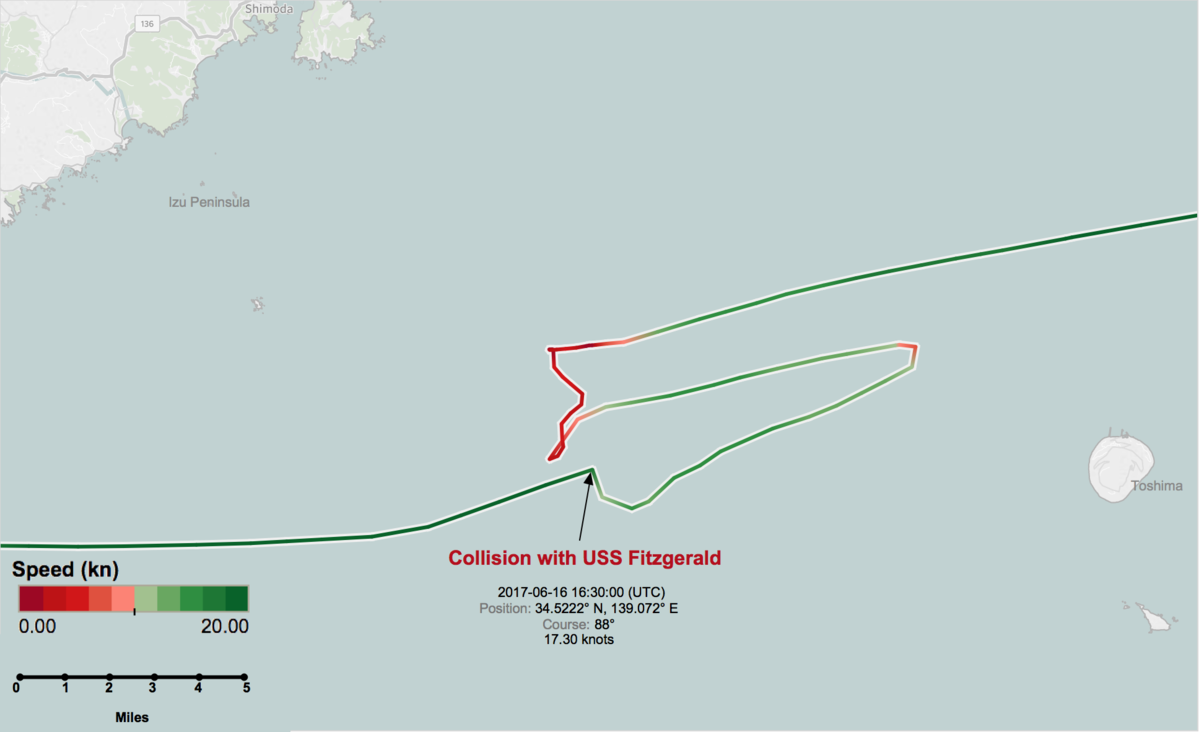
In contrast, merchant ships such as the Alnic MC, a chemical tanker (which hit JOHN S. McCAIN) have tiny crews with great reliance on autopilot. Depending on the circumstances, possibly only three people would be on the watch as the ship’s commercial navigation autonomously follows the route that the captain set initially. One of the indications that the ACX Crystal, the cargo vessel colliding with the USS FITZGERALD, was on autopilot was its behavior after the collision. Having been temporarily bumped off its course by the collision, it corrected and resumed steaming on the original course for about 15 minutes before stopping and turning to return to the collision location. While nothing is yet published about what was happening on either bridge in the June FITZGERALD collision, one can surmise that it took 15 minutes for the small crew to realize what had happened, to wrest control back of the behemoth, and turn it around.    

Possible “Normal” Explanations

Flawed human decision-making

U.S. Navy warships maintain teams of watchstanders in order to mitigate the effects of a flawed decision being made by any one individual. Ultimately, one individual makes the final decision on what actions to take in an emergency—the Officer of the Deck (OOD) if the Commanding Officer is not available—but recommendations from the others are assumed to help in identifying flaws in precipitous decisions before they are actually made.

In contrast, in merchant ships with only two or three deck watchstanders, there is less of a possibility that flawed decision-making is identified before incorrect actions are taken. These actions can also be influenced by unrelated disorienting activities. Alcohol is not permitted on U.S. warships, abuse of drugs at any time is not countenanced, and U.S. naval personnel are subjected to random urinalysis as a means of enforcement. On a merchant ship these policies vary from owner to owner, and inebriation or decision-making under-the-influence has contributed to many past collisions.   

Common tragedy from fatigue in an inherently dangerous environment

Collisions at sea happen. U.S. warships have collided with other warships, including aircraft carriers and with civilian vessels. USS FRANK EVANS was cut in half and sunk in 1969 when it turned the wrong way and crossed the bow of an Australian aircraft carrier. In 2012 the USS PORTER, a destroyer of the same class as the FITZGERALD and McCAIN, was transiting the Strait of Hormuz. The PORTER maneuvered to port (left) to attempt to get around contacts ahead of it, passing the bow of one freighter astern and then was hit by a supertanker it had not seen because it was screened behind the first freighter. Many of the previous collisions involved a loss of situational awareness by an at-least-partly fatigued crew. It is hard to avoid such conditions in an inherently dangerous, around-the-clock operating environment.

Mechanical Failure

There has been no report of a problem with the FITZGERALD prior to her collision. The Navy, however, has acknowledged the MCCAIN suffered a steering casualty prior to the collision. While backup steering exists in the form of manual controls in aft steering or using differential propulsion to twist the ship in the absence of rudder control, such control methods are not as efficient as the normal controls. Additionally, there would be a brief delay in switching control unexpectedly or transmitting orders to aft steering. In normal conditions, this would not be serious. In a busy shipping lane, with the least hesitation due to shock at the unexpected requirement, the brief delay could be catastrophic.

Quality of training for ship handling by young Surface Warfare Officers (SWOs)

One can look at the U.S. Navy Institute Proceedings (the premier independent naval journal) and other literature to see signs these incidents may be symptoms of a larger issue involving the training of watchstanders. In March 2017, LT Brendan Cordial had a Proceedings article entitled “Too Many SWOs per Ship” that questioned both the quality and quantity of the ship handling experience that surface warfare officers (SWOs) received during their first tours. Later in a SWO’s career track, the focus of new department heads (DH) is tactical and technical knowledge of the ship’s weapons systems and ship’s combat capabilities, not necessarily basic ship handling. Ship handling skill are assumed. But such skills can atrophy while these officers are deployed on land or elsewhere, and individual ships have unique handling characteristics that must be learned anew.

In January 2017, CAPT John Cordle (ret.) wrote an article for Proceedings titled “We Can Prevent Surface Mishaps” and called into question the modern SWO culture. Peacetime accident investigations rarely produce dramatic new lessons. They simply highlight past lessons. Errors in judgment, lapses in coordination, task saturation, fatigue, a small error cascading into a tragedy. Those who have stood the watch on the bridge or in the CIC read them, and frequently think, “There, but for the grace of God, go I.” However, unlike in the aviation community, near misses and accidents that almost happened were not publicly dissected and disseminated to other commands. Officers have always known how easy it is to be relieved for minor mishaps, but they do not have the community discussion of all those that nearly happened to learn vicariously from the experiences.

Pace of forward operations – especially for the MCCAIN after the FITZGERALD event

Both destroyers are homeported in Yokosuka, Japan, the headquarters of the U.S. Seventh Fleet. While only the line of duty investigation has been released for the FITZGERALD collision, one can assume that the officers and crew of the McCAIN would have heard some of the inside details from their squadron mate. Logically the CO of McCAIN would be doubly focused on the safe operation of his ship as he approached the highly congested traffic separation scheme (TSS) in the straits of Malacca and approach to Singapore harbor. But the loss of one of only seven similar and critical ships in a highly contested environment would almost certainly increased the tempo and demands on the MCCAIN as it attempted to move into the Singapore harbor just before sunrise.

In this case, tempo should have been accommodated adequately. While technology is a key component of U.S. warships, it is only one of many tools. Lookouts scan the horizon and report contacts to the bridge and CIC watch teams. The officer of the deck (OOD) uses their professional skills and seaman’s eye to judge the situation. If in doubt, they can, and should, call the Captain. Indeed, close contacts are required to be reported to the Captain. The bridge and CIC have redundant feeds to display contacts detected by radar, sonar, or AIS. The computer can perform target motion analysis, but crews are still trained to manually calculate closest points of approach and recommend courses to avoid contacts via maneuvering boards (MOBOARDs). This is done both on the bridge and in the CIC so even if one watch misses something critical, the other can catch it. When ships enter densely trafficked areas, additional specially qualified watchstanders are called up to augment the standard watch teams. Yet, it is possible that—under the theory of “normal” accidents—somewhere in this multiply redundant sensor system, misread or misheard information led to the human equivalent of the “telephone game” and the wrong choice was dictated to the helm.

But along with the “normal” explanations, the possibility of cyber or other intentional distortion of critical data does remain a possibility.

Cyber Misleads and Mis-function

If one argues that neither the Navy nor commercial crews were inebriated or otherwise neglectful, accepts that the weather and visibility were good for the time of day with crew in less stressful routine sailing postures, finds serendipitous mechanical failure of severe navigational significance on both ships difficult to accept as merely normal accidents, and questions if tempo distraction alone could explain both events, then – as Sherlock would say – the impossible could be possible. It is worth laying out using unclassified knowledge how cyber intrusions could have been used to cause warships to have collisions. This is not to say the collisions could not have multiple sources. But for the purposes of this thought experiment, however, this section will focus on cyber explanations.

Cyber affects outcomes because it is now a near universal substrate to all key societal and shipboard functions. Either cyber errors mislead humans, or its digitized operations malfunction in process, action, or effect, or both while buried inside the complex systems. To make this point, one of the two major classes of cyber assaults – the distributed denial of service (DDOS) – works by using what the computer wants to do anyway – answer queries – and simply massively overloads it into paralysis. It has been shown in a number of experiments that large mechanical systems integrated with electronics can be remotely made to overload, overheat, or vibrate erratically into breakdown by hackers or embedded malware. In several reports, the McCAIN may have suffered failures in both its main steering system (highly digitized) and its backup systems (more mechanical). Less information has been released on the earlier collision between the FITZGERALD and the ACX Crystal cargo ship so steering issues there cannot be known at this time.

However, that the two collisions involved large commercial ships with similar crews and technologies, and that two U.S. Navy vessels were sister ships close in age and technologies suggests commonalities that could be more easily exploited by adversaries using cyber means rather than humans. In particular, commonly shared logistics or non-weapon systems such as navigation are more likely to have vulnerabilities in their life cycles or embedded, routinized processes that are less sought by – or discernible to – the standard security reviews.

In a complex socio-technical-economic system like that involved in both circumstances, the one-off rogue event is likely the normal accident – i.e., the FITZGERALD incident. But too many common elements are present in the McCAIN event to suggest a second, simply rogue outcome. Hence, it is necessary to explore the three possible avenues by which the navigation could have been hacked without it being obvious to the U.S. Navy commander or crew in advance.

First, external signals (GPS, AIS) can be spoofed to feed both navigation systems with erroneous information for any number of reasons including adversary experimentation. Second, the civilian contact management systems on the civilian or military bridge (or both) could be hacked in ways either serendipitously or remotely engineered to feed erroneous data. Third, insider-enabled hacks of one or both of the destroyer’s combat systems could have occurred in the shared home port of Yokosuka to enable distortion of sensors or responses under a range of possible circumstances.

Spoofing GPS inputs to navigation

It does not take much technical expertise to spoof or distort GPS signals because the GPS system itself is sensitive to disruptions. The 2016 removal of one old satellite from service caused a 13.7 microsecond timing error that occurred across half of the 30-odd GPS satellites, causing failures and faults around the world in various industries. Anything that can be coded can be corrupted, even inadvertently. Anything so critical globally which does not have enforced, routine, and rigorous external validity tests, defenses, and corrective actions, however, is even more likely to attract the hacks from both state and nonstate actors.

Major national adversaries today have indicated interest in having the capability to arrange GPS distortions. With their already large domestic units of state-sponsored hackers, the Chinese, Russians, and North Koreans have already sought such capabilities as protections against the accuracy of largely U.S. missile guidance systems. Hacking GPS has been reported for some years, and while some efforts to harden the system have been pursued, spoofing mechanisms located on land in tight transit areas or even on other complicit or compromised vessels could mislead the autopilot. The website Maritime Executive reported mass GPS spoofing in June 2017 in the Black Sea, impacting a score of civilian vessels and putatively emanating from Russian sources most likely on land nearby.

However, it does not have to be a matter of state decision to go to war to have this kind of meddling with key navigation systems, especially if land or many other vessels are nearby. In a cybered conflict world, state-sponsored or freelance hackers would be interested in trying to see what happens just because they can. Not quite a perfect murder because of the external sources of data, however, the spoofed or spoiled data would provide misleading locations in real time to autopilot software. Vessels and their bridge would operate normally in their steering functions with bad data. They go aground or collide. So might airplanes. And the distorted signals could then stop, allowing normal GPS signals to resume and indicate that something went wrong in navigation choices but not in time to stop the collision or with the attribution trace necessary to know by whose hand.

In these two cases, the DDG FITZGERALD looks like it failed to give way to the ACX Crystal which appears by the tracking data to have been on autopilot. If the ACX Crystal’s navigation was operating on false data, and the equivalent civilian system on the U.S. ship was as well, then the watch team of the FITZGERALD would have had at least two other sources conflicting with the spoofed information – the military systems and the eyes of the sailors on watch. For the moment assume no deliberate hack of the military systems, its radars are correctly functioning, and the alert sailors have 20-20 vision, then the watch team of the FITZGERALD clearly miscalculated by believing the civilian system. Or, the overlap in relying on GPS is so profound that the military system was also fooled and the human eyes overruled. In that case, the FITZGERALD watch team trusted the civilian system over other inputs.

AIS data map of course of container ship MV ACX Crystal around the time of collision with USS Fitzgerald near Japan on June 16, 2017. (Wikimedia Commons/marinetraffic.com)

In the McCAIN case, if one assumes all the same conditions, the Navy ship had the right of way and the oil tanker plowed into it. Presumably the tanker autopilot – if it was on as one could reasonably assume – was coded to stop, divert, warn, and otherwise sound the alarm if it sees another ship in its path. Presumably, its code also embeds the right of way rules in the autopilot’s decision-making. A convincing GPS spoof could, of course, persuade the autopilot navigation that it is not where it was, thereby seeing more time and space between it and the Navy ship.  

Hacking civilian navigation radars shared by all vessels

According to experts, commercial navigation systems are remarkably easy to hack quite apart from GPS spoofing. The cybersecurity of these bridge systems against deliberate manipulation has long been neglected. In the same unenforced vein as the voluntary identification requirement of AIS, the global maritime shipping industry has relied on requirements by maritime insurance companies and specific port regulations to control individual shipping firms’ choices in vessels technologies (and level of compliance). Myriad reports in recent years discuss the increasing sophistication of sea pirates in hacking commercial shipping systems to locate ships, cherry pick what cargo to go acquire, show up, take it, and vanish before anything can be done. That is more efficient than the old brute force taking of random ships for ransom.

In addition, shipping systems tend to be older and receive less maintenance – including time-critical patches – more likely to be scheduled with infrequent overall ship maintenance in port. In the recent “Wannacry” ransom-ware global event, the major shipping company Maersk – profoundly and expensively hit – reported its key systems used WIN XP unpatched and unsupported by Microsoft. Hacking groups are also targeting ports and their systems as well.

If systems are compromised, hacks could have opened back doors to external controllers or at least inputs when the commercial ship crossed into locations close enough to land or adversary-compromised surface or submerged vessels. Then the misleading inputs could be more closely controlled to be present when U.S. vessels have been observed to be traveling nearby or are in a particular position. Navy vessels may not transmit AIS, but they are detectable on radar as ships. A radar contact without an AIS identity could be a trigger for the malware to at least become interested in the unidentified vessel, perhaps sending pre-arranged signals to remote controllers to track and then wait for instructions or updates. The autopilot would then act on the inputs unaware of the distortion.

An interesting aspect of corrupting code is that exchanging data across commercial systems alone can provide a path for corrupted code to attempt to install itself on both ends of the data exchange. Stuxnet traveled through printer connections to systems otherwise not on any internet-enabled networks. If the civilian navigation systems are proprietary – and that is likely the case on commercial ships – then it is likely that the U.S. vessels’ bridges also have ‘hardened’ COTS civilian systems whose internal software and hardware are proprietary. That means a hack successful on the commercial side could open an opportunity to hack a similar or targeted civilian system that happens to be found on a U.S. Navy vessel. Furthermore, it is possible the two systems share vulnerabilities and/or have exchanges that are not visible to external observers.

Navy IT security on vessels might also regard the civilian proprietary systems as less a threat because they are not connected to internal military systems. They presumably are standalone and considered merely an additional navigation input along more trusted and hardened military systems. The commercial systems are (ironically) also less likely to be closely scrutinized internally, because that would mean the U.S. Navy is violating contractual rules regarding proprietary commercial equipment. Outside of war – in which such holds are likely to be ignored in crises – there is little incentive to violate those proprietary rules.

One can conceive of a Navy bridge hosting a commercial navigation system that at some point along its journey is compromised with nothing to indicate that compromise or the triggering of the software now interwoven with the legitimate firmware inside the equipment. By happenstance, the Navy vessel comes in to the vicinity of an appropriately compromised large commercial vessel. At that point, the adversary hackers might receive a message from the commercial vessel to indicate the contact and have the option to distort the navigation inputs to help the commercial vessel’s autopilot plow into the warship.

Of course the adversary is helped if the Navy equipment is also hacked and, perhaps, the vessel loses its digitized steering right before the impact.

Hacking U.S. Navy military navigation systems

Remotely accessing and then changing the triggers and sensors of military systems – if possible – would be very hard given the Navy’s efforts in recent years. That possibility is tough to evaluate because the open source knowledge regarding such systems is likely to be third party information on proprietary subordinate systems at least five or six years old – or much more. Both major U.S. adversaries in Asia – North Korea and China – already show propensities for long-term cyber campaigns to remotely gain access and infiltrate or exfiltrate data over time from all military systems, including shipborne navigation. We deem this less likely simply because this is where the cybersecurity focus of the Navy and DOD already is.

However, the history of poorly-coded embedded systems, lightweight or incompetent maintenance, and deep cyber security insensitivity of third party IT capital goods corporations is appalling across a myriad of industry supply chains, even without the national security implications well-known today. While commercial vessels could be hacked remotely, a more likely avenue for entry in Navy systems would be through these corrupted supply chains of third parties, shoddily constructed software, or compromised contractors creating or maintaining the ship’s navigation and related systems. Using insiders would be especially easier than remotely hacking inside when the vessels were in a trusted harbor nestled inside a long-term ally such as Japan. Using insiders to access the systems during routine activities would be less likely to be detected quickly, especially if the effects would not be triggered or felt until particular circumstances far from port and underway.

An especially oblivious contractor engaged in using specialized and proprietary software to patch, check, or upgrade equipment could inadvertently use compromised testing or patching tools to compromise the vessel’s equipment. For example, a Russian engineer carrying in a compromised USB stick was reportedly the originating source of the Stuxnet malware in Iran – whether he was witting or unwitting is unknown. The actions would have been the same. Furthermore, Navy systems are built by contractors with clearances of course, but the systems would have deeply buried and often proprietary inner operating code. Corrupted lines of code could rest inactive for some time, or be installed in the last minute, to lie dormant during most of the deployment until triggered. None would visibly display any corruption until the programmed conditions or triggers are present.

In hacked systems, triggers are really hard to discern in advance. In part, the skill of the adversary deftly obscures them, but also the objectives of adversaries can vary from the classic “act on command of national superiors,” to “see how far we can get and how,” to pure whimsy. With no real personal costs likely for any of these motives, the game is defined by the skill, patience, and will of the adversary, especially when proprietary commercial code is involved. While it is safer in terms of attribution for hackers to have more automatic triggers such as those used in the Stuxnet software, the action triggers do not have to be automatic. In navigation systems, data is exchanged constantly. Conceivably there can be a call out and return buried in massive flows of data.

Without extensive AI and rather advanced systems management, how massive data flows are monitored can vary widely. While it is more and more common to secure a system’s outgoing as well as incoming communication, a multitude of systems that are not particularly dated have been shown to allow rather subtle communications to go on for some time without any event or external revelation. One can imagine code calling home or acting autonomously when triggered by something as mundane as a sensor noting the presence of a large commercial cargo ship within X nautical miles, moving in Y direction, and responding to encrypted queries from its own navigation system. Highly skilled botnet masters are able to detect anomalies across thousands of infected computers and, in a pinch, de-install huge botnets in minutes. It is not difficult to imagine something buried in these otherwise secured systems, especially if the adversary is willing to wait and see when it would be useful. For North Korea, the latest ratcheting of tensions between the Hermit dictatorship and the U.S. could easily provide a reason.

Hacking seems more of a possibility when considering how both destroyers failed to navigate under circumstances that were, to most accounts, not that challenging. It is possible that the first such event – the FITZGERALD collision – was a rogue event, the kind of complex system surprise that routinely but rarely emerges. What is less likely is that a similar ship in broadly similar circumstances shortly thereafter proceeds to have a similar event. Exquisitely suspicious are the reports of the failure of the steering system and possibly its backups on McCAIN, though not on the FITZGERALD. That effect is not spoofed GPS or hacked civilian systems, and it would take much more reach of the malware to achieve. In keeping with the presumption here that a successful insider hack occurred on both ships and the malware was waiting for a trigger, the lack of steering failure (at least no reports of it) on the FITZGERALD could also mean the malware or external controller was smart enough to know collision did not need additional failures to ensure damage. The ship was already in the wrong place having failed to cede right of way. Holding fire like that would be desired and expresses sophistication. Typical technique in cybered conflict is deception in tools; adversaries do not burn their embedded hacks unless necessary. Once shown, the cyber mis-function becomes unusable again against an alert and skilled opponent such as the U.S. Navy.

Furthermore, the Aegis destroyers – of which both Navy vessels are – suffer from a rather massive knowledge asymmetry with a major adversary. At some point in the early to mid 2000s, the Chinese stole the entire design of the AEGIS systems on which the Navy spent billions across contractors and subcontractors. While built to roughly the same specifications as a class of ships, each vessel reflects the upgrades and systemic changes of its particular era, with the older 1990s ships like the FITZGERALD and McCAIN having more patches and bolt-ons than the newer versions of the ship. Fundamental ship elements are hardwired into the vessel and hard to upgrade, while more modular and likely proprietary modern systems are plugged in and pulled out as time goes on. The adversary who stole those comprehensive plans would know more about the older AEGIS ships than they would about the ships completed after the plans were stolen and newer systems used in the installs. Anyone who has ever faced the daunting prospect of rewiring a large house knows by ugly personal experience that the new wiring is forced to work around the existing layout and limitations. Ships are even more rigid and, quite often, the more critical the system, the less flexibly it can be changed.

Thus, vulnerabilities built into the highly complex earlier AEGIS systems would be both known to the thieves after some years of study and perhaps covert testing on other nations’ AEGIS systems, and be very hard to definitively fix by the Navy itself, especially if the service is not looking for the vulnerabilities. Unnerving, but not inconceivable, is the failure of the digitized steering system on the McCAIN – if it happened. Exceptionally telling, however, is the presumably near-simultaneously loss of backup systems. If the steering and contact management systems were compromised, steering could be made to fail at just the right time to force a collision. A good insider would be needed to ensure both, but only an adversary with considerable engineering design knowledge could reliably hazard a successful guess about how to disable the more likely mechanical backup systems. The adversary to whom the original AEGIS theft is attributed – China – is known to be very patient before using the material it has acquired.

Both Civilian and Military Systems

Why not put hacks on both systems? Commercial vessels are easier and could be left in place for some time pending being used and, in the meantime, slowly embedding Trojans via maintenance in port or third party access to remove and replace proprietary boxes or upgrades in software. Preparation of the cyber battlefield occurs – as does the ‘battle’ – in peacetime well before anything or anyone is blown up. China and North Korea have thousands of personnel on the offensive and value extraction cyber payroll. Careers could easily be made by such coups of installing such software as potential tools and have them still in place ready to be used months or years later.

Furthermore, Westerners are routinely afflicted with the rationality disease of believing that all actions – especially if adversaries are suspected – must be intentionally strategic and logically justifiable. Otherwise, why would the adversary bother? There is also a tendency to underestimate the comprehensive approach of most adversaries working against the U.S. Silence does not mean compliance or concession on the part of adversaries, especially not China or North Korea. Installing access points or triggers on all possible systems within one’s grasp is a basic long-term campaign strategy. Even now, when a major hack of a large corporation or agency is found, it has often been in place for years.

Motives for the Collisions

Timing may be serendipitous, but at least one adversary – North Korea – has already sunk a naval vessel of a U.S. ally, South Korea, with no public punishment. Certainly, North Korea has been loudly threatening the U.S. in the region and has cyber assets capable of what has been described above. However, one difficulty in determining culpability is that, while China is an ally of North Korea, neither will readily share information so valuable as the AEGIS design plans or even what each other may have hacked. One can readily ascribe eagerness to hurt the U.S. physically to North Korea, but attributing the same motivation to China at this point is problematic.  

There are other possibilities, however. Both nations – like most nations – are led by individuals with little technical comprehension. In particular and most unfortunately, in a world of ubiquitous cybered conflict where ‘just because one can’ or ‘just to see what could happen’ operates equally well as a motivation, adversary states with a large army of hackers and technically ignorant superiors could easily have their own cyber wizards working in ways their superiors can neither discern nor realistically curtail. In this vein the McCAIN case (and possible FITZGERALD), these over eager technically skilled subordinates could have gotten quite lucky.

Why a DDG that happens to be sailing around Japan? Why one near Singapore? Why now? Well, “why not” is as good a reason, especially if the U.S. Navy publicly fires the ships’ leadership and declares the incidents over. In that case there are no consequences for adversaries. Perhaps the FITZGERALD was the rogue event, but—following that—the N.K. leaders then asked their wizards to take out another as signaling or retribution for recent U.S. “insults.” That motivation has some persuasive aspects: no publically apparent risks; a nifty experiment to see what can be done if needed in larger scale; and the public turmoil alone puts North Korea with a smug secret while the U.S. twists trying to figure it out. Cyber offensive capabilities in the hands of technically incompetent leaders have serious implications for misuse and, critically, inadvertent outcomes that are strategically more comprehensive and potentially destabilizing than ever intended.

Implications for the Navy

If it is leadership that failed in both cases, the Navy has a long history of responding and clearing out the incompetence. If it is cyber that undercut that leadership and killed sailors, the Navy has an uphill battle to definitively establish all the avenues by which it could have and did occur, including fully recognizing the multiple sources of such deliberately induced failure. The literature on complex large-scale system surprise and resilience offers means of preventing multisource failures in socio-technical systems. However, these means may not be compatible with current Naval thought and organization. The literature recommends parsing larger systems into self-sufficient and varying wholes that are embedded with redundancy in knowledge (not replication or standardization), slack in time (ability to buffer from inputs routinely), and constant trial and error learning. Trial and error learning is particularly hard because it routinely involves violations of current practices.

The current organization of the U.S. military seems incompatible with the concept of easily decomposable units engaging and disengaging as needed in collective sense-making. Neither can it accept constant systems adjustments, pre-coordinated but dynamically flexed rapid mitigation and innovation, and whole systems discovery trial and error learning. The truth is that in the cybered world, nothing can be trusted if it is not reliably verified by multiple, independent, and alternative sources of expertise. USS FITZGERALD did not discern its error and correct fast enough to avoid being in the wrong place at the wrong time. The McCAIN may have trusted its right of way entitlement too long, or made a traffic avoidance maneuver and suffered a steering casualty at the worst possible moment. Or perhaps both ships encountered something unexpected: a commercial ship operating on corrupted code. In the future, we should expect that any merchant ship controlled by digital information technology can be hacked.

This is a new idea for the Navy, that merchant shipping can be used as proxies for adversary intentions. With over 50,000 of such large vessels sailing around and next to U.S. ships all over the world, the adversary’s tools of coercion would be both effective and effectively obscured to visual or other indicators of malice. The world of cybered conflict is deeply riven with deception in tools and opaqueness in origins, and now it is clearly on the seas as well. Even if the Navy rules that both incidents were simply bad shiphandling, adversaries have already seen the great impact that can be had by making relatively fewer Navy ships collide with big, dumb, large commercial vessels. Even if cyber did not play the deciding role in these events, there is every reason to assume it will in the future. Just because they can try, they will.

Dr. Chris C. Demchak is the Rear Admiral Grace Murray Hopper Professor of Cybersecurity and Director of the Center for Cyber Conflict Studies, Strategic and Operational Research Department, Center for Naval Warfare Studies, U.S. Naval War College.

Commander Keith “Powder” Patton, USN, is a naval aviator and the former Deputy Director of the Strategic and Operational Research Department, Center for Naval Warfare Studies, U.S. Naval War College.

Dr. Sam J. Tangredi is professor of national, naval and maritime strategy and director of the Institute for Future Warfare Studies, Strategic and Operational Research Department, Center for Naval Warfare Studies, U.S. Naval War College.

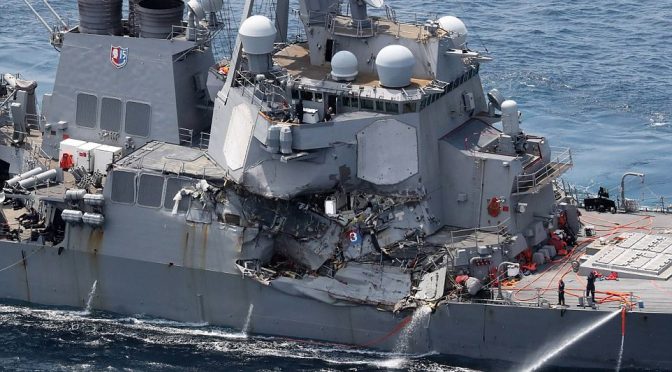
Featured Image: Damage is seen on the guided missile destroyer USS Fitzgerald off Japan’s coast, after it collided with a Philippine-flagged container ship, on June 17, 2017 (AFP)

Black Swan: An Option for the Navy’s Future Surface Combatant

Future Surface Combatant Topic Week

By B. A. Friedman

As the Navy examines its options for the Future Surface Combatant (FSC) family of ships, the large surface combatant will most likely get the most attention and effort. However, the center of gravity will more than likely be the small surface combatant. The smaller craft will be of more importance because the Navy has let its small surface combatant fleet dwindle in recent decades, and the craft chosen will be the ship to restore the fleet’s balance. Despite a rich history with small combatants, the Navy will have to dredge up a lot of moldy institutional knowledge and begin applying it to the future operating environment.

There are a number of assessments of the future operating environment, including Joint Operating Environment 2035, A Cooperative Strategy for 21st Century Seapower, and the recent Marine Corps Operating Concept. All of these documents correctly identify an operating environment characterized by pervasive surveillance and threat detection in the visual and electromagnetic spectrums, leading to a trend of small, dispersed, distributed combat units that depend on speed and stealth to survive and operate on the battlefield. The trends identified in these documents apply at sea as well as on land.

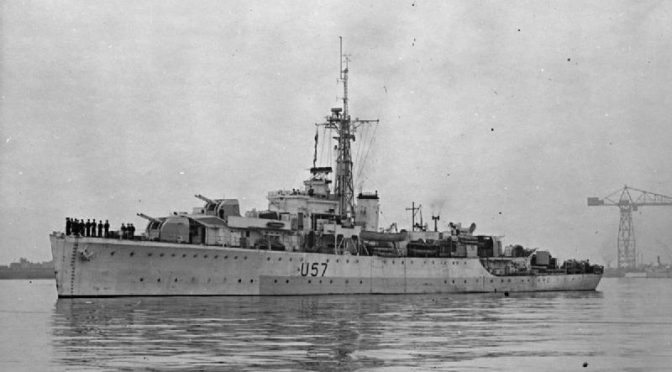
Fortunately, our allies have already been examining the use of small combatants in current and future fights. The most compelling concept is the Black Swan Concept, proposed by the United Kingdom Ministry of Defense in 2012. It’s a modernized idea that traces its roots back to the Royal Navy and Royal Indian Navy Black Swan ships that served as convoy escorts in World War II. It’s built around a hypothetical Black Swan-class sloop of war ship, displacing 3,150 tons (larger than an Independence-class LCS, but smaller than a Freedom-class LCS).

The main difference between the Black Swan and the LCS, however, is its berthing spaces and its stern ramp. This would allow the Black Swan to embark a squad-to-platoon size unit of Royal Marines while still boasting a flight deck, a directed energy weapon system, a 30mm cannon, a side access port for boats, and storage space. The Black Swan was planned to be crewed by eight sailors, leaving room for 32-60 embarked personnel depending on configuration. Individually, each Black Swan ship would be extremely flexible and useful but, importantly, flotillas of multiple Black Swan vessels could be scaled to mission, with each individual ship configured for its specific purpose whether it acted as an unmanned system “mothership,” weapon system platform, or expeditionary platform. While budget restraints prevented the UK from investing in the program, the idea itself remains sound. Now that the U.S. Navy is looking at small combatant craft, what would an American version of Black Swan look like?

A Multi-Role Small Surface Combatant

The center of gravity of the Black Swan concept is the inherent flexibility of the platforms themselves. By marrying a ramp, flight deck, weapon platform, and embarked Marines in one vessel, the small combatant craft can accomplish a dizzying array of mission sets. Moreover, small combatant craft are more difficult to detect (both through visual and electromagnetic methods) and can be purchased in greater numbers, inherently complicating adversary targeting systems and processes.

Firstly, an American Black Swan would greatly contribute to increasing the Navy’s offensive capability through distributed lethality. Whether the weapon system married to the ship is a directed energy weapon like the Laser Weapon System (LaWS), a Vertical Launch System (VLS), the Phalanx Close-In Weapon System (CIWS), or an anti-aircraft system, these ships would provide fleet commanders with more options for offense and defense against a wide range of threats.

An American Black Swan would also enhance and expand options for amphibious operations. Future amphibious assaults will in no way resemble those of previous generations; small combatant craft will be useful for disembarking Marine squads and platoons at dispersed points, depending on speed and stealth to avoid detection and land where the enemy has no presence. Commanders tasked with one of the other four types of amphibious operation – raids, demonstrations, withdrawals, and amphibious support to other operations – will also find such a vessel useful. The ship could meet up with amphibious warships at sea, allowing the larger amphibious ships to stay out of the range of shore-based missiles until Marine raids – launched via the small combatant craft – are able to address the threat. In essence, an American Black Swan would allow the Marine Corps to match the Navy’s distributed lethality with distributed maneuver at sea. Perhaps most importantly, by putting more Marines at sea, a small combatant craft like the Black Swan will allow Navy commanders to better leverage Marine Corps capabilities to gain, assert, and assure sea control.

Additionally, there is no question that unmanned systems – air, land, sea, and undersea – are becoming more important. For now, only the Navy’s biggest ships boast significant unmanned capabilities. Increasingly, the Navy will need smaller platforms able to launch a wide range of unmanned systems, from counter-mine systems to hydrographic survey drones, to the already ubiquitous intelligence, surveillance, and reconnaissance unmanned aerial systems. An American Black Swan would provide far more bang for the buck, able to deploy a wide variety of unmanned systems in situations where employing a large surface combatant or capital ship would be too risky or overly expensive.  

The benefits to the Navy and the Marine Corps are one thing, but the Special Operations Community also has an interest in an American Black Swan capability. The ships would especially shine during support to special operations missions ashore, providing a secure platform, fire support, staged Quick Reaction Forces (QRF), insertion/ extraction, or logistics depending on mission requirements.

Lastly, small combatant craft designed to put the Marine Corps’ small units and their enablers at sea will bring junior Marine Corps officers and the Navy officers assigned as crew into more contact at early points in their careers, enhancing the integration of both services. The ship would also increase the opportunities for junior officers to get important and independent commands earlier in their careers, leading eventually to senior officers with more experience.

Conclusion

The small combatant is just one aspect of the Future Surface Combatant effort but, given that the Navy is already well-equipped with large combatants, it may be the most important. Warfare trends at sea, just like those on land, point towards greater dispersion of small-units that concentrate when necessary. Modern concept documents reflect this. Even so, the Black Swan concept does not clash with older concepts; it would increase Navy/Marine Corps capabilities for Operational Maneuver From the Sea and Ship-to-Objective Maneuver. The small combatant craft component should be focused on acquiring a vessel that is flexible, self-deployed, tailorable to the mission, and able to be combined into a task-organized flotilla for any situation. The UK’s Black Swan concept is exactly that. The Navy- and the Marine Corps- should take a cue from our friends across the pond to acquire a vessel able to execute it.

Brett A. Friedman is an officer in the United States Marine Corps Reserve. He’s the editor of 21st Century Ellis: Operational Art and Strategic Prophecy and On Tactics: A Theory of Victory in Battle (forthcoming May 2017) from the Naval Institute Press. Brett holds a B.A. in History from The Ohio State University and an M.A. in National Security and Strategic Studies from the U.S. Naval War College. He is a Founding Member of the Military Writers Guild. Follow Brett on Twitter @BA_Friedman.

Featured Image: HMS Black Swan (Royal Navy official photographer – photograph FL 2274 from the collections of the Imperial War Museums, collection no. 8308-29)

Beijing’s Views on Norms in Cyberspace and Cyber Warfare Strategy Pt. 2

By LCDR Jake Bebber USN

The following is a two-part series looking at PRC use of cyberspace operations in pursuit of its national strategies and the establishment of the Strategic Support Force. Part 1 considered the centrality of information operations and information war to the PRC’s approach toward its current struggle against the U.S. Part 2 looks at the PRC’s use of international norms and institutions in cyberspace, and possible U.S. responses.

Cyber-Enabled Public Opinion and Political Warfare

Many American planners are carefully considering scenarios such as China making a play to force the integration of Taiwan, seize the Senkaku Islands from Japan, or seize and project power from any and all claimed reefs and islands in the South China Sea. Under these scenarios we can expect preemptive strikes in the space and network domains in an attempt to “blind” or confuse American and allied understanding and establish a fait accompli. This will, in Chinese thinking, force the National Command Authority to consider a long and difficult campaign in order to eject Chinese forces, and the CCP is placing a bet that American decision makers will choose to reach a political accommodation that recognizes the new “facts on the ground” rather than risk a wider military and economic confrontation.

The role of public opinion warfare may be an integral component of future crisis and conflict in Asia. Well in advance of any potential confrontation, Chinese writing emphasizes the role of “political warfare” and “public opinion warfare” as an offensive deterrence strategy. China will seek to actively shape American, allied, and world opinion to legitimize any military action the CCP deems necessary. We might see cyber-enabled means to “incessantly disseminate false and confused information to the enemy side … through elaborate planning [in peacetime], and [thereby] interfere with and disrupt the enemy side’s perception, thinking, willpower and judgment, so that it will generate erroneous determination and measures.”1 China may try to leverage large populations of Chinese nationals and those of Chinese heritage living outside China as a way to influence other countries and generate new narratives that promote the PRC’s position. Consider, for example, how Chinese social media campaigns led to the boycotts of bananas from the Philippines when it seized Scarborough Reef, or similar campaigns against Japanese-made cars during its ongoing territorial dispute over the Senkaku Islands. Most recently, Lotte Duty Free, a South Korean company, suffered distributed denial-of-service attacks from Chinese IP servers – almost certainly a response to South Korea’s recent decision to host the THAAD missile defense system.

It is also critical to recognize China’s understanding and leverage of the American political, information, and economic system. Over decades, China has intertwined its interests and money with American universities, research institutes, corporate institutions, media and entertainment, political lobbying, and special interest organizations. This has had the effect of co-opting a number of institutions and elite opinion makers who view any competition or conflict with China as, at best, detrimental to American interests, and at worst, as a hopeless cause, some going so far as to suggest that it is better for the U.S. to recognize Chinese primacy and hegemony, at least in Asia, if not worldwide. Either way, China will maximize attempts to use cyber-enabled means to shape American and world understanding so as to paint China as the “victim” in any scenario, being “forced” into action by American or Western “interference” or “provocation.”

What can the U.S. do to Enhance Network Resilience?

One of the most important ways that network resiliency can be addressed is by fundamentally changing the intellectual and conceptual approach to critical networks. Richard Harknett, the former scholar-in-residence at U.S. Cyber Command, has suggested a better approach. In a recent issue of the Journal of Information Warfare, he points out that cyberspace is not a deterrence space, but an offense-persistent environment. By that he means that it is an inherently active, iterative, and adaptive domain. Norms are not established by seeking to impose an understood order (such as at Bretton Woods) or through a “doctrine of restraint,” but rather through the regular and constant interactions between states and other actors.  Defense and resiliency are possible in this space, but attrition is not. Conflict here cannot be contained to “areas of hostility” or “military exclusion zones.” No steady state can exist here—every defense is a new opportunity for offense, and every offense generates a new defense.2

Second, the policy and legal approach to network resiliency must shift from a law enforcement paradigm to a national security paradigm. This paradigm is important because it affects the framework under which operations are conducted. The emphasis becomes one of active defense, adaptation, identification of vulnerabilities and systemic redundancy and resilience. A national security approach would also be better suited for mobilizing a whole-of-nation response in which the government, industry, and the population are engaged as active participants in network defense and resiliency. Important to this is the development of partnership mechanisms and professional networking that permit rapid sharing of information at the lowest level possible. Major telecommunications firms, which provide the infrastructure backbone of critical networks, require timely, actionable information in order to respond to malicious threats. Engagement with the private sector must be conducted in the same way they engage with each other – by developing personal trust and providing actionable information.

Network hardening must be coupled with the capabilities needed to rapidly reconstitute critical networks and the resiliency to fight through network attack. This includes the development of alternative command, control, and communication capabilities. In this regard, the military and government can look to industries such as online retail, online streaming, and online financial networks (among others) that operate under constant attack on an hourly basis while proving capable of providing on-demand service to customers without interruption. Some lessons might be learned here.    

Third, new operational concepts must emphasize persistent engagement over static defense. The United States must have the capacity to contest and counter the cyber capabilities of its adversaries and the intelligence capacity to anticipate vulnerabilities so we move away from a reactive approach to cyber incidents and instead position ourselves to find security through retaining the initiative across the spectrum of resiliency and active defensive and offensive cyber operations.

Congressional Action and Implementing a Whole-of-Government Approach

There are five “big hammers” that Congress and the federal government have at their disposal to effect large changes – these are known as the “Rishikof of Big 5” after Harvey Rishikof, Chairman of the Standing Committee on Law and National Security for the American Bar Association. These “hammers” include the tax code and budget, the regulatory code, insurance premiums, litigation, and international treaties. A comprehensive, whole-of-nation response to the challenge China represents to the American-led international system will require a mixture of these “big hammers.” No one change or alteration in Department of Defense policy toward cyberspace operations will have nearly the impact as these “hammers.”3

The tax code and budget, coupled with regulation, can be structured to incentivize network resiliency and security by default (cyber security built into software and hardware as a priority standard), not only among key critical infrastructure industries, but among the population as a whole to include the telecommunication Internet border gateways, small-to-medium sized Internet service providers, and information technology suppliers. Since the federal government, Defense Department, and Homeland Security rely largely on private industry and third-party suppliers for communications and information technology, this would have the attendant effect of improving the systems used by those supporting national security and homeland defense. The key question then is: how can Congress incentivize network resiliency and security standards, to include protecting the supply chain, most especially for those in industry who provide goods and services to the government?

If the tax code, budget, and regulation might provide some incentive (“carrots”), so too can they provide “sticks.” Litigation and insurance premiums can also provide similar effects, both to incentivize standards and practices and discourage poor cyber hygiene and lax network security practices. Again, Congress must balance the “carrots” and “sticks” within a national security framework.

Congress might also address law and policy which permits adversary states to leverage the American system to our detriment. Today, American universities and research institutions are training China’s future leaders in information technology, artificial intelligence, autonomous systems, computer science, cryptology, directed energy and quantum mechanics. Most of these students will likely return to China to put their services to work for the Chinese government and military, designing systems to defeat us. American companies hire and train Chinese technology engineers, and have established research institutes in China.4 The American taxpayer is helping fund the growth and development of China’s military and strategic cyber forces as well as growth in China’s information technology industry.

Related specifically to the Department of Defense, Congress should work with the Department to identify ways in which the services man, train, and equip cyber mission forces. It will have to provide new tools that the services can leverage to identify and recruit talented men and women, and ensure that the nation can benefit long-term by setting up appropriate incentives to retain and promote the best and brightest. It will have to address an acquisition system structured around platforms and long-term programs of record. The current military is one where highly advanced systems have to be made to work with legacy systems and cobbled together with commercial, off-the-shelf technology. This is less than optimal and creates hidden vulnerabilities in these systems, risking cascading mission failure and putting lives in jeopardy.

Finally, Congress, the Department of Defense, and the broader intelligence and homeland security communities can work together to establish a center of excellence for the information and cyber domain that can provide the detailed system-of-systems analysis, analytic tools, and capability development necessary to operate and defend in this space. Such centers have been established in other domains, such as land (e.g., National Geospatial Intelligence Agency), sea (e.g., Office of Naval Intelligence) and air and space (e.g., National Air and Space Intelligence Center).

Conclusion

It is important to understand that this competition is not limited to “DOD versus PLA.” The U.S. must evaluate how it is postured as a nation is whether it is prepared fight and defend its information space, to include critical infrastructure, networks, strategic resources, economic arrangements, and the industries that mold and shape public understanding, attitude, and opinion. It must decide whether defense of the information space and the homeland is a matter of national security or one of law enforcement, because each path is governed by very different approaches to rules, roles, policies, and responses. Policymakers should consider how to best address the need to provide critical indications, warnings, threat detection, as well as the system-of-systems network intelligence required for the U.S. to develop the capabilities necessary to operate in and through cyberspace. For all other domains in which the U.S. operates, there is a lead intelligence agency devoted to that space (Office of Naval Intelligence for the maritime domain, National Air and Space Intelligence Center for the air and space domains, etc.).

It must always be remembered that for China, this is a zero-sum competition – there will be a distinct winner and loser. It intends to be that winner, and it believes that the longer it can mask the true nature of that competition and keep America wedded to its own view of the competition as a positive-sum game, it will enjoy significant leverage within the American-led system and retain strategic advantage. China is pursuing successfully, so far, a very clever strategy of working through the system the U.S. built in order to supplant it – and much of it is happening openly and in full view. This strategy can be countered in many ways, but first the U.S. must recognize its approach and decide to act.

LCDR Jake Bebber is a cryptologic warfare officer assigned to the staff of Carrier Strike Group 12. He previously served on the staff of U.S. Cyber Command from 2013 – 2017. LCDR Bebber holds a Ph.D. in public policy. He welcomes your comments at: jbebber@gmail.com. These views are his alone and do not necessarily represent any U.S. government department or agency.

1. Deal 2014.

2. Richard Harknett and Emily Goldman (2016) “The Search for Cyber Fundamentals.” Journal of Information Warfare. Vol. 15 No. 2.

3. Harvey Rishikof (2017) Personal communication, April 21.

4. See: https://www.bloomberg.com/view/articles/2013-03-28/chinese-hacking-is-made-in-the-u-s-a-

Featured Image: Nokia Security Center server room (Photo: Nokia)