Category Archives: Capability Analysis

Analyzing Specific Naval and Maritime Platforms

Four Carrier Crises, but yet No Funeral for the Large Flattop

By Steven Wills

The arguments deployed in the latest debate over the aircraft carrier’s place in the U.S. Navy’s force structure have a familiar ring. That is perhaps because they have been very similar criticisms in every carrier debate going back to the 1920’s. While every weapon system undergoes re-evaluation and criticism over its service life, the large aircraft carrier has been the subject of four significant debates in the 20th and 21st century. Each has involved questions of the large carrier’s cost relative to the capability it delivers; the range of the carrier’s embarked air wing; and the vulnerability of the carrier itself to threats. In each case, the carrier and its embarked air wing have proved reliable, cost effective ordnance delivery systems in comparison with other naval weapon systems. The carrier’s air wing has at times been deficient in range and/or combat capability, but has upgraded to meet threats. The carrier has always been a very vulnerable type of warship due to the nature of its mission. Decision-makers have repeatedly accepted this vulnerability as an acceptable price for the capabilities the large deck flattop delivers. The present carrier debate has all of these same components, and while not all solutions to the present round of carrier criticisms are not in place, they are in sight and can be achieved. The aircraft carrier replaced the battleship as the principal capital ship of the world’s navies because, “It was far more capable than the battleship of inflicting damage on the enemy.”[1] Some other naval weapon system will eventually replace the aircraft carrier, but that platform and payload combination has yet to manifest its presence on, above or beneath the world’s oceans.

[otw_shortcode_button href=”https://cimsec.org/buying-cimsec-war-bonds/18115″ size=”medium” icon_position=”right” shape=”round” color_class=”otw-blue”]Donate to CIMSEC![/otw_shortcode_button]

The first U.S. carrier controversy dates to the decades of the 1920’s and 1930’s when the carrier first entered the world’s navies in its present recognizable form and in numbers beyond mere experiment. The main concern was that the carrier’s air wing was too weak and short-ranged to prevent an attack by a powerful surface force. A force of battleships and cruisers might travel a distance longer than the range of the carrier’s aircraft under the cover of darkness when carrier aircraft could not then operate.

There were also concerns that the first two significant carriers, USS Lexington (CV 2), and USS Saratoga (CV 3), were too large, too expensive (at $45 million dollars a unit without aircraft), and placed too much of the fleet’s air strength in too few platforms. The concept of a hybrid “flying deck cruiser” with cruiser size guns and an airwing optimized for scouting was proposed as an augment to the carrier fleet to counter these concerns.[2]
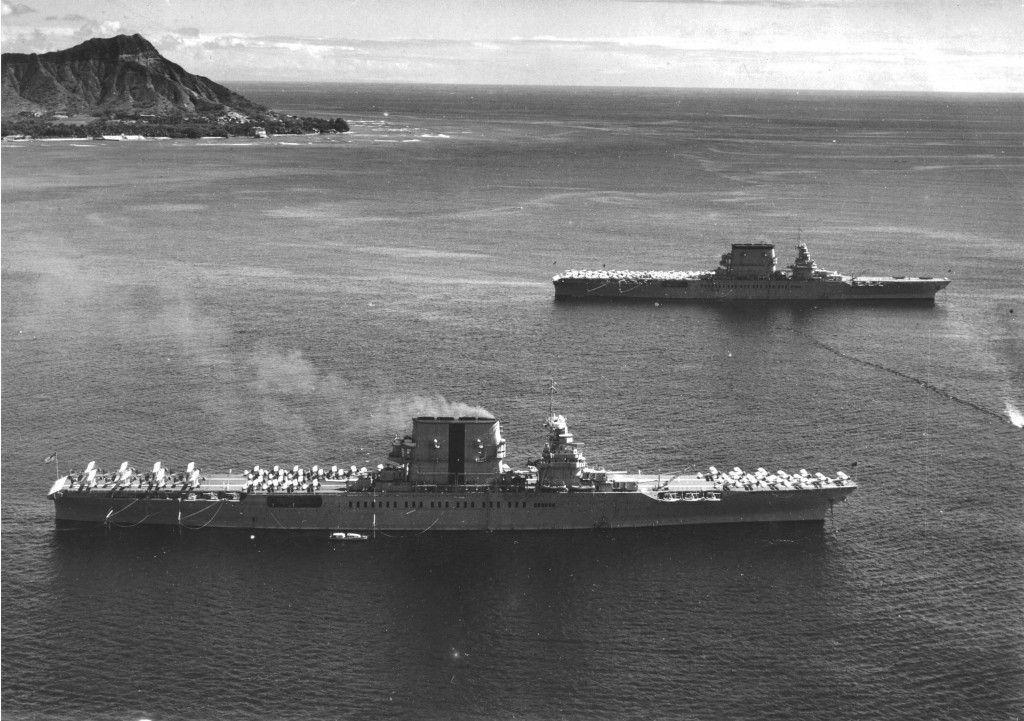
CV-2 Lexington and CV-3 Saratoga.

These concerns, however, evaporated with technological advances. The range of carrier aircraft increased over the 1930’s and that change eliminated the threat from surface forces approaching in hours of darkness. New U.S. carriers of the Yorktown class were much less expensive at $19 million a copy, but still supported air wings in size and capability approaching the larger, previous Lexington class. House Naval Affairs Committee Chairman Carl Vinson confirmed the carrier as the fleet’s new capital ship even before Pearl Harbor in the signing statement of the $8.5 billion dollar Two Ocean Navy Act of July 1940. He stated, “The modern development of aircraft has demonstrated conclusively that the backbone of the Navy today is the aircraft carrier. The carrier, with destroyers, cruisers and submarines grouped around it is the spearhead of all modern naval task forces.”[3]

The second carrier controversy began in the immediate aftermath of the carrier’s greatest triumph. The end of the Second World War and with it the navies of the fascist powers caused many to question the need for carrier aviation in what appeared to be a new age of predominately atomic warfare. Notable Army Air Corps (now Air Force) and Army officers dismissed the aircraft carrier as unnecessary in an age of intercontinental aircraft like the B-36 bomber. Army Chief of Staff General Omar Bradley dismissed the “super” (large) carrier as the Navy’s tool to employ long-range bombers, a role already covered by the Air Force.[4] Air Force Chief of Staff General Hoyt Vandenberg said the carrier was of “low military value” and that “land based air power was of far greater military usefulness.”[5] Defense Secretary Louis Johnson, with the strong support of President Harry Truman, cancelled the first postwar “supercarrier” in May 1949 based largely on these Army and Air Force opinions. Attempts by Navy Department civilians to discredit the B-36 before Congressional hearings further damaged the Navy’s case for the aircraft carrier in the emerging Cold War.

The carrier survived its second controversy thanks to the Korean War.  The conflict on the Korean peninsula demanded close air support for ground troops desperately in need of firepower to drive back larger North Korean formations. This was a mission that the Air Force had generally ignored and allowed to degrade in the aftermath of World War 2. The Navy was used to providing air support to Marine units from aircraft carriers and quickly demonstrated its ability to step up for post-World War 2 “small wars.” Naval strikes from carriers were crucial in repelling the initial North Korean attack and carrier-based Navy and Marine Corps aviators eventually flew 41% of all air combat missions in the Korean War.[6] The carrier would go on to similar strike missions in the Vietnam War and in other U.S. power projection efforts. Even President Truman came around to the carrier’s combat potential and endorsed the Forrestal class super carriers with the first commissioning in 1954.[7]
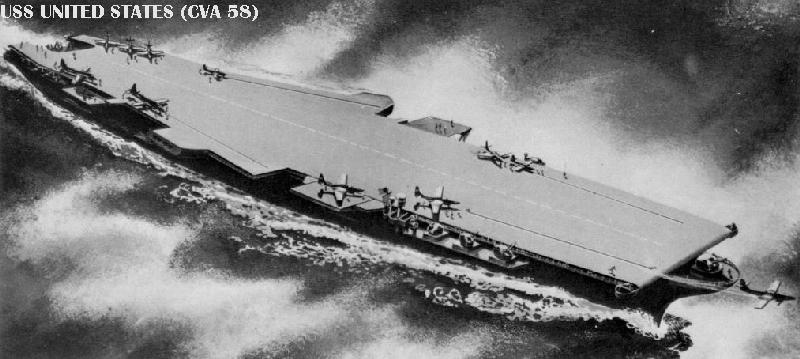
A drawing of CVA 58 the proposed USS United States which was later cancelled.
A depiction of the proposed CVA 58, USS United States, which was later cancelled.

The most recent carrier controversy had its roots in post-Vietnam war budget cuts and a misunderstanding of the operational design for the emerging Soviet Navy of the early 1970’s. The projected $2 billion dollar price tag of the fifth nuclear-powered carrier (the eventual USS Theodore Roosevelt) made the Carter administration reluctant to authorize such an expensive vessel.[8] The Congressional Budget Office produced documents suggesting that the carrier was not “survivable” in a modern battle, which further suggested that a $2 billion dollar price tag for a failed weapon system was the wrong choice.[9] Finally, NATO advocates in the Carter administration such as Robert Komer wanted the U.S. for focus the bulk of its defense expenditures on the defense of the Fulda gap against the possibility of Soviet invasion. The Navy’s chief task in this mission was sea control and protection of the vital supply lines between North America and Europe. Komer believed large carrier battle groups were unneeded for this mission and the large outlays required for their construction were better spent on land warfare equipment.[10] Some former officers including former USS Nimitz commander Admiral Eugene Carroll, and CIA director and naval strategist Admiral Stansfield Turner joined the chorus of carrier doubters. Politicians such as Colorado Senator Gary Hart, who in his book America Can Win and in other writings proclaimed, “like the battleship the carrier replaced, its magnificence cannot nullify basic changes in the nature of war at sea.”

Ironically, this carrier controversy disappeared more rapidly than the previous two. Significant analysis from disparate sources appeared in defense of the large flattop and its capabilities. Future Chief of Naval Operations Admiral Carlisle Trost in conjunction with the CNA Corporation produced the 1978 Sea Based Air Platform Study at the behest of Congressional Committees, “at loggerheads over whether the next carrier would have a nuclear or conventional power plant.”[11] Large nuclear and  smaller conventional carriers designed to operate vertical take off and landing (VSTOL) aircraft were studied. While all three types of carrier had positive attributes identified by the study, the 30 year life cycle cost of the nuclear carrier was only slightly more than that of its conventional equal. Both carried significantly more aircraft than the smaller VSTOL ship. Based on this, according to naval tactics expert (then executive assistant to Under Secretary of the Navy James Woolsey), Captain Wayne Hughes, “With total ownership costs so close, it was reasonable to let the Navy’s preference be decisive. The next year Congress authorized a CVN!”[12]
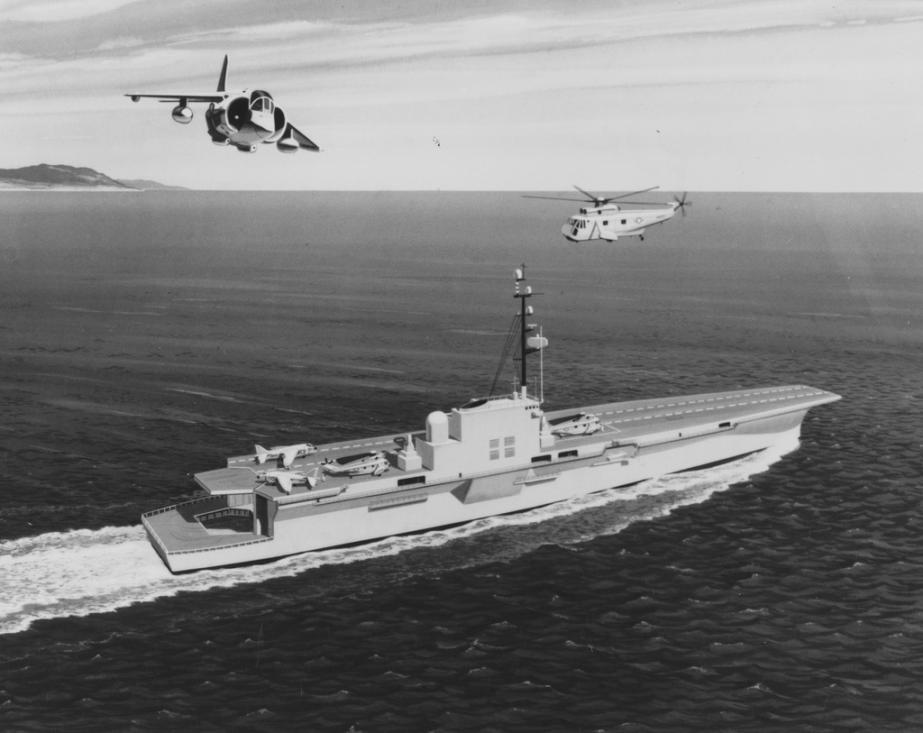
sea control ship
The proposed Sea Control Ship (SCS) which was later cancelled.

John Lehman’s 1978 Aircraft Carriers, The Real Choices came to similar conclusions. Lehman examined seven basic points concerning sea-based aviation including: (1) what should sea-based aviation do?; (2) what can land-based air do better?; (3) how vulnerable are carriers?; (4) how many carriers are needed and what do they cost?; (5) how essential is nuclear propulsion for carriers?; (6) what are the practical options for size of future carriers?; and (7) how will VSTOL technologies affect future air power at sea? [13] Lehman found that sea-based aviation was a useful companion to its land based equivalent in that carrier aviation allowed the US greater geographic freedom to strike targets out of range of land-based air. Larger carriers were less vulnerable (historically) than their smaller cousins. The examples of large carriers surviving significant accidents (USS Forrestal and USS Enterprise) was important to this determination. Enterprise survived the equivalent of six Soviet SSN-3 cruise missile hits but resumed flight operations several hours later.[14]

Lehman was also an analyst who contributed to the Sea Plan 2000 analysis that first recommended 15 aircraft carriers as the minimum number needed by the US for both peacetime presence and minimal wartime operations against the Soviet Union. His suggestion for carrier strength of 13-17 carriers as the right number was in keeping with the general Navy assumptions of the time. Lehman, like the analysts who completed the Sea-Based Air Platform study found that nuclear carrier costs over the lifespan of the ship were within 2.5% to 3% those of a large conventional carrier and worth the Navy’s investment.[15] Lehman’s analysis determined a number of significant problems associated with small carriers. Accident rates were significant in smaller ships. Over a 10 year period the smaller Midway class carrier suffered 10% greater flight deck accidents than did the larger flattops.[16] Larger carriers with 4 catapults could also put more aircraft in the air at a faster rate; a capability crucial to defense of the flattop against surprise air attack. Lehman also suggested that VSTOL aircraft held little promise of further advance and while many could be carried on a smaller aircraft carrier, their utility in high end warfare was limited.

Finally, naval intelligence efforts in the late 1970’s and early 1980’s determined that the Soviet Navy likely had no plans to significantly interdict NATO convoys to Europe in the event of a major war. U.S. taps on Soviet naval communications pods revealed that the Soviets most important fleet mission was defense of their ballistic missile submarines based in “bastions” within the Barents Sea. This intelligence confirmed what analysts like Robert Herrick and CNA’s James McConnell had said throughout the 1970’s; that the Soviet’s had a generally defensive naval strategy.[17] This revelation gave further support to the idea that an offensive naval strategy was the best choice for naval conflict with the USSR. An offensive war concept was better suited to large carrier operations than the small flattops conceived to fight antisubmarine and anti-surface battles in defense of NATO resupply convoys. Together the analysis and intelligence work of the late 1970’s and early 1980’s effectively ended the third carrier crisis of the 20th century.
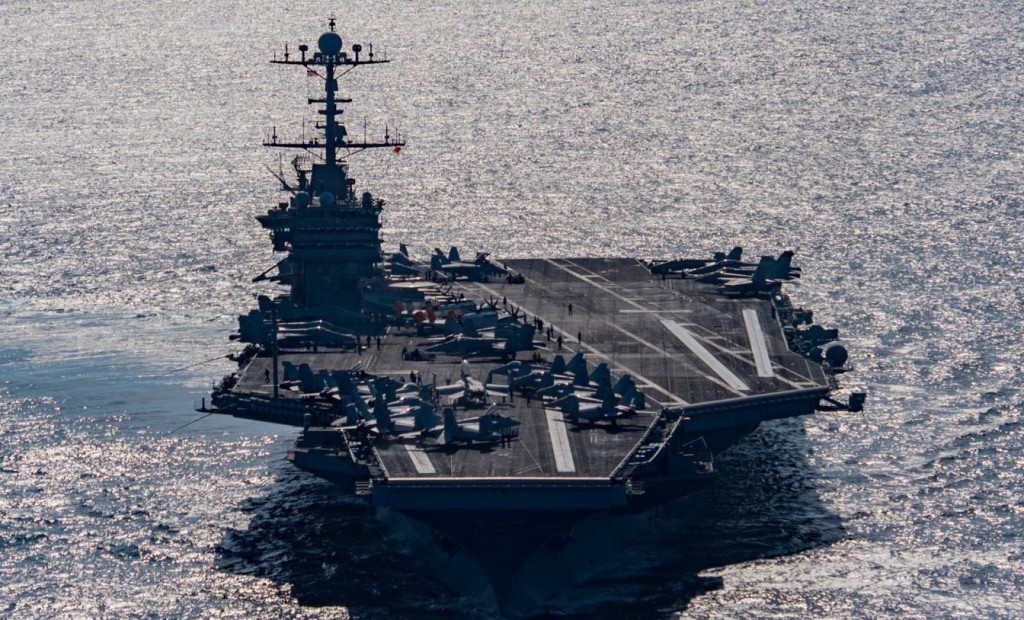
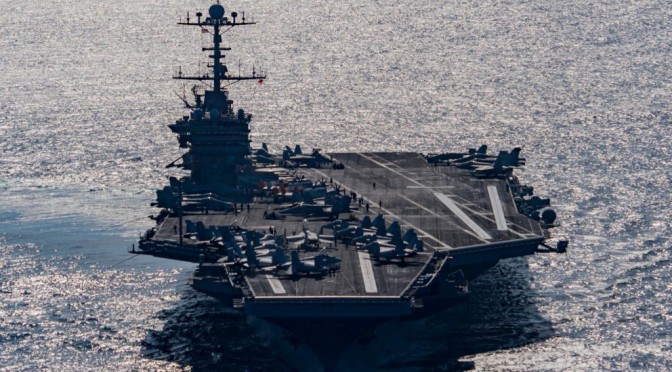
USS Harry Truman.
USS Harry Truman.

The present carrier “crisis” contains many elements of these past examples. As in the 1920’s, the current carrier air wing is too small and lacks the range necessary to effectively strike opponents without facing a significant response. Many assumptions in the wake of the First Gulf War of 1991 suggested that future conflicts would be joint and combined air/ground task force operations against rouge states and non-state actors around the Eurasian littoral. Land-based air support would always be nearby and plentiful. These assumptions, however, should be discarded in a new age where peer competitors and non-state actors exist side by side and carrier-based aviation may be the only component in the air component commander’s arsenal.

The budget is again tight as it was after the Second World War and in the late 1970’s. The nation cannot sustain another military buildup funded on debt and no miracle growth in the economy appears certain on the horizon. The other services will fight with equal vigor to keep their own assets and popular social spending programs are hard to curtail, let alone eliminate. The Navy will need creative ways to get more out of the carriers it has. The carrier force must be re-balanced with some regions getting more than others dependent on the availability of land-based aviation. Some carriers could be placed in reserve status in order to ensure that those that remain are fully capable of high-end warfare against peer competitors.

The range and strike capability of current carrier-based aircraft is substantially diminished in comparison with its late Cold War incarnation. Today’s carrier air wing boasts 62 aircraft as compared with the 80-90 aircraft wing of the Cold War.[18] The carrier air wing will need to be increased with longer range, manned or unmanned aircraft to return it to the capability of the late 1980’s/early 1990’s.

Despite these problems, no one weapon system appears poised to relieve the carrier as the primary U.S. naval offensive component. A mass of missile-shooting ships and submarines is required to achieve the same level of consistent ordnance delivery provided by a large carrier. Surface ship missile shooters may be affected by adverse weather conditions. An increase in the percentage of U.S. strike capability concentrated in submarines could result in equally rapid opponent advances in antisubmarine warfare. It is very difficult to retain technological advantages given the global diffusion of knowledge enabled by the information age. Future naval victories are more likely to depend on superior operational and tactical employment of existing platforms and payloads rather than technological superiority.

The carrier remains a flexible, re-configurable platform with significant potential going into the 21st century. The U.S. may have to reduce the overall number of large carriers it actively employs and tailor that presence to specific geographic areas where carrier-based airpower is an advantage. There has not yet been an active demonstration of a superior strike platform/system as there was in the war games of the 1920’s and 1930’s. The large U.S. aircraft carrier will likely survive this fourth challenge to its place atop the naval hierarchy, but it must increase the range and capability of its attendant air wing to achieve this goal.

Steve Wills is a retired surface warfare officer and a PhD student in military history at Ohio University. His focus areas are modern U.S. naval and military reorganization efforts and British naval strategy and policy from 1889-1941. 

[otw_shortcode_button href=”https://cimsec.org/buying-cimsec-war-bonds/18115″ size=”medium” icon_position=”right” shape=”round” color_class=”otw-blue”]Donate to CIMSEC![/otw_shortcode_button]

[1] David K. Brown, Nelson to Vanguard, Warship Design and Development, 1923-1945, Annapolis, Md, Naval Institute Press, 2000, p. 39.

[2] John Kuehn, Agents of Innovation, The General Board and the Design of the Fleet that Defeated the Japanese Navy, Annapolis, Md, The Naval Institute Press, 2008, pp. 102, 103.

[3] 8 1/2 BILLION IS VOTED FOR 1,500 WARSHIPS; House Passes Bill for Great Carrier Force and Escorts, With Battleships Left Out, New York Times, June 18, 1942. 

[4] Jeffrey Barlow, From Hot War to Cold, The U.S. Navy and National Security Affairs, 1945-1954, Standford, CA, Stanford University Press, 2009, p. 212.

[5] Ibid.

[6] George W. Baer, One Hundred Years of Seapower, Stanford, CA, Stanford University press, 1994, p. 328.

[7] Paul B. Ryan, First Line of Defense, The U.S. Navy Since 1945, Stanford, CA, The Hoover Institute Press, 1981, p. 14.

[8] Ryan, p. 104.

[9] Congressional Budget Office, The U.S. Sea Control Mission: Forces, Capabilities, and Requirements, June 1977. 

[10] Frank Leith Jones, Blowtorch, Robert Komer, Vietnam and American Cold War Strategy, Annapolis, Md, Naval Institute Press, 2013, pp. 251, 252.

[11] Wayne P. Hughes, Jr., (2002) Navy Operations Research. Operations Research. p. 7.

[12] Ibid.

[13] John F. Lehman, Aircraft Carriers, The Real Choices, Washington D.C., Center for International and Strategic Studies, Georgetown University, 1978, p. 11.

[14] Ibid, p. 41.

[15] Ibid, p. 52.

[16] Ibid, p. 57.

[17] Christopher Ford and David Rosenberg, The Admiral’s Advantage, U.S. Navy Operational Intelligence in World War 2 and the Cold War, Annapolis, MD, Naval Institute Press, 2005, p. 79.

[18] Jerry Hendrix. “The Future of the Aircraft Carrier looks Dim,” War on the Rocks, October 21, 2015. 
January’s CIMSEC Topic Week-The Littoral Arena

By Dmitry Filipoff

CIMSEC’s January Topic Week is on the Littoral Arena. The littorals only constitute around 15 percent of the world’s oceanic expanse, yet  60 percent of the world’s urbanized populations are located within sixty miles of the coast, including 80 percent of the world’s capitals. The U.S. Navy has only recently drawn attention to the littoral domain after decades of emphasizing blue water sea control. What are the unique warfighting challenges posed by the littorals? What capabilities and operating concepts best enable power projection in this complex environment? Can navies optimized for blue water operations effectively translate their experience into the littorals? These are only some of the lines of inquiry for examining this complex security environment and how to operate within it. 

Submissions are due by Thursday, January 21
The Topic Week will run from Monday, January 25 to Sunday, January 31

Interested authors should send submissions to the CIMSEC editorial team at Nextwar@cimsec.org. Topic weeks are competitive, so we encourage thoroughly researched contributions and submitting ahead of the due date. Other upcoming topic weeks can be viewed here

Dmitry Filipoff is CIMSEC’s Director of Online Content. Follow us @CIMSEC.

[otw_shortcode_button href=”https://cimsec.org/buying-cimsec-war-bonds/18115″ size=”medium” icon_position=”right” shape=”round” color_class=”otw-blue”]Donate to CIMSEC![/otw_shortcode_button]

Distributed Lethality and Concepts of Future War

By Dmitry Filipoff

Introduction

One must be ready to change his line sharply and suddenly, with no concern for the prejudices and memories of what was yesterday. To rest upon formula is a slumber that, prolonged, means death.”-Admiral Hyman G. Rickover.1

Distributed lethality is a concept that was officially launched a year ago by Navy leadership to explore how dispersing forces would enhance warfighting. Traditionally, dispersion has been a cardinal sin in the highly decisive nature of naval warfare, but new threats and capabilities may have changed this principle that has long guided the employment of warships. This analysis aims to show how distributed lethality can offer versatile means for achieving political and military objectives in an era of lean budgets and evolving threats.

Warfighting Characteristics

“More ships with more firepower acting more independently will increase the planning complexity and resourcing of our potential challengers.”-Vice Adm. Tom Rowden, Commander U.S. Naval Surface Forces.2

Navy leaders assert that distributed lethality will “add battlespace complexity3 and “complicate the calculus” of an adversary. How will dispersed surface action groups (SAG) accomplish this compared to traditional carrier strike groups (CSG), and how will dispersion affect operations in the electromagnetic (EM) domain?

Distributed lethality attacks left on the kill chain, meaning it intends to influence the earlier phases of the process by which targets are located, identified, targeted, engaged, and effects are assessed. Aside from increasing search volume, dispersion challenges intelligence, surveillance, and reconnaissance (ISR) through modularity. In a CSG centric navy, the detection of a large surface combatant increases the probability of learning the disposition of other warships, including valuable capital ships, and of knowing the operational unit they are arrayed in. The modularity offered by dispersed SAGs exacerbates the ISR challenge by reducing the certainty of what kinds of forces may be acting in concert with a potential contact, and what their capabilities and missions are. This will complicate prioritization of ISR and firepower, and increase the probability of expending precision guided munitions (PGM) due to forced error.4

However, distributed lethality will induce friction on the dispersed force. It is presumed that naval forces will employ emissions control (EMCON) techniques to frustrate the adversary in the EM domain. But EMCON exacerbates the challenges inherent to coordinating a dispersed force. Prior Navy experimentation discovered these challenges. Operations Haystack and Uptide revealed that dispersed operations under EMCON dramatically increase carrier survivability against submarines and land based bombers but at the expense of lengthened decision cycles.5 Under electromagnetic opposition, the degradation of confidence in the networking of a distributed force is easier because of additional variables to be accounted for and that can be influenced by enemy action. Aggregated forces can also more easily employ alternative means of communication compared to distributed forces.

Lengthened decision cycles for dispersed forces causes handicaps and presents dilemmas. Operations whose success is contingent upon careful coordination are less likely to succeed. The ability to mass capability on short notice amidst determined opposition is impaired. Planners must consider the extent that a SAG may be tied down by enemy action and its own tasking, and the resulting  impact on total force flexibility. Operations must have built in flexibility and consider myriad contingencies. Scenarios where SAGs may be called upon to support one another will pose a challenge given how the Navy’s offensive firepower may soon outstick its defensive firepower. These realities will place a premium on inclusive planning and the Navy’s command by negation tradition.

Dispersion will complicate the enemy’s ISR at the expense of reducing one’s own C2 agility. It is important to note that C2 is not just further left in the kill chain than ISR and targeting, but threads the entire process together. These realities may make distributed lethality inflexible under certain circumstances, and result in a higher echelon commander’s intent being articulated in broader terms and with more modest aims. Vice Adm. Ted N. Branch, Deputy Chief of Naval Operations for Information Dominance, pointedly reminded that “the assured C2 pillar touches almost everything we do.”6 The nature of modern conventional warfare has made the EM domain the battleground for superior decision making, and distributed lethality affects the kill chain of all parties.

Distributed Lethality versus Anti-Access/Area Denial 

As they seek greater influence, we confront states that seek to compromise freedom of the seas, where conflict and coercion are increasingly common.Chief of Naval Operations Adm. John. M Richardson.7

The Anti-Access/Area Denial (A2/AD) environment is the threat environment dominating the thinking of senior Navy leaders. What advantages does distributed lethality offer in meeting the A2/AD challenge?

Combating an A2/AD adversary could involve operations spanning multiple areas including blue water sea control, power projection into the littoral and across land. While the CSG is a formidable asset against the warships of a near peer adversary, a salvo competition between a CSG and A2/AD forces, especially land based forces, would be suicidal. The A2/AD model is attrition based. Its predominant advantage over expeditionary forces is the logistical sustainment of PGM, ensuring victory in a salvo competition if accurate targeting is sustained. By denying commons, A2/AD reduces freedom of maneuver and raises the probability of attrition based operations, forcing expeditionary forces into the A2/AD’s strength.

Distributed lethality counters A2/AD’s attrition model through maneuver warfare’s intent to probe for weakness and influence psychology. Dispersion facilitates multiple points of entry into theater, allowing for more sea control and maneuver. This in turn strains the anti-access mission and forces the adversary into executing area denial simultaneously. Distributed forces can probe more areas of the A2/AD envelope to gain intelligence on the opponent’s ISR capabilities and discover the true extent of their maritime domain awareness (MDA), setting the stage for follow on operations. Complicating ISR and targeting offsets logistical superiority by injecting uncertainty.

Platforms and Capabilities

“The Navy must be able to access any domain – and possess the mix of kinetic and non-kinetic weapons necessary to prevail today and tomorrow.”-Rear Adm. Mathias W. Winter, Chief of Naval Research.8

Distributed lethality will benefit from the numerous capabilities the Navy is developing to maintain its edge. The concept seeks to employ platforms in different ways, and promote versatility to make the most of limited resources. How could the Navy employ its warships differently and which capabilities should be prioritized?

In a 2014 CIMSEC article Admiral Tom Rowden, then director of Surface Warfare Directorate OPNAV N96, articulated a concept of dispersed lethality and asserted a distributed force will not be dependent on the air wing.9  While distributed lethality deemphasizes carrier strike missions, the air wing will be a critical enabler for the distributed force. A distributed air wing can provide rapid response anti-submarine warfare capability and function as communications relays for maintaining a responsive decision cycle while the dispersed force operates under EMCON. The air wing’s screening and early warning functions will be indispensable for enabling commanders on the scene to exercise initiative and engage on their own terms. The air wing will refocus from the right side to the left on the kill chain. 

Much has been made of a recent memo issued by Secretary of Defense Ash Carter to Secretary of the Navy Ray Mabus on the Navy’s programs. The most significant directives include cutting procurement of the littoral combat ship (LCS) from 52 hulls to 40, and procuring 31 additional F-35C aircraft.10 It is important to note that distributed lethality was born from a wargame at the Naval War College where a LCS equipped with a long range surface to surface missile “added stress and complexity to the red force commander, who had to spend precious ISR resources trying to find these upgunned ships.”11 If aircraft and fast frigates/LCS are mutually exclusive investments in the near term, the Navy should explore whether it needs more shooters in the form of additional warships or air wing enablers performing the aforementioned missions.

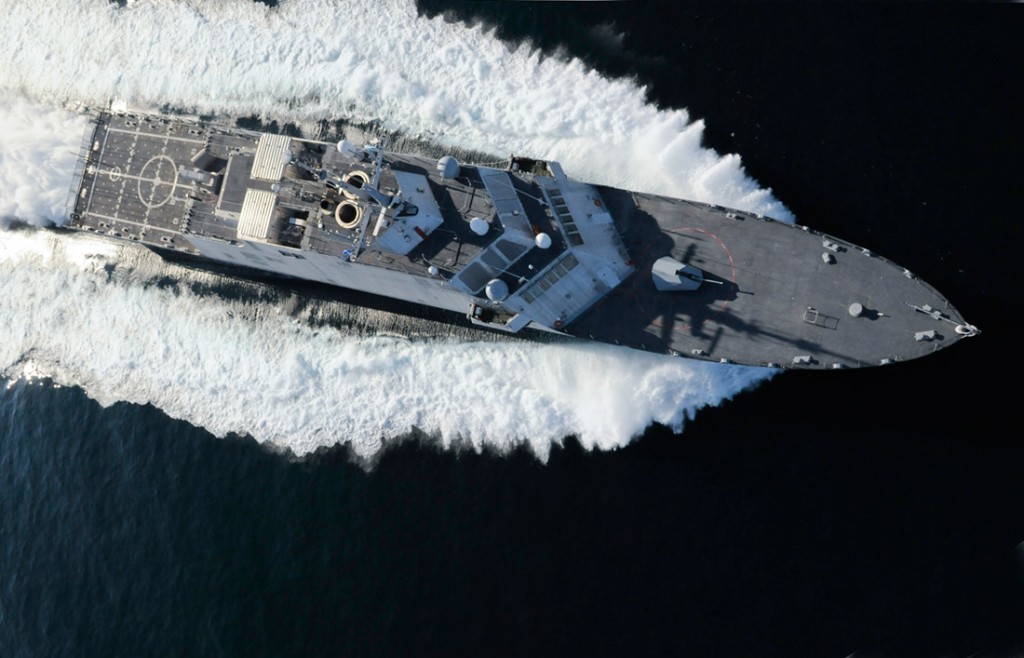
USS Fort Worth. Rolls-Royce Photo.
USS Fort Worth. (Rolls-Royce Photo)

A payload that has been wisely distributed across the Navy’s warships is the AN/SLQ-32 electronic warfare (EW) system. The Block III increment of the Surface Electronic Warfare Improvement Program (SEWIP)  will provide common electronic attack capability to surface combatants.12 Not only does the CSG focus large surface combatants on the defensive application of anti-air warfare (AAW), it does the same for EW. A distributed force equipped with an offensive EW capability could cause great disruption to an adversary’s ISR picture, reinforcing distributed lethality’s intent to attack left on the kill chain. As a part of a proposed acquisition fastlane, Chief of Naval Operations Adm. John Richardson has singled out EW capabilities as “candidates for this kind of rapid acquisition, rapid prototyping13 which will benefit distributed lethality enormously.  

Distributed lethality aims to add more firepower to the fleet, potentially even equipping logistics vessels with missiles as a part of the maxim “if it floats, it fights” issued by OPNAV N96 chief Rear Adm. Peter Fanta.14 However, the Navy should reexamine prioritizing anti-surface warfare (ASuW) capability and consider focusing on land attack. While putting modern anti-ship missiles on more surface combatants would reinvigorate the Navy’s ASuW capability, enhanced power projection across land holds greater deterrence value. The Navy’s land attack proficiency is well honed and proven through recent experience. Thankfully the versatility of the tomahawk missile can enhance both mission sets, but presents the technical challenge of installing vertical launch cells on ships that may have little space and weight to spare.

Arguably no set of capabilities stand to enhance distributed lethality more so than Cooperative Engagement Capability (CEC) and Naval Integrated Fire Control-Counter Air (NIFC-CA). These capabilities allow one platform’s sensors to provide a targeting solution to another platform’s weapons. This will multiply the lethality of a distributed force across vast areas of influence by allowing for the massing of payloads but not platforms. Distributed forces will be able to mitigate risk by mixing and matching whatever combination of sensors and shooters best fits an engagement while ensuring survivability.

Strategic Merit

“…it’s primarily about changing our ways and means right now and the operational concepts we use to achieve our objectives…”- Deputy Secretary of Defense Robert O. Work.15

An operational concept’s warfighting advantages are linked to its deterrence value. How does distributed lethality contribute to deterrence, and what options does it provide policymakers confronting crisis?

Distributed lethality enhances deterrence by influencing psychology through more than just kinetic means. It aims to degrade an adversary’s confidence in their weapons rather than through the threat of overwhelming force, a threat that is not as credible against an A2/AD adversary. Dispersion better allows for demonstrations within the EM domain, which may prove a less escalatory form of conveying resolve than deploying a CSG to a hotspot. The enormous creativity allowed by electromagnetic maritime deception allows for a more nuanced and flexible escalatory dynamic. Demonstration options range from temporarily confusing sensors to simulating strikes against strategic forces with impunity as the Navy did in NORPAC 82.16 Not only does threatening the destruction of networks constitute escalation, it attacks the channels by which deception conveys deterrence.17 During crisis, distributed lethality’s modularity allows for more options in terms of what and how many assets are committed to posturing, giving policymakers a more flexible means for adjusting the “temperature.” Distributed lethality not only has more to offer for maneuver in the military sense, but also politically.

As the threat environment evolves, reassessing the CSG’s deterrence value should occur in tandem with reevaluating its warfighting applications. Captain Robert C. Rubel (ret.) makes the excellent point that “If a lucrative target loaded with potent geopolitical symbolism is on scene, with more on the way, it could precipitate a dangerous “window-of-opportunity” mindset in the opposing government.”18 Sending a CSG to a hotspot could “catalyze as deter” and threaten nightmarish devastation or monumental loss of face as carriers are hurriedly withdrawn for the sake of preservation at the outbreak of war. During the initial phases of conflict, failing to deceive ISR through nonkinetic means could quickly escalate into attempting their physical destruction, up to and including strikes on mainland installations, which is more likely if a carrier’s survival is at stake.

Distributing forces will lower a first strike’s potential for success, which is especially important for deterring an adversary employing A2/AD. Jon Solomon points out an adversary’s maritime domain awareness “will never be as accurate and comprehensive at any later point in a conflict as it is during peacetime’s waning moments.”19 A patrolling, dispersed force would provide a more complex targeting picture, and would reveal more indicators and warning of an impending attack across a larger geographical area. These advantages would be realized by having forward deployed forces already operating in a dispersed manner at Phase 0, or otherwise face the uncomfortable process of transitioning into a dispersed force in the midst of crisis or at the onset of conflict.

Final Thoughts

“It will be orange and it may look kind of odd put together and won’t have the nice slick red/gray paint and it won’t be totally tested and it might fail, but we’ve got to get it out there and see what we can do with that.”-Chief of Naval Operations Adm. Jon Greenert.20

There are additional lines of inquiry that must be explored in order to flesh out distributed lethality. For example, what does it entail for amphibious forces? These forces are more likely to face the littoral arena, and their objectives are set upon fixed geography which limits their freedom of maneuver. The history of naval warfare has shown time and time again that key naval engagements precipitated in relation to developments and objectives on land. Scenarios commonly envisioned today such as a Taiwan contingency or a defense of the Strait of Hormuz demand that the Navy examine distributed lethality in a fixed geographical context. The concept will also challenge the ability to wage coalition warfare, as the careful planning and execution demanded by dispersed operations under EMCON will require ample cooperation and true interoperability.

Nonetheless, distributed lethality offers numerous benefits. It will make the most of what the Navy has today, while maximizing the value of investments that will achieve fruition both in the short and long term. It provides means for confronting the A2/AD challenge, and fulfills Air-Sea Battle’s intent to ensure U.S. forces can “assure access, maintain freedom of action, conduct a show of force, or conduct limited strikes.”21 Ultimately, it provides political and military leadership more flexibility to maneuver within crisis and conflict. The Navy must call upon its rich history of innovation and experimentation to turn distributed lethality into a credible warfighting construct that will deter foes, reassure allies, and make the greatest Navy the world has yet seen greater still. 

Dmitry Filipoff is CIMSEC’s Director of Online Content. He can be contacted at Nextwar@cimsec.org.

[1] Admiral Hyman G. Rickover. US Naval Postgraduate School address (16 March 1954). 

[2] Vice Adm. Tom Rowden. “Distributed Lethality: The Beginning of the Beginning,” Navy Live (January 20, 2015).

[3] Vice Adm. Thomas Rowden et. al. “Distributed Lethality,” U.S. Naval Institute Proceedings (January 2015).

[4] Solomon, Jon. “Guided Munitions Inventory Management, Producibility, and their Effects on Strategy (Part 1 of 2),” Information Dissemination (November 3, 2014).

[5] Angevine, Robert G. “Hiding in Plain Sight: The U.S. Navy and Dispersed Operations Under EMCON, 1956-1972,” Naval War College Review (Spring 2011).

[6] Vice Adm. Ted N. Branch. “A New Era in Naval Warfare,” U.S. Naval Institute Proceedings (July 2014).

[7] Chief of Naval Operations  Adm. John M. Richardson. “The Growing Importance of the Maritime,”10th Regional Seapower Symposium, Venice, Italy (October 22, 2015).

[8] The Fiscal Year 2016 Budget Request United States House of Representatives, 114th Cong. Statement of Rear Admiral Mathias W. Winter, United States Navy Chief of Naval Research. House Armed Services Subcommittee on Emerging Threats and Capabilities (March 26, 2015).

[9] Rear Adm. Thomas S. Rowden. “Surface Warfare: Taking the Offensive,” Center for International Maritime Security (June 14, 2014).

[10] U.S. Navy. “Surface Electronic Warfare Improvement Program (SEWIP),” United States Navy Fact File (November 15, 2013).

[11] Freedberg Jr., Sydney J. “CNO Richardson Urges Fast-Track For Cyber, EW & Drones,” Breaking Defense (December 7, 2015).

[12] Secretary of Defense Ash Carter. “Memorandum for Secretary of the Navy,” United States Department of Defense (December 14, 2015).

[13] Eckstein, Megan. “Navy Studying Implications of Distributed Lethality in Wargames Series,”U.S. Naval Institute News (July 9, 2015).

[14] Freedberg Jr., Sydney J. “ ‘If it Floats, It Fights’: Navy Seeks ‘Distributed Lethality’,” Breaking Defense (January 14, 2015).

[15] Deputy Secretary of Defense Robert O’Work.  The Third U.S. Offset Strategy and its Implications for Partners and Allies, Center for a New American Security, Washington D.C. (January 28, 2015).

[16] Pico, Andy. “How to Hide a Task Force,” Navweaps ( June 2, 1999).

[17] Solomon, Jonathan F. “Maritime Deception and Concealment Concepts for Defeating Wide-Area Oceanic Surveillance Reconnaissance-Strike Networks,” Naval War College Review (Autumn 2013).

[18] Capt. Robert C. Rubel (ret.), “Cede No Water: Strategy, Littorals, and Flotillas” U.S. Naval Institute Proceedings (September 2013).

[19] Solomon, Jon. “Parrying the 21st Century First Salvo,” Information Dissemination (October 16, 2014).

[20] Chief of Naval Operations Adm. Jonathan Greenert. Speech given at Naval Future Force Science and Technology Expo, (February 4, 2015).

[21] Air-Sea Battle: Service Collaboration to Address Anti-Access and Area Denial Challenges, United States Department of Defense (May 2013).

The Cabbage and the Submarine: Why Fears of Chinese Control of the Seas are Overstated

The following piece is cross-posted from our partners at the CDA Institute as part of an ongoing content sharing relationship. You can read the article in its original form here.

CDA Institute Analyst Ariel Shapiro comments on the proliferation of submarines and issue of sea denial in the Asia-​Pacific.

In 2013, Major General Zhang Zhaozhong, an outspoken senior official in the Chinese People’s Liberation Army, described China’s strategy in the South China Sea by referring to a cabbage. In regards to the Scarborough Shoal, a group of rocks disputed by China and the Philippines, the Chinese strategy is to inundate the area with a large fleet of military and commercial ships of all sizes, to surround the contested rocks like the layers of a cabbage. What essentially amounts to a blockade, disguised by friendly vegetarian metaphors, is a manifestation of the more assertive Chinese foreign policy undertaken by President Xi Jinping. In this post, I will discuss how the recent build-​up of regional naval fleets in Asia is a response to China’s increasingly assertive policy – and why this is cause for concern for China.

In recent years, there has been a buildup of military submarines in the Asia-​Pacific, which Michael Wesley at the Australian National University refers to as a “bonanza.” Despite multiple changes in leadership over the past few years in Australia, the massive project to replace the Royal Australian Navy’s six aging Collins-​class submarines with 12 new state of the art diesel submarines is still well underway (as a point of comparison, Canada currently has four Victoria-​class submarines, three of which are operational, and all of them several years older than the submarines Australia is replacing).

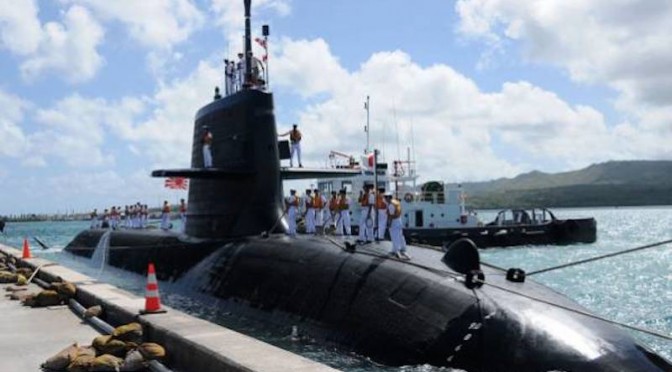
The Australian submarine procurement process brings to the forefront the changes that are happening in another key player in the Asia Pacific region: Japan. For the first time since the 1960s, new legislation in Japan permits the country’s world-​renowned industry to export military technology. The top contender for the contract to replace the Australian submarines is the Soryu-​class, developed by Japanese giant Mitsubishi. The Soryu-​class diesel submarine is notable for its air-​independent propulsion technology, which allows the vessel to remain underwater without surfacing for significant periods of time compared to other diesel submarines. Japan, of course, is not only developing the submarine for export; it is in the midst of increasing its total submarine fleet form 16 to 22.

Australia is not the only country in the region increasing its submarine fleet. In September 2015, the Indonesian House of Representatives announced a plan to purchase two Kilo-​class submarines from Russia; the nation comprises 17,000 islands, and senior military planners estimate that the country needs at least 12 submarines to adequately patrol its territorial seas. Across the Strait, Lieutenant-​Colonel Aaron Beng of the Singapore Armed Forces analyzes submarine procurement in Asia from his country’s perspective. He notes Singapore’s recent acquisition of two Vastergotland-​class submarines from Sweden, bringing the fleet’s total to six; the refurbishment of two French Scorpèné-​class submarines by Malaysia; and the ongoing purchase by Vietnam of six Kilo-​class submarines from Russia. One can also include the new Thai ruling military junta decision to purchase submarines from China. Not to be outdone, the first of India’s six new Kalvari-​class diesel electric attack submarines, based on the French Scorpèné, are currently undergoing sea-​trials.

What is the motivation for this submarine acquisition? The submarine is, in terms of dollar-​per-​value, the best tool for sea denial. This maritime strategy is an asymmetric one. Instead of great powers building up fleets to fight for control of the seas, as was the case in the lead up to the First World War, sea denial is a strategy used by weaker powers to deny access to their coastal areas by larger powers; the maritime equivalent of guerilla warfare. Essentially, a small, stealthy, relatively inexpensive submarine can pose a serious threat to an advanced aircraft carrier or major surface combatant.

For example, Singapore’s submarines will add to its defence posture of the “poison shrimp”; while the Republic has neither the ambition nor the capacity to control the seas, it does indeed have the capacity to cause significant damage to a larger power that would attempt to threaten its vital interests (which, due to its small size and the global nature of its economy, include shipping), much like eating a poisoned shrimp can make a much larger animal very ill. As Peter Briggs at the Australian Strategic Policy Institute notes, navies have submarines not only to serve in a potential war, but for “situations short of conflict” – their mobility, endurance, stealth, and payload make them an essential tool in preventing conflict through deterrence.

This brings us back to China and the cabbage strategy. In the South China Sea, despite the unresolved nature of competing claims over various small islands, China is continuing with its policy of reclaiming land and building infrastructure. Last week, tensions flared as the USS Lassen, an American destroyer, sailed in what Washington claims are international waters but which China considers within its territorial sea. While the US Navy (USN) remains the most advanced and important navy force in the Pacific Ocean, China’s growing fleet of advanced surface and undersea ships gives it a sea denial capability against America’s more formidable force – especially when combined with its on-​shore anti-​access and area denial (A2/​AD) assets.

Smaller countries in the region are eager to build up their own deterrence and sea denial capacity to protect their shipping lanes and vital interests in an era where the United States can no longer underwrite global maritime security, and submarines are perhaps the best way to do so. While this strategy is aimed primarily against China, Beijing, in turn, is building up its own fleet towards a strategy of sea denial against the more powerful USN. However, China has also increased the responsibilities placed on its forces and has turned otherwise uninvolved actors into maritime rivals. In addition to asserting its primacy over its coasts and capacity to dominate Taiwan, which remains at the core of China’s security policy, it now also actively seeks to assert Chinese freedom of maneuver over the South China Sea and eventually rival American control of wider areas of the Pacific Ocean.

While much has been written about the Sino-​American rivalry in the Pacific, the role of smaller Southeast Asian countries is too often forgotten. The USN is still far superior, for the time being, to the Chinese People’s Liberation Army Navy. Yet any assessment of the strategic balance must take into account other important players in the region, such as Australia, Japan, Singapore, India and Vietnam, all of which are showing a tendency to bandwagon with the United States – making any potential Chinese dominance even less foreseeable.

At a recent conference at the University of Ottawa, Professor Jean-​Pierre Cabestan, one of the foremost French experts on China, noted how Chinese President Xi Jinping’s success in making China more assertive on the world stage has only provoked a “rebalancing” of the United States and its allies towards China. Indeed, if the cabbage strategy continues to cause horizontal proliferation (the number of countries building up military capacity) as well as vertical proliferation (pre-​existing powers increasing their capacity, such as the development of new missile systems on littoral combat ships in the United States), China’s aggressiveness may have caused it to lose more influence than it has gained.

Ariel Shapiro recently graduated from McGill University in political science and economics and is currently an Analyst at the CDA Institute.