
By Josh Richards
This summer, seven companies began taking different unmanned systems out to sea for real-word testing. The Navy selected their designs from roughly two dozen contenders for its Medium Unmanned Surface Vessel marketplace after asking industry to build autonomous ships capable of traveling 2,500 nautical miles at 25 knots in sea state four (conditions characterized by moderate waves reaching roughly 8 feet) while carrying up to 25 metric tons of payload. The vessels must be fielded in a timeline measured in months rather than the decade that major weapons programs routinely consume.¹ Companies that complete the at-sea demonstrations due to conclude next month will receive $15 million and become eligible for follow-on production, with leasing or procurement beginning as early as fiscal year 2027.² An October 2026 court ruling has also ordered the Navy to reevaluate its exclusion of one of the contenders, Saildrone, without requiring a delay to testing by the seven companies originally selected.
The common requirements mask considerable variation among the competitors. Some designs, like Saronic’s 180-foot Marauder and HII’s 190-foot ROMULUS, emphasize payload capacity and range, while others center more heavily on modular mission payloads and mature autonomy systems adapted from earlier unmanned vessels.
The MUSV marketplace marks a real departure from how the Navy typically develops ships. Rather than paying contractors to design bespoke prototypes around an elaborate government specification, the service is asking industry to bring forward technology that already exists and accept much of the development risk itself. The Navy’s Portfolio Acquisition Executive for Robotics and Autonomous Systems has described the ambition as a recurring marketplace that will eventually extend to other vessel classes.³
The seven vessels are testing whether the Navy can learn as rapidly as its technology changes. The endurance of a vessel that completes a 2,500-mile voyage demonstrates an engineering capability. But a vessel placed repeatedly alongside destroyers, logistics ships, and Marines begins to answer different categories of questions, including how commanders can employ it when communications degrade, and which assumptions embedded in its specifications survive contact with the fleet.
If successful, these autonomous systems could collapse the boundary between developing a weapon and discovering how to fight with it. A prototype could serve two purposes at once by demonstrating whether industry can build what the Navy is requesting, and by giving sailors a chance to discover whether the Navy is requesting the right thing. The second purpose deserves far greater institutional weight than it currently receives.
Two Experiments
The Navy is effectively running two experiments in parallel. The first is technical with seven industrial teams demonstrating competing approaches to hull design and payload integration. The second is institutional: whether information generated by those systems can travel from operators back through the organizations that decide what the fleet buys next.
Evaluation asks whether a prototype satisfies a requirement. Experimentation asks whether experience with the prototype should change the requirement. For autonomous warfare, real-world iteration to fine-tune requirements is a necessity. Operational use routinely reveals applications engineers never anticipated. Deputy Secretary of Defense Kathleen Hicks described exactly this phenomenon with Replicator systems, noting that forces operating them in real environments discovered uses that had escaped consideration at the outset.⁴ That is precisely what military experimentation should accomplish: exposing assumptions rather than confirming them.
However, the institutions surrounding defense acquisition developed around a slower technological rhythm. That approach can be problematic when commercial autonomy and software can change several times while a single requirement moves through the bureaucracy. The Government Accountability Office documented this mismatch in a June 2026 review, finding that the Navy’s requirements, resourcing, and acquisition processes remain organized around traditional platforms even five years after the service’s own 2021 Unmanned Campaign Framework called for developing systems though repeated testing and refinement.⁵
The Fleet as the Missing Participant
The Navy already understands much of this at the level of practice. Sea Hunter and Seahawk, its first autonomous medium unmanned surface vessels, represented more than simply proving a ship could navigate without sailors aboard. The Navy describes their purpose in explicitly operational terms, determining how unmanned vessels should be employed and integrated into the fleet.⁶ During Integrated Battle Problem 23.2, four USV prototypes operated across the Pacific for five months, traveling a combined 46,651 nautical miles under mostly autonomous control and visiting Japan and Australia alongside a carrier strike group.⁷ The deployment’s primary value came from placing developmental systems inside an operational ecosystem where they generate knowledge about warfare rather than engineering alone.
Yet the Navy still struggles to capture that knowledge systematically. The Government Accountability Office (GAO) found in January 2026 that fleet organizations responsible for ship operations are inconsistently represented in planning for operational testing. This means missing opportunities to incorporate direct warfighter feedback and test information that could inform better requirements far beyond the immediate acquisition decision.⁸ The same body of GAO work found that Navy policy outside the software pathway has yet to fully adopt an iterative-development model in which user feedback continuously reshapes design. Instead, a linear model in which requirements are fixed at the outset and development proceeds toward compliance with them remains the standard.⁹
A fleet preparing for a rapidly changing Western Pacific battlespace cannot afford to discover in 2030 that a requirement written in 2026 captured that year’s technological possibilities more faithfully than the operational realities of 2030. Warfighters need a role larger than final customer. They need to be participants in development while meaningful design choices remain open, with a formal path through which their objections can modify requirements, budgets, software, and production lots before those decisions harden.
A Precedent Worth Recovering
The Navy has also faced a version of this problem before. In the 1920s, the aircraft carrier possessed none of the inevitability history has assigned it. Battleships were still central to American sea power, and the operational relationship between aircraft of all types and the battle fleet remained unsettled. Nor was it clear which forms of naval aviation would prove most important, as carrier-based aircraft developed alongside competing concepts built around seaplanes and lighter-than-air craft. USS Langley, an experimental platform under Captain Joseph “Bull” Reeves, became a laboratory for changing deck-loading practices and flight tempo over the objections of aviators who considered the methods dangerous. These lessons became foundations of American carrier operations.¹⁰
Those lessons matured during Fleet Problem IX in 1929, when Reeves detached USS Saratoga and a single cruiser from the main battle fleet for a high-speed run against the Panama Canal. Saratoga launched a dawn strike that demonstrated the offensive reach of an independent carrier task force. But the ship also demonstrated, after being sunk three times, the vulnerability of an aircraft carrier to layered defenses, especially when operating without proper escorts and with an air group built around short range aircraft.¹¹ This was the Navy’s first test of a concept that would define carrier warfare fifteen years later.¹²
The Navy did not begin with a fully formed theory of carrier warfare and commission ships to execute it; sailors and aviators experimented with what they had, discovered what it could do, and carried those lessons into the next exercise. The relevant parallel to autonomous vessels is not cost or complexity but epistemology. In both eras, the technology’s full military significance could not be derived from engineering performance alone.
What Washington Has Built and What It Still Lacks
Washington has already tried to force this kind of learning by fiat. When Hicks announced Replicator in August 2023, she set an intentionally uncomfortable target: field thousands of attritable autonomous systems across multiple domains within eighteen to twenty-four months, explicitly framing the effort as an attempt to reproduce a lengthy and ponderous process.¹³
The initiative demonstrated real speed, with contracts awarded within three or four months of appropriations in some cases. But by January 2026, the Congressional Research Service reported that only hundreds of systems had been fielded against an original target of thousands.¹⁴
The gap illustrated the durable lesson that a deputy secretary can convene senior leaders and force decisions across organizational boundaries, but that behavior becomes transformative only when it survives the intervention that produced it. The Pentagon’s broader acquisition record shows how difficult that transition remains. GAO reported in mid-2025 that major weapons programs take an average of almost twelve years to deliver even an initial capability, attributing much of the delay to rigid, sequential development that recent reform efforts have mostly worked around.¹⁵
Autonomous systems make that weakness increasingly consequential, because their usefulness cannot be separated from the operational concepts that emerge around them. A prototype can cross the “valley of death” and still arrive in the fleet with immature tactics or requirements that experimentation has already disproved. The Pentagon has spent years trying to move technology more rapidly from laboratory to program of record. The next reform agenda should focus just as intensely on moving knowledge in the opposite direction, from the deck plate back into the design of the system.
Making Experimentation a Standing Practice
The institutional objective should be to establish a direct institutional link between the sailor who makes a discovery at sea and the official with the authority to change what gets built. That requires connecting operational experimentation directly to authorities the Department has already created.
- Embed prototypes with operational units before requirements harden. Promising autonomous and software-intensive systems should spend sustained periods inside fleet formations while significant design decisions remain open, exposed to ordinary maintenance and command pressures. GAO has repeatedly identified continuous user feedback as a leading practice for exactly this reason.¹⁶
- Create recurring fleet experimentation windows built around operational problems. Combatant and fleet commanders should identify a limited number of problems that warrant sustained experimentation, let industry place competing systems into those campaigns, and give operators enough latitude to alter tactics, payloads, and software as evidence accumulates, through multiple iterations rather than a single successful demonstration. Acquisition officials should participate in reviewing the results before subsequent requirements and investment decisions are finalized.
- Give operational findings a formal route into portfolio decisions. Experimentation reports should feed directly into Portfolio Acquisition Executives and the Department’s new Acquisition Acceleration Reviews, with commanders empowered to recommend changes to requirements and investment priorities. The Innovation Insertion Increment, which every Portfolio Acquisition Executive must fund starting with the fiscal year 2028 budget, provides a mechanism for acting on those findings, provided operational learning can trigger its use rather than simply accompany decisions already made elsewhere.¹⁷ Those recommendations should require a documented decision from the responsible acquisition authority, ensuring that operational findings are formally considered even when they are not adopted.
- Measure learning alongside fielding speed. Acquisition scorecards understandably emphasize cost, schedule, and delivery. Autonomous portfolios should also be judged on whether experimentation produced measurable changes in requirements, tactics, or subsequent production increments. A portfolio that fields rapidly while reproducing assumptions operators have already disproved has optimized the wrong variable.
There will be friction. Fleet commanders face demanding deployment and readiness schedules, and engineers may resist changes that undermine production economics. Those tensions are reasons to structure experimentation rigorously, not to avoid it. They also serve as evidence the process is working. Military innovation has always required negotiation between what technology permits, what operators want, and what industry can build. Bringing that argument forward in time, while the seven MUSV designs are still at sea and the requirements still open, makes it cheaper to resolve.
Seven Hypotheses at Sea
By the end of this year, the Navy expects to know which of seven industrial teams can satisfy the immediate demands of its MUSV marketplace, opening a pathway toward operational vessels beginning in fiscal year 2027.¹⁸
If the process works as intended, that alone will be a meaningful achievement, with years of conventional development compressed into a competition measured in months. It should also be the beginning of the experiment, not its conclusion.
China continues to expand the world’s largest navy by US Navy Battle Force standards while investing heavily in the sensors and unmanned systems that will contest the Western Pacific. Autonomous systems offer the Navy one way to create mass and distribute risk, but their strategic value depends entirely on how effectively the fleet integrates them and adapts their employment as both the technology and the adversary evolve. The interwar Navy could never have specified the mature carrier task force of 1944 from the deck of Langley in 1922; the operational concept emerged because successive exercises, commanders, and failures changed the Navy’s understanding of what carrier aviation could accomplish. Autonomous warfare is at a similarly formative stage, and that uncertainty is not a deficiency to conceal through increasingly elaborate requirements. It is the reason for experimenting.
| Manufacturer | Vessel / Design | Length | Design / Autonomy Approach | 2026 Selections |
| Saronic | Marauder | 180 ft | Purpose-built; proprietary autonomy | 10-vessel award |
| HII | ROMULUS | ~190 ft | Modular hull; Odyssey autonomy | 10-vessel award |
| Galliano Marine | Undisclosed | — | Edison Chouest shipbuilding base | 10-vessel award |
| PacMar | Atlas 100 | 100 ft | Modular payloads; HavocAI autonomy | Qualified |
| Sea Machines | STEAMRACER | — | Modular mission deck; optional crew | Qualified |
| Leidos | Undisclosed | — | LAVA autonomy; prior USV experience | Qualified |
| Birdon | Undisclosed | — | Mythos AI autonomy; C&C Marine hull | Did not qualify |
The seven MUSVs now at sea should be understood as competing hypotheses about future naval power. Their greatest contribution may come from the requirements they invalidate and the tactics that emerge when commanders are given enough freedom to employ them differently. The decisive competition ahead will concern neither which navy unveils the first autonomous ship, nor which produces the most impressive prototype. It will concern which navy can expose new technology to operational reality, recognize when its assumptions have failed, and change course before its adversary does.
Josh Richards is the Chief Commercial Officer of Pacific Peering. He serves on the UN’s Joint Task Force on SMART Cables as a member of the Steering Committee, and chairs the Business Development Committee. He is a Security Fellow with the Truman National Security Project, a Tech Policy Fellow with the Aspen Institute, and a Senior Fellow with AI2030.
References
1. Sam LaGrone, “Navy Selects 7 MUSV Designs to Enter Prototype Phase,” USNI News, May 22, 2026. The Navy’s requirements include 2,500 nautical miles of range at 25 knots in sea state four, payload capacity of up to 25 metric tons, and an FY2027 operational timeline. https://news.usni.org/2026/05/22/navy-selects-7-musv-designs-to-enter-prototype-phase
2. U.S. Navy, “U.S. Navy Announces Seven Companies Selected for MUSV Marketplace At-Sea Demonstrations,” May 29, 2026. Companies whose MUSV successfully completes the at-sea test receive $15 million and become eligible for follow-on production. https://www.navy.mil/Press-Office/Press-Releases/display-pressreleases/Article/4503917/us-navy-announces-seven-companies-selected-for-musv-marketplace-at-sea-demonstr/
3. LaGrone, “Navy Selects 7 MUSV Designs.” Rebecca Gassler, the Navy’s Portfolio Acquisition Executive for Robotics and Autonomous Systems, described the goal as a recurring marketplace extending to additional vessel classes over time. https://news.usni.org/2026/05/22/navy-selects-7-musv-designs-to-enter-prototype-phase
4. Kathleen H. Hicks, “Keynote Address: ‘Structuring Change to Last,'” U.S. Department of Defense, August 7, 2024. https://www.belfercenter.org/research-analysis/move-fast-and-scale-brief-insiders-history-replicator-initiative
5. U.S. Government Accountability Office, Robotic Autonomous Systems: Navy Needs to Address Leadership and Organizational Challenges to Meet Urgent Needs, GAO-26-109014, June 15, 2026. https://www.gao.gov/products/gao-26-109014
6. U.S. Navy, “Medium Unmanned Surface Vessel (MUSV),” Fact Files, updated August 27, 2025. https://www.navy.mil/Resources/Fact-Files/Display-FactFiles/Article/4288073/medium-unmanned-surface-vessel-musv/
7. Commander, U.S. 3rd Fleet, “Integrated Battle Problem 23.2 Concludes as Unmanned Surface Vessels Return to Homeport,” U.S. Navy, January 16, 2024. https://www.navy.mil/Press-Office/News-Stories/Article/3645411/integrated-battle-problem-232-concludes-as-unmanned-surface-vessels-return-to-h/
8. U.S. Government Accountability Office, Navy Shipbuilding: Improving Warfighter Engagement and Tools for Operational Testing Could Increase Timeliness and Usefulness, GAO-26-108781, January 15, 2026. https://www.gao.gov/products/gao-26-108781
9. U.S. Government Accountability Office, DOD Acquisition Reform: Military Departments Should Take Steps to Facilitate Speed and Innovation, GAO-25-107003, December 12, 2024. https://www.gao.gov/products/gao-25-107003
10. Curtis Utz, “Fleet Problem IX, 1929,” Naval History and Heritage Command, January 2019. https://www.history.navy.mil/browse-by-topic/heritage/usn-lessons-learned/fleet-problem-ix.html
11. Daniel Kostecka, Fleet Problem IX and Enduring Lessons for the Anti-Access Dilemma, CIMSEC, August 5, 2021. https://cimsec.org/fleet-problem-ix-and-enduring-lessons-for-the-anti-access-dilemma/
12. Utz, “Fleet Problem IX, 1929.” https://www.history.navy.mil/browse-by-topic/heritage/usn-lessons-learned/fleet-problem-ix.html
13. Kathleen H. Hicks, “The Urgency to Innovate,” keynote address, NDIA Emerging Technologies for Defense Conference, August 28, 2023. https://www.belfercenter.org/research-analysis/move-fast-and-scale-brief-insiders-history-replicator-initiative
14. Kelley M. Sayler, DOD Replicator Initiative: Background and Issues for Congress, Congressional Research Service, IF12611, updated January 21, 2026. https://www.congress.gov/crs-product/IF12611
15. U.S. Government Accountability Office, Defense Acquisition Reform: Persistent Challenges Require New Iterative Approaches to Delivering Capability with Speed, GAO-25-108528, June 11, 2025. https://www.gao.gov/products/gao-25-108528
16. U.S. Government Accountability Office, DOD Acquisition Reform: Military Departments Should Take Steps to Facilitate Speed and Innovation, GAO-25-107003, December 12, 2024. https://www.gao.gov/products/gao-25-107003
17. U.S. Department of War, “Transforming the Defense Innovation Ecosystem to Accelerate Warfighting Advantage,” memorandum, January 9, 2026. Beginning with the FY2028 budget submission, each Portfolio Acquisition Executive must identify an Innovation Insertion Increment for rapid capability insertion. https://media.defense.gov/2026/Jan/12/2003855671/-1/-1/0/ARTIFICIAL-INTELLIGENCE-STRATEGY-FOR-THE-DEPARTMENT-OF-WAR.PDF
18. U.S. Navy, “U.S. Navy Announces Seven Companies Selected for MUSV Marketplace At-Sea Demonstrations,” May 29, 2026. Companies whose MUSV successfully completes the at-sea test receive $15 million and become eligible for follow-on production. https://www.navy.mil/Press-Office/Press-Releases/display-pressreleases/Article/4503917/us-navy-announces-seven-companies-selected-for-musv-marketplace-at-sea-demonstr/
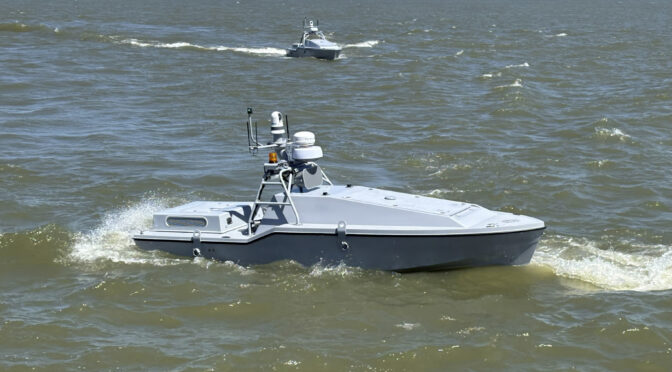
Featured image: Manned teams on shore demonstrate the capabilities of two 24-foot autonomous surface vessels in Suisan Bay, California at Military Ocean Terminal, Concord May 14, 2026, during a multi-day presentation by U.S. Army industry partner Saronic and DEVCOM Ground Vehicle Systems Center. (DEVCOM Ground Vehicle Systems Center photo by Jennifer DeHaan)
Discover more from Center for International Maritime Security
Subscribe to get the latest posts sent to your email.