Category Archives: Capability Analysis

Analyzing Specific Naval and Maritime Platforms

The Number of Mines is Less Than Infinity

By Dr. Michael M. Rosenthal, Naval Surface Warfare Center, Panama City Division

“I would be very surprised if professionals engaged full time in [Mine countermeasures] MCM who speak routinely with other professionals in the same field had no genuine prior knowledge.”–Fred Huffer, Professor of Statistics, Florida State University

Mine countermeasures are actions intended to reduce the risk that mines pose to transiting vessels. Risk is defined as the probability that a transiting vessel will incur mission abort damage from a mine detonation if it travels along a predetermined route through the potentially mined area. The purpose of an MCM operation is to lower the risk so it is safer to transit. The estimation of risk is critically important to determine if the level of risk to a transiting vessel is acceptable and if the applied effort is effectively lowering the risk.

Some of the traditional MCM tactics are founded on Bayesian risk metrics that utilize a non-informative prior distribution for the number of mines. Some statisticians prefer to use non-informative priors because they feel it is more objective. The non-informative prior reduces the amount of required inputs from the tactician so there is less error introduced from the human operator, but it also defeats the entire purpose of using a Bayesian paradigm because the prior distribution does not utilize any information. It assumes that any number of mines is equally likely. In most cases, it is far more likely that there are just a few mines and it is very unlikely there are millions of mines.

Bayesian methods are ideal for the development of MCM risk metrics because they facilitate learning as information is acquired. This is good for MCM because new information and new decisions are frequently acquired throughout the operation. New events often occur which provide critical information and appropriate responses are promptly needed. These events vary greatly in detail. Bayesian analysis centers on utilizing Baye’s theorem to formally combine prior information with newly gathered information. This provides more freedom to create information synergy. 

Bayesian calculations utilize a prior distribution to incorporate information about parameters of interest before conducting a trial. In the context of MCM, the total number of mines is an unknown parameter of interest and a search or sweep of the mines is a trial. The choice in prior distribution is less critical when data is plentiful as long as the prior is not too restrictive. When there is an abundance of data, a reasonable prior will have a weaker impact on the final analysis because the posterior distribution will be primarily influenced by the data. However, data is usually limited in MCM operations, so the prior distribution will have a stronger impact on the analysis. In this case, it is critical to scrutinize the choice of prior in order for the risk metric to be meaningful.

Some of the traditional risk models actually use an improper prior for the total number of mines. An improper prior is sometimes used as an uninformative prior with the interpretation that any value is equally likely. However, many statisticians caution against using them since they are known to complicate interpretation and this usually does not provide an appropriate Bayesian update. The improper prior is formed by taking a limit of uniform distributions as the maximum number of possible mines goes to infinity. This does not converge to a probability distribution, so there is no meaningful interpretation of the prior belief for the number of mines.

Having an appropriate Bayesian update is important to MCM because if the result of a single pass of an MCM clearance does not reduce the posterior risk to an acceptable level, then the MCM staff will need to re-plan and execute a second clearance operation in the same area to further reduce the risk. This process will iterate until the risk is lowered to the threshold level.

As Fred Huffer stated, “It would be very surprising if professionals engaged full time in [Mine countermeasures] MCM who speak routinely with other professionals in the same field had no genuine prior knowledge.” If the user cannot reliably provide any information, then a large value for the expected number of mines and a corresponding large variance can be chosen because there is less certainty in that estimate. The user should be able to reliably provide some basic information that can be utilized in the prior belief by answering two simple questions:

  • How many mines could be in the region (few or many)?
    • (Few) i. e. the enemy has a small inventory or just a few can fit in the region
    • (Many) i. e. the enemy has a large inventory or they could lay thousands in the region
  • How certain are you in the amount above (low or high)?
    • (Low) a subjective guess based on limited intelligence information
      • i. e. if I were a minelayer, what would I do?
    • (High) a more objective belief based on concrete observations.
      • e. g. vessel with room for 10 mines was sighted laying mines.

The negative binomial distribution is one possible prior distribution that can be used for the mine risk Bayesian framework. Analytical expressions for the required clearance and the risk from remaining mines are easily derived. Not only is the mathematics cleaner and easier to interpret, but it also provides a sensible approach to incorporate prior intelligence information (information known before applying effort) into the analysis.

How does using the negative binomial distribution compare with the popular (uninformative) improper prior? There is no significant difference between calculations derived using the improper prior and using a negative binomial distribution with mean of 10^15 and a variance of 10^30+10^15 as the prior distribution. This default distribution implies that on average we expect there to be one quadrillion mines in the region with an unthinkably enormous variance (one nonillion + one quadrillion) to adequately accommodate our complete uncertainty in the possible number of mines prior to applying effort. To put these numbers into perspective, the surface of the ocean has an area of roughly 360 million square kilometers. That is 3.6×10^14 square meters. If you could place one quadrillion mines over a 360 million square kilometer area, the mines could be spaced on a rectangular grid roughly 0.6 meters meters apart. This setting of the prior goes as far as to say that we think it is reasonably possible that there could more than two quadrillion mines in the region.

If there is genuine concern that the end user cannot do better than this assumption, then after applying mine countermeasures a simple hypothesis test can be done to validate the user selected prior mean and variance against the default. In this way, if the end user significantly mis-specified the prior, then a flag can be automatically raised to warn the commander that the user is unable to translate the prior intelligence information into a reasonable prior belief for this operation. In this case, the command will have significant evidence to reject the assumption that a more reasonable prior belief can be derived by the end user, and return to the default condition. It is important to note that such a flag raise would not imply an outrageous deficiency in judgement by the end user. However, a flag-raise should initiate a discussion of caution toward objectively and consistently arriving at a reasonable prior distribution. Following this protocol should effectively insulate the MCM mission from this type of human error.

We generally prefer to make decisions based on an analysis that utilizes more information over a similar analysis which utilizes less information. An analysis that relies on a non-informative prior can most often be improved with an informative prior. With a non-informative prior, no prior information is being specified, so it is easy to come up with a distribution that utilizes some additional information. An informative prior often improves the interpretation and practicality of the analysis because more realistic assumptions can be made.

The updated theory in this work gently bridges more traditional doctrine into a broader realm of possibilities so that some basic information that has not been utilized can now be incorporated to improve the decision quality for the Navy.

Dr. Michael Rosenthal received his doctorate degree in Mathematical Statistics from the Florida State University in 2014. He received his bachelor’s degree in Mathematics with a minor in Statistics from the University of Florida in 2009. For five years, Dr. Rosenthal has worked at the Naval Surface Warfare Center, Panama City Division, developing basic research topics with academic colleges and assessing warfighter needs for updating and transitioning actionable tactics in the field of mine warfare.

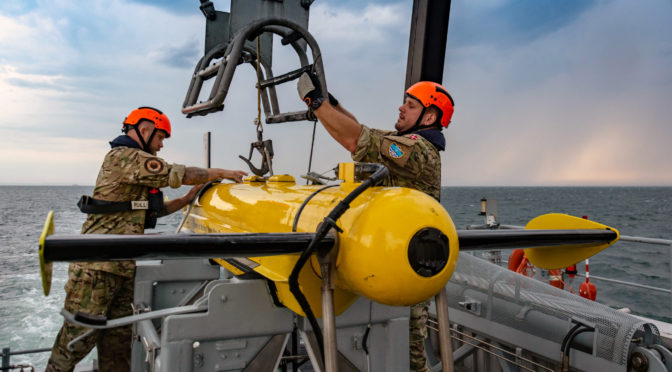
Featured Image: BALTIC SEA (June 18, 2019) HDMS MSF-1 assigned to Standing NATO Mine Countermeasures Group One (SNMCMG1) conducts side scan sonar exercises while transiting the Baltic Sea during exercise Baltic Operations (BALTOPS) 2019. (U.S. Navy photo courtesy of NATO by CPO Brian Djurslev/Released)
Ignorance of China is Not Bliss

By Capt. Brent Ramsey (ret.)

China Rising

China is modernizing every element of its military. It has announced plans to field a world-class military by 2035 and a dominant military by mid-century.1 Consistent with its goal of regional hegemony, China is building Navy, Coast Guard, and merchant ships faster than any other nation. Its Navy now directly commands China’s Coast Guard, adding hundreds of ships to its fleet. China’s fleet of warships now outnumbers U.S. warships in the Indo-Pacific by about 10 to 1. With this new capability, China constantly intimidates its neighbors through its increasingly aggressive maritime behavior.2

China intends to control the international waters off its shores.3 It has invested heavily in long-range anti-access area denial (A2/AD) missiles. These missiles represent a serious threat to warships, since considerable uncertainty exists about the effectiveness of the defenses against them.4 A strategic benefit of robust A2/AD missiles is increasing the stand-off distance from China that warships must maintain to avoid attack. By pushing navies further away from shores, these weapons look to turn the China Seas into Chinese territorial waters. According to the Commander of U.S. Indo-Pacific Command, Admiral Phil Davidson, “China is now capable of controlling the South China Sea in all scenarios short of war with the United States.”5

In the past few years, China has illegally constructed, and subsequently militarized, multiple artificial islands using various features like reefs, shoals, and atolls in the South China Sea in international waters. Most of these sites have conflicting claims of ownership between China and other countries including Malaysia, Taiwan, the Philippines and Vietnam. Construction has occurred at seven sites in the Spratly Islands, 20 sites in the Paracel Islands, and at Scarborough Shoal, totaling more than 3200 acres of reclaimed ocean upon which China has built high-tech military facilities including airfields and missile batteries.6 The UN Permanent Court of Arbitration ruled in favor of the Philippines and against China in July 2016, expressly rejecting China’s claims in the area near the Philippines in the South China Sea.7 The tribunal ruled that China’s claims to sovereignty over 90 percent of the South China Sea, particularly with regard to the Spratly Islands, part of which the Philippines claim, was invalid. It specifically found that “China had violated the Philippines sovereign rights in its exclusive economic zone in the South China Sea.”8 Virtually every other nation in the region rejects China’s claims.

China, ignoring the UN ruling,9 continues to militarize the area. Chinese aircraft and ships continue to harass many ships and aircraft of other countries venturing near.10 China has now largely gained the ability to manage and interfere with the commerce passing through the South China Sea if it so chooses. The U.S. and other countries continue to conduct Freedom of Navigation Operations (FONOPS) near these features and through the Taiwan Strait, but China vigorously protests these FONOPS and orders U.S. or allied ships out of its “sovereign waters.” After a recent FONOP near the Paracels, the Chinese government boldly issued the following statement, “We again stress that China has irrefutable sovereignty over the islands of the South China Sea and their nearby waters.”11

In order to counter this emergent capability and China’s increasing aggression, deploying a much larger number of warships to the region is urgent.

The U.S. Navy and China’s Threat

Alfred Thayer Mahan’s The Influence of Sea Power on History12 was a seminal military planning and strategy framework that shaped maritime defense and international trade policy in the 19th and 20th centuries. Mahan’s theories concerning the extraordinary importance of sea power to defend national sovereignty and economy still apply today.13 Given how 71 percent of the Earth’s surface is ocean, having a powerful Navy is essential for protecting vital commerce, defending coastlines, and defeating almost any enemy. Throughout American history, time and time again, the use of the U. S. Navy at critical junctures has been the key to its defense and the implementation of national policy. Whether it was fighting the Barbary Pirates, sending the Great White Fleet around the world, the Battle of the Atlantic during WWII, the invasion of Normandy with thousands of ships, or turning the Japanese back at Midway, the U.S. Navy has always played a vital role in war and peace. It must do so again in the Indo-Pacific by resisting China’s goals.

With an adequately sized fleet, the Navy’s ability to control the sea using nuclear-powered carriers with embarked air wings, sophisticated attack and guided missile submarines, Aegis cruisers and destroyers, coupled with unparalleled forward logistics support, would be unmatched. Virtually no one contemplates a land war with China, making the Army’s role in containing China in the Indo-Pacific somewhat limited. The Air Force can project power in Asia but its capability is much more limited than the Navy’s given its dependence on a finite number of fixed launch points and an extremely long logistics tail. With the vastness of the Indo-Pacific area of responsibility, much of it covered by oceans, only the Navy can be effective at countering China’s influences in place and prevent China from becoming a regional hegemon.

But despite the importance of having a robust Navy of sufficient size and capability to defend U.S. national interests, it is acknowledged by most defense experts that the Navy is no longer large enough to ensure freedom of navigation and to limit China’s aggressive behavior in international waters. The Navy’s technical superiority will make a difference only if there are enough ships in the right places. If the U.S. does not retain supremacy in the Indo-Pacific, China will inevitably step in to fill the vacuum.

The current administration and Congress have recognized the need for 355 ships,14 but the Navy currently has only 295 warships in commission,15 and a recent Congressional Research Service report on shipbuilding estimates that with current budget profiles the only way the Navy will reach the goal of 355 is by extending the life of existing ships to 40 and 45 years for various ship types and with increasing maintenance costs.16 With the increasing threat from China and others, the requirement is most likely much higher. The Heritage Foundation documented a need for 400 warships.17 With the inadequately sized force and with approximately one third of the current fleet already deployed at any one time, it is hardly surprising that the Navy cannot effectively keep up with China’s actions in the vital Indo-Pacific. The Navy is already so over-tasked in Asia that many ships have been forced to neglect basic navigation training and overwork it sailors with 100+ hour workweeks, resulting in multiple tragic accidents costing many lives.18

In any conflict, the best strategy would be to project power away from the U.S. and toward the adversary. But China is a long ways away as it takes weeks to traverse the 6000-plus miles from the West Coast to China. The Navy must already have a significant proportion of the fleet in place when needed. Only the Navy can loiter indefinitely near China, supported by the most capable logistics systems. Only the Navy’s power projection assets can freely exercise the American sovereign will for the U.S. and its allies, even to blockade China if necessary. The need is urgent not only for more warships, but also for more advanced warships like the Ford-class CVN and the next generation of attack and ballistic missile submarines and surface combatants that can challenge China’s A2/AD weaponry.

However, modern warships are tremendously complicated and take a lengthy time to build. The newest U.S. carrier, the USS Gerald Ford (CVN-78), took 12 years to build. It was commissioned in July 2017, but is still not certified for combat.19 Other ship classes take less time to build, but none less than 6 years. Because it takes so long to construct warships, the next war will almost certainly be fought with the ships already on hand today, unlike in WWII where the industrial base was a decisive factor. But since the fall of the Soviet Union, the U.S. shipbuilding industry has experienced a tremendous decline. Today there are only seven shipyards in the U.S. capable of building Navy warships.20 The complex nature of Navy combatants requires the retention of a robust, state-of-the-art shipbuilding industry that is capable of building the world’s most advanced warships. According to the Congressional Research Service, the industry has unparalleled capability but limited capacity as it can only build a handful of ships at a time and would have to add considerable numbers to the workforce and make major plant investments before being able to build more ships faster.21 But it is urgent to build more ships now while there is still time.  

Conclusion

While the average U.S. citizen is not aware of the dire threat that China represents, that is not the case for Navy stakeholders and supporters. The U. S. Naval Institute, the Navy League of the United States, the Association of the United States Navy, the Center for International Maritime Security, key Congressional leaders, shipbuilders, and defense think tanks are all too aware of China’s rise and the extreme risks that will dawn in the coming years. These stakeholders wield considerable influence in how the nation plots its maritime course through troubled waters. What seems to be lacking among them is effective coordination that would lead to a shared vision and unified plan for a response to the China threat, with an emphasis on increasing naval power. These organizations must strive to work together to establish common goals in support of the Navy, and inform citizens about the risks and potential consequences at hand.

Will history give a postmortem of a vanquished America that squandered preeminence because it neglected its own defense? The real question is whether the U.S. can afford not to spend adequately on defense and its Navy. We must urgently build far more warships to defend the nation against China, or else entertain the possibility of a more dangerously uncertain future.

Captain Brent Ramsey (ret.) served 30 years in the Navy and 23 years in the Navy Civil Service. He commanded Cargo Handling Battalion TWELVE, was Operations Officer/Business Manager, CBC Gulfport, and was Navy Emergency Preparedness Liaison Officer to Mississippi. He currently serves as Senior Advisor, Center for International Maritime Security, and Member/Secretary of the Meadows Military Advisory Group.

References

1. David Ignatius, “China has a plan to rule the world,” The Washington Post, 17 November 2017, https://www.washingtonpost.com/opinions/china-has-a-plan-to-rule-the-world/2017/11/28/ and US-China Economic and Security Review Commission, (US-China Economic and Security Commission Report, November 2018, 25.

2. Lyle Morris, “China Welcomes its newest Armed Force:  The Coast Guard,” War on the Rocks, 4 April 2018, https://warontherocks.com/2018/04/china-welcomes-its-newest-armed-force-the-coast-guard/

3. Christopher Cowan, “A2/AD-Anti-access/area denial,” Real Clear Defense, 12 September 2016,   https://www.realcleardefense.com/articles/2016/09/13/

4. Ronald O’Rourke, “China Naval Modernization:  Implications for U. S. Navy Capabilities – Background and Issues for Congress,” Congressional Research Service Report, 1 August 2018, 8-10.

5. Steven Lee Myers, “With Ships and Missiles, China is Ready to Challenge US Navy in Pacific,” New York Times, 29 August 2018. https://www.nytimes.com/2018/08/29/world/asia/china-navy-aircraft-carrier-pacific.html/

6. Asia Maritime Transparency Institute, https://amti.csis.org/island-tracker/china/

7. Katie Hunt, “South China Sea:  Court Rules in Favor of Philippines over China,” 12 July 2016. https://www.cnn.com/2016/07/12/asia/china-philippines-south-china-sea/index.html/

8. Tom Mitchell and Geoff Dyer, “Tribunal rules against Beijing in South China Sea dispute”, Financial Times,12 July 2016, https://www.ft.com/content/3cdcbf42-4814-11e6-8d68-72e9211e86ab/

9. Tom Phillips, Oliver Holmes, Owen Bowcott, “Beijing rejects tribunal’s ruling in South China Sea case,” The Guardian, 12 July  2016, https://www.theguardian.com/world/2016/jul/12/philippines-wins-south-china-sea-case-against-china/

10. Ben Werner, “Destroyer USS Decatur Has Close Encounter with Chinese Warship,” USNI News, 1 October 2018, https://news.usni.org/2018/10/01/37006/

11. Spratly Islands Confidential, South China Sea: US Navy Warship Conducts Freedom of Navigation Operation Near Paracel Islands, 15 September 2019. http://spratlyislandsconfidential.com/south-china-sea-us-navy-warship-conducts-freedom-of-navigation-operation-near-paracel-islands/

12. Little Brown and Company, 1890.

13. Dr. John H. Mauer, “The Influence of Thinkers and ideas on History, the Case of Alfred Thayer Mahan,” Foreign Policy Research Institute, 11 August 2016, https://www.fpri.org/article/2016/08/influence-thinkers-ideas-history-case-alfred-thayer-mahan/

14. “2016 Navy Force Structure Assessment,” 16 December 2016, https://www.navy.mil/submit/display.asp?story_id=98160/

15. “Status of the Navy,” 24 July 2019, https://www.navy.mil/navydata/nav_legacy.asp?id=146

16. Ronald O’Roarke, “Navy Force Structure and Shipbuilding Plans: Background and Issues for Congress,” Congressional Research Service Report, 10 June 2019, 22.

17. “2019 Index of Military Strength” edited by Dakota Wood, The Heritage Foundation, October 2018, 8

18. Alex Norton and Thomas Gibbons-Neff, “Deadly Navy Accidents in the Pacific raise Questions over a Force Stretched too Thin,” The Washington Post, 20 August 2017, https://www.washingtonpost.com/news/checkpoint/wp/2017/08/26/deadly-navy-accidents-in-the-pacific-raise-questions-over-a-force-stretched-too-thin/

19. Navy Fact File, USS Gerald R. Ford, https://www.navy.mil/navydata/fact/; Allen Cone, “Ford-class combat system completes test, first carrier further delayed, UPI, 13 June 2019, https://www.upi.com/Defense-News/2019/06/04/Ford-class-combat-system-completes-test-first-carrier-further-delayed/9161559662262/

20. Huntington-Ingalls, Newport News, VA and Pascagoula, MS, General Dynamics, Bath, ME, Groton, CT, and San Diego, Austal USA, Mobile, AL, and Marinette Marine, Marinette, WI.

21. Ronald O’Rourke, “Navy Force Structure and Shipbuilding Plans: Issues for Congress,” Congressional Research Service Report, 19 October 2018, 45.

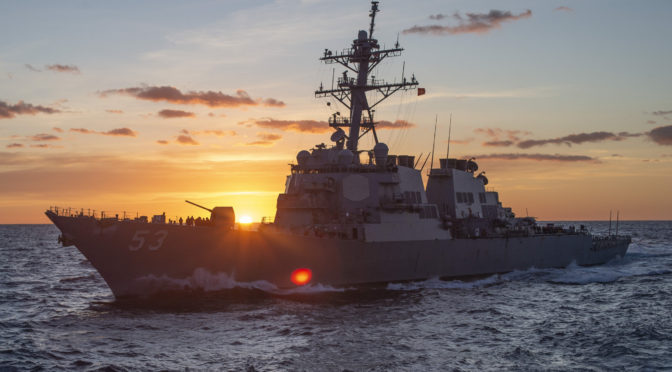
Featured Image: PACIFIC OCEAN (Feb. 5, 2020) The Arleigh Burke-class guided-missile destroyer USS John Paul Jones (DDG 53) prepares to pull alongside the aircraft carrier USS Nimitz (CVN 68) in preparation for a replenishment-at-sea. (U.S. Navy photo by Mass Communication Specialist 3rd Class Kyle Merritt)

Winning the Invisible War: Gaining an Enduring Advantage in the EMS

The following article is adapted from a new report by the Center for Strategic and Budgetary Assessments (CSBA), Winning the Invisible War: Gaining an Enduring U.S. Advantage in the Electromagnetic Spectrum.

By Bryan Clark, Whitney M. McNamara, and Timothy A. Walton

The explosion of mobile communications and emerging Internet of Things are turning the electromagnetic spectrum (EMS) into an increasingly crowded place. The advent of 5G, which needs wide swaths of spectrum in multiple frequency ranges to achieve high data rates, will only intensify this trend and create more conflicts between commercial and government users. The challenge of spectrum management and control will be acute for militaries, which depend almost entirely on the EMS for sensing and communications.

The American military is particularly affected by a congested EMS. U.S. forces deploy the most advanced networks of sensors and precision-guided munitions, relying on them for almost all operations. Adversaries like China and Russia have exploited this dependence during the last decade by developing and fielding a comprehensive array of electronic warfare (EW) systems to contest the spectrum.

The U.S. military, however, did not address the challenge posed by its competitors and numerous assessments now argue the U.S. military is unprepared for competition or conflict in the EMS. The problem was not a lack of funding, as defense spending for EMS operations grew steadily since 2015. DoD’s EMS shortfalls arose because the additional dollars were not spent implementing a coherent strategy and instead were used to upgrade legacy systems and fill various capability gaps. Regaining EMS superiority against Chinese and Russian forces at the current pace will take one or two decades – assuming America’s adversaries do not continue to improve.

DoD should accelerate its efforts to regain an advantage in the spectrum, but likely budget constraints will preclude simply throwing more money at the problem. Instead of perpetuating the current move-countermove competition by attempting to fill every EMS capability gap, DoD can adopt a new approach to EMS operations focused on asymme­tries between U.S and opposing militaries. An EMS strategy designed to undermine enemy strengths and exploit adversary vulnerabilities may leave some capability gaps intact but could be the only way for the U.S. military to achieve EMS superiority in time to forestall opportunistic aggression by one of America’s military competitors.

Exploiting Asymmetries

The most important asymmetry between U.S. and opposing militaries is the adversary’s “home team” advantage and how it impacts EMS operations. For example, Chinese and Russian forces can exploit their proximity to likely conflicts by employing sensor techniques that rely on multiple stationary arrays such as passive radio frequency (RF) detection or geolocation and long-range high frequency radars. As an expeditionary force, the U.S. military is less able to employ these techniques and often relies on active, monostatic radars for situational awareness and defense, exposing U.S. units to enemy detection and geolocation.

Their home team advantage also allows China’s People’s Liberation Army (PLA) and the Russian Armed Forces to place EW and sensor systems on their own territory, where they can rely on wired communications, or in nearby sea or airspace, where line-of-sight RF communications can be reliable and difficult to jam. The relatively uncluttered spectrum near their territory also permits Chinese and Russian militaries to pre-plan their spectrum use. As an expeditionary force, the U.S. military must manage spectrum dynamically.

The proximity of U.S. competitors to likely areas of conflict creates additional asymmetries in force design and command and control (C2) between U.S. and competing militaries. For example, because the PLA understands where conflict is likely to occur, the Chinese forces to be employed, and the likely variety of enemy dispositions and tactics, the PLA can employ pre-architected systems of systems and tactics. This approach, which Chinese military strategists call System Destruction Warfare, prioritizes attacks on perceived enemy vulnerabilities, such as U.S. forces’ dependence on the EMS. Although it also uses pre-architected systems and focuses contesting adversary information operations, the Russian military’s C2 approach delegates subordinates more authority to improvise tactics. Similar to PLA leaders, however, Russian commanders are expected to use modeling and cybernetics to scientifically lead forces and antici­pate combat outcomes.

The worldwide commitments of the U.S. military require a more expeditionary and self-contained force design than those needed by Chinese or Russia forces. Today, U.S. forces center on large multimission platforms and troop formations, which are efficient but constrain the force’s flexibility. U.S. forces also need a more adaptable C2 process than the Chinese or Russian militaries to accommodate more contested communications, changing force packages, and the variety of local conditions. The U.S. military employs “mission command” to rely on a junior leader’s judgment and ability to follow the commander’s intent if communications are lost. A lack of planning and management tools available to junior commanders currently hinders their ability to innovate, however, making their actions more predictable to an adversary.  

A Return to Maneuver Warfare

To regain EMS superiority, DoD should focus on exploiting asymme­tries in ways that could undermine adversary strengths or exploit enemy vulnerabilities. Most prominently, the home team advantage of U.S. adversaries could be turned into a weakness if DoD adopts new warfighting approaches that emphasize maneuver and complexity. For instance, the PLA’s reliance on pre-planned, static systems of systems and tactics could be a disadvantage against highly dynamic and unpredictable U.S. force postures and capabilities. Furthermore, complex U.S. operations in the EMS could be especially effective against Chinese and Russian operational concepts that center on defeating U.S. C2, communications, and sensors.

To fully exploit the potential of maneuver warfare, the U.S. military should replace some of its self-contained multimission units that result in highly predictable force packages and tactics with cheaper and less multifunctional units to create a disaggregated and recomposable force. This would enable greater adaptability in U.S. force packages while imposing considerable complexity on adversaries. A disaggregated force would better enable the U.S. military to conduct EMS operations that would be challenging for an enemy to detect and counter, including passive and multistatic sensing, distributed EW, and decoy operations.

A disaggregated force will be difficult to manage, however, in a contested communications environment. Instead of DoD’s current trend toward centralized staffs and resilient wide-area communications for distributed operations, the U.S. military should address this challenge by adopting context-centric C2 and communications (C3). In this approach, C2 relationships are based on communications availability, rather trying to build a communications architecture to support a pre-determined C2 hierarchy. An essential element of context-centric C3 is planning tools that enable junior leaders at to creatively plan, adapt, and recompose their forces and operations. These tools are already being developed and fielded by DoD labs and industry.

U.S. forces will also need to dramatically change how they operate in the EMS to impose complexity and uncertainty on an adversary. Most importantly, the U.S. military’s over-reliance on active monostatic radars can enable adversaries to understand U.S. dispositions and tactics because radars can be detected, classified, and geolocated relatively easily. To more fully support maneuver and adaptability, U.S. forces should use more passive or multistatic sensing, complemented by LPI/LPD communications and electronic countermeasures.

To support passive and multistatic sensing, every U.S. EMS system should also incorporate passive RF detection, or electronic support (ES), functionality. ES capabilities would also help achieve LPI/LPD characteristics by monitoring friendly emissions; improve the effectiveness of EW actions by sensing adversary EMS actions; and enable coordination of EMS operations with minimal communications by detecting EMS operations of collaborating units. Introducing multifunction EMS systems to U.S. forces that can communicate, sense, jam, and decoy, would increase the variety of locations from which sensing or effects be delivered and provide greater adaptability to U.S. forces.

Fully exploiting networked and multifunction capabilities to operate at machine speed will require operators to yield some deci­sion-making to the EMSO system. Today, adaptive algorithms that can react to adversary actions are reaching EW systems in operating forces. These programs should be accelerated, along with efforts to establish testing processes and data governance procedures for future cognitive EMS systems. The most significant impediments to networked EMSO and EMBM are creating interoperable data transmission standards and the varied security levels at which different EMSO systems operate.

EMS maneuver and superiority only have meaning if DoD treats the EMS as an operational domain. Today’s approach to EMS operations treats the EMS as a utility, in which actions such as electronic attack (EA), ES, electronic protection (EP), communications, and sensing are distinct operations. In a domain construct, these actions would be considered as interrelated operations that can be employed in concert to accomplish the commander’s intent and tasking through maneuver in the EMS.

Implementing a New EMS strategy

A more disaggregated and recomposable force has significant impli­cations for how DoD identifies and develops new capabilities. For example, requirements will be harder to determine if the configuration of force packages is not known in advance. Therefore, DoD could adopt an opportunity-based, rather than requirements-based, approach to capability development. New systems would be assessed based on their ability to improve mission outcomes in a range of scenarios and force packages, rather than engineering a point solution based on assumptions regarding future forces and operations. DoD’s new Middle Tier Acquisition Process reflects this approach.   

One tool for assessing the potential benefits of new technologies or systems is experimentation. DoD’s EMS training ranges are unable to provide realistic modern operational environments, but operational security concerns would prevent U.S. forces from recouping the significant investment needed to upgrading live open-air facilities. DoD should shift its emphasis for EMS operations training to virtual and constructive facilities, which would enable concept development, tactics innovation, and training against the most challenging threats at all security levels. Live EMS training to practice safe operations could focus on less-modern threats or employ closed-loop radar, communication, and EW systems.

An Imperative to Change 

DoD cannot continue attempting to gain EMS superiority by incrementally filling capability gaps. This approach is too unfocused, will take too long to reach fruition, is potentially unaffordable, and cedes the initiative to America’s great power competitors. Instead of reacting to adversary moves with its own countermoves, DoD should move in a new direction and focus EW and EMSO capability development on implementing concepts for maneuver warfare that create adaptability for U.S. forces and complexity for adversaries.

If the DoD does not mount a new more strategic and proactive approach to fighting in the EMS and developing the requisite capabilities, adversaries could be emboldened to continue their efforts to gain territory and influence at the expense of U.S. allies and partners. Demonstrating the ability to survive and fight in a contested EMS could help U.S. forces slow Chinese and Russian activities and deter or dissuade these adversaries from more aggressive approaches to their objectives.

Bryan Clark is a Senior Fellow at CSBA.

Timothy Walton is a Research Fellow at CSBA.

Whitney M. McNamara is a Senior Analyst at CSBA.

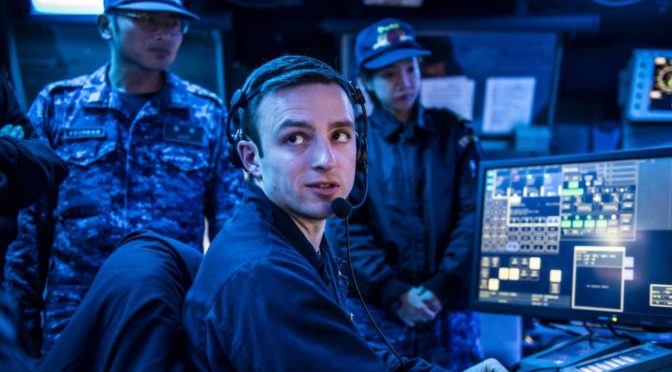
Featured Image: PHILIPPINE SEA (Nov. 13, 2019) Lt. j. g. Louis Wohletz, from Minneapolis, center, is observed by Japan Maritime Self-Defense Force officers as he stands watch as a surface warfare coordinator during a maritime strike operation exercise in the combat information center of the Arleigh Burke-class guided-missile destroyer USS Milius (DDG 69) during Annual Exercise (ANNUALEX) 19. (U.S. Navy photo by Mass Communication Specialist 2nd Class Taylor DiMartino)

The Future of Aircraft Carriers: Consider the Air Wing, Not The Platform

By Robert C. Rubel

A lot of ink has been spilled over the past decade or so concerning the viability of the aircraft carrier. Some regard its combination of expense and vulnerability to cruise and ballistic missiles as fatal to its continued utility. Supporters argue that a modern supercarrier’s size and design make it all but unsinkable, and that its power is key to the U.S. Navy’s ability to deter, to punish, and to defeat aggression. It is this author’s contention that the controversy is focused on the wrong thing: the carrier itself. Rather, it is the viability of its primary weapon system – the air wing – that should be at the center of analysis. When some do take on the air wing, it is usually to decry the lack of mission radius of modern strike fighters. But that also misses the point. Instead, what is it that the air wing, irrespective of the range of its aircraft, is supposed to do? That is a function of the ability of aircraft to penetrate to a launch point, and the ability of the weapons they deliver to achieve the effects needed. A valid discussion of those factors involves much more than just “bombs on target.” 

Unfortunately, most if not all of the discourse taking on the matter of aircraft carriers focuses on the vulnerability or impregnability of the ship. The capability of the air wing to do something tactically, operationally, or strategically useful is either assumed or ignored. But it was precisely this consideration that formed the basis for justifying aircraft carriers in the first place, and the argument that won them a reprieve from the scrap heap after World War II.

Aircraft carriers were a consequence, not a cause. Admiral William Sims perceived the potential of aircraft-delivered bombs to sink battleships. He thus sponsored a series of wargames at the Naval War College after World War I to determine what it would take for sea-based aircraft to constitute a lethal offensive weapon. The insights gained in those games influenced the subsequent design of aircraft carriers. The presumed number of aircraft needed for successful attack against an enemy fleet drove design elements ranging from the mid-ship barrier to the size and number of aircraft carriers needed for a naval offensive. They were always regarded as vulnerable, as operations in the Pacific in World War II proved, but so long as their offensive power could be brought to bear, they were key to fleet success.

The development of nuclear weapons and ultra-long-range bombers posed an existential threat to the aircraft carrier. Soon after WWII leaders of the newly formed U.S. Air Force asserted that the combination of the B-36 bomber and nuclear weapons made the Navy’s aircraft carriers irrelevant. The Navy, for its part, designed a new class of aircraft carrier able to support the large aircraft needed to carry the massive nuclear bombs of the time. However, the USS United States, the lead ship, was cancelled by Secretary of Defense Louis Johnson, precipitating the “revolt of the admirals.” In pivotal Congressional testimony, Admiral Forrest Sherman and others made the case that the B-36 was too slow and vulnerable to reach its intended targets in the Soviet Union, but carrier aircraft had a much better chance. That argument for the strategic utility of a carrier air wing carried the day, and subsequently the USS Forrestal was authorized. In the arena of nuclear warfare logic, the aircraft carrier was regarded as consumable so long as it could reach its launch point before being sunk.

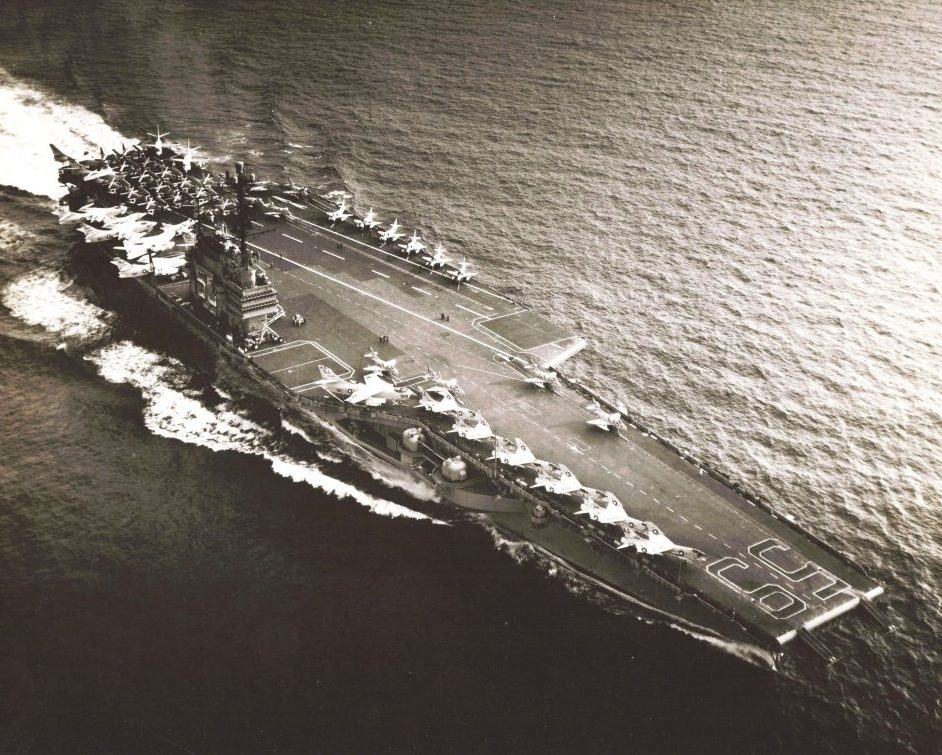
USS Forrestal (CVA-59) underway on 29 August 1959, after completing her first regular overhaul and with Carrier Air Group 8 (CVG-8) aboard for the first time. (Via Navsource)

The conventional utility of sea-based tactical aircraft was demonstrated in the early stages of the Korean War. South Korean airfields were overrun by the North Korean army, so the only source of critical air support for troops on the ground were three aircraft carriers. They could function as airfields at sea, sacrificing their mobility because there was no threat to them at sea. The combination of being available when land-based air was not, and being ready on arrival since the carrier carried enough ordnance and fuel for a week’s operations, made the carriers valuable in a wide variety of situations.

This author’s experience as CO of a strike fighter squadron aboard USS Eisenhower in 1990 is also illustrative. Not long after Saddam invaded Kuwait, we passed through the Suez Canal into the Red Sea. We were convinced that we would be launching strikes into the Kuwait Theater of Operations (KTO) the next morning. The Air Force had already sent fighters into Saudi Arabia, but they had no ordnance, with their stockpiles in the UAE taking a week or more to reach the Riyadh-area airfields. We however had plenty of ordnance on hand, but were 670 miles from the KTO. The Air Force had positioned Air National Guard KC-135s in Jiddah on the Red Sea coast so we had plenty of tanking available. However, doing our time-distance calculations revealed that we could only keep six aircraft at a time in the area.

This points to the problem. A carrier air wing can bring power to bear when no other source of tactical air power is available, but only in limited quantities. If Saddam had decided to keep going south, would six aircraft have had any effect against his large army and hundreds of aircraft? What if we had started to lose aircraft, as we indeed at that time thought we would?  The loss of one or two planes per wave would have quickly reduced the air wing to impotence. The Doolittle Raid points to the other side of that logic. That raid was a “hit and run” operation for the carriers and a one-way ride for the Air Corps crews. However, despite its pin-prick nature, it had strategic effects all out of proportion to the extent it reinforced Admiral Yamamoto’s resolve to conduct the Midway operation, and it also boosted morale at home. The two faces of the strike coin reveal the opportunities and limitations of carrier-based air power. If one can define potential catalytic effects that can be achieved by strategically significant strike, also illustrated by the series of hit-and-run carrier raids on Japanese island airfields in 1942, and these potential effects are of sufficient strategic importance to justify the possible loss of a carrier ( as they were in the Doolittle case) then the investment in aircraft carriers supporting deep strike wings makes sense, if – and only if – those effects cannot be achieved with stand-off missiles.

If a greater, more sustained application of airpower is needed, then the carrier air wing is not a suitable weapon. The other element of that equation, noted previously in the Desert Shield example, is the application of power at range. Regardless of aircraft mission radius or the availability of aerial refueling, the farther the target, the fewer aircraft that can deliver their weapons unless, like the Doolittle Raid, it is a one-time shot. Moreover, any aircraft losses will rapidly deplete the air wing’s ability to support iterative, distant strikes. The advent of modern, lethal air defenses like the Russian S-400 and those aboard modern Chinese warships makes such losses more likely, and any “friction” in the form of mechanical failures or logistic shortfalls exacerbates the problem. The hand waves concerning the carrier air wing’s weaknesses are embedded in much of the discourse supporting the aircraft carrier, and serve to muddy the analytic waters.

In a potential war with China in the Western Pacific it is hard to conceive of a limited target set that could be hit with tactical carrier air power that would have the kind of strategic effects that would justify risking the loss of a carrier, such as the Doolittle Raid of 1942. One might make the case that the air wing’s ability to strike PLAN shipping might constitute such a justification. But to do so, the strike fighters would have to carry weapons like LRASM and thus become simply first stages to those missiles. In any case, the PLAN will soon have enough ships to make any kind of one-shot decisive strike like the Navy achieved at Midway a pipe dream. What kind of “calculated risk” message could a modern PACFLT or SEVENTH Fleet commander be able to credibly write to battle group commanders?   

None of this means that aircraft carriers and their air wings are obsolete. Carriers, by virtue of their centrality in USN fleet design since 1942, have been used in many different methods connected with forward presence because they are what the Navy has. In peacetime and in cases of limited warfare, they have proven to be highly useful, which is why the demand for them by Geographic Combatant Commanders is so extensive. They can be moved around the globe like queens on a chessboard, responding to disasters, minor aggressions, and showing the flag either in threat or in support. They are big, impressive, and prestigious, which is why, despite their expense and presumed vulnerability, countries that can are either building or buying them. In the global presence arena, the issue of justification revolves around expense versus political effect.

Carriers can retain high end warfighting utility also. In addition to air-to-surface missions, either at sea or across the shore, the carrier air wing can also focus on air-to-air work, not simply to defend the carrier, but to support surface forces in various ways to include defeating enemy air ASW efforts (a key initial mission of the old Soviet Su-27), protection of our high-demand, low-availability assets like P-8s and Triton UAVs, and air superiority over distributed surface forces. Presumably (and this would have to be evaluated by gaming and simulation) such missions would allow the aircraft carriers more scope for maneuver and thus reduce their risk.

More and more, missiles are becoming the principal strike weapon of all the world’s armed forces. Navy fleet design should pivot on that assumption, especially when hypersonics begin to proliferate. Once freed of the onus of being the Navy’s “main battery,” aircraft carriers could be put to more innovative uses and the actual number and type needed would be based on a different set of criteria, leading to different numbers. This, in turn, would allow the Navy to adopt a fleet design more compatible with projected technological, geopolitical, and budgetary conditions. In the final estimate, it should also obviate the futile controversy over whether aircraft carriers are vulnerable or not.

Robert C. Rubel is a retired Navy captain and professor emeritus of the Naval War College. He served on active duty in the Navy as a light attack/strike fighter aviator. At the Naval War College he served in various positions, including planning and decisionmaking instructor, joint education adviser, chairman of the Wargaming Department, and dean of the Center for Naval Warfare Studies. He retired in 2014, but on occasion continues to serve as a special adviser to the Chief of Naval Operations. He has published over thirty journal articles and several book chapters.

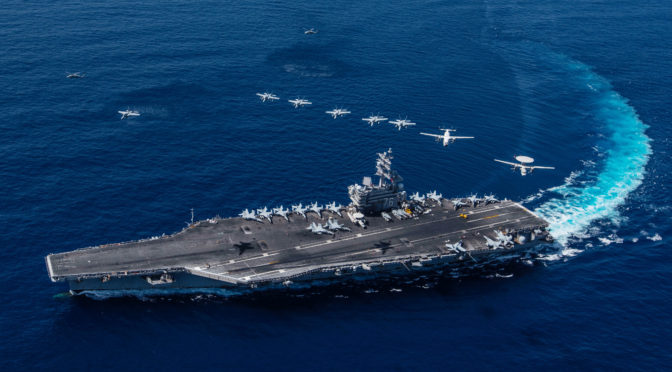
Featured Image: SOUTH CHINA SEA (October 9, 2019) Multiple aricraft from Carrier Air Wing Five fly in formation over the Navy’s forward-deployed aircraft carrier USS Ronald Reagan (CVN 76). (U.S. Navy photo by Mass Communication Specialist 2nd Class Kaila V. Peters)