All posts by Dmitry Filipoff

CFAR 2019 Winners Announced for July 16 Event at CNA

The votes are in and CIMSEC members have chosen the top authors they want to present at CFAR! Below are the winners for the respective CNA and CIMSEC categories. Not all winners will be able to attend, but many will present on their articles to provide more insight, context, and updates. 

RSVP to the Event Here!

Location: Center for Naval Analyses, 3003 Washington Blvd, Arlington, VA 22201
Time: 6-8pm

As always, thanks to the generous support of CNA and our contributors for helping us bring you this event, and congratulations to the winners!

CNA Category Winners

The Case for Maritime Security in an Era of Great Power Competition – Joshua Tallis

Nuclear Arms Control without a Treaty? Risks and Options After NEW START – Vince Manzo

CIMSEC Category Winners

Sea Control at the Tactical Level of War – Adam Humayun

Chinese Shipbuilding and Seapower: Full Steam Ahead, Destination Uncharted – Andrew Erickson

Then What? Wargaming the Interface Between Strategy and Operations – Barney Rubel

How the Fleet Forgot to Fight – Dmitry Filipoff

The Deep Ocean: Seabed Warfare and the Defense of Undersea Infrastructure – Bill Glenney

Call for Articles: Securing the Gulf

Submissions Due: July 29, 2019
Week Dates: August 5-9, 2019
Article Length: 1000-3500 words
Submit to: Nextwar@cimsec.org

By Dmitry Filipoff

A recent spate of attacks in the Persian Gulf is highlighting the fragile security environment within this strategic body of water. The Gulf, filled with commercial ships carrying much of the world’s oil supply, narrowly separates two adversarial factions composed of Arab states and Iran. As economic disturbances stem from the recent attacks, world leaders are debating how to respond, how to shore up deterrence, and how these attacks figure into Iranian strategy.

The U.S. Navy has long policed the Gulf for the sake of protecting international security, economic stability, and American interests. In 1988, American naval forces engaged in combat operations against Iranian forces to secure Gulf shipping in Operation Praying Mantis. In recent years, the U.S. Navy always maintained a carrier strike group on station in the Gulf, ready to respond. But in the face of chaotic maintenance problems, the emergence of great power competition, and overbearing demands coming from U.S. Central Command, this high-strung requirement for forward naval presence was removed. The naval balance of power in the region has shifted as a result, while making the U.S. far more dependent on local allies.

https://gfycat.com/flusteredlimpchipmunk

An American surface warship engages an Iranian oil platform during Operation Praying Mantis in 1988.

Among the solutions being debated include a multi-national coalition, ostensibly under the name Sentinel, that would help maintain situational awareness in the Gulf. How else could the international community secure the Gulf? How could the naval balance of power between Arab states and Iran affect the nature of conflict? Could the U.S. augment its presence in the region? Authors can answer these questions and more as things heat up in the Persian Gulf.

Dmitry Filipoff is CIMSEC’s Director of Online Content. Contact him at Nextwar@cimsec.org.

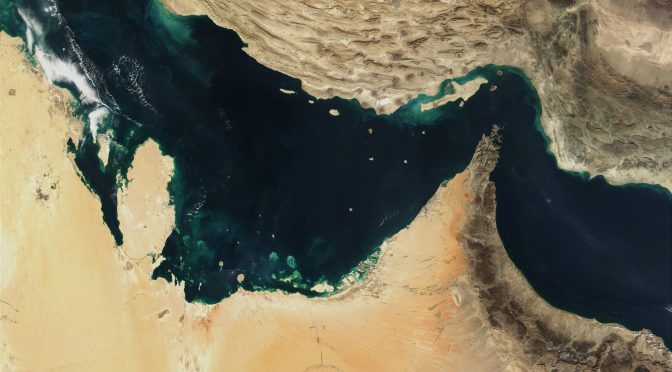
Featured Image: The Persian Gulf and the Gulf of Oman from space. (Jacques Descloitres, MODIS Land Rapid Response Team, NASA/GSFC)

Unmanned Systems Week Wraps up on CIMSEC

By Dmitry Filipoff

Last week CIMSEC published articles submitted in response to our call for articles released in partnership with the Navy’s Unmanned Maritime Systems program office. Authors discussed how to experiment with unmanned systems, how unmanned systems can contribute to amphibious assaults and fleet air defense, among other operational and developmental questions. We thank the authors for their excellent contributions. 

“Create an Unmanned Experimental Squadron and Learning System” by Dustin League and LCDR Daniel Justice

“…we propose that the Navy revisit history and revitalize the complex learning system it used to exploit an earlier set of new capabilities prior to World War II. Specifically, we call for the Navy to accelerating standing up a dedicated experimental squadron with the purpose of exploring advanced tactics for employing unmanned systems in a series of tactically challenging, objective-based exercises.”

“Unmanned Units Need Tenders for Distributed Operations” by Griffin Cannon

“Looking to the past, the precedent of the Pacific War, in which fleet tenders provided engineering support to a mobile fleet, suggests a path forward. Basing a support and sustainment model for Unmanned Surface Vehicles (USVs) on 21st century tenders would both fulfill the unique support needs of USVs and help build the ability to fight and deter a war in the Pacific.”

“Autonomous Pickets for Force Protection and Fleet Missile Defense” by 1st Lt. Walker D. Mills

“In all cases, the ability to form a protective perimeter of unmanned systems beyond the edge of the fleet would significantly boost survivability and increase options for the fleet commander by lowering risk. A flotilla of autonomous pickets, armed with effective CIWS and multi-spectrum missile countermeasures, can function as a powerful yet affordable force multiplier. Such a force would provide the Navy with an increased ability to operate and project power inside an anti-access, area-denial (A2/AD) network and help the fleet weather storms of missile salvos. “

“Accelerating the Renaissance of the U.S. Navy’s Amphibious Assault Forces” by George Galdorisi

“The ship-to-shore movement of an expeditionary assault force was—and remains—the most hazardous mission for any navy.  The value of real-time ISR and IPB is difficult to overstate. It is this ability to sense the battlespace in real time that will spell the difference between victory and defeat. For this reason, it seems clear that the types of unmanned systems the Department of the Navy should acquire are those systems that directly support naval expeditionary forces that conduct forcible entry operations. “

“Providing Secure Logistics for Amphibious Assault with Unmanned Surface Vehicles” by Neil Zerbe

“…the Navy would be better served by embracing the always successful “crawl, walk, run,” method and use commercial off-the-shelf technology to evolve an already proven logistics capability before committing to ambitious plans with unmanned surface ships that aren’t yet on the drawing boards. Far from distracting Navy officials from these more lofty ideas for using unmanned systems, demonstrating this capability in Navy-Marine Corps exercises would likely accelerate the Navy’s embrace of unmanned systems.”

“The Case for Unmanned Surface Vehicles in Future Maritime Operations” by Wayne Prender

“While it is encouraging to see Navy plans to move quickly to bring initial Medium and Large USVs into the fleet, other unmanned platforms are equally ready for such an approach. Innovation is the key to shaping tomorrow’s Navy, and getting USVs of all shapes and sizes to the fleet for Sailors to try out is the best approach to achieving it.”

Dmitry Filipoff is CIMSEC’s Director of Online Content. Contact him at Nextwar@cimsec.org.

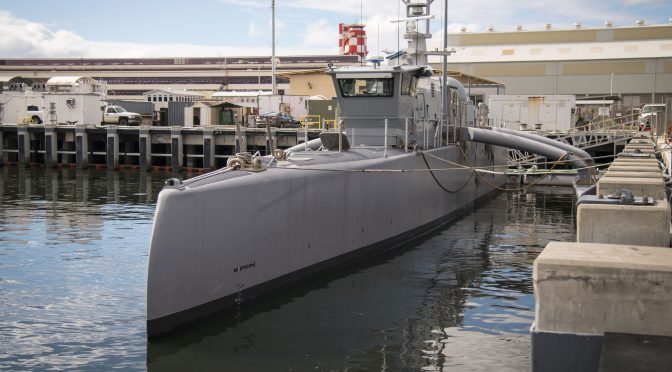
Featured Image: PEARL HARBOR (Nov. 2, 2018) The medium displacement unmanned surface vehicle (MDUSV) prototype Sea Hunter is moored onboard Joint Base Pearl Harbor-Hickam, Hawaii. Sea Hunter’s arrival in Hawaii demonstrates that MDUSVs are capable of deployed blue-water operations, enabling a new class of naval system. Highly autonomous USVs like Sea Hunter are creating a new paradigm for Navy surface forces, as they are capable of carrying a variety of payloads and performing many missions, including independent operations from manned Navy ships. (U.S. Navy photo by Mass Communication Specialist 1st Class Nathan Laird/Released)

Unmanned Systems Week Kicks Off on CIMSEC

By Dmitry Filipoff

This week CIMSEC will be publishing articles submitted in response to a call for articles issued in partnership with the U.S. Navy’s Unmanned Maritime Systems Program Office (PMS 406). As Captain Pete Small, Program Manager of PMS 406, urged in the call, “We are looking for bold suggestions and innovative approaches… Unmanned systems are clearly a growing part of the future Navy. We need to think now about the changes these systems will bring and ensure their introduction allows their capabilities to be exploited to the fullest.” 

Below is a list of articles featuring during the topic week that may be updated as prospective authors finalize additional publications.

“Create an Unmanned Experimental Squadron and Learning System” by Dustin League and LCDR Daniel Justice
“Unmanned Units Need Tenders for Distributed Operations” by Griffin Cannon
“Autonomous Pickets for Force Protection and Fleet Missile Defense” by 1st Lt. Walker D. Mills
“Accelerating the Renaissance of the U.S. Navy’s Amphibious Assault Forces” by George Galdorisi
“Providing Secure Logistics for Amphibious Assault with Unmanned Surface Vehicles” by Neil Zerbe
“The Case for Unmanned Surface Vehicles in Future Maritime Operations” by Wayne Prender

Dmitry Filipoff is CIMSEC’s Director of Online Content. Contact him at Nextwar@cimsec.org. 

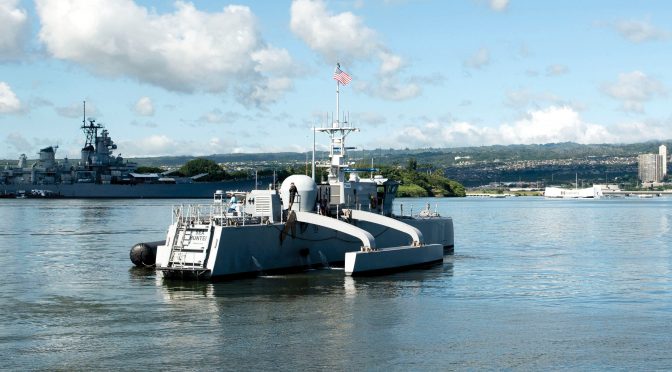
Featured Image: Medium Displacement Unmanned Surface Vehicle (MDUSV) prototype Sea Hunter pulls into Joint Base Pearl Harbor-Hickam, Hawaii on Oct. 31, 2018. US Navy Photo